




Abstract
Examining couples as joint decision makers offers valuable insights into gender disparities, yet the literature has largely overlooked the transition to a key alternative work arrangement: self-employment. Using couple-matched data from the 2015–2024 Current Population Survey, the author investigates how the collective decisions of couples are linked to the shift toward self-employment and how these patterns are moderated by parenthood and occupational characteristics. The author finds that wives are more likely to move from wage employment to self-employment if their husbands work long hours. Although this tendency is not moderated by parenthood, the association between husbands’ long hours on encouraging wives’ self-employment is stronger when wives are in occupations with strong overwork norms. This work underscores the option of self-employment for women when the demand for flexibility is heightened because of partners’ long work hours while the potential supply for flexibility is limited because of occupational norms.
It has been long understood that withinheterosexual couples, male and female partners’ decisions are not independent of each other. One of the early arguments is that families seek to maximize family income through specializations in paid or unpaid labor, which is tied to gender disparities in the labor market (Becker 1985). More recently, studies show that women with overworking partners are more likely to reduce their work hours or exit employment (Cha 2010; Musick and Jeong 2021; Stone 2007) and couples facing demanding work schedules prioritize one partner’s career, typically the man’s, over the other’s, usually the woman’s (Becker and Moen 1999; Gerson 2010). Thus, previous studies on work hours and employment status have demonstrated that within a couple, one partner needs the flexibility to manage household duties, particularly when the other partner has a demanding or inflexible schedule.
I begin this research with the assumption that wage workers, especially women, can consider self-employment as an option that can provide at least somewhat more flexible work arrangements to better manage their family-work conflicts. Although self-employment does not always provide such flexibility and autonomy, it has a broader bandwidth of allowing the workers to adjust hours and locations compared with wage employment. This characteristic is arguably getting more pronounced especially as the “gig economy,” which is often promoted as flexible and autonomous, increases in size. I thus examine how one partner’s long work hours, which can increase work-family conflict because of reduced time availability (e.g., Cha 2010), are associated with the other’s shift from wage employment to self-employment over a short period. I argue that when husbands work long hours, gendered expectations of flexible motherhood and women’s economic aspirations to engage economically coincide, making self-employment more attractive. These tendencies also likely depend on different needs for flexibility, such as parenthood, and the accessibility to it, which may be shaped by the occupational norm of overwork of their current occupation.
Because of its promise of flexibility and autonomy, scholars have examined whether women leverage self-employment as a way to remain in the labor market, especially when faced with increased caretaking responsibilities. This interest in self-employment as a “plan B” (Thébaud 2015) has been driven by gendered motivations, associating it closely with parenthood and the necessity to balance family and work obligations (Boden 1996; Budig 2006; Carr 1996; Lim 2019). This line of literature also suggests that in labor markets where the ideal of a highly dedicated worker prevails yet support for balancing family and work is insufficient, self-employment may emerge as an attractive option (Thébaud 2015). Adding to this discussion, I highlight partner’s long work hours as a potential motivator that amplifies one’s need to seek out self-employment, as it offers a viable path for women to remain engaged both in the labor market and family.
Building on the discussions of self-employment as a gendered strategy, this study deepens our understanding of gender inequality and family dynamics by showing that transitioning to self-employment (TSE) may present a practical approach to alleviating the burdens of balancing family and work (e.g., Rees 2023). Furthermore, the recent increase in nontraditional work arrangements, like platform working (Vallas and Schor 2020), reinforces the viability of self-employment as a strategic choice for women aiming to navigate the complexities of family and work. I use the Current Population Survey (CPS) pooled panels from 2015 to 2024. By leveraging the short-panel design of the data, I track couples over 12 months to observe changes in their work arrangements. I obtain individuals’ and their different-gender partners’ information from a previous interview (month-in-sample 4 [MIS4]) and assess its correlation with their work arrangement after one year (MIS8). I also consider the increasing importance of self-employment under different conditions of increased demand for flexibility (i.e., higher caretaking responsibilities due to parenthood) and decreased availability of flexibility (i.e., own occupational overwork). Through these analyses, I highlight the option of self-employment under heightened pressure to seek flexibility and how the appeal of this option depends on the normative environment of one’s occupation.
Theoretical Background
Gender Inequality and Couple-Level Dynamics
As dual-earner households gain prevalence among heterosexual couples (Raley, Mattingly, and Bianchi 2006), a thorough understanding of couple-level dynamics becomes vital in addressing gender inequality in the labor market. Traditional gender-neutral models, such as those proposed by Becker (1985), suggest that couples negotiate and specialize according to each partner’s strengths. However, England and Kilbourne (1990) critiqued this view, noting that negotiations take place within the context of the devaluation of women’s work, creating a power dynamic in different-gender couples that typically favors men’s career advancement over women’s. This argument has been further supported by various studies showing that although many couples start as dual-career households, they frequently evolve into arrangements in which the man’s career is prioritized, leading women to scale back their professional commitments (Becker and Moen 1999; Gerson 2010). Additionally, husbands’ long work hours are consistently associated with a higher probability of their wives exiting the workforce (Cha 2010), a pattern that has persisted over time (Musick and Jeong 2021). The significance of these dynamics is especially acute during life transitions such as parenthood, adversely affecting wives’ economic positions regardless of their own educational or economic resources (Musick, Bea, and Gonalons-Pons 2020; Musick, Gonalons-Pons, and Schwartz 2022).
This body of literature provides insight into couple-level dynamics against the backdrop of intensive motherhood and ideal worker norms. The former emphasizes the societal expectation for mothers to be fully devoted and constantly available for their children (Hays 1996), while the latter demands that ideal workers should work long hours and maintain inflexible schedules, especially for professional workers (Cha 2010; Cha and Weeden 2014; Correll et al. 2014). Many women find it challenging to balance these conflicting expectations (Blair-Loy 2003) and may even feel discouraged from remaining in their current jobs upon witnessing the struggles faced by those who preceded them in the workplace (Rees 2023). These societal contexts not only shape couples’ final decisions but also influence their perceived options during negotiation. Economic constraints may prevent some from altering their work arrangements, and even those who can afford to make changes might still seek jobs with more flexibility than their current positions offer. I focus on self-employment as a particularly appealing option in this context, offering an accessible path to flexibility, especially for women.
Self-Employment and Flexibility and Its Implication on Gender Disparities
Although much heterogeneity exists within self-employment, most self-employment arrangements promise flexibility and autonomy. On average, self-employment can decrease work-to-life conflicts (Reynolds and Renzulli 2005), and they have more control of the starting and ending time of their work days (Golden 2001). The majority of self-employed workers, regardless of their socioeconomic class and specific type, list independence and flexibility as their reasons for self-employment (Boden 1999). Workers highly value control of location and time of work, and independence and flexibility are considered key ways to resolve work-life conflicts (Mas and Pallais 2017). Thus, especially when workers do not have access to these workplace traits, the appeal of self-employment may increase.
The demand for flexibility, especially for locational flexibility (e.g., working from home), tends to be larger for women (Mas and Pallais 2017), and it can be helpful for women’s labor market attachment (Lyttelton, Zang, and Musick 2022; Scarborough et al. 2023). Within this context, the traits of self-employment add extra importance. Although women’s self-employment rates have always been lower than men’s in the United States (Hipple and Hammond 2016; Roche 2014), women’s rates have been growing more rapidly than men’s. Motivated by this trend, Carr (1996) theorized self-employment as women’s choice to seek a work arrangement with a more flexible schedule. This explanation is different from previous theorizations of men’s self-employment, which focused on either entrepreneurial pursuits (i.e., being “pulled”) or lack of economic opportunities in wage employment (i.e., being “pushed”). The evidence generally supports this view. This line of research finds that as women face limited opportunities in traditional employment, while the need for balancing family and work rises because of the increase of dual-earner couples, the appeal of self-employment gets stronger (Budig 2006; Heilman and Chen 2003; Loscocco and Bird 2012; Thébaud 2016). More women are also likely to answer that the main motivation for self-employment is for flexibility and family care compared with men (Boden 1999).
However, this line of literature has largely ignored couple-level decision making. This is an important omission because there are significant challenges that transitioning from wage employment to self-employment represents (Mattis 2004), meaning that within households, turning to self-employment is rarely an individual’s decision. The gender norms prevalent in wage employment are likely to be reflected within the decisions around self-employment (Loscocco and Robinson 1991), especially as being in a couple tends to strengthen the gender norms attached to self-employment even further (Yang and Aldrich 2014). Thus, adopting a couple-level perspective is crucial for understanding this shift and the constraints of the work-family system (Loscocco and Bird 2012).
One partner’s decision to transition to self-employment can be shaped by the other partner’s work arrangement in three main ways. First, the need for flexibility and autonomy is likely to increase if one household member is in a job that has higher inflexibility with lower autonomy, restricting the availability of time. Combined with the tendency to prioritize men’s careers within heterosexual couples, the pressure for the need for flexibility for women is likely to be linked to her partner’s long work hours, increasing the appeal of self-employment (Kanji and Vershinina 2024). Second, and relatedly, a partner’s long work hours in their main job may also indicate higher job security and employee benefits, as it tends to be associated with higher status occupations (e.g., Cha and Weeden 2014). Given this security, which is especially important in the U.S. context where health insurance status highly depends on one’s or partner’s employment arrangement, the other partner might be more inclined to turn to self-employment (Lombard 2001). Last, when one partner transitions to self-employment, the remaining partner is likely to follow. A partner’s self-employment status is one of the strongest predictors of TSE, particularly among those in nonprofessional occupations (Budig 2006). This is probably because when one partner transitions from wage employment to self-employment, the other partner may feel more motivated to follow, often to start and support a family business, a decision that women are especially likely to make (Bruce 1999). Some researchers also argue that couples may share a propensity to enter self-employment (Parker 2008), and when together, entrepreneurial skills are likely to spill over from one partner to the other, especially from wives to husbands, further increasing the likelihood of the second partner’s? TSE (Özcan 2011).
In this study, I focus on the first two mechanisms. Although a joint career in self-employment is an important source of transitions to self-employment, they are not likely to be associated with the motivations linked to flexibility. Two studies have taken the most closely related approach to examine the relationship between partner’s work arrangement and transitions to self-employment. The first one is by Thébaud (2016), who used restricted data from the 2014 Harris Poll to find that women with full-time working partners were more likely to be self-employed. In addition, Kanji and Vershinina (2024) also found, using couple-level fixed effects, that in the United Kingdom, partner’s overwork was positively associated with women’s transition to self-employment. My study extends these findings by examining how this relationship differs under varying conditions of higher demand (e.g., parenthood) and limited supply (e.g., occupational overwork) of flexibility.
Importance of Parenthood
Parenthood often requires rearrangement of parents’ time in the household, often increasing the demand for flexibility. In line with the argument that women’s main motivation behind self-employment is for flexibility, parenthood is associated with women’s, but not men’s probability of TSE (Budig 2006) and motivation behind self-employment (Boden 1999), especially when the child is young (Lim 2019). Although the study took place in the United Kingdom, Kanji and Vershinina (2024) also found that the positive association between husband’s long work hours and women’s self-employment was stronger among parents. Mothers may be attracted to self-employment, especially to the types that allow them to have more control of time and location as the work-family conflict increases, as a way to reconcile these tensions while “having it all” (Rees 2023). The appeal might be stronger when there is no institutional support for working mothers (Thébaud 2015). Some studies demonstrate that mothers might choose self-employment for flexibility instead of not working or even part-time working, although the evidence is limited to Germany and a specific group that was the beneficiary of earned income tax credit in the US (Georgellis and Wall 2005; Lim and Michelmore 2018).
Moderating Role of Occupational Overwork
One common thread in the discussion of the gender gap in self-employment is that self-employment is not likely to be women’s first career choice if they can have flexibility (but without precarity) in their wage work. Then it follows that one’s occupational characteristics in wage working would shape the appeal of self-employment. Empirical evidence supports this. For example, workers are more likely to consider entrepreneurship or self-employment as an alternative option when they find little room to grow within their occupation or organization (Rees 2023; Sørensen and Sharkey 2014). Being in an occupation with a higher proportion of men is associated with an even stronger association between parenthood and women’s self-employment, although this relationship is not significant among those in managerial and professional occupations (Budig 2006). Using data from Sweden, Yang, Kacperczyk, and Naldi (2024) also showed that women in occupations with higher motherhood wage penalties, or limited promotion opportunities and accommodations for working mothers may find self-employment more attractive and are more likely to venture into self-employment. These observations support that one’s occupational characteristics provide an important context when navigating the potential time crunch posed by partner’s long work hours.
In this study, I focus on “occupational overwork,” which has grasped scholarly attention to partially account for gendered labor market outcomes, such as sustained employment participation (Cortés and Pan 2019; Ishizuka and Musick 2021). Although occupational overwork can have many different definitions, I focus on the proportion of workers working long work hours (i.e., ≥50 hours per week).
This focus on the prevalence of overwork anchors on the possibility that the occupational norm of overworking can determine the bandwidth of how one flexibly arranges their workday, while partner’s work hours and parenthood status relate to the need for flexibility. Some occupations might be able to offer a wider range of flexibility in hours, which would decrease the appeal of self-employment. Especially occupations in relatively higher status such as managerial and professional, offer some freedom that allows mothers to scale back their work hours, which helps increase mothers’ labor force attachment (Damaske and Frech 2016; Landivar 2014) (even if concurrently, the norm of overworking is stronger in these occupations; Cha 2010). By contrast, if the occupation norms prevent workers from seeking flexible arrangements, one might find self-employment more attractive.
Occupational overwork is tied to women’s, especially mothers’, reduced attachment to the labor force, higher gender wage gap, gender occupational segregation, and a lower likelihood of taking parental leaves (Cha 2013; Cha and Grady 2024; Cortés and Pan 2019; Ishizuka and Musick 2021). The “ideal worker” norm that expects workers to work long hours in the United States creates widespread expectations of long work hours, and where this is especially true, such as in occupations with high expectations of long work hours, may be more likely to seek self-employment. The key to this expectation lies in the expectation toward self-employment, where people might perceive being self-employed would offer them more freedom to decide where, what time, and what to work on, leading to lower work-life conflict (Reynolds and Renzulli 2005). Although the evidence suggests that this is highly contingent on the type of self-employment and the degree of time and locational control that the workers have (Kincaid and Reynolds 2024; Reynolds and Renzulli 2005), the expectation is still widespread, and it is often a recruitment strategy for gig work (Warren 2021).
Heterogeneity within Self-Employment
Although it is not the main focus of this study, it should be noted that the heterogeneity within self-employment is extensive, arguably even more than within wage employment. Roche (2014) showed that the variance in earnings is much larger among the self-employed compared with wage workers. Especially with the rise of the platform economy (e.g., Vallas and Schor 2020), the proportion of people engaging in contract-based employment is also increasing (Collins et al. 2019; Jackson, Looney, and Ramnath 2017). Recent evidence demonstrates that when workers’ livelihoods depend on this arrangement or as they work longer hours, they are likely to suffer from heightened work-family conflicts compared with wage workers (James 2023; Kincaid and Reynolds 2024; Reynolds et al. 2024; Warren 2021). Thus, TSE, albeit with potential promises of higher flexibility and autonomy, might place workers in arrangements with greater work-family conflicts and increased economic instability, which can be difficult to recover from (Warren 2021). Meanwhile, it should also be noted that these conflicts tend to be higher when workers economically depend on these arrangements (Glavin, Schieman, and Bierman 2024). This concern tied to the heterogeneity within self-employment is reduced when self-employment serves only as a supplementary source of family income.
The Present Study
To summarize, the shift to self-employment for women is often linked to seeking flexibility that traditional wage employment fails to provide. The choice to become self-employed is often driven by motherhood and family responsibilities, especially for those with young children. Women’s self-employment tends to prioritize flexibility over financial gain, with self-employed women generally working fewer hours and weeks than their wage-employed counterparts. The appeal of flexibility from self-employment might be larger if the necessity of it increases (i.e., one’s partner is working long hours). This relationship between partner’s work hours and transitions to self-employment is likely to be moderated under contexts that require a higher degree of flexibility (e.g., parenthood) or restrict the availability afforded by occupational norms (e.g., occupational overwork).
Thus, this study first sheds light on how a partner’s long work hours shape the transition to self-employment for both women and men. I argue that women are more likely to transition to self-employment if their different-sex partners work extensive hours, potentially because of the increased demand for flexibility within the household. By contrast, I expect that men would not experience such association because even when the demand for flexibility increases, as when the couple has children, it is usually women who make adjustments to their schedules. To examine the effect of a partner’s long work hours on the other partner’s transition to self-employment, I focus on couples in which both the wife and husband were wage workers at the beginning of the observation and may or may not transition to self-employment within 12 months. I first examine the overall association between one partner’s work hours and the other partner’s transition to self-employment, before incorporating variables that may mediate this relationship, such as sociodemographic and occupational characteristics.
Hypothesis 1: Partner’s long work hours will be positively associated with women’s transition from wage to self-employment but not with men’s transition.
Next, I explore two potential heterogeneities in this association on the basis of conditions that would either increase the demand for flexibility or decrease the availability of flexibility in wage employment. First, I examine how couples’ parenthood status moderates the correlation. Considering the link between motherhood and self-employment, I hypothesize a stronger association between a husband’s long work hours and a wife’s transition to self-employment in families that have young children. This hypothesis aligns with the understanding that mothers have a stronger preference or need for flexibility than nonmothers. By contrast, I expect a null association for men, because, relative to women, men add fewer domestic responsibilities when they have a child.
Hypothesis 2.1: The positive association between partner’s long hours and women’s transition to self-employment will be stronger among mothers with young children.
Hypothesis 2.2: The null association between partner’s long hours and men’s transition to self-employment will remain similar across parenthood status.
The second source of moderation focuses on how available flexibility is in one’s job. To examine this, I focus on occupational overwork measured using the percentage of workers who work 50 hours or more in one’s? current occupation in wage employment (c.f., Ishizuka and Musick 2021). I expect that being in an occupation where overwork is common makes flexibility unlikely, and this will strengthen the association between partners’ overworking and transitions to self-employment.
Hypothesis 3: The positive association between partner’s long hours and one’s transition to self-employment will be stronger if the long work hours typically required in one’s own occupation are higher.
Finally, additional supplementary tests examine sensitivity to different definitions of occupational overwork and the partner’s overworking status.
Data and Method
Data
For the analyses, I use the CPS data spanning from 2015 to 2024, accessed through IPUMS (https://cps.ipums.org/cps/; Flood et al. 2024). The CPS interviews are commonly analyzed as cross-sectional data, but they also have a short-panel structure, as they follow the same households over 16 months. I use the harmonized data that link individuals and households longitudinally over these months to assess women’s and men’s employment status and work arrangements. I specifically use MIS4 and MIS8, when the respondents were asked detailed questions about their labor market activities. These interviews are also called the Outgoing Rotation Groups, denoting that they were collected either before the break or ending of the interview for this rotation.
Using one’s unique ID and demographic characteristics, individuals and their partners observed in the MIS4 are matched to their observations after 12 months (MIS8). 1 I restrict my sample to women and men aged 25 to 54 years who and whose partners were wage workers at MIS4, to examine the probability of moving into self-employment. The sample includes women and men who are either married or cohabiting with a different-sex partner. For simplicity, I refer to women as “wives” and men as “husbands.” This sample restriction is helpful to narrow the focus on TSE by MIS8, compared with when both parties are in wage employment at MIS4. I also exclude those who are in school and had any missing values for the control variables or occupational information (see Table A1 in the Appendix for details). After the sample restriction, the main analyses have 49,510 observations for wives’ and 51,152 for husbands’ outcomes.
Occupational characteristics are derived from two different data sources. The proportion of workers overworking in the occupation in which a respondent works for wages is from the 2011–2022 American Community Survey (ACS) data, accessed through IPUMS USA (Ruggles et al. 2024). Other characteristics of the respondent’s occupation are drawn from the Occupational Information Network (O*NET; https://www.onetonline.org) data, version 29.1. O*NET data is developed by the U.S. Department of Labor, Employment, and Training Administration and provides detailed descriptions on occupational characteristics. As both the IPUMS ACS and O*NET data provide Standard Occupational Classification System codes, I combined occupational information from these two sources using these codes. I then used the occupational code crosswalk to match this information with the CPS data.
Measure
Self-Employment
I use the information on “class of worker” at MIS8 to measure one’s self-employment status. An individual was coded as self-employed if they ran either an incorporated business or a non-incorporated business. Those who are in unpaid family business are excluded from the sample. The binary outcome variables are measured using this variable, and women and men were defined as TSE if they are wage or salary workers (i.e., paid employees) at MIS4 and are self-employed by MIS8.
Partner’s Work Hours
The main explanatory variable of interest is partner’s usual work hours. I categorized work hours observed at MIS4 into three groups: (1) 1 to 34 hours (part-time), (2) 35 to 49 hours (full-time), and (3) ≥50 hours (overwork). Workers with zero work hours are excluded, as both the individual and their partner must be wage workers at MIS4. Across all analyses, full-time working was used as the reference category.
Parenthood Status
To assess moderation by parenthood status, I include the age of the eldest child at MIS4, grouped into six categories: (1) childless (reference category), (2) 0 to 2 years old, (3) 3 to 5 years old, (4) 6 to 11 years old, (5) 12 to 17 years old, and (6) 18 years or older. I do this instead of grouping all parents together, on the basis of the possibility that the demand for flexible work arrangements would be higher when having a young child, which is tested separately.
Occupational Overwork
For occupational overwork, I use pooled data from the ACS, spanning from 2011 to 2022. Using the harmonized occupational scheme to match the U.S. Census Bureau’s 2010 coding, I calculated the proportion of workers aged 18 to 65 years who work at least 50 hours a week for each occupation (Ishizuka and Musick 2021). This occupation-level measure was then merged with own and partner’s occupations in wage employment captured in the first wave. These measures of own and partners’ occupational overwork are included in the models concurrently. The measures were standardized to have a mean of 0 and a standard deviation of 1 in the models.
Control Variables
There are three groups of control variables in the main analyses. The first group includes own work hours (excluding the not working category, as respondents must be employed at MIS4 to be in the analysis sample), calendar month and year, and whether the outcome variable was measured after the COVID-19 pandemic (March 2020 or after) or not are always included as the baseline. The indicator for COVID-19 is included to account for significant shifts in the labor market due to the pandemic, which hit the self-employed more substantially (Grashuis 2021; Mindes and Lewin 2021).
The second set of control variables include own and partner’s socioeconomic characteristics, including age and age squared (Devine 1994), level of education (Budig 2006), and race and ethnicity (Taniguchi 2002). Level of education was measured as whether one holds a bachelor’s degree or not. Race and ethnicity had four categories: (1) non-Hispanic White, (2) non-Hispanic Black, (3) Hispanic, and (4) non-Hispanic other. In addition, her share of the couple earnings (whether the wife earns more than 60 percent of joint earnings) and continuous family income (inflation adjusted to 2019 U.S. dollars) are included to control for the wife’s relative economic position within the couple and couples’ overall economic position.
The third set of control variables measures characteristics of the occupation the respondent and the partner have in wage employment at MIS4. To examine the importance of occupational groups, especially managerial and professional status (Budig 2006), this set includes own and partner’s occupational groups, categorized into five groups: (1) managerial or professional (reference category); (2) technical, sales, and administrative support; (3) service; (4) farming, forestry, and fishing; and (5) operators, fabricators, and laborers. Multiple occupational-level control variables are also included that are associated with either TSE or occupational overwork. The proportion of women is calculated using the ACS data, similarly to the occupational overwork measure (Budig 2006). I draw the level of autonomy, e-mail use, physical proximity, importance of interpersonal relationships, and proportion of workers working regular schedules from the O*NET data; these factors are likely to be meaningfully associated with occupational overwork (Cha and Grady 2024). In the models, all occupational measures include both own and partner’s characteristics and are standardized to the grand mean to have a mean of 0 and a standard deviation of 1.
Analytic Strategy
The main analyses use a series of logistic regression models that estimate the odds of TSE instead of remaining in wage employment, between MIS4 and MIS8 (12 months). The conclusion remains the same when I use linear regression models with robust standard errors (Table A2). I first estimate three different models to observe how the association of main interest (i.e., partner’s long work hours and probability of TSE) changes as control variables are added. The first model, which is the baseline, only controls for own work hours and time-related variables (calendar month and pandemic status). This model captures the total association between partner’s work hours and TSE, before accounting for confounding characteristics. The second model adds a set of own and the partner’s sociodemographic variables (level of education, race/ethnicity) as well as household-level variables (family income, parenthood status) and partner’s self-employment status. The final main model adds own and partner’s occupational characteristics, including occupational categories, the level of occupational overwork, and other relevant occupational characteristics. Again, all measures except for the dependent variable and partner’s transition status are observed at MIS4.
Results
Descriptive patterns
Figure 1 shows the overall proportion of women and men who transition from wage to self-employment by calendar year. Throughout the observation period, wives’ and husbands’ transitions to self-employment have converged. In 2016, about 2.1 percent of wives and 3.2 percent of husbands turned from wage to self-employment. For both groups, the rates declined by about 0.6 percentage points in 2019, but this decrease was only temporary. By 2020, when most observations were made after the pandemic, the transition rates go back up to the 2017 level for husbands and remain relatively stable until 2023. For wives, the rate increases to a similar level to the prepandemic level and has remained at a similar level until 2023. From 2023 to 2024, both wives’ and husbands’ transition rates increase by about 0.7 percentage points, bringing husbands’ transition rate to the 2016 level while decreasing the gender gap in transition rates. Because of this overall increase in TSE for wives, the gender gap in TSE has decreased from about 1 percentage point in the late 2010s to 0.3 percentage points by 2024. This trend thus demonstrates two patterns. First, there have been some fluctuations in TSE over the past decade, but there are about 2 percent to 3 percent of wage workers every year who turn to self-employment. Second, although husbands are still more likely to transition to self-employment, the gender gap has decreased.

Trend of transitioning to self-employment.
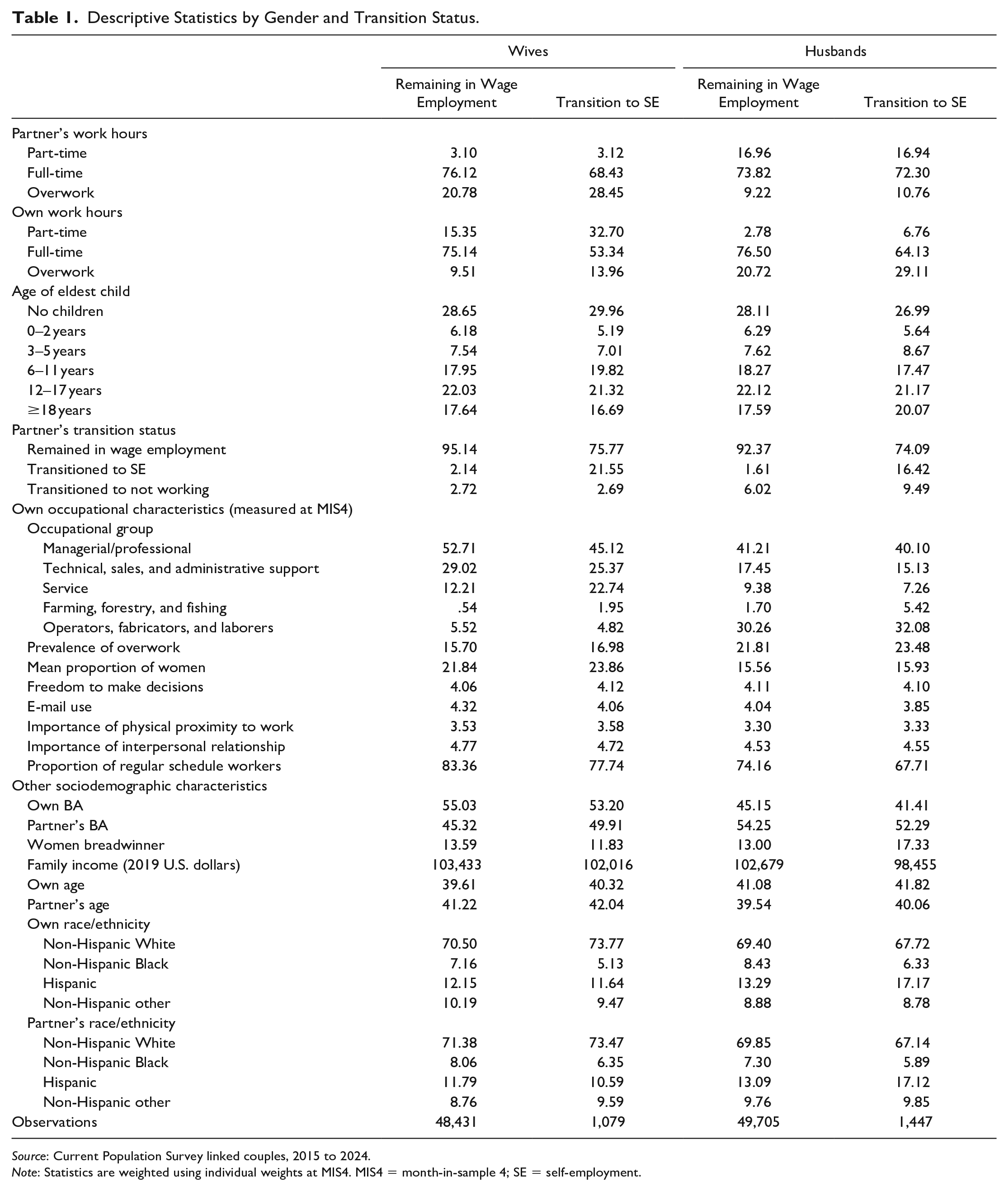
Next, Table 1 presents the descriptive statistics of the sample by gender and transition status. These statistics offer initial evidence of varying associations between a partner’s hours worked and a person’s shift to self-employment for wives and husbands. About 28 percent of TSE women have overworking partners, compared with 21 percent among wives who remain wage working. TSE husbands are somewhat more likely to have partners who work long hours compared with husbands who continue to work as employees; however, this difference is much smaller at 1.5 percentage points. There is also an association with own work hours: wives and husbands who switch to self-employment are more likely to work part-time or overwork, compared with those who stay as wage workers. Notably, more than one third of wives who transition worked part-time at MIS4.
Descriptive Statistics by Gender and Transition Status.
Source: Current Population Survey linked couples, 2015 to 2024.
Note: Statistics are weighted using individual weights at MIS4. MIS4 = month-in-sample 4; SE = self-employment.
Those who do and do not transition to self-employment differ in previous occupational characteristics as well. For example, compared with wage workers, TSE wives tend to have a lower proportion of workers in managerial or professional occupations before TSE, whereas for husbands, the proportions are similar. In addition, the proportion of overworkers at the occupational level (presented as raw values; not standardized) is slightly higher for those who transition to self-employment, for both wives and husbands. Previous to their self-employment, TSE workers are also more likely to be in occupations with a lower proportion of workers working in regular schedules. As scheduling unpredictability tends to increase work-family conflict (Henly and Lambert 2014), these patterns suggest that workers who transition to self-employment might have been facing a doubly constrained work context, experiencing greater inflexibility in the length of their work hours while also being unable to predict how these hours are distributed.
Interestingly, there are no clear differences in parenthood status across groups. More than 70 percent of the sample is parents at MIS4, regardless of gender or employment status. If anything, husbands who transition are slightly more likely to be parents compared with those who remain wage workers.
In summary, these results first suggest that wage and salary workers may either gradually transition away from their employment or attempt to secure more economic resources through part-time or overtime work. This pattern is consistent across genders. However, partner’s work hours appear to be related to TSE differently for husbands and wives; among wives, having an overworking spouse is much more positively associated with wives’ probability of TSE than husbands’. There are also substantial differences in occupational characteristics by transition status, suggesting that wives’ and husbands’ TSE may share occupational contexts that make seeking an alternative to their current wage employment more appealing. Small differences in parenthood status by the transition status suggest that the overall demand for flexibility might not be important in these short-term transitions to self-employment in the United States. Next, I conduct a series of logistic regression analyses to examine how the association between partner’s work hours and TSE changes as control variables are added.
Partner’s Long Work Hours and TSE
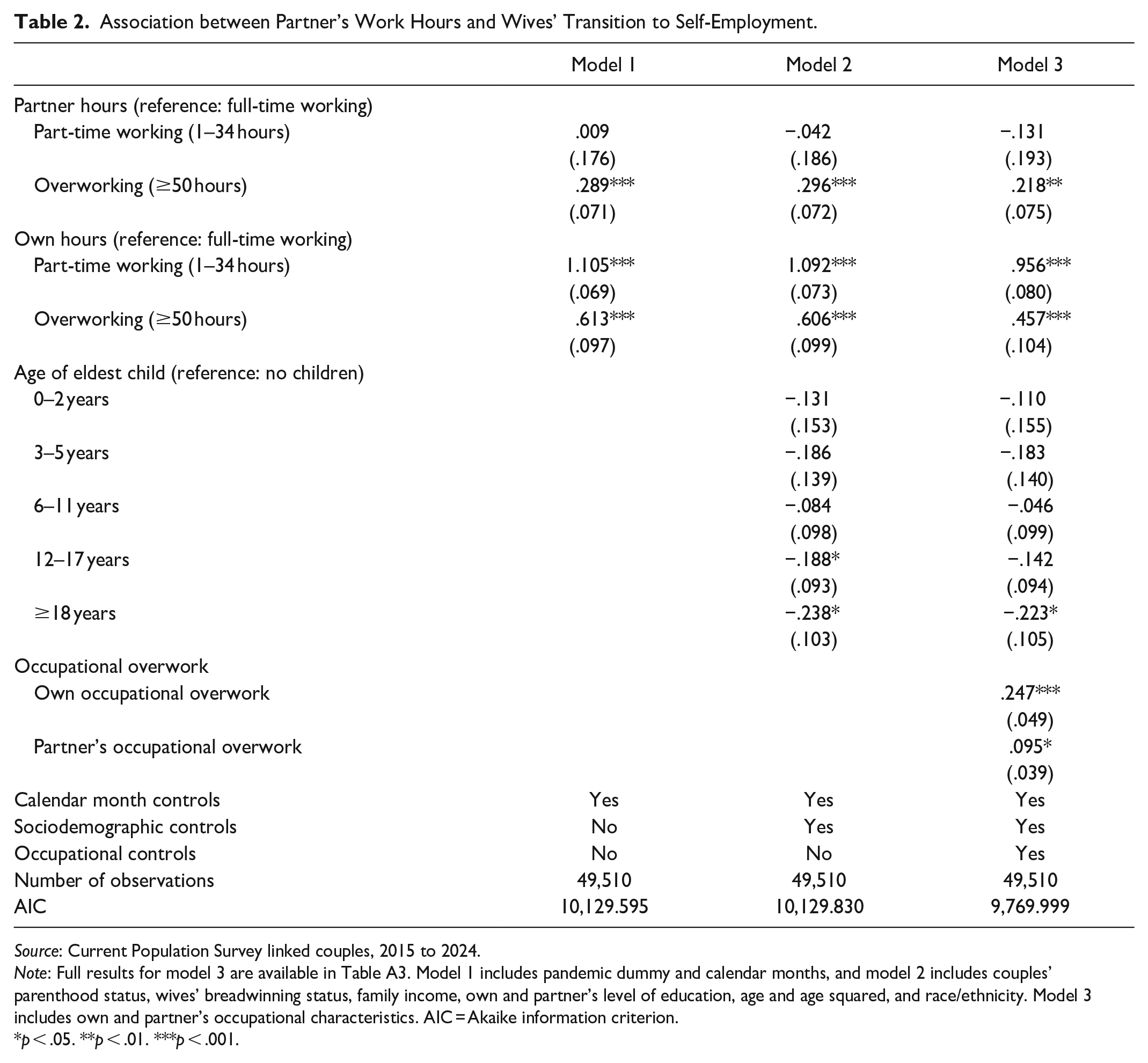
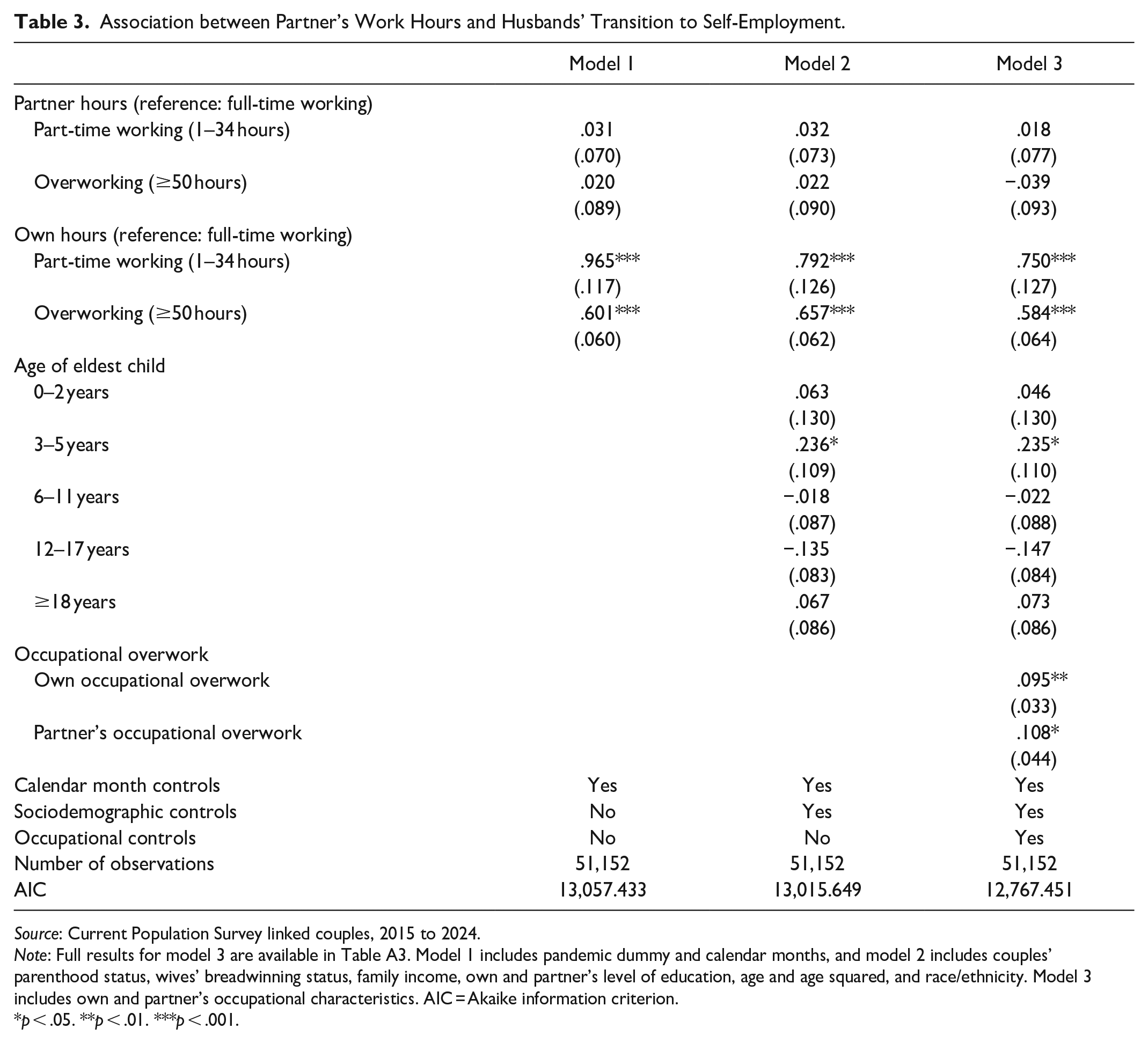
Tables 2 and 3 present selected coefficients from the regression models. In both tables, model 1 serves as the baseline model, only controlling for own hours, postpandemic status, and calendar month. Model 2 introduces sociodemographic variables, such as the age of the eldest child, wives’ share of income, family income (2019 U.S. dollars, continuous), own and partner’s? levels of education, age and age squared, and race/ethnicity. Model 3 then incorporates occupational characteristics, including partner’s and own occupational categories, occupational overwork, and other occupational-level characteristics. All occupational characteristics other than occupational group are standardized to have a mean of 0 and a standard deviation of 1 across all models.Full results of model 3 for women and men are available in Table A3.
Association between Partner’s Work Hours and Wives’ Transition to Self-Employment.
Source: Current Population Survey linked couples, 2015 to 2024.
Note: Full results for model 3 are available in Table A3. Model 1 includes pandemic dummy and calendar months, and model 2 includes couples’ parenthood status, wives’ breadwinning status, family income, own and partner’s level of education, age and age squared, and race/ethnicity. Model 3 includes own and partner’s occupational characteristics. AIC = Akaike information criterion.
p < .05. **p < .01. ***p < .001.
Association between Partner’s Work Hours and Husbands’ Transition to Self-Employment.
Source: Current Population Survey linked couples, 2015 to 2024.
Note: Full results for model 3 are available in Table A3. Model 1 includes pandemic dummy and calendar months, and model 2 includes couples’ parenthood status, wives’ breadwinning status, family income, own and partner’s level of education, age and age squared, and race/ethnicity. Model 3 includes own and partner’s occupational characteristics. AIC = Akaike information criterion.
p < .05. **p < .01. ***p < .001.
In Table 2, there is a significant association between husband’s overworking and wives’ transition to self-employment across all models. Before controlling for socioeconomic characteristics, having an overworking husband is associated with a 34 percent increase (exp[0.289] − 1) in TSE, compared with having a full-time working husband not working more than 50 hours. Accounting for socioeconomic characteristics does not change the magnitude much (model 2). Consistent with the descriptive patterns from Table 1, parenthood status is not significantly associated with wives’ TSE. This null association is consistently shown across different definitions of parenthood status (Table A4), which departs from previous findings using longer panel data. For example, Lim (2019) found that women’s self-employment rates peak when women have a youngest child of age at about four years old in the late 2000s, and Kanji and Vershinina (2024) showed that in the United Kingdom, women’s transitions from wage to self-employment are the highest when she transitions from having one child to two children. I explore the sources of this discrepancy in the later section on heterogeneity by parenthood status.
Model 3 adds own and partner’s occupational characteristics in their wage employment in the first wave (MIS4). Adding these characteristics accounts for a small portion of the association between husband’s overworking and wives’ TSE, but even after these controls, wives with an overworking husband are about 24 percent more likely to TSE (exp[0.218] − 1) compared with wives with a full-time working partner. Focusing on the occupational overwork measure for the wives’ own wage employment job, inflexibility in terms of long work hours (i.e., a higher proportion of workers working ≥50 hours a week) is positively associated with wives’ TSE.
Turning to what predicts husbands’ TSE, there are no significant associations with their wives’ work hours, which contrasts with findings for wives. After adding socioeconomic and occupational controls, this relationship remains the same. In fact, the direction of association is slightly negative, although it is not statistically significant. Unlike for wives, compared with childless husbands, husbands with the eldest child three to five years old are about 27 percent more likely to transition to self-employment (exp[0.236] − 1), which decreases only slightly after adding occupational characteristics. One aspect that mirrors wives’ pattern is the association with occupational inflexibility in long work hours. Like for wives, husbands are more likely to transition to self-employment when their previous wage employment is in an occupation with a higher proportion of overworkers. However, the size of the association between occupational overwork and TSE is much larger for wives (0.247; Table 2, model 3) compared with husbands (0.095; Table 3, model 3).
In summary, a series of logistic regression models largely reveal three main patterns. First, husbands’ work arrangement regarding hours worked is significantly associated with wives’ TSE. Partner’s overworking status can also reflect having more resources, hence making it more viable to turn to self-employment. However, for husbands, this positive relationship is not observed between their spouses’ overwork and their own transition to self-employment, suggesting that this positive association for wives indicates that husbands’ overwork leads to a heightened need for their wives to make adjustments to her work. Figure 2 visualizes the main association. It shows predicted marginal percentages in TSE, among those who are full-time working, holding other characteristics constant. In general, among wives, partner’s longer work hours are associated with her higher chances of TSE, while for husbands, the relationship is not evident. Compared with wives with a full-time working husband, wives with an overworking partner are about 24 percent more likely to transition to self-employment (1.43 percent vs. 1.78 percent), whereas for husbands, having an overworking wife decreases their chances, albeit mildly and not significantly (2.42 percent vs. 2.33 percent).

Predicted percentages of transitioning to self-employment by partner’s work hours.
Second, parenthood status indicated by the age of the eldest child does not have a clear association with TSE. Husbands with a child aged three to five years old are more likely to turn to self-employment compared with childless husbands, but there are no clear patterns for other age ranges or for wives. Again, I will explore the potential reason behind this in the following section.
Finally, occupational overwork in one’s wage employment job is positively linked to TSE for both wives and husbands, especially for wives. This might reflect that people in occupations with high levels of overworking norms might be more motivated to turn to self-employment, seeking more flexible work arrangements. At the same time, it potentially captures those with higher resources and pursue entrepreneurial goals, as occupations with a higher proportion of overworkers also have higher socioeconomic returns (e.g., Cha and Weeden 2014). However, the latter explanation cannot explain why the association between occupational overwork and TSE is stronger for wives.
In the following sections, I evaluate how the significance of partner’s overworking is moderated by the increased demand for flexibility (e.g., parenthood) and decreased supply of flexibility (e.g., occupational overwork).
Heterogeneity by Parenthood Status
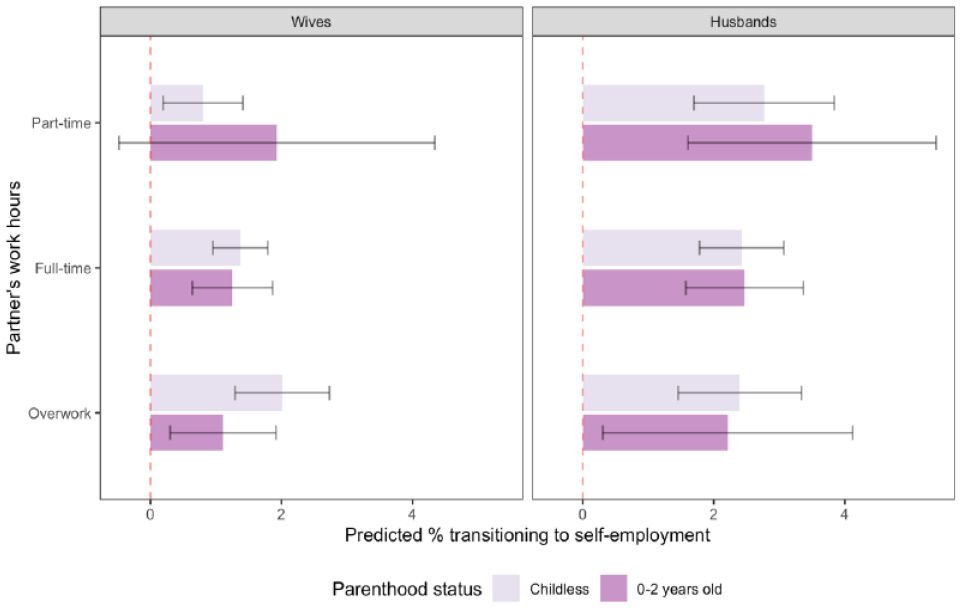
First, I examine how the higher demand for flexibility might moderate the association between partner’s overwork and TSE (hypotheses 2.1 and 2.2). Figure 3 shows the predicted likelihood of TSE by gender and parenthood status, focusing on the comparison between childless workers (lighter purple) and workers with very young children (darker purple). Results displaying the full range of eldest child’s age are available in Figure A1. Whiskers show 95 percent confidence intervals.
Predicted percentages of transitioning to self-employment by parenthood status and gender.
Overall, there is little evidence that parenthood status moderates the association between husband’s overworking and wives’ TSE. In fact, the positive association between partner’s overworking and wives’ TSE is only evident among childless wives. For wives who recently became parents, the association appears to be negative.
Earlier, I indicated that this general lack of association between wives’ parenthood status and TSEs departs from previous findings. Lim (2019) showed that wives’ self-employment rates are the highest when the age of the youngest child is two years old. My data also show that wives’ self-employment rates peak around when the age of the youngest child is about three to four years old (Figure A2), indicating that this difference does not stem from the data. There are two possibilities in this case: (1) the increase in self-employment rates among mothers with young children might be largely coming from nonemployment, rather than transitioning from wage employment (the transitions to which this study is limited), or (2) self-employed mothers have a stronger labor force attachment compared with wage-employed mothers, thus making their relative representation more prominent around early parenthood.
A replication of this model using transitions from nonworking to self-employment is shown in Table A5. Here, the association between the age of the eldest child and TSE is strongly negative, providing evidence against the first possibility that the TSE is largely coming from nonemployment (similar results when the age of the youngest child is used; available by request). It is hard to explore the second possibility directly through these data. However, this is likely because of the age range in my sample, which covers the prime childbearing and working years. Wives who foresee parenthood in the coming years but are childless at the moment, might be more actively TSE. Finally, it is also possible that the short-panel design could not fully capture the heterogeneity across individuals, such as the expectation of parenthood, which can underestimate the association between motherhood and self-employment (Semykina 2018). This is likely why the results diverge from Kanji and Vershinina (2024), who found a strong association between women’s transition to self-employment and having two children versus one. To have a more direct comparison with Kanji and Vershinina (2024), I leverage the short-panel design of my data that comprise of wives and husbands who (1) were childless at both time points, (2) were childless at MIS4 but had one child by MIS8, (3) had one child at MIS4 and two by MIS8, (4) had two children at MIS4 and three by MIS8, and (5) had three children at MIS4 and four by MIS8. Table A6 is somewhat in line with Kanji and Vershinina (2024). The results show that wives and husbands who transition from having three children to four are more likely to transition to self-employment compared with those who remain childless. Although both wives and husbands show positive associations, the size of the correlation is slightly larger for wives.
Heterogeneity by Occupational Overwork
Next, I explore how the limited availability of flexibility in people’s wage employment, as indicated by occupational overwork, moderates the relationship between partner’s work hours and TSE (hypothesis 3). Figure 4 displays the predicted marginal probabilities of TSE on the basis of partner’s work hours and one’s own occupational inflexibility in long work hours. Orange shades and lines denote predicted probabilities and 95 percent confidence intervals for women, while gray shades and lines represent men. Again, all occupational-level characteristics, including occupational overwork, are standardized with a mean of 0 and a standard deviation of 1.

Predicted percentages of transitioning to self-employment by own occupational inflexibility in long work hours and partner’s work hours.
Figure 4 illustrates that for both wives and husbands, their own occupational inflexibility in long work hours is associated with higher probabilities of TSE, particularly when the partner is overworking. This tendency is more strongly shown among wives. On average, if the partner is overworking, approximately 2 percent of wives and 2.4 percent of husbands are predicted to transition to self-employment. However, only a few wives in occupations offering greater flexibility to work fewer hours (i.e., lower proportion of overworkers) pursue self-employment (<1 percent), even when her partner is overworking. Because of this stronger association for wives, wives with an overworking partner and who are in occupations with strong overworker norms (i.e., occupational overwork two standard deviations higher than the mean) are slightly more likely to TSE than husbands with an overworking partner in occupations with similarly strong overworker norms (3.5% vs. 29%), although the differences are not statistically significant. Thus, if there is already a heightened demand for flexibility within the household due to the partner’s overworking, and individuals are unable to obtain flexibility by working fewer hours, they are more likely to seek out self-employment. Although both genders exhibit similar patterns, the difference between partner’s full-time employment and overwork is more pronounced among wives
The associations between occupational overwork and partner’s overwork do not appear when focusing on partner’s occupation (Figure A3), demonstrating the significance of the interaction between own occupational inflexibility and partner’s long work hours.
Is this association limited to occupational overwork or does it apply to other dimensions of occupational inflexibility? Occupational inflexibility can be defined on the basis of other characteristics, such as physical proximity or schedule regularity (e.g., Cha and Grady 2024; Cubas, Juhn, and Silos 2023). To explore whether the significance of occupational overwork is rooted in occupational inflexibility in general or specifically in overwork, I examined additional models. Table A7 presents the selected coefficients from these models, alongside the main model using occupational overwork (full results available upon request). The first model uses a composite measure of occupational inflexibility, which includes occupational overwork, e-mail use, interpersonal relationships, physical proximity, and the proportion of workers with regular schedules (α ≈ 0.5 for women, α ≈ 0.6 for men). The next four models examine each measure individually. The results indicate that occupational overwork specifically signals the occupational norm regarding the number of hours workers are expected to work.
How do the increased demand for flexibility and limited supply of flexibility moderate the relationship between partner’s work arrangement and transitions to self-employment? These results partially confirm the moderating roles of parenthood and occupational inflexibility. Parenthood does not strongly correlate with wives’ TSE in this sample and design, yet there’s evidence that wives might hesitate to transition from wage employment after becoming a parent if their partner is not working or is working part-time. Occupations with strong overwork norms that restrict flexible work hours are linked to TSE, particularly for wives when the partner is overworking. Other aspects of occupational inflexibility did not show such association, pointing to the specific association between the overworker norm and transitions to self-employment.
Supplementary Analysis
As a supplementary, I conducted three types of sensitivity checks. First, I assessed the sensitivity of work hours using more detailed categorization and continuous hours. Table A8 and Figure A4 each show the results. A detailed examination reveals that the association between partners’ long hours and wives’ TSE primarily stems from partners working more than 60 hours a week. Additionally, if husbands have a partner who moderately overworks (i.e., 50–59 hours), they are less likely to transition to self-employment compared with having a full-time working partner. Moving on to considering work hours continuously, there is also a clear positive association between partner’s work hours and wives’ TSE.
Also, following Ishizuka and Musick (2021), I test whether the critical decision about turning to self-employment concerns the occupational norm of full-time work, rather than overwork. Using an alternative definition of occupational inflexibility in long hours (i.e., ≥40 hours), Figure A5 provides evidence that, for TSE, the important occupational characteristic is related to overworking, rather than full-time working. Unlike what is observed in Figure 4, occupational inflexibility is not associated with either wives’ or husbands’ TSE across the board, regardless of partner’s hours. This pattern also suggests that the decision to turn to self-employment would involve different processes compared with exiting employment, where decisions around full-time working are more crucial (Ishizuka and Musick 2021).
Finally, the association with partner’s long hours may pertain to TSE in general, not solely out of wage employment. To test this, I assessed the same model using the outcome of transitioning from not working to self-employment. Table A5 illustrates the results, which shows that there are no significant associations between partner’s work hours and TSE. This result suggests that the relationship between husbands’ work hours and wives’ TSE is specific to the transitions out of wage employment, in line with the argument that women’s self-employment is likely to be tied to seeking out for more flexibility.
Conclusion
This study sheds light on couple-level dynamics in key decisions, such as leaving wage and salary employment, and it thereby improves our understanding of gender inequality in the labor market. I focus on a relatively underexplored option for couples: having at least one partner being self-employed. Self-employment sometimes offers—and is widely believed to offer—more flexibility and autonomy than wage work, and thus offers an alternative option for women, especially those who are under higher pressure to seek flexibility because their own occupation has a strong overwork norm and/or their husband works more than 50 hours a week. I examine how a short-term transition from wage and salary employment to self-employment is associated with a partner’s longer work hours, which can increase the other partner’s need to flexibly arrange their work hours.
To do this, I first build on previous literature that has shown that as the available time within couples decreases because one partner is working long hours, wives are more likely than husbands to adjust their employment arrangements, sometimes by dropping out of employment entirely (Cha 2010; Musick and Jeong 2021). The results demonstrate that a similar pattern is shown when it comes to self-employment. The descriptive patterns and a series of regression results indicate that although fewer wives than husbands make the transition from wage to self-employment, wives are more likely to make transitions to self-employment if their husbands work more than 50 hours per week, especially if they work more than 60 hours per week. By contrast, this pattern is not observed among husbands. That is, wives’ decisions to move from wage to self-employment are “tethered” to her partner’s work arrangement (Killewald and García-Manglano 2016) in the United States. These results show the importance of considering self-employment in research about couples’ implicit or explicit bargaining with each other over work-family issues (Cha 2010). The finding that wives, but not husbands, turn to self-employment in response to limited time imposed by their spouse’s long work hours is in line with previous findings that women often turn to self-employment for family-related reasons (Allen and Curington 2014; Boden 1999; Georgellis and Wall 2005).
Contrary to the initial expectation, being a parent does not predict either wives’ or husbands’ short-term transitions to self-employment. Moreover, I find parenthood not to moderate the relationship between a spouse’s long work hours and transitions to self-employment. What seems to be more important is the availability of flexibility from one’s occupation, as the association between a partner’s long work hours and TSE increased with higher inflexibility of long work hours. The critical juncture for own occupational long work hours is at 50 hours, rather than full-time working. Thus, the occupational norms of working long hours might be adding extra time pressure for wives when their partner is overworking. This result provides an important instance of the interaction between one’s occupational characteristics and their spouse’s work arrangement. Future research should delve into this further, focusing on different outcomes and occupational characteristics. Notably, wives and husbands show generally similar patterns in that when there are pressures to work longer hours from work, they are more likely to transition to self-employment. This result partially reflects that occupations with higher inflexibility are likely to be high-paying jobs such as managerial or professional occupations (Cha and Weeden 2014), which might facilitate types of self-employment that cost high resources to start (Budig 2006; Kim, Aldrich, and Keister 2006). However, the fact that the association for wives is much stronger than for husbands suggests that this association is not just about resources.
This study has two major limitations due to the structure of the data. First, because it has only short panels, I cannot examine the history of self-employment. The decision to move from wage to self-employment can be much easier or difficult depending on whether one has previously been self-employed. Many people have self-employment as part of their career, rather than just a one-time incident, and make several transitions back and forth (Burton, Sørensen, and Dobrev 2016; Dabic et al. 2023; Dillon and Stanton 2017). Future research should have a careful examination of long-term self-employment trajectories, in conjunction with partner’s work arrangements.
Second, and a bigger limitation that most population-level data share is that the definition of self-employment in CPS Outgoing Rotation Groups is highly limited. Because the CPS only collects self-employment information from those whose main job is self-employment, this definition misses a substantial portion of self-employed. For example, those who have a self-employment arrangement on the side, on top of their full-time wage employment, will not be captured (National Academies of Sciences, Engineering, and Medicine 2020). A comparison with the tax data demonstrates that the issue of this undercount has been growing, as more people are engaged with non-full-time self-employment (Abraham et al. 2021). There is no good evidence that this issue is disproportionately distributed by gender (Abraham and Houseman 2019). However, this omission is potentially crucial to capturing the exact options that couples navigate, as being self-employed full-time can be a very different decision compared with adding more work hours as a platform worker while being wage-employed as their main job.
This study built on past literature arguing that taking couple-level context into account is crucial in explaining labor market disparities by gender. I did so by showing that the option of self-employment is more likely to be used by wives when they are likely to face the heightened need for flexibility because their spouse works extremely long hours. This option might be increasingly more important as the rise of platforms has made it easier for workers to start businesses with limited resources or become freelancers (Vallas and Schor 2020). Some of these platforms explicitly endorse women’s work and separate themselves from “traditional” entrepreneurs or startups (Etsy 2017). Such self-employment might be helpful for women’s long-term careers if the counterfactual is to be out of employment (Daly 2015). It also can sometimes offer women to fulfill their career needs and be a good mother at the same time, thus being happier and more satisfied compared with their wage-employed counterparts (Rees 2023). Thus, these transitions might be reflecting women’s new strategies to find a better balance between family and work.
However, there may also be costs to these choices. First, the results demonstrated that women are disproportionately likely to make transitions from wage to self-employment when their partner is overworking. It appears that they are circumventing the unmet needs for flexibility within the gendered division of labor by exiting wage employment rather than finding solutions within wage employment. Although self-employment might lead women to have shorter work hours and to be able to work from home, past research suggests that it will likely lead them to have lower earnings (Roche 2014) and a more unequal division of labor in the household (Chung and Booker 2023; Hundley 2000). Thus, this transition may operate as a way to strengthen gendered roles, while reducing women’s economic power in the household. Indeed, compared with newly self-employed men, women who transition to self-employment are significantly more likely to operate unincorporated businesses, work part-time, and be overrepresented in lower-paying industries such as personal services (Table A9). The gender segregation by occupation and industry is substantial among the newly self-employed, suggesting a potential reinforcement of traditional gender roles in the labor market.
Relatedly, the benefit of turning to self-employment intersects with class. Recent evidence on online freelancing (e.g., crowd work) suggests that when women turn to self-employment with high flexibility at the cost of financial security, they might end up with even higher inflexibility and work-life conflicts (James 2023). Flexible self-employment helps balance work and life by offering autonomy and flexibility only if the family’s livelihood does not depend on it (Kincaid and Reynolds 2024). Thus, the rosy outlook of being a “momtrepreneur” is likely to be hard to achieve without secured income sources in the first place, making the partner’s work arrangement even more important.
Self-employment may become an appealing option when individuals experience time pressure due to a partner’s long work hours, the expectations of extended work hours in their own job, or both. For women, in particular, self-employment can serve as a termporary strategy to alleviate the tension between work and family, as they often bear the greater burden of adjusting their careers for caretaking responsibilities. The findings in this article show that some women are making transitions for these reasons. However, such decisions may also exacerbate economic disparities within couples, reinforcing imbalances in financial power and household labor. Future research should explore self-employment within the context of rising gig economy, examining how entry into self-employment varies by economic status and how it shapes dynamics within couples. Additionally, further study is needed to assess the broader implications of women’s self-employment on gender inequality in both household labor and the paid labor market.
Footnotes
Appendix
Characteristics of Women’s and Men’s Self-Employment after the Transition.

| Wives | Husbands | |
|---|---|---|
| % incorporated | 34.44 | 45.47 |
| Hours worked | ||
| Part-time (1–34 hours) | 37.97 | 11.04 |
| Full-time (35–49 hours) | 48.18 | 58.57 |
| Overwork (≥50 hours) | 13.85 | 30.39 |
| Occupations | ||
| Managerial/professional | 45.39 | 43.02 |
| Technical, sales, and administrative support | 23.72 | 16.46 |
| Service | 23.47 | 4.65 |
| Farming, forestry, and fishing | 2.60 | 8.16 |
| Operators, fabricators, and laborers | 4.81 | 27.71 |
| Industry | ||
| Agriculture, faming, fisheries | 3.04 | 8.81 |
| Mining and construction | 2.02 | 22.80 |
| Manufacturing | 3.30 | 4.72 |
| Transportation and communication | 3.63 | 8.74 |
| Trade | 14.65 | 12.72 |
| Finance, insurance, and real estate | 9.69 | 9.01 |
| Business and repair service | 14.60 | 12.54 |
| Personal service | 11.46 | 1.81 |
| Entertainment and recreation | 4.98 | 4.55 |
| Professional and related | 32.62 | 14.30 |
Source: Current Population Survey linked couples, 2015-2024
Note: Statistics weighted using individual weights at MIS4.
Acknowledgements
I thank Kelly Musick, Kim Weeden, Peter Rich, Paula England, Sabino Kornrich, two anonymous reviewers, and the editor for helpful comments to improve this article.
