




Abstract
Heightened partisan rhetoric surrounding immigration, combined with increasingly punitive immigration policies, has the potential to affect how children interact with their social environment, with implications for racially and spatially variegated developmental processes. In this data visualization, the authors use data from the 2009 to 2017 waves of the National Crime Victimization Survey’s School Crime Supplement to show that Hispanic students in Texas reported a significant increase in fear of harm in 2017, a change that was not observed among among non-Hispanic white students in Texas, or among either group in California. Despite increased fear, Hispanic students in Texas did not report corresponding increases in bullying, indicating that their rising fear was attributable to something beyond peer interaction. Together, these findings highlight emergent changes in Hispanic youth’s perceived hostility alongside changes in the surrounding political and legal landscape.
Heightened partisan rhetoric and increasingly hostile immigration policies (Flores 2017; Hinck et al. 2023; Samari, Nagle, and Coleman-Minahan 2021) have the potential for wide-ranging impacts on immigrant and ethnic minority youth, including consequences for their education, health, and psychological well-being (Amuedo-Dorantes and Lopez 2017a; Bellows 2021; Bucheli, Rubalcaba, and Vargas 2021; Kirksey 2023; Weber 2022). Because Hispanic populations are disproportionately stereotyped as undocumented immigrants (Flores and Schachter 2018; Simmons, Alvord, and Valdez 2018), Hispanic youth are especially likely to be affected. Xenophobic rhetoric and policies may thus translate into higher levels of bullying of Hispanic youth and/or higher levels of racial hostility toward them outside of peer-based interactions. Both have the power to elevate Hispanic youth’s fear of violence or harm in their day-to-day lives and to exacerbate existing racial/ethnic disparities in fear and anxiety (Kurpiel, Hullenaar, and Ruback 2023; Randa and Mitchell 2018; Varela et al. 2008).
In this data visualization, we compare reports of fear of harm in, on the way to, or outside of school among Hispanic and non-Hispanic white youth, ages 12 to 18 years, during a period of increasingly hostile immigration policy and rhetoric (2009–2017). We compare trends in fear with trends in bullying to assess the extent to which observed changes in the former are circumscribed to school-based interactions with peers. Given its large Hispanic population, location along the U.S.-Mexico border, and increasingly exclusionary immigrant policies, we focus on the state of Texas (Samari et al. 2021). For a point of comparison, we also examine trends in fear and bullying among Hispanic and non-Hispanic white youth in California, a state that has a similarly large Hispanic population, is also located along the U.S.-Mexico border, and has comparatively much more inclusive policies toward immigrants (de Castro and Zenteno 2023; Samari et al. 2021). For example, as of 2019, California explicitly allowed undocumented immigrant children to enroll in state health insurance; permitted all eligible immigrants, regardless of status, to enroll in the Supplemental Nutrition Assistance Program; and granted undocumented immigrants driver’s licenses (Samari et al. 2021). California also prohibited employers’ participation in E-Verify, a federal Web-based program through which employers verify employees’ lawful work eligibility (Samari et al. 2021). In contrast, Texas did not extend health insurance benefits to undocumented immigrants, did not confer Supplemental Nutrition Assistance Program access to immigrants more broadly, denied undocumented immigrants’ eligibility for driver’s licenses, and mandated employer participation in E-Verify (Samari et al. 2021). As a supplement, we also present results for two other states with large Hispanic populations and disparate policy regimes that are not along the southern border: New York and Florida (see Online Supplement).
Data are from the National Crime Victimization Survey (NCVS) School Crime Supplement (SCS), a nationally representative, household-based sample of youth ages 12 to 18 years. The NCVS SCS is administered every two years and asks about fear of crime and violence that occurred inside students’ school, on school grounds, on the school bus, or on the way to or from school. We use restricted data from the five most recent waves available: 2009 to 2017. 1 For each state, year, and racial/ethnic group, we estimate the percentage of students reporting bullying and fear of harm.
As depicted in Figure 1, fear of harm declined and was comparable between Hispanic and non-Hispanic white adolescents in Texas from 2009 to 2015. However, in 2017, trends across the two groups sharply diverged, as Hispanic adolescents’ fear suddenly increased by more than a third, from 20 percent to 27 percent of students, whereas non-Hispanic whites’ fear continued to decline. Notably, no comparable uptick in fear among Hispanics was observed in California during this time, and racial/ethnic trends in fear did not suddenly diverge in California (as they did in Texas) in 2017. Despite increased fear among Hispanic youth in Texas in 2017, there was no contemporaneous change in their reports of bullying, suggesting that their heightened fear was attributable to something other than peer interactions.
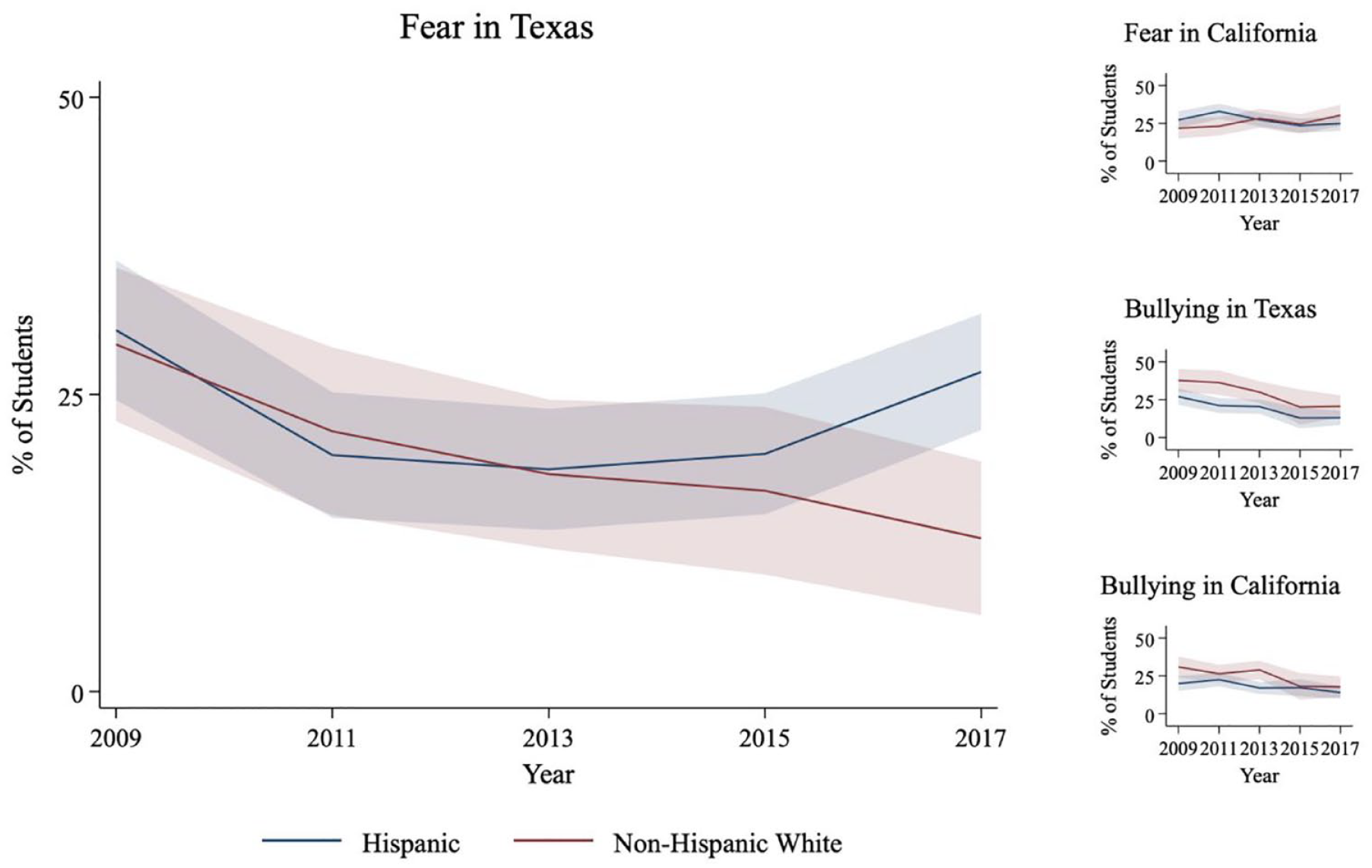
Percentage of students reporting fear and bullying among Hispanic and non-Hispanic white youth in Texas and California (2009–2017).
Several events had the potential to drive the observed increase in fear among Hispanic adolescents in Texas. Immigration, a dominant issue in the 2016 presidential election, may have had particular resonance in Texas, given debates about building a wall in the state between the United States and Mexico and given Texas senator Ted Cruz’s hard shift to the right on immigration issues during his presidential campaign (Raju 2016). Likewise, in 2017, Texas governor Greg Abbot signed SB 4 into law, effectively banning sanctuary cities and increasing immigration enforcement. That same year, 18 Texas counties entered into 287(g) agreements that enabled state and local law enforcement offices to collaborate with the federal government in federal immigration enforcement activities (Garcia 2018). Given that immigration status is highly racialized, and Hispanics are disproportionately stereotyped and profiled as undocumented, xenophobic rhetoric and policy shifts likely contributed to mounting perceived hostility, and corresponding fear, among Hispanics, including Hispanic youth. These changes could have lasting impacts on the health and educational trajectories of Hispanic youth. Heightened fear could explain why immigration enforcement leads to reduced attendance and worse school outcomes among Hispanic youth (Kirksey et al. 2020). Moreover, considering that abundant evidence indicates that chronic stress gets “under the skin” (Harris and McDade 2018), rising levels of fear could help explain adverse health outcomes associated with punitive immigration regimes among immigrant and Hispanic youth (Eskenazi et al. 2019; Vernice et al. 2020).
Supplemental Material
sj-pdf-1-srd-10.1177_23780231241307292 – Supplemental material for Fear among Hispanic and Non-Hispanic White Youth in Texas during a Period of Punitive Immigration Policies (2009–2017)
Supplemental material, sj-pdf-1-srd-10.1177_23780231241307292 for Fear among Hispanic and Non-Hispanic White Youth in Texas during a Period of Punitive Immigration Policies (2009–2017) by Nicholas D. E. Mark, Abigail Weitzman and Julia Behrman in Socius
Footnotes
Acknowledgements
We would like to thank Karin Johnson and Jamie Turcios-Villalta for their help moving this project forward.
Funding
The author(s) disclosed receipt of the following financial support for the research, authorship, and/or publication of this article: We gratefully acknowledge support from the William T. Grant Foundation (grant 202101713, PI: Weitzman) and a population center grant from the National Institute for Child Health and Human Development to the Population Research Center at the University of Texas at Austin (P2CHD042849). The content is solely the responsibility of the authors and does not necessarily reflect the official views of the funders.

Supplemental Material
Supplemental material for this article is available online.
Notes
Author Biographies
References
Supplementary Material
Please find the following supplemental material available below.
For Open Access articles published under a Creative Commons License, all supplemental material carries the same license as the article it is associated with.
For non-Open Access articles published, all supplemental material carries a non-exclusive license, and permission requests for re-use of supplemental material or any part of supplemental material shall be sent directly to the copyright owner as specified in the copyright notice associated with the article.
