




Abstract
With a focus on reentry after prison, we formulate an evidence-supported action plan for enhancing transitions from prison to society that focuses on increasing independence, reducing racial and ethnic disparities, and achieving public safety. Prisoner re-entry is a critical piece of any racial justice agenda as the lack of education or vocational training within carcer institutions impose barriers to job opportunities that, coupled with societal stigmas, often make reintegration extremely challenging. Noting that changes in policies with significant potential to improve reentry outcomes extend beyond federal agencies traditionally involved in the administration of justice, we include ways to reduce reentry barriers such as housing, education, employment, health, and political rights. The paper is divided into short, medium and long-term recommendations. The short-term recommendations pertain to existing funding streams and discretionary authority regarding administrative rules and regulations, funding decisions, and rule enforcement. Medium-term recommendations involve the creation of new legislation, infrastructure, and funding appropriations. In the long-term, recommendations include changes in laws to achieve fundamental re-orientations of existing policy frameworks, and approaches that require substantial new funding appropriations.
With a focus on reentry after prison, we formulate an evidence-supported action plan for enhancing transitions from prison to society that focuses on increasing independence, reducing racial and ethnic disparities, and achieving public safety. Prisoner reentry is a critical piece of any racial justice agenda as the lack of education or vocational training within carcer institutions impose barriers to job opportunities that, coupled with societal stigmas, often make reintegration extremely challenging. Noting that changes in policies with significant potential to improve reentry outcomes extend beyond federal agencies traditionally involved in the administration of justice, we include ways to reduce reentry barriers such as housing, education, employment, health, and political rights.
The paper is divided into short, medium and long-term recommendations. The short-term recommendations pertain to existing funding streams and discretionary authority regarding administrative rules and regulations, funding decisions, and rule enforcement. Medium-term recommendations involve the creation of new legislation, infrastructure, and funding appropriations. In the long-term, recommendations include changes in laws to achieve fundamental re-orientations of existing policy frameworks, and approaches that require substantial new funding appropriations.
The Current Challenge of Reintegration
Over 640,000 people return to our communities from prison each year. However, due to the lack of institutional support, statutorily imposed legal barriers, stigmas, and low wages, most prison sentences are for life—especially for residents of Black and Brown communities. More than half of the formerly incarcerated are unable to find stable employment within their first year of return, and three-fourths of them are rearrested within three years of release. Research has demonstrated that health, housing, skill development, mentorship, social networks, and the collaborative efforts of public and private organizations collectively improve the experience of transitioning out of incarceration and into society—a process commonly known as reentry.
Prisoner reentry should be understood as a critical piece of any racial justice agenda. Imprisonment rates are five to eight times higher for Black Americans than any other racial/ethnic group, and historically disenfranchised neighborhoods receive the bulk of returning citizens. For example, a recent study of reentry in Boston found that 40 percent of a reentry program’s participants returned to just two neighborhoods. Ultimately, reentry experiences are shaped by class and racialized neighborhood segregation.
Eliminating racial disparities in our criminal justice system and improving reentry outcomes requires a wholesale rethinking of our orientation toward criminal justice rather than piecemeal reforms or isolated new programs. We must move away from a policy framework that focuses on punishment as a tool for controlling risk in favor of a focus on human rights, harm reduction, and the social, political, and economic reintegration of those who have been incarcerated. A well-developed, evidence-supported action plan for enhancing transitions from prison to society will focus on increasing independence, reducing racial and ethnic disparities, and achieving public safety. This article presents a framework for reimagining prisoner reintegration. We then highlight the latest evidence and policy recommendations for improving reentry experiences in the U.S. focusing on four areas: addressing stigma, enhancing pre-release services, improving employment prospects, and reforming parole supervision.
Our policy recommendations build upon the recent collective efforts that led to the First Step Act and the expansion of Federal Pell Grant eligibility for incarcerated people. We acknowledge that broader investments to level the playing field and foster more equitable access to quality education and economic opportunities are important to prevent incarceration in the first place and make it easier for those who are incarcerated to transition to employment after release. However, these wider policies to increase racial and economic equity are not the main focus of this article.
Reimagining Prisoner Reintegration
Only 12 percent of prisoners are in federally controlled prisons. The remaining 88 percent are state prisoners. This means that the conditions of imprisonment and support available for reentry vary greatly for different people and places, with important implications for equity. This also means that states are best positioned to make changes to many aspects of reentry policy. Yet the federal government can do more to improve reentry outcomes: (1) Federal officials can shape the public conversation by acknowledging the historical legacy of mass incarceration in the United States, emphasizing the humanity of incarcerated people, human rights, and giving people with conviction records a fair chance to succeed. (2) Changes in federal reentry policies can serve as a model for states. (3) The federal government can provide funding for demonstration projects and more long-term funding streams to scale up proven reentry programs. (4) The federal government can change and enforce administrative rules and guidance for existing rules and laws and develop new legislation to address gaps in authority, inequities in access, and a lack of consistent institutional infrastructure for supporting reentry. We also note that changes in policies with significant potential to improve reentry outcomes extend far beyond federal agencies traditionally involved in the administration of justice. Reentry barriers include housing, education, employment, health, and political rights.
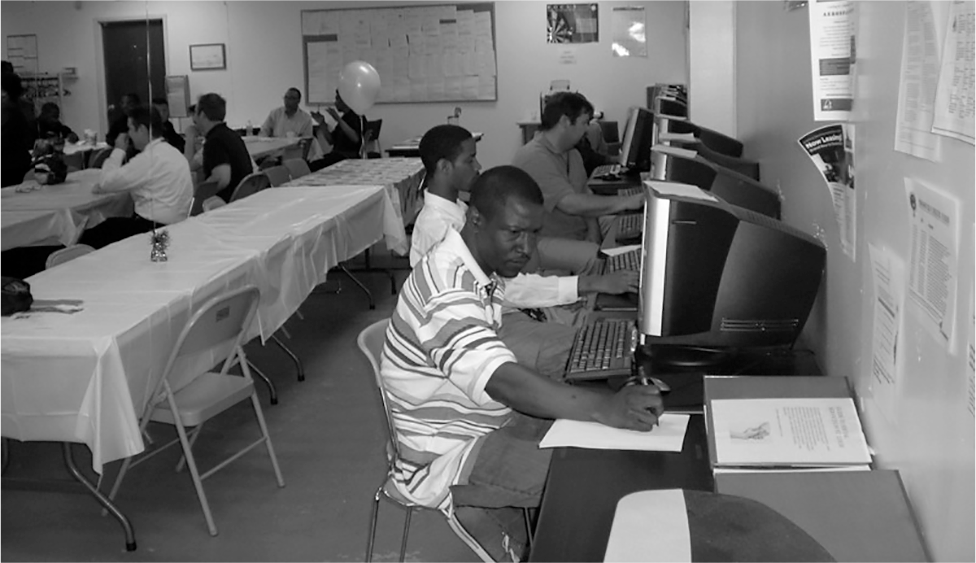
Clients at the Reentry One-Stop Career Center (REOS) applying for jobs.
Ben Oberg, Flickr cc
Therefore, a shift to a more holistic reentry approach implicates a wide range of federal programs and requires a policy focus on inter-agency cooperation, information sharing, and attention to making a wide range of services and programs easy to navigate the end user. It also means that federal leaders can play a major role in promoting a broader understanding of the challenges that a person reentering society typically encounters. Persistent stigmas of people with conviction records are one of the most formidable challenges—a topic examined in more depth in the next section.
Reducing the Impact of Criminal Record Stigma
The stigma of a criminal record is one of the most important and well-documented barriers to successful reentry and reintegration, impacting employment housing, education, and access to the safety net. Stigma is both formal—prohibitions encoded in laws or regulations—and informal—impacting how formerly incarcerated individuals are evaluated by employers, landlords, and others.
There is substantial evidence that relief from criminal record stigma leads to improved outcomes, especially with regard to employment. The stigma of a criminal record represents a form of punishment beyond the formal sentence received from a court, one that has long-term impacts. For example, many employers will routinely disqualify a job candidate if they have any record at all (also known as a “blanket” ban), without regard to whether the type of crime has any relevance to the job duties. Although it is clearly appropriate to screen out a job candidate who has a conviction record for a sexual offense for a job working directly with children or vulnerable populations, it not necessarily appropriate to screen that person out for a position driving a truck or working as a data analyst. Likewise, a past conviction for driving under the influence of alcohol may be appropriate for ruling out a job driving a truck, but not necessarily for an office job or a job as a chef. Blanket bans eliminate talent who may have otherwise been a good fit for the position without taking a closer look at how well their abilities and experience match the job or taking into consideration their efforts to get their life on a better path. Some background check products offer the employer the ability to specify upfront which types of records or (or time elapsed since the conviction) they are willing to accept for a given role and which types of records they want to exclude. These more nuanced background check processes offer a more equitable alternative to blanket bans for balancing the need to give people leaving incarceration a fair chance at employment with the need to maintain public safety.
Consideration of a criminal record must be job-specific and justified, with a presumption that the criminal record is irrelevant. Current Equal Employment Opportunity Commission (EEOC) guidelines recommend only considering the criminal record after a hiring decision has been made and only when the record itself is closely related to the job. Research suggests that many employers are unaware of these guidelines, necessitating greater education and enforcement. Ban-the-box laws in many cities and states have attempted to address this stigma by making it illegal to ask a job applicant if they have a criminal record on the initial application. However, even though they are the most common policy to counter criminal record stigma in employment, ban-the-box laws have been shown to increase racial discrimination.
To reduce the impact of criminal record stigma, we recommend the following:
End restrictions on living in publicly subsidized housing for those with criminal records
Expand the authority and budget of the Equal Employment Opportunity Commission to combat discrimination based on criminal record in employment and housing.
Reform negligent-hiring laws that make employers hesitant to hire those with criminal records.
Blanket bans on applicants with criminal records that do not take into account evidence of rehabilitation should be prohibited. Ensure that local and state governments are in compliance.
Appoint a blue-ribbon commission to study and recommend reducing occupational licensing prohibitions, which are widespread and poorly justified.
Prohibit postsecondary institutions that receive federal funds from discriminating based on criminal records in admissions and hiring.
Remove eligibility restrictions based on criminal record from federally funded safety-net programs, such as the Supplemental Nutrition Assistance Program, because access to these programs has been shown to reduce recidivism.
Enhance regulation of the criminal background check industry, as the consumer credit agencies are regulated, to improve the rights of individuals to correct information and to hold sellers of criminal record information responsible for its accuracy.
In addition to addressing pervasive stigmas, switching away from an ongoing punishment mentality to a rehabilitation mentality in the justice system has to start before release. The next section examines pre-release reentry services.
Preparation for Release
A lack of preparation for release currently hinders reentry and reintegration. Pre-release services are unevenly available across facilities and under-resourced. For example, demand for in-prison services in domains like substance abuse treatment and education far exceeds supply despite such programs’ demonstrated effectiveness at reducing recidivism. Furthermore, the effectiveness of such programs could be enhanced by adopting a “continuity of care” model common for medical treatment in which in-prison services are tied to parallel programs and supports in the community after release, facilitating effective handoffs. This model ensures continued access to support and receipt of long-term treatment, especially during the challenging period immediately after release and reorients prison staff toward rehabilitation and release preparation.
We see “continuity of care” as potentially productive in domains like substance abuse treatment, family services, employment readiness, and education. For example, identical substance abuse treatment models can improve post-release participation, college courses taught by the same institution in prison and in the community would ease enrollment, and in-prison work that builds skills in industries with high labor demand the community of release could improve employment. The location of prisons in rural areas, far from the prisoners’ families and communities, also creates barriers to continuity of care and the involvement of families, who play a central role in reintegration.
Ensuring continuity of care will require investment in bringing programs up to scale and in policy alignment and coordination across domains and levels of government. The federal government could spur innovation by providing technical expertise and funding for coordination and ensuring that rules and regulations are all aligned with the goal of cooperation between prisons and community providers, rather than limiting these connections due to a contradictory aim to reduce risk or enforce punishment.
The next section examines another common barrier to successful reentry: preparing people who are incarcerated to navigate the job market, specifically, including providing information about careers, education, job search and networking strategies.
The authors argue in this article that consideration of a criminal record must be job-specific and justified, with a presumption that the criminal record is irrelevant.
Ben Oberg, Flickr cc

Improving Employment Prospects
Stigma is not the only barrier to post-release employment, as the formerly incarcerated typically have low levels of education and work experience. Enhancing job search skills, job readiness, professional networks, and access to educational opportunities for the formerly incarcerated are essential to reentry success. One option is to increase work experience, enhance professional networks, and reduce hiring risk by expanding subsidized employment programs and programs that match employers with soon-to-be-released prisoners. Another option is to expand federal funding and incentivize the location of American Job Centers (AJCs) inside jails and prison facilities, building on the lessons from a recent U.S. Department of Labor demonstration project in 20 areas suggesting AJCs lead to gradual shifts in the culture within facilities from punishment to rehabilitation. Recent relief legislation lifted restrictions on Pell Grant access for people who are incarcerated and who have certain crimes on their records, which can spur the creation of coordinated pre- to post-release education and work-based learning programs. In addition, formerly incarcerated people typically suffer from socially and economically induced traumas that can interfere with effective decision making. Cognitive behavioral therapy (CBT), which focuses on changing negative thought patterns and coping with stress or trauma, has been shown to improve reentry outcomes.
Finally, existing evidence on program development and implementation in correctional facilities suggests multiple avenues for jumpstarting the development and quality of new programs. First, establish consistently available and evidence-based reentry programs. For example, evidence suggests that CBT is effective for justice-involved adults for rehabilitation, self-confidence, and personal transformation but access to CBT is uneven. Second, provide additional flexibility with regard to outdated security rules and technology policies so that people who are incarcerated can get used to accessing information through technology and build their digital skills for success in a labor market that increasingly requires digital fluency. Lack of Internet access and overly rigid security protocols in some jails also hindered the ability of several jails to implement satellite AJCs, which would have offered access to basic training in using computers, online job search, career counselors, career assessments, and other resources for job readiness. Third, invest in broadband infrastructure, virtual reality (VR), and other technologies in prisons to improve access to online resources like job boards and (in the case of VR) deliver classes, real-world simulations such as mock job interviews, and information about career options and other resources without needing a live internet connection. Finally, invest in digital transformation and modernization of state-level data systems and revisit outdated restrictions on data sharing across programs and agencies (while protecting privacy). Antiquated and siloed data systems are a major barrier to service coordination and holistically meeting the needs of people with multiple challenges. For example, if someone applies for food assistance, a modern and integrated data system might also allow that person to see health insurance or housing programs they are eligible for, or it may enable them to apply for multiple programs at once, without having to travel to multiple offices to fill out multiple intake forms with the same information.
The third barrier to successful reentry is the parole supervision process. The next section summarizes evidence and provides recommendations for reforming this process with an eye towards shifting away from a focus on ongoing punishment and towards rehabilitation.
Reforming Parole Supervision
With the rise and entrenchment of mass incarceration came a change in the nature and goals of post-prison parole supervision, from a social work orientation to a law enforcement orientation that focuses on risk assessment and risk management. The parole system has now become a major obstacle to successful reentry through its emphasis on surveillance and punishment. Technical violations of parole and probation account for large shares of prison admissions in many states, and recent evidence suggests that the parole system is an important driver of prison’s revolving door. For example, [insert some examples of technical violations?] Lack of due process in parole revocation decisions also raises serious questions about whether these policies and processes are aligned with the goal of rehabilitation and successful reentry (rather than ongoing punishment).
Reforms are critically needed to reorient parole to support social and economic reintegration. Rather than monitoring for desistance (whether the person has ceased engaging in criminal behavior), new policies should focus on creating opportunities to develop and reinforce pro-social identities such as cultivating healthy relationships with others, increasing self-confidence, and building skills to manage conflict and stress. These reforms include increased access to services related to housing, employment, health, mental health and addiction, and social reintegration. They also provide greater options for less disruptive penalties for technical parole violations and new national standards for the training of parole and probation officers in skills such as service coordination, motivational interviewing, alternatives to punishment, and counseling. Parolees would also benefit from opportunities to earn lower levels of supervision or early termination via completion of treatment programs or earning vocational or academic credentials.
Pre-release services are unevenly available across facilities and under-resourced. For example, demand for in-prison services in domains like substance abuse treatment and education far exceeds supply despite such programs’ demonstrated effectiveness at reducing recidivism.
ep_jhu, Flickr cc

Questions for the Future
Although there is a growing academic and evaluation literature on reentry experiences and programs, much remains to be understood if we are to improve the reintegration of formerly incarcerated people. Below are five priority areas for future research and policy that would help shape a shift from ongoing punishment to rehabilitation and address inequities in the reentry process.
First, existing research suggests that some populations experience more barriers than others in reintegrating into society.
How does reintegration differ across social groups such racial/ethnic minorities, women (especially Black, Latino or Hispanic, and Native American women), people with disabilities (including cognitive and mental health disabilities), LGBTQ individuals, young adults, people released in rural areas, gig workers, and those whose intersectional identities create multiple barriers to successful reentry?
Second, the COVID-19 pandemic profoundly impacted incarcerated individuals, prison and jail staff, and communities to which many incarcerated people return. It also prompted new experiments in decarceration—reducing the overall population that is incarcerated.
How did the pandemic change policies such as fewer arrests and more releases
What were the impacts of those changes on community safety and wellbeing of the individuals who were released?
Third, stigma plays a central role in limiting social and economic reintegration.
How can we reduce stigma among employers, landlords, and the media?
Fourth, parole officers and other justice system actors also profoundly impact reentry outcomes and continued involvement with the criminal justice system.
How do their training, mindset, and incentive structures support or undermine successful reentry?
Fifth, unstable and low-wage employment is also a product of the types of industries and occupations in which formerly incarcerated individuals can find jobs.
How do occupational segregation, discrimination, and licensing requirements contribute to more limited employment options for certain groups of people with conviction records (e.g., women and Black or Latino or Hispanic)?
Although there is bipartisan support and evidence to maximize reentry success, our legacy legal and policy frameworks often undermine these new goals as an artifact of the previous emphasis on punishment. Rather than focusing on desistance from crime, our legal and policy frameworks should emphasize opportunities to create and affirm pro-social identities. We recommend reforming federal, state, and local laws and policies to address the well-documented barriers that tend to undermine efforts at establishing pro-social identities and reintegration. This includes housing, voting, financial aid, employment, and food assistance restrictions that render people with conviction records ineligible.
Finally, new technology may offer additional opportunities for improving preparation for release and post-release outcomes. For example, Code for America partnered with local governments to expunge records for offenses that are no longer illegal. Research is needed to assess how these tools can help improve the implementation of second chance relief. In addition, virtual reality and other technologies are being deployed in multiple states to prepare people for release through immersive exposure to scenarios they are likely to encounter and for training and education. Yet new technologies also have the potential to create new problems. For instance, as new background search techniques are deployed with machine learning technologies, we need to better understand their ethical and discriminatory impacts, and to develop regulatory standards for their use to protect people from being excluded from access to credit, jobs, housing, and other opportunities without a transparent justification.
Conclusion
Unlike any point in American history, there exists a strong desire to successfully reintegrate the formerly incarcerated into society. With 8.4 million Americans unemployed and 10 million available jobs, there is room to hire returning citizens and serve as a global model for restoration. However, if we are unable to change our retributive thinking and accept the philosophy that everyone deserves a fair chance, rethinking prisoner reentry will not be an easy lift.
Divine Lipscomb shared his story to begin day two of the Prison Education & Reentry Summit at Penn State on March 30, 2019.
Penn State, Flickr cc

This article provides an empirically supported roadmap for how rethinking prisoner reentry should be approached and identifies the ideal components of a reentry ecosystem, most notably in minimizing the mark of a criminal record, preparation for release, improving employment prospects, and reforming parole supervision. In support of these components, the intersection among them must not remain limited. However, a more detailed action plan outlining precisely how we sway policymakers and key stakeholders to adopt a twenty-first-century reentry plan as it should be, including an understanding of our suggested plan’s implications for society, is needed. Doing so would guide us towards a set of robust action items required for designing an effective plan. In likely instances of minimal support from the local governments, the federal government would need to provide the requisite support so that the necessary thinking around reentry could become mainstream and integrated into our social, political, and economic systems.
As we suggest in this paper, successfully rethinking reentry for a more inclusive society is contingent upon successful reintegration experiences, repositioning the thinking around reentry in the United States, and building on “what works” to inform the national agenda. We know that the national agenda will demand alliances unlike most we are accustomed to implementing, free from political, philosophical, and theoretical predispositions. Realigning the country’s thinking around successful reentry while also making it possible for our systems to be both proactive and dynamic, is necessary for maximizing impact. In the end, our recommendations allow for the further development of a reentry plan that thinks globally yet acts locally.