




Abstract
Several theoretical traditions posit that individual skills (or human capital) have become stronger predictors of life outcomes over time. To date, however, significant limitations have hindered a confident empirical assessment of this important idea. Using six nationally representative datasets, the authors find surprisingly little support for the notion that measurable skills are becoming more important over time. Instead, the results reveal a durable relationship between measurable skills and socioeconomic outcomes despite periods of significant societal change.
Keywords
A promise of postindustrialized societies is that education-related skills will increasingly matter for socioeconomic success (Autor, Goldin, and Katz 2020; Goldin and Katz 2010) and that antiquated, discriminatory, and economically inefficient sorting mechanisms based on race, gender or social class will matter less over time (Massey 2007; Treiman 1970). Although this modernist view has been challenged by scholars of social stratification (Breen and Goldthorpe 2001; Grusky and Hill 2018; Hout and DiPrete 2006), there has not been a strong empirical test to either confirm or refute continued assertions that contemporary stratification is becoming more closely linked to skills. Given the significance of this issue, there is surprisingly little consensus regarding one simple yet critical question: Have skills become an increasingly important determinant of life outcomes?
We assess the “growing relevance of skills” (GRS) thesis in two ways. First, we examine whether individual skills are more strongly associated with socioeconomic outcomes over time; second, we examine whether the GRS thesis can explain greater shares of group-level inequalities over time (i.e., racial, gender, and class disparities). To date, we have found no comprehensive tests of these ideas in the literature.
To preview our results, using historical data from the General Social Survey (GSS), we find roughly constant associations between verbal skill and educational and occupational success in cohorts born from the 1920s to the 1980s. Similarly, among datasets that span the 1980s to the 2000s, we find little evidence that the associations among individual skills (math and reading, social and behavioral) and outcomes (education level, occupational prestige, yearly income) strengthened over time. Also, individual skills do not appear to explain more of the gaps in life outcomes by social class, race, or gender. On the basis of our evidence, we conclude that the role of skills (as measured by standardized math, reading, and social and behavioral skill assessments) has not changed in nearly a century, nor do they play a larger role in understanding race, class and gender gaps in socioeconomic outcomes, despite modernist claims that skills have grown in importance. Given how other important features of the stratification system vary over time (e.g., inequality, mobility), the possibility of a constant association between skills and outcomes is notable.
Literature Review
The Modernist View: The GRS Thesis
In public discourse (Brooks 2001) and among proponents of human capital theory (e.g., Becker 1962, 2009), there is a well-worn assumption that the efficiency with which skills are transformed into adult outcomes in the United States has been increasing over time (see also Bowles and Gintis 1976, 2002; Farkas 2003). Such claims were especially pronounced more than a half century ago. Treiman (1970) argued that as societies modernize, the direct influence of parent’s status on child’s status in adulthood declines as status in adulthood is increasingly earned (through educational training) rather than handed down. The reason for the change, Treiman posited, was that American society was becoming more universalistic: the rules of how one gets ahead were becoming increasingly applicable to more Americans. And the way these rules have evolved was increasingly clear: to get ahead, you had to do well in school.
Along these same lines, Bell (1972) described postindustrial society this way: Technical skill becomes a condition of operative power, and higher education the means of obtaining technical skill. As a result, there is a shift in the distribution of power as, in key institutions, technical competence becomes [italics added] the overriding consideration. . . . The post-industrial society, in this dimensions of its status and power, is the logical extension of the meritocracy; it is the codification of a new social order based, in principle, on the priority of educated talent. (p. 41)
Some evidence supports the modernist view. Specifically, the correlation between father’s occupation and son’s occupation decreased considerably (from .405 to .115) when son’s educational attainment was accounted for, consistent with the view that educational attainment largely mediates the intergenerational transmission of status. Noting this pattern, Blau and Duncan (1967) wrote, superior status cannot any more be directly inherited but must be legitimated by actual achievements that are socially acknowledged. Education assumes increasing significance for social status in general and for the transmission of social standing from fathers to sons in particular . . . [this] heightened universalism has profound implications for the stratification system. (p. 430)
1
Subsequent research confirmed that these patterns generalized to women (Hout 1988) and applied to both Black and White men (Featherman and Hauser 1976). Thus, the modernist view has shaped the stratification field for decades (Grusky and Hill 2018), highlighting the role of individual characteristics and skills under the mantle of “status attainment” in sociology (Blau and Duncan 1967; Sewell, Haller, and Portes 1969) and “human capital theory” in economics (Becker 1994; Schultz 1961). Of course, an equally prolific literature developed demonstrating that considerable inequality endured across social groups even when they attained the same level of education (Beck, Horan, and Tolbert 1978; Bibb and Form 1977). Overall, however, the status attainment emphasis on education as the pathway to success has become a central element of stratification research (Hout and DiPrete 2006).
Our study targets a key feature of this argument, that the link between individual skills and stratification outcomes has tightened over time. Most previous scholars have considered this question by assessing variation in the college earnings premium (i.e., economic advantage of earning a college degree). Although the general pattern—that the college earnings premium has risen since the 1980s—is consistent with the GRS thesis (James 2011; van der Velden and Bijlsma 2016), 2 a strong (and potentially growing) correlation between college going and earnings does not necessarily mean that skills are growing in importance. The credential (or “sheepskin”) value of a college degree may have increased, while the value of skills has not.
A better way to assess the GRS thesis is to measure skills directly.
Although educational attainment likely serves as a proxy for skills, the two are conceptually distinct. For example, about 27 percent of the variance in WORDSUM scores in the GSS (a measure of cognitive skills, described below) is attributable to educational attainment; the bulk of variation in WORDSUM scores occurs among people with the same educational degrees (authors’ calculation). Testing whether the “skills premium” is growing, therefore, is better accomplished by measuring skills directly rather than relying on proxies (e.g., college degree or years of education), for both theoretical and methodological reasons.
Why Would Skills Become Increasingly Important?
Building on Treiman’s claims, one argument for the GRS thesis is that other factors influencing adult status outcomes (factors like discrimination, luck, geographic opportunity, network information, and structural disadvantage) have declined in magnitude over time and that individuals are increasingly judged by more universal criteria, namely merit. For example, during the 1980s and 1990s, test scores played a growing role in shaping admissions at selective colleges (Alon and Tienda 2007; Bastedo and Jaquette 2011; Cook and Frank 1993).
A similar argument for the GRS thesis is that technological advances have increased the demand for particular job skills. Modern technologies tend to require greater skills for high-end jobs, while the skill requirements for the least lucrative jobs, or perhaps those in the middle of the distribution, decline. Thus, demand for (and returns to) traditional craft skills decline and a growing mass of relatively unskilled workers emerges in the service industry (Mullan 2018). The technological change is “skill biased,” therefore, because it ends up favoring those with the highest levels of cognitive skills (Acemoglu 2002; Autor, Levy, and Murnane 2003). Generally, jobs that can be routinized and programmed by computer technologies are automated and the demand (and wages) for such jobs decline. In contrast, jobs that require flexibility and complex cognitive skills are less vulnerable to technological advancements and so demand for workers in these jobs rises. 3 In this way, certain skills grow in importance and the reward structure for high- versus mid- or low-paying jobs becomes more unequal. In part because of the growth in the college earnings premium, the skill-biased technological change (SBTC) thesis “reaches virtually unanimous agreement” in the literature during the 1990s (Johnson 1997:41). Accordingly, Goldin and Katz (2007) attributed 60 percent to 70 percent of the overall rise in earnings inequality between 1980 and 2005 to the rising returns to schooling.
But this literature focuses primarily on education as its proxy for skills. On one hand this is not unreasonable as those with more years of education consistently demonstrate more skills. On the other hand, it is an important limitation because a rising college earnings premium, for example, could represent a larger return to skills, but it could also indicate a greater return to educational credentials or a change in the supply/demand of educated workers (Goldin and Katz 2010). Few studies provide the leverage to distinguish between these two explanations.
Besides SBTC, there are other reasons to expect a growing importance of skills. During the twentieth century, Americans went from averaging 7.4 years of education to 13.8 years (Fischer and Hout 2006). To the extent that schools are a sorting institution (Sorokin 1959), greater exposure to schools could increasingly legitimate school-based learning and therefore tighten the link between skills and outcomes. In addition, for those at the bottom of the skill distribution, the weakening power of labor unions (Brady, Baker, and Finnigan 2013; Kim and Sakamoto 2010), increased financialization (Kollmeyer and Peters 2019), and the decline in the real value of the minimum wage may all have contributed to the growing relative earnings advantage of an educated labor force and the wage losses of those with less skill. It is also possible that legal changes, such as greater protections for racial and ethnic minorities and women against discrimination, have provided incentives for businesses to place greater emphasis on education-related skills and reduce discriminatory practices in hiring and promotion.
Limitations of the Modernist View
There are two reasons, however, to doubt the GRS thesis. First, the notion that the stratification system has become more universalistic over time must be reconciled with evidence of persistent discrimination on the basis of ascribed characteristics (Bertrand and Mullainathan 2004; Correll, Benard, and Paik 2007; Pager 2003). Although it is possible that discriminatory behavior could persist and skills could grow in importance at the same time, the GRS thesis typically implies that non-skill-based stratification processes (e.g., discrimination) are diminished by the growth of skills and the economic efficiency that skill-based sorting promises.
Second, several strands of research are inconsistent with the thesis. For example, Breen and Goldthorpe (2001) analyzed two British cohorts (children born in 1958 and 1970) and found no evidence that skills (measured with the General Ability Test administered at age 11) played a larger role in shaping class destinations in the more recent cohort. Similarly, Bukodi and Goldthorpe (2010) document a weakening link between education and occupational destination as Hungary transitioned from state socialism to capitalism, a pattern not predicted by the GRS thesis. And if the SBTC thesis were true, we would expect that those holding degrees in technical fields (e.g., engineering, computer science) would have enjoyed greater gains in wages than those with degrees in nontechnical fields (e.g., education majors). Yet Card and DiNardo (2002) compared these gains across four periods (1984, 1989, 1993, 1997) in the Current Population Survey and found no evidence of this pattern.
Perhaps the most direct evidence comes from Hauser and Huang’s (1997) examination of the association between verbal ability (measured using a 10-item test) and educational attainment in the GSS from 1972 to 1994. They concluded, “There is no consistent or reliable evidence in the General Social Survey that effects of verbal ability on socioeconomic outcomes have increased over the past two decades” (p. 365). Hauser and Huang’s analysis is especially valuable for our purposes and deserves attention. Notably, there are limitations of their study that temper our confidence in their findings. As the authors acknowledge, the verbal ability score upon which their analyses depend is limited. In addition, the technological changes that should prompt a tighter relationship between skills and outcomes accelerated in the 1990s, and so Hauser and Huang’s data catch only the beginning of this period, mostly missing more recent developments. In addition, Dorius et al. (2016) noted that the structure of the vocabulary tests in the GSS has changed over time: the vocabulary test relies on a common cannon of words that inevitably change in relevance over time. Thus, the growing obscurity of particular words on the test means that some words became more difficult to recognize over time across all levels of cognitive skill. 4
Interestingly, others have assessed the SBTC thesis with mixed results. In support of the thesis, Murnane, Willett, and Levy (1995) found that math skills were more predictive of wages for high schoolers graduating in the 1980s than in the 1970s. In contrast, scholars analyzing the 1979 and 1997 samples of the National Longitudinal Survey of Youth (NLSY) have observed that cognitive skills declined in importance as a determinant of wages (by 30 percent to 50 percent) between the 1980s and the 2000s (Castex and Kogan 2014; Deming 2017). This decline may reflect increasing automation of more cognitively demanding tasks, but may also be the result of changes in the distribution of cognitive skills, with an increasing concentration over time (from NLSY79to NLSY97) of those who are less skilled among non-Hispanic White men (Hellerstein, Luo, and Urzua 2024). The NLSY studies are an important source of high-quality data in the United States, and so it is significant that studies based on those data indicate that sorting by cognitive skills weakened during the end of the twentieth century. The current evidence, therefore, is conflicting.
Deming (2017) offered a potential solution to this puzzle. He posited that although the returns to cognitive skills may not have increased over time, returns to social skills have. He estimated that between 1980 and 2012, the share of jobs requiring a prominent level of social interaction increased by 12 percent. Drawing on the two NLSY datasets (1979 and 1997), Deming found that social skills became a more important determinant of earnings in the more recent sample. A standard deviation increase in social skills among the 1979 sample resulted in a 2 percent rise in wages, while the same increase in social skills in the 1997 sample resulted in a 3.7 percent boost in wages: a 46 percent larger effect in the more recent cohort. 5 More recently, Edin et al. (2022) found that an evaluation of individuals’ teamwork and leadership skill became a stronger predictor of wages (roughly doubling) between 1992 and 2013 among men in Sweden. Consistent with the SBTC perspective, this increase in the return to social and behavioral skills was most pronounced at the top end of the wage distribution. Taken together, these studies suggest that a more comprehensive understanding of skills is important for understanding their role in shaping life outcomes (Deming 2023).
Skills and Inequality by Social Group
The GRS thesis also has implications for understanding race, gender, and socioeconomic gaps in life outcomes. The modernization view is that the civil rights legislation of the 1960s changed the legal landscape, reducing discrimination and thereby increasing the importance of skills. From this economic theory, discriminatory processes may persist, but disadvantaged individuals will have greater opportunity to get ahead if they have the kinds of skills that the modernizing market rewards, at least more so now than in the past. In other words, skill differences should increasingly explain gaps in adult outcomes among social groups.
Some evidence is consistent with this claim. In the introduction to their edited book, The Black-White Test Score Gap, Jencks and Phillips (1998) noted that in 1964, among Black and White men with above average cognitive skills, Black men earned only 65 percent of White men’s earnings. But by 1993, the pattern had changed and, among those with similar cognitive skills, Black men’s earning were much more like White men’s (96 percent). “Today’s world is different. . . . In this new world, raising black workers’ test scores looks far more important than it did in the 1960s,” the authors wrote. Similarly, Neal and Johnson (1996) explained nearly all of the Black-White gap in hourly wages by controlling just for scores on standardized tests of cognitive skills.
The patterns reported by Jencks and Phillips (1998) (and Neal and Johnson 1996) have important implications for understanding racial stratification, suggesting that the primary mechanism by which racial stratification is reproduced is via the development of cognitive skills. Although this line of inquiry has received only modest attention by subsequent scholars, there is one notable exception: Thompson’s (2021) comparison of the 1979 and 1997 NLSY cohorts. He found that test scores and years of education increasingly explained the Black-White gap in wages. Yet this finding is due primarily to the growing relationship between human capital and the likelihood of not working, a pattern that highlights the increasing vulnerability low-skilled Black individuals faced with imprisonment and its subsequent consequences for employment (Castex and Kogan 2014; Deming 2017). To date, despite these provocative patterns regarding the Black-White gap in wages, there has not been a comprehensive evaluation of whether skills play an increasing role explaining inequalities in life outcomes among racial/ethnic groups.
We know even less about whether skills play an increasing role explaining gaps by socioeconomic background or gender. With respect to socioeconomic background, Reardon (2011) posited that the income-based gap in reading skills was 30 percent to 40 percent larger for children born in 2001 than for those born 25 years earlier, suggesting that socioeconomic status (SES) has become more salient in creating skill differences (but see Hanushek et al. 2022). This may be important, but it is still uncertain how these socioeconomic skill gaps matter for explaining adult outcomes years later.
As for skills increasingly explaining gender disparities in socioeconomic outcomes, there is little indication that gender gaps in cognitive skills have changed much in the last few decades despite women’s growing educational success (DiPrete and Buchmann 2013). It is worth noting, however, that girls consistently outperform boys on social and behavioral skills (McDaniel et al. 2011). And if the economy now rewards social and behavioral skills more than it did previously (Deming 2017), these skills should play an increasingly significant role in reducing gender gaps in wages.
Taken together, few studies have examined whether skills increasingly mediate the relationship between social group status (race, gender, and socioeconomic background) and adult outcomes. And fewer (if any) have examined whether social skills gaps play a role.
Extending Previous Research
We advance the study of the GRS thesis in several ways. First, we extend the historical period under consideration. Hauser and Huang (1997) used the GSS ending in the survey year of 1994. We extend this analysis by a quarter century, analyzing the 1972–2022 data. This produces a broader historical analysis of the skills-outcomes relationship during a time of rapid technological changes in the 1980s and 1990s, where we should expect a tightened link between skills and labor market outcomes according to modernist claims. In addition, we consider potential technical issues (discussed more in the methods section) that arise when analyzing performance on the vocabulary test of the GSS over time (Dorius et al. 2016). Although the GSS data allow a historical test, we acknowledge that the 10-item vocabulary test may not adequately reflect the skills implicated in the GRS thesis. To address this shortcoming, we also analyze the more extensive tests of reading and math skills in the National Center for Education Statistics (NCES) longitudinal datasets (High School and Beyond [HS&B]; National Education Longitudinal Study [NELS]; Education Longitudinal Study [ELS]; Early Childhood Longitudinal Study, Kindergarten Cohort of 1998 [ECLS-K:98]; and Early Childhood Longitudinal Study: 2010 [ECLS-K:10]) and their link to occupational and educational outcomes.
Second, determining whether the stratification system is becoming an increasingly efficient sorter depends heavily on identifying the kinds of skills that matter for life outcomes. Although the most impressive empirical work consistent with the GRS thesis is that supporting the SBTC thesis, this evidence comes primarily from studies showing that the economic returns to a college degree (or advanced graduate degree) have increased over time. Unfortunately, despite the emphasis on “skill”-biased technological change, this thesis has been tested primarily by assessing the returns to educational credentials rather than directly testing skills.
We use scales of “generalized cognitive skills”—measures of vocabulary, reading, and math—for two reasons. First, these generalized skills consistently predict educational and occupational success and other life outcomes (Heckman, Stixrud, and Urzua 2006). Second, indicators of generalized skills are also the only ones available to test the thesis historically. Although it would also be beneficial to assess the GRS thesis with both generalized and more specific cognitive skills (e.g., synthesis, evaluation), we are unaware of any time series data that include the latter.
We posit that there is value in assessing the relationship between generalized cognitive skills and life outcomes. This broad conceptualization of skills means that our empirical investigation is necessarily limited—we will be able to measure only a subset of skills—a point to which we return in the discussion. But this generalized approach avoids the problem of assessing more industry-specific measures of skills—such as coding, taking an order, or presentation acumen—because they may not be universally recognized or rewarded in a diverse, ever changing labor market. Additionally, it is reasonable to think that these kinds of generalized cognitive skills likely translate to more technical skills in modern stratification systems (such as the ability to code in Java, or present an idea clearly).
It is important to note, however, that measures of cognitive skills alone may overlook the kinds of social and behavioral skills necessary for success in modern society: working well with others, perseverance, and completing projects. Broadening the scope of analyses to include social and behavioral skills is necessary, therefore, because these skills are often found to be as important as (and sometimes more important than) cognitive skills in predicting life outcomes (Heckman et al. 2006). Although Deming (2017) offered an important test of this possibility, his results were limited to self-reported assessments of social skills in the NLSY. Others have used assessments from psychologists and have found greater evidence that social and behavioral skills are gaining in importance (Edin et al. 2022), but the reliability of these assessments is unknown. To advance this important branch of research, we use indicators of social and behavioral skills provided by external raters who draw on rich observational data in making their assessments: teachers.
Finally, we analyze how skill gaps mediate the relationship between SES, race/ethnicity, gender, and adult outcomes. In other words, are gaps in life outcomes across social groups increasingly attributable to cognitive skill differences? And secondarily, what role do social skills play in mediating these outcomes?
We test two hypotheses generated from the GRS thesis:
Hypothesis 1: The association between skills (cognitive and social and behavioral) and stratification outcomes (educational attainment, wages, and occupational prestige) will increase over time.
Hypothesis 2: Skills (cognitive and social and behavioral) will account for an increasing share of socioeconomic, race, and gender gaps in adult outcomes.
In total, our approach is as comprehensive as current data allow. We analyze nationally representative data covering most of the last century, explore multiple adult outcomes, and consider measures of both cognitive and social and behavioral skills.
Methods
Samples
We analyze six nationally representative datasets. The GSS is a series of surveys conducted nearly annually from 1972 to the present; we rely on data collected through 2022 (n = 24,477). The GSS data are nationally representative of adults 18 years or older living in noninstitutionalized settings (Davis, Smith, and Marsden 2009). Each year represents a new sample of adults, allowing us to track the skills-outcomes relationship among cohorts over time.
HS&B:80 began in 1980 and followed a sample of 14,825 sophomores and 11,995 seniors over time. The sample is nationally representative of high school sophomores and seniors at the time and was originally stratified and clustered in about 1,100 high schools.
NELS:88 followed a sample of 24,599 eighth graders. The data are nationally representative of eighth graders in the fall of 1998.
The ELS was collected in 2002 and designed to be nationally representative of students who were high school sophomores at that time. The sample of more than 15,000 students was drawn from approximately 750 schools.
We also conduct supplementary analyses using ECLS-K:98 and ECLS-K:10. ECLS-K:98 provides information for a nationally representative sample of 21,260 children attending kindergarten in the fall of 1998. Our analytic sample includes the 19,150 cases with valid information from teachers (evaluations of children’s social skills) at kindergarten entry. ECLS-K:10 includes a nationally representative sample of 16,450 students who were enrolled in kindergarten in the fall of 2010. Children’s social skills were evaluated by teachers. There are 13,500 cases with valid teacher evaluations.
Table 1 presents detailed information for the various datasets. For each dataset we present the skill and outcome measures available, along with the sample size.
Description of Data and Measures for GSS (1972–2018), HS&B:80; NELS:88, and ELS:02.
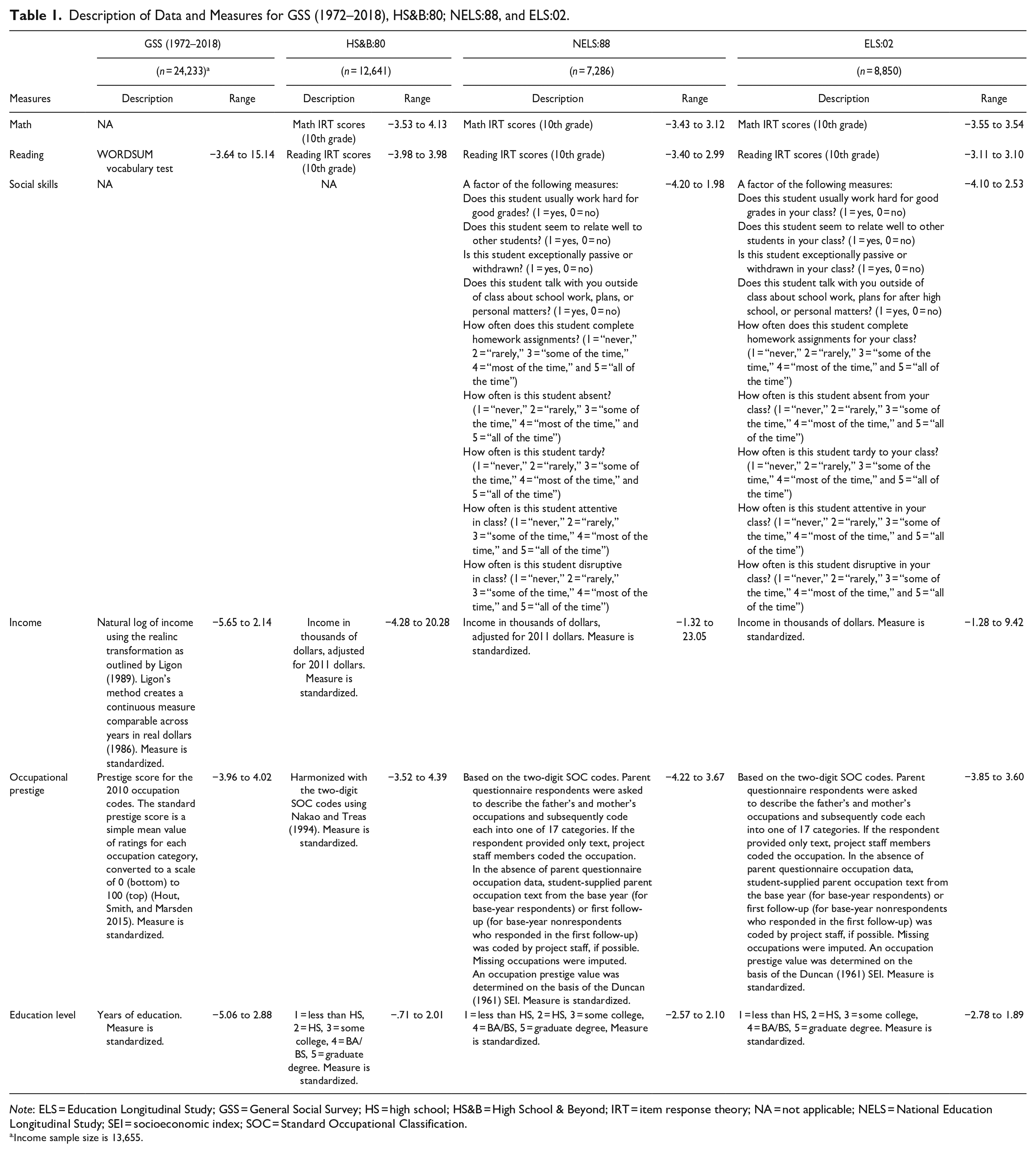
Note: ELS = Education Longitudinal Study; GSS = General Social Survey; HS = high school; HS&B = High School & Beyond; IRT = item response theory; NA = not applicable; NELS = National Education Longitudinal Study; SEI = socioeconomic index; SOC = Standard Occupational Classification.
Income sample size is 13,655.
Measures
SES
We use conventional measures of respondents’ SES. For the GSS data, we use years of education to measure education level. For the NCES data, we harmonize level of education across the three high school panel studies to distinguish among those whose highest credential is less than high school, high school, some college (including an associate’s degrees), a bachelor’s degree, or a graduate degree (not applicable to the ECLS-K studies). For occupational prestige, we use the GSS measure of prestige, and the two-digit Standard Occupational Classification codes for the NCES and ELS data (Hout et al. 2016). The two-digit Standard Occupational Classification codes are not provided in the original HS&B data; therefore, we rely on the Nakao and Treas (1994) scores to harmonize the HS&B:80 occupational categories with NELS:88 and ELS:02 prestige scores. In the NCES data, income is measured in dollars for sample members and converted with the natural log to balance extreme income values from distorting estimates. 6 Income is adjusted for inflation on the basis of the Consumer Price Index for All Urban Consumers. 7 Income was asked in the GSS for a subset of respondents. Because the respondent’s income categories were ordinal and the top category truncated, we use the constructed variable realinc that uses the Ligon (1989) transformation. 8
Cognitive and Social and Behavioral Skills
We conceive of “skills” broadly, as individual characteristics that are primarily developed and reinforced through schooling and rewarded by the stratification system (Farkas 2003). 9 In this study, we consider the cognitive skills measures by vocabulary, math, and reading assessments. In the GSS, we use the 10-word vocabulary test (WORDSUM) originally developed by Thorndike (1942) as a brief test of intelligence and later used by Miner (1957) to assess the intellectual skills of the U.S. population. Prior to 1988, WORDSUM was administered every other year to the full GSS sample. Since 1988, it has been given to roughly two thirds of the sample each year. Respondents are presented with a target word and asked to choose which one of five alternate words come closest in meaning to the target word. The correlation between WORDSUM and the Army General Classification Test, a validated assessment of general intelligence, is 0.71 (Wolfle 1980), but as Hauser and Huang (1997) noted, WORDSUM is a short test, with modest reliability (internal consistency reliabilities are 0.71 for white and 0.63 for black respondents), and so should be viewed with some caution. Using the WORDSUM scores in our case represents a trade-off. On one hand, the measure gauges a narrow dimension of skill (vocabulary) with just 10 items. On the other hand, it correlates fairly well with general intelligence and provides a rare opportunity to compare the associations between a skill (vocabulary) and stratification outcomes over a long period of time.
As mentioned previously, item difficulty of the WORDSUM measure may have changed over time. Dorius et al. (2016) compared all 10 WORDSUM words with a Google corpus of books written from 1885 to 1988 and found that some words have become less familiar over time and some have become more familiar over time. Building on Dorius et al., we compare our results based on all WORDSUM items with those based on a subset of WORDSUM items including only “basic” words (A, B, D, E, F, and I) and only “advanced” words (C, G, H, and J) to determine if word familiarity produces bias in our estimates. 10
In HS&B:80, NELS, ELS, ECLS-K:98 and ECLS-K:10, we use standardized math and reading tests developed by the U.S. Department of Education to proxy general cognitive skills. The math tests for HS&B:80, NELS, and ELS gauge skills from basic numeracy through algebraic reasoning. The reading tests for HS&B, NELS, and ELS gauge reading comprehension on the basis of a brief two to three paragraph passage, followed by a series of multiple-choice questions. 11
The NELS and ELS ask an almost identical set of nine questions to assess a 10th graders’ social and behavioral skills. 12 The following “yes” or “no” questions were asked of two teachers (we averaged their responses):
Does this student usually work hard for good grades in your class?
Does this student seem to relate well to other students in your class?
Is this student exceptionally passive or withdrawn in your class?
Does this student talk with you outside of class about school work, plans for after high school, or personal matters?
How often does this student complete homework assignments for your class?
How often is this student absent from your class?
How often is this student tardy to your class?
How often is this student attentive in your class?
How often is this student disruptive in your class?
Responses ranged from “never” (1) to “all the time” (5). We reverse-coded responses on absenteeism, tardiness, and disruptive measures and retained the first principal factor of these measures (unrotated) in both datasets (Cronbach’s α = .81 for both NELS and ELS; see Table 1). 13 Descriptions of variables from the various datasets are provided in Table 1.
Analytic Strategy
Determining whether the link between skills and outcomes has increased over time prompts us to distinguish between an absolute and relative approach to measuring skills. An absolute approach would identify a fixed skill that could be compared across time. From an absolute standpoint, we might ask whether achieving some minimal and temporally fixed level of literacy has become a stronger determinant of life outcomes. In contrast, a relative approach identifies an individual’s position in the skill hierarchy with reference to one’s peers (say, 1 standard deviation above the mean) rather than a specific criterion score and assesses how closely one’s relative position predicts life outcomes (and whether this association has changed over time). Although there is value in both approaches, we employ a relative approach for several reasons. First, identifying a fixed skill ultimately provides limited information because changes in how a particular skill matters may not represent how skills overall have changed. Second, it is unclear whether changing predictive validity means that skills (overall) have declined in importance. For example, literacy may have become less predictive of income over time primarily because literacy rates have increased to the point where they do not distinguish individual skill levels much, not because skills overall have become less important. We lack this perfect measure but by gauging vocabulary, math and reading skills, and social and behavioral skills we provide a reasonable estimate of an individual’s position in the distribution of skills known to predict life outcomes.
We proceed to examine the GRS thesis in two parts. We begin with the GSS as it provides the ability to assess how vocabulary skills predict outcomes over a 70-year period among adults born between 1915 and the 1990. 14 With these data, our primary question is whether the correlations between vocabulary skills and educational attainment, income, and occupation increased over time. 15 We also compare whether the associations between standardized math/reading tests and adolescents’ success in school, wages, and occupational attainment changed between the HS&B:80 sample, NELS:88 youth, and ELS:02 youth.
We rely on teacher evaluations of students’ behavior from NELS and ELS to assess whether the association between social skills and academic outcomes strengthened between 1988 and 2002. In analyses not reported here, we also compare how social and behavioral skills are associated with teacher’s evaluations of academic success among the young children in the ECLS-K:98 and ECLS-K:10 datasets.
We begin by estimating the bivariate association between individual’s generalized cognitive skills and their stratification outcomes over time with simple ordinary least squares regression models, without any covariates:

Stratification outcomes include income, occupational prestige, and educational attainment. B1 represents the association between skills and stratification outcome, and ε represents the error term. We estimate this model repeatedly for each cohort year of the GSS data, noting how B1 changes. Ordinary least squares regression results across 75 individual models (for birth year cohorts 1915–1990) are compiled into figures to provide the visual representation of change over time.
For some versions of the GRS thesis, this simple analysis suffices. We recognize, however, that it is possible that the association between skills and outcomes may have changed over time but been obscured by changes in other attributes. For this reason, we also estimate multivariate models:

And because we are interested in whether the skills-outcomes relationship has changed among individuals with the same level of education, in the GSS data we estimated the following:

and

Next, we test whether skills increasingly mediate gaps in stratification outcomes across race, SES, and gender. For each dataset, we consider whether the inclusion of cognitive and social and behavioral skills in ordinary least squares regression models explains a growing percentage of these gaps in education, wages, and occupational attainment. 16
Results
Have the Associations between Skills and Adult Outcomes Increased over Time?
The bivariate associations between WORDSUM scores from the GSS, and educational attainment, occupational prestige, and income for those born from 1915 until 1990 changed little during the twentieth century. Figure 1 displays the expected standard deviation change in each outcome (y-axis) associated with a one standard deviation increase in vocabulary test score across birth cohorts (x-axis).

Bivariate association between WORDSUM and years of education attainment, occupational prestige, and household income.
Note that coefficients are based on 75 birth cohort years with point estimates smoothed across a moving average of five birth cohorts. For example, the first point estimate, for 1919, is the coefficient from a regression of years of education on vocabulary test scores averaged across cohorts born from 1915, 1916, 1917, 1918 and 1919. The solid line plots each point estimate with a 5-year moving average.
We find, for example, the association between the vocabulary test and educational attainment was 0.55 for the 1920 birth cohort and 0.52 for the 1980 birth cohort. The patterns for occupational prestige and income are similarly flat. Note that these results use all words to create the WORDSUM score patterns considering only basic and advanced words show similarly flat patterns (available form the author).
It is possible that although these bivariate patterns may be constant, the conditional relationship between vocabulary skills and outcomes may have changed over birth cohorts. We tested this possibility with multivariate models (Figure 2), which produced results similar to those in Figure 1. Here we condition on parents’ SES and respondent race, gender, and sibship size. In addition, we estimated models predicting income and occupational status with WORDSUM scores, controlling for respondent’s years of education (Figure 3). These models tell us what the relationship between skills and outcomes looks like for those of similar educational success and help distinguish the skills part of education from the credential part. 17

Multivariate association between WORDSUM and years of education attainment, occupational prestige, and household income controlling for parents’ socioeconomic status (at age 16), race, gender, and sibship size.

Multivariate association between WORDSUM occupational prestige and household income controlling for educational attainment.
Although these results based on the GSS data are important because of their historical reach, we recognize the limitations of the WORDSUM vocabulary test. Accordingly, we explored the association between cognitive skills and outcomes in three datasets from the NCES: HS&B:80 (1980s), NELS:88 (1990s), and ELS (2000s). Figure 4 shows how the correlations between math test scores and educational attainment, occupational prestige, and income changed between the 1980s and 2000s. Again, correlations are mostly constant with some evidence of slight decline.

Bivariate correlation between math skills and years of education attained, occupational prestige, and household income across National Center for Education Statistics datasets High School and Beyond (HS&B), National Education Longitudinal Study (NELS), and Education Longitudinal Study (ELS).
For example, the association between math skills and years of education was 0.51 during the 1980s, 0.51 in the 1990s, and 0.46 in the 2000s. Similarly, the associations between reading skills and outcomes reveal a similar, mostly flat pattern (see Figure 5). The association between reading skills and educational attainment increases somewhat between the 1980s and 1990s, but then declines again in the 2000s. In sum, in the NCES datasets there is little evidence that the associations among skills and outcomes increased over time. 18
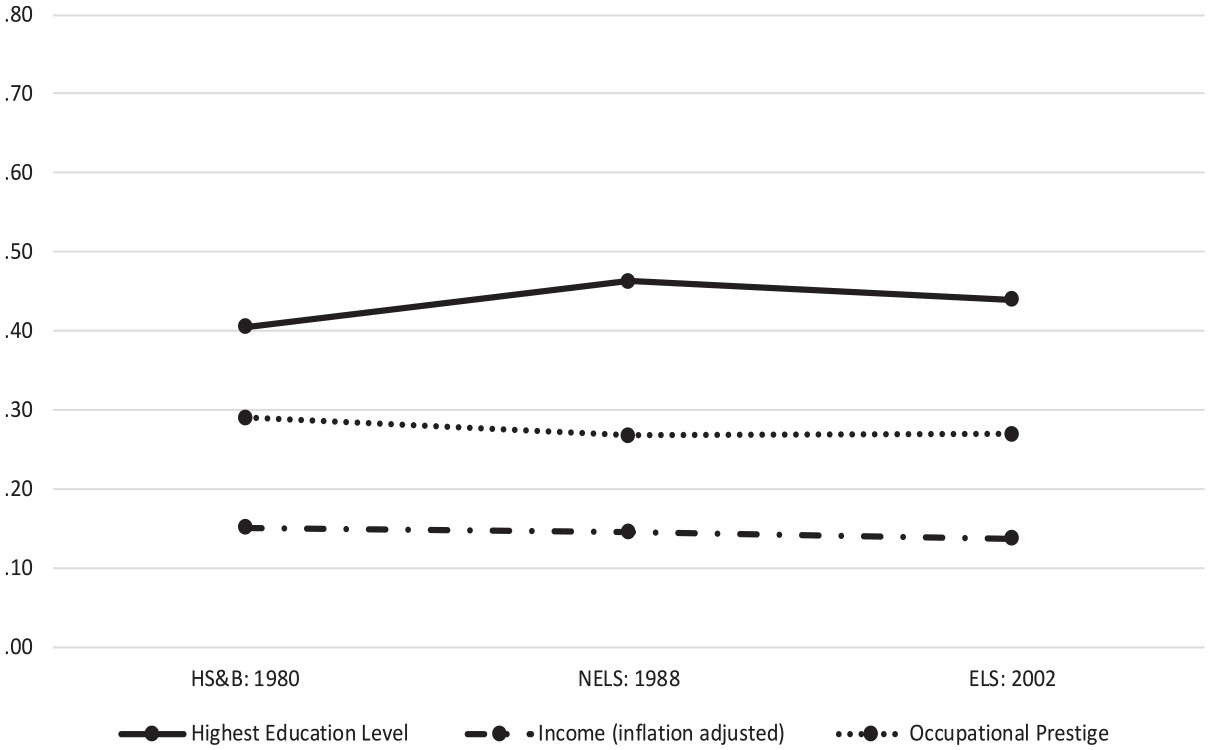
Bivariate correlation between reading skills and years of education attained, occupational prestige, and household income across National Center for Education Statistics datasets High School and Beyond (HS&B), National Education Longitudinal Study (NELS), and Education Longitudinal Study (ELS).
We also tested the association between social and behavioral skills and educational outcomes among adolescents using the NELS and ELS datasets. Figure 6 presents the correlation between social and behavioral skills and educational attainment and occupational prestige for the NELS and ELS data (there were no comparable indicators of social and behavioral skills in the HS&B:80 data). Overall, the associations between social and behavioral skills and outcomes remained about the same over time. For example, the correlation between social and behavioral skills and occupational prestige increased slightly from 0.26 (1988) to 0.28 (2002) while the correlation with educational attainment decreased slightly, from 0.49 (1988) to 0.46 (2002). 19

Bivariate correlation between social skills and years of education attained, occupational prestige, and household income across National Center for Education Statistics datasets High School and Beyond (HS&B), National Education Longitudinal Study (NELS), and Education Longitudinal Study (ELS).
In supplemental analyses (Figure S2), we estimated models predicting educational attainment with skills and assessed whether R2 increased over time. It did not.
Do Skills (Cognitive and Noncognitive) Account for an Increasing Share of the Socioeconomic, Racial, and Gender Gaps in Adult Outcomes?
The evidence of mediation fluctuates and is inconsistent across outcomes (see Table 2). 20 Here, we consider how gaps would look if there were no measured skill differences among SES, racial, and gender subgroups. We simplified the SES gap analyses by comparing the top and bottom socioeconomic quintiles of the respondent’s family background in a bivariate model and then with math and reading skill included in the model. We conducted these analyses for educational attainment, occupational prestige, and family income. To interpret results, the gap in educational attainment between a respondent from the highest socioeconomic quintile and a respondent for the lowest socioeconomic quintile was 0.98 standard deviations in the HS&B:80 cohort data. The gap grew to 1.34 standard deviations in the NELS:88 cohort and declined to 1.08 standard deviations in the ELS:02 cohort. We then explore the extent to which variation in cognitive skills might account for these gaps. When 10th grade math and reading skills are included in the models, gaps reduce by 47 percent for the 1980 cohort (1 − [0.52/0.98] = 0.47), 36 percent for the 1988 cohort (1 − [0.86/1.34] = 0.36), and 42 percent for the 2002 cohort (1 − [0.63/1.08] = 0.42).
Estimates of Subgroup Gaps in Stratification Outcomes and the Mediating Role of Skills, HS&B, NELS, and ELS.

Note: ELS = Education Longitudinal Study; HS&B = High School and Beyond; NA = not applicable; NELS = National Education Longitudinal Study; SES = socioeconomic status.
p < .05. **p < .01. ***p < .001.
If skills were playing an increasingly important role in explaining socioeconomic disparities in educational attainment, we would expect that skills would explain an increasing percentage of these gaps from the 1980 cohort to the 2002 cohort. We do not find evidence of such a pattern. Likewise, we document the difference in occupational prestige scores and income by SES and find similar patterns.
The Black-White comparisons produce more mixed patterns. For example, the Black-White gap in educational attainment was completely explained by cognitive skills among high schoolers in the 1980s and 1990s, and among high schoolers in the 2000s Black students with similar cognitive skills as White students achieved greater educational attainment. For occupational prestige, skills mediated all the gap in the 1980s (even producing a Black advantage), all the gap in the 1990s, and all the gap in the 2000s. Finally, cognitive skills explained the entire Black-White income gap in the 1980s, but in the 2000s cognitive skills only explained about 50 percent of the gap (recall that the income measure for the 1990s data is suspect). Taken as a whole, skills played a slightly more important role over time explaining Black-White gaps in educational attainment and perhaps occupational prestige, but somewhat less of a role explaining gaps in income.
The female-male patterns reproduce the well-known finding that females outperform males in educational attainment at the bivariate level at all time periods we evaluated. In models for which cognitive skills are controlled, this pattern changes somewhat—the female advantage increases in the HS&B and ELS data, but not the NELS data. With respect to occupational prestige, females enjoy an advantage at the bivariate level that increases slightly with cognitive skills controlled in both the 1980s and 2000s. Finally, when predicting annual income, females lag males in both the 1980s and 2000s, and controlling for cognitive skills explains little of that gap in both datasets.
In supplemental analyses, we compared mediation across the NELS and ELS data (HS&B lacked comparable indicators of social and behavioral skills), adding social and behavioral skills to the models (see Table S2). The results are similar: there is little sign of increasing mediation.
Discussion
Our study was motivated by provocative and popular claims that a fundamental component of the stratification system—the link between skills and outcomes—has strengthened over time. Our results suggest that this has not been the case, with several implications for stratification scholars. First, these results temper the optimism promoted by universalists (Treiman 1970) regarding the notion that one’s position in the stratification system is increasingly earned (via skills) rather than handed down or determined by antiquated discriminatory practices. Universalists describe a world where people are ever more sorted by achieved characteristics that can be taught and disseminated in public schools, including numeracy, literacy, and interpersonal skills. But we find little empirical support for this position. Skills are strongly related to educational and occupational attainment as well as income in adulthood. The relationship between skills and these outcomes, however, has remained remarkably stable over time.
Previous scholars who relied on “years of education” as a proxy for skills could point to some evidence consistent with this view. For example, during the twentieth century, fathers increasingly handed status down to their sons via educational attainment (Blau and Duncan 1967; Featherman and Hauser 1978), and the returns to educational degrees have increased precipitously over time (Goldin and Katz 2010, although less so more recently, see Autor et al. 2020). But with updated analyses and direct measures of skills we find that the relationship between generalized cognitive skills and economic outcomes in adulthood has changed little, if at all, over nearly a century. This is an important finding because if the skills-outcomes relationship had increased over time, it could have lent indirect support to the modernist claim that non-skill-based processes (e.g., discriminatory processes) have been declining in salience. 21 The fact that we did not observe a growing skills-outcomes link undermines that view.
Second, previous scholars found evidence that inequalities among social groups were increasingly due to cognitive skills (Jencks and Phillips 1998; Neal and Johnson 1996), but our more extensive analyses reveal mixed evidence of that pattern. In terms of socioeconomic and gender gaps in outcomes, it does not appear that skills have become a more important mediator over time. With respect to the Black-White gap, we find that skills have played an important role throughout this period, although perhaps more so for educational outcomes compared with occupational prestige and income in the 2000s. In sum, a clear pattern over time does not emerge in this analyses.
Revisiting the Modernist View
Our analyses focused on educational attainment, income, and occupational prestige, raising the question: Why have skills not become stronger predictors of these outcomes? Starting with educational attainment, one might expect that the significant expansion of education in the last century would be accompanied by increased sorting by skills, but this has not happened. Although education became a more important mediator between father’s and son’s status during the twentieth century (Blau and Duncan 1967; Featherman and Hauser 1978), that change did not coincide with a greater role for generalized cognitive skills (or social and behavioral skills). Our combination of results is consistent with the predictions of credentialists: that a world with more college-educated individuals would not necessarily reshape the opportunity structure (Collins 1979; Triventi et al. 2016). A mostly constant skills-outcomes link suggests that although schools might provide an avenue for mobility for some disadvantaged students, they have not become a stronger avenue, even though the typical American attended more schooling in the last half of the twentieth century than in the first half.
With respect to income and occupation, we find no evidence that skills are becoming better predictors, contrary to the SBTC thesis. Recall that the SBTC thesis posits that growing wage disparities between those with nonroutine and routine skills are due to the devaluing of routine skills (because they have been replaced by technology), along with the subsequent increase in demand for nonroutine skills. The result is that the technological changes of the twentieth century, especially computerization in the last few decades, prompted more income inequality (Autor et al. 2003). Of course, the generalized cognitive skills we gauged here may not capture the higher level cognitive skills that SBTC thesis proponents describe. It is possible, therefore, that some kinds of higher level skills (unmeasured here) have become increasingly important, but this is speculation given the lack of historical data with adequate measures. In addition, some of the higher level skills sometimes described as part of the SBTC thesis are social and behavioral (e.g., the ability to get along with others), which we were able to gauge with teachers’ evaluations. Notably, our results suggest that these skills have also not grown in importance over time.
In addition, the GRS thesis and its related SBTC thesis appear unlikely explanations for growing income inequality. Income inequality has grown considerably in the last half century (Piketty 2014), but it is more likely due to policy decisions (e.g., specific tax policies reducing taxes on the wealthy and corporations, a stagnant minimum wage, rules weakening unions, and financialization policy), successful rent-seeking by elites (Stiglitz 2012), and specific monetary policies (Davtyan 2017), than a stronger link between skills and outcomes. The argument that growing income inequality is a product of a changing world where skills and outcomes are more tightly linked is inconsistent with our findings.
Implications
Why has the stratification system not become a more efficient sorter? One possibility is that it has but the skills we were able to measure fail to uncover the pattern. To gain leverage on this question we were limited to “generalized cognitive skills”—skills that are useful in a wide range of situations—because these are the only measures of skill assessed over a long historical period. There are limits to this approach, but we argue that this is the first step in evaluating the GRS thesis because these education-related skills are universally developed and rewarded in schools and capture something that meaningfully predicts variation in individual’s educational and occupational futures. We also note that our results persist across both the GSS and the more recent NCES datasets, and across indicators of cognitive and social and behavioral skills. This gives us greater confidence in the GSS results, even though its measure of cognitive skills is more limited than those employed in more recent datasets. 22
Prior to our study, some scholars believed that social skills were becoming more important over time but had been overlooked (e.g., Deming 2017). But our indicators of social skills improve upon past research and we found no evidence that social skills have increased in importance. Of course, there could be other individual-level social skills that we have not identified that have become more salient, such as motivation, adaptability, and problem solving, but this is speculation. We are unaware of data that would provide a better historical test.
How should we think about the role of skills in the stratification system? Given our results, it is tempting to relegate skills to a position of less prominence. 23 But even though their role is not increasing, skills continue to predict life outcomes in meaningful ways. On average, more skilled individuals consistently outperform their less skilled peers in economic and occupational attainments; there are few other measurable characteristics that consistently predict life outcomes as well. These modest, yet durable correlations likely help sustain the current political and economic systems that rely on educational institutions to serve as fundamental socializing and skill-developing institutions of American society. A stratification regime with a weaker skills-outcomes relationship, and fewer discernable mechanisms for sorting, likely struggles for legitimacy in a democratic system.
One might anticipate that as Americans persist longer in school and as jobs change in ways that arguably reward greater cognitive and social skills, the association between skills and stratification outcomes would increase. But our study shows that in the United States, the link between skills and outcomes has been roughly constant. This durable relationship is especially notable in a stratification system that has undergone dramatic changes with both increasing inequality (Piketty 2014) and declining social mobility (Chetty et al. 2017). It raises questions about whether these associations will persist in the future, and whether they are constant in other societies. Why the association did not strengthen is a puzzle we cannot resolve here but we hope this work encourages future research on a fundamental topic of stratification: how skills matter, how they endure, and how they might change over time.
Supplemental Material
sj-xlsx-1-srd-10.1177_23780231241298815 – Supplemental material for Are Skills Becoming an Increasingly Important Determinant of Life Outcomes?
Supplemental material, sj-xlsx-1-srd-10.1177_23780231241298815 for Are Skills Becoming an Increasingly Important Determinant of Life Outcomes? by Douglas B. Downey, Benjamin Gibbs and Eric Grodsky in Socius
Footnotes
Funding
The author(s) disclosed receipt of the following financial support for the research, authorship, and/or publication of this article: We acknowledge grant support from the College of Behavioral Sciences at Ohio State University (Douglas B. Downey).
Data Availability
The data underlying this article were derived from sources in the public domain: GSS (https://gss.norc.org), HS&B (https://nces.ed.gov/surveys/hsb/), NELS:1988 (https://nces.ed.gov/surveys/nels88/), ELS of 2002 (https://nces.ed.gov/surveys/els2002/), ECLS-K:1998 (https://nces.ed.gov/ecls/kindergarten.asp) and the ECLS-K:2010 ( ).
).
Supplemental Material
Supplemental material for this article is available online.
Notes
Author Biographies
References
Supplementary Material
Please find the following supplemental material available below.
For Open Access articles published under a Creative Commons License, all supplemental material carries the same license as the article it is associated with.
For non-Open Access articles published, all supplemental material carries a non-exclusive license, and permission requests for re-use of supplemental material or any part of supplemental material shall be sent directly to the copyright owner as specified in the copyright notice associated with the article.
