




Abstract
Cynicism poses a potentially formidable barrier to personal and collective investments in addressing the climate emergency that has yet to receive substantive research attention. In this article, the results of a qualitative study involving interviews with 74 participants in Canada and the United States regarding personal perspectives on climate change are presented. Several different forms of cynicism were expressed across the sample, including media cynicism, government cynicism, policy cynicism, political economy cynicism, human nature cynicism, and science cynicism. Using cooccurrence analysis, cynicism was found to be strongly associated with confidence in societal response to the climate emergency, and personal feelings of powerlessness. Although not the most prevalent cynicism code, political economy cynicism had the strongest level of cooccurrence with low response confidence and powerlessness. The implications for research and praxis are discussed.
Cynicism has the potential to pose a formidable barrier to personal and collective investments into addressing the climate emergency. Social scientists have made significant strides into understanding climate change attitudes, identifying several factors that facilitate (in)action, with particular attention to skepticism and denial. The role of cynicism in personal responses to the climate emergency, however, has received limited attention in the climate social sciences. Cynicism generally describes low expectations of others (e.g., Vice 2011). Cynicism, however, is not solely an interpersonal phenomenon; it can also be applied toward institutions (Policarpo et al. 2023). Cynicism thus describes low expectations regarding our collective capacity to address problems, not on the basis of a lack of attention or the intractability of the problems themselves but rather because of the perceived ineptness of institutions (e.g., Ervasti, Kuovo, and Venetoklis 2019), whose engagement is necessary to delivering collective goods, and addressing collective action problems like climate change. Such cynicism can be directed toward specific institutional actors, like elected officials, but it can also arise because of basic features of institutions that are perceived to compromise institutional performance. This institutional cynicism entails the belief that, for example, governments are not going to protect one’s rights, conduct fair elections, and ensure stability and order, maybe because individuals in government positions are self-serving or corrupt, but maybe also because of a perception that those institutions just are not capable of performing as mandated. Finally, cynicism can be directed toward society at large, encompassing low expectations regarding fellow human beings.
All forms of cynicism—interpersonal, institutional, and societal—can have substantial consequences for civil society (e.g., Daswani 2020; Goldfarb 1991; Sloterdijk [1983] 1995; Small 2020). The vitality of civil society, and by extension the efficacy of our responses to collective action problems, depends upon not just effective institutions but also the personal investments of members of those social systems into collective projects, and toward the well-being of others. Cynicism, however, lends itself to feelings of disillusionment, resignation, disempowerment, and ultimately for some the disavowal of citizenship responsibilities like voting, rule compliance, or even staying informed (Opdycke, Segura, and Vasquez 2013; Zhelnina 2020). Cynicism encourages skepticism of institutional actors and hence delimits buy-in for policies and initiatives that require individual-level engagement, such as many environmental and climate practices. Ultimately, cynicism amounts to a loss of hope in the future. In other words, a prevalence of cynicism can greatly compromise realization of the goals of climate mitigation and adaptation policies, and support for societal transition.
To substantiate this argument, I present the findings of a qualitative study of personal responses to climate change, based on virtual interviews with a diverse sample of 74 participants drawn from across Canada and the United States. A particularly high proportion of these research participants expressed low to no confidence in our collective capacity to address the climate emergency. This lack of confidence appeared to derive not from the scale and complexity of the problem, but rather from high levels of cynicism toward a number of contemporary institutions, including media and government, as well as a high level of social cynicism. Less prominent but noteworthy were expressions of cynicism by some participants toward a particular facet of Western institutions: the high concentration of wealth and power in Western economies, leading in particular to the rise of a small but enormously wealthy and highly consumptive elite group of “superpolluters.” Each of these forms of cynicism, in turn, appears to be associated with high levels of perceived powerlessness in relation to climate change. In the next sections, I review recent scholarship focused on the prevalence of personal and collective inaction in response to the climate emergency, followed by a brief overview of the concept of cynicism and its deployment in the social sciences. A description of the present study, including methods and findings, follows this, and finally, I offer a discussion of the relevance of the study’s findings, and conclude with my thoughts regarding how these findings might inform future climate citizenship and collective action.
Explaining (In)action toward Climate Change
Factors identified by researchers that facilitate personal and collective investments in proclimate action include strong environmental values (Stern et al. 1999), positive emotions like hope (Daysh et al. 2024; Feldman and Hart 2018; Kleres and Wettergren 2017), and perceived self-efficacy (e.g., Feldman and Hart 2016; Gregerson et al. 2021; van Valkengoed and Steg 2019), among other elements. On the other hand, inaction is often attributed, foremost, to lower concern levels (e.g., Fisher, Fitzgerald, and Poortinga 2018). Lack of concern is in turn explained with reference to varying aspects of our perceptions of climate change itself, shaped by a lack of trust in information providers (e.g., Alvarez and Debnath 2023; Groneworld, Burnett, and Meister 2012; Haltinner and Sarathchandra 2018; Smith and Mayer 2018), or the ways it is communicated to us, which enable judgmental discounting, or psychological distance, from the phenomenon (e.g., Gifford 2011; Harth 2021; Spence, Poortinga, and Pidgeon 2012; Tang and Chooi 2023). Concern alone is by no means sufficient to prompt active support for climate change mitigation and adaptation, however. Contrary to assumptions that inactive individuals simply lack sufficient attention and concern for climate change, individuals may well express high levels of deliberation and reflexivity regarding the climate emergency and their agency and choose not to take action (Irwin and Wright 2024). Indeed, those who are highly concerned may be no more likely to engage in action than the unconcerned, a “values-action gap” that has received a significant amount of research attention (e.g., Flynn, Bellaby, and Ricci 2009). Low personal efficacy is often identified as a prominent correlate of inaction despite high concern. The source of the limited efficacy may be due in part to the positionality of the perceiver, but the sheer scale and complexity of the problem itself and hence its perceived intractability often come to the fore (e.g., Aitken, Chapman, and McClure 2011; Xiang et al. 2019). The confrontation with currently entrenched values and lifestyles posed by climate change—or more accurately the necessary structural changes to meaningfully address it—can also support inaction (Brulle and Norgaard 2019; Haltinner and Sarathchandra 2018; Norgaard 2011). Rishi (2022) and Hochachka (2024), for example, refer to a climate “shadow,” “an ego-defence mechanism to safeguard the self against negative emotions about climate impacts (or about climate action itself) that are too difficult for the self to manage” (Hochachka 2024).
However, the perceived psychological distance from its effects, the intractability of such a complex and large-scale problem, and the confrontations that mitigation and adaptation pose to western values and lifestyles, may tell only part of the story. Disengagement in the face of the climate emergency may have at least as much to do with cynicism, a potentially highly relevant dimension to social responses to climate change that has yet to receive due attention.
What Is Cynicism?
Cynicism is a general attitude or predisposition on the part of an individual to feel skeptical or disillusioned or to hold otherwise negative sentiments with respect to one or more persons, groups, organizations, institutions, or society at large (e.g., Andersson 1996; Andersson and Bateman 1997; Dean, Brandes, and Dharwadkar 1998; Johnson and O’Leary-Kelly 2003; Vice 2011). Psychologists refer to cynicism as one of five basic social axioms, or beliefs, that are learned, generalized expectations about oneself and the world around them (Leung and Bond 2004, 2009; Leung et al. 2002). Studies show that the prevalence of cynicism can vary substantially within and across societies. This highlights the relevance of life experiences and context, with high levels of cynicism in the United States throughout that country’s history being remarked upon in particular (e.g., Agger, Goldstein, and Pearl 1961; Cappella and Jamieson 1996; Robinson 2013).
Although distrust is often recognized as a barrier to climate concern, cynicism is more than a lack of trust. On the interpersonal level, cynicism is not simply my distrust of someone who asks me for a loan based on my assessment of that individual as self-interested or manipulative (Stavrova and Ehlebracht 2016); cynicism describes my low expectations that the loan will be recouped, regardless of the best intentions of the borrower. This interpersonal cynicism (Agger et al. 1961) may be directed toward specific individuals or groups. Individuals can also develop deeply held feelings of cynicism toward the organizations they are involved in, if their experiences with those organizations support expectations that fairness, integrity, or effectiveness cannot be counted on (e.g., Atwater et al. 2000; Bernerth et al. 2007; Kwantes and Bond 2019).
Institutional cynicism, on the other hand, is cynicism extended toward institutions with which one is not necessarily directly involved as a member or employee, but which nonetheless affect their lives in some way (Policarpo et al. 2023). Similar to organizational cynicism, institutional cynicism describes a lack of confidence that those entities will perform as mandated, perhaps because of a poor opinion of certain institutional actors—elected officials, scientists, journalists, or corporate executives—but it may also reflect a deeper and more generalized loss of faith in the performance capabilities of those institutions as a whole. This cynicism can then become generalized after repeated experiences of disappointing institutional behavior, such that certain institutions, notably those expected to play important roles in delivering public goods and addressing collective action problems, are instead seen in a negative light (Agger et al. 1961). Cynicism can, finally, be directed toward society in general. Niklas Luhmann (1979) referred to this aspect of cynicism as system trust (or lack thereof), describing a lack of confidence in the reliable functioning of social systems as a whole, and is elsewhere referred to as social cynicism (e.g., Alexandra et al. 2017). This form of cynicism is referred to as human nature cynicism in the following analysis to most accurately represent the sentiments of interview participants.
Why Do People Become Cynical?
Studies on cynicism have identified a number of cynicism correlates at the individual level, such as age (older) and education levels (lower) (Agger et al. 1961), and more recently a social dominance orientation (Alexandra et al. 2017). However, cynicism should not be conceived as a purely individual personality attribute, as can be implied in some psychological studies. To the contrary, the contexts giving rise to cynicism matter a great deal. Cynicism, in other words, may reflect not a personality flaw but rather flaws in the organizations, institutions and social structures giving rise to such reactions. Several studies have focused on experiential factors associated with cynicism, rather than personal attributes, including being the target of disrespect (Stavrova, Ehlebracht, and Vohs 2020) or repeated experiences of disappointment and betrayal of expectations placed upon other people, organizations, institutions, or society (Kanter and Mirvis 1989).
The experiences that generate cynicism may not be limited to personal experiences. Cynicism can emerge in response to crisis, for example, or, more aptly, the perceived poor performance of institutions expected to respond to crisis, facilitating cynicism across publics. Ervasti et al. (2019) conducted one such study, observing substantial increases in cynicism directed to the Greek state in the midst of that country’s financial crisis in the early aughts. But crisis episodes are by no means prerequisites. Robert Bellah (1987) observed that a rise in cynicism accompanied the decline in legitimacy of religious and political institutions in the United States after World War II, a period that put to rest, for most Americans anyway, any notions that achievement came down to individual effort and has much more to do with one’s position within a political-economic hierarchy. Such experiences led to feelings of disillusionment and estrangement in a social system in which full participation was only granted to the few. Sloterdijk ([1983] 1995) drew a similar portrayal of disillusioned German publics after World War II. More recent comparative studies have shown that confidence in institutions decreases as the power differentials within a given social system increase (Kaasa and Andriani 2022). Recent work by Arlie Hochschild (2018) resonates here. Although never explicitly using the term, in her work among low-income white residents of the southern United States, Hochschild described feelings of having been dismissed or rendered invisible by increasingly elitist and urbanist political institutions. These personal experiences prime such individuals to conclude that political institutions cannot be relied upon to protect their interests. Hochschild’s research participants described feeling disillusioned by conventional party politics, and many turned toward discourses of the “swampification” of Washington, allying themselves with populist movements and their leaders. As stated by Schieman and Wilson (2024), in reference to research conducted in Canada, feelings of being “pushed around in life” are prevalent, associated with rising perceptions of inequality.
Finally, the substantial role played by mass media as a set of institutions that both engenders and is the target of cynicism has only grown since social media has come into prominence. The framing of news stories, whether emanating from mainstream or alternative sources, inevitably shapes the way viewers respond to contemporary issues, and this includes the facilitation of cynicism (Cappella and Jamieson 1996). What comes with the rise of social media, however, is an inordinate rise in the availability of mis- and disinformation, and the more readers are cognizant of the contamination of our information environments with such viral threats, the more cynical they become of all media (Jones-Jang, Kim, and Kenski 2020). Interestingly, in contrast to Agger’s study from decades prior, Jones-Jang et al. (2020) found younger people to be more inclined to be cynical than their elders, perhaps because of their increased exposure to social media.
What Are the Consequences of Cynicism?
Lynne Zucker (1986) argued that confidence in the reliable functioning of social systems was essential to the secularization and industrialization that the Western world underwent during the nineteenth century. If such confidence is necessary to the reliable functioning of social systems, then periods of increasing cynicism should be seen as worrying indeed. Research since has certainly offered compelling validation for this concern. Cynicism has been correlated with declines in voting and other forms of civic engagement (e.g., Opdycke et al. 2013) and low expectations regarding the efficacy of collective action (e.g., Daswani 2020; Goldfarb 1991; Sloterdijk 1995; Small 2020). Zhelnina (2020), for example, found that in Russia, cynicism coincides with resigned complicity in the status quo, regardless of how unacceptable that status quo may be perceived to be, because efforts to introduce changes are deemed fruitless. According to Small (2020), “the stance of the cynic is one of conscious detachment” (p. 1). That detachment nonetheless appears to allow space for conspiracy theories (Bensley et al. 2021) and increased support for extremism (Rijkhoff 2018), particularly when populist leaders profess to know how to upend that status quo.
On the personal level, perhaps not surprisingly, cynicism is associated with self-preservation and declines in expressions of empathy and goodwill toward others (Choy, Eom, and Li 2021; Hui and Hui 2009; Leung and Bond 2004), in part because such efforts would not be considered effective, or because cynical individuals may have no confidence that personal expressions of goodwill toward others would be reciprocated. Cynicism also appears to be harmful to one’s mental health, associated with hopelessness, loneliness and stress, and lower levels of self-esteem (Alexandra et al. 2017; Bernardo & Nalipay 2016; Chen et al. 2005; Kuo et al. 2007; Lai, Bond, and Hui 2007; Neto 2006).
Very few studies have focused explicitly on the influence of cynicism on pro-environmental and proclimate action, but the results generated from a handful of studies implicitly focused on cynicism are informative and not particularly surprising given the body of research just discussed. Research on cross-national climate change attitudes shows that both social trust (generalized trust in others) and trust in institutions influence climate change attitudes and planned behaviors (Smith and Mayer 2018). And in workshops with highly climate-concerned UK residents, Cherry, Verfuerth, and Demski (2024:8) identified one among a number of narratives of inaction that is highly suggestive of what I refer to in this work as human nature cynicism, finding that “negative arguments that change just isn’t possible were linked to ideas about human nature, acting to convince people that both they and others were incapable of change” (p. 8). Irwin and Wright (2024) observed a deep sense of institutional cynicism among their research participants despite high levels of concern and personal responsibility, as participants “foregrounded tensions between their sense of personal responsibility and the felt meaninglessness of individual actions vis-à-vis the wider structural changes they saw as necessary to address climate change” (p. 5). In other words, inaction does not necessarily indicate a lack of attention. To the contrary, such personal decisions may instead be a response to “reflexivity and critical evaluations of certain everyday practices” (Irwin and Wright 2024:8). One study that explicitly focuses on cynicism and environmental practices indicated that high levels of cynicism are associated with less pro-environmental behavior (Chan and Tam 2021).
The Study
Although there has been scant attention to cynicism in studies of climate and environmental behavior, on the basis of the overview of research on cynicism in other domains reviewed here, there would appear to be a strong possibility that cynicism may come into play in personal reflexive processing about the climate emergency, and our record of institutional efforts to address that emergency. This research thus explores the prevalence of cynicism in reflexive processing about the climate emergency among a sample of North Americans and the association of that cynicism with personal motivations to act. If cynicism is indeed a prominent driver of climate inaction, this has direct implications for how climate social scientists direct their future inquiries and for climate advocacy: research and advocacy premised upon presumptions of information deficit or emotional appeals intended to evoke guilt, for example, to take two common approaches to climate behavior, would be unlikely to be effective.
Methods
This study draws from a larger project focused on emotional responses to climate change, supported by the Social Sciences and Humanities Research Council of Canada and approved by the research ethics board at the University of Alberta. The research participants in this study consisted of a subsample of 4,000 survey respondents who agreed to participate in a follow-up interview. The survey results enabled the identification participants on the basis of their alignment with one of five climate response profiles, which were drawn from a previous article depicting distinct emotional pathways to climate (in)action (Davidson and Kecinski 2022), including the following:
Denial: individuals who reject that humans are the primary cause of global warming
Apathy: individuals who accept that humans are the primary cause of global warming but indicate low concern
Withdrawal: individuals who accept that humans are the primary cause of global warming and are highly concerned but express low personal efficacy and take limited action
Inert: individuals who accept that humans are the primary cause of global warming, are highly concerned, express high personal efficacy, but take limited action
Action: individuals who accept that humans are the primary cause of global warming, are highly concerned, express high personal efficacy, and do take action
Among those survey respondents who indicated their willingness to participate in a follow-up interview, I overselected for members of nonwhite and low-income groups to maximize sample diversity. The interviews were all conducted and analyzed by the author and took an average of 30 minutes, with some as short as 15 minutes, and the longest interview just over an hour. The interviews were semistructured, following a common question format including questions such as (1) “How confident are you that we will be able to address climate change?” (2) “What do you think are the main barriers to doing so?” and (3) “What do you think needs to be done?” in addition to questions on personal identity, climate change perceptions, observations, and information sources. The semistructured interview format also allowed for emergent follow-up discussion topics. All but two of the interviews were conducted virtually on Zoom, and participants were able to choose whether they participated with the camera on or off. The remaining two interviews were conducted by telephone.
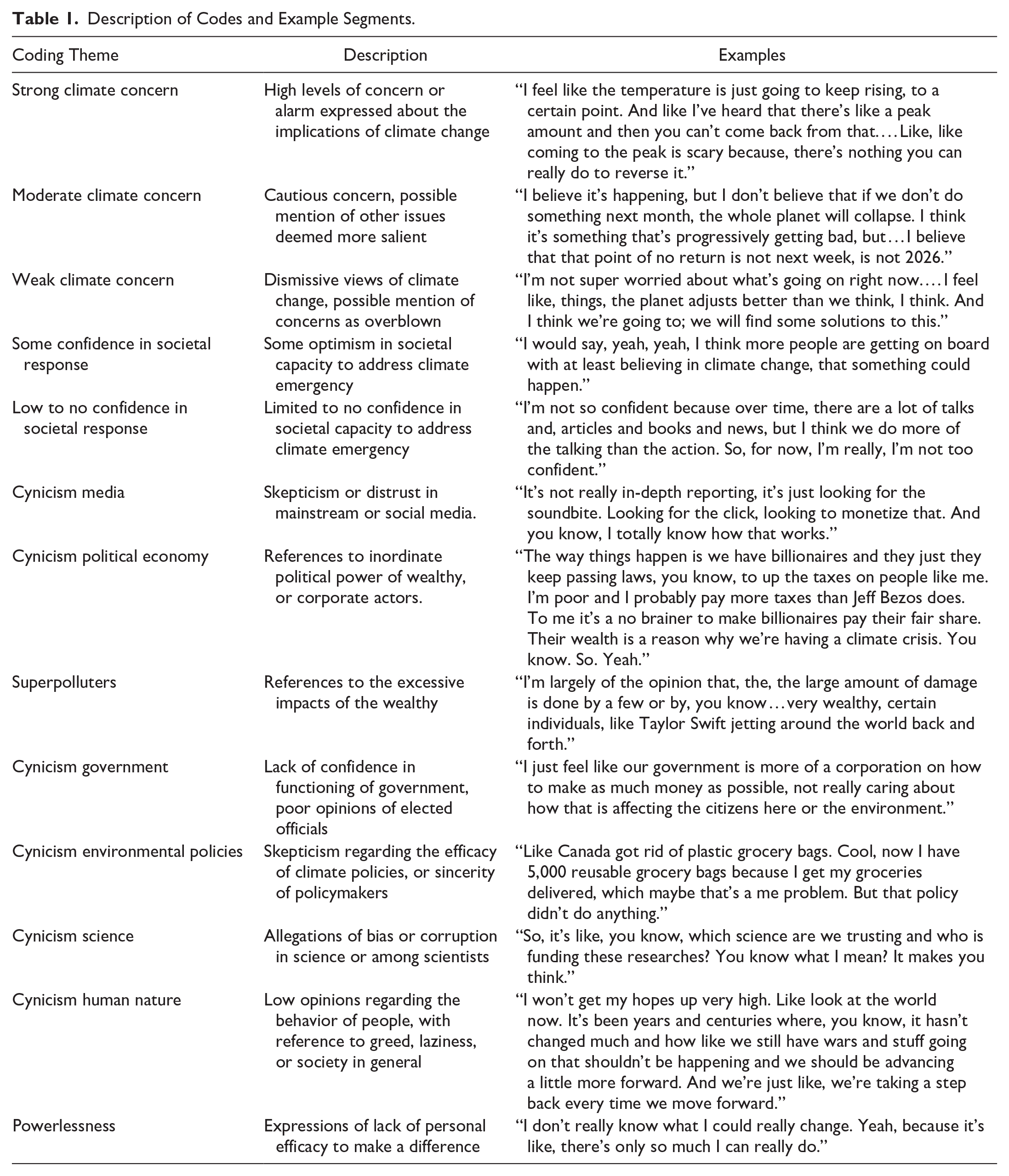
All interviews were conducted and analyzed by the author. The interviews were recorded, transcribed, and uploaded into MAXQDA, a qualitative software analysis program. The interview transcripts were then subjected to multiple stages of coding, beginning with open coding to generate initial codes, including those informed by the interview guide as well as those which emerged inductively. This step was followed by axial coding, whereby the initial list of codes is refined and organized into a coding tree according to patterns and relationships identified among the codes. This was followed by a final review of the transcripts to confirm code identification and further refine the coding tree. Using MAXQDA, the frequencies and cooccurrence of codes were then analyzed, along with cross-tabulations of participant attributes. The codes included in the findings discussed later are described in Table 1. Notably, among the codes of interest for this analysis, only climate concern and confidence in societal response were explicitly elicited in the form of interview questions. The remaining codes, including all forms of cynicism, as well as powerlessness, emerged in situ. Some participants expressed inconsistencies throughout the interview with respect to climate concern and confidence, such that some codes are not mutually exclusive. For example, a participant may have expressed both some confidence and low confidence throughout their interview.
Description of Codes and Example Segments.
Key participant attributes, including demographic characteristics and climate response profile, are presented in Table 2. The sample consisted of a larger number of men than women, with a relatively even distribution of liberals and conservatives, and a smaller number of moderates. The largest proportion of participants were in the lowest income bracket, and 61 percent of the sample was nonwhite. I also sought to ensure a distribution of respondents according to their climate response profile, although the resulting sample had a higher proportion of those participants with an apathy orientation.
Description of the Sample.

Participants reported their incomes in the currency of their country of residence (Canada or the United States); these were then transposed to U.S. dollars according to currency exchange rates at the time of analysis (March 2024).
Table 3 depicts the preponderance of number of expressions of the codes of interest among interview participants across each of the five climate response profiles. Because of the uneven size of each climate response profile group, data are reported in the form of ratios of code frequency per number of individuals in each profile group. Unsurprisingly, participants in the apathy and denial bins expressed the lowest levels of climate concern, but concern was generally high across the remaining three bins. The first finding of note is the large majority of participants who express low to no confidence in our collective ability to address the climate crisis, with more than twice the number of expressions of low to no confidence than some confidence. Those with the most confidence were in the apathy group, their confidence in societal response potentially helping support their lack of concern. Yet the frequency of expressions of low confidence in this group was nonetheless nearly the same as for expressions of some confidence. There were no expressions of what could be interpreted as high confidence; most of the segments coded some confidence were cautious, and indicative of hopefulness more than a calculated optimism, with statements such as the following:
Like a scale of 1 to 10, like maybe a five, like, you know, like I feel like I hear a lot like net zero by 2030 or 2050, but I don’t know if it’s like a legitimate goal or kind of just a number like a date that gets thrown out there to kind of shut everybody up or, you know. So, like, I think there are bodies and organizations that are doing a lot and working hard to make the changes that need to happen. But I think there’s also ones that are kind of restricting that or working against it. So, like, it’s hard to say.
Relative Frequencies of Code Occurrence across the Sample by Climate Change Profile Group.

The frequency of expressions of cynicism also varied by climate response profile. Cynicism expressed toward media and government were particularly prominent across all five groups, although the highest overall levels of cynicism were directed toward human nature, with the surprising exception of those participants in the denial group. Expressions of cynicism regarding human nature ranged from references to certain negative attributes such as greed or laziness purported to be inherent tendencies of the human species, to reflective comments on the current state of society, such as the following:
When I was young, I sort of imagined, like, I used to daydream about there being sort of like, catastrophes because I felt like it would sort of force people to work together more. And I feel like in the last 10, 15 years, I’ve found that a lot of people have the opposite impression that, you know, society will completely break apart and it’ll be every man for himself.
On the other hand, cynicism expressed toward the political economy and superpolluters—interpreted here as a specific subset of political economy cynicism—were lowest among participants in the action bin. Consistent with previous research highlighting the high levels of cynicism among climate deniers, those participants in the denial group expressed the highest level of cynicism overall, along with those in the withdrawal group. Considering the focus in many previous studies on cynicism expressed toward science and scientists in climate politics, participants in this study expressed unexpectedly low levels of science cynicism in comparison with other forms of cynicism, even among participants in the denial group.
Almost half the sample expressed perceived powerlessness to effect change in response to the climate emergency. Just one participant in the action group expressed powerlessness, but the prevalence of powerlessness across the other four groups, all of which depict inaction, was higher.
Confidence, Cynicism, and Powerlessness
Expressions of cynicism often followed participants’ responses to the confidence question. The interrelations between confidence and cynicism can be explored further by observing the frequency of cooccurrence of confidence and cynicism codes within the same interview. Table 4 shows the number of cooccurrences of confidence with each of the cynicism codes. Media cynicism does not appear to affect level of confidence in societal response as much as the others, but all remaining cynicism codes cooccur with low confidence with much greater frequency than with some confidence. This pattern is starkest for political economy cynicism.
Cooccurrence of Confidence and Cynicism.

Expressions of low confidence also frequently cooccurred with expressions of powerlessness, with 26 cooccurrences of powerlessness and low confidence and just 4 cooccurrences of powerlessness and some confidence. Cynicism codes also tend to cooccur with powerlessness, shown in Table 5. Expressions of political economy cynicism and cynicism regarding superpolluters were especially likely to cooccur with powerlessness.
Cooccurrence of Cynicism and Powerlessness.

Positionality also appears to play a role in one’s inclination to express cynicism toward climate change. Table 6 presents coding frequencies according to demographic characteristics. Female, black, low-income, and liberal participants, and those in the withdrawal group, were more likely to express low confidence. Female, low-income, liberal and withdrawal participants were also more likely to express powerlessness, although curiously, a higher proportion of white than nonwhite participants expressed powerlessness. Ascription to different types of cynicism appeared to vary substantially, with a higher proportion of men expressing media and government cynicism, while women were particularly cynical regarding the political economy, superpolluters, and policies. White participants were more likely to express four of the seven categories of cynicism, the exceptions being media, political economy, and human nature. Those participants in the highest income bracket tended to be the least likely to express cynicism across all categories. Those most likely to express powerlessness, finally, tended to be female or nonbinary, white, and liberal. Although these demographic patterns are interesting points for further inquiry, what is perhaps most noteworthy is the degree of cynicism expressed across the entire sample. In fact, just 1 of 74 participants expressed no cynicism at all.
Demographic Characteristics of Sample and Code Frequency.

Discussion
This research offers several new insights that contribute to current understandings of climate-related behavior change. Low levels of public engagement in efforts to address the climate emergency are often attributed to lack of knowledge, defense of lifestyles and worldviews, and psychological distance, among other things. Each of these drivers most certainly contributes to climate inaction. However, another obstructive force may be at work to demotivate proclimate action, even when these other drivers are absent. In this study, participants shared personal reflections about our collective capacity to foment meaningful responses to the climate emergency, and a large majority concluded that such capacity is sorely lacking.
This prevalence of low confidence in societal responses to the climate emergency does not appear to be attributed to the perceived complexity of the problem, or a lack of scientific or technological knowledge to address it. This low confidence instead appears to be strongly correlated with cynicism: the perceived failure of our institutions and low expectations with respect to people in general, the latter of which could in effect be interpreted as a reflection of the failure of institutions to cultivate constructive collective agency. As stated by one participant, “Am I confident that people, governments, systems could do it? Yes, totally. Am I confident that they will do it? Not really.”
Cynicism was expressed in different ways by different participants, but notably, participants of all five climate profile groups expressed some form of cynicism, from climate deniers to those committed to taking action. Participants across the sample, even in the four inaction groups, did mention different actions they take which were understood to be supportive of a low-carbon transition, from recycling to relying on public transit. Many referred to a sense of personal responsibility to support such actions, but for most, factors other than perceived climate benefit were also mentioned as reasons for taking such actions, like saving on energy bills, or not being able to afford a car in the first place. Notably, no one mentioned participation in collective forms of engagement. Some were even skeptical of voting for candidates with strong climate campaigns, because of their lack of faith that such campaign promises would be realized.
Media cynicism was the most prevalent form of cynicism, particularly among conservative men and among deniers—a group in which conservative men are overrepresented, both in this study and in numerous previous studies (e.g., McCright and Dunlap 2011, 2013)—although this form of cynicism did not appear to have as much bearing on confidence in societal response than the others. Government cynicism was also prominent across the sample. We may be in a moment of particularly high cynicism toward governments in Western democratic countries such as Canada and the United States, with implications for more than social responses to the climate emergency, to include vaccination, for example (Sturgis, Brunton-Smith, and Jackson 2021). As one Canadian participant stated,
It doesn’t matter if it’s Justin Trudeau or Pierre Poilievre in charge, you know what? They’re not going to do a thing . . . those two guys will just listen, do whatever they’re told by the corporates. They don’t give a damn what you or I think or care about any of it.
The relatively small number of expressions of science cynicism is surprising, considering distrust of science has been in the limelight as a primary barrier to public engagement in climate action (Alvarez and Debnath 2023; Bugden 2022; Sarathchandra and Haltinner 2020). Its near exclusive expression among those participants in the apathy and denial bins, who also happen to be predominantly conservative white men, is less surprising, but even among these groups only a minority expressed this form of cynicism. One of the biggest surprises for this researcher, however, and an important contribution to research on climate behavior but also to social studies of cynicism in general, was the strong prevalence of human nature cynicism, with the highest frequency of expression in comparison with all other cynicism codes. Perhaps these unflattering perspectives on the human species are contextual, that context being individualist Western economies in which human relations are often prescribed as competitive, a “structure of feeling,” to use Raymond Williams’ term (Williams and Orrom 1954), that permeates Western society today. Interestingly, some participants who recently immigrated to North America suggested that their cynicism reflected their observations of politics and society since moving to Canada or the United States.
Cynicism directed toward the current structure of political economies, and relatedly, toward uber-wealthy “superpolluters,” were not the most prominent forms of cynicism expressed but are noteworthy because of their particularly strong cooccurrence with low confidence and powerlessness. This form of cynicism appears on the basis of interviews to be borne of perceived stark inequities, combined with a deeply held feeling of hypocrisy: the elites are the ones causing all the problems, and they have all the power, yet we are told to change our lifestyles while they are free to fly around in private jets. The implications to social well-being of the gross distortion of our economies, which have squeezed the middle classes to near suffocation, expanded the ranks of the poor, and hollowed out bureaucratic states, have of course been commented upon at length across the academy. But these phenomena also feature very large in the facilitation of cynicism, suggesting an additional, indirect consequence of highly distorted political economic systems for social well-being: civic disengagement and, according to some research, poor mental health (e.g., Alexandra et al. 2017). The rise of the 1 percent coinciding with the stagnation or decline in status among the remaining 99 percent has generated a central narrative about inequity: “people are not getting their fair share.” But there appears to be a deeper narrative at work, expressed by a number of participants in this study that warrants further attention in future research: “I don’t matter.” As research by Mekvabishvili (2023) illustrates, when free-riding behavior is evident and not penalized, we can expect lower investments in cooperation, while free riding is incentivized.
Conclusions
Efforts by policymakers and climate advocates to engage citizens in personal and collective responses to the climate emergency tend to gravitate toward one dominant strategy: seeking to change the minds of the inactive: the beliefs, decisions, and practices of those individuals all too often deemed to be flawed in some way. In effect, individual citizen consumers and their bad attitudes become the problem to be remedied. Many in the climate research and politics communities may be inclined to chide those expressing cynicism for making excuses for inaction: discourses invoked to provide comfort, security, and justification to continue carbon-intensive social practices. But these narratives are not solely forms of motivated reasoning to protect middle class lifestyles. Indeed, the interviewees in this study were drawn disproportionately from lower income groups, and those from higher income groups were less inclined to express cynicism.
Although narratives of climate denial have been well articulated and documented in the literature (e.g., Haltinner and Sarathchandra 2018), less effort has been put into examining the reflexive reasoning that supports these narratives, much less those of the much larger group of concerned but inactive. Such narratives have indeed been strategically deployed in an effort to obstruct by vested interests, such as representatives of conservative think tanks financed by the fossil fuel industry (Elsasser and Dunlap 2013; McCright and Dunlap 2010). However, even among publics who have been receptive to such strategically deployed narratives, and certainly among those who have not, inaction may reflect a deeper sentimentality, including in particular cynicism.
Far from being a personality flaw to be overcome with effective communication strategies, the cynicism expressed toward our efforts to confront climate change and the institutions implicated represents reflexive critical evaluations of social change and one’s personal agency within the context of current social structures (Archer 1995). The premise that personal behavior change alone can allow substantial mitigation is based solely on the proportion of emissions emanating from the household and personal consumption sector in the aggregate, which is indeed substantial (e.g., Dietz et al. 2009), but such calculations include the proviso that all individuals voluntarily embrace proclimate action. However, many would-be proclimate actors are critically reflexive about their impact on the climate (Irwin and Wright 2024), and calls for personal and household behavior change are likely to be effective only to the extent that individuals perceive that their engagement matters—that they matter. Although many individuals, including those participating in this research, do engage in certain personal proclimate practices, often because of cobenefits such as energy savings or compatibility with lifestyles, under the heavy cloak of cynicism, such motivating factors hold little weight in support of broader lifestyle changes required, much less participation in collective action, increasingly considered to be even more important to addressing the climate emergency than personal behavior change (Hormio 2023).
Rather than interpreting the cynical sentiments of the inactive as flawed reasoning, researchers and advocates should treat them as valid warning signals. Perhaps the most pertinent question is, What if the cynics are right? A certain degree of cynicism would appear to be perfectly justified. As Freudenburg (1993) argued, far from indicating some form of irrationality or negative personality trait, the withholding of faith in institutions can in certain circumstances be perfectly justified, even rational, as was the case in his research regarding public responses to environmental bureaucracies that fail to abide by their mandate, leading to higher levels of perceived risk for environmental disruption than would have been the case had those bureaucracies been viewed as more reliable. There are many good reasons to accept the assertion that the very institutions that we have come to depend upon in modern society to protect rights, distribute resources, increase knowledge, keep us informed, and address emerging collective action problems are failing in these roles. Institutions are the means of organizing complex modern social systems, and we rely upon institutions for virtually everything we do, from purchasing a meal, to applying for a passport, to accessing emergency services. When institutions fail to perform in accordance with their mandates, multiple negative repercussions for social well-being ensue. One indirect effect of poor institutional performance, however, is cynicism. The outcome of cynicism for individuals is a perceived lack of security, and lack of agency. Cynicism drives people to check out, to hunker down, and to focus all their energies on personal and familial survival. Cynicism thus facilitates the social and political disengagement of citizens, stifling personal investments in civil society, and for some, a gravitation toward extremism. By extension, cynicism facilitates the retraction of the very social force capable of holding those institutions to account, transpiring in a positive feedback loop with substantially negative implications for our collective capacity to transition at a speed and scale that is requisite with the danger we currently face.
Rather than villainize the cynics, social scientists need to commit future research efforts into evaluating the pathways that led them there, beginning with closer examination of the reflexive reasoning engaged by climate inactive citizens, and the sociopolitical contexts within which such cynicism is most prevalent. Considering that the present study was conducted in a very particular sociopolitical context, attention to other regions and other population groups would be particularly valuable to enhancing our understanding of the role of cynicism in shaping personal and collective responses to the climate emergency. Although future research is always warranted, however, this study’s findings can inform current efforts to facilitate such behavioral responses in North America, a region disproportionally responsible for global greenhouse gas emissions, and hence where such action is particularly urgent. Shifting advocacy discourse beyond promoting policy support and personal behavior change, and toward the cultivation of collective demands for institutional accountability, for example, can not only foster validation of the critical scrutiny expressed by cynics, it can also generate a stronger sense of collective identity among subgroups that feel disenfranchised in their own polities, while also supporting the very structural change needed to alleviate the prevalence of cynicism. Moving away from telling publics what the solutions are and toward creating more civic spaces for inviting public deliberations about climate response pathways, moreover, can invite both greater personal investments and a broader palette of creative response options.
