




Abstract
The authors describe protest patterns at U.S. and Canadian universities in the 2010s. The research draws on a new dataset, the Higher Ed Protest Event Dataset, which combines machine learning and sociological hand coding of 16,069 campus newspaper articles. The sample consists of 5,553 higher ed protests involving 584 universities and colleges between 2012 and 2018. The dataset also includes university and police responses to a subset of protests. The authors find that protest frequency is patterned by the academic calendar. The top issue in both U.S. and Canadian higher education protests was university administration and governance. The comparative analysis reveals distinctive patterns in other issues raised and protest intensity. In the United States, the periods of greatest protest activity were waves of mass mobilization across the country on often racialized issues with a national dimension: racist police violence, racially hostile campus climates, and Donald Trump’s presidency. In Canada, protest activity was most intense during provincial or local campaigns led by formal student organizations and unions on issues of economic security: public tuition, austerity, and labor conditions. Across both countries, university administrations and police usually avoided extensive intervention during protests. The findings contribute to social movements research through methodological innovations and new empirical insights on movements in higher education.
Protest activism in universities and colleges is an essential engine of social change worldwide. Protests are an especially vital strategy for liberal, left, and liberatory campus movements (Boren 2019). As a form of participatory democracy, these protests challenge the status quo by challenging power and oppression, and fostering participatory democracy and student input in decision making (Morgan and Davis 2019; Rhoads 1998).
In the United States and Canada, the twenty-first century has been a time of vibrant protest activism across both countries, with universities and colleges serving as sites of major civil resistance. Highly publicized protests included a massive student-led strike campaign in 2012 against the Québec provincial government’s proposed tuition increases, a 2015 boycott against anti-Black racism at the University of Missouri-Columbia by its football team that sparked solidarity protests across the world, and more than 150 pro-Palestine campus encampments in the two countries, as part of a global protest wave in spring 2024 (https://www.palestineiseverywhere.com). Protest mobilization was also occasionally used by reactionary and far-right groups, such as the highly publicized white supremacist Unite the Right march through the University of Virginia in 2017. Meanwhile, university administrators and campus and municipal police routinely managed protests, taking actions that ranged from administrators’ deflection of policy issues to violent police intervention.
Research on recent U.S. and Canadian campus protest dynamics has focused on issue-specific campaigns (Asal, Testa, and Young 2017; Bass 2024) and college students’ perceptions and participation (Binder and Kidder 2022). However, unlike the large-scale studies of contemporary off-campus movements by the Black Lives Matter movement and the anti-Trump movement known as The Resistance (e.g., Dunivin et al. 2022), scholars have not examined higher education protests at a large scale in recent decades (but see Beyerlein et al. 2018). Thus, we do not know the foundational characteristics of higher education movement activism in this period, such as how many protests were mobilized, where, or on what issues. Nor do we understand how higher education protests may vary across countries, in general and in their most intense periods. Are the campus actions in the United States that captured media and political attention exceptional or specific to the U.S. campus environment? What distinguishes Canadian higher education protest, where large national movements are less common but many students are represented by large, activist-oriented organizations?
In this article we characterize major trends in higher education protests in the United States and Canada between 2012 and 2018, on the basis of our first analyses of a new dataset, the Higher Ed Protest Event Dataset. Our study builds on a long tradition of protest event analysis within social movement scholarship, which applies quantitative content analysis to document the occurrence of protest and its features across countries, over time, and across issues (Hutter 2014; Oliver, Hanna, and Lim 2023). We constructed the Higher Ed Protest Event Dataset through machine learning–assisted hand coding of more than 16,000 news articles from approximately 600 student newspapers. The dataset contains 5,553 distinct higher education protest events involving 584 U.S. and Canadian universities and colleges. These include on-campus protests as well as off-campus protests concerned with higher education issues. To capture protest management, it includes data on how university administrators and/or police managed protest activity in about 40 percent of these protests, also sourced from student newspaper reporting.
The main goal of this research is to describe higher education protest events as social movement activity, both quantitatively and qualitatively. The work contributes empirically and methodologically to the sociology of protest activism, particularly to protest event analysis. Our conceptual framework draws on social movement scholarship, critical studies of higher education, and organizational sociology, all of which inform our research design and account of large-scale protest dynamics in the higher education context. The size and scope of our dataset capture major patterns in protest intensity, such as timing, and top issues raised as well as key protest management strategies. Our comparative design enables us to identify important commonalities and differences in protest activity across two countries with fairly similar higher education environments. We leverage this design to document cross-national and country-specific patterns in U.S. and Canadian higher education protest. Our qualitative case studies of five major protest waves provide detail on protest patterns and consequential interactive dynamics, such as solidarity protests, administrative responses by university leaders, and police intervention.
As we find, the mid-2010s was a time of renewed higher education activism, with mass protests sweeping campuses across both countries. In both the United States and Canada, higher education protests tended to be student led, held on campus grounds, at large public universities, and in large cities or those with a history of protest. In terms of timing, most higher education protest mobilization occurred in a cyclical pattern, spiking when fall and winter and spring classes were in session and then dissipating in summer months. In both countries, higher education protests overwhelmingly advocated for left-wing causes and goals. The most common issue was university or college administration, governance, policies, and curricula, raised in almost 40 percent of U.S. higher education protests in the United States and 34.5 percent of those in Canada. Another common, though less prevalent, issue cutting across both countries was labor and work. Other top issues diverged, with 37.5 percent of U.S. higher education protests advocating antiracism and 30 percent of Canadian higher education protests concerned with university tuition and fees.
In the 2010s, both countries also were home to episodic periods of intensified higher education protest activity, what we refer to as protest waves. Protest waves consist of a disproportionately large number of protests on a shared issue during a condensed time period (see also Koopmans 1993). Waves are analogous to episodes of contention (McAdam, Tarrow, and Tilly 2001) and issue clusters (Oliver et al. 2022). By examining major protest waves in each country, our analyses reveal noteworthy differences in the motivating issues and organizing approaches that facilitate mass mobilization. These differences indicate distinctive national features of campus activism.
In the United States, the largest campus protest waves centered on antiracism and national political issues, involved mobilizations across the country, and coincided with massive off-campus and cross-campus mobilizations. These dynamics were evident in the three largest U.S. campus protest waves, which opposed racist police violence in late 2014, anti-Black racism and expressing solidarity in fall 2015, and the election and presidency of Donald Trump in late 2016 and early 2017. In Canada, in contrast, concern with economic security was a major theme of higher education protest. The largest protests were key actions within provincial and local campaigns by established, formal campus-based organizations led by students. These patterns are evidenced by a massive 2012 strike campaign in Québec against tuition increases and a 2015 graduate student–led union labor strike.
When involved, both U.S. and Canadian university administrations and police tended to manage these protests with minimal direct intervention in the events as they occurred. Administrators commonly made statements affirming the value of political protest and the exercise of free speech. Meanwhile, police usually monitored events and gave instructions and warnings. This nonintervention was made possible, in large part, by institutionalized policies and behind-the-scenes organizational practices that contain and suppress political expression (Davis 2019). However, in a small proportion of protests and campaigns, university administrators punished protesters via administrative or academic sanctions or pursued legal penalties, and police used overwhelming force and violence.
Our study contributes to the critical sociological study of social movements through methodological advancements and new empirical insights. The innovations in research design, methods, and rigor include the broad range and large number of sources, coding transparency and replicability, and measurement of media attention. Likewise, our findings characterize contentious protest politics in higher education across hundreds of institutions in two countries in the 2010s—an account that did not previously exist. The cross-national findings demonstrate that universities and colleges continue to be major institutional incubators and geographic sites of protest. The country-specific findings reveal distinctive national patterns in how campus activists mobilize protest and the concerns that animate their mobilization. We also elaborate the concept of protest management, identifying key ways that administrative leaders and police institutionally control and contain campus activism.
Protest Mobilization and Management in Higher Education
Higher education movements are distinct from many other social movements because they are nested within large bureaucratic organizations (Rojas and King 2018). Scholars who study movements within organizations, such as students in universities (Binder 2004; Rojas 2006), commonly attend to both movement dynamics and the organizational entities, including the responses of those targeted (Davis et al. 2008; King and Pearce 2010; Soule 2012). Universities and colleges are, at once, bureaucratic organizations, geographic places, and social spaces (Stevens, Armstrong, and Arum 2008). They provide fertile ground for activism, depending on their organizational characteristics, spatial features, and cultures of activism (Asal et al. 2017; Baker and Blissett 2018; Soule 1997; Van Dyke 2003).
Higher education movements are shaped by the institutional roles of higher education within societies. Universities and colleges are culturally significant and influential organizations with multiple constituencies and stated commitments to the public interest (Rojas 2012). They also are essential for reproducing existing systems of power and domination; they are built on and persist through settler colonialism, racialized neoliberalism, class domination by the wealthy, patriarchy, heteronormativity, and punitive state social control (Boggs et al. 2022; Cottom 2017; Hamilton and Nielsen 2021; Patel 2021). This status makes them important sites and targets for higher education movements fighting for greater access, inclusion, and liberation, especially within the dominant “white institutional space” (Moore and Bell 2017) of U.S. elite higher education. It also makes them targets and staging sites for right-wing movements; such movements try to maintain structures of white supremacy and conservatism and combat the idealized notions of progress the university is meant to represent. Given the societal importance of higher education, it is no surprise that about 6 percent of U.S. protests in 2010 and 2011 sought to change universities and colleges or K–12 schools (Beyerlein et al. 2018).
Higher education movements have another important distinctive characteristic, derivative of their institutional environments: they are full of students. Compared with other populations, students tend to be more eager and available to mobilize. They are more predisposed to protest because they have more time and fewer social commitments (what McAdam 1986 called “biographical availability”) and heightened political consciousness of social issues (Stokes and Miller 2019). Indeed, university and college students have been centrally important in major movements across the globe, whether involving higher education or not (e.g., Carnegie Endowment for International Peace n.d.; Ortiz et al. 2022). They have been involved in, and often at the center of, nearly every U.S. and Canadian social movement since the mid–twentieth century, from Mississippi Freedom Summer activism of the civil rights movement in the 1960s (McAdam 1986) to recent pro-Palestine protests (Serino 2023).
Student activists have been important instigators of change within institutions of higher learning. Student protest movements have raised a wide range of campus issues—among them free speech, tuition increases, sexual assault, and fair wages for campus workers—although in the United States, one of the most prominent concerns has been challenging racism. Accordingly, many U.S. campus protest campaigns have been led by Black students, from the movement to create Black studies programs that dates to the 1970s (Rojas 2010) to antiracism campaigns for inclusive campus climates in the 2010s (Blissett, Baker, and Fields 2020; Useem and Goldstone 2022). In Canada, student protests historically have been especially focused on economic issues such as tuition costs but also have demonstrated on issues of anti-Black racism, militarism and war, and sexual harassment, among other headline issues (Boren 2019).
Although progressive student organizing has received the most attention from scholars interested in higher education, other campus actors also engage in movement activism (Davis, Morgan, and Cho 2023). Faculty members lead intellectual movements and get involved in political organizing (Moore 2008). Unions organize and represent faculty, staff, contingent faculty and adjuncts, postdoctoral fellows, and, increasingly, graduate students (Herbert, Apkarian, and van der Naald 2024). Right-wing off-campus movements target universities and use the campus as a type of stage for white supremacist and far-right agitation. Over the past 40 years, nonacademic political activists and lawyers have organized long-term, well-funded, and increasingly successful attacks on higher education that have dismantled affirmative action and undermined other inclusive policies, with support from national organizations, Republican politicians, and conservative courts (e.g., Okechukwu 2019). Right-wing provocateurs—among them Milo Yiannopoulos, Ann Coulter, and David Horowitz—visit campuses to speak against supposedly liberal higher education students, personnel, and policies (Southern Poverty Law Center n.d.).
Sociological research on higher education protests has largely been driven by a curiosity in what fuels, or hinders, campus mobilization on specific issues (but see Walder 2009 for an important critique). This mobilization-centered research has relied heavily on protest event analysis to examine questions of where and how student movements organize and how their movements spread across places and over time (e.g., Soule 1997). A smaller number of studies identify the effects of campus protest, especially on universities’ policies and structures (e.g., Rojas 2006).
Critical scholars of higher education also study student protest, contextualizing it within student activists’ struggles to challenge oppression on campus and attending to activists’ relationships to the campus leaders they often target (Dawson 2021; Garces et al. 2022; Lerma, Hamilton, and Nielsen 2020; Morgan and Davis 2019). This scholarship focuses on power dynamics, social justice, and an objective of supporting marginalized students. It largely relies on qualitative case studies, which can give voice directly to students. Researchers find, for instance, that student protesters’ motivations to act include their perceptions of campus problems and their lived experiences (Blissett et al. 2020). Across both sociological and critical education scholarship, qualitative research on higher education movements and protest also investigates issue-specific campaigns and organizing on individual campuses (e.g., Berrey 2015), especially on liberal and progressive issues (but see Binder and Kidder 2022; Binder and Wood 2014).
This literature, in sum, tends toward conceptualizing universities and colleges as organizational sites, incubators, and targets of protest (Davis et al. 2008), although scant literature pays attention to protest management and policing in higher education settings.
Using Protest Event Analysis to Understand Higher Education Protest
Protest event analysis is a means of counting protest events and coding salient elements of each event to capture the relational dynamics of social movement protests across time and place (Hutter 2019). Traditionally, researchers have collected protest event data drawn from newspapers, although sources can include police records, crowd-sourced information, or, more recently, social media (Hutter 2014; Zhang and Pan 2019). Protest event analysis has a long and critical history within the sociological study of social movements, beginning with Tilly’s (1978) catalogs of repertoires of contention in Britain and records of political conflict, such as the Correlates of War project (Suzuki, Krause, and Singer 2002). Protest event analysis can serve as both a record of large-scale social movement action and as an entry point for considering the tactics, scale, and issues around which particular movements organize. With the methodology we outline in this project, we hope to be able to switch easily between the idiographic and the nomothetic, from a large-n study to small-n cases.
Only a handful of protest event databases cover protest events over the past 15 years. Most of these only focus on the latter half of 2010s, or they do not consider a sufficient number of sources and therefore miss a significant number of protest events. The Armed Conflict Location and Event Data (ACLED) project contains information on protest events, in addition to political conflict events, on a worldwide scale. ACLED has the benefit of sourcing primarily from subnational (e.g., state, provincial, and local) U.S. and Canadian news sources (ACLED 2023). However, it covers only the United States and Canada from 2020 and 2021 onward, respectively. The Crowd Counting Consortium uses both crowd- and machine-assisted methods of collecting data on protest events and protesters (Chenoweth and Pressman 2017). Their dataset, however, only began in light of the Trump presidency, and therefore contains data only from 2016 and later. The National Study of Protest Events (Beyerlein et al. 2018) features a sample of 1,037 protests from 2010 and 2011. This dataset is meant to be a snapshot of U.S. protest events in a short time period, rather than a large-n study of events across several years. More recently, Oliver et al. (2022) created a database of Black U.S. protest events from 1994 to 2010, although it is based on only a handful of newswire datasets.
There is a dearth of large-scale, nationally representative data on higher education protests, both on and off campus and across higher educational institutions. Many recent studies of higher education social movements in the United States rely only on comparative qualitative cases (Binder and Wood 2014; Useem and Goldstone 2022). Quantitative scholarship on U.S. campus protest events has been restricted to a much smaller universe of events and universities or more limited sources. For instance, Soule’s (1997) study of shantytown protests against South Africa apartheid from 1985 to 1990 contains only 46 events, while Van Dyke’s (2003) study of left-wing movements focuses on only eight universities, albeit over a very long timeline (1930–1990). In a study of how Black student protests influenced the creation of African American studies programs, Rojas (2006) examined approximately 1,400 universities over a 30-year time period (1968–1998) but relied on two national newspapers for protest data on this specific movement.
Our dataset, the Higher Ed Protest Event Dataset, is unique among higher education protest event catalogs for a number of reasons, both methodological and substantive. These range from our examination of an understudied decade, to the broad range of sources used, to our inclusion of relational dynamics across protests.
Research Design and Methods
Our study design enabled us to create a large sample of U.S. and Canadian higher education protests that documents protest management by administrations and police. Our innovative source selection and relational coding strategy helps address some of the concerns associated with protest event analysis, such as extant issues in source selection and selection bias in using newspapers (Jenkins and Maher 2016).
Sample
To create the dataset, we first constructed a sample of all available English-language U.S. and Canadian student newspaper articles on campus protests in the two countries between January 2012 and June 2018, using student newspapers published in each country. In comparison with off-campus media, student newspapers are far more likely to document campus protests. In a study at a smaller scale, Van Dyke (2003) found that only half of campus protest events were covered in local municipal newspapers, and none were covered in national media. Campus newspapers, in contrast, have offices in close proximity to protest (Myers and Caniglia 2004; Ortiz et al. 2005) and cover news with a hyperlocal focus. We sourced articles via Nexis Uni (formerly Lexis-Nexis), accessible through university libraries, collecting all available campus newspaper articles distributed by the newswire service UWire, which contains more than 600 affiliate student newspapers. The majority of newspapers in UWire are in the United States, but it also contains newspaper articles from several large Canadian universities.
To check the representativeness of the UWire data on U.S. universities, we used the Integrated Postsecondary Education Data System (IPEDS) to compare the organizational characteristics of universities in our dataset with those of all four-year public, private, and for-profit universities. IPEDS is a survey-based dataset produced by the U.S. Department of Education with major organizational variables (e.g., tuition, student enrollment, public or private status) for more than 7,000 U.S. universities and colleges. To check the coverage of the UWire data, we identified which U.S. institutions publish campus newspapers by using a list from Wikipedia (n.d.) as of July 2019 and cross-checked whether those newspapers were in UWire. Unsurprisingly, most smaller schools (fewer than 5,000 students) do not have a student newspaper. Of institutions with student newspapers, about half are in UWire. The UWire database, however, does tend toward institutions with enrollments more than 5,000, and toward public universities which offer four-year or higher degrees. Thus, the dataset likely overrepresents protest at larger U.S. colleges and universities. Because of an underrepresentation of historically Black colleges and universities in UWire, we scraped the student newspaper Web sites of the 13 historically Black colleges and universities that have newspapers available online.
To ensure that our sample systematically includes major Canadian universities, we scraped the newspaper Web sites of 26 Canadian universities with student newspapers and at least 20,000 undergraduate students. Several provinces do not have representation because student newspapers were not scrapable or not online. Our data underreport higher education protests in Québec, although our dataset likely includes the province’s largest protests. 1 In comparison with U.S. higher education, few institutional data are available for Canadian schools, and there is no centralized dataset comparable with IPEDS. We compiled the limited institutional data available from sources such as Universities Canada.
To identify appropriate articles in these U.S. and Canadian campus newspapers, we used an innovative automated textual analysis system called the Machine-Learning Protest Event Data System (MPEDS), developed by Hanna (2017). MPEDS filters newspapers for protest-related articles. Moreover, the MPEDS Annotation Interface provides a Web-based interface for human coding of protest event details (Hanna and Skalinder 2018). We used MPEDS to filter all newspaper articles gathered from UWire and web scraping. For the period from 2012 to 2018, MPEDS identified 16,069 articles, from approximately 600 different campus newspapers, that made mention of a possible protest event. Comparable semiautomated methods for identifying protest events have become common in contemporary protest event dataset creation, including the Count Love project (Leung and Perkins 2021), the POLCON project (Makarov, Lorenzini, and Kriesi 2016), and the Mass Mobilization in Autocracies Database (Croicu and Weidmann 2015; Weidmann and Rød 2019).
We later added to the dataset articles documenting antiracism protest campaigns at the University of Missouri-Columbia (Mizzou) and Yale University that started in fall 2015, to capture these empirically and theoretically significant protest mobilizations. We identified a campus newspaper for each of those universities that had thorough coverage of the campaigns but were not originally included in the original UWire results. We manually identified and scraped relevant articles from those newspapers and then coded them for protest events.
The closeness of the campus newspapers to protest locations allows us to say with more confidence that we have a defendable sample of campus events in the United States and Canada in this period. Compared with national news reporting on protests, local news provides more coverage and is more informative for protest event analysis, with greater breadth and depth (Daphi et al. 2024). Others (e.g., Biggs 2018) argue that we ought to be focusing on the largest of protest events, rather than on periods of more frequent events. The approach is duly noted; however, there are well-known data problems with measuring protest size (e.g., McCarthy, McPhail, and Smith 1996; McPhail and McCarthy 2004; Wouters and Van Camp 2017). We would argue that this approach is more justified when there is a dearth of coding labor and news sources. Our project was fortunate enough not to be faced with either problem.
Coding and Adjudication
Transforming the newspaper articles identified by MPEDS into protest event data required a multiyear process of coding and adjudication. Our protocols are publicly available in the online supplement for purposes of transparency and replicability, including examples of the coding process and excerpts from news articles. Our team of research assistants (RAs) first hand-coded the campus newspaper articles to identify codable protest data. For each article, RAs identified all discrete protest events on campus as well as protests off campus pertaining to a higher education issue. Each codable article contained information on protest events and, sometimes, protest management activities of university administrators and police.
We operationalized a protest as an event organized by one or more people with (1) a date and (2) a location and characterized by (3) one or more actions or forms that differ from routine institutional political participation such as voting (e.g., a sit-in, a march) and (4) a collective claim about an issue (e.g., advocating for or against a political goal, expressing the shared grievances of a social group), all in an attempt to challenge power relations, change major institutions, pressure institutional leaders, alter law and policy, or otherwise transform society and culture. Our definition is largely informed by other large-scale protest event analysis collection definitions, including the Dynamics of Collective Action Project (McAdam et al. n.d.). Additionally, we operationalized higher education protests as also (5a) occurring entirely or partially on university or college grounds or (5b) occurring entirely off campus and raising a higher education issue, such as government funding of public universities. We arrived at these additional stipulations inductively, learning from our coding process that the campus is both a site of contentious politics for both members of the campus community and beyond, and off-site, in the public sphere and seats of governmental power (e.g., city halls, state houses).
For each higher education protest event identified, RAs applied our extensive protocol, guided by our 82-page protest codebook. 2 They coded variables such as the protest’s location, duration, form (e.g., march, boycott), and size, as well as actors (e.g., students, faculty, non–campus members), issues raised (e.g., campus climate, fossil fuel divestment), protesters’ targets, counterprotests, relevant text on protest for both standardized categories (e.g., issues, forms) and open-ended categories (e.g., movement organizations, slogans and symbols), and a qualitative description of the event. To capture detail on protest management, another RA team used additional protocols, guided by a 42-page protest management codebook. For articles with reported protest, they coded any text on the actions and discourse of university administrators and on protest policing activities of campus and local police.
The coding of the 16,069 news articles identified 13,352 “candidate” protest events. There is not a one-to-one mapping for articles to events, although many of the existing protest event databases elide this fact (Oliver et al. 2023). Many protests are covered in multiple articles with different details featured in different articles. Similarly, single articles may report on many different protests. Because of this, RAs then did detail-oriented work of considering multiple candidate events to construct a final record for each protest event—what we call “canonical” protest events—through a process we call “adjudication.” RAs used an adjudication interface as part of the MPEDS Annotation Interface, guided by a 33-page adjudication protocol, also available through our supplemental materials. Through adjudication, we identified 5,553 canonical protest events (simply referred to as “protests” or “protest events”) across approximately 475 unique campus newspapers. Of these events, 1,587 (29 percent) included text on university responses and 910 (17 percent) had text on protest policing.
Even with the use of machine learning and the assistance of custom-built annotation interfaces, this work of constructing the dataset was laborious. The work took eight years, required the labor of 27 undergraduate and graduate student RAs, and relied on two federal grants (in both the United States and Canada) and internal institutional funding. Throughout all coding, we took numerous measures to ensure high accuracy, such as months-long training, detailed feedback sheets used on an ongoing basis, double coding of many articles and of nearly all university and police text, and coding comparisons using a data dashboard.
Methodological Innovations and Contributions
The Higher Ed Protest Event Dataset innovates on and advances the study of protest events generally and higher education protest events in particular. The project makes at least eight meaningful methodological contributions. Some of the innovations in the design of our study enable us to empirically describe understudied protest dynamics. First, to our knowledge, no other study captures higher education protest dynamics at such a large scale. Notably, our coverage of protest in two countries allows comparative analysis and a broader geographic range than most studies of U.S. protest events, especially in the higher education context. Second, the time frame covered by the dataset captures a historical period of distinct political significance. In the United States, the period from 2012 to 2018 included the second term of President Obama, the origins of the Movement for Black Lives after a so-called period of abeyance in Black political action (Oliver et al. 2022), and the first two years of Donald Trump’s presidency. In Canada, this time period covers the 2012 mobilization concerning tuition and austerity in Québec, which became the province’s largest and longest strike and included what was the longest and likely the largest act of mass civil disobedience in Canada (Bass 2024; Pineault 2012). Third, although these data receive less attention in this study, our accounting of protest management by university administrations and police, including both action and discourse, builds on recent trends in protest event research (Hutter 2014). It expands the unit of analysis to cover relational, multi-institutional dimensions of political contention.
Other innovations of our study advance the methodology of protest event analysis, thanks in large measure to our ability to use the MPEDS technology. A fourth contribution is our analysis of a very broad range of sources, as the UWire catalog contains more than 600 different student newspapers. This allows us to look at many more campuses and across multiple different movements within our time frame. It also provides multiple media reports on the same protest events. Fifth, the design, technology, and implementation of coding interfaces are distinctly rigorous and extensively documented. Importantly, our approach to adjudication allows methodological transparency. The technology enabled human adjudicators to retain linkages between the news articles that describe (candidate) events and the (canonical) events that appear in the final event catalog. Thus, our data collection can be readily replicated. Sixth, this design also enables us to capture the numbers of newspapers and articles that cover a protest event, which we note briefly later in the article. Following Oliver et al. (2023), we believe that the amount of media attention that particular events receive is an important signal in its own right.
A seventh methodological contribution is that these design features facilitate mixed-methods research. As evident in this study, we can access the original source articles to create in-depth qualitative analysis of individual protests, protest campaigns, and protest waves. The design also supports medium-n comparative case analysis (see also Dawson, Berrey, and Hanna 2024). Eighth, the dataset shows relationships across protests. Using the adjudication interface, our research team recorded relationships within and across movements. This enables us to examine complex inter- and intramovement protest dynamics. In our qualitative case studies of major protest waves here, we describe some key relationships (notably those of solidarity), especially in our analysis of students standing with protesters at Mizzou in 2015.
Positionality and Political Intentions
The co–principal investigators of this project began this study with similar political commitments and overlapping intellectual interests. We were motivated by both a commitment to antiracist and social justice movements and an intellectual curiosity about how campus communities mobilize and how university administrations respond. We each have personal identities and histories rooted in activism, as well.
The Black-led, multiracial antiracism mobilizations of summer 2020 and the pro-Palestine, anti-Zionism uprisings on college campuses and elsewhere in 2024 have been radicalizing for each of us. We also have been changed by our experiences as supervising managers of dozens of student-workers, through many years of a pandemic. In that role, we have tried to build and lead research teams according to feminist ethics such as care, collaboration, relationship building, and fair wages. We now are in the early stages of analyzing this dataset on topics that are politically urgent and academically important. However, we are acutely aware of the limitations of the political utility of the dataset. To address this lack, we have engaged as RAs and collaborators scholars who have been deeply enmeshed in campus politics and protests, to ensure those engaged in the research come from the communities the research purports to study. 3
Findings: U.S. and Canadian Higher Education Protest in the 2010s
Our findings provide an overview of general characteristics of higher education protest in the United States and Canada in the 2010s. We focus on protest occurrence and frequency, such when and where campus members protested, as well as protest issues and periods of protest intensity. We begin by explaining striking patterns in protest dynamics in both countries. We then detail protest issues and waves in each country separately, centering important cases. Throughout, we also identify common and noteworthy techniques of protest management.
Most of our analyses differentiate higher education protests by country. We do so for two reasons, one theoretical and the other empirical. First, as we find, major issues generally do not cross national borders, and institutional fields of action are largely limited to their respective nation-states. This itself is a negative finding which we did not anticipate, but we do not untangle what this means substantively in this analysis. Second, we find that U.S. higher education protests considerably outnumber those in Canada. This is not surprising given the larger U.S. population—almost 10 times larger than Canada’s—and the larger number of U.S. higher education institutions. Analyzing the country-specific data together would obscure the Canadian social movement field.
General Patterns in Higher Education Protest and Protest Management
As we find, at least 5,553 U.S. and Canadian higher education protests took place between 2012 and 2018, across 533 different towns and cities. These protests involved at least 584 different universities and colleges: as geographic sites, as the schools that student protesters attended, as the employers of protesting faculty and staff, as the locus of social movement issues, and as targets of protesters’ demands. Approximately 81 percent (4,504) of these protests were in the United States and about 18.5 percent (1,025) in Canada. 4 Overall, university administrations in the two countries had reported responses to a similar proportion of higher education protests: 30 percent of protests in the United States and 27 percent of those in Canada. Across both countries, administrations responded to the protest activities, usually during the event (reported in 15 percent of protests), and to the substantive issues raised (reported in about 12.4 percent of protests). Police were reported as involved in almost 17 percent of protests. This included university police (11 percent) and/or municipal police (almost 8 percent).
Some general patterns in higher education protest cut across both countries. These include their timing, locations, and focus on campus issues as well as administrators’ and police departments’ preferred strategies of protest management.
Protest Timing: On the Semester Schedule
Higher education protests had a distinctive periodic pattern over the course of a school year. Figure 1 displays the frequency of protests over time in both the United States and Canada, from January 2012 through July 2018. Protest activity peaked during the fall semester, lulled in late December over the winter break, peaked again during the winter and early spring semester, and dropped dramatically in the summer. The academic calendar clearly patterns the timing of protests, as does the schedule of campus newspaper publication.

Frequency of U.S. and Canadian higher education protest events, January 2012 to July 2018.
The U.S. higher education protests opposing Trump are illustrative. Mass protests opposing Trump’s November 2016 election—the highest peak in Figure 1—were followed by a lull in mid- to late December, then resumed in mass numbers in January 2017 with his inauguration. The one noteworthy exception to this calendar pattern proves the rule. As illustrated in the first peak in Figure 1, the student-led tuition protests in Québec began winter 2012 and extended into May and June, past the semester’s end, when they swelled into a broader mass movement against the provincial government (see also Bass 2024; Pineault 2012). As evidenced by both the anti-Trump and Québec tuition protests, higher education protests commonly peak in waves, each centered on a singular issue or set of issues, as we further elaborate later.
In short, people are far more likely to protest on campus and on higher ed issues when most classes are in session. The massive drop-offs during the summer and winter holiday breaks are likely due to fewer students on campus but also the intentional strategic disadvantage of holding protests with fewer students around to witness them and join in. However, these results may reflect a media bias effect: student newspapers publish less in the summer and during winter breaks, if at all, because of reduced staffing and the lack of an audience.
Although this timing of higher education protest might seem unsurprising, it underscores a key strategy that university leaders leverage to respond to protest: wait it out. In summer, when fewer classes are in session and attention from students, especially those graduating, has turned elsewhere, the pressure predictably dissipates.
Students Rally and March, on and through Campus
More than 92 percent of higher education protests in the United States and Canada happened entirely on campus grounds or included protest actions both on and off campus. Fewer than 10 percent of protests occurred entirely off campus. Campus members usually mobilized on the property of their university or college. But especially for larger campaigns, they sometimes protested at other universities and colleges, or not on a campus. For example, in spring 2015, UW-Students against Education Cuts organized a rally at the Wisconsin State Capitol, attended by students from at least four University of Wisconsin campuses. From the capitol, the protesters marched to the University of Wisconsin-Madison campus, where they signed postcards to send to state representatives calling for “more investment in public education, not less” (Woellner 2015).
The University of Wisconsin protesters who advocated for public education engaged in what were, by far, the most popular forms of protest in both countries: rallies, demonstrations, and marches. Other commonly used protest forms included blockades, petitions, labor strikes (especially in Canada), and symbolic displays (especially in the United States), such as a demonstration with a pretend wall to represent Israel’s occupation of Palestine (Charniga 2015). Although the number of people in a protest is notoriously difficult to count and highly politicized (McCarthy et al. 1996; McPhail and McCarthy 2004; Wouters and Van Camp 2017), the reported numbers of higher education protesters at these events ranged widely, from one-person hunger strikes to hundreds of thousands of marchers.
Protests Cluster in Big Cities and Places with Protest Traditions and Organization
Higher education protesters in the 2010s mobilized on campuses across both the United States and Canada and in cities of all sizes. That said, a small number of universities and cities had a disproportionate number of protests. These tended to be large and elite public institutions in large cities, and places with strong protest histories and organization. 5
Table 1 reports the top 15 universities involved in higher education protests and the top 15 cities where such protests were located. Campus members of the University of California-Berkeley were involved in the largest number of U.S. higher education protests (282 [6 percent]), most of them in the city of Berkeley, which was the top U.S. location for higher education protests. This can be explained in part by the storied histories and cultures of both the university and the city as epicenters of progressive organizing (e.g., Cohen and Zelnik 2002), as certain campuses serve as “hotbeds” of activism (Van Dyke 1998).
Top 15 U.S. and Canadian Universities and Locations for Higher Education Protests.

Large urban regions with a density of universities and students were popular locations for higher education protest. The greater Boston region in eastern Massachusetts is not known as a hotbed of student activism, yet the city of Boston together with two nearby suburbs, Cambridge and Medford, was home to 243 protests. This was more protests than there were in the city of Berkeley (222). This pattern likely is explained by the area’s substantial numbers of universities—including Harvard University, the Massachusetts Institute of Technology, Boston University, and Northeastern University—and their students. Furthermore, almost two thirds of the Boston-area protests involved Harvard University, an elite private institution where students mobilized high-profile campaigns in the 2010s (Harvard also has a well-resourced student newspaper, which likely increased our protest counts for the school because of disproportionate media coverage). The country’s largest cities and also those with the most university students were the other top U.S. cities with the most reported higher education protest: New York, Los Angeles, and Chicago.
Meanwhile, in Canada, the places with the most higher education protests in the 2010s were the two largest cities, Montréal and Toronto, which have the most students and also large, strong political organizations that support student activism. We document 414 protests in Montréal, by far the most of any city in our dataset and more than a third of the Canadian higher education protests, with McGill University and Concordia University most involved. This is likely an undercount, given our exclusion of French-language newspapers. Montréal historically has been the epicenter of student activism in Québec, which has an extraordinary provincewide network of student unions and federations. That network supported 11 massive strikes and countless additional protests between the late 1960s and 2015, making Québec home to one of the most active student movements worldwide (Bass 2024; Drago 2021). Similarly, Toronto was the site of about the same number of protests as Berkeley, involving the University of Toronto, Toronto Metropolitan University (formerly known as Ryerson University), and York University. A considerable proportion of these protests were organized by the active unions representing graduate student workers, staff members, and (at Toronto Metropolitan and York) faculty members.
Most Protests Involve Students, with Many Focused on the Administration
The vast majority of U.S. and Canadian higher education protests were organized and attended by students. Fewer than 8 percent had no reported student involvement. Some protests included or were mobilized by faculty and staff members, particularly protests concerning labor and work. An even smaller number of protests were led by organizations and individuals not affiliated with campus, such as homophobic “soapbox” preachers in the United States. For instance, six evangelical pastors and congregants of the First Baptist Church rallied on the central campus of Northern Michigan University in fall 2013, harassing students and calling them anti-LGBTQ epithets (Pagel 2013).
Despite the visibility of hateful preachers and some far-right and white supremacist protests on U.S. campuses, higher education protests in the 2010s overwhelmingly centered progressive and liberal causes—more than 90 percent of protests across the two countries. The much smaller portion of protests championing conservative and far-right causes were commonly met with counterprotests or were themselves counterprotests to left-wing and liberal protests. At Northern Michigan University, for instance, pro-LGBTQ+ student counterprotesters denounced the church-led protest. One student leader shared a common sentiment, “anyone has the right to free speech but they don’t have the right to abuse us” (Pagel 2013).
Protesters in each country tended to foreground quite different issues, as elaborated later, but they shared the same top issue: how university leaders managed campus problems and governed the institution. University administration, policies, programs, curriculum, and governance was raised as a protest issue by participants in nearly 40 percent of U.S. higher education protests and 34 percent of those in Canada. These protesters objected to university leaders’ decisions, inaction, and/or their decision-making processes, and they typically raised additional issues in concert with the university’s actions or inaction. Some centered tuition increases. Others focused on the allocation of university funds, such as opposing endowment investments in fossil fuel industries. In January 2018, despite below-freezing temperatures, Divest Dalhousie student activists in Halifax, Nova Scotia, organized a weeklong campout calling for the university to divest its endowment funds in fossil fuels (Sweny 2018). Protests that raised racialized issues in university administration—which, as detailed later, were far more common in the United States—concerned curricular offerings, administrators’ lack of attention to a culture of racism or hate incidents, or other policy failures.
The university leadership also was the top higher education protest target in the United States and the second most common target in Canada (closely following domestic government targets, which most often was a provincial government). When protesters were concerned with campus administration and governance, they tended to target university leadership and governing boards, as happened in the Dalhousie occupation. Similarly, a 2016 student protest disrupted a University of North Carolina Board of Governors meeting to oppose the hiring of the unpopular system president Margaret Spellings; University of North Carolina protesters criticized both the process as undemocratic and Spellings for her association with for-profit universities and her anti-LGBTQ statements (Kennedy, Stone, and Will 2016).
In the Moment, Most Protest Managed with a Light Touch
During protest events, both U.S. and Canadian university administrations managed higher education protest activity with a multiplicity of methods, such as monitoring events, penalizing protesters, and revisiting their institution’s protest policies. Police actions at protests similarly varied, from being present, to constraining protesters to specific areas, to using force with officers’ bodies and weapons.
Generally, higher education protest events were managed by university administrations and police with a proverbially light touch. The most common approaches reported involved minimal direct intervention during the protest event. University administrators were reported as monitoring or present at about 5 percent of protests. For administrators, other favored responses to protest activities included meeting with protesters—or offering or agreeing to meet—and sending an e-mail, letter, or other communication about the protest to a broad audience, such as all students or the general campus community. When administrators made statements on the protest activity, their rhetoric tended to affirm the value of political protest and emphasize moderation. They often described the protest as positive and as free speech, called for listening and dialogue, and emphasized the safety of protesters and the campus community. For instance, University of California-Berkeley associate vice chancellor and dean of students Joseph Greenwell attended a rally organized by the Black Student Union at University of California-Berkeley in fall 2015, with upward of 300 Black students, allies, and community members in attendance (Pitcher 2015). Carrying signs reading “#Black@Cal” and “We Refuse to be your Silent Respectable Markers of ‘Diversity,’” Black students testified to their small numbers and isolation on campus and called for solidarity with Black students protesting racism at the University of Missouri and across the country (Dawson et al. 2024). Dean Greenwell described the rally as “just one way that students have been voicing their concerns” about underrepresentation and the campus climate. “It’s important to listen and work together to create a more inclusive campus,” he said.
Likewise, police monitored, without making observable interventions, 7.5 percent of higher education protests overall and almost 45 percent of the protests with any reported police presence. For instance, in fall 2016, campus security was present but, according to the journalist, “no action was taken” at a Unite Here 2017 organized rally on the Trinity College campus in Hartford, Connecticut, with hundreds of unionized food service workers demonstrating against antiworker provisions in employee contracts for Trinity’s privatized dining services (Furigay 2016).
When police were reported as present at higher education protests, they were more often campus police (66 percent of protests with policing), although municipal or regional police were at nearly half of the protests that involved any police. In 16 percent of protests with policing, both campus and municipal police were involved. The type of police involved in higher education protests was patterned by the protest location. For instance, municipal police were more often involved in off-campus protests.
Although campus security and police offices are organizational units within a university, they have distinctive operations from the administration. This creates complexities and additional obstacles for protest organizers. These various dynamics were evident in the Northwest Arkansas Earth Day “March for Science” in Fayetteville, which was one of the more than 500 Marches for Science around the world in April 2017 following the Trump administration’s decision to cut funding for scientific agencies (March for Science 2017). With more than 500 Northwest Arkansas protesters, the march traveled from a local Fayetteville church to the University of Arkansas campus. This required organizers to obtain prior separate approval from the Fayetteville Police Department, the university police department, and the university administration.
Extensive police intervention in higher education protests was fairly uncommon overall. Police made arrests at about 3 percent of higher education protests, and formal accusations, such as charges, at about 2 percent of protests. Extreme policing—characterized by heavy police presence, so-called riot police, use of force with many types of weapons, and/or mass arrests—was very uncommon. The noteworthy exceptions were the Montréal mass tuition protests in 2012 and some highly contentious U.S. events that involved both protests and counterprotests concerning Trump, the far right, and white supremacy.
The Issues That Animate U.S. Higher Education Protests
In the 2010s, U.S. higher education protests centered a wide variety of protest issues. 6 Notably, the majority of the U.S. protests (74 percent) raised multiple issues. 7 As displayed in Table 2, concerns with university administration and governance were highlighted in almost 40 percent of these protests. Protests that raised issues in administration tended to cite at least one other issue, with antiracism and labor the top co-occurring issues. In 28 percent of protests concerning administration, protesters also pointed to racialized problems that they believed the administration or governing body needed to address, such as underrepresentation of Black, Indigenous, and people of color students and everyday hostility on campus.
Top 15 U.S. Higher Education Protest Issues.

The second most common issue in U.S. higher education protests involved opposition to racism, bias, and exclusion. Antiracist issues were raised in 37.5 percent of these protests, captured with a composite measure that includes police violence (12.4 percent of U.S. higher education protests), support for immigration (10.1 percent), racist campus climate (9 percent), and less prevalent concerns, such as white supremacy (1.4 percent). 8 Protests opposing former U.S. president Donald Trump and his administration and policies constituted 12.4 percent of U.S. protests. The anti-Trump protests often cited racialized issues, especially immigration.
Labor and work was the third most common issue in the U.S. higher education protests (16.6 percent of protests). Protesters advocated for better conditions for campus workers such as custodial and food service staff and graduate employees, unionization of campus employees, and the Fight for $15 campaign to raise minimum hourly wage on campus and elsewhere. They also opposed union busting and the growing privatization of public sector employment. More than two thirds of the labor and work protests also addressed the university administration. The number of labor and work protests was fairly steady year to year, but these issues were not centered in any major U.S. protest wave.
Approximately 20 percent of the U.S. labor and work protests were strikes and pickets, which typically were led by unions or unionization drives of campus workers 9 These actions reflected the national uptick in faculty and postdoctoral scholar labor strikes in the mid-2010s (Herbert et al. 2024). They were almost always connected to larger campus or cross-campus campaigns, particularly in California. For instance, in what was reported to be the longest strike by doctors against a U.S. employer in decades, unionized doctors from all 10 University of California campuses went on four-day strike in mid-April 2015, with rotating strikes across campuses (To 2015). The protesting doctors called on university leadership to bargain with their union to address unfair labor practices, and they questioned the allocation of funds for chancellors’ salaries rather than student health services. The major U.S. higher protest waves centered on additional issues commonly raised by campus members.
Frequency of U.S. Higher Education Protests and Major Waves
Figure 2 displays the frequency of U.S. higher education protests between January 2012 and July 2018, with the three major issue waves labeled. The uptick in protests starting in fall 2013 aligns with observations by scholars and activists that the early 2010s were a time of “dampening of activism” on U.S. campuses and the mid-2010s were a time of resurgence (Davis et al. 2023; Johnston 2015). 10 The increase in protest activity starting in fall 2014 corresponds with the concurrent rise in the Movement for Black Lives organizing and protests, prompted by the August 2014 police murder of Michael Brown (Dunivin et al. 2022; see Figure 2).
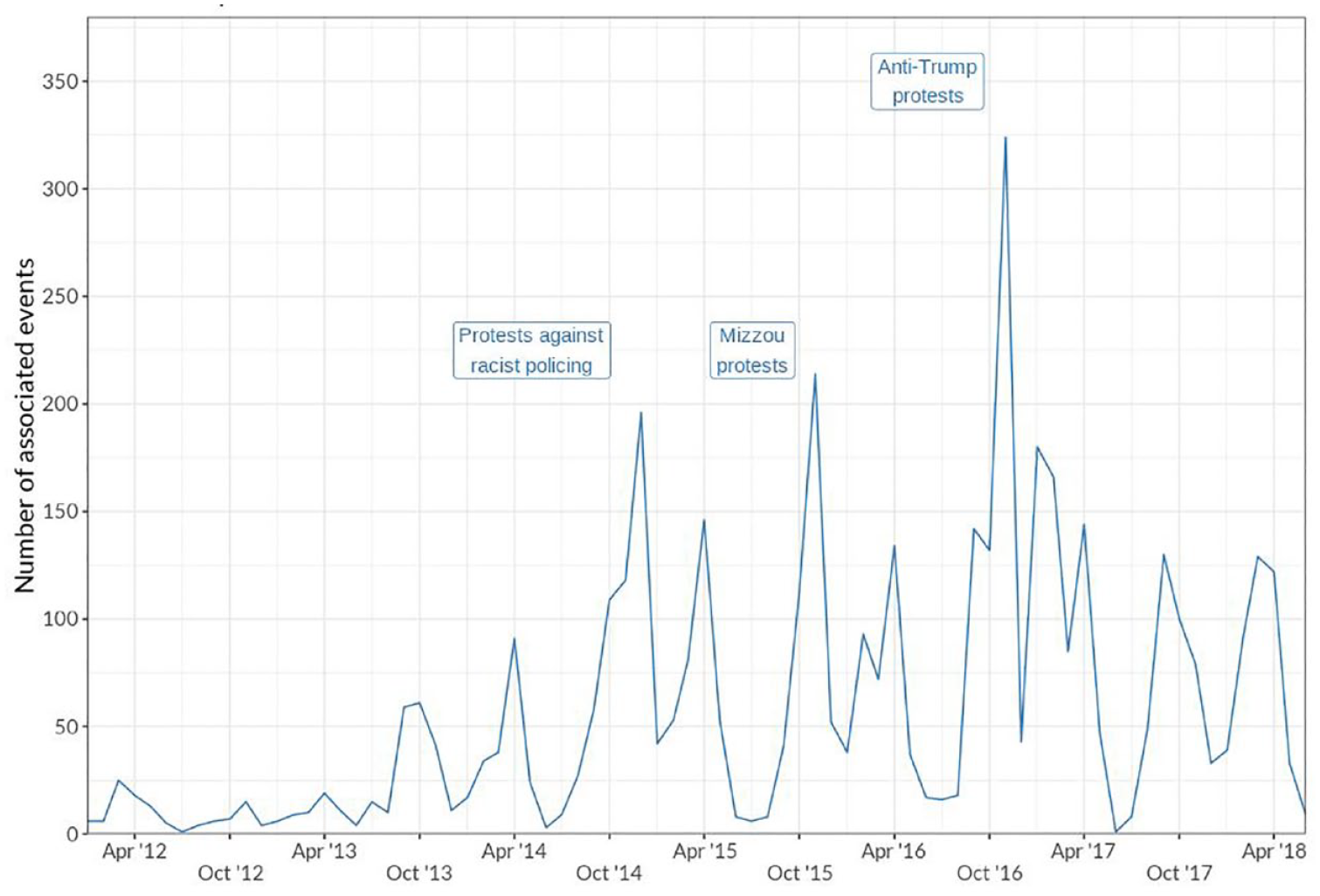
Frequency of U.S. higher education protests and major waves, January 2012 to July 2018.
Our analyses of each major wave reveal key patterns in U.S. higher education protest dynamics on some top issues. Foremost, an important dynamic is the episodic nature of higher education protests and also campus news reporting (see Figure 2). 11 Each of the three large, discernable spikes in protest volume centered a related set of issues: racist police violence (December 2014), racist campus climate (fall 2015), and opposition to newly elected president Trump, especially his immigration policy (November 2016 to spring 2017). Racialized issues were important for all three waves. Anti-Black racism was the core concern in the first two, while anti-Trump protests commonly raised the racialized issue of immigration. In addition, each U.S. wave had a national dimension and, often, a very local dimension. This was apparent in the locations of activism, the institutions that protesters contested, and protesters’ interpretations of issues, especially their understanding of racism as a systemic problem with local instantiations. Notably, each wave had connections to national movement organizing, especially the Movement for Black Lives and The Resistance.
In terms of their patterned frequency over time, these salient issues became major protest issues during particular years, seasons, months, weeks, or even days. For instance, more than half of the U.S. protests against racist police violence in our dataset happened in 2014, with most in early December. In other words, the largest U.S. higher education protest waves centered issues that tended not to be the central focus of protests in other time periods.
Next, we turn to qualitative case studies of the top U.S. waves, to understand how these general patterns played out alongside distinctive dynamics in protest and protest management.
U.S. Wave 1: Protests against Racist Police Violence, December 2014
The first major wave of U.S. higher education protests illustrates the powerful resonance of the issue of racist policing for campus communities and the importance of the Movement for Black Lives for campus activism in the 2010s. In August 2014, Michael Brown, an unarmed Black teenager, was shot and killed by Darren Wilson, a white police officer in the police department of Ferguson, Missouri. Community residents and activists protested in the streets of Ferguson, across the country, and around the world. They condemned anti-Black racism in policing and extrajudicial murders of Black people (Boyles 2019; Kudesia 2021). These protests emerged in an environment of aggressively hostile, white-dominated, and violent local police departments, documented in Ferguson by the U.S. Department of Justice, Civil Rights Division 2015), and an unresponsive legal system that prioritizes police immunity.
Ferguson marked a sea change in protest against police racism nationally and on campus, propelled in many ways by the burgeoning Movement for Black Lives. This very localized crisis exemplified systemic problems in racist policing in communities across the country. A massive wave of protests was set off on November 24, 2014, by a grand jury’s decision to not indict Wilson for Brown’s murder. By that evening, protests and rioting had returned to the streets of Ferguson and more than 170 cities across the country (“‘Hands Up, Don’t Shoot’” 2014). Elephrame data, reporting on off-campus BLM demonstrations, recorded 148 U.S. protests across 69 unique locations from November 24 to the end of the year (Elephrame 2023). This was the largest wave of Black Lives Matter protests of the decade, until the massive protests of 2020. In late 2014, additional national events brought further attention to anti-Black police violence, including the November 22 police killing of Tamir Rice, a 12-year-old child, and a grand jury decision on December 3 not to indict the white New York City police officer who killed Eric Garner.
U.S. higher education protests mirrored national trends. In the week following the Wilson nonindictment, campus members mobilized at least 79 protests. They opposed the Wilson nonindictment specifically and systemic problems of racist policing generally and also in honor of Black victims of police brutality, racism, and misogynoir (violence and racism against Black women). These protests loomed as the third largest peak of U.S. campus activism in our dataset. From November 24 to the end of 2014, there were at least 226 higher education protests opposing racist police violence in 131 distinct locations. 12 Those 226 protests constituted 83 percent of all U.S. higher education protests (272 total protests) between November 24 and December 31, 2014. This figure reflects the periodic nature of campus protest on racism in policing which, in other years in the dataset, was an issue in 3 percent to 12 percent of protests.
Participants in many higher education protests in this wave adopted similar tactics. At 79 higher education protests, participants staged “die-ins” to represent Brown’s body lying on the pavement while police prevented ambulances and medical personnel from accessing him. Protesters also chanted the “Hands up! Don’t shoot!” slogan (61 protests), which originated in the Ferguson protest, and paused for four and a half minutes in silence to represent the four and a half hours in which Brown’s body lay in the street (24 protests).
Higher education protests commonly connected the broader issue of state-sponsored police violence to local issues in their communities and on campus. For instance, a protest organized by the Tallahassee Dream Defenders at Florida State University pointed to similarities between the death of Brown and the lack of legal consequences for Wilson with local cases of police brutality in Tallahassee, such as a police officer’s recent use of a taser and violent assault against 61-year-old Viola Young (“‘Hands Up, Don’t Shoot’”, 2014). Many campus members participated in protests particular to their own professions and campuses, with their own demands expressly germane to their lives and local context. For instance, the national medical student-run organization White Coats for Black Lives arose out of the December 2014 protests and mobilized independent campus protests, including a National White Coat Die-In (White Coats for Black Lives n.d.). At least 75 medical schools participated in the movement in 2014 (Kaufman 2015), with die-in protests by medical students at Boston University, Dartmouth College, Georgetown University, and the University of Iowa. These protests connected police violence with other demands around medical racism and discrimination, such as the need for a profession dominated by privileged white doctors to act in solidarity with Black Americans (Chatlani and Constant 2015). This pattern, in which higher education protesters showed solidarity with broader movements and raised national issues while making connections to their local concerns, was common across many U.S. protests in our dataset.
Although these late 2014 higher education protests were aligned with the residents of Ferguson and contributed to Black Lives Matter protests nationwide, the second largest wave of higher education protests in the United States started close to Ferguson nearly a year later and set off a chain of protests explicitly in solidarity with a single campus.
U.S. Wave 2: Mizzou Antiracism Campaign and Solidarity Protests, October to November 2015
The second largest wave of U.S. higher education protests demonstrates local campus iterations of national movement antiracism demands as well as the nature of solidarity.
Fourteen months after the killing of Michael Brown and two hours away from Ferguson, Black student activists organized a major protest campaign to denounce racism in the campus climate and university governance at the University of Missouri-Columbia, the flagship of the public university system and known, colloquially, as “Mizzou” or MU. The Mizzou antiracism campaign was the most important wave of protests against campus racism in our study and, we suspect, the entire decade, prior to 2020. Mizzou activists centered anti-Black racism on a campus where Black students constituted 7 percent of the student population (white students were about 80 percent). The peaceful campus protests prompted high-profile resignations by top university officials and motivated students at dozens of U.S. schools and a few in Canada to post antiracism demands (Black Liberation Collective n.d.; Byrd et al. 2021; Ndemanu 2017) and served as inspiration for more than 100 protests in solidarity with the Mizzou protesters.
Hence, this fall 2015 protest wave includes the large antiracism campaign at Mizzou together with student-led protests against campus racism at universities and colleges across the United States. In this wave, student protesters yet again recognized racism as a systemic problem, with very localized manifestations at their own institutions and locally at Mizzou, as their solidarity protests recognized. And again, the protesters foregrounded problems of anti-Black racism in particular.
The Mizzou antiracism campaign spanned the 2015-16 academic school year and consisted of 21 protests led by Black students in total, with most of the protests organized between late September and mid-November. The precipitating incident for the campaign was a Facebook post by Payton Head, a Black student who was the president of the Missouri Students Association. Head described a recent incident in which a white passenger in a pickup truck repeatedly yelled the N-word at him. He also wrote of many of his other personal experiences at Mizzou, and those of other students of color, getting targeted by both “in-your-face” racism and microaggressions (Serven 2015). A series of high-profile antiracism protests at Mizzou soon followed, led by Black students with the newly formed student organization Concerned Student 1950. Their high-profile actions included a graduate student hunger strike, a multiday encampment, and a boycott by the university’s Tigers football players (Missourian Staff 2015). They targeted University of Missouri System president Tim Wolfe specifically, calling on him to address racism in the university’s institutional culture and to either be removed from his position or resign.
Protest management by university officials at Mizzou was an important dynamic in this campaign. University leaders’ responses can themselves become emergent issues in the course of a campaign, and this was true at Mizzou, most notably, following the university’s homecoming parade, where Wolfe refused to acknowledge students blockading the convertible car transporting him and the car appeared to bump into a protester (Serven and Reese 2015). Moreover, although resignations and firings of administrators and faculty members are extremely uncommon responses (reported in only 7 higher education protests in our dataset), President Wolfe and Chancellor Loftin both resigned on Monday, November 9, in response to the Mizzou campaign. The university’s governing body announced initiatives such as hiring a systemwide diversity officer, although a punitive backlash by Republican state legislators soon followed (Useem and Goldstone 2022).
In response to the Mizzou protests, the country saw a major uptick in protest mobilization against campus racism. Our dataset reports that students mobilized at least 150 antiracism protests across the country in November 2015 alone, the vast majority of which objected to racism in the campus climate, criticized university administrators’ management of race-related issues, and/or targeted the university administration. Other high-profile racist incidents and demonstrations also made headlines and fueled campus organizing, such as at Yale University and Ithaca College.
Solidarity protest was a centerpiece of this protest wave. Our dataset contains 109 Mizzou solidarity protests during this wave, meaning protests at which participants explicitly stated or symbolized that they were in solidarity with Mizzou. 13 Most of these occurred during the week of November 9 or the following week. Many protests identified as part of the November 12 “Blackout,” called for by the Black Ivy Coalition. Some also showed solidarity for students at other universities facing similar struggles elsewhere.
Many Mizzou solidarity protests shared a distinctive pattern: participants made statements and displayed support for Mizzou while also pointing to problems on their own campuses, particularly the racial climate and the lack of university leadership, policies, and programs on racial issues. For instance, on November 12, about 200 Boston College students and some faculty members dressed in black and gathered for a demonstration at the center of campus in the rain. One student leader explained, “The Mizzou thing is not unique to that school because it’s in the south or because it’s in Missouri. We all go through this across the board at different institutions. It’s something we have been fighting for” (St. Germain 2015).
Although this protest wave centered on the higher ed environment and individual campuses specifically, the third and largest protest wave in the United States drew attention to national politics and the federal government.
U.S. Wave 3: The Resistance on Campus and Counterprotests, November 2016 to February 2017
Protests against former president Donald Trump feature as the largest wave of higher education protests in the United States in our dataset. This wave indicates the importance of national-level politics on campus, both as an issue in its own right (i.e., who leads the U.S. federal government) and as a concern that shapes local demands, which faculty, students, and staff agitate for against their universities and colleges.
Trump’s November 2016 election was the impetus for a mass oppositional social movement, sometimes known colloquially as The Resistance (e.g., Fisher 2019; Maresca and Meyer 2020). On and off campus, the movement organized in massive numbers in opposition to Trump and his policy agenda. The movement’s mobilization included mobilizations directly after election day, the 2017 Women’s March in mid-January 2017, on the day after his inauguration, with a huge march in Washington, D.C., and sister marches across the United States and around the world. With approximately 4.16 million participants in the United States alone, it was likely the largest protest up to that point in U.S. history (Chenoweth and Pressman 2017). 14 It also included protests against Executive Order 13769, the so-called Muslim ban, which would have limited entry to individuals from several Muslim-majority countries. Although united in their opposition to Trump, local mobilizations commonly focused on other specific issues, such as women’s rights, racial justice, and Trump’s brazen sexism (Fisher, Dow, and Ray 2017).
Trump’s election and presidency became the impetus for intense mass protest mobilization on university and college campuses, as well. Overall, between 2015 and mid-2018, our data documents 564 U.S. higher education protests opposing Trump and his administration, slightly more than 10 percent of all U.S. protests. About 70 percent of the reported anti-Trump higher education protests happened in November 2016 (the month he was elected), January 2017 (the month he was inaugurated), and in February 2017 (a period of early policy announcements). This pattern is displayed in Figure 3 (for off-campus protests in this period, see Andrews, Caren, and Browne 2018; Pressman et al. 2022)

Frequency of Trump- and immigration-related protest, November 2016 to February 2017.
For most of these protests, resisting Trump was the main issue that protesters mobilized on. This was most evident immediately following his election and again right after his inauguration. The anti-Trump higher education protests raised myriad other issues at the same time, the most salient of which was support for immigration, which featured as a main issue in 248 protests, or 44 percent of protests against Trump. Protests against Trump and his administration’s immigration policies primarily took place in late January and early February, when his administration first issued the Muslim ban on January 27, and wound down after the temporary restraining order issued by a federal court on February 9.
Notably, there is a discernible series of protests in this wave demanding that universities become sanctuary campuses. Our dataset contains 102 protests in which protesters called on university administrations to designate their universities as “sanctuary campuses” to signal support for undocumented students and to guard against anticipated attempts by the Trump administration to deport these students and their families. The majority of the sanctuary campus protests (75 [73.5 percent]) occurred between November 2016 and February 2017. Most occurred shortly after his election, concentrated on a National Day of Action on November 16, called for by Movimiento Cosecha, an immigrants’ rights organization.
The Trump presidency also was characterized by complex protest/counterprotest activity on and near campuses. Far right extremists and white supremacists also were more visible, both as protest participants and as protest issues. Between 2015 and 2018, we identify 52 pro-Trump protests, the majority of which (42) were counterprotests to anti-Trump events. We counted five counterprotests specifically to the sanctuary campus protests noted earlier. White supremacist political activism skyrocketed on university and college campuses following the Trump election. This activity tended to take the form of racist propaganda such as flyers, posters, and banners and statements, rather than protest events (Garces et al. 2022). Nonetheless, there were some organized white supremacist and far-right higher education protests. The most high-profile of these was the march through the University of Virginia in August 2017, on the day before the white supremacist Unite the Right rally in Charlottesville, Virginia. Such events exemplify the increasingly frequent and often violent face-offs between protesters and counterprotesters during the Trump presidency, which often were accompanied by greater police presence and engagement (e.g., Wood 2020).
While U.S. higher education protests often took the character of off-campus protests against racism and federal level policy, Canadian higher education protests centered more uniquely around labor and work, the economy, and inequality. Likewise, the U.S. protest had a national dimension, either by virtue of their substantive concerns (i.e., the presidential election) or as local but systemic problems that were protested in locations across the country (e.g., police brutality). Meanwhile, Canadian higher education protests were distinctly provincial or local.
The Issues That Animate Canadian Higher Education Protest
In the 2010s, Canadian higher education protests centered on a variety of protest issues, but two sets of issues received the most attention. University administration and governance was the top issue for Canadian higher ed movements, raised in 34.5 percent of the Canadian protests (see Table 3), as in the United States. Economic security was the other major concern. Activists on Canadian campuses protested economic issues across multiple fronts: the rising cost of higher education through tuition and fee increases (30 percent of Canadian higher education protests); labor and work issues such as wages, working conditions, and unionization drives by campus workers (19.9 percent); public funding for higher education (9.2 percent); and broad concerns with the economy and inequality (9 percent).
Top 15 Canadian Higher Education Protest Issues.

Note: BDS = Boycott, Divestment, Sanctions.
Antiracist issues received attention in 11.7 percent of Canadian higher education protests. Top racialized concerns were Indigenous issues (5.2 percent), such as opposing pipeline construction on Indigenous lands, and support for Palestine and the Boycott, Divestment, Sanctions movement against Israel’s settler-colonial system of apartheid (2.9 percent). Compared with the United States, few campus protests in Canada opposed Trump or police violence (although racist policing had long been resisted by Black and Indigenous communities; e.g., Maynard 2017).
Frequency of Canadian Higher Education Protest and Major Waves
Figure 4 displays the frequency of Canadian higher education protests between January 2012 and July 2018, with two waves labeled. The largest singular wave of protest was, without comparison, the massive university student strikes and protests in Québec opposing a provincial-wide increase in tuition fees in early 2012. The second peak in protest frequency, in winter 2015, was driven by two distinct campaigns. One was an ongoing campaign in Québec against government austerity measures. The other, which we focus on in our discussion of wave 2, was a series of labor actions by unionized graduate students and other academic workers in Toronto.

Frequency of Canadian higher education protest events, January 2012 to July 2018.
The first peak in protest frequency in Canada, at the beginning of the decade, coincided with off-campus progressive and anti-colonial movement activism globally and activism across the country concerned with economic inequality and government policy. The student strike campaign in Québec was dubbed by some as Printemps érable, or Maple Spring, referencing the Arab Spring of antigovernment protest throughout the Middle East and North Africa in 2010 and 2011 (Bégin-Caouette and Jones 2014). In Canada, national and international movement organizing contributed to a climate of progressive politics at this time. Both the protests against the 2010 G20 Summit in Toronto and the Occupy protests in fall 2011 in Québec (which identified with the summer 2011 occupation of Madrid’s Puerta del Sol public square) opposed inequality and the concentration of power in the global financial system (Bonin 2016; Drainville 2013). The Indigenous Idle No More movement (https://idlenomore.ca), which began in late 2012, mobilized for Indigenous sovereignty and environmental justice in response to the Canadian federal government’s Bill C-45.
The 2012 protest wave and two campaigns in winter 2015 illustrate important protest dynamics in Canada, all made evident by the scale and scope of our dataset. First, higher education protest politics in Canada on the top issues of economic security are highly provincialized. This is to be expected, given that higher education is overwhelmingly public in Canada and is funded and governed by provincial governments. All three of the campaigns in this period addressed student-centered concerns about the cost of higher education in the context of austerity and economic insecurity. The Toronto union actions also included calls for higher wages on campus and stronger workplace protections, reflecting student protesters’ status as simultaneously students and workers.
Second, the scale of protest in Canada was enabled by coordinated, multiuniversity campaigns led by formal organizations representing campus members. The student associations and federations in Québec are not labor unions but are modeled after a labor union structure (Bass 2024). Although the unionization rate in Canada has fallen since the 1980s (Statistics Canada 2022), overall union density nonetheless remains at a little more than 28 percent, three times that of the United States (Eidlin 2018). Third, through the 2012 Québec protests specifically, our data on police responses to protest allows us to understand a case of aggressive, often violent police responses to coordinated protest action. It is also a case in which the violent brutality by police itself became an issue of more protests, which gives us insight into the repression-protest nexus in the campus context (Earl 2011).
Canada Wave 1: Québec 2012 Strike against Tuition Increases
The largest wave of Canadian higher education protests indicates the strength of formal student organizations in Québec, broad concerns about economic security, and the provincial nature of Canadian higher education politics. It also illustrates a major government effort, vis-a-vis police and legislation, to repress mass democratic protest.
Between November 2011 and September 2012, university and college students across Québec mobilized against the Liberal provincial government’s plan to increase tuition at public colleges and universities by 75 percent over five years: $325 CAD per year or $1,625 total. Hundreds of thousands of protesters participated during the peak period that spring in what student activists described as a “strike” (Bass 2024). Organized through the province’s student associations, the “general strike” began on February 13, 2012. Students walked out of classes, picketed, and flooded city streets with marches and rallies for months. Movement leaders understood the tuition increase as fiscal austerity in the service of corporatized neoliberalism (Pineault 2012). Some protesters raised additional issues of austerity, including student debt, privatization of public services, and the need for free tuition. Additional concerns with policing emerged as the strike was met with extreme policing tactics, government repression, and condemnation by university administrators. Ultimately, the student movement achieved their goal of stopping tuition increases indirectly through provincial elections (Robbins-Kanter and Troup 2018). In September 2012, the new Parti Québecois government temporarily froze tuition, while maintaining a $39 million student aid increase. The outcome was tenuous, however. The government later indexed tuition to inflation, which many critics perceived as a disguised hike, prompting ongoing protests.
The province’s extensive organization of representative student associations and federations enabled the scale of the 2012 demonstrations. It was also through these organizations that the student activists formally negotiated with the government. Indeed, these organizations are essential to the province’s history and strong culture of mass student strikes, dating to 1968 (Bass 2024). Depending on the university or college, they represent students at the entire institution, a faculty, or specific programs and departments. The Coalition large de l’Association pour une solidarité syndicale étudiante (CLASSE), the most radical of the federations, was central to defining the strike’s objectives and mobilizing its largest protests (Pineault 2012). Student association members voted on strike mandates over seven months, with weekly votes in general assemblies. By late March, about 300,000 students, or roughly three-fourths of Québec’s university and college students, were striking (Bégin-Caouette and Jones 2014).
Protesters mobilized through the streets of Montréal in massive numbers. More than 200,000 protesters attended each of the four major monthly protests, and thousands took part in nightly marches in May and June (Pineault 2012). Student associations and federations across different institutions coordinated most events, with CLASSE sustaining long-term mobilization.
Although the demonstrations started peacefully, local and provincial government sought to quell the strike protesters. The municipal police presence was heavy and often highly repressive, with many officers in riot gear. Police were involved in almost 40 percent of these strike protests, compared with about 24 percent of Canadian higher education protests in our dataset.
Extreme policing was reported at 17 percent of the Québec 2012 strike protests, compared with 1.6 percent of all higher education protests. Police used concussion grenades, tear gas, rubber bullets, and “kettling” tactics to make mass arrests. On February 23, upward of 20 police vehicles—including a riot police van, an ambulance, and a helicopter flying overhead—trailed a march of approximately 15,000 through Montréal. After the march, SWAT vans and upward of 75 provincial police officers confronted one of many splinter protests. With shields raised and batons in hand, police shoved forcefully into the crowd and shot pepper spray.
Although this aggressive police response is an outlier in our dataset, it aligns with research showing student activists, even when peaceful, often face more police force, violence, and repression (Feinberg and Salehyan 2023). Extreme policing is common in Québec, where police historically have repressed protest, acted violently toward civilians, and profiled Indigenous, Black, Arab, and Latinx civilians (e.g., Armony, Hassaoui, and Mulone 2019).
When the provincial government passed Bill 78 in mid-May, it enabled even greater police violence and repression of street protest. The temporary legislation criminalized protest with provisions of questionable constitutionality by adding strict rules limiting public demonstrations. Police quickly declared many strike protests illegal, yet protesters often resisted. Because the legislation required organizers of demonstrations of 50 or more to notify police, a May 22 march with more than 250,000 participants was described by some supporters as the largest act of civil disobedience in Canadian history (Pool 2012).
In late 2014 and early 2015, there were echoes of the 2012 strike when Québecois students and community members mobilized antiausterity protests. After the provincial government introduced austerity measures, a newly formed student coalition called Comité Printemps 2015 (Spring Committee 2015) collaborated with off-campus organizations also concerned with economic security and led a significant campaign that peaked in spring 2015 (Morris 2019; Sadikov 2015).
Meanwhile, another major throughline of Canadian campus protest simultaneously focused on union activism in Ontario. We elaborate this activism next to highlight the distinctive protest dynamics in a union strike over labor issues, given both the importance of unions in Canadian higher education protest and the salience of labor issues.
Canada Wave 2: Toronto Academic Workers Strikes, Winter 2015
Union strikes led by graduate students and other academic workers in Toronto in early 2015, further illustrates how higher education politics around economic security are provincialized or localized and tied to formal organizations. In this campaign, graduate student workers—who were, at once, employees and students—connected issues of higher education costs and issues of labor and work within universities.
In the winter semester of 2015, two month-long union strikes were organized by large numbers of academic workers at University of Toronto and York University, both major public universities with campuses in and around Toronto, as part of the Canadian Union of Public Employees (CUPE; pronounced cue-pee). As the largest union in Canada, CUPE’s formal organization allowed sustained mobilization, coordination, and solidarity within and across the CUPE unions, or “locals” (Canadian Union of Public Employees n.d.). Organizing for the 2015 strikes was prompted by unsuccessful negotiations with the university administrations. The strikes were the result of months of planning and campaign-building to ensure sustained participation.
The strike by CUPE 3902 Unit 1 at University of Toronto began on February 27, when members overwhelmingly voted to reject the tentative agreement reached between the university and the bargaining team. The 3902 local represented about 6,000 academic workers: teaching assistants, graduate course instructors, exam invigilators, and other graduate workers. Members then commenced picket lines across the university’s three campuses. Soon after, approximately 3,700 CUPE 3903 academic workers at York University, in three different units, began striking and picketing.
The majority of these CUPE members were graduate students, and their concerns reflected their multiple roles within universities. Most were precarious contract workers responsible for educating undergraduate students and also students facing tuition increases and rising cost of city living. The contract proposals put forward by both locals in contract negotiations with their administrations sought to address these needs, such as living wages to match inflation. Indeed, one of the union’s fundamental disagreements with the University of Toronto administration concerned graduate student funding packages, which the administration considered to be an academic, not a labor, discussion, and thus outside the purview of negotiations.
In 2015, as in prior strikes, CUPE National provided substantial organizational and financial support to both locals and their striking units in 2015. CUPE served as an institutional network across the universities, allowing worker solidarity across striking units and at least three coordinated actions that amplified the strikes. For example, the Joint Action Committee, representing the locals’ bargaining units, organized a march on March 27 that started at York University’s Glendon campus, marched toward the University of Toronto’s downtown campus, and ended with a rally at the provincial legislature building. Undergraduate students also joined picket lines and staged walkouts in solidarity (Chen 2015).
At both universities, the local union strikes led to limited yet meaningful gains in their new collective agreements. Some gains—such as tuition-funding indexation at York, which increased graduate funding when tuition increased—recognized the academic workers’ interconnected roles as workers, students, and citizens. The multi-institutional solidarity across CUPE, protesters, and universities helped sustain mobilization and achieve these movement goals.
Conclusion
Our findings make sense of a decade of vibrant student protest in the United States and Canada, the same decade that started with a raucous Occupy Movement and closed with a racial reckoning around racist police violence and anti-Black racism sparked by the police murder of George Floyd. Given the prominent place of students and young people at the heart of progressive movements, we have given our attention to campuses and institutions of higher education. But more than that, as these institutions are continually deprived of resources, increasing numbers of teaching and administrative positions are being staffed by contingent faculty and contract staff, and debt-fueled tuition is shifting the cost burden of higher education onto the backs of students. Consequently, institutions of higher education are becoming all the more relevant as a site of politics.
The research design enables us to investigate a wide swath of institutions. Instead of focusing on a large timescale and focusing on one or two newspapers, as is common in much protest event research, we have opted to narrow in on a shorter time scale and vastly expand our sources. This enables us to examine 475 separate newspapers. This snapshot provides a richer view of the dynamics of student protest and evidence of administrative and police responses.
This research is a first glimpse of what has been a multiyear data collection, cleaning, adjudication, and documentation effort. Our innovative approach is similar to the cutting edge in protest event analysis, including the use of machine-aided coding and the efforts undertaken by the Crowd Counting Consortium (Chenoweth and Pressman 2017), as well as our focus on hundreds of local newspapers that are much more likely to capture protest events, such as that in the National Study of Protest Events (Beyerlein et al. 2018).
Protest event analysis as a process is laborious. For our study, coding and annotation were performed by dozens of RAs over thousands of hours. Much of our ability to code these protests and to write this report was facilitated by extensive documentation written and maintained by our RAs, without whom this project would not have been possible.
While activism in the 2010s has been documented by qualitative accounts of individual campaigns and movements, scholars have paid relatively little attention to student protest as a whole in the United States and Canada. We find that, although we coded more than 16,000 articles, these articles reported on slightly more than 5,500 events. We do not present results here on media attention to protests, but in preliminary calculations, media attention is not distributed equally. Some events are mentioned in dozens of news articles, while many are mentioned only in passing by student journalists in a sentence listing off many days of action. Typically, most protests are only mentioned once in a news article in our dataset, with the exception of noteworthy events like the Berkeley protests against Milo Yiannopoulos. We explore this uneven coverage in other work.
In terms of the issues animating higher education protests, a plurality of both the U.S. and Canadian protests are concerned with university administration and governance, followed by antiracism in the United States, and then labor and work in both countries. We find that although some patterns of student protest matched the ebbs and flows of popular nonstudent protest more broadly (e.g., Black Lives Matter protests concerning Wilson’s nonindictment and anti-Trump protests after his election), major student movements are notable in their own right.
Our results on the three key U.S. protest waves highlight a number of protest dynamics. Although the data do not include all the various semipublic and private organizing activities of these actors (e.g., town hall meetings, general assemblies, and organizing committee meetings), they provide insight into the timing and connections between sustained, institutionally bound campaigns. In the Mizzou case, we can identify the connections of solidarity campaigns across the country taking on their own localized issues.
One major ambiguity that our data reveal is to what coherence we can give to the notion of a “protest wave.” Although there have been theoretical formulations of what constitutes a campaign (e.g., an “episode of contention” or an “issue cluster”), it is not clear that a high frequency of events within a short time frame with common issues can be coherently discussed as a “campaign.” A prime example is the U.S. wave of post-Ferguson protests in late 2014 against racist police brutality, which involved many separate “campaigns,” each with distinct instances of police violence and demands of separate police departments. However, this mobilization also became an object of national politics and preceded the national conversation around police abolition several years later in 2020. We hope to explore this more in subsequent theoretical and empirical work.
Although our data have many virtues, clear limitations are emerging as we continue working with it. Most notably, although our articles may represent a large sample of all student newspapers, we are not able to provide detailed accounts of entire campaigns or comprehensive coverage of protests on an individual campus. In addition, our data only feature university responses as recorded at the time of protest, or, if we are fortunate, days or weeks after if the campaign and news attention lasted that long. Thus, our empirical data do not capture the most impactful strategies of protest management: structurally overlapping campus, system, and state policies and governance structures (Davis 2019) and the punitive legal authority vested in both campus and state police (Miller 2024). Going forward, we hope to supplement our data with additional information about changes to relevant university policy in reaction to student mobilization.
Building on our early findings on the Mizzou protests, we plan to examine the broader diffusion of protests across campuses. Our questions not only focus on how protests spread, but also on which campuses are more likely to hold protests based on local institutional contexts and student organizing capacity. Other future work will focus on responses by administration and police to understand institutional management of campus movements. Given our findings on the extreme policing of the 2012 Québec protests, we will zero in on differential policing strategies by campus and municipal police. This will include analyses of the mobilization of far-right extremist protest and counterprotests, and institutions’ strategies for managing those dynamics. Last, we plan to investigate claims-making contests between protesters and administrators across a broad range of protests and issues, including hate speech and free speech.
Footnotes
Funding
The author(s) disclosed receipt of the following financial support for the research, authorship, and/or publication of this article: Research support provided by the National Science Foundation (SES-2241920), Social Sciences and Humanities Research Council of Canada, the Distributed AI Research Institute (DAIR), University of Toronto, University of Toronto Jackman Humanities Institute, University of Toronto Mississauga Department of Sociology, and the Peel Social Lab.
1
French is the official language of Québec, and about three quarters of university and college students in the province attended a French-language institution in the 2010s ( ). Because of resource limitations, we omitted student newspapers for French-language institutions, including Université de Montréal and Université Laval. However, student publications for English-language institutions report on many protests involving students from across universities. These institutions are concentrated in Montréal, which had more protests than any other city in our dataset, and many of these were organized by cross-institutional coalitions.
2
Our original piloted codebook borrowed heavily from the Dynamics of Collective Action codebook (.). We updated and adapted the Dynamics of Collective Action variables and codes and formalized definitions to fit our data, time period, and research questions through a rigorous, iterative process of coding text and modifying the codebook. We recorded a methods log to track codebook changes made while coding was in process, such as the addition of issue codes for Trump. We (re)trained coders and did additional rounds of coding and data cleaning to ensure consistency in the application of all codes.
3
4
These numbers add up to only 5,494 because they exclude 24 purely virtual events that could not be tied to a single country.
5
Nearly all Canadian universities, and all in our study, are public.
6
The full list of issue categories can be found in the codebook.
7
8
Our protocol differentiated nonracialized issues from racialized issues to provide greater detail on racialized issues, which are of particular theoretical and substantive interest. However, analyzing these racialized issues separately can mask the overall importance of antiracism in higher education protest.
9
This figure does not include other protest actions involving labor unions, such as marches and rallies.
10
Because our study time frame begins in 2012, Figure 2 does not capture the U.S. Occupy Wall Street events on campus in the 2010–2011 school year, which numbered close to 200 according to previous scholarship (Asal et al. 2017; ). We expect those Occupy events would have registered in our sample as a major wave if our time period had begun in 2010.
11
However, selection bias in media coverage may contribute to this episodic pattern. News coverage of protests commonly is episodic, as well, focusing on specific protest activities and related current events, often in short news cycles (Earl et al. 2004; ).
12
13
Consulting additional sources not in the original Higher Ed Protest Events Dataset, we identified an additional 64 Mizzou solidarity protests in November and December 2015, for an estimated total of 173 Mizzou solidarity protests during those two months.
14
Citing social movement scholars and public opinion polling, the New York Times estimated that 15 to 26 million people protested for racial justice after the murder of George Floyd in the summer of 2020 (Buchanan, Bui, and Patel 2020).