




Abstract
Having a child incarcerated can take a toll on the physical, psychological, and financial well-being of mothers. These factors could, in turn, affect behavioral outcomes of mothers, such as alcohol use patterns. Some mothers might drink to cope with the experience of having a child incarcerated, but others may reduce alcohol use for various reasons. Given these uncertainties, the authors examined the association between child incarceration and maternal alcohol consumption (i.e., any use, frequency, quantity, and binge drinking). Eight waves of nationally representative data from the National Longitudinal Survey of Youth 1979 cohort were linked with the National Longitudinal Survey Children and Young Adults (n = 3,837 mothers; 678 had children incarcerated). Multilevel generalized linear regression models showed that compared with mothers with no child incarceration, mothers of ever-incarcerated children were more likely to binge drink and consume more drinks when drinking (between-person effects). In contrast, following child incarceration, women consumed alcohol less frequently and were less likely to binge drink than they were prior to experiencing child incarceration (within-person effects). Additional research should focus on mechanisms that explain these opposing associations to identify protective factors and institutional supports for women whose children have been incarcerated.
Over the past few decades, alcohol consumption among women has increased, reducing gender differences in alcohol use and misuse (Hasin, Shmulewitz, and Keyes 2019). Binge drinking among women increased approximately 14 percent across a 10-year period (Grucza et al. 2018) and alcohol-related emergency department visits have also increased over time for women (White et al. 2018). Alcohol misuse increases the risk for sexual assault, accidental injury, and motor vehicle fatality (Hingson, Zha, and White 2017; White and Hingson 2013), and alcohol consumption has been implicated in myriad diseases, including cancer and liver disease (Maddur and Shah 2020; Rehm et al. 2010; Shield, Soerjomataram, and Rehm 2016). At the same time, consuming alcohol is a central part of the daily lives and social interactions of many Americans. Alcohol consumption can enhance social connections, increase fun and enjoyment, and promote relaxation and destressing (Corbin, Morean, and Benedict 2008). Light drinkers often report better social, mental, and physical well-being than heavy drinkers and abstainers (Tucker et al. 2021), and moderate drinking among women is associated with lower mortality (Keyes et al. 2019). Taken together, these studies underscore the importance of examining multiple alcohol use indicators to accurately depict and predict women’s alcohol consumption patterns in the United States.
Roles, responsibilities, and stressors within the family context can shape the frequency and quantity of women’s alcohol consumption. Some family roles, such as marriage and parenthood, are associated with reductions in alcohol consumption (Staff et al. 2010, 2014). Conversely, stressors within the family system, such as divorce, can increase substance use (Kretsch and Harden 2014; Leonard and Eiden 2007; Staff et al. 2010). The present study adds to this literature by examining maternal alcohol use in the context of child criminal justice contact experiences. Individuals and families in the contemporary United States have lived for decades in the era of mass incarceration and the expansion of the criminal justice system. We compare the alcohol use of mothers who have ever had an incarcerated child with those who have never had an incarcerated child (between-person effects). In addition, we examine whether a mother’s alcohol use differs before and after her child is incarcerated (within-person effects). Multilevel models using data from the National Longitudinal Survey of Youth 1979 (NLSY79) cohort demonstrate opposing associations across levels. Because of selection factors, mothers who ever experienced incarceration were less likely to drink on average. However, they consumed more alcohol on occasions when they did drink compared with mothers who never had a child incarcerated (between-person effects). Yet after having a child incarcerated, mothers drank alcohol less frequently, and they were less likely to binge drink than they were prior to having their children incarcerated (within-person effects).
Life-Course Theory, Incarceration, and Maternal Well-Being
A life-course perspective (Elder 1998) provides a useful framework for understanding how incarceration affects family members’ well-being. First, the principle of time and place underscores that lives are shaped by the sociohistorical context in which they are lived. As of 2019, 1 in 40 U.S. adults, or more than 6 million people, were under some form of correctional supervision in the United States, and 8 percent of all adults have a felony conviction (Minton, Beatty, and Zeng 2021; Shannon et al. 2017). Poor families and families of color are more likely to experience incarceration. For instance, an estimated 3 percent of adults have ever been imprisoned, but 15 percent of African American men have been imprisoned (Shannon et al. 2017). Similarly, a study of jail incarceration in New York City revealed that nearly 27 percent of Black men and more than 16 percent of Latino men had been jailed by age 38, in contrast to only 3 percent of White men (Western et al. 2021).
The life-course principle of linked lives is also relevant in considering the potential consequences of family member incarceration. This principle emphasizes interdependence, calling attention to how events in the life of a child also affect the parent, and vice versa (Elder, Johnson, and Crosnoe 2003). In this context, a family member or a loved one’s contact with the criminal justice system and/or their incarceration may affect the trajectory and health behaviors of other family members. After more than 50 years of mass incarceration, family member incarceration has become commonplace in American families. Recent estimates suggest that 45 percent of Americans have ever had an immediate family member in jail or prison, and 64 percent have had any family member incarcerated (Enns et al. 2019). Sibling and parent incarceration are the most common, but 12 percent of Americans are estimated to have experienced incarceration of their children (Enns et al. 2019).
Although some families experience short-term benefits when family members are incarcerated, mostly by removing individuals who may be endangering other household members, the weight of the evidence demonstrates that parental incarceration can have deleterious impacts on spouses and children (see, e.g., Haskins 2016; Turney 2014; Turney and Goodsell 2018; Turney and Haskins 2014). As Lee and Wildeman (2021) noted, “family member incarceration may send generational ripples both down (to their children) and up (to their mothers)” (p. 279). Although covering the breadth of this research is beyond the scope of the current study, we call attention to reviews that summarize the impacts of incarceration on the health and well-being of family members (Lee and Wildeman 2021; Wildeman, Goldman, and Lee 2019; Wildeman and Lee 2021).
Child Incarceration and Maternal Alcohol Use: Between-Person Selection Factors
Because of various selection factors, mothers of children who are incarcerated may demonstrate unique alcohol use patterns. Black women and less educated women are much more likely to experience the incarceration of a child (Wildeman and Lee 2021), and extensive research has examined how these demographic factors are linked to alcohol use. Blacks abstain from alcohol use at higher rates than Whites, and during their 20s, Black women are less likely to drink heavily (Evans-Polce, Vasilenko, and Lanza 2015; Vasilenko, Evans-Polce, and Lanza 2017; Vogt Yuan 2010; Williams et al. 2018). Yet there is some evidence of a crossover in risk for substance misuse; longitudinal studies have shown that Black women drinkers are more likely to drink heavily and develop alcohol use disorder during midlife than White women drinkers (Banks and Zapolski 2018; Lui and Mulia 2018; Mulia et al. 2017, 2018). With regard to socioeconomic status (SES), research is mixed. However, some studies show that individuals of lower SES experience the greatest alcohol-related harms despite drinking alcohol at similar or lower levels than their higher SES counterparts (known as the “alcohol harm paradox”) (Collins 2016; Katikireddi et al. 2017). Importantly, race and SES are only two of many stable background factors that may influence both alcohol consumption and the likelihood of experiencing child incarceration. Parsing out these stable between-person differences using a multilevel approach allows a better understanding of how individual behaviors change in tandem with child incarceration.
Child Incarceration and Maternal Alcohol Use: Reasons for Within-Person Change
Court-mandated restrictions, physical health problems, and intentional behavior change are examples of potential reasons why child incarceration might reduce maternal alcohol use. Mothers often provide direct cash assistance to their children (Western et al. 2015) and help pay court-mandated fines after incarceration (deVuono-powell et al. 2015). These financial obligations could reduce disposable income, decreasing alcohol consumption for some women. Furthermore, the parental home is a common housing resource for individuals leaving prison (Steiner, Makarios, and Travis 2015; Visher, La Vigne, and Travis 2004; Warner and Remster 2021). Supervised release or prerelease custody policies may necessitate a court-approved housing situation, such as one that is free of alcohol and drugs. Thus, it is possible that mothers change their alcohol use behaviors because of incarceration-related fines or restrictions.
Physical health problems are another reason why child incarceration may reduce maternal alcohol use. A large body of literature demonstrates that individuals often reduce or stop drinking alcohol in response to health problems or new health conditions. This well-documented association is known as the “sick quitter” phenomenon (Dawson, Goldstein, and Grant 2013; Naimi et al. 2017; Rehm et al. 2008). It is relevant because research indicates that having a child stopped by the police as well as having an incarcerated child predicts worse overall health and more health limitations among mothers (Goldman 2019; Turney and Jackson 2021). Likewise, having an incarcerated son increased the likelihood that mothers had a health limitation that interfered with their ability to work for pay (Sirois 2020). Thus, child incarceration may negatively affect maternal health and, in turn, reduce alcohol consumption.
It is also possible that mothers may intentionally choose to change their alcohol use in response to their child’s incarceration. The societal ideal of “intensive mothering” (Hays 1996) suggests that mothers should be self-sacrificing and provide substantial care and support for their children. Drug and alcohol use conflict with the cultural expectation of what it means to be a “good mother” and substance-using mothers are aware of this stigma (Couvrette, Brochu, and Plourde 2016). Indeed, stigma itself could also result in reductions in alcohol use if stigma isolates mothers from their social group. Drinking alcohol in the United States is often socially motivated and occurs within a social context. Research has linked greater social participation with more frequent alcohol use (Vogelsang and Lariscy 2020). Thus, if child incarceration reduces social networks or going out with friends then it may also reduce alcohol use.
In contrast to the aforementioned reasons, it may be that child incarceration is associated with increases in maternal alcohol use. Having a child incarcerated may have negative impacts on maternal mental health, resulting in anxiety or depressive symptoms. Mothers often have close relationships with their children and may experience incarceration-related worries or feelings of embarrassment related to the incarceration. Previous research has shown that mothers’ parenting stress increased following their adolescent’s contact with police (Turney 2023). In addition, experiencing child incarceration was associated with symptoms of maternal depression (Goldman 2019). This is notable because a large body of literature has linked mental health problems such as depression and anxiety with alcohol misuse (Brière et al. 2014; Conner, Pinquart, and Gamble 2009). Thus, it is plausible that drinking to cope (Kenney, Anderson, and Stein 2018) might increase among mothers in response to the emotional, psychological, and social burdens associated with child incarceration.
Moderating Effects by Race and Education
The association between child incarceration and maternal alcohol use may vary depending on demographic characteristics of mothers. One plausible reason for these differential associations could be the striking variation in rates of incarceration across race and education. Certain groups are much more likely to experience family member incarceration. For instance, one study demonstrated that 63 percent of African Americans had experienced family incarceration compared with 42 percent of Whites. Likewise, 60 percent of individuals without a high school education had experienced family member incarceration compared with 30 percent of individuals with bachelor’s degrees or higher (Enns et al. 2019). When incarceration is less common in a community or group, the impacts may be especially deleterious (Turney 2017). For those at lower risk for exposure, the experience of child incarceration may be more stigmatizing or unexpected, resulting in a greater shift in social relationships or well-being. In line with this possibility, Goldman (2019) found that incarceration had a stronger negative impact on the self-rated health of White women than Black women. Another study found that the association between child incarceration and maternal health limitations were largest for mothers with higher levels of education (Sirois 2020). It is important to note, however, that the literature is mixed and other studies have found that the deleterious physical and mental health consequences associated with family member incarceration were similar across race/ethnicity and SES (Turney 2021; Turney and Jackson 2021).
The Present Study
Using nationally representative data from mothers and their children, we address three research questions related to child incarceration and maternal alcohol use: (1) Do mothers of children who have ever been incarcerated exhibit different alcohol use patterns than mothers of children who have never been incarcerated? (2) Do mothers alter their drinking behaviors when their children become incarcerated? and (3) Do the associations between child incarceration and maternal alcohol use vary by educational attainment and race? The first question examines between-person differences, or average associations over time, whereas the second question examines within-person change and disentangles the impact of stable selection factors from the estimates. Examining both within- and between-person effects as well as multiple indicators of alcohol use while using a nationally representative dataset enables us to expand understanding of women’s alcohol consumption and the social consequences of incarceration. The third research question considers the possibility that there may be distinct patterns across demographic groups; however, we consider these comparisons to be exploratory because of small sample sizes. That said, by testing interactions by maternal education and race, the findings help identify which mothers may alter their alcohol use patterns in response to their child’s incarceration.
Methods
Data and Participants
Data were drawn from two associated collections from the National Longitudinal Surveys (for an overview of the data, see https://www.bls.gov/nls/). The first dataset is the NLSY79 cohort. Participants in this nationally representative dataset were first interviewed in 1979, when they were 14 to 22 years of age. Follow-up interviews occurred annually between 1979 and 1994 and biannually between 1996 and 2020. All information about the mother, including background characteristics and alcohol use, came from these surveys. Maternal data were linked with data on children via the National Longitudinal Survey Children and Young Adults. This supplement interviewed children born to mothers in the original NLSY79 sample. When children reached age 15 or older, they entered the young adult survey. This survey began in 1994 and included information on criminal justice contact. Although information about criminal justice contact has been available since 1994, maternal alcohol use was not collected during the 1996 to 2000 interviews or in 2004 and 2016. Thus, our study drew from eight survey waves for which information on alcohol use and criminal justice contact was available (1994, 2002, 2006, 2008, 2010, 2012, 2014, and 2018). Across these years, mothers averaged 45.42 years of age (SD = 6.77 years), and children averaged 23.62 years of age (SD = 5.92 years). Table 1 presents descriptive characteristics for our analytic sample; these are discussed further in the results section.
Descriptive Statistics for All Variables.

Note: Standard deviations are presented (in parentheses) for continuous variables only.
Measures
Alcohol Use
Respondents were asked a range of questions about their alcohol use and frequency in the past month. From these, we created four indicators of alcohol use. The first is a dichotomous variable indicating any past month alcohol use (1 = yes). The second, alcohol use frequency, indicates the number of days that the participant consumed alcohol in the past month (range = 0–31). The third, heavy binge, is whether the participant reported drinking six or more drinks on one occasion in the past month (1 = yes). Finally, the number of drinks that the respondent typically consumed on drinking days in the past month was included. This variable was top-coded at eight or more drinks, a level that is twice the binge threshold for women (National Institute on Alcohol Abuse and Alcoholism 2004). Top-coding occurred on less than 1 percent of occasions.
Child Incarceration
Our focal independent variable is a dichotomous indicator of whether any of the children of a mother have been incarcerated. All available waves of data were used to create this variable including those in which substance use of mother was not asked.
Mothers were coded as having had a child incarcerated at a particular interview in one of two ways. First, children were asked if they had been sentenced to spend time in a corrections institution, like a jail, prison or a youth institution. Those mothers who never had a child report that they spent time in a correctional institution were coded 0 for all waves. Second, a residence item was taken at each survey, and respondents could indicate that their primary residence was in jail. For mothers with children who experienced either of these forms of incarceration (that is, they reported having been incarcerated or they lived in jail at the time of the survey), the measure is coded 0 in all waves before incarceration and 1 in all waves after incarceration. In this way, this variable was created as a consuming state, such that once a child was incarcerated, the mother was coded “1” for all subsequent waves. Coding incarceration in this manner, what others have called an absorbing status (Maroto 2015), is appropriate because the strain associated with family member incarceration is not temporary, but rather occurs over the long term.
Time-Invariant Covariates
We included indicators of mother’s race (White, Black, or other).
Time-Variant Covariates
Our models included various indicators that might be linked to both the likelihood of experiencing child incarceration as well as alcohol use. To capture change over time, we included an indicator of the mother’s age and a quadratic age indicator that was multiplied by 1,000 to show decimals. Educational attainment was categorized into four groups on the basis of self-reported highest grade completed: less than high school, high school degree (the referent), some college, and a bachelor’s degree or more. We also included time-varying indicators of the number of children in the household as well as dichotomous indicators of whether the mother had ever been incarcerated and whether she was married (1 = yes). Maternal employment was captured with a variable that was the percent of weeks unemployed since the last interview and maternal physical health was captured with a dichotomous indicator of whether the mother had a health limitation that interfered with her ability to work.
Analytic Strategy
Given the data structure that included up to eight waves of data (level 1) nested within mothers (level 2), we computed a series of multilevel models (Hoffman 2015; Raudenbush and Bryk 2002). This approach allowed for missing data at level 1; that is, mothers could have skipped a survey or two and still be included in the analysis. In addition, it addressed the problem of dependency in which responses from the same person tend to be more similar than responses from different people; the multilevel modeling approach handles the associated correlated residuals (Hoffman 2015; Raudenbush and Bryk 2002). We computed multilevel linear regressions and thus linear probability models for the dichotomous outcomes because of concerns about nestedness, interactions, and interpretation issues in logistic regression (Breen, Karlson, and Holm 2018; Gomila, 2021; Mood 2010). However, we computed logistic regressions for the dichotomous outcomes when requested by a reviewer, and these models are included in Appendix A. For all the models, we examined simple models (i.e., bivariate) as well as models that included all time-stable and time-varying controls (i.e., multivariate). The models that predict any alcohol use include everyone whereas the models that predict number of drinks, binge drinking, and typical drinks are limited to drinkers (i.e., those who drank in the past month in a given wave).
To understand the relationship between child incarceration and maternal alcohol use, we created indicators to disentangle the between- and within-person associations. In the level 2 equation (between-person), we included the person-level mean across all waves. Because women were coded 1 if they ever had children incarcerated, this indicator represents the percentage of all waves during which a mother had a child who had ever been incarcerated. As such, the between-person estimates allow us to compare mothers who never had children incarcerated to those mothers who did experience child incarceration. The within-person indictor captures the mother’s deviation in each wave from her overall average. Thus, it is the time-varying absorbing status of having an incarcerated child (coded 0 = no, 1 = yes) minus her between-person mean (i.e., the percentage of all waves during which she had a child ever incarcerated). Substantively, this means that the within-person estimates compare maternal alcohol use after having a child incarcerated with maternal alcohol use prior to this experience.
We also tested interactions by race and limited the sample to the two largest racial groups: Black women and White women. The small sample size of the “other” racial category, which included Hispanics, precluded testing interactions and examining within-group associations. In addition, we split the sample by comparing associations between those with a high school education or less with those with more than a high school education. The small sample size of particular groups (e.g., mothers of incarcerated children who also had four-year college degrees) interfered with our ability to test more nuanced interactions.
Results
Descriptive Associations
Table 1 presents descriptive statistics for the full sample. Given the person-year structure of the data, descriptive statistics reflect averages across all available waves of data. Thus, 10.5 percent of all observations occurred following child incarceration. Furthermore, mothers in the full sample reported past 30-day alcohol consumption in 48.6 percent of all observations. Table 2 presents the alcohol use of mothers who never experienced child incarceration and separates the pre– and post–child incarceration descriptive statistics for those who did experience child incarceration. Mothers who never had children incarcerated had consumed alcohol in 50.0 percent of the survey waves, whereas mothers who had experienced child incarceration drank on 43.5 percent of occasions prior to child incarceration and on 40.0 percent of occasions after having children incarcerated. Prior to child incarceration, mothers who drank alcohol averaged 7.3 drinking days per month, they averaged about 2.5 drinks on those days, and 32.4 percent had consumed 6 or more drinks in the past month. Following child incarceration, these mothers drank on 5.6 days per month, they averaged 2.5 drinks when they drank, and 27.5 percent had consumed 6 or more drinks on one occasion in the past month.
Descriptive Statistics Based on Incarceration History.

Note: Means and standard deviations (in parentheses) are presented.
Results for alcohol use frequency, heavy binge, and typical number of drinks are limited to respondents who report any alcohol use in a given observation. Mean comparison tests were estimated across outcomes (i.e., no child incarceration vs. before child incarceration, no child incarceration vs. after child incarceration, and before vs. after child incarceration). T tests demonstrated that all comparisons were statistically significant with one exception: mothers’ typical number of drinks did not differ before and after child incarceration. Sample sizes for mothers with no child incarceration were as follows: n = 3,159 persons and 18,242 person-years for any alcohol; n = 1,554 persons and 9,123 person-years for the alcohol consumption measures. Pre– and post–child incarceration sample sizes were as follows: n = 678 persons and 1,204 person-years for any alcohol; n = 299 who provide 524 person-years before child incarceration and 910 person-years after child incarceration for the alcohol consumption measures.
Between-Person Associations
Table 3 displays the bivariate between- and within-person associations between child incarceration and alcohol use as well as models that include time-stable and time-varying controls. The bivariate results demonstrated that on average, mothers who had incarcerated children were less likely to drink alcohol than mothers who never experienced child incarceration. However, the differences in any alcohol consumption were no longer statistically significant when controlling for demographic factors such as education. Among drinkers, mothers who had incarcerated children averaged more drinks on days that they drank alcohol and they had a higher likelihood of having consumed 6+ drinks on one occasion in the past month. This suggests that, on average, mothers of incarcerated children were more likely than mothers with no child incarceration to abstain because of selection factors; however, on occasions when they did drink, they consumed higher quantities.
Between- and Within-Person Associations between Child Incarceration and Maternal Alcohol Use.

Note: Values in parentheses are standard errors.
Results for alcohol use frequency, heavy binge, and typical number of drinks are limited to respondents who report any alcohol use in a given observation.
All models also include a measure of age squared (not displayed to conserve space).
p < .10. *p < .05. **p < .01. ***p < .001.
Within-Person Associations
Within-person associations tested whether maternal alcohol use was different before and after their children were incarcerated. The first columns examine any child incarceration and alcohol consumption; the associations did not reach statistical significance, suggesting that the likelihood of drinking alcohol was similar before and after having a child incarcerated. However, within-person findings emerged among drinkers. Following child incarceration, mothers consumed alcohol less frequently, averaged fewer drinks, and were less likely to binge drink compared with prior to their children’s incarceration. These within-person associations remained negative and statistically significant even when controlling for relevant time-varying covariates including education, marital status, employment, and health limitations. Full models suggest that among current drinkers, mothers drank alcohol on 2.3 fewer drinking days per month after their children were incarcerated compared with before. Heavy alcohol use also declined, mothers were 6.9 percentage points less likely to report a binge episode in observations following the incarceration of their children, and they consumed fewer typical drinks per episode. Thus, these data provide evidence that child incarceration is associated with small reductions in both the frequency and quantity of maternal drinking in the years following a child’s incarceration.
Sensitivity Tests
Results from logistic regression models predicting any alcohol use and binge drinking were mostly consistent with the linear probability models in terms of direction of the associations and tests of statistical significance. Appendix A presents logistic regression models for these two dichotomous outcomes.
Do Associations Differ by Maternal Education or Race?
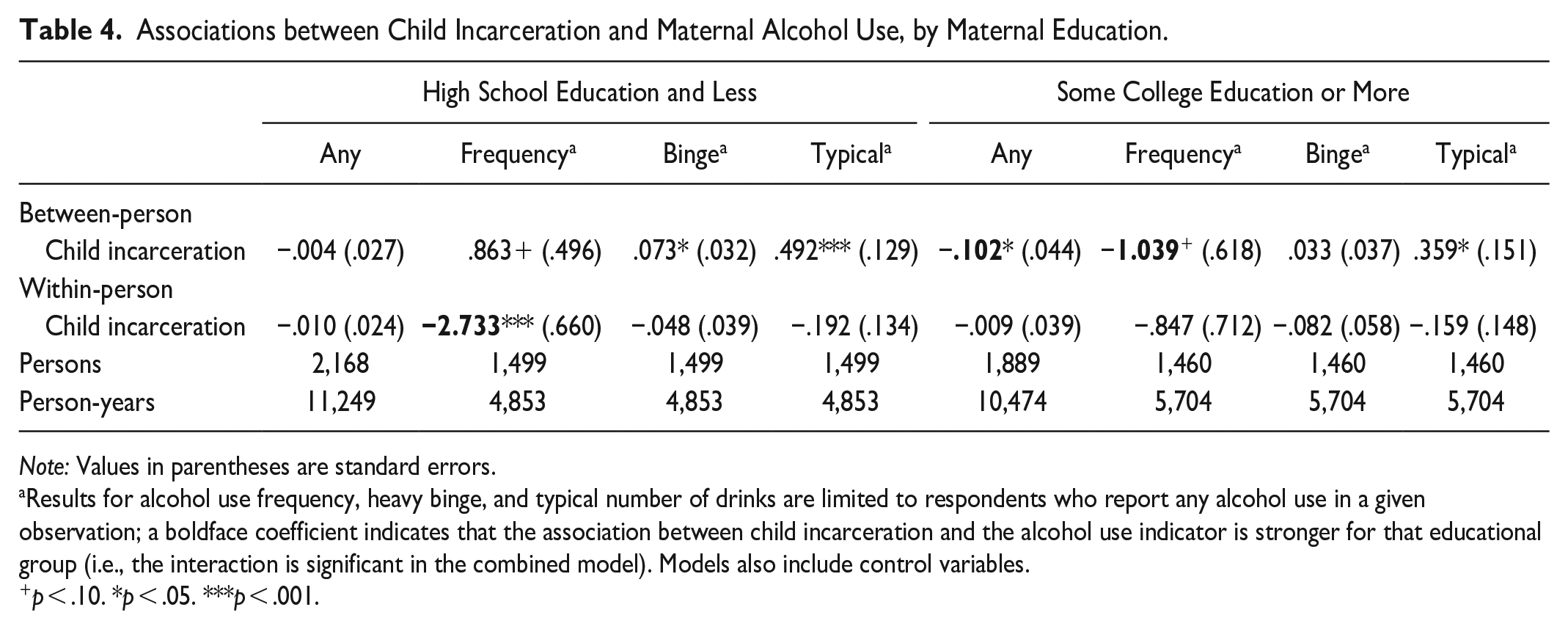
We conducted stratified models by educational attainment and race to explore whether associations diverged across groups. Results in Table 4 demonstrated that for women with more education (some college or a college degree), those who had ever experienced child incarceration were less likely to drink alcohol. Both groups reported that they consumed more drinks on occasions when they drank than their counterparts who never experienced child incarceration. For women with a high school education or less, those who experienced child incarceration were more likely to binge when they drank alcohol than those who never experienced child incarceration. For both educational groups, the direction of the within-person associations were all negative, but only one reached statistical significance. Among women with a high school education or less, mothers consumed alcohol less frequently after having children incarcerated than they did prior to experiencing child incarceration.
Associations between Child Incarceration and Maternal Alcohol Use, by Maternal Education.
Note: Values in parentheses are standard errors.
Results for alcohol use frequency, heavy binge, and typical number of drinks are limited to respondents who report any alcohol use in a given observation; a boldface coefficient indicates that the association between child incarceration and the alcohol use indicator is stronger for that educational group (i.e., the interaction is significant in the combined model). Models also include control variables.
p < .10. *p < .05. ***p < .001.
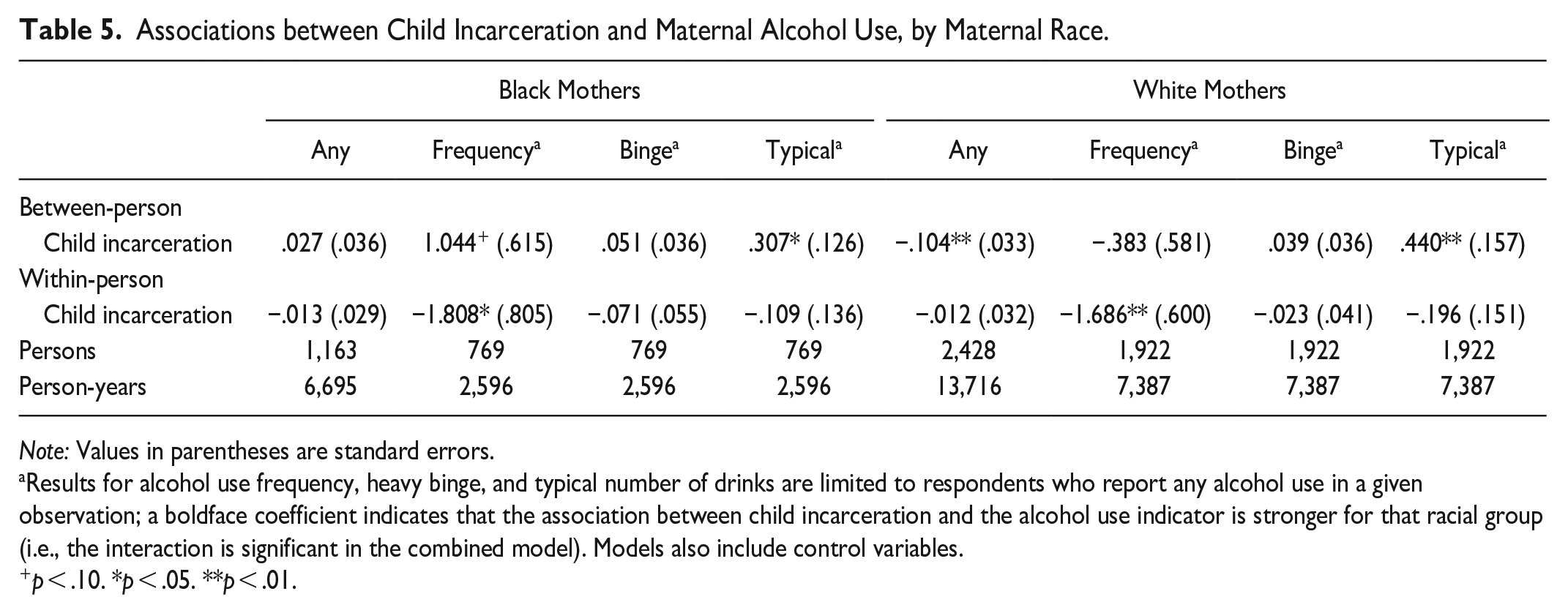
In terms of race, the results in Table 5 show that, net of control variables, White women who ever had children incarcerated were less likely to drink alcohol than White women who never had incarcerated children. Among both Black and White women who were current drinkers, those who ever had incarcerated children averaged more typical drinks than those who never had incarcerated children. The within-person coefficients were negative across all alcohol use outcomes for women of both races. However, the only association to reach statistical significance was child incarceration and alcohol use frequency. Both Black and White women drank less frequently after having children incarcerated than they did prior to having children incarcerated, even when controlling for a host of demographic, employment, and health-related factors.
Associations between Child Incarceration and Maternal Alcohol Use, by Maternal Race.
Note: Values in parentheses are standard errors.
Results for alcohol use frequency, heavy binge, and typical number of drinks are limited to respondents who report any alcohol use in a given observation; a boldface coefficient indicates that the association between child incarceration and the alcohol use indicator is stronger for that racial group (i.e., the interaction is significant in the combined model). Models also include control variables.
p < .10. *p < .05. **p < .01.
Discussion
Although prison populations have declined 11 percent from peak populations in 2009, incarceration continues to be a common feature in the lives of U.S. families. Indeed, there were 1.4 million people held in state and federal prisons in the United States in 2019, and about 600,000 individuals are released from prison each year (Carson 2020). Some estimates suggest that nearly half of all Americans have had immediate family members incarcerated (Enns et al. 2019). Research on the social consequences of mass incarceration has established that family member incarceration can have far-reaching consequences for partners and children (see Kirk and Wakefield 2018), and our study joins a growing body of research exploring the consequences of child incarceration for parents. As emphasized by the linked lives principle of the life-course framework (Elder et al. 2003), having children incarcerated and subsequently released may have wide-ranging impacts on the well-being of mothers, who often provide crucial emotional and instrumental support during this time (deVuono-powell et al. 2015). Therefore, in the present study we examined linkages between child incarceration and maternal alcohol use. Our findings demonstrated that mothers’ alcohol use patterns shifted slightly after their children were incarcerated: they drank less frequently and were less likely have six or more drinks on one occasion.
Our approach to separately model between- and within-person associations provides some insights on the differences between mothers who ever had incarcerated children and those who never had incarcerated children. The two groups had unique drinking patterns, which were partially attributable to differences in background characteristics (e.g., race, education) rather than the experience of having a child incarcerated per se. Mothers of ever-incarcerated children were more likely to abstain, but they consumed a larger number of drinks and were more likely to have six or more drinks on drinking occasions. Research demonstrates that this pattern of heavy episodic drinking is detrimental and associated with an increased likelihood of experiencing acute alcohol-related consequences (Labhart et al. 2018; White and Hingson 2013; Wilsnack et al. 2018) Thus, intervention or prevention programming could be provided to reduce heavy episodic drinking among mothers who have ever had a child in contact with the criminal justice system.
A primary goal of the study was to understand whether having a child incarcerated might shape maternal alcohol use behaviors. Our within-person findings demonstrated that child incarceration was associated with a lower frequency and quantity of alcohol consumption among mothers who drank. That is, after experiencing the incarceration of their children, mothers drank fewer days per month and were less likely to binge drink than prior to their children’s incarceration. The findings suggest that mothers’ alcohol use patterns change slightly after their children are incarcerated. These findings persisted even after controlling for maternal health limitations and maternal employment, suggesting that these factors do not explain the associations.
Although we do not know the underlying reasons for our findings, it may be that women intentionally choose to consume less alcohol after a child is incarcerated. Cultural expectations of intensive mothering (Hays 1996) suggest that mothers should be selfless and provide for all of the needs of their children. When mothers use alcohol or other substances, they may be stigmatized or feel as though they are deviating from societal expectations (Couvrette et al. 2016; valentine, Smyth, and Newland 2019). Some substance-using mothers may resist negative stereotypes or adjust their definition of a “good mother” to be included, whereas others may adjust their behaviors to better align with the cultural ideal, especially when a turning point occurs (Couvrette et al. 2016). It is possible that having a child experience criminal justice contact may act as one of these turning points, leading women to reevaluate their own lives and align their behaviors with cultural expectations.
Another possibility is that mothers are responding to external factors outside of their control. The majority of prisoners live with family members after prison (Visher, Yahner, and La Vigne 2010), and coresidence with parents is common following incarceration among children previously living independently (Warner and Remster 2021). Parents, especially mothers, provide order, emotional support, and “a refuge from the possibility of trouble outside” (Sirois 2020:846). Coresidence, however, could result in restrictions on the household, as stipulations may require that the parolee’s house be free of alcohol and other drugs and that the parolee cannot be around individuals using these substances. Thus, restrictions may compel mothers to eliminate drug and alcohol use to house their recently incarcerated children.
In addition, contact with the criminal justice system may lead mothers to fear involvement with other systems such as Child Protective Services (Goffman 2009). Research demonstrates that Child Protective Services caseworkers’ perceptions of the substance abuse of parents directly affect their decisions related to child maltreatment and removal even when adjusting for a host of risk factors (Berger et al. 2010). Because mothers often provide housing as well as emotional and financial support to their children who have been recently incarcerated, contact (or fear of contact) with court and social services may have important impacts on their behavioral choices.
Given the concentration of incarceration and other forms of criminal justice contact in disadvantaged and minority communities, we also examined heterogeneity by education and race. The most consistent within-person associations were for alcohol use frequency: mothers consumed alcohol less frequently after they had children incarcerated than they did before, regardless of race or educational level. That said, as others have pointed out (Sugie and Turney 2017), the disproportionate exposure to incarceration in disadvantaged and minority households has the potential to contribute to population-level health outcomes. For instance, one study showed that by age 50, 1 in 5 Black parents will have had children incarcerated, compared with 1 in 10 White parents (Boen, Olson, and Lee 2022). Thus, because of differential exposure, child incarceration may be more consequential for Black women at the population level, potentially leading to larger declines in drinking among this group.
Limitations and Strengths
There are some limitations that should be noted with the present study. A primary issue is that we are limited to the measures and waves available in the NLSY79. In particular, we are unable to test possible time-varying explanatory mechanisms, such as changes in mental health (e.g., depression or anxiety) or changes resulting from court-mandated substance use restrictions, because these variables either were collected at only one or two waves or not at all. In addition, although we considered incarceration an “absorbing status,” and we compared maternal alcohol use before and after child incarceration, it is also possible that the relationship between child incarceration and maternal drinking may shift over time. Some research has found evidence for this; for instance; Sirois (2020) found that a son’s incarceration negatively affects maternal health, and this harmful effect may grow over time. We do not explore this possibility in the present study because the alcohol use measures were collected periodically rather than at each wave, resulting in far fewer observations per person. Thus, this remains an important area for future research. Another limitation is that we know relatively little about the duration of the incarceration spells, because the data do not have entry or exit dates for incarceration. Thus, a child incarcerated at two consecutive waves could have been continuously incarcerated during that time or released and subsequently reincarcerated. A final limitation is that sample sizes become small for analyses that focus on group-specific comparisons among current drinkers. As a result, we reiterate that some of these results should be considered exploratory.
Nonetheless, there are some notable strengths of the present study. For instance, the use of longitudinal data as well as the rigorous methodological strategy enables us to disentangle the impacts of many time-stable selection factors that may shape the association between child incarceration and maternal alcohol use. As other scholars have argued (Wildeman and Lee 2021), although these designs cannot allow us to infer causality, they are large improvements over cross-sectional designs or approaches that cannot separate stable background factors. In addition, the sampling strategy of the NLSY79 improves confidence in the generalizability of findings in the present study, a notable strength given that convenience samples are common in the research on the impacts of incarceration on families. Furthermore, a strength of the data is its use of multiple reporters (e.g., mothers report on their alcohol use, and children report on their criminal justice contact).
Conclusion and Implications
Over the past few decades, alcohol consumption and alcohol-related harms have increased among women in the United States (Grucza et al. 2018; White 2020). Thus, it is critical to uncover the factors that lead to increasing or decreasing alcohol use among this population. Our findings demonstrate that compared with before their children were incarcerated, after child incarceration, mothers drank less frequently and were less likely to binge drink. These findings can be interpreted in a positive light; that is, there is no evidence that child incarceration is associated with increases in problematic alcohol use. Indeed, mothers may make slightly healthier choices related to alcohol use after their children have been incarcerated, a notable finding given the increases in alcohol consumption and alcohol-related deaths among women over the past few decades (Grucza et al. 2018; Spillane et al. 2020). At the same time, these mothers may be missing out on the positive benefits of light alcohol use, including enjoyment and social connections in the short term and possible physical health benefits in the long term (Corbin et al. 2008; Keyes et al. 2019; Tucker et al. 2021).
Our findings should be considered within a broader literature demonstrating that child incarceration can have various negative consequences for mothers (Goldman 2019; Jackson and Turney 2021; Sirois 2020; Turney and Jackson 2021). Previous research has demonstrated that the physical health of mothers declines and mothers’ parenting stress, psychological distress, and likelihood of depression increase when they have children in contact with the criminal justice system (Goldman 2019; Sirois 2020; Turney 2022; Turney 2023; Turney and Jackson 2021). With regard to the present findings, if the reductions in alcohol use resulted from court restrictions rather than individual choice, then the takeaway message may be different. Mothers who want to interact, spend time with, or provide housing to their children lose important autonomy if they are being expected to stop consuming a legal substance such as alcohol. Incarceration tends to be clustered in poor families and families of color, who already experience more surveillance by the state than other families. Substance use restrictions may be another way that the state can wield power over these populations. Thus, it is critical that additional research examine the reasons for alcohol use changes among mothers of incarcerated children. This research should explore the protective factors among mothers of incarcerated children and the institutional and social supports that can be provided to help these women.
Footnotes
Appendix
Multilevel Logistic Regression Models Predicting Any Alcohol Use and Heavy Binge Drinking.

| Any Alcohol | Heavy Binge a | |||
|---|---|---|---|---|
| Bivariate | Multivariate | Bivariate | Multivariate | |
| Between-person | ||||
| Child incarceration | −.944*** (.165) | −.232 (.173) | .685*** (.160) | .348* (.163) |
| Within-person | ||||
| Child incarceration | −.036 (.156) | −.155 (.160) | −.848*** (.204) | −.396+ (.205) |
| Constant | −.014 (.048) | 2.320** (.800) | −1.701*** (.049) | 4.501*** (1.005) |
| n | 21,723 | 21,723 | 10,557 | 10,557 |
Note: Values in parentheses are standard errors.
Results for heavy binge are limited to respondents who report any alcohol use in a given observation; bivariate models include no control variables; multivariate models include full set of control variables.
p < .05. ***p < .001.
