




Abstract
Incarcerated mothers typically interact with multiple government agencies on their journey into and out of prison. Each agency has its own rationale, processes, and terminology, which can lead to confusion and conflicting requirements being placed on the mother. Yet effective system navigation is the key to accessing support and services crucial to addressing the deep history of victimisation and vulnerability that many mothers in prison and their children have experienced. A knowledge of mothers’ criminal justice pathways is also important for agency staff, with many struggling to understand system complexities outside their own organisation. Improving system navigation, coordination, and integration can reduce the stress and trauma of criminal justice contacts and contribute to better outcomes for mothers and families. A threshold issue in achieving better integration is understanding how organisations are connected at a system level, rather than as a collection of stand-alone agencies. System-level approaches consider the dependencies and connections between organisations, and how they operate collectively to influence outcomes for individuals. This approach is not often applied to criminal justice agencies, despite their common designation as a “criminal justice system.” This article uses stock-and-flow modelling to capture the complexity of that system in one Australian jurisdiction. We do this by mapping how mothers move through different criminal justice agencies, and how each agency can affect mothers’ future pathways either detrimentally or beneficially. In particular, we examine the impact of different pathways on the likely connectedness between mothers and their children. By highlighting how actions and decisions taken by one agency can impact the subsequent pathways of mothers and children, we aim to better understand system complexity and how this affects individuals. Ultimately, this can lead to better coordinated responses for mothers and children, and the overcoming of system silos, complexity and fragmentation.
Introduction
Maternal incarceration has widespread impacts on mothers, their families and communities (Arditti, 2015; Lockwood et al., 2024). These impacts have been exacerbated by the recent, global growth in female incarceration rates (Fair & Walmsley, 2025). In Australia, females account for around 8% of prison populations (ABS, 2024), female incarceration rates have grown nationally by 31% over the past decade (ABS, 2024), and many women experience incarceration more than once (ABS, 2024). In addition, around one-third of women in prison have at least one dependent child, while around 72% have been pregnant at some time (AIHW, 2023). Prior research has demonstrated the complex histories of victimisation and disadvantage, and diverse support needs of incarcerated mothers and their families (Arditti, 2015; Besemer et al., 2017; Fischer et al., 2024; Lockwood et al., 2024; O’Malley et al., 2023). Addressing these needs is key to interrupting intergenerational cycles of disadvantage and offending (AHRC, 2024; Cracknell, 2021; Dominey & Gelsthorpe, 2020), by reducing the detrimental impact of maternal incarceration on children's developmental outcomes across a range of domains (Dallaire, 2007). Crucial to this is understanding how women's interactions with the criminal justice system can either exacerbate or help overcome the challenges that contribute to their ongoing criminal justice system involvement, and this is the focus of the current article.
Imprisonment is a systems-level outcome (Bernard et al., 2005; Petersen, 2022). It follows a sequence of decisions made and actions taken within criminal justice sub-systems, from police as first responders, through prosecutors, bail and court processes, to sentencing and incarceration. After prison comes either supervised or unsupervised release to the community, where in the case of re-offending or breaches of parole or bail, the process continues again. Agency actors make various decisions—such as to arrest or give a notice to appear or summons, order bail or remand, impose a community order or imprisonment, grant parole or no parole—and these often discretionary decisions shape the systemic response to individuals. For mothers, another parallel system exists around their children, which can involve child protection, schools, and other services. Decisions about mothers impact their children, and can help keep them connected or drive them apart. Most imprisoned people are also affected by multiple other systems, particularly housing, welfare, and health systems (AIHW, 2023). These various systems can help provide support, or enmesh mothers in a confusing web of officials, rules and bureaucracy.
Despite their shared interest in people alleged to have committed offences, criminal justice systems operate practically as a group of loosely related silos (Mayeux, 2018; Petersen, 2022). Police, prosecutions, courts and corrections are administered by separate agencies with their own priorities, rules and processes. While they are commonly referred to as the criminal justice system, their focus, performance targets, budgets and cultures vary significantly (Daly & Sarre, 2017). Blumstein (1967), one of the first proponents of a systems approach to criminal justice, saw these individual agencies as interconnected, with each contributing to system-level outcomes. What happens at the start of the process can affect subsequent stages, so that a mother who is arrested faces different issues than one given a notice to appear in court at a later date, particularly in her ability to make alternative arrangements for her children, housing, and employment. The existence of these arrangements can then affect bail outcomes, her sentence, and her children's custody. Much of the downstream effects are not readily apparent to the police officer deciding whether to arrest or use an alternative option. Systems approaches seek to make these effects transparent so that decision-making can be better informed and lead to better individual outcomes.
There is also a need to understand how agency decision-making about mothers affects their children. Currently, these children are largely invisible in Australia's adult criminal justice system. For example, data is not routinely collected or reported on whether a woman is a mother, how many children she has, or what their care arrangements are in Australia, nor in other countries including the United States, the United Kingdom, and the majority of European nations (COPE, 2013; Davies et al., 2022; Dennison et al., 2013; Rémond et al., 2023; Sufrin et al., 2019). This is despite the UN Bangkok Rules recommendation (Rule 3) that information about a woman's children be recorded upon her admission to prison (United Nations, 2010). Similarly, child protective services do not systematically record whether children in their systems have an incarcerated parent. Improving the visibility of children is an important step to understanding the system impacts on them of maternal incarceration.
The first step in a systems approach to maternal incarceration is to map the major components and how they interact, as Blumstein (1967) did for the U.S. criminal justice system (Mayeux, 2018; Petersen, 2022). Past efforts have focused on how offences are processed, with efficient case finalisation being the desired system outcome (Bernard et al., 2005). This article takes a different approach by focusing instead on how criminal justice agencies’ decision-making affects mothers’ system pathways and the impact of those pathways on individual outcomes. Additionally, we focus on how decision-making affects the ability of mothers to maintain contact with their children, given the research showing the importance of that contact to beneficial outcomes for children (van Meegen et al., 2024). To do this we applied stock-and-flow modelling to model common criminal justice pathways. Using this whole-of-system approach we captured the system's complexity, which enabled us to better understand how mothers interact with it, and how this impacts mothers’ ability to maintain a relationship with their children.
This article begins with a brief introduction to systems thinking, including what constitutes a system, and the purpose and strengths of this approach. We then explore system modelling and in particular stock-and-flow modelling, and how this has been applied in a range of fields, before considering its application to the criminal justice system. This is followed by a detailed description of our stock-and-flow modelling of the criminal justice system as experienced by incarcerated mothers and their children in Queensland, Australia. We then apply our model to a fictional but realistic scenario to demonstrate how it illuminates key decision points along a mother's pathway to prison, and her ability to maintain contact with her children. Lastly, we discuss our model, including its use for policy, practice and further research including in other jurisdictions, as well as its limitations.
Systems approaches
A system can be conceptualised as two or more interconnected components that function in an organised manner to achieve a particular purpose or goal (Meadows, 2008). It is the way in which these elements are organised and connected with a shared goal that makes them a system and not just a group of separate components (Skyttner, 2006). Complex systems are inherently difficult to understand, because their components can interact in a variety of ways, producing many possible interactions even in systems with relatively few components. These many interactions mean that causality does not operate in linear chains of cause and effect that can be traced back to root causes for system behaviour (Cilliers, 2005). Instead, complex systems are characterised by networks of causality, where outcomes are produced by interactions between multiple system components, and circular feedback loops where downstream components can trigger changes in upstream components, which in turn affect downstream components. Complex systems may lack clear boundaries, instead being interdependent with their environment (Meadows, 2008). Indeed, there is often no obvious way to distinguish a system from its environment, so defining a system is a provisional process that is undertaken for the purpose of analysis (Cilliers, 2005).
Deciding the “function” or “purpose” of the system is important as it becomes the organising principle for the systems analysis (Meadows, 2008). However, within systems, various components or sub-systems can have their own purposes that may coincide, align, or conflict (Meadows, 2008). Actors within each subsystem may only partially understand the overall system (Senge, 1990), and operate in a way that is rational for their own sub-system, but not for other subsystems or the system as a whole (Auerhahn, 2008). Complex systems also display emergent properties, or behaviours that cannot be located in any particular components (Byrne, 2001; Cilliers & Richardson, 2001). Rather, these behaviours emerge from the interactions between components. Given these features, complex systems often behave in ways that are surprising, counterintuitive, and resistant to straightforward explanation.
Systems thinking has emerged as an interdisciplinary approach to examining complex problems that other methods have been unable to resolve (Cabrera & Cabrera, 2023). This approach aims to simplify complexity by considering issues holistically through identifying patterns and trends over time (van der Heijden, 2022). This provides insight into the underlying structures and drivers, rather than only addressing a problem at a surface level (Cabrera & Cabrera, 2023). Within systems thinking, general systems theory is a conceptual framework that focuses on identifying a system's components and the relationships between them (Auerhahn, 2008; Senge, 1990). Modelling informed by systems thinking has been utilised across a range of complex areas, including health (Davahli et al., 2020), road safety (Salmon et al., 2016), building collapses (He & Atangana Njock, 2023), child safety (Lane et al., 2016; Munro, 2010), and public policy (van de Hejden, 2022). The aim of system modelling is to move beyond analysis of components to understand how the system functions as a whole.
Applying systems approaches to criminal justice
There have been different approaches taken to applying systems thinking and modelling to the criminal justice system. Blumstein (1967) mapped the U.S. criminal justice system to identify potential efficiency improvements and opportunities for crime reduction (see Mayeux, 2018). Chaiken et al. (1975) reviewed 46 subsequent criminal justice models from the United States and Canada, some of which modelled the overall system, whilst others modelled either the police, courts or prison subsystems including car patrol systems, police patrol beats, the generation and assignment of court cases, as well as the federal corrections system. Subsequently, Bernard et al. (2005) used general systems theory to gain insight into how the criminal justice system is structured and how it functions. Dabbaghian et al. (2014) developed a high-level model of the criminal justice system, including the police, Crown, court and corrections sub-systems, in British Columbia, Canada, as a tool to understand and predict how changes in any of these sub-systems would impact the broader criminal justice system. Police use of force in behavioural health crisis episodes in Phoenix, United States has also been examined using systems modelling (Ross et al., 2022). Mapping this part of the criminal justice system allowed the authors to illustrate system barriers that negatively impacted individual patients as well as the wider community enabling researchers, policymakers and stakeholders to explore these barriers and potential solutions.
In Australia, Halloran and Fitzgerald (2018) developed a simulation model of the New South Wales criminal justice system. This type of model helps predict the potential impacts of policy interventions and changes at a population level, or tests theories around crime and crime reduction (see Birks et al., 2012; Brantingham et al., 2012; Stewart et al., 2008). The development of the simulation model was based on a stock-and-flow system map created by Lind et al. (2001). Models developed for simulations are often based on stock-and-flow models and focus on factors such as workload volumes and policy effects, rather than individual pathways.
Our stock-and-flow model differs from prior models in that it illuminates the different pathways mothers can have through the system, the factors and system responses that contribute to those pathways, and how these pathways impact mother–child connectedness. While our long-term goal is to identify intervention points where different system decision-making could produce better outcomes for mothers and children, the focus of this article is on how we built the model. Our model is based on one Australian jurisdiction but is broadly reflective of criminal justice systems in other comparable jurisdictions with similar institutions and processes.
Model development
Since 2020, the research team has co-created and is trialling, with mothers in prison and service providers, a new model of wraparound support for incarcerated mothers and their children (Dennison et al., 2021a, 2021b, 2021c, 2022; Lockwood et al., 2024; Williams et al., 2023, 2025). Part of this support includes helping families navigate services offered by government agencies and other organisations to ensure they can access the right services when and where they are needed. However, system gaps, barriers and siloing make navigation of these services complex (Williams et al., 2025). To better understand the system as a whole and thus improve the support provided, we mapped how women move through justice processes and institutions, and how each move can affect mother–child connectedness.
To do this we applied stock-and-flow modelling (Meadows, 2008; Stroh, 2015) to represent the criminal justice system in the jurisdiction and how women move administratively and physically between agencies, locations, and legal statuses. While other methods only focus on structures, the stock-and-flow approach enabled us to explore the interaction between administrative structures and “units” subject to the influence of those structures (mothers and their children). As defined in the literature (Meadows, 2008), “stocks” are the system's foundational element and can be ascribed a numerical value. In this case, stocks are the different criminal justice agencies or phases through which individuals pass (e.g., police action, court, sentencing, prison); individuals are not stocks. The size of these stocks can fluctuate over time due to inward and outward flows (Barbrook-Johnson & Penn, 2022). Flows are the paths between stocks, and are determined by system structures (Auerhahn, 2008). For example, inflows to the prison stock result from sentences in the court stock, and outflows from the prison stock can lead to the parole stock. These flows can be affected by internal and external factors which impact the rate of change in each stock (Meadows, 2008; Stroh, 2015). Thus changed sentencing practices can increase flows to prison, which increases the numerical value of the prison stock in the model. Similarly, changed parole practices can reduce flows out of prison, also increasing the prison stock numerical value. Our model captured not just that more women are in prison, but the system-wide factors that contribute to that and how they affect individuals.
We utilised a multi-stage approach to model the system. The first stage was to identify the agencies engaging with incarcerated mothers, the factors that impact women before, during and after incarceration, and the sequencing of criminal justice processes. This information was gained from prior research and experience and reviewing earlier models of other systems (see Auerhahn, 2008; Chaiken et al., 1975; Dabbaghian et al., 2014; Halloran & Fitzgerald, 2018; Halloran et al., 2017; Lane et al., 2016; Lind et al., 2001; Ross et al., 2022). Based on this, mothers and mother–child connectedness were chosen as the primary units of analysis in our model, as doing so allowed us to consider the way the system operates to disconnect and reunify mothers and their children.
The next step was to define the boundaries of the criminal justice system for our model. The formal elements of the criminal justice system (police, courts, corrections, probation and parole) were utilised as they directly influence how women pass through the justice system. Given many other agencies (e.g., health, education, child protection) are relevant, future stages of our work will unpack points of engagement with other agencies. We determined our model should not depict a linear system with “in” and “out” points, but rather that a loop would better capture repeated system involvements. Therefore, we included “community” as a system stock, as it is the place of initial contact with police, of return post-sentence, and also of the ongoing impacts of incarceration (e.g., housing instability, poor health and income outcomes) which are risk factors for re-offending. These “invisible stripes” (LeBel, 2011) can take many forms, including stigma, trauma, and the long-lasting effects of family separation, all of which influence the likelihood that a woman will be drawn back into the formal elements of the criminal justice system (Crewe, 2015; Garland, 2013; LeBel, 2011).
The construction of the model was iterative, with a total of 15 versions produced in a process of continuous refinement. Subsidiary models of key sub-systems (e.g., courts, correctional facilities) were also produced to help unpack the complexity (these are available in the supplementary materials accompanying this article). Drawing from participatory mapping, which involves constructing causal system models through stakeholder engagement (Barbrook-Johnson & Penn, 2022), we developed the models in consultation with stakeholders from nine key agencies that interact with incarcerated mothers and their children including corrections, child protection, education, health and housing services. As noted previously, criminal justice systems are experienced as bureaucratic, confusing, and fragmented by those subject to criminal justice. Given this, while at least one stakeholder had lived experience of incarceration, our focus was primarily on professionals with insight into the structure and operation of formal elements of the system. These stakeholders reviewed multiple model iterations to check their validity and provided feedback about their potential utility for their respective agencies. The purpose of these consultations was to test the accuracy, comprehensiveness and need for the model, with stakeholders uniformly welcoming its construction.
We also developed a fictional scenario, based on real cases and drawing from other scenarios previously utilised (see Williams et al., 2023), that depicted the circumstances and pathway of an incarcerated mother and her children. The goal was to ensure that the model could be used to accurately track individual pathways through system complexity, and identify key points at which decisions taken influenced that pathway. This ensured both practical utility but also that there were no significant differences between our model and reality (Dabbaghian et al., 2014).
Results
This process resulted in a loop model broken down into four “sectors.” These four sectors represent the agencies that have the strongest impacts on how women flow through the criminal justice system. This begins in the community, where women first come to the attention of police. From this point women gradually become more embedded in the system, as they move from this contact with the police to the courts, through to sentencing, and then release back to the community again. The model identifies important stocks in this process as shown in Table 1.
Criminal justice system model sectors and stocks.
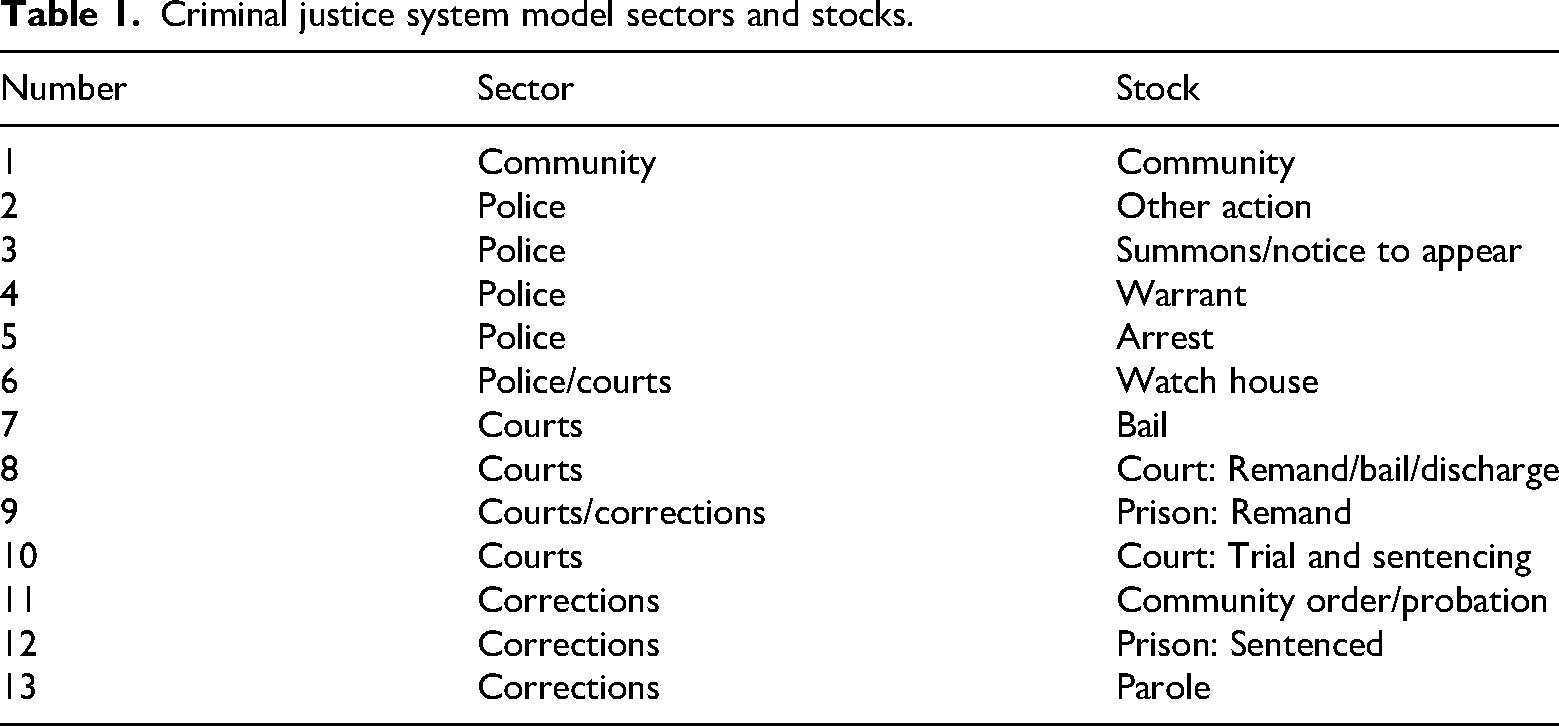
The community stock in Table 1 consists of women living in the community (either with or away from their children). It is here that they interact with the police who serve as “gatekeepers” to the following processes, and who can exercise discretion to take various types of formal and informal action which then impact what follows (Neusteter et al., 2019). These actions lead to mothers flowing to one of four stocks, which are numbered 2, 3, 4, and 5 in Table 1 and also in the model for ease of reference.
Police may decide on stock 2 “other action” which can be a caution, referral, restorative justice conferencing or informal action. The outcome of this is that the mother flows straight back to the community with minimal ongoing system contacts. Alternatively, stock 3 is a notice to appear or summons, which requires the mother to appear in court at a later date. She returns temporarily to the community, has time to arrange her affairs, but must re-enter the system at the prescribed time. If she fails to do this, or otherwise breaches an existing process, she enters stock 4, when a warrant for her arrest is issued (warrants may also be issued for breaches at other stages of the system). Stock 5 can follow a warrant, but many individuals also go direct from community (stock 1) to arrest (stock 5), as determined by police discretion. After arrest, the mother moves to police detention (the watch house [stock 6]), where an initial bail decision is made, again based on discretion. If bail is granted she moves to stock 7, and then back to the community to await the next process. If police bail is refused, she flows to stock 8 for an initial court appearance where bail may again be requested, or the charge may be finalised by either a plea or a discharge, based on the magistrate's discretion. If the matter is not finalised and bail is still refused, the mother flows to pre-trial detention or remand (stock 9). The next flow is to court for determination and sentence (stock 10), then depending on outcome, back to the community (stock 1), to the community under a supervision order (probation, stock 11) or prison (stock 12). The final flows are either directly back to the community (stock 1), or via a period of supervised parole which may be either court-ordered or determined by the parole board (stock 13).
The flows between these various stocks are illustrated in Figure 1 by arrows showing how different decisions lead to different pathways. We have identified less punitive (solid green line) and more punitive (dotted red line) flows for mothers through the criminal justice system. In comparison to the more punitive flow, the less punitive flow likely has a less adverse impact in that it reduces the time a mother spends in formal processes. Research shows that formal processes are likely to lead to poorer health, social and offending outcomes (UN Women et al., 2018). Uniquely, our model also shows flows that represent mother–child connectedness, with some patterns maintaining this and others reducing it. These flows are shown by blue (more connected) and orange (less connected) dashed lines. Our model also allows analysis of potential early exit points from the system for mothers. For example, a police officer deciding to take other action (stock 2), or a court imposing a discharge or a community-based sanction (stocks 8, 10 or 11), would each result in mothers leaving the system earlier and remaining potentially more connected to their children.
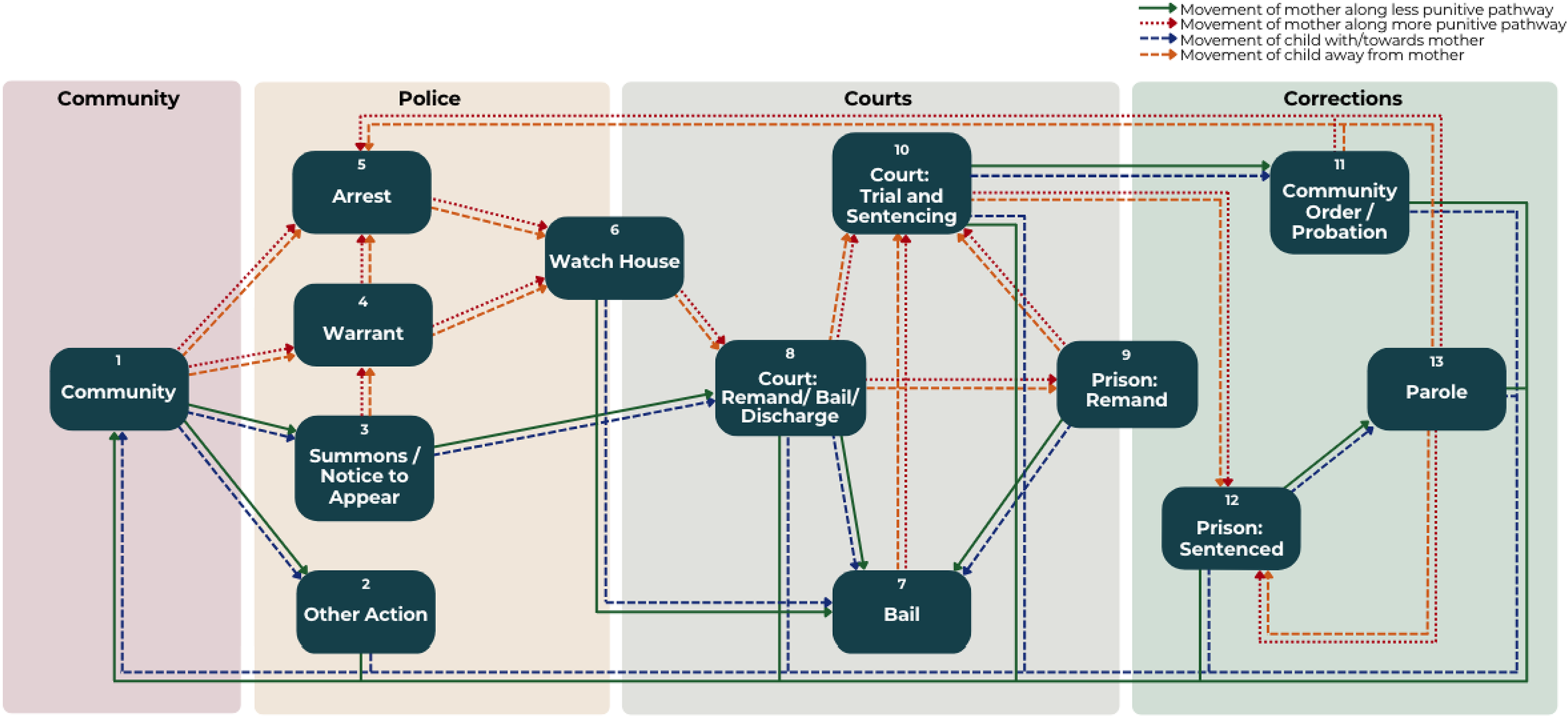
High-level stock-and-flow model of overall system for mothers engaged in the criminal justice system.
Testing the model
As outlined above, we are using our model to understand the pathways of individual families supported by our programme. To test this we adapted a fictional scenario developed as part of our earlier co-creation process (Williams et al., 2023), which drew from real events. Fictional scenarios enable effective anonymisation, and the manipulation of key characteristics to plot different pathways. This allowed us to ensure the model could capture the complexity of real-life derived examples, as well as demonstrating the utility of the model to stakeholders.
Scenario
Mary has four children aged 6, 8, 9 and 16. The children attended schools over 3 km from the family's social housing. Mary had an old car, however, it was not registered, and Mary's licence had been cancelled due to unpaid fines. Driving an unregistered car, and being unlicensed, were both offences. But to ensure the children attended school, Mary continued driving. One day while driving to drop the children off at school she was pulled over by police, charged and given a notice to appear in court. On the court date, Mary's youngest child was sick, and without anyone to care for her child she missed her court date. Consequently, a warrant was issued and police arrested Mary early the next morning. She was subsequently denied bail at both the watch house and court. The arresting officer had asked Mary if there was anyone who could care for the children. Mary was scared to tell the officer that she had no family members who could help, as she did not want child protection services to take her children. She lied and said that her cousin was coming to visit and should be there before lunch. The police notified the child protection agency of Mary's arrest, who upon attending the house and seeing that the children were alone, removed them. Mary attempted to find out about her children's wellbeing and placement whilst at the watch house and in prison on remand, but could not get any clear information. By the time she was released on probation, she had had no contact with her children for several months and did not understand the process to get back custody of her children.
Using the model to map this scenario
Figure 2 depicts a personalised version of the model, showing the stocks that directly impacted how Mary moved through the system. Mary's interaction began in stock 1 in the community when she was detected breaching vehicle and driving licence requirements (a common ″gateway″ offence leading to fines and ultimately incarceration in Australia, see ALRC, 2017). Mary was issued with a notice to appear and moved to the summons/notice to appear stock. This flow allowed Mary to remain with her children until she attended court. However, by not appearing when required, Mary moved in quick succession to the warrant and then arrest stocks. Mary then flowed through pre-trial detention in the watch house and remand stocks, which further weakened her connection with her children. This weakened connection has ongoing impacts for Mary (loss of connection to children is a risk factor for maternal recidivism and other adverse outcomes (Covington, 2007)), and for her children for whom maternal incarceration is also a known risk factor (Dallaire, 2007; Greene et al., 2000). Mary remained on remand for three months at which point she moved to the sentencing stock where she was placed on a community-based order of 6 months on probation, moving back to the community, but now completely removed from her children.
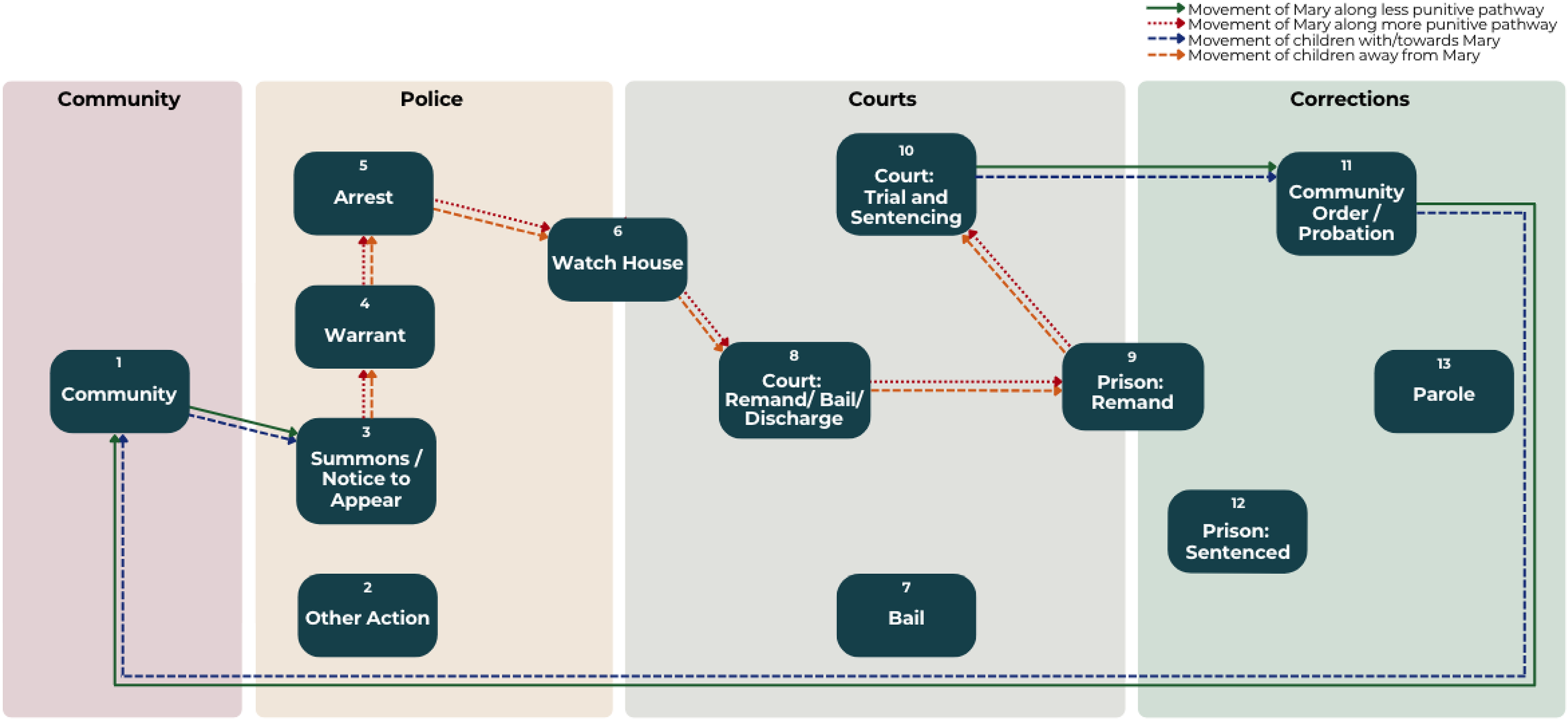
Mary's pathway through our criminal justice system model.
Mary's scenario could have developed differently had alternative decisions been made at various intervention points. For example, had she received better support in the community in stock 1, she may have been able to access assistance to pay or defer outstanding fines, or housing closer to schools. Had she been granted bail via different decisions in stocks 6 or 8, she may have been able to make alternative arrangements so her children were not left unsupervised. Had she been involved in or aware of child protection decision-making while she was on remand in stock 9, she may have been able to maintain some contact with her children with help from prison or external support services. This ongoing contact would have kept her aware of her children's placement, but may also have made reconnection with them more likely once she was released.
The mapping of Mary's scenario illustrates how flows through the system progressively and cumulatively impacted her connectedness with her children. It also draws attention to the alternative pathways that exist which could have satisfied legal and criminal justice requirements while also helping preserve the connection between mother and children. This illustrates the potential utility of a broad system model in understanding system effects as experienced by individuals.
Discussion
Stock-and-flow modelling allowed us to capture and understand the complex pathways of mothers and their children by identifying and mapping system components and their relationships. There are vast numbers of possible pathways as women can move circuitously or repeatedly through different parts of the system. The model addresses this by focusing on system structures, rather than attempting the impossible task of delineating or enumerating all of the different routes women may follow or by taking the reductive approach of grouping women with heterogenous experiences together for the purpose of analysis. Our model can accommodate all possible permutations of movements through the system, while remaining legible.
The model is useful in highlighting the way that upstream decisions shape downstream outcomes. For example, it shows how early decisions by police to make an arrest or issue a notice to appear set women on pathways toward either more or less restrictive states. The circularity of the model also highlights the ways that downstream decisions play into upstream outcomes. For example, when Mary re-entered the community, she did so separated from her children. If she was subject to subsequent criminal justice involvement, she would be at further disadvantage from her criminal history and limited contact with her children. Understanding these relationships between subsystems may assist actors within the system to understand the full consequences of their decisions and may help break down the silos that characterise criminal justice systems.
The main original contribution of our model is that it describes the way that decisions about women are decisions about children too. Each pathway sheds light on the otherwise invisible children of mothers involved in the criminal justice system. The model highlights the immediate effects of decisions, for example the decision to hold a mother on remand creates separation, while the decision to release her on bail supports connection. More importantly, each decision is positioned in the context of all other decisions. The model shows how separation can accumulate as mothers move through the system. Varying degrees of separation are not just a feature of the stock the mother finds herself in, but also the path she took to get there. For example, a woman on bail will experience greater separation if she reaches that point via a watch house than she would if she were given a notice to appear and released on bail by the court.
The model shows the flexibility of the system to separate or connect mothers and children. There are no pathways in the criminal justice system that lock mothers and children into permanent separation. For each path that moves children away from mothers, the next stock provides an opportunity to move children and mothers back together (although these subsequent movements may not fully ameliorate the separation). As such, there is capacity at every part of the system to support connection between mothers and children, and for the system to produce greater or lesser separation within its existing structure.
The model has some limitations. Like all models (Cilliers, 2005), ours is limited by deliberate decisions to focus on some things and not others. For example, our model does not include external factors that also impact the way women move through the system, including limited funding for legal support or to maintain a tenancy while in prison, or access to safe social housing to be placed on bail or receive parole. Furthermore, our model assumes that any woman can be in only one stock at any one point in time. However, in some cases, women may be involved with more than one subsystem at a time. For example, a woman can be in prison serving a sentence whilst also have outstanding charges against her that will require her to attend court. This was again a deliberate decision to produce a legible model that meets our objectives. Another limitation is that whilst we have modelled how a mother's status within the criminal justice system affects her children, we cannot comprehensively, simultaneously, model the locations of her children. Additionally, whilst we have modelled how the criminal justice system impacts mother–child connectedness using parallel flows, this is not a perfect representation of mother–child separation for justice-involved women as this is far more nuanced and complicated than can be reflected through our model. For example, a mother returning to the community will not necessarily be reunified with her children, as there are other complex family and government systems involved. However, the model does meet the purpose of capturing how decisions about mothers affect her separation from her children. Given this, our model of a criminal justice system as it relates to incarcerated mothers and their children provides a strong, useful basis that can be further utilised and developed.
Conclusions and future directions
A complete description of the criminal justice system would be too complex and detailed to be of practical use. Indeed, a truly comprehensive description would be as complex and therefore as unintelligible as the system itself (Cilliers, 2005). Previous attempts to model criminal justice systems in Australia have focused on their use as tools to quantitatively simulate the impacts of policy (Halloran et al., 2017; Halloran & Fitzgerald, 2018; Lind et al., 2001). These models have been used to make predictions but retain a high degree of complexity that make them less useful as an explanatory tool. In contrast, the aim of this study was to use stock-and-flow modelling to develop a model that would both capture the complexity of the criminal justice system in an Australian jurisdiction, and serve as an accessible tool to better understand the relationship between the system structure and the experiences of mothers and children. Rather than making mathematically derived predictions, the resulting model makes the system legible and comprehensible to practitioners, policy makers, and researchers at a holistic level. This required a clear definition of the boundaries of the criminal justice system, which for the purpose of this study included four key sectors: community, police, courts, and corrections.
Our modelling of the criminal justice system provides a basis from which the implications of changes to service provision, policy and legislation can be examined. One of the key strengths of this study is that our model focuses on mothers and their children. This unique approach allows agencies and other service providers to see their role distributed across the model, as well as how their role is interconnected with others and the impact their interactions have on mothers and their children. It also draws attention to the children of justice-involved mothers, who remain invisible to criminal justice practitioners, and how the mother–child connection is impacted as mothers move through the system. It shows that decisions about how mothers enter the criminal justice system, where they reside during prosecutions, whether they receive a custodial sentence, and the timing and circumstances of their return to the community profoundly affect children. It is hoped that this will underpin research, policy, and practice within and across police, courts, and corrections that more appropriately consider the interests of children. Recognising the role of system impacts on both mothers and their children is equally important if we are to address intergenerational cycles of disadvantage and offending (AHRC, 2024).
Our model also has policy utility in enabling criminal justice practitioners and decision makers to understand the entire process a mother experiences when they are engaged in the criminal justice system. Being able to consider the wider system at a more macro level enables practitioners and researchers to see beyond these interactions and understand how locally rational decisions contribute to undesirable and desirable dynamics across the broader system. It has the added benefit of also allowing service providers to explore and consider other points throughout the system at which they may be able to provide further assistance either directly or through liaising with other services. Policymakers can also utilise this model as a decision-making tool when implementing policies that impact incarcerated mothers and their families (Malbon & Parkhurst, 2023). Doing so would ensure they consider the wide-reaching consequences of any policies beyond their immediate purview.
Lastly, our model also opens several important lines of enquiry for future research. Firstly, while our model does not draw directly on lived experience of mothers who have been incarcerated or their children, it helps to explain those experiences by mapping out the context within which they arise. Research incorporating voices of both mothers and children would provide deeper understanding of how movement along different pathways shapes lived experiences. Secondly, administrative data can be used to measure the flows indicated in the model to understand which pathways are more common, and how movement through pathways that are more restrictive and more disruptive to connectedness can be reduced. Until data about children of people involved in criminal justice system are routinely captured by police, courts, and corrections, other data sources will be required to similarly quantify impacts on children. This may include qualitative interviews, surveys, and linked administrative data, for example, measuring movements in and out of the child protection system. The model highlights the key decision points that determine flows between stocks. Each branching point is a decision with its own local rationality and its own ecology, including decision makers, policies, processes, and resources (Auerhahn, 2008). Review of legislation, policy and practice that regulate each decision point would enable us to understand their impact on the movement of mothers through the system and the consequential separation and potential reunification of mothers and children. Thirdly, we can build up the model by mapping flows of information that constitute feedback loops, which trigger one part of the system to change in response to another part of the system (Cilliers, 2005; Meadows, 2008). Given the siloed nature of criminal justice systems (Mayeux, 2018; Petersen, 2022), information flows between subsystems are likely to be weak or absent. The aim would be to identify opportunities for patterns of undesirable downstream outcomes to trigger upstream changes. Improved understanding of how the criminal justice operates as a system can help avoid unnecessary separation between mothers and children and the detrimental outcomes that can arise from maternal incarceration.
Supplemental Material
sj-docx-1-anj-10.1177_26338076261431368 - Supplemental material for Modelling criminal justice processes and pathways for incarcerated mothers
Supplemental material, sj-docx-1-anj-10.1177_26338076261431368 for Modelling criminal justice processes and pathways for incarcerated mothers by Lorena Rivas, Brian Jenkins, Janet Ransley, Peter Martin, Tara Renae McGee and Susan Dennison in Journal of Criminology
Footnotes
Acknowledgements
This work was carried out as part of the Transforming Corrections to Transform Lives Centre ( ). The authors thank the Paul Ramsay Foundation for funding this project and the Griffith Criminology Institute for their additional support. We also acknowledge and thank the stakeholders who provided feedback on the various iterations of our model.
Ethical Considerations
There are no human participants in this article and informed consent is not required.
Consent to Participate
Not applicable.
Consent for Publication
Not applicable.
Author Contributions
Lorena Rivas: Conceptualisation; Writing- original draft; Writing- review and editing Brian Jenkins: Conceptualisation; Writing- original draft; Writing- review and editing Janet Ransley: Conceptualisation; Writing- original draft; Writing- review & editing; Funding acquisition Peter Martin: Writing- review & editing. Tara Renae McGee: Writing- review & editing; Funding acquisition Susan Dennison: Writing- review & editing; Funding acquisition
Funding
The research was funded by the Paul Ramsay Foundation (Grant No. 5090). Any opinions, findings, or conclusions expressed in this report are those of the authors and do not necessarily reflect the views of the Foundation.
Declaration of Conflicting Interests
The authors declared no potential conflicts of interest with respect to the research, authorship, and/or publication of this article.
Data Availability Statement
Not applicable.
Supplemental Material
Supplemental material for this article is available online.