




Abstract
Existing research shows that first-person narratives can reduce exclusionary attitudes against marginalized groups. In this article, we test how they might mitigate stigma against formerly incarcerated people. We outline two mechanisms: (1) signaling, wherein sharing an autobiographical narrative improves others’ perception of oneself, and (2) role-taking, wherein the content of the narrative leads the audience to see themselves in the author’s place, thereby changing their evaluation of the author. We test these mechanisms using data from a vignette-based online experiment. We examine how a sample of college students respond to a hypothetical classmate who discloses a history of incarceration. Overall, we find support for the signaling mechanism. We also find that desired social distance falls primarily because the narrative increases the classmate’s perceived warmth (e.g., sincerity, trustworthiness, friendliness, etc.). Findings suggest advocates and institutions should create opportunities to obtain and present credentials and skills that will credibly signal warmth.
Formerly incarcerated people (FIP) suffer a stigma, what Goffman (1963:5) described as “an attribute that is deeply discrediting.” An incarceration history is one such discrediting attribute that negatively impacts life chances (Pescosolido and Martin 2015). Important components of the ill repute that stigmas bring include prejudices and negative stereotypes about members of stigmatized groups. These negative perceptions then produce discrimination in the very situations that are crucial to reintegration, including employment, postsecondary education, housing, interactions with police, and the acquisition of social capital (for a review, see Kirk and Wakefield 2018). Solving the present problems of reentry means solving the problem of social stigma.
The stigma associated with incarceration is rooted in the belief that FIP are less moral than other members of society (Mikkelson and Schweitzer 2019; Overton, Fretwell, and Dum 2022). For example, when judges decide on occupational license applications from people with criminal records, they emphasize evidence that bears on the applicant’s character, such as signs of remorse or responsibility (Denver and Ewald 2018). Receiving informal help from others upon release is also highly contingent on establishing trusting relationships (Western 2018). For good reason, then, social scientists interested in promoting successful reintegration recommend helping FIP sincerely signal desistance from past criminal behavior (Bushway and Apel 2012).
In pursuit of this goal, we look to leverage the programming in prisons that facilitates and shares narrative writing. Such programs include the Minnesota Prison Writing Workshop 1 and the ID13 Prison Literacy Project. 2 Narratives that evoke sympathy for various marginalized groups can erode stigma (Kalla and Broockman 2020) and even activate a feeling of empathy in the audience (Dodell-Feder and Tamir 2018). Through exercises in role-taking, audiences identify more with the authors of such pieces. We chose higher education as the site of our intervention in part because it is prone to many of the same discriminatory practices (Stewart and Uggen 2020) and negative moral attitudes about FIP (Overton et al. 2022) found elsewhere in American society. Moreover, college is a crucial site wherein FIP enter prosocial networks and develop redemptive identities (Curtis, Evans, and Pelletier 2021) that discourage recidivism. Therefore, a successful college experience could serve as an important turning point away from criminal behavior (Sampson and Laub 1993). To guide future programming and interventions for reintegration, we seek to better understand the exact impression change mechanisms by which narratives can mitigate stigma against FIP.
This article turns specifically to a stigma management technique called “narrative humanization” (first proposed by Harper, Bartels, and Hogue 2018), wherein stigmatized people share first-person narratives. We examine how well this tactic mitigates prejudice and discrimination against FIP. By understanding the mechanics that underlie narrative humanization, we can better understand ways to mitigate stigma in general. Broadly, we expect there may be two central reasons that narrative humanization is effective. The first is signaling. Being viewed as a writer or being willing to share personal writing in front of a group might meaningfully signal that the author is prosocial or committed to conventional activities. Alternatively, the content of narrative writing may shift attitudes about the author because the audience understands or feels the author’s emotions. Such insights are important because they indicate what makes the intervention work. Knowing this tells us what other kinds of stigma management strategies—for all kinds of groups—may be effective or ineffective. Finally, we test the scope of our intervention by measuring whether exposure to writing by someone who has been to prison shifts attitudes about FIP in general. This indicates whether narrative humanization might be better characterized as a personal stigma management strategy or a basis on which to change perceptions of FIP as a category of people.
Background
The Stigma of Incarceration
When someone is convicted of a crime, they acquire a new identity representing their formal denunciation and rejection by a community (Garfinkel 1956). The roots of hostility against FIP stem from the way the state legitimizes FIP’s redefinition as “criminals” and restricts their opportunities even after the end of their sentence. Because 90 percent of incarcerated individuals are released from prison (Petersilia 2005)—448,432 people in 2022 alone (Carson 2023)—many people suffer the stigma of incarceration. Unfortunately, around 75 percent of FIP are rearrested within five years of their release (Durose, Cooper, and Snyder 2014). The stigma FIP face presents many barriers to reintegrating in a way that would prevent recidivism. In the case of housing, a not-in-my-backyard (or NIMBY) attitude toward sharing neighborhoods with FIP denies access to reliable shelter (Garland, Wodahl, and Saxon 2017), perhaps most starkly seen for those convicted of sex offenses (Dum, Socia, and Rydberg 2017).
Another key aspect of successful reentry is finding employment. For example, many states exclude FIP from certain government positions and occupational licenses, such as plumbing, care work, cosmetology, or other fields that require frequent interpersonal contact (Harris and Keller 2005; Wheelock 2005). Employers are reluctant to hire FIP, and this is particularly amplified for African American job seekers (Pager 2003; Stoll and Bushway 2008). This consigns many FIP to insecure low-wage jobs (Kirk and Wakefield 2018). Those with criminal histories also find it difficult to access social capital through informal ties and institutions. Public opinion surveys demonstrate that many members of the public desire social distance from FIP in a variety of situations (Overton et al. 2022; Simonds et al. 2021). This social distance then prevents many FIP from building relationships in prosocial networks that are central to reentry (Sampson and Laub 1993).
Returning to stigma, Goffman (1963:5) famously wrote that the public “believe[s] the person with a stigma is not quite human.” Stigma has four components: (1) the labeling of difference between humans, (2) tying negative associations to those differences, (3) a division between mainstream society and those with a stigmatizing characteristic, and (4) discrimination (Link and Phelan 2001). In this article, we draw especially on theory and research on parts 2 and 4, that is, how prejudice shapes discrimination. Research on criminal records and employment demonstrates that a criminal record raises fears of recidivism alongside stereotyping, status loss, and discrimination (Sugie, Zatz, and Augustine 2020).
In social psychology, prejudice refers to an attitudinal preference for or against members of a particular group, whereas discrimination refers to the behavioral treatment of members of one group differently than those from another group (Allport 1954). The prejudice-discrimination connection is the focus of the stereotype content model (Fiske et al. 2002). It begins with the premise that when people encounter one another, they first assess the other’s intent: Does this person have friendly or ill intent toward me (Wojciszke and Abele 2008)? Then people assess the other person’s competence: How capable is this person? These considerations give rise to the two dimensions of stereotype content: warmth and competence. Perceived threat (e.g., from competition or a clash of values) leads to the perception that members of a group are cold rather than warm. By implication, people who spent time in prison violated society’s values and are thus stereotyped as low on interpersonal warmth (Overton et al. 2022). This is especially concerning because low perceived warmth elicits feelings of contempt and physical attacks (Fiske, Harris, and Cuddy 2004). Other studies find that FIP are seen as less trustworthy (Simonds et al. 2021) and less moral than people without a record of incarceration, which, in turn, produces discriminatory behavior (Mikkelson and Schweitzer 2019).
Although the stereotype content model conceives of attributions in broad global terms, much of the criminological literature has examined more narrowly construed expectations, such as expected harm or “repetition risk”—fear that a person will commit the same crime again (Sugie et al. 2020). According to the stereotype content model (Fiske et al. 2002), these narrow expectations should be subsumed under warmth because they are all aspects of prosociality. However, when thinking about someone convicted of a crime, concerns for the safety of one’s person and property might overwhelm the more general aspects of prosociality that warmth captures. For example, a person may not care how friendly or kindhearted someone else is in general if they believe that individual is capable of attacking them under even limited circumstances. Such moral attributions are at the core of stigma against people who have spent time in prison (Mikkelson and Schweitzer 2019; Overton et al. 2022).
Several strategies exist for individuals to manage the stigma of incarceration. One is concealment. This includes trying to “pass” as someone without a criminal history (Goffman 1963) by hiding their status (LeBel 2008) or in other cases, withdrawing and avoiding social interaction (Winnick and Bodkin 2008) except with those who share or accept the stigmatized attribute (Goffman, 1963). Secrecy and withdrawal fall at the reactive end of what Siegel, Lune, and Meyer (1998:10) call the “reactive-proactive continuum” of managing stigma. However, social withdrawal may limit opportunities (Winnick and Bodkin 2008), and readily available criminal records make it easy for criminal histories to be uncovered (Lageson 2020). Because of these limitations, those with criminal histories may choose a more preemptive approach (Park and Tietjen 2021; Winnick and Bodkin 2008).
For the purpose of this study, we are interested in these preemptive approaches that involve disclosing a criminal history, called “proactive” and “intermediate” on the continuum of stigma management, or “preventative telling” (Park and Tietjen 2021). Those who take a proactive approach challenge their stigma head-on by fully and confidently disclosing their status to others (LeBel 2008), whereas more intermediate strategists selectively disclose and attempt to reduce the negative effects of stigma rather than challenge it (Harding 2003).
What is important about these strategies is that the stigmatized individual is presenting a particular version of themselves (Goffman 1959) to control the narrative around their criminal history. Such narratives can reshape a person’s understanding of their own past behavior in therapeutic ways that help them shift their self-views and control the redemptive narrative they present to others in education and employment (Hernandez, Murillo, and Britton 2022; Lindsay 2022; Maruna 2001). In the next section, we explore that second use of narratives, whose transformative power can alleviate the stigma of a criminal record.
Narrative Humanization
Because of the potential narratives hold, we turn to a stigma management technique called narrative humanization. This refers to the process by which the personal narratives of members of stigmatized groups change others’ attitudes to counteract the effects of a stigma. Harper et al. (2018:535) explain that humanization is necessary when “the targets of punitive attitudes are linguistically and euphemistically stripped of their personhood,” as is true of stigmas generally (Pescosolido and Martin 2015). Humanization can be achieved through many avenues, such as intergroup contact (Pettigrew and Tropp 2006) or the exchange of narratives between activists and members of the public that characterizes “deep canvassing” (Kalla and Broockman 2020). But what makes narrative humanization different is that it is necessarily the stigmatized individuals who are sharing the narrative.
A wide array of research speaks to the humanizing potential of narrative storytelling. Kalla and Broockman (2020) find that sharing the stories of transgender people and immigrants reduces transphobic and xenophobic attitudes. Past research has shown exposure to narrative humanization improves attitudes toward people involved with the justice system (e.g., Dum et al. 2022; Harper et al. 2018; Miner-Romanoff 2014, 2016; Wurtele 2021). The public can encounter the writing and poetry of FIP due to writing programs in prisons, such as the Minnesota Prison Writing Workshop and the ID13 Prison Literacy Project, and publications that share such writing (e.g., Poetry Magazine, and PEN America). Recently, Dum et al. (2022) found that reading humanizing poetry by incarcerated individuals decreased public stigma (negative attitudes toward FIP generally) when compared to other written information about FIP.
How Does Narrative Humanization Reduce Stigma?
To understand how narrative humanization may reduce stigma, we turn to intergroup contact theory, which predicts suggests that contact reduces prejudice against a social group (Corrigan et al. 2001; Pettigrew and Tropp 2006). Indeed, knowing those with a criminal history reduces negative attitudes toward FIP (Hirschfield and Piquero 2010) and reduces support for publicizing criminal records (Lageson, Denver, and Pickett 2019). Exposure outside face-to-face contexts also mitigates prejudice. Clement et al. (2012) found that both live and filmed social contact between student nurses and people with mental illness reduced stigmatization. Written communication and first-person narratives (Harper et al. 2018) also reduce stigma against certain groups.
To achieve an accepted self-presentation (Goffman 1959), it is likely that stigmatized individuals are sharing such positive characteristics and credentials about themselves as well as sharing stories and narratives. Therefore, we believe that narrative humanization may alleviate stigma in two ways: (1) It signals prosociality, or (2) it allows audiences to imagine and sympathize with the role of the author (i.e., role-taking). We ultimately think narrative humanization may reduce discrimination against FIP through either pathway. We now describe these two pathways and related interventions in greater detail.
Signaling
The negative stereotypes of FIP can be countered by presenting individuating information, which communicates additional knowledge about an individual that goes beyond their stereotypes (Kunda and Thagard 1996). One type of individuating information is positive signaling. Most research about positive signaling in criminal justice focuses on prison credentials and employment. Although time in prison carries a stigma, credentials such as employment history, letters of recommendation, and certificates can signal employability and desistance from criminal activity (Bushway and Apel 2012; Reich 2017). These positive credentials can mitigate stigma from a criminal record (DeWitt and Denver 2020) by acting as “disidentifiers,” which allow “applicants with criminal records to appear more credible, defy criminal stereotypes, and signal positive information” (Lindsay 2022:459).
Although certain prison credentials can be positive signals, Bushway and Apel (2012) also argue that individuals may signal desistance from crime by displaying behavior or characteristics that others consider to be prosocial—opposed to criminality. As Denver and Ewald (2018) explain in their analysis of judicial comments on former offenders’ applications for occupational licenses, judges were most concerned with the morality of the applicant and looked for indicators of conventional commitments. For example, one wrote, The applicant testified credibly that he is a committed parent and family man, and his life since he was released from prison reflects that dedication. The applicant actively engages in his children’s upbringing and is motivated to seek full-time employment so that he may set a good example for them. (Denver and Ewald 2018:728)
In this way, a variety of prosocial characteristics (e.g., being a good father) become a positive credential and signal desistance. During the process of narrative humanization, a stigmatized person can proactively present positive characteristics and credentials. Therefore, we believe that narrative humanization of FIP may alleviate stigma by simply signaling that a person is prosocial.
Role-taking
If the content of narratives is important, we would expect its impact to be felt because it leads to role-taking, when a person imagines themselves in another’s position (Davis and Love 2017). As a foundation of prosocial behavior and coordination, role-taking enables people to inhabit the point of view of another (Mead 1934). In our case, this entails understanding the plight of another person. Role-taking in this way may occur via empathy (sharing the feelings of another) and perspective-taking (determining what someone thinks or feels; Davis and Love 2017). Indeed, prior research finds that activating perspective-taking (Ahn, Le, and Bailenson 2013; Weyant 2007) and empathy (Whitford and Emerson 2019) can reduce prejudice and negative stereotyping against a wide variety of social groups.
As to narratives generally, research suggests that these increase empathic responses. A meta-analysis of experimental evidence showed that reading fictional stories increases the experience of empathy and other prosocial emotional states (Dodell-Feder and Tamir 2018), although the original finding on this question was subject to some debate (Kidd and Castano 2013; Panero et al. 2016). Narratives are also promising because they are among the most effective ways to reduce prejudice against members of marginalized groups in general (e.g., Kalla and Broockman 2020). Consequently, the narrative of someone who has been to prison may mitigate stigma by calling out an empathic or understanding response in the audience.
To determine how narrative humanization shapes prejudice and discrimination, we use an online survey experiment to explore the effects of narratives written by FIP. Building on the emerging literature on narrative humanization, we address the following research questions:
Research Question 1: Does consuming humanizing narratives (poetry) authored by a formerly incarcerated student reduce a respondent’s negative impressions of FIP?
Research Question 2: What are the mechanisms by which such narratives affect social exclusion?
Research Question 2a: Do narratives operate through signaling by changing perceptions of prosociality alone?
Research Question 2b: Do narratives operate by activating role-taking processes that allow people to better understand the author?
Our findings show whether and why narrative humanization succeeds and what other interventions and strategies can improve attitudes toward FIP. The present study examines how college students react to a hypothetical classmate who does or does not disclose a history of incarceration. We focus on college students because education plays a crucial role in successful reentry (Lockwood et al. 2012), reducing recidivism (Halkovic 2014), and enhancing upward mobility (The Pew Charitable Trusts 2010). Recently, colleges have received an influx of students with criminal histories due in part to increased access to Pell Grants and other attempts to make higher education more accessible (Anderson et al. 2024). However, college students with incarceration histories face substantial stigmatization during the application process (Binnall et al. 2022) and from others once they are on campus (Copenhaver, Edwards-Willey, and Byers 2007; Halkovic and Greene 2015). In the past, Overton et al. (2022) found that perceived warmth reduced social exclusion against FIP among college students. Therefore, effectively reducing discrimination may help formerly incarcerated students form ties on campus and therefore persist in college and accrue the benefits of education.
Furthermore, colleges offer several contexts where students encounter people of many social backgrounds. Students learn, live, and work on campus. These contexts vary in the closeness of interaction, allowing us to determine if effects of narrative humanization are limited to only a few types of social situations. Whereas sharing a personal narrative with a conventional coworker or a neighbor might seem inappropriate, a classroom or performance is the kind of place where personal narratives might be appropriately shared. Therefore, these situations provide a variety of useful and appropriate interactions to study.
Methods
This study uses a vignette-based survey experiment to examine how narrative humanization intervenes in the stigma process. Because this demonstrates how attitudes shift in response to controlled sets of contextual stimuli, it is the ideal use of vignette experiments (Mutz 2011). In our case, those stimuli are a target person’s incarceration status and an instance of narrative humanization (poetry). Our approach is ideal because it bypasses a common problem with facilitating intergroup contact in natural settings: Is contact related to prejudice because contact reduces prejudice or because prejudice reduces contact (Pettigrew and Tropp 2006)? Random assignment ensures people with preexisting prejudices are equally likely to read about the target with an incarceration history as they are to read about the target with no time in prison (our comparison group). In this way, we can be sure that different outcomes between levels of the independent variable do not owe to reverse causality or omitted variable bias.
Our vignette experiment was conducted on Amazon Mechanical Turk (MTurk). From April 13 to May 31, 2020, 1,200 MTurk workers completed our study. 3 Eligible participants had to be enrolled in a face-to-face undergraduate-level course at the start of the Spring 2020 semester. Although MTurk is a widely accepted source of data in the social sciences (for an in-depth review, see Litman and Robinson 2021), precautions are necessary to guarantee data quality. We describe these, randomization checks, and other diagnostics in Supplement A in the supplemental material.
Design
In the study, participants read a vignette about a classmate (henceforth, the “target” student) who introduced themselves in a college writing course. The experiment used a 2 × 3 factorial design, summarized in Table 1. Respondents were randomly assigned to see one of these six conditions. The first factor, incarceration record, has two levels. Either the target student discloses that they spent time in prison for committing a felony or this classmate says nothing about prison or a felony (the “generic student”). The second factor, poetry, was manipulated by having the target (1) simply introduce themselves, (2) introduce themselves with a poem but where the participant did not see the text of the poem, or (3) introduce themselves with a poem where the participant saw the actual text of the poem. 4 This approach allows us to examine whether and how our intervention shapes impressions of someone who spent time in prison relative to a peer without prison experience. For the exact text of each vignette, see Supplement B in the supplemental material.
Factorial Design.

Note: Participants were randomly assigned to one of these six experimental conditions. N = 200 in each condition.
The design also allows us to separate the mere fact of having read poetry to the class from actual exposure to the poem’s content. In other words, we will know whether a change in attitudes was driven by mere signaling (what matters is that this person shared a poem) or by role-taking with the author (what matters are the words of the poem). This would show precisely if the poetry intervention worked and if so, why it worked. Such insight will help determine what kinds of interventions are necessary to reduce social exclusion against stigmatized groups more generally.
After participants consented to participate in the study and indicated they were eligible, they were randomly assigned to read one of six possible vignettes based on the manipulations summarized in Table 1. After reading the vignette, participants answered several questions about their feelings about and perceptions of the student from the vignette and concluded by providing basic demographic information. The average participant finished the study in 11 minutes and 21 seconds. Participants received $1.25 in exchange for their response.
Measures
For all measures described below, question wording and the labels on five-point Likert responses are reported in Supplement B of the supplemental material.
Desired social distance
Our main outcome measure of interest is discrimination against stigmatized individuals. We asked respondents about different situations in which they would be comfortable interacting with the student described in the vignette. These questions are rephrased from the classic Bogardus (1926) social distance scale to ask about the target student in contexts relevant to college. Scale reliability was exceptionally strong (α = .96).
Empathy and perspective-taking
To measure immediate reactions to the target (the student described in the vignette), we used the Adapted Interpersonal Reactivity Index (Neuman 2017). The index contains measures of empathy (α = .81) and perspective-taking (α = .76). If the content of poetry indeed has unique humanizing effects (in line with the role-taking mechanism), we should expect reading the poem to evoke both higher perspective-taking and empathy with the target.
Perceived warmth
Should signaling be the primary mechanism of narrative humanization, we would expect a change in perceived morality. Our first measure of perceived morality is warmth from the stereotype content model (Fiske et al. 2002), which exhibited acceptable reliability (α = .84). 5
Moralization of Everyday Life Scale
Our other measures of perceived morality come from the Moralization of Everyday Life Scale (Lovett, Jordan, and Wiltermuth 2012). These questions deal with subsets of expected moral behaviors that may be more relevant when judging someone who has committed a crime in the past (reflecting concerns about recidivism). Participants were asked about how much they expected the target described in the vignette to be deceptive (α = .87), harm others (α = .86), and fail to be moral (α = .86). 6
Incarceration stigma
To test the scope of our intervention, we want to see if a humanizing narrative might generalize beyond the formerly incarcerated target reading a poem to improve public stigma (negative attitudes about FIP in general; Pescosolido and Martin 2015). Respondents were presented with a series of statements about people who have been incarcerated (from Hirschfield and Piquero 2010) and asked to indicate their opinion (α = .82).
Hypotheses
The role-taking mechanism implies that when respondents see the content of the poem, they should feel a greater connection to the target student and understand the target’s point of view. Consequently, we should expect that as the poetry intervention “intensifies” (from no poetry, to mentioning poetry, to reading poetry) both empathy and perspective-taking will rise. Formally,
Hypothesis 1: As the level of the poetry intervention intensifies, empathy will increase.
Hypothesis 2: As the level of the poetry intervention intensifies, perspective-taking will increase.
Moreover, if the text of the poem truly “moves” respondents and produces a change in discrimination—as the role-taking mechanism would predict—then we should expect significantly less desired social distance when participants read the text of the poem compared to when they are simply told the target read a poem. Formally,
Hypothesis 3a: As the poetry intervention intensifies, desired social distance from the formerly incarcerated target student will decrease. Specifically, less social distance will be desired when the poem is read (Condition 6) than when it is merely described (Condition 5).
However, if the signaling mechanism is correct, then we should not expect the content of the poem to provoke a substantial change in desired social distance. This is an alternative possibility to Hypothesis 3a. Formally,
Hypothesis 3b: Compared to when poetry is not mentioned at all (Condition 4), desired social distance from the formerly incarcerated target student will decline when poetry is merely described (Condition 5) and will not change further when the text of the poem is read (Condition 6).
We expect that the supported mechanism from either Hypothesis 3a or 3b will explain why poetry affects desired social distance. Because the effect of the poem is as yet undetermined, this part of the analysis is exploratory. If the role-taking mechanism is supported, we expect that empathy or perspective-taking will explain why poetry changes desired social distance. However, if the signaling mechanism is supported, then we expect that attributed moral characteristics will be the mediators. Statistically, we conduct a test of moderated mediation (described in detail under Analyses): Poetry should disrupt the effect of incarceration on desired social distance because of the signal it sends about the target student or because it provokes role-taking from the participant.
Finally, we turn to the scope of our intervention. Exposure to the poem may improve attitudes about FIP in general. Formally,
Hypothesis 4: The poetry intervention will interact with the target’s incarceration status to modify public stigma against formerly incarcerated people such that (1) poetry produces no change when the target has no record and (2) higher levels of the poetry intervention reduce public stigma when the target student has a record.
Analyses
To test Hypotheses 1 through 4, we use analysis of variance techniques, following up with two-tailed independent samples t tests. Our exploratory analysis uses moderated mediation, also called “conditional process analysis” (Hayes 2018). This analysis is ideal for examining variation in a theoretical process. Our present interest, as illustrated in Figure 1, is in whether the poetry intervention improves the social image of a formerly incarcerated person. If the poem intervenes as expected, then more intense levels of the poetry intervention should correspond to statistically smaller indirect effects of incarceration on desired social distance. As an overall test, we calculate the index of moderated mediation (Hayes 2018). Whereas mediation is typically inferred by multiplying the effect of X → M by the effect of M → Y, the index of moderated mediation is a single omnibus test that multiplies the interaction term in the X → M path by the coefficient in the M → Y path. This test is conducted on estimates from a series of bootstrapped seemingly unrelated regression models (Zellner 1962) with 5,000 resamples.

Illustration of how the poetry intervention is expected to reduce desired social distance from people who have been to prison.
Results
Descriptive Statistics
In our sample, 46 percent of respondents were cisgender men, 50 percent were cisgender women, 3 percent were transgender or nonbinary, and 1 percent preferred not to answer. Racially, 64 percent of respondents were non-Hispanic White, 9 percent were Black, 14 percent were Asian, 5 percent reported another racial identity, and 13 percent reported they were Hispanic or Latino. Our sample contains many advanced and older students. The average participant was 26 years old, with a median of 23 years. Of the entire sample, 8 percent were freshmen, 17 percent sophomores, 26 percent juniors, and 38 percent seniors. Graduate students made up 11 percent of the sample. We suspect the sample skewed older and more advanced in class rank because participation required enrollment in at least one undergraduate course. Defining “college student” this broadly means participation was open to more (1) graduate students enrolled in undergraduate courses, (2) nontraditional students, and (3) people enrolled in one-time community college courses. Descriptive statistics for variables used in the current analyses are presented in Table 2.
Descriptive Statistics (N = 1,200).

Hypothesis 1: Empathy
If reading the target classmate’s poem is humanizing, then exposure to poetry should raise self-reported empathy. As expected, the poetry intervention exhibits a main effect on empathy (see Table 3). A follow-up t test shows a significant increase in empathy from the baseline no-poetry condition (M = 3.35, SD = .65) to the condition where poetry is mentioned (M = 3.46, SD = .67, p = .016). A second test confirms that actually reading the poem produces significantly more empathy than just being told the target classmate read the poem (M = 3.70, SD = .70, p < .001). The poetry intervention overall increases empathy, with a notable increase occurring if the participant actually reads the text of the poem. Hypothesis 1 is supported.
Summary of Analysis of Variance Main and Interactive Effects of Factorial Model (N = 1,200).

Note: Degrees of freedom appear in parentheses.
Hypothesis 2: Perspective-Taking
Hypothesis 2 proposed the intervention would increase participants’ willingness to adopt the target’s point of view. First, as shown in Table 3, only incarceration status’s main effect is significant. A follow-up t test shows that participants took the perspective of the formerly incarcerated student (M = 3.69, SD = .65) less than the generic student (M = 3.82, SD = .57, p < .001). Second, contrary to Hypothesis 2, poetry’s main effect is not significant. Hypothesis 2 is unsupported; exposure to poetry does not change perspective-taking.
Hypotheses 3a and 3b: Desired Social Distance
Hypothesis 3a predicts that although incarceration status increases desired social distance, each level of the poetry intervention will reduce desired social distance (in accordance with the role-taking mechanism). Poetry should compensate for a record of incarceration. Hypothesis 3b predicts that desired social distance will be affected by the mere act of reading a poem—regardless of its content (the signaling mechanism). Consistent with both hypotheses, we find a significant interaction between incarceration and poetry (see Table 3). The interaction is illustrated in Figure 2.

Indirect effect of an incarceration record on desired social distance through each moral perception by level of the poetry intervention.
To clarify the interaction, we conducted a series of t tests. Compared to the no-poetry condition (M = 2.59, SD = 1.17), the mere mention of presenting poetry to the class reduces desired social distance from the formerly incarcerated target student (M = 2.18, SD = 1.08, p < .001). However, exposure to the content of the poem did not reduce desired social distance more than when the content went unseen (M = 2.08, SD = .89, p = .300). For the generic target student, the poetry intervention does not consistently impact desired social distance. An F test on the three poetry conditions for the generic student only shows that the means are not significantly different, F(2, 1194) = 1.56, p = .211.
This pattern of results suggests that formerly incarcerated students merely had to “read” their poem to change discrimination against them—regardless of whether the respondent saw the content of the poem. In accordance with the signaling mechanism, that action in itself was meaningful, and the content of the poem did not significantly reduce desired social distance beyond that point. This is consistent with signaling (Hypothesis 3b) rather than role-taking (Hypothesis 3a). Because signaling is the supported mechanism, this implies that changes in moral attributions (warmth, expected harm, deception, and moral failings) are driving the change in desired social distance.
Exploratory Analysis: Changing Perceptions
Previous work identifies moral perceptions as outcomes affected by an incarceration record (Overton et al. 2022). In Overton et al. (2022), when isolating our analysis of these same data to targets who introduced themselves without any poetry (Conditions 1 and 4), formerly incarcerated targets were assumed to be more deceptive, more likely to harm others, more likely to fail in their moral obligations to others, and less interpersonally warm. A multiple mediator model found that warmth, net of all other perceptions, was the only perception that significantly predicted desired social distance. Warmth also mediated about half the effect of an incarceration history on desired social distance. Here, we examine whether this process changes based on the level of the poetry intervention (as shown in Figure 1).
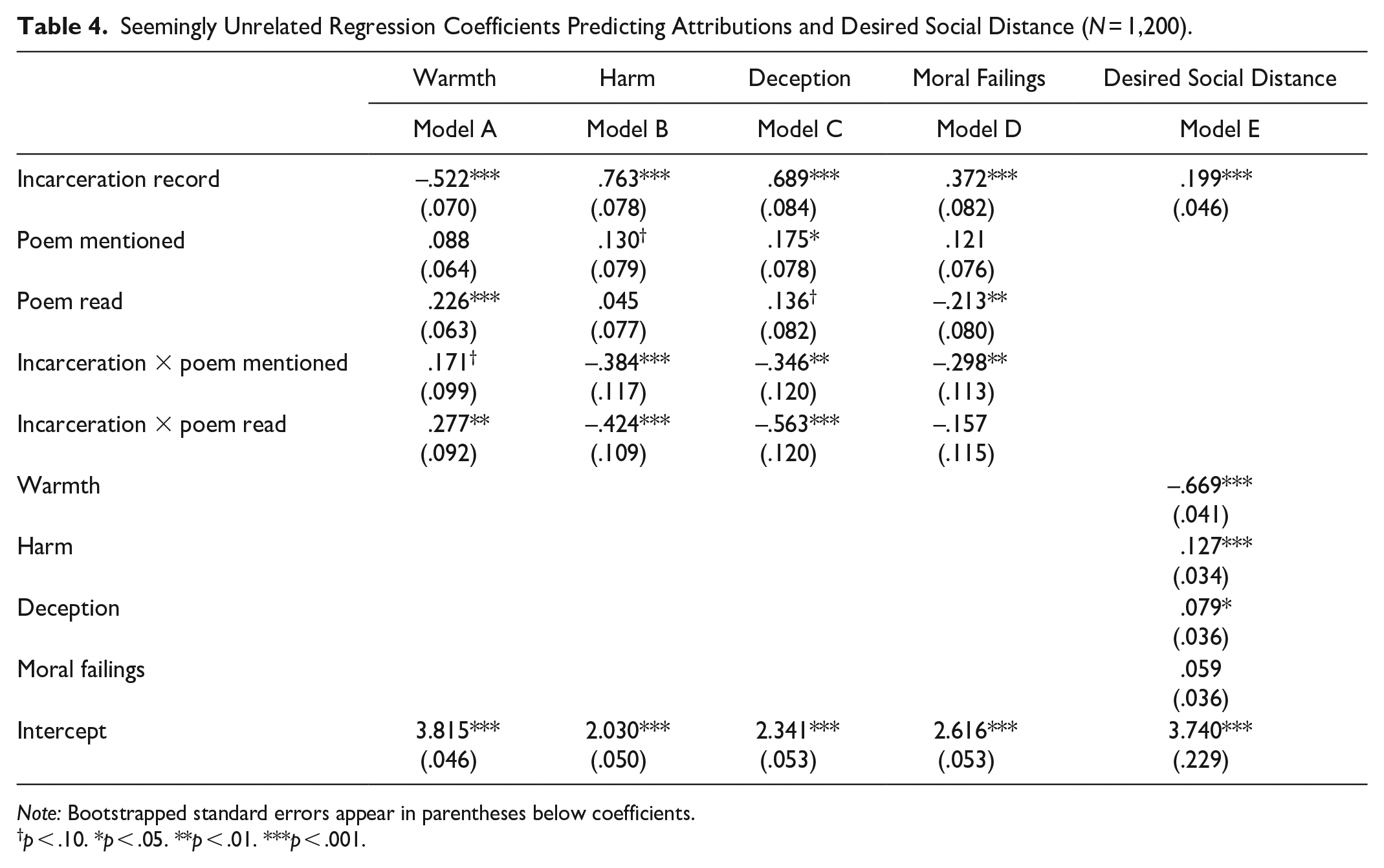
As shown in Table 4, the full factorial model is used to predict each perception, and then desired social distance is predicted using the target’s incarceration record and each perceptual variable. An incarceration record significantly predicts warmth and all expected moral behaviors (Models A–D). In these models, poetry and its interaction with incarceration counteracts the main effect of an incarceration record.
Seemingly Unrelated Regression Coefficients Predicting Attributions and Desired Social Distance (N = 1,200).
Note: Bootstrapped standard errors appear in parentheses below coefficients.
p < .10. *p < .05. **p < .01. ***p < .001.
To determine whether poetry changes the effect of each perception on desired social distance, we calculate the index of moderated mediation for each mediator. Following Hayes (2018), the index is a joint test of the null hypothesis that each interaction term in the X → M path (from Models A–D) times the M → Y path (from Model E) equals zero. The index is statistically significant for warmth, χ2(2) = 8.48, p = .014, and harm, χ2(2) = 7.19, p = .028, but not for deception, χ2(2) = 4.21, p = .122, or moral failings, χ2(2) = 1.75, p = .418. This suggests that the poetry intervention changes the indirect effects for warmth and harm. Next, we examine the indirect effects at each level of the poetry intervention. If poetry reduces discrimination by making the target seem more moral, then indirect effects of harm and warmth should shrink with more “intense” levels of the poetry intervention.
These indirect effects are visually summarized in Figure 2 (for the estimates reported in a table, see Supplement C in the supplemental material). Figure 2 shows two especially notable patterns. First, an incarceration record produces desired social distance through warmth more than any other perception that we measured (with smaller but statistically significant effects for expected harm). Depending on the level of the poetry intervention, the indirect effect of warmth is 3 to 5 times larger than the indirect effect of harm. Second, at higher levels of the poetry intervention, the indirect effects of warmth and harm are smaller. This evidence implies that the poetry intervention is reducing desired social distance by changing the target’s perceived warmth (i.e., target’s perceived overall morality).
In summary, our exploratory analyses suggest that the poetry intervention is reducing negative stereotypes about the formerly incarcerated student, thereby reducing desired social distance. This effect operates by increasing perceived warmth and to a lesser degree, by reducing expected harm. This is not to say that the effect of this intervention applies to all FIP in the mind of the perceiver. Rather, these tests are confined to the respondent’s perception of the poem’s author.
Hypothesis 4: Stigma against CFIP
Because the poetry intervention improved perceptions of the formerly incarcerated target classmate, one might predict it would also reduce public stigma against the whole category of FIP (Hypothesis 4). First, there is no interaction between poetry and incarceration status (see Table 3) suggesting that poetry is not affecting impressions of incarcerated (and formerly incarcerated) people generally. That said, there was a main effect of exposure to a formerly incarcerated classmate such that stigmatizing beliefs were endorsed less when participants read about a formerly incarcerated target (M = 2.70, SD = .88) compared to a generic target (M = 2.87, SD = .84, p < .001). These results do not suggest the poetry intervention contributed to public stigma. Hypothesis 4 is unsupported.
Discussion
In this study, we used a survey experiment to determine if and how narrative humanization alleviates social exclusion of FIP. Indeed, a narrative (poem) written by a hypothetical formerly incarcerated student reduced desired social distance, indicating it could function as a proactive stigma management technique. It did so because the narrative made the student appear more interpersonally warm and less likely to harm others. Our experiment suggests effects were driven more by the act of sharing a narrative rather than the content of the narrative. However, exposure to the narrative in general activates greater empathy for its author even though the narrative does not affect perspective-taking. Combined, these results suggest that exposure to narrative humanization combats stigma because it signals to the audience that the author is a prosocial person, not because it activates feeling or understanding for the author’s position. Finally, although the intervention improved perceptions of the poem’s author, it did not generalize to improve impressions of FIP overall.
This test of narrative humanization offers several lessons. First, separating the poem’s content from the action of reading a poem allowed us to conclude that the action mattered more than the text. Once the student shared a poem, desired social distance fell. Others have found that such “positive credentials” lend credibility to justice-involved people, such as achieving conventional life course milestones (Denver and Ewald 2018) or having character references (DeWitt and Denver 2020). The credibility-building behavior of sharing poetry similarly signaled to participants that despite a history of incarceration, the target student was ultimately good-natured. Although audiences experience greater empathy after reading narratives themselves—which may be desirable on its own—exposure to the content of narratives does not uniquely affect social exclusion, making the case for the power of simply sharing a positive credential. Therefore, prisons and reentry services should offer programming that bestows positive credentials, and FIP should emphasize credentials, behaviors, and identities in their professional and personal interactions that distance them from criminal stereotypes (Lindsay 2022) and that signal desistance from crime (Bushway and Apel 2012). More concretely, such credentials could aid in the employment process by being added to job applications and discussed in cover letters. For any situation that requires a reference, it might be beneficial for a formerly incarcerated person to list someone involved in the credentialing process as a reference so that the reference could discuss these positive credentials.
Second, the overwhelming effect of perceived warmth implies stigma reduction efforts should focus on proving that members of stigmatized groups are friendly or prosocial people. Anything that increases perceived warmth should mitigate discrimination. Our finding fits a long-observed pattern in social cognition that warmth, as a very general trait, influences perception more than many other more narrowly conceived traits, such as expected harm (Wojciszke and Abele 2008). Because FIP may take on other prosocial or conventional roles, researchers should explore if and how other positive credentials shape perceived warmth in proactive stigma management. Prison and reentry programs can then help establish access to such credentials. Furthermore, scholars should explore other mechanisms that teach FIP effective social skills to project a prosocial identity. For example, strong social skills can also mitigate deficits in desired social distance (Penn, Kohlmaier, and Corrigan 2000). Leveraging the effect of warmth in key interactions, such as interviews, first impressions, and disclosing a criminal history, could provide FIP with a useful toolkit to overcome barriers to reentry.
Third, our intervention did not extend to shaping perceptions of FIP in general (cf. Dum et al. 2022). This result may reflect an instance of subtyping; when a person diverges from a group stereotype, observers make sense of their own violated expectations by viewing this person as an exception to the rule (Richards and Hewstone 2001). Consequently, subtyping maintains stereotypes (e.g., FIP as untrustworthy) even while an unexpected behavior may lead an individual to be seen in a different light (e.g., as a result of sharing a sympathetic personal narrative). Although narrative humanization may still be useful for reducing discrimination against whole categories of people, its effects may be strongest for the author themselves because it “disidentifies” that person from group stereotypes (Lindsay 2022). Our analyses suggest this approach works best as an individual-level stigma management strategy rather than as a form of advocacy that might change perceptions of FIP generally.
Fourth, our study shows that effective interventions can be relatively simple, such as reading a poem to an audience. As our analyses suggest, any activity that improves the perceived warmth of FIP can reduce social exclusion. Such activities using narrative humanization are easily incorporated into real-life situations involving stigmatized groups and the public, especially in controlled classroom contexts, but also in public writing, open mic events, or other public performances. This capitalizes on existing prison programming, such as writing workshops, that create products of narrative humanization. Finally, this article shows one way that formerly incarcerated students on college campuses can both share negative aspects of their past while building a redemptive narrative in the minds of themselves and others (Curtis et al. 2021; Hernandez et al. 2022; Lindsay 2022).
Limitations
Although our results give important insight into stigma reduction strategies, this study does have its limitations. First, our study did not test other forms of narrative humanization or alternative poems. Poetry has gained traction among incarcerated individuals (e.g., PEN America and the FreeMinds Book Club and Writing Workshop), and we chose this particular poem because it was found to reduce public stigma against FIP in general compared to other poems that focused on prison life (Dum et al. 2022). That said, to build an effective toolkit of narrative humanization strategies, future research should explore how other forms of narrative humanization (e.g., essays, paintings, etc.) and content themes (e.g., sharing information about prison life, life after prison, etc.) affect warmth and social exclusion.
Second, this study sought to develop an intervention for a particular environment, college campuses. A skeptical reader might wonder if similar results would emerge, for instance, in a workplace with an older sample. In fact, a whole volume of meta-analyses explored this very question, comparing psychological findings tested in laboratory settings and in naturally occurring workplaces (Locke 1986). The overwhelming result was consistent across multiple meta-analyses: The direction of effects did not vary between laboratory and field settings. Although effect sizes did vary between the laboratory and the field, effect sizes varied across all study settings. In our view, the present study’s results offer fertile ground for additional research to probe aspects of external validity. New samples comparing students attending community colleges versus those attending selective liberal arts colleges or college students versus workers might show differences in sensitivity to the intervention. Future studies comparing different mediums (e.g., text vs. video vs. in person) would demonstrate the relative strengths of different presentation formats and thus indicate what forms of narrative humanization are best suited to which contexts. These alternate mediums would also allow researchers to move beyond hypothetical vignettes and capture participants’ actual behavior.
Third, although our results show that the poetry intervention reduced discrimination through perceived warmth, we do not understand precisely why poetry affected warmth. What exactly about poetry persuaded respondents? Maybe participants interpreted the target’s action as communicating trust in the participant, thus prompting trust in-kind. Alternatively, participants may have seen poetry as a conventional social activity, persuading them that the student was not a “criminal.” Future studies should employ qualitative methods to understand what role narrative humanization plays in attitude change toward FIP and the specific messages and themes that resonate with respondents.
Finally, this study was unable to assess how other characteristics of the formerly incarcerated student would influence results. This intervention may be more effective for social groups that American culture already labels as warm (e.g., the elderly, Christians, and members of the middle class; Cuddy, Fiske, and Glick 2007). The type of offense that led to incarceration may also moderate the effectiveness of our intervention because the public views some crimes as more serious than others (e.g., assault compared to homicide; Fenimore and Jones 2024). It is important to know for whom narrative humanization will be a useful impression management strategy so that we can be sure it helps groups overrepresented in the carceral system. Therefore, future research should incorporate more vignettes that manipulate characteristics such as offense, race, ethnicity, and gender.
Conclusion
Our findings inform efforts at proactive stigma management by showing exactly how and why narrative humanization changes impressions of and discrimination against FIP. We find that exclusionary attitudes stem from perceptions of interpersonal warmth. We demonstrated that FIP can share personal narratives to overcome this deficit in their perceived warmth. Applied efforts at stigma management should include opportunities for this population to employ narrative humanization among members of the public. Our findings imply such interventions can be very short and simple. This points the way toward short scalable interventions that reduce discrimination against FIP and thereby increase the chances of successful reentry.
Supplemental Material
sj-docx-1-srd-10.1177_23780231241287246 – Supplemental material for Softening the Stigma of Incarceration with Personal Narratives
Supplemental material, sj-docx-1-srd-10.1177_23780231241287246 for Softening the Stigma of Incarceration with Personal Narratives by Jon Overton, Michelle D. Fretwell, Kevin Weng and Christopher P. Dum in Socius
Footnotes
Acknowledgements
Funding
The author(s) disclosed receipt of the following financial support for the research, authorship, and/or publication of this article: This project was funded by the Farris Family Innovation Fund through Kent State University.
Supplemental Material
Supplemental material for this article is available online.
3
Although George Floyd died during data collection (May 25, 2020), only 9 out of 1,200 respondents participated in our survey experiment after his death, so our results largely reflect attitudes about criminal justice before his death and associated protests.
4
The poem used in the vignette was written by a male writer for a prison writing program. This poem was chosen because it presents a first-person account by an incarcerated writer about their childhood, which fits the concept of narrative humanization. Indeed, this poem was more effective than other tested poems in reducing stigma against FIP in general ( ).
).
5
6
Author Biographies
References
Supplementary Material
Please find the following supplemental material available below.
For Open Access articles published under a Creative Commons License, all supplemental material carries the same license as the article it is associated with.
For non-Open Access articles published, all supplemental material carries a non-exclusive license, and permission requests for re-use of supplemental material or any part of supplemental material shall be sent directly to the copyright owner as specified in the copyright notice associated with the article.
