




Abstract
This exploratory study renders it an open empirical question how ordinary people understand the meaning of culture and what are its sociopolitical implications. Using original survey data from over 11,000 respondents across nine European countries, the study focuses on an open-ended question where the respondents defined the meaning of “culture” in their own words. The open-ended answers are scrutinized by structural topic modeling, which allows for identifying relatively coherent clusters of understandings of culture and their relationships. In addition to examining how these understandings vary across national contexts, the study investigates their variation according to major sociodemographic divisions and sociopolitical and cultural factors in and across the nine European societies through regression methods. The results underscore substantial national variation and social stratification of the understandings of culture and the potential of computational text analysis in open-ended survey research.
Keywords
In recent decades, culture has become a key element in explaining social processes and inequalities. This “cultural turn in sociology” (Mohr 1998) highlights how cultural elements such as symbolic boundaries (Lamont 1992), cultural toolkits (Swidler 2001; Vaisey 2009), and meaning-making processes (Mohr 1998; Mohr et al. 2020; Rawlings and Childress 2021) help to understand societal phenomena and changes. Whereas a large portion of such work still operates in the Bourdieusian tradition of social inequality research in which culture indicates or invokes social status (Childress et al. 2021; Flemmen, Jarness, and Roselund 2018), studies of how meanings are attributed to culture tend to remain on relatively separate tracks. The need to improve our understanding of what constitutes culture according to whom has been put forward (Bail 2015; Lizardo 2017) yet not fulfilled despite the sociopolitical associations that culture increasingly invokes (e.g., DellaPosta, Shi, and Macy 2015; DiMaggio 1996; DiMaggio, Nag, and Blei 2013).
In line with other studies that apply computational analysis of cultural artifacts (e.g., Michel et al. 2011; Nelson 2021), we take a data-driven approach to explore how ordinary Europeans interpret and give meaning to “culture.” We thus make three major contributions to literature.
First, our study provides novel insights into what individuals mean when they talk and think about culture and cultural issues. Until recently, researchers had to face an important trade-off when trying to examine conceptual understandings such as the meanings attached to “culture”: They could either ask a small number of people, let them answer freely in their own words, and analyze the textual data produced qualitatively (European Commission 2006), or they could employ a large-scale survey, rely on predefined categories, and analyze the data quantitatively (European Commission 2007). Our research overcomes this divide by analyzing an open-ended survey question in large-scale cross-national data with computational text analysis methods (McFarland, Lewis, and Goldberg 2016). By doing so, we can not only find new meanings of culture but also measure the interrelationships and prevalence of all identified meanings.
Second, we investigate whether understandings of culture differ cross-nationally and how they are associated with various sociodemographic variables. Whereas previous research (European Commission 2007) has examined such relationships using bivariate statistics, our study estimates multivariate regression models. Therefore, we can more clearly examine the social predictors of understandings of culture and show differences and similarities between countries.
Third, we examine the association of people’s understanding of culture with several variables measuring political attitudes, cosmopolitanism, and cultural participation. Prior research has demonstrated a close relationship between cultural taste patterns and these variables (e.g., DellaPosta et al. 2015). However, the connection between understandings of culture and these variables remains unclear and requires further investigation.
Different Understandings of Culture
Culture is notoriously a multifaceted concept. Stemming from classic Latin, where it described the general process of cultivation or nurture, it has been defined in more than 150 ways (Kroeber and Kluckhohn 1952) but is in its more modern sense often viewed as describing the way of life of a specific group of people (Fornäs 2017; Williams 1981). This conceptualization became widely known as the “broad” understanding of the culture, which culminated in UNESCO’s (2001:4) famous definition of culture as “the set of distinctive spiritual, material, intellectual, and emotional features of society or a social group, that encompasses, not only art and literature, but lifestyles, ways of living together, value systems, traditions, and beliefs.”
In contrast, a narrow understanding of culture emerged during late eighteenth and the nineteenth centuries that only encompasses a specific aspect of the broader understanding: the arts (Fornäs 2017; Williams 1981). Underneath this conception lies the assumption that the arts express the highest cultivation. Thus, culture, in this narrow sense, was increasingly used for demonstrating moral superiority and for ideological and social exclusion (DeNora 1991; DiMaggio 1982), resulting in a strong divide between highbrow and popular culture that existed during most of the twentieth century throughout the Global North (Levine 1988).
In addition to the abundance of a priori theoretical conceptualisations (Fornäs 2017), various empirical case studies have explored the meanings of culture among ordinary people (Grindstaff, Lo, and Hall 2019). However, only few studies have examined different meanings of culture cross-nationally, and even fewer have used representative samples of different national populations. Notable exceptions are two studies conducted in the European Union. The first is a qualitative study that employed focus group interviews in each country to identify different understandings of culture. It identified both narrow understandings (as the arts) and broad understandings of culture (as “that which brings a human community together and that which distinguishes it from others”) besides categories such as “culture as education or knowledge” or “culture as a normative system that prepares people for life in society” (European Commission 2006). The second study then used these different understandings to categorize open-ended answers of a cross-national survey and proceeded to measure the prevalence of understandings and their relationships with sociodemographic variables (European Commission 2007).
Sociodemographic Background of Different Understandings of Culture
What would the social stratification of the understandings of culture look like? If we extrapolate the research on cultural participation and tastes, arguably, the closest point of comparison is the consistent finding that cultural participation in “high” culture (understood as the rate of conventional outside-home cultural participation, practicing culture and arts either as a hobby or a profession, or the overall interestedness in the matters of culture and aesthetics) is disproportionally characteristic of high-status groups (e.g., Bennett et al. 2009; Bourdieu 1984; Brook, O’Brien, and Taylor 2020). Thus, from a classical point of view, narrow conceptions of culture (as “the arts”) would be most typical for high-status groups, whereas lower-status groups would understand culture more broadly as mundane ways of (everyday) life (cf. Bourdieu 1984; Fornäs 2017). Bourdieu (1968:609) explained this high-status groups’ adherence to arts by a specific disposition—often misrecognized as a natural talent but obtained through upbringing in suitable social conditions—making it possible to “confer on culture and in particular, ‘love of art.’” The findings by the European Commission (2007) support this perspective.
However, based on the cultural omnivore literature, which found much broader taste and consumption patterns among high-status individuals (e.g., Chan 2019; Lindblom 2022; Ollivier 2008; Peterson and Kern 1996), high-status groups appear more likely to embrace broad conceptions of culture rather than narrow ones. Of course, the connection between the breadth of cultural understandings and the scope of cultural taste and consumption patterns might be less straightforward because these constitute different phenomena. Still, our analysis will show which of these two views is supported by our data (when measuring status by educational level) and how other understandings of culture that do not necessarily fall under the narrow/broad distinction may be affected by social stratification.
As for other sociodemographic divisions, previous research on cultural participation and tastes suggests that cultural engagement, particularly in “high” culture (as potentially emblematic of understanding culture narrowly as arts), also has other significant social correlates than that of status. Studies have repeatedly shown the importance of, for instance, age, gender, residential area, and even religiosity for cultural engagement (e.g., Bennett et al. 2009; Falk and Katz-Gerro 2016; Flemmen et al. 2018; Katz-Gerro, Raz, and Yaish 2009). For instance, older age predicts highbrow cultural consumption and appears associated with understanding culture as arts (European Commission 2007; Reeves 2019). We expect to find corresponding patterns between highbrow cultural participation and understanding culture as arts related to gender, place of residence, and religiosity.
Understandings of Culture versus Social and Political Attitudes
Previous studies have shown that individuals with high-culture (DiMaggio 1996; Flemmen, Jarness, and Roselund 2022) and omnivorous taste patterns (Chan 2019) tend to be more cosmopolitan, that is, more open toward foreigners and foreign cultures, than their counterparts. 1 However, how understandings of culture relate to morally and politically contentious frames of social position-takings is yet not clear. In other words, although lifestyles are structured by culture and culture is increasingly political, the boundary work that underlies “lifestyle politics” and “culture wars” (DellaPosta et al. 2015) often leaves implicit which foci individuals have when thinking of culture.
In recent decades, opinions on cultural issues—ranging from gender equality and civil rights for ethnic minorities to how much funding should go to the arts—have become increasingly conflictual in Western populations (DiMaggio et al. 2013; Goren and Chapp 2017). Nevertheless, despite the prominence of the term in the framing of “culture wars,” it is not clear which interpretations of culture are employed by laypersons with different sociopolitical and cultural orientations. So far, studies have mainly focused on cultural practices within lifestyles. Some literature finds cultural omnivores to be more liberal, postmaterialist and tolerant (Lindblom 2022), or more cosmopolitan (Chan 2019; Coulangeon 2017) than the average population. Similarly, “wider” media repertoires tend to be associated with more progressive political attitudes (Heikkilä, Leguina, and Purhonen 2022). In addition, other studies find liberal political attitudes and lifestyles to be associated with cultural capital (e.g., DiMaggio 1996; Flemmen et al. 2022; Purhonen and Heikkilä 2017). Notwithstanding the puzzle of omnivorousness versus highbrow taste, both approaches have little to say on cultural meanings and motivations, which appear highly relevant for understanding the role of culture in contemporary political turmoil. In line with the dual-processing theory that emphasizes how unconscious schemas of culture can be important predictors of attitudinal viewpoints (Vaisey 2009), we argue that knowing more about people’s first associations with “culture” would open new perspectives on politically contentious cultural issues and debates.
Cross-National Differences
Studies have repeatedly demonstrated the importance of national contexts for inquiries into cultural issues (e.g., Janssen, Kuipers, and Verboord 2008; Janssen, Verboord, and Kuipers 2011; Lamont and Thévenot 2000; Purhonen et al. 2019). Thus, we anticipate finding the narrow/broad divide across all countries (European Commission 2007; cf. Fornäs 2017; Williams 1981) but with significant cross-national differences in the prevalence of specific understandings of culture. Among other aspects, these countries differ in terms of cultural policy regimes (Rius-Ulldemolins, Pizzi, and Arostegui 2019), access to higher education (Eurostat 2021), degree of globalization (Gygli et al. 2019; see Appendix AI), and dominant values (Inglehart and Welzel 2005, 2023). More specifically, the European Commission (2007) found that people in northern European countries, characterized by a cultural policy model with strong public funding of culture and high cultural participation rates (Rius-Ulldemolins et al. 2019), relatively often think of culture as arts. In contrast, in southern European countries, characterized by lower levels of cultural participation and (with the exception of France) a cultural policy model with lower public expenditure on culture, people more frequently than elsewhere associated culture with education and family (European Commission 2007). Greater access to higher education might shift these understandings toward education-related topics and vice versa, whereas a high level of globalization may nudge people to understand culture broadly as values, traditions, and ways of life that separate them from others, understandings which, according to European Commission (2007), prevailed in central European countries.
Cross-national differences in understanding culture might also relate to the materialist (or “survival”) versus pos-materialist (or “self-expression”) values, as presented by Inglehart and Welzel (2005). The southeastern countries in our research, Croatia and Serbia, are closer to the survival end of the scale, and the other countries are closer to the self-expression end. In countries scoring high on postmaterial values, understandings of culture may lean toward abstract and creative concepts. Those countries are also more open toward ethnic and cultural diversity, possibly rendering the understandings of culture toward broad, social notions. In survival-value-oriented countries, it is more common to emphasize economic and physical security at the cost of considering new cultural influences threatening, which may enhance established, traditional, and normative understandings of culture (Inglehart and Welzel 2005).
Research Design
Data
To analyze different understandings of culture, we use survey data collected in Croatia, Denmark, Finland, France, the Netherlands, Serbia, Spain, Switzerland, and the United Kingdom in 2021. In addition to different understandings of culture, the survey measures practices and attitudes toward culture and attitudes toward broader sociopolitical issues. In each country, a survey agency collected responses from a representative sample of at least 1,200 respondents ages 18 to 80 years, amounting to a total of more than 14,000 respondents. Appendix AII provides a detailed description of the survey methodologies and descriptive statistics by country.
The central question of our analysis asks the following: “What comes to mind first when you think of the word ‘culture’? Please elaborate.” Respondents could answer this open-ended question without any limitations. The methodological advantage of this approach lies in the combination of unveiling different latent dimensions for representative samples of individuals, with the possibilities of analyzing large bodies of texts with state-of-the-art natural language processing methods (Roberts et al. 2014). Theoretically, it follows the dual-processing cue of asking the more intuitive first notion of culture that comes to mind, which is thought to be more insightful for underlying cultural schemas (Vaisey 2009). To avoid steering respondents, the question was asked soon after the start of the survey and before other items. The answer lengths ranged from 0 to 153 words, with a median word count of 4.
Data utilized in the analysis have two main limitations. First, as is common in contemporary survey research, a sizable proportion of the contacted individuals did not provide responses, either due to the inability to reach the target individuals or more importantly, their refusal to participate (Beullens et al. 2018). Second, there was a significant number of nonresponses to our central question of interest, which is a common problem with open answers (Roberts et al. 2014). The variation in nonresponses is addressed in detail in Appendix AIII, with the main sources of variation being the country where the data were collected and the educational level of respondent, particularly for open-ended questions. Both sources of nonresponses raise a similar concern: Our sample may underrepresent individuals who are less culturally inclined (in a narrow sense). These individuals may have been less likely to participate in the survey they did not find interesting or to voice their opinion about culture. Consequently, our sample might overrepresent understandings of culture that align with a narrower interpretation.
The answers were given in 14 languages and translated to English by native-speaking or otherwise capable researchers. Subsequently, the data were cleaned and prepared for analysis. To reduce noise in the model, short answers, composed of only one or two words after the data cleaning, were discarded from the data that we used for model estimation. We created a document-term matrix, comprised of 6,479 documents and 599 unique terms (singular words, bigrams, and trigrams) from the cleaned textual data. The most frequently appearing words in the vocabulary were “art,” “music,” “theatre,” “people,” “museum,” “knowledge,” and “traditions.” The discarded short answers (n = 4,764) were included in the subsequent analysis, yielding 11,243 answers (for a detailed description of the data cleaning process, see Appendix AIII; Appendix AIV presents the distribution of word lengths).
Analytical Strategy
First, we examine what kinds of understandings of culture are present in our data. After establishing a model highlighting the various understandings of culture and validating them via close reading of the documents most probably stemming from the respective topics (see Appendix AIII), we examine how the understandings are distributed across countries. Then, we examine how respondents’ sociodemographic backgrounds and sociopolitical and cultural orientations are connected to their understandings of culture.
To analyze thousands of respondents’ first meanings they attribute to culture, we use structural topic modeling (STM; Roberts et al. 2014). Like other topic modeling methods, such as latent Dirichlet allocation (LDA; Blei 2011), STM is a mixed-membership model, where each document is assumed to be generated from the probability distribution of different latent topics. A key strength of topic modeling is “its ability to capture polysemy and disambiguate different uses of a term, based on the context (other terms) in which it appears” (DiMaggio et al. 2013:578). STM has two advantages over LDA. First, topics can be correlated, implying that subdivisions in the different understandings of culture can be demonstrated via correlated but distinctive topics. Second, metadata about the documents can be incorporated in the topic estimation procedure, allowing us to systematically measure relationships between the topics and desired covariates.
We include a covariate representing the country of the respondent to our model because it arguably influences the data generation process for several reasons. First, different countries have different cultural, social, and historical environments, which may impact the meanings respondents attribute to the word “culture.” Second, the culture concept may carry language-specific associations and nuances of meanings. Considering its almost perfect collinearity with the country variable, we do not include language as a separate covariate. To keep our modeling as inductive as possible, we do not use any other structuring covariates.
Finally, we examine the relationships between the topics and other variables by a series of linear regression models, where the topic proportions are predicted by various measurements.
Measurements
In addition to the open-ended question about the meanings attributed to culture and our only structural covariate in the model estimation phase of STM, country, we employ variables measuring sociodemographic background, cultural participation, cosmopolitanism, and sociopolitical attitudes to analyze the social patterns in different understandings of culture (see Appendix AV for detailed descriptions).
The sociodemographic variables are age, gender, education, urban–rural status, and religiosity. Age is a continuous variable, ranging from 18 to 91 years. Gender is used as dichotomous. Education is measured by the highest attainment according to three levels—primary or lower secondary, upper secondary (general or vocational), and tertiary education—and is considered categorical in the analysis. Urban–rural status is measured on a 10-level ordinal scale, where 10 means living in the capital of the country and 1 indicates living on a farm in the countryside. Religiosity is measured by a variable including three categories based on the following answers: “yes, I do have religious belief”; “no, but I do have spiritual belief”; or “no, I don’t have any religious or spiritual beliefs.”
We use three indicators of sociopolitical attitudes and include a measure of cultural participation for comparison. Although cultural participation is a standard variable in cultural consumption studies trying to capture the volume of individuals’ outside-home cultural activity (e.g., Falk and Katz-Gerro 2016), the debates of the interlinkedness of culture and politics revolve around the opposition between more and less cosmopolitan and progressive–liberal value orientations in the political domain (e.g., DellaPosta et al. 2015), informing our choice of measures.
We measure cultural participation by calculating an average score for each respondent according to four items: how often the respondent visits (1) classical music concerts, the opera, ballet performances, or theatre performances in a concert hall or theatre; (2) popular music concerts or popular music festivals; (3) local fairs with food and music; and (4) museums, monuments, or historical places. The scale range is 0 to 4 (with 4 indicating more frequent participation), and the reliability is high (Cronbach’s α = .70).
We measure cosmopolitan orientation by calculating an average score of four items (following Cleveland et al. 2014): (1) “I am interested in learning more about people who live in other countries,” (2) “I enjoy exchanging ideas with people from other cultures and countries,” (3) “I like to learn about other ways of life,” and (4) “I enjoy being with people from other countries to learn about their unique views and approaches.” The level of agreement was measured on a 5-point Likert scale, with 5 indicating the highest level of cosmopolitanism. The scale reliability is very high (Cronbach’s α = .92)
We measure political orientations by four items, which are reduced to two dimensions with principal component analysis (see Appendix AVI). Research has clearly shown the relevance of the distinction between the “new” (conservative–liberal orientation) and “old” political (left- and right-wing economic orientation) dimensions (Chan 2019; DellaPosta et al. 2015; Heikkilä et al. 2022). Here, the “new” politics dimension is constructed by high loadings of two attitudinal items: agreeing that (1) “Same sex marriages should be allowed throughout Europe” and (2) “All in all, family life suffers when women have a full-time job” (reversed). The “old” politics dimension is constructed by high loadings of the following attitudinal items: (3) “People who are unemployed should not get benefits if they do not try to find work” and (4) “Government regulation of business usually does more harm than good.” We use principal scores of these two components. Higher values are coded to indicate more liberal orientation in the case of new politics and more economic left stance in the case of old politics.
Results
The Model, Topics, Intertopic Relationships and Distribution of Topics across Countries
We used fit statistics (i.e., semantic coherence and exclusivity scores; Roberts, Stewart, and Tingley 2019) and qualitative interpretation of the topics to determine the optimal topic solution. The model with 10 topics proved to strike a good balance between model complexity and the interpretability of the topics. A relatively large number of topics in our solution introduced nuanced understandings of culture, and the model preserved some topics that were prevalent in only some of the countries. Appendix AIII presents detailed information on the model building and validating process.
Table 1 summarizes the estimated structural topic model with 10 topics. The topics are relatively evenly distributed, with the proportions of the answers stemming from respective topics varying from 0.05 to 0.19. A notable share of the answers featured multiple, distinct understandings of culture, mentioning, for example, both arts and knowledge. The correlations of the topics (Appendix AVII) were used to group topics into broader categories. Our results show that people’s understandings of culture can be divided into five distinct categories.
The Topics and Their Most Important Words, Proportions, and Exemplary Answers, N = 6,479. a

Note: Estimated by latent Dirichlet allocation initialization structural topic modeling with country of the respondent as a prevalence covariate. Topics are arranged in categories based on moderate or stronger (>0.3) positive intertopic Pearsons correlation coefficients (see Appendix AVII).
The table is comprised of only individuals whose responses were used to generate the model.
The two most important categories are clearly the common “narrow” and “broad” understandings of culture. The narrow understanding equates culture with the arts and comprises two topics. We label the first topic “arts,” which refers to art and its different forms, such as music, literature, and dance. The second topic is labeled “institutional”—it refers to cultural institutions and locations where culture is consumed, such as theatres, museums, and cinemas. These two topics reveal different patterns in understanding culture as arts, the former being a more abstract concept of art and the latter being more concrete.
The broad understanding, in contrast, comprises four highly correlated topics and captures the anthropological notion of culture as a whole way of life (Williams 1981), encompassing both the material and immaterial features of groups of people in different geographical areas and nations. First, we find a topic involving “shared values and traditions,” which refers also to the ways of life and beliefs common at the societal level. Second, we identify a topic labeled as “geographical identity,” referring to specific countries and regions and the practices and commonalities perceived as typical to them. The third topic is labeled “group characteristics,” referring to people and communities in differently sized social groups. The final topic in this category is labeled “habits and lifestyles,” referring to the customs and features particular to some collective, such as food, language, or religion.
The third category of understandings of culture refers to the past and present forms of human activity and contains two specific topics. The first we label “human activity,” which comprises important words such as “human,” “activity,” “create,” and “expression.” In this topic, culture is understood as something that humans have created to express themselves and as something opposing nature and mundane everyday life. The answers belonging to this topic are often long and almost poetic. The second topic of this category, “history and heritage,” involves a temporal dimension and refers to development, passing of time, and the significance of history.
The remaining two topics do not have correlations with other topics. The first one we label “cultivation,” which refers to understanding culture as cultivating and educating oneself. The second isolated topic we label is “good manners,” which refers to good and civilized behavior of individuals, something that is taught and produced by a proper upbringing.
For the subsequent analyses, we append our modeled answers with predicted document-topic probabilities for short answers including only one or two words. Next, we examine how the various understandings of culture are distributed across the nine countries. Figure 1 shows the expected topic proportions in each country (see Appendix AVIII for exact values). Topics that represent a narrow understanding of culture, arts and institutional, are found in every country with different proportions—most frequently in Croatia and least frequently in Spain and the United Kingdom. Together, these topics compose a third of the understandings of culture in the data. Arts is a relatively common and evenly distributed component across the countries, but the share of understanding culture as institutional varies substantially more, from one-tenth in the United Kingdom to one-third in Croatia. Understandings of culture related to the broad meaning of culture are clearly most prevalent in the United Kingdom and the Netherlands, where half of the answers concern these topics. In all other countries, particularly in France, such understandings of culture are relatively rare. The topics of human activity and history and heritage are both most common in Finland and Denmark. Understanding culture as cultivation is prevalent in France, Spain, and to a lesser extent, Switzerland but seldom found in other countries. Similarly, understanding culture as good manners is common in only two countries, Serbia and Croatia, but is very rare in other countries.

Topic proportions in aggregate and per country (N = 11,243).
Figure 1 thus reveals relatively substantial cross-national variation in the prevalence of the 10 topics, reflecting different understandings of culture. In particular, we find “pairs” of countries with similar topic distributions that set them apart from the other countries: the Nordic countries with substantial proportions of human activity and relatively common narrow understandings of culture as arts; the southeastern European countries, Croatia and Serbia, with substantial proportions of good manners and institutional understandings; the big Mediterranean countries, France and Spain, with high shares of understanding culture as cultivation; and the United Kingdom and the Netherlands with broad understandings being common. Switzerland is the only country without such an obvious “pair” but represents a fairly balanced combination of different understandings.
Topics and Their Relationships with Sociodemographics
Figure 2 presents the relationships between the topics and sociodemographic variables (see Appendix AIX for detailed information). We find that countries’ relationships with the topics (estimates omitted from Figure 2) indicate similar connections as presented in Figure 1 even after controlling for sociodemographic variables. Old age predicts the narrow understandings of culture as arts and institutional, and the latter is also predicted by female gender. This could be explained by the fact that highbrow cultural participation—from which the vocabulary to describe culture as arts and especially institutional is most strongly derived—has been in decline among younger generations in most European countries (Donnat 2011; Roose and Daenekindt 2015) and in the case of institutional, is a female-dominated field in many countries (Lagaert and Roose 2018). A narrow understanding of culture is least common among individuals with the lowest level of education, whereas individuals with middle-level education are more inclined to understand culture as cultural institutions than highly educated individuals. Unlike European Commission (2007), we find no association between the highest level of education and narrow understandings of culture. In addition to age, gender, and education, a nonreligious disposition predicts understanding culture as arts.

Relationships between the topics and sociodemographic variables (N = 11,243).
Conversely, the broad understandings of culture—shared values and traditions, geographical identity, group characteristics, and habits and lifestyles—are all predicted by young age and lowest education level, and two of them are predicted by male gender. The relationship between these topics and education accords with empirical research on the social stratification of cultural practices, which found the practices and tastes of lower status groups to be more mundane and connected to everyday practices (cf. Bourdieu 1984; Fornäs 2017; Levine 1988). Moreover, religious dispositions are common among respondents with a broader understanding of culture.
Understanding culture as both human activity and history and heritage is predicted by male gender. In case of human activity, both low and high education levels predict this understanding of culture. Human activity and cultivation embrace education, open-mindedness, and creativity. The relationship between cultivation and high education level can easily be explained: Highly educated people appreciate the dimension of Bildung in culture because they are educated themselves (cf. Bourdieu 1968). Interpretation is more complex for the topic of human activity, which does not fall under the category of four topics labeled as broad culture—a label reflecting prior theories by emphasizing the polarity between narrow and broad cultures, clearly visible in the data. However, the topic of human activity features even a very broad understanding of culture, referring to any human activity not necessary for survival or done for recreational purposes. Thus, it spans both narrow and broad meanings of culture without distinguishing between them. Finally, the most openly normative topic of good manners, emphasizing culture as civilized behavior, is predicted only by living in rural areas.
Following the analysis of the aggregated data, we examined whether the relationships between the topics and sociodemographic variables vary across countries by regression models including interaction terms between countries and sociodemographic variables. The most systematic interactions concern the association between the two topics of narrow culture—arts and institutional—and age. This can be seen in Figure 3 (Appendix AX provides precise estimates). The relationship in Denmark, Finland, the Netherlands, Switzerland, and the United Kingdom resembles the one in Figure 2: Understanding culture as arts is more common among older respondents. However, Figure 3 shows this is not the case in the southern European countries—Croatia, France, Spain, and Serbia—where understanding culture as arts is more common among younger respondents. We find a similar pattern for the other narrow understanding of culture, institutional, for which the association with old age is also significantly weaker in the southern countries except for Spain, where the relationship is negative. The associations between the other topics and sociodemographic variables are relatively stable across countries.

Expected topic proportions by age in each country for topics of arts (top row) and institutional (bottom row; N = 11,243).
Understandings of Culture and Sociopolitical and Cultural Variables
Our final analysis, presented in Figure 4, concerns the relationships between topics and sociopolitical and cultural variables (see Appendix AXI). 2 Cultural participation is positively associated with understanding culture in its narrow form and with the topics related to human activity and history and heritage. This may be attributable to the fact that the variables used to measure cultural participation are all connected to these topics. Active cultural participation may thus advance the association of culture with these topics, whereas a low level of participation may have the opposite effect. In contrast, the topics related to a broad understanding of culture are predicted by a low level of cultural participation.
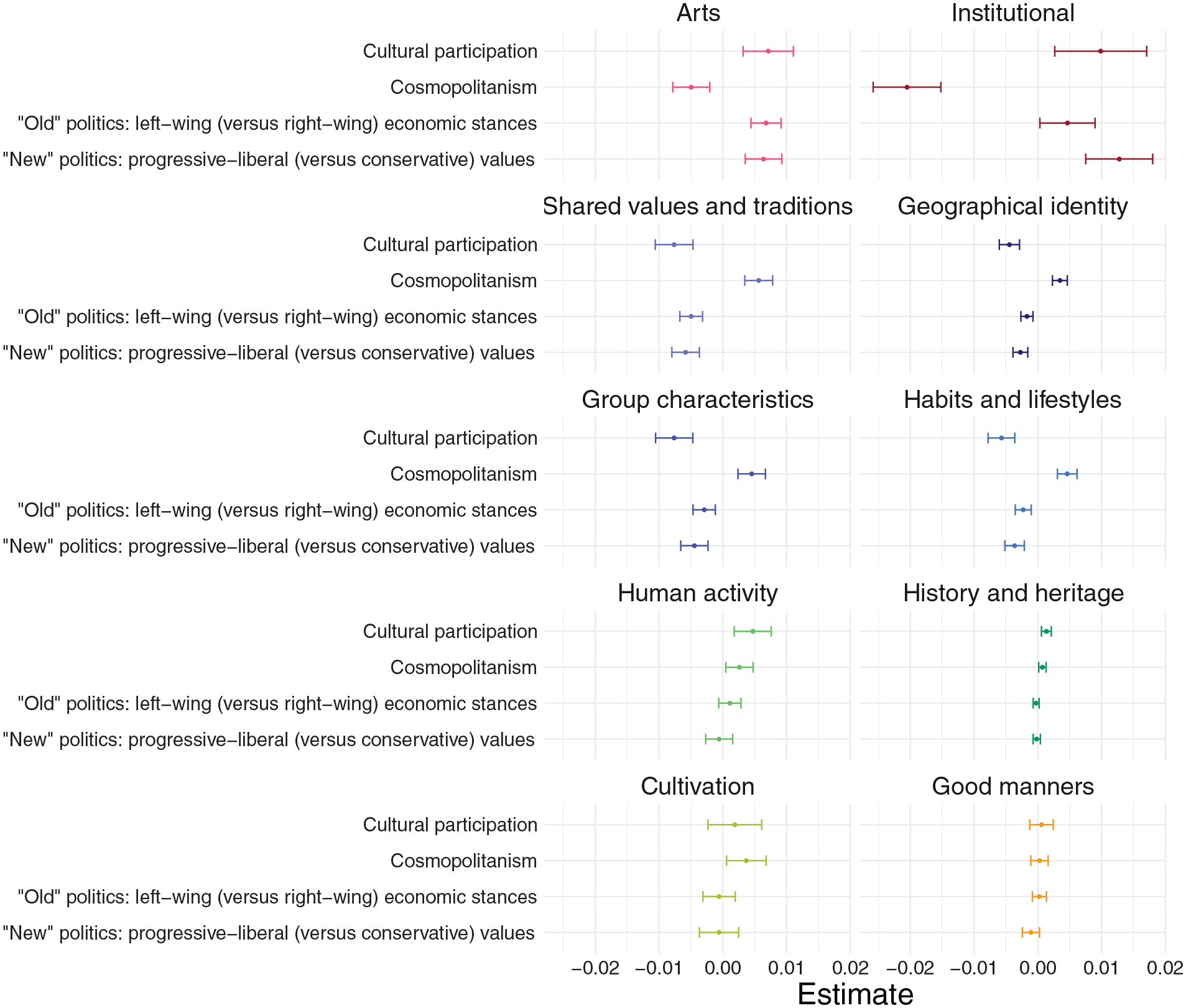
Relationships between the topics and sociopolitical and cultural variables (N = 11,243).
For cosmopolitanism, the relationships are inverse compared with those for cultural participation. A low level of cosmopolitan orientation predicts understanding culture as arts and institutional, whereas a high level is associated with topics related to broad understanding of culture. Displaying openness toward other cultures diminishes the tendency to associate culture with only arts but stimulates broader conceptions of culture.
Interestingly, sociopolitical orientations work differently from cosmopolitanism. Both old and new political orientations are positively associated with understandings of culture that emphasize arts and institutional topics. In contrast, understanding culture in a broad manner—in the case of all four topics belonging to this dimension—is predicted by a right-wing economic stance and conservative value orientations. This may be associated with a stronger focus on broad cultural issues by people who feel that their way of life is under threat by immigrants and therefore tend to vote for right-wing parties (Lucassen and Lubbers 2012).
In sum, we find evidence for both the “omnivorousness connection” via cosmopolitanism, which is associated to high status and omnivorous cultural consumption patterns (Igarashi and Saito 2014), and the “cultural capital connection” via cultural participation and political orientations. The first meaning of culture that springs up and the sociopolitical orientation of Europeans are therefore related. We find a distinction between cosmopolitanism (measured as a general openness toward other cultures) and more specific sociopolitical orientations (e.g., concerning gender equality): Broader accounts of culture are postulated by both cosmopolitans and more right-wing-oriented citizens. At the same time, the distinction between old and new value stances appears less important for explaining the different understandings of culture than in other areas of cultural sociology (Chan 2019; DellaPosta et al. 2015; Heikkilä et al. 2022).
Conclusions
We have empirically studied the different understandings of culture in nine European countries using representative survey data. Utilising a research design that tackles the limitations of previous research (European Commission 2006, 2007), we performed an inductive computational analysis of textual data that required no a priori definitions of culture but kept the “bottom-up” perspective of ordinary Europeans on the subject. In doing so, we contributed to the literature in three different ways.
First, our computational approach allowed us not only to identify but also to measure different meanings of culture in more detail than ever before. Thus, we confirmed the continuing relevance of the narrow/broad distinction for Europeans’ understandings of culture yet also uncovered more fine-tuned distinctions between several subgroups of the already known categories (i.e., that the narrow understanding divides into a more abstract arts and concrete institutional, whereas the broad understanding is divided into as many as four topics emphasizing social aspects of culture such as shared values and traditions or geographical identity). Moreover, we identified important understandings of culture outside the neat narrow/broad distinction that are either well known from the history of the concept but appear to be highly relevant in some specific national contexts in contemporary Europe (culture as cultivation and as good manners) and even a new category rarely articulated as an understanding of culture of its own right (culture as a general human activity, having, however, some commonalities with a traditional view of culture as history and heritage).
Second, we find that understandings of culture have both shared and distinguishing features cross-nationally, and these differences are stable after controlling for sociodemographic and cultural-political variables. The most common understandings of culture, culture in the narrow sense, are found in every country to a different extent, most often in Croatia and least often in the United Kingdom and Spain. Higher spending on cultural services per capita (Eurostat 2021) or level of cultural participation (Rius-Ulldemolins et al. 2019) thus do not predict the cross-national variation in the prevalence of understanding culture in a narrow manner. A broad understanding of culture, composed of four topics, is also found in every country, most prominently in the Netherlands and the United Kingdom. Understandings of human activity and history and heritage emerged most often in Finland and Denmark, countries with the highest level of cultural participation and high levels of public expenditure on culture (Rius-Ulldemolins et al. 2019).
Culture as cultivation and good manners are found in two pairs of southern European countries characterized by lower cultural participation levels (Rius-Ulldemolins et al. 2019): France and Spain and Serbia and Croatia, respectively. These pairs of countries differ, among other things, in the share of population having completed tertiary education (Eurostat 2021), which is clearly higher in France and Spain than in Croatia and Serbia, the countries that stand out also in terms of their position on the survival versus self-expression value scale (Inglehart and Welzel 2023). In these survival-oriented countries, it is more common to embrace traditional and established understandings of culture, which is reflected in the high shares of understanding culture as institutional (mostly referring to established art institutions) or as good manners (an openly normative understanding of culture echoing the meanings usually attributed to the historical sister concept of culture, civilization; see Williams 1981).
Third, we showed how understandings of culture are associated with sociodemographic, sociopolitical, and cultural characteristics. Using regression models, we found that understandings of culture vary by all measured sociodemographic variables: age, gender, education, urban versus rural area, and religious disposition. Social status (measured as the level of education) proved connected to having narrow understandings and lower status to broad understandings of culture. Overall, we found a similar pattern with other predictors of narrow understandings of culture as previous research has found for highbrow cultural consumption: female gender, older age, and nonreligious disposition being among significant predictors (Katz-Gerro et al. 2009; Reeves 2019). The opposite is true for the topic category of broad understandings of culture. Our findings concerning social stratification patterns thus confirm that understandings of culture are structured according to a narrow/broad dichotomy, similar to cultural consumption patterns (cf. Bennett et al. 2009; Bourdieu 1984; Falk and Katz-Gerro 2016; Flemmen et al. 2018), although not all patterns are fully analogous, as the nonlinear relationship between education level and narrow understandings of culture demonstrate.
Why are some understandings stratified along sociodemographic divisions but some are not? We assume that different understandings of culture are adopted via different mechanisms. The patterns of being exposed to different emblematic notions of culture, such as artistic or educational dimensions, are stratified by class and sociodemographic characteristics (Bourdieu 1968, 1984), whereas other notions, such as embracing good upbringing, might be more uniformly shared in some national contexts with historically shaped values.
Finally, we show that different understandings of culture are associated with political and cultural orientations. Contributing to the literature on the relationships between various aspects of cultural meaning (e.g., DiMaggio 1996), we find that cosmopolitans and right-wing-oriented people share a a propensity for broader understandings of culture, whereas Europeans with more leftist economic and progressive–liberal value orientations tend to have more narrow understandings of culture. This may be explained by cosmopolitans’ exposure to different cultures and the focus on intercultural tensions by right-wing politics, which both invoke a broad understanding of culture. In light of the current tensions that “culture” triggers in the public and political spheres (e.g., DellaPosta et al. 2015; Flemmen et al. 2022), it seems imperative that these top-of-mind cultural meanings are taken seriously in further research.
Our findings have several implications. First, future research must account for geographically, sociodemographically, and politically stratified and diverse understandings of culture. Survey questions—especially in cross-national research settings—about culture should explain what is meant by the term or avoid it altogether. Alternatively, future surveys could use our categories to create more specific questions about culture that respondents are more inclined to answer. Second, our findings are relevant to various cultural institutions and cultural policy actors that may want to consider their target audience’s specific understanding of culture and tailor their communication accordingly. Finally, our findings call for further research about different meanings of culture. Future research could examine the potential consequences of understanding culture in a certain way, for example, how people’s understanding of culture impacts their support for public funding of culture.
Our sample had several limitations affecting our analysis, which we discuss in detail in Appendix AIII. First, methods of data collection differed between the countries (see Appendix AII). Second, our central question of interest had a significant share of nonresponses, which might hamper the representativeness of our results. Third, in addition to nonresponse to our central question, similar implications need to be considered due to nonresponse to the survey in general. Fourth, our measurement of social status is only based on educational level and thus rather unidimensional. This results in our inability to consider the links between different forms and compositions of capital (Bourdieu 1984) and understandings of culture. Finally, our scope is limited to nine European countries. Therefore, we call for future research to gather more comprehensive data, also beyond the Global North, which might yield previously unseen understandings of culture.
Supplemental Material
sj-docx-1-srd-10.1177_23780231241278524 – Supplemental material for Understandings of Culture: A European Bottom-up Study Using Structural Topic Modeling
Supplemental material, sj-docx-1-srd-10.1177_23780231241278524 for Understandings of Culture: A European Bottom-up Study Using Structural Topic Modeling by Ossi Sirkka, Simon Walo, Semi Purhonen, Marc Verboord, Susanne Janssen and Philippe Bonnet in Socius
Footnotes
Authors’ Note
Ethical approval for this study was obtained from the Ethical Review Board of the coordinating institution of the research project, Erasmus University Rotterdam, Erasmus School of History, Culture and Communication (Application ID 21-05). The data will be made publicly two years after the end date of the project (July 31, 2023) via DANS EASY archive ( ). All analysis- and figure-producing R code is available from the authors upon request.
Funding
The author(s) disclosed receipt of the following financial support for the research, authorship, and/or publication of this article: This work was supported by the European Union Horizon 2020 Research and Innovation Programme under Grant Agreement No. 870691.
Supplemental Material
Supplemental material for this article is available online.
Notes
Author Biographies
). He is the first author of Enter Culture, Exit Arts? The Transformation of Cultural Hierarchies in European Newspaper Culture Sections, 1960–2010 (Routledge 2019, with Riie Heikkilä, Irmak Karademir Hazir, Tina Lauronen, Carlos Fernández Rodríguez, and Jukka Gronow).
References
Supplementary Material
Please find the following supplemental material available below.
For Open Access articles published under a Creative Commons License, all supplemental material carries the same license as the article it is associated with.
For non-Open Access articles published, all supplemental material carries a non-exclusive license, and permission requests for re-use of supplemental material or any part of supplemental material shall be sent directly to the copyright owner as specified in the copyright notice associated with the article.
