



Abstract
The thesis that schooling inevitably leads to secularization continues to be debated. Indeed, while education has become a central and authoritative institution across the world, religiosity seems to persist. An alternative hypothesis proposes that recognizing the cultural aspects of the growth of “schooled societies” may reveal unexpected compatibilities between education and religiosity. However, research that both empirically integrates these aspects and examines their relationship with religiosity from a global perspective remains scarce. Against this background, this article first constructs a macro-level indicator that taps into cross-national variation in the different dimensions of “schooled societies.” Subsequently, we examine its relationship with the subjective importance of religion in people’s lives and individual-level educational differences in religiosity. Results based on data from 94,011 respondents across 76 countries show that in societies that are more “schooled,” people generally tend to be less religious. Moreover, the development of a schooled society moderates the relationship between educational attainment and religiosity. In societies that show more characteristics of a schooled society, especially less educated people are likely to remain religious. Finally, we found that our new indicator for the schooled society explained more variance than other, less fine-grained indicators of this concept. This illustrates the added value of a more comprehensive indicator for the role of schooling as an institution. In the conclusion, we use our findings to outline a research agenda.
Keywords
According to classical secularization theory, the modern world offers limited space for religiosity. During modernization, references to religious forces would initially be banned to the private sphere, subsequently fade away, and finally be replaced by a rational and scientific perception of reality (Bruce, 2002; Wallace, 1966). The secularization thesis has consistently highlighted the role of education as a major disenchanting force (e.g. Voyé and Dobbelaere, 1994; Wilson, 1982). As the central agent of a scientific and fact-based worldview, so the argument goes, education posits fundamental ontological problems for religious beliefs. Through schooling, people would come to understand the empirical relationship between events, thus “disproving” religious explanations for the world. Moreover, contemporary curricula are thought to instill modern values and attitudes that are at odds with traditional religious thoughts, while disseminating the view of a human-centered society (Norris and Inglehart, 2011; Smith, 2003).
Despite these predictions, religious commitment seems to persist in modern societies characterized by mass schooling. Over the past century, each generation has spent, on average, more years in formal education than their parents (e.g. UNESCO, 2020). Furthermore, people’s educational attainment increasingly explains a wide range of outcomes, including attitudes and aspects of one’s socio-economic and cultural position (Kalmijn and Kraaykamp, 2007; Kingston et al., 2003). The observation that religious life continues to play a significant role in modern highly schooled societies has led to intense debate on the fate and nature of religiosity in the contemporary world (Berger, 2008; Stark, 1999). In that context, scholars such as David Baker (2019) have proposed that schooling and religion are both historically and currently compatible and even reinforcing institutions, as exemplified by the United States, a country that is both highly educated and where a considerable proportion of the population is strongly religious. Along with an emerging literature that explores the institutional effects of education (e.g. Baker, 2014; Kingston et al., 2003; Meyer, 1977; Spruyt and Kuppens, 2015), Baker argues that the various “education paradoxes” in social scientific research (such as the education-religion paradox) are largely the result of the conception of education as an “instrument” to other institutions. An alternative view holds that the educational expansion is part and parcel of a global cultural and structural trend that has led to the development of “schooled societies,” where education is a leading institution that authoritatively and legitimately defines and organizes many aspects of human life. Neglecting these forces may lead to biased conclusions about the relationship between schooling and religiosity, as their moral and ideological aspects could primarily cause changes in religious belief and conduct (e.g. lead to new forms of religious activism and conceptions of sacrality: see Baker, 2019; Eickelman, 1992).
Against that background, this article examines (1) the empirical relationship between schooling and religiosity from a comparative and global perspective. To that end, we develop (2) a macro-level indicator that taps into various dimensions of the development of schooled societies. We contribute to the literature in two main ways. First, through our global comparative approach, we shift the focus of the existing literature on the relationship between education and religiosity away from the United States, where most studies on this relationship are conducted but which might prove to be an “exception.” Moreover, adopting a global comparative perspective enables us to consider both the theoretical considerations on the growth of schooled societies proposing that, despite national differences in educational systems, schooling as an institution has spread globally in a similar way (Baker and LeTendre, 2005; Schofer and Meyer, 2005), and assess its effects on religiosity by studying its cross-national empirical variation. Second, previous studies on the societal consequences of the growth of schooled societies have mainly relied on its demographic dimension, that is, the (growing) share of the higher educated per country (e.g. Gidron and Hall, 2020; Van Noord et al., 2019). We argue that this measure reflects only one aspect of schooled societies. Therefore, based on country-level administrative and survey data, we construct a country-level indicator that integrates components of the cultural and structural dimensions of the level of development of schooled societies.
To achieve the objectives of this study, we relied on the integrated data from the World Values Survey (WVS) and the European Values Study (EVS) gathered among 94,011 respondents across 76 countries. Using multilevel regression analyses, we examined the effects of our multidimensional schooled society indicator on the importance of religion in people’s lives, and on the association between individual-level educational attainment and religiosity.
Schooling and religiosity: a necessary antagonism?
The disenchantment of the world
Over the past decades, there has been intense debate in sociology about the place of religiosity in the modern world and its relationship with schooling. Classically, secularization theory predicted that modernization, with its expanding education, scientization, and rationalization, should inevitably diminish the significance of religion in people’s lives (e.g. Smith, 2003; Voyé and Dobbelaere, 1994). Either as a consequence of an epistemological conflict originating in the dissemination of schooled and scientific knowledge and rational thought (Wilson, 1982) or by causing general human development and thus providing better living conditions and existential security (Norris and Inglehart, 2011), formal education has systematically been considered a major force in this secularization process. Indeed, from the outset, sociological theory assumed that more schooling would lead to less religiosity (Bruce, 2002; Wallace, 1966).
The most radical versions of secularization theory, however, have been criticized on the basis of two arguments. First, while societies worldwide are modernizing and schooling everywhere becomes universal, the disappearance of religiosity has never fully occurred (Berger, 2008; Hadden, 1987). Over the past years, for example, commitment to religions such as Islam and Evangelical Christianity have remained stable or even increased (e.g. Norris and Inglehart, 2011; Stark, 1999). Moreover, it seems that the expected association between modernization and different aspects of religiosity varies according to the historical context of societies, indicating “overlooked variability” in religious change (cf. Kusano and Jami, 2022) and thereby challenging the idea of a simple, universal pattern. Second, there is the question of what exactly secularization is. Increasingly, it is argued that the decline of the political power of the church and the decreasing attendance at religious services among Roman Catholics and Protestants in Western European societies has been misunderstood as the disappearance of religiosity tout court (e.g. Norris and Inglehart, 2011; Stark, 1999). Instead, people remain religious in a non-institutional way, as exemplified by the emergence of new religious and spiritual movements (Davie, 1994; Houtman and Aupers, 2007).
The education-religion paradox
Despite much research on the subject, there remains debate on how people’s education and religiosity are related (for an overview, see Mayrl and Oeur, 2009). At the individual level, cross-sectional and panel studies conducted in the United States have pointed to the negative relationship between educational attainment and traditional religious beliefs such as biblical literalism and belief in a deity (Hill, 2011; McFarland et al., 2011). Cross-national research of 26 European (Immerzeel and Van Tubergen, 2013) and 10 Eastern European countries (Need and Evans, 2001) also concluded that the higher educated participate less in religious services. However, other research from the United States found that higher levels of education were not associated with a decrease in belief in God or an afterlife, or even promoted religious participation (Eickelman, 1992; Iannaccone, 1998; Schwadel, 2011). Similarly, schooling seems to have stimulated (often anti-colonial) religious movements established by higher educated youths (Anderson, 2006), and it was mainly the latter that engaged in new forms of religious activism in Arab societies (Eickelman, 1992). Thus, results remain ambiguous about the relationship between educational attainment and aspects of religiosity. The latter seems to be dependent on the larger historical, religious, and educational context (Kusano and Jami, 2022; Schwadel, 2015; Stroope, 2011). However, even when taking the possible effects of schooling at a contextual level into account, results remain inconclusive. On the one hand, longitudinal research from Germany and the Netherlands found declining patterns of church membership and belief in the supernatural with increasing education on the aggregate level (e.g. Becker et al., 2017; De Graaf and Te Grotenhuis, 2008; Schwadel, 2015). Moreover, a cross-congregational study in the United States observed that people were both less inclined to take the Bible literally in congregations where the higher educated were dominant and that the effects of individual education become more important in those congregations (Stroope, 2011). On the other hand, when taking a more global approach, Ruiter and Van Tubergen (2009) found in a study of 60 countries worldwide that the negative relationship between the educational expansion and religious participation was relatively weak and inconsistent. Moreover, generally schooling seems to have a stronger impact on the rejection of traditional than non-traditional religious beliefs (Baker, 2019).
When taken together, the previous examples illustrate the need for further empirical research on the relationship between education and religiosity that (1) adopts a global and cross-national perspective, (2) uses a more general conception of religiosity, and (3) theorizes the institutional effects of education more systematically. First, the vast majority of existing studies has focused on the United States. Nevertheless, it is possible that this country proves to be an exception and that variation in religiosity becomes apparent when studied across broader regions (e.g. Kusano and Jami, 2022; Norris and Inglehart, 2011). Second, previous research has often focused on specific aspects of religiosity, such as church attendance or belief in the supernatural. However, it has been well established that a decline in participation at religious services and the rejection of traditional religious beliefs do not necessarily equate to less religiosity (Baker, 2019; Houtman and Aupers, 2007). Rather, secularization theory predicts a decline of the significance (and authority) of religion on both an individual and societal level (e.g. Chaves, 1994). Religion as an institution then becomes less meaningful in people’s lives, regardless of their specific religious beliefs and conduct. Therefore, in this study, we specifically study the perceived (subjective) importance of religion in people’s lives. Third, while educational attainment has become a usual suspect in social scientific research, educational differentials are subject to a low degree of systematic theorization (Kingston et al., 2003). In this article, we engage with a line of research that emphasizes the importance of education as a central and powerful institution in the contemporary world. To that end, in the following section, we reassess the role of education in contemporary societies.
The relevance of context and the emergence of schooled societies
The schooled society and the need for an indicator
Never before has schooling been such a globally ubiquitous and powerful institution (Baker, 2014; Meyer, 1977). Perceived as one of the most “functional” institutions of modern societies (cf. Meyer, 1977), schooling is typically presented as a key variable in the larger “development project” of globally integrated nation-states, as it would lead to greater individual, economic, and national development, less poverty and health problems, and, importantly, less discrimination and illegitimate forms of inequality (Fiala, 2007; Fiala and Lanford, 1987). This trend, whereby schooling authoritatively and legitimately defines and transforms many aspects of human life, is the result of a relatively recent, silent, and wide-ranging revolution referred to by David Baker (2014) as the growth of schooled societies. He and others (e.g. Baker and LeTendre, 2005; Meyer, 1977; Schofer and Meyer, 2005) argue that despite some profound national differences in its practical organization, schooling as an institution is almost universally experienced as an imperative and has spread globally as the main form of childhood socialization. In this process, it is becoming a leading force in the construction of the cultural fabric of societies worldwide. Moreover, despite important differences in its development (e.g. constructed by the state or organized by local social movements, heavily tracked or not), schooling has diffused in a strongly standardized form, with a converging general structure (divided into primary, secondary, and tertiary education), curriculum, and testing (see Benavot et al., 1991). That proposition, however, does not imply that countries do not vary in terms of the extent to which they have adopted the characteristics of a schooled society. Indeed, as John Meyer (1977) argues, “[. . .] with cross-societal (or time series) analyses, we need to consider the contextual effects of variations in the extension and institutionalization of education on the perspectives of students and nonstudents, graduates and nongraduates, citizens and elites” (p. 75). There is, however, a lack of empirical research on this cross-national variation in how schooled societies are. Although it has received some attention (e.g. Baker and LeTendre, 2005; Gidron and Hall, 2020; Van Noord et al., 2019), studies that did include education-based country characteristics have mainly relied on a single measure, namely the share of higher educated per country. It is clear that this indicator covers only one aspect of the development of a schooled society, that is, the educational expansion or its “demographic” dimension. To properly assess the full impact of its growth, we argue that a more comprehensive measure should cover at least three subdimensions: (1) the educational expansion, (2) the culture of education, and (3) education-based stratification. We aim to develop an indicator that taps into these subdimensions more comprehensively than has been done before.
The educational expansion
The educational expansion refers to the continuous and global growth in the number of people attending school for an increased period of time (Baker, 2014; Meyer et al., 1992). This tendency started in Europe in the mid-19th century when its developing nation-states constructed systems of mass schooling under the political pressures of the interstate system (Ramírez and Boli, 1987). Subsequently, the installment of educational systems by the European empires in protectorates and dependencies lead to the diffusion of mass schooling across the world (Anderson, 2006). In the context of the decolonization, global integration, and increased international competition from the end of the World War II onward, access to secondary and especially tertiary education expanded exponentially (Collins, 1979; Schofer and Meyer, 2005). Diploma inflation renders this an ongoing process with ever-increasing attendance rates in a wide range of countries (e.g. Baker, 2014). Indeed, during the period between 1950 and 2015, the average number of years of schooling has more than tripled worldwide and all world regions experienced quasi parallel growths (see Appendix C, Supplemental material).
The culture of education
The rise of mass schooling burgeoned with the formation of nation-states, the construction of a citizenry, and the development of a model of the individual and society as a project aimed at “development” (Meyer et al., 1992; Ramírez and Boli, 1987). In the context of a developing world society in the post-World War II era, the belief in education and its role as driver of societal success diffused across the world (Fiala and Lanford, 1987; Schofer and Meyer, 2005). This “culture of education” sees schooling as universal development and defines new types of knowledge, competencies, success, and personnel (Baker, 2014; Meyer, 1977). This is strongly reflected in the extent to which (1) schooling is regarded as a fundamental individual right that everyone should receive (Ramírez et al., 2007); (2) societal “problems”—from prejudice, inequality, and citizenship to health, crime, and traffic safety—have become “educationalized” (i.e. presented in such a way that more education is the solution; see Labaree, 2008); and (3) “expert elites” have expanded, defined as entitled actors possessing specialized competencies rooted in school-based knowledge (Baker, 2014; Meyer, 1977). Thus, the educational culture sees the educatable (i.e. schooling can be for all) and the egalitarian (i.e. schooling should be for all) individual as an actor whose schooling and education-based selection will lead to the progress of society at large. This belief is put into practice by nation-states through the adoption of compulsory education laws and the provision of tuition-free education, the enormous and increasing public spending on schooling, the adoption of educational policies, reforms and curricula (in which individual and societal development become the main goal) and by legalizing educational credentials (Fiala and Lanford, 1987; Meyer, 1977; Ramírez and Boli, 1987). Accordingly, in schooled societies, it is assumed that schooling is the medium to build a just society (Sandel, 2020; Young, 1958). These characteristics—that schooling is effective in solving problems and leads to a just society—are the pillars on which the authority of modern education as an institution rests.
Education-based stratification
The third dimension that we distinguish follows to some extent from the other dimensions: in schooled societies, education authoritatively allocates people to societal positions and thereby increasingly becomes the main source of social status and symbolic power (Collins, 1979; Meyer, 1977; Van Noord et al., 2019). Credentials not only act as an important gatekeeper on the labor market. As educational outcomes are presented as the result of talent (“gifted” and superior intelligence) and effort (i.e. merit), the unequal distribution of social positions and the subsequent personal success or failure is experienced as legitimate and just (Sandel, 2020; Young, 1958). In this way, educational credentials become “objectified” symbolic capital (Bourdieu, 1985; Spruyt and Kuppens, 2015)—prestige wrapped in an institutionalized and legal form. Educational credentials create sharp distinctions between different educational groups and lend moral weight to these groups (Sandel, 2020). Education thus becomes central to the stratification process in contemporary societies.
Religious life in schooled societies
Institutional conflict or change?
The foregoing considerations about the diffusion and authority of education as an institution may lead to the idea that, rather than being necessarily antagonistic, the relationship between education and religiosity is defined by the extent to which both institutions historically struggle for power over different societal models and symbolic authority (Evans and Evans, 2008; Meyer, 1977; Smith, 2003). For example, the spread of mass schooling in Europe during the 19th century implied the weakening of the control of the Catholic Church over (childhood) socialization and access to elite positions. Much the same happened during the 20th century in countries in both Eastern and Western Asia, where state-sponsored schooling undermined the authority of traditional Islamist organizations and leaders and lead to the abolishment of Confucian education (e.g. Anderson, 2006; Eickelman, 1992). Moreover, the images of universality and individualism (cf. Boli, 1989) that have been globally diffused through the growth of schooled societies locate the authority of action and control with the individual and the formal organization rather than with religious and super-empirical forces (Schofer and Meyer, 2005; Thomas, 2001). Consequently, religious control, beliefs, and ways of life may be increasingly stigmatized and seen as a threat to individualistic notions of entitlement, a world in which societal positions are believed to be achieved, and general development. Finally, in schooled societies, schooled-based and scientific bodies of knowledge increasingly become authoritative and an imperative basis for action. This tendency causes religious and magical solutions to societal problems to become illegitimate (Meyer, 1977). If education can indeed be seen as “a secular religion in modern societies” (cf. Meyer, 1977: 72), it seems hardly surprising that its legitimations of the structure and culture it creates conflict with other versions of the world. The development of schooled society would then undermine religious life.
It is, however, also possible that the opposition in schooled societies to the authority of (traditional) religiosity has mainly led to changes in religious experience through the integration of dominant ideas and narratives put forth by education (Baker, 2019). Indeed, the same aspects of a schooled society that may lead to a decrease in religiosity may have a stimulating effect on new forms of religious life as well (Thomas, 2001). For example, models of individual actorhood may define religiosity as a personal right and choice, and natural and physical forces may acquire a supernatural significance. The growth of schooled societies could then lead to education’s “ironic role in developing and promoting an ideology of religious pluralism [. . .] [that] may unintentionally make space for desecularization at meso-levels” (Baker, 2019: 57, emphasis in original). Following this line of argument, the development of schooled societies should not necessarily lead to a decrease in religiosity.
The educational gap in religiosity moderated by the growth of schooled societies
Finally, the development of schooled societies changes the meaning and importance of individual educational attainment (Meyer, 1977). Indeed, it not only affects the position and meaning of being higher educated, but simultaneously defines what it means to be less educated. While developing a common context, we thus expect that the emergence of schooled societies moderates the relationship between educational attainment and religiosity. On the one hand, the higher educated become a dominant group in schooled contexts and come to be defined as deserving and competent elites (e.g. Spruyt and Kuppens, 2015). This may make them the earliest and strongest advocates of a culture of schooling in which religiosity is rejected. On the other hand, as a schooled society develops, the stigma of being lower educated increases (e.g. Kuppens et al., 2018). This may cause this group to reject the authority of education by reverting to a more “classical” model of the world and identity. This “two-fold effect” could then lead to a widening gap between the lower and the higher educated in terms of religiosity.
Data and methodology
Data
To answer our research questions, we searched for data that (1) covered a large number of countries, (2) provided country-level information on education, and (3) included measures of religiosity. For this, we relied on individual-level survey data, as well as aggregated survey data and national administrative information. The survey data that met these requirements came from the integrated dataset of the most recent waves of the WVS and the EVS. Both are ongoing large-scale cross-national data collection programs based on nationally representative samples obtained through face-to-face interviews (see Appendix A, Supplemental material). These social surveys have collected individual data on a wide range of values and attitudes relating to various societal domains, including religion and trust in institutions (e.g. the educational system), and on sociodemographic characteristics, such as educational attainment, age, and gender.
In this study, we used the integrated dataset from the seventh wave (2017–2020) of the WVS and the fifth wave (2017–2020) of the EVS. In order to include as many countries as possible in our analyses, we added to this dataset the data of country samples that did not occur in the latest waves of the WVS/EVS but were included in the sixth wave (2010–2014) of the WVS and the fourth wave (2008–2010) of the EVS. 1 For five countries (Germany, Greece, Romania, Russia, and Serbia), we merged the data from the WVS and the EVS, as they participated in both surveys. In our analyses, we included only those countries for which all relevant individual-level and country-level information was available. 2 After excluding all respondents under 25 years of age (to ensure that the majority of respondents had completed their education) and those who had missing values for at least one of the variables, we obtained a final sample of 94,011 respondents across 76 countries (including 37 European, 18 Asian, 8 African, 8 South American, 3 North American, and 2 Oceanian countries; see Appendix A, Supplemental material). These data bring us as close to a global approach as is currently possible. See Appendix D.1 (Supplemental material) for a comprehensive overview of the countries, data sources, sample sizes, and country-level measurements.
Dependent variable
As the theory of schooled society refers to a global historical development, we want to analyze its relationship with as general a form of religiosity as possible. Therefore, we used an item that reflects the perceived importance of religion in one’s life, measured by a 4-point scale ranging from “Very important” to “Not at all important.” We recoded this item so that higher scores would reflect a higher importance attributed to religion. 3 Across 76 countries, 65% of the respondents experienced religion as at least important in their lives.
This variable allows us to measure religiosity in a way that is (1) significantly associated with other aspects of religiosity (as it measures the perceived meaning of religion in one’s life) and (2) comparable across cultures and religious denominations. Moreover, (3) the perceived importance of religion in one’s life correlates strongly with more specific (but less cross-culturally comparable) public and private measures of religiosity, such as trust in religious organizations (r = 0.55; p < 0.001), attendance at religious services (r = 0.59; p < 0.001), the importance of God in one’s life (r = 0.69; p < 0.001), and religious self-identification (r = 0.53; p < 0.001). To further explore the relationship between the level of development of schooled societies and different forms of religious life, however, we re-estimated our models for these items as well. The results of these analyses are reported in Appendix G (Supplemental material). Furthermore, because we could not rule out variation in the significance and intensity of our measure according to different religious denominations (eta squared scores showed significant differences in the subjective importance of religion between denominations), we also controlled the results by including eight denominational categories in our analyses (see Model 3b of Table 2 and Appendix J, Supplemental material).
Toward a measure of the schooled society
For the development of measures for the different subdimensions of the schooled society, we needed cross-nationally comparable country-level data. Taking this into account, we used several proxies. While these lack some empirical refinement with respect to the theoretical considerations of this study, we feel confident that they provided satisfactory measures given their global reach and comparability.
The educational expansion refers to the exponential growth in the average number of years of schooling. We used two proxies to capture this trend. First, we included a measure of the development of tertiary education by calculating the share of higher educated per country (i.e. the proportion of the population aged 25 years and over with at least an ISCED 5 ‘short-cycle tertiary education’ degree) for the most recent year possible (up to 2000). For this, we mainly relied on information from the UNESCO Institute for Statistics (UIS) dataset for educational attainment (September 2020 release). However, due to some missing values, for several countries we had to use data from the Barro-Lee Educational Attainment Dataset (v2.2.; Barro and Lee, 2013). Second, we used literacy rate per country (i.e. the share of the population aged 15 years and older who can both read and write) as a reference of the ubiquity of primary education. Again, we mainly utilized UIS data on education. This was supplemented with information from the literacy section of the online resource Our World in Data.
We used three proxies for the culture of education, which refers to the institutionalization of a set of narratives about the authority and importance of education. First, we included UIS statistics on government expenditure on education as a percentage of GDP as a proxy for the extent to which belief in education as a source of human development and national success is entrenched among nation-states and their political programs. We preferred this relative measure over the absolute level of investments in education, as the latter is highly correlated with GDP and we are most interested in the “independent” effect of the development of a schooled society. Second, we included the number of researchers per million inhabitants from the UIS data on science, technology, and innovation to gauge the extent to which education has created new types of occupational categories and elites that are seen as having specialized competencies based in school-based knowledge. Such a measure both reflects the presence of such categories and the authority of school-based knowledge. Finally, we constructed a more general measure of institutional legitimacy based on the proportion of the population that has a high degree of faith in education. This was obtained through the calculation of the percentage of respondents per country that reported to have “a great deal” or “quite a lot” of confidence in the universities (WVS) and the educational system (EVS) in the sixth and the seventh wave of the WVS, and the fourth and the fifth wave of the EVS. Although we are aware that both items were formulated slightly different, we feel that some pragmatism was appropriate given the importance of this variable in assessing the cultural authority of education.
Education-based stratification refers to the extent to which educational attainment becomes a central source of economic prosperity and social status. Following Kalmijn and Kraaykamp (2007), we measured this by calculating aggregate eta-squared scores for 105 countries between educational attainment and (1) subjective health status, (2) income level, and (3) civic participation, based on the fifth (2005–2009), the sixth, and the seventh wave of the WVS, and the fourth and the fifth wave of the EVS. Educational attainment was measured by differentiating between respondents who had received at most (a) basic education, (b) higher secondary education, and (c) tertiary education. Subjective health status was assessed by a general self-reported evaluation of health (1–5). The income level was determined through respondent’s self-classification into income categories (WVS: 1–11; EVS wave 4: 1–12; EVS wave 5: 1–10). Finally, civic participation was measured by respondents indicating (a) their general interest in politics (1–4), and their will to (b) sign a petition, (c) join boycotts, (d) attend peaceful demonstrations, and (e) join strikes (1–3) (Cronbach’s alpha = 0.76). See Appendix D.1 (Supplemental material) for an overview of the data and Appendix F (Supplemental material) for the analyses in which we re-estimated our models by including each subdimension separately.
Finally, respondents’ level of schooling was measured using the highest level of education attained, distinguishing between (1) the lower educated (no education through to lower secondary education), (2) the middle educated (upper secondary and post-secondary non-tertiary education), and (3) the higher educated (tertiary education). An overview of the descriptive statistics is provided in Appendix B (Supplemental material).
Control variables
GDP per capita, gender, age, marital status, unemployment, income level, and religious denomination were included as control variables (see Appendix B, Supplemental material). At the country level, we gathered World Bank statistics on the gross domestic product (GDP) per capita (expressed in current international dollars) to account for the degree of economic wealth and existential security provided by the national context (Norris and Inglehart, 2011). Indeed, the effects of schooling may be confounded by measures of national economic capital (Schofer and Meyer, 2005). At the individual level, gender was measured with a dummy (male = 1). Age was included as a continuous variable (aged 25 years and older). Marital status was categorized into (a) never married or registered partnership, (b) married or registered partnership, (c) divorced or separated, and (d) widowed. Unemployment was measured dichotomously (unemployed = 1). The income level variable differentiated respondents who positioned themselves in a (a) lower, (b) middle, or (c) higher income category. The latter three variables controlled for existential security at the individual level. Finally, we also controlled for eight categories regarding religious denomination. However, because this variable was not surveyed in one country (i.e. Ethiopia), we only included it in a second step (Ncountry = 75; Nindividual = 89,178). A more extensive presentation of this control can be found in Appendix I (Supplemental material).
Research strategy
The analyses were conducted in two steps. First, we constructed a country-level indicator for the schooled society that taps into its multiple dimensions. To this end, we generated factor scores for each of these subdimensions through principal component analyses. Next, we examined the extent to which these subdimensions could be captured by a second-order scale that reflected variation in the development of schooled societies (see Appendix D, Supplemental material). Second, we assessed the relevance of this indicator by examining its relationships with individual-level religiosity by estimating linear multilevel regression models (e.g. Snijders and Bosker, 2012). We then added cross-level interaction terms to investigate whether the effect parameters of individual-level educational differences in religiosity were moderated by the level of development of a schooled society. 4 We also examined whether the relationship between the schooled society, educational attainment, and religiosity varied according to a country’s religious tradition (measured as its religious majority; see Appendix K, Supplemental material). Additionally, we conducted a series of robustness checks. We re-estimated our models by including an alternative scale of the schooled society indicator (Appendix E, Supplemental material); integrating the subdimensions of the schooled society separately (Appendix F, Supplemental material); analyzing different aspects of religiosity (Appendix G, Supplemental material); and controlling for non-linear associations (Appendix H), region (or country non-independence; Appendix I, Supplemental material), religious denomination (Appendix J, Supplemental material), country-level religious characteristics (Appendix K, Supplemental material), and wave (Appendix L, Supplemental material). Finally, all continuous variables included in the analyses were standardized. Replication files are provided publicly on the Open Science Framework (OSF) via: https://osf.io/xyz7p/?view_only=d74cf3cd06794d82a32f30a53c0babea.
Results
Measuring the development of schooled society
A brief examination of the various aspects of the subdimensions of the schooled society showed substantial between-country differences (see Appendix D.1, Supplemental material). For example, while the average number of years of schooling increases in a parallel manner worldwide, in countries such as Ethiopia, Myanmar, and Rwanda, less than 5% of the population has attained tertiary education, compared to over 40% in countries like Australia, Kazakhstan, South Korea, and the United States. Similarly, the proportion of the population that has a high degree of faith in education—which is fairly high on average across 102 countries (68.4%)—varied from 24.6% (Egypt) to 92.8% (Vietnam). Differences in the number of scientific researchers were immense (13.86 per million inhabitants in Rwanda to 8065.89 in Denmark). Finally, there were large differences in, for instance, the explanatory power of educational attainment as to the level of civic participation: the explained variance ranges from 0.1% (Myanmar) to 19.5% (Portugal). Such variation manifested itself also for the other proxies (see Appendix B, Supplemental material).
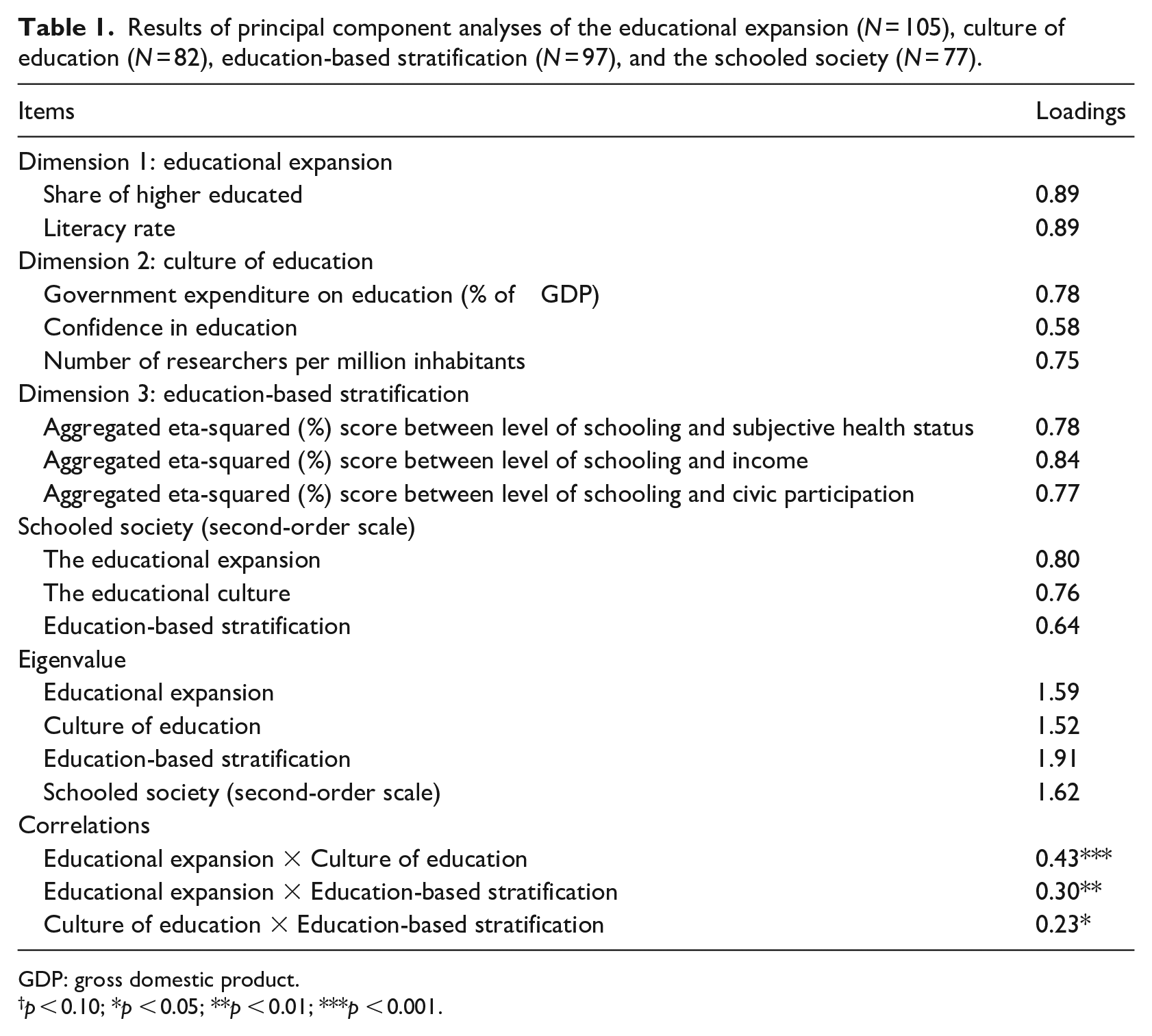
In this study, however, we are mainly interested in the global common variance and interdependence of these proxies. Factor scores were generated through principal component analyses of (1) the share of higher educated within the population and literacy rate (educational expansion; r = 0.59); (2) government expenditure on education, faith in education, and the number of researchers per million inhabitants (culture of education; 0.16 < r < 0.24); and (3) the aggregate eta-squared scores between educational attainment and health status, income, and civic participation (education-based stratification; 0.38 < r < 0.53) (see Table 1 and Appendix D.4, Supplemental material). Each principal component analysis yielded a factor that explained 79.5%, 50.5%, and 63.7% of the variance, respectively. Table 1 summarizes the results.
Results of principal component analyses of the educational expansion (N = 105), culture of education (N = 82), education-based stratification (N = 97), and the schooled society (N = 77).
GDP: gross domestic product.
p < 0.10; *p < 0.05; **p < 0.01; ***p < 0.001.
Next, we examined to what extent these subdimensions could be captured by one common second-order factor. Simple bivariate correlations (see Appendix D.2, Supplemental material) indicated positive and significant relationships between the educational expansion and the culture of education (r = 0.43; p < 0.001), the educational expansion and education-based stratification (r = 0.30; p < 0.01), and the culture of education and education-based stratification (r = 0.23; p < 0.05). Figures A2 to A4 in Appendix D.3 (Supplemental material) illustrate these correlations. A principal component analysis of the subdimensions of the schooled society across the 77 countries for which all data were available yielded one factor that explained 54.0% of the variance (see Table 1).
Finally, we constructed a summation scale that reflected the relative growth of a schooled society in a country. We developed this scale by first converting all scores of the subdimensions of the schooled society into positive values and then summing these scores and finally rescaling this to a continuum from 0 (Myanmar) to 100 (Belgium), where higher values reflected a stronger development of a schooled society (M = 53.68; SD = 23.16). This way, the three subdimensions of the schooled society were given equal weight (see also Appendix F, Supplemental material). To assess whether a scale defined by the cumulative combination of these subdimensions better reflected cross-national variation in the growth of schooled societies, we also constructed a multiplicative scale. However, because its effect parameters followed the same pattern as those of the sum scale and appeared to not better fit the data, we did not include it in the main part of the article (see Appendix E for the results, Supplemental material). All scores can be found in Appendix D.1 (Supplemental material) and an overview of the country-level indicators included in the analyses is provided in Appendix D.4 (Supplemental material).
The effects of the schooled society on the perceived importance of religion
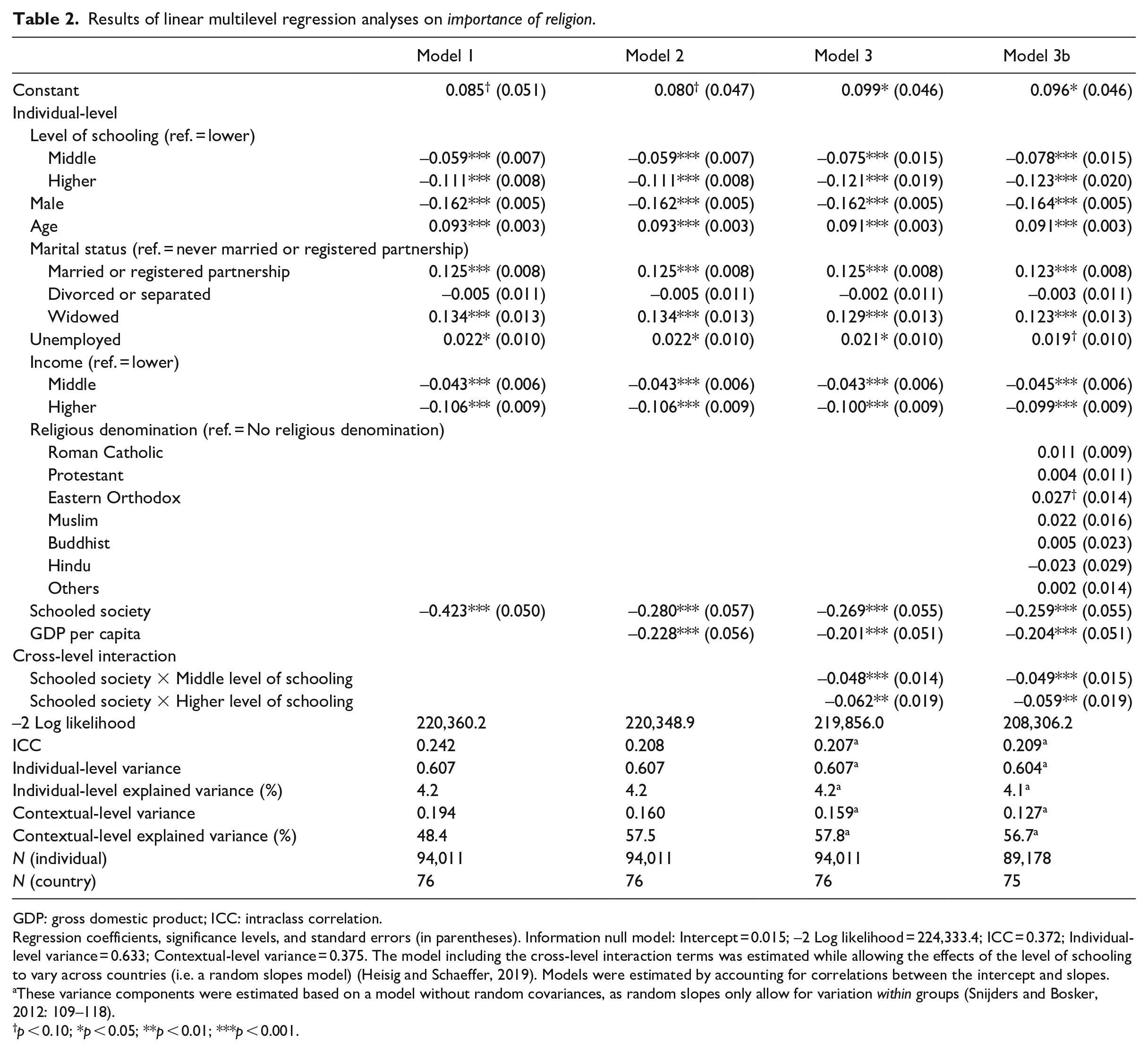
Having constructed a scale that reflects the relative development of a schooled society across 77 countries, we examined the extent to which this was related to cross-national variation in religiosity. Table 2 shows that the level of development of a schooled society had a strong negative relationship with religiosity (Model 1). People were less likely to experience religion as important when education was a more central and authoritative institution. Figure 1 shows this relationship at the aggregate level. Interestingly, a country’s GDP only partially explained the relationship between the development of a schooled society and the perceived importance of religion, revealing that both the national economic capital and the centrality of schooling in a country had an independent relationship with it (Model 2). Moreover, the multidimensional schooled society indicator was a better predictor of the perceived importance of religion than its separate subdimensions and the measure used in previous studies, namely the share of higher educated per country (see Table A5 in Appendix F, Supplemental material). This finding highlights the added value of using a more comprehensive indicator of the centrality and authority of schooling in explaining cross-national variation in the perceived importance of religion.
Results of linear multilevel regression analyses on importance of religion.
GDP: gross domestic product; ICC: intraclass correlation.
Regression coefficients, significance levels, and standard errors (in parentheses). Information null model: Intercept = 0.015; –2 Log likelihood = 224,333.4; ICC = 0.372; Individual-level variance = 0.633; Contextual-level variance = 0.375. The model including the cross-level interaction terms was estimated while allowing the effects of the level of schooling to vary across countries (i.e. a random slopes model) (Heisig and Schaeffer, 2019). Models were estimated by accounting for correlations between the intercept and slopes.
These variance components were estimated based on a model without random covariances, as random slopes only allow for variation within groups (Snijders and Bosker, 2012: 109–118).
p < 0.10; *p < 0.05; **p < 0.01; ***p < 0.001.
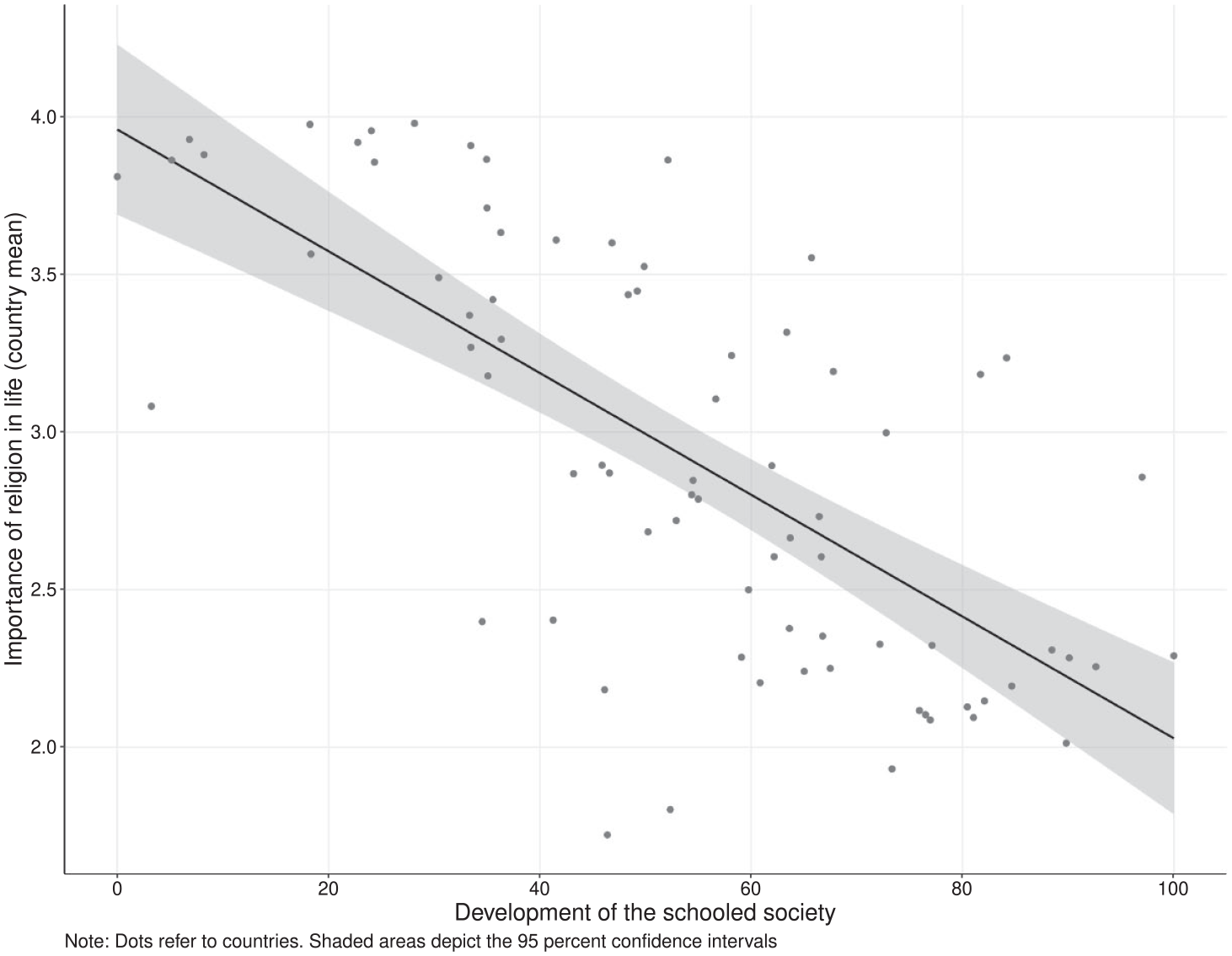
Country mean of the importance of religion in life on the degree of development of the schooled society.
Furthermore, we systematically found a significant negative association between the development of a schooled society and other experiences of subjective religiosity and public religious life (or authority) as well (see Appendix G, Supplemental material). Only for identification as a religious person did we find a weak relationship that was significant at the p < 0.10 level. We also tested the possibility of curvilinearity by including the quadratic product of the schooled society indicator in our analyses. It is possible, after all, that the overall antagonism between education and the perceived importance of religion is strongest in those countries where the conflict between the two institutions is most salient, while in the most developed schooled societies that struggle has subsided, allowing for a shift toward a relationship of affinity or at least neutrality (Baker, 2019). However, the quadratic term turned out not to be significant (see Appendix H, Supplemental material).
Overall, then, the presence of schooled society seems to undermine religious society without exception. Indeed, controlling for the religious majority of a country (see Appendix K, Supplemental material) did not alter our results. Moreover, we found that the association was similar across different religious contexts. Figure 2 displays the aggregate scores of the perceived importance of religion in one’s life on the degree of development of schooled society by religious majority. This clearly illustrates differences between religious traditions in terms of the development of schooled society and the importance of religion. For example, countries with an Islamic majority were less “schooled” and on average more religious, while the opposite is true for Protestant countries. 5 Crucially, however, across all religious contexts the direction of the relationship was the same: in societies where schooling was a more central and authoritative institution, people were generally less religious.
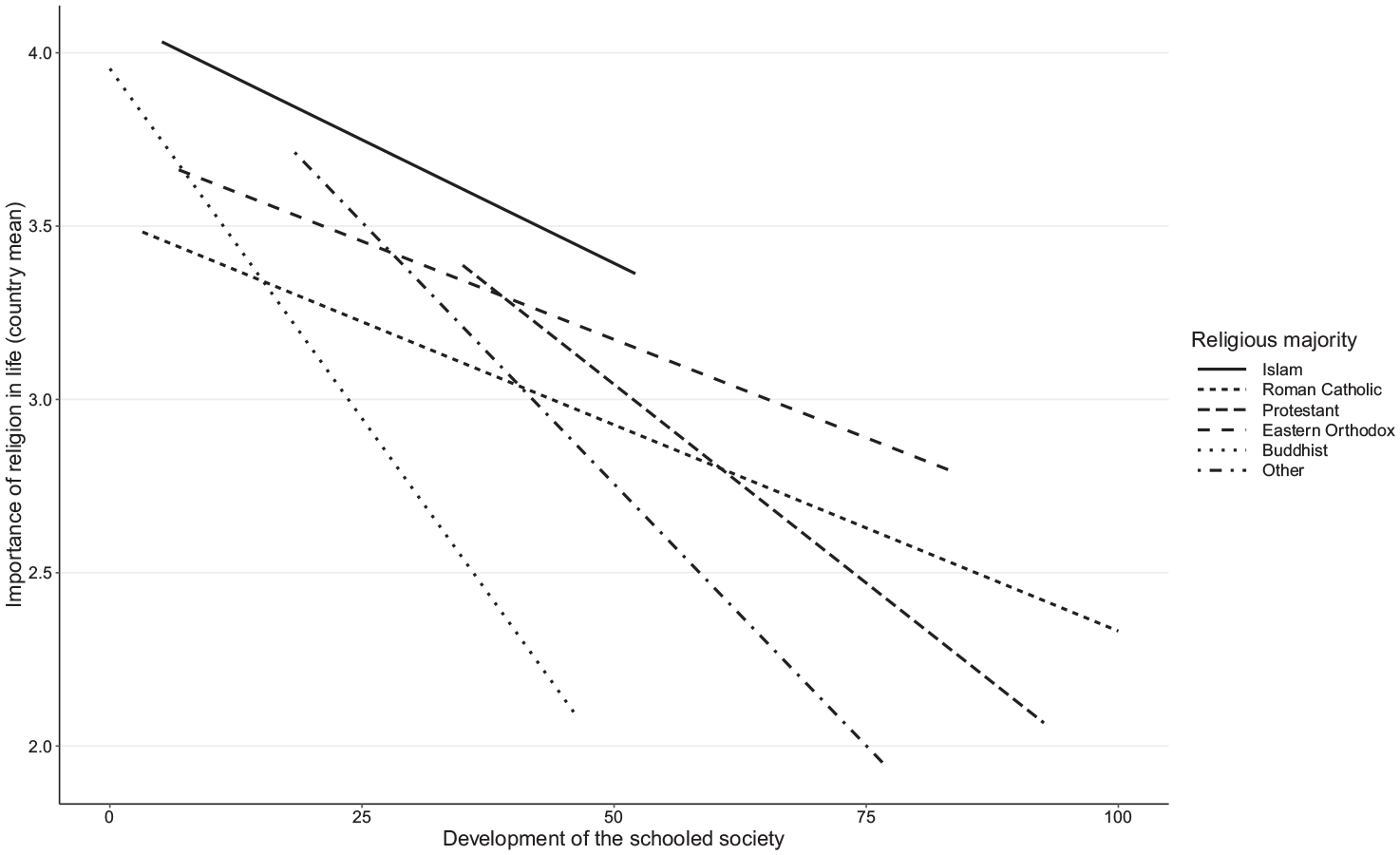
Country mean of the importance of religion in life on the degree of development of the schooled society, by religious majority.
Differences in the perceived importance of religion between educational groups
Furthermore, we investigated whether the level of development of schooled societies moderated the association between individual educational attainment and the perceived importance of religion by adding a cross-level interaction term between the indicator for the development of a schooled society and individual schooling in Model 3 of Table 2. By doing so, we aimed to (1) examine whether educational attainment does indeed increase in societal importance in more schooled societies (see also Van Noord et al., 2019) and (2) identify a potential direction through which the education paradox regarding religiosity (i.e. how can religious life persist in highly educated societies?) can be bridged. We found that people with higher levels of schooling were less likely to be religious. Model 3 shows that this negative association between educational attainment and the perceived importance of religion was stronger in countries with a higher degree of development of a schooled society. Figure 3 allows us to interpret these differences by illustrating the association between individual schooling and the (unstandardized) mean scores of the perceived importance of religion in three groups of countries defined by the degree of development of the schooled society (constructed on the basis of a relative distribution). This plot shows that (1) differences, albeit modest, in the perceived importance of religion of educational groups were present in the least schooled societies, but that in societies that were more schooled, (2) the perceived importance of religion was lower in general, and (3) therein a strong divide appeared between the middle and higher educated, on the one hand, and the lower educated, on the other hand. Finally, in Model 3b, we re-estimated Model 3 by including the respondent’s religious denomination. The results show that this estimation leads to the same substantive conclusions as Model 3.
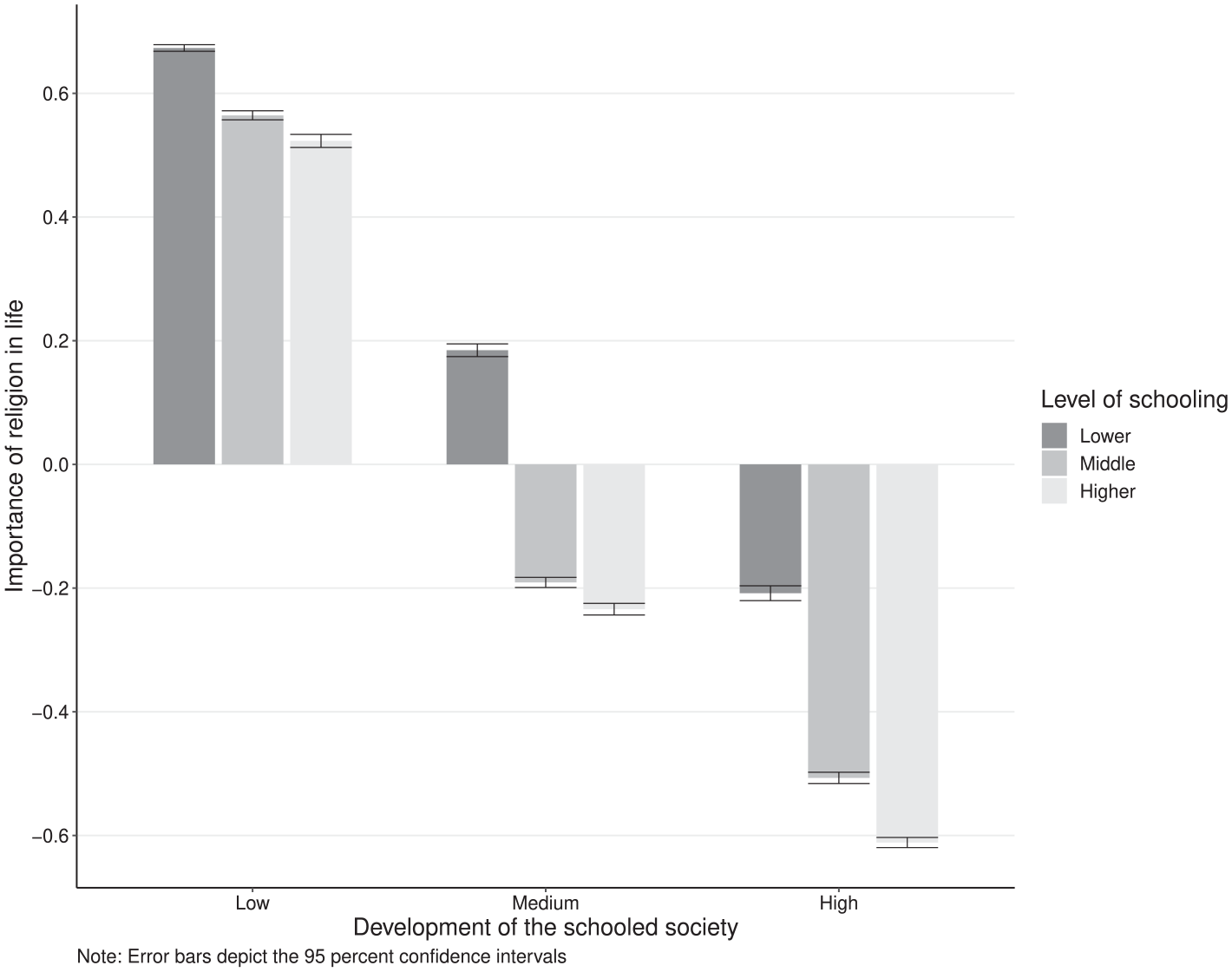
Importance of religion in life by educational group on the degree of development of the schooled society.
These observations support prior research suggesting that education has similar effects on a global level and across different contexts, but that these effects are more pronounced in schooled societies (Van Noord et al., 2019; see also Kołczyńska, 2020; Schwadel, 2015). However, these observations must be qualified in some respects by the analyses based on the separate aspects of religiosity (see Appendix F, Supplemental material). First, we did not find a significant relationship between educational attainment and attendance at religious services, which may be a consequence of the often found positive relationship between schooling and participation in public life (see also Baker, 2019; Schwadel, 2011). Second, the cross-level interaction effects were non-significant in terms of trust in religious organizations, for religious self-identification regarding the middle educated, and for attendance at religious services regarding the higher educated (see Tables A7 and A8). Finally, we compared these cross-level interactions across different religious traditions (see Appendix K, Supplemental material). Figure 4 illustrates these comparisons. We found similar patterns across almost every context, with educational differences in religiosity being greater in more schooled societies. In Islamic and Buddhist countries, the pattern was even reversed for people living in the least schooled societies, the higher educated being most religious. In the already quite highly schooled contexts of countries with a Protestant and other denominational (e.g. Anglican, non-religious, Hindu) majority, however, the gap in religiosity between educational groups was smaller in the most schooled societies, as almost all people in such societies perceived religion as unimportant in their lives. On the other hand, differences between the lower educated specifically and the other educational categories were greatest in highly schooled Roman Catholic and Buddhist countries.
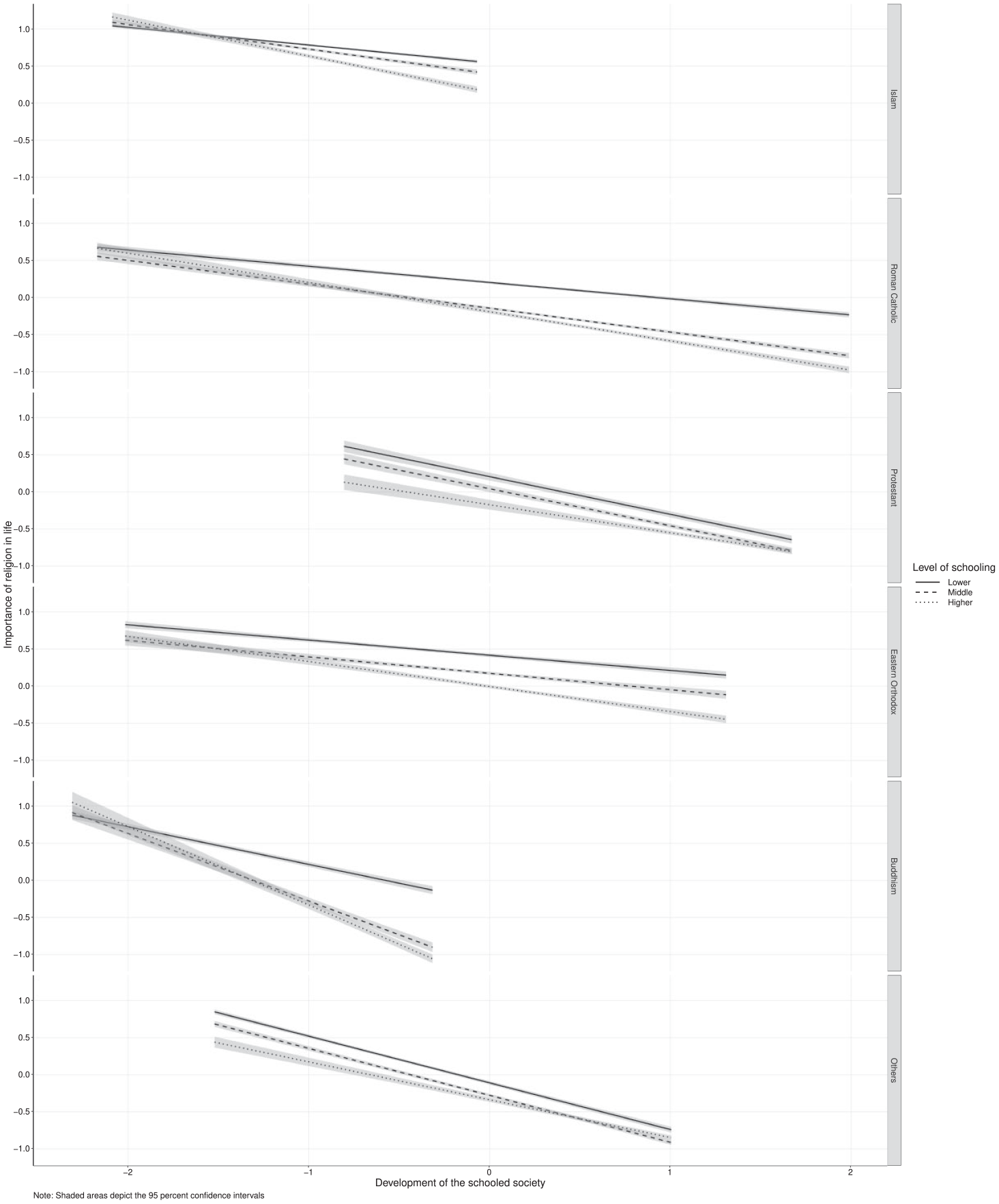
Importance of religion in life by educational group on the degree of development of the schooled society, by religious majority.
Regarding the control variables, the economic capital of a country systematically had a negative, significant relationship with the various forms of religiosity. At the individual level, the elder, groups with lower levels of income, the married and widowed, Eastern Orthodox people, and especially women exhibited higher levels of religiosity.
Finally, we conducted a series of additional robustness checks by controlling for region, country-level religious characteristics, and wave (Appendices I–L, Supplemental material). None of these checks altered our substantive conclusions.
Discussion and conclusion
Starting from the ongoing debate on the education-religion paradox, this study examined (1) cross-national variation in what Baker (2014) has described as the growth of schooled societies and (2) its relationship with the perceived importance of religion across 76 countries. We first constructed a macro-level indicator that better grasps the multiple theoretical dimensions of the growth of schooled societies. More specifically, we distinguished between (1) the educational expansion, (2) the culture of education, and (3) education-based stratification. We combined these subdimensions into a single second-order scale that taps into the cross-national variation in the level of development of schooled societies. Multilevel analyses subsequently showed that people generally perceived religion as less important in their lives in the more developed schooled societies and that this was the case across different religious contexts worldwide. Simultaneously, the level of development of a schooled society moderated individual-level educational differences. Generally, in schooled societies, there was a wider gap in the perceived importance of religion between the less educated, on the one hand, and the middle and higher educated, on the other hand. Additional analyses show that the general patterns we found for the perceived importance of religion in life apply to a certain extent also to other aspects of religiosity such as the importance of God in life and attendance at religious services.
Although our empirical analyses did not allow us to determine exactly why education and the perceived importance of religion are generally at odds, this study fills a gap in the work on both the growth of schooled societies (Baker, 2014; Meyer, 1977) and the relationship between education and religiosity (Mayrl and Oeur, 2009). Scholars such as Meyer (1977) and Baker (2014) have pointed to the cultural and authoritative characteristics of education and argue that educational expansion is part and parcel of their global diffusion. So far, however, research on the institutional effects of education (e.g. Gidron and Hall, 2020; Van Noord et al., 2019) has not used a measure that captures the multidimensionality of this phenomenon at a contextual level while reflecting its cross-national variation at the global level. Indeed, while there has been research that focused on the global similarities of education as a “world-level variable” (e.g. Baker and LeTendre, 2005; Fiala and Lanford, 1987; Schofer and Meyer, 2005), we aimed to examine the relevance of cross-national differences within these global similarities with regard to the perceived importance of religion among people. In that respect, we found that a composite indicator for the level of development of schooled society had a systematically stronger relationship with the perceived importance of religion than the measure that solely represents the educational expansion, thus providing an initial confirmation of its added value. Our results could furthermore suggest that the “tension” between education and religion is less the result of their inherent characteristics, but rather a historical institutional conflict over different societal models (e.g. Anderson, 2006; Evans and Evans, 2008; Meyer et al., 1992). 6 Indeed, not only our composite indicator of the schooled society—which measures the centrality of education as an institution—but also its subdimensions (the educational expansion, the culture of education, and education-based stratification) had a negative relationship with the perceived importance of religion in life (see Appendix F, Supplemental material). This implies that aspects of the relationship between education and religiosity cannot fully be explained by theses such as the epistemological secularization theory.
Our findings further underscore the relevance of country-level characteristics of schooling in explaining the relationship between individual educational attainment and the perceived importance of religion (see also Schwadel, 2015). The negative association between education and the perceived importance of religion appears to be affected by the degree of development of a schooled society. In the least schooled societies, where the aggregate level of religiosity is generally high, educational differences in the perceived importance of religion were present, with the higher educated often constituting the least religious group. This suggests that the higher educated are the most ardent secularizers in poorly schooled and strongly religious contexts, adopting a globally diffused and school-based view of the world and struggling for societal recognition (Evans and Evans, 2008; Kołczyńska, 2020). In societies that are characterized by a high degree of centrality of education, the rejection of religion’s importance in life is more common among less educated groups as well.
However, the impact of the development of schooled society on the perceived importance of religion seems to affect the least educated to a lesser extent. While middle educated groups quite consistently saw religion as similarly important as the higher educated, the less educated remained more religious, even in the more schooled societies. It is thus plausible that the negative relationship between educational attainment and the perceived importance of religion in those societies is not fully due to the effects of going longer to school and receiving higher education, but partly to the rejection of secular beliefs and behaviors by the less educated. While we cannot verify this empirically with the current study, this could be because they are less affected by the socialization of schools and education-based narratives. Moreover, given that in schooled societies (Spruyt and Kuppens, 2015), educational attainment increasingly becomes a central source of social status (Van Noord et al., 2019), the higher educated develop an intergroup bias toward the lower educated (Kuppens et al., 2018) and a lack of education is increasingly equated with incompetence, poor decision-making, and personal and societal problems (Sandel, 2020), it becomes particularly difficult for the less educated to develop a positive identity. The greater importance attributed to religion (and the associated other aspects of religiosity) among the lower educated could then also be a reactionary strategy to provide themselves with a place in a world that rejects them. Finally, while previous research (Van Noord et al., 2019) has shown that educational differences with regard to social status take on an increasingly binary division in which those with a higher education degree are distinguished from those without, imitation processes (Elias, 2000 [1939]) by middle educated groups could explain why they are less religious as well.
The analyses presented in this article aim to further advance empirical research on the consequences and particularities of the growth of schooled societies. This theory argues that the role and effects of mass schooling as an institution are too often seen as just a “complement” to other institutions (Baker, 2014; Kingston et al., 2003; Meyer, 1977). More than an individual investment, a mere provider of knowledge and skills or a machine that operates to the beat of economic demands, education has increasingly become a central institution that authoritatively and legitimately influences people’s lives. We feel that this emerging literature can be further developed by (1) more concrete and applied comparative empirical research that (2) directs attention to national differences within this global trend. In this context, we believe that the theory of the schooled society is in need of an indicator. The bottom line of our argument is this: although we fully agree with previous accounts (Baker, 2014; Schofer and Meyer, 2005) that point to the striking similarities in how education as an institution has traveled the globe, we believe that only by simultaneously studying the relevance of national differences in this process will we achieve a full understanding of the meaning and implications of the growth of schooled societies. Clearly, however, further research should seek to overcome some limitations of our analysis. Most importantly, more and more accurate variables should be collected and integrated in the indicator. Indeed, the current version of the schooled society indicator does not take into account several important differences between countries’ educational systems. For example, the level of within-country differentiation of the educational system (e.g. tracking), or more direct measures of the extent to which education is seen as key to individual and societal development, a universal problem-solver and the basis of a just social structure (e.g. in educational policies and curricula) should be included. Further research should also aim to include more aspects of religiosity (e.g. spirituality). Finally, in this study, we focused on national differences within global similarities. However, if we are to examine more closely aspects of the growth of schooled society (and how it relates to other institutions such as religion), within-country time-series analyses must be conducted. As many European and Northern American countries have exhibited characteristics of a schooled society since the 1980s, it may be more fruitful to study those countries that can be considered to be in the early stages of the “development trajectory” toward a schooled society (e.g. India).
Finally, although the current research focused on the religious domain, several considerations point to the relevance of the schooled society thesis in relation to other societal outcomes as well, such as political participation, occupational change, and gender relations. In these fields, too, “educational paradoxes” have been observed (e.g. Baker, 2014; Spruyt and Kuppens, 2015; Van Bavel et al., 2018). Achieving a better understanding of these paradoxes will only be possible if we broaden our view on schooling and not regard it as an institution that merely serves other institutions, but as a primary institution, a social force that deeply transforms social life.
Overall, this study offers an exploration of the consequences of the development of schooled societies and a demonstration of the added value of conceiving of mass schooling as more than merely an increase in the number of (highly) schooled people. The rise of schooled societies, a global trend whose institutionalization varies considerably across countries, appears to be an independent and important force in the decrease of religious life. Indeed, where education enjoys authority and legitimacy, religion seems to have lost it to a significant extent.
Supplemental Material
sj-docx-1-cos-10.1177_00207152231177238 – Supplemental material for Religious life in schooled society? A global study of the relationship between schooling and religiosity in 76 countries
Supplemental material, sj-docx-1-cos-10.1177_00207152231177238 for Religious life in schooled society? A global study of the relationship between schooling and religiosity in 76 countries by Leandros Kavadias, Bram Spruyt and Toon Kuppens in International Journal of Comparative Sociology
Footnotes
Acknowledgements
The authors are very grateful to Marieke Timmerman for her useful advice and comments regarding quadratic functions in logistic regression analyses.
Funding
The author(s) disclosed receipt of the following financial support for the research, authorship, and/or publication of this article: Funding from the Research Foundation – Flanders (FWO). Grant number: 11H8922N.

Supplemental material
Supplemental material for this article is available online.
Notes
References
Supplementary Material
Please find the following supplemental material available below.
For Open Access articles published under a Creative Commons License, all supplemental material carries the same license as the article it is associated with.
For non-Open Access articles published, all supplemental material carries a non-exclusive license, and permission requests for re-use of supplemental material or any part of supplemental material shall be sent directly to the copyright owner as specified in the copyright notice associated with the article.
