




Abstract
This article investigates perceptions of university quality and status threat among White and non-White Democrats and Republicans in response to a curriculum emphasizing diversity. We hypothesize that Americans in general will perceive a university with a diversity-focused curriculum as low quality and that White Americans (particularly Republicans) will perceive the university as posing a status threat. We test our hypotheses with data from a survey experiment of roughly 700 Americans. White Republicans rated a university with a diversity-focused curriculum as low quality; contrary to expectations, White Democrats did not. We find partial support for our predictions regarding status threat, with Republicans indicating more status threat than Democrats. Participants, regardless of political affiliation or race, generally opposed government regulation of university curricula. Findings demonstrate a complex interplay between party affiliation, race, and perceptions of university quality, offering insight for institutions aiming to navigate the challenging environment of diversity-focused education.
In today’s sociopolitical climate, diversity efforts attract responses ranging from strong support to outright contempt (Dover, Kaiser, and Major 2020). This conflict has spread to universities. Many claim that diversity enhances students’ educational experiences and career readiness (Holland and Ford 2021). Accordingly, they have invested in what some call a “diversity infrastructure,” including building multicultural centers, writing diversity-centered missions, establishing diversity-oriented courses and offices, and promoting multicultural awareness campaigns (Okuwobi, Faulk, and Roscigno 2021:385; Thomas 2018). But diversity efforts in universities also evoke negative reactions. Diversity, equity, and inclusion (DEI) efforts at universities have come under attack following the Supreme Court of the United States (SCOTUS) ban on affirmative action in university admissions (Opie and Washington 2023), and state governments are limiting DEI efforts. For example, the Wisconsin legislature recently approved a 6 percent wage increase for employees of the statewide university system on the condition that universities stop hiring individuals whose job centers on diversity efforts and instead realign spending on programming that does not focus on historically marginalized students (Spears 2023). In organizations generally, people have called diversity efforts “unfair” (Dover et al. 2020; Kaiser et al. 2013; Trawalter, Driskell, and Davidson 2016) and “anti-meritocratic” (Iyer 2022) and have pushed back against or demonstrated only low levels of support for pro-diversity workplace policies (Dobbin and Kalev 2021; Dover et al. 2020; Scarborough, Lambouths, and Holbrook 2019).
Understanding individuals’ reactions to diversity is necessary for explaining the limited success of diversity efforts (Dobbin and Kalev 2021) and the dwindling support for spaces supporting inclusion, equitable practices, and diversity. For universities specifically, understanding reactions to diversity initiatives is important for understanding patterns of public support for and frustration with higher education (Parker 2019). Research shows that universities, particularly those with high prestige, seek diverse student bodies and advertise their diversity (Holland and Ford 2021; Petts and Garza 2021; Stevens 2009). We know less about how people perceive university diversity efforts, particularly when those efforts emphasize diversity practices other than student body composition (e.g., resource investments in diversity initiatives, required diversity components in courses, or required diversity training).
Here, we argue that organizational investment in diversity lowers perceptions of an organization’s quality and increases perceptions of status threat. More specifically, we argue that people will associate universities’ diversity-centered curriculum with low quality because these efforts create an association between the university and groups low on the social status hierarchy; when people see a university as low status, they assume that it is lower quality. At the same time, organizational diversity efforts will increase a sense of threat among high-status groups (in particular, White individuals) that fear symbolic or material losses of power and status that they perceive accompany diversity efforts. We expect these patterns of perceptions of quality and threat to vary depending on people’s political party affiliation and race/ethnicity. We test our hypotheses using an online vignette experiment in which we expose participants to a fictitious university with a curricular focus on either diversity or teamwork. Our hypotheses are substantially supported. Our study has implications for organizations, particularly universities, whose advertised mission is to support diversity while navigating the current polarized sociopolitical terrain.
Literature and Hypothesis
Diversity Efforts and Quality
We explore the association between diversity efforts and perceptions of quality by focusing on status dynamics. “Status” refers to the evaluative beliefs people hold about actor types, particularly about their competence and the quality of contributions they are likely to make (Berger et al. 1977; Correll and Ridgeway 2003; Ridgeway 2014; Webster and Foschi 1988). In some instances, an individual might gain prestige by supporting diversity because doing so demonstrates cultural tolerance and open-mindedness (Berrey 2011; Mayorga-Gallo 2019; Underhill 2019). But status theories predict that characteristics such as race act as a status indicator such that absent specific information about an individual’s competence in particular domains, people assume that White individuals are generally more competent than non-White actors (Lovaglia et al. 1988; Melamed et al. 2019; Wagner, Forde, and Ford 1986; Webster and Driskell 1978). Importantly, because both low- and high-status individuals are exposed to the same status hierarchy, they both have similar perceptions of who falls where on that hierarchy (Ridgeway and Correll 2006).
Research suggests that status is transferable. Actors can change their status or the status of others through their interactions. Research demonstrates that an organization’s status can be negatively impacted by an association with diversity (Wooten and Couloute 2017). When a high-status actor accommodates a low-status actor (e.g., when White people engage in diversity efforts), the low-status actor may gain status because of their association with the efforts of the high-status actor. At the same time, the high-status actor may lose status (Podolny 2005). For example, after one school became 90 percent minority, its prestige among local employers dropped (Damaske 2009). And when mostly White public schools integrate along race lines, minority student attendees may gain status by being associated with the school, but the status of the school itself often declines (Reardon and Owens 2014).
If race is a status characteristic—such that White individuals are viewed as more competent and higher status than Black, Latinx, or Indigenous actors—the implication is that a diversity-focused curriculum that lifts voices and perspectives of non-White individuals and communities will be associated with low status. If so, people will assume that a university with a diversity-focused curriculum has low competence and is low quality. Because Americans are generally exposed to a consistent racial status hierarchy, this pattern will hold for everyone, including White and non-White actors and Republicans and Democrats.
Hypothesis 1: (a) People will perceive a university that has a diversity-focused curricular emphasis as lower quality than one that does not. (b) This relationship will hold across race and political party.
Diversity Efforts and Status Threat
Research shows that high-status actors tend to react negatively if low-status actors engage in threatening actions (e.g., Scheepers and Ellemers 2004; Scheepers, Ellemers, and Sintemaartensdijk 2009; see also Hofstadter 1967). Negative reactions may be especially pronounced when a member of the high-status group (i.e., White individuals) perceives a symbolic threat that is an attack on their values or beliefs (Rios, Sosa, and Osborn 2018, cited in Iyer 2022) or a threat to meritocracy (i.e., DEI initiatives that allegedly lead to favoring of less qualified individuals; see Aberson and Haag 2003; Dover, Major, and Kaiser 2020; Iyer 2022; Kravitz and Klineberg 2000; Son Hing, Bobocel, and Zanna 2002). Researchers have ample evidence that status threats result in more support for political conservatism (Craig and Richeson 2014; Mutz 2018), engagement in gender harassment (Berdahl 2007), support for authoritarianism (Feldman and Stenner 1997), and resistance to diversity (Danbold and Huo 2015). Resistance to diversity can manifest in a backlash to diversity practices (Iyer 2022), White claims of “reverse racism” and unequal treatment (Norton and Sommers 2011), and the outright rejection of DEI policies by racially advantaged group members (Dover et al. 2020; Iyer 2022; Renfro et al. 2006; Scarborough et al. 2019). In general, high-status actors who perceive a threat to their status react negatively to support for social equality (i.e., attention to diversity; Morrison, Fast, and Ybarra 2009).
When a university emphasizes diversity as part of its curriculum, it may be seen as undercutting a traditional monopoly of content focused on high-status actors (i.e., White individuals; Bonilla-Silva and Peoples 2022) and with it, creating a threat to White individuals’ status. For example, some White people may perceive a curricular focus on diversity as suggesting that White people are problematic or inherently racist (see Gorka and Gonzalez 2022; Knowles et al. 2014), that whiteness is a “cultural liability” (McKinney 2003), or that whiteness is something to be ashamed of (Ray and Gibbons 2021). The implication is that high-status (White) people will feel threatened by a diversity-focused curriculum. And when threatened, White people may feel that they and their viewpoints are unwelcome and believe that the university is biased and treats White people unfairly (Dover, Kaiser, and Major 2019; Dover, Major, and Kaiser 2016; Wooten and Couloute 2017). In addition to fearing unfair treatment, White people may want to withhold support for actors producing the threat, as was the case when the federal government underfunded the visibly racialized Historically Black Colleges and Universities (Wooten 2016; Wooten and Couloute 2017). This might mean, for example, supporting less funding and more government regulation of a university.
Given political polarization around education and race, we expect to see differences in perceptions of threat by political party. More specifically, we anticipate patterns of perceived status threat will be stronger for Republicans than Democrats. Compared to Democrats, Republicans are more likely to believe that White people get little benefit from their race (Bartels 2020; Doherty 2023) and that racism is not social problem (see Wetts and Willer 2022). They tend to be less supportive of funding higher education, especially diversity-focused efforts whose presumed beneficiaries are racially diverse (Lieb 2023; Parker 2019; Surovell 2023; Taylor et al. 2020) and whose efforts pose a threat to their status (Mutz 2018). A recent study finds that deep cuts to higher education follow declines in the White population of states controlled by Republican governments (Taylor et al. 2020). We also expect to find feelings of threat among White people but not non-White people, who stand to gain voice and access to resources from diversity efforts and presumably would have little reason to feel threatened by diversity efforts.
Hypothesis 2: (a) A university’s investment in diversity efforts will increase White people’s sense of threat. (b) This effect will be stronger for Republicans than Democrats.
In sum, we expect that people exposed to a university that emphasizes diversity-related content in its curriculum will see the university as lower quality than one without such a curricular focus. Negative perceptions will be held by individuals from all racial backgrounds and by both Democrats and Republicans. In addition, White individuals will feel more threatened by a university whose curriculum emphasizes diversity than one that does not. White people will see a diversity-centered curriculum as more unfair to them than one not centered on diversity. They will also support less funding and will seek greater government regulation of the university and its curriculum. These effects will be stronger for White Republicans than for White Democrats.
Methods
We tested our hypotheses using an online vignette experiment in which we manipulated the description of the curricular efforts of a fictitious university and asked questions designed to elicit participants’ perceptions of the quality of the university and their sense of threat. The study has two conditions—a curricular emphasis on diversity versus one on teamwork. In addition, we intentionally recruited Democratic and Republican participants and White participants and traditionally underrepresented groups that are most likely to benefit in similar ways from diversity efforts (Black, Hispanic, and Indigenous individuals and those who described themselves as belonging to more than one racial/ethnic category, n = 48). We realize there are many nuances to race and higher education, including debate around which racial groups do and do not benefit or how they might benefit differently from one another. The impacts of diversity initiatives in college are particularity complicated for Asian individuals, who are not the traditionally underrepresented racial minorities groups typically targeted by affirmative action practices (Skrentny 2002). In fact, that Asian students’ claims of discrimination in college admissions brought about the recent Supreme Court ruling to eliminate race-based affirmative action in college admissions highlights the mixed success of affirmative action gains for this racial group. Given this complication, we purposefully exclude Asian participants.
Participants and Procedures
Participants were recruited from Prolific, a site similar to Amazon’s Mechanical Turk but designed specifically for academic researchers. 1 Prolific allows researchers to screen participants on a range of characteristics, including participant political orientation. We prescreened on participant political party to obtain a sample that was half Democratic and half Republican. We also screened on race—aiming for a sample of half White and half non-White (Black, Hispanic, and Indigenous) participants. In addition to relying on Prolific’s prescreeners to select participants, we asked participants their political orientation and race in the study itself. We found some discrepancies between their race as identified in the prescreen and as reported in the study—more people reported themselves as White in our study than in their prescreen responses. We assume that self-reported race was more accurate than the prescreen, and so as measured in the study, our sample includes more White participants than non-White participants.
We posted our study on the Prolific site. When individuals clicked on the study link, they were taken to a consent form in which they were told that the information they give may be used in research in ways that maintain their anonymity. Upon affirming their consent, they were then taken to the vignette experiment on the Qualtrics platform. Participants were randomly assigned to an experimental condition (diversity or teamwork). Each participant was exposed to only one condition. They read a vignette that described a fictitious university’s curricular focus. They then answered questions about the university, sociodemographic questions, and manipulation checks. The study took approximately 5 minutes to complete. Participants were paid $1.50. 2 Data were collected in October 2023.
Our sample was 54 percent female. Mean age was 24 (SD = 13.8). About 2 percent of participants were Indigenous, 19.3 percent were Black, 71.8 percent were White, 1.1 percent were Asian (excluded from analysis), and 6.1 percent were multiracial. Twenty percent of the sample was Hispanic. Fifty percent of our participants were Republicans, and 50 percent were Democrats.
Forty-four (5.5 percent) participants failed the manipulation check (i.e., a question used to identify and filter out respondents who did not notice the experimental manipulation): 13 (3.3 percent) in the diversity condition and 31 (7.7 percent) in the teamwork condition. The results are substantially the same whether or not these participants are included. We report results for analyses excluding those who failed the check, for a sample of about 739. Data are available at Harvard Dataverse (Kmec 2024).
Experimental Conditions
Our study manipulated information about the curricular focus of a fictitious university—diversity versus teamwork with the following vignette:
A university is committed to preparing students for a complex world. This university requires that students take courses that emphasize communication and [teamwork/diversity]. The university has invested substantial resources, particularly in its [teamwork/diversity] initiatives, because it views [teamwork/diversity] as important for student success. It requires that all faculty have training in [teamwork/diversity] and that all courses include [teamwork/diversity] components.
Dependent Measures
To gauge participants’ perceptions of a university’s quality, we ask five questions. We ask respondents to indicate their broad assessment of the quality of the university with the question, “What is the overall quality of this university? (0 = very low, 10 = very high). We measure perceived eliteness of the university with two questions: “How hard do you think it is to get into this school?” (0 = very easy, 10 = very hard) and “How smart do you think students at this university are?” (0 = not at all smart, 10 = very smart). To measure perceived academic training qualitym we ask, “How likely are graduates to get good jobs?” (0 = very unlikely, 10 = very likely). To get at perceptions regarding academic rigor, we ask, “How rigorous are the courses at this university?” (0 = not at all rigorous, 10 = very rigorous). These items were highly correlated, with a Cronbach’s alpha of .81. We averaged responses to create a quality scale.
To test the presence of status threat, we ask questions designed to get at participants’ perceptions of threat and support for constraining the financial resources and academic freedom of the university. To measure perceptions of unfairness against White people, we ask, “How fairly do Whites get treated at this university?” (0 = very unfairly, 10 = very fairly). We recoded this so that 0 = very fair and 10 = very unfair. Because reactions to a status threat may affect interest in supporting the threatening organization, we ask, “How much funding should the government give this university?” (0 = none, 10 = a lot). We recoded this variable so that a lot of funding = 0 and no funding = 10. Because a sense of threat may lead people to want to constrain the threatening actor, we ask, “How much should the government regulate this university?” (0 = not at all, 10 = a lot) and “How much should the government regulate what people teach at this university?” (0 = not at all, 10 = a lot). These two items were correlated with a Cronbach’s alpha of .83. We averaged the two responses to create a scale, which we refer to as the “regulation scale.”
Results
Table 1 describes mean participant responses across the experimental conditions by race and political party. To test our hypotheses, we conducted ordinary least squares regressions (Tables 2 and 3). We found three-way interaction effects of the diversity condition, political party, and race on university quality and status threat. To clarify these patterns, we report the results separately for White participants and non-White participants.
Mean Responses across Conditions by Respondent Race and Political Party.
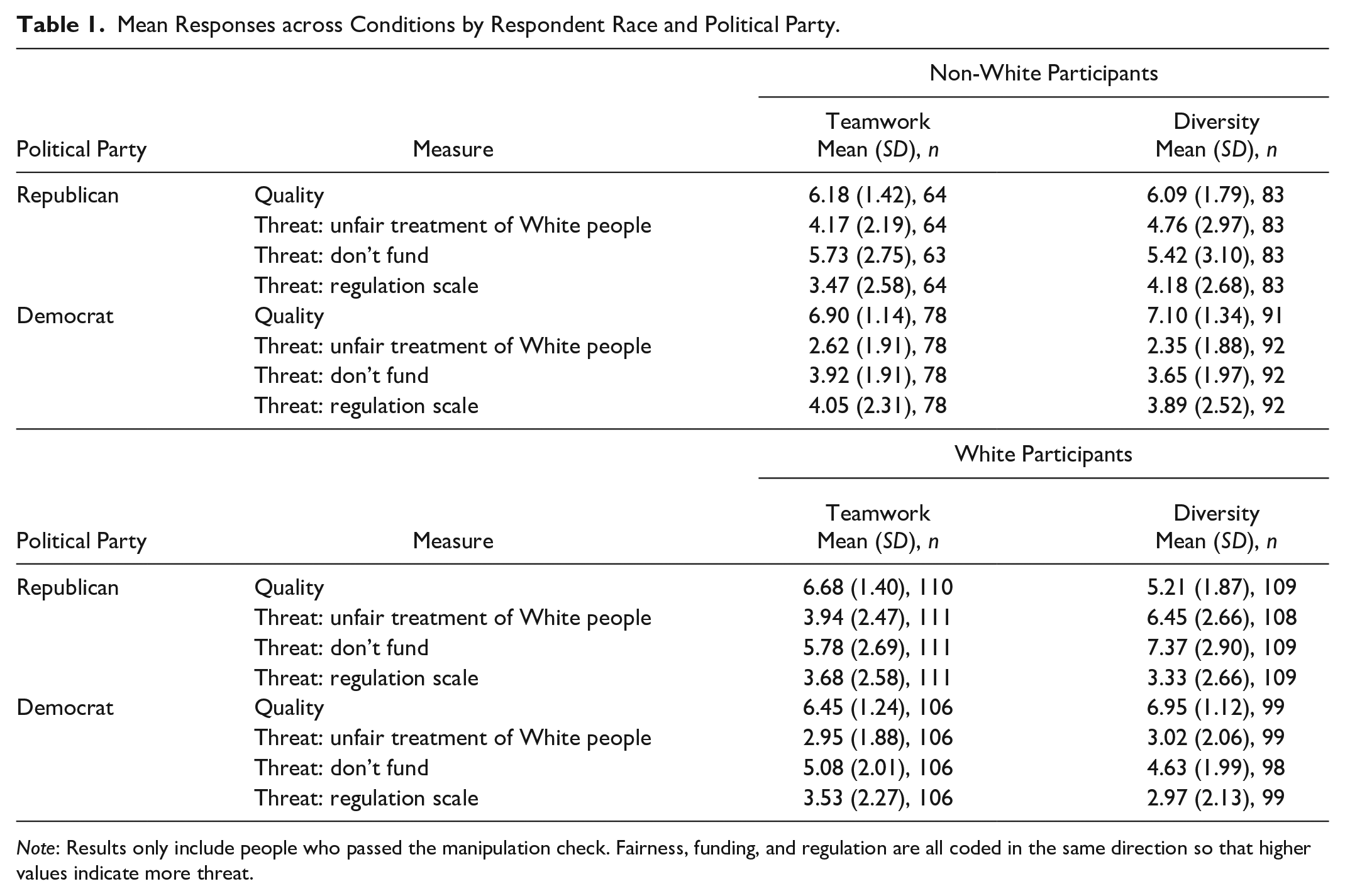
Note: Results only include people who passed the manipulation check. Fairness, funding, and regulation are all coded in the same direction so that higher values indicate more threat.
Ordinary Least Squares Regressions Predicting University Quality.

Note: Analyses only include people who passed the manipulation check.
p < .001. ***p < .0001 (two-tailed tests).
Ordinary Least Squares Regressions Predicting Three Measures of Status Threat.

Note: Analyses only include people who passed the manipulation check. Fairness, funding, and regulation are all coded in the same direction so that higher values indicate more threat.
p < .05. **p < .001. ***p < .001 (two-tailed tests).
We expected participants exposed to the diversity condition to evaluate the university as lower quality than those who were exposed to the teamwork condition (Hypothesis 1) (Table 2, Models 1 and 2). For non-White participants, the effect of the experimental conditions was in the predicted direction but was not statistically significant (see the nonstatistically significant diversity and Diversity × Democrat coefficients in Model 1). For White Republicans, as predicted, the diversity condition led to perceptions of lower quality (see the diversity coefficient in Model 2). For White Democrats, the diversity condition was actually associated with perceptions of higher status (see the Democrat and Diversity × Democrat coefficients in Model 2, Table 2, and mean quality indicators in Table 1—diversity: M = 6.95, SD = 1.12; teamwork: M = 6.45, SD = 1.24). Among Democrats, the mean quality indicator was higher for non-White participants than that of White participants in both the diversity (M = 7.10, SD = 1.34) and the teamwork (M = 6.90, SD = 1.14) conditions.
We predicted that participants would have a greater sense of status threat when exposed to the diversity condition than the teamwork condition (Hypothesis 2a) and that White Republican participants would have stronger negative reactions than White Democrat participants (Hypothesis 2b). Looking first at perceptions of unfairness toward White people, as expected, White Republicans reported greater status threat when exposed to the diversity versus teamwork condition (see the diversity coefficient in Model 2, Table 3); there was no effect for non-White Republicans (Model 1, Table 3). As predicted, the effect of exposure to the diversity condition effect was weaker for White Democrats than White Republicans (see the Diversity × Democrat interaction coefficient in Model 2, Table 3). A similar pattern holds for participants’ support for government funding. There were no effects of exposure to the diversity condition for non-White participants (see the nonsignificant diversity and Diversity × Democrat coefficients in Model 3). But White Republicans were less inclined to support government funding (see the diversity coefficient in Model 4). This effect was weaker for White Democrats, who were more inclined to fund than Republicans (see the Diversity × Democrat coefficient in Model 4 and means in Table 1). Contrary to our expectation, there is no effect of the experimental condition on desire to regulate the university for any of the participants (see Models 5 and 6, Table 3).
Discussion
Our results partially support our hypotheses. We expected participants to rate a university whose curriculum signals attention to diversity as low quality. This prediction was supported for White Republicans. For non-White participants, however, exposure to the diversity condition had no effect on their quality evaluations. And White Democrats actually see a university emphasizing diversity as higher quality than one whose curriculum does not. We also expected diversity to produce status threat and predicted that this effect would be stronger for White Republicans than White Democrats. This hypothesis was supported for perceptions of unfairness and feelings about funding but not for support for overall regulation of the university.
University Quality
Democrats make different quality assessments than Republicans because they may take into account factors that reduce or offset any negative connotation stemming from a university curriculum centered on diversity. In particular, they may place more instrumental and moral value on diversity. Compared to Republicans, Democrats tend to have more favorable views of the value of diversity, especially at work. In fact, among roughly 6,000 survey participants in a Pew Research Center panel, Democrats (78 percent) are more in favor than Republicans (30 percent) of saying that increasing diversity, equity, and inclusion at work is a good thing (Minkin 2023). For Democrats, then, an educational emphasis on diversity may be associated with high quality because it prepares students for workplace success.
In addition to seeing an instrumental value to diversity, Democrats may see a greater moral value in diversity than Republicans (Mayorga-Gallo 2019; Mellow 2020; Taylor et al. 2020). White Democratic respondents might view engagement in diversity efforts as a display of their moral (nonracist) goodness (Berrey 2011; Mayorga-Gallo 2019; Underhill 2019). For example, White parents intentionally exposed their children to racial diversity to demonstrate “good” parenting and teach children racial tolerance (Ahmed 2012; Underhill 2019). Democrats may also see diversity as an elite moral value and view support for diversity as a signal of conformity to elite signals (Wetts and Willer 2022). If so, then diversity efforts in higher education may be morally valued and associated with high quality among Democrats.
The quality ratings for non-White participants mirrored those of White participants; they were in the same direction but not statistically significant. Non-White Republicans may not label diversity efforts as negatively as do White Republicans because they stand to gain from a curriculum that emphasizes diversity and with it, a higher quality educational experience. Non-White Democrats rated university quality higher in both conditions compared to White Democrats, a finding that may reflect the more positive meaning minorities may attach to universities in general. For Non-Whites, a college degree can be a key to economic mobility absent the social network ties and capital of many White individuals.
Status Threat
We found partial support for our status threat hypothesis. We found our predicted effects for unfairness and funding but not for university regulation. A lack of support for regulation is consistent with evidence that Americans in general are ambivalent about government regulation of university curriculum. For example, when asked if the government should regulate college minors and majors, 67 percent of respondents in a sample drawn from the American Community Survey indicated they were opposed to or unsure of it (McKown-Dawson 2023). When asked how likely they would be to apply to a public school in a state that banned courses with controversial social material (e.g., critical race theory), similar shares of both Democrats and Republicans parties were uncertain of or indifferent to the way curricular bans would affect their interest in a college.
Limitations and Future Research Considerations
There is much to gain from studying diversity in higher education and from examining how universities teach students to contribute to conversations about equitable practices, adapt to diverse environments, and make equity-minded contributions. We suggest a few avenues for future research.
We collected data from a convenience sample of White and non-White Democrats and Republicans. Future research should replicate our analyses with a representative sample to better gauge perceptions of diversity in a college curriculum across a broader swath of Americans. Future studies should include a measure of political ideology (very liberal to very conservative). Because political ideology may be a better indicator of one’s “fundamental evaluative standard” (Smith 1999) and acceptance of inequality (Bai 2024), ideology may be a better predictor of outcomes than political party affiliation. Diversity efforts in higher education may affect Asian individuals living in the United States differently than members of other race/ethnic groups; accordingly, we excluded them from the present analyses. Extensions of our study may want to include Asian respondents. Their reactions to a diversity-centered curriculum may offer a different way to study status threat, especially given the events that prompted the current SCOTUS decision banning race-based affirmative action in universities.
We intentionally did not sample college-bound high school graduates or early career college students, yet these groups could help us understand patterns of university quality and status threat perceptions. People in this life stage are close to decisions about higher education and likely to be aware of college missions. Additionally, future research should explore whether there are cohort effects related to our outcomes; there may be something unique to this generation that shapes their responses to diversity efforts.
Our study focused on “diversity” without specifying the domain. We expect that people read diversity as being about race. Future research could explicitly state the domain of diversity—race, religion, language, and so on—because all-inclusive diversity statements (i.e., ones that do not specify a domain) mean different things for White people and non-White people (Small, Major, and Kaiser 2021). Alternatively, the manipulation could omit the word “diversity” and instead describe a curriculum that prepares students to thrive in a “pluralistic” society, a term that captures the idea of diversity, but in a way that may mitigate hostile and contentious reactions to it (Blumenstyk 2024; Charles 2024).
Public support for government regulation of college-related expenses, such as tuition costs, may vary across political party affiliation and race in ways that differ from support for the regulation of the academic curriculum. Because our survey did not explicitly inquire about tuition, a potential avenue for future research would be to broaden the scope of our threat questions to include aspects such as tuition, loan forgiveness, or financial assistance provided to students.
Finally, a takeaway from our analyses is a note of caution for future research related to organizational diversity in general. Recent empirical evidence points to status threat resulting from the ways people view the status position of their own political party, not the more commonly understood status threat resulting from economic position (Mutz 2018). Similarly, in our study, political parties are central to explaining support for a university curricular focus on diversity. Samples that allow race by political party analyses to study support for diversity across other institutions (e.g., secondary school, the workplace, etc.) will be important moving forward.
Conclusion
The bipartisan divide over the appropriateness of a diversity-focused college curriculum is more than a signal about the importance (or lack thereof) of diversity-related course content. We find that people use diversity to judge the quality of a university and how much it should be funded. Decisions about government funding of higher education are not new, but conversations about (de)funding tied specifically to diversity-centered teaching are, and they are increasing at a substantial rate (e.g., Florida lawmakers’ elimination of spending public money to support DEI programming in state universities). Quality assessments and funding decisions have crucial and lasting effects for universities, including student enrollment and hiring of faculty and staff even in fields outside of those teaching diversity-related material. If large swaths of the public associate diversity with low quality and demand reduced government funding support, will that lead universities to limit teaching about diversity-related issues? Who decides what diversity-related issues are? Actions limiting the teaching of diversity-related content have impacts beyond the academy. The National Association of Colleges and Employers (2024) reports that employers see benefit to their employee’s engagement in equity and inclusion behaviors (e.g., the ability to recognize and implement equitable practices, process diverse ideas and new ways of thing, make equity-minded decisions, etc.) as career-readiness competencies.
As the nation becomes more racially diverse and confronts increasingly evident racial disparities, political clashes around the benefits from the study of diversity and whether (or how) it is the job of a university to include such opportunities in their curricula will intensify. Universities are in a precarious position given this political climate. We find that university engagement in DEI efforts affects perceptions of quality and status threat and that these effects vary across political party and race. Successful diversity efforts may depend on how well universities can manage these status dynamics.
Footnotes

1
The study was reviewed by the authors’ university Human Research Protection Program and was determined to satisfy the criteria for exempt research (Institutional Review Board No. 20059-001).
2
$1.50 is the pay for doing 5 minutes of work at a rate of $18 per hour.