




Abstract
Throughout its history, the real estate industry has emphasized privacy and exclusion in housing advertisements, helping entrench patterns of residential segregation in the process. Recently, however, some forms of neighborhood-level social diversity are becoming more common, as indicated by the growing number of neighborhoods that are mixed-income. Does the proliferation of income-diverse neighborhoods suggest that advertisers are curtailing their exclusionary rhetoric when marketing homes in mixed-income communities? To answer this question, this study analyzes over one million Craigslist rental listings posted in the 100 largest U.S. metropolitan areas in July and August of 2019. Findings show that real estate advertisers continue to rely on rhetorical strategies that likely reinforce, if not encourage, privacy and exclusion in mixed-income neighborhoods. Specifically, rental advertisements in mixed-income neighborhoods were disproportionately likely to mention that the advertised unit came with a home security device, a rhetorical tool likely aimed at calming homeseekers’ apprehension toward living in an income-diverse neighborhood. This finding suggests that scholars have underexamined the strategies that real estate actors use to persuade homeseekers to live in diverse neighborhoods. Furthermore, the security rhetoric prevalent in income-diverse neighborhoods may encourage homeseekers’ fears of mixed-income settings and impede cross-class social integration.
Keywords
Real estate actors have a long history of emphasizing privacy and exclusion in housing advertisements (Galster, Freiberg, and Houk 1987; Gotham 2002; Howard 2021; Phillips 1997; Strahilevitz 2006). In the first half of the twenthieth century, it was common for real estate ads to be openly restrictive, using phrases like “White Only” or “Christian Only” to prevent certain people from renting or owning homes (Dinnerstein 1987; Rubin 1988). After the Fair Housing Act of 1968 banned housing advertisements that discriminated on the basis of “race, color, religion, sex, or national origin” (Rubin 1988:165), advertisers used less inflammatory language but continued to facilitate exclusionary practices in the real estate industry. In the second half of the twentieth century, advertisers promoted suburban homes through the promise of privacy and exclusion (Jackson 1985; Miller 1995; Nall 2018), and they helped popularize gated communities as well (Atkinson and Blandy 2016; Caldeira 2000; Judd 1995). More recently, online rental listings highlight criminal background checks, minimum income restrictions, and other techniques meant to filter out unwanted tenants (Adu and Delmelle 2022; Besbris et al. 2022; Stewart et al. 2023). All of these practices reinforce the actions of brokers, landlords, and other housing market intermediaries (Korver-Glenn, Bartram, and Besbris 2023) who exclude marginalized populations from high-quality housing and well-resourced neighborhoods by engaging in activities like racial steering or sorting low-income homeseekers into less desirable neighborhoods (Besbris 2020; Helper 1969; Korver-Glenn 2021; Rosen 2014).
Such exclusionary practices exacerbate patterns of residential segregation, channeling different social and economic groups into different neighborhoods (Ellen 2020; Massey and Denton 1993). Despite this fact, some neighborhoods are becoming more rather than less socially diverse. Between 2000 and 2016, for example, the number of mixed-income neighborhoods in the metropolitan United States grew by 40 percent (Kneebone, Reid, and Holmes 2019), and nearly all U.S. metropolitan areas now contain at least one mixed-income neighborhood (Cortright 2018). The proliferation of income-diverse neighborhoods may suggest that real estate advertisers are curtailing their exclusionary rhetoric when marketing homes in mixed-income communities.
In spite of this possibility, our study shows that real estate advertisers are continuing to rely on rhetorical strategies that likely reinforce, if not encourage, social exclusion in mixed-income neighborhoods. Using computational text and regression analyses of over 1 million Craigslist rental listings posted in the 100 largest U.S. metropolitan areas in July and August of 2019, results show that rental ads in income-diverse neighborhoods were disproportionately more likely than rental ads in other areas to mention that the rental came with a home security method. Home security refers to housing unit features, such as alarm systems and door attendants, that residents use for physical protection and an overall sense of safety (Atkinson and Blandy 2016). Nonpoor residents of income-diverse communities routinely use home security to surveil and exclude their poorer neighbors (Bearman 2005; Calacci, Shen, and Pentland 2022; Low, Donovan, and Gieseking 2012; Segura 2021), and real estate actors likely overemphasize the availability of home security in housing ads to calm homeseekers’ fears of living in an income-diverse neighborhood (Carpenter and Lees 1995; Flusty 1997).
The types of home security most often mentioned in mixed-income neighborhoods include door attendants, concierges, and access control systems, suggesting that findings were driven by the kinds of home security methods used by expensive apartment buildings in urban areas. Put another way, beyond whatever is implied by advertisers’ rhetoric, our findings may reflect the heavy usage of home security by residents of expensive apartment buildings in income-diverse neighborhoods. Even if this is the case, the security rhetoric used by real estate advertisers can help institutionalize and normalize the forms of exclusion and surveillance already present in income-diverse communities. Advertisements “are an integral element in the social construction of urban space” (Perkins, Thorns, and Newton 2008:2075), and just like other real estate actors, advertisers can shape how homeseekers perceive housing units and the reputations of neighborhoods (Benites-Gambirazio 2019; Bourdieu 2005; Evans and Lee 2020; Schachter et al. 2023). By highlighting the unique rhetorical strategies used by real estate advertisers in mixed-income neighborhoods, our study underscores a large gap in the literature, namely, that the field has underexamined the techniques housing market intermediaries use to persuade homeseekers to move into diverse neighborhoods. Most studies examine how housing market intermediaries steer homeseekers away from diverse neighborhoods (Besbris 2020; Korver-Glenn 2021; Rosen 2014). Scholars can do more to examine how housing market intermediaries engage with homeseekers’ attitudes toward diversity and perceptions of mixed-income neighborhoods. Indeed, the pervasiveness of security rhetoric among real estate actors may encourage homeseekers’ fears of mixed-income settings and discourage cross-class social integration in income-diverse areas.
The Emphasis on Social Exclusion in Real Estate Advertisements
Real estate advertising has a long history of emphasizing the exclusivity of properties and the availability of amenities intended to promote exclusion. The most explicit of such ads come from the era of racially restrictive covenants. Now illegal, racially restrictive covenants were agreements between White home sellers and homebuyers that the new owner would never sell or rent their property to a member of a minoritized racial group (Kennedy et al. 2021; Rothstein 2017). Coded language meant to signal that a racially restrictive covenant was in place included the use of phrases like “highly restricted” or “secure investments” in advertisements (Howard 2021:16). Other advertisements stated that properties were “White only” as late as the 1970s (Rubin 1988:178). More subtly, ads for suburban homes in the mid-twentieth century marketed properties as “restricted” and “exclusive” places, offering “an escape from noise, tension, and social unrest” in the city (Nall 2018:39). “Privacy” was used as “a code word signaling the suburb’s distance from urban crime and other bad elements” (Miller 1995:403). Although these rhetorical techniques were built on top of formal, legal mechanisms of exclusion, such as redlining, advertising was crucial for turning the exclusionary promise of the suburbs into a reality (Henthorn 2006; Jackson 1985).
By the late twentieth century, after racially restrictive covenants were outlawed and the suburbs were well established, gated communities proliferated rapidly across the United States (Blakely and Snyder 1997; Low 2003; Vesselinov 2008), in no small part due to advertising. One observer at the time noted that “the promise of security is nestled at the center of all advertisements” for gated communities (Judd 1995:160). Such appeals resonated with consumers as well. Homeseekers respond positively to advertisements mentioning security but negatively to advertisements mentioning diversity (Luchtenberg, Seiler, and Sun 2019), so it is little surprise that over 16 million U.S. residents lived in a gated community by the 2010s (Branic and Kubrin 2018). Marketers of gated communities have been incredibly successful at tapping into homeseekers’ anxieties regarding diversity and unknown strangers (Atkinson and Blandy 2016; Caldeira 2000; Low 2001).
As real estate advertising shifted from print to online ads in the twenty-first century, the emphasis on social exclusion persisted. Real estate actors regularly alter the language in online home ads based on the race and class composition of local neighborhoods (Pryce and Oates 2008). Depending on the neighborhood, online real estate listings also change whether they mention criminal background checks, fees, credit scores, housing vouchers, evictions, or minimum income restrictions, all of which can be used to screen out unwanted tenants (Adu and Delmelle 2022; Stewart et al. 2023). Although in some cases advertisers may use such rhetoric to appeal to rather than exclude marginalized populations from rental properties, qualitative research shows that landlords and real estate agents sort and segregate homeseekers on the basis of characteristics like these (Benites-Gambirazio 2019; Korver-Glenn 2021; Rosen 2014). In sum, exclusionary language has long been central to real estate advertising.
Today, due in part to processes such as gentrification (Lees, Slater, and Wyly 2008), the suburbanization of poverty (Kneebone and Berube 2013), and the proliferation of encampments for the unhoused (Duane 2016; Herring and Lutz 2015), the number of mixed-income neighborhoods in the United States is growing (Cortright 2018; Kneebone et al. 2019). Given this growth and the tendency of real estate actors to emphasize social exclusion in housing ads, it is useful to examine the ways that homes are advertised in mixed-income neighborhoods.
Real Estate Advertising in Mixed-Income Neighborhoods
After the Fair Housing Act was passed in 1968, it became illegal for real estate actors to sort homeseekers into housing units or neighborhoods on the basis of race, nativity, or related characteristics. Consequently, few contemporary real estate advertisers, if any, explicitly refer to characteristics such as race or nativity when constructing ads. The real estate industry nevertheless overtly segments homeseekers by income, publishing numerous “how-to” guides for real estate actors who cater to income segments like luxury buyers or low-income households (Glessing 2014; Haughey 2007). This kind of market segmentation spills over into advertising. Advertisers market high-end properties by stressing the availability of local amenities or revivalist architectural styles (Fu 2020; Strahilevitz 2006) but market lower-income properties by asking for details like credit scores and eviction histories (Adu and Delmelle 2022; Besbris, Schachter, and Kuk 2021). Therefore, mixed-income neighborhoods are a valuable context in which to assess how extensively advertisers rely on exclusionary rhetoric when marketing homes.
Few existing studies examine real estate advertising in mixed-income neighborhoods, yet numerous studies show that many nonpoor residents of income-diverse neighborhoods fear the poor people living around them, treating home security as a necessary amenity (Bearman 2005; Low et al. 2012; Tissot 2015). Some of the most evocative examples of this come from mixed-income neighborhoods in gentrifying global cities. In Los Angeles, for example, homes surrounded by a “perimeter of alarms, video observation, cameras, and security lighting” are common in “gentrifying areas, where new wealthier residents feel threatened by the established poorer community” (Flusty 1997:49). Los Angeles is also a city in which video doorbell cameras such as Ring are more prominent where poor and nonpoor people live in close proximity (Calacci et al. 2022). In Chicago, “real and perceived concerns about crime . . . prompted [a] developer [of luxury condominiums] to assure prospective buyers that the building’s security system [was] ‘linked to [the] police department 24 hours a day’” (Lees et al. 2008:60). Finally, in New York City, London, and Paris, “doormen in expensive apartment buildings exclude entry, along with security doors and buzzers. The gentrifiers in all three cities reveal that they are not yet entirely comfortable with inner city living, they still feel insecure, hence the exclusionary practices” (Carpenter and Lees 1995:299).
Residents of mixed-income neighborhoods rely on a wide variety of security devices to surveil and exclude their neighbors, ranging from the old—such as fences and security guards, which have been used since at least the Roman Empire (McGuire 2020)—to the new—such as concierges and access control systems. Concierges are staff members who both provide security and personal services, such as package delivery and laundry services (Prenzler 2021), and access control systems are “electronic systems that allow authorized personnel to enter controlled, restricted, or secure spaces by presenting an access credential to a credential reader” (Norman 2012:3). Examples of access control systems include fob entry systems, key card readers, and smart locks. In recent years, concierges and access control systems have become common in both multifamily residential buildings and communities of single-family homes (Gabriele 2023; Hand 2022; Peele 2021; Tilala, Roy, and Das 2017).
Given homeseekers’ potential apprehension toward living in mixed-income neighborhoods (Bearman 2005; Flusty 1997; Low et al. 2012), real estate actors may respond by disproportionately mentioning home security when advertising properties in mixed-income neighborhoods. Although this assertion is plausible, it needs to be tested empirically. This study therefore uses housing data from across the United States to test the following hypothesis:
The likelihood that a real estate advertisement mentions home security is positively associated with the level of income diversity in the neighborhood where the advertised housing unit is located.
If results are consistent with this hypothesis, then real estate actors’ tendency to emphasize social exclusion in housing advertisements has likely extended into mixed-income neighborhoods.
Analytic Strategy
Data
To test our hypothesis, we use rental listings posted on all Craigslist sites among the 100 largest U.S. metropolitan areas in July and August of 2019. Craigslist is a classified advertisements website that allows landlords to post rental housing ads at little to no cost. Due to its ease of use and popularity, Craigslist has become a predominant webhost of rental ads in the United States (Boeing 2020). Like our study, others have used Craigslist data to conduct large-scale analyses of housing advertisements in neighborhoods across the United States (Besbris et al. 2022; Hangen and O’Brien 2023; Kennedy et al. 2021; Schachter et al. 2023). Studies that analyze multiple online rental platforms observe that Craigslist covers a similar set of neighborhoods as do other platforms such as Zillow and Apartments.com, with the greatest coverage occurring in low-poverty neighborhoods and regions experiencing little racial or ethnic isolation (Adu and Delmelle 2022; Hess et al. 2021, 2023).
We analyze Craigslist ads from July and August of 2019 because, according to monthly Zillow data on single-family rental inventory, July and August were the two busiest months for rental transactions in the United States that year. 1 We examine 2019 because the COVID-19 pandemic destabilized the U.S. rental market starting in 2020 (Kuk et al. 2021), and there has been tremendous debate about what the long-term consequences of COVID-19 on real estate markets will be (Musa, Zahari, and Yusoff 2022; Pojani and Alidoust 2023).
We used the Helena web scraper 2 to scrape Craigslist rental listings once each day during the study period. 3 Before analyzing data, we de-duplicated listings and eliminated outliers beyond the 0.5th and 99.5th percentiles of listed rent. The extreme lower end of the rent spectrum included many moving services and nightly rentals, whereas the upper extreme included many luxury vacation homes that were available for only part of the year. Virtually all Craigslist advertisements included location data, either in the form of geographic coordinates or addresses that can be geocoded. We used this information to append neighborhood-level demographic information from the 2015–2019 American Community Survey 5-Year Estimates to each listing. The final data set includes 1,102,832 rental listings in 38,553 census tracts. Appendix Table A1 in the supplemental material provides listing counts in the data set by metropolitan area.
Variables and Methods
Our outcome of interest is whether a rental ad mentioned that the advertised unit came with a home security method. This measure can reveal where home security was more heavily emphasized and signaled to homeseekers in advertisements. To create our outcome variable, we examine whether each listing mentioned one of 10 home security methods that play an outsized role in the crime prevention through environmental design (CPTED) literature (Cozens and Love 2015). CPTED is a subfield of architecture devoted to the design of secure homes and communities (Atlas 2013; Badiora and Adebara 2020; Newman 1972). Appendix Table A2 in the supplemental material outlines the full list of home security terms and phrases we include in our analysis.
To capture whether Craigslist advertisements mentioned any of these home security methods, we rely on text analysis, using an iterative technique adapted from Bonikowski and Gidron (2016). First, we take a random subset of listings and test whether they contain various words and phrases (both stemmed and unstemmed) frequently mentioned in the CPTED literature. We then code these phrases to verify that the algorithmic classification approach aligns with human understanding of these terms and their usage. If the algorithm incorrectly classifies a term (e.g., the term “alarm” includes all mentions of a “fire alarm”), we update the algorithm to improve it. For each home security method, we iterate through the process until human understanding of home security terms matches the algorithmic approach according to three successive random samples (with replacement) of 30 listings each. Not all home security methods were mentioned in all metropolitan areas, so for each home security method, we restrict regression analyses to listings taken from metropolitan areas in which at least five rental ads mentioned that home security method. 4
To measure our independent variable, neighborhood-level income diversity, we use a neighborhood’s Gini coefficient, taken directly from the 2015–2019 American Community Survey 5-Year Estimates for census tracts. For ease of presentation, we multiply the Gini coefficient by 100 in analyses so that values range between 0 and 100. Although the Gini coefficient is often used to measure inequality, it can also be used to measure diversity (Benson et al. 2018; Harrison and Sin 2006; Talen 2006). In a given neighborhood, if all households had the same annual income, then the Gini coefficient would equal 0, and the variance in incomes would also be 0. If a single household earned all of the income, however, the Gini coefficient would equal 1, and the variance in incomes would be high. The Gini coefficient is advantageous as an easily interpretable measure of income diversity, but results are robust if we use other measures of income diversity such as Reardon’s (2009) ordinal entropy score or the Theil entropy index on binned income data.
To account for potential confounders, regression analyses include additional variables that reflect characteristics of each unit for rent and its surrounding neighborhood. At the listing level, we adjust for the cost of rent listed in the advertisement. We also adjust for neighborhood-level variables, including the proportion of residents who were non-White, median household income, population density, the proportion of housing units in the neighborhood that were single-family homes, and the proportion of housing units built after 2010. In regressions, we log-transform listed rent, median household income, and population density because these variables were right-skewed. 5 In robustness checks discussed later, we adjust for neighborhood-level crime rates, neighborhood-level racial diversity scores, the possibility that multiple rental ads came from the same building, and whether ads were in urban, suburban, or rural areas.
Our analysis uses logistic regressions because we focus on binary outcomes. In regression models, we include metropolitan-level fixed effects and cluster errors at the metropolitan level. Fixed effects purge models of unobserved heterogeneity between metropolitan areas, and clustered errors account for the nonindependence of listings within these same areas.
Home Security and Income Diversity
Table 1 provides summary statistics that contextualize any potential associations between income diversity and home security. There are two major takeaways from the table. First, listings in our data set spanned the rent spectrum, and neighborhoods captured by the data set varied substantially in terms of income diversity. Listed rents ranged from $300 to $5,814, and Gini coefficients for neighborhoods containing these ads ranged from 0.6 to 90.3. 6 Second, some home security methods were mentioned more often than others. Access control systems, for instance, were the most commonly mentioned home security type, appearing in 8.7 percent of all rental ads. Some home security methods were also mentioned more frequently than others in specific metropolitan areas, which we show next.
Summary Statistics.
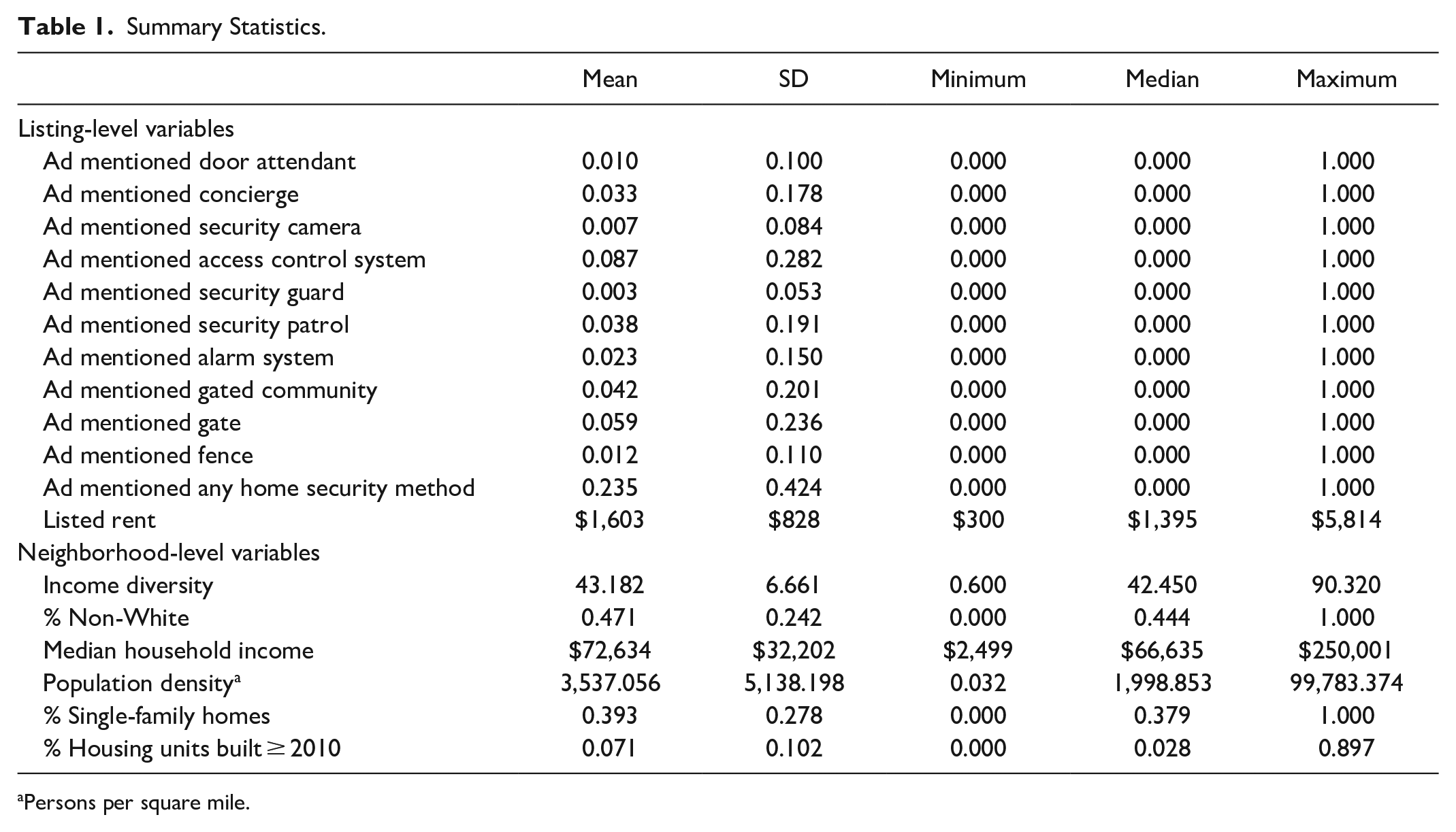
Persons per square mile.
Figure 1 presents a heatmap of the frequencies of home security methods in metropolitan areas. According to the figure, mentions of physical barriers and machine-based home security were more geographically dispersed than person-based home security. For example, access control systems were mentioned at least five times in 95 metropolitan areas, but security guards were mentioned at least five times in 26 metropolitan areas. Furthermore, certain home security methods concentrated in specific cities. Over two out of every three mentions of door attendants came from either the New York City or Chicago metropolitan areas, for instance. In summary, mentions of home security were distributed widely across metropolitan areas in the data set, but factors such as region of the country and type of home security method were sometimes associated with the locations where rental ads mentioned home security.
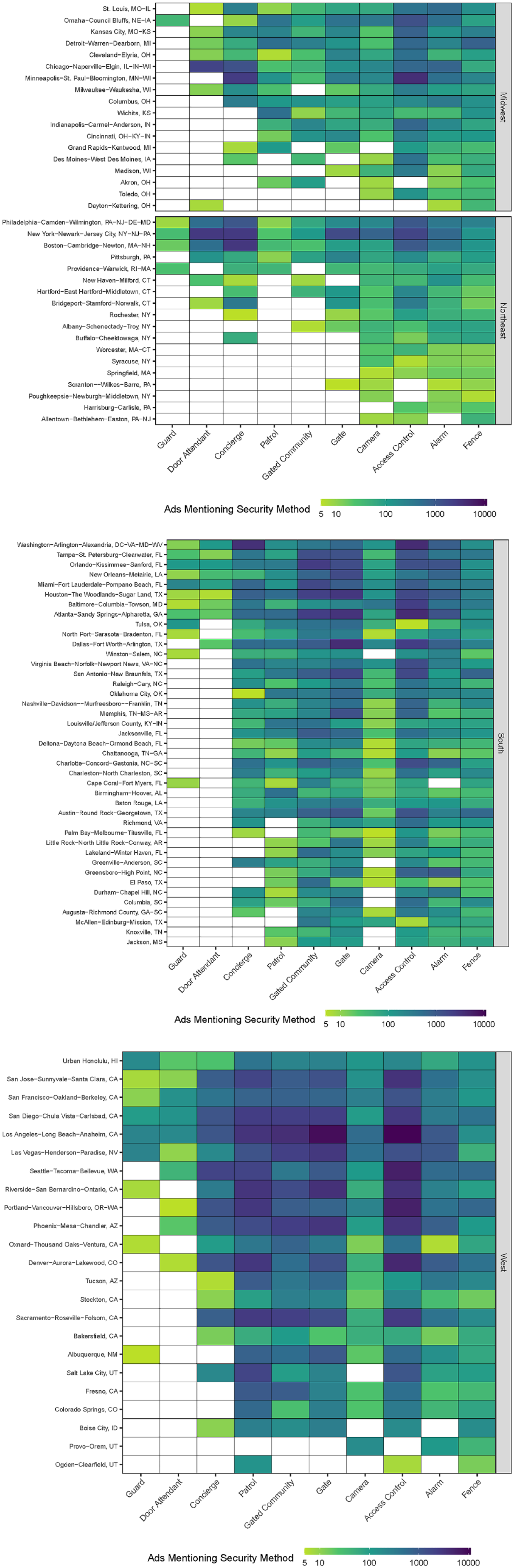
Heatmap of home security mentions across U.S. metropolitan areas, by census region.
Figure 2 is a coefficient plot that shows results from 10 logistic regression models, each of which tests the association between income diversity and a given home security method. 7 Full regression tables, including control variables, are in Appendix Table A3 in the supplemental material. According to the figure, mentions of door attendants, concierges, access control systems, and security cameras were positively and significantly associated with neighborhood-level income diversity, whereas mentions of security patrols, gated communities, gates, and fences were negatively and significantly associated with neighborhood-level income diversity. To demonstrate more clearly how income diversity was positively associated with mentions of some home security methods, Figure 3 shows how predicted probabilities of mentioning a door attendant, concierge, access control system, or security camera changed as income diversity grew larger. Associations grew exponentially stronger at higher levels of income diversity. In addition, both concierges and access control systems consistently had larger predicted probabilities than door attendants and security cameras. Predicted probabilities were higher for the former two home security methods because they were more commonly mentioned in the data set than the latter two were.

Coefficient plot of associations between income diversity and mentions of home security.
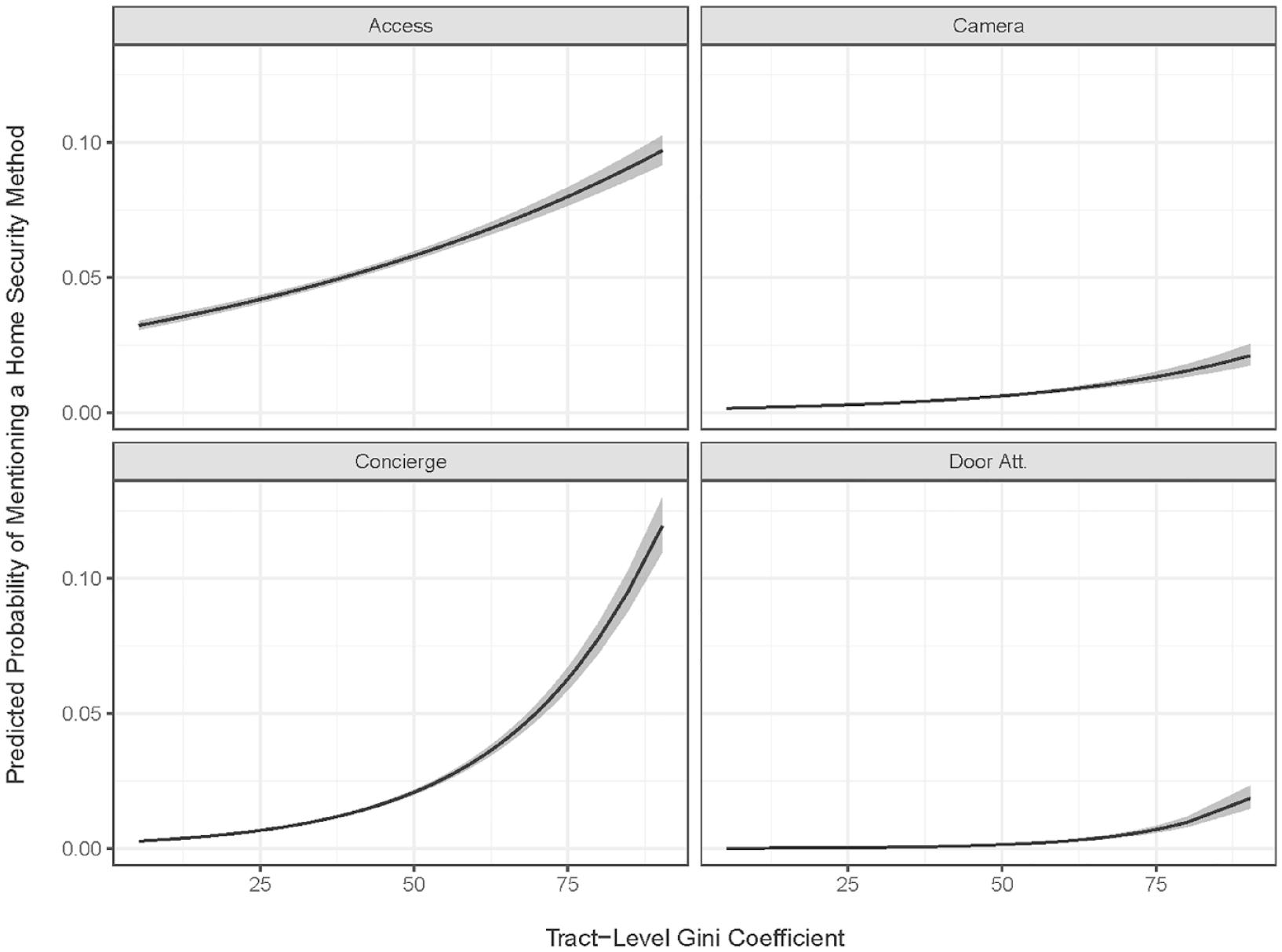
Predicted probabilities of mentioning a home security method in rental listings across various levels of income diversity.
Taken together, Figures 2 and 3 reveal that home security methods associated with traditional residential segregation, such as gated communities (Vesselinov 2008), were more likely to be mentioned in income-homogeneous neighborhoods. This finding aligns with existing literature that suggests the nonpoor live far away from the poor (Dwyer 2007; Owens 2016; Reardon and Bischoff 2011). Going beyond existing literature, however, door attendants, concierges, access control systems, and security cameras were more likely to be mentioned in income-diverse neighborhoods. Other covariates in our models help contextualize this finding. Door attendants, concierges, and access control systems were the only home security methods whose presence in listings increased as the percentage of single-family homes in the neighborhood decreased. These three security methods also tend to be associated with expensive apartment buildings (Bearman 2005; Benjamin, Sirmans, and Zietz 1997; Low et al. 2012). For mentions of door attendants, concierges, and access control systems, then, findings were likely driven by the concentration of expensive apartment buildings in mixed-income neighborhoods. Furthermore, ads that mentioned these home security methods rarely discussed crime or safety in the local area, instead listing home security as one among many amenities. 8 Table 2 provides examples of advertisements that mentioned door attendants, concierges, and access control systems. The fact that home security was listed alongside other amenities reveals much about the rhetorical strategies used by real estate advertisers in mixed-income neighborhoods. Even in the unlikely scenario that real-life conditions were decoupled from rhetoric and rentals in income-homogeneous neighborhoods were more likely than rentals in income-diverse neighborhoods to actually come with a door attendant, concierge, or access control system, advertisers were still more likely to mention the availability of these home security methods when listing rentals in income-diverse neighborhoods.
Examples of How Door Attendants, Concierges, and Access Control Systems Were Mentioned in Rental Ads.

Regarding the statistically significant association between income diversity and mentions of security cameras, we believe it is spurious. The association does not hold up to robustness checks. Moreover, listings mentioning door attendants, concierges, and access control systems had respective median rents of $2,675, $2,045, and $1,605, whereas listings mentioning security cameras had a median rent of $1,375, which was less than the overall median rent of $1,395. Rather than suggest a genuine divergence between security cameras and other home security methods, however, this finding may have been due to rental features such as size or location. To account for this possibility, Figure 4 provides a coefficient plot from ordinary least squares regressions of logged rent on each of the four home security methods in question. We present full regression results in Appendix Table A4 in the supplemental material. Regressions control for square footage and number of bedrooms in the rental, and they include a fixed effect for each census tract. Unlike mentions of security cameras, mentions of door attendants, concierges, and access control systems were associated with higher rents. Due to the consistency with which these latter types of home security were associated with ads in mixed-income neighborhoods, we argue that door attendants, concierges, and access control systems are central to our results and that security cameras are not.

Coefficient plot of associations between listed rent and mentions of home security.
Robustness Checks
Thus far, findings reveal that rental ads in income-diverse neighborhoods were disproportionately likely to mention door attendants, concierges, and access control systems. These home security methods are often found in urban apartment buildings, so the inclusion of suburban and rural rental ads in the data set may bias our findings. Furthermore, crime may confound the findings. Some studies suggest that a neighborhood’s crime rate increases along with income diversity (Choe 2008; Hipp 2007). If so, landlords may have mentioned home security due to the local crime rate rather than the income diversity surrounding the property for rent. Additionally, income and race are highly correlated across U.S. neighborhoods (Abascal and Baldassarri 2015; Jargowsky 2020), and residents’ concerns about safety often grow as neighborhoods become more racially diverse (Covington and Taylor 1991; Putnam 2007). The disproportionate number of home security mentions in mixed-income neighborhoods, in other words, may be attributable to racial diversity rather than income diversity, suggesting that our findings are highly racialized. Finally, findings may have occurred because rental ads mentioning home security clustered in the same apartment buildings. This section addresses each of these issues in turn.
Urbanicity and Mentions of Home Security
To account for urbanicity, we disaggregate rental ads into three subsets based on whether they were listed in an urban, suburban, or rural census tract. We borrow this tripartite distinction from the 2017 National Household Transportation Survey. 9 First, we rank census tracts across the United States according to their population densities. Then, we treat any tracts in a census-defined urbanized area above the 60th percentile of population density or in a census-defined urban cluster above the 30th percentile of population density as urban. Tracts in urbanized areas below the 60th percentile or in urban clusters below the 30th percentile are treated as suburban. We treat tracts outside of urbanized areas and urbanized clusters as rural.
Rental ads in rural neighborhoods rarely mentioned door attendants, concierges, or access control systems. Therefore, Appendix Tables A5 and A6 in the supplemental material show regressions for urban and suburban tracts only. Appendix Table A5 reveals that results are robust when restricted to urban tracts. This conclusion holds even though the coefficient for access control systems becomes borderline significant (p = .052). In suburban tracts, as shown in Appendix Table A6, door attendants and concierges were also significantly or nearly significantly associated with income diversity (p = .064 and p = .047, respectively). Although findings are somewhat consistent between urban and suburban areas, average marginal effects were weaker in suburban listings compared to urban listings. The average increase in a listing’s predicted probability of mentioning home security due to a one-unit increase in a neighborhood’s Gini coefficient was larger in cities than suburbs for door attendants (0.07 vs. 0.03 percentage points, respectively), concierges (0.17 vs. 0.06 percentage points, respectively), and access control systems (0.10 vs. 0.09 percentage points, respectively). Taken together, rental ads in income-diverse suburban neighborhoods may have been associated with mentions of home security, but associations were stronger and more consistent in urban neighborhoods. This suggests that expensive apartment buildings in cities were a large driver of key findings.
Crime and Mentions of Home Security
To account for neighborhood-level crime rate as a potential confounder, we use the crimedata package in R to obtain geocoded, time-stamped crime data for 16 U.S. cities in the 2017–2019 period. The crimedata package culls crime data from each city’s open data portal. 10 After restricting our data set to these 16 cities, 11 we aggregate tract-level crime counts across the 2017–2019 period and calculate each neighborhood’s violent crime rate per 1,000 population (logged). 12 Violent crime tends to be a rare event, so aggregating crime counts over three-year periods is common practice (Papachristos et al. 2011). We focus on the violent crime rate because although most publicly available crime databases suffer from underreporting, coverage is better for violent crimes compared to other types of crime (Baumer and Lauritsen 2010). Nevertheless, in analyses soon to be shown, we also test for the property crime rate and overall crime rate to ensure the comprehensiveness of our results. Beyond our specification of variables, the number of clusters in the data set decreases sharply from 100 metropolitan areas to 16 cities, so traditional clustering approaches can underestimate true standard errors. We consequently use Cameron, Gelbach, and Miller’s (2008) wild cluster bootstrap procedure to estimate standard errors. More specifically, we run linear probability models with 1,000 wild cluster bootstrapped standard errors. 13 We rely on linear probability models because wild cluster bootstraps can be problematic when using maximum likelihood estimation (Roodman et al. 2019).
Appendix Table A7 in the supplemental material presents results from three sets of regression models, each of which respectively control for the neighborhood-level violent crime rate, property crime rate, and overall crime rate. No matter which crime rate we control for, key associations of interest continue to be statistically significant and positive. In addition, for some home security methods, both income diversity and local crimes rates were statistically significantly associated with mentions of home security. This latter finding is important because it suggests that income diversity and crime may influence real estate actors to mention home security through separate social processes. 14
Racial Diversity and Mentions of Home Security
To address whether our findings are racialized, we adjust our regression models to include neighborhood-level racial diversity as a potential confounder. Following Freeman (2009), we include Shannon entropy scores for racial diversity in our models. We calculate entropy using the following equation:

where for each census tract, r is a given racial category and p is the proportion of residents in the tract who identified with racial category r. Our analysis uses seven major racial categories found in U.S. census data: non-Hispanic White, non-Hispanic Black, Hispanic, Asian, American Indian or Alaska Native, Native Hawaiian or Other Pacific Islander, and “Other.” The minimum value of the entropy index is 0, which would indicate that all residents in a given tract identified with one racial category. The maximum value is approximately 1.95, which would indicate that residents who identified with each of the seven racial categories were equally present in the tract.
Appendix Table A8 in the supplemental material shows regression results that control for racial diversity. Mentions of door attendants, concierges, and access control systems in rental ads continue to be statistically associated with income diversity. 15 Although in some cases racial diversity was associated with mentions of home security, these associations were inconsistent across home security methods and do not hold up to robustness checks, such as the inclusion of crime rates as a covariate. Associations between income diversity and mentions of home security were far more robust across different model specifications.
Mentions of Home Security That Came from the Same Location
Finally, to account for the possibility that similar listings were clustered within the same apartment buildings, we adjust our models to include the logged number of listings that came from a given spatial coordinate (i.e., latitude and longitude) as a covariate. As shown in Appendix Table A9 in the supplemental material, when accounting for the clustering of listings by location, results remain consistent. Findings are upheld despite the fact that spatial clustering was statistically associated with mentions of concierges and access control systems. Some listings from the same apartment building were indeed posted together on Craigslist, but even after acknowledging this fact, we still conclude that mentions of several home security methods were disproportionately prevalent in mixed-income neighborhoods.
Discussion and Conclusion
Throughout its existence, the real estate industry has emphasized social exclusion in housing advertisements, helping entrench patterns of residential segregation in the process (Ellen 2020; Galster et al. 1987; Gotham 2002; Howard 2021; Massey and Denton 1993; Phillips 1997; Strahilevitz 2006). At the same time, mixed-income neighborhoods have become more prominent in the United States (Cortright 2018; Kneebone et al. 2019), suggesting that real estate advertisers may be curtailing their use of exclusionary rhetoric when marketing homes in income-diverse areas. Using computational text and regression analyses to examine over 1 million Craigslist rental listings posted in the 100 largest U.S. metropolitan areas in July and August of 2019, this study found that real estate advertisers are continuing to rely on rhetorical strategies that likely reinforce, if not encourage, social exclusion in mixed-income neighborhoods. Specifically, rental ads in mixed-income neighborhoods were disproportionately likely to mention that the advertised unit came with a home security method, a rhetorical tool likely aimed at calming homeseekers’ apprehension toward living in an income-diverse neighborhood. Findings were driven by the kinds of home security methods found in expensive urban apartment buildings, namely, door attendants, concierges, and access control systems. These results have important implications for urban sociology and the subfields with which it is in dialogue.
First, despite a growing body of literature on the technologies (Calacci et al. 2022; Kurwa 2019; Segura 2021), policing tactics (Beckett and Herbert 2010; Bell 2020), and physical barriers (McAtackney and McGuire 2020; Roberto and Korver-Glenn 2021) that nonpoor residents of mixed-income neighborhoods use to surveil and exclude their poorer neighbors, little scholarship investigates how real estate actors facilitate such trends. There are literature streams on security companies that push fearful residents to invest in home security (Atkinson and Blandy 2016) and housing developers who exploit such fears to advocate for neighborhood redevelopment schemes (Mele 2000). Yet other members of the real estate industry likely also encourage social exclusion in diverse communities through their characterizations of housing units and the neighborhoods surrounding them (Caldeira 2000; Judd 1995; Low 2001; Perkins et al. 2008). Advertisers in particular may rely on divisive language, including security discourse, to assuage the fears of homeseekers moving into diverse communities.
Second, advertisers’ emphasis on home security in mixed-income neighborhoods may be a key ingredient in gentrification. In mixed-income neighborhoods, a landlord may bring in a nonpoor renter with the promise of a home security method, after which more nonpoor renters move in until the neighborhood becomes homogeneously wealthy rather than income-diverse. The home security methods advertised in mixed-income neighborhoods are often found in expensive apartment buildings, and expensive apartment buildings are often associated with the gentrification of urban neighborhoods (Lauermann 2022). Therefore, the availability of home security—whether real or perceived—may be an underappreciated catalyst of neighborhood change. Ours was a cross-sectional analysis, and it was beyond the scope of our data to test this possibility. Future scholarship can address this issue by combining longitudinal data on neighborhoods, thus capturing demographic turnover, with longitudinal data on real estate ads, thus capturing rhetorical changes in advertisements over time.
These implications hold despite three limitations to the analysis. First, it is possible that our findings are less about discourse and more a reflection of the actual overrepresentation of home security devices in mixed-income neighborhoods. Even if that is the case, there are still important implications for understanding the rhetorical practices used by housing market intermediaries in diverse neighborhoods. When real estate actors emphasize home security in mixed-income neighborhoods, they reinforce a message that the diversity in these neighborhoods is to be feared rather than embraced. Furthermore, as shown by our analysis, income diversity was associated with mentions of home security even after accounting for local crime rates. Real estate actors may consequently have the capacity to shape homeseekers’ perceptions of safety in mixed-income neighborhoods regardless of any criminal activity that may be occurring there. There are many opportunities for future work to investigate how, when, and why market intermediaries convince homeseekers to move into diverse communities. In its current state, the literature more frequently examines how, when, and why housing market intermediaries steer homeseekers away from diverse neighborhoods (Besbris 2020; Korver-Glenn 2021; Rosen 2014).
Second, we cannot causally establish whether mentions of home security in rental ads influence homeseekers’ behaviors both during the home search process and after homeseekers move into a mixed-income neighborhood. A large literature shows that diverse neighborhoods experience social tensions across lines of class, race, nativity, age, sexual orientation, and recency in the neighborhood (Hyra 2017; Lees 2003; Mayorga-Gallo 2014; Tach 2014; Walton 2021), in part due to real estate actors’ behaviors and advertising practices (Bridge 2001; Tissot 2015). More work is necessary to clarify how real estate actors’ emphasis on home security in mixed-income neighborhoods shapes and reflects the social conditions found in diverse neighborhoods.
Third, because our study relied on Craigslist rental advertisements, our study cannot speak to the rise of home security usage among houses and condominiums for sale in mixed-income neighborhoods. Nonetheless, there is reason to believe that our findings extend to homes for sale as well. Some local governments subsidize the installation of security cameras in homes in mixed-income neighborhoods, as occurred in Washington, D.C., despite furious public criticism (Hendrickson 2020). Access control systems are also becoming more common in single-family homes (Tilala et al. 2017), and concierge services are being offered to nonpoor families living in houses rather than apartments (Peele 2021). We hope future research goes beyond our analysis to examine the connections between income diversity and home security among homeowners. The home security industry is booming (Gabriele 2023), so there remain many research questions to ask about how security rhetoric impacts real estate advertising practices, housing searches, and the daily life of residents in diverse neighborhoods.
Supplemental Material
sj-docx-1-srd-10.1177_23780231241260253 – Supplemental material for How Do Real Estate Actors Advertise in Mixed-Income Neighborhoods? The Importance of Home Security
Supplemental material, sj-docx-1-srd-10.1177_23780231241260253 for How Do Real Estate Actors Advertise in Mixed-Income Neighborhoods? The Importance of Home Security by Mahesh Somashekhar, Chris Hess, Ian Kennedy and Kyle Crowder in Socius
Footnotes
Acknowledgements
The authors would like to thank Andy Clarno, Jacob Faber, Tyrone Forman, Rebecca Johnson, Rahim Kurwa, Renaud Le Goix, Ashley Muchow, Anna Reosti, Elena Vesselinov, two anonymous reviewers, and participants of UIC Sociology’s Quantitative Workshop and Neighborhoods, Housing, and Urban Sociology Reading Group for helpful conversations and feedback on earlier drafts. An early version of this article was also presented at the Johns Hopkins Department of Sociology’s Seminar Series.
Funding
Partial support for this work comes from the Eunice Kennedy Shriver National Institute of Child Health and Human Development training grant, T32 HD101442-01, and research infrastructure grant, P2C HD042828, both to the Center for Studies in Demography & Ecology at the University of Washington.

Supplemental Material
Supplemental material for this article is available online.
Notes
Author Biographies
References
Supplementary Material
Please find the following supplemental material available below.
For Open Access articles published under a Creative Commons License, all supplemental material carries the same license as the article it is associated with.
For non-Open Access articles published, all supplemental material carries a non-exclusive license, and permission requests for re-use of supplemental material or any part of supplemental material shall be sent directly to the copyright owner as specified in the copyright notice associated with the article.
