



Abstract
In this article, we focus on ways in which ‘internal migration industries’ shape the housing location of refugees in cities. Based on empirical studies in Halle, Schwerin, Berlin, Stuttgart and Dresden, we bring two issues together. First, we show how a specific financialised accumulation model of renting out privatised public housing stock to disadvantaged parts of the population has emerged that increasingly targets migrant tenants. With the growing immigration of refugees to Germany since 2015, this model has intensified. Second, we discuss how access to housing is formed by informal agents. While housing is almost inaccessible for households on social welfare, the situation is even worse for refugees. This situation has given rise to a new ‘shadow economy’ for housing that offers services with dubious quality for excessive fees. Bringing these two issues together, we argue that housing provision to refugees has become a new business opportunity. This has given rise to a broad variety of ‘internal migration industries’ that provide the housing infrastructure, but also control access to housing. This not only results in new opportunities for profit extraction, but actively shapes new patterns of segregation and the concentration of refugees in particular types of disadvantaged neighbourhoods.
Introduction
In the ‘summer of migration’ of 2015 (Kasparek and Speer, 2015), nearly 1 million refugees took up residence in Germany. This article deals with the question of where and how they found a place to live, highlighting the role of providers, that is those agents who either offer their own housing stock to refugees or deliver specific services that support access to the housing market. We develop the concept of ‘internal migration industries’ and demonstrate how it enables a more complex understanding of refugee settlement in Germany.
The background to this argument is the rapidly increasing concentration of refugees in a number of German neighbourhoods, particularly in East German prefab areas built under socialism. Here, the arrival of refugees was a rather unprecedented phenomenon (see also El-Kayed et al., 2020) which, together with the impoverishment of the areas affected (see Helbig and Jähnen, 2018, 2019), has resulted in increased segregation. While this phenomenon is well noted in expert and media discourses, the academic literature has thus far failed to explain why refugees have come to live in precisely these (and not other) neighbourhoods. Neither an insistence on the ‘autonomy’ of refugee choices, nor a reference to discriminatory state policies of ‘dumping’, ‘containment’ and ‘stigmatisation’ (for the UK case, see Phipps and Kay, 2014), alone can offer satisfactory explanations here. Instead, we orient our enquiry towards the conditions which frame the housing choices available to asylum seekers (see also Hill et al., 2021) and the agents facilitating these choices. We thus try to bridge structural factors (e.g. the nature of local housing markets with regard to demand, size or tenure) and the actual doings of actors such as government agencies, landlords, service providers and – last but not least – the refugees themselves.
To our knowledge, this perspective has to date only been considered in rather cursory form by urban, housing and migration studies. Such studies have, instead, either leaned towards the perspective of migrant trajectories (see Aigner, 2019) or focused on discriminatory state policies of dispersal, stigmatisation and control (see Darling, 2016; Meer et al., 2021). Bridging these two perspectives has, however, remained a difficult task. In particular, the role of housing providers in enabling and shaping refugee housing options has barely been addressed by the literature. This is particularly the case for private landlords, as well as for the ‘services’ necessary for finding access to accommodation in a scarce market. Both issues are, to some degree, a blind spot in international debates. Where the role of housing providers has been discussed internationally (e.g. Mullins and Jones, 2009; Phillips, 2006; Zetter and Pearl, 1999, 2000), the focus has more often than not been limited to providers that are integrated into governmental support mechanisms. Housing providers falling outside this realm have received less attention.
Closely related to this, discussion has remained centred on specific national constellations, unconnected from wider debates in urban and housing studies (for a notable exception, see Hill et al., 2021). Thus, for example, recent works on financialisation and the changing structure of housing provision (Aalbers, 2011, 2020; Aalbers and Christophers, 2014; Rolnik, 2019) and their implications for welfare arrangements and socio-spatial differentiation have hardly been taken into account. Moreover, the bulk of studies is limited to the UK, that is to a housing and migration regime which (as for every housing and migration system) has its own characteristics which differ widely from the German case discussed here.
In this article, we combine the concept of ‘migration industries’ (Cranston et al., 2018; Hernández-León, 2013; McCollum and Findlay, 2018; Nyberg Sørensen and Gammeltoft-Hansen, 2013) with theories about ‘urban managerialism’ (Pahl, 1975; Rex and Moore, 1967) and demonstrate how a pragmatic combination of concepts developed in migration studies, with perspectives originating in urban studies, can fruitfully be applied to better study the complex interactions between the regulation of migration, housing markets and the movement of immigrants within cities.
While we base our argument on our own empirical work, we have to emphasise that the empirical foundation of this text is rather intricate. By and large, we draw on two empirical research projects that were developed and conducted independently from one another. The first project, StadtumMig, 1 was begun in 2019 and aims to explore the challenges for governance and planning that emerge in the new ‘arrival neighbourhoods’ that are currently forming at the peripheries of numerous East German cities. For the purpose of this article, we have analysed expert interviews from the city of Schwerin and conducted a document analysis of government papers. The second project is a three-year research project named ‘Welcoming Neighborhoods – Conditions of Social Cohesion in Super-Diverse Com-munities’ (Humboldt-Universität zu Berlin, n.d.) that studies the varying capacities of four neighbourhoods in large German cities to offer welcoming conditions to migrants. For this article, we use qualitative interviews with refugees from two research sites – Kreuzberg in Berlin and Untertürkheim in Stuttgart – and complement them with an analysis of newspaper articles. This article brings empirical findings from both projects into dialogue with one another and discusses how they can be interpreted utilising a combination of the different conceptual approaches described below. The aim of this is not so much to contribute to one specific field of theory, but to creatively think about new ways of approaching the well-known themes of ‘the migration industry’ and ‘segregation’ together. The following section elaborates on the theoretical perspectives utilised in this article. We focus on the concepts of ‘migration industries’ and ‘urban managers’ (or ‘gatekeepers’) and discuss how these can be meaningfully combined. We develop the concept of ‘internal migration industries’ as a synthetic tool that enables us to bring different perspectives together, allowing for greater insight into the complex phenomenon of refugee settlement. In the subsequent section, we briefly describe the context of refugees’ access to housing and residency in German cities. This is followed by a presentation of two empirical vignettes focusing on the work of specific migration industries within urban housing markets. These are: (a) housing companies specialising in renting out their housing stock to refugees and (b) brokers charging illegal fees to facilitate access to housing. In the conclusion, we re-examine the application of the concept of internal migration industries developed in the course of our empirical studies and discuss its potential for examining the housing choices of refugees at the local level. We argue that the concept enables different perspectives on the same phenomenon to be brought together, and thus assists both broader and more complex analysis.
Theoretical background
In recent years, the term ‘migration industries’ has become increasingly popular in the field of migration studies. The major reason for this is that the concept can be applied at the meso level, ‘mediating between the micro-level social networks, and the state level and international institutions shaping migration flows’ (Cranston et al., 2018: 546). Early research on the ‘commerce of migration’ (Harney, 1977) goes back to the 1970s, but migration industries have only recently become a research field in their own right. The development of this field has included controversies about the definitions and delineation of migration industries that cannot be discussed in depth here (see Cranston et al., 2018; Hernández-León, 2013; McCollum and Findlay, 2018; Nyberg Sørensen and Gammeltoft-Hansen, 2013). Most importantly, these debates discuss whether the term should be reserved for commercial providers or include informal networks, NGOs and other philanthropic actors. Commonly researched examples of migration industries include ‘money lenders, recruiters, transportation providers, travel agents, smugglers, and lawyers’ (McCollum and Findlay, 2018: 558f.), along with charities and NGOs. In a nutshell, migration industries comprise the individuals and organisations that provide the infrastructures necessary for human mobility.
While discussion about migration industries is located in the field of migration studies, it resonates well with the concept of urban managers or gatekeepers that was influential in the New Urban Sociology of the 1970s and 1980s. The starting point in the literature was a study by Rex and Moore (1967) on Race, Community and Conflict, in which the authors showed that segregation was not a quasi-natural product of ecological (as the Chicago School had thought) or economic processes (as neoclassical economists saw it), but was actively managed. They argued that housing-market gatekeepers in Birmingham discriminated against populations of immigrants from the West Indies, Pakistan and India, making both the suburban owner-occupation sector and local authority-managed council housing inaccessible to them. As a consequence, residents from these minorities had little choice but to settle in the cheap and low-standard private rental sector that was concentrated in the inner city. Pahl (1970, 1975) developed this argument further, making urban managers and the ideologies and practices with which they granted or denied access to urban resources the focal point for explaining segregation. This conceptualisation enabled a focus on the actual ‘making’ of urban segregation.
While the two approaches are rooted in different theoretical and disciplinary backgrounds and refer to different questions, there are intersections between them. Both agree that the movement of people in space is promoted and/or restricted by the availability of infrastructures provided by industries, gatekeepers or urban managers. Furthermore, both approaches agree that these actors are embedded into wider institutional frameworks that shape the particular ‘business’.
The two concepts arise from different questions but arrive at very similar objects of interest. The concept of migration industries came into being when scholars sought to better understand the material prerequisites structuring the paths of migrants. This led researchers to focus on the crucial role of providers in shaping the conditions for migration and mobility. If this strand of research is applied to the urban realm, we necessarily end up asking how migrants gain access to urban infrastructures (such as schools or housing), whose services they use and under what conditions.
Differentiated access to urban resources is the pillar around which the theory of urban managers was developed. Starting from the question of why members of marginalised groups end up in specific areas of cities, this strand of urban research investigates the provision of and control over urban resources. It highlights the geographically differentiated allocation of these resources, and thus arrives at an explanation for segregation based on agency and power (instead of choice, urban ecology or political economy). Figure 1 illustrates this relationship.
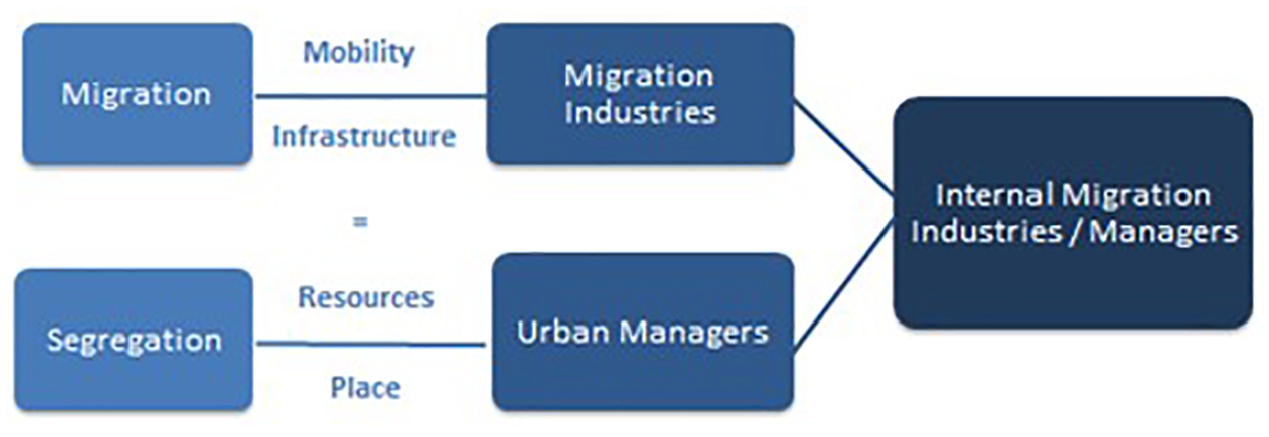
The conceptual relation between migration industries and urban managers.
Thus, although the two concepts have different origins, they end up asking the same questions about the conditions of mobility. The concept of migration industries focuses on these as ‘infrastructures’ and highlights the structure and agency of their provision, while the literature on urban managers addresses them as ‘urban resources’ and considers their control. As these literatures address a similar subject from different perspectives, we think it useful to combine the concepts of migration industries and urban managers in order to study the housing options of refugees.
We argue that the process of assisting the movement of migrants for profit does not end with their arrival at the destination society’s national territory, but continues after migrants have entered the territory, that is at the level of municipalities and cities. As is the case for international movement, the needs and choices of migrants create a demand for services at the local level. This gives rise to individuals and organisations that provide these infrastructures, which we thus term internal migration industries. We understand internal migration industries as a synthetic concept that allows the individual movements, preferences and choices of immigrants to be brought together with the infrastructures facilitating the realisation of these choices at the local level. At the same time, the agents providing housing and housing-related services are literal gatekeepers, managing access to different housing stocks, and therefore creating openings to certain housing segments for refugees in what are otherwise virtually closed housing markets. At the level of the city, migration industries and urban managers overlap. In summary, we conceptualise immigrant pathways, from camps to housing, as being structured by three conditions:
The housing preferences and choices of the immigrants and the strategies they use for realising them.
The restrictions immigrants face with regard to their locational choices. These restrictions might be based on state regulations (e.g. place of residence, see next section), but also on economic restrictions and racism by market actors.
The existence of housing providers providing services (letting, selling or brokering housing) to immigrants (i.e. ‘migration industries’).
While we consider all three conditions as crucial, our focus in this article is on the interaction of structural conditions with the businesses of housing providers.
The regulation of migration within Germany
The following section provides a short overview of the regulations that shape the conditions of movement of refugees within Germany. These regulations build the framework upon which ‘internal’ migration industries can emerge and provide their services.
After arriving in Germany, refugees applying for asylum are first allocated to one of the federal states (Bundesländer) through a distributional algorithm, termed the Königsberger Schlüssel (AsylG, 2008: §45), that takes into account the state’s tax income and population.
In the federal states, asylum seekers must first stay in so-called ‘preliminary reception centres’ (Erstaufnahmeeinrichtungen) for a period of up to six months (AsylG, 2008: §47). After this initial phase, refugees are assigned to another camp or to apartments within the federal state to which they have been allocated. Whether refugees live in camps or are accommodated ‘decentrally’ in individual flats is an outcome of decisions and regulations at the level of the federal states and municipalities (Schammann and Kühn, 2016; Wendel, 2014: 11).
After acquiring asylum status, refugees face further regulation pertaining to their freedom of residency. In 2016, alongside other regulations, a residency regulation (Wohnsitzregelung) was introduced in German federal law that limited refugees to seeking housing only within the federal state to which they first applied for asylum for a period of three years (AufenthG, 2008: § 12a Abs. 5 Satz Nr. 1). Similar residence regulations existed in the 1990s, having been especially introduced for immigrants from countries of the former Soviet Union who had a claim to German descent (Spätaussiedler) (Haug and Sauer, 2007: 12). The residency regulation currently in force is legally disputed. In summary, it ‘creates an internal border by restricting housing-market access for persons with asylum status’ (El-Kayed and Hamann, 2018: 140) to the territory of a single federal state, and in some states even to specific municipalities.
In addition to these state regulations, access to urban housing markets for many refugees is structured by the discriminatory practices of housing companies and private owners (El-Kayed and Hamann, 2018; Hummel et al., 2017). However, the situation is not uniform. The reason for this is the immense variation of conditions within local housing markets throughout Germany. Thus, ‘several regions are growing and pose challenges for the regional housing market, which can be seen, for example, in rising new rents. By contrast, in shrinking regions, dealing with housing vacancies is more on the agenda’ (Bundesinstitut fr Bau Stadt und Raumforschung [BBSR], 2010). In summary, the conditions for finding an apartment are varied for refugees across Germany. In cities with a tight housing market, refugees hardly have a chance to leave the accommodation centres they are allocated, staying in camps for years after their asylum status is recognised.
In conclusion, it can be said that the region refugees are allocated to upon their arrival shapes the conditions under which they can begin to search for housing outside of the camp. Once settled in a region, their housing chances within this region will depend on the interaction between the structural conditions of the specific local housing market (e.g. overall demand, share of social housing, extent of private rental stock) and the actors operating within it. In the following sections, we use two empirical examples to explore how this affects refugee housing access.
Migration managers 1: Selective letting strategies of housing providers in a low-demand market
The first example comes from the study of a peripheral housing estate in the city of Schwerin. The housing market in this city is characterised by substantial differences between its inner city and the outer areas. While the inner city is largely gentrified and consists of historic buildings mostly owned by private landlords, the outer areas comprise modernist estates built using prefab technologies in the 1970s and 1980s. Historically, these estates have been managed by the municipal housing company Wohnungsgesellschaft Schwerin mbH (WGS) and a housing cooperative called Schweriner Wohnungsbaugenossenschaft eG (SWG). Both have, however, since sold a large part of their stocks to financial investors.
Characterising the difference between the inner city and housing estates is the huge discrepancy in the concentration of immigrant residents, as the local statistical report (Table 1) on residents with foreign nationalities demonstrates.
Share of foreign residents in selected neighbourhoods in Schwerin (data from the Statistical Office of Schwerin).
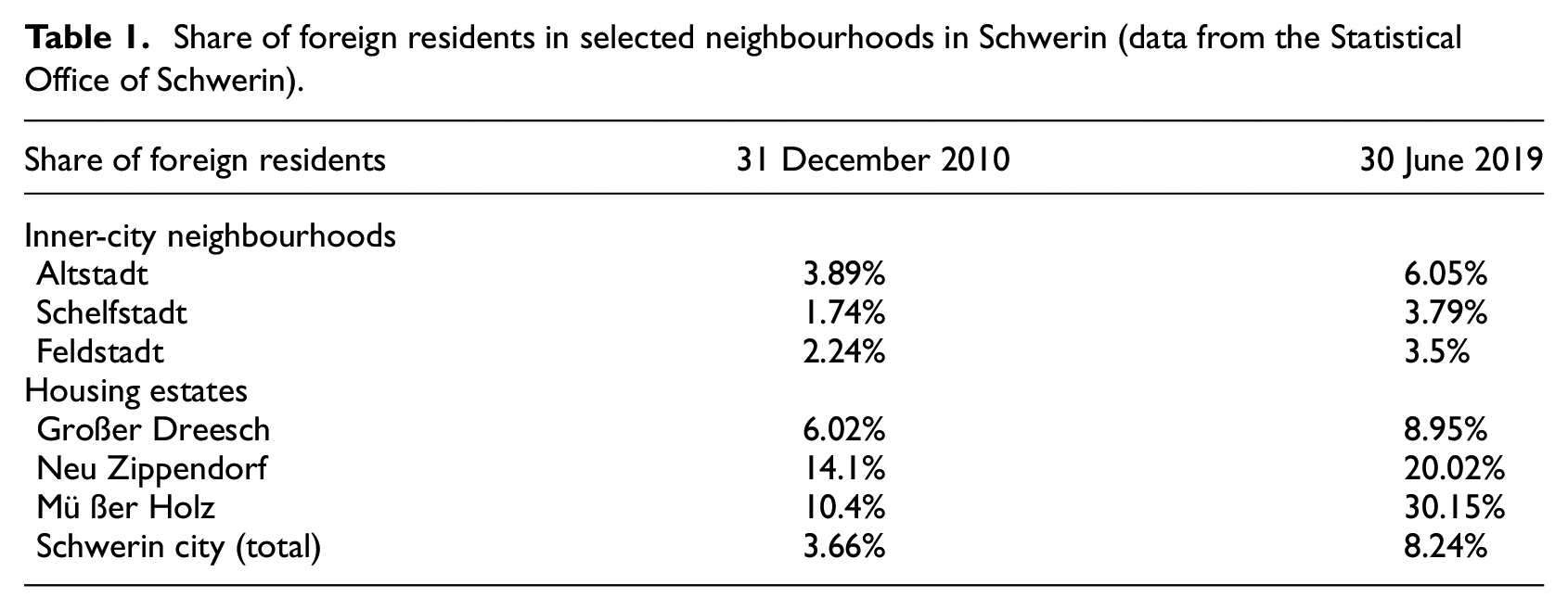
While the total share of immigrant residents in Schwerin is rather low, it has nearly tripled over the last decade due mainly to new (mostly Syrian) refugee residents settling in the city since 2015. The proportion in the inner city is below the overall city average. In the estates, by contrast, the share of non-German citizen residents was already above average before 2010 and has quickly grown since.
How can this be explained? As Fields and Uffer (2016) have described for Berlin and Bernt et al. (2017) for the case of Halle, East German cities have experienced two waves of privatisation of municipal and cooperative housing since the fall of the Berlin Wall. As a consequence, large segments of housing estates have been taken over by financial investors. The geography of this process is, however, very uneven. Thus, in Schwerin, most of the municipal stock at Mueßer Holz was sold. The outcome is a rather fragmented ownership structure: altogether, the 5824 housing units located in the area are now owned by 10 companies (data from the City of Schwerin). Of these, the cooperative SWG is the largest, holding about a quarter of the total stock, followed by the municipal WGS, which holds less than 10%. The rest belongs to eight different companies with shares ranging from 4% to 13%; within this segment, ownership structures have changed frequently.
The letting policies of private owners with regard to refugees are highly varied. An internal statistical evaluation 2 (BBSM, 2020) demonstrates that immigrant residents do not have the same degree of success finding a place with each landlord, even within Mueßer Holz. The following section provides an overview of the major differences and discusses the factors that have led to them.
The municipal WGS is owned by the city of Schwerin and, as a consequence, it is mandated with assisting the city in fulfilling its ‘compulsory tasks’ (kommunale Pflichtaufgaben). When refugees are allocated to Schwerin in accordance with Federal regulations (see above), the city is therefore responsible for the provision of accommodation and hands this task over to its housing company. Thus, as an interviewed representative of WGS put it: [When the refugees arrived in 2015] … their accommodation was exclusively managed with the municipal housing company. We were the main contact [Hauptansprechpartner] for the city … And this is how it worked: we had vacancies in Neu Zippendorf and Mueßer Holz which allowed for a bigger number of lodging arrangements. We wouldn’t have been able to accommodate the refugees elsewhere. And this is why this was concentrated in Mueßer Holz and Neu Zippendorf. (Interview S 18_KW)
The internal statistical evaluation mentioned above confirms that the municipal company remains a major housing provider for refugees even after their formal recognition. Put differently, while SWG works in line with the requirements of the city, it is also bound by market logic, which makes it very likely that refugees will find themselves in the least popular (and, therefore, vacant) housing stocks.
The situation is somewhat different for the SWG housing cooperative. The most important particularity of it is that all tenants are co-owners who need to pay ‘cooperative shares’ when renting a flat (e.g. a one-time fee of €765 for a two-bedroom flat at Mueßer Holz, https://www.swg-schwerin.de/ueber-uns/mitgliedschaft). The costs of these shares are not covered for welfare recipients. Moreover, the cooperative has not agreed upon an arrangement with city authorities regarding the accommodation of refugees within the municipality: We don’t do that. Because then the city would have to become a sort of a cooperative member so that they [the people ‘sent’ by the city, MB] can live with us. […] We have to be able to make a legal transaction with this person. And that can only be done with a regular status. (Interview SWG)
On this basis, it is hardly surprising that the number of refugees living in the housing stocks managed by the cooperative is rather low.
The third group of landlords is fairly heterogeneous and includes both owners who hardly rent out to refugees at all and those for whom the ratio between housing units owned in Mueßer Holz and foreign residents is 2:1. The spatial limitations of this article and the data themselves do not allow us to go into detail, but some remarks on one of these owners helps to illustrate the picture. Projekt Wohnen Schwerin GmbH (named Intown prior to 2017) acquired over 1000 apartments from the municipal WGS in 2015. Of these, 622 apartments were located in Mueßer Holz. In subsequent years, Intown has received a particularly bad reputation as a ‘rogue landlord’. There were numerous reports about deficiencies in the apartments, as well as tenants’ complaints about the lack of fire-safety measures, structural defects and mould infestation. In fact, the conditions in the homes owned by Intown were so poor that the Mayor of Schwerin announced in 2017 that he would support tenants in moving out. The point here is that the business model of investors like Intown is based on bargain sale prices, cheap mortgages and low operating and maintenance costs on the supply side, and low but guaranteed revenues through the letting of flats to welfare recipients on the demand side (see also Bernt et al., 2017; Fields and Uffer, 2016). German planners have depicted this model as a ‘Hartz IV’ 3 business strategy. While this business model has been in place for about a decade, it was re-intensified with the upsurge of immigration following the ‘summer of migration’ in 2015, so that a nexus has emerged of ownership by speculative corporate landlords, refugee immigration and the concentration of migrant minorities in prefab areas. This, we would argue, makes companies like Intown a particular kind of landlord whose business is based on exploiting the difficulties refugees face when searching for accommodation, providing an easily accessible but low-quality product. Since this product is usually located in the least preferable locations, this results in a spatial concentration of refugees. In Schwerin, to sum up, a spatial concentration of refugees can be observed in a handful of peripheral estates that can by and large be explained by the different letting strategies of the landlords owning properties there. Thus, while the cooperative has only weak interests in accepting refugees as tenants, both municipal housing stocks and stocks owned by private financial investors have become places where refugees disproportionally find a home. The reasons behind this are, however, varied. In the case of the municipal WGS, the dominant mechanism is the administrative management of municipal duties. Companies such as Intown, by contrast, have specialised in disadvantaged customers, among them refugees, and provide uncompetitive and substandard-quality housing at low costs and high margins. Since both WGS and Intown play a crucial role in providing housing opportunities that enable refugees to leave mass-accommodation camps and settle in more autonomous and self-controlled living conditions, they can meaningfully be characterised as ‘internal migration managers’.
Migration managers 2: The shadow economy for housing
The second example of an internal migration industry that provides housing-related services for refugees is that of informal brokers who provide housing for refugees by charging illegal brokerage fees of hundreds or often thousands of euros.
Refugees, social workers and other actors reported such brokerage in interviews we conducted in Berlin and Stuttgart. In order to get a sense of how widespread the phenomenon extends beyond these cities, we conducted an additional media search for reports on similar instances of fraud in the German national and local media outlets.
As these practices are part of a shadow economy, personal and media accounts are incomplete and the structures behind these businesses remain at least partly obscured. Nonetheless, our material allows us to gain insights into a range of different strategies employed.
In our interviews, refugees – especially in Berlin – often described this informal industry as the only option available for finding an apartment (B_Interview_C/D/E/G/H/N 2019, S_Interview_D 2019): ‘I would like to have an apartment which is not so expensive, but I cannot find any. […] What’s happening here is that you need to pay lots of money to a middleman […] to get a house’ (B_Interview_H 2019). The amount of this ‘brokerage fee’ varies and depends on the apartment size and location, but in interviews and media reports sums between €700 and €10,000 are mentioned (Hampel and Ludwig, 2017; Hür, 2017; Khello and Werner, 2016; Laugstien, 2016; Maibaum, 2015; Staib, 2017; Wein, 2017; Zu Löwenstein, 2015; author interview with Mr Noessing, 2019).
Several newspaper articles concerning a number of different German cities corroborate these statements, reporting that mobile numbers of such marketeers circulate in refugee accommodation and networks.
Many refugees have experienced instances of outright fraud, in which they paid substantial sums up front and never received a flat in return (Abdi et al., 2017; Hampel and Ludwig, 2017; Hür, 2017; Laugstien, 2016; Loy, 2016; Sasse, 2020; Ströhl, 2016; author interview with Mr Noessing, 2019). Other refugees, however, succeeded in securing a flat via such intermediaries. Media reports depict a variety of strategies used and services offered by these urban migration industry agents, including those described below.
Some housing companies identified individuals who make a number of apartment-viewing appointments, to which they bring along refugees who have paid them for the appointment (Abdi et al., 2017; Hampel and Ludwig, 2017). Thus, apparently some of the shadow brokers simply search for flats in newspapers and online platforms and then try to secure the flat for their client (Ströhl, 2016). In other cases, shadow-market brokers work together with employees of larger housing or property management companies to secure access to flats and rental agreements. For this access, these employees in turn receive a share of the illegal brokerage fee (Der Spiegel, 2017; Focus Online, 2017; Geisler and Stinauer, 2017; Khello and Werner, 2016; Spiegel TV Magazin, 2017).
In another fraudulent strategy, landlords let their substandard flat directly to refugees because they can charge a higher rent to refugees than they would otherwise be able to, the rent being paid by the welfare agency (Braitinger, 2019; Der Tagesspiegel, 2015; Schnebeck, 2018; Staib, 2017).
Often, the different kinds of brokering seem to be connected to the bridging of language barriers, as many reports mention that intermediators speak both Arabic and German (Abdi et al., 2017; Khello and Werner, 2016; Laugstien, 2016; Maibaum, 2015; Musharbash, 2015; Sasse, 2020; Ströhl, 2016; Zu Löwenstein, 2015) – although this is not always the case (Der Spiegel, 2017; Spiegel TV Magazin, 2017). However, what all these actors have in common – whether brokers embedded in bigger or smaller networks, Arabic speaking or not, within or outside of housing or property management companies or owners who rent directly to refugees – is that they profit from the barriers that refugees are confronted with when they look for a flat. Refugees then use these options in order to increase their chances of finding housing. One refugee we talked to lives in a state accommodation camp that is soon to be closed. She is therefore in urgent need of finding an apartment. She would like to remain in the same neighbourhood, where she feels secure. The interpreter for the interview translated: She would like to stay here in Kreuzberg, in this district, because she is slowly feeling safe here, she knows her way around. […] She was told that this shelter will close, she has one more year and she doesn’t know where to move afterwards. She was told that maybe you can find an apartment illegally, so to speak, on the black market, pay a little extra money and so on. And she said I’m ready to do that. […] Yes, [because] she’s a little at a loss, she needs support, […] she has no [German] language skills so she couldn’t go to companies and apply for apartments on her own. Yes, she needs help. (B_Interview_C, 2019)
There is a close link between the barriers that refugees encounter when they try to enter the German housing market and the brokering services described here. In our interviews, refugees, social workers and other actors referred to three main factors which make it difficult for refugees to find housing and that open up an informal market for housing-related services.
First, there are specific administrative and legal barriers: for instance, the high administrative burden and long processing times often complicate the process of obtaining the required documents, such as the certificate needed to qualify for a state-subsidised apartment (Wohnberechtigungsschein) (B_ Interview_E/H 2019). Moreover, when social-welfare recipients such as refugees find an apartment, they depend on a confirmation from the welfare agency (Jobcenter), which in some cases takes too long to secure the apartment (B_Interview_Unterkunftsleitung 2020). In addition, the residency regulation (Wohnsitzregelung) geographically limits the refugees’ search for housing (S_Interview_D/G/J/L 2019). A refugee in Stuttgart explains how this affects his options when searching for an apartment: I am not allowed to look for an apartment outside of Stuttgart. It poses big problems because there are 10,000 refugees in Stuttgart. And the city cannot help all families. I have been registered at the municipal housing office for two years. I only got one offer. […] It limits the freedom to choose where you want to live. (S_Interview_D 2019)
The second barrier is that many housing markets are almost closed off and characterised by discrimination. Many refugees living in shared accommodation have looked for a flat for several years. Some are registered on long waiting lists of housing companies or municipal housing authorities. In addition, many refugees report having experienced discrimination (as migrants and as social-benefit recipients) from housing companies and landlords. Others stress the language barriers that make it difficult to secure a flat on the open market (S_Interview_A/D/E/G/H 2019, B_Interview_G/H/Q 2019).
Thirdly, our interviewees point out that there is a lack of information, advice and support when seeking apartments, as well as with regard to protection against discrimination in the housing market. A refugee in Stuttgart emphasises: ‘We don’t get any help from the job centre or from social workers. […] I have asked 10 times, I thought maybe they are helping families or people with the apartment, but they say that is not our job’ (S_Interview_D 2019). The illicit brokerage industry helps to overcome these barriers by offering a specific service. As depicted above, they search for apartments that satisfy the legal requirements needed to be paid for by the welfare agency, and often bridge language and information barriers.
But how do these barriers and the migration industry agents reacting to them shape the paths of refugees towards specific urban neighbourhoods? Few media reports or interview materials specify the neighbourhoods where the brokered flats are located. However, as they need to be within the correct price and size range to receive state subsidy, they are very likely to be social or low-cost housing. Furthermore, the few specific instances of such shadow-market structures that have been revealed publicly are connected to housing or property management companies that own (parts of) larger estates, often on the city outskirts (Der Spiegel, 2017; Geisler and Stinauer, 2017; Spiegel TV Magazin, 2017; Wein, 2017). While some of the reports and interviewees also mention the brokering of flats in inner-city areas (such as Neukölln in Berlin), it is likely that the main share of illegally brokered flats are located – similarly to the pattern depicted in the previous section – in the outer areas of cities where there are bigger shares of flats that fall within the price range required for state subsidies. To conclude, shadow-market brokering services close a gap created by government regulation of residency, narrow housing markets and a lack of counselling and support structures, and can be regarded as an infrastructure that enables refugees to enter the housing market.
Discussion and conclusion
In the previous sections we have explored the connection between state regulation regarding the movement of refugees, the composition of local housing markets, the work of migration industries and the housing choices of refugees.
Summing up a complex and diverse field, three points can be made:
Once refugees arrive in Germany, they face considerable legal restrictions. Even after the asylum process is complete, for three years most refugees can only look for housing in the federal state to which they were first allocated, limiting their housing choice to these regions.
Refugees are confronted with numerous bureaucratic barriers that are often difficult to meet. In addition, refugees often do not have enough information, experience or support necessary to find a home in a difficult market and must also struggle with language-related obstacles.
Refugees often face racist discrimination by housing providers. In addition, low incomes and transfer dependency are a problem. As a consequence, their options in the housing market are severely limited.
The combination of these three factors makes the provision of (overpriced) lodging services and/or the renting out of less popular or overpriced flats to refugees a lucrative business. It gives way to internal migration industries that provide translation services, help with meeting bureaucratic requirements and/or provide flats in exchange for high fees. These ‘industries’ mediate between the micro level of refugee housing needs and the structural macro context framing the conditions for their fulfilment.
The profitability of this business largely results from federal state actions and state inaction. Thus, while the state limits the freedom of movement quite considerably through legal restrictions on refugees, it also barely provides them with housing. Advisory and language-support services are also not provided adequately. It is thus the failure of public policy that results in the ability of the described housing-market actors to extract profit from refugees and claim rent in a variety of forms.
Refugees, experts, NGOs and activists have long been describing this situation and have made numerous demands for more just access to housing to be provided. At the top of the list of priorities are: providing more affordable housing, lifting restrictive residency regulations and financing public consultation services for refugees.
In this article, we have also shown that the work of internal migration industries has a spatial dimension. Informal brokers have connections to particular landlords, target specific housing stocks and operate in geographically varied ways. Housing companies hold housing stocks in some parts of a city, but not in others, and they follow different letting strategies for different parts of their stock. This spatiality makes the agents working in internal migration industries literal gatekeepers ‘who control or manipulate scarce urban resources and facilities’ (Pahl, 1970, cited in Forrest and Wissink, 2017: 158) in a way that limits the pathways to housing for refugees in some parts of the city, while opening them up in others.
The geography of internal migration industries is, however, complex and still underexplored. In this article, we have been able to cast only a small amount of light over a broad landscape, much of which still lies in shadow. How informal agents and housing providers are connected in chains of rentiership, how the restrictions faced by refugees work in more detail, which range of strategies refugees pursue in order to deal with different housing-market situations, how the differing circumstances of the local housing market impact on the business and many other questions all still need to be researched.
Nevertheless, we argue that the combination of theories applied in this article has proved to be a valuable tool. Starting from the question of how migrant mobility is restricted, and then searching for infrastructures that assist migrants in overcoming these restrictions, has led us to observe the ways in which refugees manage to obtain access to housing. This has enabled us to identify the relevance of services provided by informal brokers. Starting from quantitative data on residential segregation and the ‘concentration’ of refugees in specific areas, we have furthermore identified specific housing providers who disproportionally let their properties to refugees, and analysed their business strategies. We have shown how the provision of housing is related to specific types of landlords who focus on specific areas and building types, analysed how the business model of these landlords is connected to broader changes in the housing economy and explained how this structures refugees’ pathways into particular neighbourhoods. Looking at the empirical reality from different perspectives has thus enabled us to achieve a more complex and nuanced understanding of a multi-faceted phenomenon. As in a puzzle, we have provided a more complete picture by starting from different angles, but we have not yet been able to sort and connect all the pieces. While our research has yet to comprehensively cover the subject, we argue that starting from different perspectives has enabled us to achieve more than other approaches. It is for this reason that we think that the synthetic concept of internal migration industries provides a meaningful way by which migrant settlement and housing markets can be better linked together and research in general can be advanced.
Footnotes
Acknowledgements
We would like to thank Tatiana Fogelman, Nir Cohen and the three anonymous reviewers for their insightful comments on earlier versions of this article. We would also like to thank Kerstin Wegel and Yağmur Dalga for technical support.
Declaration of conflicting interests
The authors declared no potential conflicts of interest with respect to the research, authorship, and/or publication of this article.
Funding
The author(s) disclosed receipt of the following financial support for the research, authorship, and/or publication of this article: The research for this article was funded by the German Federal Ministry of Education and Research, Grants Nos. 01UG1739X (NaWill) and 01UR1802A/C (StadtumMig).
