




Abstract
The pandemic adversely affected the employment of child caregivers, exacerbating already existing inequalities. The authors offer an integrated framework that considers the interdependencies between unpaid and paid child caregiving and the construction of the childcare sector as a devalued and fractionalized group. The authors outline the prepandemic positioning of mothers, childcare teachers, preschool teachers, and primary school teachers. Then, using cross-sectional and panel data from the Current Population Survey, the authors describe how the pandemic affected these four groups of child caregivers’ employment between January 2018 and December 2022. Black, Brown, and non-college-educated mothers were hit particularly hard during the pandemic. Primary school teachers were in a better position prior to the pandemic and fared much better than childcare teachers during it. The authors argue that an integrated framework helps us understand the disparities in the impact of the pandemic between child caregivers as partly a by-product of the fragmented and devalued organization of child caregiving.
The pandemic brought needed public attention to the “childcare crisis” and the importance of the care workforce. The shutdown highlighted capitalist production’s dependence on reproductive care, the negative consequences of women’s disproportionate childcare responsibilities on their wellbeing and careers, the precarious labor conditions of many childcare jobs, and the “essentialness” of labor performed by migrants and Black and Brown workers to ensure human flourishing. Recent research has shown, for example, that the loss of childcare and the homeschooling demands of the 2020 stay-at-home orders led to greater job loss, unemployment, and reduced work hours for mothers, as well as mothers spending more time on childcare and housework (Calarco et al. 2020; Collins et al. 2021; Garcia and Cowan 2022; Landivar et al. 2021; Petts, Carlson, and Pepin 2021; Russell and Sun 2020). Despite fathers’ increased time spent caring for children, mothers still disproportionately shouldered the bulk of household labor and homeschooling during the pandemic (Burns, Jegatheeswaran, and Perlman 2023).
Unsurprisingly, mothers experienced greater depression and mental health issues during school closures (Lee et al. 2021; Zamarro and Prados 2021). Stay-at-home orders also caused disruptions to center and in-home care. The formal childcare sector faced a significant crisis, with many centers closing, going out of business, or taking on increased financial risk, particularly affecting families of color (Ali, Herbst, and Makridis 2021; Kim et al. 2022; Lee and Parolin 2021; Thomas 2022). Many childcare workers reported increased mental health problems, financial distress, and illness (Eadie et al. 2021; Elharake et al. 2022; Quinn et al. 2022; Tarrant and Nagasawa 2020). Teachers also faced the significant burden of having to provide remote learning (Kraft, Simon, and Lyon 2020). Many expressed experiencing burnout, stress, and decreased self-efficacy (Guirguis and Plotka 2022; Pressley 2021). One study showed that interest in pursuing teaching as a career decreased by 35 percent among prospective students (Bill et al. 2022). The challenging experience of finding and providing care to young children during virtual schooling, center closures, bouts of illness, or while working caused many parents to see connections across childcare sectors: paid and unpaid, in home and center based, and school. Most children depend on unpaid and paid caregivers, and parents’ well-being and employment prospects are dependent on these combinations of childcare labor.
We lack an integrated picture of the synergies and mutual dependencies of paid and unpaid childcare and the effects the pandemic had on groups that provide care to children from birth to 11 years of age. The pandemic’s impacts on one group of caregivers reverberate to other groups and we need to recognize the inequalities that cut across these groups. Although the costs to women and mothers are well documented, it is imperative that we also emphasize the uneven racial and class outcomes of the pandemic on caregivers. We argue that an integrated framework helps us understand the disparities in the impact of the pandemic between and among paid and unpaid child caregivers as partly a by-product of the fragmented and devalued organization of child caregiving.
We adopt an intersectional political economy of care perspective that considers the integration of paid and unpaid care for children and the connections between people who care for babies, toddlers, and children in private homes, centers, and schools. Typically, research on child caregiving focuses either on the paid care sector or on unpaid caregiving. Scholars tend to further divide paid care by age groups: from birth to age 5 or from kindergarten through fifth grade settings, separating early care from primary school. We consider the full array of child caregivers, paid and unpaid, nannies, center workers, teachers, kin, and parents caring for children from birth until age 11. Our analyses are focused on four paid and unpaid groups: (1) childcare (nannies, babysitters, center workers, au pairs), (2) preschool (Head Start, preschool, prekindergarten, and kindergarten teachers), (3) primary teachers (elementary and middle school teachers), and (4) mothers. Following Folbre’s (2012) call to bring paid and unpaid analyses together, we highlight the similarities and mutual dependencies of child caregivers as a linked sector. We apply this framework to understand what happened to these groups’ employment during the first year of the pandemic.
Political Economy of Care: Intersectional Organization of Childcare
A political economy of care approach understands the childcare sector as fractionalized and devalued because of feminization, racialization, and familialization. By fractionalization, we mean the segmentation of caregivers into distinct and separated groups that are socially constructed to represent disconnected and often competing forms of childcare. For example, nannies are classified as “unskilled” and sometimes even less knowledgeable than mothers, despite both groups doing similar tasks with shared goals (Macdonald 2010). And although teachers are not “babysitters,” childcare workers educate, teach, and care for children, just as teachers do. This fractionalization reflects the racialized and classed development of paid childcare in the United States. Devaluation includes the tendency to render invisible both the work and the value of the labor involved in caring for babies and young children. We argue that devaluation is driven by the intersectional processes of feminization, racialization, and familialization that fractionalize childcare.
Feminization
Care work is devalued, in part, because it is feminized and naturalized as women’s innate abilities, rather than as a skill or cultivated practice. Even when done in public, care work is associated with women and the home. Because women are expected to be caregivers and homemakers, childcare is not always seen as work, especially when a biological parent does it (Duffy 2005). This deep-seated connection between womanhood/motherhood and childcare also translates into paid care work. Paid childcare and primary school teaching overwhelmingly employ women; more than 95 percent of childcare and preschool teachers and more than 80 percent of public school teachers are women (Ingersoll et al. 2018; Ullrich, Hamm and Herzfeldt-Kamprath 2016). And research has shown that paid childcare is poorly compensated and suffers a wage penalty compared with other jobs requiring similar education levels (Budig, Hodges, and England 2019; England, Budig, and Folbre 2002). Among paid childcare teachers, those working with the oldest children and in settings least associated with the home, like schools, are paid more (Ullrich et al. 2016). This public/private divide is reinforced by the idea that babies and toddlers need care, not education. Thus, women who care for babies and toddlers or work in the home are deemed less skilled and less deserving of compensation than those who “educate.”
Racialization
Care work is also devalued and fractionalized through racialization. The United States’ white supremacist racial order constrains and stigmatizes the unpaid care of Black, Brown, and migrant women for their own families and communities while simultaneously coercing and segregating them into low-paying care jobs. Black women, for example, have historically been rendered inadequate mothers but ideal domestic workers and childminders for white children, as jobs under the supervision of white women were considered “civilizing” (Branch 2011; Dill and Duffy 2023; Duffy 2005, 2011; Glenn 2010; Gonalons-Pons 2022; Roberts 1997; Romero and Pérez 2016; Wooten and Branch 2012). To this day, white women often hold management and credentialed higher status care jobs, whereas Black, Brown, and migrant women predominate lower status care jobs (Glenn 2010; Ullrich et al. 2016). The disproportionate concentration of nonwhite women in care jobs in homes and with babies and toddlers contributes to the reproduction of the low status and low pay of these positions. The same racial order holds white women as ideal mothers: women who should mother without pay and pass on their “civilizing” traits to children. This valorization simultaneously penalizes white women for working for pay while also limiting their paid work options to care jobs that have lower relative status and pay compared with noncare jobs (Folbre 1994).
Familialization
Care work is also devalued and fractionalized through familialization. By familialization, 1 we refer to the extent to which childcare is defined as a private, family responsibility, whereas defamilialization involves the socialization of child caregiving responsibilities via public policies that support paid or unpaid child caregiving (e.g., paid family leave, or publicly financed childcare and schooling). The United States has zealously maintained the familialization of childcare by historically avoiding dedicating public resources for either paid or unpaid childcare, thus expecting mothers to either leave the workforce to care for newborns for free or foot the bill to pay for childcare. Most federal involvement in early care and education has been targeted and often designed in a way that reinforces racial hierarchies and limits public investment. Public support for paid childcare (i.e., Head Start and childcare subsidies), for example, has been, in part, designed to force poor Black mothers back into the workforce (often in low-paying care jobs) and counteract the bad influence of poor families on children’s development (Collins 1990; Collins and Mayer 2010; Roberts 1997).
Although less pronounced, familialization also affects primary school education. Unlike the limited to nonexistent public financing of early care, there is both widespread public support for free and universal K–12 schools, and municipal, state, and federal funding for them. Despite this public support, familialization is evident in everything from resistance to schools’ providing free breakfast because of the belief that it is parents’ responsibility to feed their children to the growing role of parent-teacher associations in raising money for schools (Nelson and Gazley 2014; Spruance et al. 2018). The public funding that is available for K–12 education is contested and unevenly distributed (Baker 2018; Baker, Di Carlo, and Green 2022; Condron and Roscigno 2003) and needs to be continually defended against defunding attacks. Even when well funded, the average school day is much shorter than the typical workday, leaving families on their own to find and finance aftercare.
These intersectional processes blend with legal precedents and economic structures to create a devalued and fractionalized care sector. There is very little continuity of care for children or connections between workers and families in the different sectors. Each family must find and provide care on its own, learning to navigate multiple systems—kinship networks, the nanny market, babysitter list servers, childcare centers, and primary schools—often at the same time and for the same child. Many childcare providers also face the challenge of finding care for their own children while working to care for the children of others. In this fractionalized and devalued landscape, caregivers are pitted against one another so that a raise for childcare teachers means less money for families and mothers are forced to decide whether staying in the workforce is financially worth it. Even after three decades, Nelson’s (1990) finding remains true: “‘It’s an issue of bread and butter on my table or bread and butter on yours’” (p. 55).
Prepandemic Paid and Unpaid Childcare Sector: A Devalued and Fractionalization Sector
The forces of fractionalization and devaluation constitute the underlying background that shapes child caregiving. Before the pandemic, all four groups of paid and unpaid child caregivers we examine—childcare teachers, preschool teachers, primary teachers, and mothers—were devalued, but the intersectional processes of feminization, racialization, and familialization put them in different prepandemic positions. Their histories, briefly outlined in the subsequent discussion, are distinct but linked. For example, primary school teachers are majority white and were relatively advantaged before the pandemic compared with other child caregivers. This advantage is a product of the childcare workforce that grew out of domestic service and childminding for working class women, and it is also upheld through K–12 teachers’ activist organizing for their professional advantage, and the stigmatization of nonwhite motherhood. By examining these four groups together, we demonstrate the commonalities between them as well as the pandemic’s differential impact.
Paid Childcare Teachers
Before the pandemic, childcare teachers were underpaid, overworked, and unprotected, but to different degrees for childcare teachers than for preschool and primary school teachers and in ways that connect to intersecting processes of feminization, racialization, and familiarization. Nonwhite racialization and familialization maintain the precarity of a feminized workforce in homes and centers, and for babies and toddlers. Conversely, white racialization and defamilialization create relatively higher positions for white teachers in schools.
Early childcare teaching arose out of domestic work, that has long been pushed onto those with the fewest recourses. In the nineteenth century, domestic work was the most common job for women; Black domestic workers were treated particularly brutally and barred from most other jobs. In the 1800s, more than 50 percent of employed women worked as domestics, nearly 30 percent were Black, and another 26 percent were foreign born (Duffy 2011:23–24). Over the first quarter of the twentieth century, looking after children outside the family home, such as in childcare centers, evolved gradually (Michel 1999). The new positions attracted women who had previously worked as domestics, for whom discrimination left few options to work outside other people’s homes (Branch 2011; Glenn 1992; Wooten and Branch 2012). Over recent decades, this childcare sector has increasingly included migrant women, relying on stereotypes that Latinas, Filipinas, and other migrants are nurturing inclined and thus fit to care for young children (Chang 2000; Duffy 2011; Hondagneu-Sotelo 2007; Parreñas 2001). The combination of structural constraints to enter better paid jobs, stereotypes about Black, Brown, and migrant women’s fitness for caring for young children under the supervision of white women, and efforts to retain early care familialized and separated from public education, maintained the nonwhite racialization of the childcare workforce before the pandemic.
Primary school teaching evolved from an elitist and male-dominated profession to a public and female-dominated one. Beginning in the middle nineteenth century, women entered public K–12 teaching en masse, and advocates sought to expand free public schools and institutionalize teaching as “women’s work.” Despite their experience with educating and working with children, Black, Brown, and migrant domestics were not sought for employment. Victorian ideals of white feminine superiority were central pillars of common school reformers’ notions of what made an ideal teacher (Pawlewicz 2020:16). Strober and Tyack (1980) explained that advocates claimed that “teaching was an ideal preparation for motherhood. The very characteristics that made women good mothers—their nurturance, patience, and understanding of children—made them better teachers than men” (p. 496). These Victorian ideals of femininity did not extend to Black women, who were depicted as suspect mothers and virtually locked out of teaching in northern schools and confined to teaching for lower pay and status in segregated schools in the South (Branch 2011; Pawlewicz 2020; Walker 1997).
The expansion of public education and unionization delivered notable gains for K–12 teacher wages and working conditions in the twentieth century, but teaching has only ever been a semiprofession, partly because of its feminization and contested defamilialization (Ingersoll and Collins 2018). K–12 teachers have long sought the same authority and oversight as doctors and attorneys, citing their expertise and education levels as key to their professional status (Duffy 2011; Quinn and Ferree 2017), yet teachers’ work is still externally controlled (Ingersoll 2003). Between 1900 and 1970, U.S. teachers saw consistent pay increases, but workers with similar education still earned more (Sedlak and Schlossman 1987). The devaluation of the teaching profession deepened starting in the 1980s, as the neoliberal turn and embrace of standardized testing deteriorated public support and challenged its defamilialization (Rury 2024). K–12 teachers have progressively received less pension benefits, health insurance, and unionized jobs (Allegretto and Lawrence 2018), and experienced increased work intensification and stress (Valli and Buese 2007; Williamson and Myhill 2008). Between 2008 and 2018, P–12 schools experienced a nearly $600 billion state disinvestment (Farrie and Sciarra 2020). K–12 teachers report being exhausted because of increased demands or a sense of alienation, powerlessness, and isolation (Dworkin 2008), especially related to accountability for standardized test scores (Berryhill, Linney, and Fromewick 2009). These conditions led to an increase in K–12 teacher turnover between 1990 and 2013, and more than 44 percent of new teachers leaving within five years (Ingersoll et al. 2018).
In recent years, early childcare teaching is experiencing partial defamilialization that echo racial and class divides witnessed during the K–12 public education expansion. Concerns about quality childcare have motivated a push to increase credential requirements for the early education sector (Prentice 2009) and prompted many U.S. states to offer public prekindergarten. These 3–K and 4–K jobs have given families more options and workers better pay and protections, but they also create an upper class of whiter, higher status early childhood educators (Chaudry et al. 2017; Ullrich et al. 2016). The reminder of the early childcare workforce, working with children 0 to 3 years old in centers and in homes, has seen relatively fewer changes in public investment, quality of jobs or racialization. Home-based childcare—babysitters, nannies, au pairs, kin—continues to be largely informal and have limited protection under labor laws (Boris 2019; Lieberman et al. 2021; Smith 1999, 2012). The majority of center-based caregivers are employed by small businesses and operate on extremely slim margins, which leaves little room for boosting wages without forcing the centers out of business (Chaudry et al. 2017; Folbre 2012). Most childcare teachers, therefore, have limited access to benefits. For instance, just 7.2 percent of childcare teachers and 17.7 percent of preschool teachers held unionized jobs in 2019, and only 14.1 percent of childcare teachers and 33.7 percent of preschool teachers had pensions (Gonalons-Pons and Quinn 2023).
Unpaid Child Caregiving
The same resistance to defamilialize and publicly invest in paid early care workers for 0- to 3-year-olds has also curtailed public resources for unpaid care, thus keeping early care firmly in the realm of private family responsibility and reinforcing motherhood penalties. This resistance is based on the construction of motherhood as a sacred duty of educated white mothers and stigmatized or denied for Black, Brown, and working-class mothers (Michel 1999). Although attitudes toward policies supporting unpaid childcare such as paid leave or child allowances are growing in popularity, its implementation remains highly contested, partial, and stratified (Horowitz et al. 2017).
Devotion to unpaid childcare has been central to the construction of white femininity, but this devotion is viewed with suspicion when demonstrated by Black women. In the late 1800s, for example, white women’s fears of a domestic worker shortage led to programs that targeted Black women for arrest if not working for wages, forcing many Black women to work as domestics, even if they had young children (Glenn 2010). In the 1970s and 1980s, the image of the “Black welfare queen” was instrumental in dismantling policies providing unconditional income support to all mothers (Hancock 2004; Mink 1998), as Black full-time mothers were blamed for generational poverty, crime, and social disarray (Roberts 1996). Since then, public policies to support mothers focus on coercing poor mothers into typically low-waged employment while providing poor children nonparental care. Head Start and the Child Care Development Fund offer poor mothers subsidized paid childcare, and these services provide vital relief but they also reinforce the stereotype that “good mothers” (white educated mothers) do not need public support and should invest their human capital in their children, whereas “bad mothers” (Black or poor mothers) should work rather than stay home and negatively influence their children (Collins and Mayer 2010; Roberts 2022). Increasing public support for unpaid childcare is thus met with fierce opposition and is often accused of destroying the (white) family while enabling (Black) dependence (Black 2020).
The rise of intensive motherhood has helped maintain familialization and it slowed men’s unpaid childcare (Halperin 2020; Hays 1996). Fathers’ childcare involvement nearly quadrupled between the 1970s and 2000s, but the gender gap remained because women’s participation also increased (Sayer, Bianchi, and Robinson 2004). Even though most acknowledge the financial and personal costs, mothers of all socioeconomic and racial backgrounds contend with “concerted cultivation,” “maternal presentism,” and other forms of intensive mothering (Brown 2022; Christopher 2012; Edgley 2021; Elliott, Powell, and Brenton 2015; Gauthier and de Jong 2021). Black upper- and middle-class mothers additionally navigate the pressures of being strong Black women while avoiding welfare queen stereotypes (Dow 2015). Prepandemic views of children as requiring deep human capital investment (Bandelj and Spiegel 2022; Macdonald 2010) also promote intensive motherhood and beliefs that early childhood development requires expert knowledge, which Black, Brown, and non-college-educated women are assumed not to have. The emergence of children as human capital not only affects unpaid mothers but is also directly related to the growth, professionalization, and stratification of early care education mentioned earlier.
In sum, an integrated political economy of care framework describes child caregivers’ prepandemic fractionalized and devalued landscape as the historical product of the intersecting processes of feminization, racialization, and familialization. All child caregivers experience devaluation, but there are important differences in degree and manner. Nonwhite racialization and familialization contribute to early care teaching jobs being relatively more precarious, underpaid, and devalued than primary school teaching, although the quality of primary school teaching jobs has been declining in the face of defamilialization challenges. Stigmatization of nonwhite motherhood has been instrumental in reinforcing labor market discrimination processes that confine nonwhite, non-college-educated mothers’ employment in low-wage jobs, and in preventing the familialization of early childcare in ways that would support all mothers of young children. The familialization of early care means that mothers of young children are relatively less supported than mothers of school-aged children. However, given the racial wealth gap, white families, and white college-educated mothers in particular, have advantaged economic resources that enable them to overcome this lack of public investment better than nonwhite, non-college-educated mothers. Therefore, before the pandemic, the processes of feminization, racialization, and familialization reinforced each other and contributed to the devaluation and fractionalization of child caregiving (see Table 1). This integrated perspective allows us to understand the connections between the relative social positions of the different child caregiver groups before the pandemic and derive expectations about the impact of the pandemic that recognize this pre-existing organization.
The Layered Processes of Feminization, Racialization, and Familialization That Create Baseline Divides among Paid and Unpaid Caregivers of Children Aged 0 to 11 Years.

Research Objectives and Hypotheses
Using the framework of the political economy of care, we perform an integrated analysis of the impact of the pandemic on paid and unpaid caregivers for children aged 0 to 11 years. Deep inequalities existed between these groups before the pandemic, but they all contend with devaluation and fractionalization. We focus on employment status as an economic outcome because it is an important metric of economic standing and integration in the paid economy. However, relief policies during the pandemic, such as extended unemployment benefits and Economic Impact Payments, made individuals’ income less dependent on paid work than before. This means that during the pandemic nonemployment, for many, was not associated with the same income loss it typically would be associated with because relief policies were able to curve the spike in poverty that would have resulted from mass nonemployment (Belledonne and Chien 2024). Although nonemployment might not have led to the same income loss it would have, it is still a meaningful outcome to examine because it signals marginalization from the paid economy. Data limitations preclude our ability to examine the impact of the pandemic on income across the groups of interest.
Our overall expectation is that the impact of the pandemic on paid and unpaid caregivers will be heterogeneous, partly because of the fragmented and devalued social organization of child caregiving. We expect the pandemic to make visible the interdependence between paid and unpaid caregivers and to exacerbate already existing inequalities among caregivers. More specifically, there are three hypotheses that guide our analyses. First, among paid caregivers, differences in familialization and racialization will result in childcare and preschool teachers being more negatively affected than primary school teachers, particularly teachers in the public system. Second, among unpaid caregivers, unpaid caregivers of younger children will be more negatively affected than those of older children because of the uneven impact of the pandemic on the paid care sector structured by preexisting familialization and racialization. Third, also among unpaid caregivers, the impact of the pandemic will be more negative among nonwhite, noncollege mothers than among white college-educated mothers because nonwhite, noncollege mothers are segregated to low-paying precarious jobs (partly through the stigmatization of nonwhite motherhood) and have fewer resources to navigate the challenges of childcare and school closures. Although the legacy of fractionalized devaluation in childcare is by no means the only factor shaping the impacts of the pandemic, we contend that this legacy leaves a powerful imprint that structures the inequalities among paid and unpaid child caregivers above and beyond the influence of specific policies. That is, we would see the expected heterogeneous effects of the pandemic in any state, irrespective of the policy direction the state took.
Data, Measurement, and Methods
We use panel data from the Current Population Survey (CPS) to examine the impacts of the pandemic on the economic trajectories of four core groups of child caregivers. The CPS is a nationally representative household survey that collects monthly information on employment status and other economic characteristics. The CPS sample is structured as a set of short rotating panels. Respondents are included in the CPS for four consecutive months, they temporarily leave the sample for eight months, and they are interviewed again for four consecutive months. Our analyses leverage both the cross-sectional and panel components. We use cross-sectional data to describe the economic position of the four groups from January 2018 to December 2022. This sample includes all respondents ages 16 to 60 years (n = 3,748,294). We use panel data to examine what happened to individuals who were employed and child caregivers at the onset of the pandemic. This sample includes all respondents ages 16 to 60 who had a job at the first interview and who entered the CPS panel between January 2018 and March 2020 and were interviewed at least twice (n = 247,418). 2 Table S1 in the Online Supplement reports descriptive statistics for the two samples.
Measures
The analysis focuses on four groups of women child caregivers of young children that we define as follows. 3 Unpaid caregivers are women who live with at least one own child under the age of 12 (0 = living with no own children, 1 = living with at least one own child 0–5 years of age, 2 = living with at least one own child 6–11 years of age). Women without unpaid childcare responsibilities are women without any own children under the age of 12 living in their homes, while women with children includes all sampled women living with at least one child under the age of 12 in their home. The three groups of paid caregivers—primary school teachers, preschool teachers, and childcare teachers—are women employed at the beginning of the pandemic and whose first reported occupation is one of these three jobs (0 = not a paid child caregiver, 1 = primary teacher, 2 = preschool teacher, 3 = childcare teacher). 4 Intersectional analyses further divide paid and unpaid caregivers by broad race and class categories. We measure race in two groups (0 = nonwhite or Hispanic, 1 = white non-Hispanic) and class in two groups (0 = no college degree, 1 = college degree).
Our key dependent variable is employment status. The main models reported here focus on employment as a dichotomous variable (0 = does not have a job, 1 = has a job). The Online Supplement presents additional models analyzing other employment statuses: unemployment, not in the labor force but not retired, and retired. The key independent variable is a dummy indicator for the pandemic (0 = before March 2020, 1 = March 2020 and after). Additionally, all regression models include control variables for age, age squared, and year and month fixed effects.
Methods
We use different methods for the cross-sectional and panel analyses. Cross-sectional analyses aim to describe long-term economic outcomes for the four groups of caregivers. We plot trends in employment for each group. The panel analyses focus on people who were employed and caregivers of children before the pandemic to examine how their economic situation changed during the pandemic. We use individual fixed-effects regression models to estimate changes in economic outcomes for each caregiver group, and additional models explore heterogeneity by race and class. The baseline panel model can be written as follows:

where Yiym is an economic outcome (i.e., employment) for individual i in year y and month m. β1 is a coefficient for the indicator of the pandemic. This coefficient estimates within-individual average changes in the outcome variable before versus during the pandemic. β2 is a coefficient for the interaction between the pandemic indicator and a caregiver group variable. This coefficient estimates heterogeneity in the impact of the pandemic by child caregiver group. α i denotes individual fixed effects that are not explicitly estimated, and µ m and µ y are coefficients for month and year fixed effects, respectively.
We begin by estimating separate models for unpaid and paid child caregiving. Unpaid childcare models estimate the impact of the pandemic on women who live with their own children versus those who do not live with their own children. Paid caregiving models estimate the impact of the pandemic on women paid child caregivers versus women who hold jobs in other occupations. Initial models establish average pandemic estimates for each childcare group, while intersectional analyses estimate the same set of pandemic estimates across four race/class groups: (1) nonwhite or Hispanic without a college degree, (2) white without a college degree, (3) nonwhite or Hispanic with a college degree, and (4) white with a college degree. Subsequent models examine two additional dimensions of heterogeneity among paid caregivers. First, we examine the differences among paid child caregivers by whether they are also unpaid child caregivers or not (which we measure as living with their own children). Second, we examine differences between paid child caregivers by whether they are employed in the public or private sector.
Results
Cross-Sectional Evidence
Figure 1 shows trends in employment levels for all caregiver groups of interest. Figure 1A focuses on paid child caregivers, and Figure 1B on unpaid child caregivers. Across the board, the size of the employed population in each of the paid and unpaid child caregiver groups was clearly affected by the onset of the pandemic, and all groups experienced marked declines in employment. However, the depth and duration of the decline varies between groups. Among paid child caregivers, primary teachers appear to be the group that experienced the smallest decline in employment compared with other caregiver groups and the rest of the workforce. However, the size of the primary teacher workforce remains below prepandemic levels by the end of the study period, whereas the size of the rest of the workforce recuperated by March 2022. Employment levels in preschool and childcare also remain below prepandemic levels. Preschool employment appeared to rebound momentarily in mid-2022 but began to decline shortly after. Childcare employment, on the other hand, has remained way below prepandemic levels since March 2020, showing little signs of recovery. By December 2022, employment levels in preschool and childcare were, respectively, 15 percent and 20 percent below the March 2020 levels.
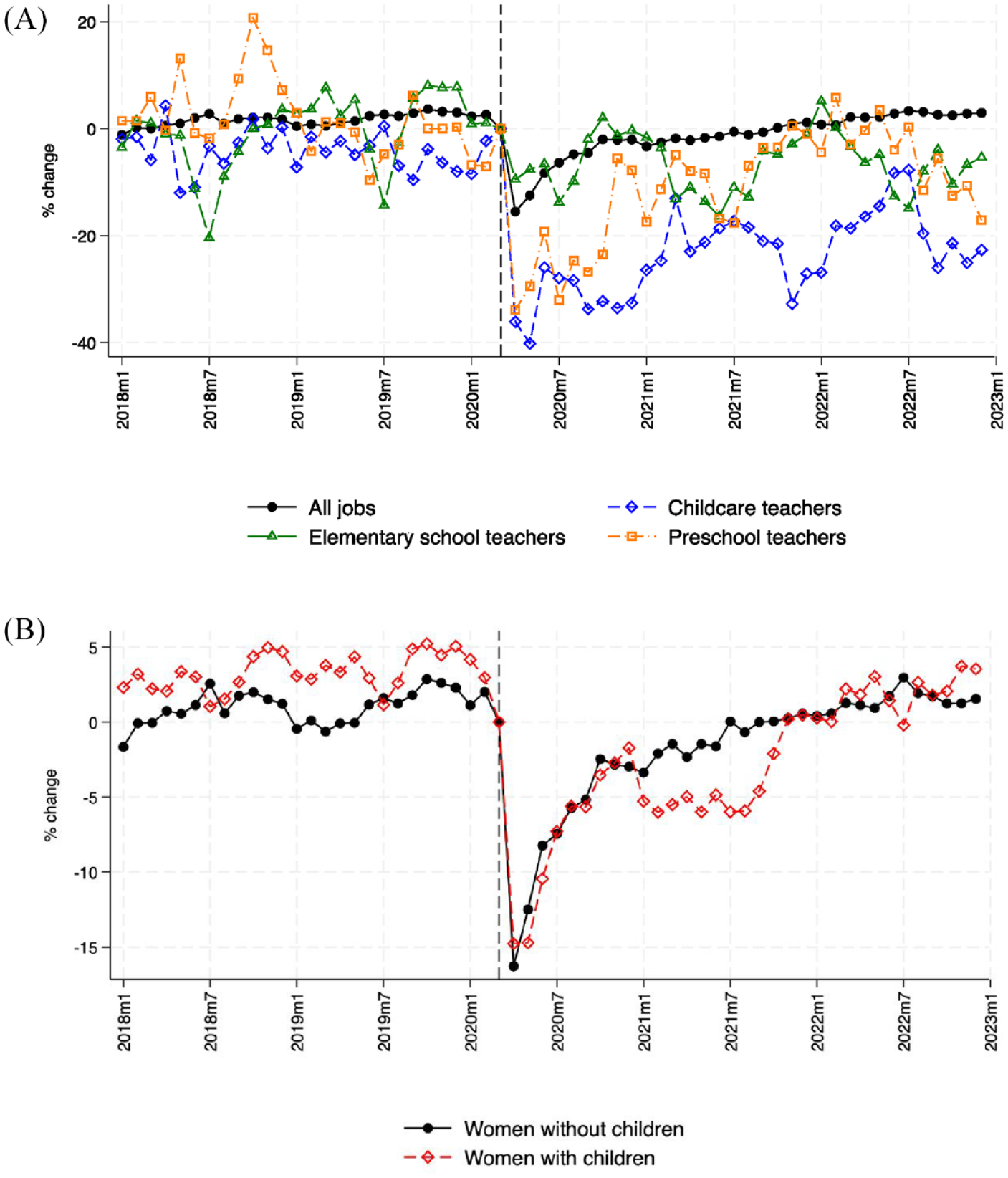
Trends in employment for paid and unpaid childcare groups, 2018 to 2022. (A) Paid childcare groups. (B) Unpaid childcare groups.
Among unpaid child caregivers, women who lived with their own children recovered more slowly than their counterparts without children. Women with children experienced large declines in employment (i.e., the number of employed women with children was 6 percent below March 2020 levels one year after the pandemic onset) and recovered prepandemic levels of employment by November 2021. Additional analyses show that the declines in employment among women with children were more acute for mothers of children younger than five years and mothers of school-aged children (see Figure S3 in the Online Supplement).
Panel and Intersectional Evidence of Employment Loss for Paid and Unpaid Child Caregivers
Figure 2 shows average estimates of the impact of the pandemic on the employment of paid and unpaid child caregivers. Figure 2A shows that childcare teachers were the group most severely hit by the pandemic, experiencing an 18 percent decline in employment. The loss of employment among preschool teachers was similar to that experienced by the rest of the workforce (a 10 percent decline), while primary teachers experienced a sizably smaller decline in employment (a 6 percent decrease). Figure 2B shows that young children exacerbate the impact of the pandemic on women. Mothers with children aged 0 to 5 years experience a larger decline in employment than women without children in the household. The loss of employment among mothers with children aged 6 to 11 is also greater than among women not living with children. In general, these average estimates of the impact of the pandemic lend initial support to the expectations concerning the interdependence between paid and unpaid caregivers of children and the worsening of preexisting inequalities among paid caregivers. The analysis shows that those living or working with children aged 0 to 5, paid and unpaid, were the most negatively affected.

Overall changes in employment among paid and unpaid child caregivers. (A) Paid Caregiving. (B) Unpaid caregiving.
Figure 3 presents a similar set of estimates but includes our intersectional analysis subdivided by race-class groups. Figure 3A shows that the differences among paid child caregiver groups are relatively similar across race-class groups, but that differences between race and class groups are large. The impact of the pandemic among the baseline group of individuals not in paid childcare is greatest for those who are not white and do not have a college degree. The nonwhite-no-college group does the worst, followed by the white-no-college group, the nonwhite-college group, and the white-college group. These differences are large and statistically significant. For instance, the impact of the pandemic among the nonwhite-no-college group is 10 percentage points larger than the white-college group. Because of these large baseline differences, the relative position of paid child caregivers as a whole varies within each of these groups. Among the nonwhite-no-college group, preschool teachers do slightly better than those with jobs not in paid child caregiving (although this difference is not statistically significant), while childcare teachers do much worse. Among the white-no-college group, all paid child caregiver groups do worse than the baseline, with preschool teachers experiencing a 7 percentage point greater decline in employment compared with the baseline and childcare teachers experiencing an 11 percentage point greater decline. Among those with college degrees, the impact of the pandemic on primary teachers is similar to the impact among those not in paid childcare, while the impact for preschool and childcare teachers is substantially worse. For example, nonwhite-college and white-college childcare teachers experience a 4 percentage point and 12 percentage point greater decline in employment compared with the baseline. In sum, these results indicate that the advantage of teachers observed in the baseline estimates is largely because primary teachers hold a college degree. When comparing the impact of the pandemic among those who have a college degree, primary school teachers are no longer “advantaged.” 5 Additionally, the results show that being a childcare teacher is a disadvantage across the board and particularly among groups otherwise advantaged by race and/or class. As mentioned earlier, the results here are consistent with our expectation that the fractionalization of the paid childcare workforce by class and race would be exacerbated during the pandemic.

Racialized and classed changes in employment among paid and unpaid child caregivers. (A) Paid caregivers. (B) Unpaid caregivers.
Figure 3B examines how the pandemic impact on unpaid child caregivers varies across race and class groups. We find that the disadvantage of mothers with 0- to 5-year-old children relative to women without unpaid childcare responsibilities is particularly acute among the nonwhite groups (nonwhite-no-college and nonwhite-college). Among the nonwhite-no-college group, mothers with children ages 0 to 5 experience an additional 3 percentage point decrease in employment compared with their counterparts without unpaid childcare responsibilities. Among the nonwhite-college group, living with children aged 0 to 5 results in a marginally statistically significant 2.5 percentage point additional decrease in employment (−.024, p = .060). Among the groups with college degrees, living with children ages 0 to 5 does not result in a clear disadvantage, particularly for white women. Across all groups, the impact of the pandemic for mothers of school-aged children is indistinguishable from the reference group for nonwhite women and it is smaller than the reference group for white women. These results contrast with the dominant media narrative about the negative impacts of the pandemic on mothers centering white professional workers. Contrary to that perception, we see that the loss of employment associated with unpaid child caregiving is really concentrated among nonwhite mothers. The differences between race-class groups and between groups of unpaid childcare workers are consistent with the shocks experienced in the paid childcare workforce. First, we see that the most severe unpaid caregiving pandemic effects coincide with the most severe paid caregiving pandemic effects. The paid childcare teachers and the unpaid child caregivers of the youngest children are the most severely affected by the pandemic, consistent with what we saw in the average analyses. Second, the differences in the impact of unpaid child caregiving by race, class, and child age mirror the stratification of the impacts on the paid childcare sector, as studies have documented more severe center and school closures in nonwhite communities (Landivar et al. 2022; Lee and Parolin 2021).
Panel Analyses for Paid Caregivers: Unpaid Caregiving and Public Sector Employment
Figures 4 and 5 present additional analyses of the impact of the pandemic on paid child caregivers. Figure 4 examines the impact of unpaid caregiving responsibilities, and Figure 5 examines the differences between the public and private sectors.

Unpaid caregiving among paid caregivers.
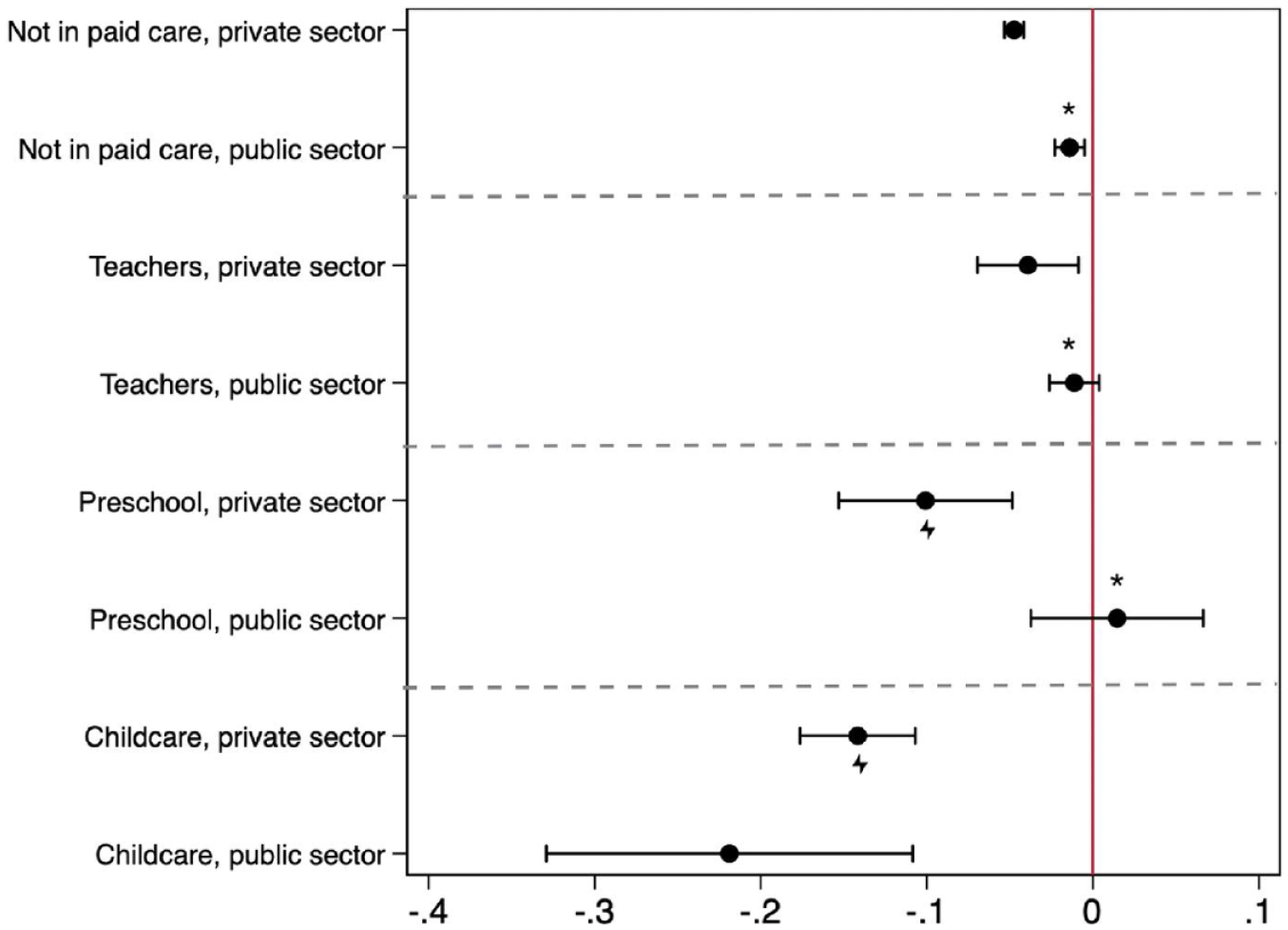
Public versus private employers among paid caregivers.
Figure 4 shows that unpaid caregiving responsibilities do not significantly change the impact of the pandemic among teachers but do change it for preschool and childcare teachers. Particularly among childcare teachers, we find robust evidence that those with young children (0–5 and 6–11 age categories) experienced much larger employment losses than childcare teachers without unpaid childcare responsibilities. The coefficients are substantial, with mothers of young children experiencing additional 15 and 18 percentage point decreases in employment compared with childcare teachers without children. This result is consistent with the idea of cumulative pandemic effects: childcare closures affected workers who were hit on one side by reduced income, which affected their ability to afford childcare as well as their eligibility for childcare subsidies, and on the other side by a lack of childcare centers to work at or send their children to. The results suggest similar patterns of unpaid child caregiving penalties for preschool teachers, but the coefficients are not statistically significant, likely because of limited sample size and statistical power.
Figure 5 shows that workers in the public sector experienced much smaller declines in employment than workers in the private sector, and this difference is true both for those with jobs in paid childcare and in the rest of the economy. The loss of employment for public primary teachers is 3 percentage points smaller than for private primary school teachers (this public-private difference is similar for the rest of the workforce). Among preschool teachers, the public-private difference is very large, with those employed in the private sector experiencing a 13 percent higher decline in employment. Among childcare teachers, those working in public facilities appear to experience a larger decline in employment, but this group is very small (n = 175) and the difference in employment loss between public and private is not statistically significant. Taken together, these results are consistent with the expectation that public responsibility for the care infrastructure is essential to protect this critical sector of the economy. Familialization, which places the responsibility onto families to secure childcare arrangements, results in a privatized and segmented childcare sector that is highly vulnerable to crisis shocks, such as the pandemic.
Other Employment Statuses and Income Loss Patterns for Paid and Unpaid Caregivers
The Online Supplement provides additional analyses for other employment statuses (unemployment, labor market dropout, and retirement) and for earnings losses. The results reinforce the pattern of worsening inequalities among paid and unpaid child caregivers. Most paid and unpaid child caregivers who lost their jobs became unemployed, but nonretirement labor force exits were more likely for childcare teachers with children and nonwhite mothers with children 0 to 5 years of age, and retirement was more likely among teachers. Consistent with results on employment status, we observe very significant earnings losses among childcare teachers and mothers with children 0 to 5.
Discussion and Conclusion
Our analyses show that the pandemic has affected child caregivers in ways that are consistent with the long-lasting effects of intertwined processes of feminization, racialization, and familialization that devalue and fractionalize the labor of caring for children. Our results supported our hypotheses that integrated and intersectional analyses of employment outcomes during the pandemic would show how paid and unpaid caregivers depend on each other and demonstrate how existing inequalities worsened. We found evidence for heterogeneous impacts of the pandemic among paid and unpaid caregivers that followed patterns consistent with the distinct processes of racialization and familialization. Black, Brown, and non-college-educated mothers were hit particularly hard during the pandemic. Primary school teachers, most of whom are white, were better positioned before the pandemic and fared much better than childcare teachers during the pandemic. Primary teachers’ employment outcomes illustrate how defamiliazation can safeguard essential workers and the services they provide and that public support for teachers, while limited, cannot be disentangled from the raced, classed, and gendered construction of teachers as a group. If more child caregivers had had similar supports as public school teachers before the pandemic, they likely would have experienced less severe employment loss and financial distress, but the path toward receiving support must contend with a public aversion to supporting Black and Brown workers and mothers. Although primary teachers fared comparatively better economically relative to other childcare workers, they experienced unprecedented burnout already increasing because of the decline of public support for education (Pressley 2021). The intensified work-family conflict and financial distress among families with children demonstrate how privatized and familiarized responsibility for children’s care harms unpaid caregivers, families, and workers in privatized childcare settings and exacerbates existing racial inequalities.
Our study provides evidence linking the uneven impact of the pandemic on paid and unpaid child caregivers to the devaluation and fragmentation of child caregiving, but our study has limitations. By focusing on employment as our main outcome, we are unable to analyze how the loss of wages from nonemployment for these groups was partially offset and sometimes increased by pandemic relief programs such as Economic Impact Payments (Cortes and Forsythe 2023). Additionally, child caregivers experienced many noneconomic adverse effects of the pandemic, such as declining mental and physical health (Eadie et al. 2021; Elharake et al. 2022; Quinn et al. 2022; Tarrant and Nagasawa 2020). Our study is unable to capture how these important non-employment-related effects differentially affected these groups. In addition, our panel pandemic estimates cover the full first year of the pandemic, but they do not cover the period after that because the CPS does not have prepandemic observations for anyone interviewed after March 2021. This exclusion is important because families with children received unprecedented income support in 2021, when the American Rescue Plan Act temporarily expanded the child tax credit. Although our period of analysis is limited, other scholars’ reports on this workforce reinforce our findings that paid and nonpaid child caregivers experienced severe hardships during the pandemic, indicating that nonemployment in this sector is a valid indicator of economic hardship (Belledonne and Chien 2024). They also support our findings of the differential gendered and classed impacts among and between child caregivers (Bassok et al. 2020; Landivar et al. 2023; Petts et al. 2021; Zamarro and Prados 2021).
Our goal in combining research on childcare teachers, preschool teachers, primary teachers, and unpaid mothers has been to highlight the interplay between gendered, racialized, and classed narratives about these groups and the forms of public support accorded to them. By doing so, we have sought to show how an integrated analysis can inspire forging alliances between these connected communities and offer policy solutions directed at those most affected. Despite long-standing differences in pay, prestige, and working conditions between workers who provide care for children ages 0 to 5 years and those who work with children 5 to 11, families often rely on care workers across sectors, and primary teachers and childcare teachers depend on paid and unpaid caregivers to do their work. There are high-stakes collective benefits to challenging devaluation and fractionalization that serve to divide, devalue, and stratify the essential work of paid and unpaid caregivers that would improve the lives of caregivers and those who receive care. Increasing the quality of care as well as the quality of jobs would lift child caregivers’ families out of poverty and enhance children’s flourishing, health, and well-being. Rather than engaging in strategies that seek to demonstrate the unique expertise of already better positioned child caregiver groups, the best way forward is for caregivers to band together across sectors. A cultural and policy shift toward recognizing the importance of collectively supporting childcare across all ages would not only help lift the floor for unpaid caregivers and childcare teachers, it would also help K–12 teachers fight the continuing threats to their jobs. It is through these alliances that the devaluing-induced fractionalization can begin to be challenged.
Supplemental Material
sj-docx-1-srd-10.1177_23780231241259681 – Supplemental material for Pandemic Pathways: An Integrated Approach to Studying the Pandemic’s Employment Impacts on Paid and Unpaid Care of Children 0 to 11 Years Old
Supplemental material, sj-docx-1-srd-10.1177_23780231241259681 for Pandemic Pathways: An Integrated Approach to Studying the Pandemic’s Employment Impacts on Paid and Unpaid Care of Children 0 to 11 Years Old by Pilar Gonalons-Pons and Johanna S. Quinn in Socius
Supplemental Material
sj-pdf-2-srd-10.1177_23780231241259681 – Supplemental material for Pandemic Pathways: An Integrated Approach to Studying the Pandemic’s Employment Impacts on Paid and Unpaid Care of Children 0 to 11 Years Old
Supplemental material, sj-pdf-2-srd-10.1177_23780231241259681 for Pandemic Pathways: An Integrated Approach to Studying the Pandemic’s Employment Impacts on Paid and Unpaid Care of Children 0 to 11 Years Old by Pilar Gonalons-Pons and Johanna S. Quinn in Socius
Footnotes
Acknowledgements
The manuscript benefited from feedback from Annabel Ipsen, Lily Liang, Casey Stockstill, and the Socius reviewers. We thank them for their support.
Author’s Note
The authors are listed in alphabetical order. Both authors contributed equally to this work.

Supplemental Material
Supplemental material for this article is available online.
Notes
Author Biographies
References
Supplementary Material
Please find the following supplemental material available below.
For Open Access articles published under a Creative Commons License, all supplemental material carries the same license as the article it is associated with.
For non-Open Access articles published, all supplemental material carries a non-exclusive license, and permission requests for re-use of supplemental material or any part of supplemental material shall be sent directly to the copyright owner as specified in the copyright notice associated with the article.
