




Abstract
In this study, the authors explore the role of echo chambers in political polarization through a network and content analysis of 183 political influencer accounts and 3,000 audience accounts on Twitter (now X) around the Arizona audit of the 2020 U.S. presidential election, sampled between July 17 and August 5, 2021. The authors identify five distinct groups of influencers who shared followers, noting differences in the information they post and the followers they attract. The most ideologically diverse audiences belong to popular media organizations and reporters with localized expertise to Arizona, but partisan influencer groups and their audiences are not uniformly like-minded. Interestingly, conservative audiences are spread across multiple influencer groups varying in ideology, from liberal influencers and mainstream news outlets to conservative conspiracy theorists. The findings highlight the need to understand users’ motivations for seeking political information and suggest that the echo chamber issue may be overstated.
Partisan hostility in the United States is at an all-time high. On average, Democrats and Republicans are ideologically the furthest apart now than at any other point over the last 50 years (Desilver 2022). According to the Pew Research Center (Nadeem 2022), Democrats and Republicans increasingly view members of the other party with disdain, characterizing them as closed minded, dishonest, and immoral. Pundits and scholars often point to social media as one cause of political polarization because, among other reasons, platforms cater to users political predilections, nudging them into echo chambers where their points of view are validated and echoed back to them (Hobolt, Lawall, and Tilley 2023; Ross Arguedas et al. 2022).
There is a debate, however, over the importance of echo chambers in the process of political polarization (Dahlgren 2021). Some scholars argue that filter bubbles, which are products of algorithmically curated personal feeds, can exacerbate political polarization by pushing users toward niche partisan accounts (Bandy and Diakopoulos 2021; Chen et al. 2021; Del Vicario et al. 2016; Flaxman, Goel, and Rao 2016). Once users choose to follow niche political influencers and like-minded users, echo chambers, or insular online communities that share a political ideology, can form and aid polarization (Hobolt et al. 2023; Parmelee and Roman 2019; Quattrociocchi, Scala, and Sunstein 2016). Other scholars argue that filter bubbles and echo chambers are less consequential than users’ media and information seeking choices (Bogert et al. 2023; Bruns 2019; Dubois and Blank 2018; Kim and Kim 2021). Recent research, for example, shows that individuals’ media choices can expand (or limit) the kinds of information and range of perspectives to which they are exposed, and that these choices can increase (or reduce) their overall political polarization (Reed et al. 2021; Yarchi, Baden, and Kligler-Vilenchik 2021). In other words, this research suggests that understanding individuals’ motivations for finding and interpreting information may be more important than the echo chambers themselves (Bruns 2019).
We weigh in on the debate by focusing empirical attention on the relationship between political influencers, or accounts with the capacity to spread political information and direct others’ attention to issues and events (Liang and Lu 2023), and their audiences to better understand political polarization. More specifically, we explore the extent to which political influencers and their audiences seem to share political points of view through a profile analysis of 183 political influencer accounts and 3,000 audience accounts sampled between July 17 and August 5, 2021 around the audit of the 2020 presidential election in Maricopa County, Arizona, on Twitter (now X). We construct and cluster a shared audience network using follower overlap between influencers to identify groups of influencers that share audiences. Then, through a content analysis of influencers’ profile biographies and their followers’ profile biographies, we assess whether the audiences appear to ideologically align with (or diverge from) the political influencers they follow. We find that there are five groups of distinct influencers who shared followers, and that these groups differ in terms of the kinds of information they post as well as the kinds of followers they attract. The most ideologically diverse audiences belong to established media organizations and reporters with localized expertise to Arizona, but partisan influencers groups and their audiences were not uniformly like-minded. Interestingly, we find that conservative audiences are spread across multiple influencer groups that vary in their ideological orientation, from groups that consist of liberal influencers and mainstream news outlets to groups that are composed entirely of conservative conspiracy theorists. We discuss the significance of our findings relative to the debate over the role of echo chambers in political polarization.
The Influencer-Audience Relationship
Despite the growing impact of political influencers, 1 much of the research on audiences relies on survey and web traffic data (Dubois and Blank 2018; Majó-Vázquez, Nielsen, and González-Bailón 2019; Mukerjee, Majó-Vázquez, and González-Bailón 2018). The issue with this approach is that it largely neglects the relationship between political influencers and their social media audiences. Consequently, when considering why audiences follow a given influencer, researchers often assume that influencers overtly signal their political identities to a broader audience and users who share or are sympathetic to a political identity follow the influencer, forming the political echo chambers that fuel polarization (Asatani et al. 2021; Soares, Recuero, and Zago 2018; van der Does et al. 2022). This assumption is problematic for two reasons. First, it presumes that there is ideological homophily between influencers and their audiences. Second, it assumes that shared audiences have uniform ideologies.
The extant literature on audiences of political information suggests that an individual’s choice to follow a given influencer is motivated by more than ideological alignment alone. 2 Communication scholars, for example, find that individuals seek out political content online for many reasons including the perceived credibility of an account with a broader audience, the social utility of knowing different kinds of political information, and the desire to surveil individuals with different political perspectives (Johnson and Kaye 2010; Kaye and Johnson 2004; Knobloch-Westerwick 2014; Metzger, Hartsell, and Flanagin 2020; Parmelee and Roman 2019). These findings suggest that although some of the choices individuals make regarding who to follow may reinforce existing political biases (Ekström, Niehorster, and Olsson 2022), this is not always the case (Kim and Kim 2021). Individuals following choices can be complicated, which means some political influencers’ audiences may be more ideologically diverse than previously thought.
There are at least two factors that can help explain the ideological diversity of influencers’ audiences, or lack thereof. First, influencers who are regarded as trustworthy or credible sources of political information may attract more diverse audiences than those who are not (Metzger et al. 2020). Social scientists find that perceptions of trust and credibility influence the kinds of online news media to which users expose themselves (Metzger et al. 2020; Strömbäck et al. 2020; Turcotte et al. 2015), and that trust and credibility can be situationally bound. Users who seem to be on the ground and/or have inside knowledge during a crisis, for example, are regarded as trustworthy in the moment, which can cause (mis)information to be widely shared (Rohlinger, Williams, and Teek 2020). Even individuals who do not trust a source may still opt to follow an account. For instance, individuals interested in surveilling their political opponents may passively monitor the accounts they believe their “enemies” follow. It is easy to imagine that mainstream news media outlets attract a relatively diverse set of followers, as audiences for these venues already lean Democratic (Jurkowitz et al. 2020) and as conservatives, who often regard mainstream media outlets as biased (Gottfried 2021; Major 2015), may follow these accounts to see how the “lamestream” media are “spinning” the news of the day.
Second, how researchers operationalize political influencers may very well affect audience composition. There is not a standard operationalization of what constitutes an influencer (Dubois and Gaffney 2014; Jackson and Foucault Welles 2015; LeFebvre and Armstrong 2018). That said, studies typically assume that size matters and focus on accounts with hundreds of thousands and millions of followers (Casero-Ripollés 2021; Poirrier et al. 2020). The current focus on high-profile accounts, particularly those that routinely peddle lies and conspiracy theories, may overestimate the size of the audiences that follow and tune into extreme content (e.g., Baker and Maddox 2022; Fong et al. 2021). Additionally, although there is much to learn from these accounts, it reinforces the “million follower fallacy” that only the most followed accounts matter, ignoring the fact that social scientists routinely find that micro-influencers, or content creators with only thousands of followers, can have an outsized impact on discussions in virtual spaces (Cha et al. 2010; Kausar, Tahir, and Mehmood 2021; Park et al. 2021). Furthermore, given that echo chambers can emerge from smaller groups of users densely connected with one another (Bruns 2019), focusing on micro-influencers can help scholars identify political, and potentially politically extreme, echo chambers.
Here, we draw on the work of Rohlinger et al. (2023), who distinguish message-amplifying influencers (or those who have a lot of followers) from message-driving influencers (or those who share a lot of content on a platform). They find that both kinds of influencers shape the political information environment. Message amplifiers, who were predominantly politicians worried about their brands, were less polemical in their posts because they were mindful that firebrand rhetoric might alienate voters they would need on their side in the future. This was not true of message drivers who tried to steer political discourse by posting dozens, sometimes hundreds, of posts a day. Message drivers’ posts were more polemic, and they sometimes used their accounts to spread conspiracy theories. We extend this insight and argue that, given the differences between political influencers, it is reasonable to expect message amplifiers and message drivers to attract different kinds of followers. More important, different kinds of influencers (or mixes of influencers) may attract different sizes of audiences, which could provide critical insight into the relative insularity of audiences for, among other things, conspiracy theories and extreme content. It is completely possible that the (typically conservative) audiences for misinformation and conspiracy theories are smaller than current research suggests (Baker and Maddox 2022; Fong et al. 2021; Garrett and Bond 2021) and that the conservative audience is fragmented with more moderate conservatives tuning into different influencers than conservatives who identify with Trump’s brand of politics.
Data and Methods
This project addresses four research questions:
Research Question 1: What groups of influencers share audiences?
Research Question 2: Do different types of influencers (amplifiers vs. driver) share audiences?
Research Question 3: Are there similarities among the influencers who share audiences?
Research Question 4: Do audience members ideologically align with the political influencers they follow?
To answer these questions, we use the case of the Arizona audit. In 2021, defeated incumbent Donald Trump endorsed an audit of Maricopa County, Arizona, in hopes to uncover fraudulent activity and decertify the 2020 U.S. presidential election. The audit became a political flashpoint after the Maricopa County Board of Supervisors authorized a multilayered, forensic audit of the ballot tabulation equipment software used in the 2020 election and, ignoring the efforts of the Board of Supervisors to conduct a transparent audit, the Republican-dominated Arizona State Senate authorized a “partisan review” of the county’s ballots (Bradner and Rappard 2023). Central to the debate over the Arizona State Senate’s audit was its decision to have Cyber Ninjas, the third-party application security service with no experience in election audits and a CEO sympathetic to Trump’s arguments, conduct the review (azcentral.com 2021). Political influencers on both sides of the audit debate were vocal about the need for perceived legitimacy of the audit and, more often than not, offered a disparaging word or two about their opposition (Rohlinger et al. 2023). In other words, given the ideological range of the debate, the Arizona audit represents a good case to observe the relationship between different kinds of political influencers and their audiences, and, more specifically, to assess the extent to which expressed political points of view between influencers and their audiences align.
Data
This is part of a larger project that analyzes influencers and political discourse around the Arizona audit. For this project we focus on discourse between July 17 and August 5, 2021, because the audit was initially scheduled to be released in mid-July. The anticipated results created a “critical discourse moment,” or a moment when the issue was salient, broadly discussed, and different kinds of users had an opportunity to weigh in on the audit debate (Rohlinger 2002; Staggenborg 1993). Because at the time, Twitter was regarded as the go-to place for civic and political information (Aslam 2023; Crudele 2022), we used the keywords “Arizona audit” and the program DiscoverText 3 to retroactively scrape 245,020 posts from the platform. DiscoverText enabled us to access Twitter’s application programming interfaces to query tweets and profiles. We were then able to organize our sample into “archives” and “buckets” of retweets and posts and identify the most retweeted and most active users.
Next, we operationalized and identified the two types of political influencers: message amplifiers and message drivers. We operationalized message amplifiers as the top 10 most retweeted accounts from each of the days included in the sample. As there is not a standard metric by which researchers define message amplifiers (Dubois and Blank 2018; Jackson and Foucault Welles 2015; LeFebvre and Armstrong 2018), we reasoned that this approach allowed us to capture accounts at least some segment of the user population was attending to. This approach particularly made sense given that the engagement rate on Twitter is low. According to the 2022 Social Media Industry Benchmark Report (Feehan 2023), the median engagement rate (or [likes + shares + replies]/total number of followers) on Twitter is only 0.037 percent. We identified 112 message amplifiers in the sample.
We operationalized message drivers as the top 10 users who posted or shared the most content on each of the 20 days. This operationalization is the same as the one used by Rohlinger et al. (2023). By measuring influence relative to the size of the discourse, we were able to identify influencers with a wide range of follower counts, including smaller, niche political audiences. This process identified 117 message drivers in the sample. It is important to note that five accounts were both amplifiers and drivers, meaning that there are a total of 224 unique political influencer accounts. To maintain compliance with Twitter’s developer agreement (X 2023), we restricted our analysis to accounts that had not been suspended. This reduced the final working sample of 183 total political influencers: 90 message amplifiers, 88 message drivers, and 5 influencers who qualified as both. 4
To assess the relationship between political influencers and followers, we examine the shared audience networks, or overlapping audience segments that follow political influencers’ accounts. 5 We use this as our starting point because scholars interested in studying audiences for political ideas and media consumption patterns more generally use shared audience networks to better understand who (or what) gets attention online (Mukerjee et al. 2018; Peng and Yang 2022; Stewart et al. 2017; Webster and Ksiazek 2012). Here, analyzing the shared audience networks of political influencers allows us to assess what kinds of political influencers share audiences, the relative importance of different kinds of political influencers (message amplifiers vs. message drivers as well as the political brand) in contemporary debates, and the mix of political influencers who seem to attract a more (or less) ideologically diverse following.
To identify the influencers’ networked audiences, we collected the most recent 150,000 followers of each message amplifier and driver using the academictwitteR package for R (Barrie and Ho 2021). The decision to cut off data collection at 150,000 followers per influencer was necessary because of practical constraints. At the time of data collection, Twitter’s version 2 application programming interface restricted researchers to collecting the profiles of 15,000 followers every 15 minutes. The lead researcher selected 150,000 followers as the cutoff to balance this time constraint with the goal of minimizing affected accounts. Because 49 influencers in our sample (26.8 percent) have more than 150,000 followers, this decision meant that only a portion of their followers were collected. No influencers were excluded from our analysis based on their follower count. It is worth noting that the timing of the data collection could potentially alter the kinds of followers captured. Twitter’s version 2 application programming interface only allows researchers to collect followers in the order in which they followed the target account beginning with the most recent follower. Because the follower data collection occurred a year after the influencer data collection, this introduces room for error. However, the majority of influencer accounts (73.2 percent) were unaffected by this cutoff because they had fewer than 150,000 followers.
Network Analysis
We performed a network analysis to identify groups of influencers that shared networked audiences as well as to estimate the number and size of those audiences engaged in Arizona audit discourse. First, we constructed a shared audience network which connects accounts by a shared audience metric (SAM). The SAM is based on the Jaccard similarity index and describes the number of followers two accounts share as a proportion of the union of the two accounts’ followers:

After the SAM was calculated between each pair of accounts, we constructed the shared audience network by treating each account as a vertex and the SAMs as weighted edges between vertices. Accounts sharing no followers were tied by an edge with weight 0 and accounts sharing all followers were tied by an edge with weight 1. This process resembles Stewart et al.’s (2017) network analysis of #BlackLivesMatter discourse which identified politically distinct groups of influencers who shared audiences.
Next, we clustered the shared audience network through the Clauset-Newman-Moore modularity algorithm to group influencers together who share large portions of their followers (Clauset, Newman, and Moore 2004). This clustering algorithm is particularly well suited for large networks and attempts to find community partitions with the highest modularity. The algorithm uses a “greedy agglomerative” approach to community detection. Agglomerative refers to using each node (an account) in the network as the beginning of a community (Nielsen 2016), and greedy refers to the algorithm’s process of merging communities iteratively at each step of the algorithm to maximize modularity (Black 2005). Influencers who belong to the same shared audience cluster are understood to share a networked audience.
Content Analysis
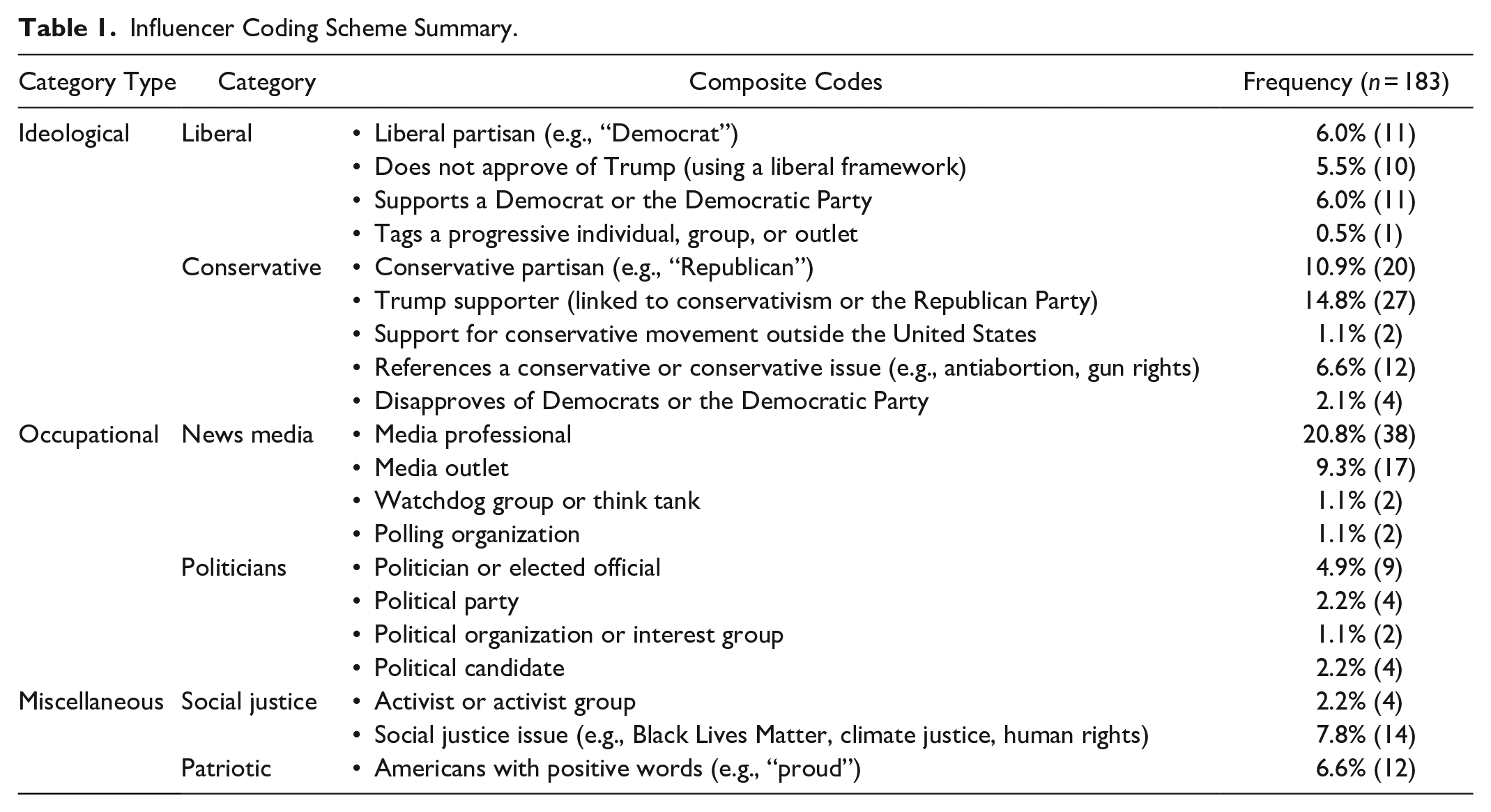
After clustering the shared audience network, we performed two content analyses (Krippendorff 2018). First, we analyzed influencers’ profile biographies to see whether influencers who share audiences also share similarities in their profile biographies. In our content analysis of influencers, we used focus coding to identify the kinds of descriptors included in each of the 183 profiles and then counted and collapsed the descriptors into broader summative categories (Charmaz 2014). We recorded users’ political ideologies by observing whether they identified with or opposed a partisan (e.g., Trump or Biden) or partisan group (e.g., Republican or Democrat), and we recorded users support of social justice movements (e.g., Black Lives Matter, climate justice) and patriotism when they positively identify with the United States (e.g., “proud American”). Table 1 shows the composite characteristics in influencer profiles. Notice that the collapsed categories reference an ideology (liberal and conservative), reference an occupation (news media and politician), and reference social justice and patriotism. An account could contain (and be coded for) the presence of more than one of these categories. For example, one profile biographies which reads “Managing Editor, @CrooksandLiars Co-host, @MOMocrats podcast . . . #BlackLivesMatter” was coded for both news media and social justice.
Influencer Coding Scheme Summary.
Second, we analyzed the descriptors used in the followers’ profile biographies. As it was impractical to code all the followers’ profiles, we stratified our sample by influencer so that followers of every influencer in a shared audience cluster were represented. We randomly selected 600 followers from each shared audience cluster for a total of 3,000 accounts. To analyze the accounts, we used a combination of deductive and inductive analysis. We started by coding each of the 3,000 follower profiles for the presence of the descriptors identified in the analysis of the influencer profiles. We reasoned that this was a logical first step, as some accounts likely share occupations, political ideologies, and a sense of patriotism with the influencers they follow. We recorded the political ideologies of audience members with the same categories as the influencers (liberal, conservative, news media, politicians, social justice, and patriotic). Then, we used open coding to identify additional relevant categories (Charmaz 2014). We identified three: (1) accounts that noted an Arizona affiliation, (2) accounts that expressed support for conspiracy theories, and (3) accounts whose profiles were not in English. 6 As with the influencer content analysis, a profile could contain (and be coded for) the presence of more than one category. In the case of follower accounts, however, an account may have no codes at all. This is because we did not include descriptors such as “drinker” and “pet lover,” codes that emerged in the open coding process, in final coding scheme given their low frequency and lack of relevance. The two researchers coded an even split of the follower profiles, and the intercoder reliability between the two coders was 0.94 (Cohen’s κ), indicating a high level of agreement between the coders.
Findings
Figure 1, which illustrates the results of the network analysis, indicates that there are five groups of influencers with shared audiences (research question 1). Four influencers shared no followers with any other influencers and were labeled “no group.” Figure 1, which also describes the number of influencer accounts in each shared audience group and the number of followers belonging to each group, shows that the number of influencers and their audience sizes vary widely. Group 4, which is composed of 41 influencers, has 78,865 followers. In contrast, group 2, which is composed of only five influencers, has more than 32 million followers (Figure 1). This suggests that there are distinct influencer-audience groups engaged in conversation about the Arizona audit during this time frame and that their audiences vary dramatically in their relative size.
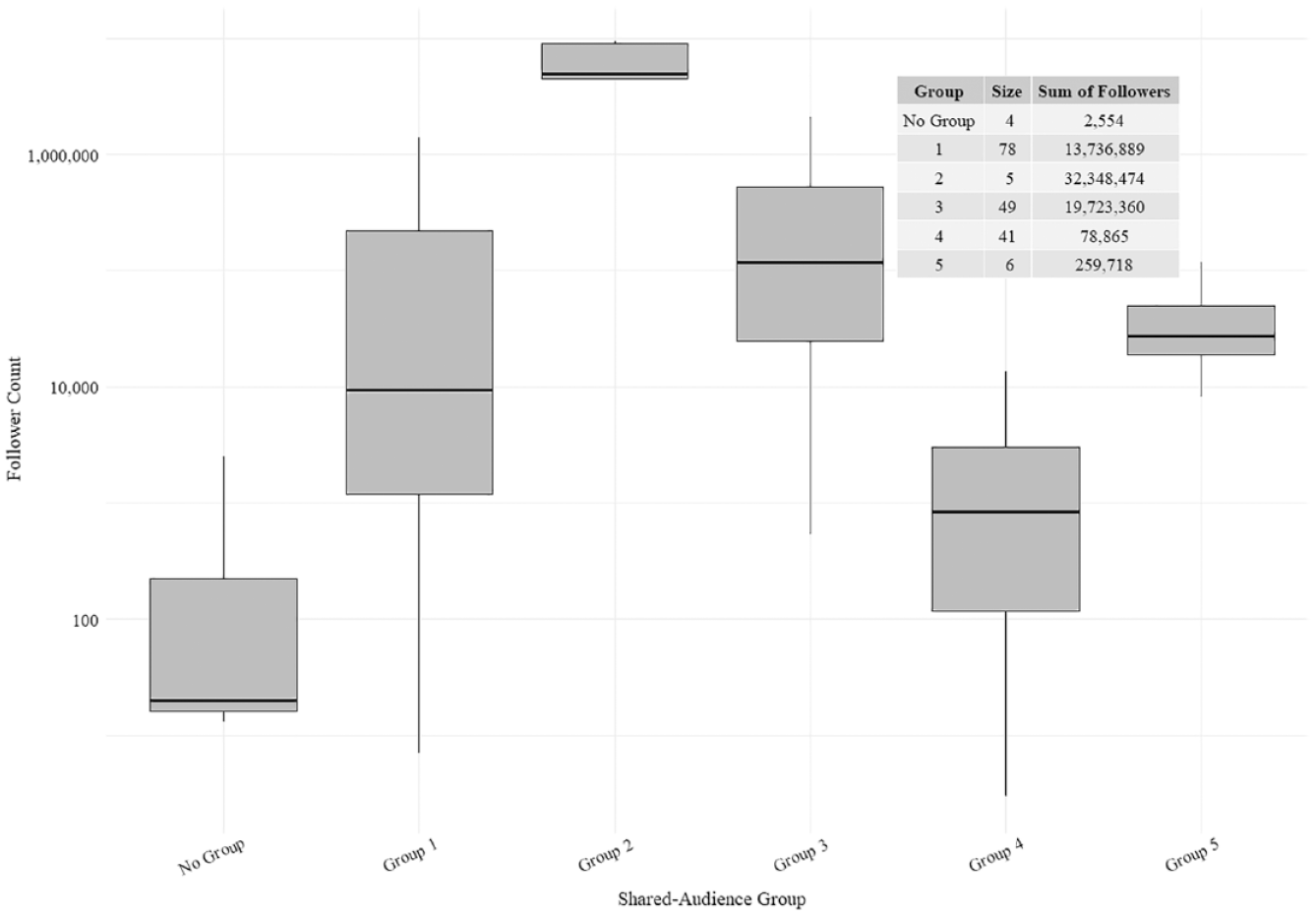
Shared audience clusters by influencer group.
Table 2, which shows the shared audience cluster by influencer type, indicates that different kinds of influencers tend to share distinct audiences (research question 2). Table 2 shows the percentage of influencers in each group who were message amplifiers, message drivers, or both an amplifier and a driver (recall that five accounts fell into this category). Notice that except for group 1, which is almost evenly split between message-amplifying influencers and message-driving influencers, the shared audience groups are composed almost exclusively of message amplifiers or exclusively of message drivers. Groups 2, 3, and 5 are composed almost entirely of message amplifiers and group 4 consists exclusively of message drivers. This means that message drivers sometimes, but not always, have different audiences than message amplifiers.
Frequency of Message Amplifiers and Message Drivers by Shared Audience Cluster.

Table 3 summarizes the content analysis of the 183 influencer profile biographies (research question 3). We see distinct similarities in the kinds of ideological orientations and occupations mentioned in influencer profiles within each group. For example, “social justice” and “liberal” are descriptors that are almost exclusively associated with influencers in group 1. “Conservative,” in contrast, is predominantly associated with influencers in groups 3 and 4. A deeper inspection of the influencer accounts reveals clearer ideological and occupational differences among the groups.
Frequency of Categories in Influencer Profile Biographies.

Note: Rows might not sum to 100 percent, as an account could contain more than one category or no categories at all.
The influencer profiles in group 1, which we call “liberal,” included references to the news media industry, social justice issues, and being ideologically liberal (Table 3). An analysis of the 78 accounts in the liberal group found that influencers included (1) a mix of media professionals (e.g., Associate, Press reporters Nick Riccardi and Jon Cooper as well as Kyle Griffin from MSNBC), (2) engaged citizens (e.g., accounts that identified themselves as “your friendly neighborhood debunker,” “former 60s protestor,” and “Desert dweller turned unlikely political activist”), (3) social justice advocates (e.g., an account that proclaimed “America, the moral torchbearer and defender of human rights, of fairness and justice”), and (4) generically liberal accounts (e.g., accounts that included references such as “Democrat—Biden/Harris. Vote Blue” and “A proud native Detroiter #Liberal”). Notably, media professionals have the largest number of followers in this group and, rather than sharing headlines alone, they offer their opinions about the Arizona audit. This is not an unprecedented practice. Previous research shows that in the United States, journalists sometimes post messages that are not ideologically consistent with their employers’ points of view (Harlow 2019), a trend we see here. Indeed, media professionals such as Kyle Griffin, who works for MSNBC, expressed his opinions about the audit, noting, more than once, that it was “fake” and based on election lies. In a much-liked tweet, for example, Griffin reported that “Arizona could face a more than $9 million clean up bill after their partisan, Republican-supported fake audit.”
Group 2, which we call “mainstream media giants,” consisted entirely of five official news media accounts (Table 3): MSNBC, CNN Politics, The Hill, NBC News, and the New Yorker. Unlike the media professionals in the liberal group, the mainstream media giants were the official accounts of the news organizations and, consequently, used less polemic language when describing the audit and its progress. For instance, instead of calling the audit fake as Griffin did, mainstream media giants used quotation marks to describe Arizona’s “forensic audit” or “so-called audit.” Headlines posted by accounts in this group included, “Dominion, Maricopa County refuse to comply with state Senate subpoenas in Arizona audit” and “As ballot counting in Arizona ends, turmoil and revelation of funding by Trump backers cast doubt on conclusions of ‘forensic audit’ of the 2020 election,” accompanied by links to the news stories. Although the language used may not seem objective on its face, it does reflect where the coverage of the audit was in July 2021. A number of news outlets reported Cyber Ninjas’ lack of experience with election audits as well as had shown direct connections between the company’s CEO, Doug Logan, and election deniers, causing politicians and pundits to redouble their questions about the Arizona audit and its validity (Duda and Small 2021; Levine 2021).
The profiles of the 49 influencers in group 3, which we call “Trump conservatives,” included conservative media outlets and professionals, Republican politicians, and a handful of Trump conservative accounts (Table 3). Unlike the previous groups, the outlets in Trump conservatives skew what the Ad Fontes Media Bias Chart labels strongly right. 7 These right-skewing outlets include Breitbart News, Newsmax, and the Right Side Broadcasting Network. Arguably, this is also true of the politicians in the group. Elise Stefanik, Tracia Flanagan, and Wendy Rogers, all of whom are vocal Trump supporters, amplified pro-audit content and lies about the 2020 election being stolen. The Trump conservatives group additionally included right-wing pundits such as George Papadopoulos, who served on Trump’s foreign policy panel during the 2016 election cycle. Papadopoulos was convicted of making false statements to the Federal Bureau of Investigation regarding his communications with the Russian government while working for the Trump campaign. After a 14-day stint in jail, and 12 months of supervised release, Papadopoulos published a book titled Deep State Target: How I Got Caught in the Crosshairs of the Plot to Bring Down President Trump, which he promoted heavily on social media along with his support of Trump. Note that two influencers in this group were message drivers and three qualified as both message drivers and amplifiers. These dual influencers shared the ideological orientation of the message amplifiers, they just had smaller audiences. For example, one of the influencers was the Washington Examiner, a conservative commentary outlet, and another was an “Old School Conservative. Citizen Journalist.”
Group 4, which we call “conspiracy conservatives,” consisted of 41 accounts with patriotic, conspiracy theory, and conservative themes in their profile biographies (Table 3). Unlike the Trump conservatives, conspiracy conservatives did not include any news outlets or politicians. In fact, all the conspiracy conservatives accounts belong to message drivers, meaning that these influencers frequently posted content but were not among the most retweeted. In this case, influencers were predominantly concerned with the 2020 U.S. presidential election and the audit’s ability to prove the election was stolen from Trump. Posts included messages such as “Thank you to the Arizona State Senators who DEMANDED election integrity for the citizens of Arizona. This audit will prove that Donald Trump won the state of Arizona, but some criminals cheated.” Additionally, posts pointed to the anticipated audit results, noting that they would conclusively show that the “thousands of affidavits and personal accounts describing [election] fraud” were correct and that the election was stolen from Trump.
Finally, group 5, which we call “Arizona locals,” was composed of five media professionals and one politician with ties to Arizona (Table 3). Like the mainstream media giants, the Arizona locals group was a small group of influencers, all of whom were message amplifiers (Table 2). The politician in the group is Stephen Richer, the Maricopa County recorder, a position responsible for maintaining public records, voter files, and elections. Richer was openly critical of the audit while also being sympathetic to Republicans. Richer’s most widely circulated tweet was an open letter addressed to his “beloved Party (GOP),” wherein he emphasizes that the election was not stolen and outlines his turmoil being implicated by his own party as part of the plot against Trump (Richer 2021). In another tweet, Richer wrote, “The ONE person in the audit with ANY previous high-level involvement with election administration has now been kicked out. Why? Because the new ballot count matched Maricopa County’s numbers, not the Ninjas’. The adult has left the room.” All five media professionals were local to (and reporting on) the city of Pheonix, Maricopa County, or Arizona more generally. Much like the mainstream media giants, the media professionals in the Arizona locals group tweeted information about the audit and its progress. Garret Archer from ABC15, for instance, published an “Arizona election audit fact check.” Other journalists tweeted similarly information-rich posts to update audiences on the audit, including “Trump adviser Cleta Mitchell is funneling money through an escrow account for Arizona Audit” and “BREAKING Maricopa County judge orders Karen Fann & Arizona Senate to immediately turn over to @weareoversight all documents connected to audit, including Cyber Ninjas & subcontractors records.”
In sum, the content analysis of influencers’ profiles illustrates that influencers who shared audiences also shared political affiliation, ideological orientation, or occupational status. The mainstream media giants group and Arizona locals group are composed of message amplifiers who predominantly shared fact-based headlines with links to their stories. The difference between the groups is their scope: mainstream media giants are geared to national news and Arizona locals focus primarily on news in the Grand Canyon State. This is quite different from the other three groups, which consisted of message amplifiers and/or drivers and who took clear, and more polemic, positions on the audit and its legitimacy. The liberal group (group 1) is split between message amplifiers and drivers (Table 2), signaling that this group’s audience consumes some of its information from mainstream outlets, liberal leaning journalists, and niche liberal political influencers. The Trump conservative and conspiracy conservative groups were both supportive of the audit, but the latter focused incorrectly on election lies. Although about 90 percent of the influencers in the Trump conservative group (group 3) are message amplifiers, the conspiracy conservative group (group 4) was composed entirely of message drivers (Table 2). These findings suggest that there is some fragmentation in conservative influencers’ audiences between those that follow Trump supporters and right-leaning outlets and those that follow conspiracy-oriented influencers. Although the liberal group (group 1) and Trump conservative group (group 3) have comparable follower counts in the millions, the conspiracy conservative influencers (group 4) have fewer than 80,000 followers between them (Figure 1), signaling that the audience for the most extreme conservative content is relatively small.
Figure 2, which summarizes the content analysis of audience members’ profile biographies, indicates that some audiences are more ideologically diverse than others (research question 4). The audiences in the liberal, Arizona local, and mainstream media giants groups are more ideologically diverse than the audiences in the Trump conservative and conspiracy conservative groups. Notice that both liberal and conservative themes are mentioned in the profiles of audiences of the liberal, Arizona locals, and mainstream media giants groups and that liberal themes are almost completely absent from the Trump conservative and conspiracy conservative groups. These findings suggest that liberal audiences largely follow mainstream and left-leaning outlets and accounts, and that the conservative audience is indeed more fragmented across the media ecosystem.

Summary of followers’ profile biographies by group.
There are two potential explanations for these results. First, the ideological diversity of the mainstream media giants and Arizona locals’ followers lends support to the argument that perceived credibility, whether general or localized, attracts diverse audiences (Dubois and Blank 2018; Rohlinger et al. 2020). In this case, individuals from across the political spectrum with a variety of motives may tune into mainstream outlets to better understand the Arizona audit. Second, it is possible that more moderate conservatives follow liberal political influencers rather than conservative influencers alone because they do not like Donald Trump or the direction in which the Republican Party is headed.
A deeper drive into the biographies of conservative audience members in the liberal, Trump conservative, and conspiracy conservative groups indicates that different kinds of conservatives follow different kinds of influencers. Notice, for instance, that the second and third most popular political themes in the liberal group’s followers’ biographies are patriotic (4.83 percent [n = 29]) and conservative (3.17 percent [n = 19]). An analysis of these accounts reveals that while some seem to belong to users who dislike Trump (e.g., profile biographies reading “Anti-Trumpanzee. Pro-Democracy” and “Educator, Artist, Patriot. Will block bots and trump’s brainwashed, anti-American MAGAts”), some of the followers are conservatives who are dissatisfied with the Republican Party (e.g., profiles noting “moderate conservative, abandoned by my party” and “Country over Party. Reclaiming my Party one election and seat at a time”). This suggests that the liberal group appeals to both liberals and moderate conservatives (Figure 2).
The audiences of the Trump conservative and conspiracy conservative groups are also different from one another. The audience of the Trump conservative Group predominately identified as conservative (22.8 percent [n = 137]) and patriotic (12.8 percent [n = 77]) in their profile biographies, and clearly aligned with the former president and conservative issues. Representative profile biographies in this audience include “Patriot for truth. MAGA,” “Independent conservative who cannot stand woke idiots,” and “Patriot. Let’s Go Brandon! ULTRA MAGA. US Veteran.” The audience of the conspiracy conservatives also included references to conservatism (35 percent [n = 210]) and patriotism (17.7 percent [n = 106]), but explicitly signaled their support for conspiracy theories in their profile biographies. One follower proclaimed, “Climate Change is a hoax, I’m completely unvaccinated, I have zero tolerance for liberals, The WEF/UN/WHO are Nazis. . . . All elections are rigged for Democrats,” in their biography. Another audience member noted “teaching my son conspiracy facts, how not to be a victim, and not to trust the government.”
Discussion and Conclusion
This research contributes to the debate over the role of echo chambers in political polarization by exploring the relationship between political influencers and their audiences. Our findings support the argument that the concern over echo chambers is overstated and that studying users’ motivations for pursuing information may be more efficacious than studying echo chambers to address polarization (Bruns 2019; Dubois and Blank 2018). The shared audience network analysis identified five groups of influencers who shared audiences ranging in ideological diversity. Three of these groups, the liberal, Trump conservative, and conspiracy conservative groups, shared political ideologies, and two of these groups, mainstream media giants and Arizona locals, shared an occupational status. The mainstream media giants and Arizona locals had the most ideologically diverse audiences, but partisan influencer groups and their audiences were not uniformly like-minded. The liberal group had some conservative users among their audience, while the Trump conservatives and conspiracy conservatives attracted users who were more aligned with their political and ideological orientation.
Three of our findings support some scholars’ concerns that social scientists have focused too much attention on the role of echo chambers in political polarization. First, our findings support the literature which suggests that individuals seek out credible information regardless of their political affiliation (Dubois and Blank 2018; Rohlinger et al. 2020). The mainstream media giants and Arizona locals were fact oriented and less polemic in their coverage of the audit, and their audiences included the most balanced mix of liberal and conservative followers that we observed. Next, despite the concern that conservative users follow their way into politically extreme echo chambers that circulate election disinformation (Garrett and Bond 2021), we observed conservative users among all influencer groups’ audiences. Even among the audience of the liberal group of influencers, we observed explicitly conservative users who were fed up with Trump and the direction of the Republican party. Finally, our findings support the argument that few users actually find themselves in politically extreme echo chambers (Dubois and Blank 2018). The conspiracy conservatives were the most active group in terms of circulating extreme political attitudes and election disinformation, and they had the smallest audience. Given the politically divisive nature of the Arizona audit, our findings suggest that, even when users are experiencing a contentious critical discourse moment (Rohlinger 2002; Staggenborg 1993), echo chambers ensnare relatively few individuals and most users seek out trustworthy information.
Additional research on audience members’ motivations for following political influencers is needed. Most influencers attract followers who are likely at least somewhat unsupportive of their ideas. Figure 2 shows that although the proportion varies, each group has some liberal, conservative and some seemingly conspiracy-minded followers. Although their profile biographies suggest that influencers and their followers are not always in ideological alignment, it would be worthwhile to interview followers to better understand the motivations behind their media diets. Better understanding the motivations behind individuals’ media diets will help scholars and stakeholders find ways mitigate the harms of echo chambers and disinformation more effectively. Additionally, it would be worthwhile to assess whether individuals use different social media platforms for different reasons in patterned ways. Given Twitter’s transition into X and the launch of new platforms such as Meta’s Threads and former Twitter CEO Jack Dorsey’s Bluesky, users have more choices for where to spend their time. Users may designate one platform for entertainment and another for political information. It is also possible that some individuals go to a partisan platform such as Gab for their news fix but follow mainstream media outlets on Facebook or X to surveil their political opponents. Future research should compare relationships between influencers and audiences in different political and media contexts. The Arizona audit was a divisive political issue that may have motivated users not only to confirm their own bias, but also to surveil ideologically challenging influencers as well. Different political contexts may inspire audiences differently and affect their following behavior. Addressing these questions will shed further light on the problem of political polarization and how it might be addressed online.
Footnotes
Acknowledgements
We would like to thank David Russell and Ting Luo for their thoughtful contributions to this paper at the 2023 ASA conference. Additionally, we thank Stu Shulman for access to DiscoverText and the reviewers at Socius for thier helpful feedback.
Funding
The author(s) disclosed receipt of the following financial support for the research, authorship, and/or publication of this article: Florida State University Institute of Politics.
1
We use political influencer in this study to mean accounts that reach a large audience or are highly active relative to a given political discourse or community. This is more in line with conceptualization of influencer in political discourse research ( ; Meraz and Papacharissi 2013) rather than those in cultural communications, business, or marketing research.
2
Social scientists routinely find that confirmation bias and group identity are important predictors of selective exposure and avoidance behaviors online (Knobloch-Westerwick and Alter 2007; Parmelee and Roman 2019; Trilling, van Klingeren, and Tsfati 2017). The point here is that motivations such as confirmation bias, social utility, guidance, and surveillance compete with one another, meaning individuals actively choose when and how to use social media to protect their political bias and when and how to use social media to fit in at work or to surveil their ideological opponents (Kim and Kim 2021; Knobloch-Westerwick and Kleinman 2012). This means that some political influencers may have a more ideologically diverse following than others. It is also worth repeating that selective following is only one mechanism connecting audiences to political influencers. Algorithms play an important role in curating a user’s personal feed, which can shape the influencers to whom users are exposed. Although some research reveals no evidence that their algorithm amplifies far-right or far-left political groups more than moderate ones (Huszár et al. 2022), sock puppet audits show that users’ personal feeds amplify niche partisan accounts at the expense of bipartisan accounts (Bandy and Diakopoulos 2021). These personal feeds may in turn affect who users choose to follow (). We believe that these studies underscore the importance of researching ideological diversity among influencers and their audiences.
3
DiscoverText is a cloud-based platform that supports the collaborative analysis of text data, including Twitter content. It features a range of text mining, data science, and machine learning tools that assist users in collecting, managing, and analyzing large volumes of unstructured textual data. For more about DiscoverText, visit .
4
The analysis was not influenced by the accounts qualified as both amplifiers and drivers. Any descriptive statistics of different influencer types in this article specify when accounts qualify as both.
5
Followers capture the known audience of social media accounts. The unknown audience, who may be exposed to a given social media account in their feed, is not available to researchers.
6
Languages included Arabic, Spanish, Japanese, Mandarin, Nepali, Romanian, and French. Tweets that were coded “not English” were not analyzed for other categories such as ideology or occupation.