




Abstract
The author investigates survey respondents’ reports of job displacement due to artificial intelligence (AI) and concerns about AI-related job displacement. Accordingly, the author examines explanations of AI exceptionalism—the view that AI technology is unique and will have different job-related outcomes compared with previous technological advances—and the vulnerability of underprivileged groups. The findings support the AI exceptionalism view, indicating that white-collar occupations and those with technical experience are more likely to be at risk. The study also reveals that concerns about job loss are widespread, but those who are more concerned are more likely to be vulnerable to workplace discrimination, not white-collar employees. The author concludes by emphasizing the need to develop new approaches for understanding AI’s impacts in the labor market.
Our social media feeds are inundated with an endless stream of news articles, expert interviews, and editorials predicting the impact of artificial intelligence (AI)—digital systems designed to “mimic, augment, or displace human agency” (Joyce et al. 2021:2)—on our day-to-day lives. Alarmist accounts predict, among other things, AI systems will replace human labor and lead to widespread unemployment. This outlook represents the displacement view. Historically, blue-collar work, characterized by manual and repeatable tasks, has been considered the most vulnerable to automation. But an updated version of the displacement view, which I call AI exceptionalism, has gained traction recently with the buzz surrounding ChatGPT. AI exceptionalism is the notion that the current wave of technological progress is different. AI’s ability to perform (some) cognitive tasks has fueled endless speculation about its potential to take over white-collar jobs. Whereas white-collar jobs have been considered relatively immune from automation in the past, the notion of AI exceptionalism suggests that jobs that are likely to characterized by cognitive tasks (i.e., coders, financial analysts, actuaries, and accountants, as well as marketers, writers, and journalists) will be disproportionately affected this time around. 1
In contrast to alarmist views, optimistic predictions highlight the potential benefits of AI, which corroborates the complementary view of technology and employment (e.g., Dahlin 2019a). Although automation may displace certain types of labor and occupations, it is complementary with others (Autor 2015), as when robots work side by side with assembly-line employees or in robot-assisted medical procedures. Advocates of the complementary view point out that in previous eras of technological advances troubling effects of automation have often been offset by higher product demand, reskilling, and the creation of entirely new jobs and industries. AI can also enhance existing jobs. For instance, AI can summarize vast amounts of text or sort through piles of résumés within seconds so that employees can focus on higher order tasks. Rather than displacing jobs, technology that complements employee efforts increases the value of and demand for human labor that goes beyond these mundane tasks.
Because of problems of data availability, most studies of new technologies and employment aggregate data at the national (e.g., Klenert, Fernandez-Macias, and Antón 2023) or subnational (e.g., Acemoglu and Restrepo 2020) level. Examining net employment levels mask job losses and gains and does not allow researchers to evaluate the direct relationship between job loss due to technology and employee or job characteristics. To address this issue, the data I use in this study permit me to address directly the question of whether job loss due to AI varies for certain groups of respondents. I use a unique data source, a survey I conducted in the fall of 2023, to examine whether AI-related job loss and concerns about job loss are indeed differentially distributed by employee and occupational characteristics. Findings from my analysis indicate that AI-induced job displacement occurs, on average, for respondents with white-collar jobs. This finding suggests, so far, that the effects of AI do indeed appear to be unique because they disproportionately affect employees with job characteristics that are associated with AI exceptionalism. Additional findings illustrate that concerns about AI are relatively widespread and that respondents from disadvantaged groups, those who are commonly susceptible to structural inequalities in the labor market, feel more vulnerable than others.
AI and Employment
AI applications are making inroads in a variety of professional settings. In 2022, IBM (2022) surveyed 7,502 respondents worldwide and found that 35 percent of firms used AI. Results from a 2023 survey conducted by McKinsey & Company show similarly that one third of respondents reported that their organizations regularly use AI (Chui et al. 2023). A Pew Research Center analysis of 873 occupations from the U.S. Department of Labor’s Occupational Information Network in 2022 calculated that 19 percent of U.S. workers were employed in jobs highly exposed to AI. Exposure means workplace tasks are likely to be replaced or aided by AI. Asian and White workers typically have jobs with higher levels of exposure as do jobs that are higher paying and require a college education. The five most highly exposed jobs are mechanical drafters (those who prepare diagrams of mechanical devices), billing and postal clerks, biological technicians, bookkeeping and auditing clerks, and industrial designers. The study notes that white-collar workers are the most exposed because their work consists of cognitive tasks, which AI is increasingly adept at carrying out (Kochhar 2023).
Despite the recent hype surrounding ChatGPT, research on AI is still in its infancy, data are scarce, and many claims about job displacement are merely anecdotal or projections about the future. Furthermore, much of the burgeoning scholarship on AI examines indirectly the impact of AI on labor market outcomes. In one such study, Goldfarb, Taska, and Teodoridis (2020) examined millions of online job postings that require AI skills from 2015 to 2018. They show that the information technology industry had the highest percentage of AI job listings, with the construction industry being the lowest. In another study, Felten, Raj, and Seamans (2023) analyzed occupational categories and reveals that 16 of the 20 occupations most likely to be affected by large language models (such as ChatGPT) are considered “high skill.” These occupations require advanced university degrees and include an array of social scientists and postsecondary teachers of English, foreign language, and history. Acemoglu et al. (2022) also examine AI-related job vacancies posted online from 2010 through 2018 in the United States. Their analysis shows that job vacancies and, by implication, the demand for AI-related skills increased substantially during this time. What is more, for the organizations in their sample that posted AI jobs, non-AI jobs decreased, suggesting “that the recent AI surge is driven in part by the automation of some of the tasks formerly performed by labor” (p. 296). However, as Acemoglu et al. noted, they found no evidence for aggregate AI-related job loss or gain at the industry level.
When scholars who study novel technologies (e.g., robots or AI) and occupations are faced with insufficient theory and data, a conventional strategy is to draw from established frameworks that explain the relationship between automation, more generally, and employment. One such framework is the skill-biased technological change (SBTC) view, a common starting point for explaining the relationship between technologies that automate work and labor market outcomes such as job loss and wage inequality (e.g., Levy and Murnane 1992). Proponents of this view underscore the uneven effects of technology by type of occupation. These occupations are based on the types of “skill” that is typical of different occupations. High-skill occupations include, for instance, doctors, engineers, and attorneys and require creativity and complex decision making and problem solving. These occupations have been considered the most stable because these tasks are difficult for machines to execute. By contrast, middle- and low-skill occupations often involve tasks that are routine and amenable to automation, including retail cashiers, assembly-line workers, and clerical workers. So when machines perform routine tasks more efficiently, productivity is expected to improve, labor costs decrease, and wages and job security diminish. Evidence for the SBTC view comes from Krueger (1993), who found that college graduates are more likely to use computers at work and in turn earn higher wages than low-skill workers.
I should note that these skill-based categories—low, middle, and high, commonly used by the Bureau of Labor Statistics—are misleading. In practice, these categories are essentially proxies for level of education. Occupations that require little formal education are coded low skill and occupations that require a university degree are usually coded high skill. Of course, education is not a direct measure of job skill (Morris and Western 1999). A high level of expertise is often a prerequisite for performing well in many occupations categorized as low or middle skill. Some low- and middle-skill jobs may not require much formal training or a college degree, but proficiency involves years of informal on-the-job training whether it comes in the form of learning from others or personal experience.
The job polarization view builds on the SBTC perspective. According to this view, technological advances benefit high-skill employees and displace middle-skill employees, forcing them to migrate to low-skill occupations that require less or no formal education. Examples of low-skill jobs include sales representatives or administrative assistants. Displacement occurs as automation substitutes for routine tasks in middle-skill jobs and complements nonroutine tasks in high-skill jobs. High-skill employees, unlike middle-skill employees, presumably have the tools, resources, level of knowledge to adapt and keep pace with the constantly shifting technological landscape. Because middle-skill employees are no longer qualified for these types of jobs, these laborers lose their jobs and reenter the workforce as low-skill workers, which are the only jobs for which they are now qualified. The job market becomes polarized as the share of employees in middle-skill occupations contracts and those in high- and low-skill occupations expands. Autor and Dorn (2013) provided empirical support for job polarization. They show that low-skill jobs and high-skill jobs expanded substantially even as middle-skill jobs declined in the United States from 1980 to 2005.
Another perspective, the complementary view, suggests that automated technologies supplement human labor and generate overall job growth (Dahlin 2019a). In support of the complementary view, Dell’Acqua et al. (2023) found that consultants who use AI are not only more productive but produce higher quality results. Additionally, the expanded use of new technologies can create demand for new skills and new jobs thereby expanding the labor market for certain occupations. A panel of technology experts were recently interviewed and identified 20 occupations that are likely to emerge in the future alongside the expansion of AI in the workplace. These include AI operators, employees who train AI systems and oversee AI output, and AI integration specialists, employees who help adapt AI solutions to specific organizational contexts (Forbes Technology Council 2023).
AI Exceptionalism
Chatbots allow anyone with Internet access to generate content rapidly; the same type of content produced by programmers, translators, writers, educators, and artists, though the quality may vary. As a result, ChatGPT’s potential applications and increasing use—it attracted more than 100 million active users in the first two months after it was launched (Robison and Lev-Ram 2023)—has prompted a new sense of job market fatalism in these professions. Pessimism has been especially pronounced among journalists and other members of the media who can envision a future in which chatbots render their jobs expendable. For several years, chatbots have been creating limited types of media content, summaries of financial or economic data, or recapping of sporting events. However, ChatGPT’s widespread accessibility calls into question the professional future of media members who contribute to, comment on, and shape public discourse. And as they articulate and amplify messages about their potential professional demise (e.g., Albom 2023; Mullen and Grant 2023), media members intensify the hubris of AI’s potentially imminent threat for themselves, and by implication, white-collar workers more generally.
Grounded in these fears, another explanation of AI’s impact has become increasingly popular. I call it AI exceptionalism. The main assertion is that advances in AI technology uniquely and disproportionately affect, if not displace, white-collar workers compared with previous eras of technological progress. This view assumes, first, as AI tools become increasingly proficient at performing cognitive tasks, they will eventually become adopted in workplaces inhabited by white-collar employees. I label this the weak or lite version of AI exceptionalism. I also identify a strong or strict version of AI exceptionalism in which, in addition to performing the tasks of white-collar employees or enhancing or complementing their efforts, AI will displace those employees because they will become comparatively less efficient and more costly to retain than their technological replacements. The principal distinction between the weak and strong views, then, is the presumption that AI tools will be used disproportionately by white-collar employees compared with other types of employees, the weak version of AI exceptionalism, whereas the strong version presumes that AI systems will end up replacing white-collar employees altogether.
Indeed, research increasingly demonstrates that AI can perform—and even outperform humans on—a variety of cognitive tasks. In their comparison of 256 humans with chatbots, Koivisto and Grassini (2023) found that chatbots generated more creative responses on divergent thinking tasks, on average, though they did not outperform highly creative individuals. The results of a yet to be published study by Erik Gulzik, a management scholar at the University of Montana, produced similar findings. He examined creativity test scores for ChatGPT-4 and 2,700 students across the United States. ChatGPT scored in the top 1 percent (Shimek 2023). When it comes to other cognitive skills such as writing, speaking, image recognition, reading comprehension, and language understanding, Kiela et al. (2021) showed that certain AI systems perform better than humans. Research by Dell’Acqua et al. (2023) offers additional insight. They were less interested in whether AI can outcompete humans and more interested in the impact of AI on employee performance. They found that the white-collar employees they studied who used ChatGPT-4 completed more tasks, completed tasks more quickly, and delivered higher quality results than those who did not.
Still, predictions of AI displacing a wide swath of white-collar jobs, as the strict account of AI exceptionalism suggests, are tenuous for the foreseeable future. Even in the medical field, where AI has made inroads in the fields of radiology, pathology, and endoscopy and can often detect problematic symptoms earlier than doctors, there is no systematic evidence of AI-enabled unemployment. Doctors remain crucial for obtaining and interpreting AI-generated results, communicating and discussing the results with patients, and creating treatment plans for patients. Wu et al.’s (2023) study confirms the limited scope of AI technologies used in medical procedures in the United States. Their analysis showed that 16 medical procedures used AI technology, but 2 of them accounted for 90 percent of total use. Also, the use and effects of AI will vary throughout the workforce, even adding to employee workloads in some cases. Wright (2023) examined an eldercare facility in Japan that experimented with robot care for its residents. In addition to their regular duties, staff members were also tasked with “setting up, configuring, moving, operating, mediating, storing, cleaning, maintaining, updating, managing, and overseeing” the robots (p. 142). Or consider the additional emotional labor required to support Internet applications enabled by AI. At times, employees need to manage relationships with users who are frustrated with new AI systems (Shestakofsky 2017) or expend additional effort cultivating goodwill with customers on digital platforms (Shestakofsky and Kelkar 2020). All of this provides broad support for the lite or weak version of AI exceptionalism.
AI and Labor Market Stratification
Sociologists of work and occupations call attention to differences in employee cultural capital—skills, experiences, and preferences that signal social class boundaries—that influence personnel decisions such as firing, hiring, or other matters requiring discretion (Reskin 2000). Pager’s (2003) seminal audit study revealed that White job applicants with a criminal record were more likely to receive a callback for an interview than Black applicants without a criminal record. Another study, Rivera (2012), showed that hiring is often an artifact of cultural matching, or interviewers selecting job candidates with similar cultural tastes and experiences. Additional research documents racial discrimination in layoffs (Wilson and McBrier 2005), mobility to upper-tier occupations (Wilson and Roscigno 2010), wages (Bielby 2012), access to managerial positions (Wilson 2020), and performance evaluations (Castilla 2008).
Munn (2022) argued that automation is often incorrectly framed as a force that universally transforms the labor market. Instead, novel technologies are embedded within systems of labor market discrimination so that when technological advances do transform work, their impact is uneven and may be slow to diffuse given the social and material contours of our everyday lives. Characteristics such as race, social class, and gender shape whether employees are affected positively or negatively, or even exposed to novel technology in the first place (Dahlin et al. 2023). Munn (2022) continued, “Theoretically, ‘anyone’ can code and ‘anyone’ can drive a forklift but it is clear that not just anyone does” (p. 84). Some people have the time and resources to learn to code, or the requisite access to education or technology, others do not. Moreover, systems of race and gender pervade and compose entire occupations. In the United States, Asian American or Pacific Islander women constitute 51 percent of all manicurists and have an average yearly salary of $21,228. Sixty-five percent of aircraft pilots and flight engineers are White men with yearly earnings of $161,888 (Zhavoronkova, Khattar, and Brady 2022). Research that disentangles the effects of AI for different social and occupational groups has been insufficient, but it is imperative. As Renski et al. (2020) astutely observed, “The relevant discussion is not about the end of work, per se, but rather who wins and loses in the AI-transformed workforce” (p. 17).
Precarious employment is another feature of the stratified labor market. Precarity involves employment that is uncertain because of a lack of opportunity, skill, or education. It is associated with low wages, part-time or contract work, and limited or negligible access to legal protections or employee benefits. Underserved groups are most likely to be employed in precarious jobs: women, people of color, and those with less income and education (Kalleberg 2009; Wilson, Eitle, and Bishin 2006). The rise of the gig economy, a labor market that relies heavily on temporary and part-time positions, has contributed to the pervasiveness of precarity. The gig economy perpetuates inequalities when it diminishes an employee’s capacity to gain skills, education, or other training that would otherwise increase one’s chances for upward mobility. Gig jobs such as Uber driver, housecleaner, retail or fast-food worker, and home health aide contribute to the financial instability, stress, and poor working conditions experienced by disadvantaged social groups in these settings.
Fears about AI-induced job displacement are likely to be influenced by one’s position within the labor market. Anxiety about employment is more likely to be experienced by those who are typically susceptible to the exclusionary processes that are motivated by in-group preferences in the workplace. A 2017 nationally representative Pew Research Center survey showed that 42 percent of women and 53 percent of Black women in the United States have experienced gender discrimination at work (Parker and Funk 2017). The mere possibility of automation in the workplace because of advances in AI is likely to exacerbate fears about discrimination compared with those in positions of privilege. For instance, a substantial proportion of U.S. employees in industries more susceptible to technological disruption remain optimistic about AI as a tool that could benefit them. A 2023 Pew Research Center study revealed that 32 percent of individuals employed in information and technology jobs, jobs that are more exposed to AI, believe AI will be more helpful than hurtful, compared with just 11 percent who feel it will hurt more than it will help them personally (Kochhar 2023). On the whole, employees from privileged groups feel better equipped to survive these technological threats, while employees from disadvantaged groups, influenced by both historical and contemporary narratives about automation and job displacement for blue-collar workers, are more likely to view AI as a threat. The lived experience of people of color, low-income and less educated workers, and women—those who are overrepresented in precarious jobs—are likely to feel more vulnerable to predictions involving the negative effects of AI on employment.
Although existing scholarship provides important insights into the employees who are likely to be affected by AI, gaps remain. Numerous studies of the rise and fall of occupations examine descriptive data of occupational growth or decline and assume that time serves as a proxy of increasing automation. But typically, these studies do not use direct measures of automation (e.g., Brynjolfsson and McAfee 2014). To be sure, time is strongly correlated with automation, yet this proxy measure obscures the varied pace of automation, the prevalence of different kinds of automation, and automation’s uneven impact by social group. Also, much of the research on novel technologies such as robots that automate work tasks aggregate data at the national (e.g., Klenert et al. 2023) or regional (e.g., Acemoglu and Restrepo 2020) level. These data measure the copresence of robots and jobs in geographic locales [but] may not provide a complete picture, because even when robots are displacing some jobs in these locations, losses may be masked by aggregate gains in other sectors of employment. (Dahlin 2022:1)
Micro-level data are needed to provide a more complete picture of job loss for different types of employees. Last, so far research has been limited largely to reviews (e.g., Joyce et al. 2021; Zajko 2022), analyses of attitudes about AI (e.g., Jones and Skiena 2023; Mesch and Dodel 2022; Van Fossen et al. 2022), and qualitative data on workers in AI-enabled platform organizations (e.g., Griesbach et al. 2019; Schor, Tirrell, and Vallas 2023; Shestakofsky and Kelkar 2020). Because it is still a relatively underdeveloped research topic, many types of data involving AI are limited, and quantitative studies that measure the direct impact of AI on job loss are scarce.
Data and Method
I use a unique dataset to examine the relationship between employee job and demographic characteristics including membership in socially disadvantaged groups (independent variables), and AI-related job loss and concern (dependent variables). The data come from a survey of individuals who are employed either full- or part-time. I commissioned Qualtrics to conduct the survey during September and October 2023. The survey asked participants about their familiarity with AI and characteristics of their job. The sample includes 1,000 participants and the effective sample size, the sample used in the logistic regression models, is 951 due to missing data for several of the variables.
To collect the survey data, Qualtrics screened for survey respondents who were 18 years or older and employed. Qualtrics used quota sampling to ensure the sample reflects the U.S. population along the lines of gender, race, and household income. Consequently, the sample’s gender composition is 52 percent female, 41 percent male, and 0.5 percent gender nonconforming; the racial composition is 59 percent White, 19 percent Hispanic, 13 percent Black, 6 percent Asian, and 3 percent other; and the household income composition is 35 percent less than $50,000, 35 percent $50,000 to $99,999, and 30 percent $100,000 or more. Qualtrics uses sampling when a sampling frame is not available. The primary disadvantage of quota sampling is that it does not provide random selection of research participants and may not capture the complexity of additional subgroups, beyond the quotas, within the population.
Qualtrics recruits potential survey respondents in a variety of ways, including Web site intercept, targeted e-mail lists, gaming sites, customer loyalty web portals, permission-based networks, and social media. Survey respondents’ names, addresses, and dates of birth are typically verified through third parties, but this information is excluded from the dataset. Qualtrics solicits responses by sending an e-mail invitation or pointing people on a particular platform to the survey and then provides a link to the survey. Qualtrics incentivizes research participants through customer reward programs or with gift cards. When potential respondents are invited to take a survey, they are informed of how much they will be compensated, which depends on how they were recruited.
The first dependent variable, job loss, comes from a survey question asking respondents, “Have you ever lost a job because your employer replaced your position with artificial intelligence or chatbots?” The response categories were “yes,” coded 1, and “no,” coded 0. The second dependent variable is operationalized as whether respondents are concerned about AI-related job loss (including chatbots). This measure comes from a question that asked, “How concerned are you, if at all, about artificial intelligence and chatbots replacing your current job?” The response categories are “very concerned,” “somewhat concerned,” “not very concerned,” and “not at all concerned.” I recoded those who were “very concerned” or “somewhat concerned” as 1 and those who were “not very concerned” or “not at all concerned” as 0.
The next set of variables measures survey respondents’ job characteristics, although I should point out that the survey questions from which the variables are derived did not ask about the job that AI replaced. Rather, the questions ask about the characteristics of the respondent’s current job. Therefore, for the analysis regarding those who have lost a job to AI, the data related to the respondent’s current job merely serves as a proxy for the type of jobs and the type of job characteristics for which the respondent’s skills and experience are well suited. Any association between past job loss and current job characteristics is informative but limited because current job characteristics do not precede or co-occur with the past job that the respondent lost. For the second dependent variable any association between job characteristics and respondents’ concern about job loss is not limited in this way.
The first set of independent variables captures the explanation associated with AI exceptionalism, which is that the contemporary era of AI technology is unique and will have different job-related effects compared with previous eras. Namely, “high-skill” or white-collar occupations, along with the work tasks that characterize these types of occupations, are most likely to be at risk. Because current conceptualizations of occupations by skill level are problematic for the reasons mentioned above, I reconceptualize them on the basis of the types of tasks commonly associated with each occupation in the literature. These tasks are based on a typology developed by Jaimovich and Siu (2012). The typology includes two dimensions—tasks that are routine or nonroutine, and tasks that are cognitive or manual—and four broad occupational categories (e.g., high skill, middle skill with routine and cognitive tasks, middle skill with routine and manual tasks, and low skill). Routine tasks refer to activities that can be replicated and are executed by adhering to well-defined procedures. Nonroutine tasks involve creativity and flexibility. Manual tasks necessitate physical labor, whereas cognitive tasks require abstract reasoning.
I adapt Jaimovich and Siu’s (2012) typology by creating the variable nonroutine-cognitive occupation (relabeled from high-skill occupation), which is based on the following self-reported occupational categories: management; business and financial operations; computer and mathematical; architecture and engineering; life, physical, and social science; social services; legal; education, training, and library; arts, design, entertainment, sports, and media; or health care practitioners. Nonroutine-cognitive occupation is a binary variable that is coded 1 for participants with one of these occupations, otherwise it is coded 0. Routine-cognitive occupation (relabeled from the first of the middle-skill occupations) is coded as 1 for participants who were employed in one of the following occupations: sales, office and administrative support, or health care support. Otherwise, the variable is coded 0. Routine-manual occupation (relabeled from the second of the middle-skill occupations) is coded 1 or 0 depending on whether participants are employed in construction, maintenance and repair, production, or transportation. Nonroutine-manual occupation (relabeled from low-skill occupation) is coded 1 for respondents in service sector occupations such as food preparation and serving related, personal care and service, protective services, and building and grounds cleaning (see Table 1, adapted from Dahlin 2019a).
Types of Occupations.

Computer and engineering experience comes from a survey question that asks, “What is your experience with computer science/technology?” Respondents could select one or more of these responses: “I have taken at least one college-level course in computer science,” “I have a computer science or engineering undergraduate degree,” “I have a graduate degree in computer science or engineering,” “I have computer programming experience,” and “I don’t have any of the educational or work experiences described above.” This question is adapted from a study of attitudes about AI by Zhang and Dafoe (2019) and is a dummy variable indicating whether the participant indicated having any experience (coded 1) or none (coded 0).
The next two variables, though imperfect, come from questions in the Princeton Data Improvement Initiative survey that asked employees about the types of tasks they perform at work. Assignments change measures the degree to which work assignments are routine, which are easier to automate or change on a consistent basis, which are difficult to automate. This variable comes from the survey question “How much of your typical workday do your work assignments change?” Response categories consist of “almost none the time,” “less than half the time,” “more than half the time,” and “almost all of the time.” I coded this variable as 1 or 0 depending on whether respondents answered “almost all of the time” to reflect those that experienced change almost continuously at their job. Reading for job represents an aspect of cognitive tasks in which participants may engage at work. The question asks, “What is the longest document that you typically read as part of your job?” Response categories consist of “one page or less,” “2 to 5 pages,” “6 to 10 pages,” “11 to 25 pages,” “more than 25 pages,” and “I never read at my job.” I coded this variable as 1 if participants read “more than 25 pages” and 0 otherwise.
The last set of independent variables measures membership in groups most vulnerable to workplace discrimination and, consequently, job loss. Female is a dummy variable coded 1 for female and 0 for other (male or nonbinary). Respondents who identified as nonbinary are not differentiated in this measure, because of their small number (five). Person of color is a dummy variable signifying those who identified as Black, Hispanic, Asian, or other. White is the reference group. No college degree indicates whether the respondent has a college degree. Lower income is a binary variable that identifies respondents who reported income less than $38,133. Following the Pew Research Center guidelines, this category represents two thirds of the U.S. median household income in 2023, as calculated by Walrack (2023). Age 18 to 24 signifies respondents who are 18 to 24 years old, with respondents who are 25 years and older serving as the reference group. This category represents the age of employees who are most likely to be unemployed. According to the Current Population Survey, 12 percent of 18- to 19-year-olds were unemployed in September 2023, and 7 percent of 20- to 24-year-olds were unemployed in September 2023. These groups easily have the highest unemployment rate among those who are 18 years and older (Bureau of Labor Statistics 2023). Rotating schedule is a dichotomous variable and is coded 1 if the respondent’s employment includes rotating shifts.
The analytic strategy consists of, first, examining the summary and bivariate statistics for the dependent variables, job loss, and concern about job loss for the respondents in my sample. The first part of the analysis includes cross tabulations with χ2 tests of significance and bar graphs that examine the relationship between types of occupations and the dependent variables. Second, I use logistic regression models, appropriate for binary dependent variables, to estimate the effects of the independent variables. I report the odds ratios rather than the log odds because they are more intuitive to interpret. I use Stata 18 (StataCorp LP, College Station, TX) to conduct the analyses.
Results
Descriptive results for the dependent variables indicate, first, 12.6 percent of respondents have lost a job to AI. Second, when it comes to respondents’ being concerned about losing their job to AI, about half (51 percent) are very or somewhat concerned. Specifically, 27 percent are very concerned, 24 percent are somewhat concerned, 30 percent are not very concerned, and 19 percent are not at all concerned. Taken together, these results reveal a significant gap between the fear of job loss because of AI and whether a respondent lost a job to AI.
Figure 1 depicts the relationship between the type of occupation and whether the respondent’s job was replaced by AI. For Figure 1, I measure type of occupation as a binary variable, nonroutine-cognitive occupation compared with all others, to reflect the presumption of AI exceptionalism: that AI has a unique impact on these types of occupations, which are analogous to white-collar occupations, compared with past waves of automation. Results from the figure show that 20 percent of respondents in nonroutine-cognitive occupations report having lost a job to AI compared with 8 percent of respondents in other occupations. These results suggest occupations that typically require employees to engage in more creative activities or perform tasks involving abstract reasoning are more likely to have had a job replaced by AI. This finding provides broad support for the AI exceptionalism view. Consistent with the graphical results, a χ2 test from a cross tabulation of the two variables included in Figure 1 provides statistical support (significant at p < .05 [two-sided test]) for this bivariate relationship.
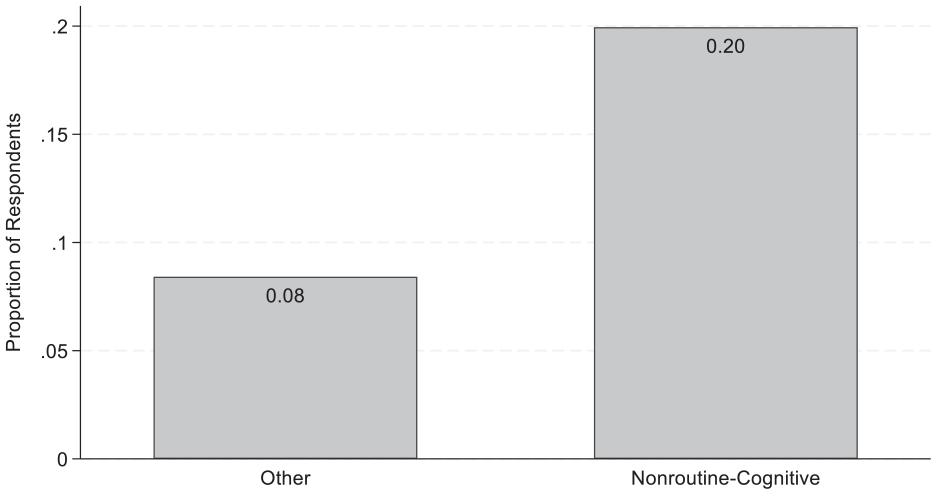
Proportion reporting job was replaced by artificial intelligence by type of occupation.
Figure 2 displays the relationship between the type of occupation and the respondent’s concern about job displacement by AI. As with Figure 1, I compare nonroutine-cognitive occupations with all others to underscore the expectation that AI has a unique relationship with these types of occupations. In this case, the difference is negligible for nonroutine-cognitive occupations compared with other types of occupations (52 percent to 51 percent). These results demonstrate that respondents experience concern regardless of the type of occupation. A χ2 test confirms that the relationship between these variables is trivial or not statistically significant (at p < .05 [two-sided test]).

Proportion reporting concern about job being replaced by artificial intelligence by type of occupation.
In Table 2, I report summary statistics and bivariate correlations for the independent variables that I include in the logistic regression models. For the occupation variables, 38 percent report having an occupation that is categorized as nonroutine-cognitive, 25 percent have routine-cognitive occupations, 16 percent have routine-manual occupations, and 19 percent have nonroutine-manual occupations. Of the bivariate correlation coefficients, nonroutine-cognitive and routine-cognitive occupations exhibit the strongest correlation. These variables are moderately and negatively correlated (−.45). To address potential problems attributable to collinearity, I estimated coefficients for the models with and without these variables. The effects did not differ significantly in models estimated without these variables from those that include them. Therefore, I report the latter in Table 3.
Descriptive Statistics for Independent Variables.

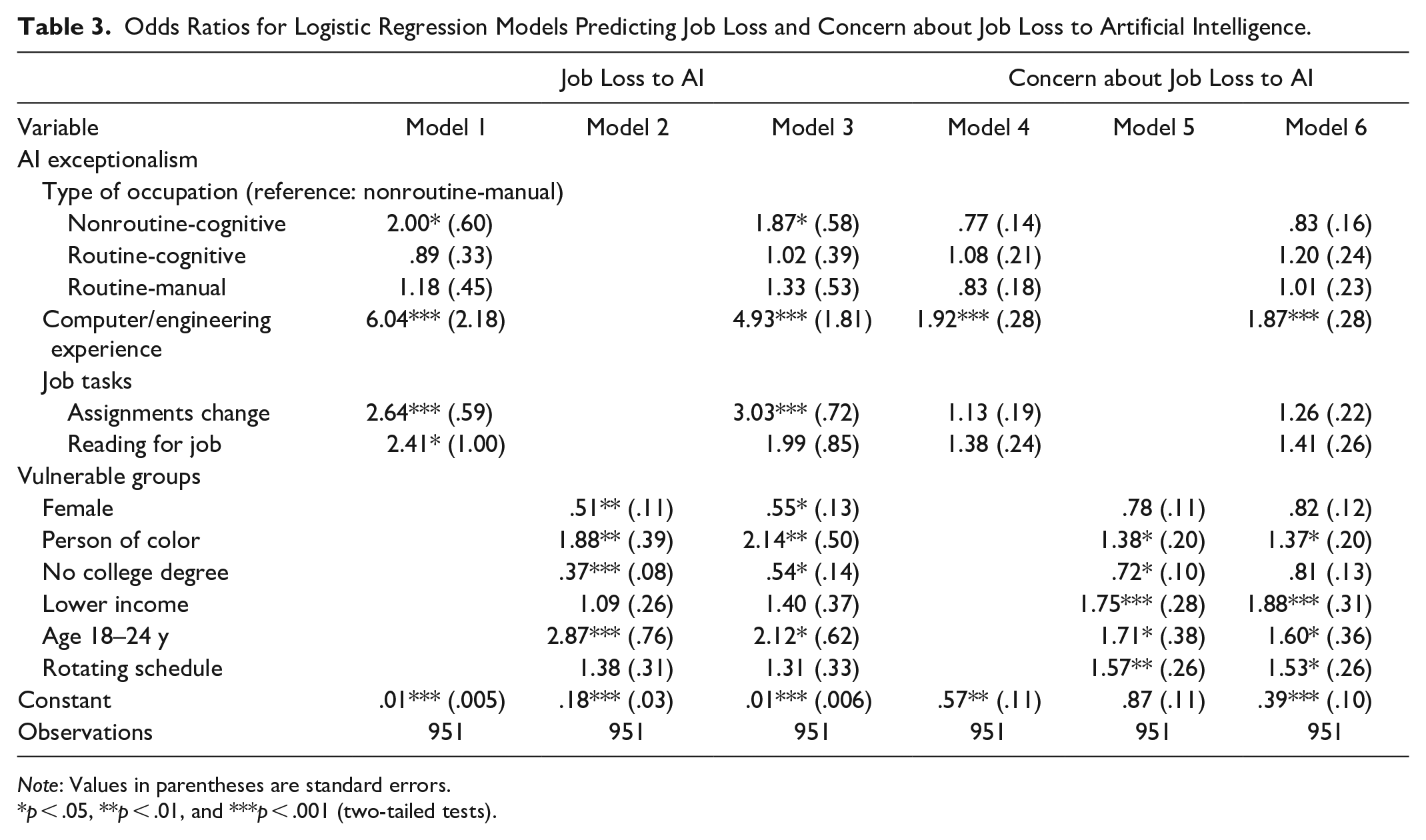
Odds Ratios for Logistic Regression Models Predicting Job Loss and Concern about Job Loss to Artificial Intelligence.
Note: Values in parentheses are standard errors.
p < .05, **p < .01, and ***p < .001 (two-tailed tests).
Table 3 contains the results of the logistic regression models, including the odds ratios, standard errors, and p values for each independent variable. Models 1 through 3 assess the extent to which variables measuring AI exceptionalism and structural inequality are associated with job loss to AI. Consistent with the AI exceptionalism view and controlling for the effects of the other independent variables, working in an occupation that is considered high skill increases the odds of job loss to AI by a factor of 1.87 (model 3). The other statistically significant predictors are positive as well. Of these, the odds ratio for computer or engineering experience is 4.93 (model 3). The magnitude of this effect compared with the others in the model may suggest that prior experience is more strongly associated with past job loss than the current job characteristics represented by the other variables. Model 3 also indicates that respondents that hold jobs with assignments that consistently change increase the odds of job loss by a factor of 3.03.
Of the remaining independent variables, measures that identify social groups disproportionately vulnerable to structural inequalities in the labor market, several have statistically significant effects on job loss. Two of the variables have positive effects, person of color and ages 18 to 24 years, and two others have negative effects, female and no college degree (model 3). The positive effects for person of color and younger employees are not surprising. These groups are more vulnerable to unemployment and job loss with younger employees, on average, having less job tenure than people who are older. The negative effect for females is surprising. But the negative effect indicates that the women in the sample are less likely to find themselves in occupations that are exposed to AI. A post hoc cross tabulation of these data shows that women are less likely than men to have computer or engineering experience, 60 percent to 71 percent (χ2 test significant at p < .05). This result seems to suggest that men have more opportunities, are increasingly “at risk” compared with women. The negative effects for respondents without a college degree, alongside the positive effects for the job and occupation variables, imply that the potential for exposure to AI matters.
In models 4 through 6, I report the effects for the independent variables on whether respondents are concerned about job loss because of AI. Only one of the AI exceptionalism variables is statistically significant, computer and engineering experience. It seems reasonable that this result is due to these respondents’ awareness of AI capabilities or, again, their exposure to or contact with AI systems in the workplace. For the variables indicating structurally vulnerable groups, the odds ratios that are statistically significant are all positive. Being a person of color or a respondent who is less than 25 years old or having a lower income or rotating work schedule predicts whether respondents are concerned about losing their job to AI. Clearly, these respondents feel vulnerable to discriminatory practices so prevalent in the labor market.
Most results from the descriptive and regression analyses support the view advocated by proponents of AI exceptionalism with respect to job loss. It appears these results are attributable to exposure to AI in jobs with these characteristics. Concern over job loss is another matter. Many respondents in the sample are concerned about the prospect of job loss. But respondents who are the most vulnerable to structural inequalities are also the most concerned with job loss. The logics of impartiality that typically accompany data-driven decision-making algorithms do not seem to assuage these respondents’ concerns about AI and the job market.
Discussion and Conclusion
AI’s unique potential lies in its ability to automate nonroutine-cognitive tasks, which have historically been resistant to automation. This presumption provides the backdrop for the AI exceptionalism view. Findings from the present study are suggestive and support the view that AI has a greater impact on the white-collar employees examined here. On average, respondents who report losing their jobs to AI are more likely to come from nonroutine-cognitive occupations and have some technical expertise related to engineering or computers. They have also worked in jobs that were more likely to involve tasks that change regularly. At the very least, these findings support the lite version of AI exceptionalism. That is, AI’s capacity to perform complex tasks, characteristic of white-collar work, is distinctive and its effects are uniquely suited to affect these workers. The potential exists for these novel capabilities to affect employees negatively, which is a departure from conventional views of the impacts of previous waves of automation on employment.
At first glance, it is tempting to conclude these findings provide evidence for the strict view of AI exceptionalism, which is that the potential for AI-powered automation to spell certain doom for white-collar workers. But a caveat is in order. Temporary job loss differs from sustained job loss due to AI. Losing a job, then getting another relatively quickly is a much different proposition than being unable to secure further employment. Given the finding by Acemoglu et al. (2022) that the market for AI jobs is expanding, it seems probable that employees in white-collar jobs with AI-related technical skills are able to find another job relatively quickly. White-collar employees who lost their jobs to AI presumably have the social and cultural capital necessary to find another job and quickly. This supposition would also confirm Goldfarb et al.’s (2020) finding that the information technology industry had the highest percentage of job listings as well as the Pew Research Center report by Kochhar (2023), which found employees in AI-exposed occupations expected AI would help rather than hurt them. Speculation aside, the measures needed to test these nuances of the AI exceptionalism hypothesis are not available in the data I collected for the present study. More research is needed that examines job losses and gains simultaneously and the amount of time needed to secure additional employment. If AI leads to job loss and expansion in this sector, increased employee turnover would not signify a protracted labor market. Instead, this scenario would support the weak version of AI exceptionalism. Employees in these jobs are more likely to be exposed to and use AI are also more likely to find new, similar types of jobs.
Findings from this study also highlight the gap between perception, respondents who are concerned about job loss to AI, and lived experience, those who report losing their job to AI. Of course, neither widespread AI implementation nor resulting social changes are inevitable. As well, a January 6, 2024, blog post by AI expert Ethan Mollick (2024) of the Massachusetts Institute of Technology underscores the time lag between technological advances and their consequences in real time. He wrote, Social change is slower than technological change. We should not expect to see immediate global effects of AI in a major way, no matter how fast its adoption (and it is remarkably fast), yet we certainly will see it sooner than many people think.
What is more, technological capability and whether it is implemented (or consequential) may be decoupled altogether. Social, cultural, technical, and economic conditions foster and restrict the implementation of novel products as much as its technological proficiency (Dahlin 2011, 2019b; Dahlin and Sumsion 2023; Dahlin et al. 2023). In the early 2000s, some proclaimed the Segway would revolutionize the transportation industry. Today, it is not much more than an enjoyable way for tourists to explore places like the National Mall in Washington, D.C. (though we are finally witnessing the increased use of much less expensive personal transportation devices such as electric skateboards and scooters). Innovative products often fall short of expectations. That expectations for technology differ from outcomes is illustrated by the gap between concern about job loss and job loss reported here as well as findings from Dahlin (2022) on the effects of robot technology. Dahlin similarly found that survey respondents overestimated the percent whose jobs were displaced by robots compared with those who experienced job loss to a robot.
Results from regression models examined in this study indicate respondents who are persons of color, have lower incomes, are 18 to 24 years old, and have rotating schedules are more likely to be concerned about job loss to AI. Factors contributing to these results include the structural inequalities experienced by certain social groups in the labor market. Discrimination in employment outcomes because of social status, cultural capital, and precarity result in power asymmetries that negatively affect employees from disadvantaged groups. Research demonstrates clear patterns of explicit and implicit discrimination when decision makers exercise discretion in personnel decisions (Bielby 2012; Castilla 2008; Pager 2003; Rivera 2012; Wilson and McBrier 2005). For that reason, it is unsurprising that members of social groups who are already disproportionately affected by discrimination feel even more vulnerable—given common myths surrounding automation (Munn 2022) and the ever increasing awareness that AI algorithms discriminate against women and people of color (e.g., Benjamin 2019; Noble 2018)—even as these job market fears have yet to materialize, at least for now, for underprivileged employees.
Limitations of this study involve respondents’ subjective evaluations of job loss to AI and the temporal ordering of the independent and dependent variables. First, it is entirely plausible that some respondents inaccurately identified the source of their job loss because of information and power asymmetries between upper management and employees that pervade the workplace. Whereas individuals with computer science or engineering experience are likely to be more cognizant of AI-driven layoffs, others may have attributed their dismissal to AI rather than the mass layoffs that have plagued the technology industry recently (Shapero 2024). Alternatively, if the reasons for firing decisions are not transparent, respondents may be unaware that it was in fact predicated on the company’s investment in AI technologies. Second, the survey questions used for the independent variables ask about characteristics of the respondents’ current job are a proxy for the type of prior job that would have been automated. Ideally, the survey would have asked about the characteristics of the job that was replaced by AI because respondents may have switched to different types of job in response to AI-driven job displacement.
As with most studies, these limitations highlight promising avenues for future research. To improve measurement validity, researchers could triangulate self-reported data with company records, industry reports, or feedback from other organizational employees or superiors. These would provide a more realistic and comprehensive understanding of job loss because of AI. Moreover, the assumption that respondents remain within the same type of job in an expanding job market even after AI replaces their jobs warrants further investigation. A straightforward remedy would be to ask survey questions about the characteristics of the job lost to AI, characteristics of the next or subsequent job, and the amount of time needed to find a new job.
In this era of AI, it is imperative to develop new perspectives to keep pace with these ever evolving technologies and their applications. A promising approach would be a revival of the ecological perspective of careers (Carroll, Haveman, and Swaminathan 1992), which examines the interface between labor markets and individual job mobility. Taking this approach would provide a more comprehensive and accurate picture of the impacts of AI on job loss. First, it would help address findings related to job loss to AI in this study and others that demonstrate the market for AI jobs is expanding. Elsewhere, in an analysis of US metropolitan areas I find that higher levels of industrial robots were positively associated with cognitive-nonroutine occupations (Dahlin 2019a). Although this research examines a different but related technology than the present study (robots vs. AI), taken together, these findings suggest exposure to advanced technologies may reshuffle employees. Job opportunities may expand even while employee turnover increases. Second, given the insights produced by the sociology of work and occupations scholarship about the propensity for labor market stratification, ultimately, underprivileged groups are likely to encounter the negative consequences of innovation (Dahlin et al. 2023). Assuming AI systems continue to expand the purview of workplaces penetrated in the future, managers will be required to exercise discretion about employees who lack the skills to adapt. Under these conditions, job market inequality is prone to increase. Therefore, the impetus for anticipating and understanding the ecology of the labor market for the most vulnerable workers will become even more crucial.
