




Abstract
The author examines the relationship between skin color and educational and labor market outcomes within White, Black, and Hispanic populations in the United States. By analyzing National Longitudinal Survey of Youth 1997 data, the author challenges claims that intraracial inequalities on the basis of skin color match or surpass inequalities among ethnoracial groups. The findings indicate that although a darker skin tone correlates with less favorable outcomes across all ethnoracial groups, disparities along the color continuum within the Black population are less pronounced than those between Blacks and Whites as a whole. For Hispanics, the significance of between- and within-race inequality varies depending on the outcome. These insights remain consistent both in descriptive analysis and after adjusting for socioeconomic origins.
Keywords
Racial stratification in the United States has historically been construed as a system of categorical inequalities among groups whose boundaries are sharply demarcated by common ancestry (e.g., Whites, Blacks, Asians, and others). However, race scholars have long observed that such categorical disparities coexist with a gradational hierarchy rooted in phenotypic traits, with skin color being the most conspicuous. This phenomenon, known as “colorism,” operates through various discriminatory practices that favor individuals with lighter skin and features deemed “European” over their darker skinned counterparts. Consistent with this theory, empirical studies in the United States have repeatedly shown that above and beyond well-documented inequalities among races, darker skin is associated with myriad adverse social outcomes within racial groups, particularly among Blacks and Hispanics. These include lower educational attainment (Branigan et al. 2013; Monk 2014), reduced earnings, income, and wealth (Adames 2023; Goldsmith et al. 2006; Hersch 2006; Monk 2014), a higher incidence of hypertension (Laidley et al. 2019), an increased likelihood of perceived discrimination, and deteriorated mental health (Monk 2015), among other factors.
Building upon this evidence, some scholars argue that a gradational approach to understanding racial inequalities not only complements but potentially surpasses the traditional categorical perspective in relevance (Monk 2022). For instance, Monk (2021) contended that across nearly every outcome that social scientists study with respect to ethnoracial inequality between Blacks and Whites, African Americans are also significantly stratified by skin tone, so much so that intra-racial inequalities along the color line, across a whole host of outcomes, often rival or exceed ethnoracial inequalities between Blacks and Whites as a whole. (p. 86)
Using data from the National Longitudinal Survey of Youth 1997 from 2008 to 2013, in this visualization I challenge the aforementioned claim. I do so by examining the association between skin color, measured when respondents were 24 to 30 years of age, and four educational and labor market outcomes across White, Black, and Hispanic populations in the United States: years of schooling, attainment of a college degree, personal earnings, and family income, measured when respondents were 26 to 33 years of age. The analysis unfolds in two stages. First, using Bayesian regression models, I estimate the expected value of each outcome by skin color within each ethnoracial group. Second, recognizing that associations with skin color originate partly from inherited disadvantages due to race- and color-based discrimination in previous generations (Flores and Telles 2012), I compute the expected value of each outcome by skin color and ethnoracial group, while controlling for socioeconomic origins (parental education, parental income, and family structure) and basic demographics (age and gender) (details on measures and modeling strategy are available in the Supplemental Materials). Figure 1 depicts the results of this analysis.
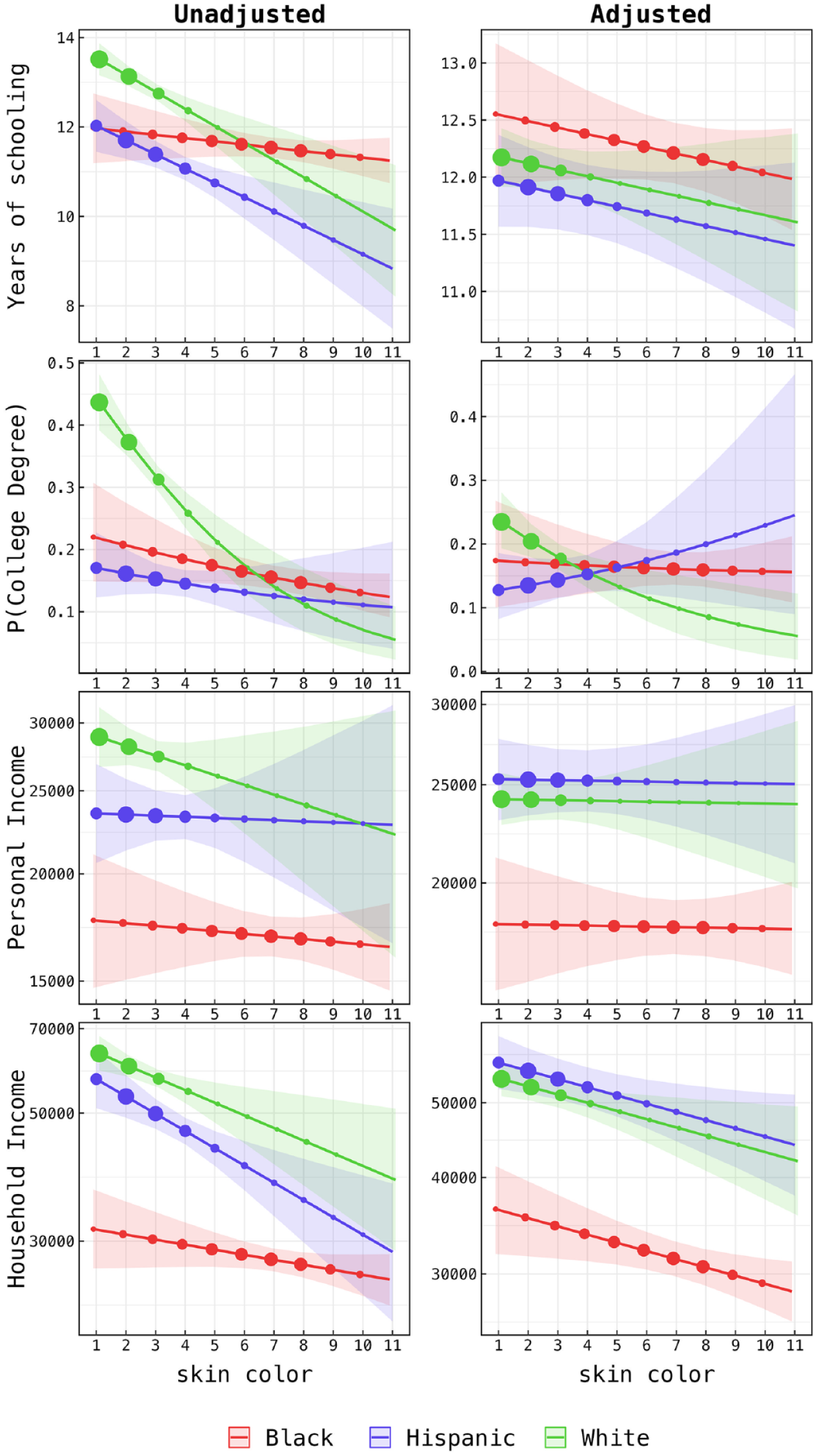
The expected value of each outcome, conditional on the interaction of skin color and ethnoracial group.
The results unveil several important insights. First, the unadjusted analysis shows that darker skin color generally correlates with lower levels of education, a reduced likelihood of attaining a college degree, and lower personal and family income across all ethnoracial groups. However, the extent of this correlation varies significantly among groups. Moreover, variation in the location and amplitude of the color spectrum for each group implies that the “color continuum” carries distinct implications for different ethnoracial groups. For example, whereas the educational and economic outcomes for Whites display a steep decline as skin color shifts from very light to moderately light, the outcomes for Blacks demonstrate a more gradual rate of decline. However, the color spectrum for Blacks is considerably broader, spanning from moderately light to dark, potentially leading to larger gaps between the extremes.
Second, and most important, despite the gradient of skin tones within races, these results indicate that, contrary to previous claims, disparities within the Black population along the color spectrum are smaller than the disparities between Blacks and Whites as a whole. In the case of Hispanics, the relative significance of disparities between and within racial groups varies depending on the specific outcome being examined. Furthermore, the adjusted results suggest that if individuals of different skin colors and ethnoracial groups had similar socioeconomic origins, the average income disparities between the White and Black populations would be significantly larger than the inequality by skin color within Blacks. Only for years of schooling does this analysis suggest that the magnitudes of within- and between-race inequalities are comparable.
Overall, these findings cast doubt on the claim that intraracial inequalities based on skin color gradients equate or exceed categorical inequalities between ethnoracial groups. Although such assertions might be valid in certain areas, such as health (Monk 2015), this is not the case for educational and labor market outcomes. Importantly, these results are derived from a high-quality, nationally representative longitudinal sample of American youth, including one of the most reliable measure of skin color to date within existing surveys (see Abascal and Garcia 2022:354).
Supplemental Material
sj-docx-1-srd-10.1177_23780231241259656 – Supplemental material for Are Within-Racial Group Inequalities by Skin Color Really Greater Than Inequalities Between Racial Groups in the United States?
Supplemental material, sj-docx-1-srd-10.1177_23780231241259656 for Are Within-Racial Group Inequalities by Skin Color Really Greater Than Inequalities Between Racial Groups in the United States? by Mauricio Bucca in Socius
Footnotes
Acknowledgements
I thank Lucas Drouhot for his helpful comments on this work.
Funding
The author(s) disclosed receipt of the following financial support for the research, authorship, and/or publication of this article: This research was supported by the ANID Milenio project Labor Market Mismatch—Causes and Consequences, LM2C2 (grant NCS2022_045).

Supplemental Material
Supplemental material for this article is available online.
Author Biography
References
Supplementary Material
Please find the following supplemental material available below.
For Open Access articles published under a Creative Commons License, all supplemental material carries the same license as the article it is associated with.
For non-Open Access articles published, all supplemental material carries a non-exclusive license, and permission requests for re-use of supplemental material or any part of supplemental material shall be sent directly to the copyright owner as specified in the copyright notice associated with the article.
