




Abstract
Racial disparities in the criminal justice system are striking, but social scientists know little about skin color inequalities within this system. Research demonstrates that racial minorities with darker skin are more disadvantaged than their lighter skinned counterparts. However, scholars often analyze individuals across families without considering that skin color differences also exist within families. I improve on prior studies with an underused, within-family approach using data from the National Longitudinal Study of Adolescent to Adult Health. I first examine the relationship between skin color and being arrested among a male nationally representative sample. Furthermore, to account for mutual unobserved and observed family characteristics, I use sibling fixed effects models to consider whether skin color disparities in arrest outcomes occur between brothers. Even when analyzing family members, I find that having darker skin remains a significant predictor for being arrested.
Introduction
Numerous studies document the persistence of “colorism,” or the preferential treatment of lighter skinned individuals and the corresponding discriminatory treatment of darker skinned people within the same racial group (Walker 1982). Social scientists show that blacks and Latinos with lighter skin are advantaged in the labor market, educational system, and marriage market as compared to their darker skinned counterparts (Arce, Murguia, and Frisbie 1987; Espino and Franz 2002; Hill 2000; Hughes and Hertel 1990; Hunter 1998, 2005; Keith and Herring 1991; Monk 2014). This growing body of literature points to the role of skin color as an important component of racial inequality.
A separate body of work details the racial disparities in the criminal justice system. It is well documented that blacks and Latinos are disproportionally arrested at higher rates than whites (Bureau of Justice Statistics 2015). Researchers agree that an individual’s race can increase the likelihood of being arrested even after accounting for a broad range of related factors such as offense severity and the presence of witnesses (Kochel, Wilson, and Mastrofski 2011). Despite the extensive research on race and the criminal justice system, less scholarship exists on skin color bias in this system. The limited work in this area suggests that individuals with darker skin and Afrocentric facial features receive longer criminal sentences (Blair, Judd, and Chapleau 2004; Burch 2015; Gyimah-Brempong and Price 2006; King and Johnson 2016; Viglione, Hannon, and DeFina 2011). While these few studies focus on the sentencing outcomes of inmates, scholars know even less about the relationship between skin color and an arrest, which is one of the first points of contact in the criminal justice system, even before being sentenced for a crime. The only examination of how skin color is related to an arrest shows that the association is tenuous (White 2015). Given that one must be arrested before they stand trial, are convicted, or are sentenced, it is important to understand how skin color may be consequential for different stages in the criminal justice system.
Although the stratification literature shows that skin color and racial disparities are extensive, researchers typically examine individuals across families and include controls for key background characteristics. However, racial and skin color variations do not just occur across families, they also exist within families. In recognition of this, Telles (2004) suggested an innovative approach by comparing racial differences within the family by comparing siblings. This strategy improves on previous work because it allows researchers to account for observed and unobserved family background characteristics. Although very few studies have used this approach, the limited research on this topic using this strategy reveals that skin color or phenotype is a significant predictor of sibling outcomes in both Brazil and the United States (Francis-Tan 2016; Marteleto and Dondero 2016; Rangel 2015; Ryabov 2016).
The data from the National Longitudinal Study of Adolescent to Adult Health (Add Health) offers a unique way to address the limitations of prior research and build on Telles’s (2004) approach. The existence of a nationally representative sample, a subsample of siblings, and a measure of skin color provides the opportunity to isolate the effects of skin color bias from family background. Because siblings may vary by skin color but share a variety of family characteristics, an analysis of members of the same family innately accounts for unobserved characteristics that siblings have in common. This strategy allows me to reveal the extent to which the likelihood of being arrested is due to the siblings’ different skin colors. Although there are some family features that siblings do not share, I argue that holding constant a myriad of characteristics that siblings do have in common is a more advantageous approach than the typical strategy of stratification researchers. Thus, examining the within-family effects of skin color on arrest reveals whether siblings experience the criminal justice system differently because of the color of their skin.
In this study, I use this underused within-family analytical strategy to address two research aims. My first objective is to evaluate the relationship between skin color and an arrest among black, Latino, Asian American, and Native American men. To do this, I examine whether complexion is predictive for an arrest, controlling for illegal behavior and family background characteristics among a nationally representative sample from Add Health. My second objective is to examine whether within-family arrest outcomes are related to skin color. To address this, I use sibling fixed effects models to consider whether sibling differences in arrest outcomes vary by skin colors. I do this using a subsample of brothers from the Add Health data.
This paper makes several contributions. First, I connect two separate bodies of literature— colorism and racial disparities in the criminal justice system—by documenting the relationship between skin color and an arrest. Unlike other studies that focus on how skin color is consequential for sentencing outcomes, I examine an earlier point time in the criminal justice process. Additionally, previous studies on skin color stratification focus primarily on the experiences of African Americans and to a lesser extent Latinos. Given that previous research shows that skin color affects the outcomes of both Latinos and Asian Americans (Ryabov 2016), in this study, I examine whether skin color matters across multiple racial groups. Finally, I improve on previous studies by better accounting for unobserved differences in family background. No study to date has considered whether sibling differences in skin color influence the likelihood of an arrest. I build on prior work and use both between-family estimates and a within-family fixed effects approach to examine the relationship between skin tone and an adult arrest. In doing so, I provide novel estimates that account for potential confounding factors that vary across families and compare these estimates to nationally representative estimates using both a nationally representative sample of American males and a subsample of male siblings.
Historical Context of Colorism
Skin Color Stratification in the United States: Black Americans
Alice Walker (1982) coined the term colorism to describe the preferential treatment of lighter skinned individuals and the corresponding discriminatory treatment of darker skinned individuals within the same racial group. The origins of colorism or skin color stratification among black Americans is rooted in the legacy of slavery and white supremacy. In the United States, scholars argue that colorism emerged from two main sources: whites’ enslavement of Africans and the forced miscegenation through sexual violence (Hunter 2005; Stevenson 1996). For whites to justify enslaving an entire group of people, they associated blackness with ugliness, evilness, and savageness, and whiteness came to mean the opposite: beauty, goodness, and civility (Hunter 2005). Additionally, forced miscegenation produced a black population with a variety of phenotypes, including skin color, which then came to represent the characteristics that were attached to whiteness and blackness (Hunter 2005). Indeed, historical evidence suggests that white elites considered slaves with a more European appearance to be more aesthetically and intellectually superior and as a result paid a higher price for these types of slaves and preferred them for personal servants (Myrdal 1944). At the time, whites considered slaves with more European ancestry and lighter skin color as less African and thus superior to other blacks (Reuter 1917). Furthermore, slaves with European ancestry were treated better by slave owners and were more desired for skilled and domestic positions (Russell, Wilson, and Hall 2013).
Skin Color Stratification in Latin America
As Hunter (2005:2) asserts, colorism is essential to “the maintenance of white supremacy in [the United States].” I would extend her argument to Latin America, which has parallels to the United States, including their shared history as participants in the trans-Atlantic slave trade. Like the dynamics that were occurring in the United States, in Latin America, Europeans colonized indigenous populations and enslaved Africans, establishing a racial hierarchy. Centuries of miscegenation produced a population with a variety of phenotypes, but instead of eliminating racial inequality, it just formed a hierarchy that used skin color and phenotype as markers of Spanish, indigenous, and African ancestry (Telles 2014).
Skin Color Stratification in Asia
In Asia, there is also a skin color stratification system that affects the distribution of rewards and opportunity by skin color (Hall 2008). However, unlike the United States and Latin American, the import of skin color did not come from slavery but rather from European colonization and class structures dividing the land-owning elite from the peasantry who labored in the sun (Rondilla and Spickard 2007). Although Europeans did not rule all the countries in this region of the world, the link between darker skin and lower socioeconomic backgrounds became embedded in East Asian, South Asian, and Southeast Asian countries (Leong 2006; Rondilla and Spickard 2007). Considering that there is a global preference for lighter skin, it is crucial to understand how skin color is consequential across blacks, Latinos, and Asian/Pacific Islanders (Glenn 2008).
Previous Research on Skin Color Stratification
Numerous studies conducted in the United States show that darker skinned blacks and Latinos are more disadvantaged in the labor market and in terms of educational attainment (Allen, Telles, and Hunger 2000; Arce et al. 1987; Espino and Franz 2002; Gomez 2000; Hill 2000; Hughes and Hertel 1990; Hunter 2002; Keith and Herring 1991; Mason 2004; Monk 2014; Murguia and Telles 1996; Telles and Murguia 1990). Among Latinos, dark skin is associated with lower income (Allen et al. 2000; Telles and Murguia 1990) and occupational prestige (Espino and Franz 2002). Similarly, these trends can be found among African Americans. Darker skinned blacks earn less money (Johnson, Farrell, and Stoloff 1998), are more likely to be in poverty (Bowman, Muhammad, and Ifatunji 2004), and have lower occupational prestige and wealth (Allen et al. 2000; Keith and Herring 1991; Seltzer and Smith 1991).
More recent work demonstrates that skin color stratification persists. For example, research shows that skin tone continues to be significantly associated with black Americans’ household income, occupational status, and educational attainment (Monk 2014). Likewise, skin color is also related to the school-to-work and school-to-college transitions for black male youth (Ryabov 2013). That is, lighter skinned black males are significantly more likely to have secured a job and be enrolled in college than their darker skinned peers.
The majority of skin color stratification research focuses on the experiences of blacks and Latinos with few studies including Asian/Pacific Islanders or Native Americans. In contrast to conventional studies on racial inequality, Bailey, Saperstein, and Penner (2014) use both racial self-identification and perceived skin color to examine household income inequality in Latin America and the United States among several different racial groups. Their findings reveal that models using both measures do the best job of analyzing economic inequality in the United States (Bailey et al. 2014). While these researchers looked at differences across racial groups, including Asian and Native Americans, they focused on only one socioeconomic outcome, household income, and so more research needs to be conducted on how both skin color and race are associated with other types of racial inequality. Another study exceptional for its focus on Asian/Pacific Islanders examines how skin color is associated with educational attainment (Ryabov 2016). This study shows that among Asian/Pacific Islanders and Hispanics, respondents with darker skin tone are less likely to have completed high school and be enrolled in college than their lighter skinned peers (Ryabov 2016). Still, more research needs to be conducted on the extent to which skin color stratification persists in the United States and how this may vary across racial groups and in different aspects of social life.
Race, Skin Color, and Arrest Outcomes
American racial disparities in the criminal justice system are well established, with scholars arguing that discriminatory practices against blacks and Latinos have perpetuated and substantially increased these racial disparities, which Alexander (2010) calls the “New Jim Crow.” In comparison to the numerous studies of racial disparities in arrests (Kochel et al. 2011), research on skin color bias is noticeably absent. My review of the literature identified only one existing study focusing explicitly on skin color and arrest outcomes. White (2015) examines the significance of skin color for black and Latino men and women in a nationally representative sample with mixed results. For example, while she finds that there is a significant bivariate relationship between skin color and an arrest among African Americans, this association is no longer significant after accounting for gender. However, White (2015) finds that among Latinos, women with darker skin tone are significantly more likely to be arrested, whereas males with darker skin are not. The only other studies of skin color and the criminal justice system come from a handful of studies focusing on sentencing outcomes. This work reveals that having darker skin is associated with longer sentences (Blair et al. 2004; Gyimah-Brempong and Price 2006; King and Johnson 2016; Pizzi, Blair, and Judd 2005; Viglione et al. 2011). However, it is still unclear whether skin color may be consequential for an arrest and whether this relationship is similar for Asian Americans or Native Americans.
Racial Perceptions of Criminality
Extensive social psychological research illustrates the prevalence of U.S. stereotypes of blacks as violent, criminal, and subhuman (Allport and Postman 1947; Correll et al. 2002; Devine 1989; Duncan 1976; Goff et al. 2008; Greenwald, Oakes, and Hoffman 2003; Payne 2001; Sagar and Schofield 1980). Those with darker skin are seen as more criminal still (Eberhardt et al. 2004; Maddox and Gray 2002). In contrast, other racial groups are stereotyped much differently, with the link between crime and other racial groups not as clear. For example, Asian Americans are stereotyped both as studious and passive “model minorities” and as “forever foreigners” who are not truly considered American (Ng, Lee, and Pak 2007; Tuan 1999). On the other hand, Native Americans are stereotyped as “noble savages” and drunkards (Freng and Willis-Esqueda 2011). These stereotypes may map on to how they experience the criminal justice system. Very little research has been conducted on Native Americans’ treatment during the sentencing process, but there is evidence that they receive harsher sentences than African Americans, whites, and Latinos (Franklin 2013). Likewise, research shows that Asian Americans receive more lenient sentences as compared to Latinos and blacks (Johnson and Betsinger 2009). Thus, it may be possible that the relationship between skin color and arrest varies across racial groups.
A Within-Family Analysis for the Study of Inequality in the Criminal Justice System
Previous Research on Sibling Outcomes
Stratification scholars have longstanding interests in understanding the role of family background in intergenerational mobility. For example, researchers have analyzed sibling differences regarding health, poverty, neighborhoods, birth order, and weight (Aaronson 1998; Conley and Bennett 2000; Conley, Pfeiffer, and Velez 2007; Edmonds 2006; Fletcher 2010; Haas 2006; Hao and Matsueda 2006; Warren et al. 2012). To do this, researchers employ sibling correlations or within-family analyses to calculate their shared background characteristics. While analyses of siblings are not perfect, as Conley and Glauber (2008:297) argue “they are one of the best measures of the effect of family background . . . because they provide a summative measure of all aspects of family background, including measurable and un-measurable neighborhood, genetic and parental characteristics that siblings share.”
In analyzing siblings, researchers find that almost half of the variance in siblings’ educational outcomes can be associated with their shared family background (Hauser and Wong 1989; Kuo and Hauser 1995). Moreover, almost half of the variance in siblings’ wages are also related to their family background (Mazumder and Levine 2003; Solon et al. 1991). Although we know that siblings are different in many ways, they also vary in phenotype and skin color. Very rarely do studies examine sibling differences in skin color. In recognition of that fact, studies have begun to focus on how skin color differences among siblings also impact their socioeconomic outcomes.
Skin Color Differences within Families
Acknowledging the reality that siblings can vary in both phenotype and racial identification and categorization, Telles (2004) briefly compares the educational outcomes of siblings with different racial identities in his book, Race in Another America: The Significance of Skin Color in Brazil. Here he introduces the idea of leveraging the shared family background of siblings to better understand discrimination. In fact, he argues that this strategy of comparing the outcomes of siblings “[is] a rigorous test of racial discrimination” (Telles 2004:149).
Recently, scholars have turned to using Telles’s (2004) proposed method to examine how differences in siblings’ skin color and race correspond to differences in their socioeconomic outcomes (Francis-Tan 2016; Marteleto and Dondero 2016; Rangel 2015; Ryabov 2016). Studies in Brazil typically use measures of racial categorization, which function as a proxy for skin color. Telles (2004) finds white siblings have better educational outcomes than their nonwhite siblings, that is, they are more likely to be in the age-appropriate grade. Extending these results in their study of twins, Marteleto and Dondero (2016) similarly find that nonwhite twins face significant educational disadvantages. These differences by skin color persist into adulthood. Francis-Tan (2016) finds that darker skinned siblings in Brazil are more disadvantaged than their lighter skinned adult siblings in a variety of ways, with significantly lower educational attainment, employment, occupational status, and income. Likewise, Francis and Tannuri-Pianto (2012) found that white siblings have higher scores on college entrance exams than their nonwhite siblings. However, it is not just that white siblings have better socioeconomic outcomes. Rangel (2015) finds that lighter skinned children are more like to attend private school, which suggests that parents’ investment in their children’s education varies by skin color.
Only one study to the best of my knowledge has explicitly examined how skin color is associated with sibling outcomes in the United States. In studying Latinos and Asian/Pacific Islanders, Ryabov (2016) found that having lighter skin was predictive of higher level of educational attainment. However, it is still unclear how skin color may relate to siblings’ arrest outcomes in the United States, and so this paper contributes to our understanding of this relationship.
Data and Methods
I use restricted-use data from the National Longitudinal Study of Adolescent to Adult Health, a nationally representative sample of adolescents who were in grades 7 through 12 during the 1994–1995 school year (Wave 1). These are the only data available that can be used for these analyses because they come from a large national sample, a sibling sample, and comprehensive longitudinal data on respondents’ delinquency and contact with the criminal justice system during adolescence and young adulthood along with a measure of skin color. Add Health selected participants through a two-stage stratified sampling design for a nationally representative probability sample of approximately 19,000 respondents. Following the original respondents from adolescence into adulthood, Add Health has completed four in-person survey interviews. The key measures from this study are from the Wave 4 adult interviews (2008). I also include measures of respondents’ self-reported race and interviewer-perceived skin color from the Wave 3 young adult interviews (2001–2002). Additionally, I control for information on their adolescent offending behavior from Wave 1, along with other measures of human capital
Samples
I draw on two subsamples to examine the relationship between skin tone and contact with the criminal justice system. The first subsample includes male respondents who identified as Asian American/Pacific Islander, black, Latino, and Native American in Wave 3 and for whom there is nonmissing data for all variables in this analysis. Whereas this larger subsample is from the in-home sample of all male adolescents (N = 1,897), the second subsample is from the Add Health sibling pair data. In Wave 1, Add Health asked respondents if they lived with a sibling, and siblings were subsequently recruited into the sample (Harris et al. 2003). Unlike the nationally representative sample of Add Health, the sibling subsample is not a probability sample (Chantala 2001). I include twins, full siblings, and half-siblings who identified as male and who had nonmissing information for all relevant study variables (N = 610) in the sibling subsample. To address missing cases, I used listwise deletion.
Dependent Variables
To examine the relationship between skin color and arrest outcomes, I draw on men’s response to the question “How many times have you been arrested since your 18th birthday?,” as measured during the Wave 4 in-home survey when respondents were between the ages of 24 and 32. I created a dichotomous variable from responses to this question (0 = no, 1 = yes), indicating whether a respondent has ever been arrested in adulthood.
Independent Variables
Interviewer-perceived skin color
My primary independent variable is interviewer-reported skin color, as recorded at the end of the Wave 3 survey when respondents were between the ages of 18 and 26. The categories for skin color included “black,” “dark brown,” “medium brown,” “light brown,” and “white.” I coded this continuous variable as a scale with a range from 1 (white) to 5 (black). Numerous scholars have used this Add Health measure to examine how skin color is related to differential experiences within racial groups (Ryabov 2016; Saperstein, Penner, and Kizer 2014; White 2015).
Self-reported race
To ensure that my skin color findings are not driven by differences across race groups, I include self-reported race in Wave 3 in my analyses. The categories for race included “black or African American,” “American Indian or Native American,” “White,” and “Asian or Pacific Islander.” If respondents gave more than one response to this question, I used the category that they indicated best described their racial background, which Add Health asked in a subsequent question. In addition, the survey asked respondents a separate question about their Hispanic or Latino origin. I coded respondents as Latino if they responded with a yes to that question, regardless of the race they put down. I excluded respondents who identified white as their primary or best from my analyses.
Delinquency
I used the 15-item delinquency scale from Wave 1 of Add Health. 1 Including this index as a control ensures that their prior offending behavior occurred before the adult arrest and establishes that the relationship between skin color and an adult arrest is not related to their prior offending behavior. Scholars have used these items to measure adolescent delinquency in previous studies (Sieving et al. 2001; White 2015)
Additional controls
Wave 3 interviewer race is an important control because prior research shows that it may affect how interviewers perceive and code skin color (Hannon and DeFina 2014; Hill 2002). Possible races included “white,” “African-American,” “Asian/Pacific Islander,” “American Indian/Alaska Native,” or “other” and whether the interviewer identified as Hispanic. Finally, although marital and employment status, educational attainment, and parental education are not visible to police officers when they are deciding to make an arrest, research suggests that these attributes influence offending behavior (Lochner 2004; Meghir, Palme, and Schnabel 2012; Skardhamar et al. 2015). Thus, I account for these demographic characteristics to establish that the observed relationship between skin color and an adult arrest does not result from other factors related to illegal behavior. Controls include age, nativity, marital status, and employment status, all coded as indicator variables for respondent’s year of birth, being born in the United States, being married, and currently working for pay for at least 10 hours per week. I also include controls for respondents’ educational attainment and the respondents’ resident mother’s education, measured as years of schooling completed.
Analytic Approach
To examine the relationship between skin tone and criminal justice outcomes, I estimate a series of a linear probability models predicting arrest with an indicator of skin tone. 2 I first estimate the probability of an adult arrest for the nationally representative sample of Asian Americans, blacks, Latinos, and Native Americans males. Estimating this relationship at the population level allows me to determine whether complexion is predictive for men’s arrests in adulthood. To account for the complex design features of the Add Health sampling structure, I use the SVY command in Stata version 14. Second, I investigate whether brothers’ skin color is related to their likelihood of being arrested in adulthood using family fixed effects, which allows me to compare siblings while holding family environment constant. Intuitively, these models can be thought of as comparing respondents to their siblings (as opposed to comparing them to all others in the sample) and then averaging these sibling comparisons across the population. 3 In each of my models, I control for the race of the interviewer, prior illegal behavior, and age and other measures of human capital. By predicting the likelihood of an adult arrest in Wave 4 while controlling these variables, I ensure that the relationship between complexion and contact with the criminal justice system is not due to a possible relationship between skin tone and other possible characteristics.
Results
Table 1 shows how much variation there is in skin color across racial groups. For instance, in the larger national sample, there is quite a bit of variation within each racial group. As we can see, among Asian/Pacific Islanders, almost half are coded as having light brown skin, almost 30 percent coded as having white skin, almost 20 percent has having medium brown skin, and only 4 percent as having dark brown skin. There is also substantial variation for African Americans and Latinos. For blacks, the majority of respondents are in three groups, with almost 30 percent of respondents coded into medium brown, dark brown, and black. Almost 10 percent of black Americans were coded as having light brown skin. For Latinos, almost half were coded as white, 35 percent as light brown, 12.2 percent as medium brown, and 2.49 percentas dark brown. Finally, among Native Americans, 39 percent were coded as white, 24.39 percent as light brown, and 24.39 percentas medium brown.
Skin Color by Race.

Note. — indicates cells containing fewer than 10 cases.
Source. National Longitudinal Study of Adolescent to Adult Health.
Among the sibling sample, there is also variation in skin color. Among Asian Pacific/Islanders, 30.34 percent are coded as white, 48.31 percent as light brown, and 17.98 percent as medium brown. Among blacks, 28.67 percent are coded as medium brown, 30.07 percent as dark brown, 32.17 percent as black, and 8.74 percent as light brown. Finally, for Latinos, 40 percent were coded as white, 40 percent as light brown, and 15 percent as medium brown.
In Table 2, I compare the national sample and the sibling sample and find that they are similar across all measures. For example, about 24 percent of men across the national sample and the sibling sample have been arrested in adulthood by Wave 4. Likewise, respondents in both samples have equivalent levels of prior delinquent behavior, with an average of 5.03 and 5.07 in the national and sibling sample, respectively.
Descriptive Statistics.
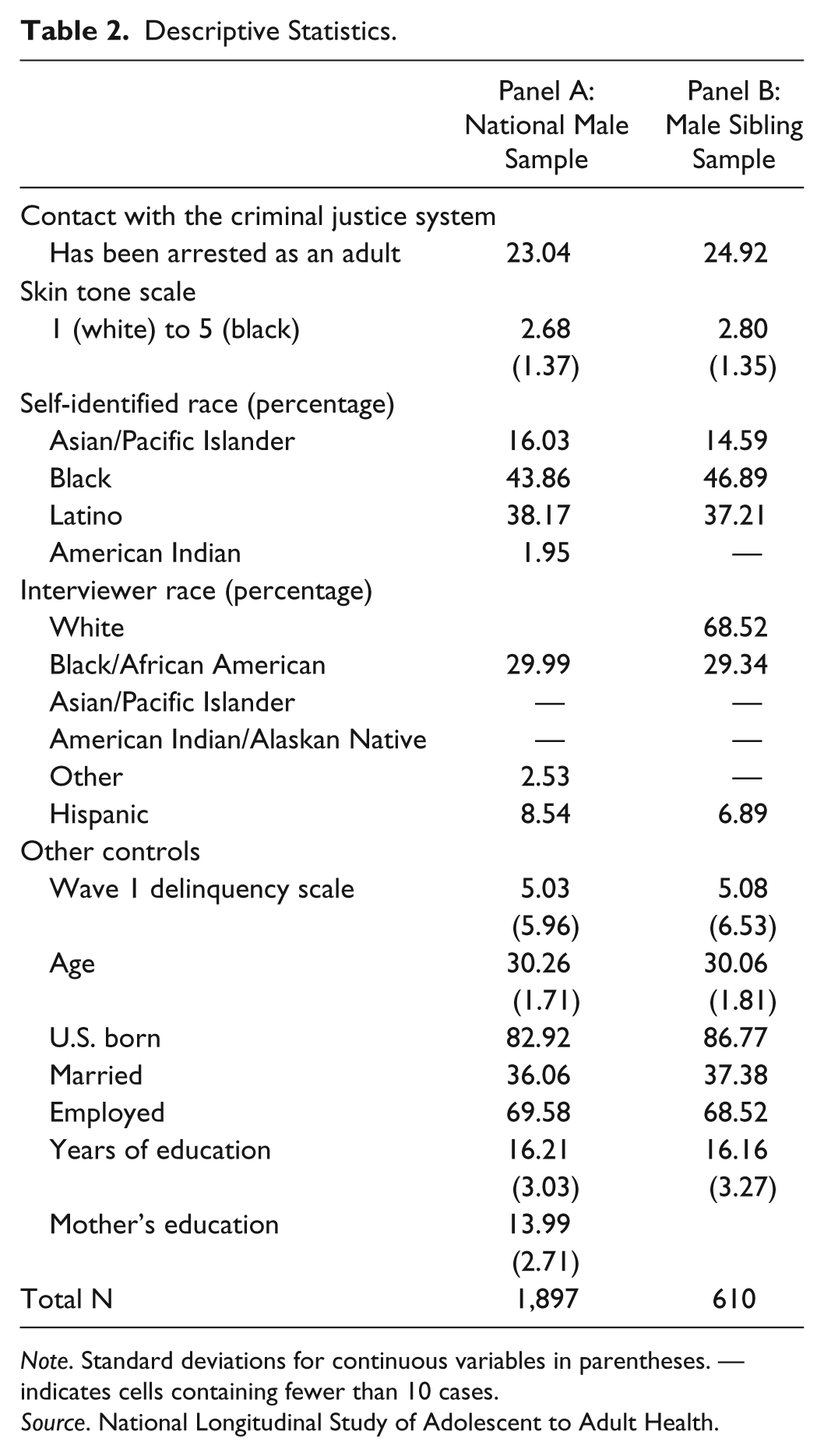
Note. Standard deviations for continuous variables in parentheses. — indicates cells containing fewer than 10 cases.
Source. National Longitudinal Study of Adolescent to Adult Health.
Table 3 presents ordinary least squares regression models investigating experiencing an adult arrest. I find that men with darker skin are more likely to be arrested in adulthood, even after controlling for the individuals’ age, self-identified race, race of the interviewer, and prior offending behavior. These results are consistent with and expand previous findings (White 2015). Unsurprisingly, prior offending behavior is a significant predictor of being arrested in adulthood; however, it does not completely account for skin color differences in arrest rates. Overall, I find that a one-unit increase in skin tone (on the 5-point scale) increases the probability of an arrest by .038. Interestingly, the magnitude of the relationship increases from Model 1 to Model 5, indicating that once prior delinquency, age, and race of both the respondent and the interviewer are accounted for, the association between skin tone and an adult arrest is larger and more statistically significant.
Results from Ordinary Least Squares Regression, Adult Arrest among the Male National Sample (N = 1,897).

Note. Standard errors are in parentheses. Analyses are weighted to account for National Longitudinal Study of Adolescent to Adult Health’s complex design.
p < .05. **p < .01. ***p < .001 (two-tailed tests).
In Table 4, I turn to examining the sibling sample, and I contrast it with the results from the national sample. Like the estimates from Table 3, models from the sibling sample include controls for interviewer race, prior delinquency, respondent race, and age. In Model 2, estimates of the relationship between skin color and adult arrest between families show that the coefficient for skin color remains positive and significant, although it is smaller than the nationally representative sample. Like the findings from the national sample, the between-family estimates show that a one-unit increase in skin tone increases the probability of an arrest by .043. After including family fixed effects, which accounts for unobserved family characteristics, the association between skin color and arrest is substantially stronger. The coefficient indicates that a one-unit increase in skin tone increases the likelihood of an adult arrest by .115. This indicates that darker skinned brothers are more likely to be arrested in adulthood than their lighter skinned brothers and that interestingly, after including the family fixed effects, juvenile delinquency is no longer a statistically significant predictor of experiencing an adult arrest. This suggests that levels of prior offending behavior are similar among brothers and that differences in the arrest rates are driven more by discrimination than their actual behavior.
Among the Male National and Sibling Sample Predicting an Adult Arrest Using Ordinary Least Squares Regression.

Note. Standard errors are in parentheses. Analyses are weighted to account for National Longitudinal Study of Adolescent to Adult Health’s complex design.
p < .05. **p < .01. ***p < .001 (two-tailed tests).
Discussion and Conclusion
Although previous studies on skin color stratification and the criminal justice system show that skin color is related to sentencing outcomes, researchers know very little about how skin color is related to arrests (Barlow and Barlow 2002; Burch 2015; Gyimah-Brempong and Price 2006; King and Johnson 2016; Pizzi et al. 2005; Viglione et al. 2011; White 2015). In this study, I consider whether skin color is a significant predictor of an adult arrest. Contrary to previous research (White 2015), I find that net of observed human capital and prior illegal behavior, skin color is significantly associated with being arrested among black, Latino, Asian American, and Native American men. Being arrested is an increasingly common event in the United States, with the prevalence of an arrest rising over the past 40 years (Brame et al. 2014). By age 23, almost half of black men and 44 percent of Hispanic men have been arrested, compared to 38 percent of white men (Brame et al. 2014). While the research on skin color stratification and the criminal justice system has focused primarily on sentencing outcomes, an arrest is a much earlier stage in the process. My research shows that skin color is consequential from the beginning of the criminal justice process. As Kochel et al. (2011:498) astutely note, “Because of the interconnectedness of decisions made in the criminal justice system, even small racial differences that occur at many points in the criminal justice process will compound and produce profound effects further along in the system.” My findings suggest that the biases leading to skin color disparities in criminal sentencing did not begin there but in fact started much earlier at the first point of contact. Thus, it is important for future research to examine how complexion impacts criminal justice outcomes at multiple points in the process.
To my knowledge, this is the only study that uses within-family estimates to examine the relationship between skin color and arrest outcomes. I improve on previous studies examining the relationship between police contact and complexion by leveraging a sample of siblings to better capture family background. In doing so, I show that there are significant disparities by skin color in the likelihood of being arrested that are unexplained by both previous illegal behavior and observed human capital. Furthermore, I find that the relationship between skin color and an arrest is greater in size when examining members of the same family than when comparing people across the population, suggesting suppression effects.
Although I am unable to determine the suppression mechanism, recent evidence from qualitative research suggests that family processes may be an important factor to consider. Moreover, qualitative research provides additional evidence showing that skin color affects parent-child relationships, which suggests that may be an important factor to consider. For example, ethnographic work on Afro-Brazilian families shows that children with light skin and more European features received preferential treatment over those who were darker skinned, which in turn compromised parent-child relationships (Hordge-Freeman 2015). Likewise, in the United States, Landor et al. (2013) found that black families exhibited preferential treatment toward offspring based on the complexion and gender of the child. Specifically, darker skinned sons received higher quality parenting than lighter skinned sons. On the other hand, daughters with lighter skin acquired higher quality parenting than girls with darker skin. Future research should examine family processes as a potentially important factor when examining the relationship between skin color and sibling outcomes.
Furthermore, my findings also highlight the need to include measures of skin color, whenever possible, when conducting research on racial disparities in the criminal justice contact. While there is a large body of literature showing that there are significant racial inequalities, my study along with others demonstrates that even within racial groups, the experiences of racial minorities within the criminal justice system vary by skin color. Thus, my findings suggest that both racial and skin color bias operate jointly in the criminal justice system to disadvantage racial minorities and darker skinned minorities. Incorporating measures of skin tone along with race will allow researchers to better examine the differential treatment individuals experience in the criminal justice institution.
In contrast to previous studies focusing on how skin color stratification exists for blacks and Latinos, my study includes Asian/Pacific Islanders and Native Americans. Research on skin color bias among these groups is limited, and more studies are needed to understand how phenotype affects their experiences within different institutions. Although I did not find that the relationship between skin tone and being arrested varied across race, it is likely that I did not have enough statistical power to uncover this relationship due to the small sample sizes of both Asian/Pacific Islanders and Native Americans. Future examinations of skin color and criminal justice outcomes should include these populations and consider how skin color stratification varies by race, which would contribute to our understanding of this process.
Although this study contributes to the literature on skin color stratification and the arrest, there is still much more that we do not know. Future research should strive to better understand the different factors that may mediate the relationship I have described in this study. Additionally, the mechanism linking complexion to arrest outcomes remains unclear. Although the social psychological literature reveals the skin color bias that exists in people’s minds, more research needs to be conducted in real-world settings with additional information on the context of the arrest to understand how these biases impact on the ground behavior.
Footnotes
Appendix
Complete List of Delinquency Scale Questions from In-home Questionnaire Codebook Section 29.

| Possible responses for all questions: Never 1 or 2 times 3 or 4 times 5 or more times 1. In the past 12 months, how often did you paint graffiti or signs on someone else’s property or in a public place? 2. In the past 12 months, how often did you deliberately damage property that didn’t belong to you? |
| 3. In the past 12 months, how often did you lie to your parents or guardians about where you had been or whom you were with? 4. In the past 12 months, how often did you take something from a store without paying for it? 5. How often did you get into a serious physical fight? 6. How often did you hurt someone badly enough to need bandages or care from a doctor or nurse? 7. How often did you run away from home? 8. How often did you drive a car without its owner’s permission? 9. In the past 12 months, how often did you steal something worth more than $50? 10. How often did you go into a house or building to steal something? 11. How often did you use or threaten to use a weapon to get something from someone? 12. How often did you sell or marijuana or other drugs? 13. How often did you steal something worth less than $50? 14. In the past 12 months, how often did you take part in a fight where a group of your friends was against another group? 15. How often were you loud, rowdy, or unruly in a public place? |
Acknowledgements
I am grateful to Andrew M. Penner, Cynthia Feliciano, Yader R. Lanuza, Angela Fillingim, Ann Hironaka, the members of her Race Research Workshop, and the anonymous reviewers for their insightful feedback. I also thank audience members at presentations of this work at the Population Association of American annual meetings and the Add Health Users Conference for helpful feedback. I owe a special thank you to Elbert Smith, Jr. for research assistance.