




Abstract
By combining research on banal and unconscious nationalism with cognitive psychology, this article outlines a novel framework for so-called “implicit nationalism.” In the first part of the article, I detail how different events, symbols, and discourses affect nationalist attitudes and sentiments beyond conscious awareness and control. I argue that certain events and symbols affect implicit—but not necessarily explicit—nationalism by changing the accessibility of implicit nationalist associations. In the second part of the article, I use this framework to analyze the 2014 FIFA World Cup. The study consists of a natural experiment, including respondents from Germany, Brazil, and the United Kingdom. Winning the World Cup increased implicit nationalism in Germany, and losing decreased implicit nationalism in Brazil and the United Kingdom. Importantly, winning and losing had no corresponding effect on explicit nationalism in any country. The article concludes by discussing the implications for research on nationalism and implicit cognitions.
Keywords
Social scientists have long been interested in the different ways a nation and national identity is reproduced (e.g., Anderson 1983; Billig, 1995; Brubaker 1996; Gellner 1983). Although many have traditionally focused on economic and physical power, several scholars have also detailed more subtle, symbolic reproductions of the nation-state. Bourdieu (1994:9), for example, argued that the state is the “site par excellence of the concentration and exercise of symbolic power.” The state uses this power to create a certain national identity, imbuing it with specific traits and attributes. Billig (1995) similarly argued that nation-states (and their citizens) use different symbols and institutions to reproduce nationalism and national identity. By focusing on the role of flags, idioms, and sports events, Billig tried to show how this reproduction takes place.
Neither Bourdieu (1994) nor Billig (1995) viewed this type of nationalism as necessarily explicit or extreme. Politicians and citizens alike reproduce the nation by automatically internalizing, performing, and reenacting a certain type of nationalism and national identity. Billig (1995) described these mundane and habitual reproductions as a form of banal nationalism, arguing that a lack of explicit nationalism should not be confused with a lack of nationalism. Although Germans, for example, may be averse to expressing nationalist sentiments, Germany is not devoid of nationalism. A nation-state might, in fact, be at its weakest when having to explicitly enforce the symbolic order, such as during “unsettled periods” of nationalism (cf. Bonikowski 2017b).
Subsequent research on banal and everyday nationalism (Skey and Antonsich 2017) has outlined how specific events, discourses, and symbols help reproduce the nation and nationalism. This work has almost exclusively been qualitative (Skey 2017b), leaving us with a limited understanding of the cognitive mechanism underpinning this reproduction. Although we know that exposure to national events, symbols, and discourses can reproduce nationalist attitudes and beliefs (Kemmelmeier and Winter 2008), we do not know how this reproduction takes place.
The current article argues that research on implicit cognitions can shed light on this cognitive mechanism. Throughout the article, I attempt to outline a framework that bridges the gap between banal nationalism and research on implicit cognitions, suggesting that implicit measures can be used to (partially) measure more automatic and less conscious forms of nationalism (cf. Skey 2017b). I further suggest that different events, discourses, and symbols activate nationalist attitudes via an increase in implicit—but not necessarily explicit—nationalist attitudes.
After outlining the theoretical framework, it is used to analyze a specific natural experiment: the 2014 FIFA World Cup. By including respondents from Germany, Brazil, and the United Kingdom, the current study looks at whether success or failure during the event affected implicit and explicit nationalist attitudes. The article thereby directly tests the effect of a certain national event on implicit nationalism. The article marks one of the first comprehensive studies of implicit nationalism and is, to the best of my knowledge, the first natural experiment using implicit measures to study nationalism.
Theoretical Background
Banal Nationalism
In Banal Nationalism, Billig (1995) attempted to show how the nation-state is reproduced through everyday conversations, habits, and symbols. He showed how flags during sporting events, symbols on currency, and even idioms can be used to remind us of our nation and national belonging. These subtle reminders are often perceived as unimportant, but they both activate nationalist sentiments and imbue these sentiments with meaning. We might cheer for a national team during sports events, but we also cheer for a team representing a flag and a nation. The team’s success and attributes will, to an extent, become intertwined with both the flag and the nation it represents. This banal reproduction is often unnoticed and habitual, 1 forming a type of implicit and largely subliminal nationalism (Duchesne 2018; Hearn and Antonsich 2018).
Billig (1995) argued that banal expressions of nationalism are not benign. Although rooting for the national team might seem harmless, these nationalist sentiments help strengthen a nation’s cohesion and symbolic power. 2 They create a resource (e.g., sentiments and beliefs) that can be reaped during more “unsettled times” (Bonikowski 2016), such as during natural disasters, terror attacks, or even wars. 3 In this sense, banal nationalism can be regarded as a type of “rehearsal” (Billig 1995:125) for more explicit and extreme forms of nationalism.
Since the publication of Banal Nationalism (Billig 1995), several studies have focused on different types of banal and everyday nationalism (Skey and Antonsich 2017). Whereas Billig (1995) focused on top-down expressions of nationalism, subsequent research has shown how individuals embody, produce, and reproduce different nationalist sentiments and beliefs (Fox and Miller-Idriss 2008). We do not only read a newspaper story: We discuss, categorize, and particularize what we read. We situate new knowledge and experiences within an existing but malleable nation-centric framework. Although the nation-state might be the “site par excellence” for meaning-making (Bourdieu 1994:9), nationalist frames and narratives also depend on everyday conversations, events, and contextual constraints.
Implicit Nationalism: A Cognitivist Framework
Research on banal nationalism has mainly been confined to qualitative and often ethnographic work despite calls for more surveys (Bonikowski 2016) and experiments 4 (Skey 2017b). Even fewer studies have attempted to connect research on banal nationalism with cognitive sociology and psychology, and the lack of cross-fertilization has left several unanswered questions. How can different events, symbols, and narratives affect nationalist sentiments beyond conscious awareness and control, and can we measure these less conscious forms of nationalism? 5
To answer these questions, this article draws from research on implicit associations and dual-process models. Similar to research on banal nationalism, I suggest that nationalist symbols, events, and narratives can affect nationalist sentiments beyond either conscious awareness or control. I specifically argue that they affect nationalist sentiments by activating different types of implicit associations. 6 In the following section, I provide a short overview of implicit associations, how they are formed, and how they may transform into nationalist sentiments.
Implicit associations
Implicit associations consist of different sentiments and beliefs and generally come in the form of an attitude or a stereotype (Greenwald and Krieger 2006). An implicit attitude refers to an association between a certain object and a sentiment, whereas an implicit stereotype refers to an association between an object and a specific trait or attribute. Implicit attitudes and stereotypes tend to overlap, with most traits and attributes being coupled with either a positive or negative sentiment (Kurdi et al. 2019).
The key difference between explicit attitudes and implicit associations lies in our awareness, automaticity, and control, where implicit associations are more automatic and less subject to introspection. Implicit attitudes and beliefs has therefore been described as spontaneous (and often affective) gut reactions (Hahn and Goedderz 2020). Implicit associations—like most gut reactions—are not wholly unconscious, with a host of research showing that we can gain introspective access to both their source, content, and effect (Goedderz and Hahn 2022). The same line of research does, however, show that we tend to be unaware of our implicit associations unless we specifically pay attention to them. Implicit associations are thus best described as neither conscious nor unconscious but, rather, preconscious. Although we can gain introspective access to them, we often do not, and gaining introspective access to one dimension (e.g., the content of an association) does not guarantee access to other dimensions (e.g., the source of this association; Lizardo 2022).
Implicit associations have been linked to many types of explicit attitudes and behaviors, such as racial bias (Nosek et al. 2007), discrimination (Rudman and Ashmore 2007), and support of right-wing populism (Bos, Sheets, and Boomgaarden 2018). Implicit associations tend to have higher predictive validity than explicit attitudes for certain types of behavior, such as more automatic actions, and under certain conditions, such as during times of stress and cognitive load (Friese, Hofmann, and Wänke 2008). Changes in implicit associations can directly influence related attitudes and behavior but potentially also indirectly by increasing the resonance between a certain frame and attitude (Olsson 2023b).
Implicit associations are formed when two or more concepts co-occur, and repeated co-occurrence strengthens the association (De Houwer, Thomas, and Baeyens 2001). Repeated exposure to, for example, “quirky Englishmen” (Bourdieu 1994) will create an association between “English” and “quirky.” Once an association is formed, being exposed to the concept English will increase the likelihood of activating the concept quirky and vice versa. If the association is sufficiently strong, we might think of quirky whenever we encounter an English person and think of an English person whenever we imagine someone quirky (De Houwer et al. 2001).
Implicit associations and nationalism
People will, over time, internalize a number of implicit associations related to the nation, national symbols, and national identity. A nation may become associated with positive feelings, a sense of superiority, or any other sentiment and attribute. Being exposed to a reminder of the nation, such as a flag, an idiom, or an event, can both strengthen and activate these associated concepts (Carter, Ferguson, and Hassin 2011b; Hassin et al. 2009). Seeing a flag during a successful sports event will strengthen the association between national symbols and the attribute “successful.” If the association becomes sufficiently strong, exposure to the flag in other contexts (e.g., during a political speech) may also activate a feeling of national success or superiority. Associations formed in one context, such as during a sports event, can thus affect how we perceive the nation and its representatives in other contexts.
Some implicit associations thereby come to form a type of implicit or automatic nationalism (Hassin et al. 2009). In line with existing research on implicit cognitions, I define implicit nationalism as any implicit association between a positive sentiment, trait, or attribute and a nation. 7 Implicit nationalism consists of positive associations directly related to the nation and national identity but also of associations related to, for example, national symbols and representatives. Analogous to other implicit cognitions, implicit nationalism can take the form of both implicit nationalist attitudes (e.g., “England” + “Positive”) and nationalist stereotypes (e.g., “England” + “Superior”) and can be described as a form of preconscious, spontaneous gut reaction. Unlike explicit nationalism, these spontaneous gut reactions may operate beyond conscious awareness and become consciously accessible only when we (or someone else) direct our attention toward them. 8
Exposure to nationalist symbols, idioms, and discourses can be both subliminal and explicit, with certain exposure being so brief or normalized that it evades our attention (Hassin et al. 2007). We might pay attention to someone singing the national anthem but not to the unwaved flag hanging outside of a public building. 9 We might similarly perceive certain rhetoric as nationalistic and potentially dangerous (e.g., “We are a superior nation”) while perceiving other expressions as harmless (e.g., “We are a tolerant people”). Both subliminal and conscious exposure can, however, activate and strengthen implicit associations beyond conscious awareness and control (Hassin et al. 2009). 10 Both the national anthem and the unwaved flag can activate nationalist associations, and both the portrayal of a nation as superior and as tolerant can strengthen the association between the nation and positive attributes.
Implicit and explicit nationalism
Implicit nationalistic attitudes and stereotypes will often overlap with explicit attitudes (Charlesworth and Banaji 2019): A person who is explicitly nationalistic tends to be implicitly nationalistic and vice versa. It is, however, possible to harbor implicit nationalist attitudes and stereotypes while rejecting explicit nationalism (Charlesworth et al. 2022). Some people may thus report low levels of explicit nationalism while exhibiting relatively high levels of implicit nationalism.
Certain events will similarly affect implicit but not explicit attitudes (Olsson 2023b), resulting in even larger disconnects between implicit and explicit nationalism. Exposure to national flags during celebrations might not increase explicit nationalism, but the co-occurrence of national symbols and celebrations will likely increase implicit nationalism irrespective of explicit nationalism. The disconnect will be particularly substantial if respondents perceive nationalism as socially undesirable (Greenwald, McGhee, and Schwartz 1998). Respondents in Germany may be unwilling to report (or oblivious of) an increase in nationalist attitudes but still show an increase in implicitly measured nationalism. National Day celebrations or international sports events can thereby, at least temporarily, increase implicit nationalist associations without affecting explicitly measured nationalism.
Variations in implicit nationalism
Implicit associations toward a concept vary between different contexts and languages (Soriano and Valenzuela 2009): Implicit nationalism will thus consist of different associations in, for example, Germany compared to the United Kingdom. Germans might primarily associate their nation with success in sports and the economy, whereas British people might associate their nation with historical accomplishments and power (Becker et al. 2017). The specific content of implicit nationalism and national identity changes over time depending on political, discursive, and institutional conditions (Carter et al. 2020).
The content of implicit nationalism will also, similar to explicit nationalism (Bonikowski and DiMaggio 2016), vary within a country (Sibley, Liu, and Khan 2010). Some Americans might primarily associate the United States with liberty and freedom, whereas others associate it with Christianity and whiteness (Devos and Banaji 2005; Jacobs and Theiss-Morse 2013). People within a nation will therefore react differently when exposed to a certain nationalist symbol or event; it will activate specific nationalist attitudes and beliefs for some but not others (cf. Billig 2009; Skey 2009).
Individuals can thus internalize different nationalist attitudes and stereotypes over time, and these attitudes and stereotypes vary both within and between nations. Will implicit nationalism similarly vary within an individual, or is it a “chronically activated” (Bonikowski and DiMaggio 2016:975) and stable trait? 11 Research on implicit cognitions (Payne, Vuletich, and Lundberg 2017) shows that individuals internalize a host of different associations toward the same concept. An individual may thereby associate their nation with both pride and success and shame and failure. Whether the nation evokes pride or shame depends on concept accessibility. Concept accessibility refers to “the readiness with which information can be retrieved and used in cognitive processing” (Payne et al. 2017:235). The more cognitively accessible an association is, the more likely it is to be activated.
Concept accessibility can be caused by both chronic and contextual factors, but variations within an individual primarily depend on contextual and situational factors (Gawronski, Brownstein, and Madva 2022). Some contexts will increase implicit nationalism, whereas other contexts will decrease it. Germans might feel shame when reminded of their history but pride when reminded of their success in sports or the economy. The activation and strength of implicit nationalism can thus vary significantly between different contexts. 12 Implicit nationalism may differ in this sense from explicit nationalism, which is often described as relatively chronic and trait-like (but see Bonikowski and DiMaggio 2016).
The importance of implicit nationalism
Previous attempts to conceptualize more automatic and less conscious forms of nationalism have sometimes been criticized for detailing something potentially trivial and outdated (see e.g., Beck 2002). Implicit nationalism might increase following a football game or national event, but will these sentiments and beliefs have any real-world impact beyond the event itself? Billig (1995) argued that explicit nationalism is dependent on more unconscious, banal nationalism, claiming that more extreme forms of nationalism are made possible by, for example, sports events. He did not, however, provide any real evidence of this link (Calhoun 2017).
A framework relying on implicit cognitions can help alleviate this “evidence problem” (Fox 2016:27). Although implicit associations and explicit attitudes are generally considered distinct constructs, 13 considerable research within psychology has found that implicit attitudes both mediate and moderate the link between explicit attitudes and behavior. Implicit associations can predict discriminatory (Rooth 2010) and political behavior (Bos et al. 2018; Schmuck and Matthes 2018) above and beyond explicit measures, but they can also explain why emotions (Weber et al. 2020) and explicit attitudes (Schmuck and Matthes 2018) turn into certain behavior. Previous studies have, for example, found a relationship between implicitly activated nationalism and prejudice (Hassin et al. 2009), system justification (Carter et al. 2011), and voting preference (Carter et al. 2011). Although few of these studies have been longitudinal, Carter et al. (2011) found that the effect of exposure to nationalist symbols could last for several months. 14 Other strands of research within psychology have similarly linked implicit national identity—that is, the implicit association between a nation and different groups—to political participation (Yogeeswaran et al. 2023), context diversity (Sadler, Somos, and Devos 2020), and discrimination (Yogeeswaran and Dasgupta 2010).
Applying the Framework: The 2014 World Cup
This article has so far outlined a more cognitivist framework of implicit nationalism. I have, in line with research on both banal nationalism and cognitive psychology, argued that different national symbols and events can affect nationalist attitudes and stereotypes in a more automatic, spontaneous, and less conscious manner. I have further argued that these symbols and events affect implicit nationalism by temporarily increasing the accessibility of implicit nationalist associations. National symbols and events can thereby both strengthen implicit nationalism and imbue it with meaning. This cognitivist framework of implicit nationalism is, however, largely untested. Although psychological studies have shown the importance of implicit nationalism for certain behavior and attitudes, no study has looked at how nationalist symbols and events directly affect the activation of implicit nationalist attitudes.
In the remainder of the article, the framework is used to study a specific case: the 2014 FIFA World Cup. The FIFA World Cup is a type of sporting mega event, and these types of events often serve as a “mechanism of nationalism” (Arnold 2020:2), having been linked to state aggression (Bertoli 2017), changes in international trade (Bertoli and Yin 2022), and intergroup attitudes (Rosenzweig and Zhou 2021).
The World Cup is an arena of explicit expressions of nationalism, but it is often perceived as relatively harmless or benign. The study tests whether exposure to this type of nationalist event affects implicit nationalist attitudes. The study also tests whether success and failure during the event moderate the effect on implicit nationalist attitudes. The study specifically focuses on whether the World Cup affected positive and negative implicit attitudes toward the nation, that is, if the event increased associations between, for example, “Germany” and “good” and “Brazil” and “bad.”
Three Storylines: Germany, Brazil, and England
The 2014 FIFA World Cup began on the 12th of June in Brazil, with a total of 32 national teams participating. The event generated substantial interest all across the world, and over 1 billion people tuned in to watch the finals between Germany and Argentina (ESPN 2015). In this article, I focus on three specific cases during the 2014 World Cup: Germany, Brazil, and England. All three countries are large and storied football nations, with football being deeply intertwined with German, Brazilian, and English national identities. All three countries were also, to different extents, regarded as potential contenders for the World Cup trophy (Manfred 2014).
The winner: Germany
The German national team had a relatively dominant run in the 2014 World Cup, finishing the tournament with no losses and one group-stage tie. Germany’s win against Argentina marked the country’s first World Cup title since the unification of West Germany and East Germany. Nationwide partying followed the win, with over 500,000 taking to the streets of Berlin to dance, cheer, and wave the German flag in celebration (McKirdy 2014). The media framed the win in subtle nationalistic and even militaristic terms, and subsequent analyses have described the coverage as a “renaissance of nationalist sentiment” (Senkbeil 2017:163). This renaissance was part of a broader discursive shift that began during the 2006 World Cup. The 2006 World Cup created—for the first time in decades—a socially acceptable outlet for German nationalist sentiments and celebrations (Sullivan 2017).
The eruption of nationalist sentiments is particularly noteworthy in Germany. Following the end of World War II, Germans have been averse to expressing most types of nationalism, reporting relatively low levels of, for example, national pride (Meitinger 2018). They do, however, feel great pride in sports achievements (Bonikowski 2017b; Seippel 2017), and the World Cup win helped make certain nationalist expressions—such as flag waving and singing the national anthem—more commonplace and normalized (Sullivan 2017).
The losers: Brazil and England
England came into the tournament with lukewarm expectations. Although few (barring diehard fans) expected England to win the World Cup, most experts predicted them to make it out of the group stage and potentially even make a deeper run (Allen 2014).
England ended up being eliminated during the first week of the World Cup without winning a single game. England’s elimination was its earliest World Cup exit ever, and the loss was described in the media as being “kicked in the teeth” and “ravaged” by the opponents (Greenslade 2014). The loss resulted in widespread disappointment and was linked to an increase in violence and domestic abuse (Hall 2018).
Brazil was the clear favorite to win the tournament. The team had just won the FIFA Confederations Cup and had the advantage of playing on home soil. Although the World Cup was surrounded by substantial controversy leading up to the event, most of the critique in Brazil subsided once the tournament began. Calls for a boycott were replaced with a general feeling of celebration, optimism, and patriotism (Rosentahl and Flavia 2015).
The Brazilian team started off strong, topping their group without dropping a single game. After defeating Chile and Colombia in the knockout stage, Brazil advanced to the semifinals. Brazilian fans and experts went into the match with high hopes, but Brazil unexpectedly lost to Germany with a scoreline of 7 to 1. The scoreline marked one of the biggest losses in modern football history and led to nationwide anger and sadness but also to riots, mass robberies, and the burning of Brazilian flags (Dearden 2014). Brazilian media described the match as Brazil’s “biggest shame in history” and widely considered it a national humiliation (Gibson 2014). The humiliation was further solidified a few days later when Brazil lost 3 to 0 to the Netherlands in a game for third place.
Empirical Predictions
During the World Cup and similar events, national symbols (e.g., flags) and representatives (e.g., players and fans) co-occur with different sentiments and attributes. The co-occurrence can happen through direct exposure (i.e., watching the games) but also through media coverage and postgame conversations. A sports event will thereby make certain associations toward the nation more accessible than others. Although the study does not directly measure exposure to the event, we can assume that most people were exposed to some coverage or discussion of the event. The World Cup was highly salient in all three countries, and it would be difficult for respondents to avoid any mention of the World Cup and the national team’s performance.
Winning and implicit nationalism
The German win was followed by mass celebrations and positive coverage, with German symbols (e.g., the flag) being paired with positive sentiments and attributes in both the media and elsewhere (McKirdy 2014; Senkbeil 2017). The win increased the co-occurrence of positive sentiments and the nation, and the increased co-occurrence should make positive associations more accessible and negative associations less accessible. The win is thus expected to increase the accessibility of implicit nationalist attitudes, leading to the study’s first hypothesis:
Hypothes 1: Implicit nationalist attitudes increased in Germany following the 2014 World Cup win.
Losing and implicit nationalism
The Brazilian and English losses led to widespread disappointment and sadness. Both events were covered and discussed negatively (Gibson 2014; Greenslade 2014), increasing the co-occurrence between negative sentiments and the nation. Feelings such as sadness, shame, and humiliation were (at least momentarily) increasingly associated with the nation, particularly in Brazil. Negative attitudes toward the nation should thus become more accessible, resulting in a decrease in implicit nationalist attitudes. The study’s second hypothesis is therefore as follows:
Hypothesis 2: Implicit nationalist attitudes decreased in England and Brazil following their 2014 World Cup defeats.
Explicit nationalism
Winning and losing sports events have been linked to a number of outcomes, such as domestic abuse (Kirby and Birdsall 2021), attacks against immigrants (Pinto 2021), and even state aggressions (Bertoli 2017). These outcomes are usually attributed to “surges of nationalism” (Bertoli 2017:837) following, for example, football matches.
The link between these events and explicitly measured nationalism is, however, not as clear-cut. Although Gassman, Haut, and Emrich (2020) found a slight increase in national pride during and shortly after the 2014 World Cup in Germany, Shimokubo (2022) found no equivalent increase in national pride. Studies in other countries have found no effect on general national pride (Elling, Van Hilvoorde, and Van Den Dool 2012) but some effects on national sporting pride (Shibli, Ramchandani, and Davies 2021). Studies using interview or correlational data (e.g., Abell et al. 2007) similarly indicate that success and failure in the World Cup might have a limited (or nonexistent) effect on explicit nationalism. Although these events may create a “surge of nationalism,” this surge does not seem to consistently affect explicitly measured attitudes.
Success and failure during the 2014 FIFA World Cup may thus not necessarily affect explicit nationalism in Germany, Brazil, and England. Although we might expect implicit nationalism to change following success or defeat, explicit nationalism may be more stable. This might particularly be the case in countries where nationalism is perceived as socially undesirable, 15 such as Germany. Although the study is principally interested in testing whether the World Cup affects implicit nationalism, the study also includes two hypotheses related to potential changes in explicit nationalism:
Hypothesis 3: Explicit nationalist attitudes did not increase in Germany following the 2014 World Cup win.
Hypothesis 4: Explicit nationalist attitudes did not decrease in Brazil and England following their 2014 World Cup defeats.
Method
Study Design
The study uses data from the international Project Implicit database to test the four hypotheses. The international Project Implicit database consists of over 2.3 million respondents from 34 different countries (Charlesworth et al. 2022). Participants are self-recruited, and the number of available participants varies by country and time period.
Participants from Germany, Brazil, and the United Kingdom were included in the study. Included participants were generally both younger and more left leaning than the general population in Germany and the United Kingdom (see Appendix A in the supplemental material). This provides a sample of participants that are, overall, less nationalistic. Respondents in Brazil were also overall younger, but slightly more conservative than the general population of Brazil (see Appendix A in the supplemental material). These characteristics limit the generalizability of the results. Although it would be optimal to use a randomly sampled data set, the Project Implicit data set is the only data set available for the relevant time period. The data set has, however, been shown to replicate known effect sizes in different populations (Charlesworth et al. 2022) and has previously been used for similar studies and research questions (Lopez, Devos, and Somo 2022). The theoretical framework assumes that exposure to positive or negative coverage and discussions will affect implicit nationalism. Although certain respondents might be exposed to more intense coverage, most—if not all—respondents will be exposed to some coverage. The magnitude of the effect could thus differ depending on sample characteristics, but the direction of the effect should remain the same for most types of respondents. Because the article is principally interested in the existence and direction rather than the specific magnitude of the effect, the Project Implicit data set is deemed acceptable for the purpose of this article.
Participants were divided into a control group and an experiment group, consisting of individuals who completed explicit and implicit measures right before and after the World Cup. 16 The study thus consists of a type of natural experiment. The experiment is analyzed with a so-called unexpected event survey design (UESD). The UESD has become an increasingly popular alternative to regression discontinuity and similar designs but comes with a separate set of requirements and assumptions (see Muñoz, Falcó-Gimeno, and Hernández 2019).
The UESD primarily relies on two assumptions: ignorability and excludability. The ignorability assumption requires that the assignment to treatment group or control group is as good as random, and the excludability assumption requires that the relevant outcome is not caused by other time-varying trends. Findings are treated as causal in a UESD if the design fulfills these two assumptions. The self-recruited nature of the data could particularly affect the ignorability assumption given that certain participants might be more likely to participate following national successes or failures. A difference between the control group and experiment group would then reflect these preexisting differences and not the experimental intervention itself. These issues are not exclusive to self-recruited data. Issues such as reachability and attrition affect the ignorability assumption irrespective of sampling strategy, as Muñoz et al. (2019) demonstrated using data from the European Social Survey (ESS). Although such violations might be more common using certain sampling strategies, all studies using UESD need to test and control for violations of both the ignorability and excludability assumptions.
A number of balance and placebo tests are included in Appendices B and D (in the supplemental material) to control for potential violations. The placebo tests control for preexisting and seasonal time trends in implicit nationalist attitudes, and the balance tests control for group imbalances on a set of covariates. There are no substantial violations of the excludability assumption (Appendix B in the supplemental material), but there are some imbalances between the control and treatment groups (Appendix D in the supplemental material). To minimize the effect of any group imbalance, all regressions include an entropy-balanced sample following the recommendation in Muñoz et al. (2019), balancing the groups by age, gender, education, citizenship, and religion. Entropy balancing matches the control and treatment groups on several dimensions, such as the mean, variance, and skewness of the covariates (Hainmueller 2012).
Sample and Bandwidth
Data were gathered from the Brazilian, German, and British versions of the Project Implicit website, resulting in three separate data sets. The final sample consists of respondents who completed the measures 1 to 30 days before or after the World Cup.
The 30-day bandwidth gives us a sample of 480 respondents in Germany, 227 in Brazil, and 560 in the United Kingdom. Because Project Implicit collects data continuously, it would be possible to use a larger or smaller bandwidth than 30 days. Using a larger bandwidth (e.g., 60 days) would increase the sample size, whereas using a smaller bandwidth (e.g., 15 days) could reduce bias and group imbalances (but see Muñoz et al. 2019). A 30-day bandwidth was chosen for a few different reasons.
Previous studies on both explicit nationalism (Gassmann, Haut, and Emrich 2020) and other implicit attitudes (Olsson 2023b) show that an effect typically dissipates within a few weeks. A larger bandwidth would thus increase the sample size but might conceal the more immediate (and short-term) effect of the event on implicit nationalism. A larger bandwidth also increases the risk of collateral events (Muñoz et al. 2019) and can sometimes create large imbalances between the control and treatment groups (see Appendix D in the supplemental material for balance checks). A smaller bandwidth would, on the other hand, be underpowered to detect even a medium-size effect in both Brazil and Germany.
A bandwidth of 30 days produces relatively balanced groups and gives us at least 0.8 power to detect a medium-size change in all three countries. 17 I demonstrate in Appendix C (in the supplemental material) how different bandwidths would affect the principal hypotheses. The overall trend remains the same irrespective of bandwidth, but the effect generally increases with a smaller bandwidth and decreases with a larger bandwidth.
Variables
Implicit nationalism was measured with a nationality implicit association test (nationality IAT). The nationality IAT measures positive and negative implicit associations toward both national and foreign symbols. The symbols differed between the three countries but contained the same type of content, such as a flag or a banknote. Participants were also tasked with categorizing foreign symbols consisting of U.S.-related words and images.
An IAT is a type of reaction-speed test in which respondents are tasked with sorting words and symbols into different categories. Throughout the nationality IAT, participants were tasked with classifying certain symbols as either foreign or national and words as either positive or negative. During the critical stages of the IAT, participants were tasked with classifying both categories at once (for more details, see Greenwald et al. 1998). If participants implicitly associate two concepts together, such as national symbols and positive words, their reaction speed will be both faster and more accurate. Participants were instructed to complete the sorting task as quickly as possible, and reaction speed was measured in milliseconds.
The IAT is typically used as a relative measure. A relative nationality IAT measures how positive a person feels towards, for example, Germany relative to the United States. This study uses the DD scoring algorithm (O’Shea et al. 2020) to produce an absolute score for attitudes toward the nation. The DD scoring algorithm allows us to disentangle the effect on nationalist attitudes from warmth or antipathy toward the United States. Specifically, it allows us to measure how strongly a respondent implicitly associates national symbols with either positive or negative sentiments.
The outcome of an IAT is called a d score. 18 The d score ranges from −2 to 2, and most respondents typically score between 0 and 1 (Charlesworth et al. 2022). Positive values indicate positive attitudes toward a nation, and negative values indicate negative attitudes toward a nation. A d score above 0.15 is categorized as a weak effect, 0.35 as a moderate effect, and 0.65 as a strong effect. A d score of 0 indicates neutral attitudes toward the nation.
Explicit nationalism was measured with a feeling thermometer. A feeling thermometer is a single-item question that measures feelings of warmth or antipathy toward the nation. It is the primary explicit measures included in the Project Implicit data set and is commonly used within implicit bias research due to its similarities with the IAT. This specific feeling thermometer measured how warm or cold a respondent felt toward their country, ranging from 0 (“very cold”) to 10 (“very warm”).
Both the nationality IAT and the feeling thermometer thus measure positive and negative sentiments toward the nation, albeit on different levels, and measure a very specific subtype of nationalism. As mentioned in the theoretical part of the article, both implicit and explicit nationalism can consist of many different attitudes and stereotypes related to both national symbols and groups.
Results
Prior to the World Cup, participants had, on average, moderately strong implicit nationalist attitudes in all three countries, from 0.36 in Germany to 0.41 in the United Kingdom and 0.59 in Brazil. Only a small subset of all participants (4 percent to 12 percent) reported negative implicit attitudes (d = −0.15 and below) toward the nation (see Figure 1).
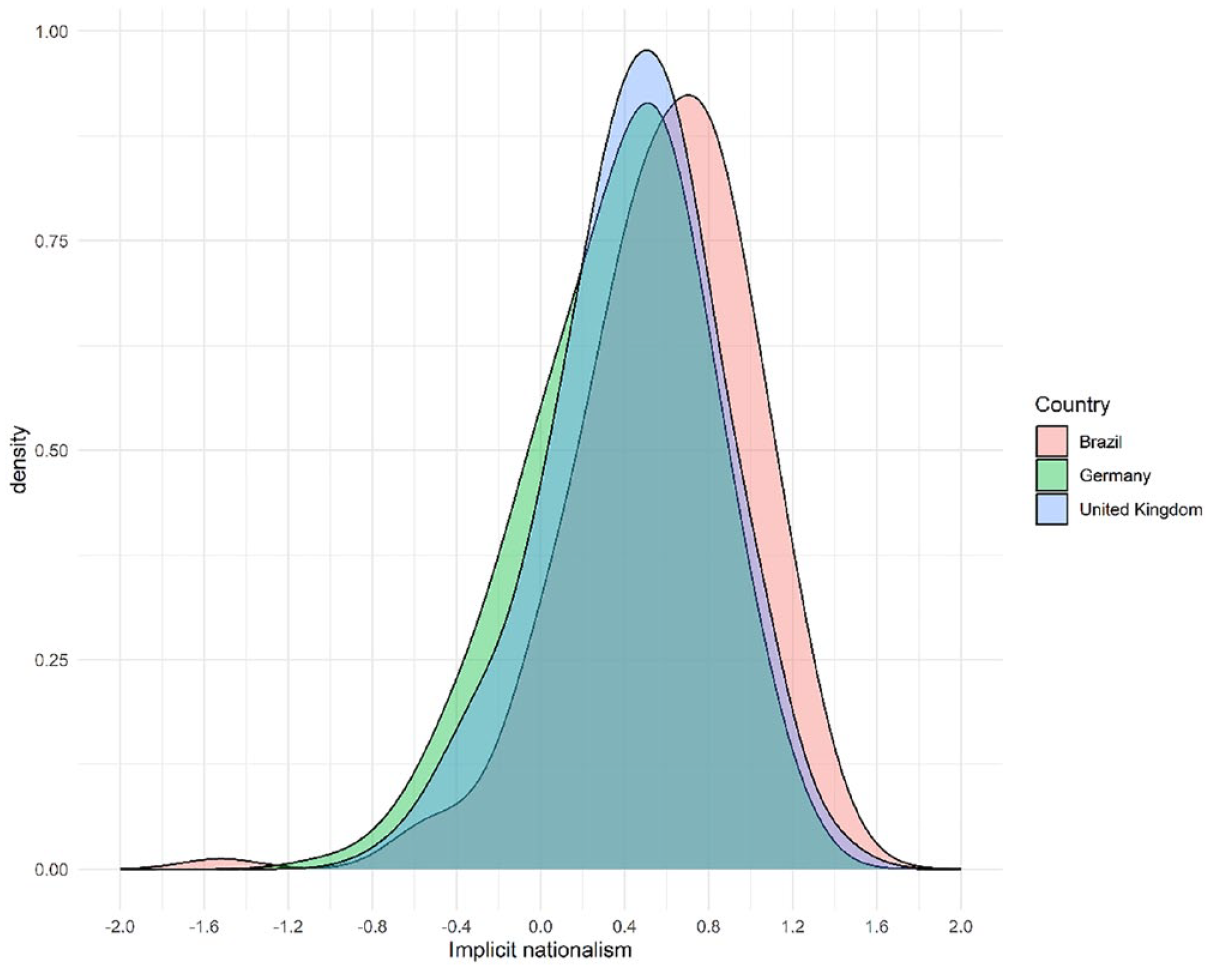
The distribution of implicit nationalist attitudes before the World Cup in Germany, Brazil, and the United Kingdom.
An ordinary least squares model was used to test whether exposure to the World Cup affected implicit nationalist attitudes in Germany, Brazil, and the United Kingdom. The model only includes the treatment variable, that is, exposure to the event, and is presented in Table 1 and Figure 2.
The Effect of the World Cup on Implicit Nationalist Attitudes Using an Ordinary Least Squares Regression.

Note: Standard errors are in parentheses.
p < .05. **p < .01. ***p < .001.

Mean values and standard errors of implicit nationalist attitudes before and after the World Cup in each country.
Success and failure had a significant effect on implicit nationalist attitudes in all three countries. It led to an increase in nationalist attitudes in Germany (d = 0.156, p = .002) and a decrease in both Brazil (d = −0.148, p = .03) and the United Kingdom (d = −0.094, p = .008). These changes equate to a standardized effect size (Cohen’s d) of 0.36 in Germany, −0.33 in Brazil, and −0.23 in the United Kingdom. The change was particularly large following the German win and the Brazilian defeat. The proportion of people with negative implicit attitudes toward Brazil increased from 4 percent to 15 percent, and the proportion of people with positive implicit attitudes toward Germany increased from 70 percent to 78 percent.
Model 2 includes an entropy-balanced19,20 sample, balancing the control and treatment groups by age, gender, education, citizenship, and religion. The coefficient changes slightly in each case, but the findings remain the same: Winning had a positive effect on implicit nationalist attitudes, and losing had a negative effect.
With the third and fourth hypotheses, I test whether exposure to the World Cup affected explicit nationalist attitudes. Following the findings from previous research, explicit nationalist attitudes were expected to remain relatively unchanged following the event.
Most respondents had positive feelings toward the nation prior to the event, scoring an average of 6.64 in Germany, 7.56 in Brazil, and 7.57 in the United Kingdom on a 10-point scale. Between 4 percent and 8 percent of respondents reported negative feelings toward their nation. Winning the World Cup had no significant effect on explicit nationalist attitudes in Germany (p = .99), and being eliminated had no significant effect in Brazil (p = .23) or the United Kingdom (p = .76). The results remain largely the same when using an entropy-balanced sample (Model 2). There is thus support for both hypotheses: Exposure to the World Cup did not significantly affect explicit nationalist attitudes in any of the included countries (Table 2).
The Effect of the World Cup on Explicit Nationalist Attitudes Using an Ordinary Least Squares Regression.

Note: Standard errors are in parentheses.
p < .05. **p < .01. ***p < .001.
General Discussion
The purpose of this article was to outline a cognitivist framework of implicit nationalism. I began the article by attempting to connect research on banal nationalism with cognitive psychology, arguing that different symbols and events can affect nationalist attitudes beyond conscious awareness and/or control. I further argued that these symbols and events affect nationalist attitudes by activating different implicit associations. To demonstrate the framework, I tested whether exposure to a large-scale nationalist event—the 2014 FIFA World Cup—affected a specific type of implicit nationalism (implicit attitudes) and whether the outcome during the World Cup (i.e., winning or losing) moderated the effect.
Implicit and Explicit Nationalism
There was support for the first two hypotheses: Winning the World Cup increased implicit nationalism in Germany, and losing the World Cup decreased implicit nationalism in both Brazil and the United Kingdom. The effect was particularly substantial in Germany and Brazil, with the World Cup having a more limited (but significant) effect in the United Kingdom. The lower effect could be due to a lower salience of the event compared to Brazil and Germany but also due to the geographical location of the respondents. It was not possible to control for geographical location in the study, and any effect would likely be diluted if a significant percentage of respondents came from Scotland, Wales, or Northern Ireland instead of England.
Irrespective of these differences, the findings show how seemingly benign (but nationalist) events can affect nationalist attitudes. By using both implicit (i.e., the IAT) and explicit measures, the study showed how nationalist attitudes can transform via changes in implicit associations. There was no corresponding effect on explicit nationalism in any of the three countries, indicating that certain events can make people more (or less) nationalistic without affecting explicitly measured nationalism.
The lack of effect on explicit nationalist attitudes could be explained in two different ways. As speculated when outlining the theoretical framework, certain events might primarily and sometimes exclusively affect implicit attitudes and beliefs. The World Cup was a highly emotional affair for all countries. The win was followed by mass celebration, dancing, and partying, whereas the loss was followed by riots, burned flags, and feelings of national shame. Implicit measures are particularly useful in these cases because they are designed to measure spontaneous and affective reactions (Goedderz and Hahn 2022). People may experience these increases (or decreases) in nationalism without necessarily being aware of its content or source, and this lack of introspection would make them unable to report any changes in nationalist attitudes. 21 These events may also primarily affect implicit nationalist attitudes due to social desirability bias. Expressing nationalist attitudes is perceived as taboo in certain contexts and during certain times. This taboo has been particularly prevalent in Germany (Senkbeil 2017). The win might thus have increased both implicit and explicit nationalism without respondents being willing to report on this increase. Social desirability can similarly moderate the effect of national failures on explicit attitudes. If people do not wish to be perceived as unpatriotic, they might be unwilling to disclose a decrease in nationalism following elimination. Although many in Brazil and England were open in their disappointment (with some even burning the Brazilian flag), social desirability could still have suppressed some of the effects on explicit nationalist attitudes.
Natural experiments—particularly those relying on anonymous, online surveys—are typically less susceptible to social desirability bias and potential expectancy effects. 22 It is, however, difficult to disentangle divergences between implicit and explicit measures because any divergence could reflect a combination of differences between the underlying constructs and social desirability bias. These two mechanisms are particularly difficult to separate given the constraints of the Project Implicit data set (because there was no direct measure of social desirability).
We do, however, know that different groups are differently willing to report explicitly nationalist attitudes irrespective of actual sentiments. In Germany, explicit nationalism has typically been associated with right-wing voters. People who identify as left-wing report substantially lower levels (Molthof and Mohr 2022), and the taboo against explicit nationalism has been particularly strong among left-wing voters. If the results were due to social desirability, we would expect left-wing respondents to be more unwilling to report increases in explicit nationalism than people who identify as right-wing. A supplemental analysis (Table 3C in the online supplemental materials) shows that this is not the case. In fact, more left-wing respondents showed larger (but not significant) increases in explicit nationalism following the win (Δ = 0.332, p = .1). Although this is by no means an exhaustive test of social desirability, it indicates that the lack of increase in explicit nationalism was not primarily driven by social desirability. Irrespective of why we saw a divergence between implicit and explicit measures, the study shows how nationalist events, even those perceived as relatively benign, can affect implicit nationalist attitudes without affecting explicitly measured attitudes. We might not report feeling (or even feel) more nationalistic, but these events seem to still have a significant effect on nationalist attitudes.
Theoretical and Methodological Implications
The study has several implications for research on nationalism. Although almost all quantitative research on nationalism has relied on explicit measures, the study highlights the importance of incorporating implicit measures in the study of nationalist attitudes. The use of implicit measures can help bridge the gap between research on nationalism and cognitive sociology and psychology but also the gap between quantitative (and often survey-based) research and studies on banal nationalism.
The study adds to the call from previous studies within both sociology (Lamont et al. 2017) and political science (Olsson 2023a) to incorporate implicit measures when measuring socially sensitive attitudes. I show, in line with these studies, how exclusively using explicit measures may lead to erroneous conclusions. Some studies have, for example, not found an effect of sports events on different political attitudes, deeming these events as “irrelevant” (Müller and Kneafsey 2023). This article shows that these events can affect attitudes and potentially even behavior but that any effect might be undetectable using explicit measures.
The exclusive reliance on explicit measures has likely created systematic blind spots in the study of nationalism. Billig (1995) partially wrote Banal Nationalism to combat some of these blind spots, arguing that a lack of explicit nationalism is not the same as a lack of nationalism. This article similarly shows that a lack of effect on explicit measures is not the same as a lack of effect. If certain events, narratives, and symbols primarily affect implicitly measured nationalism and if (almost) all quantitative studies rely on explicit measures, we will inevitably miss out on the many ways nationalism and national identity are reproduced.
The framework of implicit nationalism predicts that explicit—but not implicit—nationalism will decrease during times (e.g., certain decades) and in places (e.g., Germany) where nationalist expressions have become either normalized or socially unacceptable. Although studies using explicit measures might find a decrease under these conditions, implicit measures would likely reveal different patterns and trends. These trends and patterns might—in line with Billig’s (1995) original argument—prove to be instrumental in understanding why explicit nationalism sometimes “flares up” and why it sometimes subsides. Implicit nationalism might thereby help us understand the current resurgence in explicit nationalism but also make the resurgence appear less sudden and unexpected. 23
Relatedly, research on right-wing populism often talks of the supply and demand of ethno-nationalist politics and related attitudes. Some argue (e.g., Bonikowski 2017a) that neither the supply nor demand of nationalism has changed but that the resonance between ethno-nationalist frames and people’s lived experiences has increased. The stability or decrease in demand might, however, not necessarily be true for implicit nationalism. Although it is not the subject of this study, the Project Implicit data set does show an increase in implicit nationalism in Germany and the United Kingdom over the years (see Table 1B in the online supplemental material) but a decrease in explicit nationalism and prejudiced attitudes. The increase in nationalist rhetoric and the popularity of right-wing populist parties might thus reflect not only an increased resonance but also a real change in nationalist attitudes. Resonance could, of course, still be used to explain how or why these “latent dispositions” (Bonikowski 2017b) transform into explicit political attitudes, but it might be premature to say that the demand for nationalism has remained unchanged or even subsided.
Lastly, the study adds to the discussion of how dispositional or malleable nationalism and national identity are. Many studies assume that nationalist attitudes are “chronically activated in particular respondents” (Bonikowski and DiMaggio 2016:975). This study shows, in line with Bonikowski and DiMaggio (2016), that the activation and strength of nationalist attitudes seem to rely on additional contextual cues. Certain events, frames, and discourses will activate different implicit associations within the same person, and these associations can both strengthen and weaken nationalist stereotypes and attitudes. These findings are particularly interesting in light of a larger debate within psychology (Payne et al. 2017) and sociology (Shepherd 2011) on the contextual nature of implicit cognitions. Studies show that implicit prejudice is highly malleable and context-dependent, but some speculate that attitudes more closely tied to personal identity (e.g., nationalist attitudes) might be less malleable. Contrary to this assumption, this study finds that implicit nationalism is also sensitive to contextual changes, adding further evidence to the malleability of implicit cognitions. This also has consequences for our understanding of implicit nationalism as a conceptual construct. If implicit nationalism is malleable and context-dependent, measures of implicit nationalism could—at least compared to explicit measures—better be conceived as measures of situations rather than individuals. Surveying preexisting or changing levels of implicit nationalism would thus tap into levels of implicit nationalism in a certain context. Importantly, we would interpret high levels of individually measured nationalism to be symptomatic of the person’s context rather than chronically nationalistic traits.
Limitations and Future Studies
Although I have attempted to sketch a rough outline of implicit nationalism, the article has several limitations worth addressing. Some of these limitations are inherent to the data set and method used, whereas others could be addressed by coupling the analysis with follow-up studies.
The study focused on a certain aspect of implicit nationalism: implicit positive associations toward the nation. This is equivalent to measuring how explicitly positive a participant feels toward their nation, but nationalism encompasses many distinct (and not so distinct) types of nationalism, such as patriotism, national chauvinism, civic nationalism, and ethnic nationalism (Mylonas and Tudor 2021; Schatz, Staub, and Lavine 1999). The definition and measure of implicit nationalism are compatible with any of these types of nationalism, but we do not know how the measure corresponds to specific constructs. The increase in implicit nationalism could potentially reproduce both “good” (e.g., constructive patriotism) and “bad” (e.g., national chauvinism) nationalism. Perhaps most nationalist events and frames increase implicit nationalism, but only some increase national chauvinism. Future studies could clarify this relationship by testing what type of implicit nationalism a certain event triggers. 24 It could partially be done by constructing novel measures of implicit nationalism (see Bursell and Olsson 2020) but also by exploring the link between implicit nationalism and outgroup prejudice. The study similarly uses a very crude measure of explicit nationalism. Although the study shows that some events may affect implicit but not explicit nationalism, this finding needs to be replicated using more elaborate measures of nationalism.
The study focused on the effect of a single event, but it would also be beneficial to track variations in implicit nationalism over a longer time period. Project Implicit contains data spanning many years, allowing researchers to test a number of unexplored research questions. 25 Has implicit nationalism, for example, seen a surge in certain contexts, during certain times, and for certain people? Was the rise of right-wing populist parties predated by a surge in implicit nationalism, or has implicit nationalism increased following the popularity of right-wing populism? Most of these questions could be answered by using already existing data from the Project Implicit data set.
I also encourage researchers to use more representative data. Although I found support for the study’s primary hypotheses, the Project Implicit data set generally consists of younger, more left-leaning, and less nationalistic participants. Other groups may have more stable implicit nationalist attitudes or more malleable explicit nationalist attitudes. Although these characteristics might make respondents less sensitive to nationalist events and frames (thus providing a type of least-likely case), this assumption remains untested. I would similarly encourage researchers to explore heterogeneity within a nation. It is possible—and perhaps likely—that the effect of exposure will vary between different subgroups (e.g., different political groups) and regions.
A final limitation concerns the sampling of the data. The Project Implicit data set consists of self-recruited participants, and it is possible that the willingness to participate was affected by the World Cup. The article controlled for imbalances between by using entropy balancing, but there is always the possibility of imbalances on unobservable variables. There are, however, potential upsides using Project Implict data compared to, for example, ESS data. Muñoz et al. (2019) found issues related to reachability using ESS data, with older, less educated, and unemployed people being more likely to participate during early data collection. Such issues may be less pervasive when using the Project Implicit data set because participants complete tests by their own volition. 26
Concluding Remarks
The overarching purpose of this article was to outline a framework of implicit nationalism, providing a preliminary sketch of what implicit nationalism is and how it relates to both banal and more explicit forms of nationalism. My hope is that this article might provide a starting point for future studies looking to incorporate implicit measures in the study of nationalism. Not only can these measures help overcome the issue of social desirability, but they also have the potential to tap into a unique, important, and uncharted construct. This article studied implicit nationalism by analyzing the FIFA World Cup, but the framework and data set can be used to explore a number of related research questions.
Supplemental Material
sj-docx-1-srd-10.1177_23780231241258396 – Supplemental material for Implicit Nationalism: The Missing Link in the Study of Nationalist Attitudes?
Supplemental material, sj-docx-1-srd-10.1177_23780231241258396 for Implicit Nationalism: The Missing Link in the Study of Nationalist Attitudes? by Filip Olsson in Socius
Footnotes
Acknowledgements
I thank Magnus Bygren, Moa Bursell, and Daniel Ritter for insightful comments and suggestions.
Author’s Note

Supplemental Material
Supplemental material for this article is available online.
Notes
Author Biography
References
Supplementary Material
Please find the following supplemental material available below.
For Open Access articles published under a Creative Commons License, all supplemental material carries the same license as the article it is associated with.
For non-Open Access articles published, all supplemental material carries a non-exclusive license, and permission requests for re-use of supplemental material or any part of supplemental material shall be sent directly to the copyright owner as specified in the copyright notice associated with the article.
