




Abstract
Research finds racial disparities in the frequency and severity of police violence. Police violence research has not interrogated gender to the same effect. We build on theories of “gender irrelevance” to argue that violent incidents between police and civilians cannot be extricated from masculinity’s relevance. However, in contexts when police respond to women as violent, police render women’s femininity as irrelevant. Using 2016–2021 California URSUS data and supplementary archival examples, we examine gender and race across fatal and nonfatal police violence incidents. We find that women are no more or less likely to experience fatal relative to nonfatal police violence than men of the same racial group when accounting for police perceptions of civilians being armed. We also find racial differences in perceptions of weapons, with lower barriers for fatal violence against Black and Latinx civilians. When women are in high-conflict, violent situations, other statuses become hyper-present beyond women’s femininity.
Keywords
Police kill approximately 1,000 civilians a year in the United States, about three people per day (Mapping Police Violence 2024; Washington Post 2024). Many of these deaths are well documented and memorialized. Increasingly, media and social movements have given attention to women of color killed by police because 4 to 5 percent of these civilian deaths are women (Mapping Police Violence 2024; Washington Post 2024). In addition to the thousand civilians killed by police each year are approximately 3.6 times more civilians who survive police violence (California Department of Justice 2021), including a notable proportion of women. Men and women civilians harmed by police violence are likely to be armed themselves, which amplifies the potential fatality during these interactions (Oramas Mora, Terrill, and Foster 2023). Our research examines violent incidents between civilians and California police and the outcome of civilians killed relative to survivors of police violence. Although 92.9 percent of these civilians are men, we examine the context and complexity of the less frequent cases of White, Latina, and Black women killed and harmed by California police.
Violent incidents between the police and civilians are dyadic interactions foregrounded with weapons, threat, and danger (Collins 2009; Sierra-Arévalo 2021). The critical legal distinction is police officers’ use of violence against civilians is sanctioned by the state, whereas civilians’ use of violence is criminalized and has harsher sanctions when directed at police. The 1985 U.S. Supreme Court ruling in Tennessee v. Garner clarified that law enforcement could direct lethal force at civilians—this particular case was about a fleeing 15-year-old who stole $10 and a purse—so long as officers have probable cause that civilians pose an immediate threat to others (Flanders and Welling 2015). Like the Tennessee v. Garner case clarified, the state sanctions certain actors’ use of violence, such as bombings during wartime or the death penalty. Police violence can be criminalized when state actors deem the violence as excessive or unreasonable, but most police violence is legal and procedural. Collins (2009) provides an interactional theory of violent interactions that focuses on the emotion, ritual, and dynamics of violence rather than the criminalization of it. We find this interactional perspective useful because so little research has theorized civilian women’s violence and police’s violent responses to it.
We situate our study in interactional theories of gender, race, and violence in the United States context by asking the following: (1) Can gender be irrelevant in moments of violence? (2) How is police violence racialized and gendered? and (3) Are officers’ race and gender relevant to police violence? We structure our literature review around these questions. Our study examines violent policing interactions in California from 2016 to 2021—a population of fatal and nonfatal incidents in which California police used different forms of violence against civilians, of whom 50 percent were armed. Because of California’s large population size, racial diversity, and mandatory annual reporting of “use of force” (compiled into a data set called “URSUS”), we can examine gender differences and similarities within racial groups. We find that although women are underrepresented in URSUS fatal and nonfatal violence cases relative to their proportion of California’s population, women are no more or less likely to experience fatal police violence relative to nonfatal police violence compared to men of the same racial group when accounting for police perceptions of civilians’ weapons. We also find racial differences in how police perceive and respond fatally to weapons other than firearms for Black and Latinx civilians. We supplement our statistical findings with six examples of women harmed by California police. These cases provide examples of context and interactions on how police responded to civilian women’s violence. We build on theories of intersectionality and gender irrelevance to argue that police and civilian violent incidents cannot be extricated from masculinity and race. However, when women threaten police, police appear to render women’s femininity, especially women of color’s femininity, irrelevant.
Background
Can Gender Be Irrelevant in Moments of Violence?
Messerschmidt (1993) argues that violence is an accessible resource for the accomplishment of masculinity, and many men—especially men of racially marginalized masculinities—understand masculinity to be inherently violent (Anderson and Umberson 2001; Contreras 2013). In opposition, legal and media discourses typically construct women as victims rather than agents capable of committing violence (Morrissey 2003). Societal views of women as less capable of violence lead to increased sensationalism of women’s violence, perceiving violent women as monsters or failing to conform to stereotypical norms of femininity (Cervantes 2019; Hollander 2001). Violent women are positioned as lacking self-control, whereas men’s violence is positioned as exerting control. This legitimizes men’s violence and constructs women’s violence as an inability to contain emotion (Anderson and Umberson 2001). The relationship between masculinity and violence diminishes women’s claims to the same resource of power and control.
Race compounds the entangled relationship of gender and violence described so far. According to Collins (2017:1460), “race and gender as intersecting systems of power shape the very definitions of violence.” Thus, the intersectionality framework informing theory and method considers how multiple status categories shape experiences in relation to violence (Collins 2004). Intersectional analyses have established that the relationship between masculinity and violence is amplified for men of color and that the erasure of femininity from women’s violence is heightened for women of color (Collins 2004; Ritchie 2017). Perceptions of danger target men of color as inherently violent, whereas White men’s violence can be perceived through a lens of guardian masculinity (Carlson 2022; Contreras 2013; Owusu-Bempah 2017). Characterizations of White women as nonviolent and submissive create oppositional femininities for women of color (Hollander 2001; Ritchie 2017). Institutional racism and sexism render Black women’s bodies more tolerant of pain, more masculine, and less worthy of protection (Collins 2004; Ritchie 2017). Thus, the relevance of gender as a master status in violent contexts varies by race.
The theory of “gender irrelevance” builds on West and Zimmerman’s (1987) theory of “doing gender.” “Doing gender” refers to how individuals accomplish gender through everyday interactions for the evaluation of an audience (West and Zimmerman 1987); the theory pushed back on arguments about biological sex differences and gender roles. Gender scholars have since interrogated the interactional and relational foundations of doing gender to identify ruptures in the stability of gender as a binary system of men doing masculinity and women doing femininity. Among these include Deutsch (2007), who articulated the focus on social interactions that reduce gender differences, “undo” gender, or produce instances of “gender irrelevance.” For Deutsch (2007), gender irrelevance proposes that there are contexts and situations where gender becomes a less salient category of difference. These are not necessarily instances of gender equality, but they are instances in which other statuses are more prominent than someone’s gender. We build on Deutsch’s (2007) work to propose that violence is an interaction in which femininity, but not masculinity, can be deemed irrelevant and that the irrelevance of femininity will vary for women by racial status.
The interaction of gender irrelevance requires two sides: one in which the actor interprets their own gender as irrelevant and another in which the audience interprets the actor’s gender as a less relevant master status. Regarding the actor’s side of gender irrelevance interactions, women and girls must interpret their violence through gender in ways that men and boys do not. Examples of this in research show that girls in gangs and violent women drug dealers refer to themselves as “one of the guys” to describe their violence in the context of markets and criminal activities dominated by men (Grundetjern 2015; Miller 2001). Black girls in Philadelphia view themselves as fighters and describe their violence as just as hard as boy’s violence even when audiences make light of their violence as silly or stupid (Jones 2010). To gain respect, earn a reputation, and protect themselves from being messed with, these examples of violent women and girls conjure masculinity frames and diminish femininity frames to contextualize their violence. When violent women and girls claim to be “one of the guys,” they are not rendering gender irrelevant—only femininity as irrelevant.
However, these interactions require audiences to also render gender irrelevant or, as we are establishing in some cases of violence, femininity as irrelevant. Some scholarship shows instances when audiences prioritize statuses other than femininity when interpreting women’s violence. Attention after 9/11 on women suicide bombers shows that media reports emphasize the statuses of “martyr,” “terrorist,” and “religious extremist” more than statuses related to femininity (Ponzanesi 2014). Religious leaders even note that women suicide bombers are equal to men because of their violence (Ponzanesi 2014). Femininity irrelevance also appears in judges’ responses to women charged with sex offenses. Judges describe severity in punishment to be equal for men and women, highlighting equivalent custodial sentences with “no breaks” or leniency for women because of their gender (Christensen 2018). Judges prioritize the stigma and status of “sex offender” and rebuke the relevance of femininity when lawyers claim that the women were “pestered” into sex (Christensen 2018). Mexico City police had been looking for a man serial killer for years until evidence named Mestiza woman Juana Barraza as the primary suspect (Cervantes 2019). In turn, police heightened attention to the masculineness of Juana Barraza’s body and her wrestling career to minimize her femininity and rectify their profiling errors (Cervantes 2019). These examples of violent women show audiences rendering femininity, but not masculinity, irrelevant.
Our final example is the profession of policing and its resource of state-sanctioned violence. Both actors and audiences diminish gender as a master status in policing, but again, only for women. In interviews with women police, Morash and Haarr (2012) find that some women describe gender differences as trivial in their occupation because they encounter similar policing situations and respond the same as men officers. Respondents express that other statuses, like officers’ race or rank, lead to greater differences in how police do their job (Morash and Haarr 2012). From the audience’s perspective, men officers sometimes describe women’s gender as irrelevant to policing, suggesting that the status of officer can supersede femininity (Chan, Doran, and Marel 2010).
Returning to the question at hand, can gender be irrelevant in moments of violence? The literature proposes that masculinity and its intersection with race are always relevant in moments of violence but points to some ruptures for femininity. Although violent women and girls claim femininity irrelevance to flex their capacity for serious violence, audiences occasionally also do so. When other master statuses are available that are highly stigmatized and inconsistent with the gender binary’s assumptions of masculinity and femininity—such as terrorist, sex offender, or serial killer—audiences can minimize women’s femininity, especially for women of color. The pattern of femininity irrelevance also carries over into the occasionally violent profession of policing. We add our proposal to this literature that violent interactions between police and civilians are also contexts of femininity irrelevance that will be amplified by race.
How Is Police Violence Racialized and Gendered?
Research has documented the racial disparities among men’s experience of police violence: Black and Latinx men experience disproportionately more fatal police violence than White men (Edwards, Lee, and Esposito 2019; Zimring 2017). Police violence is a leading cause of death for young Black men (Edwards et al. 2019). Even being stopped by police in the presence of a Black man can increase one’s risk of police violence across race and gender groups (Remster, Smith, and Kramer 2024). Black men face perceptions of being less human and more violent than men of other racial groups, and this dehumanization becomes justification for their disproportionate experiences of police violence (Owusu-Bempah 2017). Latinos also report dehumanization and indignation in stop-and-frisk encounters (Rios, Prieto, and Ibarra 2020). Rios et al. (2020) suggest that racial disparities operate through the guise of protection because police describe the disproportionate surveillance of Latinos as deterring future crime.
Research also documents that men and women civilians are not policed the same. Men are more likely to be stopped by police than women, and men, especially men of color, experience higher rates of physical and fatal police violence (Edwards et al. 2019; Gaston, Fernandes, and DeShay 2021; Remster et al. 2024; Schuck 2004). A review of the last decade of research shows that men experience the most deaths from police violence (Oramas Mora et al. 2023). Cooper (2009) argues that police respond to the entanglement of masculinity and violence with a mission to gain control through their resource of state-sanctioned violence. In interactions with women civilians, men police officers frequently exert gender-specific strategies, such as telling women civilians to “act like a lady” or utilizing sexual flattery (Martin 1999). The “chivalry hypothesis” proposed that police granted women more leniency when they act according to stereotypical feminine expectations (Visher 1983). Findings showed that police were only chivalrous to older White women because police anticipated apologetic feminine behavior from them (Visher 1983).
Quantitative scholarship has not given the racial disparities in police violence among women and nonbinary people the same level of attention as racial disparities among men, likely due to data limitations. However, several quantitative studies have documented contexts in which Black women experience higher rates of police violence than White women (Edwards et al. 2019; Gaston et al. 2021; Remster et al. 2024; Schuck 2004). Some of these studies also find that Latinas experience similar or lower rates of police violence as White women. Qualitative scholarship has progressed intersectional insights about the lived experiences of police violence by race and gender. Police perceive Black women as violent and suspicious, and these perceptions shape violent police interactions with Black women (Hitchens, Carr, and Clampet-Lundquist 2018). Police also subject Latinas to substantial surveillance, harassment, and abuse (Díaz-Cotto 2006).
Whereas gendered and racialized assumptions of who is violent and who is less capable of violence shape policing interactions, violent women or women who threaten violence disrupt this pattern. Police encounter civilians through the lens of the “danger imperative,” and they train to regain control of all situations at any cost (Sierra-Arévalo 2021). The danger imperative supersedes any master status associated with nonviolence, such as White femininity. For example, research shows that New York City police are equally as likely to point their service weapons at men and women civilians during investigatory stops when controlling for civilians’ demeanor and possession of weapons (Remster et al. 2024).
Are Officers’ Gender and Race Relevant to Police Violence?
The job of policing requires much feminized emotional labor and interpersonal skills (Martin 1999), but the organization of policing emphasizes the “masculinity contests” of the day-to-day work through which officers attempt to dominate men civilians through aggression and control (Cooper 2009). The masculine organization of policing doubly burdens women officers through simultaneous expectations of suppressing emotions to control civilians while also managing stereotypes of women as nicer and more emotional (Martin 1999). To be seen as “real police,” women officers diminish attention to their gender in their work or use their gender to their advantage during policing situations with women civilians (Martin 1999; Morash and Haarr 2012). The patterns of men and women officers using violence are consistent with our discussion of femininity irrelevance and violence discussed previously. Although there is some variation across studies, women police are not less violent than their men counterparts (Holmes, Painter, and Smith 2019; Preito-Hodge and Tomaskovic-Devey 2021). This dynamic of control emphasizes masculinity for men officers and diminishes femininity for women officers.
U.S. policing is a predominantly White occupation, although police departments tend to be more racially diverse than many other employers (Hyland and Davis 2019). Officers of color navigate a racialized organization using the narrow schemas and resources that target marginalized communities (Ray 2019). Some research shows that officers of color use as much violence as White officers or that the racial composition of a police department does not explain differences in police violence (Holmes et al. 2019; Preito-Hodge and Tomaskovic-Devey 2021). In response to the aforementioned question, the literature suggests that the gender and race of individual officers are less relevant to their deployment of violence because they operate within the masculine and racialized organization of policing.
Current Study
Across these literatures is a tension of when civilian violence and police violence are gender-specific versus when femininity might be irrelevant. The intersection of gender and race amplifies the relationship between masculinity and violence for men of color while simultaneously lowering the barrier for fatal violence for women of color. To shed more light on the gender and race dynamics occurring within violent incidents between police and civilians, we focus on officially recorded fatal and nonfatal interactions when California police directed violence at civilians, many of whom were armed with firearms or other weapons (e.g., knives, blades, vehicles). As we show, these are violent incidents in which men, especially Latinos, are overrepresented. These are also violent contexts in which armed, dangerous women are rare but are also killed by police. Our literature review proposes that we know much more about men of color’s experiences and risks of police violence than women of color’s experiences and risks. By narrowing in on this population of rare but fatal and harmful violent police incidents, we continue to develop the theoretical thread that violent women, especially women of color, are aberrations to the gendered assumption that entangles masculinity with violence and that police control and contain violent women with less regard to femininity.
Data
This study uses Open Justice California’s URSUS Use of Force data, which have been publicly available since 2016. The compilation of these data results from the implementation of Assembly Bill 71 and its inclusion of Government Code section 12525.2 that went into effect January 1, 2016 (Assembly Bill No. 71 2015). This mandates that all California law enforcement agencies report to the California Department of Justice (DOJ) all policing incidents involving death, serious bodily injury, or the discharge of a firearm (Assembly Bill No. 71 2015). Before the implementation of Assembly Bill 71, reporting of fatalities was voluntary for California law enforcement agencies. Now the reporting is mandatory, and the DOJ hosts the data online.
Although URSUS is specific to California, California comprises 12 percent of the U.S. population and 14 percent of fatal police violence in the United States (Mapping Police Violence 2024; Washington Post 2024). The URSUS data include incident details, civilian and officer demographics, and use of weapons. We pool the data from 2016 to 2021. Our unit of analysis is civilians, and our analytic sample is the population of civilians harmed by California police and officially recorded in URSUS from 2016 to 2021 (n = 4,326).
We conducted supplementary archival research using Google News on a random selection of URSUS incidents to understand the context of violence and to validate some URSUS variables. We completed this archival work in 2020, when only three years of URSUS data were available. We randomly searched 496 incidents (23.2 percent of the 2016–2018 total URSUS incidents), and we found additional archival information on 233 incidents (10.9 percent). URSUS does not provide names of civilians, but many of the incidents were searchable with URSUS information on dates, city, and injury type. Some of these rare events had archives of local news reporting or publicly available court records. We found more archived reports on fatal URSUS incidents but found some information on nonfatal incidents. Although there was variation in archival coverage, we confirmed that URSUS reports on race, gender, age, location, weapons, and level of injury were consistent with archived reports. However, some URSUS variables, such as the reason the police made contact with the civilian, mental health, and drug use, were less reliable across reports.
Some of the archived reports included detailed coverage of violent incidents between police and civilians, and we selected six detailed cases of armed women in URSUS as examples to supplement our quantitative results. Including these six cases as a supplement showcases some of the complexity and dynamics of violent interactions that can get buried in the quantitative results. We did not select these six cases randomly from URSUS because there was high variation in the online archives. Instead, we selected six cases that varied by race and outcome with the most information on the context of the incident. We did not systematically code these supplementary cases; rather, we present them as examples of what some women’s violence looked like and how police responded to their violence.
Measures
Our outcome of interest is a binary variable of fatal versus nonfatal police violence. Fatal violence includes any incident recorded as “death” under the URSUS injury level variable (1 = fatal violence; N = 943 civilians). Fatal police violence mostly involved shootings but also included fatal violence using other weapons and force (Appendix Table A1 in the supplemental material). Nonfatal violence includes all URSUS incidents recorded as serious injury (n = 2,441), injury (n = 302), or no injury (n = 640). Examples of serious injuries include gunshot wounds, disfigurement, loss of consciousness, lacerations, chokeholds, chemical sprays, electronic devices, K9 units, and impact projectiles. Injuries include the same list of examples minus gunshot wounds. More than one-third of the no injury cases represent civilians who were shot at, but not hit. 1 Including these cases is consistent with the literature that defines deadly force as every time officers fire their weapon, even if they miss (Nix et al. 2017). The remainder of no injuries in URSUS also include force. We drop unknown race, gender, and injuries from our sample (n = 63).
Our explanatory variables of interest include civilians’ gender and race. For gender, we rely on the variable of man or woman because the number of transgender civilians (n = 6) is too small for analysis. URSUS includes many racial groups and individuals of multiple races, but most groups are too small for analysis except White, Latinx, and Black. When URSUS lists multiple races (n = 33), we code these civilians’ race as “other” for consistency with URSUS reporting. We include Asian, Indigenous, and other race groups in our descriptive statistics only.
Control variables include age and police perception of civilians’ weapons. We code age into four categories following Nix and Shjarback (2021): 0 to 25, 26 to 35, 36 to 45, and 46+. We code the variable of police perception of civilians’ weapons following the order of weapons mentioned in URSUS. Any time URSUS lists a perceived firearm, we code the civilian’s perceived weapon as a firearm. When URSUS does not list a firearm alongside other weapons, we code the civilian’s perceived weapon as “other.” Other weapons include knives, blades, stabbing instruments, and vehicles. When URSUS lists no weapon or lists the perceived armed variable as false, we code the civilian’s perceived weapon as “none/missing.” Our Appendix in the supplemental material includes the reason police contacted civilians as an additional control variable, which we do not include in main analysis due to reliability issues.
Our final control variables include the gender and race of the officers involved in the violent incident. These are group-level measures because the number of officers involved in URSUS incidents ranges from 1 to 23 officers with an average of 2.4. Our descriptive statistics present five gender composition groups for officers: (1) a man or group of only men, (2) group of mostly men, (3) group of 50/50 men and women, (4) group of mostly women, and (5) a woman or group of only women. Most of these categories are too small to include in our models, and we reduce them to two categories for the regression analysis following Boehme, Metcalfe, and Kaminski (2022). The reference category includes URSUS incidents with a solo man officer or a group of only men officers. The comparison group includes URSUS incidents with one or more women officers present. The officer race variable is also at the group level: (1) all/mostly White officer or group, (2) all/mostly Latinx officer or group, (3) all/mostly Black officer or group, (4) all/mostly other race officer or group, and (5) group of officers of different races. For example, the all/mostly Latinx officer or group category includes incidents with a solo Latinx officer, but it also includes incidents with more than 50 percent Latinx officers in the group. The last category includes URSUS incidents for which equal numbers of officers of different races were present. Our descriptive tables show that some of these officer group race categories are too small to include in our models, so we combine the all/mostly Black category with the all/mostly other race category. See our supplementary analysis in the Appendix of URSUS incidents that include only one civilian and one officer.
Analytic Strategy
The first set of results presents descriptive statistics by civilian and officer race and gender groups to show the similarities and differences across the outcome and control variables relative to the total. Second, we use logistic regression to model the outcome of fatal police violence (coded as 1) and nonfatal police violence (coded as 0). Research establishes the different selection biases that police use when stopping civilians and using violence against civilians of different racial groups (Knox, Lowe, and Mummolo 2020). Official data sets, like URSUS, have these biases built in. For example, the policing criteria that result in Black men experiencing violence and having a record in URSUS are different from the policing criteria that result in White women experiencing violence. For this reason and following prior studies (Gaston et al. 2021; Remster et al. 2024), we split the analytic sample by civilian race (White, Latinx, and Black) to model the effect of gender within racial group. 2 This introduces the challenge of small cell sizes for some of the combinations of variables, but we keep our models simple to analyze the population of URSUS data. We present nested models with Models A including only the baseline effect of civilian gender within the racial group and Models B adding the controls. Following our quantitative results, we present supplementary examples of six women harmed by police and the relevant URSUS variables to highlight some of the dynamics of these violent interactions involving armed women civilians.
Results
Descriptive Results
Table 1 shows group-level descriptive results by civilians’ race and gender. From 2016 to 2021, 21.8 percent of civilians in URSUS incidents experienced fatal police violence (n = 943). Men comprise 96.3 percent of all deaths in URSUS reports, and women comprise 3.7 percent. Latinos constitute the highest percentage of deaths in URSUS at 44.9 percent, and White and Black men make up, respectively, 28.4 percent and 15.5 percent of URSUS deaths. White women account for the largest percentage of URSUS deaths among women, at 1.7 percent of total deaths, and Latina and Black women make up, respectively, 1.3 percent and 0.4 percent.
Descriptive Statistics of California Police Violence Incidents by Civilian Gender and Race, 2016–2021 (N = 4,326).

Indigenous women make up the remaining 0.18 percent of the California population, but URSUS does not record any women as Indigenous.
Based on 2015–2019 American Community Survey, five-year sample.
Nonfatal police violence accounts for 78.2 percent of URSUS incidents (n = 3,383). Men comprise 91.9 percent of nonfatal violent incidents, and women comprise 8.1 percent. Latinos again constitute the highest percentage of nonfatal URSUS incidents at 42.5 percent, and White and Black men make up, respectively, 26.2 percent and 18.2 percent. White women account for the largest percentage of nonfatal violent incidents among women, at 3.2 percent, and Latina and Black women make up, respectively, 2.9 percent and 1.6 percent.
Table 1 shows high variation across the percentages of race and gender groups dying from and being injured by police violence, but these differences should be considered relative to the demographics of California. White men comprise 26.7 percent of all URSUS police violence incidents and 18.6 percent of California’s population. In contrast, Black men account for 17.6 percent of URSUS incidents and only 2.7 percent of California’s population. Latinos comprise the highest percentage of URSUS incidents among men, 43 percent, even though they make up only 19.6 percent of California’s population.
The gender gap in violent police incidents is stark. Across race, women are underrepresented relative to their proportion of California’s total population. However, among URSUS incidents that include only women, White women are slightly overrepresented, constituting 37.2 percent of women in California but 40.3 percent of URSUS incidents among women. Latinas account for 38.8 percent of women in California but are slightly underrepresented in URSUS incidents involving women at 35.4 percent. Black women are the most overrepresented group of women in URSUS incidents, accounting for 18.5 percent of incidents involving women but only 5.6 percent of women in California. Although some of these counts are small for women, they represent the population of violent policing incidents in California. Table 1 masks this race difference among women when considering women’s experiences of police violence only relative to men.
The civilians in Table 1 are on the receiving side of California police violence, and Table 2 turns to the policing side of these interactions. These are mostly group events, with 2.4 officers on average involved in each incident (range = 1–23). Table 2 shows that 87.8 percent of civilians receive violence from an officer/group of officers that is entirely men. There is small variation for women civilians who experience slightly more violence from an officer/group of officers that includes at least one woman (21.1 percent). Turning to the racial composition of the officers involved, 49.9 percent of civilians receive violence from a White officer or group of officers that is all or mostly White. This percentage is consistent across incidents involving men and women civilians. There is some variation in officer race across civilian race. Latinx civilians experience violence mostly from White officers and officer groups, but they have a slightly higher percentage of Latinx officers and officer groups involved in their violence. Black civilians experience violence mostly from White officers and officer groups, but they have the largest percentage of Black officers and officer groups involved. The takeaway from Table 2 is that police violence in California predominantly involves White men officers, but women officers and officers of color are involved in fatal and nonfatal violent incidents against civilians of the same gender or race.
Descriptive Statistics of California Police Violence Incidents by Officer Gender and Race, 2016–2021 (n = 4,326 Civilians).

Includes Indigenous, Asian, and other race civilians.
Multivariate Results
Table 3 presents the results of the models that measure civilians’ likelihood of experiencing fatal police violence relative to nonfatal police violence, split by race. Models 1a and 1b include White civilians in URSUS (n = 1,277), Models 2a and 2b include Latinx civilians (n = 1,971), and Models 3a 3b include Black civilians (n = 819). Our primary focus in Table 3 is to examine gender within racial groups as a baseline effect (Models A) and with the controls (Models B). Our main finding across the models in Table 3 is that White, Latina, and Black women are no more or less likely to experience fatal police violence relative to nonfatal police violence than men of the same racial group when accounting for control variables. The baseline effects of gender are significant in Model 1a (White women are 51 percent less likely to experience fatal police violence relative to nonfatal police violence than White men), Model 2a (Latinas are 58 percent less likely to experience fatal police violence relative to nonfatal police violence than Latinos), and Model 3a (Black women are 68 percent less likely to experience fatal police violence relative to nonfatal police violence than Black men). However, these gender differences lose significance when the controls are added, and model fit improves. Our nonsignificant gender findings within racial groups are consistent with research on police pointing their services weapons on men and women in New York City during investigatory stops (Remster et al. 2024).
Nested Logistic Regression Models Predicting Fatal from Nonfatal California Police Violence by Race, 2016–2021.

Note: Odds ratios are presented; standard errors are in parentheses.
Men are the reference category.
Age range 0 to 25 is the reference category.
Firearm is the reference category.
Only men is the reference category.
All/mostly White is the reference category.
p < .05. **p < .01. ***p < .001.
For the most part, age is not significant in reducing the likelihood of fatal police violence relative to nonfatal police violence for White or Black civilians, although Black civilians between the ages of 36 and 45 are more likely to experience fatal police violence relative to nonfatal violence than Black civilians under the age of 26. Older Latinx civilians are more likely to experience fatal police violence relative to nonfatal violence than Latinx civilians under the age of 26. The age finding is somewhat consistent with prior studies showing that civilians over the age of 40 are more likely to experience fatal police violence (Zimring 2017), but in California, we find that this is specific to Latinx civilians and applies to civilians over the age of 26.
The gender composition of the officers has no significant effect on civilians’ risk of fatal versus nonfatal police violence. The race of the officer or group of officers has no significant effects on White or Black civilians’ risk of fatal violence relative to nonfatal violence. In Model 2b, Latinx civilians experienced 1.4 times higher odds of fatal violence from groups of officers of different races relative to all/mostly White officer/groups (see our supplementary analysis of one officer and one civilian incidents in the Appendix for solo officer race effects). Some research shows that women officers and officers of color use as much violence as White men officers or that the gender and racial composition of a police department is unrelated to its violence (Holmes et al. 2019; Preito-Hodge and Tomaskovic-Devey 2021). Our results are consistent with these findings in terms of officers’ gender, and our results add some complexity to the officers’ race finding depending on the race of civilians.
The greatest reduction in the odds of experiencing fatal police violence relative to nonfatal police violence across the three racial groups is police perceiving civilians as unarmed compared to perceiving them as armed with a gun. This is consistent with the last decade of research on police violence (Oramas Mora et al. 2023). However, we find that Black and Latinx civilians whom police perceive to be armed with other weapons do not experience a decrease in the likelihood of fatal police violence compared to Black and Latinx civilians perceived to have firearms. This is different for White civilians, who have 50 percent lower odds of being killed by police if they are perceived to have weapons that are not firearms compared to those perceived to have firearms. Prior research shows that unarmed Black civilians have a higher likelihood of experiencing fatal police violence than unarmed White civilians (Nix et al. 2017). Our results in Table 3 suggest that being unarmed reduces fatal violence relative to nonfatal violence across race but that there are fatal racial differences in the perceptions of weapons other than firearms for Black and Latinx civilians.
Supplementary Examples
Cases of Six Armed Women Harmed by California Police
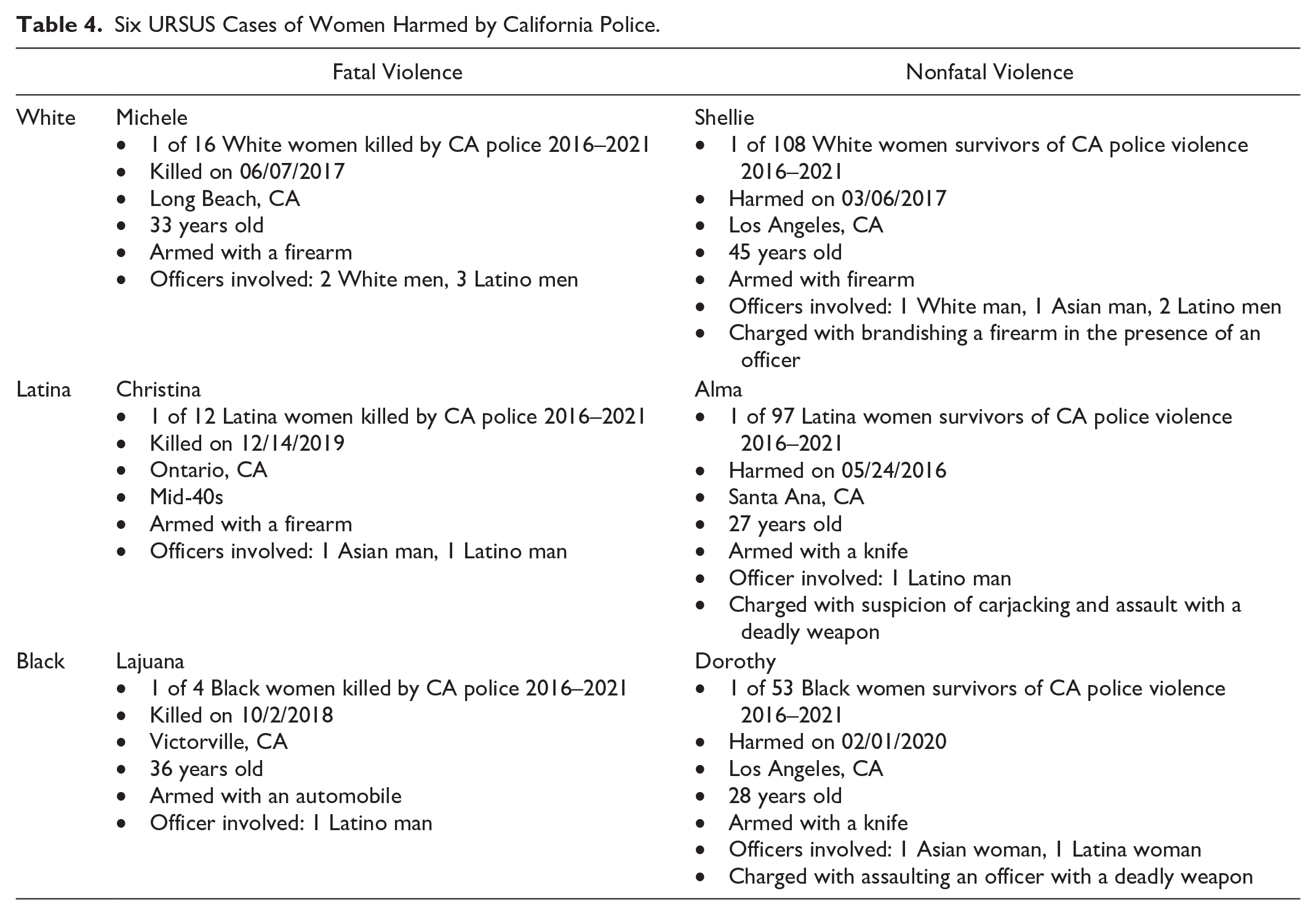
Our quantitative analyses establish the statistical finding of femininity irrelevance in violent incidents between police and civilians, but they are limited in capturing the dynamics of these incidents. In this section, we showcase six examples from URSUS for which we were able to find detailed and archived reports of armed women harmed by California police: three women killed by police and three who survived police violence. Zooming in on these women’s cases supplements the nonsignificant gender effects in our previous models by providing examples of how the theory of femininity irrelevance transpired for women’s violence and police’s violent responses to it. Table 4 summarizes these cases with their relevant URSUS variables, which is followed by the case narratives. The Appendix in the supplemental material lists all of the archival sources that we referenced for the cases.
Six URSUS Cases of Women Harmed by California Police.
Michele
On June 7, 2017, at 9:00 p.m., Michele, a 33-year-old White woman, left her home in Long Beach after getting into an argument with her partner, Ryan, an off-duty police officer. The pair continued their argument over the phone as Michele continued walking around the neighborhood with a bottle of alcohol. Over the phone, Michele told Ryan that she was “going to give [him] a reason to kill [her],” and he decided to look for her, knowing that she was armed. As he pulled up beside her, Michele drew a firearm and fired twice in Ryan’s direction, shattering the windows of his truck. He drove off, called 911, and gave Michele’s location to dispatchers. Two Long Beach police officers met Ryan a few blocks from Michele’s location. Ryan informed the officers that Michele was armed. A third officer began driving in Michele’s direction as a police helicopter flew overhead. The helicopter informed the three officers that a woman was sitting on the porch of Michele and Ryan’s home. As the first officer approached the home, he immediately drew his firearm and pointed it in Michele’s direction. The other two officers approached moments after, and the three officers sought refuge behind parked cars on the street. They ordered Michele to walk toward them with her hands in the air. Two other officers approached at this time and took cover as well. Three of the officers involved were Latino men, and two were White men. As Michele walked forward, she began to drop her hands and appeared to be reaching into a pocket. One officer shouted, “Please don’t do this,” as Michele pointed her firearm at the hiding officers. All five officers opened fire on Michele, firing 44 rounds collectively. Michele was struck seven times and pronounced dead on the scene.
Christina
On December 14, 2019, around 2:40 a.m., the Ontario Police Department responded to a 911 call from a man who said that he and his wife were bleeding and provided the address. No further detail was provided about the incident during the call, although the man requested paramedics as opposed to police officers. Four firefighters arrived alongside two police officers. The two police officers knocked on the door. The man stepped outside, revealed gunshot wounds on his head, and said, “My wife is crazy. She has a gun.” As police looked into the home, they saw Christina, a mid-40s Latina off-duty probation officer, holding a firearm pointed at one of the officers’ heads. Both officers moved backward, drew their firearms, and fired five rounds at Christina. One of the officers involved was an Asian man and the other a Latino man. It remains unclear whether Christina actually fired at the officers. The officers and firefighters took cover in the front yard and could hear Christina’s cries for help from inside the home. About 40 more officers arrived on the scene for backup. SWAT teams placed shields near the front entrance and continued to request that Christina surrender. Officers evacuated the surrounding neighborhood. After a five-hour stand-off and the use of scouring teams and drones, SWAT officers felt it was safe to enter the home around 7:30 a.m. When officers entered the home, they found Christina and two children deceased with gunshot wounds. Christina’s husband later clarified that she had also shot her children. Bullet fragments from Ontario Police were found during Christina’s autopsy along with bullet fragments from her own gun.
Lajuana
Around 12:30 p.m. on October 2, 2018, Victorville police responded to reports of an assault that had just taken place at a car dealership. Lajuana, a 36-year-old Black woman, had recently purchased a used car from the dealership. The car was a lemon, and Lajuana returned to the dealership to complain. Tension at the dealership ensued, and Lajuana punched a man patron in the face and allegedly threatened the lives of employees. The wife of the man who had been punched by Lajuana called 911 to report that a woman was fighting with patrons and had punched her husband in the face. Victorville police arrived at the dealership shortly after and made contact with Lajuana there. One deputy informed Lajuana of a warrant for her arrest for driving with a suspended license. Lajuana ignored the officers and entered her vehicle. Officers insisted that she exit the vehicle. One officer sprayed Lajuana with pepper spray through a partially open car window. At this point, Lajuana began to drive in the direction of one of the officers, and the officer fired six rounds at her through the car. The officer involved was a Latino man. Lajuana was immediately unresponsive after the shooting, and paramedics pronounced her dead in her vehicle.
Shellie
Around 3:30 p.m. on March 6, 2017, the Los Angeles Police Department (LAPD) responded to a 911 call in the Silver Lake area. The mother of Shellie, a 45-year-old White woman, called 911 and reported that her daughter was likely intoxicated, was in possession of a rifle, and had barricaded herself in her bedroom. Shellie’s mother expressed concern that Shellie might harm herself because she had threatened to shoot herself earlier. Two LAPD officers arrived on the scene first, with eight additional officers arriving shortly after and as backup. Officers surrounded the residence, and two officers called Shellie on the phone to encourage her to surrender. Shellie refused to leave the residence. The officers made another attempt to get Shellie to surrender using a loudspeaker public address system from the patrol car. Shellie remained barricaded in her home for two hours. During this time, officers called the SWAT team for additional assistance. At 5:45 p.m., Shellie walked out of the residence holding the rifle in a low pointed position. Walking toward the officers, one of the officers shouted, “She has a gun,” and another officer ordered her to drop the gun. Instead, Shellie pointed the gun in the direction of an officer who was stationed behind a parked car on the street. Immediately, three officers opened fire on Shellie and fired nine rounds collectively, and a fourth officer fired four beanbag rounds at Shellie. The four officers who used violence were one Asian man, two Latino men, and one White man. Shellie fell to the ground and was transported to the hospital for surgery. Shellie survived her injuries. Upon further investigation, police found that Shellie’s gun was unloaded. Shellie was booked and charged with brandishing a firearm in the presence of an officer.
Alma
On May 24, 2016, at 7:50 p.m., Alma, a 27-year-old Latina woman, began pouring water on cars in a parking lot of a strip mall in Santa Ana, appearing to act as though the water was gasoline. Alma then approached an elderly couple outside of a beauty salon they owned as they were attempting to close for the night. Armed with a butcher knife, Alma grabbed the man’s car keys, attempting to carjack. The couple and other witnesses attempted to get away from Alma by hiding in a nearby convenience store. Realizing that the door to the convenience store was unable to be locked, Alma struggled to open the door as the couple attempted to hold it closed from the inside. Alma stabbed the elderly man and injured two other men with the butcher knife during the struggle with the door. Someone called 911 and reported that a woman armed with a knife was attempting to stab people. Officers arrived at the scene and saw Alma fleeing on a bike with the knife still in her hand in the direction of a nearby park. Police followed Alma to the park. They saw Alma approaching a car exiting the park, and one officer fired at her. Alma received a single gunshot wound and was transported to the hospital for surgery. The officer who fired the gun was a Latino man. Although in critical condition, she survived her injuries. Alma was charged with suspicion of carjacking and assault with a deadly weapon.
Dorothy
On February 21, 2020, around 1:30 a.m., the LAPD received a call from a woman asking for an officer to be sent to her location but provided no further detail other than an address. Two officers responded to the call and approached Dorothy, a 28-year-old Black woman, who was sitting on a curb. The officers repeatedly asked Dorothy whether she called them because they had received a call requesting that officers show up at this location. Dorothy remained unresponsive when they asked her if she was in trouble and when they offered help. When she did respond, her words were unintelligible to the officers. One of the officers walked around Dorothy, shone her flashlight around her, and noticed a shiny object in her back pocket. The officer assumed that she was likely armed, asked Dorothy to stand up, and attempted to help her up by grabbing her arm. Dorothy struggled away from the officer, repeating the word “no” as the two officers continued to ask her to calm down. Dorothy then retrieved a 13-inch knife from her waistband and began walking toward the officers. Both officers walked backward, yelling “Stop!” with their firearms drawn. The officers involved were one Asian woman and one Latina woman. As Dorothy continued to approach with the knife in hand, one of the officers fired two nonfatal shots, and Dorothy fell to the ground. The officers called for backup and kept their firearms drawn as Dorothy tried to reach for the blade. Several patrol cars arrived as backup because the officers warned that Dorothy had a knife. Dorothy remained lying on the ground as the officers discussed how to put her in custody and how to move the knife. They decided to move forward as a unit and handcuff Dorothy, who was still lying on the ground. After handcuffing her, one of the officers noticed faint breathing and a slight pulse and began CPR. Dorothy was transported to the hospital and survived her injuries. She was charged with assaulting an officer with a deadly weapon.
Meaningful across these six cases and in the results of our statistical analyses is the similarity that police responded to these women, their danger, and their weapons with violence. There is no impression from these cases and the details of the archival reports that officers were less afraid of these civilians or that they responded to these civilians differently because they were women. When the officers saw knives, automobiles, and guns, they responded with guns. The officers’ responses to threats are consistent with Sierra-Arévalo’s (2021) work on the “danger imperative” of policing. We build on this work by emphasizing the gender dynamic of women’s threat, which is more rare than threats from men but responded to similarly.
These cases provide an example of the intersectional difference in experiences with police violence that appeared in our statistical models. Shellie, a White woman, pointed a rifle at an officer and survived the police shooting. One of the officers even shot bean bags at her rather than bullets. Lajuana’s case stands in stark contrast and has been memorialized at #SayHerName. Lajuana, a Black woman, was not armed with a gun or a knife. Following a verbal altercation with the police who threatened her with arrest, she began to drive her car in the direction of an officer, and that officer shot and killed her. The threshold of police perceiving Lajuana as dangerous and armed was lower than the threshold of police perceiving Shellie as dangerous, and Shellie survived. Dorothy’s case is unique in that there were no civilian victims present. Dorothy, a Black woman, was largely unresponsive but walking toward officers. Dorothy was clearly unwell, but officers relied on their firearms when Dorothy held a knife. As our statistical results show, White civilians need only to be perceived as armed with guns to experience fatal police violence relative to nonfatal police violence, whereas being perceived with knives and automobiles was just as fatal for Black and Latinx civilians.
Lastly, Shellie, Alma, and Dorothy survived the police violence, but their experience of state violence did not end. The majority of civilians in URSUS (78.2 percent) survive these violent incidents with police, and this reality has been missing from most scholarly and activist discussions of police shootings in the United States. Shellie, Alma, and Dorothy were charged with crimes, likely felonies. Police accompanied these women to their surgeries, sometimes in handcuffs, where they processed their criminal charges. After release from the hospital, these women would have been taken to jail. Based on URSUS alone, the state of California has thousands of police violence survivors in its criminal justice system.
Discussion
Using URSUS data from 2016 to 2021, we examine gender and race similarities and differences in official reports of fatal and nonfatal violence between police and civilians across California. We summarize our main statistical findings at the intersection of gender and race in police violence here: (1) White, Latina, and Black women are no more or less likely to experience fatal police violence relative to nonfatal police violence than men of the same racial group when controlling for police perceptions of civilians’ weapons, and (2) although police violence is most fatal for White civilians only perceived to be armed with guns, perceptions of being armed with any weapon (guns but also knives, automobiles) is fatal for Latinx and Black civilians.
Our findings shed some light on the questions that we posed in our introduction and literature review. Question 1 asked whether gender can be irrelevant in moments of violence. Building on conceptualizations of gender irrelevance from actors’ and audiences’ perspectives (Deutsch 2007), prior work shows that femininity, but not masculinity, can be rendered irrelevant in cases of violence. Although we cannot directly test all of the nuances of this question with the quantitative data, our results do suggest an additional context in which police render threatening and armed women’s femininity as irrelevant. To Deutsch’s (2007) theory, we contribute the context of high-conflict violent situations when other statuses, such as race and threat, become hyper-present with sometimes fatal consequences.
Our second question asked how police violence is racialized and gendered. The literature on policing and gender documents how physical and fatal police violence mostly targets men, especially men of color. URSUS data allow us to consider women’s experiences of fatal and nonfatal police violence relative to men’s. We contribute to the small body of growing scholarship that interrogates the contexts of women’s increased risks of fatal and potentially fatal police violence (Edwards et al. 2019; Gaston et al. 2021; Remster et al. 2024; Schuck 2004). We add our findings, noted previusly, that although women are a small fraction of civilians in officially recorded violent policing incidents in California, women are no more or less likely to experience fatal police violence relative to nonfatal police violence than men of the same racial group when accounting for police perceptions of civilians’ weapons. The fatality threshold for police perceptions of weapons is lower for Black and Latinx civilians than it is for White civilians. Our examples of six armed women harmed by California police illustrate this lower threshold when police shot Black women armed with a car and a knife. Our attentiveness to gender and race uses an intersectionality framework revealing both similarities and differences. Armed women experience similar rates of fatal violence compared to men across the three racial groups, which we argue is evidence of femininity irrelevance. However, the threshold for femininity irrelevance for Black and Latina women’s threat appears to be lower.
Question 3 asked whether officers’ gender and race are relevant to police violence. Some prior scholarship shows that the gender and race of individual officers or the composition of police departments does not have a strong impact on how they police (Holmes et al. 2019; Preito-Hodge and Tomaskovic-Devey 2021). Police departments are masculine and racialized organizations, which have stronger influences on behavior than individual officer identities. Our findings in Tables 2 and 3 and our supplementary examples are consistent with prior studies. Although most fatal and nonfatal police violence in California includes White men officers, broadly, groups of officers that include women and officers of color do not increase or decrease civilians’ odds of experiencing fatal violence. Our officer findings point to another violence example in which femininity, but not masculinity, is a less relevant master status.
Conclusion
Our study is among the first to examine the intersection of gender and race across the population of officially reported fatal and nonfatal police violence incidents in California, but it is not without limitations. Although we validated the variables from URSUS through supplementary archival research, our analysis was limited to the rough categories of gender and race provided in official reports. Our measurement of gender was only a variable of men and women with no nonbinary civilians and so few transgender civilians that we dropped them from our analyses. Similarly, the measurement of race erases the complexities of racial identity and colorism in California. We had to drop Asian and Indigenous civilians and civilians with multiple races from our models due to their small numbers in URSUS. It is also possible that other contextual variables of police and civilian violent incidents may produce gender differences where we found similarities, such as mental health status or the reason police made contact. Unfortunately, these context variables have low reliability in URSUS.
We encountered several challenges in our modeling that potentially limit our study. The number of Black women in URSUS is small (n = 57). Four of these women were killed by police, which may artificially produce nonsignificant results. Future releases of URSUS data will clarify this finding. The URSUS data only include officially recorded instances of police violence, meaning that our models ignore unreported police beatings, sexual violence, stalking, threats, and harassment, for which the gender and race results might differ. This also points to a need for national policies mandating databases that include broader definitions of police violence beyond just fatalities.
Given these limitations, our analyses shine light on gendered and racialized responses to threat, violent interactions between civilians and police, and thousands of people who survive police violence every year with criminal charges. For most, these violent interactions are only the beginning of their experience of state violence, and we hope that future research will advance knowledge of these police violence survivors. Ritchie (2017) has called out scholars and activists for their distinction between “good” (unarmed, not threatening) and “bad” (armed, dangerous, actively committing a violent crime) civilians killed by police violence. Most police and civilian violent interactions include weapons, threats, and in some cases, hostages and victims. These civilians killed by police violence do not garner the same level of public sympathy, but calls for police reform must take their cases just as seriously.
Supplemental Material
sj-pdf-1-srd-10.1177_23780231241258378 – Supplemental material for When Femininity Is Irrelevant: Gender Similarities and Racial Differences in Fatal and Nonfatal Police Violence in California, 2016–2021
Supplemental material, sj-pdf-1-srd-10.1177_23780231241258378 for When Femininity Is Irrelevant: Gender Similarities and Racial Differences in Fatal and Nonfatal Police Violence in California, 2016–2021 by Taylor Domingos and Chris M. Smith in Socius
Footnotes
Acknowledgements
We thank Sharla Alegria, Michelle Nadon Bélanger, Ellen Berrey, Nicky Fox, Emily Hammond, Aryssa Hasham, Paula Maurutto, Ronaldo Monasterio, Sharon Oselin, Brianna Remster, Amanda Sheely, Anna Yates, Katie Young, and the Socius editors and anonymous reviewers for feedback and support on versions of this work. We also thank Laxsega Sivaloganathan, Matt Thompson, and Patricia Xinaris for their research assistance.
Funding
The Department of Sociology at the University of Toronto Mississauga funded parts of this project.

Supplemental Material
Supplemental material for this article is available online.
Notes
Author Biographies
References
Supplementary Material
Please find the following supplemental material available below.
For Open Access articles published under a Creative Commons License, all supplemental material carries the same license as the article it is associated with.
For non-Open Access articles published, all supplemental material carries a non-exclusive license, and permission requests for re-use of supplemental material or any part of supplemental material shall be sent directly to the copyright owner as specified in the copyright notice associated with the article.
