




Abstract
Social movement scholars have demonstrated that activists can increase mobilizing attitudes by articulating collective action frames. However, these studies have left unresolved whether and under which conditions state officials such as prosecutors can effectively use collective action frames to trigger mobilizing attitudes. This study draws on an experiment in Brazil to test the effect of different components of collective action frames articulated by prosecutors: identity, agency, urgency, and injustice frames that highlight the material or immaterial consequences of the issue. Respondents were randomly assigned to watch videos that simulated a press conference in which prosecutors discussed a corruption investigation and called for public support using different frames. Although social movement studies would lead us to expect framing components to effectively trigger mobilizing attitudes, results revealed that none of the frames consistently and significantly affected willingness to mobilize against corruption or support for bills that strengthen or weaken prosecutors’ anticorruption efforts.
Prosecutors face numerous barriers to criminalizing high-level corruption because corporate and political elites are often well connected and may be able to escape punishment through backroom deals or by hiring the best lawyers capable of exploiting loopholes in the law (Eisinger 2017; Gottschalk 2014). As a result, both scholars and practitioners claim that prosecutors need public support when they embark on crusades against corruption (Della Porta 2001; Mattos 2018), in part because this may pressure courts to be more punitive in corruption trials (Vilaça, 2024). To build public support, prosecutors must go beyond the legal aspects of their work—investigating, analyzing evidence, conducting testimonies, and preparing legal documents—and engage in efforts to frame corruption as a social problem that needs societal attention. This is in part because prosecutors typically hold a monopoly over information regarding corruption investigations, as only prosecutors (and sometimes police officers) have the legal mandate to investigate corruption. Therefore, the ways in which information about corruption is presented to the public depends on how prosecutors frame this issue when talking to the press. Drawing on an original experiment in Brazil, the aim of this study is to test whether prosecutors’ framing work affects mobilizing attitudes and support for bills related to corruption.
Research from different bodies of literature would lead us to expect prosecutors’ framing work to affect public attitudes toward corruption. On one hand, some studies show anticorruption claims corruption can have important behavioral and cultural consequences (Wilson 2023). For example, some studies examine how accusations of corruption—claims that identify who to blame and shame for corruption—affect how people make sense of their experiences in the workplace (Hung and Chiu 2009). Others show that people’s voting behavior and attitudes toward regulation depend on their perception of how widespread corruption is (Di Tella and MacCulloch 2009). Yet other studies suggest that the public’s feelings and optimism toward anticorruption efforts vary according to whether they pay more attention to the crimes or investigations (González Ocantos et al. 2023). Although these studies show that anticorruption claims are consequential, they leave if unresolved prosecutors’ framing efforts to mobilize people into taking action against corruption are actually effective.
On the other hand, several studies show the importance of frames on public attitudes and willingness to engage in collective action. Studies in political science, for example, show that people’s attitudes toward social problems and their support for solutions depend on how this problem is framed in the public sphere (Chong and Druckman 2007; Druckman 2022). Other studies show that social movements activists can trigger mobilizing attitudes 1 by resorting to collective action framing (Benford and Snow 2000; Snow et al. 1986), understood as “relatively coherent sets of action-oriented beliefs and meanings that legitimate and inspire social movement campaigns and activities” (Snow 2013:1330). Specifically, prior studies have emphasized four frame components that are expected to trigger mobilizing attitudes: an injustice element to arouse moral indignation (Gamson 2013; Snow et al. 1986), a shared collective identity against those who caused the problem (Gamson 1992), an agency component that cultivates hope for change (Gamson 1992; Snow et al. 1986), and a call for urgency to stress the need for immediate action (Benford 1993). However, these studies typically focus on framing work done by social movement activists, thereby leaving unresolved whether and under which conditions prosecutors can effectively use collective action frames to trigger mobilizing attitudes. Prosecutors, especially in contexts where they are tenured public officials such as Brazil (Coslovsky 2011), may face obstacles to persuasively building collective action campaigns against corruption because, like other bureaucrats, they are expected to be apolitical (Seibel 2010; Weber 1978).
This study expands prior scholarship on anticorruption claims and framing by testing the effects of prosecutors’ use of collective action frames. Moreover, this study also contributes by testing the differences between injustice frames that highlight the material versus immaterial consequences of social problems. There are multiple ways to construct injustice frames (Gamson 2013), and research on social movement framing in areas other than corruption has shown that the ways in which social movements articulate claims about injustice matter for how audiences respond. For example, some studies show that public reactions to the issue of immigration vary according to whether frames emphasize the protection of human rights, the contribution of immigrants to economic growth, or the importance of keeping families together (Bloemraad, Silva, and Voss 2016). In the context of corruption, the type of injustice frame may matter because the consequences of corruption can remain elusive to most people (Perri 2011). As a result, frame articulators should have to emphasize the concerning issues and outcomes that result from the problem. To test the effects of different types of injustice frames, I conceptualize a distinction between injustice frames that highlight the material and immaterial consequences of a social problem. Material injustice frames focus on the tangible consequences of a social problem on people’s lives, for example, how corruption takes resources away from public hospitals or schools. In contrast, immaterial injustice frames focus on the intangible consequences of the problem. For example, corruption can represent a threat to democracy because it has been shown to decrease trust in political institutions, but this likely does not result in immediate material changes in people’s lives.
In this study, I test whether prosecutors can effectively engage in framing work to increase mobilizing attitudes and support for bills that enhance or threaten prosecutors’ efforts to criminalize corruption. I use a survey experiment in Brazil in which 2,032 respondents were randomly assigned to watch videos that simulated a press conference of prosecutors talking about an investigation and calling for public support. In videos assigned for the control group, prosecutors only present descriptive information about the investigation, whereas each treatment group received identical videos but with one frame component in the end: injustice (material), injustice (immaterial), identity, agency, urgency, and a combination of four frame components. 2
Although prior research on framing effects would lead us to expect prosecutorial efforts of building collective action frames to matter, the results revealed that none of the frames consistently and significantly affect mobilizing attitudes. The frames also failed to affect support for bills that strengthen or weaken prosecutors’ anticorruption efforts. In other words, compared with the control group that was not exposed to any frames, treatment groups were no more likely to show willingness to participate in protests against corruption or to support bills related to the issue. However, the results revealed that when adjusting the analyses to take into account compliance (i.e., respondents’ attention to the frame they were exposed to) there is evidence that material injustice frames may matter for some of the outcomes, increasing willingness to sign a petition for the dismissal of public officials involved in corruption, as well as support for bills that threaten prosecutors’ efforts to fight corruption. But as I will explain, results based on compliance average treatment effects must be read with caution because of potential biases introduced by these analyses.
Prosecutors, Injustice Frames, and Mobilizing Attitudes
Corruption is not the only social problem that often fails to get public attention. Several conditions that cause distress for large numbers of people may never be perceived as social problems (Edelman 1988), which means that they are unlikely to generate public outrage or be addressed by public policies. For example, diseases that kill thousands of people, such as hepatitis B, generate very little attention and mobilization (Best 2019). Similarly, some problems, such as hate speech, became recognized as problems in some regions but not others (McVeigh, Welch, and Bjarnason 2003).
To capture public attention and inspire them to mobilize against certain problems, social movement activists often rely on framing (Gamson 1992; Snow et al. 2014). Prior studies typically emphasize four components that make a frame compelling: (1) injustice, (2) identity, (3) agency, and (4) urgency. First, frames need to portray the issue as an injustice (Gamson 1992, 2013), sometimes called the diagnostic part of framing (Snow et al. 1986), because this arouses moral indignation. For example, leading to the Whiskey Act of 1791, small farmers recruited participants to protest new taxes by framing increases in taxes as unjust because only big distillers could afford the new fees, thereby creating an unequal playing field (Barnes 2013).
Unlike injustice frames, which typically focus on the consequences of the problem, collective identity frames are characterized by clearly distinguishing those who caused the problem and those who are affected by the problem (Gamson 1992; Javeline 2003). For instance, the Black Lives Movement drew on collective identity frames to differentiate between those who suffer from police abuse—black people and sometimes specifically black women and black LGBTQ members—and those responsible for it: police officers (Bonilla and Tillery 2020).
Scholars also theorize about agency frames, which emphasize how the status quo can be changed if everyone does their part (Gamson 1992; Snow et al. 1986). The idea here is to bring hope that people can make a difference if they come together and mobilize around an issue. For example, the climate movement claimed that participation in collective action could pressure political elites into passing the Green New Deal, which could address problems caused by the climate crisis (Prakash and Girgenti 2020).
Finally, urgency frames emphasize the need for immediate action. Although injustice frames focus on why people should care about this problem, urgency frames underline when people should act. This is important because even if people perceive a problem to be unfair, “unless the expected undesirable consequences are expected to be immediately forthcoming, rationales for postponing action could be easily reconciled” (Benford 1993:203). For example, the antinuclear movement often embedded urgency frames in their messaging by claiming that there was no more important matter to address than stopping the nuclear arms race, and that immediate action was necessary before it was too late (Benford 1993).
However, it remains unclear whether bureaucrats, such as prosecutors, can also effectively use collective action frames to trigger mobilizing attitudes. This is an important omission because bureaucrats are typically expected to be apolitical (Seibel 2010; Weber 1978), which may undermine their credibility as frame articulators, in particular when they are organizing collective action campaigns against other state actors, such as politicians. This is because campaigns organized around elected officials or political parties may be perceived as politically motivated (González Ocantos et al. 2023). As a result, the public may be skeptical about collective action frames articulated by prosecutors.
Prosecutors’ Framing Work
In this study I examine whether and under which conditions prosecutors can effectively use collective action frames to influence mobilizing attitudes against corruption and support for legislative projects related to prosecutors’ fight against corruption. Mobilizing people to support and fight corruption is extremely difficult (Gamson 1992), for at least three different reasons. First, in many countries, corruption is widespread such that people tend to normalize it, perceiving it as a problem that is impossible to change (Pavão 2018). Moreover, people tend to be apathetic toward corruption because its consequences are often invisible or unintelligible, unlike in crimes such as murder or robbery in which the victim is clear (Perri 2011). Third, accusations of corruption, in particular political corruption in the highest levels of government, may be perceived as witch hunts driven by politically motivated prosecutors (González Ocantos et al. 2023). Therefore, people may not believe in prosecutors when they press charges and start public campaigns against politicians allegedly involved in corrupt schemes. The challenges toward cultivating mobilizing attitudes against corruption should underscore the importance of framing work in this domain.
Building on research on social movement organizations, I expect that each frame component—injustice, identity, agency, and urgency—will increase people’s mobilizing attitudes against corruption. Just like social movement activists, prosecutors organizing collective action campaigns need to convince people that corruption is unfair, create a collective identity among those affected by corruption, persuade people that it is possible to change the status quo, and motivate them to take urgent action to address the problem.
However, not all types of injustice frames may be equally effective at increasing mobilizing attitudes to fight corruption. Prior studies show that the effect of frames on support for policies can vary according to a variety of factors. For example, the effect of frames on support for the death penalty depends upon whether the injustice is framed in terms of everyone or African Americans (Peffley, Hurwitz, and Mondak 2017). Other studies suggest that the type of moral values enacted on frames, such as fairness or loyalty, affects how people respond to the frames in terms of supporting policies (Bloemraad et al. 2016) and voting (Wolsko, Ariceaga, and Seiden 2016).
Scholars argue that injustice frames are typically important for two reasons: they help identify who caused the problem that frame articulators seek to address and explain why the problem is unjust (Gamson 2013). In the context of corruption investigations, the guilty parties are usually identified when prosecutors present a new case (e.g., who is being investigated or charged). In contrast, it is particularly challenging to explain why corruption is unjust because it is hard to determine whom it is harming and how, which is why corruption is often perceived as a “victimless crime” (Perri 2011). For example, people sometimes rate robberies or burglaries as more serious than fraud because, in the first two crimes, people can clearly identify a concrete victim, whereas in the fraud case, the victimology is diffuse (Kane and Wall 2005). As a result, prosecutors engaged in framing work should have to focus on shedding light on the harm that corruption is causing to the collectivity.
I develop a conceptual distinction between material and immaterial injustice frames to test whether the type of consequence highlighted by frame articulators affects the way the frame is received by the public. Injustice frames typically highlight the (negative) consequences of the problem to a group of people (Gamson 1992). But most social problems have numerous consequences that can have material or immaterial consequences in people’s lives. For example, corruption in public contracts can be framed as a threat to capitalism because it compromises the competition between companies (Canal Um Brasil 2018). However, this does not represent material changes in the lives of most people, except for those who work for companies that rely on public contracts. In contrast, corruption can also divert funds from transportation departments, resulting in more potholes, which is a tangible consequence because the vast majority of people rely on public roads for transportation.
Although studies on postmaterialism might lead us to expect immaterial injustice frames to be more effective given the rise of postmaterialist values among the Western public (Inglehart 1981; Patulny and Spies-Butcher 2023), I hypothesize that prosecutors are more likely to trigger mobilizing attitudes when they use injustice frames that focus on the material consequences of a social problem. This is because, at least in the context of developing countries where many individuals do not have basic material needs met, people are more likely to care about problems that have consequences highly proximate to their daily lives compared with problems in which consequences are less material.
Social movement scholarship traditionally examines the effect of frames on willingness to participate in collective action, but other scholars show that frames can also affect attitudes toward public policies (Chong and Druckman 2007; Druckman 2001a, 2022). Building on this work, I expect that injustice frames also affect people’s support for the solutions advocated by frame articulators. When prosecutors build collective action campaigns to criminalize corruption, they typically advocate for bills that enhance their power to investigate corruption or that increase sentences for corruption (see Mattos 2018; Pontes and Anselmo 2019). But just like social movement activists are often challenged by countermovements, prosecutorial activists also face opposition from those who benefit from maintaining the status quo, such as sectors of economic or political elites implicated in corruption. For example, when Italian prosecutors built a collective action campaign to gather support for their efforts to criminalize high-level corruption, politicians reacted by proposing bills that curtailed the autonomy of prosecutors and weakened their investigative powers (Della Porta and Vannucci 2007). Therefore, the aftermath of prosecutors’ anticorruption campaigns depends critically on whether subsequent legislative initiatives empower or curb the power of prosecutors (Da Ros and Taylor 2022).
I expect that when prosecutors use identity, agency, urgency, immaterial injustice, and in particular material injustice frames, they manage to (1) increase support for solutions they advocate as important to enhance future efforts to criminalize corruption and (2) decrease support for solutions that can threaten anticorruption efforts.
Frames and Audiences
Finally, I also hypothesize that the effects of prosecutors’ framing efforts vary across different types of audiences. I expect the effect of collective action frames will vary according to respondents’ trust in prosecutors and their level of education. We know that frames are more effective when coming from a credible source (Druckman 2001b). Therefore, I expect that prosecutors’ framing efforts to trigger mobilizing attitudes and increase or decrease support for policies to empower or weaken prosecutors’ anticorruption initiatives will be more effective among those who trust prosecutors. This is because people who trust prosecutors should be more likely to believe in the substantive message prosecutors are publicizing and less likely to think that prosecutors are politically motivated.
I also expect the effect of prosecutors’ framing efforts to vary according to the level of education of their audiences. Prior research shows that people’s responses to information about corruption depend on their level of education (Agerberg 2020), as voters with more education or political knowledge are more likely to support initiatives to address corruption (González Ocantos et al. 2023) and take action against corruption (Weitz-Shapiro and Winters 2017), possibly because they are better equipped to understand information about complex crimes such as corruption. Building on these studies, I expect that prosecutors’ framing efforts will be more effective among audiences with higher levels of education because they should be more likely to understand the language used by prosecutors to talk about investigations. To summarize, the theoretical framework leads to the following empirical expectations:
Hypothesis 1: When prosecutors use injustice, identity, agency, or urgency frames, they increase mobilizing attitudes toward corruption compared with when no frames are used.
Hypothesis 2a: When prosecutors use injustice, identity, agency, or urgency frames, they increase support for bills that strengthen their efforts to fight corruption compared with when no frames are used.
Hypothesis 2b: When prosecutors use injustice, identity, agency, or urgency frames, they decrease support for bills that weaken their efforts to fight corruption compared with when no frames are used.
Hypothesis 3: Material injustice frames are more effective than immaterial ones in triggering mobilizing attitudes and increasing or decreasing support for bills to strengthen or weaken prosecutors.
Hypothesis 4a: Frames’ effects on mobilizing attitudes and support for bills are larger for people who trust prosecutors.
Hypothesis 4b: Frames’ effects on mobilizing attitudes and support for bills are larger for people with higher levels of education.
Prosecutorial Framing against Corruption: The Case of Brazil
Brazil is a particularly good case to examine the effects of prosecutorial framing strategies on attitudes around corruption. First, corruption has become one of the most salient public issues in Brazil over the past two decades. Social movements organized hundreds of large-scale protests against corruption, in particular between 2014 and 2016 (Melo 2021; Tatagiba and Galvão 2019). Protesters largely focused on economic and political corruption rather than bureaucratic corruption because the former is perceived to be more present in the country. 3 Moreover, corruption has recently risen to the top of Brazilians’ concerns (Figure 1).

Most important problem of Brazil over time.
Second, there is suggestive evidence that judicial cases of high-level corruption affect the importance of corruption in the public imagination. For example, Figure 1 shows that corruption was perceived to be particularly problematic in 2005, 2015, and 2017. These were precisely the years in which prosecutors launched important investigations against economic and political elites. In 2005, prosecutors uncovered a scheme in which the federal government gave monthly bribes to Congress members in exchange for supporting the president’s legislative priorities, in a case called “monthly bribes” (mensalão) (Praça and Taylor 2014). In 2014, prosecutors spearheaded a larger anticorruption crusade called “operation car wash” (operação lava jato), an investigation of bribery schemes between construction companies, politicians, and directors of Petrobrás, a state-owned oil refinery. 4 Lava jato started in 2014 but peaked between 2015 to 2017, which likely explains why corruption rose to the top of public attention in 2015 and 2017.
Importantly, prosecutors had a prominent role in high-level corruption investigations, which stems in part from their institutional prerogatives. In Brazil, prosecutors (at the state and federal levels) are autonomous from the executive and judicial branches (Coslovsky 2011), constituting what is sometimes referred to as the fourth branch of government. Prosecutors are recruited on the basis of meritocratic and impersonal exams and are forbidden from having any formal ties with political parties. This means that there should be an even greater expectation for prosecutors to behave apolitically in Brazil compared with countries where they are appointed by the president, such as the United States. Moreover, Brazilian prosecutors enjoy high degrees of autonomy, as they have tenured positions from which they cannot be fired or even moved to offices in different cities against their will, except in extraordinary circumstances (Coslovsky 2011).
Finally, Brazilian prosecutors proactively organized collective action campaigns against corruption. To build up public support for their anticorruption campaign during Lava Jato, prosecutors started to publicize investigations through press conferences and public interviews (Da Ros and Taylor 2022; González Ocantos et al. 2023). Prosecutors also launched their own bill, called “10 Initiatives to Fight Corruption” (“10 Medidas Contra a Corrupção”), and campaigned for bills that would empower their efforts to criminalize corruption. However, it is not clear whether prosecutors’ efforts to discuss corruption publicly affected mobilizing attitudes or support for bills that aim to enhance the criminalization of corruption.
Data and Methods
Sampling
To test the effect of material injustice frames vis-à-vis other frame components, I fielded an online experiment in Brazil with a sample of 2,032 respondents. I obtained a sample from Netquest, a reputable marketing firm that has a large online panel of respondents across the Americas, including a panel of more than 300,000 respondents in Brazil. The firm collected the data from September 1 through September 23, 2022. 5
To ensure that the sample is diverse and similar to the population of Brazil, I used a quota sampling strategy. I calculated quotas for four key demographics—income, gender identity, age, and region—to make the sample mirror as closely as possible the population of Brazil. Quota sampling provides sample diversity by screening out participants who are members of groups in which quotas have been filled. Netquest sent replacements for participants who had been screened out because of quotas, as well as for participants who failed to complete the survey (n = 303). 6 This strategy ensured that the final sample was similar to the population of Brazil in terms of income, gender identity, age, and region 7 (Table 1). However, as is often the case with online experiments in the Global South, the sample is overrepresented by highly educated individuals.
Sample versus Population of Brazil across Key Demographics.
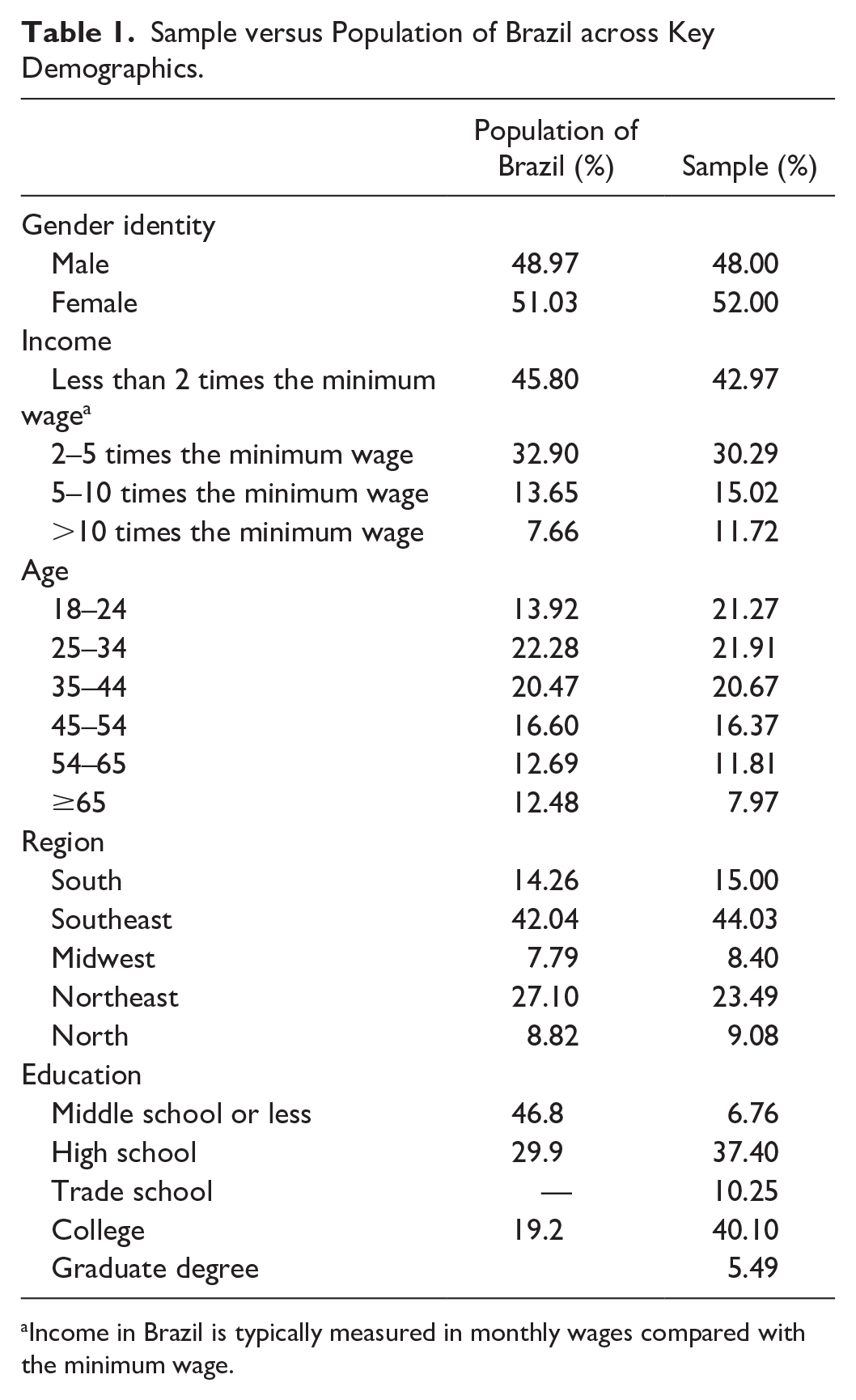
Income in Brazil is typically measured in monthly wages compared with the minimum wage.
Experimental Manipulation
The experimental manipulation was done through a video and subsequently reinforced in a vignette. To create realistic manipulations of the frame components, I used three strategies. First, I watched more than 50 real press conferences of prosecutors working on corruption cases that took place between 2014 and 2020. I coded these press conferences across the four frame components emphasized by prior social movement studies—injustice, identity, agency, and urgency—and collected examples of each component. Second, I fielded a pilot study in which frames were operationalized through vignettes with a smaller sample (n = 600) in December 2021. Third, I organized a focus group with nine participants to pretest framing statements and selected frames that were most accurately classified by the focus group participants (see Appendix A for details about the focus group). Table 2 shows how each frame component was operationalized in the survey.
Prosecutors’ Quotes and the Manipulation of Frames.

The urgency frame was the one that changed the most because some participants in the focus group struggled to understand the idea of setbacks in anticorruption efforts. As a result, I opted for a more straightforward version of the urgency frame that clearly establishes the need for immediate action.
To make respondents’ interaction with the frame as realistic as possible, I hired a firm to record videos simulating a press conference of prosecutors. I hired two actors—one man and one woman—and staged a set to replicate what a real press conference looks like, which included a banner of the Public Prosecutor’s Office in the background (Figure 2).

Picture of the press conference from the video (left) compared with a real press conference (right).
In the video, prosecutors talked about an investigation that uncovered schemes of bribery in the Public Health Care Department in Brazil, involving Congress members, bureaucrats, and executives from large pharmaceutical companies. Just as in the real examples of press conferences I watched, the video starts with prosecutors describing the investigation, presenting the evidence, and calling for public support. To enhance the realism of the experiment, the video was not portrayed as hypothetical and instead appeared as if it represented a real investigation, but the survey included a debrief at the end where participants were told the video was fake. Following is the script used for the videos: Good morning, everyone. We scheduled this press conference to talk about Operation Health Care Embezzlement. We conducted 23 search warrants and 10 arrest warrants against Congress members, public officials, and executives from large pharmaceutical companies involved in a corruption scheme. The investigation revealed that the executives and Congress members were part of a criminal organization with public officials from the Ministry of Health to commit public procurement fraud on contracts concerning the purchase of medication and medical equipment. Based on bank statements and wiretaps, we collected evidence that indicates that this operation’s targets participated in a criminal organization to embezzle taxpayers’ money in the healthcare sector. The scheme worked as follows: members of Congress who had high-level contacts at the Ministry of Health were bribed by large pharmaceutical companies, and, in exchange, helped these companies win multimillionaire contracts illegally through defrauded public procurement processes. [TREATMENT] We hope that society becomes aware of the importance of the fight against corruption.
8
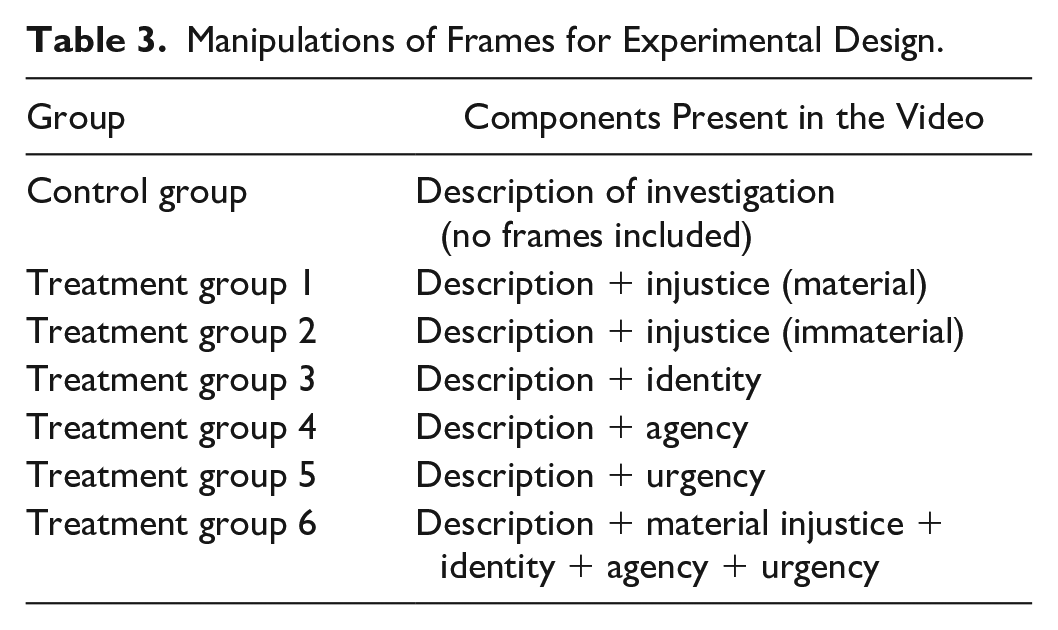
The videos were all identical except for one sentence toward the end in which prosecutors used one frame for each treatment group (one of the groups received a combination of each component). 9 The experiment consisted of seven different groups: the control group and six treatment groups (Table 3). Each video lasted approximately 1.5 minutes.
Manipulations of Frames for Experimental Design.
Because the effects of framing can be subtle, I also included a vignette about halfway through the survey that reminded participants of the frame. After answering questions about mobilizing attitudes, but before being asked questions about support for policies, participants were presented with a short vignette that simulates a note from the press about how the investigation in the video mobilized politicians both to propose bills that empower and weaken prosecutors’ anticorruption crusade. Just like the videos, all vignettes were identical except for the sentence that operationalizes the frames. Figure 3 shows an example of the vignette.
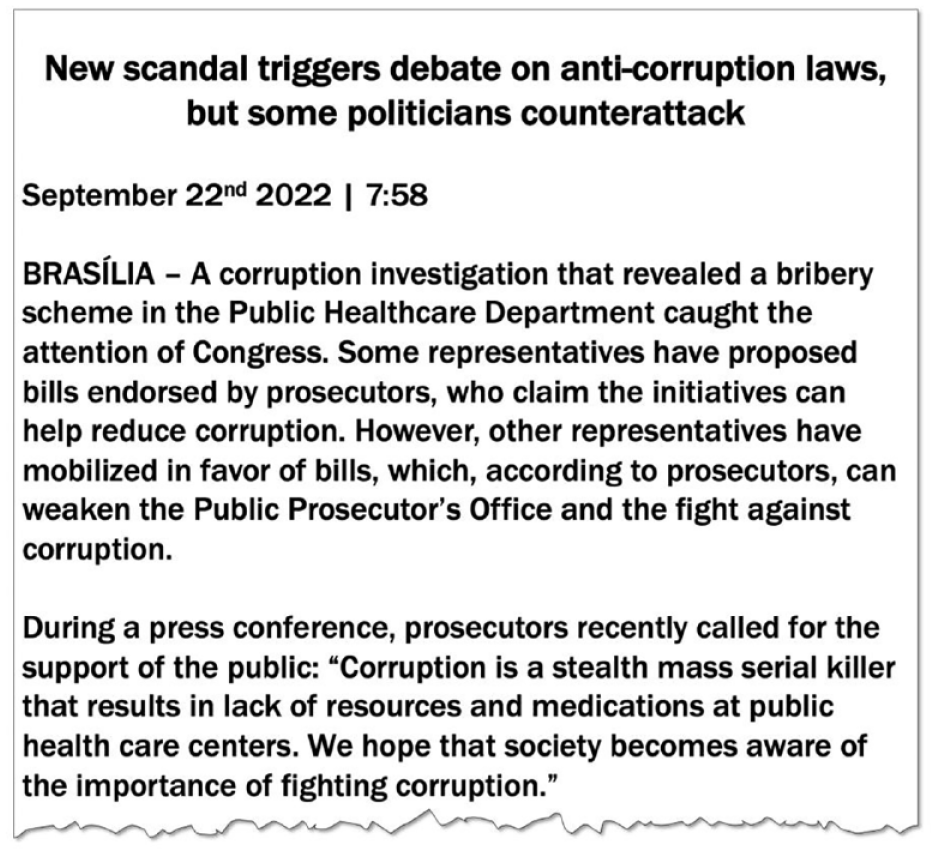
Vignette about the legislative effects of the investigation.
I omitted defendants’ partisan affiliations—instead, the video mentions that the investigation targeted politicians from “multiple parties”—from the videos and vignettes for three reasons. First, Brazil has a multiparty system with more than 30 different parties, which means that operationalizing parties in the experiment in addition to the frames would have required a substantially larger sample. Second, recent investigations in Brazil uncovered corruption schemes from a variety of parties that often acted together in the same criminal organizations (Lagunes and Svejnar 2020). As a result, portraying the investigation as targeting members from multiple parties also increased the realism of the videos. Third, the effects of frames are subtle. Prior research shows that people’s reaction to news of corruption is largely mediated by their partisan affinity with those accused of corruption (Anduiza, Gallego, and Muñoz 2013). As a result, partisan affinity—whether respondents identify with the same party as those accused of corruption—may have completely trumped the effect of frames.
To ensure that the treatment worked, I included a manipulation check after the video. 10 Respondents were asked: “Can you remember which sentence prosecutors said in the video? Select the sentence prosecutors said during the press conference.” For each treatment group that saw one frame, respondents were given two options: the quote used to signal the frame and a fictional sentence that was not present in the video but that is closely related to corruption investigations and has been used by prosecutors in real press conferences in the past: “We cooperated with international authorities to collect evidence that demonstrates the involvement of the people who were accused in the corrupt schemes.” 11 Because the control group did not see any frames, their manipulation check contrasted the aforementioned fictional sentence with a real sentence from the videos: “Based on bank statements and wiretaps, we collected evidence that indicates that the targets of this investigation participated in a criminal organization.”
Table 4 presents the percentage of respondents who passed the manipulation check for each frame. For all treatment groups with a single frame, on average, about 80 percent of respondents passed the manipulation check. Respondents assigned to the treatment group with multiple frames passed the manipulation check at lower rates, likely because the check for this group demanded that respondents remember multiple sentences. 12
Manipulation Check Results.

Variables
All variables were measured on a five-point scale ranging from totally disagree to totally agree, unless otherwise specified. Willingness to participate in collective action was measured by asking respondents to what extent they agreed with the following statements: “I support the investigations,” “I would sign a petition for the dismissal of public agents involved in the corrupt scheme,” “I would join a street protest against corruption,” “I would participate in a pot banging protest against corruption,” and “I would text/call my friends to join a protest against corruption.”
Support for bills to address corruption 13 was measured through the following question: “Please indicate if you support the following bills that prosecutors claim would strengthen the fight against corruption.” Respondents rated four different bills: “Allow felons to be sent to prison following a circuit court conviction,” “Increase the sentence of corruption crimes involving high sums of money,” “Allow prosecutors to use illegal evidence in court, provided that it was obtained in good faith,” and “Make it a crime to have more assets than what one’s income can explain, even if prosecutors cannot prove acts of corruption.”
Support for bills that constrain anticorruption efforts was measured in the following way: “Please indicate if you support the following bills that prosecutors claim would weaken the fight against corruption.” Respondents rated four different bills: “Introduce 5-year quarantine for prosecutors who seek to run for office,” “Prohibit prosecutors from extending investigations without a proper justification,” “Ban prosecutors from conducting investigations, transferring all investigative powers to the police,” and “Criminalize the behavior of prosecutors who threaten defendants to sign plea bargain deals.”
I also collected data on respondents’ perceptions of the performance of prosecutors, which was measured through the following question: “To what extent do you believe the prosecutors in this case are” “impartial,” “credible,” and “competent.” Moreover, I collected data on respondents’ perceptions of corruption and trust in prosecutors. Following Montgomery, Nyhan, and Torres (2018), to avoid posttreatment bias, I asked these questions at the beginning of the survey, before respondents were exposed to the treatment. Perceptions of corruption were measured by asking, “To what extent do you agree with the following statements”: “The vast majority of Representatives and Senators in Brazil are corrupt,” “The vast majority of public servants in Brazil are corrupt,” and “The vast majority of Brazilians would engage in corruption if they occupied a public office.” Trust in institutions was measured through the following question: “To what extent do you trust the following institutions?” Respondents selected an option from a five-point scale ranging from extremely distrust to extremely trust for three categories: Congress, the Public Prosecutor’s Office, and political parties.
Analysis
My first analytical strategy was to estimate the average treatment effects with ordinary least squares (OLS) models. I ran the OLS models including the full set of controls: gender identity, income, ideology, party identification, race, age, education, region, trust in prosecutors, disposition of participation in collective action, disposition to report corruption, perceptions of how widespread corruption is, and perception of how impartial, credible, and competent prosecutors were. I also ran the same models dropping posttreatment variables—respondents’ perceptions of the extent to which prosecutors were credible, impartial, and competent, as well as disposition to report corruption—given that these variables could introduce bias (Montgomery et al. 2018). Across these models, I compared each frame component with the control group, as well as material injustice frames to the other treatments.
In the main text, I present the results of the average treatment effect models. However, I also estimated complier average treatment effects (CATEs) through generalized structural equation models (Gerber and Green 2012; Troncoso and Morales-Gómez 2022). This is because we should only expect the treatment to work if respondents paid attention to the frame, and a nonnegligible proportion of respondents failed the manipulation check (Table 4). This analytical strategy can be useful when the intention to treat does not automatically correspond to receiving the treatment because, in these contexts, the average treatment effect would be biased. The CATE addresses this problem by comparing the outcomes for participants who complied with the treatment and those who would have complied if assigned to receive treatment (Troncoso and Morales-Gómez 2022).
As I will show, this method revealed somewhat different results from the standard average treatment effect. The CATE showed that concrete injustice frames and identity frames significantly affected some of the outcome variables: willingness to sign a petition and support for one bill that weakens prosecutors. But as I will show, these results must be read with caution, not only because the CATE models can introduce bias in the results—it is challenging to determine who would have complied if assigned to a particular treatment 14 —but also because of the problem of multiple comparisons. In other words, it is possible that these effects estimated by the CATE models were due to chance because of the large number of comparisons calculated in this study. I estimate the effects of six different frames (relative to the control group) on five mobilizing attitudes, support for four bills that empower prosecutors, and support for four bills that weaken prosecutors. In the first scenario, I conducted 30 comparisons, whereas in the last two scenarios, I conducted 24 comparisons each. This raises the question of whether significant effects represent true effects or are just a product of chance given the number of comparisons made.
To address the multiple-comparisons problem, I used two strategies. First, to decrease the risk for type I error in multiple comparisons, I adjusted the p values using the Bonferroni method. The rationale of this method is that the standard α value of .05 is not appropriate when conducting a large number of comparisons. Therefore, this method suggests lowering the p value for each test by dividing it by the number of comparisons. For the models that test the effect of frames on mobilizing attitudes, this means dividing the p value by 30 (.05/30 = .002), whereas for the models that test the effect of frames on support for policies, this means dividing the p value by 24, which arrives at a very similar value (.05/24 = .002).
In addition to these p value adjustments, I also created indexes that group similar dependent variables into one single variable to address the problem of multiple comparisons (see Table C7 in Appendix C). I created three indexes: one index on mobilizing attitudes that was calculated by the average value of the following variables: support for the investigation, and willingness to sign petitions, participate in pot bangs, participate in protests, and organize protests. The second index refers to support for policies that empower prosecutors and was operationalized by calculating the average value of support for the four bills presented to respondents as proposals that empower prosecutors’ anticorruption efforts. Similarly, the third index refers to support for policies that weaken prosecutors and was operationalized by calculating the average value of support for the four bills presented to respondents as proposals that weaken prosecutors’ anticorruption efforts. As I will show, the CATE effects do not hold when using these robustness checks to account for the multiple comparison problems, further evidence that the results from these models should be read with caution.
Findings
Although research on collective action frames would lead us to expect prosecutors’ framing efforts to affect mobilizing attitudes, the results revealed that frames used by prosecutors do not seem to produce the intended effect. The analysis showed that none of the frames—injustice (material), injustice (immaterial), identity, agency, urgency, and a combination of all of them—consistently and significantly affects mobilizing attitudes on corruption. In other words, compared with the control group that was not exposed to any collective action frames, groups exposed to each of these frames were just as likely to support investigations or demonstrate a willingness to mobilize against corruption (Figure 4). The effect of material injustice frames, for example, was positive for support for the investigation and willingness to sign a petition, but did not reach statistical significance.

Coefficient plots for the effect of frames on mobilizing attitudes.
The results also showed that the effect of material injustice frames was not consistently and significantly different than that of other frames. In other words, material injustice frames do not significantly affect mobilizing attitudes compared with the control group as well as to groups assigned to other frames (see Table C2 in Appendix C).
The models that estimated the effect of frames on support for policies that strengthen or weaken prosecutors’ efforts to fight corruption revealed a similar pattern. Collective action frames do not consistently and significantly affect respondents’ support for bills that empower prosecutors. Compared with the control group, the effect of material injustice frames was positive for three of the four bills—expedite sentence for those convicted, increase sentence for corruption crimes, and criminalize illicit enrichment—but did not reach statistical significance across the OLS models (Figure 5). The effect of material injustice frames was also not significantly different compared with the other frames (see Table C4 in Appendix C).
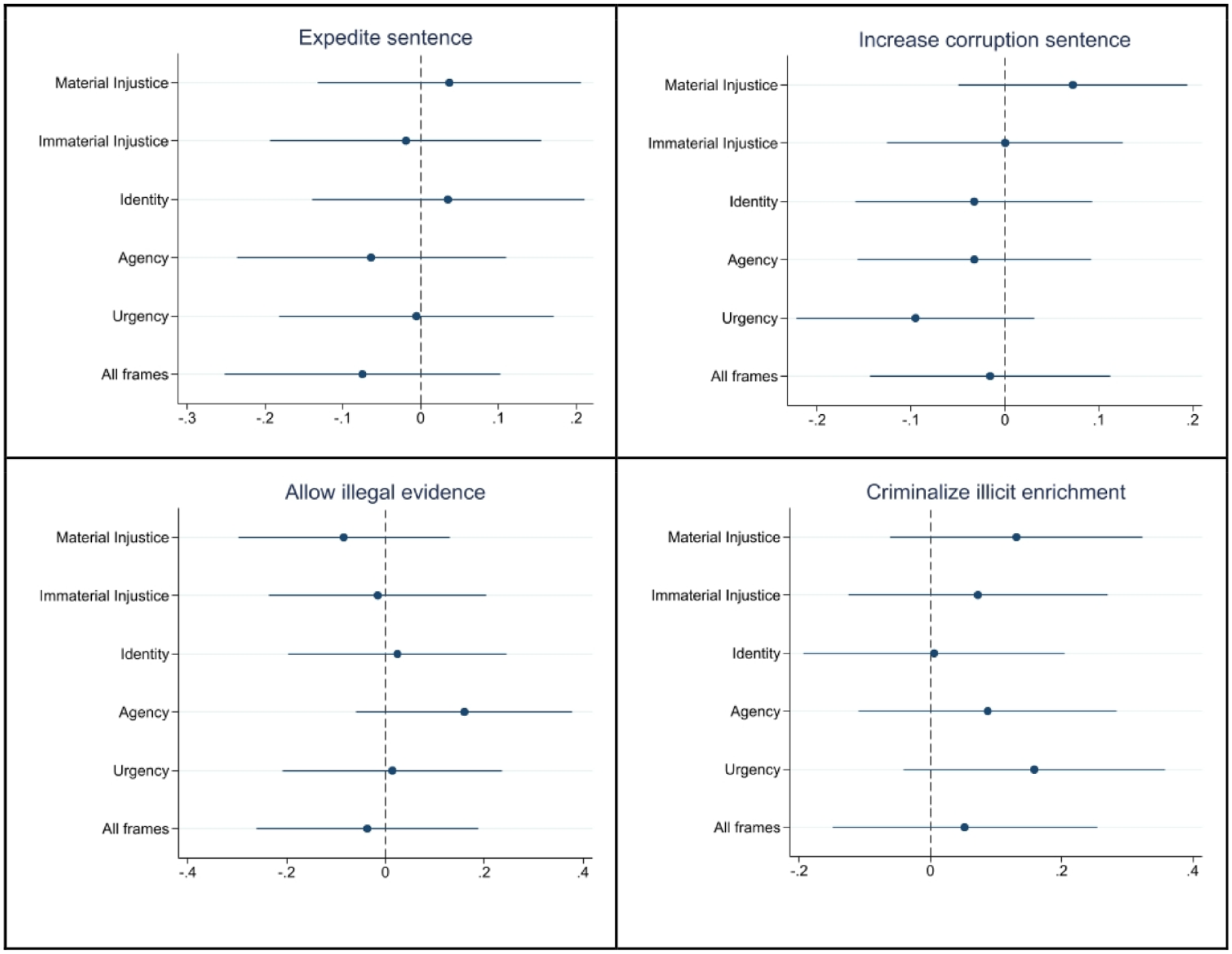
Coefficient plots for the effect of frames on support for bills to empower prosecutors.
Although these results suggest that prosecutors have little to gain from engaging in framing work in terms of triggering mobilizing attitudes and gathering support for bills they advocate as important to advance their efforts to criminalize corruption, there is also evidence that collective action frames do not hurt prosecutors. The effect of collective action frames did not consistently and significantly shape respondents’ support for bills that weaken prosecutors’ efforts to fight corruption (Figure 6). Just like before, the effect of material injustice frames was not significantly different from the control as well as from the other frames (see Table C6 in Appendix C).

Coefficient plots for the effect of frames on support for bills to weaken prosecutors.
Finally, the results showed that the treatment did not vary significantly according to respondents’ trust in prosecutors, as I previously expected. One possibility is that respondents see the fight against corruption as an interorganizational initiative, which means that their trust specifically in prosecutors has little effect on what they are willing to do in relation to corruption. Indeed, recent investigations such as Lava Jato were coordinated by multiple agencies beyond the Public Prosecutor’s Office, such as the Federal Police and Federal Accounting Office (Da Ros and Taylor 2022).
Similarly, the results revealed that there were no heterogeneous effects according to respondents’ levels of education. One possible explanation is that the frames were very accessible and did not rely on legal jargon. Therefore, although education may be a predictor of how well people understand the technical description of investigations (e.g., which kind of evidence prosecutors collected and through which means), it has little effect on how people understand the frames, which are deliberately designed to be less technical and more intelligible. As a result, it is likely that respondents understood the frames regardless of their instruction levels. 15
CATE Results
Although the results from the experiment show that prosecutorial framing efforts fail to trigger mobilizing attitudes or support for bills that empower or weaken prosecutors’ anticorruption efforts, there is evidence that material injustice frames could matter for some outcomes. Following the standard practice with experiments (Montgomery et al. 2018), the results above all refer to the full sample of respondents, including those who failed the manipulation check. In other words, these results are based on a sample that treats the same way respondents who paid attention to the video and remembered the frame and respondents who did not pay attention or remember the frame embedded in the video. This is because removing noncompliers can result in bias (Montgomery et al. 2018). On the other hand, we should only expect treatments such as framing effects to work when individuals exposed to them pay attention.
Therefore, although I present the most conservative estimates in the article represented by average treatment effects, I also ran CATE models. The CATE models suggest that material injustice frames matter for some of the outcomes. Specifically, these models showed that material injustice frames—which emphasize the consequences of the problem for peoples’ daily lives—increased by 4 percent respondents’ willingness to sign a petition for the dismissal of public authorities allegedly involved in the corrupt scheme (see Table C8 in Appendix C). Although this effect may seem small, its magnitude is nonnegligible given that framing effects are quite subtle, especially considering frames were operationalized by only one sentence at the end of the video.
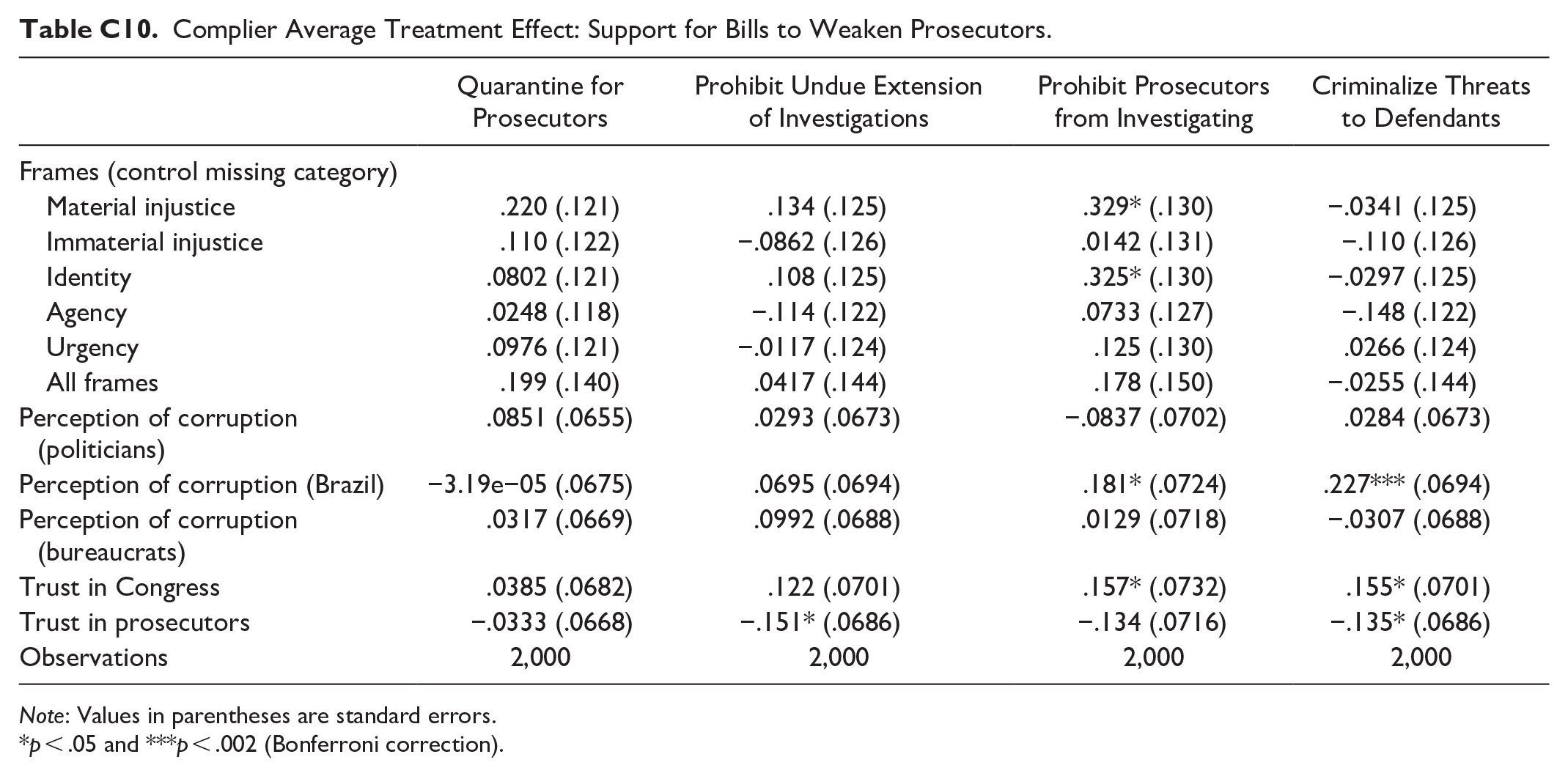
Paradoxically, the CATE models also revealed that some frames—material injustice and identity frames—increased support for bills aimed at weakening prosecutors’ efforts to fight corruption (see Table C10 in Appendix C). Specifically, the models showed that material injustice frames increased by 12 percent support for a bill that removes from the Public Prosecutor’s Office the mandate to conduct investigations, transferring all investigative powers to the police. The models also suggest that material injustice frames increase support for a bill that introduces a five-year quarantine for prosecutors who seek to run for political office, but this result was statistically significant at only the .10 level.
The results from the CATE models, however, should be read with caution because of the two reasons previously mentioned. First, they rely on CATEs rather than the standard average treatment effects. Therefore, there is the possibility that these models introduce bias to the results because “the types of subjects who fail the manipulation check under one treatment may not be the same as those who fail under a different treatment” (Aronow, Baron, and Pinson 2019:575). Moreover, these results are not robust to different tests that address the problem of multiple comparisons discussed in the methods section. For example, as shown in Tables A9 to A11, these results are no longer significant when using the Bonferroni correction that adjusts the p value by dividing it by the number of comparisons (in this case, by using a p value of .002). Furthermore, although the results were significant for these particular outcomes, they lost significance when grouping the different outcome variables into indexes of mobilizing attitudes and support for bills that empower or weaken prosecutors.
Conclusion
This study contributes to scholarship on framing and social movements. First, it shows that although collective action frames articulated by social movements may effectively trigger mobilizing attitudes (Gamson 1992; Snow et al. 1986, 2014), similar efforts of framing done by prosecutors do not elicit the same responses, at least in the context of anticorruption frames. Leveraging an experimental study of anticorruption campaigns in Brazil, I show that none of the components of prosecutors’ framing efforts—injustice frames (material or immaterial), identity, agency, and urgency—consistently and significantly increase willingness to engage in collective action against corruption. This finding also has important broader implications for studies on prosecutors. Whether it is normatively desirable or not, prosecutors are increasingly using the press and media outlets more than before (Joy and McMunigal 2014; Modisett and Dreyer 2005), thereby raising the question of whether and through which frames prosecutors can generate public support for a cause. This study contributes by systematically testing the independent causal effects of different frame components, showing that none of them consistently affect mobilizing attitudes or support for bills that strengthen or weaken prosecutors’ efforts to fight corruption.
The finding that prosecutorial framing efforts against corruption do not increase mobilizing attitudes or support for bills related to corruption opens up important avenues for future research on collective action frames. First, future studies could further examine the conditions under which frames against corruption affect mobilizing attitudes by analyzing framing efforts from other actors in the anticorruption field. For example, future work could compare collective action frames about corruption articulated by prosecutors with similar frames made by different actors, including nonprofit organizations, social movements, and other state officials such as detectives and judges. It is possible that nonstate organizations are better positioned to engage in collective action framing against corruption because state officials are expected to behave in impartial and apolitical ways.
To better understand if and when prosecutors can increase mobilizing attitudes by constructing collective action frames, future studies could also compare prosecutorial efforts of framing in areas other than corruption. Prosecutors may struggle to build collective action frames around corruption—in particular political corruption—because it is an issue closely related to partisan dynamics. When prosecutors press charges against politicians, they can hurt the reputation of (certain) political parties (González Ocantos et al. 2023). It is possible that prosecutors can more effectively engage in framing work in issues that are less controversial or connected to partisan struggles, such as drug or human trafficking. Future work could therefore compare the effectiveness of prosecutors’ frames across various issues that vary according to the degree of controversy and proximity to partisan divides.
Future studies could also test the effectiveness of prosecutors’ framing efforts in contexts beyond Brazil, in particular because prosecutors in Brazil are uniquely autonomous and constitute a fourth branch of government, similar only to prosecutors in Italy (Kerche 2018). In other countries, such as the United States, state prosecutors (district attorneys) are typically elected, whereas federal prosecutors (U.S. attorneys) are appointed by the president (Sklansky 2018), unlike Brazilian prosecutors who are tenured bureaucrats recruited via impersonal exams. It is possible, for example, that there is less of an expectation that appointed prosecutors behave impartially and apolitically, and therefore that their framing efforts are met with less resistance, in particular among those publics who share prosecutors’ partisan identity.
Finally, to further explain when anticorruption frames are effective, future work could compare efforts to build collective action frames against corruption in countries with varying levels of corruption. Brazil is a country that has historically struggled with corruption, in particular at the highest levels of government (Power and Taylor 2011). This may result in a perception that everyone involved in politics is corrupt, thereby reducing hope that corruption can actually be addressed (Pavão 2018). Indeed, about three fourths of respondents in the survey agreed or strongly agreed that the vast majority of politicians in Brazil are corrupt. It may be that frame components, especially those that revolve around agency and urgency, are more effective in contexts in which the overall levels of political corruption are lower and where people believe they can reduce corruption through mobilization. Future studies could compare, for example, the effects of framing around anticorruption campaigns in countries where the baseline level of corruption is high with countries where levels of corruption are lower.
Footnotes
Appendix A: Organization of the Focus Group
I recruited participants by posting messages on Facebook and WhatsApp groups of a neighborhood in Brasília (the capital of Brazil). To maximize variation in demographic characteristics, I created a form in which interested participants had to fill in information about their level of education, gender identity, and political ideology. I selected participants to maximize variation across these three characteristics.
The focus group consisted of two main activities. First, participants were presented with videos containing different frame components and were told to talk about how the frame made them feel (without any prior knowledge that it was an injustice, identity, agency, or urgency frame). Second, I gave participants a sheet of paper with definitions for each frame component and then read to participants three examples of each frame and had them classify each one according to the frame that was closest to the idea the examples were transmitting.
The definitions presented to participants were as follows: “1) Injustice: show the damage caused by the problem, 2) Identity: show who is affected by the problem and who caused the problem, 3) Agency: motivate people to mobilize and do something about the problem, and 4) Urgency: show the need to act urgently to address the problem.”
The results revealed that participants correctly classified each frame component more than 90 percent of the time. I selected the frames that were most accurately classified by the focus group participants.
Appendix B: Descriptive Statistics
Means and Proportions of Key Demographics across Treatment Groups.

| Control | Injustice Material | Injustice Immaterial | Identity | Agency | Urgency | All | |
|---|---|---|---|---|---|---|---|
| Ideology (1–7) | 4.07 | 4.26 | 4.26 | 4.39 | 4.29 | 4.11 | 4.31 |
| Trust in prosecutors (1–5) | 1.73 | 1.85 | 1.73 | 1.78 | 1.63 | 1.76 | 1.73 |
| Corruption perception (1–5) | 4.02 | 3.81 | 3.93 | 3.93 | 4.04 | 3.96 | 3.97 |
| Activism disposition (1–5) | 1.82 | 1.79 | 1.78 | 1.88 | 1.69 | 1.78 | 1.77 |
| Men | 50.60 | 50 | 47.02 | 45.91 | 46.36 | 50.44 | 45.19 |
| Middle school | 3.31 | 6.79 | 6.94 | 8.83 | 9.09 | 4.63 | 7.92 |
| High school | 41.39 | 37.96 | 34.72 | 37.81 | 32.66 | 39.50 | 37.74 |
| Trade school | 10.26 | 11.42 | 9.72 | 12.37 | 10.10 | 8.90 | 8.68 |
| College | 39.07 | 38.27 | 41.32 | 35.34 | 43.77 | 40.93 | 42.26 |
| Graduate school | 5.96 | 5.56 | 7.29 | 5.65 | 4.38 | 6.05 | 3.40 |
| White | 48.68 | 48.00 | 46.53 | 48.59 | 51.85 | 57.24 | 47.73 |
| Brown | 33.77 | 32.92 | 35.76 | 35.56 | 34.68 | 30.04 | 34.85 |
| Black | 9.93 | 13.23 | 10.76 | 9.86 | 6.06 | 9.19 | 12.12 |
| Other | 7.62 | 5.85 | 6.94 | 5.99 | 7.41 | 3.53 | 5.30 |
| 18–24 | 22.12 | 19.89 | 25.30 | 21.07 | 23.03 | 16.72 | 20.83 |
| 25–34 | 23.33 | 22.58 | 19.94 | 22.96 | 20.70 | 22.09 | 21.79 |
| 35–44 | 20.30 | 18.28 | 19.64 | 22.01 | 21.87 | 21.79 | 21.15 |
| 45–54 | 15.45 | 16.40 | 17.56 | 15.09 | 16.03 | 16.42 | 17.63 |
| 54–65 | 10.00 | 13.17 | 12.50 | 11.32 | 9.62 | 14.03 | 11.86 |
| ≥65 | 8.79 | 9.68 | 5.06 | 7.55 | 8.75 | 8.96 | 6.73 |
Appendix C: Model Results
Complier Average Treatment Effect: Support for Bills to Weaken Prosecutors.
| Quarantine for Prosecutors | Prohibit Undue Extension of Investigations | Prohibit Prosecutors from Investigating | Criminalize Threats to Defendants | |
|---|---|---|---|---|
| Frames (control missing category) | ||||
| Material injustice | .220 (.121) | .134 (.125) | .329* (.130) | −.0341 (.125) |
| Immaterial injustice | .110 (.122) | −.0862 (.126) | .0142 (.131) | −.110 (.126) |
| Identity | .0802 (.121) | .108 (.125) | .325* (.130) | −.0297 (.125) |
| Agency | .0248 (.118) | −.114 (.122) | .0733 (.127) | −.148 (.122) |
| Urgency | .0976 (.121) | −.0117 (.124) | .125 (.130) | .0266 (.124) |
| All frames | .199 (.140) | .0417 (.144) | .178 (.150) | −.0255 (.144) |
| Perception of corruption (politicians) | .0851 (.0655) | .0293 (.0673) | −.0837 (.0702) | .0284 (.0673) |
| Perception of corruption (Brazil) | −3.19e−05 (.0675) | .0695 (.0694) | .181* (.0724) | .227*** (.0694) |
| Perception of corruption (bureaucrats) | .0317 (.0669) | .0992 (.0688) | .0129 (.0718) | −.0307 (.0688) |
| Trust in Congress | .0385 (.0682) | .122 (.0701) | .157* (.0732) | .155* (.0701) |
| Trust in prosecutors | −.0333 (.0668) | −.151* (.0686) | −.134 (.0716) | −.135* (.0686) |
| Observations | 2,000 | 2,000 | 2,000 | 2,000 |
Note: Values in parentheses are standard errors.
p < .05 and ***p < .002 (Bonferroni correction).
Acknowledgements
This project benefited greatly from suggestions from Erin McDonnell, Ann Mische, Rory McVeigh, Aníbal Pérez-Liñan, Kraig Beyerlein, Dana Moss, Jacob Turner, Ludovico Feoli, Virginia Oliveros, Igor Acácio, Emilia Simison, Anna Callis, and Hannah Baron. Earlier versions of this article were presented at the Studies of Politics and Movements Workshop at the University of Notre Dame.
Funding
The author(s) disclosed receipt of the following financial support for the research, authorship, and/or publication of this article: This project was funded by a Graduate Student Research Award from the Institute of Liberal Arts at the University of Notre Dame and a Kellogg Institute Graduate Student Research Grant.
