



Abstract
Social innovations and changes in educational systems are the cornerstones for success of emerging countries. Current developments in Brazil and heterogeneity of society make the country a perfect candidate to investigate these topics. Drawing on historical analysis and content analysis, the author builds a model that recognizes patterns of social change. This model enables to analyze social change through the interaction of radical changes, innovations, social movements, and reforms. This model is applied to two periods in Brazil, where social movements, like the revolution in the 1930s and the military coup in the 1960s, triggered a series of social changes. The findings of this study suggest that social change is a cyclical process where social innovations and educational change are involved. These findings have significant implications for our understanding of current changes in the Brazilian society and provide a key instrument for analyzing social change in other societies.
Introduction
Since 2013, Brazilian society has experienced radical governmental changes and social protests against unemployment, health care, and cuts in budgets for education and science. These radical changes indicate that Brazil is an appropriate country for studying innovations in society and the education system. Brazil also represents a challenging case of study due to its diversity in terms of social class, ethnic groups, urban–rural differences, and gender differences. Awareness of social diversity in research is necessary, in order to recognize differences and tackle inequalities in better ways (De Freitas, 2017).
Here, the article focuses on social movements and social innovations that pushed a great part of educational modernization and change in the country in two specific periods. Using this approach, this article is not meant to provide a general model for the diverse Brazilian society, but to investigate patterns of social changes followed during these periods.
This article provides a tool for studying trends in social change and offers a new approach to analyzing social change that can be useful for studying other countries. Hence, the case of Brazil can be used to deepen our understanding of the ways in which societies innovate. This article investigates the meaning of social innovation and educational change in Brazil. It considers radical changes, social movements, educational reforms, and social innovations in two key periods of change in the country and also discusses current events. The model proposed in this article is based in two historical periods with relevant changes in Brazil. It includes national events, but it focuses on three states of Brazil. These states are relevant because most of the political pressure groups and economic elites of the analyzed periods were concentrated there and boosted change at the national level.
The central questions that are addressed in this article are as follows:
Has Brazilian society played a major role in the development of innovations in education in the last century? To what extent are social innovations and social movements in Brazil linked to educational and social change?
These questions emerge from three reflections on Brazilian society: the high investment in public education in Brazil, which has had poor outcomes; the recognition of Brazil as a driver of social innovation in Latin America; and the leading position of Brazil in social movements in Latin America.
Since 2008, Brazil has spent significantly more on primary to tertiary education than the Organisation for Economic Co-operation and Development (OECD) average (5% averaged from 2005 to 2015, compared to 4.7% of the gross domestic product (GDP) 1 ; OECD, 2016, 2018b). Despite this higher investment, enrolment of 15–19-year-old students at any level of education is among the lowest in comparison with the OECD average (69% compared to 85%; OECD, 2018a).
Brazil’s number of social innovations is higher than other countries in Latin America (Domanski et al., 2017; Rey de Marulanda & Tancredi, 2010; Rodríguez Herrera & Alvarado Ugarte, 2008). Some fields in which innovation in Brazil was implemented, are for example, participation of civil society in public decisions and in the improvement of education. In the field of education, Brazil stands out as the country with the most innovations between 1998 and 1999 (44 cases from 95) among 18 Latin American countries 2 (Blanco & Messina, 2000).
In the 1930s, there was high social participation in public issues in Brazil. It is important to remark that such participation was initiated by the privileged social classes in Brazil (Ghanem, 1998). In contrast, in the 1960s and 1970s, mobilization for democratization and demands for better living conditions for the poor boosted social movements and the rise of nongovernmental organizations (NGOs) (Ghanem, 2012). Gohn recognizes that in the beginning of the twenty-first century, NGOs in Brazil replaced social movements due to an increase in association with more active participation in public topics (Gohn, 2011). Hence, investigation of the links between radical changes and social movements is important in understanding the origins and consequences of social innovations.
Current scientific debates seek to identify the main differences between technological innovation and social innovation (Howaldt & Kopp, 2012; Rammert et al., 2018). Recent research suggests that social innovations produce new institutions (Huberman, 1973, p. 5; Rammert, 2010; Zapf, 1989, 2003), new organizations (Kesselring & Leitner, 2008; Neumeier, 2011), and new social relations (Fontan et al., 2008; Moulaert et al., 2005). Howaldt and Schwarz (2010) define social innovations as “new social practices that aim to meet social needs in a better way than the existing solutions.”
Some authors suggest that social innovation has an impact on social change (Howaldt & Schwarz, 2010; Kesselring & Leitner, 2008). Nevertheless, the question remains as to what kind of social changes originate from social innovation. Zapf (1969) was one of the first to recognize the potential of social change through innovation when he argued that “social change is the interruption of stable situations whose stability needs to be known in order to recognize the potential for change.” 3 Similarly, Kesselring and Leitner (2008: 28) argue that “Social innovations are elements of social change that create new social facts, namely impacting the behavior of individual people or certain social groups.”
Studying innovation is not an easy task. Edquist (1997) suggests observing innovations as a system and from a historical perspective, meaning that social innovations should be contextualized within a specific time and space. Hence, Edquist’s research provides an analytical framework, based on a system-wide and historical perspective of innovation, helpful to be applied in Brazil.
Methodology
This study’s methodology consisted of a historical analysis of the key events that shaped the political, educational, and social context of Brazil during the nineteenth and twentieth centuries.
This study shows the trends of social change led by the most developed states in terms of economy and literacy opportunities, in the period of analysis. In this study, I recognized that historical development in Brazil is linked to different aspects, like cultural and economic differences between ethnic groups (Soares and Aristides dos Santos, 2018), meaning that regions developed with different speed and focus. Considering this, this article focuses on the main social movements and innovations that influenced modernization of educational system in the country in two specific historical periods.
Historical analysis was undertaken in two steps. First, I identified the key events in Brazil’s history and separated them into categories that cover the most important changes—related to innovation and educational change—in the country from 1800 to 2019. After this analysis, the states of São Paulo, Mina Gerais, and Rio de Janeiro were analyzed and identified as leading states on social innovation and educational change. Second, the categories used in the analysis are as follows: the main political changes, educational reforms, innovations in education, and social movements. All categories were considered at the national level, with the exception of reforms, where the state level was considered in cases where related reforms were identified.
I collected data from three main sources. First, journal articles and books focused on social movements, innovation and educational change in Brazil in the mentioned periods of analysis. The sources were in English, German, Portuguese, and Spanish. Second, as a primary source, I collected an online version of the original Manifests of the Pioneers of Education of Brazil. Third, I collected reforms of law, such as decrees and codes that reformed the Brazilian education system during the period of analysis. In addition, the state reforms of São Paulo state were analyzed. The decision to focus on state reforms of São Paulo was made after the first literature review, where I identified São Paulo state as one of the most reformist and innovating states in the country (Maldonado-Mariscal, 2017).
The data analysis was a historical analysis that included a literature review of social movements, innovation and educational change in Brazil and a content analysis of national and state reforms. The data analysis also included the Manifest of the Pioneers of Education of Brazil as a proposal for several educational reforms. To answer the first research question, I performed a historical analysis of key events in Brazil and divided them into three periods: the nineteenth century (1800–1899), twentieth century (1900–1999), and contemporary Brazil (2000–2019). The historical events were classified into five categories that were used to build a model: political changes, national reforms in education, state reforms in education in São Paulo, innovations in education, and social movements. To answer the second research question, I used a historical analysis and content analysis to identify relationships in different periods and events. Building on this, I developed a model of social innovation and educational change. This model facilitates an analysis of the existence of links between radical changes, social movements, reforms, and social innovations in specific periods in Brazil. This model functions as an analytical tool, based on the key historical events identified, and builds six new categories that are named in stages:
radical changes, social movements, experimental reforms, social innovations, macro reforms, and social change
In the following section, the model of social innovation and educational change depicted in Figure 1 and each stage of the model are explained.
Description of the Model
Radical change is a change of ideology in a society that recognizes that a current ideology or political system is no longer serviceable. For example, radical changes can be observed as revolutions. The group that opposes the dominant group collectively acts to replace the old ideology in such a way that a change in power and ideology occurs.
Social movements are the result of the goal of a collective and the identity of a group (Della Porta & Diani, 2006). One of the main differences between social movements and radical changes lies in the clear goal and organization of the collective action of a movement. In contrast, radical change focuses on changing a political ideology by removing a group from power. According to Della Porta and Diani (2006: 20), a social movement is a “social process where actors are involved in conflictual relations with clearly identified opponents, are linked by dense informal networks and share a distinct collective identity.” Social movements are motivated by group demands that create new priorities in politics and argue for their legitimization. Social movements are tightly linked to reforms (Fadaee, 2012). In this way, social movements take the form of concrete regulations or frameworks. Thus, I consider reforms the first institutionalizing process of social movements.
Experimental reforms occur when smaller reforms are implemented to test new regulations. Such reforms include previously ignored issues and cover specific demands from society. They have specific goals and cover particular issues that are not included in other reforms. In countries with a tradition of national reforms, a macro reform may occur, first, as an experimental reform.
Social innovations are changes implemented by a group of people reacting to a problem. Innovations usually offer better solutions to problems (Zapf, 1989). Social innovations change previous beliefs, norms, and institutions. Thus, they act at three levels: a cultural level (Barnett, 1953; Merton, 1938), a normative level, and an institutional level (Hämäläinen & Heiskala, 2007; Loogma et al., 2013). When applied to the education system, this concept can be understood as “interventions from below” on a micro level (Torres, 2000).
Macro reforms refer to educational “interventions from above” that are implemented on a macro level by the state (Torres, 2000). The main difference between experimental reforms and macro reforms is that macro reforms can occur at a later stage than experimental reforms. Macro reforms aim to ameliorate the mistakes of previous reforms or have greater coverage.
Social change refers to social evolution, meaning evolution in terms of a society’s progress in favour of its citizens. Social change shows an advanced phase of progress, where innovation is accepted and transformed in established institutions in a way that achieves a certain equilibrium and agreement within society. Zapf (1995: 389) defines social change as “the processual change of the social structure of a society in its basic institutions, cultural patterns, associated social actions and consciousness.” 4 This definition includes changes in institutions, culture, and awareness.
Summarizing the Model
Figure 1 illustrates the model of social innovation and educational change, which shows the six stages mentioned before. The starting point of this model is radical change, since radical changes abruptly modify the direction of a paradigm or ideology. The second stage depicts social movements that emerge from radical changes and depicts the organized actions of social actors to achieve common goals. The third stage illustrates reforms as a stage that collects and implements demands for change. Experimental reforms may deal immediately with the general object of the social movement. The fourth stage shows social innovation as a stage that reflects some reactions of adaptation and needs for change. The fifth stage also shows reform, but it represents macro reforms, meaning reforms that emerge from previous unsuccessful reforms. Macro reforms may act as an adaptation after social innovations are implemented. The sixth stage is a summary of all previous stages. This means that a certain level of change and an institutionalization of new practices have been achieved. Nevertheless, social change is not a static stage. It is possible to observe social changes by framing a specific time and space. However, social changes continue, and this phase moves on, starting a new cycle with a new radical change.
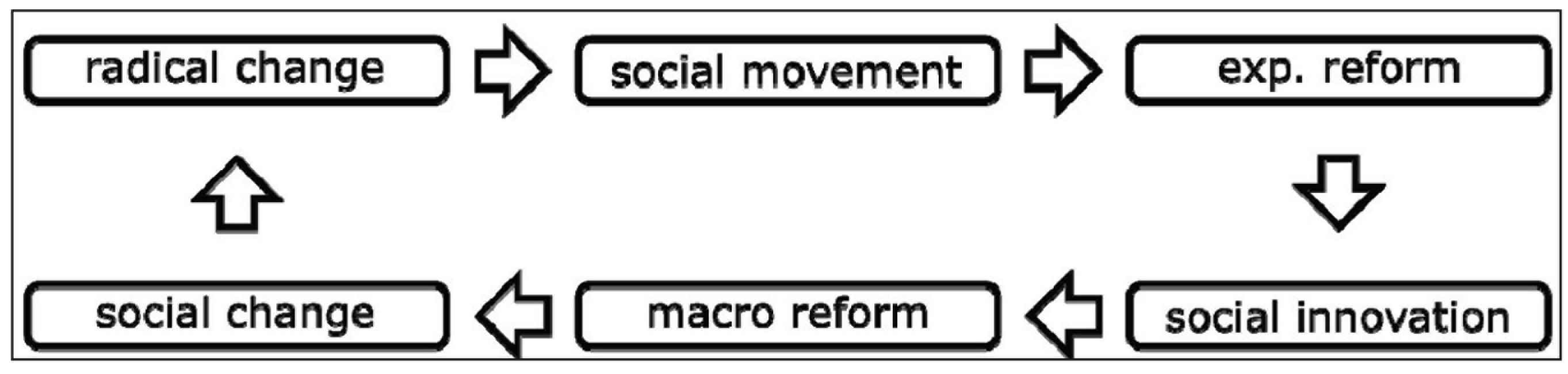
This article argues that a key stage within this model is that of social innovation, as this represents a milestone at which a society’s collective mind starts to experience a shift. One characteristic of social innovation is that it is rarely spontaneous: it is triggered by different groups and emerges simultaneously with different initiatives for change. Social innovations are examples of reactions to reforms that have failed to provide a satisfactory solution. Although social innovations do not have the magnitude and political power of social movements, they do have a tradition of engaging in power struggles (Hämäläinen & Heiskala, 2007).
Implementation of the Model of Social Innovation and Educational Change
The implementation of the model of social innovation and educational change was applied in two historical periods in Brazil: the 1930s and the 1960s. These two decades were selected because they are crucial points in Brazil’s history when radical changes arose with waves of activism relating to social issues and education.
Period 1: Brazil 1930–1964
The first period of social innovation and educational change in Brazil is from 1930 to 1964 and begins with the revolution of 1930. An unstable economy and political environment characterized the 1930s Brazil. The Brazilian revolution occurred during a period of strong economic depression worldwide.
Figure 2 illustrates the first period of social innovation and educational change in Brazil in the 1930s, including the six stages of the model. The seventh stage represents the starting point of a new radical change.
The following lines explain each of the stages depicted in Figure 2.
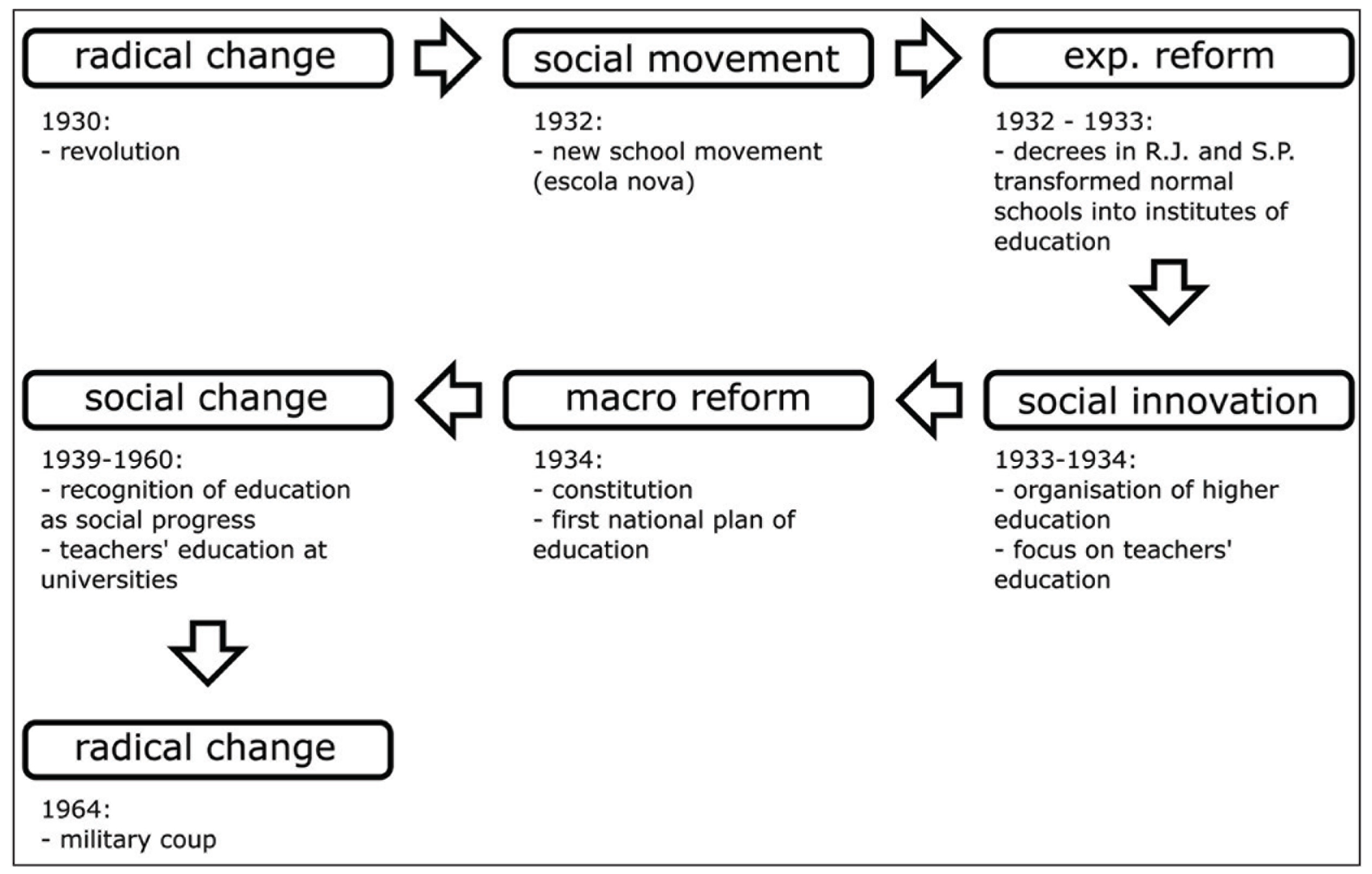
This movement had a strong influence on national and municipal reforms in Brazil (Da Cunha, 2005). Its principles were based on the Progressive Education Movement 5 that had emerged in the USA. Two leaders of this social movement in Brazil and considered as important thinkers on education were Azevedo and Texeira (Vilela & Dittrich, 2018); together, they wrote the Manifest of Pioneers of New Education, which promoted democratization, modernization, and innovation in education. This movement represented a milestone for later national and regional reforms in education (Vidal, 2013). The New School Movement and the transformation of the system of higher education set a strong basis for deeper reforms.
Period 2: Brazil 1964–2016
International events during the 1960s mobilized different social groups around the world through movements for workers’ rights, women’s rights, and minority rights. In some countries of Latin America, groups were also mobilized against military regimes, as in the case of Brazil.
Figure 3 depicts the second period of social innovation and educational change in Brazil from 1964 to 2016. This model begins with the military coup and gives continuity to the previous model, showing that radical change began to occur in the 1960s, but the effects and institutionalization of such changes took at least five decades. Social movements in Brazil have been a continuous process at least over four decades; however, this study focuses on one cycle related to innovation and educational change, which began in the 1960s.
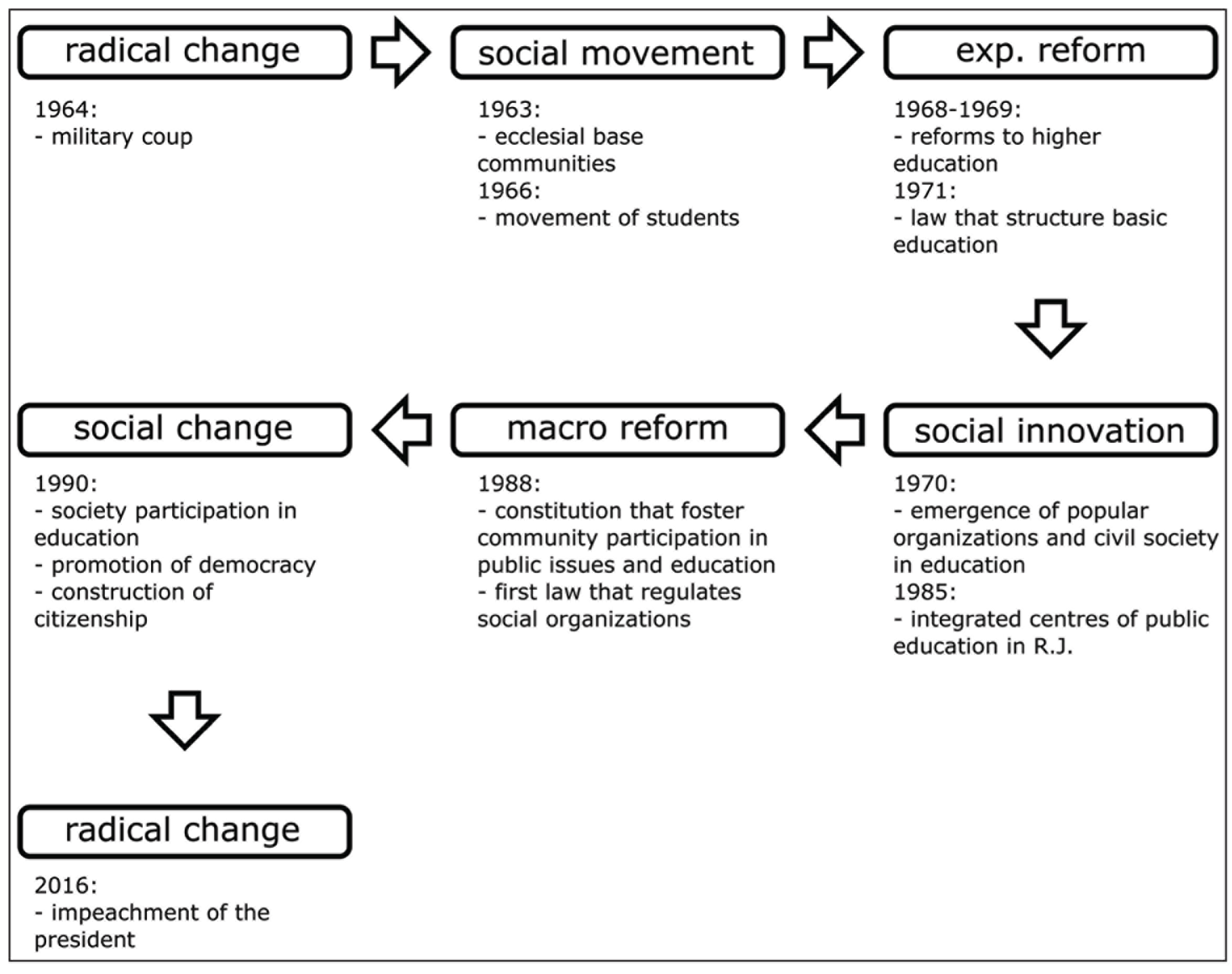
In 1960, the emergence of the National Union of Workers in Education defended the participation and rights of educators, while, decades later, social movements with community-based, popular organizations and civil society grew in popularity. These movements had two main objectives in common: they sought an end to the dictatorship and promoted democracy and rights for the marginalized. The social movements of the 1960s were based on the Basic Ecclesial Communities (Comunidades Eclesiais de Base; CEBs) and student movements.
The Basic Ecclesial Communities’ movement emerged in Brazil as an evangelical movement that was not only strongly against the military regime but also argued for access to education for all. This movement based its principles on two ideologies: the Theology of Liberation based on ideas of Latin American theologians and Paulo Freire’s Pedagogy of the Oppressed (Freire, 2000). The Theology of Liberation was supported by the Catholic Church as a set of ideas to protect and benefit the poor. Pedagogy of the Oppressed, on the other hand, argued that education and culture create mechanisms of oppression that subjugate the lower classes and the poor. For this reason, Freire argued that there was a need for freedom and autonomy in society, achieved through education and values (Freire, 2000). The movement built around Pedagogy of the Oppressed and other social movements based on the Christian Base Communities, which were not only popular in Brazil but also spread throughout Latin America (O’Cadiz et al., 2018). In Brazil, despite the closeness of the Basic Ecclesial Communities movement to the Catholic Church, the movement contributed to the construction of communitarian leaderships and to the opposition of dictatorships. Mainwaring (1987) asserts in his work Grassroots Catholic Groups and Politics in Brazil in 1964–1985 that the CEBs and other similar groups were crucial in opposing military rule. Another relevant social movement was the student movement that arose in 1966. This movement was not only against the dictatorship but also demanded democracy in the education system (Gohn, 2013).
The education reforms of the 1970s were introduced in basic education with the 1971 Law 5,692. This reform structured basic education and established a general curriculum that created new disciplines such as social organization, Brazilian policy, and moral and civic education.
The first CIEP was introduced in Rio de Janeiro in 1985 (the CIEP Presidente Tancredo Neves) and later spread to Sa˜o Paulo. Sa˜o Paulo experienced an increase in interventions in education, and similar CIEPs were implemented in Sa˜o Paulo under a different name—the Unified Educational Centers (Centro Educativo Unificado [CEU]). These centers were built in marginalized neighbourhoods that were difficult to access and which often had high criminality. More CEUs have been introduced in Sa˜o Paulo since 2001, and there are already 46 centers 11 spread throughout the state.
Contemporary Brazil
With the impeachment of President Dilma Rousseff, a new presidency and unstable government was installed (from Dilma, to Temer, to Bolsonaro). The 2016 impeachment was not an isolated event and was followed by protests in different states, demanding an end to corruption in the government.
Recently, in 2019, further protests among students and scientists have taken place against cuts to the research budget and unjustified increases in the cost of education. In 2020, a national strike on education was planned, but due to the worldwide COVID-19 pandemic, such a strike was cancelled. The findings from this study suggest that current protests can reach the magnitude of a social movement to demand an end to corruption and an increase in the education and research budget.
Thus, the radical change brought about by the impeachment of the president and the social movements of organized groups, like students and scientists, suggests that such events can bring about social innovation and educational change in Brazil. This opens the door to further investigations into whether a new cycle of social innovation and educational change is currently underway.
Conclusion
This article demonstrates that educational changes in Brazil are led by cyclical changes in society (radical changes), changes in educational law (reforms) and changes in ability of social actors to solve problems (social innovation). This article shows a model based on a complex and diverse society like Brazil. The advantages of such a model are the analysis of relationships and consequences of social movements and social innovation. A possible limitation of this study is that it focuses on two periods and, as such, cannot be applied to make generalized statements about Brazil.
Findings more generally valid suggest that social innovations and educational change are part of a cyclical process of social change. More specific findings for Brazil in the 1930s show the involvement of a pioneer educational movement for modernization of the national education system. Similarly, specific findings for Brazil in the 1960s show the participation of society in public issues like education as well as engagement of marginalized communities in the construction of regional education policies, where states like São Paulo, Mina Gerais, and Rio de Janeiro, appeared to be leaders on innovation in education.
The methodology of the historical analysis and content analysis provides limited scrutiny of all historical events in the country. However, this article presents two relevant examples in Brazil that can help us understand the influence of society in educational change. Moreover, it provides an original tool that can be used to analyze different time periods and countries.
Evidence from this study suggests that Brazilian society has played a key role in driving innovations in education and educational transformation in the last century. Although this study does not cover all possible radical changes in Brazil, it recognizes that society’s involvement plays a key role in changing the direction of education, reforms, and innovation in education. The results of this research also support the idea that innovations in education in Brazil are tightly linked to social movements and education reforms. Innovation is closely linked to social movements in the sense that social movements create opportunities to innovate. Social movements represent a strong driver for innovation because they lead to reforms and, consequently, to innovation.
The analysis performed in this article is relevant because social innovations are not isolated events that occurred suddenly, but they had a strong background in social movements and in society’s engagement in public issues.
These findings have significant implications for our understanding of how current changes in Brazilian society can be understood according to previous cycles of change. The major radical changes in the last century in Brazil took place in the 1930s and the 1960s. Therefore, an analysis of the political and social changes from 2016 onwards may provide tools to explain the new cycle of change in recent years and contribute to research on social innovation and social change.
More research is needed to understand how specific parts of society build new social movements and implement innovations. For example, how a feminist movement is linked to innovation, how a black movement, or how an indigenous movements build innovation, not only to improve education but also to recognize their own rights as citizens and to promote social change.
Authors such as Kesselring and Leitner (2008); Gillwald (s/n) Hochgerner (2009); Howaldt and Schwarz (2010); and Ogburn (1937) agree that social innovations create the conditions needed for social change. However, two other remaining questions that require further investigation are as follows: to what extent do social innovations lead to social change? And how can we recognize these changes?
Footnotes
Acknowledgements
I thank all the individuals from different disciplines who have encouraged, reviewed, supported, and read this publication. I thank both Professors Boike Rehbein and Jürgen Howaldt for their valuable feedback and support for this research. I also thank to Dr. Luzia Costa-Becker, who helped me to improve this manuscript with her knowledge of the Brazilian society. I am especially grateful to Professor Andreas W. Schell for his critical questions from a different scientific discipline and his support in finalizing this article.
Declaration of conflicting interests
The author declared no potential conflicts of interest with respect to the research, authorship, and/or publication of this article.
Funding
The author disclosed receipt of the following financial support for the research, authorship, and/or publication of this article: This publication was possible thanks to the financial support of the National Council of Science and Technology of Mexico (CONACYT), Grant 312499, and the German Academic Exchange Service (DAAD), Grant 5330 6407.