




Abstract
Scholars have linked income inequality to the recent success of radical-right parties and movements. Yet research shows that inequality reduces participation among groups likely to support the radical right and promotes support for redistribution, an issue championed by the radical left. This raises questions about why, if at all, inequality matters for radical-right politics. The author reconciles previous arguments by developing a theory that connects these phenomena through the process of boundary consolidation. He argues that inequality generates status threats that prompt exclusionary shifts in national group boundaries. This promotes ethnonationalism, a restrictive conception of national membership and, ultimately, support for the radical right, whose mobilization relies on ethnonationalist appeals. Analyses of time-series cross-sectional data from 38 countries support this theory, revealing that inequality is associated with greater ethnonationalism, with distinct associations by income and ethnicity, and that ethnonationalism strongly predicts radical-right voting. The author thus demonstrates how long-term structural changes are linked to contemporary radical politics and how arguments setting economic and cultural causes of the radical right in opposition are inadequate.
Explanations of the recent success of radical-right politics in Europe and North America frequently highlight the role of income inequality. Scholarly responses to the Trump election victory, Brexit referendum, and radical-right gains in numerous countries identify growing inequality as an important feature of the contexts enabling these phenomena (e.g., Bobo 2017; Dodd, Lamont, and Savage 2017; Inglehart and Norris 2017). 1 According to these accounts, inequality produces feelings of abandonment, alienation, and resentment within electorates that increase the appeal of right-wing causes. Such claims are premised on evidence that these parties, movements, and leaders disproportionately appeal to working-class, ethnic-majority voters and that their votes are motivated by feelings of economic marginalization. This evidence appears in ethnographic research documenting the grievances of white, working-class communities in multiple countries (e.g., Gest 2016; Hochschild 2018) as well as analyses of postelection surveys (Hobolt 2016; Morgan and Lee 2018). Scholars have drawn on warnings of the deleterious consequences of growing inequality in wealthy democracies (Piketty 2014) alongside reports of economic marginalization among the radical right’s key supporters to hypothesize that these phenomena are linked.
Although largely uncontroversial among scholars, claims regarding income inequality’s role in radical-right support rest on questionable theoretical and empirical grounds. Notably, this hypothesis appears inconsistent with previous research on income inequality’s political consequences. First, greater inequality tends to reduce political participation and election turnout, particularly among lower income voters (Gallego 2015; Schäfer and Schwander 2019). Second, income inequality, and especially perceptions thereof, are associated with support for redistribution (Condon and Wichowsky 2019; Schmidt-Catran 2016). Together, these findings appear to contradict what scholars have inferred about radical-right success: if electorally consequential supporters of radical-right parties are found primarily among the economically disadvantaged, then this group should become increasingly withdrawn from politics as inequality increases, rather than reinvigorated, but also, to the extent that they are involved, increasingly supportive of redistribution. As redistribution is most strongly represented by radical-left parties, previous findings would suggest that greater inequality leads economically marginalized voters to support the radical left, not the radical right. Moreover, although established theories of the origins of the postwar radical right in Europe make little mention of income inequality (Rydgren 2007), the few empirical studies on this topic have produced mixed results (Engler and Weisstanner 2021; Han 2016; Jesuit, Paradowski, and Mahler 2009). Previous research thus challenges claims about the origins of radical-right support and raises questions about why, if at all, income inequality matters for these parties and movements.
I reconcile recent arguments linking inequality to radical-right success and established research by synthesizing key findings from sociology, social psychology, and political science on inequality’s consequences, collective identification, and radical-right voting. Three insights are central to this theory. First, income inequality is a social status threat: inequality increases the salience of social status and generates anxiety about one’s position in the status hierarchy, leading to status enhancement strategies among those who feel their status threatened (Layte and Whelan 2014; Pickett and Wilkinson 2009). Second, shifting group boundaries are a response to status threat: threats motivate individuals to seek security by identifying with privileged groups while also redefining those groups’ boundaries to make membership more exclusive (Abascal 2020; Gorman and Seguin 2018; Wimmer 2008). Third, ethnonationalism is a core feature of radical-right appeals: an exclusionary conception of legitimate membership in the nation, ethnonationalism is a critical cultural cleavage on the basis of which the radical right draws voters (Bonikowski 2017; Mudde 2007).
The theory holds that income inequality generates heightened status threat, which in turn promotes ethnonationalism within the electorate and, ultimately, contributes to support for the radical right, whose mobilization strategies rely on ethnonationalist appeals. 2 I describe the process linking status threat to ethnonationalism as boundary consolidation, which refers to a structured exclusionary shift in individual conceptions of national boundaries that preserves one’s own ethnic or racial group’s inclusion but may exclude others. For dominant ethnoracial group members, boundaries should shift toward a conception that equates the nation with the dominant ethnic group while minorities’ conceptions will include their own group but may exclude other minorities. As a result, boundary consolidation among ethnic minorities may result in conceptions of the nation that, while relatively restrictive, nonetheless challenge and attempt to expand dominant conceptions of the nation that exclude minorities. I also use the term consolidation to distinguish the phenomenon documented in this study from related but distinct processes discussed in relation to ethnic boundaries, notably boundary contraction and expansion (Wimmer 2008).
I test the theory using data from the International Social Survey Programme (ISSP) National Identity module series, covering 38 countries over two decades, and income inequality data from the Standardized World Income Inequality Database (SWIID). Results from linear mixed-effects models indicate that countries with greater income inequality since the 1990s feature higher average levels of ethnonationalism and that, within countries, ethnonationalism tends to be strongest among lower income ethnic-majority group members. Moreover, inequality’s association with ethnonationalism is moderated by both household income and majority ethnic group membership, which are understood as characteristics that confer status and buffer status threats prompted by inequality. I find that income inequality is on average more strongly associated with ethnonationalism for individuals who are not members of the country’s majority ethnic group. For non–majority group members, inequality tends to be most strongly associated with nationalism for those with lower incomes while, for majority group members, inequality’s association is greatest at upper incomes. On the basis of results from logistic mixed-effects models, I find that ethnonationalism strongly predicts radical-right support net of demographic characteristics and levels of subjective social status, a prominent alternative explanation for the link between inequality and the radical right (Gidron and Hall 2020). These results are robust to a variety of estimation strategies and alternative specifications.
Findings provide correlational evidence of national boundary consolidation as a contextual effect of income inequality that, in turn, promotes radical-right support. This has numerous theoretical implications. First, by articulating an explicit mechanism linking inequality to radical-right support that pays attention to the distinction between deprivation and inequality, the study resolves a discrepancy in the literature on two phenomena of eminent interest in contemporary politics. Second, it shows the need to center nationalism in theories of radical-right success, which often conflate the radical right with populism, one of its constituent parts, and unjustifiably prioritize it at the expense of others. Third, by demonstrating how inequality is associated with electorally consequential cultural dispositions, it shows why setting cultural and economic causes of radical-right success in opposition to each other is fundamentally misguided.
Background
Radical-Right Success and Income Inequality
Radical-right parties are characterized by antiestablishment, anti-immigrant, and xenophobic orientations, and threaten established liberal democracies and their core commitments to principles such as civil rights and the rule of law (Rydgren 2007). Recently, these parties have been successful in numerous countries and particularly in Central and Eastern Europe, where they have prompted democratic backsliding by undermining minority rights and the separation of state powers (Bakke and Sitter 2022). In the United States, President Trump and the Republican Party have similarly flouted democratic norms through attacks on minorities, the media, and independent institutions and their efforts to undermine elections, raising concerns about democratic erosion (Levitsky and Ziblatt 2018). Given the potentially serious consequences of these parties and leaders for democratic societies, it is important to understand the conditions promoting their success.
An influential set of explanations for radical-right support focuses on economic causes and, among these, numerous accounts draw attention to high levels of inequality in countries experiencing radical-right success. Income inequality in many industrialized states, but particularly English-speaking ones, has grown dramatically since the 1970s and reached levels not seen since before World War II (Piketty and Saez 2006). Scholars have identified inequality as contributing to the formation of a “reservoir of discontent” (Gidron and Hall 2020) among voters, which has recently achieved a critical mass and made the radical right an appealing choice for large segments of the electorate. As the radical right has in many cases courted voters with similar messages for decades, inequality is seen as a key feature of the context that has recently made these appeals successful, evidenced by the dramatic successes of radical-right parties around the world and cases such as Trump and Brexit.
According to this perspective, inequality produces feelings of abandonment, alienation, and resentment within electorates that increase the appeal of radical-right causes. Scholars describe Brexit support as an expression of discontent with Britain’s glaring, regionally patterned economic inequality (Fetzer 2019; Mckenzie 2017) and attribute Trump’s success to conditions central among which is a sense of economic vulnerability for lower and middle-class Americans due to rising inequality and related economic developments (Bobo 2017; Campbell 2018). Evidence for these claims is supported by ethnographic studies finding that grievances related to economic insecurity are a significant source of support for radical-right politics in multiple countries (Cramer 2016; Gest 2016; Hochschild 2018). Economists have issued similar warnings about inequality’s deleterious consequences. Piketty (2014:534) notably argued that as wealth concentrations grow, so too will the contradiction posed by, on one hand, the meritocratic values professed by democratic societies and, on the other, the dramatic material differences based on inherited wealth they exhibit, provoking political upheaval. Dodd et al. (2017) summarized this perspective when they wrote that the radical right’s successes “cannot be understood in isolation from the dramatic increase in economic inequality” in the United States, United Kingdom, and other countries and that they result from inequality “spilling over into the political realm” (p. 6).
Political Consequences of Income Inequality
Although commonly accepted, theories regarding inequality’s role in the rise of the radical right are challenged by research on income inequality’s political consequences. First, comparative politics research consistently finds that income inequality reduces political participation. Lower income citizens are less likely to vote in elections, the quintessential form of participation (Laurison 2016) and higher inequality depresses turnout, especially among poor citizens (Gallego 2015; Schäfer and Schwander 2019). Inequality is also linked to declines in other forms of participation, including political discussion, protest, and campaign involvement (Lancee and van de Werfhorst 2012; Ritter and Solt 2019). These findings suggest that as inequality increases the concentration of economic and, consequently, political power among the wealthiest, their issues and preferences are more likely to be represented and prevail, convincing less wealthy citizens that politics neither represents their interests nor is worth participating in (see Schattschneider 1960).
Second, income inequality is associated with support for redistribution. The median-voter hypothesis (Meltzer and Richard 1981) posits that income inequality is positively associated with government redistribution because the more unequal a society’s income distribution, the more the (electorally consequential) median-income voter gains from progressive taxes and transfers, and the more likely they are to vote for proredistribution candidates. Studies testing this model show that income inequality promotes demands for redistribution (McCall et al. 2017; Schmidt-Catran 2016), although individual and contextual factors moderate this relationship (e.g., Breznau and Hommerich 2019). Moreover, subjective inequality assessments are consistently associated with support for redistribution (Condon and Wichowsky 2019; Kuhn 2019). These perceptions, based on individuals’ immediate reference groups and local conditions (Gimpelson and Treisman 2018), closely inform the processes of individual social comparison thought to generate many of inequality’s political consequences and are thus likely even more relevant than national-level inequality for shaping redistributive attitudes.
These established findings call into question recent claims regarding income inequality’s role in radical-right support. In fact, previous studies reasonably lead to the opposite expectation of what has been suggested: if electorally consequential radical-right supporters are primarily found among economically disadvantaged voters—and greater income inequality reduces political participation, especially among those with lower incomes—then this group should become increasingly withdrawn from politics as inequality increases, not invigorated. Moreover, to the extent that these voters do remain politically engaged as inequality rises, they should become increasingly supportive of redistribution. Although voters may support redistribution selectively (e.g., only when it benefits conationals; Kustov 2021), economic issues are of secondary importance for the radical right (Rovny 2013) and redistribution is most strongly represented by radical-left parties and their supporters (March 2012; Rooduijn et al. 2017). Previous findings could thus lead one to expect that, all else being equal, greater inequality makes economically marginalized voters more likely to support the radical left, not the radical right.
Recognizing that the hypothesis linking inequality and radical-right support rests on questionable grounds helps explain several inconsistencies in the broader literature on the radical right. Established theories of the postwar radical right’s origins notably make little mention of income inequality (see Rydgren 2007), suggesting that recent interest in inequality as a cause may not be well founded. The few studies explicitly investigating the relationship between income inequality and radical-right voting have found mixed results, reporting negative (Coffé, Heyndels, and Vermeir 2007), null (Jesuit et al. 2009), and disparate conditional effects (Engler and Weisstanner 2021; Han 2016). Strikingly, related research reveals inequality associated with voting for radical parties in general, left or right (Burgoon et al. 2019). Such findings may result from an incomplete theory of how macro-level inequality and micro-level voting are linked; as discussed below, I argue that previous work overlooks the mediating role of nationalism in this process, something that sociological research on the radical right sees as central to its success (e.g., Bonikowski 2017). Overall, these findings call for a reevaluation of previous claims and raise questions about why income inequality matters for radical-right politics.
Politics of Boundary Consolidation
Income Inequality as Social Status Threat
I now develop a theory that links income inequality to radical-right success through the process of boundary consolidation and thus reconciles recent arguments about inequality and the radical right with established findings. It is grounded in three key insights from research in sociology, social psychology, and political science. The first is that income inequality is a social status threat.
A dominant explanation for income inequality’s pernicious effects is the status anxiety hypothesis. It holds that, as income inequality increases, people become increasingly aware of status differences, concerned about them, and likely to feel that their position in the status hierarchy is threatened, amounting to a state of status anxiety (Marmot 2004; Pickett and Wilkinson 2009). This is because people generally care deeply about having status, motivating them to routinely monitor status dynamics in their environment and seek arrangements offering higher status (Anderson, Hildreth, and Howland 2015). Status anxiety is the result of income inequality intensifying conventional status-maintaining behaviors by making status differences larger and more salient, negative social comparisons and feelings of relative deprivation more frequent, and status competition more important (Kim et al. 2018; Layte and Whelan 2014).
Status anxiety in turn promotes protective responses aimed at preserving status. According to the hypothesis, the increased salience of status differences in more unequal societies generates greater social evaluative threats (i.e., perceived negative judgments from others) for high and low-status people alike, which are in turn linked to undesirable physiological and psychological reactions (Wilkinson and Pickett 2017). In response to evaluative threats, and because they are loss averse with regard to status (Pettit, Yong, and Spataro 2010), people engage in self-enhancing behaviors aimed at mitigating the consequences of evaluative threats and avoiding them in the future, including status-motivated consumption and borrowing (Christen and Morgan 2005) and prioritizing self-interest (Côté, House, and Willer 2015).
When it comes to explaining its individual-level consequences, research in social psychology and related disciplines suggests that income inequality should be understood primarily as a threat to social status. Made possible by increasingly salient status differences and frequent negative social comparisons as inequality grows, status threat promotes protective responses that allow individuals to maintain their sense of status.
Status Threat, Collective Identification, and Shifting Group Boundaries
An important response to social status threat, directly relevant to the origins of radical-right support, is shifting group boundaries. Status threats, first, motivate people to feel greater identification with ethnic, racial, and national in-groups, which provide a sense of safety and esteem in the face of threat (Abascal 2015; Feinstein 2016; Solt 2011). Second, and most relevant to the present theory, threats motivate people to redefine group boundaries to make membership more exclusive (Abascal 2020; Wimmer 2008). Social identity theory and related perspectives understand group identity as a form of symbolic capital that confers social benefits (e.g., Emirbayer and Desmond 2015). Facing status threat, privileged group members may enhance their membership’s value by imposing more restrictive membership criteria and limiting access. Following a basic microeconomic pricing model, the value of group membership within symbolic exchange markets increases when the supply of members is restricted while demand for membership is held constant (McVeigh and Estep 2019). In other words, belonging to a group is more valuable when it is more exclusive and greater exclusivity can be achieved through exclusionary boundary shifts. 3
Recent studies have provided direct evidence that status threats promote in-group identification and exclusionary shifts in group boundaries. Abascal (2015) found that U.S. whites respond to group threat by emphasizing their white (racial) identity, while Black Americans respond by emphasizing American (national) identity. Crucially, Abascal found that Black respondents primed for group threat are also more likely to endorse a conception of American identity that excludes those of other cultural backgrounds, such as Hispanics, suggesting that people respond to threat with strengthened group identification combined with exclusionary boundary shifts (Abascal 2015:805). She posited that individuals respond to group threat by identifying with the most privileged group they plausibly can that excludes members of the threatening group. Gorman and Seguin (2018) relatedly found that when particularistic sources of identity fail to provide security, people respond by identifying with more expansive and strongly positioned groups. In another study, Abascal (2020) found that white Americans react to threats to group status by adopting more exclusive conceptions of who is considered white, evidenced by their lower likelihood of classifying those appearing ambiguously white or Latino as “white.” Together, these studies suggest that exclusionary shifts in group boundaries are an important response to social status threat.
Ethnonationalism and the Radical Right
Definitions of group boundaries are directly linked to radical-right success because ethnonationalism is essential to radical-right appeals. A core feature of the radical right, alongside populism and authoritarianism (Bonikowski 2017; Mudde 2007), ethnonationalism is an exclusionary conception of group boundaries that sees legitimate membership in the nation (e.g., “America,” Hungary, India) as restricted to those possessing the appropriate ascribed, or at least relatively stable, characteristics, such as ancestry, ethnicity, and religion (Brubaker 1992). Conceptions of the nation are diverse and contested within contemporary democracies, so that restrictive understandings appear alongside more inclusive ones, as seen in civic nationalism, which prioritize elective criteria for membership, such as respect for local laws and customs (Bonikowski and DiMaggio 2016). These conceptions predict preferences on key issues including immigration and minority rights (de Figueiredo and Elkins 2003; Kunovich 2009), dividing populations on important normative questions about the national community. Usually associated with ethnic majorities, minorities also exhibit ethnonationalism, although likely of a variety that includes them but excludes other minority groups (Bonikowski and DiMaggio 2016). Ethnonationalism is the radical right’s signature approach to national membership, featuring heavily in its messaging and underpinning its distinctive arguments about threats posed by immigrants and multiculturalism (Eger and Valdez 2019; Ellinas 2010).
When successful, the radical right’s ethnonationalist messaging—and the vision of the nation-state it implies—resonates with ethnonationalist understandings in the electorate, motivating people to vote for these parties and candidates (Bonikowski 2017). Recent survey-based research explicitly links ethnonationalism to radical-right voting. Lubbers and Coenders (2017) found that preferences for ascribed criteria for national membership, alongside stronger identification with the nation, are positively associated with voting for European radical-right parties, net of attitudes typically seen as proximate determinants of radical-right vote choice. Bonikowski, Feinstein, and Bock (2021) similarly found that exclusionary conceptions of American nationalism strongly predict voting for Trump in the 2016 U.S. presidential primary and general elections, net of standard predictors such as party identification. These studies, along with research documenting the prevalence of nationalism in radical-right appeals, provide strong evidence of the centrality of nationalist attitudes for explaining radical-right success.
Proceeding from the above insights, I argue that income inequality generates support for the radical right by prompting social status threats among voters. Status threats provoke various protective responses. Among them, exclusionary shifts in national group boundaries are most relevant to explaining radical-right support. The nation is a privileged source of identity, and its symbolic value increases by recasting national membership in more restrictive terms, most notably by positing ethnicity and race as necessary criteria. The redefinition of legitimate membership criteria in this way results in heightened levels of ethnonationalism among voters. Greater ethnonationalism contributes to support for the radical right, whose mobilization strategies rely on ethnonationalist appeals. Figure 1 depicts a schematic overview of the argument.

Schematic overview of the argument.
Income, Ethnicity, and Status Upgrading
I further argue that income inequality has heterogeneous effects on ethnonationalism, conditional on individual income and ethnicity. This is because status threat, the mechanism linking inequality to ethnonationalism, is not felt uniformly within populations. Rather, it is experienced most acutely by more disadvantaged groups and those with the least status to begin with. Social psychological studies find that status anxiety is inversely associated with income and felt most by economically vulnerable individuals (Layte and Whelan 2014; Sommet, Morselli, and Spini 2018). Identity research has linked status anxiety and national identification, arguing that people strategically emphasize closeness with dominant national groups (and citizenship in associated countries) to signal higher social status (Bloemraad and Sheares 2017; Harpaz and Mateos 2019). Crucially, such identification occurs most often among (1) those with low socioeconomic status and (2) ethnic minorities, who use it to compensate for low status as part of “status upgrading” (Caron et al. 2023). Low education, occupational prestige, and income independently contribute to low social status (Treiman 1977). Ethnic minorities, subject to processes such as hiring discrimination (Lippens, Vermeiren, and Baert 2023), often experience low status because of economic marginalization but are also symbolically excluded vis-à-vis the dominant ethnic group, even when economically successful (Beaman 2015). Because disadvantaged groups should be more sensitive to status threats, income and ethnicity, as key status determinants, are particularly relevant to understanding differences in how identification is used to compensate for status.
Empirical studies from multiple contexts find that lower income people and ethnic minorities are more likely to emphasize national identity compared with higher status groups. Kesler and Schwartzman (2015) and Maxwell (2009) found that in the United Kingdom, less socioeconomically advantaged immigrants and minorities are more likely to identify as British, while Abascal (2015) found that in the United States, Blacks are more likely to emphasize American identity in response to group threat than members of the white majority. In France, Caron et al. (2023) found that among foreign-born census respondents, socioeconomically disadvantaged and non-European minority individuals are more likely to change their self-reported citizenship over time to the most desirable category, “French by birth,” thus emphasizing closeness to the nation.
These findings support the status upgrading perspective, which holds that disadvantaged groups compensate for their low status by emphasizing membership in privileged groups to which they have plausible claims, such as the nation. By contrast, high-income and ethnic-majority individuals already enjoy considerable status on the basis of these characteristics and have much less to gain from identification’s status benefits. Identification with privileged groups and boundary shifts (i.e., increasing the value of group identification by excluding others) are analogous and complementary processes (Abascal 2015; Wimmer 2008), in that both help maximize available symbolic resources to maintain positive self-image amid status insecurity. Exclusionary boundary shifts should therefore similarly enable status upgrading and, as such, appear more commonly among disadvantaged groups, who are also most sensitive to status threats. I thus expect that low-income individuals and ethnic minorities, who have the most to gain from status upgrading, will more sharply shift their individual conceptions of national group boundaries in response to income inequality compared with higher income and ethnic-majority individuals.
The causal linkages advanced by the theory imply the following hypotheses at the individual and contextual levels:
Hypothesis 1: Countries and years with higher income inequality are associated with higher average levels of ethnonationalism.
Hypothesis 2: The positive association between income inequality and ethnonationalism is stronger for those who are not members of their country’s majority ethnic group, compared with majority group members.
Hypothesis 3: The positive association between income inequality and ethnonationalism is stronger for those with lower incomes, compared with higher incomes.
Hypothesis 4: The association between income inequality and ethnonationalism is conditional on both income and ethnic group membership, such that this positive association is strongest for those with lower incomes and who are not members of their country’s majority ethnic group.
Hypothesis 5: Individuals with higher ethnonationalism are more likely to vote for a radical-right party or candidate.
Boundary Consolidation
I describe the overall process linking status threat to ethnonationalism as boundary consolidation. This refers to an exclusionary shift in individual conceptions of national boundaries that preserves one’s own ethnic or racial group’s inclusion but may exclude others, thus accounting for the different kinds of exclusionary boundaries minority and majority individuals draw. Consolidation specifies how individuals do not respond to inequality by redrawing national boundaries in a haphazard or undirected way. Instead, because it is driven by the desire to maintain one’s status in response to threat, this process creates boundaries that exclude others in a structured manner. This structure is based on someone’s existing membership in groups, most notably ethnic and racial ones, whose advantage boundary shifts seek to maintain. The desire to maintain one’s group’s status (and, by extension, one’s own status) leads individuals to reconceptualize the nation in terms of a more limited combination of its constituent groups that preserves their own group’s inclusion; this amounts to a specific, structured shift in national boundaries that I term consolidation.
An implication of theorizing inequality-related boundary shifts as consolidation is that, although consolidated boundaries are always, on the whole, more restrictive than unconsolidated boundaries, they can result in a diverse set of conceptions of who legitimately belongs in the nation. When majority ethnic group members consolidate national boundaries, they are expected to shift toward a conception that equates the nation with the dominant ethnic group. In contrast, consolidation among ethnic minorities will produce a conception that most likely includes their own group but may exclude other minorities. As a result, boundary consolidation, especially among minorities, may result in conceptions of the nation that, although relatively restrictive, nonetheless challenge and attempt to expand dominant conceptions of the nation to include minorities.
National boundary consolidation is related to but distinct from processes previously described in the boundary-making literature. Notable among them are expansion and contraction, which Wimmer (2008) identified as elementary strategies of ethnic boundary making that seek to change established boundaries by increasing or decreasing the range of people included. These strategies are described in terms of fusion and fission processes, respectively, where multiple narrow ethnic categories are transformed into a single, more inclusive one (expansion) or a broader category is split into multiple more exclusive ones (contraction) (Wimmer 2008:1031). Consolidation, which has both inclusionary and exclusionary aspects, bears some resemblance to these concepts but describes a distinct phenomenon. It refers narrowly to how people alter the boundaries of a single entity, the nation, and avoids the implication of replacement found in expansion and contraction, whereby new categories replace old ones, which then disappear or lose significance. More broadly, Wimmer’s account focuses on cases of relatively influential actors (notably, state elites, antistate movements, and dominant majorities) attempting to change established categories, while consolidation seeks to explain ordinary individuals’ everyday classificatory practices concerning the nation, which result in heterogeneous boundary configurations that may affirm or challenge dominant, elite conceptions (Bonikowski 2016).
Methods
Data and Measures
I test the foregoing hypotheses using survey data on attitudes about the nation and voting preferences from the ISSP National Identity module series, waves 1 to 3, fielded in 1995, 2003, and 2013 (ISSP Research Group 2020). These are well suited for my analyses because they contain an unusually rich battery of questions, repeated across waves, gauging attitudes associated with various dimensions of nationalism in addition to items measuring party vote choice. Data constitute representative samples of the adult populations of each surveyed country, which are primarily wealthy, industrialized democracies (Table A1 lists all countries and waves analyzed). To estimate the association between income inequality and ethnonationalism, I merge individual-level ISSP data with annual country-level income inequality data from the SWIID, version 9.1 (Solt 2020). I control for other relevant country characteristics using data from sources discussed below (Table A3 reports descriptive statistics for all covariates).
Ethnonationalism
The outcome variable examined in the first analysis measures ethnonationalism using seven ISSP items gauging the importance of different criteria for legitimate national membership. The corresponding survey question begins, “Some people say that the following things are important for being truly [e.g., American]. . . . How important do you think each of the following is?” The seven criteria named are native birth, country citizenship, lifelong residence, dominant religion membership, ability to speak the main language(s), feeling like a member, and respect for institutions and laws. Respondents are asked to rate the importance of each criterion on a four-point scale ranging from “very important” to “not important at all” (Table A2 describes the questions and responses in detail). These items span the range from achievable (e.g., feeling) to stable (e.g., religion) to immutable traits (e.g., birth), making it possible to gauge the relative exclusiveness of boundaries of national membership. Figure 2 reports average levels of support for different criteria in the countries analyzed, pooled across available waves.
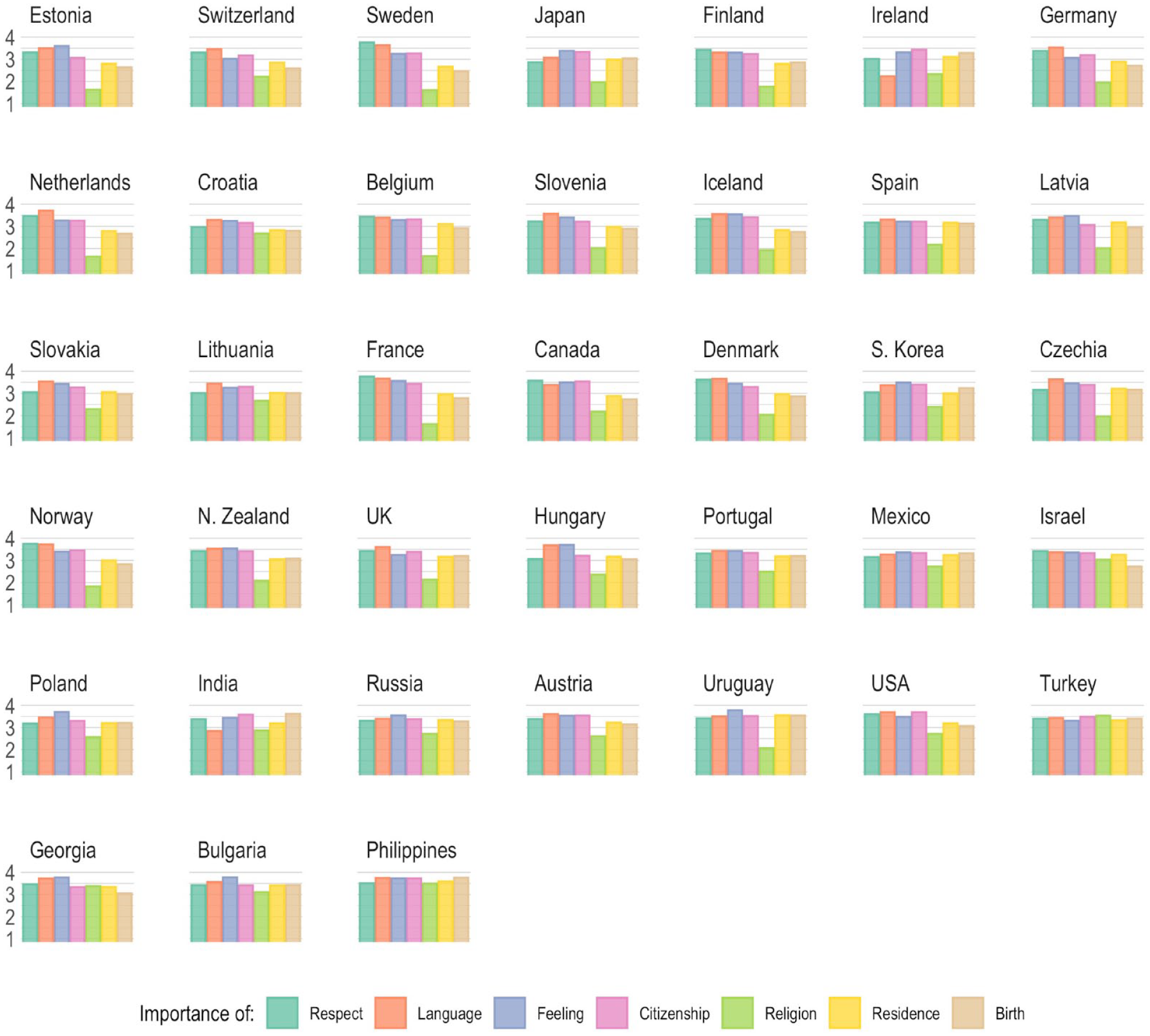
Importance of legitimate national membership criteria by country.
I develop a composite measure of ethnonationalism on the basis of factor scores from a confirmatory factor analysis (CFA) model using the ISSP national membership items. I operationalize these survey items as observed variables that load onto latent factors representing the two core varieties of national membership conceptions, ethnic and civic, identified in previous research and model the relationships between the seven observed indicators and latent constructs using CFA (Bollen 2002). After fitting CFA models to pooled ISSP data, I compute two factor scores for each respondent on the basis of the best fitting model (DiStefano, Zhu, and Mindrila 2009). These estimate how strongly someone endorses an ethnic or civic national membership conception, given their responses to the survey questions. Factor scores account for differences in how survey items load onto factors, so that individuals’ responses to items more strongly associated with a factor contribute more to that factor score, resulting in a more principled measurement approach compared with alternatives such as additive scales or single items (Appendix E reports results from analyses based on these alternative measurement approaches, which are consistent with results from the preferred approach described here). This strategy is also consistent with contemporary sociological approaches to nationalism, which understand it as a set of cognitive schemas through which people come to see the world in national ways (Bonikowski and DiMaggio 2016; Brubaker, Loveman, and Stamatov 2004) and whose content can be discerned using sets of domain-specific survey questions (Vaisey 2009). 4 Following previous factor analytic research on nationalism, the primary outcome variable analyzed is an ethnic-civic difference score, derived by subtracting respondents’ civic factor score from their ethnic score, where higher values indicate a greater preference for ethnic over civic nationalism (e.g., Kunovich 2009). Such a measure is desirable as it incorporates all the information derived from factor analyses (and the full set of survey questions) and, moreover, accounts for the relationality of meaning involved in national understanding, that is, that measuring someone’s conception of the nation requires accounting for the relationship between support for ethnic and civic conceptions, which are not mutually exclusive (Hjerm 1998; Mohr 1998). Appendix B describes the CFA in greater detail.
Radical-Right Voting
The outcome variable in the second analysis measures radical-right party vote choice on the basis of the specific party someone reports voting for in the last general election or intending to vote for in the next. 5 It is coded 1 when a respondent supports a party designated as radical right on the basis of an updated version of Mudde’s (2007) classification scheme in the Comparative Political Data Set (Armingeon et al. 2020). To assess differences between the radical right and other categories of parties (see, e.g., Rooduijn et al. 2017), I compare results from analyses of three different dichotomous outcome variables: (1) where those who abstained or supported any other party are included in the analysis (i.e., coded 0), (2) abstainers are excluded from analysis (i.e., coded missing), and (3) both abstainers and radical-left party voters are excluded (i.e., coded missing). Table C1 lists all party classifications.
Individual-Level Covariates
Analyses control for respondents’ age (years), gender, household income (quintiles, adjusted for household size), highest completed education, place of residence, unemployment status, union membership, workplace authority (whether respondent is a supervisor at work), and subjective social status (10-point scale). 6 Majority ethnic group is a variable coded 1 if a respondent is in a country’s modal ethnic response category. I use relative group size as a proxy for status and understand the majority ethnic group to be a country’s dominant ethnic group (Blalock 1967). Where the numerical majority group cannot be understood as dominant (e.g., India) or there is no clear majority group on the basis of ISSP categories (e.g., the Philippines), I determine the dominant group using information from the Ethnic Power Relations Data Set (Vogt et al. 2015). 7 I expect the dominant-nondominant distinction to be most important for identification and boundary conceptions, so I do not measure ethnic groups in more granular detail. Dichotomizing this measure also helps reconcile the disparate ethnic categorization schemes used across surveys. Table C2 lists the groups coded as dominant for each country, and Table A3 reports coding details and descriptive statistics for all covariates.
Income Inequality
Inequality is operationalized as national household disposable income inequality, which captures inequality in household incomes after taxes and government transfers and is adjusted for household size with the square-root scale also used in the individual-level income measure. I measure inequality in disposable income because such income is most relevant the kinds of everyday economic encounters that drive the attitudinal consequences of income inequality (Willis et al. 2022). Inequality is measured using the Gini coefficient, which has a range of 0 to 100, with higher values indicating greater inequality. I match responses from each ISSP survey country-year to a Gini coefficient from the SWIID, averaged across the survey year and previous three years, as individuals are unlikely to notice small annual changes in country-level inequality and more likely to be affected by longer term inequality perceptions (Gimpelson and Treisman 2018). This variable is scaled so that a one-unit increase indicates a 10-point change in the Gini coefficient (approximately 1.5 standard deviations). Ethnonationalism and all continuous covariates are standardized with a mean of 0 and a standard deviation of 1 to aid interpretation.
Country-Level Covariates
Analyses include controls for economic development, democratic governance, immigration, and trade globalization. Economic development (real gross domestic product per capita) captures differences in living standards thought to shape political and cultural attitudes (Feenstra, Inklaar, and Timmer 2015). Democratic governance, also expected to shape attitudes about the nation (Kunovich 2009), is measured using a six-item scale based on the World Bank Governance Indicators. 8 Immigration is measured as the annual number of international migrants as a percentage of the population with United Nations International Migrant Stock data. I adjust for this variable because it potentially confounds the association between inequality and ethnonationalism, given links between immigration, national identity (Wright 2011) and inequality (Card 2009). Trade globalization is measured using the KOF Globalisation Index (Gygli et al. 2019). 9 I include this because research links globalization with both income inequality (Alderson and Nielsen 2002) and nationalism (Ariely 2012).
Analyses
First, to estimate the association between income inequality and ethnonationalism, I fit linear mixed-effects models, estimated via restricted maximum likelihood. Also known as hierarchical linear models or multilevel models, these are commonly used to model complex, multilevel structures and allow for the simultaneous estimation of parameters at individual and contextual levels, in addition to cross-level interaction terms, making them well suited for testing the hypotheses elaborated above. Mixed-effects models have numerous desirable properties and tend to yield more precise estimates compared with alternative modeling and estimation approaches such as cluster-robust pooled ordinary least squares, particularly in applications with relatively few clusters, as is common with cross-national survey data (Bryan and Jenkins 2016). 10
Because ISSP data constitute repeated cross-sections of national populations, I specify models with a three-level random-effects structure, where individual respondents are nested within country-years, which are nested in countries, accounting for expected clustering among observations (Schmidt-Catran and Fairbrother 2016). I also specify random slope terms for income and majority ethnic group membership, variables involved in cross-level interactions with income inequality. Random slopes allow the strength of lower level predictors to vary across upper level units (e.g., country-years), and simulations suggest they improve precision and are necessary for accurate inferences about both cross-level interaction terms and the main effects of their lower level components (Heisig and Schaeffer 2019). I specify slopes only for variables of key theoretical interest to strike a balance between flexibility and parsimony and attenuate well-known issues of overspecification in mixed models with complex random-effects structures (Heisig, Schaeffer, and Giesecke 2017). Appendix E reports estimates from mixed models without random slopes and comparable models estimated with cluster-robust ordinary least squares, which are consistent with results from specifications described here.
The adjusted mixed model, for individual i in country-year j and country k, can be expressed as a system of equations, with the following individual-level model:
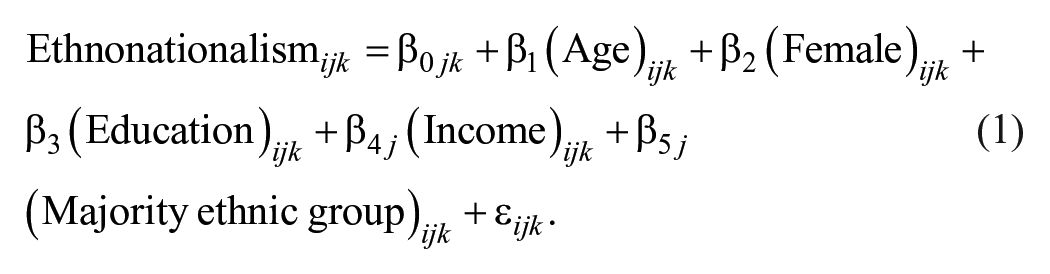
The intercept



Finally, the intercept

Second, to estimate the association between ethnonationalism and radical-right voting, I fit a mixed-effects logistic regression model to ISSP data, estimated using maximum likelihood. 12 This model is an extension of the model described above that accommodates binary response variables. It can be expressed as the following individual-level equation:

where
Results
Income Inequality and Ethnonationalism
I begin by discussing the relationship between income inequality and ethnonationalism cross-nationally. Figure 3 displays the bivariate association between income inequality (four-year average) and ethnonationalism. Data from pooled ISSP cross-sections show a clear positive relationship: since the mid-1990s, countries and years with higher levels of income inequality tend to have higher levels of ethnonationalism. Sweden stands out at the bottom left of the figure as among the countries with the least inequality combined with the least ethnonationalism. Norway and Denmark show similarly low inequality and among the lowest ethnonationalism levels in the sample. The plot’s center region features higher inequality countries (Gini coefficients of 30–40), including the United States and United Kingdom, with correspondingly higher ethnonationalism, at levels around the sample mean. Finally, India, Mexico, and the Philippines feature the greatest inequality among surveyed countries (Gini coefficients >40), combined with the highest ethnonationalism levels in the sample. Figure D1 shows that this positive association exists within individual waves too.

Income inequality and ethnonationalism.
Figure 4 reports the estimated association between income inequality and ethnonationalism from a covariate-adjusted linear mixed-effects model, which controls for various individual and contextual characteristics. First, results indicate that inequality has a positive, substantively meaningful, and statistically significant association with ethnonationalism. On average, a 10-point Gini coefficient increase is associated with an approximately 0.30 standard deviation increase in ethnonationalism, net of controls. For context, a 10-point Gini coefficient increase (approximately 1.5 standard deviations) is roughly equivalent to the difference in income inequality between Germany (29.3) and the United States (38.7) or between the United States and Brazil (48.3), on the basis of 2018 SWIID estimates. It is also comparable with the increase in inequality seen in the United States and United Kingdom between the 1970s and 2020.

Estimated effect of income inequality on ethnonationalism.
The estimated average increase in ethnonationalism associated with such an inequality change is approximately 0.15 units on the ISSP items’ four-point response scale. This is about one third of the difference between the estimated average scores in the United States (2.57) and Sweden (2.14), the country with the lowest value, and approximately the difference between the U.S. and Germany (2.40). Comparing effect sizes between contextual and individual levels, the estimated inequality association resembles that of being a majority ethnic group member or with having some secondary education, compared with less than a secondary education. More striking, the estimated average effect of a 10-point Gini coefficient increase is comparable with the increase in ethnonationalism seen in the United States between 1996 (2.53) and 2004 (2.69), in the wake of the 9/11 terrorist attacks and U.S. invasion of Iraq, exceptional political shocks that prompted widespread xenophobia, anti-Muslim discrimination, and fervent and exclusionary American nationalism (Bonikowski and DiMaggio 2016; Schildkraut 2002). It is notable that an association of this magnitude is estimated net of multiple other previously identified contextual determinants of nationalist attitudes. Results provide strong evidence in support of hypothesis 1, regarding inequality’s contextual effects.
To evaluate hypotheses 2 to 4, concerning inequality’s heterogeneous effects, I fit mixed models with interaction terms. Figure 5 reports estimated marginal effects from a model specifying a three-way interaction between income inequality, income, and ethnic group membership. The figure shows predicted levels of ethnonationalism across the observed inequality range by income quintile and, within each, for majority and minority ethnic group members (for male respondents with secondary schooling and other covariates at means). As the leftmost panel displays, for respondents in the lowest quintile, there is a sizable, statistically significant difference between the slopes for each group, representing the estimated covariate-adjusted association between inequality and ethnonationalism (model 6 in Table D2 reports estimates and significance test results for all parameters on which these findings are based). This suggests that inequality has a much stronger association with ethnonationalism for ethnic minority individuals compared with majority group members, consistent with hypothesis 2.
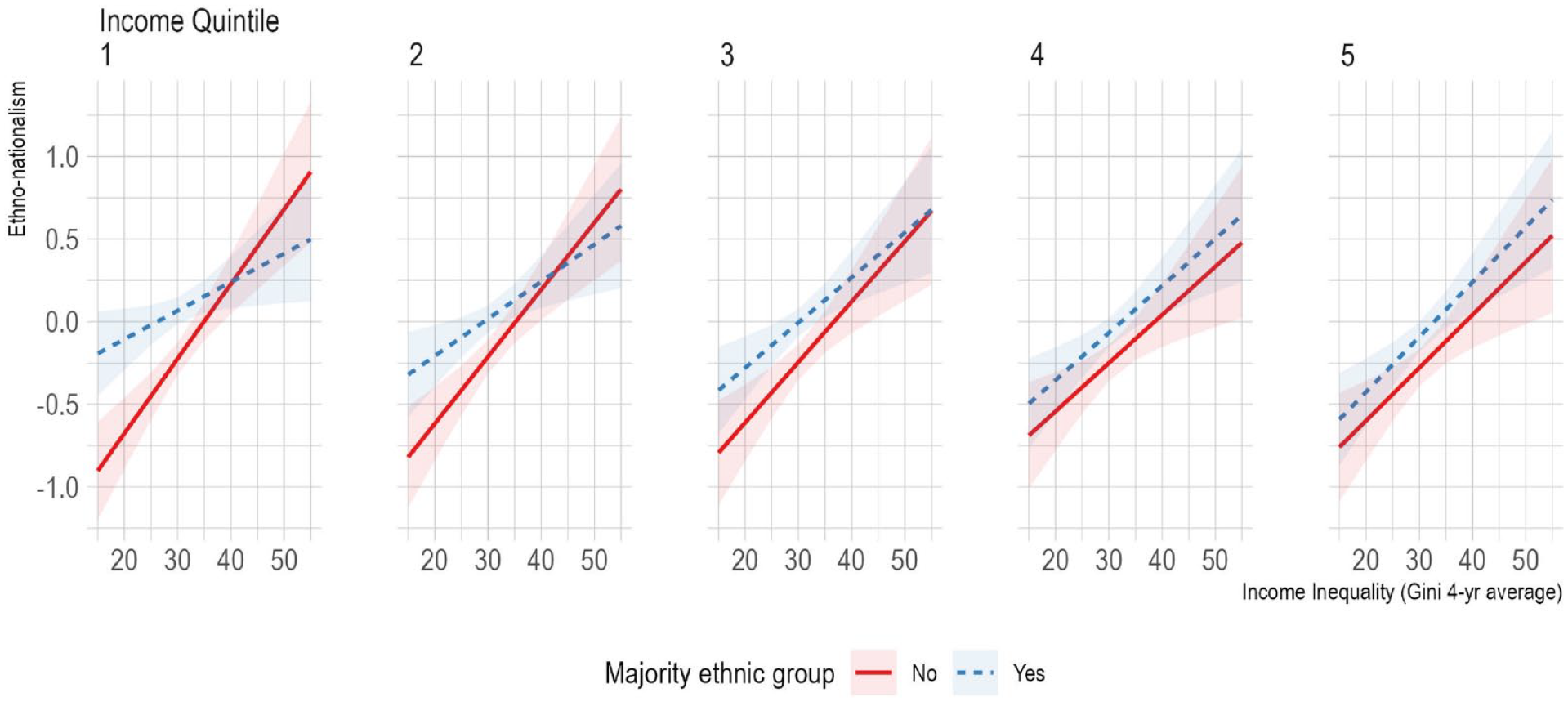
Estimated marginal effects of inequality on ethnonationalism.
However, a stronger association for ethnic minorities appears only for those in the first three income quintiles; comparing slopes across panels from left to right shows that the between-group difference in inequality’s association diminishes across quintiles and eventually disappears, demonstrated by the roughly parallel slopes for the fourth and fifth quintiles. In other words, a stronger association between inequality and ethnonationalism for ethnic minority group members is only observed at lower and middle incomes while inequality appears to affect both groups similarly at the highest income levels, providing qualified support for hypothesis 2. A significant interaction effect, consistent with hypothesis 2, is also observed when fitting a less complex model where the ethnic group difference in the inequality effect does not vary by income (i.e., a two-way inequality-by-ethnicity interaction; see model 3 in Table D2).
Results from mixed-effects models with interactions suggest that income only modestly moderates inequality’s association with ethnonationalism. Estimates from a model that assumes income’s moderating effect is constant across ethnic groups (i.e., a two-way inequality-by-income interaction) indicate that belonging to successively higher income quintiles is, on average, associated with a stronger association between inequality and nationalism, net of covariates. However, this association is statistically significant at conventional levels only for the difference associated with being in the fifth quintile compared with the first (see model 4 in Table D2). The results thus fail to provide support for hypothesis 3.
Estimates from a model where income’s moderating effect can vary by ethnic group indicate that income moderates inequality’s effect differently for majority and minority group members. Examining the slopes in Figure 5 shows that the overall steepest slope (i.e., strongest association between inequality and nationalism) for any combination of income and ethnic group exists for minorities in quintile 1 (solid line in the leftmost panel), consistent with hypothesis 4. Comparing slopes with solid lines in Figure 5 across panels shows that inequality’s association for minorities is weaker at higher income levels, also consistent with the theory (the difference in slopes is statistically significant for quintiles 4 and 5, compared with quintile 1). The slopes for majority group members (dashed lines), however, follow a different pattern: the inequality association is weakest at quintile 1 and becomes stronger at progressively higher levels, where it converges with the association for minorities (the difference in slopes is statistically significant for all quintiles, compared with quintile 1). Support for hypothesis 3 is therefore found only for ethnic minorities, for whom higher income tends to attenuate inequality’s association with ethnonationalism. The opposite is true for ethnic majorities, for whom inequality’s association is stronger at higher incomes.
Overall, results from linear models show that income inequality is associated with ethnonationalism but that the association depends on both individuals’ income and ethnic group, providing support for hypothesis 4, which predicts a three-way interaction effect. Although results suggest that equivalent increases in inequality are associated with greatest differences in ethnonationalism for low-income ethnic minorities and, to a lesser extent, higher income ethnic majorities (as depicted by their steeper slopes in Figure 5), it must be emphasized that majority group members nonetheless report significantly higher average levels of ethnonationalism, especially at lower incomes. Figure 6 reports predicted levels of nationalism at different values of the interacted variables and shows that ethnic-majority group members are expected to have higher ethnonationalism at all given combinations of income and inequality. In other words, whereas lower income minorities and higher income majorities have the strongest association between inequality and ethnonationalism (i.e., the steepest regression slopes), majority groups members—and, among them, those with lower incomes—tend to have higher overall ethnonationalism than minorities (i.e., a higher group-specific intercept).
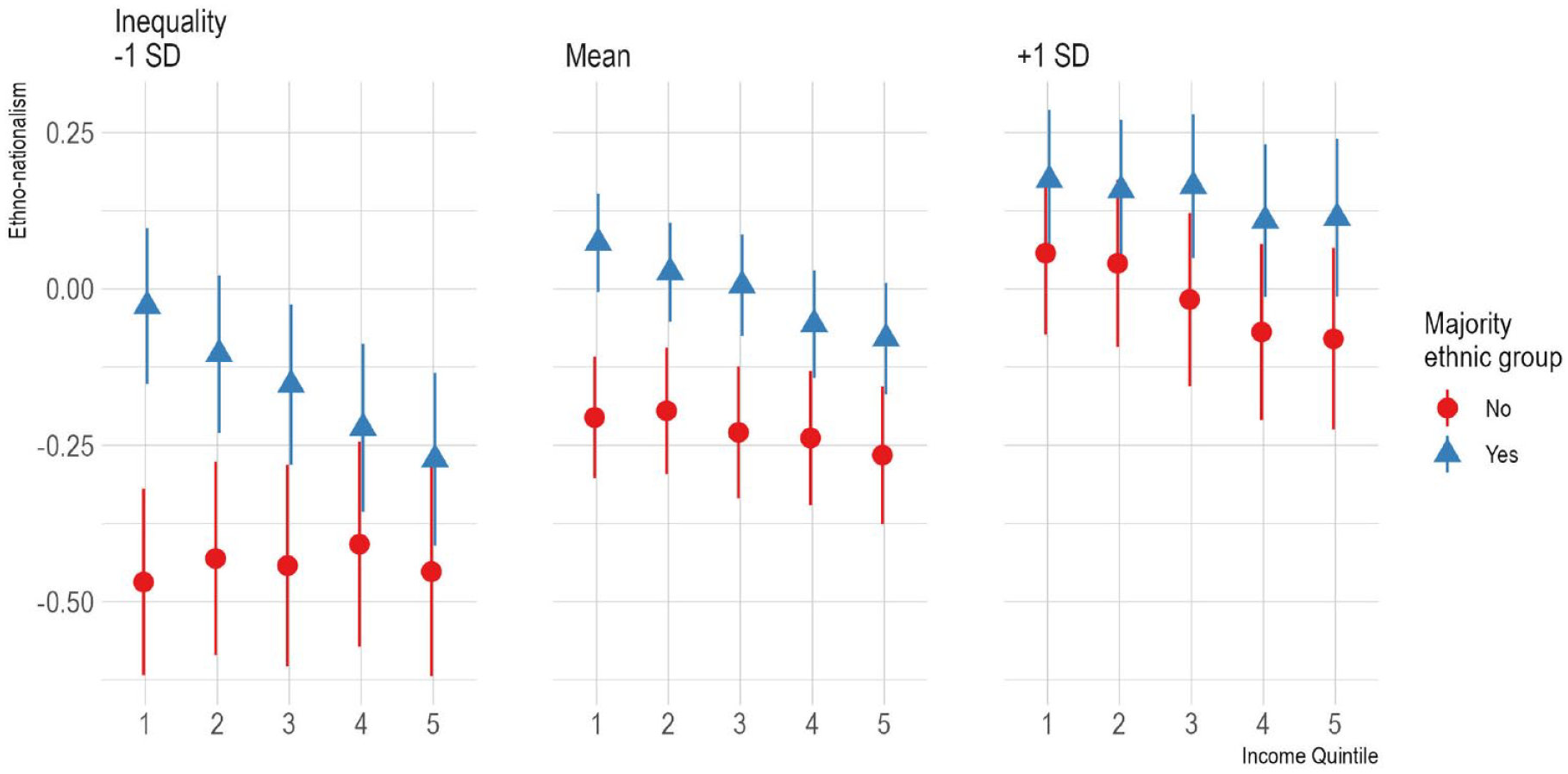
Predicted levels of ethnonationalism by income, ethnic group, and income inequality.
Ethnonationalism and Radical-Right Voting
This section presents results from analyses testing hypothesis 5, regarding ethnonationalism’s association with radical-right voting. Figure 7 reports average marginal effects (AMEs) from a mixed-effects model of radical-right support fit to ISSP data. AMEs from model 1, which includes respondents who voted for any party or abstained (rounded points), indicate that ethnonationalism is strongly associated with radical-right voting, over and above various socioeconomic and demographic characteristics and subjective social status. A 1 standard deviation increase in ethnonationalism (roughly 0.5 points on a four-point scale) is on average associated with an estimated 2.5 percentage point increase in radical-right voting probability, net of covariates (the overall probability of radical-right voting is about 7 percent in the sample). This association resembles the (negative) association estimated for being female, reflecting the well-known gender gap in radical-right support. I find a small and negative but not statistically significant effect for subjective social status, which previous research argues is a key attitudinal determinant of radical-right voting likewise shaped by inequality.

Estimated average marginal effects of ethnonationalism on radical-right voting.
Results from model 2 are estimated using data that exclude abstainers. As nonvoting or voting for radical parties in general is more common among the socially or economically marginalized, omitting abstainers recasts the outcome as a choice between a narrower set of options that no longer includes the choice of no party. Socioeconomic variables should become stronger predictors of vote choice in such specifications, compared with models fit to data with all respondents. AMEs from model 2 (triangular points in Figure 7) confirm this expectation. Larger associations are estimated for nearly all demographic predictors in this model along with ethnonationalism. For the latter, a standard deviation increase is on average associated with an estimated nearly 3 percentage point increase in the probability of radical-right voting.
The effect of subjective social status, although small, is statistically significant once abstainers are excluded, consistent with other studies (Engler and Weisstanner 2021). The estimated association for status is even larger in a model that also excludes radical-left voters, while the estimate for ethnonationalism remains virtually unchanged (see model 3 in Table D3). This supports the idea that subjective social status may be useful for distinguishing between mainstream voters and those who support any radical party, left or right, or the politically disengaged but that it fails to capture what is distinctive about radical-right voters specifically. Ethnonationalism meanwhile appears much more relevant for distinguishing radical-right voters from the electorate at large, evidenced by consistently large estimated associations across models. Overall, results provide strong support for hypothesis 5. Results of robustness checks reported in Appendix E show that these findings are robust to alternative measures, model specifications, estimation strategies, approaches to handling missing data, and the exclusion of potentially influential observations.
Discussion and Conclusion
After more than a half century in the political margins following World War II and the fall of fascism, radical-right parties and ideas are once again mainstream. In this study I have investigated income inequality as one potentially contributing factor to their rise. I have argued that although commonly accepted, explanations of radical-right success that emphasize inequality are inconsistent with established findings and should be reevaluated. In response, I develop a theory that reconciles recent arguments with established findings and explains the relationship between inequality and radical-right support through the process of boundary consolidation, understood as a structured exclusionary shift in national boundaries that preserves one’s own group’s inclusion. I argue that inequality generates status competition that promotes ethnonationalism within electorates and, ultimately, support for the radical right, whose mobilization relies on ethnonationalist appeals. I find support for this theory from analyses of time-series cross-sectional data from the ISSP National Identity survey modules.
Three key findings result from the analysis. First, income inequality has a substantial positive association with ethnonationalism. I estimate that a 10-point increase in the national Gini coefficient—roughly the change seen in the United States and United Kingdom since the 1970s—is associated with a similar change in ethnonationalism as that seen in the United States between 1996 and 2004, following the 9/11 terrorist attacks and military invasion of Iraq, exceptional shocks that prompted unmistakable surges in exclusionary nationalism.
Second, income inequality’s association is conditional on both ethnic group and income. Although ethnonationalism is on average higher among ethnic majorities, I estimate that inequality is more strongly associated with ethnonationalism for individuals who are not members of their country’s majority ethnic group, although only at lower and middle incomes. At the highest income levels, inequality has a similar association for majorities and minorities. This result is consistent with the theory, which predicts that those without access to dominant ethnic group membership, a source of status and security, are more likely to emphasize national identification (and exclusive membership conceptions) in response to status threat. For minorities, such ethnonationalism likely includes their own group but may exclude other minority groups, although research on minority ethnonationalism is limited. Although not explicitly hypothesized, a stronger inequality association only for lower income minorities is overall consistent with the theory, which understands both income and ethnic membership as resources that buffer threat; higher income minorities may not benefit from their ethnic group’s status but are likely less responsive to status threats than lower income coethnics because of income’s status-enhancing benefits (see Han 2016). This finding provides support for the posited mechanism for inequality’s effect, boundary consolidation, which is expected to have distinct heterogeneous effects.
Although inequality’s association with ethnonationalism appears to weaken at progressively higher incomes for ethnic minorities, as the theory predicts, I find the opposite for majorities. For them, inequality’s association is on average stronger at high incomes compared with low ones, something not anticipated. Following research on status upgrading, I theorize that inequality affects ethnonationalism differently for different groups because they experience status threat to different degrees, so that the most materially and symbolically disadvantaged are most vulnerable to status threat. This finding suggests that although the most disadvantaged (i.e., low-income ethnic minorities), indeed, feel threat most acutely, perceived status threats do not decrease monotonically as a function of advantage, as assumed. This partially supports research by Engler and Weisstanner (2021), who argued that inequality’s overall effect (they do not distinguish between ethnic groups) is stronger among those with higher income and status, who have more to lose and thus feel greater status anxiety, rather than those already “left behind.”
The unexpected finding may also be explained by the fact that status perceptions are based on comparisons with salient reference groups rather than purely objective assessments of one’s rank in the overall status hierarchy. Recent studies note the importance of the structure of everyday social comparisons in shaping how inequality is experienced. The spatial segregation of income and wealth and different levels of intraethnic income inequality (Akee, Jones, and Porter 2019) mean that some people are less likely to encounter significantly more or less affluent others, shielding them from inequality (Condon and Wichowsky 2019). Inequality’s stronger association with nationalism among high-income majorities may thus be explained in part by this group’s concentration in income-diverse areas with more opportunities for social comparisons, leading to greater status threats. Also relevant is how income and ethnicity might contribute differently to status security during social comparisons; for example, low-income majorities may feel relatively secure when comparing themselves with minorities, given their fixed membership in a high-status ethnic group. By contrast, upper middle income majorities may feel relatively insecure if they compare themselves with other majorities, given the inherent volatility of income as a basis for status. Future research should further investigate different groups’ salient reference groups and how different ascribed and elective characteristics shape experiences of status threat, with special attention to ethnic membership.
The third key finding is that ethnonationalism is a strong predictor of radical-right voting. I estimate that, on average, a one-standard deviation increase in ethnonationalism is associated with a 2.5 to 3 percentage point increase in the probability of radical-right voting, net of socioeconomic characteristics. This effect size resembles the substantial effect of gender that has received much attention in research on the (male-dominated) radical-right electorate (Arzheimer 2017). I estimate this association net of subjective social status, which recent studies have advanced as a proximate cause of radical-right support likewise shaped by inequality (Gidron and Hall 2020). I find a significant effect for the latter only in models that exclude abstention or radical-left voters (see also Engler and Weisstanner 2021), suggesting that low subjective status (perhaps depressed by inequality) may drive voters toward radical parties in general, but that ethnonationalism pushes them toward the radical right specifically. Nationalism’s effects on voting may be different across groups, however, so that, for example, although inequality promotes ethnonationalism particularly strongly among minorities, this group may nonetheless be more reluctant than majorities to vote radical right given the latter’s frequent condemnation of minorities. Future research should further investigate nationalism’s potentially heterogeneous effects on voting.
This study makes multiple theoretical contributions to research on income inequality’s consequences and the origins of radical-right success. First and foremost, by articulating an explicit mechanism linking inequality to radical-right support, it resolves an inconsistency in the political sociology and inequality and stratification literatures on two phenomena of eminent interest. An implicit lesson in this effort is the need to distinguish between inequality and deprivation in research on economic determinants of political support: scholarship on Trump and Brexit has tended to conflate phenomena such as insecurity and hardship with income inequality, and much of the narrative about inequality prompting these outcomes appears to be fueled by evidence of dissatisfaction with deprivation, documented in ethnographic studies (e.g., Gest 2016), rather than income inequality per se. Attending to this distinction and drawing on inequality research—especially on its contextual effects, which occur even when individual income itself is unrelated to the outcome of interest (Neckerman and Torche 2007)—has made it possible to develop a coherent theory accounting for seemingly inconsistent statements in the literature. The value of this distinction is borne out by studies that have failed to link income loss to radical-right support (e.g., Gidron and Mijs 2019) and the distinct effects for income and inequality reported in this study. Future research should guard against conflating these related but distinct phenomena and better integrate research on inequality and stratification.
Second, this study makes a case for centering nationalism in theories of radical-right success. As others have noted, discussions of the radical right after Trump and Brexit have been rife with analytical imprecision regarding the outcome of interest. Most notably, the radical right is commonly conflated with populism, properly understood as just one of its constituent parts (Mudde 2007). This obscures the radical right’s other features that are arguably more important to explaining its support, namely, nationalism (Bonikowski 2017). Although recent work has advanced declining subjective social status as a proximate cause of radical-right success (e.g., Gidron and Hall 2020), this study’s findings suggest that ethnonationalism is much more relevant than subjective status for distinguishing radical-right voters from the electorate at large. I thus join recent studies highlighting nationalism’s significance in contemporary electoral politics and call on scholars to foreground nationalism in analyses of the radical right (Bonikowski et al. 2021).
Third, the study shows why debates surrounding radical-right success that set cultural and economic causes in opposition are misguided. Much of the scholarship on radical-right success has been animated by a debate about whether economic factors (e.g., job loss and globalization) or cultural ones (e.g., racism and xenophobia) are primarily responsible (e.g., Morgan 2018; Mutz 2018). This study furnishes new evidence that this dichotomy—and the search for economic or cultural explanations generally—is fundamentally flawed (Gidron and Hall 2020). The association between income inequality, ethnonationalism, and radical-right voting identified suggests that economic conditions can promote electorally consequential cultural dispositions and, therefore, how economic and cultural factors can combine to shape electoral outcomes.
Although this study makes numerous valuable contributions, it is not without limitations. Regarding data limitations, the study uses a national income inequality measure that ignores subnational differences. Future analyses would benefit from more fine-grained data because individuals’ local inequality perceptions are likely more consequential for political attitudes than objective national conditions. In addition, although the ISSP series is the longest running cross-national survey measuring diverse aspects of nationalism, its longitudinal coverage remains small, and more detailed data are needed to rigorously evaluate the causal links implied by the theory, such as experimental or single-nation panel data. Better longitudinal data are also needed to answer the larger question arising from this research: if boundary consolidation is a key mechanism linking income inequality and radical-right support, as I argue it is, how much of the radical right’s success today is attributable to this process and income inequality’s dramatic growth in recent decades? Such data would better address concerns about endogeneity and reverse causality as well, such as the possibility that ethnonationalism affects inequality by weakening welfare state support or that successful radical-right parties promote ethnonationalism through partisan cue-taking. Scholars should also continue to improve the measurement of nationalism: measures that explicitly capture nationalism’s racial and ethnic components would be particularly useful for better assessing how boundary consolidation, the concept developed in this study, occurs among different groups and the specific structures of exclusion they draw (i.e., which groups are included and excluded within consolidated boundaries), which the present data do not allow.
Conceptually, focusing on nationalism and the radical right in this analysis disregards other identities that may promote far-right support but do not focus on the nation-state, such as “civilizational” identities emphasizing “Judeo-Christian” or “Aryan” heritage and supranational ethnic identities (Brubaker 2017). By focusing on the determinants of one attitudinal domain predictive of radical-right support, nationalism, the study also leaves aside other ways that inequality might promote radical-right support and how supply-side factors (e.g., electoral system characteristics) are affected by inequality.
Despite these limitations, this study documents a significant relationship among income inequality, ethnonationalism, and radical-right support, providing evidence for a theory of inequality’s political consequences that reconciles prominent recent arguments about the rise of the radical right with long-standing research findings. More generally, it suggests that scholars should place questions about the distribution of economic resources, such as income and wealth, firmly on the agenda of studies of contemporary nationalism and the politics it inspires.
Supplemental Material
sj-pdf-1-srd-10.1177_23780231241251714 – Supplemental material for Politics of Boundary Consolidation: Income Inequality, Ethnonationalism, and Radical-Right Voting
Supplemental material, sj-pdf-1-srd-10.1177_23780231241251714 for Politics of Boundary Consolidation: Income Inequality, Ethnonationalism, and Radical-Right Voting by Martin Lukk in Socius
Footnotes
Acknowledgements
I would like to thank Gordon Brett, Angela Hick, Sakeef Karim, Vanina Leschziner, Sébastien Parker, David Pettinicchio, Erik Schneiderhan, Lance Stewart, Lawrence Williams, Geoffrey Wodtke, and participants in the Toronto Graduate Research Practicum, Toronto Theory Workshop, and Northwestern Problem-Solving Sociology Workshop for their comments on previous drafts of this article. Earlier versions of this research were presented at meetings of the Eastern Sociological Society, Association for the Study of Ethnicity and Nationalism, Council for European Studies, and American Sociological Association. I thank audience members at these venues for their helpful critiques. I also thank the anonymous reviewers and editors at Socius for their valuable comments and suggestions.

Supplemental Material
Notes
Author Biography
References
Supplementary Material
Please find the following supplemental material available below.
For Open Access articles published under a Creative Commons License, all supplemental material carries the same license as the article it is associated with.
For non-Open Access articles published, all supplemental material carries a non-exclusive license, and permission requests for re-use of supplemental material or any part of supplemental material shall be sent directly to the copyright owner as specified in the copyright notice associated with the article.
