




Abstract
Climate change will affect all life. Sociologists contribute to major climate change reports and are interested in how people are engaging these documents. Major climate change reports coming from the Intergovernmental Panel on Climate Change and the National Climate Assessment are used by scientists, policy makers, and localities to assess climate vulnerability and create climate action plans. Although sociologists have been at the forefront of understanding climate change perception, there is limited understanding about how the public interacts with these reports or whether they are even aware of them. The author uses survey data (n = 1,013) to assess public awareness of these reports. The results suggest that conservative think tanks may be doing a better job at marketing reports to advance their agendas. This is important information as scientists continue to think about how to reach the public to advance mitigation and adaptation efforts and counter climate denialism.
Since the establishment of the Intergovernmental Panel on Climate Change (IPCC) in 1988 by the World Meteorological Organization and the United Nations Environmental Programme, attention has been placed on how to synthesize what we know about climate change and communicate this information to scientists, policy makers, and the public (Agrawala 1998; Vardy et al. 2017). Comprehensive climate change reports have become particularly important to scientists and policy makers in identifying trends and promoting policy (see, e.g., Cointe, Cassen, and Nadai 2019; Djalante 2019). The most comprehensive and recognized of these are the IPCC and National Climate Assessment (NCA) (National Climate Assessment 2020) reports.
The IPCC reports are designed to support the work of the United Nations Framework Convention on Climate Change, which is an international treaty adopted in 1992 with the goal of stabilizing greenhouse gas concentrations to prevent catastrophic impacts to natural and human systems. Full reports by the IPCC are released every four to seven years, and special reports are released in the interim. All reports are considered comprehensive, covering the science, technology, and humanitarian impacts of human-induced climate change along with documenting the potential impacts and options for mitigation and adaptation. However, the reports contain no original research. They synthesize peer-reviewed literature to create a comprehensive review of the current state of climate change. To accomplish this task, thousands of scientists voluntarily contribute to writing and reviewing, with a typical report involving scientists from more than 120 different countries. The IPCC reports are internationally recognized as the central authority on climate change (Oreskes 2014). In 2007, the Nobel Peace Prize was shared between the IPCC and Al Gore “for their efforts to build up and disseminate greater knowledge about man-made climate change, and to lay the foundations for the measure that are needed to counteract such change” (The Norwegian Nobel Committee 2007).
Similar in scope, but smaller in scale, the NCAs are an interagency effort by the U.S. government to evaluate the state of climate change in the United States. The NCAs are driven by the Global Change Research Act of 1990, which requires that a report evaluating and interpreting how climate change is and will be affecting the United States be presented to the president and Congress every four years. Just like the IPCC reports, the NCA reports document the current science on the impacts of climate change to the natural environment, energy production, resource use, agriculture, human health, social systems, species, and biodiversity. The reports are produced through the collaboration of 13 federal departments and agencies.
Sociologists argue that it is essential that we understand how people are thinking about and engaging with climate change, which includes the reporting of climate change science (Dietz, Shwom, and Whitley 2020). Given the growing importance of these reports for all individuals to make informed decisions about climate change, this study seeks to begin a conversation about public interaction with major climate change reports by first assessing to what extent people report being aware of major IPCC and NCA releases and then evaluating what predicts awareness. Although a large body of literature within sociology, and social science broadly, explores public perceptions of climate change, there are no articles that explore who is (or reports being) aware of climate change reports. Although self-reported awareness may seem negligible, this information can give insight into which communities are having conversations about report releases, how they are being used (for proenvironmental or antienvironmental dialogue), and which communities need to be targeted. Ultimately, this information can inform how we think about the marketing and use of major climate change reports among different groups.
Relevant Literature to Understanding Climate Change Report Releases
Prior to 2018, few Americans reported regularly hearing about global warming or discussing it with others (Ballew et al. 2020). This was termed the “climate spiral of silence,” based on the spiral of silence, which has important implications for how the public responds, or in this case, does not respond to issues that are perceptually silent to them (Noelle-Neumann 1991). With mounting scientific evidence documenting the growing and future impact of climate change, in 2018, two major climate change reports were released. Both reports received extensive media coverage. On October 8, 2018, the IPCC (2018) released “Global Warming of 1.5 °C.” On November 23, 2018, “Fourth National Climate Assessment Volume II: Impacts, Risks, and Adaptation in the United States” (NCA4) (USGCRP National Climate Assessment 2018) was released. The IPCC and the NCA both provide summary information that has historically been used by scientists and policy makers, with limited content specifically for a general audience. However, this is changing with greater attention being paid to getting community members and community scientists engaged in climate change mitigation and adaptation efforts. There is some indication that this approach is working and that the public is increasingly taking notice of these reports. Scholars have tracked tweets mentioning the reports, finding that individual bloggers and concerned citizens accounted for the most propagated tweets, with most tweets focused on public understanding of the report mentioning a particular media source (the IPCC’s “Fifth Assessment Report” in this case) (Newman 2017). Importantly, then, most information within these reports is filtered through news media. O’Neill et al. (2015) found that frames of the IPCC “Fifth Assessment Report” across media outlets were not neutral, as they adhered to the slant of the news outlet. This means that news outlets often pick and choose components that adhere to their support or opposition to climate change science, mitigation, and adaptation. In fact, scientists have shown that reports are often framed as contested by conservative and Republican-leaning news outlets, adding to the allure of controversy, when the science held little uncertainty (O’Neill et al. 2015).
Social scientists are increasingly taking interest in how people think about climate change and associated science (Dietz et al. 2020). One of the only studies to look at how the public engages these reports assessed whether Norwegians exposed to the reports showed changes in their perceptions of climate change threat. The findings showed that exposure to the reports did increase perception of threat (Ogunbode, Doran, and Böhm 2020). However, it is unclear is this perception persists over time. Scholars have long argued that scientists need to do a better job of communicating risk and uncertainty regarding climate change (Budescu, Broomell, and Por 2009), especially because of how the media can use this information to counter climate change advancements (Aven and Renn 2010; Budescu et al. 2009; Zehr 2000). Historically, research shows that in years when major climate change summits and reports are released, the public shows greater concern about climate change (Bakaki and Bernauer 2017). It is likely no coincidence that after the reports in 2018 were released, climate change coverage increased throughout 2019 and will likely continue to be a hot topic (Svoboda 2020). The increased coverage of climate change also correlates with amplified climate change concern (Nacu-Schmidt, Katzung, and Boykoff 2020).
The release of the 2018 reports marked a unique shift in climate change communication, because many news outlets decided that they would no longer entertain conversations about climate change denial. For instance, in early January 2019, Chuck Todd declared on Sunday’s edition of Meet the Press that CNN would not “give time to climate deniers” and that “the earth is getting hotter, and human activity is a major cause. Period” (Schwartz 2019). These reports were highly influential in how climate change is addressed in localities and in the production of climate change action plans. For instance, the Municipality of Anchorage in Alaska cites the NCA4 in its “Climate Action Plan” (Hahn et al. 2019), and San Antonio, Texas, cites the report in its “SA Climate Ready” action and adaptation plan (San Antonio Climate Ready Steering Committee 2019). These are only two examples of dozens of cities across the country that have incorporated the information from these reports into their planning processes.
Given that public opinion on environmental issues shapes policy (Brulle, Carmichael, and Jenkins 2012), it is likely that this awareness is having an impact on policy creation. Scholars suggest that awareness of scientific consensus and other phenomena related to climate change “may correspond to events such as scientific reports, leadership statements, or weather” (Hamilton 2016:1). Although we have a good understanding of how the media presents these reports and how concern for climate change is correlated with report releases, we have no understanding of who reports being aware of these reports and what sociopsychological or sociodemographic factors correlate with reported awareness. Given that climate change impacts are rapidly becoming a reality, and it is becoming clearer that climate change is a risk to human well-being and safety, understanding the public’s perceived and actual awareness of these reports is even more critical. The goal of this study is to start a conversation about the sociopsychological and sociodemographic factors that influence reported awareness of climate change reports, so that scientists and environmental journalists can think more critically about how report information is disseminated.
Applying Value-Belief-Norm Theory
Although research on awareness of climate change reports is limited, a wealth of literature explores environmental awareness and decision making. One of the most prominent of these theories is value-belief-norm (VBN) theory, which suggests that a sequence of cognitive processes have direct and indirect influences on environmental decision making (Dietz 2015; Dietz, Fitzgerald, and Shwom 2005; Stern and Dietz 1994; Stern, Dietz, and Kalof 1993; Stern et al. 1995). VBN theory draws on a long and well-developed lineage of social psychological work assessing the importance of values (Schwartz 1992, 2012; Schwartz and Bilsky 1990) and in doing so adopts and extends the Schwartz’s value survey to include items that distinguish humanistic and biospheric altruism. The result is five distinct value orientations: biospheric altruism, altruism (humanistic altruism), egoism, willingness to change, and traditionalism. This theory posits that values influence our worldview or what is often described as general beliefs about the environment, which then influence our specific beliefs about environmental consequences. Ultimately, these values and beliefs influence our norms about what actions we should take. VBN theory is ideal to assess what drives awareness of climate change reports, as values, beliefs, and norms are all likely to influence who is paying attention to climate change rhetoric and aware of new information about climate change.
In addition to the traditional VBN formulation, trust is increasingly evaluated as a determinant of climate change attitudes and behaviors (McCright et al. 2016). Because of this, it is also increasingly incorporated into VBN modeling (Bodor, Varjú, and Grünhut 2020; Dietz, Dan, and Shwom 2007; Gifford, Kormos, and McIntyre 2011). For this study, trust is considered as a sociopsychological factor appended onto the VBN model. However, in this case, trust’s role may be less straightforward. Major climate change reports are created by scientists, commissioned by governments, and used by corporations (for good or for bad). The trust individuals have in any of these entities may influence their interest and awareness of these reports. For instance, if an individual holds considerable trust in science, they may be more likely to follow scientific headlines and be aware of these reports. Alternatively, if an individual shows great distrust in science, they may report greater awareness of these reports because they have been tuned into announcements of scientific information. Trust is also likely to influence how people value these reports, a topic that is outside the scope of this article.
Potential Sociodemographic Factors
Beyond sociopsychological factors, sociodemographics such as gender, race, income, education, age, political orientation, having children, and religion may play a role in awareness of reports, as these have historically been important factors in climate change related engagement, attitudes, beliefs, and behaviors. Climate change is having gender-differentiated impacts that exacerbate gender inequality (Eastin 2018). Because of this, women may be more attuned to climate change reports. However, studies also suggest that women underestimate their climate change awareness, whereas men overestimate it (McCright 2010). In this case, women may underestimate their awareness of the reports, while men may overestimate it.
Research suggests that people of color show greater concern about the environment and awareness of environmental ills compared with those who identify as white (Dietz and Whitley 2018; Macias 2016; Pearson et al. 2018). Climate change is expected to exacerbate inequalities and have the greatest impact on underrepresented and marginalized groups. If people of color are more aware of these issues, then we might expect people of color to report greater awareness of climate change reports. However, there may be issues related to access of climate change information that may or may not relate to race. Several scholars have found an interaction between race and gender, whereby white men are less likely to believe climate science and support actions to mitigate climate change (Finucane et al. 2000; Kahan et al. 2007; McCright and Dunlap 2011a). One might think this would lead to white men reporting being less aware, but in this case the opposite may be true. There may be a white male effect, whereby white men report greater awareness because of actively seeking sources that support their perceptions that climate change is not something to be concerned about. Differences among racial groups in awareness of these reports remains unknown.
The social psychology of environmental justice literature shows us that income plays a role in environmental decision making but that the concern expressed by vulnerable populations, including lower income communities, has been underestimated (Pearson et al. 2018). Some scholars argue that educational attainment is the strongest predictor of climate change engagement around the world (Lee et al. 2015); however, others have found that there are nuances in educational attainment and type of education that can affect climate change engagement. For instance, political polarization increases as education and income increase, and higher education strengthens the conservative white male effect (Ballew et al. 2020). These findings leave the effects of income and education on report awareness an open question.
Family dynamics and age play a role in how people are socialized to access environmental information (Lawson, Stevenson, Peterson, Carrier, Seekamp, et al. 2019). Younger individuals are less influenced by political polarization and may have greater influence on family beliefs and dynamics in terms of awareness and concern about environmental issues like climate change (Hula et al. 2017; Stevenson, Peterson, and Bondell 2019). Although having children may make parents more concerned about the future of the planet, having children also seems to increase climate change socialization within families because of concern among children (Lawson, Stevenson, Peterson, Carrier, Strnad, et al. 2019; Stevenson et al. 2019).
Given that many people rely on religious and ideological cues to shape their attitudes, it is not surprising that both political orientation and religion are important predictors of environmental engagement. Political orientation has long been considered a dominant factor, with liberal Democrats reporting greater awareness and concern about environmental issues such as climate change (McCright and Dunlap 2011b; McCright et al. 2016). The connection between religion and environmental awareness and engagement dates to the work of Lynn White, who asserted that Judeo-Christian traditions exacerbated environmental destruction (White 1967). Although Judeo-Christian traditions are not monolithic, research has found that people adhering to Christian traditions that are theologically conservative tend to have less concern for the environment and climate change (Arbuckle and Konisky 2015; Clements, McCright, and Xiao 2014). One assumption is that those with greater environmental awareness and concern would show greater awareness of the reports given that they are likely seeking out such information. Alternatively, those who adamantly oppose climate change mitigation and adaptation efforts may also report significant awareness as an oppositional stance. Ultimately, because of the lack of research on report awareness and engagement, this study serves as an initial exploration of sociodemographic effects.
Sample
A survey was launched on the Qualtrics platform obtaining individuals from Amazon Mechanical Turk (MTurk) on December 24, 2018 and running through December 25, 2018. MTurk was selected as the platform because it has historically produced diverse samples that can often approximate population statistics (Casler, Bickel, and Hackett 2013; Goodman, Cryder, and Cheema 2013). Concerns about reliability and validity of MTurk data were assessed and appropriate measures taken to make sure data were valid. This included two pretests and multiple systems for identifying and excluding bots (see, e.g., Chmielewski and Kucker 2020). Additionally, studies show that MTurk participants do better at attention checks compared with subject pool participants (Hauser and Schwarz 2016). A total of 1,013 responses were collected. Each participant averaged about 5 minutes to complete the survey. Individuals were paid $0.60 for their responses, which is equivalent to minimum wage. This is not a random or representative sample, although it does approximate the U.S. population quite well. The date was strategically chosen given that MTurk surveys tend to be skewed with more female participants (Burnham, Le, and Piedmont 2018). As women have been historically responsible for most of the holiday work (see, e.g., Deem 1996), it was assumed that fewer women would participate on Christmas Eve, leading to a more balanced sample in terms of gender. This assumption was correct. The resulting sample was 49 percent male (49 percent male for the U.S. population) (U.S. Census Bureau 2019a). Compared with the U.S. population, the sample was 74 percent white (76 percent for the U.S. population), 12 percent Hispanic/Latino (18 percent for the U.S. population), and 11 percent Black (13 percent for the U.S. population) (U.S. Census Bureau 2019a). The median age of the sample was 35 years (38 years for the U.S. population) (U.S. Census Bureau 2019b). The state distribution of responses was excellent, with a 98 percent correlation between the sample and the U.S. population. The central difference is that the sample was more educated than the population, with 56 percent reporting having a bachelor’s degree compared with only 36 percent of the U.S. population (U.S. Census Bureau 2020). The descriptive statistics for all variables used in the analysis are presented in Table 1.
Descriptive Statistics of Variables Used in Modeling (n = 1,013).
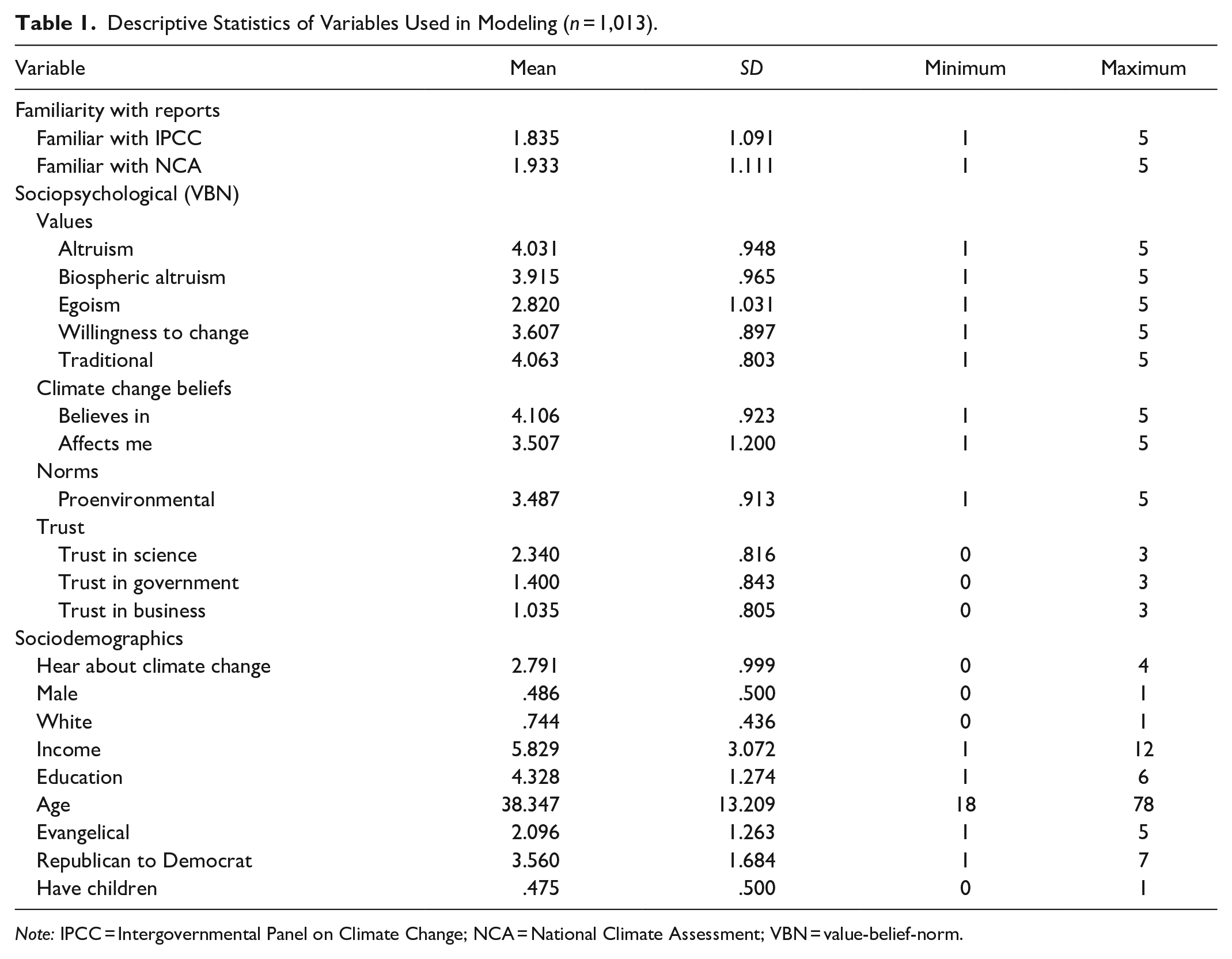
Note: IPCC = Intergovernmental Panel on Climate Change; NCA = National Climate Assessment; VBN = value-belief-norm.
Variables
The analysis involved two dependent variables: familiarity with the IPCC report and familiarity with the NCA report. Individuals were asked, “How familiar are you with the following reports that were recently released?” These are ordered categorical variables with five categories: “never heard of”; “heard of, but not familiar”; “heard of, somewhat familiar”; “heard of, moderately familiar”; and “heard of, very familiar.” More than half of people (55 percent) had not heard of the IPCC report, compared with nearly just half (49 percent) of people reporting that they had not heard of the NCA report. The descriptive statistics for all variables used are presented in Table 2.
Descriptive Statistics on Familiarity with the NCA and IPCC Reports.

Note: IPCC = Intergovernmental Panel on Climate Change; NCA = National Climate Assessment.
Sociopsychological Factors
Values
Individuals were asked, “How important is each of the following as a guiding principle in your life?” and given choices on a five-point, Likert-type scale ranging from “not at all important” to “extremely important.” Five environmental value orientations were composed of three standard items each: altruism (Cronbach’s α = .887), biospheric altruism (Cronbach’s α = .921), egoism (Cronbach’s α = .811), willingness to change (Cronbach’s α = .817), and traditionalism (Cronbach’s α = .747). Reliability scales were assessed by generating Cronbach’s α values (Cronbach 1951). Nunnally and Bernstein (1967) argued that reliability above .700 is acceptable. On average, people scored high on altruism (4.031), traditionalism (4.063), and biospheric altruism (3.915), which equates to these values’ being “very important.” The average for willingness to change was 3.607, which equates to this value’s being “moderately important” to “very important.” Egoism was the lowest rated value, with an average of 2.820, which equates to “slightly important” to “moderately important.”
Beliefs
Two factors were considered in beliefs: general beliefs about whether climate change is real and human caused, which uses four items (Cronbach’s α = .862), and a specific belief about whether “climate change is already impacting me.” All items were measured on a five-point, Likert-type scale ranging from “strongly disagree” to “strongly agree.” Belief that climate change is real and is caused by human activity was high, with an average of 4.106, between “somewhat agree” and “strongly agree.” Belief that climate change is already affecting respondents was slightly lower at 3.507, which equates to “neither agree nor disagree” to “somewhat agree.” The survey used for this analysis did not include a variable to measure environmental concern. Although not the same, people who belief that climate change is affecting them already are likely to be more concerned about climate change. This variable is being used to loosely approximate concern about climate change.
Norms
A proenvironmental norm scale was included to capture the moral obligation to protect the environment through behaviors such as turning off lights, carpooling, recycling, and reducing chemical use. All items were measured on a five-point, Likert-type scale ranging from “never” to “always.” The resulting scale includes eight items total (Cronbach’s α = .881). On average, people scored a 3.487, which equates to doing these behaviors “about half the time” to “most of the time.”
Trust
Individuals were asked, “How much do you trust the following groups to provide accurate information about climate change?” Three categories were used: trust in science, government, and business or industry. There were four response categories, ranging from “not at all” to “to a great extent.” On average, trust in science was 2.340, indicating that people had “somewhat” to “a great extent” of trust in scientists. Trust in government and business was lower at 1.400 and 1.035, respectively, indicating “very little” to some trust.
Sociodemographic Factors
Gender
Individuals were asked what gender they most identify with and given the options of man, woman, and “not listed, but please specify.” Only 12 people selected the “not listed” category. For this study, these individuals were excluded. Future work should look at how nonbinary and other genders can be better included in quantitative research on environmental issues. Whitley and Bowers (2023) conducted promising work in this area by oversampling the LGBTQ+ community and documenting that LGBTQ+ people are more concerned about climate change than their cisgender/heterosexual counterparts. Nothing has been done to assess awareness. About 49 percent of the sample was male.
Race
Categories of race conformed to the basic U.S. census categories: white, Black or African American, Native Hawaiian, other Pacific Islander, Native American or American Indian or Alaskan Native, Asian or Asian American, South Asian or South Asian American, Arab American or Middle Eastern, and mixed race not listed. Given that some categories had extremely small response numbers, the categories were collapsed into white and non-white, which also avoided having to eliminate certain communities of color, such as Native American or American Indian or Alaskan Native from the sample. Roughly 74 percent of the sample was white.
Household Income
Household income was measured in $10,000 increments across 12 response categories from less than $10,000 to $150,000 or more. On average, at 5.829, household income ranged from $40,000–$49,999 to $50,000–$59,999.
Education
Individuals were asked about the highest level of education they had completed on a six-point, Likert-type scale ranging from less than a high school diploma to a graduate or professional degree. With an average of 4.328, people reported having an associate’s degree or some college with no degree to having a bachelor’s degree.
Age
Age was calculated on the basis of the real age the participant was at the time the survey was conducted. Ages of participants range from 18 to 78 years, with the average for the sample being 38 years.
Evangelicalism
This variable is based on three items to assess biblical literalism and evangelicalism. Individuals were asked to what extent they agreed with the following statements: “the bible is to be taken literally,” “I gain guidance from religion,” and “I identify as evangelical” (Cronbach’s α = .868). Responses were recorded using a five-point, Likert-type scale ranging from “not at all” to “a great deal.”
Political Party
Individuals were asked about their political party identification using a seven-point, Likert-type scale ranging from “very strong Democrat” to “very strong Republican.” On average, respondents were somewhere between “independent, near Democrat” and “independent” at 3.560.
Have Children
Individuals were asked if they had children. The age of the children was not recorded, nor was whether respondents were involved with these children. A total of 47.5 percent of the sample had at least one child.
Climate Change Engagement
Individuals were asked, “How often do you hear about climate change in the media?” Response categories were on a Likert-type scale ranging from “never” to “at least once a week.” On average, people asserted that they heard about climate change somewhere between “several times a year” and “at least once a month,” at 2.791.
Methods
Stata 16.1 was used to complete the analysis. Ordered logistic regression models were evaluated first and a brant test confirmed no evidence that the parallel regression assumption had been violated. Ordinary least squares (OLS) regression models were also generated for comparison. Angrist and Pischke (2008) argued that although there is some concern about an OLS estimator giving best linear unbiased estimates with ordered data, many within econometrics affirm that the practical effect of violating assumptions is trivial with multiple ordered categories and that model simplicity outweighs these concerns when the same predictor significance is observed between both models. OLS regression results are reported. Furthermore, because each state is affected by, responds to, and communicates about climate change differently, individuals in each state are likely to respond more similarly to others in their state. To account for this, standard errors for intragroup correlation (clustering around the state individuals are residing in) are used, which ultimately relaxes the assumption that observations are independent. The resulting models depict heteroskedasticity-robust standard errors (Cameron and Miller 2015).
Results
Table 1 presents the descriptive statistics for awareness of both the NCA4 and IPCC reports. Awareness of and familiarity with these reports were relatively low. A total of 49 percent of people said they had not heard of the NCA4 report, while 55 percent had not heard of the IPCC report. Adding in the category of “heard of, but not familiar,” this increases to 72 percent for the NCA4 report and 74 percent for the IPCC report. The mean familiarity score for the IPCC report was 1.835 (1.09), and the mean familiarity score for the NCA report was 1.930 (1.11), indicating that individuals have not heard of or are not familiar with the reports. A Hotelling’s t2 generalized means test indicates that these scores are significantly different from each other (Hotelling’s F1, 1,012 = 12.16, p < .001) (Johnson Wichern 2007). Although statistically different, the difference is not necessarily meaningful, as it does not change the interpretation or outcome.
To better assess how to reach target demographics in report dissemination, we need to understand what current sociopsychological and sociodemographic indicators drive public awareness. The model is consistent with VBN theory, with values, beliefs, and norms all showing direct (and likely indirect) influence on awareness of reports. Table 3 presents the unstandardized coefficients and robust standard errors for OLS regressions predicting familiarity with the two reports. Starting with the sociopsychological variables, we see that values are an important factor, with those who adhere to egoism reporting greater familiarity and those adhering to traditionalism reporting less. The magnitude of holding traditional values is particularly interesting; each increase in adherence reduces awareness of these reports by a quarter of a point on a 5-point scale. This alone could create a point or more difference in awareness of reports when comparing those who reject traditional values and those who adhere to them. Humanistic and biospheric altruism are insignificant; however, this lack of significance does not necessarily indicate these values are unimportant, just that they do not have a direct influence. Given that most sociopsychological research points to altruism as a key factor in environmental engagement and awareness, these values may well be acting through beliefs, norms, and trust.
Ordinary Least Squares Models Predicting Familiarity with the NCA and IPCC Reports with Beta Coefficients and Robust Standard Errors Clustered on States (n = 1,013).

Note: IPCC = Intergovernmental Panel on Climate Change; NCA = National Climate Assessment; VBN = value-belief-norm.
p < .05. **p < .01. ***p < .001.
Beliefs and norms are significant in both models but in somewhat unexpected ways. Those who have beliefs that are consistent with scientific consensus—that climate change is real and human caused—reported less familiarity with both reports. People who believe that climate change is affecting them show greater familiarity with the reports. Yet as proenvironmental norms increase, reported familiarity with the reports also increases.
Trust in scientists, government, and business are all significant in the model predicting familiarity with the NCA4. However, they do not behave as expected. Those who report greater trust in science report less familiarity, while those who report greater trust in government and business report greater familiarity. Only trust in business significantly predicts familiarity with the IPCC report: greater trust in business leads to greater familiarity with the report.
Table 3 also presents sociodemographic predictors. Those who report hearing about climate change more frequently correlated with greater awareness of the IPCC report, though not with the NCA report. Those who identify as men, are younger, who identify as evangelical, are Republican leaning, or have children report greater familiarity with both reports. A variety of interactions were tested. Selm et al. (2019) showed that an interaction between education and gender is often present in environmental engagement, so that more highly educated men report knowing more about climate change compared with more highly educated women. No interaction between gender and education was found in this study. Additionally, scholars have shown that within environmental engagement studies, there is often a white male effect whereby white men show less concern about the environment (McCright and Dunlap 2011a). No white male effect was found.
Discussion
The Influence of Values
Beyond demonstrating that VBN theory is appropriate and applicable, this study shows that few people are familiar with climate change reports and that the demographic of those who report greater familiarity may indicate one of two things: (1) an overconfidence in knowledge about climate change or (2) that conservatives may be doing a better job at disseminating and likely countering climate change report information. Given the robust literature that suggests that the climate change denier and counter movement is highly active (see, e.g., Basseches et al. 2022; Dunlap and Brulle 2020; Dunlap and Jacques 2013; Dunlap and McCright 2015; McKie 2019, 2022), the second is a real possibility, although it is not directly tested in these models.
The Influence of the Climate Denial Movement
Statistically, people reported being more aware of the NCA4 report compared with the IPCC report, although the difference is not necessarily meaningful. The difference could reflect the fact that the NCA4 was released closer to when data were collected or because the NCA4 report received increased attention because it was released during Thanksgiving, which is outside of the normal release schedule. Overall, findings may suggest that climate change reports are better marketed to, and used by, climate deniers and conservatives, which would be consistent with findings by other sociologists regarding the organization and extent of the climate change denial movement (Dunlap and Brulle 2020). This potential is seen in the fact that those who report greater familiarity with the reports are men, Republicans, and evangelicals. It is well established that the energy industry has historically lobbied against climate change legislation even when their internal research confirmed the leading cause of climate change to be the burning of fossil fuels (see, e.g., Banerjee 2015; Gunderson and Fyock 2022). It would not be surprising to see that these companies and the climate change countermovement has strategically used the release of these reports to fuel their agendas. Findings reported in this article might give some insight into how effective climate denial lobbying has been, not just around climate change broadly but in using these reports as a key to create misperceptions (see, e.g., Brulle 2018; Dunlap and McCright 2011).
The Influence of Demographics
Although men reported being more familiar with these reports, studies also show that when knowledge is tested, women perform better on assessments of climate change knowledge (McCright 2010). Women underestimate their awareness and knowledge, whereas men overestimate them. In this sense, greater attention should be placed on how gender affects reported familiarity and decision-making processes in terms of support for climate change mitigation and adaptation efforts. Additionally, this study uses a binary definition of gender as male or female. New research also suggests that LGBTQ+ people show greater interest and concern about climate change (Whitley and Bowers 2023). Data on sexuality were not available for this study. Scholars are increasingly calling for studies that think about and incorporate gender differently to capture not only gender identity but also performance and presentation as factors that may dictate how people think about or are affected by climate change (Djoudi et al. 2016). Although nonbinary and “self-reported” options were included on the survey, other ways of assessing gender should be considered including potentially oversampling target populations.
The significance of an evangelical identity in awareness may also signal a connection back to conservative politics and the nature of climate change being politicized. This may indicate that conservatives are doing a better job marketing climate change and perhaps refuting climate change reporting. More attention needs to be placed on how climate change information is being transmitted among evangelicals. Additionally, greater attention should be placed on the transmission of climate change information between children and parents, as those who had children were more likely to report being familiar. This is not surprising. There is likely a combination of factors contributing to this effect. First, children may be learning about climate change and then communicating this information back to parents. Young people such as Greta Thunberg have had an enormous impact on climate change awareness and communication among youth, which has led to events such as the School Strike for Climate. In addition, parents might be more interested in climate change information because it will affect their children. There are some studies that affirm this perception (Gaziulusoy 2020).
Applying VBN Theory
The Influence of Values
VBN theory effectively predicts familiarity with reports. However, previous studies using VBN theory to look at environmental concern or support differ compared with this study, in that this study looks at familiarity with climate change reports. It is not surprising that few values were significant given that this model looks at direct correlations. Whereas other studies noted that those who adhere to egoism have less concern about the environment, this research looks at something slightly different and reveals that although they may have less concern for the environment, they report greater awareness of climate change reports.
One explanation for this is that those who have greater egocentric value orientations may be interested in the reports to better understand how climate change may affect them directly or their financial futures. Another possibility is that those with greater egocentric value orientations may report greater familiarity with the reports when they have no more familiarity than those who adhere to other value orientations because they want to present themselves as knowledgeable. A third possibility is that climate change denial groups may be doing a better job at reaching people with less concern for the environment to limit climate change actions and the associated impact on extractive industries. This study could not decipher which of these possibilities is more plausible. Studies have long shown that those with traditional values tend to be less environmentally friendly (Karp 1996; Schultz and Zelezny 1998; Stern et al. 1995). More research should be conducted to look at how environmental value orientations align with awareness of information about environmental issues such as climate change, not just with concern for the environment. What is most concerning about the findings related to values is that these reports seem to be reaching only people of certain value orientations. This means that certain groups are likely doing a better job at disseminating information about these reports. It is unclear from this study what information, accurate or not, is being conveyed to people to give them a sense of familiarity of these reports. This could be one of many indications seen in these findings that these reports are being better marketed by conservative groups and climate deniers to denounce climate change mitigation and adaption. Sociologists have long made claims about conservative think tanks’ attacking climate change science and scientists (Dunlap and Brulle 2020; Dunlap and Jacques 2013).
The Influence of Beliefs
In VBN theory, beliefs influence norms. In this study, beliefs about climate change that are consistent with science decrease reported familiarity. This seems counterintuitive. This might be an additional indicator that climate deniers and more conservative outlets do a better job at “marketing” reports to support their positions, which would align with other studies suggesting that the climate change denial movement is highly organized and strategic (Dunlap and Brulle 2020; Dunlap and Jacques 2013; Dunlap and McCright 2011). Again, this could not be directly tested.
The Influence of Norms
Unlike beliefs, norms function somewhat differently and more in line with past studies on proenvironmental attitudes and behaviors. Norms are simply unwritten rules guided by values and beliefs that dictate acceptable behavior and function to provide order and predictability. It is not surprising that as adherence to proenvironmental norms increases, so does familiarity with the reports. These reports provide general guidelines for individual and social behavior as it relates to the environment. Understanding how to best protect the environment as new information is released is key to environmental protection. New information presented in these studies does provide suggestions to alter behavior at various levels from the individual to the collective.
The Influence of Trust
It is often argued that trust is a firm belief in someone or something (Keren 2014). In this sense, trust fits rightfully with the VBN model and could be an extension of beliefs. Different results were obtained regarding trust from the two reports. For the NCA report, which focuses on the United States, trust in science was negatively related to familiarity, whereas trust in government and trust in business was positively related. This is once again another factor potentially indicating that certain sectors, such as conservatives and business, use these reports to counter pro–climate change views and narratives. Additional studies are needed to explore these potential explanations.
Conclusion
With discussions about climate change increasingly important and climate change reports increasingly being used to create policy on mitigation and adaptation efforts, this study was designed to start a conversation about how the public engages with these reports. Although some might not think that awareness is an important factor, the reality is that change starts with awareness. If the value of these reports and associated information is not being effectively communicated, or is being coopted to fuel climate denialism, this could affect our ability as a nation to put effective and efficient mitigation and adaptation strategies into place. It is well established that scientists are not good at communicating climate change science to the public (Moser 2010; Ros et al. 2020), which can lead to misunderstandings even without having these documents coopted. These reports are foundational to how countries, states, and localities will make decisions about how to address and prepare for climate change. Having an informed public is essential. This study revealed an interesting finding that may indicate these reports are being cooped or misused to fuel the climate change denial movement. Although this study could not determine this to be true, findings reveal that conservatives, Republicans, and evangelicals report being more aware of these reports. This is concerning. If this is accurate, climate change scientists (social and natural) need to figure out better ways to reach all types of people regarding the release of these reports, so that they are not simply being used by conservative think tanks to create spin narratives about fighting climate change policies. This study is unique as it begins a discussion about who is paying attention to climate change report releases.
This study has several limitations and opportunities for future research. First, looking at what drives awareness is a good first start, but more research should be done to properly understand what awareness means among different groups and identities and how this does or does not translate into climate change perceptions and actions. Second, this study does not include a variable to control for where people obtain their news or the political leaning of these sources, which would be a key factor in determining if conservative outlets are better at publicizing climate change reports. Third, although this study does include variables that measure climate change belief, it does not include a variable that measures concern or engagement with climate change. A variable that asks people if climate change is affecting them now was included, and it was significant. This variable likely captures a portion of concern, but engagement remains entirely unaccounted for. Finally, results show that people reported being more aware of the NCA4 report than the IPCC report. This is interesting given how high profile the IPCC is. Although the exact reason this occurred could not be determined, it may be because data were collected one month after the NCA4 report was released and two months after the IPCC report was released. The NCA4 report likely received greater news coverage because it was released by the Trump administration during Thanksgiving weekend, which is outside the normal release schedule, a move that made headlines because it was highly criticized by the scientific community. More work should be done to assess how posting surveys on different holidays affects survey demographics and responses. These are all opportunities for future research. Moving forward, the importance of these reports is undeniable. They will increasingly be used to craft life altering policies on climate change mitigation and adaptation. Making sure the public is aware of the value and importance of these reports should be a top priority.
