




Abstract
The mechanisms behind mothers’ wage penalties remain unclear. In this article, the authors consider the role of birth spacing and changes in employers after a second birth. Using the 1979 National Longitudinal Survey of Youth and competing risk event history models, the authors investigate how spacing between first and second births influences the likelihood of returning to a pre–second birth employer, changing employers, or remaining outside of the labor force within six months of the second birth. The authors find no differences in the influence of birth spacing on the likelihood of returning to an employer versus changing employers but that shorter birth spacings relate to lower likelihoods of returning to the labor market. There is some evidence that birth spacing and postbirth employment varies by age at first birth, marital status, and occupation. Overall, the results suggest that although birth spacing is relevant for returning postbirth to employment, job changes are unlikely to drive mothers’ wage penalties.
Parenthood is a key part of the life course, affecting multiple life course domains, one of which is work. For men, fatherhood seems to have positive effects on labor force outcomes, but for women, motherhood is associated with negative consequences, such as wage penalties (e.g., Budig and England 2001; Hodges and Budig 2010). Nonetheless, and despite the lack of institutional support for parents in the United States (Waldfogel 1999), most mothers with minor children in the United States are in the labor force (Bureau of Labor Statistics 2021a). Previous research on motherhood has extensively documented the “motherhood wage penalty” (for an overview, see Gough and Noonan 2013) as well as the effects of having children on labor force exits (Baum 2003; Doren 2019; Felmlee 1984; Glass and Riley 1998) and job changes (Looze 2017).
With desired family size continuing to stay at two or more children (Brenan 2023), coupled with a high likelihood of returning to the workforce after having a child, it is important to incorporate higher parity births and birth spacing into the literature on maternal employment. As Baird and Burge (2018) noted, higher parity births are both qualitatively and quantitatively different than first births. Why might birth spacing matter? Consider career advancement and within-organization career paths. In general, within-organization advancements are a less common pathway to further one’s career; instead, changing jobs seems to make it easier to advance one’s career (Bidwell et al. 2013; Hollister and Smith 2014). Yet evidence suggests that mothers, in contrast to men and childless women, may enjoy fewer benefits from job changes (Fuller 2008; Yu and Hara 2021). Instead, mothers might be better off staying with the same employer during the early childbearing years. Returning to a prebirth employer may indicate mothers’ commitment to their careers and to the labor force in a climate in which mothers often face discrimination in hiring (Correll, Benard, and Paik 2007; Hill 1979; Weisshaar 2021); it may also reflect an employer who is more accommodating of work-family balance. Moreover, the association between birth spacing and maternal employment may vary across maternal age, marital status, and occupation. Women who delay childbearing, in particular, could benefit from staying with the same employer between births because their longer work histories (before parenthood) provide them with both more experience and leverage. Birth spacing may also be linked differentially by marital status; married women have a different set of employment and income constraints and options than their unmarried peers. Previous research on motherhood and labor market outcomes has also found that the effects of children vary by occupation, focusing on women in more prestigious careers like professional or managerial careers compared with other types of jobs (e.g., Glass 2004; Landivar 2020; Shreffler 2017).
The present investigation fills a gap in the literature on motherhood and labor market outcomes by studying the effect of birth spacing on mothers’ post–second birth employment, conditional on working after a first birth. Using the 1979 National Longitudinal Survey of Youth (NLSY79), we ask, How does the spacing between a woman’s first and second births influence her likelihood of returning to her pre–second birth employer, relative to changing employers or not returning within six months? Moreover, we consider whether age at first birth, marital status, and occupation, respectively, moderate the link between birth spacing and employer and employment status six months after the second birth.
Background
In the United States, most mothers of working age are in the labor force (Bureau of Labor Statistics 2021a), but leaving the labor force, at least for short spells, is not uncommon, particularly when pregnant with a first child (Doren 2019). Given that most mothers have two or more children, many working women face more than one potential disruption in their work experience, a factor that partly explains the disadvantage in mothers’ career outcomes relative to childless women (Anderson, Binder, and Krause 2003; Gough 2017). Women’s paid employment careers and fertility careers are thus intertwined.
From a life-course perspective, timings and transitions of specific events are linked together: having a child denotes a women’s transition to motherhood, the timing of which both is affected by and affects their careers in the labor market. Their experiences as first-time mothers and their experiences as working parents, in turn, are linked to decisions about having higher parity births. Mothers may choose to exit the labor force in response to becoming a mother or after having another child. They might leave the labor force for some time and later reenter. Transitions to higher parity births and transitions in and out of the labor market around births almost certainly influence mothers’ later careers trajectories. As such, the life-course perspective is useful in understanding how birth characteristics (such as the timing of second births) are linked to postbirth employment characteristics.
Birth Spacing and Women’s Careers
Birth spacing has increased in recent decades, especially among women with no college degree (Schwartz, Doren, and Li 2020). Research on the role of birth spacing and labor market outcomes first became prominent during the 1970s. For instance, Ross (1974) found that more educated women were more likely to postpone childbearing to older ages, space their first and second child more closely together, and to reenter the labor force quicker after having a second child. More generally, though, longer spacing between a first and a second child was related to entering the labor force sooner postbirth (Mott 1972; Ross 1974; Smith 1973). Other research during this period, in contrast, revealed that closer spacing of children increases the likelihood of returning to the labor force and that women who have higher earnings are more likely to space their children more closely to reduce the cost of having children (Falaris 1987), with more educated women reentering the labor force later than less educated women, more often when their children are school aged (Young 1978).
Findings from more recent research suggest a sweet spot for birth spacing that corresponds with more advantaged labor market outcomes. Gough (2017) found, using the NLSY79, that mothers who spaced their children between 2 and 6 years faced the smallest negative consequences for earnings and wages compared with other spacing lengths. However, ideal spacing may vary across sociodemographic factors, particularly age at first birth. Among mothers who have their first child after 30 years of age, shorter spacing between the first and second child lessens adverse labor market outcomes (Gough 2017). Delaying childbearing shortens the window for having subsequent children because of decreasing fecundity and, at the same time, makes it more likely that women will have accumulated longer work histories; as such, a later age at first birth lessens the effect of a shorter space between births on labor market outcomes for women (Gough 2017; Miller and Xiao 1999).
Within-Organization Career Paths and Motherhood
Research shows that job changes are often a key pathway to career advancement (Bidwell et al. 2013), as today’s labor market today values flexibility and adaptability. Yet for mothers, this may not be feasible, especially if seeking better opportunities involves moving to another geographic area (Fuller 2008). Even when mothers do change jobs or have periods of nonemployment, such changes could be involuntary (linked to spousal job changes or childcare needs, for instance), and these changes likely hurt rather than help their career (Looze 2017; Patton and Doherty 2020). When mothers spend time out of the labor force, potential employers often view this as a sign of lower commitment to work, leading to even longer interruptions in their work experience (Fuller 2008). However, there is some evidence that mothers face less disadvantage when remaining with the same employer after having a child than if they had changed employers. Yu and Hara (2021) found that the motherhood wage penalty is lower within organizations compared with between organizations, pointing to better (yet still negative) outcomes for women if they stay with the same employer upon having children. By staying with the same employer in the long(er) run, mothers may experience less discrimination because the employer has more information about a mothers’ productivity, whereas a new employer might assume that mothers have lower productivity than nonmothers (Lazear and Rosen 1990).
Birth Spacing, Age, Marital Status, Occupation, and Within-Organization Employment
The link between birth spacing and postbirth labor market behavior likely differs by key characteristics, namely age at first birth, marital status, and occupation. Drawing from the life-course perspective, spacing may be more relevant women who make the transition to parenthood relatively early. In general, delaying motherhood increases the likelihood of staying in the work force after having children (Miller and Xiao 1999; Troske and Voicu 2013), reduces family-work conflict (Bulanda and Lippmann 2012), and carries lower wage penalties (Doren 2019; Miller 2011). Women who have children at more normative ages or who delay childbearing into their 30s (rather than having children early) have fewer job changes and, relevant to the present project, do not gain from voluntarily changing jobs when they are further in their careers (Looze 2014). These differences could arise because women who avoid early parenthood tend to be more advantaged, tapping into elements of labor force orientation and attachment and/or reflecting the ability to attain better jobs with more favorable work environments. Conversely, those who had children in their teens or early 20s are a more select group with other disadvantages that could limit success in the labor market and reflect less attachment to the labor force. Early and closely spaced births are also more often unintended (Guzzo and Hayford 2020), which may limit the ability to plan births for when labor market penalties might be lowest. Delaying childbearing also helps establish longer career histories and build greater human and social capital within the workplace. As such, we expect that women who have children relatively early and have closely spaced births may leave the labor force entirely compared with their peers whose first birth happened at more normative ages. Furthermore, we expect that a higher age at first birth (and, by definition, second birth) not only increases the odds of returning to work for the same employer after the second birth but doing so sooner, regardless of birth spacing (Aisenbrey, Evertsson, and Grunow 2009; Berger and Waldfogel 2004; Klerman and Leibowitz 1999).
Marital status may also moderate the link between birth spacing and postbirth employment behavior, with marriage working as a deterrent to job change. Married women often have lower job mobility (Bielby and Bielby 1992; Fuller 2008; Markham et al. 1983) and are less likely to change jobs compared with unmarried mothers (Looze 2017). As such, married mothers may be more likely to either leave the labor force or return to the same employer, regardless of birth spacing. Furthermore, family friendly policies might even encourage having a second child among stably partnered women, and women may be more likely to return to a pre–second birth employer, regardless of spacing, if such policies are available (Averett and Whittington 2001; Glass and Riley 1998), if benefits signal to mothers they will have lower work-family conflict (Baird and Burge 2018). As such, birth spacing could be more relevant to single mothers as they have neither a second income to rely upon nor the constraints to job changes as their married counterparts.
Occupation type, particularly the difference between professional careers relative to other careers, may also be relevant. Professional occupations tend to require long hours that are viewed as incompatible with childrearing, and such occupations usually entail long periods of career investment (i.e., graduate training, training tracks, etc.). Not surprisingly, even professional women who value motherhood tend to postpone childbearing to older ages to mitigate the adverse effects of motherhood on their career outcomes (Landivar 2020; Shreffler 2017) in the face of role incompatibility and high wage penalties (England et al. 2016; Landivar 2020). Even still, there is evidence that women are often “pushed out” of such careers (Stone 2007); if entire professions are viewed as incompatible, some women may permanently leave the labor force after becoming a parent. However, conditional on staying in the labor market after having a first birth, the higher salaries among mothers in professional careers may encourage women to return to the labor force after their second child (and to do so more quickly) because it allows them to purchase childcare. Furthermore, they may also have access to family friendly policies at their workplace and have more flexibility and autonomy (Glass 2004; Shreffler 2017), which might encourage (or require) continuous employment at an employer (Landivar 2014, 2020). Furthermore, selection may also be at play. Some women deliberately go into occupations that offer more flexibility (e.g., jobs in the service industry) because part-time employment is often easier for combining caregiving with paid work (e.g., Edwards 2005; Glauber 2012; Lowen and Sicilian 2009). Service jobs, however, offer less autonomy and control over one’s schedule and so may not always lessen work-family conflict (Edwards 2005; Hodges 2020). Still, we might expect that women in nonprofessional occupations would be more likely to exit the labor force (Glass 1988) or, because they are in jobs that lack adequate job protections during leave, to return to a different employer than return to the same employer. In sum, birth spacing is likely to be less influential for whether women in professional occupations post–second birth employment compared with women in nonprofessional occupations.
The Present Investigation
Previous research has extensively studied the effect of parenthood on women’s labor market outcomes. The present investigation contributes to this body of work by examining how spacing between a mother’s first and second child affects the likelihood of staying with the pre–second birth employer compared with changing jobs or exiting the labor force. On the basis of Gough’s (2017) finding of the optimal spacing for minimal labor market impacts of between births of two to six years, we posit the following:
Hypothesis 1: A spacing between children of two to six years leads to a higher likelihood of returning to the pre–second birth employer within six months of the birth (relative to either changing employers or not returning to the labor force) compared with either a shorter or a longer interval between the first and second births.
We also expect that age, marital status, and occupation moderate the association between birth spacing and within-organization employment.
Hypothesis 2: Birth spacing will have the greatest impact for those who had children relatively early.
Hypothesis 3: Birth spacing will have a greater impact for unmarried mothers than married mothers.
Hypothesis 4: Birth spacing will have a greater impact for mothers in nonprofessional and nonmanagerial occupations than those in professional and managerial occupations.
Data and Methods
In the present investigation we use NLSY79 (Bureau of Labor Statistics 2021b), a longitudinal survey that started in 1979. It is nationally representative of noninstitutionalized (in the first wave of survey) Americans born between 1957 and 1964, and the sample size of the survey in 1979 was 6,403 young men and 6,283 young women (Bureau of Labor Statistics 2021b); we focus on women in the present study. Interviews were conducted annually from 1979 to 1994 and biennially since. There are currently 28 waves of data available (1979–2018); however, in the present study we limit the years used to 2008, when most women in the sample had completed their fertility. The NLSY79 is uniquely suited for this project, as it includes both women’s fertility histories and work histories.
Analytical Sample
Our analytical sample is limited to women with at least two children (n = 3,580). We dropped those who were not employed at all after the first birth (n = 1640) or who started working after their first births the same month as the second birth (n = 15), those who worked multiple jobs prior to or after birth (as this complicated the coding of whether a mother returned to the same employer; n = 91), and those for whom job identification data were missing (n = 2). This resulted in a final analytical sample of 1,832 mothers.
Measures
Dependent Variable
Our dependent variable is a measure that considers post–second birth employment relative to pre–second birth employment. The dependent variable is operationalized as a categorical variable: returning to or remaining with their pre–second birth employers, reentering the work force with other employer, and not returning to the work force. The variable is based on the weekly arrays of work status and the job associated with employment per week. Respondents count as remaining with their pre–second birth employers if they go back within six months or if they never had a gap in employment. A six-month window reflects a short to medium long maternity leave or exit from the labor force rather than a longer exit (e.g., Zhang et al. 2016) and it is also the recommended time for women to exclusively breastfeed (Fisher et al. 2016). Women who change jobs after the month of the second birth (within six months following the second birth) count as changing employers, and respondents are counted as exiting the labor force if they did not go back to any job within six months. We make no distinction between full-time and part-time work. Of the sample, 528 women did not come back to work within six months of their second births (exited the labor force), 1,108 women returned to their pre–second birth employers, and 196 women changed employers after their second births.
Focal Independent Variables
The main explanatory variable is a time-invariant categorical variable representing spacing between the first birth and the second birth, operationalized as a categorical variable using number of years between the births: no birth, <2 years, 2 to 6 years, and >6 years. There are three moderating variables. First, age at first birth is operationalized as a three-category variable derived from the distribution in the NLSY79 data (not shown): younger than 24, 24 to 30, and older than 30 years. 1 Second, marital status is a dichotomous variable indicating if a woman is married at the time of the second birth (women who married in the same month as the second birth are categorized as married, whereas if women divorced in the same month as the second birth, they are categorized as unmarried). 2 Cohabitation is not added as a category as this variable was not consistently measured throughout the survey years. Third, occupation is operationalized as occupations that are professional or managerial compared with any other occupation. The occupations are classified using the 1970, 2000, and 2004 occupational codes and their “major” categories.
Additional Covariates
We account for several factors linked to both birth spacing and women’s employment. These include demographic and work characteristics often included in analyses on labor market outcomes (see, e.g., Anderson et al. 2003). The models (outlined below) control for educational attainment, race/ethnicity, region, urban or rural area, and potential work experience. Educational attainment is operationalized as a categorical variable with completed high school (the reference category), less than high school, and completed college or more. Education is measured at the interview the year of the second birth. If a respondent is missing on education, the preceding interview is used. Values are imputed using mode imputation for respondents if they are missing values on education after that step is finished (0.90 percent). The modal educational attainment is a high school diploma. Potential work experience is used in lieu of total actual work experience to control for the different slopes of work experience after completed education for college-educated and non-college-educated women as well as for the effect of age (Mincer and Polachek 1974). Potential work experience is defined as age at second birth minus years of education at second birth minus 5, with 5 representing age before the start of schooling. Race/ethnicity includes non-Black, non-Hispanic, non-Hispanic Black, and Hispanic.
Additional control variables are region and urban area (rural is the reference category). Region is a categorical variable representing the Northeast, North Central, South (the reference category), and Pacific West. Urban area is a dummy variable where 1 indicates urban area and 0 indicates rural area. These control variables are measured at the wave of a respondent’s second birth. For a birth in a year that falls in between interview years (recall that after 1994, NLSY79 moved to biennial interviews), the year used for region, urban area, and education is the year preceding the year of the birth. For respondents who have not been interviewed in the preceding wave or are missing on any of these variables, the values for region (3.17 percent) and urban area (5.57 percent) are imputed using mode imputation. The modal region is South, and the modal urban or rural area is urban. With regard to potential work experience (1.97 percent), the mean number of years per level of education is used to impute data. Education is also imputed (2.68 percent) using mode imputation, a high school diploma. Finally, occupation is imputed using mode imputation, using “other occupation” (4.31 percent).
Analytical Strategy
We run competing risk event history models, with mothers entering the model at the month of their second births and leaving the analysis when they return to employment or censored at six months after their second births if they have not returned to work. Model 1 is a baseline model including only birth spacing. Model 2 adds educational attainment, race/ethnicity, marital status, age at first birth, region, and urban area to model 1 to account for basic demographic differences in women’s employment. In model 3, potential work experience is added to model 2 to investigate how much of the potential effect of birth spacing on the likelihood of returning to the pre–second birth employer is attributable to (limited) work characteristics. Model 4 tests whether age at first birth moderates the effect of birth spacing on the likelihood of returning to a pre–second birth employer. Model 5 tests whether marital status potentially moderates the effect of birth spacing. Model 6 tests whether occupation type (professional or managerial vs. all others) moderates the effect of birth spacing. For these interaction models, we display predicted probabilities to ease interpretation.
Results
We begin with descriptive statistics, presented at the person level (1,832 respondents) for all respondents as well as separately for those who remain with their pre–second birth employers, those who change employer after their second births, and those who do not return the labor force. All models as well as the descriptive statistics are run using NLSY79 custom weights.
Descriptive Statistics
Table 1 shows the descriptive statistics for the sample overall and by each employment outcome. In general, women who remain with their pre–second birth employers are more advantaged: they became parents at older ages, are more often married, have higher levels of education, have more work potential experience, and are more often employed in professional or managerial occupations. The least advantaged group seems to be women who change employers after having their second child. These women, in general, had their children at younger ages, have lower levels of education, are more often employed in any occupation other than professional or managerial occupations, and are less often married than women who remain with their employer. Women who left the labor force fall in between those who returned to the same employer and those whose post–second birth employers were different in terms of age, potential work experience, marital status, and education.
Weighted Descriptive Statistics Overall and by Employment Status at Six Months After the Second Birth.

The most common birth spacing among all women is two to six years; this is highest among women who remained with the same employer (61 percent) and lowest among those who exited the labor force (58 percent). The share of mothers with short birth spacing (less than two years) is highest among women who exited the labor force (25 percent), and the share with long birth spacing (more than six years) was highest among those who remained with their employers (18 percent).
Effect of Birth Spacing on Remaining at Pre–Second Birth Employer
To test the first hypothesis—that a birth spacing of two to six years leads to a higher likelihood of returning to a pre–second birth employer within six months of the second birth compared with either a shorter or a longer interval—three competing risk models are used, with relative risk ratios (RRRs) presented in Table 2. The base outcome for all models is returning to the prebirth employer, compared with changing employer after the second birth or exiting the labor force after the second birth. In model 1, the baseline model, mothers are more likely to leave the labor force if their second births is less than two years after their first births compared with those with spacing of two to six years, by about 48 percent. Conversely, and contrary to expectations, long birth spacing (greater than six years) increases the risk for returning to the pre–second birth employer versus changing employer, compared with a spacing of two to six years, by about 34 percent. In model 2, which adds sociodemographic characteristics, the link between short birth spacing and leaving the labor force becomes stronger (RRR = 1.630), as does the link between long birth spacing and changing employers (RRR = 0.426). Moreover, in the presence of sociodemographic controls, long birth spacing also decreases the risk for exiting the labor force relative to staying with the same employer by about a quarter.
Relative Risk Ratios from Multinomial Logistic Models Predicting Labor Market Participation after a Second Birth among Working Mothers.

Note: Models 2 and 3 also control for urban area and region.
p ≤ .05. **p ≤ .01. ***p ≤ .001.
In model 2, women who have some college education (but no degree) have about a 20 percent lower risk for exiting the labor force compared with staying with a pre–second birth employer, compared with having a high school diploma. Women with a college degree or more, versus a high school diploma, have a lower risk for changing employers compared with staying with the pre–second birth employer (RRR = 0.517). Women who had less than a high school education are more likely to exit or change employers compared with remaining with a pre–second birth employer (RRR = 1.512 and RRR = 1.620, respectively). Mothers who were younger at first birth are more likely to exit the labor force or change employers than return to the same employer compared with women aged 24 to 30 years (RRR = 2.191 and RRR = 3.525, respectively), whereas women older than 30 at first birth are less likely to exit than return to the same employer (RRR = 0.616) and more likely to change employers versus returning to the same employer (RRR = 1.048). Married mothers are about 29 percent less likely to exit, rather than stay with the same employer, than unmarried mothers, and Hispanic and Black mothers are 30 percent and 20 percent, respectively, less likely to exit the labor force than return to the same employer.
Model 3 adds potential work experience to model 2. The link between short birth spacing and exiting the labor force relative to returning to the same employer remain significant but attenuated relative to models 1 and 2 (RRR = 1.307), but the association between a spacing of more than six years and changing employers is no longer significant nor is the association between a longer birth spacing and exiting the labor force. Age differences are no longer significant for exiting the labor force versus staying with a pre–second birth employer but having a first child at older ages is still associated with a higher risk for changing employers. The role of education does not differ between model 2 and model 3 and remains significant. Marriage remains important, with married mothers 21 percent less likely to exit than return to the same employer within six months than unmarried mothers. Compared with non-Black, non-Hispanic mothers, both Black and Hispanic mothers continue to be less likely to exit the labor force than return to the same employer. Potential work experience is relevant for exiting the labor force versus remaining with a pre–second birth employer: the more potential experience, the less likely it is that women will exit relative to returning the same employer. Finally, being employed in professional or managerial occupation, as opposed to any other occupation, decreases the likelihoods of both exiting the labor force or changing employers compared with remaining with a pre–second birth employer (RRR = 0.398 and RRR = 0.365, respectively).
Next, we test our moderation hypotheses (hypotheses 2, 3, and 4), with results displayed in Table 3 (models 4, 5, and 6). Model 4 adds an interaction between age at first birth and birth spacing to model 3. Longer birth spacing is more influential for those with early births (<24 years) than those ages 24 to 30 years in terms of returning to the pre–second birth employer (RRR = 0.683), and short spacings decrease the risk for returning to a new employer primarily for those younger than 24 at first birth (RRR = 0.190). To graphically display the results for ease of interpretation, these differences can be seen in Figure 1. For women who had their first child before age 24, patterns of employment after the second birth do not vary across our three measures of birth spacing. However, for women who had their first child later, the link between spacing and outcomes is more variable. Among those ages 24 to 30 at first birth, having a second child within six years differentiates outcomes, but there are no differences among outcomes for those who waited six or more years. Conversely, for those who were older than 30 at first birth, labor market risks are only different among those who waited longer than six years (but only for exiting the labor market). Thus, we find no support for hypothesis 2 and, in fact, find the opposite pattern to that hypothesized.
Relative Risk Ratios from Multinomial Logistic Models Predicting Labor Market Participation after a Second Birth among Working Mothers, Moderation Models.

Note: All models also control for race/ethnicity, education, potential work experience (and its square), urban area, and region.
p ≤ .05. **p ≤ .01. ***p ≤ .001.

Predicted probabilities: birth spacing × age at first birth.
Model 5 adds an interaction term between birth spacing and marital status to model 3. Marriage does not seem to moderate the effect of birth spacing on the likelihood of exiting the labor force but seems to affect changing employer compared with remaining with the pre–second birth employer. Compared with unmarried mothers, married mothers who space their second births either less than two years or more than six years are less likely to change employers than stay with the same employer (RRR = 0.294 and RRR = 0.419, respectively). As seen in Figure 2, the link between spacing and outcomes varies between marital status groups, but within marital status, birth spacing differentiates labor market outcomes primarily, but weakly, among married women; confidence intervals among unmarried women overlap across spacing categories. Thus, there is no support for hypothesis 3.
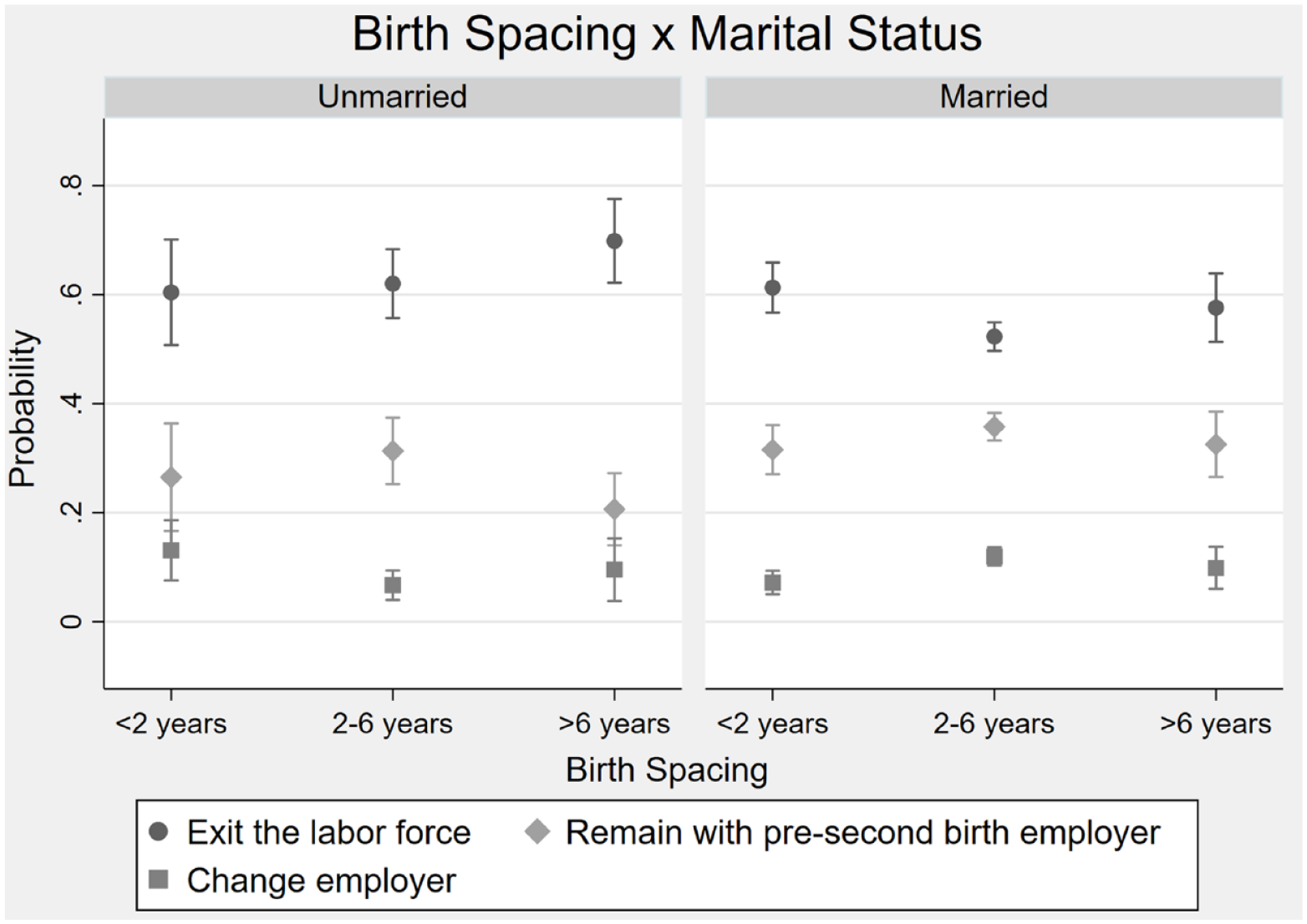
Predicted probabilities: birth spacing × marital status.
Finally, model 6 adds the interaction between professional and managerial occupation and birth spacing to model 3. Spacing children more than six years apart and being in a professional occupation, versus any other occupation, is associated with a higher risk for exiting the labor force versus remaining with a pre–second birth employer (RRR = 2.156). Spacing children less than two years apart, in contrast, is related to lower likelihoods of changing employers relative to remaining with a pre–second birth employer (RRR = 0.122) among women in professional/ managerial occupations. As seen in Figure 3, birth spacing differentiate risks more strongly for mothers in professional and managerial occupations than those in other types of jobs. In fact, only among professional mothers with birth spacing of 2 to 6 years do we see that risks for exiting the labor market are lower than remaining with the same employer. Thus, we find the opposite pattern to that predicted in hypothesis 4.

Predicted probabilities: birth spacing × professional occupation.
Discussion
The links between women’s childbearing and childrearing behaviors and employment patterns have been studied extensively, seeking to understand the less favorable labor market outcomes for mothers. Much of this research focuses on earnings or labor market exits, with fewer studies considering job changes. In addition, much of this research considers the transition to parenthood or the number of children as focal independent variables. This study fills an important gap in this literature by considering job duration and birth spacing among working mothers.
Our findings show that any effect that birth spacing has on labor market trajectories is mostly concentrated among labor market exits, rather than changing or staying with an employer. Women are more likely to exit the labor force if they space their first and second births less than two years apart. Perhaps these mothers face more discrimination in the labor force because of two closely spaced interruptions in their work experience or, lacking maternity leave, caring for two children may be easier when exiting the labor force (or at least not returning within six months, the end of the observation period in the analysis). Leaving a current job for childcare reasons, rather than voluntarily leaving a job for another in order to advance one’s career, is likely common for new mothers. Because of stigma and discrimination, such leaves might be especially important over the long run if mothers search for jobs after being out of the labor force for an extended period of time. Conversely, mothers might preemptively decide to have a second birth soon after their first in anticipation of leaving the labor force. That is, if employed first-time mothers realize that they do not want to, or cannot, continue working and childrearing, they may choose to go ahead and have another birth relatively soon after having their first child.
There is evidence that age moderates the birth spacing effect; that is, that the link between birth spacing and labor force participation varies by the age at which women became a parent, though not as we hypothesized. We expected that spacing would matter more for younger mothers (those with a birth before age 24) given that these mothers are a more select group that likely has less labor market attachment. Instead, we find more variation across birth intervals in post–second birth employment among mothers who had children at more normative ages as well as those who, among the NLSY79 cohort, might be considered “older” mothers. For those who had their first child at ages 24 to 30, short birth intervals clearly differentiated employment outcomes after the second birth, with a particularly high risk for leaving the labor market, but long birth intervals exhibited no such variation, and the risk for exiting the labor market was much lower at longer intervals. Conversely, among mothers whose first birth occurred after age 30, the risk for leaving the labor market after the second child was much higher when the second birth occurred more than six years later compared with other birth intervals. Perhaps both long birth intervals among mothers whose first birth occurred happened during more normative ages and short birth intervals among mothers with delayed fertility reflect a higher level of career commitment. That is, mothers who have their first child in their mid- to late 20s but wait several years to have another may be more career oriented than their peers who progress to the second birth more quickly, much like we might expect most who delayed childbearing until after 30 would be.
We also find little evidence suggesting that marital status influences the likelihoods of returning to a pre–second birth employer as compared with changing employers, although we find some differences in the risk of exiting the labor market completely (or at least for the six months after the second birth we observe). This variation is not as hypothesized, however. Instead, we find that married women’s risk for exiting the labor market after a second birth varies more by birth spacing than unmarried women’s risk. Short birth spacing between the first and second births among married women increases the risk for exiting the labor market more so than longer birth intervals. Given work-family conflict among working mothers, married women who have children closely spaced may have more of a financial cushion to leave the labor force given the availability of a second income. Furthermore, married mothers with birth intervals greater than two years are less likely to leave the labor force than their unmarried counterparts. For married women, longer birth intervals may reflect greater work commitment combined with more partner support in alleviating work-family conflict and/or, with their partners’ income, more options to outsource some of the increased childcare and household responsibilities.
Finally, we expected that the link between birth spacing and labor market outcomes would be stronger for mothers working in nonprofessional and nonmanagerial careers than those in professional and managerial careers, but we find the opposite. Birth spacing did not seem to differentiate the risk for leaving the labor market or changing employers for women in nonprofessional jobs, but for their counterparts, there are clear differences in the risk for exiting the labor market and remaining with the same employer. For these women, having a second birth 2 to 6 years after the first birth increases the chances of returning to the same employer after the birth and decreases the chances of leaving the labor market. Gough’s (2017) finding that the optimal spacing is 2 to 6 years seems most applicable to women in professional occupations, at least in terms of job tenure within the labor market. Professional careers might offer women the type of family leave programs that strongly support within-employer career trajectories.
Limitations
This study has several important limitations. First, there is a large selection effect: all mothers were working after their first births, and thus this is already a select group. Second, we were unable to incorporate variables that affect how a specific job influences the decision to leave a current position to exit the labor force or change employer, such as tenure at pre–second birth employer, industry, uptake of maternity leave, and offer of maternity and child care policies, nor do we account for work hours (i.e., part- vs. full-time).
Third, the NLSY79 is limited to one generation of women, those born from 1957 to 1964, and can therefore not be generalized to other generations. This is important because the labor market has changed dramatically, including the newer gig economy, the potential effects of the Great Recession, and labor market changes induced by the coronavirus disease 2019 pandemic. Future research should consider expanding research on continuous employment and birth spacing to younger generations.
Fourth, the time frame used in this project spans from the second birth to six months after the second birth. This precludes observations of job changes in the long run among mothers. We also did not account for whether births were planned, nor did we account for changes in partnership. Finally, we must acknowledge that birth spacing itself likely depends on post–first birth employment experiences and characteristics.
Conclusion
The factors that influence the negative link between motherhood and career and earnings trajectories are multifaceted. In focusing on higher parity births and employer-specific employment, we explored another potential aspect. The results suggest that short birth intervals increase the risk that women exit the labor force after a second birth but are otherwise unrelated to whether mothers return to a new employer or the same employer they were employed prebirth, with the exception of women employed in professional/managerial careers. Thus, it seems that employment changes cannot explain the link between spacing and wage gaps that occur among women more generally, and future work should investigate other potential mechanisms.
Footnotes
Authors’ Note
An earlier version of this article was presented at the 2021 annual meeting of the Population Association of America.
Funding
The author(s) disclosed receipt of the following financial support for the research, authorship, and/or publication of this article: This research was supported in part from center grants to Bowling Green State University’s Center for Family and Demographic Research (P2C-HD050959) and the University of North Carolina at Chapel Hill’s Carolina Population Center (P2C-HD050924).
