




Abstract
Black people are overrepresented in the American criminal justice system, yet policy-based criminal justice research has historically ignored the perspectives of criminalized Black people. Using interviews with 27 formerly incarcerated Black men, the author helps address this issue by exploring how carceral experiences produce “criminalized subjectivities.” In particular, when explicitly asked about what they would say to powerful state officials about their contact with the criminal justice system, the Black men in this study described a range of practices and policies they viewed as unfair and contradictory. Interviewees discussed: unequal judicial processes, inhumane prison conditions, postimprisonment barriers to reintegration, and the rigged nature of racialized mass criminalization. The author argues that, taken together, their responses constitute a critical perspective urging structural (rather than individual-level) change, rooted in experiences with invisibilization and criminalization.
Although Black people represent only 13 percent of the American general public, roughly 40 percent of the incarcerated and formerly incarcerated population is Black (Sawyer and Wagner 2023; Shannon et al. 2017). Such disproportionality arises, in part, from racialized processes within the criminal justice system itself (Chin 2016). Unfortunately, policy-based criminal justice research has historically ignored the perspectives of criminalized Black people (Williams and Battle 2017), favoring instead an approach that centers individual-level attributes and their relationship to outcomes such as recidivism. This absence of experiential insight reinforces the notion that Black people are a problem to be solved, rather than American criminal justice being a problem for Black people (Gonzalez Van Cleve 2023; Young 2018).
Fortunately, a growing body of work takes a more critical approach by exploring the institutional experiences of Black people who have been accused or convicted of crimes (Clair 2021; Miller 2021; Williams, Wilson, and Bergeson 2019). These works privilege experiential and relational dynamics, offering a more contextualized picture of how criminal justice operates today. By examining the perspectives of previously incarcerated individuals, this study contributes to that body of research and helps clarify the relationship between racism, mass criminalization, and meaning-making.
Specifically, through an analysis of interviews with 27 formerly incarcerated Black men, I demonstrate how experiences with systems of criminalization contribute to a unique form of racialized subjectivity (Du Bois 1899, 1903; Itzigsohn and Brown 2020), or what Clair (2021) termed criminalized subjectivity. In particular, when explicitly asked about what they would say to powerful state officials, these Black men argued for (1) increased criminal justice transparency, (2) improved prison conditions, (3) additional reintegrative supports, and (4) an end to the “rigged” nature of criminal justice. I argue that, taken together, their responses constitute a critical perspective urging structural (rather than individual-level) change, rooted in experiences with racialized invisibilization and criminalization.
In what follows, I review recent literature on race and the criminal justice system, racialized ignorance and subjectivity, and the perspectives of justice-involved Black individuals. These works help ground the voices of my participants in broader patterns of inequality and resistance. I then detail my data and methods before illustrating the profound structural critiques espoused by interviewees, which demonstrate their criminalized subjectivities. This work shows that the Black men I interviewed were cognizant of their invisibilization, along with the relationship between mass criminalization and racism, and sought to unveil structures of inequality (and corresponding solutions) that are typically hidden from public purview or ignored altogether.
Background
Developing a More Complete Picture of Racialized Mass Criminalization
In the United States more than 1.9 million people are currently incarcerated, another 3.7 million are under some form of community supervision, and estimates suggest that about 19 million carry a felony record (Sawyer and Wagner 2023; Shannon et al. 2017). The size and scope of the contemporary criminal justice system extends to communities across the country; however, research demonstrates that Black people, in particular, are subject to a broad range of social processes leading to disparate correctional control (Brame et al. 2014; Gonzalez Van Cleve 2016; Huebner and Bynum 2008; Jordan and Freiburger 2015; Kutateladze et al. 2014; Shannon et al. 2017; Steinmetz and Henderson 2016; Western 2006). Once criminalized, this population then faces a range of “collateral consequences” and informal systems of discrimination, together constituting what Miller and Alexander (2015), Miller and Stuart (2017), and Miller (2021) have described as a system of “carceral citizenship”. This critical perspective on criminalization illuminates how formally criminalized people are subject to both alternative legal realities (e.g., nearly 45,000 legal consequences of a criminal record) and new sets of responsibilities (e.g., to demonstrate productivity, submit to increased surveillance, pay fine and fees) that do not exist for noncriminalized people (Kilgore 2013; Miller 2014, 2021; Miller and Stuart 2017; National Inventory of Collateral Consequences of Criminal Conviction 2023; Page and Soss 2021.
Although a growing body of literature documents the policies, practices, and cultural ideas that maintain this alternative reality for a disproportionate number of Black people (Kirk and Wakefield 2018), there remains a need to better understand (1) how carceral citizens experience criminal justice inequality and (2) how they make sense of their experiences (Williams and Battle 2017; Williams et al. 2019). As currently constructed, research in the area of punishment inequalities centers around what Russell-Brown (2009) called the “bright lines” of racial discrimination (e.g., the discrete arrest, sentencing, and conviction stages). For example, numerous studies have sought to explain whether racial disparities in prison populations are warranted; while many find evidence of judicial bias at the sentencing stage (e.g., discrimination), others argue that extralegal factors such as offense type and criminal history better explain the observed disparities in prison populations (see King and Light 2019, Spohn 2017, Tonry 2019, and Ulmer 2012 for exhaustive reviews).
Although informative, this literature on correctional disparities remains somewhat incomplete. First, as Murakawa and Beckett (2010) demonstrated, research into criminal justice inequalities largely operate with narrow definitions of discrimination, favoring overt and intentional behavior, which limits our social scientific capacity to understand the systemic and mundane nature of racism. In this case, quotidian processes, such as plea bargaining and risk scoring, go unabetted or unaddressed altogether despite their downstream racialized implications (Angwin et al. 2016; Murakawa and Beckett 2010:695; Subramanian et al. 2020). As small disadvantages in the unobserved “backstage” (Russell-Brown 2009) accumulate, their combined impacts remain undetected (Kurlychek and Johnson 2019; Wakefield 2022). What happens, for example, when racialized biases inform whom to approach and arrest, when to divert or charge with a misdemeanor versus a felony, or whether an individual should be granted pretrial release? Research examining the discrete sentencing decision necessarily exclude numerous micro-interactional processes with important implications for sentencing-based outcomes (King and Light 2019; Murakawa 2019).
Moreover, the literature’s emphasis on calculating inequality precludes our ability to account for less quantifiable, though no less harmful, racialized processes. For instance, Gonzalez Van Cleve’s (2016) ethnographic account of Cook County (Chicago) courtrooms helps illuminate those everyday racialized experiences that fail to appear in studies exploring singular discretionary junctures. As Gonzalez Van Cleve noted, “Race is everywhere but nowhere: in the structural arrangements, in the policing of racial boundaries, in the recoding of rhetoric, and in the delineation of defendants as ‘deserving’ or ‘undeserving’” (p. 53). Gonzalez Van Cleve’s work demonstrates how police officers, judges, prosecutors, and even defense attorneys collectively operated to stigmatize and sort defendants of color and in doing so, strip any semblance of legal power they might have otherwise exercised. These qualitative insights help underscore the pervasiveness of racism throughout the backstage.
Relatedly, researchers have called for a more critical social scientific lens attuned to the problematic nature of official criminal justice statistics (Glover 2019; Gómez 2012; Henne and Shah 2015; León 2021; Murakawa 2019; Gonzalez Van Cleve and Mayes 2015). Dominant approaches to uncovering criminal justice disparities conceptualize race as an inherent and unchanging characteristic of individuals rather than a power relation. For example, in a number of well-cited meta-analyses of recidivism, race is explicitly included as a static risk factor for rearrest (Gendreau, Little, and Goggin 1996; Katsiyannis et al. 2018; Wehrman 2011). Incorporating “race” in this way, through the use of dichotomous control variables, implicitly suggests that racial categories are stable and unproblematic; notions that have been falsified elsewhere. Take, for instance, recent research documenting the mismatch between police perceptions of an arrestee’s race and their self-identification (Laniyonu and Donahue 2023; Penner and Saperstein 2015). Additionally, the failure to problematize racial data inhibits our ability to tell accurate causal stories around a number of outcomes (Palmer, Rajah, and Wilson 2022; Parmar 2016; Sampson 2010). Thus, although recidivism rates are widely viewed as indicators of individual success or failure, they often reflect both community disadvantages and community surveillance practices that differ along racialized lines (Bailey et al. 2020; Bradner and Schiraldi 2020; Hyatt and Barnes 2017; Kubrin, Squires, and Stewart 2007).
Taken together, these insights suggest a greater need to explore the voices of carceral citizens. In particular, the narratives of criminalized Black people can help uncover (accumulated) racialized institutional harms that go undetected in variable-based analyses, address causal theoretical gaps, and provide potential solutions to pressing issues related to criminal justice inequalities (Presser and Sandberg 2019). As Williams and Battle (2017) noted, “qualitative differences in the ways in which punishment is administered is painfully lacking within criminological discourses regarding punishment, and has thus contributed to a colorblind ethos that has omitted lived experiences” (p. 555). Inherent in such critiques is a call to reconsider the ever present question pondered by Du Bois more than a century ago: “How does it feel to be a problem?” (Du Bois 1903; Gonzalez Van Cleve 2023). In the current era of racialized mass criminalization, understanding the perspectives of carceral citizens (e.g., those who are constructed as problems in and of themselves) can help illuminate both how racism operates and how racialized criminal justice processes affect the subjectivities of those who are made to exist in alternative social realities. In the next section I detail a Du Boisian case for exploring the narratives of carceral citizens.
Racialized Subjectivity
Du Bois (1899), in what he termed “double consciousness,” theorized that Black people in America come to develop a particular sense of self out of their cumulative experiences with the color line: the Negro is a sort of seventh son, born with a Veil, and gifted with second-sight in this American world,—a world which yields him no self-consciousness, but only lets him see himself through the revelation of the other world. It is a peculiar sensation, this double-consciousness, this sense of always looking at one’s self through the eyes of others, of measuring one’s soul by the tape of a world that looks on in amused contempt and pity. One feels his two-ness,—an American, a Negro; two souls, two thoughts, two unreconciled strivings; two warring ideals in one dark body, whose dogged strength alone keeps it from being torn asunder.
For Du Bois, the “Veil” signifies the separate social worlds inhabited by Black and white people, whose views of themselves and others are mediated by their position on either side of the Veil (i.e., the color line). For whites, the view across the Veil is both incomplete and dehumanizing; clouded by distorted constructions of Black people and absent a true recognition of Black humanity. Yet, it is not that Whites simply lack knowledge around the lives of Black people, Du Bois argued that ignorance is cultivated and defended in order to maintain racial orders (Du Bois [1940] 2007; Itzigsohn and Brown 2020; see also Mueller 2020). As Mueller (2020) outlined in her theory of racial ignorance, white racial ignorance operates as an ends-based technology useful for defending antiracist critique, evading moral implications of racial consciousness, and maintaining racial domination. Therefore, when whites are exposed to data on racial disparities in the criminal justice system and become more supportive of the very policies that create such disparities (Hetey and Eberhardt 2018), a Du Boisian theory of racial inequality points to the active and rational maintenance of racial “unknowing” or “nonknowing” in support of racial hierarchies (Mueller 2020; Murakawa 2019).
Although Du Bois noted that the Veil could similarly produce in Black people a distorted view of themselves, he also recognized a potential for clarity of vision; a “second-sight” arising from the Veil that enables Black people to wield an undistorted view of the white world and their place within it. The duality, or twoness produced by at once being American and Black, Du Bois argued, could facilitate a range of responses such as: self-assertion, rebellion, and assimilation. This occurs, Du Bois argued, because Blackness is not monolithic and therefore the range of subjectivities derived from life behind the Veil are contingent upon intersecting factors, including: historical period, geography, education, class, and gender (Clair 2021; Du Bois 1899; Itzigsohn and Brown 2020). As Itzigsohn and Brown (2020) demonstrated, Du Bois’s own experiences with professional and personal discrimination “allowed him to understand the relationship among power relations, exclusionary dynamics, and the formation of racialized subjectivities and identities” (p. 37). Du Bois’ theory of double consciousness, then, is explicitly constructed around the importance of lived experience for understanding racialized modernity (Itzigsohn and Brown 2020).
The Voices of Justice-Involved Black People
In an era of mass criminalization, when half of all Black men have been arrested by the age of 23 (Brame et al. 2014) and nearly one quarter of the Black population in the United States has a felony record (Shannon et al. 2017), understanding the subjective experiences of Black carceral citizens is imperative to fully understand racialized modernity in the American context. Fortunately, a growing body of work has begun to uncover these subjective experiences, demonstrating a range of theoretically rich interpretations of and responses to American criminal justice. For example, studies of Black men’s experiences with policing demonstrates how disproportionate police surveillance and harassment produces deep-seated feelings of distrust, along with survival tactics aimed at avoiding further police contact (Gau and Brunson 2010; Martinez et al. 2023; Stuart 2016; Williams 2020). Bell (2016) found a comparable level of cynicism around policing in her sample of Black mothers, however the participants in her study also expressed “situational trust” of police officers under particular circumstances. That is, in a context of limited institutional resources to help them solve everyday problems related to race, class, and gender, the Black mothers Bell interviewed felt they could rely upon police officers under certain conditions (i.e., when they knew a particular officer to be trustworthy or in situations that posed an immediate threat to themselves or their children).
Glover’s (2008) analysis of racial profiling narratives further reveals how encounters with law enforcement were viewed as part of a larger project of citizenship-crafting. Experiences with disproportionate surveillance and suspicion led the participants in Glover’s study to develop a sense of twoness and a recognition of their alternative social-legal status. They, too, exhibited important narrative responses to their differential treatment; some asserted their American-ness amid institutional processes denying their full citizenship, while others made explicit references to the permanency of the Black experience.
Research on the judicial system similarly shows that Black people report little satisfaction with criminal legal processes (Buckler et al. 2011). Martinez et al.’s (2023) interview-based study reveals that many of their court-involved Black participants felt stigmatized during court proceedings (see also Gonzalez Van Cleve 2016), burdened by complicated court rules, silenced by court processes that valued efficiency over truth-seeking, and discriminated against because of being poor and Black. Clair’s (2020) ethnographic account of the Boston court system also uncovered a broad-based cynicism of court-appointed lawyers among poor Black and Latino defendants. In particular, Clair found that defendant mistrust of lawyers was grounded in a range of factors, including: their prior experiences with indigent defense systems, skepticism around public defender incentives (e.g., poor pay, the pressure to process high caseloads quickly), cultural gaps between defendants and their attorneys, a lack of personalized attention, and extrajudicial experiences that promoted systemwide criminal justice skepticism (e.g., negative experiences with policing). Importantly, Clair showed that attorney mistrust led to various forms of agency: while some defendants attempted to directly cultivate their own legal knowledge and skill in an effort to supplement (and sometimes replace) their court-appointed attorneys, others resigned from participating in the legal process altogether, preferring to focus on the many issues they faced outside of courtrooms (such as evictions, addiction, and mental health issues).
Although studies examining subjectivity and prisons are relatively rare, a growing body of work explores incarcerated people’s perceptions of prison-based discriminatory treatment, sorting, and programming (Ellis 2021; Fader 2013; Goodman 2014; Hattery and Smith 2022; Lopez-Aguado 2018; Walker 2016; Wulf and Trammell 2021). For instance, in their study of race and solitary confinement, Hattery and Smith (2022) found that many of the incarcerated Black people they interviewed recounted specific instances of racist treatment, while others spoke broadly about differences in treatment between themselves and incarcerated white people. Hattery and Smith also found that correctional authorities used race to help make decisions around cell assignments, justifying the practice because, as one unit manager described, “The white guys wouldn’t live with Black guys and vice versa” (p. 64). Others have similarly uncovered how incarcerated people are sorted, by correctional authorities, on the basis of race and place, and how such segregative practices affect racialized identity formation, survival strategies, and familial networks (Goodman 2014; Lopez-Aguado 2018; Walker 2016).
Finally, while research on the back-end of the criminal justice system is largely concerned with the quantitative measurement and reduction of recidivism, recent work privileges the voices of formerly incarcerated Black people in an attempt to better understand racialized criminal justice experiences. For example, researchers have documented the widespread sentiment among Black formerly incarcerated job seekers that criminal record discrimination remains a persistent barrier to (re)integration (Henson 2022; Williams et al. 2019). Additionally, researchers have consistently uncovered disjunctures between reentry-related programming that emphasizes personal change and the structural realities (such as labor market discrimination) that formerly incarcerated people must navigate (Fader 2013; Miller 2014; Ortiz and Jackey 2019; Payne and Brown 2021).
Miller (2014, 2021) found that many of his participants viewed the reentry support they received as symbolic and unhelpful (rather than material and concrete). Payne, Brown, and Wright (2020) similarly illustrated the deep-seated distrust of reentry programming espoused by their participants. As one of their participants reflected: “I really haven’t seen any . . . positive things come out of most reentry programs. All I see is like reentry, to come back to jail. . . . I don’t see no reentry program helping anybody. All I see, is harming” (p. 403). Overall, the existing literature uncovers a broad theme of cynicism around contemporary prisoner reentry systems, often because of their inability to facilitate social and economic integration among Black formerly incarcerated people (Ortiz and Jackey 2019; Payne and Brown 2021).
Smiley’s (2019) ethnographic study of prisoner reentry also exposes negative views around criminal justice, but provides an important reflexive component that explicitly confronts the meaning formerly incarcerated Black men make from experiencing and observing the interconnected forces of mass incarceration and systemic racism. The study, set in the context of the early Black Lives Matter Movement, explores how the killing of Trayvon Martin unearthed subjectivities specific to being Black and justice involved. In particular, Smiley found that after Martin’s death, focus-group participants spoke at length about “the various ways history has failed Black people in general and Black men in particular when it comes to the criminal justice system” (p. 408). Participants used historical events such as the lynching of Emmett Till, the beating of Rodney King, and the killing of Oscar Grant to illustrate the racial injustices levied against Black bodies through criminal justice action (or inaction). Furthermore, some of the participants in Smiley’s study juxtaposed the treatment of Black people convicted of crimes (including themselves) with white people who have been acquitted of crimes, illustrating their belief in the “rigged” nature of criminal justice. Others expressed a sense of optimism grounded in what they viewed as important technological or political developments (e.g., social media and the presence of Barack Obama in the White House) that would help drive awareness around racialized injustices, such as the killing of Trayvon Martin. Last, another group of participants compared their violent crimes to the deeds of George Zimmerman, questioning whether their behaviors were just as detrimental to their own (Black) communities.
Smiley’s analysis captures how the formerly incarcerated people in his study viewed their own carceral experiences in relation to a larger system of racialized social control. As they witnessed the unfolding of Martin’s murder and Zimmerman’s criminal case, their narratives identified the criminal justice system as an important institution for the reproduction of racial inequality, while also leaving room for nuanced variation.
Toward the Study of Criminalized Subjectivity
In general, the scholarship detailed above focuses our attention on the perspectives of those whose are regularly ignored, veiled, or discredited altogether. This body of work suggests that, at every stage of the criminal justice system, criminalized Black people experience, describe, and respond to racially unequal carceral processes. Additionally, by uncovering multiple responses toward race, crime, and criminal justice, this work supports the Du Boisian contention that a range of subjectivities may arise from life behind the Veil (see also Trimbur 2009), while also peeling back that Veil to provide a clearer view of how criminal-legal institutions shape the experiences and understandings of Black people today. Still, there remains a need to better understand (1) the full range of perspectives within varying criminal justice contexts, (2) how carceral citizens conceptualize their experiences in relation to racism more broadly, and (3) future-oriented perspectives around criminal justice. As Clair (2021) argued, such work is a necessary supplement to the dominant strand of race-related criminal justice research that focuses primarily on group-level disparities, rather than how criminalized people “perceive and react to the racial order and the structure of the law” (p. 12).
Fortunately, Clair’s (2021) concept of criminalized subjectivity provides a unifying theoretical framework to help clarify the relationship between racialized mass criminalization and sense-making. Criminalized subjectivity, Clair explained, involves the “unique understandings and visions attendant to being a person, or part of a community, routinely subject to legal control and exploitation sanctioned by the criminal law” (p. 15). He continued, What is important for a theory of criminalized subjectivity is a person or group’s subjective perception of their position in relation to the structure of criminal legal control and exploitation. A theory of criminalized subjectivity focuses on the individual and collective consciousness—the concerns, attitudes, and narratives (Ortner 2006)—that result both from direct experiences of punitive control as well as its possibility. (p. 16)
Notably, Clair’s concept of criminalized subjectivity pushes researchers to go beyond the documentation of difference (in outcomes or even attitudes), to examine processes of racial knowledge production. That is, criminalized subjectivity builds from Du Boisian insights around the Veil and double consciousness, and focuses our attention to the relationship between lived criminal-legal experiences, meaning, and racialized modernity (Clair 2021; Itzigsohn and Brown 2020). As Davis (2018) noted, through experiences with seclusion, alienation, and dehumanization, a new consciousness may develop in Black criminalized people, allowing a more critical understanding of how racism and criminal justice interrelate: They come to recognize that the denial of their humanity is predicated on social structures, and so critique those social structures that impose upon their self-consciousness an unnatural unreality. They recognize that they are not the problem, the structure of society is the problem with its adherence to inhumane practices such as mass incarceration. (p. 1140)
I build on these insights by exploring criminalized Black men’s views on what people in power should do to create a fairer criminal justice system. In particular, I situate my analysis around a prompt asking formerly incarcerated Black men to consider what they would say to politicians about the criminal justice system. This prompt encouraged interviewees to reflect back on their carceral experiences, connect those experiences to broader systems of racial inequality, and imagine alternative forms of justice. In other words, the formerly incarcerated Black men I interviewed detailed their subjective perceptions around processes of criminalization and in doing so, illustrated how racially excluded populations are able to “see the world beyond the veil” (Itzigsohn and Brown 2020:42). In particular, these men used knowledge gained from their cumulative lived-experiences to critique taken-for-granted criminal justice actors, policies, and practices, while also pointing to alternatives; both of which reflect the Du Boisian contention that the perspectives of racially disadvantaged people illuminate social realities that would otherwise go unnoticed (Itzigsohn and Brown 2020). Taking seriously Gonzalez Van Cleve’s (2023) challenge to develop a Du Boisian criminology that holds race and racism as central processes, in this article I investigate how formerly incarcerated Black men “look up at the power structure” and reveal how punishment reinforces racial dominance. In the next section, I detail my data and methods before moving on to the findings.
Data and Methods
This article arises out of a larger ethnographic study of formerly incarcerated people’s experiences in the greater Hartford, Connecticut, area. The data used for this analysis are based primarily on in-depth semistructured interviews with 27 formerly incarcerated Black men conducted between 2016 and 2018 (Table 1). Participants ranged in age from 25 to 68 years, with a median of 40 years. Almost two thirds of the sample held at least a high school degree, but fewer than 50 percent of participants had any job at all, and no participants enjoyed full-time work. The vast majority of participants were most recently convicted of a violent offense, most often robbery or assault, and the sample exhibited a mean of 70 months served (median = 36 months) during their most recent period of incarceration. Each formerly incarcerated participant had been released from prison within 5 years at the time of the interview and had responded to a “call for participants” flyer circulated among both criminal justice professionals and formerly incarcerated individuals. 1 Participants were paid $30 for the interview.
Sample Characteristics.
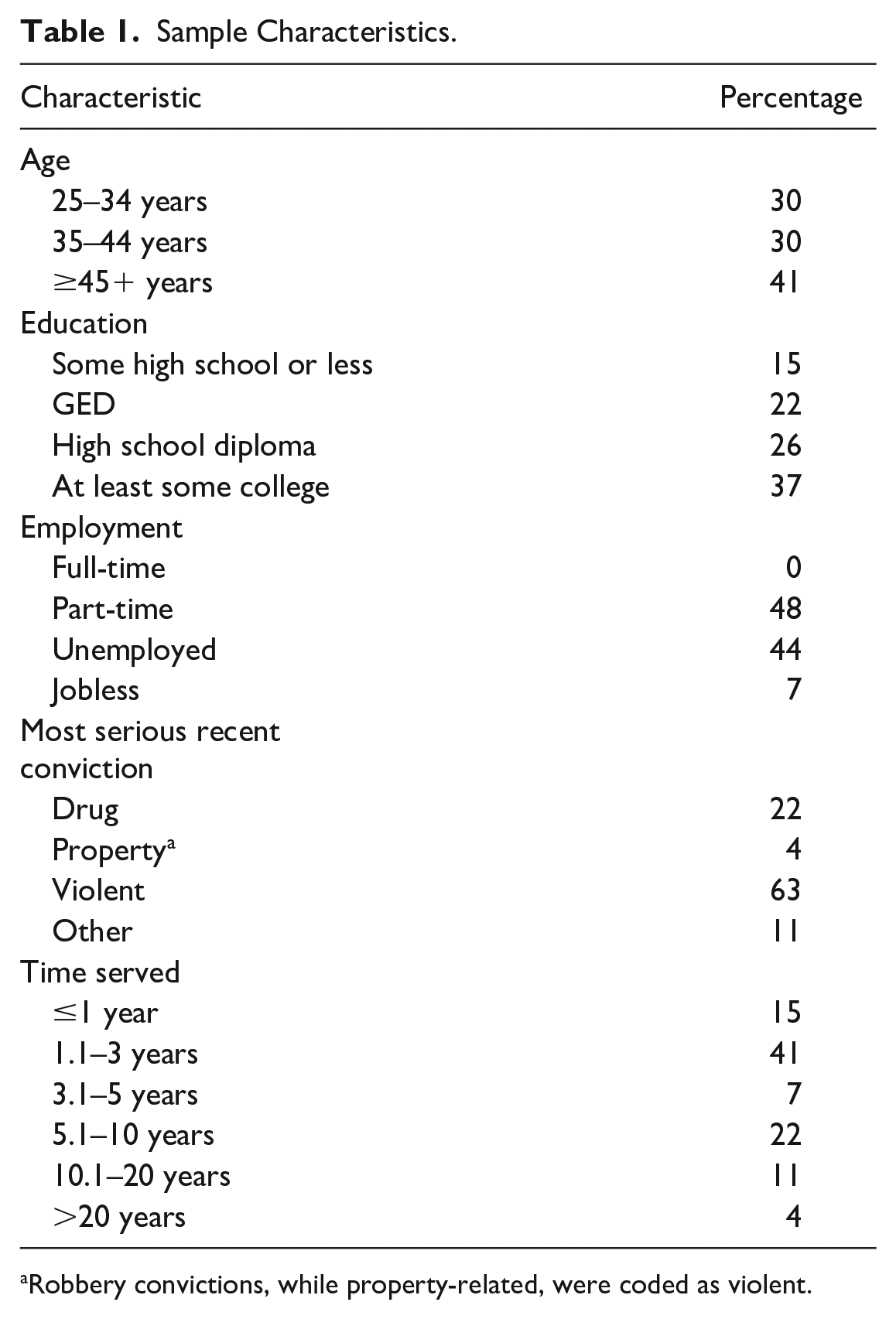
Robbery convictions, while property-related, were coded as violent.
Hartford provided an ideal setting in which to examine justice system experiences. As a state, Connecticut operates a comparatively small prison system, which had experienced a consistent population decline from 19,410 in 2008 to 13,370 in 2018 (Connecticut Department of Corrections). This decline was the result of several factors including declining crime rates, strained state budgets, and policy changes that funneled people away from prison (such as expediting the parole process and reclassifying certain felony drug crimes as misdemeanors). As such, under the governorship of Dannel P. Malloy, Connecticut had gained a reputation as a reformist state leading the way on decarceration.
I wanted to investigate how these changes squared with the lived experiences of formerly incarcerated people. At first, I began attending local community events centered around criminal justice issues, before attending regular Returning Citizens Coalition gatherings, where criminal justice practitioners, formerly incarcerated individuals, and concerned citizens would meet to discuss and work on important reentry-related issues. What I began to notice was that although the prison population had declined, the local criminal justice system was still a dominant presence in the lives of those with criminal records.
Furthermore, it was clear that Connecticut’s criminal justice system was still dealing with deeply embedded racial inequalities. Most of the previously incarcerated people I met were Black men. Indeed, Connecticut has one of the most racially unequal incarceration rates in the country: Black people make up 41 percent of the incarcerated population, but only 11 percent of the overall state population (Vera Institute of Justice 2018); roughly 148 of every 100,000 white Connecticut residents are incarcerated, whereas 1,392 of every 100,000 Black residents find themselves behind bars. Only five states exhibit larger Black/white disparities (Nellis 2021). These statistics suggested the need to unpack not only the experience of going to prison, but also the unique perspectives of criminalized Black men who most often face state-sanctioned systems of punishment. In particular, I wondered how these Black men conceptualized and discussed the criminal justice system, and whether they viewed it as an unequal institution.
I used in-depth, semistructured interviews to help answer these questions. Interviews were typically conducted at local libraries or coffee shops. Interview topics ranged from pre-prison experiences to aspirations, but in this article I focus on answers to one question in particular: “What would you say to the Governor or a state senator about your criminal justice experiences?” As one of my goals was to uncover the often ignored perspectives of criminalized people, this question was designed to elicit experiential insight from those most affected by the criminal justice system. Analysis of the interviews incorporated a combination of deductive coding, whereby a set of theoretically informed questions and prior analysis contributed to the development of a “living” and flexible codebook, along with inductive coding, on the basis of emergent themes arising directly from participant responses (Gerson and Damaske 2021). In particular, the analytic process followed insights from narrative criminology, which emphasizes the role of stories as meaning-making endeavors capable of demonstrating how storytellers understand the world around them (Presser and Sandberg 2019; Stone 2016). As participants described their criminal justice and reentry experiences, and were asked to transform their experiences into focused feedback for powerful state actors, they uncovered both the structural conditions shaping experiences and roadmaps for social action (Maruna 2001; Presser 2016). Each interview was analyzed and coded entirely before isolating responses to the focal question as stated above. This analytic scheme allowed a holistic understanding of the themes elicited by the focal question. 2 In the findings section, I present a qualitative analysis of these themes centered around developing a better understanding of the relationship between carceral experiences and meaning-making. I also provide a limited number of figures detailing the prevalence of themes; these figures are not intended to convey the generalizability of my findings, but rather to provide a deeper sense of how such themes cut across this specific sample. Where appropriate, I also include dialogue from follow-up questions and from elsewhere in the interview for contextualization purposes.
It is also important to discuss my positionality as a Black man from Hartford. Being racially and geographically similar to many of my respondents allowed a mutual understanding of numerous topics, informing both interview dialogues and my analysis. Although I had never been incarcerated, sharing a certain level of cultural (and even experiential) insight made for nuanced conversations and a more informed analysis than would have been possible if I had been more socially “distant.” Although there remains a strong sociological tradition of valuing arms-length “neutral” scholarship, in this article I take the perspective that proximity can be a strength for researchers engaged in nuanced social scientific research (Harris 2021; Miller 2021). For example, respondents would often use specific words, recall previous local events, or explain experiences of formal and informal policing that I was familiar with or experienced personally. These shared meanings and experiences also promoted rapport-building and a certain level of comfortability with me as a researcher that may have been absent otherwise.
In what follows, I detail the themes that appeared most salient to my participants as they explained what they might say to powerful state actors. In doing so, this research contributes important insights to the literature on race, policy, and mass criminalization.
Findings
Despite the prevalence of reentry-related studies, in both academic and mainstream spaces the voices of formerly incarcerated Black people remain underexplored, and rarely, if ever, are the concerns of this population considered in discussions of criminal justice policy. During my time in the field, however, I soon came to realize that this population had much to say about the way our criminal justice system works and how it ought to work. They spoke at length about specific rules and procedures, the people working in the correctional system, and what would be required to create a better system for everyone. More broadly, and in both implicit and explicit ways, I also found that the formerly incarcerated Black men I interviewed connected punishment to racial domination. In the remainder of this article, I detail interviewee responses to the question of what they would say to powerful state officials regarding their criminal justice experiences, situating these responses within a framework of criminalized subjectivity.
Contending with the Veil
Embedded in the narratives of my interviewees was a belief that most people had little knowledge of how it feels to be processed through the criminal justice system. In fact, when I asked interviewees if they believed that others understood what it was like to “walk in their shoes,” the vast majority stated some version of “only if they’ve been through it themselves.” About one third of interviewees, however, took the focal question as an opportunity to shine some light on the experience of being incarcerated, with the hope that their concerns would eventually be taken seriously by those in power:
Help [incarcerated people] get a fighting chance. You know what I’m saying? With the ones that are fighting for their cases and fighting for their freedom, these are their lives. They got 60, 80 years. They’re going to die in prison if they don’t get a chance to get out. Make sure the outside world knows this so that they’ve got a fighting chance when they go back to court, when they do their habeas . . . not just bone them off because “oh, you’re a prisoner already,” you know what I’m saying?
Yeah. I mean, it seems like that would benefit everyone, right? Like, not just them.
Yeah. I mean, some dudes did what they did, okay, and they’re fighting to get out. Pretty much evidence, forensics or whatever they did to get convicted pretty much is going to explain that in the court and they’ll get shut down. But the ones that actually didn’t do nothing . . . these dudes deserve a fighting chance, and a lot of them are not getting it, and they’re going to die in prison. They don’t have no outside help. Tha’s why I was willing to talk to you. I told myself, if I ever get out of prison and I get a chance to speak to somebody that could get some type of help for the guys locked up in DOC [Department of Correction], I would take the opportunity 100 percent, and that’s why, you know, I’m here, man.
David (34 years old) recognized that few people on the outside take the time to concern themselves with the lives of people behind bars. Earlier in our interview, David lamented the fact that so many “really good people” were either behind prison bars or confined to quasi-carceral spaces such as halfway houses; that’s the problem that we have now, where our system is like, it doesn’t work, you know what I’m saying? Because these type of guys don’t need to be locked up, because they don’t know me from a hole in the wall and here they were making sure I got clothes, food in my stomach and stuff like that, you know what I mean?
He wanted both policy makers and the public to know that there were decent incarcerated people attempting to fight for freedom, but argued that they were too frequently being excluded from legal pathways to release. In this way, participants responses uncovered a widely held belief that they had not been afforded what punishment scholars call procedural justice, or the perception of fair treatment by the criminal legal system. 3 David’s concluding sentiment, a sense of gratitude for the opportunity to shine a light on carceral injustices, was also shared by a majority of interviewees. For this group, the interview operated as a means to get their story out and illuminate the inequality structures governing the lives of justice-involved people. If the Veil, here conceptualized as an institutional-level system of domination and distortion (Du Bois [1940] 2007; Joseph and Golash-Boza 2021), had hidden what it was truly like to be a criminalized Black person, the interview offered a glimpse at how it might feel to peel the Veil back and speak to the “passing world” (Du Bois [1940] 2007:66).
Others (n – 4), however, were skeptical of speaking out. These interviewees believed that even if they got their concerns to powerful people, it would still not result in meaningful criminal justice reform. When I asked Deron (68 years of age), who spent 24 years behind bars for a robbery conviction, enhanced by a “persistent offender” statute, about what he might say to a governor, for example, he expressed doubt that the information would lead to systemwide change: Truthfully, it would depend on really what they wanted to know and why they wanted to know it, because a lot of people ask you them type of questions and they still don’t do nothing. I really don’t have the time or the patience to sit up and tell you something that need changing and you sit there nodding your head and then you ain’t going to make no changes or make no attempt to change it. It’s just a waste . . . you just want to make it look like you’re doing something.
These formerly incarcerated Black men (all of whom spent at least five cumulative years behind bars) were suspect of the political gatekeepers keeping mass incarceration afloat and were hesitant to turn to politicians for change. Although reformist messages may proliferate among political leaders, some criminalized Black men have developed a skepticism of politicians rooted in their experiences of erasure and disregard. Much like Du Bois’s [1940] (2007) revelation in Dusk of Dawn, this group of criminalized Black men expressed the sentiment that “the people passing by do not hear.”
Prison Conditions
Du Bois makes note of “some thick sheet of invisible but horribly tangible plate glass” preventing people racialized as white from truly hearing the concerns of those racialized as Black. This metaphor, of a thick glass Veil, represents an amalgam of (sometimes hidden) social processes that limit the interaction and understanding that can occur across the socially constructed color line. Davis (2018) argued that this metaphor takes on added meaning for incarcerated Black people, who must exist behind a Veil of solid brick, concrete, and steel, making the task of communicating the multiple pains of imprisonment (Sykes 1971) to the outside world that much more difficult. As interviewees recounted medical concerns that were treated as trivial by correctional authorities, the high cost of prison and jail communication services, limited and sometimes complicated prison grievance procedures, and the rural location of prison facilities, they demonstrated an awareness of this concrete Veil and called for political leaders to peel it back. When I asked Shawn (46 years of age) about what he would say to political leaders, he emphasized their need to gain experiential knowledge: They need to go in there and experience it for a couple of months, you know? It will confirm my theory as far as there’s no help inside of prisons. Once you get sentenced, you’re just laying in a cell doing time. That’s that. I mean, yeah, they got little programs for you to do but they’re not serious, intense type of programs. You know, those people were in there for a paycheck pretty much. Some of them mean well but they just don’t have the resources to help you in there. So yes, I mean, in order for them to see what we feel, what I feel, they’d have to go through that themselves.
Shawn, who spent 11 years behind bars for convictions related to an armed robbery, provides a damning account of prison life defined by liminality and a lack of serious programming. In fact, Shawn’s experience highlights the long-standing decline in educational, rehabilitative, and recreational prison programming since the 1990s (Beckett and Sasson 2000; Buruma 2005). Asserting “they need to go in there and experience it,” Shawn argued that policy makers have failed to recognize the humanity of incarcerated people and should be made to “see what we feel” by going “through [prison] themselves.”
This search for recognition, I argue, is a contemporary example of Du Bois’ insight on racialized subjectivity. As Itzigsohn and Brown (2020) explained, Du Bois’ theory of racialized subjectivity—double consciousness—directly addresses the process of rendering invisible the lives of racialized subjects. Amid this invisibility-making, however, Du Bois suggested that racialized groups tend to exhibit one or more typical responses: revolt, adjustment, or self-realization (Itzigsohn and Brown 2020). I contend that my participants’ narratives exemplify a fourth response, what we might call “reflection.” By illuminating the pains of imprisonment and calling for those in power to “go in there and experience it,” the people I interviewed desired to reflect their (hidden and distorted) carceral experiences back onto those who maintain the contemporary system of mass incarceration.
In fact, some of the men focused on issues such as prison food, hygiene, and correctional officer behaviors in an effort to reflect the conditions of confinement and to push back against racialized stereotypes around violence. David, for example, made an unambiguous connection between prison conditions and the possibility of violent outbursts: Man, just—if you do anything with this, just please put it out there, you know what I’m saying, to get these guys a fighting chance on the inside that are looking for some outside assistance, because there’s a lot of dudes in there that’s been trying to reach out to the world, to have them look inside DOC, because we’re being treated wrong. We’re not getting fed right, hygiene’s not right, you know what I’m saying? The way the COs [corrections officers] operate on these blocks, they don’t need to be there, because you’re making a simple timeframe really difficult, to the point where it’s like a lion being backed up in a corner. Once you get against that wall, you got nothing to do but to spring out.
David’s response begins with an explicit plea to communicate the needs of incarcerated people who are looking for “outside assistance.” Embedded in this appeal is the recognition that incarcerated people’s concerns are being largely ignored and the ongoing need to peel back the Veil. As David continues, he describes the multiple ways incarcerated people are treated inhumanely: they are fed inadequate food, housed in unsanitary conditions, and treated poorly by correctional officers. David then connects these conditions of confinement with the potential for violence, recognizing the contextual and organizational factors that may influence individual-level behavior.
As David hinted above, my interviewees also identified the problem of health concerns within carceral spaces. Correctional facilities are notoriously unsanitary and unhealthy spaces, a fact made plain by the recent coronavirus disease 2019 pandemic (Barnert, Ahalt, and Williams 2020).
4
When I asked Rick (42 years of age) about his recommendations for policy makers, he had the following to say: Well, the first one would be in regards to, you know, how inmates get treated in prison, you know, in regards to the medical attention, the medical procedures and being seen for emergencies and stuff like that. I know a lot of inmates that have medical problems that did not get the proper care in there, including myself, you know? I’m having this problem right now as we speak. I’d like to go see a doctor on the outside, but I can’t because I’m still considered DOC, so I got to see the doctor from inside, and they’re not doing nothing for me from the inside. . . . So what am I supposed to do?
In response to the focal question, four interviewees explicitly pointed to inadequate correctional health care practices (such as receiving 800 mg of Tylenol for sicknesses they believed warranted greater responses). Because Rick did not have private medical insurance and was living in a halfway house at the time of our interview, he was forced to rely on medical care provided by the DOC to help him deal with a drug addiction that went largely untreated in prison, an institution in which he had little faith. Although social science research on prisons has identified numerous pathways to negative health outcomes (Massoglia and Remster 2019), Rick suggests that an underrecognized mechanism of health inequality lies in the inadequate attention that correctional authorities pay to incarcerated people. The feeling of ignored medical needs was widespread among my interviewees (mentioned by more than 25 percent of participants), showing up in responses to the focal question and elsewhere in interviews. 5
Rick went on to discuss the food served in prisons, noting that “Some of the food is uneatable. . . . I don’t think they ever serve it like that in the refugee camps and they have it bad there.” In a country with such vast resources, situating prisons below refugee camps illustrated the disdain that Rick believed correctional authorities and policy makers have for incarcerated people. I found that my interviewees were highly cognizant of their diminutive social status. Criminalized and racialized populations, those viewed as the “undeserving poor” (Gans 1994), are consistently sent the message that they are unworthy of even basic health care and nutrition (The Marshall Project n.d.). Noting that the food served in prisons would be unfit for animals, interviewees described their incarceration experiences as overwhelmingly dehumanizing. Rick went on to discuss prison overcrowding as part of this dehumanizing process: They even had people sleeping in the chapel. They would take them out in the daytime, throw them in the bullpens or whatever, run services, and put them back in the chapel again at night, you know? So, it was overcrowded. Definitely overcrowded.
Fed “uneatable” food, herded into cramped chapels and “bullpens”, unable to breathe clean air, restricted from exercising, and facing the harshest treatment at every stage leading up to and including incarceration (Chin 2016); interviewees who discussed the prison experience uniformly described it as a degrading one and advocated for more humane treatment that better supported the professed goals of prison officials; such as safety, rehabilitation, and eventual reintegration. These reforms included providing nutritional food, access to clean and less restricted living spaces, opportunities for exercise, and adequate medical care. Although the majority of men in this study were interviewed at least six months after release, that roughly one third discussed prison conditions when asked about what they would say to those in power suggests both a recognition of the concrete Veil and the need for alternative ways of dealing with people who have been convicted of crimes. By pointing to inhumane prison conditions, interviewees were able to make legible the human experience of American incarceration.
Barriers to Reentry
In response to the focal question, two thirds of the Black men I interviewed addressed structural barriers to (re)integration. Although popular approaches to reentry, and a significant body of criminological literature, focus explicitly on addressing individual-level issues among formerly incarcerated people, these interviewees highlighted the challenges of overcoming multiple forces outside of their immediate control. The automatic exclusion from job opportunities because of a criminal record was a particularly pressing subject: I would speak to them and I would just probably push towards the end of that box question, because the processes and certain things like that can open the door for that individual. And if they really want to, then they can take [the question asking about criminal records] off. I’m not a big believer into a whole bunch of handouts, but fair opportunity for getting work—let that individual improve himself, you know? If you’re a dirtbag career criminal and you go apply for a job and you’re still about those dirtbag ways, you’re not going to last in the job regardless. . . . But give those individuals that initial opportunity to get to that interview process, to get that job, to get through orientation, you know? Don’t just put that on all those applications and things like that. (Kareem)
For these men, the question of whether job applications should ask about prior records was steeped in broader notions of fairness and equality. According to this group, job sorting practices that rely upon blanketed criminal record bans directly contradicted the notion that American society is a meritocratic one. If job applicants possess the requisite skills and credentials, these men argued, they should not be discounted because of criminal histories that have little bearing on job performance.
Indeed, extant research supports the perspective of my interviewees: once hired, those with criminal records tend to outperform those without records (Lundquist, Pager, and Strader 2018; Minor, Persico, and Weiss 2018; Paulk 2015). As Kareem (40 years of age) implored, give them a fair shot to get into something where they can make some decent money and take care of themselves and their family. It’s—you got to press that. You have to press that. Give them the opportunity to get in that door, if they really want it.
Kareem described himself as well-rounded worker: I always worked my whole life. . . . I worked in the IT field for a little while. . . . I know a lot about carpentry. . . . You need some work done? Okay. I can do it for you. . . . Oh yeah, ten plus years I worked as a press operator.
Kareem eventually secured a part-time job administering exams for a local career certification company, but a consistent pattern of job offers followed by rescindments, because of criminal record concerns, signaled to Kareem that “second chances” were largely elusive. Importantly, research appears to support Kareem’s perspective: even when employers voice a willingness to hire people with criminal histories, rarely do they afford this population an opportunity to showcase their abilities by actually giving them jobs (Pager and Quillian 2005).
These barriers were particularly difficult for the men in my sample who had families they wanted to help provide for but could not because of pervasive labor market exclusions. My interviewees noted that securing stable and well-paying work would have given them the ability to assist their families economically, something that few would be willing to jeopardize if given the opportunity. In this way, participants exhibited the idea of “fair play” as described by Ryan (1981). In calling for lawmakers to reduce the structural barriers to jobs and other opportunities, they advocated for a socioeconomic system with uniform rules and limited discrimination.
Taking their aspirations further, and recognizing historical legacies of discriminatory treatment, participants also advocated for “fair-share” principles, positing that “everyone is entitled to a share of society’s resources sufficient to live a dignified, flourishing life” (Wright and Rogers 2011:249). These Black men envisioned a society where even the most stigmatized individuals would have the resources necessary to live decent and stable lives—a radical shift from the neoliberal, hierarchical vision of society that affords minimal resources to stigmatized populations. They identified a lack of reentry supports available to newly released individuals, particularly for those who completed their entire sentence and were not released under parole supervision. For this group, there were no halfway houses, negligible reentry planning, and little economic assistance made available to them after release. As Kareem questioned, I don’t know why they didn’t [send me] to the halfway house. It was just like, “all right, you’re released, we’re going to open the door, see you.” What I’m going to do now, you know? I’m pretty sure they didn’t know that my family was able to support me in the way that they did.
Kareem, like others, was not provided with the kind of wrap-around support that would have ensured a smooth reentry transition. Fortunately, Kareem did have the support of his extended family, but a number of the people I interviewed were not so lucky and were forced to rely upon shelters or stay with people they would have preferred to avoid immediately after release.
Reggie (31 years of age) offered a practical solution to the problem of scarce reentry support: a work-release program providing a decent wage that could be used to secure private housing prior to release:
So, if you could talk to a governor or a state senator about your experiences with prison, with life after prison, what would you tell him or her?
I would tell him or her programs—not just on paper, but programs that actually help the community, and I would say you would start these programs from the inside out. I believe that African Americans, especially, should get the opportunity to get work release and obtain that 18 months before release. You should be able to have 18 months of working a good job and your transition should be smooth. From prison to an apartment that you already paid, looked at, and built the finances for six months. . . . I say this because if you don’t start from the gate, it’s so much harder when I’m released with nothing to try to build and work my way up to at least being suitably comfortable, than if I had 18 months of work release or a transition program.
Reggie was skeptical of the programs advertised by prison administrators. Similar to what Ortiz and Jackey (2019) found in their study of formerly incarcerated people across five states, participants in this study noted that prison programs often exist in name only, are too small to benefit the majority of incarcerated people, or include too many eligibility requirements. Programs that “actually help the community” would instead be easily accessible, consistently run, and provide material benefits for participants upon release. Reggie also noted that “African Americans, especially, should get the opportunity to get work release.” Earlier in our interview, Reggie argued that Black incarcerated people get less access to work-release programs than do whites, resulting in a racialized system of disadvantage and unequal recidivism rates: So if you let me out of prison after I’ve been down three or four years with no family, no job, no money saved up, you put me back in the same area where I got my drug offenses, then of course what am I going to do? You give me 100 dollars gate money and I’m thinking “well, I must take this money and make some money.”
Similar to Reggie, other interviewees connected the lack of reentry-related assistance to crime. They recognized their stigmatized status as Black men with criminal records and were cognizant of the fact that this often meant being excluded from most decent jobs. Lamenting this fact, Deion (52 years of age), who described himself as a mentor to younger justice-involved men during his 17-year prison bid, pleaded for governmental leaders to both better understand these issues and remedy them: Brothers have to resort to some difficult circumstances. And then it’s hard to say—“oh, you shouldn’t do this.” But I’ve been there, I did it. And it’s hard when a young boy says, “I can’t get a job, what I’m supposed to do? I got a baby. I’m 19 years old, milk and Pampers is a lot of money.” So, what do we do? We need the government, we need Connecticut, we need people in Hartford, we need their help to build with. We can help people make their transition a little better. That’s all it is. If you ain’t been through what we been through, you don’t understand, because there’s a lot of politicians and people who ain’t never been through nothing.
These men levied sharp critiques at the contemporary reentry system. Combining an analysis of (minimal) reintegrative supports and an economic infrastructure that hierarchically delineates workers on the basis of categorical distinctions, they sought to shine a light on the steep barriers confronting people coming out of prisons. Embedded in their critiques was also the recognition that politicians were ignorant of their realities. When Reggie rhetorically asks, “then of course what am I going to do?” and when Deion states, “If you ain’t been through what we been through, you don’t understand,” their words embody Du Bois’s ([1940] 2007) insights around the inability of those on the other side of the thick plate glass to “hear”: “not being possibly among the entombed or capable of sharing their inner thought and experience, this outside leadership will continually misinterpret and compromise and complicate matters, even with the best of will” (p. 67). In the next section, I explore how some participants viewed their experiences as part of a rigged racialized system, before reflecting on the larger themes of this article.
Rigged Systems
Building upon Du Bois’s work, Clair’s (2021) concept of criminalized subjectivity is grounded in the meaning that people make from their criminal-legal experiences. Implicit in the concept is that people come to develop understandings around the interrelation between race and racism and mass criminalization, through interactions with the American carceral infrastructure. Although it is difficult to identify the precise moment at which such understandings develop, the narratives of some interviewees point to the experiential dynamics undergirding the emergence of criminalized subjectivities.
Participant narratives in this vein included both first-person stories of unequal treatment and more structural stories of how inequality operates today. They questioned the existence of systems that continuously treat Black people more punitively and with less care, while critiquing white gatekeepers and organizations who control such systems. In these cases, participants displayed what might be called “racial awakenings,” whereby they described distinct events or processes that led them to connect broader systems of racism with criminal justice, leading to a recognition that the game was “rigged” against Black people.
Anthony’s (33 years of age) story, for example, demonstrates this kind of awakening. Early in our interview I asked Anthony about his criminal record, after which he described a long history of drug-related arrests, incarceration, release, economic insecurity, and recidivism. As Anthony noted, “I’m basically a drug dealer. Well, that’s what they stereotyped me as.” He explained that he often sold drugs to supplement his legal income, but a few years prior to our interview got mixed up in a case of mistaken identity after being selected from a mugshot lineup. Anthony went on to describe the inadequate legal defense he received from his overburdened public defender:
They said that she said that I robbed her. I didn’t fit none of those descriptions. One assailant was 5’6”, I’m not 5’6”. The other assailant was 6’1”, but he had hazel eyes. I don’t got hazel eyes. . . . One of them got a chipped tooth. I don’t have a chipped tooth. . . . So why are we going through all this? And you know what [my public defender] told me? Well, listen, come back next court date and we can figure this out. So, all right, I have to do, you know, a couple weeks. Next court day came, he comes to me and tells me they want to give me 15 years.
What?
Fifteen years. I looked at him, I said, bro, you mean to tell me you forgot—you forgot the conversation we had before here? Like, you know this is not me, none of these people are me. So why are we going through all of this? Why are you going to sit here and want to take the 15 years? Hell no I’m not taking the 15 years for nothing I didn’t do. So this is how crazy the court system is. Next time I come back to court the offer was 12 years with three years special parole and two years’ probation. . . . I told them, I said “listen, man, I’m going back to [jail], I’ll see you in another month.” He said, “oh, so you’re rejecting the offer?” You’re damn right. What the fuck I look like? . . . So it’s like, what the hell is wrong with this court system? What’s wrong with the justice system?
Anthony spent almost 9 months behind bars before his public defender was able to request oral moldings, which proved he could not have been the assailant. Prior to this experience, he held neutral views of criminal justice and largely blamed himself for his criminal record.
After spending 9 months behind bars for a crime he did not commit, however, his views of the “system” changed: A lot of old school cats, they used to say the system is designed to incarcerate minorities, and it’s just a revolving door for, you know, the private investors and all that stuff. And I started to say like, “man, that’s some bullshit, ain’t no way in the world, like, America—America ain’t like that. Hell no, it can’t be.” And then I actually seen it first hand, like, damn, this shit is really not designed to help us out.
Anthony felt betrayed by a system that failed to allocate sufficient and timely resources toward his defense. Upon finding out that he would not receive any compensation for being incarcerated (in pretrial detention) for a crime he did not commit, Anthony came to realize that the judicial system was “not designed to help us out” and was instead “designed to incarcerate minorities.” Transitioning to the issue of reentry, he went on to explain that it’s not just the prison system. . . . I think we deserve a higher minimum wage because the billionaires are separating the gap. The upper class and the lower class, that gap is getting greater every year, you know what I’m saying? And I think that’s unfair.
Anthony thus developed a perspective on mass criminalization that connected racial disproportionality to economic inequality. In other words, Anthony saw mass criminalization through the lens of racial capitalism, both in the way that “minorities” are funneled into the system and exploited within it, but also because the criminal justice system produces carceral citizens who are relegated to low wage jobs as a function of capitalist accumulation.
The belief that criminal justice operated as a mechanism of racialized class exploitation was common among interviewees (just over half of the sample), within and beyond the focal question. 6 Indeed, interviewees viewed mass incarceration relationally and hierarchically. Where they disproportionately faced arrest, imprisonment, and supervision, these men identified politicians, businesses, investors, and white individuals who unfairly create, benefit from, or experience differently, systems of mass incarceration:
I’d say [to politicians], man, it was rough staying alive. I seen people get stabbed up for no reason. . . . Crazy shit. So, I would tell the governor that. I don’t think nobody deserves that, the way sentencing [works], how they treat [us]. Because they make a lot of rules in the jail. That comes from the governor, the state’s attorney. A lot of the rules come from the people high up. And then we got the CO’s and secretaries that got to enforce that. So, it’s crazy. Today, if you knew the right people, you could invest in prisons because they’re warehousing so many brothers and sisters. I’m going to say the Caucasians too, because white people, they’re human. They deserve the best too, you know what I’m saying? It’s just that they get it a lot easier than we do. We got to work harder, you know? So that’s how that goes.
Here we see how Demar (25 years of age) makes an explicitly relational argument around racial capitalism (Calathes 2017; Robinson 1983), grounded in the lived experience of being funneled through prisons. By juxtaposing his personal journey, where he witnessed violence and unfair treatment after being sentenced to prison for robbery (and serving three years), with the reality that powerful people both create prison policy and benefit from those policies, Demar highlights the systemic nature of racial inequality. In fact, while the vast majority of incarcerated people from Connecticut reside in public facilities, many prison services (such as phone calls) have historically operated on a private, for-profit basis. In 2019 alone, roughly $10 million in phone fees were extracted from incarcerated people and their families in Connecticut, with profits flowing to both the state and private telecommunications provider Securus Technologies (Mack 2021). Cognizant of this carceral profitability, a majority of the criminalized Black men in this study recognized that their disadvantages were bound to the economic fortunes of others.
Another participant, Andre (38 years old), espoused a similarly systemic analysis, but used his response to the focal question as an opportunity to question state lawmakers after they visited Germany to tour their prison facilities: Why is it that you went to Germany to see this system that was built in the complete opposite manner that our system is? [Germany] didn’t know their recidivism rate, they didn’t track failure, and they didn’t look at anyone as beyond the pale of redemption. And how is it that you come back and all that you can create is one [prison] block? Like, if this [German] system is known to work, then why not in Connecticut? Why not in your [entire] state? I don’t know. [Long pause]. Why is money around reentry held up in the hands of a few white nonprofits? And so even though these seem like questions surrounding the incarceration thing in Connecticut, these are questions surrounding the economics of Connecticut.
Andre was critical of the fact that important state officials traveled to another country to learn about alternative ways of addressing crime, yet failed to enact systemwide reforms that would truly result in a fairer criminal justice system. From Andre’s perspective, piecemeal changes, such as creating one specialized block where older incarcerated people could mentor younger ones, 7 did little to transform the criminal justice system. Earlier in our interview, Andre critiqued the lack of recognition that the older incarcerated mentors received, while “all of the success [of the new prison block] is laid on the hands of the commissioner, or the warden, or Governor.” He noted that many of the older men who were mentoring younger incarcerated people also made their mistakes at a young age (as he did when he committed murder as a teenager), “but you won’t acknowledge that this is what these men are rooted in and give them another chance.”
After a long pause, Andre ended his response to the focal question with a critique of the racialized manner in which reentry funding was distributed. For him, piecemeal reforms, the lack of recognition around who was “building up” the young incarcerated men, and unequal nonprofit funding streams were each part of a broader institutional-level process of erasing and neglecting criminalized Black people. The repeated references to the “economics” of criminal justice (e.g., prison investors, nonprofit grant funding) among Andre and other interviewees also helps illustrate the prevalence of the “rigged system” perspective. Regardless of whether interviewees were correct in assuming that large profits were being made from incarceration, their narratives uncover a set of criminalized subjectivities that place the carceral experiences of Black people amid a broader context of economic inequality and exploitation.
Conclusion
Existing criminal justice research largely views criminalized Black men as “a problem to be solved” (Gonzalez Van Cleve 2023; Young 2018); failing to recognize the importance of their perspectives for uncovering fundamental problems with American criminal justice itself. By privileging the experiential knowledge of criminalized Black men, this study takes a more critical perspective and adds to a limited yet growing body of sociological research that takes Du Bois’s work around racialized subjectivity seriously (Clair 2021; Miller 2021; Wright and Calhoun 2006). In particular, I argue that formerly incarcerated Black men hold important insights into the inner workings of carceral systems, provide substantive critiques of current practices, and can help us develop a fairer vision of criminal justice.
The Black men I interviewed recalled a range of carceral experience when asked about what they might say to those in power. Some spoke about judicial processes, others spoke about prison conditions or postimprisonment barriers to reintegration, while another set of interviewees highlighted the rigged nature of mass criminalization. Repeatedly, their responses demonstrated a near-universal belief that the criminal justice system was unfair, contradictory, and served limited goals outside of retribution and exploitation. This did not mean that the men I interviewed espoused exclusively structural perspectives. In fact, when discussing reentry navigation strategies, many of my interviewees discussed individual-level changes that would help them succeed amid countless structural barriers. Yet the question of what one might say to those in power led my respondents to discuss the deeply embedded practices and policies they believed upheld an unequal carceral system. They strived to speak structural truths to oppressive power.
Their answers did not stop at critique, though. These men also proposed solutions aimed at transforming what they viewed as an overly punitive system, calling for an institution that more squarely promoted fairness, reintegration, and transparency. I argue that their responses demonstrate a contemporary and emergent form of racialized subjectivity, or what Clair (2021) referred to as “criminalized subjectivity.” By leveraging their lived experience as racially subordinated and criminalized people, the formerly incarcerated Black men in this study sought to critically reflect upon life behind the veil of mass criminalization and envision possible alternatives. The question thus becomes, why does this matter both for the broader field of sociology and for our understanding of criminal justice-related policy and research?
Three implications stand out as particularly notable. First, my analysis demonstrates that the Black formerly incarcerated men I interviewed were cognizant of the Veil; they recognized that few people understood what it was like to experience carceral punishment if they had not experienced it firsthand. In fact, some participants doubted that others wanted to know, preferring instead a willful ignorance (Mueller 2020; Murakawa 2019) around the plight of criminalized people. As an institutionally reinforced phenomenon that actively segregates, conceals, and obscures, the Veil was less a theoretical construct and instead a “real” barrier between carceral citizens and those with more power. This insight may help inform a range of empirical puzzles. For example, quantitative research demonstrates that contact with the criminal justice system reduces the likelihood of voting (Weaver and Lerman 2010). Others argue that system contact may increase alternative forms of civic participation such as public advocacy around justice-related issues (LeBel 2011). Ideas around the permanence or permeability of the Veil, arising from criminal justice experiences, may help us better understand a range of social, economic, and even political activities among carceral citizens.
Second, this article contributes to the conceptual development of what Clair (2021) termed legal envisioning, whereby “criminalized people and communities imagine and build alternative futures within and beyond the current legal system” (p. 289). The Black men in this study called for the elimination of dehumanizing prison practices and discriminatory reentry processes, while also imagining judicial fairness, a more significant system of reintegrative supports, and a system-level transformation in how criminal justice operates. These perspectives, in addition to those outlined in Clair’s study, demonstrates the range of changes advocated by carceral citizens and should be taken seriously by researchers and policy makers interested in building more equitable and safe futures.
Relatedly, my findings around the rigged systems perspective, which holds that American criminal justice is designed to uphold racial inequality, contributes to the concept of legal envisioning (Clair 2021) and draws our attention to the development of meaning via “backstage” (Russell-Brown 2009) social processes. As the Black men in this study were processed into, within, and out of the criminal justice system, they accumulated a range of experiences that shaped how they understood the mutual constitution of race and criminal justice (Gonzalez Van Cleve and Mayes 2015). Here again, the concept of racial capitalism operated concretely rather than in the abstract. As participants connected their experiences to the social and economic power of others, they demonstrated an awareness of the relational and structural forces shaping contemporary hierarchies. Their perspectives challenge researchers to look beyond overt racial discrimination and reorient our gaze to the mundane and taken-for-granted processes that shape inequality.
Yet as Itzigsohn and Brown (2020) argued, on the basis of Du Bois’s scholarly and political work, “Although second sight gives the Black subject the possibility of understanding the world constructed around the veil, it does not change their subordinate position” (p. 45). Although the voices of criminalized Black men presented here help us to recognize the human experience of mass incarceration, more work is necessary to bring their vision of justice into existence. The racialized organizations that underpin mass incarceration (Ray 2019), the “whiteness of US criminological thought” (León 2021), and myriad racialized myths structuring the subordination of justice-involved Black people in the United States require a multi-level framework for changing “everything” (Kaba 2021).
If the data presented here suggests anything, however, it is that justice-involved people must be the ones leading such change. Researchers and reform organizations should take note of the grassroots policy work of criminalized people already under way in pockets across the country. Where the data for this project was collected (Connecticut), for example, the Full Citizens Coalition, led by formerly incarcerated people, recently engaged in a successful statewide public advocacy campaign to pass legislation ensuring that people on parole gained the right to vote (Mola 2023). In another example, the Connecticut branch of the American Civil Liberties Union’s Smart Justice Campaign, a funded cohort of justice-involved advocacy leaders, has successfully contributed to the passage of numerous criminal justice reform bills in the last five years (ACLU of Connecticut n.d.). Therefore, in addition to the analyses presented in this article, the grassroots work of criminalized people lends support to the old, yet critical adage that those who are closest to the problem are closest to the solution.
Footnotes
Funding
The author(s) disclosed receipt of the following financial support for the research, authorship, and/or publication of this article: The Labor Research & Action Network’s New Scholars Grant.
