




Abstract
Few topics are as heavily studied as Americans’ beliefs about racial disparities. Most of this research examines white people’s endorsements of stereotypes that blame black people for their unequal position in society. Research in the racial resentment and symbolic racism traditions is perhaps the best-known example of this approach. This research, however, is incomplete and is becoming more so as contemporary U.S. discourse expands to incorporate systemic racism as a fundamental cause of racial disparities. Within this discourse, negative stereotypes of whites—as racially insensitive, biased, and complicit in maintaining systemic racism—are increasingly common. This raises the question, Why do some Americans attempt to make sense of racial disparities by endorsing antiblack stereotypes while others do so by endorsing antiwhite stereotypes? Building on recent work by Silver and colleagues, the authors examine a novel explanation: the strength of people’s moral intuitions regarding social justice and social order. Using a YouGov sample of 1,125 U.S. adults, the authors find that social justice intuitions decrease antiblack stereotypes but increase antiwhite stereotypes, whereas social order intuitions do the opposite. These results suggest that future studies of Americans’ beliefs about racial disparities would benefit from measuring antiblack and antiwhite stereotypes and from measuring people’s social justice and social order intuitions.
Keywords
Few topics are as heavily studied as Americans’ beliefs about racial disparities. Most of this research examines white people’s tendency to blame black people for racial disparities by invoking negative stereotypes, such as the view that blacks would be better off if only they worked harder. Research in the racial resentment and symbolic racism traditions is perhaps the best-known example of this approach (e.g., Kinder and Sanders 1996; for reviews, see Cullen, Butler, and Graham 2021; Davis and Wilson 2022). Whether driven by animus, perceived injustice, or principled individualism, findings within this tradition rest ultimately on whites’ endorsements of antiblack stereotypes that purport to make sense of racial disparities between blacks and whites.
This research, however, is incomplete and is becoming more so as contemporary U.S. discourse expands to include systemic racism as a fundamental cause of racial disparities (e.g., Bonilla-Silva 2021; Kam and Burge 2018, 2019; Silver, Goff, and Iceland 2022). Systemic racism is the idea that racial disparities are structurally induced and that white people as a group are complicit, whether consciously or not, in their maintenance (Bonilla-Silva 2021; DiAngelo 2018; Kendi 2019; Lippard, Carter, and Embrick 2020; Mueller 2017; Perez and Salter 2019). Starting in 2014, when the Black Lives Matter (BLM) movement rose to prominence, negative stereotypes of whites—as racially insensitive, biased, and complicit—have become more common in public discourse. In a recent study of Internet search terms, for example, Dunivin et al. (2022) found a sharp and persistent uptick in searches for terms such as white privilege, white supremacy, and white fragility starting in 2014 (see also Perry, Frantz, and Grubbs 2021; Rozado, Al-Gharbi, and Halberstadt 2023).
As public discussions of racial disparities expand to encompass systemic racism, studies of disparity-relevant racial stereotyping must also expand. To this end, in the present study we examine respondents’ endorsements of disparity-relevant antiblack and antiwhite racial stereotypes. By “disparity-relevant” we mean negative racial stereotypes that purport to make sense of racial disparities. We conceptualize such stereotypes as “legitimizing myths.” Davis and Wilson (2022) described legitimizing myths as “any coherent set of socially accepted attitudes, beliefs, values, and opinions that provide moral and intellectual legitimacy to the unequal distribution of social value” (p. 22). Legitimizing myths do not need to be objectively true or empirically verifiable to be effective. They only need to provide a plausible interpretative framework for making sense of racial disparities.
To measure disparity-relevant antiblack stereotypes, we use items derived from Kinder and Sanders’s (1996) well-known racial resentment scale, which asks respondents how much they agree or disagree with statements that stereotype blacks as a group as not working hard enough to improve their lot and as accepting undeserved assistance. Our measure also includes items measuring “racial resentment as a form of political anger over the use of race” (Davis and Wilson 2022:50), which ask respondents whether they believe blacks have too much influence in U.S. politics and whether they believe blacks are responsible for increasing racial tensions in the country (Henry and Sears 2002).
To measure disparity-relevant antiwhite stereotypes, we use a scale measuring whites’ complicity in and indifference to racial disparities. Although we developed the scale independently of Davis and Wilson’s (2022) scale measuring blacks’ resentment of whites, the two scales tap similar stereotypes. The main difference is that their scale was designed to be answered by blacks whereas ours was designed to be answered by respondents from all racial groups, including whites. Extending the measurement to whites is important given the considerable support and involvement of whites, especially progressive whites, in contemporary antiracism activism (Perry et al. 2021). Such whites are likely to experience some form of what Hughey (2012) called “stigma allure,” in which they willingly “accept a ‘spoiled’ identity (whiteness-as-racist)” while embracing “stigma as markings of moral commitment and political authenticity.” This orientation to racial justice may lead more than a few whites to endorse antiwhite stereotypes depicting whites as complicit in and indifferent to racial disparities.
Some readers may wonder why we did not frame our study as a study of racial resentment but instead chose to focus on disparity-relevant racial stereotypes. We did this to avoid importing long-standing debates regarding the true meaning of racial resentment: as prejudice, animus, group conflict, or principled individualism, and so on (for reviews, see Davis and Wilson 2022; Simmons and Bobo 2018). Instead, we chose to focus on the degree to which contemporary Americans make sense of racial disparities by holding blacks or whites responsible for it. Our choice rests on the contention that no matter what the true meaning of racial resentment turns out to be, it ultimately boils down to a predisposition to endorse stereotypes that blame one group or another for the racial disparities that plague contemporary society.
On top of measuring antiblack and antiwhite stereotypes, an important goal of the present study is to consider why people may be more likely to endorse one stereotype over the other. To answer this question, we draw on research by Silver et al. (2022) which showed that people’s racial attitudes were linked to the strength of their moral intuitions in the domains of social justice and social order (see also Iceland, Silver, and Redstone 2023). Social justice intuitions center on a moral concern for the wellbeing of others, especially the vulnerable; they encourage people to see the world as a conflict between oppressors and oppressed (Kling 2019). Such intuitions should promote a sympathetic concern for the racially oppressed who are likely to be viewed as unfairly blocked from attaining social and economic parity with whites because of racism (e.g., Chudy 2021). At the same time, social justice intuitions may promote an unsympathetic view of whites as oppressors within a racist system that keeps people of color down (e.g., Bonilla-Silva 2021; DiAngelo 2018; Kendi 2019; Mueller 2017). This leads to our first hypothesis:
Hypothesis 1: Social justice intuitions should discourage endorsements of disparity-relevant antiblack stereotypes and encourage endorsements of disparity-relevant antiwhite stereotypes.
Social order intuitions are different. According to Silver et al. (2022), they center on a moral concern for social stability, which encourages people to see the world as a conflict between order and chaos (Kling 2019). Social order intuitions foster an increased receptivity to “just world” (Lerner 1980), “system justifying” (Jost et al. 2018), and “social dominance–oriented” (Sidanius et al. 2004) beliefs that engender a preference for preserving the status quo and pursuing social change slowly and incrementally. Social order intuitions should therefore encourage respondents to endorse antiblack stereotypes that hold blacks, not society, responsible for their unequal position in society (e.g., Davis and Wilson 2022; Kinder and Sanders 1996), as to do so is to support a view of society as orderly and just rather than as unfair and flawed (Silver et al. 2022). At the same time, social order intuitions should encourage respondents to downplay the pervasiveness of systemic racism in society, including whites’ complicity in it, making them less likely to endorse antiwhite stereotypes, as to do otherwise would detract from a view of society as orderly and just. This leads to our second hypothesis:
Hypothesis 2: Social order intuitions should encourage endorsements of disparity-relevant antiblack stereotypes and discourage endorsements of disparity-relevant antiwhite stereotypes.
In suggesting a degree of parallelism between antiwhite and antiblack racial stereotyping we are not suggesting they share the same proximate causes or are “of a kind.” When people negatively stereotype blacks, they are, metaphorically speaking, “punching down,” that is, blaming a historically oppressed group for its disadvantaged situation in relation to other groups. In contrast, when people negatively stereotype whites, they are, metaphorically speaking, “punching up,” that is, blaming a historically privileged group for seeking to protect its advantaged status at the expense of other groups. This historically rooted status difference between blacks and whites renders the racial stereotypes used to characterize them qualitatively different with respect to attributions of blame and responsibility. We are merely suggesting that whether people gravitate toward antiblack or antiwhite stereotypes should depend at least in part on the strength of their social justice and social order intuitions.
Measuring Social Justice and Social Order Intuitions
Following Silver et al. (2022), we measure respondents’ social justice and social order intuitions using Moral Foundations Theory (MFT) (Graham et al. 2011; Haidt 2012). MFT is grounded in the assumptions that moral judgments (1) are rooted in a “dual process” system in which intuitive moral cognitions precede and influence deliberate moral reasoning (Haidt 2012; Kahneman 2011); (2) are focused within distinct domains and vary in intensity across domains (Graham, Haidt, and Nosek 2009); and (3) guide a person’s stance, whether consciously or not, on ethical issues and decisions (Koleva et al. 2012). In addition, MFT scholars have done extensive psychometric work to develop an instrument, the Moral Foundations Questionnaire (described below), that measures moral intuitions independent of related factors, such as political ideology and religion (Graham et al. 2011). MFT thus holds considerable promise as a guide for research aimed at better understanding people’s endorsements of disparity-relevant racial stereotypes.
As Silver et al. (2022) explained, MFT organizes people’s moral intuitions into two broad domains. The first, referred to within MFT as “individualizing,” is tied to social justice because the primary moral concern is to avoid harming or mistreating others, especially the vulnerable and oppressed. The second, referred to within MFT as “binding,” is tied to social order because the primary moral concern is to safeguard the order and stability of social groups. According to MFT, individualizing moral intuitions evolved to enhance interpersonal relationships through the promotion of rights, autonomy, and reciprocity (hence the link to social justice), whereas binding moral intuitions evolved to enhance group cohesion through the promotion of loyalty, hierarchy, and appreciation of the sacred (hence the link to social order) (Graham et al. 2011; Silver et al. 2022). We use the labels social justice and social order throughout this article to refer to these two broad categories of moral intuitions.
Methods
Data
Data for this study come from a national survey of 1,125 U.S. adults (including a 100 percent oversample of African Americans) conducted in June 2021 by YouGov, a high-quality provider of public opinion data for numerous disciplines (e.g., Burton et al. 2021; Enns and Ramirez 2018; Lee et al. 2022; Lehmann and Pickett 2017). YouGov interviewed 1,700 U.S. respondents from its online panel of 2 million U.S. residents. Of these, 1,125 were matched to a stratified sample drawn from the 2019 American Community Survey (ACS). 1 Matched cases from the online panel were weighted using a propensity score function that included age, gender, race, years of education, and region. The resulting weights were then poststratified on the basis of respondents’ 2016 and 2020 presidential vote preferences, gender, age, race, education, and regions. This yielded separate weights for the general population sample and the oversample of African Americans. The two samples were then poststratified on race to create an overall sample weight variable.
Not surprisingly, given YouGov’s methodology, the demographic characteristics of our sample closely approximate those of the 2019 U.S. adult population. Comparisons with the ACS are as follows (ACS estimates are in parentheses): non-Latino white, 63.5 percent (60.0 percent); female, 51.6 percent (50.8 percent); bachelors degree or more, 30.2 percent (33.1 percent); and currently married, 44.1 percent (47.6 percent) (U.S. Census Bureau 2019a, 2019b). The close match between our sample and the U.S. general population increases our confidence in the generalizability of our results.
Measures
Disparity-Relevant Antiblack Stereotypes
Our scale of disparity-relevant antiblack stereotypes consists of four items. Two were adapted from Kinder and Sanders’s (1996) racial resentment scale. Respondents were asked how much they agreed or disagreed with the following statements: (1) “If Black people would only try harder, they could be just as well off as Whites” and (2) “Irish, Italian, Jewish, and many other minorities overcame prejudice and worked their way up. Black people should do the same.” Response options for these items ranged from 1 = “strongly disagree” to 5 = “strongly agree.” 2
The other two items capture the perception that blacks are responsible for racial tensions in the United States today and that they have too much influence in politics (Henry and Sears 2002). Respondents were asked, “How much of the racial tension that exists in the United States today do you think black people are responsible for creating?” Response options ranged from 1 = “none of it” to 5 = “all of it.” Respondents were also asked, “In general, do you think black people have too little, about the right amount, or too much influence in U.S. politics?” Response options were 1 = “too little influence,” 3 = “about the right amount of influence,” and 5 = “too much influence.” The four items were averaged to form a scale with high reliability (α = .93). To further assess the scale’s dimensionality, we ran an exploratory factor analysis with oblique rotation. All four items loaded on a single factor (eigenvalue = 2.9), with factor loadings ranging from .90 to .79. This single factor explained 72.2 percent of the variation.
Disparity-Relevant Antiwhite Stereotypes
Our scale of disparity-relevant antiwhite stereotypes consists of five items with response options ranging from 1 = “strongly disagree” to 5 = “strongly agree”: (1) “Most white people in this country believe that whites are better than other groups,” (2) “Most white people in this country just don’t get it when it comes to understanding the hardships of other race groups,” (3) “Most white people in this country would rather keep society as it is than make changes that would benefit other groups,” (4) “Most white people in this country don’t care about the hardships experienced by other race groups,” and (5) “Most white people in this country are reluctant to give up their white privilege even though doing so would make society more equal.” The items were averaged to form a scale with high reliability (α = .92). To further assess the scale’s dimensionality, we ran an exploratory factor analysis with oblique rotation. All five items loaded on a single factor (eigenvalue = 3.8), with factor loadings ranging from .90 to .83. This single factor explained 76.7 percent of the variation.
Social Justice and Social Order Intuitions
Following Silver et al. (2022), we measure social justice and social order intuitions using the 30-item Moral Foundations Questionnaire, shown in Appendix Table A1 (Graham et al. 2011). The social justice intuitions scale, referred to within MFT as “individualizing,” averages the 12 items in MFT’s care/harm and fairness/cheating foundations (α = .81). 3 The social order intuitions scale, referred to within MFT as “binding,” averages the 18 items in MFT’s loyalty/betrayal, authority/subversion, and sanctity/degradation foundations (α = .92). 4
Control Variables
To help isolate the effects of the intuitions measures on racial stereotype endorsement, we control for race/ethnicity, political ideology, political party affiliation, religious affiliation, religiosity, sex, age, education, income, urbanicity, and residence in or near an area respondents considered dangerous. Race/ethnicity is measured using three dummy variables, with non-Latino white as the reference category. Non-Latino black is coded 1 for respondents who identified as non-Latino black or African American. Non-Latino other race is coded 1 for respondents who identified as Asian (4.3 percent), Native American (0.8 percent), Middle Eastern (0.4 percent), or “other” (5.1 percent) and those belonging to two or more races (2.5 percent). Latino is coded 1 for respondents who identified as Latino or Hispanic. Political ideology is coded on a scale from 1 = “very liberal” to 5 = “very conservative.” Political party affiliation is measured using three dummy variables, one for Democrat and Democrat leaning, one for Republican and Republican leaning, and one for “other party,” with independent as the reference category. Religious affiliation is measured using four dummy variables, one for Evangelical Protestant, one for non-Evangelical Protestant, one for Catholic, and one for “other” religions, with “not religious” as the reference category. Religiosity is measured by the question, “How important is religion in your life?” and is coded from 1 = “not at all important” to 4 = “very important.”
Respondent sex is measured using a dummy variable coded 1 for female and 0 for male. Age is measured in years. Education is measured as the respondent’s highest level of schooling and is coded from 1 = no high school to 5 = postgraduate degree. Income is the annual total for the household and is coded from 1 = less than $10,000 to 13 = $200,000 and above. Residential urbanicity is measured by the type of area in which respondents reported living, coded 1 = rural area, 2 = small town, 3 = suburban area, 4 = smaller city, and 5 = big city. Residence in or near a dangerous area was measured by the yes-or-no question “Is there any area right around where you live—that is, within a mile—where you would be afraid to walk alone at night?” Respondents who answered “yes” were coded 1, otherwise 0. Descriptive statistics for all variables are shown in Table 1.
Descriptive Statistics.

Note: Data are weighted to be in alignment with the U.S. adult population.
Range: 1 = “very liberal” to 5 = “very conservative.”
Analysis
Multivariate analyses were conducted using ordinary least squares regression and applied the YouGov sample weight described above. We examined the variance inflation factors for all variables and found that none exceeded 2.86, which is below the critical value of 4.00 typically used to indicate multicollinearity problems (Fisher and Mason 1981). The mean variance inflation factor was 1.58. Twelve percent of respondents opted not to report their income, and 7.6 percent opted not to report their political ideology or party. To recover these cases we used chained multiple imputation (M = 20) including all independent variables in the analysis. Supplemental analyses using listwise deletion yielded substantively similar results (not shown).
Results
Because we are using a new scale for measuring disparity-relevant antiwhite stereotypes, we begin by examining respondents’ endorsements of each item in the scale. This analysis enables us to gauge the pervasiveness of disparity-relevant antiwhite stereotypes in the U.S. population. We break out the data by respondent race because prior research on antiblack stereotypes leads us to expect race differences. As shown in Figure 1, a substantial proportion of all racial/ethnic groups endorse disparity-relevant antiwhite stereotypes. Black respondents exhibited the highest levels (between 69 percent and 79 percent depending on the item), followed by Latino respondents (47 percent to 62 percent), white respondents (40 percent to 53 percent), and respondents of other origins (33 percent to 39 percent). Across groups, the highest endorsement was for the item “Most white people in this country just don’t get it when it comes to understanding the hardships of other race groups,” while the lowest endorsement was for the item “Most white people in this country don’t care about the hardships experienced by other race groups.”

Percentage agreement with items in the antiwhite stereotypes scale by respondent race.
For comparison, Figure 2 shows the degree of endorsement of each item in the disparity-relevant antiblack stereotypes scale broken out by respondent race. As shown in Figure 2, black respondents exhibited the lowest level of endorsement (between 6 percent and 25 percent depending on the item), followed by Latino respondents (11 percent to 37 percent), White respondents (29 percent to 52 percent), and respondents of other origins (33 percent to 69 percent). The most highly endorsed item across racial groups was “Irish, Italian, Jewish, and many other minorities overcame prejudice and worked their way up. Black people should do the same,” while the least endorsed item was that black people have too much influence in U.S. politics.
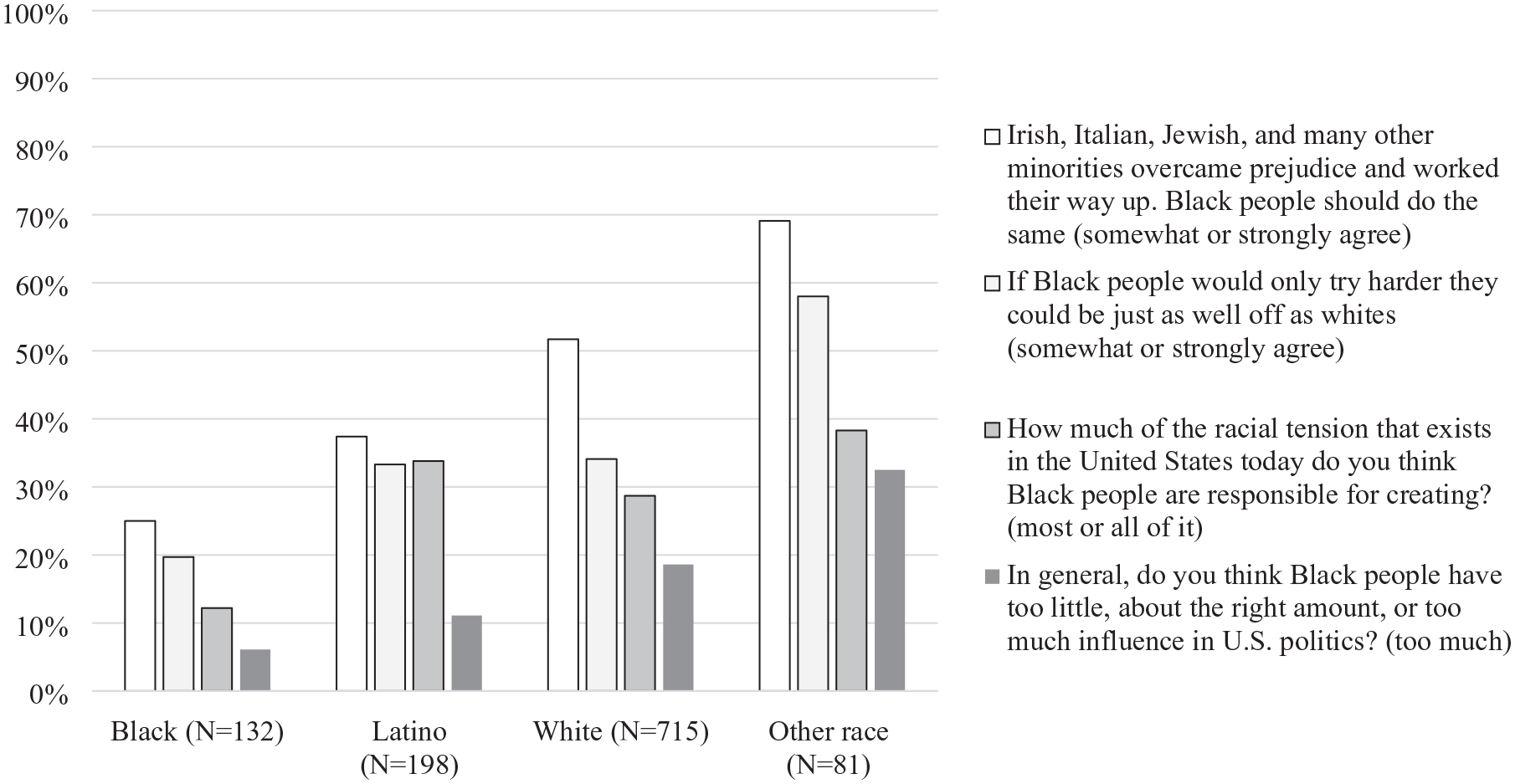
Percentage agreement with items in the antiblack stereotypes scale by respondent race.
Overall, Figures 1 and 2 show that all racial groups endorse both antiblack and antiwhite stereotypes in nontrivial amounts, including toward members of their own group and that the groups most likely to endorse antiwhite stereotypes are the least likely to endorse antiblack stereotypes and vice versa. The bivariate correlation between the antiblack and antiwhite racial stereotypes scales is −.532 (p < .001).
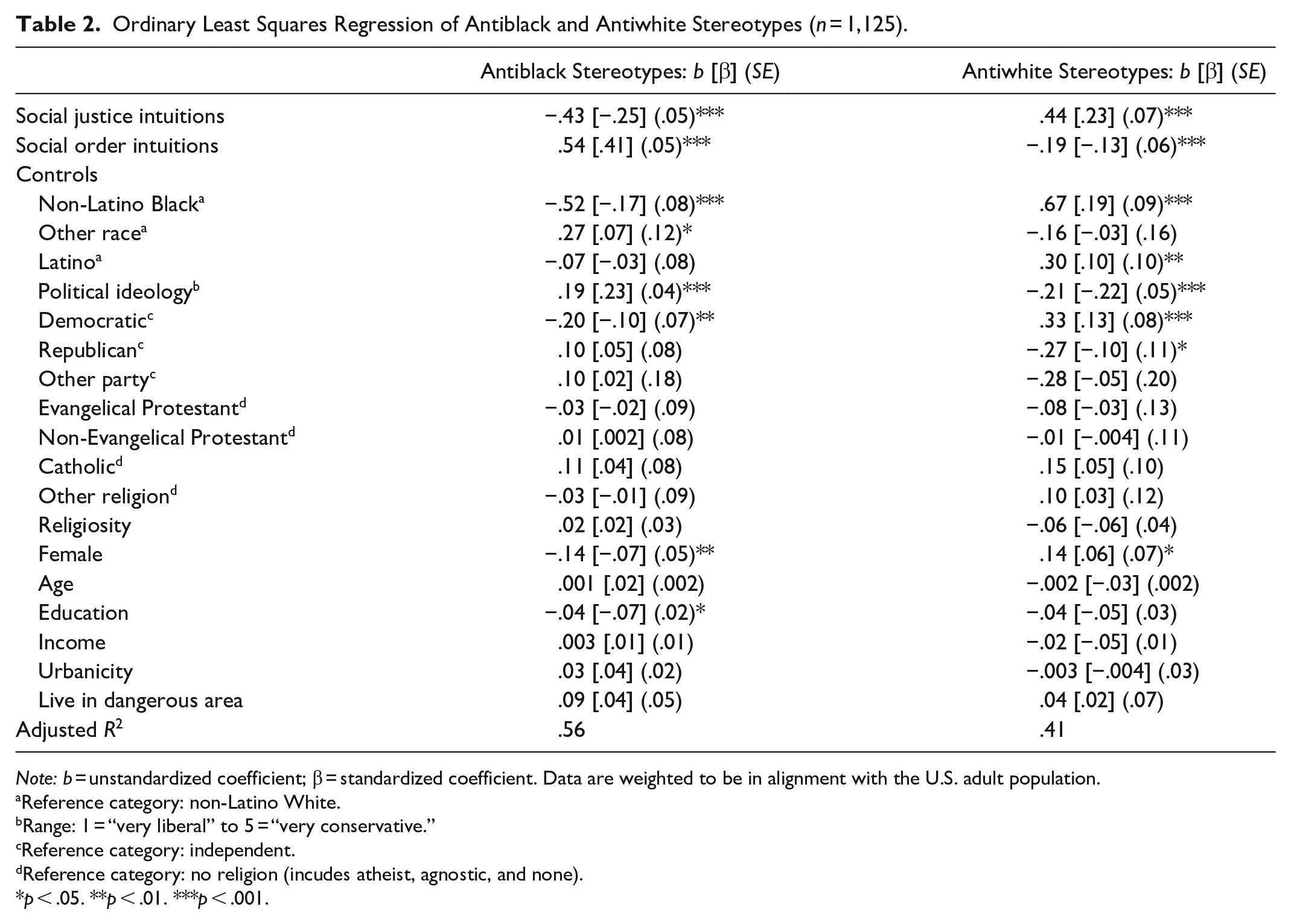
We now turn to our first hypothesis, which is that social justice intuitions decrease endorsements of disparity-relevant antiblack stereotypes and increase endorsements of disparity-relevant antiwhite stereotypes. The first row of Table 2 shows that stronger social justice intuitions—emphasizing the moral importance of not harming or mistreating others, especially the vulnerable—are associated with lower levels of antiblack racial stereotyping and higher levels of antiwhite racial stereotyping. For every one-unit increase in the 5-point social justice stereotypes scale, there was a .43 unit decrease in the 5-point antiblack stereotypes scale (p < .001) and a .44-unit increase in the 5-point antiwhite stereotypes scale (p < .001). These results support hypothesis 1.
Ordinary Least Squares Regression of Antiblack and Antiwhite Stereotypes (n = 1,125).
Note: b = unstandardized coefficient; β = standardized coefficient. Data are weighted to be in alignment with the U.S. adult population.
Reference category: non-Latino White.
Range: 1 = “very liberal” to 5 = “very conservative.”
Reference category: independent.
Reference category: no religion (incudes atheist, agnostic, and none).
p < .05. **p < .01. ***p < .001.
Next, we examine our second hypothesis, which is that social order intuitions increase endorsements of disparity-relevant antiblack stereotypes and decrease endorsements of disparity-relevant antiwhite stereotypes. The second row of Table 2 shows that stronger social order intuitions are associated with higher levels of antiblack racial stereotyping and lower levels of antiwhite racial stereotyping. For every one-unit increase in the 5-point social order stereotypes scale there was a .54-unit increase in the 5-point antiblack stereotypes scale (p < .001) and a .19-unit decrease in the 5-point antiwhite stereotypes scale (p < .001). These results support hypothesis 2. 5
As for the controls, blacks and Democrats were less likely than whites and Independents to endorse antiblack stereotypes and more likely to endorse antiwhite stereotypes. Political conservatives were more likely than political liberals to endorse antiblack stereotypes and less likely to endorse antiwhite stereotypes. Latinos were more likely than whites to endorse antiwhite stereotypes but just as likely to endorse anti-back stereotypes. Females were less likely than males to endorse antiblack stereotypes but just as likely to endorse antiwhite stereotypes.
The standardized coefficients shown in brackets in Table 2 indicate that the effects of the moral intuitions measures on endorsements of antiblack and antiwhite stereotypes are nontrivial. A standard deviation–unit change in the moral intuitions measures is associated with a greater change in endorsements of antiblack and antiwhite stereotypes than a standard deviation–unit change in political ideology, except for the association between social order intuitions and antiwhite stereotypes, which is comparable in magnitude. The table also indicates that a standard deviation-unit change in the moral intuitions measures is comparable in magnitude with that observed between blacks and whites.
Discussion
We examined the influence of social justice and social order intuitions on disparity-relevant antiblack and antiwhite stereotypes. We argued that examining people’s endorsements of antiblack and antiwhite stereotypes is timely because public awareness of systemic racism, including contemporary whites’ perceived involvement in it, has increased in recent years (Dunivin et al. 2022; Perry et al. 2021; Rozado et al., 2023). It is also timely because scholars are increasingly foregrounding whites’ role, both historically and contemporarily, in the perpetuation of systemic racism in U.S. society (Bonilla-Silva 2021; DiAngelo 2018; Kendi 2019; Lippard et al. 2020; Mueller 2017).
Our results indicate that social justice intuitions that put care for the vulnerable at the center of moral concern are associated with less antiblack stereotyping but more antiwhite stereotyping, and that social order intuitions that put group cohesion and order at the center of moral concern are associated with more antiblack stereotyping but less antiwhite stereotyping. Our results also indicate that the magnitudes of these effects are nontrivial: greater than the effect of political ideology and comparable to the effect of race. Explaining variation in disparity-relevant antiblack and antiwhite stereotyping amidst a strong lineup of control variables, including race, political ideology, political party, religious affiliation, religiosity, residence in or near a dangerous area, and demographic characteristics, was a high bar for the social justice and social order intuitions to have cleared. Our results suggest that future studies of Americans’ beliefs about racial disparities would benefit from (1) measuring antiblack and antiwhite stereotypes and (2) measuring people’s social justice and social order intuitions.
Ours is the first study to examine the moral-intuitive underpinnings of disparity-relevant antiwhite and antiblack stereotyping among the U.S. adult population. Using a five-item scale developed for the present study, we found that a substantial proportion of all racial/ethnic groups exhibit some amount of antiwhite stereotyping, with black respondents exhibiting the most, followed by Latino respondents, white respondents, and respondents of other origins. Perhaps surprisingly, a substantial number of whites (43 percent to 53 percent) endorsed antiwhite stereotypes.
Across all groups, the most highly endorsed item was “Most white people in this country just don’t get it when it comes to understanding the hardships of other race groups,” while the least endorsed item was “Most white people in this country don’t care about the hardships experienced by other race groups.” This suggests that respondents were more inclined to believe that whites are unaware of other groups’ struggles than to believe that they are aware but do not care. Overall, our results suggest that antiwhite stereotyping occupies an important place in the public’s thinking about racial disparities in contemporary society. These results suggest that research that focuses only on whites’ racial stereotyping of blacks may miss the bigger picture of how racial stereotyping operates in contemporary society.
Davis and Wilson (2022) made a similar observation in their chapter examining blacks’ racial resentment toward whites. We commend their approach and build on it in two important ways. First, given the pervasiveness of systemic racism in contemporary discussions of racial disparities, including whites’ complicity in it, we thought it important to gauge endorsements of antiwhite stereotypes among all racial groups, not just blacks. Doing so enabled us to document the considerable degree to which antiwhite stereotypes are held not just by blacks and other underrepresented groups, but also by whites. These results should be considered preliminary, however, as our samples of nonwhite groups were not large.
Second, following a long line of research in moral psychology (Graham et al. 2018), we thought it important to examine people’s moral concerns in two distinct domains, social justice and social order, whereas Davis and Wilson (2022) framed their work around a single moral domain tied to belief in a just world (Lerner 1980). They argued that just world beliefs are violated whenever a racial group is perceived as taking unfair advantage of the system at the expense of other groups. This would include when people see whites as taking unfair advantage of the system, which we linked to a moral concern for social justice and when people see blacks as taking unfair advantage of the system, which we linked to a moral concern for protecting the social order. Both approaches are rooted in large amounts of research: theirs in the literature on just world beliefs beginning with the work of Lerner (1980), ours in the literature on MFT (Graham et al. 2018). Their approach has the advantage of parsimony; ours has the advantage of greater nuance. Determining which approach is to be preferred would seem an important direction for future research.
Finally, it should be noted that in examining disparity-relevant antiblack and antiwhite racial stereotyping, we remain agnostic as to which stereotypes are “right” and which are “wrong.” Some may argue it is wrong to stereotype contemporary blacks as being in any way responsible for their unequal position in society, because contemporary blacks are burdened by a history of oppression that continues to this day. Others may argue that it is wrong to stereotype contemporary whites as oppressors in a systemically racist society, because contemporary whites are not responsible for the atrocities of the past or their legacy in the present. The important finding of our study is that from the relative strength of people’s social justice and social order intuitions, different forms of racial stereotyping are likely to emerge.
This study is not without limitations. Although our sample closely matches the U.S. general population, it was drawn from a single survey implemented by YouGov in June of 2021, one year after the peak in public support for BLM that followed the killing of George Floyd. Whether our results will generalize to other time periods is unknown. However, we note that although support for BLM declined in the months after its June 2020 peak, it remained stable over the following year (Horowitz 2021). In addition, because our data are cross-sectional, we were unable to establish causality among our measures. It is possible that people exhibit stronger or weaker social justice and social order intuitions on the basis of their racial stereotypes. For this to be the case, however, endorsements of disparity-relevant racial stereotypes would need to be conceptualized as exogenous, that is, as independent of people’s social justice and social order intuitions. Although we think this is an unlikely scenario, we encourage future researchers to explore it. Another limitation of our study is that we were only able to examine negative stereotypes of blacks and whites.
Conclusions
Why do some Americans attempt to make sense of racial disparities by endorsing antiblack stereotypes, whereas others attempt to do so by endorsing antiwhite stereotypes? Building on recent research by Silver et al. (2022) and using a national YouGov sample of 1,125 U.S. adults, we examined a novel explanation: the strength of people’s moral intuitions regarding social justice and social order. We found that social justice intuitions that put care for the vulnerable at the center of moral concern were associated with less antiblack stereotyping but more antiwhite stereotyping and that social order intuitions that put group cohesion and order at the center of moral concern are associated with more antiblack stereotyping but less antiwhite stereotyping. We conclude that future studies of Americans’ beliefs about racial disparities would benefit from (1) measuring antiblack and antiwhite stereotypes and (2) measuring people’s social justice and social order intuitions.
Footnotes
Appendix
Moral Foundations Questionnaire.

| Item | Intuition | Moral Foundation |
|---|---|---|
| Part 1: How relevant/irrelevant? | ||
| Whether or not someone conformed to the traditions of society | Social order | Authority/subversion |
| Whether or not someone showed a lack of respect for authority | Social order | Authority/subversion |
| Whether or not an action caused chaos or disorder | Social order | Authority/subversion |
| Whether or not someone did something to betray his or her group | Social order | Loyalty/betrayal |
| Whether or not someone’s action showed love for his or her country | Social order | Loyalty/betrayal |
| Whether or not someone showed a lack of loyalty | Social order | Loyalty/betrayal |
| Whether or not someone did something disgusting | Social order | Sanctity/degradation |
| Whether or not someone violated standards of purity and decency | Social order | Sanctity/degradation |
| Whether or not someone acted in a way that God would approve of | Social order | Sanctity/degradation |
| Whether or not someone suffered emotionally | Social justice | Care/harm |
| Whether or not someone cared for someone weak or vulnerable | Social justice | Care/harm |
| Whether or not someone was cruel | Social justice | Care/harm |
| Whether or not someone acted unfairly | Social justice | Fairness/cheating |
| Whether or not some people were treated differently than others | Social justice | Fairness/cheating |
| Whether or not someone was denied his or her rights | Social justice | Fairness/cheating |
| Part 2: Agree/disagree | ||
| Respect for authority is something all children need to learn. | Social order | Authority/subversion |
| Men and women each have different roles to play in society. | Social order | Authority/subversion |
| If I were a soldier and disagreed with my commanding officer’s orders, I would obey anyway because that is my duty. | Social order | Authority/subversion |
| I am proud of my country’s history. | Social order | Loyalty/betrayal |
| People should be loyal to their family members, even when they have done something wrong. | Social order | Loyalty/betrayal |
| It is more important to be a team player than to express oneself. | Social order | Loyalty/betrayal |
| People should not do things that are disgusting, even if no one is harmed. | Social order | Sanctity/degradation |
| I would call some acts wrong on the grounds that they are unnatural. | Social order | Sanctity/degradation |
| Chastity is an important and valuable virtue. | Social order | Sanctity/degradation |
| Compassion for those who are suffering is the most crucial virtue. | Social justice | Care/harm |
| One of the worst things a person could do is hurt a defenseless animal. | Social justice | Care/harm |
| It can never be right to kill a human being. | Social justice | Care/harm |
| When the government makes laws, the number one principle should be ensuring that everyone is treated fairly | Social justice | Fairness/cheating |
| Justice is the most important requirement for a society. | Social justice | Fairness/cheating |
| I think it’s morally wrong that rich children inherit a lot of money while poor children inherit nothing. | Social justice | Fairness/cheating |
Acknowledgements
We are grateful to Penn State’s McCourtney Institute for Democracy, Penn State’s Rock Ethics Institute, and Penn State’s College of the Liberal Arts for supporting this work.
