



Abstract
Using data from a 2023 YouGov survey of U.S. adults, we examine whether the strength of Black and White respondents’ racial identities are associated with their endorsements of anti-Black stereotypes that blame Blacks for their unequal position in society and anti-White stereotypes that blame Whites for their indifference to racial inequality and protection of their privilege. We find that, among Black respondents, a stronger racial identity—and especially importance and commonality—is associated with greater anti-White stereotyping but is not associated with anti-Black stereotyping. Among White respondents, a stronger racial identity is associated with greater anti-Black and anti-White stereotyping, with racial pride being the most important component predicting anti-Black stereotyping. These novel findings suggest that a strong racial identity is prevalent among two different groups of Whites: those who hold negative views of Blacks—views commonly described as symbolic racism—as well as those who hold negative views of Whites—views commonly associated with antiracism.
Keywords
Even with the decline of overt forms of racism, people still often negatively stereotype others by race. Anti-Black stereotyping—typically termed “racial resentment” or “symbolic racism”—is anti-Black sentiment rooted in beliefs that African Americans violate or lack cherished American values, such as hard work and self-reliance, and that they take what they have not earned (Bobo 1998; Kinder and Sanders 1996; Kinder and Sears 1981; Mangum and Block 2021). Racial resentment is thought to develop early in life when Whites are socialized to have negative views toward African Americans, views that may be rooted in outright prejudice or in nonracial, conservative moral values such as individualism (Henry and Sears 2002; Sears and Henry 2003). In this formulation, being socialized as White can serve as a precursor to forming negative views of other groups, including African Americans. Some African Americans also subscribe to these stereotypes, though considerably less frequently than Whites (Kam and Burge 2019; Silver, Goff, and Iceland 2023).
In recent years, there also has been a noticeable rise in the prevalence of anti-White stereotyping in the public discourse. It is grounded in the notion that Whites are racially insensitive, biased, and complicit in perpetuating racial inequality. The proliferation of these stereotypes coincided with the increased prominence of the Black Lives Matter (BLM) movement, accompanied by heightened public discussions of concepts such as White privilege, White supremacy, and White fragility (Goldberg 2020; Dunivin et al. 2022; Rozado, Al-Gharbi, and Halberstadt 2023; Silver et al. 2023). These views are more common among Black than White Americans, but they are present in nontrivial proportions in both groups (Silver et al. 2023).
Past studies have also indicated that the strength of one’s racial identity is associated with negative racial stereotyping. Specifically, a stronger racial identity among Whites has been linked to greater anti-Black racial resentment (Croll 2007; Fording and Schram 2023; Jardina 2019; Winant 2004). Among Blacks, a stronger racial identity has been linked to anti-White attitudes and a dissatisfaction with power arrangements in the existing racial order (Cross 1978, 1991; Gurin, Miller, and Gurin 1980; Hooks 1992; Phinney 1996; Vandiver et al. 2001).
Racial identity may also be associated with stereotypes of one’s own group. On one hand, a stronger identity might be associated with positive stereotypes of one’s own group, given the link between Black identity formation and political, civic, and cultural pride among Blacks (Cross 1978; Dizard 1970; Ogbar 2019), and the association between White identity and belief in White supremacy among racist Whites (Ferber 1998; Jardina 2019). On the other hand, a stronger racial identity could be associated with negative stereotypes of one’s own group, if members of each group internalize popular negative stereotypes of their own group (Jackson 2012; Kardiner and Ovesey 1962; Hughey 2010).
We explore these issues by examining the link between respondents’ endorsements of anti-Black stereotypes that blame Blacks for their unequal position in society and anti-White stereotypes that blame Whites for their indifference to racial inequality and protection of their privilege. To measure anti-Black stereotyping, we use items slightly modified from Darren W. Davis and David C. Wilson (2022), which ask respondents how much they agree or disagree with statements that stereotype Blacks as a group as not working hard enough to improve their well-being and whether they deserve special consideration. To measure anti-White stereotyping, we use items developed by Silver et al. (2023; Silver, Iceland, and Goff 2024) on perceptions of White people’s complicity in and indifference to racial inequality.
Our study is one of the few to examine the association between racial identity and anti-Black and anti-White attitudes among a national sample of both Black and White respondents. As we detail shortly, previous studies have tended to examine attitudes among either one group or the other, and/or one type of racial stereotype, and rarely investigate the extent to which members of a group hold negative stereotypes about their own group. Furthermore, we examine the association between these stereotypes and three components of racial identity: importance of racial identity, feelings of commonality with others of the same group, and racial pride (Jardina 2019). In doing so, we provide a more rigorous account than previous studies of what dimensions of identity are most strongly associated with the negative stereotyping of Blacks and Whites.
In examining both anti-Black and anti-White racial stereotyping, we are not implying that these stereotypes have the same origins or consequences. Anti-Black stereotyping historically was employed to downplay the prevalence of systemic racism and to blame African Americans for their own disadvantage. Conversely, anti-White stereotyping involves attributing blame to a historically privileged group for maintaining its advantageous status at the expense of others. Our aim in examining these stereotypes is not to ascertain which are right or wrong or accurate or not. Rather, our aim is to examine whether the strength of individuals’ racial identities correlates with holding these stereotypes.
Our analysis is based on a 2023 YouGov national survey that included 995 White respondents and 993 Black respondents. The survey included questions on the strength of respondents’ racial identification, stereotypes about Black and White peoples’ roles in maintaining racial disparities, and other characteristics, such as political ideology, moral intuitions, and socioeconomic status. In addressing these issues, we aim to shed new light on the association between racial identification and racial stereotyping in the United States during a time of heightened awareness of and concern with racial identity, racial disparities, and racial conflict.
We address the following three research questions:
To what extent is a stronger racial identity among Black and White respondents associated with holding stereotypes that attribute blame to Black Americans for current racial disparities?
To what extent is a stronger racial identity among Black and White respondents associated with holding stereotypes that attribute blame to White Americans for current racial disparities?
What dimensions of racial identity—importance, commonality, or pride—are most strongly associated with anti-Black and anti-White stereotyping?
Background
Racism and prejudice can be expressed in a variety of ways, including beliefs about the racial inferiority of some groups, or “old-fashioned racism” (Sears et al. 1997:20). The focus of our analysis is on a more subtle form of anti-Black stereotyping, usually termed racial resentment. Racial resentment, as originally conceived by Donald R. Kinder and David O. Sears (1981), is thought of as anti-Black sentiment that is rooted in beliefs that African Americans violate or lack cherished American values, such as hard work and self-reliance, have too much influence in politics, and thus implicitly do not deserve certain benefits or special treatment (Bobo 1998; Kinder and Sanders 1996; Mangum and Block 2021). The role of racial resentment in shaping the attitudes of Whites toward a variety of issues has received a great amount of attention especially in recent years, including toward affirmative action and the BLM movement (Drakulich et al. 2021; Feldman and Huddy 2005; Iceland, Silver, and Goff 2023; Kam and Burge 2019; Mangum and Block 2021; Silver, Goff, and Iceland 2022).
The theoretical and empirical research on anti-White stereotyping is much newer. Drawing on antiracism theory (Kendi, Bonilla-Silva, etc.), Silver et al. (2023) conceived anti-White stereotyping as the belief that Whites are racially insensitive, biased, and complicit in upholding racial inequality. These stereotypes became more common in the 2010s, as public discussions of concepts such as White privilege, White supremacy, and White fragility grew (Goldberg 2020; Dunivin et al. 2022; Rozado et al. 2023). This growth was stimulated in part by the publication of popular books focusing on antiracism including Robin DiAngelo’s (2018) White Fragility: Why It’s So Hard for White People to Talk about Racism, Ibram X. Kendi’s (2019) How to Be an Antiracist, and Tom Schaller and Paul Wladman’s (2024) White Rural Rage.
Racial attitudes, prejudices, and stereotyping are often shaped by socialization early in life, when children are most apt to adopt the attitudes and prejudices of their parents (Kinder and Sanders 1996; Kinder and Sears 1981; Sears and Henry 2003). Prejudices and stereotypes are also a function of group position, such as feeling that one’s own group is superior to others, or mistreated by others, which can lead to antipathy toward other groups (Blumer 1958; Bobo 1999). We explore how the strength of one’s racial identity might be linked to both anti-Black and anti-White stereotyping.
Racial Identity
Social scientists today no longer consider race a biological concept, but rather a social one. As Michael Omi and Howard Winant (2009:21) argue, “Racial categories and the meaning of race are given concrete expression by the specific social relations and historical context in which they are embedded. Racial meanings have varied tremendously over time and between different societies.” Identity is produced and reinforced through everyday social interactions (Jenkins 1994). Through much of American history, the racial category “Black” was determined by the “one drop rule.” This was the legal designation in many states where people with any Black ancestry were considered Black. This rule was socially internalized by White and Black people alike over time, and it was used as a tool of subjugation during the Jim Crow period that mandated racial segregation in many public places (Davis 2001; Roth 2005).
Today, there is significant variation in the extent to which people report that their race is a critical aspect of their personal identity. According to a 2019 Pew Research Center poll, 74% of Black respondents said that their race or ethnicity is extremely or very important to how they think about themselves, compared to 15% of White respondents, 59% of Hispanic respondents, and 56% of Asian respondents (Horowitz, Igielnik, and Kochhar 2020).
There are different dimensions to racial identity, including a cognitive component and an affective component (Ellemers, Kortekaas, and Ouwerkerk 1999; Jardina 2019; Tajfel 1978). The cognitive component entails self-categorization, or identifying with a group, such as in a job application or response to a survey question. We use this type of question in our own survey to identify the race of the respondents (i.e., self-reported race). The affective component, which measures strength of identity, includes: (1) importance of social identity, (2) the valence, or pride, of feelings one has toward group members; and (3) the subjective sense of belonging to the group, or commonality among group members (Demo and Hughes 1990; Ellemers et al. 1999; Hughes et al. 2015; Jardina 2019; Tajfel and Turner 1986).
Some scholars have investigated identity with more elaborate scales, including the 50-item Racial Identity Attitudes Scale (RIAS) developed by Thomas A. Parham and Janet E. Helms (1981), and the Multidimensional Model of Racial Identity (MMRI) by Sellers et al. (1998). The MMRI, for example, is a 56-item scale that measures several dimensions of identity, including racial salience, racial centrality, racial regard (public and private), and racial ideology (with four categories). We use the three-dimension scale developed and validated by Ashley Jardina (2019) in our analysis because it is more parsimonious.
Black Identity and Racial Stereotyping
Black identity in the United States was rooted in the institutionalization of slavery during the colonial period (Omi and Winant 2009). Due to their experiences with oppression, racial identity has been a significant factor in the lives of African Americans (Sellers et al. 1998). At the micro level, Black identity has been conceptualized as occurring within children and young adults in stages as they encounter prejudice and hostility from White Americans, internalize notions of what it means to Black, and then often finally internalize a commitment to community building and embracing Black history and culture and developing self-confidence in one’s Blackness (Cross 1971, 1978; Cross and Fhagen-Smith 2001; Jackson 2012). Research has generally indicated that the strength of racial identify has been linked to perceptions of the extent to which others are hostile to and mistreat one’s own group, which has been historically common in the United States among people of color, especially African Americans (Allport 1954; Gurin et al. 1980; Jardina 2019; Thompson 1999).
William E. Cross (1978, 1991) argued that anti-White attitudes are an inevitable consequence of Black identity formation as Blacks embrace Black culture and the Black community (see also: Vandiver et al. 2001). This suggests that the strength of one’s racial identity among African Americans would be associated with negative views of White individuals (Ferguson et al. 2008; Lecci and Johnson 2008). hooks (1992) also argued that anti-White sentiment is not only understandable, but rational in a system of White racist domination, as this system confers many rights and privileges to White Americans (Desmond and Embirbayer 2009). Thus, we expect that a strong racial identity among African Americans will be associated with negative views of Whites as indifferent to Black–White disparities and complicit in upholding a system that privileges Whites (
However, not all empirical evidence on the association between the strength of Black identity and anti-White stereotyping suggests that there is a positive relationship between the two (Sullivan and Ghara 2015; Wong and Cho 2005). Jas M. Sullivan and Alexandra Ghara (2015:268), for example, found a positive association between warm feelings toward Whites and racial pride among Blacks. They conclude that being “pro-Black” is not the same as being “anti-White” (see also Herring, Jankowski, and Brown 1999). This suggests that importance and commonality might be most strongly associated with anti-White stereotyping, with pride less so (
A stronger Black racial identity may be associated with positive views of one’s own group and thus less endorsement of anti-Black stereotypes. Past research shows that a stronger Black racial identity is accompanied by a greater appreciation of Black history and culture (Cross 1978; Cross and Fhagen-Smith 2001; Jackson 2012; Vandiver et al. 2001). This suggests that a strong racial identity will be associated with less anti-Black stereotyping (
It also could be that among some African Americans, a strong racial identity is not necessarily associated with positive in-group attitudes and negatively associated with anti-Black stereotyping if they do not embrace the positive aspects of communal history and culture. Historically, at least, Black identity development often began with an acceptance of being Black in a White-dominated society. As Jackson (2012:41–42) argues, this could mean that, even among those individuals who recognize the importance of their Black identity, some may still follow . . . the prevailing notion that ‘White is right.’ This person attempts to gain resources—such as approval, sense of worth, goods, power, and money—by accepting and conforming to White social, cultural, and institutional standards and values . . . A Black person who consciously (active acceptance) adopts the prevailing White view of the world weakens his or her positive self-concept or positive view of black people.
In testing H3 and H4, we will see if there is support for this opposing conceptual perspective.
White Identity and Racial Stereotyping
In recent years, there has been a growing literature on Whiteness, including racial identity formation among Whites. Earlier literature focused on “invisible normality” among the White population (Hughey 2010:1291), where Whites are unaware of the privileges they enjoy (Delgado and Stefancic 1997; McIntosh 1988; Perry 2001; Doane 1997). This is consistent with the observation that racial identity is often less psychologically salient among dominant group members (Hartmann, Gerteis, and Croll 2009; Jardina 2019; Phinney 1996). Thus, until recently, racial identity among Whites was mostly ignored by social scientists (Jardina 2019).
Over time, however, White identity has become less synonymous with invisible normality for a few reasons (Hughey 2010:1291). Among the most important is the aforementioned growing racial and ethnic diversity of the U.S. population (Martin and Midgley 2010), with the result that Whites constitute an increasingly smaller share of the overall population. About 59% of the U.S. population was non-Hispanic White in 2021, down from 83% in 1970 (Iceland 2017; USA Facts 2023). Many large metropolitan areas are now “majority–minority” (Frey 2011). The fact that non-White groups are also now more prominently represented in various institutions, including positions of power, has also contributed to the decline in invisible normality among Whites (Bell 2021; Hughey 2010; Jardina 2019).
Even so, the meaning of White identity varies among White Americans, and may be contingent on the context and the individual’s political orientation (Winant 2004). Some White Americans embrace White identity in order to preserve the racial order and their status within it (Jardina 2019; McDermott and Samson 2005). Jardina (2019) describes how many White Americans are taught to subscribe to racist beliefs and embrace racial resentment as children, and how they carry these beliefs into adulthood. Among such individuals, White racial identity is linked to the adoption of anti-Black racial stereotypes. These stereotypes include notions traditionally associated with “racial resentment” including the endorsement of stereotypes that help such White individuals justify current racial disparities (Bobo 1998; Kinder and Sanders 1996; Mangum and Block 2021). Previous empirical work has indicated that White Americans who have stronger White identities express greater racial resentment and hostility, and are more likely to embrace individual rather than structural explanations to explain Black disadvantage (Douds, O’Connell, and Bratter 2019; Fording and Schram 2023; Giles and Evans 1985; Jardina 2019). Thus, we expect that a strong White identity will be associated with greater anti-Black stereotyping (
Jardina (2019:23) also asserts that such White individuals . . . are proud of their group, but are also worried that group members are experiencing discrimination, and they have not been given their fair share in life. They also believe their group experiences competition with other racial and ethnic groups, and that Whites have too little political and economic influence.
In more extreme cases, the importance and meaning of White identity is central and explicit, such as in White supremist organizations (Adams and Roscigno 2005; Blee 2002; Croll 2007; McDermott and Samson 2005). Thus, as suggested by Jardina and others, and which we directly test here, pride and importance are the dimensions of identity that might have the strongest association with anti-Black stereotyping, though all three components might be important (
Racial identity may also be important to White individuals with progressive racial attitudes—but for different reasons. For this group, White identity may be connected to beliefs about the roles that systemic racism and White privilege play in perpetuating racial inequality (Branscombe, Schmitt, and Schiffhauer 2007; Croll 2007; Jardina 2019; Phinney 1996). White individuals with this view may actively adopt antiracist orientations that encourage them to help combat racial disparities by becoming more aware of their White privilege (Bradley, Golner, and Hanson 2007; Haranas 2023; Winant 2004; Wise 2011).
Along these lines, Paul R. Croll (2007:618) argues that White identity can manifest in multiple ways: “Rather than conceive of White racial identity as a uniform concept, White racial identity may be a duality, a split between progressive and defensive White racial claims.” In a qualitative study, Matthew W. Hughey (2010) found that White identity was important to both White racists and White antiracists. Thus, we hypothesize that White identity is positively associated with anti-White stereotyping (
Data and Methods
We use data from a national survey of 4,000 U.S. adults conducted in July 2023 by YouGov, a leading academic survey research firm. YouGov uses a model-based sampling approach to produce weighted samples that generalize to the adult U.S. population (Ansolabehere and Rivers 2013; Ansolabehere and Schaffner 2014; Simmons and Bobo 2015). Our sample was derived from YouGov interviews of 4,418 respondents from its online panel of 2 million U.S. residents. Of these, 4,000 were matched to a stratified sample drawn from the 2019 American Community Survey (ACS) 1-year sample to represent the target population of U.S. adults using a propensity score function that included age, gender, education, and region.
The demographic characteristics of our sample approximate those of the 2019 adult U.S. population. Following is a comparison of our sample with the ACS, with the latter in parentheses (U.S. Census Bureau 2019a, 2019b): non-Hispanic White, 64.0% (60.0%); non-Hispanic Black 12.4% (12.4%); non-Hispanic Asian 5.9% (5.6%); Hispanic 16.9% (18.4%); female, 51.3% (50.8%); Bachelor’s degree or more, 30.8% (33.1%); and currently married, 43.0% (47.6%).
We include in our analyses only respondents who identity as non-Hispanic White (N = 995) or non-Hispanic Black (N = 993) for a total sample of 1,988. We omit people of other groups because the current literature focuses mainly on the attitudes of Whites and Blacks, and we seek to extend it by examining how both anti-Black and anti-White stereotyping are associated with racial identity among both Blacks and Whites. Future research should theorize and analyze how racial identity is associated with negative stereotyping of different groups among a broader range Americans.
Our main dependent variables measure stereotypes that attribute blame to Black Americans and stereotypes that attribute blame to White Americans for current racial disparities. We measure anti-Black stereotypes using four items slightly modified from Davis and Wilson (2022). Respondents were asked how much they agreed or disagreed with the following four statements: (a) African Americans do not need any special considerations because racism is a thing of the past; (b) For African Americans to succeed they need to stop using past racism and slavery as excuses; (c) African Americans bring up race only when they need to make an excuse for their failure; and (d) Special considerations for African Americans place groups who have done nothing to harm them at an unfair disadvantage. Response options ranged from 1 = strongly disagree to 5 = strongly agree. The items were averaged to form a scale (Cronbach’s alpha=.87).
Anti-White racial stereotyping is measured with five items focusing on perceptions of White people’s complicity in, and indifference to, racial inequality, which antiracism scholars argue is a key a factor in the perpetuation of systemic racism (Bonilla-Silva 2021; DiAngelo 2018; Kendi 2019). We adopt the measure developed by Silver et al. (2023). Respondents were asked how much they agreed or disagreed with the following statements: (a) Most White people in this country believe that Whites are better than other groups; (b) Most White people in this country are willing to make sacrifices to make society more equal for other groups (reverse coded); (c) Most White people in this country just don’t get it when it comes to understanding the hardships of other race groups; (d) Most White people in this country genuinely care about the hardships experienced by other race groups (reverse coded); and (e) Most White people in this country are reluctant to give up their White privilege even though doing so would make society more equal. Response options for all seven items ranged from 1 = strongly disagree to 5 = strongly agree. The items were averaged to form a scale (Cronbach’s alpha = .76).
As discussed earlier, racial identity has a cognitive and affective component (Ellemers et al. 1999; Jardina 2019; Tajfel 1978). The cognitive component involves self-categorization. We measure this using questions on race and Hispanic origin similar to those used by the U.S. Census Bureau: (a). Are you of Spanish, Latino, or Hispanic origin or descent? and (b) What racial or ethnic group best describes you? Individuals are classified as non-Hispanic White or non-Hispanic Black if they did not choose the Hispanic response to the first question and chose White or Black, respectively, to the second question.
Our independent variable, strength of racial identity, taps into three commonly used subscales of the affective component of racial identity: (a) importance of racial identity; (b) pride; and (c) commonality. These were measured with the following three questions, respectively:
“How important is being [your own race group] to your identity?” The response categories ranged from 1 = very important to 4 = not at all important.
“How much do you agree or disagree with the following statements: [Your own race group] in this country have a lot in common with one another.” We coded responses from 1 = strongly disagree to 5 = strongly agree.
“How much do you agree or disagree with the following statements: [Your own race group] in this country have a lot to be proud of.” We coded responses from 1 = strongly disagree to 5 = strongly agree.
Following Jardina (2019:65–66), we combine these responses into a scale. This scale (calculated by adding the measures together and dividing by three) has a Cronbach’s alpha of 0.66, indicating a level of reliability that is near the lower end of the threshold of that is typically considered acceptable (0.60 or 0.70). We also run models examining each of the three questions separately to gain greater insight into the extent to which the different components of racial identity are associated with racial stereotyping.
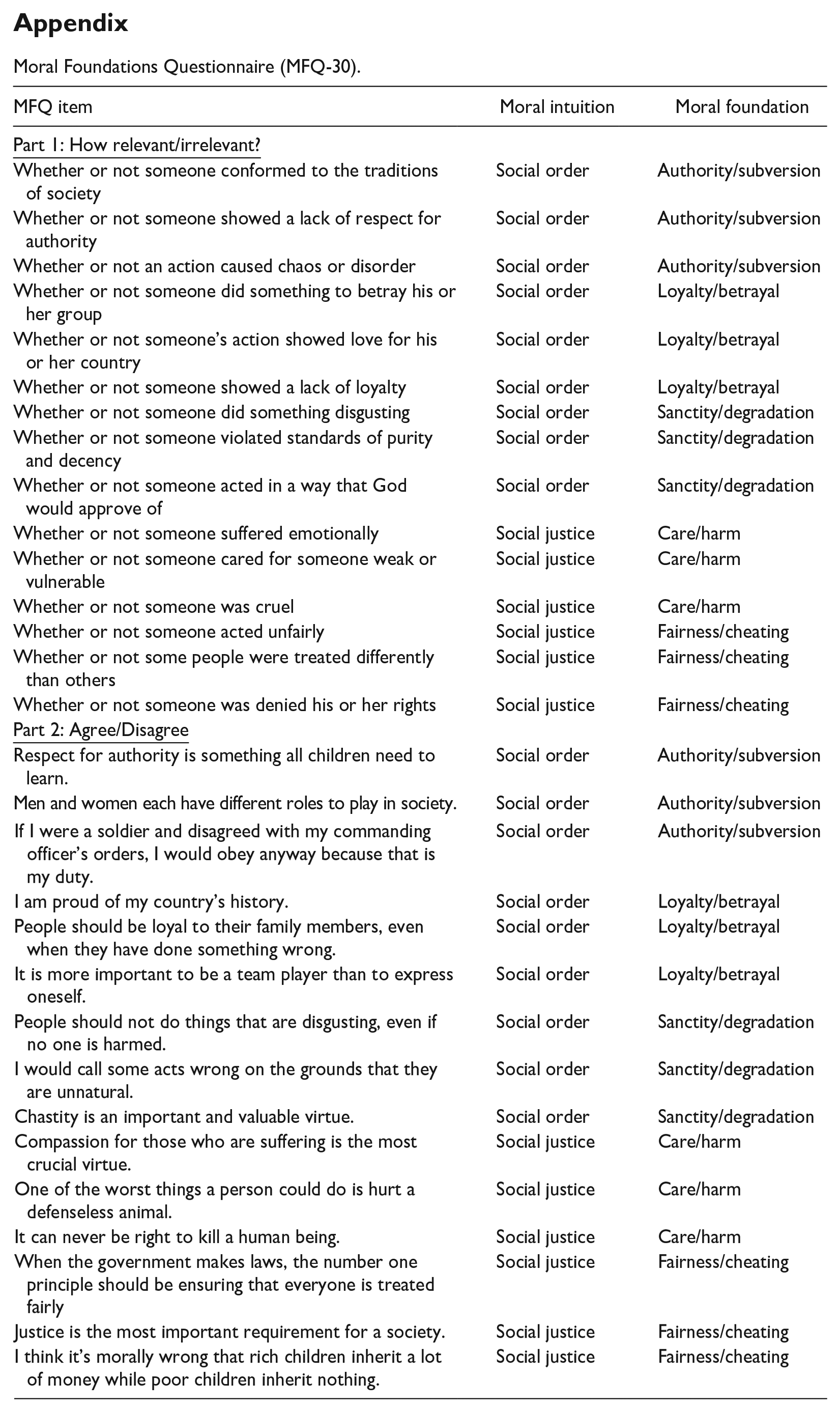
Our analysis controls for a range of variables that might be correlated with anti-Black and anti-White stereotyping, including political ideology, consisting of self-identification as liberal, moderate, conservative, or not sure; age; female; religious affiliation: Protestant, Catholic, “other” religions, and not religious; education: no high school, high school only, some college, and BA degree or greater; total annual household income: $0–$29,999, $30,000–$69,999, $70,000–$199,999, and $120,000 or more; residential urbanicity, coded 1 = “rural area,” 2 = “small town,” 3 = “suburban area,” 4 = “smaller city,” and 5 = “big city”; and whether the respondent has experienced racism or not. Finally, following Silver et al. (2023), we include a measure of respondents’ moral intuitions using the 30-item Moral Foundations Questionnaire (MFQ-30—see the Appendix) (Graham et al. 2011). This enables us to separate out the effects of racial identity from any underlying moral concerns respondents may have regarding explanations of social inequality, particularly preferences for social justice or social order (Silver et al. 2022, 2023) The social justice (or “individualizing”) moral intuitions scale was calculated as the mean of 12 items in the care/harm and fairness/cheating foundations (alpha = 0.82). The social order (or “binding”) moral intuitions scale was calculated as the mean of the 18 items included in the loyalty/betrayal, authority/subversion, and sanctity/degradation foundations (alpha = 0.89).
Analytical Approach
After presenting descriptive statistics, we estimate ordinary least squares regressions that examine the association between strength of racial identity and anti-Black and anti-White stereotyping for the total sample and then for Blacks and Whites separately, net of controls. When using the strength of racial identity scale as the main independent variable, we are testing our odd-numbered hypotheses (H1, H3, H5, and H7). In the pooled model, we include an interaction term between strength of racial identity and respondent race, as we hypothesize that the association between strength of racial identity and anti-Black stereotyping would be positive for Whites and negative for Blacks. We examined the variance inflation factors (VIFs) for all measures and found that none exceeded 2.5 in the model for Whites and 1.8 in the model for Blacks, which is well below the critical value of 4.0 typically employed to indicate multicollinearity problems (Fisher and Mason 1981). We then examine the association between the components of racial identity (strength, commonality, and pride) and stereotyping—these analyses test our even-numbered hypotheses (H2, H4, H6, and H8).
Since 217 respondents did not report their income and 1 respondent did not provide full information on their moral intuitions, we used multiple imputation including the age, gender, education, urbanicity, race, political ideology, religion, and experienced racism as the predictors. Supplemental analyses (not shown) yielded substantively similar results to those obtained using listwise deletion. We use the YouGov sample weight described above in all analyses.
Results
Table 1 shows the weighted descriptive statistics of our sample. The means for anti-Black and anti-White stereotypes were 3.1 and 2.9, respectively (out of 5). As might be expected, we see higher levels of anti-Black stereotyping among Whites than Blacks and higher levels of anti-White stereotyping among Blacks than Whites. The mean racial identity index was 3.1 (with a range of 1 to 4.67), with a stronger mean identity among Black (3.9) than White (2.9) respondents—consistent with previous work (Horowitz et al. 2020).
Descriptive Statistics.
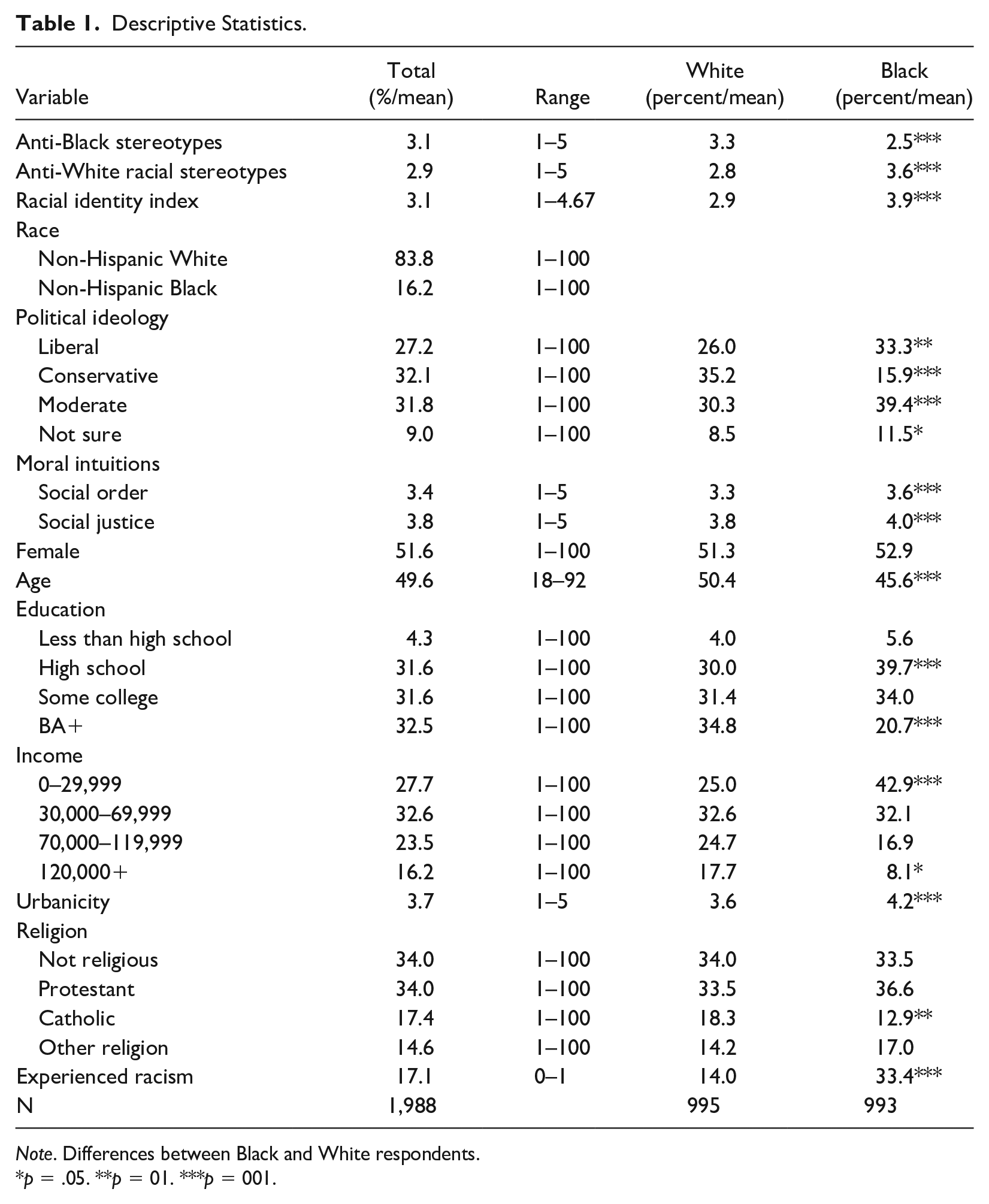
Note. Differences between Black and White respondents.
p = .05. **p = 01. ***p = 001.
Table 2 shows results from the ordinary least squares (OLS) regressions where anti-Black stereotyping is the dependent variable. Results for the total sample (model 1) indicate that strength of racial identity was positively associated with anti-Black stereotyping, though more so among Whites than Blacks (the interaction term). Adding the first-order racial identity term (0.10) with the interaction term (−0.13) suggests that the strength of racial identity has little association with anti-Black stereotyping among Blacks. Results from models 2 and 3 for White and Black respondents, respectively, confirm this by showing that the positive association between strength of racial identity and anti-Black stereotyping is significant only among White respondents. These results support the notion that Whites with a strong racial identity are more likely to negatively stereotype African Americans (supporting H5), but that strength of racial identity is not associated with anti-Black stereotyping among Black respondents (not consistent with H3, which posited a negative relationships). The coefficients for the control variables indicate that conservativism is positively associated with anti-Black stereotyping among both White and Black respondents. Social order intuitions are associated with more anti-Black stereotyping, and social justice intuitions are, as might be expected, associated with less anti-Black stereotyping. White respondents who reported experiencing racism reported higher levels of anti-Black stereotyping, while for Black respondents the association was the reverse.
OLS Regressions Predicting Anti-Black Stereotyping.
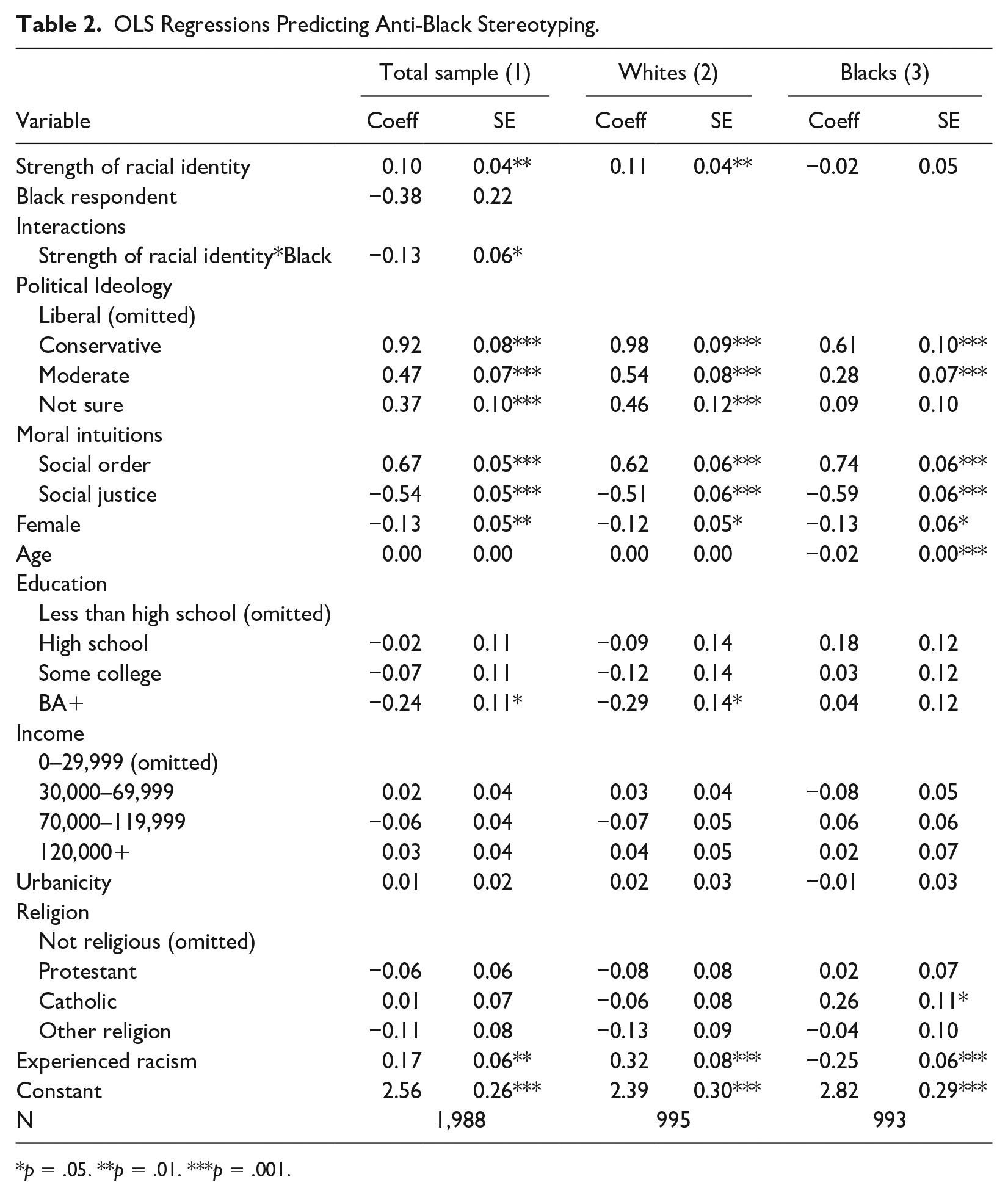
p = .05. **p = .01. ***p = .001.
Table 3 shows results from the OLS regressions where anti-White stereotyping is the dependent variable. Results in model 1 indicate that strength of racial identity was positively associated with anti-White stereotyping, with the interaction term indicating that there was no significant difference in this association between Black and White respondents. Models 2 and 3 likewise show the positive association among both Whites and Blacks, respectively. This indicates that a strong racial identity was associated with the negative stereotyping of Whites among both Blacks and Whites (supporting H1 and H7). We generally see that control variables had an opposite association with anti-White stereotyping as they did with anti-Black stereotyping. For example, conservatism is associated with less anti-White stereotyping among both Black and White respondents. Social order intuitions are associated with less anti-White stereotyping, while social justice intuitions are associated with more anti-White stereotyping. White respondents who reported experiencing racism expressed less anti-White stereotyping, while Black respondents who reported experiencing racism expressed more anti-White stereotyping.
OLS Regressions Predicting Anti-White Stereotyping.
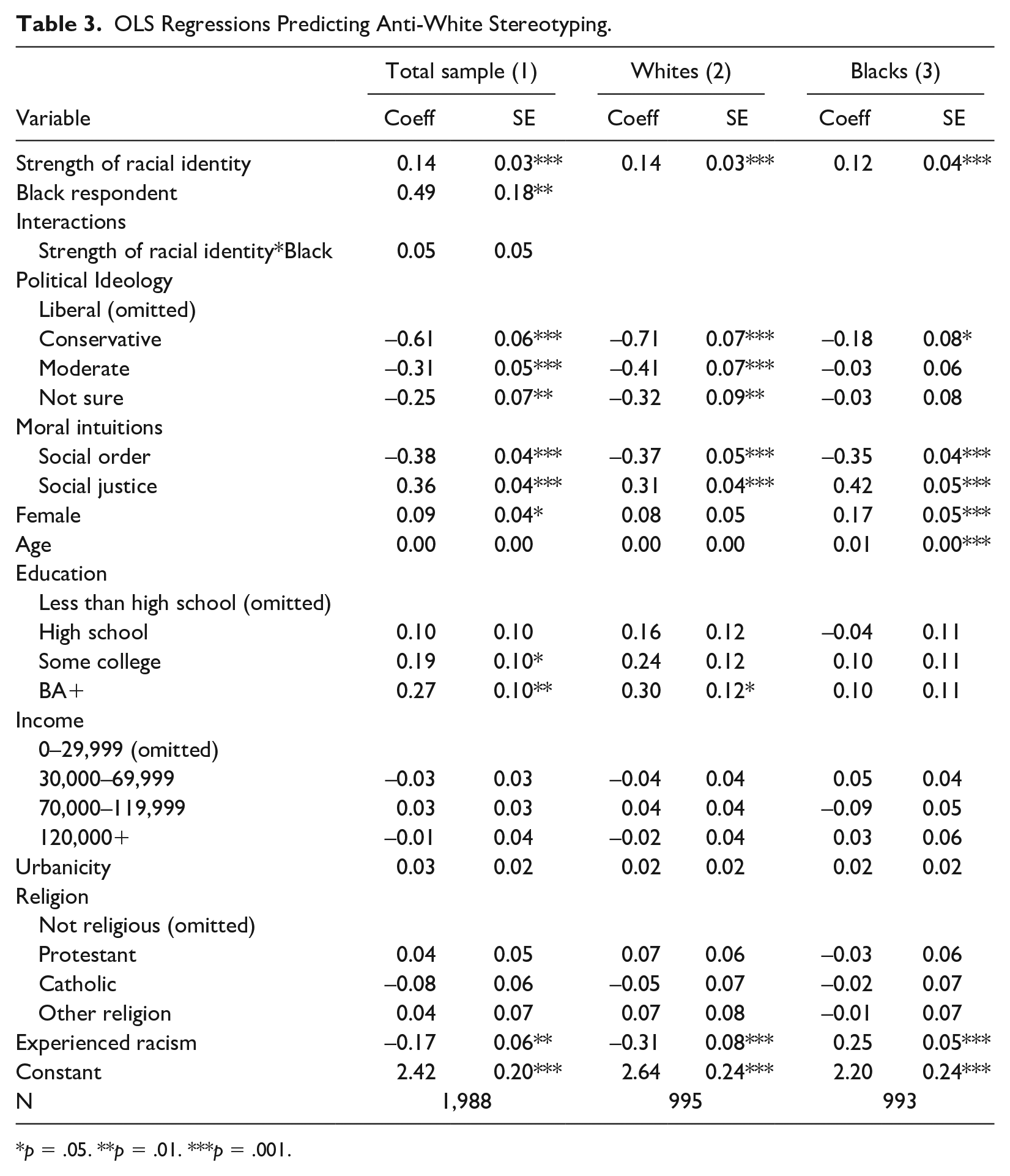
p = .05. **p = .01. ***p = .001.
Figure 1 provides a visualization of anti-Black and anti-White stereotyping among Black and White respondents by the strength of their racial identity. 1 The figure on the left shows that the association between the strength of one’s racial identity and anti-Black stereotyping varies by race—with a strong racial identity associated with higher levels of anti-Black stereotyping among White respondents and less stereotyping among Black respondents, though the latter was not statistically significant. The figure on the right shows that a stronger racial identity is associated with more anti-White stereotyping among both White and Black respondents, though with a higher constant among Blacks than Whites. The higher constant indicates that, in general, Black respondents expressed more anti-White stereotyping than White respondents (this was also shown with the coefficient for Black respondent in model 1 of Table 3).
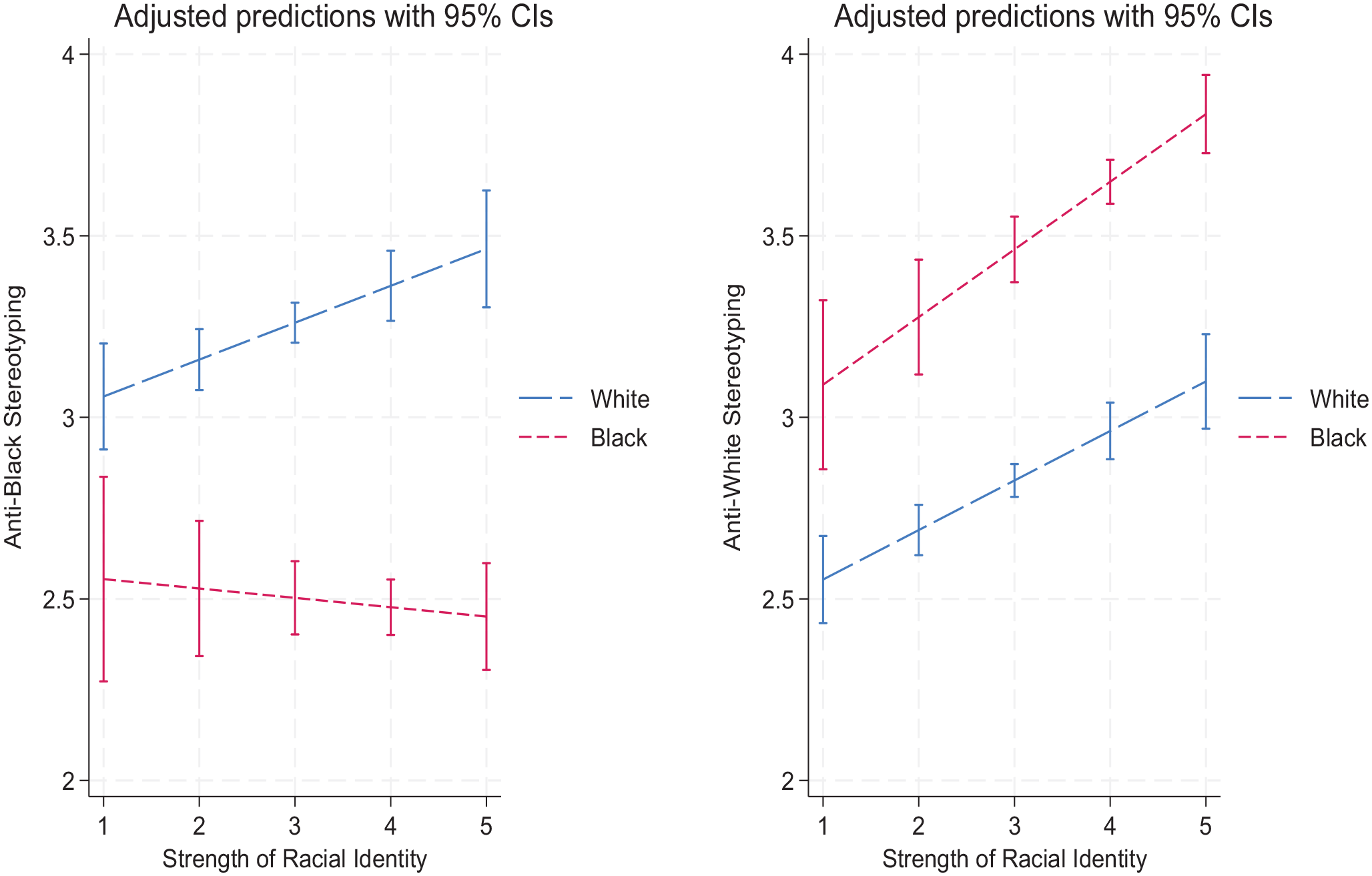
Levels of anti-Black and anti-White stereotyping by strength of racial identity and race of respondent.
Overall, our results show that a stronger racial identity is positively associated with anti-White stereotyping among both Black and White individuals, while a stronger racial identity is associated with higher levels of anti-Black stereotyping only among White respondents. These findings suggests that White individuals with stronger racial identities hold negative views of Black Americans—views commonly described as symbolic racism—and negative views of White Americans—views commonly associated with contemporary antiracism. 2
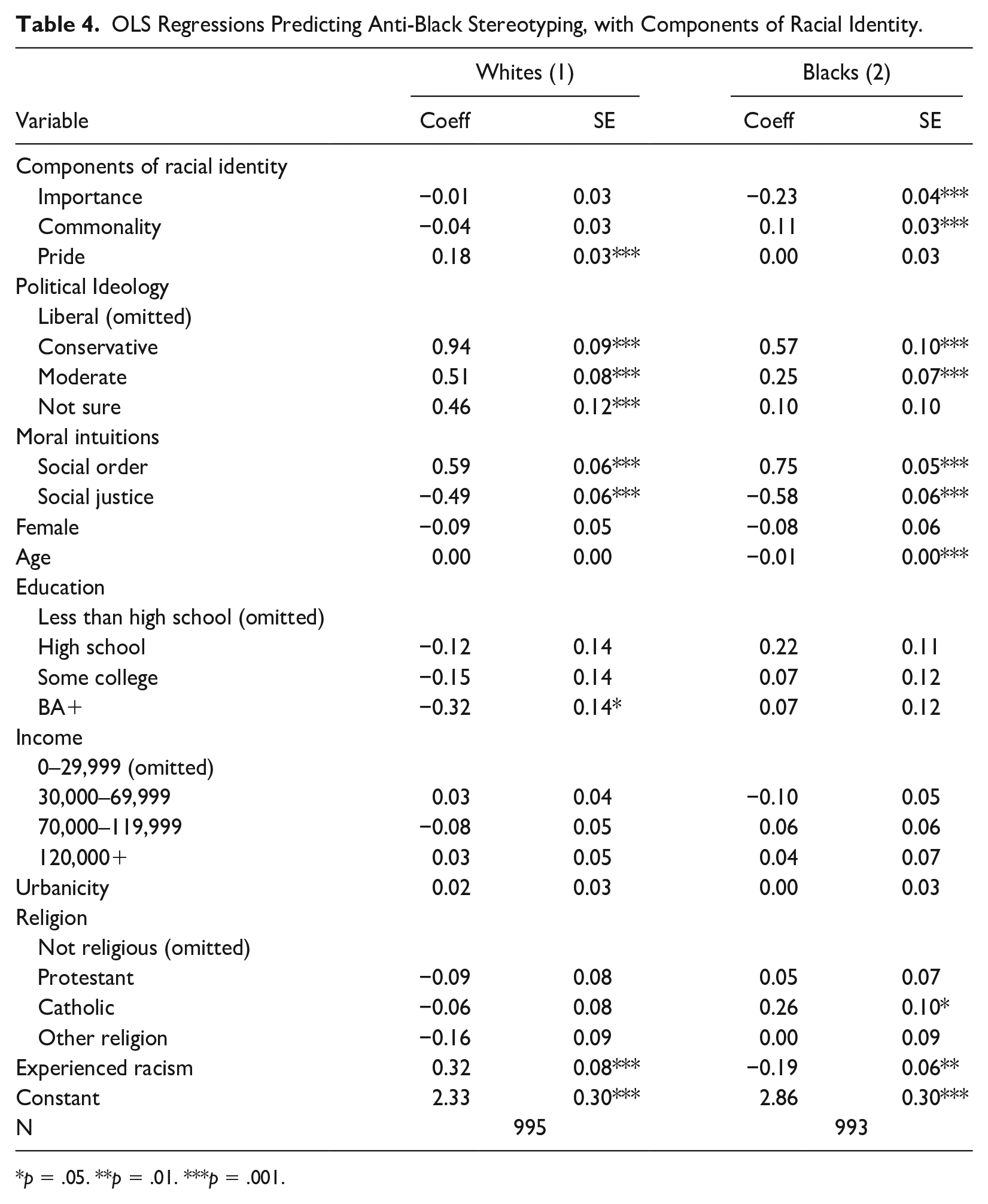
Table 4 show results where we examine the association between anti-Black and anti-White stereotyping and the three constituent elements of the racial identity index, importance, commonality, and pride. We find that, among White respondents, anti-Black stereotyping is positively associated with “pride” in White identity, but less so with importance and commonality (partially consistent with H6). This suggests that racial pride among Whites predicts views that Blacks are to blame for racial inequality and are not deserving of support. Among Black respondents, importance of Black identity is associated with lower levels of anti-Black stereotyping (consistent with H4), though commonality is positively associated with anti-Black stereotyping (not consistent with H4). The positive association between commonality and anti-Black stereotyping among Blacks, which persists even in models lacking other controls (not shown), suggests that perceiving co-ethnic members as very similar may lead to the adoption of prevalent negative stereotypes about one’s own group.
OLS Regressions Predicting Anti-Black Stereotyping, with Components of Racial Identity.
p = .05. **p = .01. ***p = .001.
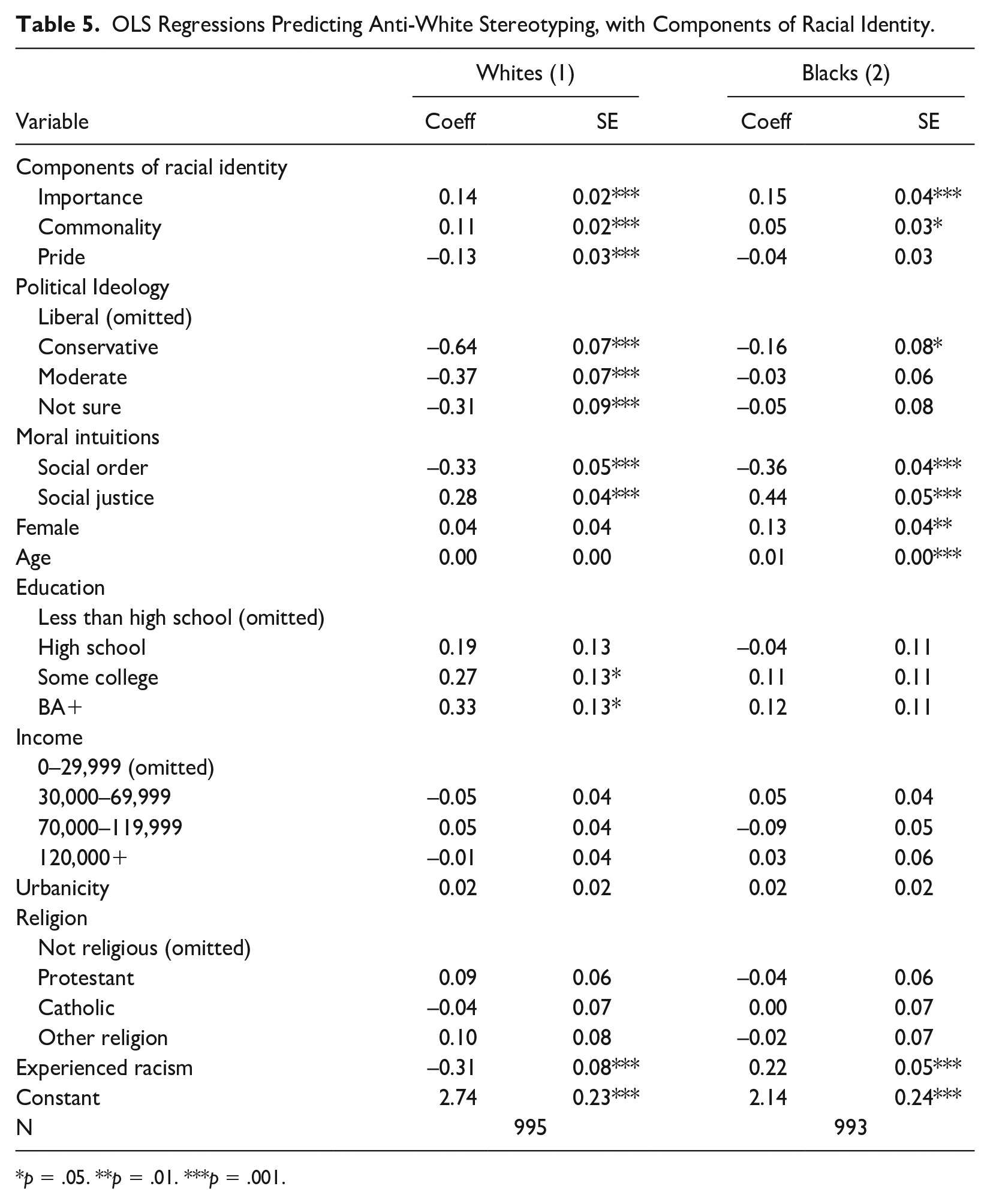
Table 5 shows that, among White respondents, importance and commonality are associated with more anti-White stereotyping, but as might be expected, pride is associated with less anti-White stereotyping (consistent with H8). Among Black respondents, importance and commonality are associated with greater anti-White stereotyping, though pride is not (the association is not statistically significant). These results are mostly consistent with H2.
OLS Regressions Predicting Anti-White Stereotyping, with Components of Racial Identity.
p = .05. **p = .01. ***p = .001.
Discussion
While overt forms of racism have declined over time, people still express negative views of other groups, even if in more subtle ways than in the past (Bobo 1998; Kinder and Sanders 1996). Among Blacks, a stronger racial identity has been linked to anti-White attitudes and a dissatisfaction with power arrangements in the existing racial order (Cross 1978, 1991; Gurin et al. 1980; Hooks 1992; Phinney 1996; Vandiver et al. 2001). Among Whites, the strength of racial identity has been linked to racial resentment against Blacks (Croll 2007; Fording and Schram 2023; Jardina 2019; Winant 2004). Using data from a 2023 YouGov national sample that included nearly 1,000 White and 1,000 Black respondents, we build on this research by examining how the strength of one’s racial identity is associated with negative stereotyping not only of other groups but also one’s own group among both Black and White Americans, an under-studied issue. Moreover, we examine the link between specific dimensions of affective racial identity—importance, commonality, and pride—and racial stereotyping.
We found that a strong racial identity is associated with anti-Black stereotyping among White respondents, confirming past work on racial resentment (Fording and Schram 2023; Giles and Evans 1985; Jardina 2019). This positive association indicates that racial identity among some White Americans coincides with a desire to justify the current racial order and their status within it (Jardina 2019), though it may also indicate that they subscribe to the notion that systemic racism is no longer as endemic as it once was. The component of identity that mattered most was pride (strength and commonality had little association with anti-Black stereotyping), consistent with Jardina’s (2019:23) assertion that among Whites, pride is often directly linked to racial resentment.
We found no general association between the strength of racial identity and anti-Black stereotyping among Black respondents. We hypothesized that there would be a negative association, given that Black identity is often associated with pro-Black attitudes (Cross 1978; Dizard 1970; Ogbar 2019). Our analysis of the components of identity indicated that importance of identity was associated with less anti-Black stereotyping (as we would expect), but commonality was, unexpectedly, associated with more anti-Black stereotyping. While we cannot be sure as to why, it could be that some African Americans internalize prevailing negative stereotypes of Blacks (Jackson 2012), and the positive association between commonality and anti-Black stereotyping dimension may reflect this internalization.
We also found that, among Black respondents, a strong racial identity is associated with greater anti-White stereotyping—the belief that most White people are complicit in and indifferent to racial inequality. This positive association is consistent with the notion that racial identity among minority group members is linked to their discontent with power arrangements in society seen as driven by systemic racism by the White majority (Allport 1954; Gurin et al. 1980; Jardina 2019; Thompson 1999). Among the components of racial identity, importance and commonality were both associated with greater anti-White stereotyping, but not pride (the association between pride and anti-White stereotyping is not statistically significant). The finding on pride is consistent with previous research indicating that being “pro-Black” is not the same as being “anti-White” (Herring et al. 1999; Sullivan and Ghara 2015). Our findings thus indicated that pride plays a larger role in out-group stereotyping among Whites than Blacks.
A novel finding of our study is that among White respondents, the association between the strength of racial identity and anti-White racial stereotyping was positive and significant. This suggests that Whites with a stronger racial identity tend to express progressive racial attitudes which urge them to acknowledge the complicity of Whites maintaining racial inequality in society (Branscombe et al. 2007; Croll 2007; Jardina 2019; Winant 2004). This interpretation is supported by our finding that importance and commonality were positively associated with anti-White stereotyping, but not pride, which was negatively associated with anti-White stereotyping. This suggests that White antiracists believe that their identity is important and that they have much in common with other Whites, such as by being beneficiaries of White privilege, but they are not proud of being White.
Our study is not without limitations. First, it is based on cross-sectional data, so we use caution in making causal inferences. We drew upon theoretical models that suggest that racial identity is associated with negative perceptions of other groups. However, we recognize that racial identity and racial attitudes may be mutually reinforcing such that being exposed to and adopting negative views of other groups may in turn strengthen one’s racial identification. A second limitation is that the data were collected in 2023, a time not far removed when racial justice was at the forefront of public discussions about race after the killing of George Floyd. Future work should examine whether the patterns found in our analysis hold over time. Our analysis excluded Hispanics and Asians because identity formation and stereotyping might operate in different ways among these groups. Future work should therefore examine these processes among them. Despite these limitations, our analysis describes how racial identity contributes to negative group stereotyping among Black and White Americans, and we hope it serves as a springboard for future research on this topic.
Conclusion
Despite historical progress, racial inequality and divisions continue to be a problem in the United States. Racial stereotyping of other groups is common and often rooted in a person’s awareness of belonging to a social category or group, including the importance of and emotional attachment to that group. Our study suggests that the strength of one’s racial identity is associated not only with distrust or disaffection with outgroups, but also, among White Americans, with dissatisfaction with their own racial group. This dissatisfaction is especially evident among Whites who believe that their racial identity is important and who believe that Whites have much in common with each other, but notably less so among Whites who are proud of their racial identity.
These findings suggest that future research would be enriched by examining how different dimensions of identity are associated with support for race-related policies. For example, since racial pride was associated with racial resentment among Whites, but commonality and importance were not, we might expect that pride might have a stronger association with opposition to race-related policies, such as affirmative action. Among African Americans, importance was associated with less anti-Black stereotyping and more anti-White stereotyping, suggesting that salience of racial identity may play an especially important role in race-related policy preferences. A fuller understanding of the dynamics of identity and in- and out-group attitudes will provide greater insight into what drives partisan divisions among Black and White Americans and the policy preferences of the electorate.
Footnotes
Appendix
Moral Foundations Questionnaire (MFQ-30).
| MFQ item | Moral intuition | Moral foundation |
|---|---|---|
|
|
||
| Whether or not someone conformed to the traditions of society | Social order | Authority/subversion |
| Whether or not someone showed a lack of respect for authority | Social order | Authority/subversion |
| Whether or not an action caused chaos or disorder | Social order | Authority/subversion |
| Whether or not someone did something to betray his or her group | Social order | Loyalty/betrayal |
| Whether or not someone’s action showed love for his or her country | Social order | Loyalty/betrayal |
| Whether or not someone showed a lack of loyalty | Social order | Loyalty/betrayal |
| Whether or not someone did something disgusting | Social order | Sanctity/degradation |
| Whether or not someone violated standards of purity and decency | Social order | Sanctity/degradation |
| Whether or not someone acted in a way that God would approve of | Social order | Sanctity/degradation |
| Whether or not someone suffered emotionally | Social justice | Care/harm |
| Whether or not someone cared for someone weak or vulnerable | Social justice | Care/harm |
| Whether or not someone was cruel | Social justice | Care/harm |
| Whether or not someone acted unfairly | Social justice | Fairness/cheating |
| Whether or not some people were treated differently than others | Social justice | Fairness/cheating |
| Whether or not someone was denied his or her rights | Social justice | Fairness/cheating |
|
|
||
| Respect for authority is something all children need to learn. | Social order | Authority/subversion |
| Men and women each have different roles to play in society. | Social order | Authority/subversion |
| If I were a soldier and disagreed with my commanding officer’s orders, I would obey anyway because that is my duty. | Social order | Authority/subversion |
| I am proud of my country’s history. | Social order | Loyalty/betrayal |
| People should be loyal to their family members, even when they have done something wrong. | Social order | Loyalty/betrayal |
| It is more important to be a team player than to express oneself. | Social order | Loyalty/betrayal |
| People should not do things that are disgusting, even if no one is harmed. | Social order | Sanctity/degradation |
| I would call some acts wrong on the grounds that they are unnatural. | Social order | Sanctity/degradation |
| Chastity is an important and valuable virtue. | Social order | Sanctity/degradation |
| Compassion for those who are suffering is the most crucial virtue. | Social justice | Care/harm |
| One of the worst things a person could do is hurt a defenseless animal. | Social justice | Care/harm |
| It can never be right to kill a human being. | Social justice | Care/harm |
| When the government makes laws, the number one principle should be ensuring that everyone is treated fairly | Social justice | Fairness/cheating |
| Justice is the most important requirement for a society. | Social justice | Fairness/cheating |
| I think it’s morally wrong that rich children inherit a lot of money while poor children inherit nothing. | Social justice | Fairness/cheating |
Declaration of Conflicting Interests
The author(s) declared no potential conflicts of interest with respect to the research, authorship, and/or publication of this article.
Funding
The author(s) disclosed receipt of the following financial support for the research, authorship, and/or publication of this article: The authors are grateful to Penn State’s Criminal Justice Research Center and the Institute for Human Studies at George Mason University for supporting this work.
