




Abstract
White men have realized persistent advantages in high-status leadership positions in the workplace. Theories of gender inequality in leadership, including the “glass escalator” theory, consider only how this issue functions within occupational contexts and have yet to assess whether or how such patterns of inequality occur across institutions and may persist throughout the education-to-occupation pipeline. Using nationally representative data on U.S. high school students, the authors test for early evidence of racialized glass escalator effects by examining leadership disparities within the feminine-coded field of performing arts activities, which serve as an upstream approximation of feminized occupations. The authors find that although boys are less likely to participate in performing arts than girls, conditional on participating, they are significantly more likely to be leaders. White boys, in particular, have a strong leadership advantage compared with all other schoolmates, and especially to girls of color. The significant disadvantage girls of color face relative to White boys in attaining leadership within feminized domains in high school parallels established patterns in the occupational sphere. To the extent that early leadership experience begets future skills, opportunities, and pursuit of leadership positions, such early disadvantages may be expected to compound over the life course, influencing gendered and racialized role expectations and sorting.
Keywords
Men continue to be disproportionately represented in high-status and high-authority leadership roles across all occupational settings in the United States, settings that have generally been gender typed as masculine (Acker 2006; Eagly and Carli 2007). Even men who perform jobs with ascribed “feminine” traits experience such leadership advantages (Williams 1992). Via the mechanisms Williams (1992) termed the “glass escalator” effect, men who perform what is gender typed as “women’s work” are invisibly fast-tracked into higher status, more lucrative positions over women, who make up the majority of the field. This theory has been extended to show the existence of a “racialized glass escalator,” wherein White men accrue leadership advantages not only over women within feminized occupational spheres but also over racially minoritized men (Wingfield 2009). The leadership attainment gap between White men and all other groups grows over the course of their respective careers, as White men are promoted more often and faster, thus compounding their advantage in compensation and status throughout the life course (Maume 1999).
Although the glass escalator has been a consequential theory for explaining racialized and gendered disparities in promotion to leadership in feminized occupations, scholarship in this theoretical lineage looks only at the occupational sphere and has yet to address potential upstream influences on patterning of inequality in leadership outcomes prior to when people enter the workforce. Given how important socialization, practice and experience in childhood and adolescence are to future gender and occupational role expectations and sorting (Bos et al. 2022; Lawson, Crouter, and McHale 2015; Polavieja and Platt 2014; Raley and Bianchi 2006), we argue that it is important to assess when and how these patterns of gender inequality arise earlier in life. Extracurricular activities are an important arena wherein social patterns manifest in youth and childhood and shape students’ identities and future outcomes (Eccles and Roeser 2011; Kim and Bastedo 2017). We investigate the existence of such patterns of inequality in preoccupational, meso-level organizational contexts, namely, high school extracurricular activities. The school environment has many features—including structural hierarchies, tasks, teamwork, performance evaluations, and importantly, opportunities for leadership in activities—that both mimic workplace experiences and socialize adolescents into ways of interacting in occupational contexts. They can therefore help us understand how patterns found in the workplace and management may develop in preoccupational contexts and persist throughout the educational pipeline. 1 In addition to the social learning that occurs in these activities, extracurricular involvement during childhood and adolescence also has a direct impact on life chances and the patterning of leadership in the workforce because of their increasing importance in college admissions, especially at selective institutions (Chetty, Deming, and Friedman 2023; Park, Zheng, and Kim 2023; Rosinger, Sarita Ford, and Choi 2021). Using school-based performing arts extracurricular activities as an exemplar of feminized domains 2 (see, e.g., Lehman and Dumais 2017; Morris 2008; Pascoe 2007; Schmutz, Stearns, and Glennie 2016), we seek to establish whether similar patterns of leadership disadvantage are evidenced in nonoccupational spheres and as early as adolescence.
Using data from the Educational Longitudinal Study of 2002 (ELS:2002), a nationally representative dataset of high school students, we examine the relationships between gender, race and gender, and leadership in high school performing arts. Our findings suggest particularly pernicious disadvantages Black and Latina girls face in comparison with White boys long before they even reach the workplace. We find that although boys are less likely to participate in performing arts than girls, they are significantly more likely to be leaders, conditional on participating. White boys have a significant leadership advantage over schoolmates of other race and gender groups, despite being equally likely to participate in the arts as boys of color, and significantly less likely to participate than all girls. We establish that White men’s additional advancement in feminized areas correspondingly impedes the leadership advancement of girls—emphatically Black and Latina girls—in high school. The parallel trends we find between high school and occupational contexts have serious implications for how socialization, experience, and opportunities to practice leadership differentially shape boys’ and girls’ life chances.
Theoretical Perspectives
Men’s Leadership Advantage and the Glass Escalator Effect
There are numerous pathways by which marginalized groups have been excluded from high-status positions, frequently operating at the interplay of skill development and selection (e.g., the issue of how the skills and dispositions most often attributed to and socialized in women are not those that are valued in leaders, especially when coming from non-White women) (Gipson et al. 2017; Parker 2005). Theorized mechanisms behind men’s leadership advantage tend to fall into two broad categories: discrimination (including discrimination against women on the basis of expectations around motherhood) and role socialization. Though these are not limited to men’s advantage in feminized domains, they are considered to be the driving forces behind the inequality therein.
Studies on workplace discrimination have shown that women, especially women of color, are evaluated less favorably as leaders, because of group and role stereotypes that are both descriptive and prescriptive (Rosette and Livingston 2012). Women face a double bind when it comes to meeting the expectations both of leadership and of womanhood, which results in the assumption that they will be less competent, less committed to their work, and less likable than men in these positions (Bell and Nkomo 2001; Quadlin 2018; Ridgeway 2011). Occupational gender discrimination has also been attributed to gender essentialist notions that women make poorer leadership candidates because of expectations about pregnancy and parenting obligations (Budig and England 2001; Correll, Benard, and Paik 2007; Eagly and Carli 2007). This popular debate over whether women face discrimination predominantly on the basis of the presumption that they will become mothers can be clarified if girls are being denied leadership opportunities during high school, in a context where they are generally not becoming mothers during their tenure in the organization. We show that this effect does occur temporally prior to when motherhood is considered an issue.
Early formation of gender inequality through socialization processes present a complementary mechanism behind men’s leadership advantage, as cultural conceptions of gender influence men and women’s career choices, and women learn to avoid such positions in the first place (Correll 2001; England 2010). For example, recent studies among children and teens have found that because of gendered expectations internalized over childhood, girls are significantly less likely than boys to aspire toward political leadership because they see it as an area dominated by men (Bos et al. 2022). Many of these girls, especially girls of color, attribute this to the racist and sexist discrimination they see as precluding historically excluded groups from attaining these leadership positions (Miller 2021). Scholars of gender, race, and leadership have also identified a lack of prerequisite experience as an important factor in the underrepresentation of women, and women of color specifically, in leadership positions (Oakley 2000). Therefore, in researching women’s persistent disadvantage in leadership, we ought to prioritize the ways in which women are socialized and denied opportunities to practice and gain experience—and unequal patterns in who is encouraged to strive for leadership—as sites of generating inequality and potential opportunities for intervention. Thus, the socialization and behavioral constraints students experience in high school is a crucial site to study both elements of organizational inequality: externally imposed barriers to entry and promotion, as well as self-selection that results from role socialization. 3
At the interplay of both discrimination and socialization, Williams’s (1992) glass escalator theory demonstrates how the relative rarity of men selecting into so-called women’s occupations gives these men hidden advantages. This concept helps make sense of how men in feminized occupations tend to be advanced through organizational hierarchies, as they are disproportionately promoted into higher status authority positions. Williams finds that while men in feminized occupations encounter prejudice from outside of their field, within it, they reap “hidden” rewards that advance their careers. Men in lower status “women’s” occupations tend to receive warm reception, collegiality, and pathways to advancement (including having supervisors of the same gender and forming a “gendered bond”). As such, they are “tracked” into relatively higher paying and more prestigious positions within the field, on the basis of the assumption that men are more qualified than women for leadership work. This stands in direct opposition to how women often face discrimination, social exclusion, and lack of mentorship when they enter occupations dominated by men (Williams 1992). Thus, we expect that boys in the feminized domain of high school performing arts activities, which are significantly dominated by girls, will be disproportionately represented in their leadership positions.
Intersectional Inequality in Leadership
Research on gender, occupations and organizations has long addressed the rarity of women in management, leadership, and executive positions. Scholarship on workplace leadership increasingly considers the even more intransigent barriers to leadership faced by workers of color when both racism and sexism are at play (Bell and Nkomo 2001; Parker 2005; Sanchez-Hucles and Davis 2010; Wingfield 2009). We join the body of scholarship that critiques the race-neutral stance much of the theorizing on women in leadership has taken, which inherently privileges White women and excludes the experiences of both men and women of color. We extend these theoretical frameworks by measuring the simultaneous effects of both race and gender in high school organizational contexts. Mechanisms of exclusion work qualitatively differently for women of color, especially Black women, than when only considering White women. Compared with White women, Black women face even greater agency penalties when asserting their leadership ability, because of racist controlling images of the “angry Black woman,” and they face a greater burden of doubt regarding their competence (Abulbasal et al. 2023; Collins 1990; Livingston, Rosette, and Washington 2012). Literature in both occupational and schooling contexts show that Black women and girls are penalized for being assertive, which is read as “pushy,” “loud,” “argumentative,” or “overly ambitious,” and many feel pressure to tone down their directness and minimize their ambition and successes (Crenshaw, Ocen, and Nanda 2015; Harris-Perry 2011; Collins 1990; Morris 2018). The assertiveness required of leadership in high school activities is also likely to be read as more aggressive or pushy when coming from Black girls.
In the workplace, the metaphorical “ceiling” women of color face is not glass but concrete. 4 Career progression is not just impeded, but nearly impenetrably blocked; the barriers women of color face can also obscure even considering leadership and higher status positions, or create such disillusionment that many “choose” to leave their employer (Bell and Nkomo 2001; Davidson 1997). Given that leadership expectations are read and rewarded differently on differently racialized and gendered bodies, and that Black women’s personalities, intelligence, and job performance are subject to greater scrutiny and hostility from colleagues and superiors (Bell and Nkomo 2001; Parker 2005; Sanchez-Hucles and Davis 2010), we expect that White girls are relatively less likely than White boys to occupy leadership roles, and girls of color even less so.
In the case of the glass escalator, Adia Harvey Wingfield further advanced the theory by establishing how the upward mobility the glass escalator provides is not available equally to all men in so-called women’s work, but that these occupational (dis)advantages vary at the intersection of race and gender (Wingfield 2009). Wingfield theorized that although men in general are perceived to be more “capable and accomplished” than women, men of color, Black men in particular, do not experience those same assumptions. Therefore, where the conspicuousness of token status impedes advancement in the workplace for people of color and White women, this visibility actually benefits White men (Williams 1992; Wingfield 2009). As such, even in a preoccupational high school setting, we expect that White boys will benefit from their token status in the girl-dominated space of performing arts, while racial/ethnic minoritization will place students at a leadership disadvantage in these majority White spaces.
Despite advancement in research on race, gender, and leadership, this area of scholarship focuses on patterns of inequality exclusively in the workplace, implying that racialized gender disadvantage in leadership is a distinctly occupational phenomenon. Starting to study these patterns at the occupational level leaves ambiguous how, where and when these patterns of inequality originate. It also neglects to consider whether the glass escalator functions similarly in nonoccupational organizational contexts, such as schools. Thus, we argue, studying racialized and gendered patterns of leadership among high school students is essential to understand the origins of such persistent inequality.
Why Study High School Performing Arts?
The High School Context
Through their norms, customs, formal structures, and institutional gatekeepers, high schools influence and constrain the behaviors of their students and accustom them to ways of being in the social world and prime them for different (racialized, classed, and gendered) pathways into their future roles in adult society. Although schools do not share the exact same systems of relationships, requirements, and incentives as the workplace, it is the closest experience adolescents have to a full-time occupation. A large body of scholarship is concerned with how behaviors and achievements during high school predict future career outcomes through the development of skills, work habits, expectations, and aspirations (DiPrete and Buchmann 2013; Farkas 2003; Gardner, Roth, and Brooks-Gunn 2008; Qian and Yavorsky 2021; Rosenbaum 2001). For example, Qian and Yavorsky (2021) found that academic achievement in adolescence predicts wildly unequal leadership outcomes in men and women’s future careers, especially when parenthood is taken into account. Such studies that predict occupational leadership on the basis of academic achievement in high school demonstrate how profound gendered leadership gaps are at all levels, even before considering potential mediating factors such as holding leadership positions in extracurricular activities, a high school achievement that is not captured in grade point average. Thus, we can speculate that unequal patterns in supplemental educational activities will only further compound these effects on future leadership outcomes.
High school is one of the earliest opportunities students have to take on formal leadership roles. Critically, the culture and environment in classrooms and school activities shape how students experiment with social roles and identities, and as such, influence what future roles adolescents see as available to them, which are more attractive, and for what reason (Crosnoe 2000; Eccles and Roeser 2011; Feldman and Matjasko 2007). Dominant ideologies around gender and race, as they are enacted in “social relational” contexts, such as schools, work to uphold prevailing social systems. As Ridgeway and Correll (2004) suggested, the gender composition of student-teacher interactions can subtly elicit gender ideologies and behavioral modeling that “will shape not only the way the individuals enact their roles but also how they evaluate each other’s performance in that situation” (p. 512). In this way, interactions in school set up expectations that both boys and girls carry with them as actors and evaluators within the occupational world. Yet surprisingly little research exists on students’ leadership experiences and opportunities. Many studies on race and gender disadvantage in schools focus on test scores and achievement gaps (Riegle-Crumb et al. 2018), and increasingly on inequality in discipline (e.g., Ispa-Landa 2017), but not on opportunities. To redress intersectional inequality in occupational roles, we must first examine its roots in educational contexts. 5
Extracurricular activities provide an important but relatively understudied area of students’ educational experiences, given that we know the social learning that takes place in voluntary extracurricular activities shapes future adult behavior (Eccles and Roeser 2011; McFarland and Thomas 2006). Although U.S. high school students have less choice in their academic specialization at this stage of their educational career, extracurricular activities provide an arena in which we can observe students’ processes of self-selection into certain fields over others, and the patterns of inequality which result from this sorting. Furthermore, the structure of many extracurricular or club activities is such that stratification can emerge among students who take on leadership roles and those who do not.
Access to extracurricular activities, leadership positions within them, and the future opportunities they can engender are stratified along multiple simultaneous axes, including race, gender, sexuality, and socioeconomic status (SES). Prior research has established that class is one of the most significant determinants of extracurricular participation, and the disproportionate participation in extracurricular activities contributes to the advantage higher SES students hold throughout the educational pipeline (Covay and Carbonaro 2010; Dumais 2006; Lareau 2011). 6 Yet elective activities also provide an interesting area to study gender socialization and the policing of gendered boundaries around certain areas and behaviors, as adolescents engage routinely in these different activities which “reflect the differences in cultural expectations, gender-specific, and gender group collective experience within society” (Popp and Peguero 2011:2417). Several sources of data on high school activities reveal trends in participation that demonstrate girls’ disproportionate representation across all extracurricular activities, with the exception of sports (Eccles and Barber 1999; Popp and Peguero 2011; Schmutz et al. 2016). The gender gap is particularly salient within arts activities (Ingels et al. 2005).
High school is a powerful context with which to gain theoretical purchase on issues of structural inequality, and how systemic racism and sexism permeate all aspects of society. Acker’s (2006) notion of how the processes and practices that constitute organizations reproduce the mutual reinforcement of race, class, and gender inequality on a societal level (i.e., “inequality regimes”) makes important claims about the continuous production of intersectional inequalities via occupations. Like workplaces, high schools are also meso-level organizations whose structuring of day-to-day practices, rules, and hierarchies, often tacitly, reproduce stratification along intersecting axes. They are implicated in the connection of individual-level biases, in-group favoritism, and cognitive schemas rooted in ideologies of gendered racism to the unequal distribution of resources (which, we argue, applies to such things as leadership opportunities and role status within activities) (Ray 2019). If much of social inequality is created in organizations (Acker 2006), we must consider students’ experiences not only in terms of their family’s interface with occupational organizations but also students’ own experiences and patterning of inequality within the mundane organizations with which they interact most directly. Schools constitute such racialized and gendered organizations themselves, and are also an important site of socialization, which has implications for structuration and stratification of future society.
In addition to how these activities provide opportunities for skill development and role socialization, they also have a direct impact on future leadership opportunities through the educational pipeline. For example, recent analyses reveal that leadership across high-status U.S. sectors, from Fortune 500 executives to political leaders to academic elites, is dominated by graduates of highly selective private universities. These elite institutions are also where women remain underrepresented in postsecondary education, despite equal application rates (Riegle-Crumb et al. 2018). An important part of how privileged students stand out on their applications is through their “nonacademic credentials,” such as extracurricular activities and leadership therein (Chetty et al. 2023). In light of a move away from standardized testing as a main determinant of admission (Nietzel 2023), these other signals of character and promise can only be expected to take on more weight in the college selection process (Chetty et al. 2023; Jayakumar and Page 2021; Lovell and Mallinson 2023; Park, Zheng, et al. 2023; Rosinger et al. 2021). They also can count more in scholarship applications, thus undermining programs which have the potential to mediate intersectional inequalities in educational opportunities (Park, Kim, et al. 2023; Schultz and Backstrom 2021). It is therefore a critical time to study how access to opportunities for nonacademic advantage is structured not only by class, as many of these studies emphasize, but also by race and gender. If White boys are disproportionately able to hold leadership positions in high school arts activities, at the expense of Black and Latina girls, this has important consequences for long-term educational and occupational inequalities.
Research and policy attention on inequalities in educational organizations is often attuned to disparities around either race or gender (Crenshaw et al. 2015); we focus on girls of color as facing sets of discrimination and experiences which may be distinct from boys of color and White girls. In schools, Black girls are penalized for being “loud, defiant, and precocious,” and, notably, “unladylike,” in ways their White girl classmates are not (Carter Andrews et al. 2019; Morris 2018). This demonstrates how their ambition and promise are hampered, as their bodies and behaviors are evaluated in relation to a White standard of femininity. The crisis boys of color face in schooling is well documented, but the challenges that Black and Latina girls contend with are consistently overlooked or dismissed by teachers, administrators, researchers, and policy makers (Carter Andrews et al. 2019; Crenshaw et al. 2015; Ricks 2014). Interventions often center Black boys to the relative detriment of Black girls, who face similar disciplinary issues, harmful treatment, and detachment from school, which limit their educational opportunities (Crenshaw et al. 2015; Ispa-Landa 2017; Morris 2018). Girls of color are also more likely to be punished for rule infractions more harshly than boys exhibiting the same behavior because teachers “expect it” from boys and perceive the same behaviors as overly “aggressive” when coming from girls (Crenshaw et al. 2015). This oversight reproduces misconceptions about their experiences, capabilities, attitudes, behaviors, and achievements. Thus, we center the experiences of girls of color in school. In the context of high school performing arts, a domain characterized by White femininity, we expect that teachers similarly discriminate against boys of color, overlook girls of color, and view White boys who want to participate as exceptional, and thus promote them even over White girls.
The Performing Arts as a Feminized Domain within High Schools
Although studies on the occupational glass escalator are based largely on feminized care-work fields, such as elementary school teaching, librarianship, social work, and nursing (Williams 1992; Wingfield 2009), evidence also supports the extension of these theories of men’s leadership advantage to other fields, notably the arts. Men dominate the highest ranks and receive the highest accolades in artistic professions that are highly feminized especially at lower or amateur levels, including music (Woolfe 2018), theater (Higgins 2012), dance (Cooper 2016), and fashion (Stokes 2015). To assess the parallels between occupational and preoccupational organizational contexts and whether early experiences could set the groundwork for leadership inequality in future organizational contexts, we look to high school performing arts extracurricular activities as a case of a feminized arena wherein competition over leadership can be measured.
Not only are extracurricular activities numerically skewed, but certain activities are also symbolically gendered through the gendered socialization of boys and girls in childhood and throughout their schooling. Sports and science classes have been shown to demonstrate the mark of masculinity in high school, while arts and cultural activities (including drama, choir, and even band) are understood as the feminine domain (Christin 2012; DiMaggio 1982; Lehman and Dumais 2017; Morris 2008; Pascoe 2007; Schmutz et al. 2016). Such gender associations begin much earlier, as parents hold divergent expectations and behaviors around their sons’ and daughters’ educational activities throughout their childhoods. Parents enroll their daughters in more cultural classes such as dance, music, and art and believe that they find science harder or less interesting (Raley and Bianchi 2006). Particularly in gender normative contexts, students perceive arts activities as being “part of the world of women” and therefore recognize girls’ participation as appropriate, whereas boys’ participation in such activities is often at odds with “dominant male adolescent culture” and results in their being bullied, stigmatized, and labeled as “unmasculine,” “sissy,” “gay,” or “pussies” (Lehman and Dumais 2017; Morris 2008:737; Pascoe 2007; Schmutz et al. 2016:30). Here, the stigmatization of boys as “gay” is more about their performance of masculinity than about their sexuality per se, as nonhegemonic expressions of masculinity are often perceived as queer. Within these activities, students have more freedom to explore different versions of masculinity, but outside of these spaces, arts participation is perceived by others as effeminate and “not normal” for boys (Klein 2006; Morris 2008; Pascoe 2007). This already suggests that the same dynamics at play as Williams’s (1992) original formulation of the glass escalator theory suggests (i.e., that although men in feminized fields may face bias or derision from outside others, they receive “hidden advantages” within the field).
To confirm whether such patterns of (dis)advantage antecede those in occupational leadership, we examine the race and gender disparities in representation in high-status positions within these groups (leaders, captains, or officers), and how they vary according to the activity’s gender composition and coding (i.e., numerical and symbolic dominance). Specifically, we evaluate whether White boys experience a hidden advantage within the feminine-coded sphere of high school performing arts and whether this is unique among other activities. We expect that White boys will be disproportionately represented in leadership positions in performing arts activities but that this will not be the case for activities that are not symbolically gender typed, such as student government, newspaper, and the honor society.
Data and Methods
We use data from ELS:2002, a dataset collected by the National Center for Educational Statistics to explore the educational experiences and trajectories of U.S. students. ELS:2002 is the only available National Center for Education Statistics survey that asks students to report their participation and leadership status in school-based extracurricular activities. More recent surveys (e.g., the High School Longitudinal Study of 2009) prompt students to report only participation. ELS:2002 participants attended high school 20 years ago and experienced a different sociopolitical climate than today’s students. Racial and gender attitudes become more progressive in the years since these data were collected, especially among youth and adolescents (AP-NORC 2021; Parker, Graf, and Igielnik 2019). Yet the age of these data also provides a means to theorize the link between prior education and contemporary occupational leadership patterns, as ELS:2002 participants are currently navigating the stratified U.S. occupational sphere as mid-career professionals in their thirties. Thus, understanding their formative high school experiences provides a meaningful opportunity to contextualize current occupational inequalities.
ELS:2002 was collected using a two-stage stratified random sample design that selected high schools for participation and randomly sampled students within selected schools. Data were collected from 752 schools, with an initial cohort of 17,591 10th grade students. As a nationally representative sample, these data represent the characteristics of 27,000 high schools and 3.4 million U.S. students. Students were surveyed during 10th grade (2002), 12th grade (2004), and twice after graduation (2006 and 2012). We draw on student survey data from the 10th grade base year and 12th grade first follow-up to examine extracurricular participation and leadership. The 12th grade wave provides information on extracurricular participation and leadership, as well as students’ race and gender identification. Data from the base year provide information on students’ academic self-perceptions and educational aspirations which are included as controls.
Fifteen percent of students were missing data on one or more relevant variables. One third of the reduction in analytical sample size is caused by no variation in arts participation within surveyed schools (i.e., all students surveyed within a school indicated participation in the arts or no students within a school indicated participation). Students with no variation in arts participation within their respective schools are removed from the sample by default due the inability to compare participation-leadership disparities within a given school context. All remaining students have complete information on arts participation, race, gender, and SES measures which indicates no systematic variation between race, gender, and class groupings on students’ propensity to report extracurricular participation. Missing data on students’ academic self-perceptions and educational aspirations are conditionally independent of the probability of reporting arts participation, indicating these data are missing at random and introduce minimal bias in parameter estimates. With the application of survey weights, the sample is representative of the broader student population and is sufficiently powered to detect variation in extracurricular outcomes between race and gender groups (β − 1 = 0.8), meeting the qualifications to proceed with complete case analysis (Cheema 2014). After specifying for complete cases and limiting the sample to the largest four racial groups (White, Black, Hispanic/Latinx, and Asian) the final analytical sample is 9,296 students.
Dependent Variables: Measuring Extracurricular Participation and Leadership
We construct our primary dependent variables, performing arts participation and performing arts leadership, from a survey question in the 12th grade wave which prompted students to report their participation in school-sponsored extracurricular activities. For this question, students are provided with a list of activities and asked to mark one response for each activity indicating: nonparticipation, participation (as a nonleader), and participation as an officer, leader, or captain (see Appendix). 7 To construct our measure of performing arts participation and leadership, we combine two categories of extracurricular activities (band, chorus, orchestra or choir, and school play or musical) into one aggregate performing arts category. From this category, we construct two dichotomous dependent variables. The first dependent variable, arts participation, designates a student as a nonparticipant (did not participate in performing arts) or participant (as either a leader or nonleader). The second dependent variable, arts leadership, distinguishes, within the pool of all performing arts participants, who participated in a general capacity from those who participated as a leader, officer, or captain (e.g., choir, band, or orchestra section leaders, drama captains, stage managers, drum majors, student conductors). 2,217 students, or approximately 24 percent of the final analytical sample participated in a performing arts activity. Of the students who participated in the arts, 595 students, or 27 percent, assumed leadership roles.
In addition to our focal dependent variables, we construct parallel participation and leadership measures for the other school-sponsored activities. These measures serve to compare how gendered patterns of leadership in performing arts differ from other, less feminized extracurricular activities, which include student government, academic honor societies, and newspaper, yearbook, and literary magazine (hereafter, literary clubs). We exclude from the analysis sports and activities that are underspecified. We exclude sports because, while most extracurricular activities are open to students of all genders, high school sports are overwhelmingly gender-segregated. Gender segregation may also be prevalent in underspecified activities, which we define as categories of extracurricular activities within the survey that are qualified with “such as.” For example, the activity category “service club” is followed by the phrase “such as Key Club, Big brother or Big sister.” The latter evidence gender-segregated service club factions. Similar gender segregation may prevail in hobby clubs, vocational clubs, and academic clubs that are also underspecified within the survey. In gender-segregated domains, only a girl (boy) can captain a girls’ (boys’) sports team or activity. Including sports and underspecified extracurricular activities in the analysis could bias results by capturing the distribution of leadership across gender-segregated extracurricular arenas, when our theoretical question is premised on contexts wherein direct competition for leadership positions occurs.
Independent Variables: Gender and Race-Gender
Measures for gender and students’ race and gender (race-gender) come from student self-reported measures during the first follow-up (12th grade). The first key independent variable, gender, is coded boy (male) or girl (female) and is constructed from the survey question in which students are prompted to self-report their sex. 8 Girls serve as the reference group. Our race variable has four categories which indicate whether a student self-identifies as Hispanic/Latino or non-Hispanic Black, White, or Asian/Pacific Islander. We combine the race and gender measures to construct our second key variable, race-gender, which has eight categories (i.e., White girls, Latino boys). White boys serve as the reference group.
Control Variables
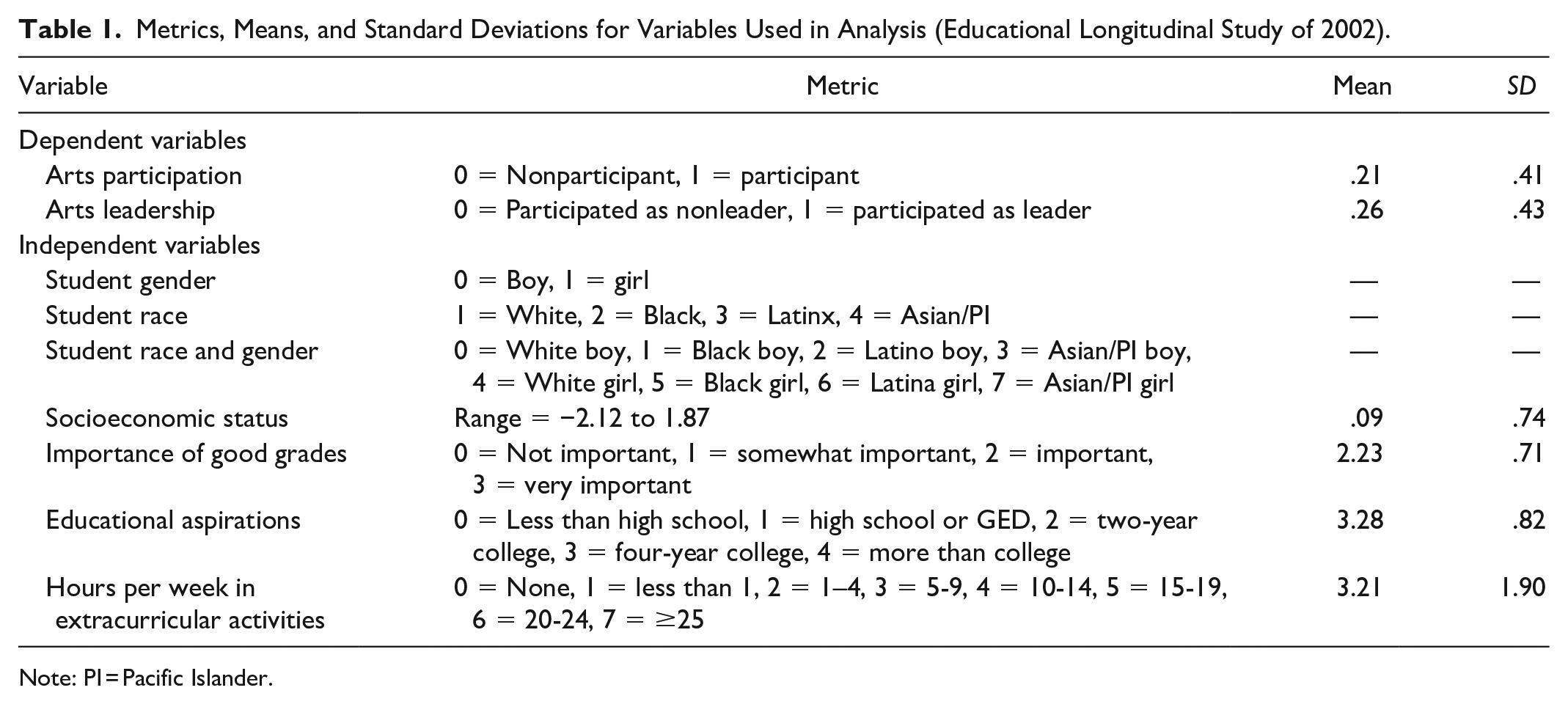
We include controls for students’ SES, importance of their course grades, aspiring level of educational attainment, and hours spent involved in extracurricular activities, as these characteristics affect the odds of extracurricular participation and leadership. Aspiring educational attainment and importance of course grades are collected from the base year to eliminate the risk for reverse causality (i.e., that extracurricular participation affects educational ambitions) and to ensure temporal ordering between students’ aspiration, ambitions, and extracurricular involvement. SES and hours spent on extracurricular activities are collected from the first follow-up. SES is an index of five standardized, equally weighted measures: father’s education, mother’s education, family income, father’s occupational prestige and mother’s occupational prestige. SES is a particularly important control as it has been shown to be an influential predictor of extracurricular activity involvement in general and in arts activities in particular (Dumais 2006; Lareau 2011). 9 Additionally, the co-constitution of norms of masculinity and social class (along with race) likely differentially influence boys’ willingness to participate in feminized activities (Morris 2008; Pyke 1996). Aspiring educational attainment measures how far in school a student believes they will go (i.e., high school, two-year college). Prior research suggests students and families often pursue extracurricular activities and leadership positions to increase competitiveness for college entrance (Lareau 2011), and popular forums discuss extracurricular participation and leadership as important portions of well-rounded college applications, especially as more colleges are moving to test-optional admissions (Nietzel 2023; Princeton Review 2021; Rosinger et al. 2021). Therefore, the link between extracurricular activities and college planning may compel college aspirants to seek out extracurricular participation and leadership opportunities at higher rates and are thus controlled for in our analysis. Importance of course grades to students serves as a proxy for academic ambition as students who place greater emphasis on academics may be more likely to participate in extracurricular activities (Swanson 2002). We include hours spent per week on extracurricular activities in analyses which predict extracurricular leadership, as time spent within activities is positively associated with likelihood of advancing to a leadership role. Last, because all students included in this study were in 12th grade when the question was asked, age is held constant by design. Therefore, differences in leadership status cannot be attributed to age. Table 1 presents descriptive statistics for all variables included in the analyses.
Metrics, Means, and Standard Deviations for Variables Used in Analysis (Educational Longitudinal Study of 2002).
Note: PI = Pacific Islander.
Model
We use logistic regression models with school fixed effects to analyze the association between gender, race-gender, and performing arts participation and leadership. Fixed-effects models are nested, within-cluster models that difference-out the effects of time-invariant cluster characteristics. The fixed-effects model accommodates the stratified nature of the data (i.e., that students nested in the same school are not independent from one another but rather share school-level random effects). Numerous aspects of school context (such as school SES, urbanicity, racial composition, size) matter for how adolescent cultures, especially around peer activities and gender norms, vary across school contexts (Lehman and Dumais 2017; Morris 2008; Schmutz et al. 2016). We therefore run school fixed-effects models to avoid omitted variable bias at the school level, rather than using these characteristics for prediction. This school fixed-effects model is the most constructive for mirroring real-world processes, as extracurricular participation and leadership are decided at the school level and model coefficients estimate variation among students and their schoolmates. This level of analysis is critical toward evaluating disparities within school-based extracurricular processes.
To mirror occupational studies of selection and promotion, our analysis proceeds in two steps. First, we examine which students select into the performing arts first by gender, and then by race and gender. Next, we examine which students assume a leadership role among all students who select into the performing arts. We model variation at the baseline (gender and race-gender only), then include controls for student characteristics that predict participation and leadership, and last include school fixed effects. We apply sample weights to generalize findings to national trends. We present estimates as odds ratios which report the odds of experiencing an outcome relative to the reference group. An odds ratio greater than 1 indicates relative increased odds of experiencing an outcome, and an odds ratio less than 1 indicates decreased odds. Because of fixed residual variance in logistic regression models, coefficients are rescaled at the addition or subtraction of covariates. As a result, this rescaling may bias the interpretation of coefficients in nested models. To account for this issue, we cross-check our estimates against the Karlson-Holm-Breen method, which decomposes variables’ total effects into direct and indirect effects (Breen, Karlson, and Holm 2013). We find that results are consistent with the analyses presented herein.
Results
Testing for Glass Escalator Effects in High School Performing Arts
In the occupational sector, a glass escalator effect occurs when men are promoted over women to a greater degree in woman-dominated than in mixed or man-dominated domains. Here, we find that the glass escalator is also prevalent in preoccupational contexts. Within high school performing arts, boys’ token status gives them an edge in assuming leadership roles, a tacit leadership advantage that does not hold in extracurricular activities that are not symbolically feminized.
Table 2 reports gender representation within the overall sample, arts participants, and arts leadership. These baseline descriptive statistics show that boys and girls are at near equal representation in the sample, yet boys participate in the arts at 23 percentage points lower than girls. However, compared with their percentage representation in the arts, boys are overrepresented in leadership roles, whereas girls are underrepresented. This trend suggests boys’ leadership advantage at baseline.
Gender Representation: Overall, Participation, and Leadership.

This advantage holds after controlling for student-level confounders and netting out variation between schools through the inclusion of school fixed effects. The covariate-adjusted fixed-effects model shown in Table 3 and visualized in Figure 1 shows that while boys are significantly less likely to participate in performing arts—at 41 percent lower odds than girl schoolmates—they advance to leadership roles within the performing arts at more than twice the odds of girls.
Odds Ratios from Logistic Regression Model Predicting Performing Arts Participation and Leadership, by Gender.

Note: Model controls not shown for presentation purposes include socioeconomic status, importance of course grades, aspiring level of education, and total number of hours spent on extracurricular activities. Exponentiated coefficients are shown, with t statistics in parentheses. FE = fixed effects; PI = Pacific Islander.
p < .05. **p < .01. ***p < .001.
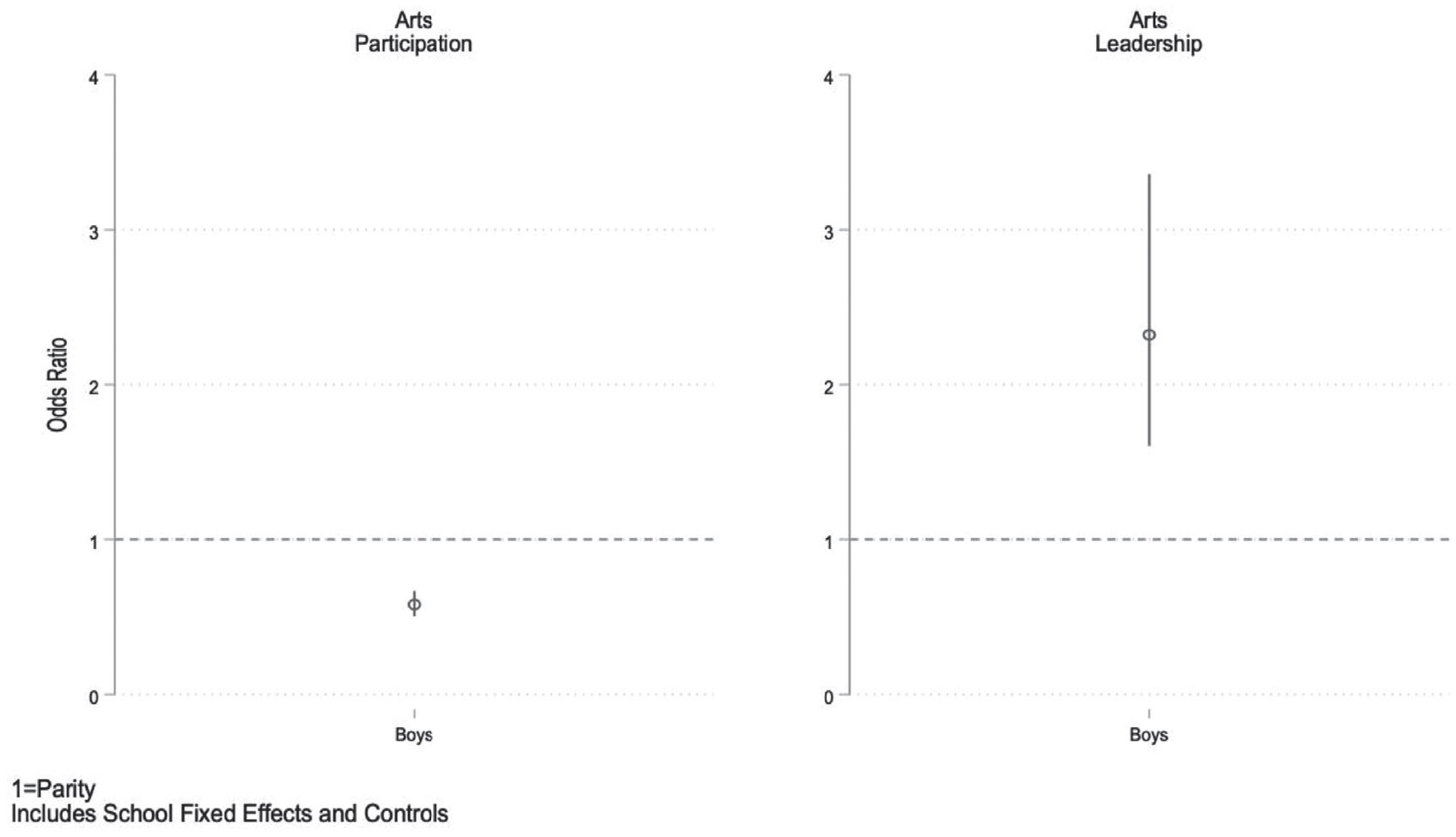
Predicting arts participation and leadership by gender.
Testing for Racialized Glass Escalator Effects
We next examine arts participation and leadership at the intersection of race and gender. Prior research suggests that men’s leadership advantage is not all inclusive; it is White men who accrue the largest advantage (Maume 1999; Wingfield 2009). In testing for a racialized glass escalator, we compare the odds of performing arts participation and leadership for White girls and Black, Latinx, and Asian boys and girls against those of White boys. Table 4 reports representation within the overall sample, arts participants, and arts leaders by race and gender (race-gender). This shows that White, Black, and Asian boys are overrepresented in performing arts leadership when compared with their percentage of performing arts participants; Latino boys are slightly underrepresented. The gap between participation and leadership, or the baseline leadership advantage, is largest for White boys, at a magnitude nearly four times that of boys of color. Simultaneously, White, Black, Latina, and Asian girls are underrepresented in performing arts leadership when compared with their percentage representation as participants. Among girls of color, this leadership deficit at baseline is largest for Black girls.
Race-Gender Representation: Overall, Participation, and Leadership.

Note: PI = Pacific Islander.
The racialized glass escalator effect also holds when controlling for student-level confounders and including school fixed effects. This covariate-adjusted fixed-effects model in Table 5 and visualized in Figure 2 shows that compared with White boys, Latino and Asian boys are equally likely and Black boys slightly more likely to participate in the performing arts. Black, Latino, and Asian boys have an equal likelihood to White boys of assuming leadership roles. White boys’ leadership advantage exists most prominently in comparison with Black, Latina, and Asian girls. Compared with White boys, White girls are estimated to hold 71 percent higher odds, Asian girls 95 percent higher odds, Latina girls 57 percent higher odds, and Black girls more than twice the odds of participating in the performing arts. However, girls across all racial groups face significantly lower odds of assuming leadership roles. Compared with White boys, White girls are estimated to hold 47 percent lower odds, Asian girls 70 percent lower odds, Latina girls 84 percent lower odds, and Black girls 80 percent lower odds of assuming leadership roles. Thus, analyses suggest that the racialized glass escalator effect in high school performing arts is one of White boys’ leadership advantage over all girls and emphatically over girls of color. This participation-leadership contrast is starkest comparing White boys to Black girls. Black girls hold twice the odds of White boys of participating in the arts but only one fifth of their odds of assuming leadership roles.
Odds Ratios from Logistic Regression Model Predicting Performing Arts Participation and Leadership, by Race-Gender.

Note: Model controls not shown for presentation purposes include socioeconomic status, importance of course grades, aspiring level of education, and total number of hours spent on extracurricular activities. Exponentiated coefficients are shown, with t statistics in parentheses. FE = fixed effects; PI = Pacific Islander.
p < .05. **p < .01. ***p < .001.

Predicting arts participation and leadership by race and gender.
Testing for Glass Escalator Processes in Other Extracurricular Activities
Identical analyses across other extracurricular activities show that (White) boys accrue the largest relative leadership advantages in feminized domains, supporting our argument that glass escalator processes are not unique to the workplace. Boys are significantly less likely than girl schoolmates to participate in student government, academic honor societies, and literary clubs. Whereas boys in the performing arts advance to leadership at more than twice the odds of girls, boys in these activities are significantly less likely (as in the case of academic honor societies and literary clubs) or equally likely (as in the case of student government) as girls to hold leadership roles (see Table 6 and Figure 3).
Odds Ratios from Logistic Regression Model Predicting Performing Arts and Other Extracurricular Activity Participation (Gender).

Note: Model controls not shown for presentation purposes include socioeconomic status, importance of course grades, aspiring level of education, and total number of hours spent on extracurricular activities. Exponentiated coefficients are shown, with t statistics in parentheses. PI = Pacific Islander.
p < .05. **p < .01. ***p < .001.

All extracurricular activities by gender.
White boys’ leadership advantages also diminish in extracurricular activities outside of the performing arts. Whereas White boys hold a significant leadership advantage over girls of all racial groups in performing arts, this blanket advantage recedes in other extracurricular arenas. Compared with White boys, White girls hold equal odds of assuming leadership roles in student government and higher odds of assuming leadership roles in academic honor society and literary clubs. Similarly, Asian girls hold equal odds of assuming leadership roles in student government and higher odds of assuming leadership roles in academic honor societies and literary clubs. Latina girls hold equal odds of assuming leadership roles across all activities. Black girls are the only race-gender group across both girls and boys to hold a significant leadership disadvantage compared with White boys. Although Black girls hold equal odds to White boys of assuming leadership roles in academic honor societies and literary clubs, they hold an estimated tenth of the odds of assuming leadership roles in student government. This failure for Black girls to attain leadership parity in all the comparative extracurricular domains and their disparately large disadvantage relative to White boys in attaining leadership roles in the performing arts suggests that Black girls are uniquely disadvantaged in extracurricular leadership advancement during secondary education (see Table 7 and Figure 4).
Odds Ratios from Logistic Regression Model Predicting Performing Arts and Other Extracurricular Activity Participation (Race-Gender).

Note: Model controls not shown for presentation purposes include socioeconomic status, importance of course grades, aspiring level of education, and total number of hours spent on extracurricular activities. Exponentiated coefficients are shown, with t statistics in parentheses. PI = Pacific Islander.
p < .05. **p < .01. ***p < .001.

All extracurricular activities by race and gender (graphs subset by gender).
Discussion
This study extends established patterns of women’s racialized leadership disadvantage in feminized areas (Williams, Muller, and Kilanski 2012; Wingfield 2009) into preoccupational contexts. We find that in high school performing arts, a field that is numerically and symbolically girl-dominated, girls, especially Black girls, are less likely than their (White) boy counterparts to rise to leadership positions. Establishing how racialized glass escalator processes affect members of society before they enter the workplace is important for several reasons. By studying leadership promotion in adolescence, we can expand the reach of racialized glass escalator theories, help disentangle some of the competing explanations for women’s relative disadvantage in leadership, and identify opportunities for intervention. Although literature has established how racialized and gendered leadership inequalities manifest within the workplace (Acker 2006; Maume 1999; Williams 1992; Williams et al. 2012; Wingfield 2009), we reveal how these patterns manifest across institutions and occur prior to the workplace, namely, how leadership inequalities arise as early as adolescence and shape all stages of the educational pipeline. Leadership disadvantage in the workplace is only one part of a larger picture of how race and gender inequalities manifest across institutions and throughout the life course.
Discrimination and Socialization
In addition to expanding the contextual relevance of the racialized glass escalator theory, our evidence of a glass escalator effect in adolescence helps clarify the existing explanations for White men’s advantage in leadership more broadly. Research has identified mechanisms of exclusion in workplace organizations, including self-selection (Correll 2001; England 2010; Lawson et al. 2015), gatekeeper discrimination and biased evaluations (Eagly and Carli 2007; Livingston et al. 2012; Ridgeway 2011) bonding with same-gender supervisors (Williams 1992), balancing assertiveness and likeability (Quadlin 2018; Williams et al. 2012), and discrimination on the basis of motherhood or presumption of motherhood (Budig and England 2001; Correll et al. 2007; Eagly and Carli 2007). Our findings do not challenge the existence of these practices and patterns in the occupational sphere, but they allow us to separate out which mechanisms operate at the cross-institutional, possibly structural, level. We need to attend not only to mechanisms and ensuing policy recommendations in the contexts of specific workplaces, high schools, or extracurricular activities, but also to how these are connected.
Discrimination on the Basis of Race, Gender, and Motherhood
A central advantage of studying these patterns in high school is the theoretical leverage it provides in understanding which among existing explanations for gendered leadership inequality occur outside of the workplace as well. We argue that many explanations based on race and gender discrimination are plausible reason for broad patterns of leadership inequality, with the notable exceptions of motherhood and bonding with supervisors on the basis of shared gender identity. For example, by finding significant gendered and racialized patterns in leadership in high school activities, at a time in the life course when motherhood rates are statistically low, we can infer that motherhood, the presumption of motherhood and its surrounding stereotypes, or time demands of parenting are not the primary or original source of this inequality. Rather, motherhood is a compounding factor that exacerbates existing inequalities once in the workplace. Although discrimination on the basis of motherhood undeniably occurs in the workplace (Budig and England 2001; Correll et al. 2007; Eagly and Carli 2007), our findings tell a story about how White boys’ token status gives them an advantage over all other groups, including all girls (especially Black and Latina girls), as well as boys of color.
Our findings lend further support for explanations of broader, cross-institutional inequalities based on intersectional discrimination unrelated to motherhood, which would theoretically apply to women in all racial groups and not to other men. These findings also demonstrate that bonding with same-gender supervisors as a mechanism behind men’s accelerated tracking and promotions within feminine-coded arenas (Williams 1992) is unique to the workplace, given that the majority of teachers, especially arts teachers, are women (National Center for Education Statistics 2021). We argue that race and gender discrimination among peers, supervisors, and gatekeepers remain compelling explanations for glass escalator phenomena across institutional settings, along with the structuring of opportunities and role socialization.
Socialization and Practice
The existence of a glass escalator effect in adolescence, as a precursor to the patterns in occupational leadership inequality, also supports explanations rooted in racialized gender role socialization, as these expectations and learned behaviors around leadership that are reinforced in adolescence will carry forward into adulthood. These patterns and social role expectations become established and ingrained, and they follow men and women into the workplace (Correll 2001; England 2010). Given the venue for gender role socialization in high school activities, and the path dependency of educational and occupational outcomes to elective activities via higher education (Feldman and Matjasko 2007; Kim and Bastedo 2017), the existence of a racialized glass escalator effect during this important developmental period has implications for understanding how racialized gender inequality not only persists over time but can be amplified over the life course.
By providing students from historically excluded groups more opportunities to practice the tricky balance of assertiveness and likeability required of women and people of color in leadership (Bell and Nkomo 2001; Quadlin 2018; Ridgeway 2011), we argue that high school activities provide a critical site for intervention toward leadership equality. The idea that minoritized groups have a narrower path to leadership because of the positive interpretations of White men’s assertiveness and correspondingly negative interpretations of White women and men and women of color exercising functionally equivalent behaviors (Bell and Nkomo 2001; Collins 1990; Rosette and Livingston 2012; Sanchez-Hucles and Davis 2010), makes opportunities to practice all the more essential. Our findings are just as important in helping understand Black and Latina girls’ and women’s disadvantages as they are in understanding White boys’ and men’s privilege. As such, increasing opportunities for girls of color to lead also has the potential to better accustom White boys to being directed by others and thus to deconstruct such racialized gender role expectations.
Education-to-Occupation Pipeline
Not only are these inequalities in extracurricular leadership important for socialization, skill development, and opportunities for practice, but they provide concrete, traceable mechanisms for White boys’ advantage in high school, college-going, and subsequent occupational outcomes. Within the context of schools, our findings support literature that show White boys’ advantage and girls of color facing discrimination (Musto 2019; Riegle-Crumb et al. 2018).
The patterning of leadership opportunities also has direct effects on college admissions. In the wake of the Supreme Court’s reversal of affirmative action, and moves away from standardized testing, colleges are more limited in what they can consider in evaluating an applicant. This will inevitably result in fewer students of color admitted to selective colleges because of racial biases in the structuring and distribution of prior educational opportunities and resources (Liu 2022). These effects can only be expected to compound as students move into the workforce, as Black and Latinx students are those who are shown to benefit the most from the social capital that comes with attending a highly selective university (Dale and Krueger 2011; Hout 2012).
Simultaneously, in the absence or devaluation of standardized test scores, extracurricular activities and other “softer” gauges of character are starting to carry more weight in admissions decisions and scholarship awards (Park, Kim, et al. 2023; Rosinger et al. 2021; Schultz and Backstrom 2021). As we acknowledge bias in standardized testing that continues to privilege White boys and men in educational attainment, we must also recognize the biases in the pathways into college based on other nonacademic measures, such as leadership roles. Research is abundantly clear that standardized tests such as the SAT make differences in educational opportunities seem like differences in ability and advantage some students over others (i.e., high-SES White boys over all other groups, especially students of color) (Bussey et al. 2021; Reeves and Halikias 2017). Our findings reveal how the glass escalator mechanism similarly yields inequalities within leadership roles in the performing arts, such that it advantages White boys over girls of color. As the most selective colleges, which powerfully structure future leadership opportunities, rely more on such factors (Park, Kim, et al. 2023; Rosinger et al. 2021), we must be attuned to how these opportunities disproportionately privilege White boys to the detriment of girls of color.
Limitations and Directions for Future Research
As the first to examine how the glass escalator begins to pattern women’s representation in leadership as early as adolescence, this study leaves ample room for further research on the topic. First, an important next step is to determine what, if anything, extracurricular leadership predicts about future performance, and whether there is a racialized and/or gendered difference in the return to involvement. It is worth exploring how holding leadership positions in activities with different gender composition and symbolic coding bears out in future educational or occupational outcomes. We might expect that leadership experience in high school would matter differently depending on the demographic composition and symbolic association of the extracurricular field as well as the future fields women attempt to enter, shaping both the skills they learn and practice as well as how they are received by future gatekeepers. Second, data constraints in this study did not allow us to tease out mechanisms by which leadership patterns are established, future studies should follow students into their postsecondary years to assess whether, how, and which young people are deprived of the opportunity to practice leadership in college or early stages of their careers.
Finally, recognizing the centrality of sexuality, and its relationship to traditionally privileged forms of masculinity, in the feminization of high school arts activities (Klein 2006; Morris 2008; Pascoe 2007), and the growing acknowledgment of sexuality as a central element of educational stratification more broadly (Mittleman 2022), we propose the need for more data and research. The interplay of sexuality, homophobia, stereotyping, and hegemonic forms of masculinity complicates patterns of representation not only at the intersection of race and gender, but sexual orientation as well. Despite common stereotypes around gay men being disproportionately interested in the arts, research has found no empirical support for the idea that gay men have innately better artistic sense, more creativity, and have a particular affinity for the arts (Lewis and Seaman 2004). A popular explanation for the overrepresentation of queer adults in classical music, art museum, theater, and dance audiences is their higher probability of being childless and highly educated and living in urban areas (Lewis and Seaman 2004), factors that would not apply to our sample of high school students. Nevertheless, the prevailing stereotype may influence the dynamics of performing arts participation and leadership even among youth and children, leading more gay or queer boys to seek out leadership positions in the arts and more peers and teachers to see them as qualified. If it is the case that many of the boys who do hold leadership positions identify as queer, then this complicates the perception of White masculinity, and patterns of dominance are more nuanced. Therefore, although we seek primarily to understand how race and gender intersect in extracurricular participation and leadership opportunities, we also encourage inquiry into other intersectional dimensions in these processes.
To pursue further research in this area, we need more recent data which collects information on leadership and respondents’ sexuality. 10 Questions about leadership in high school activities have not been asked on national education surveys since ELS in 2004. ELS:2002 respondents graduated high school in 2004 and navigated a high school context that differs both socially and politically than those of current high school students. Today’s young people have been found to hold more progressive attitudes about race and gender than earlier generations and are more likely to self-identify as LGBT (AP-NORC 2021; Jones 2021; Parker et al. 2019). Without newer data, we cannot confirm whether the patterns we find in schools nearly 20 years ago are the same in schools today. Therefore, we advocate that future large-scale education surveys include both measures to offer a broader understanding of the intersectional dimensions of extracurricular leadership disparities and its longitudinal changes and impacts over time.
Our findings call for further investigation of preoccupational glass escalator processes using qualitative data to make sense of these data limitations, as we cannot infer from these surveys the extent to which phenomena such as stereotyping, prejudice, stereotype threat, or prior gender role socialization are at play. Ethnographic data collection in schools is necessary to more definitively understand the mechanisms by which boys and girls are differentially selected into these leadership positions (i.e., whether by gatekeeping by teachers or other authorities, by self-selection, election by peers, etc.). This information would allow us to further understand which explanations for the gender inequality in leadership—aspects of discrimination, socialization, or both—are most influential at the high school level. Qualitative data can also provide further insight into students’ understandings of arts activities and leadership positions within them in relation to race, gender, and sexuality, and how they police the symbolic boundaries around such activities.
Conclusion
If we think of the glass escalator as a product of dynamics constructed prior to, rather than failings of occupational spaces alone, earlier advocacy in educational contexts that mitigate racialized-gendered inequalities in children’s opportunities to lead may serve a promising approach to remedying this long-standing social problem. On the basis of occupation literature, solutions have been proposed to mitigate the problem of gendered leadership inequality, such as increasing overall numbers of women leaders to countervail the cultural association of leadership with specific gender-typed traits and styles (Sanchez-Hucles and Davis 2010). We draw attention to the temporality of the glass escalator, and argue that to be truly effective, interventions must occur further upstream. If girls, and especially girls of color, are denied the opportunity early in their educational careers to practice the skills necessary to take on leadership positions, and White boys continue to reap hidden advantages at higher levels of education and into their transition into the workplace, we can expect that leadership disadvantages that occur during adolescence will compound. Once in occupational settings, women and their evaluators have already been deeply socialized to understand occupational roles in gendered and racialized ways, and whether or for whom high-status roles are worth striving for in the first place. Thus, we advocate for concerted efforts to meaningfully disrupt these inequalities at multiple stages of the educational pipeline.
First, we suggest that teacher training programs expand diversity, equity, and inclusion training to examine features of the educational system that exist outside of classroom teaching that (re)produce inequalities such as extracurricular activity access and leadership. We advocate for schools educating their personnel to ensure the inclusion of Black girls and other girls of color and to recognize, not erase, their needs and experiences. Such training could help girls of color succeed if teachers, administrators, and peers understand their striving for leadership in extracurricular activities as ambition and interest, rather than as pushiness or defiance (Crenshaw et al. 2015). We additionally encourage schools to be attentive to disparities in extracurricular participation and leadership as an important feature of educational equity. Like college entrance exam scores are monitored and compared across high schools, we advocate for an index that measures equity across less measured dimensions such as access to extracurricular activities and diversity in their leadership.
In addition to advocating for expanded definitions of educational equity, we encourage schools to consider the structural constraints to extracurricular participation caused by hosting club meetings at the end of the school day. Students’ after-school activities are shaped by raced, classed, and gendered processes. More than half of students nationwide rely on school buses for transportation. These buses depart at the end of the school day, thus precluding students from participating in after-school club meetings without making special arrangements (Cordes, Rick, and Schwartz 2022). This could address not only class-based inequalities in participation 11 but race and gender inequalities as well. Girls are more likely than boys to be responsible for caregiving and other household tasks that make demands on their time after school (East 2010). Compared with White students, Black and Latinx students live farther from their schools which reduces the ability to walk to school and increases their reliance on the bus (Speroni 2023). Each of these factors plays a role in shaping disparities in extracurricular participation and leadership. One potential approach to reducing disparities is to follow the lead of schools that have expanded extracurricular participation by extending lunch periods to allow clubs to meet during the school day. This expanded access may allow greater participation and tenure in school-based extracurricular activities which may meaningfully increase access to leadership opportunities for underrepresented students, low-income students, and student caregivers.
Beyond K–12 settings, we advocate for more attention to extracurricular leadership inequalities in the transition to higher education and workplaces. With the sweeping adoption of test-optional policies by U.S. universities (Nietzel 2023), admissions professionals may place greater weight on other elements of students’ applications, including their extracurricular profiles (Rosinger et al. 2021). Thus, in this evolving higher education landscape, there is a compelling and immediate demand for educational programming and training that prioritizes the examination of the social structures influencing students’ high school experiences and contextualizes students’ access to extracurricular opportunities therein. One proposed method to partially address this is to limit the number of activities applicants can list (Park, Zheng, et al. 2023). We also advocate for the return of race-conscious admissions, so that universities can meaningfully account for these inequalities in leadership opportunities.
Even beyond students’ educational careers, extracurricular leadership matters. For example, women are found to undervalue and underemphasize their extracurricular participation and leadership as qualifications that employers seek and reward when, in fact, employers are increasingly valuing extracurricular leadership experience in hiring decisions (Stevenson and Clegg 2012). Therefore, we advocate for schools and universities not just to provide equal opportunities for girls and racially minoritized students to pursue these roles and activities, but also to encourage these students to recognize their value as a form of capital in the labor market.
Our findings speak to pervasive and intersecting racialized and gender inequalities in leadership opportunities among adolescents. We find that glass escalator processes apply not only within workplaces, but across institutions and stages of the life course. These findings highlight the need for interventions to provide historically excluded groups, particularly girls of color, more opportunities for leadership. They also emphasize the need for changes in how students and prospective job candidates are evaluated which are less biased in favor of White boys over other sociodemographic groups. These results provide a compelling case for addressing racialized and gendered inequalities not just in the workplace, but across the entire education-to-occupation pipeline.
