




Abstract
A growing body of research focuses on multigenerational mobility, but few studies show how grandparents’ gender and gender-specific lineage (paternal vs. maternal side) are differentially associated with the process of status transmissions across generations. This article uses data from the Health and Retirement Study 1992–2018 (N = 15,623) to examine gender and gender-specific lineage differences in grandparent-grandchild education associations. Grandfathers’ educational attainment is more strongly associated with grandchildren’s education than is grandmothers’ education. Variation in shared lifetimes and residential proximity do not account for these differences, but shared lifetimes between grandmothers and grandchildren are positively associated with grandchildren’s educational attainment.
Keywords
Whether grandparents matter for grandchildren’s life outcomes has garnered substantial interest from social scientists in recent years, partly because of its implications for social inequality and mobility across generations (Mare 2011). Evidence from this growing body of research suggests that the social status of grandparents—for example, their occupation, wealth, and education—may directly affect the life chances of their grandchildren, even controlling for the middle generations’ characteristics (for a review, see Anderson, Sheppard, and Monden 2018). Previous research points to several potential mechanisms that may explain these grandparent-grandchild associations. For example, grandparents may pass down their economic, social, and cultural capital to grandchildren by way of early life investments (Pfeffer and Killewald 2018), via shared lifetimes and child care (Zeng and Xie 2014), or by providing ties to extended family networks that enable resource transfers (Lehti, Erola, and Tanskanen 2019).
These studies, however, have rarely investigated whether the pathways of multigenerational transmission vary by grandparents’ gender (grandfathers vs. grandmothers) or by gender-specific lineage (paternal vs. maternal side). Some studies only use the characteristics of one grandparent, often a grandfather (Chan and Boliver 2013; Hertel and Groh-Samberg 2014; Knigge 2016; Kroeger and Thompson 2016). Other studies with information on more than one grandparent have generally not focused on gender or lineage differences in these associations (Engzell, Mood, and Jonsson 2020; Modin, Erikson, and Vågerö 2013; Pfeffer and Killewald 2018; Song and Mare 2017, 2019; Zeng and Xie 2014). Only one prior study to date has explicitly hypothesized and tested how the effects of grandparents’ resources and exposure vary by grandparent gender and gender-specific lineage and by parents’ socioeconomic status (using data from Finland; Lehti et al. 2019). However, this study’s focus was not on multigenerational education associations, and it used the single grandparent with the highest level of education as a proxy for all four grandparents’ educational attainment, making it impossible to directly compare the size of multigenerational education associations across all four grandparents by gender and gender-specific lineage.
I extend existing research by developing and testing contrasting hypotheses of how grandparent-grandchild education associations vary by grandparents’ gender and gender-specific lineage, drawing on Lehti et al.’s (2019) three theoretical perspectives: legacy effects, exposure effects, and gendered kin-keeper effects. These perspectives have different predictions about expected patterns of grandparent-grandchild education associations. The legacy effect perspective focuses on the importance of legacy and wealth transfers from grandparents to grandchildren—a domain historically associated with men and thus predicts stronger grandfather-grandchild education associations than grandmothers-grandchild education associations on both sides. The exposure perspective centers on the role of social interaction and care—a domain historically associated with women and predicts stronger grandmother-grandchild education associations than grandfather-grandchild education associations on both sides. The gendered kin-keeper perspective focuses on the key position of women connecting family members, for instance, in facilitating interactions through organizing family visits (Di Leonardo 1987). This perspective predicts grandchildren’ education to be more strongly associated with maternal grandparents’ (especially maternal grandmothers’) education than paternal grandparents’. The pattern of results shed light on the plausibility of different hypothesized mechanisms that may explain grandparent education associations and contribute to an emerging area of research on family-of-origin gender differences in the status transmission process (Beller 2009; Hout 2018; Hu and Qian 2023; Korupp, Ganzeboom, and Van Der Lippe 2002; Minello and Blossfeld 2014).
To investigate gender and gender-specific lineage differences in grandparent-grandchild education associations, I use data from the 1992 to 2018 waves of Health and Retirement Study (HRS), a data source that has not previously been used to investigate grandparent education associations. The HRS has important advantages over the Panel Study of Income Dynamics (PSID; Pfeffer and Killewald 2018; Song and Mare 2017, 2019) and the Wisconsin Longitudinal Study (WLS; Jæger 2012; Warren and Hauser 1997), the data upon which most of the existing literature on U.S. multigenerational associations has been based. The main PSID sample contains information on either maternal grandparents or paternal grandparents, and information for all four grandparents is only available for a smaller subset of grandchildren. The WLS does not contain information on all four grandparents (only grandparents from WLS graduates’ side) and is limited in its generalizability because it is a sample of select birth cohorts who graduated from high school in Wisconsin. No prior study on multigenerational education associations has taken advantage of benefits of the HRS, which is a large nationally representative sample and contains information on the educational attainment and survival of all four grandparents. Thus, the HRS is well suited for this analysis, and the use of these data is a key contribution in addition to the main focus of this study—grandparent gender and gender-specific lineage variation in patterns of grandparent-grandchild education associations.
Theorectical Perspectives
Legacy Perspective
The legacy effect perspective appears in much of the literature on grandparent effects (Hällsten and Pfeffer 2017; Jæger 2012; Lehti et al. 2019; Pfeffer and Killewald 2018). The emphasis of this perspective is that a source of grandparent-grandchildren education associations is direct resource transfers from grandparents to grandchildren, for example, legacy college admissions and wealth inheritance. The legacy system of elite college admissions in the United States served as a key mechanism of direct transmission of educational privileges from grandparents (or more likely, grandfathers) to grandchildren (Castilla and Poskanzer 2022; Mare 2011). Applicants benefit from preferential treatments in admission even if they do not have an Ivy League-educated father but had a grandfather who was a graduate or donor of these colleges (Castilla and Poskanzer 2022; Mare 2011). In the United States, wealthy grandparents can also set up “generation-skipping trusts” to pass down wealth to their grandchildren to avoid estate taxes, which would otherwise apply if their children’s names were on the trusts (Mare 2011; Segal 2021). These trusts can then be used to pay for an elite education for the grandchildren.
Grandparents with advanced educational credentials may also possess social capital that could directly benefit grandchildren’s education. Highly educated grandparents may be well connected and employ such connections to help their grandchildren to get an edge (Møllegaard and Jæger 2015). For example, they may know the right people at the right schools, social clubs, and companies to connect their grandchildren to prized internships and extracurriculars that would be advantageous for grandchildren’s further education. Because it was predominantly men who had access to higher education and the employment from which to accumulate such wealth and social capital prior to the 1970s, these wealthy grandparents were likely to be grandfathers.
Thus, the legacy perspective implies that grandfathers rather than grandmothers of this era were the primary grandparents transmitting educational advantages, and thus, we would expect stronger grandfather-grandchild education associations than grandmother-grandchild education associations. This prediction is consistent with the “conventional view” of social background (Goldthorpe 1983). Existing empirical research has generally focused on grandfathers, and although it does not speak to whether the grandfather-grandchild education association is larger than the grandmother-grandchild education association, it nevertheless shows evidence of significant grandfather associations in studies where only grandfathers’ information is available (Chan and Boliver 2013; Hertel and Groh-Samberg 2014; Knigge 2016; Sheppard and Monden 2018).
Exposure Perspective
Differential exposure to and interaction with grandparents may lead to variation in grandparent-grandchild education associations (Song and Mare 2019; Zeng and Xie 2014). Over the twentieth century, drastic declines in mortality and large increases in life expectancy led to an increase in the expected average years of shared lifetime between grandparents and grandchildren, with the largest increase occurring among more highly educated grandparents (Bengtson 2001; Song and Mare 2019). Increased shared lifetimes between grandparents and grandchildren have been shown to be associated with stronger grandparent-grandchild education associations overtime in the United States (Song and Mare 2019), but this research did not explore differences by grandparent’s gender or lineage. More pronounced increases in longevity and younger ages of birth for women than men means that women (grandmothers) tend to have longer generational overlap with their grandchildren than do men (grandfathers) and that maternal grandparents have slightly longer overlap than paternal grandparents (Margolis and Verdery 2019).
Shared lifetimes are necessary for more intense forms of exposure and interaction. Living grandparents can contribute to grandchildren’s outcomes by providing child care or providing guidance and supervision (Chen, Liu, and Mair 2011; Dunifon, Near, and Ziol-Guest 2018; King and Elder 1997; Møllegaard and Jæger 2015; Zeng and Xie 2014). Educated grandparents may also pass down cultural capital to their grandchildren by fostering stimulating learning environments that are advantageous for the grandchildren’s educational success (Møllegaard and Jæger 2015), and more intense forms of exposure, such as coresidence, may also lead to variation in the size of grandparent-grandchild associations across grandparents (Zeng and Xie 2014). While it is relatively uncommon for U.S. children to live with their grandparents (Dunifon et al. 2018), residential proximity between grandparents and parents (and by extension, grandchildren) has been shown to be an important correlate of more frequent contact and closeness between grandparents and grandchildren (Mueller and Elder 2003).
Research has consistently shown that grandmothers in particular are more likely to spend time with grandchildren, evidenced by grandmothers’ higher levels of involvement in grandchild care (Danielsbacka et al. 2011; Guzman 2004; Hank and Buber 2009; Horsfall and Dempsey 2015). If increased exposure helps facilitate the multigenerational transfer of educational advantages, then grandmother-grandchild education associations may be larger than grandfather-grandchild associations. The exposure perspective suggests stronger associations between grandmothers’ and grandchildren’s education than those between grandfathers and grandchildren on both sides, the reverse of expectations from the legacy perspective.
Gendered Kin-Keeper Perspective
Gender-based differences in familial obligations within the parental generation also predict differential grandparent-grandchild education associations. Mothers often serve as gatekeepers in kin networks, maintaining intergenerational contacts and familial ties (Kalmijn et al. 2019; Rossi and Rossi 1990). Di Leonardo (1987) recognized this as kin work, distinguished from housework, childcare, or work in the labor market. Kin work refers to “the conception, maintenance, and ritual celebration of cross-household kin ties”; it can take the forms of writing greeting cards and making phone calls and organizing holiday gatherings and family visits (Di Leonardo 1987:442).
As wives and mothers, women often serve as the critical link between their husbands and their own kin and between their children and their own parents, more so than men and fathers do on the paternal side. For example, Rossi and Rossi (1990) found that in the Unitec States, both men and women cite grandparents from the maternal side, in particular maternal grandmothers, as more significant figures in their lives than grandparents on the paternal side. This “matrilineal advantage” in grandchild-grandparent relations is well documented (Chan and Elder 2000). Not only are maternal grandmothers more satisfied as grandparents than other grandparents (Somary and Stricker 1998), they invest more in childcare and are more willing to “go the extra mile” in initiating face-to-face contact with their grandchildren, even as their residential distance from their grandchildren increases (Perry and Daly 2017; Pollet, Nettle, and Nelissen 2007). It is no surprise, then, that grandchildren are more likely to rate their maternal grandmothers as “very important” to them while growing up and feel more obligated to provide comfort and emotional and financial support during times of crisis to their maternal grandmothers than they do to their other three grandparents (Rossi and Rossi 1990).
Consistent with this, the gendered kin-keeper perspective would predict grandchildren’s education to be most strongly associated with maternal grandmothers’ education (two female links), followed by maternal grandfathers’ and paternal grandmothers’ (both with one female link) and lastly paternal grandfathers’ (two male links). The mechanism behind these hypothesized effects is greater contact across generations through female ties, which is proxied by the gender-specific lineage.
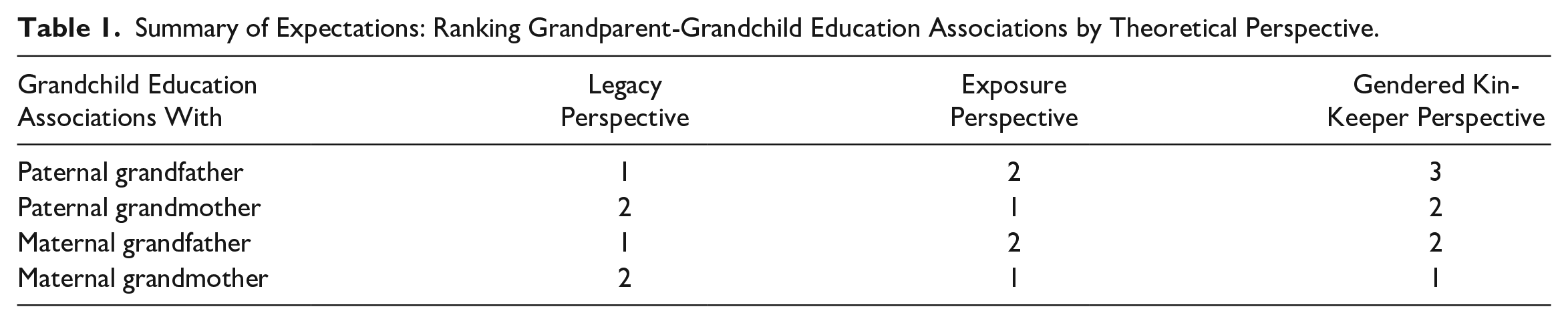
Table 1 shows a summary of expectations about the patterns of education associations from the three perspectives. I rank-order the expected strength of grandparent-grandchild education associations, where 1 is the strongest expected association and 3 is the weakest. These theoretical perspectives predict contrasting expectations on the direction and magnitude of grandparent-grandchild associations and point to potential gendered differences in these associations. However, different mechanisms may be operating in countervailing directions at the same time. The results of my analysis show the dominant associations and do not exclude the possibility of co-occurring mechanisms.
Summary of Expectations: Ranking Grandparent-Grandchild Education Associations by Theoretical Perspective.
It is important to acknowledge that omitted variable bias may be an issue, especially in multigenerational research (Engzell et al. 2020). In the absence of high-quality household register data, I proceed with the limitations of survey data in mind and discuss how omitted variables might influence the results later in the article. Other studies using survey data suffer from the same limitations but conceal potential variation in omitted variable bias by grandparent gender and lineage without an analysis of all four grandparents.
Data and Methods
Data and Sample
The HRS is a nationally representative, longitudinal panel survey of individuals over 50 years of age in the United States, with oversamples of African Americans and Hispanics. The survey began in 1992, after which new cohorts were added in 1993, 1998, 2004, 2010, and 2016. Once respondents enter the survey, they are reinterviewed biannually. In what follows, for clarity and brevity, I refer to grandparents as G1 for Generation 1, parents as G2 for Generation 2, and grandchildren as G3 for Generation 3 following the convention of the literature (Anderson et al. 2018). HRS respondents are G2, their parents are G1, and their children are G3. I pool the HRS data across the 1992 to 2018 waves (excluding the 1993 wave due to inconsistent measures) using the RAND HRS Longitudinal File 2018 and the public use HRS files 1992 to 2018. Online Appendix Table A1 gives a list of the variables used and the HRS interview that they are taken from. Many measures come from the respondents’ first interview—that is, the first time they were interviewed—which can range from 1992 to 2018, as new respondents were added to the study at different points of time. Birth cohorts for G3 range from the 1930s to 1990s, although most were born in the 1950s through the 1980s. Sensitivity tests indicate that there are no statistically significant differences in the results by G3 birth cohort (see more discussion on this in the results section).
The sample is restricted to HRS respondents’ biological children in the G3 generation who are 25 years old or older, following most studies in this literature (Song and Mare 2019; Warren and Hauser 1997). A total of 798 grandchildren were excluded because of missing information on the dependent variable (own education) and primary independent variables (all four grandparents’ education or either parents’ education). I used multiple imputation with chained equations to impute missing data in other independent and control variables (White, Royston, and Wood 2011). Online Appendix Figure A1 compares the distributions of the imputed grandparents’ education to the observed grandparents’ education. The distributions are similar, suggesting that the imputations are reliable. Levels of missingness are generally low, with the most missing data on paternal grandfather’s education at 13.19 percent (see Table 2). A sensitivity test using a sample including only complete cases yields similar results (Online Appendix Table A2). The final sample consists of 15,623 G3 grandchildren in 6,105 families.
Descriptive Statistics.

Note: Health and Retirement Study respondents’ household sampling weights are applied. G1 = Generation 1 (grandparents); G2 = Generation 2 (parents); G3 = Generation 3 (grandchildren); PGF = paternal grandfather; PGM = paternal grandmother; MGF = maternal grandfather; MGM = paternal grandmother; NH = non-Hispanic.
Variables
The primary goal of the analysis is to draw on the legacy, exposure, and gendered kin-keeper perspectives and examine the pattern of grandparent-grandchild education associations while controlling for parental characteristics and other relevant background variables. The perspectives have different predictions about the gender and lineage pattern of education associations. As shown in Table 1, the legacy perspective and the exposure perspective are tested using grandparent gender as a proxy, but they hypothesized contrasting predictions, given that the former predicts stronger grandfather-grandchild education associations on both sides while the latter predicts stronger grandmother-grandchild education associations on both sides. The gendered kin-keeper perspective is tested similarly using gender-specific lineage as a proxy (i.e., maternal vs. paternal side), which predicts stronger education associations between maternal grandparents (especially maternal grandmothers) and grandchildren than between paternal grandparents and grandchildren.
Measures that would allow tests for mechanisms behind the legacy perspective and kin-keeper perspective are unavailable (e.g., measures of legacy admissions, wealth transfer, and social capital; time diaries capturing grandparent-grandchild interaction), but the HRS contains two pieces of relevant information on exposure: years of shared life between grandparents and grandchildren and residential proximity. I use this to test the mechanisms of the exposure perspective in secondary analyses. The number of years of shared lifetime is estimated using G3’s year of birth and G1’s year of death, which is either recorded at respondent’s first interview or at a later interview when G1 passed. If G1 was still alive by the respondent’s last interview, the “year of death” for G1 is censored at this last interview year. The number of years of shared lifetimes is then top coded at 25 years, consistent with prior research (Song and Mare 2019). Given that a sizeable share of grandchildren have no shared lifetime with their grandparents in my sample, I further construct a binary variable to indicate whether there is any shared lifetime for each G3-G1 dyad and control for this. Histograms of the distributions of shared lifetimes with all four G1 grandparents are presented in the Online Appendix (Figure A2).
Residential proximity of G1 and G2 (and by extension, of G1 and G3) is reported by G2 at the first interview. The residential proximity variable is created using the HRS survey question asking G2 whose parents were alive at the time of the interview: “Does your (mother/father)/Do your parents live within 10 miles of you?” Using this information, I construct a categorical variable for residential proximity for each G1-G3 dyad that indicates G1 not alive, G1 lived within 10 miles, or G1 lived more than 10 miles away. Neither measure of shared lifetimes or residential proximity perfectly capture the intensity or quality of time spent with grandparents, but together, they offer new insights into the potential mechanisms behind G1-G3 education associations.
Education for all three generations is measured by the number of years of completed schooling. G3 education is updated by G2 in every wave because some G3 were school age during the study period; the highest value reported across all waves is used. G1 education and G2 education (both reported by G2) are only measured once—the first time G2s were interviewed—because G1 and G2 were in middle and old ages and most likely had completed their education by this time. In all analyses, I control for G2 parental occupation at the first interview, and because of the sampling strategy, a considerable portion of respondents (parent/G2) reached retirement age and were not working, so I also control for whether the parent/G2 reached retirement age of 65 at the first interview. Other controls include G2 parental marital status at the first interview, mother’s race and ethnicity (but not father’s race and ethnicity because of collinearity; see Table 2), G2’s age at birth of the focal child/G3, G1’s age at birth of the G2, G3’s age, G3’s age squared, an interaction term between G3’s gender and G3’s birth cohort, and an interaction term between G3’s gender and G2 mother’s race because previous research has shown that the trends of education attainment vary by both gender and race (De Brey et al. 2019).
Analytic Strategy
For the primary focus of the article, I use linear regressions with linear specifications of the dependent and independent education variables to investigate grandparent gender and gender-specific lineage differences in grandparent-grandchild education associations. Because siblings who share the same four grandparents are included in the sample, I correct the standard errors with the cluster sandwich estimator in Stata for all analyses (Williams 2000). The baseline model (Model 1) has G3 education as the dependent variable and education of each of the four G1 as the main independent variables, controlling parental education and other relevant characteristics.
In secondary analyses, I use the information available on shared lifetime and proximity to further test the extent to which the pattern of grandparent-grandchild education associations can be accounted for by these measures of exposure. To do this, I estimate two additional models. Model 2 includes the number of years of shared lifetime with each of the four grandparents while controlling for not having any shared lifetime with each grandparent. Model 3 adds the variables for residential proximity with each grandparent to the baseline model. Given that most living grandparents on the same side reside together and proximity with maternal grandmothers and maternal grandfathers, for example, are highly colinear, I also report a sensitivity analysis using only grandmothers’ residential proximity in Online Appendix Table A3.
Results
Table 2 shows social and demographic descriptive statistics for G3 grandchildren, G2 parents, and G1 grandparents. As is well known, education has increased across generations. Among G3, the mean number of years of schooling is 14 years compared with less than 10 years across grandparents in G1. Consistent with women’s longevity advantage, shared lifetime between grandchildren and grandmothers is longer than shared lifetime between grandchildren and grandfathers by about 5 years. Maternal grandmothers and grandfathers have slightly longer shared lifetimes with grandchildren than the paternal side. This is likely because of G2 mothers’ younger ages of childbearing than G2 fathers’, but these differences are not nearly as large as the grandfather-grandmother differences. More than three fourths of G1 grandfathers and slightly more than half of G1 grandmothers were no longer living at the time of the first interview, which is not surprising given that G2 respondents were 50 years of age and older at interview. A higher share of G1 grandmothers on both sides reside near G2 than grandfathers, partly because a higher share of G1 grandmothers than G1 grandfathers were alive as of the first interview. Almost all (99 percent) of G2 parents were married, which is a result of the household sampling strategy of the HRS—both G2 parents were in the HRS sample because they lived together at the time of the first interview.
These descriptive statistics form the context with which to assess whether there is evidence for gendered differences in grandparent-grandchild education associations. Table 3 addresses this question, showing results from the baseline three-generation association model in Column 1. Consistent with the expectations of the legacy effect perspective, the grandfather-grandchild education coefficients are larger than the grandmother-grandchild coefficients. For example, maternal grandfathers with an additional year of schooling tend to have grandchildren with an additional 0.028 year of schooling, holding the other variables in the model constant, compared with a coefficient of 0.018 for paternal grandfathers. Hypothesis tests indicate that the maternal grandfathers’ education coefficient (0.028) is not larger than paternal grandfathers’ education (0.018) but is larger than the maternal grandmothers’ education coefficient (0.0008) and the paternal grandmothers’ education coefficient (−0.006), while the paternal grandfathers’ coefficient (0.018) is not significantly larger than the grandmothers’ coefficients from either side. Although the effect sizes are modest, these findings are consistent with previous estimates that show the positive association between grandfathers’ education and grandchildren’s education (Sheppard and Monden 2018).
Linear Regression Results Predicting G3 Grandchildren’s Education.

Note: Models include controls for G2 marital status, G2 age 65+, G3’s age, G3’s age squared, G3’s birth cohort, interactions between G3 cohort and G3 gender, interactions between G3 gender and G2 mothers’ race, all four G1/grandparents’ age at birth of each G2, and G2’s age at birth of focal G3. G1 = Generation 1 (grandparents); G2 = Generation 2 (parents); G3 = Generation 3 (grandchildren); PGF = paternal grandfather; PGM = paternal grandmother; MGF = maternal grandfather; MGM = maternal grandmother.
p < .1. *p < .05. **p < .01.
The findings thus far are consistent with the legacy effect perspective, which suggests that grandfathers’ education (on either side) is more tightly associated with grandchildren’s education outcomes than grandmothers’ education. The pattern of association does not show robust support for the gendered kin-keeper perspective because only maternal grandfathers’ education, and not maternal grandmothers’ education, are statistically significant, and maternal grandfather’s education is not significantly larger than paternal grandfather’s education. The findings are also inconsistent with a simple exposure argument that predicts the grandmother-grandchild associations would be larger than the grandfather-grandchild associations.
The results also suggest that grandparent-grandchild education associations do not vary by grandchildren’s birth cohorts, which may be surprising to some (Online Appendix Table A4). Expanded access to higher education in the second half of the twentieth century may suggest weaker grandparent-grandchild education associations among the later cohorts because more grandchildren were able to attain higher education regardless of family origins. One reason for the null results could be that the grandparent-grandchild education associations are already modest—about one-fifth to one-ninth of the size of parent-child education associations. It is possible that cohort differences in educational mobility are not picked up in these three-generation models, although other research has shown that intergenerational mobility (between parent and children) also stabilized since the 1970s (Chetty et al. 2014).
Thus far, I have explored patterns of grandparent-grandchild education associations, which shed light on the plausibility of the various hypotheses, but there are two additional measures in the HRS that allow for further assessment of the exposure perspective. Column 2 in Table 3 includes years of shared lifetimes and dummy variables for no shared lifetime between G1 and G3 and shows that the positive associations between grandfather’s education (on either side) and grandchildren’s education are very similar in magnitude as in Column 1 and remain statistically significant. Column 3 in Table 3 includes residential proximity rather than shared lifetimes, given that these two measures are highly colinear, and again shows that the education associations between G1 and G3 are virtually unchanged from those of the baseline model. Sensitivity analysis using only grandmothers’ residential proximity shows the same results (Online Appendix Table A3). This suggests that shared lifetimes and residential proximity (as measured in this analysis) do not account for the observed G1-G3 education associations, which is not surprising given that the associations are largest for grandfathers.
It is also worth pointing out that these measures are directly associated with grandchildren’s education. The number of years of shared lifetime with maternal grandmothers is positively associated with G3 grandchildren’s education, while the same is not true for other grandparents (Column 2). In addition, not having a living grandmother (paternal or maternal) at the time of the first interview is associated with lower G3 grandchildren’s education regardless of whether grandmothers live closer or farther away (Column 3). Thus, although variation in shared lifetimes and residential proximity as measured here do not account for the observed pattern of grandparent-grandchild education associations, it is nevertheless noteworthy that these factors are directly associated with grandchildren’s education outcomes and more so for grandmothers, especially maternal grandmothers. These results are consistent with other research that shows longer share lifetimes with grandmothers are linked to positive education outcomes for grandchildren (Lehti et al. 2019).
Conclusion and Discussion
Which grandparent-grandchild education associations are strongest? I find robust grandfather-grandchild education associations on both sides and little evidence of education associations for grandmothers on either side, supporting the legacy perspective of multigenerational transmission of status. Grandfathers’ education may be more readily translated into socioeconomic resources that are passed down the generations and benefit grandchildren’s education because only grandfathers (i.e., men), for the most part, had the ability to use their education to access employment, wealth, and social capital. These results are consistent with previous findings showing a positive association between grandfathers’ education and grandchildren’s education (Sheppard and Monden 2018). However, by including all four grandparents and examining the theoretical perspectives comparing grandparents’ effects by grandparent gender and lineage, this study sheds light on the gender patterns and the underlying mechanisms of grandparent-grandchild education associations.
Shared lifetimes with grandmothers, especially maternal grandmothers, is directly positively associated with grandchildren’s education, independent from grandmothers’ education. Other research has also highlighted the important role of grandmothers in grandchildren’s lives (Horsfall and Dempsey 2015; Lehti et al. 2019), but as findings from this article suggest, grandmothers’ impacts on grandchildren may not be from their education. The findings could reflect the importance of the childcare grandmothers are performing or the fact that longevity may be another proxy for grandmothers’ higher socioeconomic status that is not well captured by their education.
It is important to point out that grandparent-grandchild associations could be artifacts of omitted variable bias. Education may be a weak measure of grandmothers’ social status, especially prior to widespread educational opportunities for women. Chadwick and Solon (2002) found strong associations between husbands’ earnings and wives’ parents’ earnings and suggested that wives’ own earnings might be an inadequate measure of social status for married women. So if education more accurately captures the social status of grandfathers than of grandmothers, grandfathers’ education would be more strongly associated with their children’s education as well as their grandchildren’s education compared to grandmothers’ education. This is consistent with the larger estimates of the association between grandfathers’ education and grandchildren’s education found in this analysis. In other words, omitted variable bias may be a reason that I am finding support for the legacy perspective.
Exploring gender patterns in grandparent-grandchild education associations, this study contributes to the ongoing debate about whether and how grandparents matter in grandchildren’s lives. By including all four grandparents and explicitly hypothesizing and testing differences in education associations by grandparent gender and gender-specific lineage, this analysis moves beyond the assumption that grandparents are the same and there is a singular grandparent effect. Instead, it highlights that grandparents may play distinctive roles in grandchildren’s lives based on the grandparent’s gender and lineage. With the rise of divorce and remarriage (Smock and Schwartz 2020), more people may increasingly have more than four grandparents. Future research should investigate how these demographic changes affect grandparent-grandchild relationships and how grandparent gender and lineage factor in these multigenerational dynamics.
Supplemental Material
sj-docx-1-srd-10.1177_23780231231184221 – Supplemental material for Which Grandparents? Multigenerational Education Associations by Grandparent Gender and Paternal versus Maternal Side
Supplemental material, sj-docx-1-srd-10.1177_23780231231184221 for Which Grandparents? Multigenerational Education Associations by Grandparent Gender and Paternal versus Maternal Side by Anita Li in Socius
Footnotes
Acknowledgements
I am grateful to Christine Schwartz, Jason Fletcher, and Eric Grodsky for their helpful comments and generous readings of various drafts. Many thanks to Russell Dimond, who provided valuable assistance in Stata coding. Felix Elwert pointed me in the direction of helpful sources. Lindsay Jacobs generously guided me to use various data sets from the Health and Retirement Study. Participants of The Sociology of Gender Brown-bag (FemSem) at the University of Wisconsin-Madison and those of the 2019 RC28 Summer Meeting at Princeton University provided helpful feedback.
Funding
The author(s) disclosed receipt of the following financial support for the research, authorship, and/or publication of this article: This research is supported by the Center for Demography and Ecology at the University of Wisconsin-Madison (P2C HD047873).

Supplemental Material
Supplemental material for this article is available online.
Author Biography
References
Supplementary Material
Please find the following supplemental material available below.
For Open Access articles published under a Creative Commons License, all supplemental material carries the same license as the article it is associated with.
For non-Open Access articles published, all supplemental material carries a non-exclusive license, and permission requests for re-use of supplemental material or any part of supplemental material shall be sent directly to the copyright owner as specified in the copyright notice associated with the article.
