



Abstract
The authors examine cohort trends in childhood income volatility among U.S. children born between 1970 and 1990. In contrast to previous studies that focused mainly on period trends, the authors adopt a cohort-life-course perspective and measure children’s exposure to income volatility from birth to age 17, which provides a more adequate account of the economic environment during early life stages. Using data from the Panel Study of Income Dynamics, the authors investigate (1) how income volatility among U.S. children has changed across cohorts, (2) how cohort trends in income volatility differ by family structure, and (3) the extent to which the increasing prevalence of single-headed families and the growth of income volatility among single-headed families contribute to the overall trend in childhood income volatility. The results show that (1) income volatility in childhood has increased over time; (2) children who lived in single-headed families experienced greater increase in childhood income volatility than those from two-headed families; and (3) both the increasing prevalence of single-headed families (“composition effects”) and the fact that single-headed families’ incomes have become less stable (“volatility effects”) in the past decades account for a significant proportion of the increasing income volatility for U.S. children, yet their relative contributions differ between White and Black families.
Keywords
A growing literature argues that the economic standing of a family depends not only on the average level of family income, but also on the extent to which the family moves from one economic level to another over time (Bane and Ellwood 1996; Duncan et al. 1984; Hill et al. 2013;Western et al. 2012, 2016). One pivotal dimension of the over-time changes in family economic status is income volatility, which measures the amount and degree of changes in family income from year to year. An upward period trend in income volatility among American workers and households (Dynan, Elmendorf, and Sichel 2012; Gottschalk and Moffitt 2009; Jensen and Shore 2015; Moffitt and Zhang 2018) 1 has raised concern among scholars, as it indicates growing economic risk for workers and households and increasing economic insecurity for American families (Duncan et al. 1984; Hacker 2019; Western et al. 2012).
Not only does a family’s economic instability influence adults’ well-being and family life, it also carries important implications for children’s well-being and intergenerational mobility (Cheng et al. 2020; Hardy 2014; Hill 2018, 2021; Hill et al. 2013). Constant changes in income can undermine a family’s continuous and stable investment in children and thus negatively affect children’s education (Bradley and Corwyn 2002; Mayer 1997). Frequent and significant income fluctuations can also stress parents and compromise their ability to provide high-quality child care (Conger, Conger, and Martin 2010; Masarik et al. 2016; Mistry et al. 2002). All these consequences of income instability have far-reaching effects on children’s development, behavioral patterns, mental health, education, and socioeconomic attainment in adulthood (Cheng et al. 2020; Gennetian et al. 2015; Hardy 2014).
Despite its significance for children, few studies have investigated cohort trend in childhood income volatility, a first step toward a more comprehensive understanding of its mechanisms and consequences. Although Western et al. (2016) documented the trend of volatility for American children from the 1980s to the 2000s—a notable exception to the overall neglect of trend in childhood income volatility—they used data from the Survey of Income Program Participation, which captures income changes only within four years for a child and does not allow cohort comparisons. Another relevant work is by Hill (2018), who analyzed data from the Panel Study of Income Dynamics (PSID) and shed light on the changing stability of economic environment for U.S. children since the 1970s. Yet as it captured only 10 years in one’s childhood, this work does not tell us about how the degree of income volatility experienced during an individual’s childhood has changed across cohorts in the United States.
This study advances literature on family income volatility by adopting a cohort-life-course perspective, in which we examine the cohort trends in American children’s exposure to family income volatility from the 1970s to the 2010s. Given the significant relationship between a family’s structure and its economic well-being, and the increasingly precarious family structure in the population (Smock and Schwartz 2020), we approach this topic from the perspective of family demography. Specifically, we examine how the focal trend differs across family types, and how the trends associate with contemporaneous societal changes in family structure. We measure childhood income volatility by considering children’s family income from birth to age 17. Unlike the short-term measures of income shocks or variability measures over a short period in childhood that has been used in previous literature, our measurement captures family income stability across the entire childhood and provides a more adequate account of the economic environment during the early life course. As such, the cohort-life-course perspective adopted by this paper allows us to better evaluate not only how economic status varies across the entire childhood, but also how the levels and underlying factors behind these variations have evolved across birth cohorts (Cheng 2021). We expect that childhood income volatility has risen in the past decades for American children and that it has become increasingly divergent between single-headed families and two-headed families.
We further attempt to propose and evaluate two ways that an increasing incidence of family disruptions in our society could contribute to an increase in childhood income volatility over the past decades: composition change and volatility change. Composition change refers to the increasing proportion of single-headed families whose incomes are generally more volatile than two-headed families. Volatility change refers to the possibility that an increase in the degree of income volatility for single-headed families drives the overall childhood income volatility to rise. We also conducted separate analyses on White and Black families to account for the potential racial differences.
Using data from the PSID, we found that childhood income volatility has increased since the cohort born in the 1970s. There is a notable gap in childhood family income volatility between children who have ever resided in a single-headed family and those who have not, and the gap has been growing over time. In fact, the increase in childhood volatility is considerably more pronounced among children in single-headed families, whereas that for children from two-headed families has remained largely unchanged. In other words, the overall rise in childhood income volatility is driven mainly by the increase in income fluctuations among children from single-headed families.
We also found that the demographic trend in family structure in the United States over the past decades is associated with increasing childhood income volatility by both composition change and volatility change. In the general population, the increase in the proportion of single-headed families accounts for about 20 percent to 30 percent of the rising trend in childhood income volatility, as income of these families is less stable than that of two-headed families. The growth of income volatility among single-headed families accounts for 55 percent to 65 percent of the climbing income instability across cohorts. These overall trends, however, mask important heterogeneity by race. Our additional analyses reveal that although volatility change is the more salient factor to the rising trend among White families, composition change is the primary factor among Black families.
The Importance of Income Volatility for Children
It is well documented that family income is positively related with children’s development and is a significant predictor of children’s social outcomes such as education achievement and attainment. However, most previous studies have used a static income measurement that only captures a snapshot family income. Although only a few works have investigated how changes in family income are associated with children’s well-being, theoretical projections alongside empirical evidence suggest that income instability carries meaningful implications to children’s development and intergenerational mobility. For instance, higher family income volatility in childhood is found to be associated with one’s lower achievement and educational attainment, more behavioral problems, and worse school attendance (Gennetian et al. 2015, 2018; Hardy 2014; Yeung, Linver, and Brooks-Gunn 2002).
From the perspective of family demography, frequent and significant changes in family income can drain parents’ energy and compromise their childcare quality. Parents who have less stable income are more likely to be exposed to financial challenges, forced to make difficult spending decisions, and worried by their financial prospects. As a result, they may have less energy to interact with their children and become less responsive to their children’s needs (Corapci and Wachs 2002; Hill et al. 2013). These and other disruptions in the proximal processes between children and their parents would in turn impede children’s development in competency, self-regulation, and emotional regulation (Coldwell, Pike, and Dunn 2006; Denham et al. 1997).
Studies from other disciplines have also corroborated the detrimental effects of income instability by showing that instability in family income could pose a direct threat to children’s well-being and development. A changing economic environment would predispose children to stresses and chaos, and thus challenge their physiological development (Ganzel, Morris, and Wethington 2010). These negative impacts are consequential because they are irreversible (Sterling and Eyer 1988) and have long-term costs (McEwen and Stellar 1993).
Despite the significant impact of family income volatility on children’s well-being, few studies have examined how economic instability in families with children has changed over the past decades. Although descriptive, such a study would provide a corner stone upon which to build a deeper understanding of the causes and consequences of childhood income volatility. In one such study, Western et al. (2016) examined the trend in childhood economic insecurity from 1984 to 2010 by analyzing fluctuations in children’s monthly family income. Although their conclusion was that income insecurity had indeed increased during this period, they used data from the Survey of Income Program Participation, which limits evaluation of income instability to at most over four years in one’s early life instead of to the whole course of childhood years and does not allow cohort comparisons. Another recent work by Hill (2018) also notably advances our understanding by showing that income variability during childhood increased from 1970 to 2011, and the increase is more significant among children from socioeconomically disadvantaged families. Yet those investigators constructed income dynamics measurements for children in each decade and did not fully capture income variations over the whole childhood or compare across cohorts. The level of childhood income volatility and how it has changed over the past decades in the United States, the central question of this study, thus remains unclear.
Trends In Childhood Family Income Volatility And Family Structure
Given the economic and demographic trends and the prominent institutional changes that American families have traversed since the 1970s, we expect a rising trend of childhood income volatility during this period. In fact, a large body of literature on income volatility trends of men’s earnings reports that income volatility for men has increased between the 1970s and the 2000s (Gottschalk and Moffitt 2009; Gottschalk et al. 1994; Shin and Solon 2011). Although fewer studies have investigated the trends in household income volatility, it has been found that American families’ gross volatility, commonly measured by the variance of income, rose from the 1970s to the mid-1980s, become stable during the mid-1980s to the mid-2000s, and rose again after the Great Recession (Moffitt and Zhang 2018). Large income losses, another frequently used measurement of household income insecurity, has also increased for families with children during 1985 and 2008 (Western et al. 2016). These trends in macro economics indicate an increasing childhood income volatility over the past decades.
From the perspective of family demography, an increasing trend in childhood income volatility in the past 40 years is also accompanied by the contemporaneous changes in family structure in the United States. In fact, family composition is strongly related to a household’s income fluctuations, and single-headed families are more likely to experience greater income fluctuations than two-parent families. As marriage and cohabitation dissolution always presages significant changes in household income and worsening economic consequences, children could face substantial income drop at their parents’ divorce or separation (Burkhauser and Duncan 1987; Tach and Eads 2015).
The effects of family disruption or union dissolution on income stability can even ripple over time and disadvantage children from single-headed families. As the remaining parents must account for family responsibilities such as child care, their employment opportunities are constrained (Holden and Smock 1991; McManus and DiPrete 2001), and they may force themselves to take less remunerative or low-end jobs that come with higher income fluctuations. Single-headed families’ income stability is inherently more vulnerable to unemployment than two-headed families another two additional reasons. First, they cannot rely on adjusting a spouse’s work to maintain economic stability (Oppenheimer 1997) as can their two-headed counterparts. Second, single-headed families tend to have fewer social or personal resources than two-headed families and receive less private financial transfers, in the form of gifts and loans from family members and friends, with which to cope with the financial burden of unemployment (Hao 1996; Marks and McLanahan 1993; McLanahan and Sandefur 2009). All these factors can expose children from single-headed families to higher income volatility. Unfortunately, among families in the United States, the decades after the 1970s have witnessed a steady rise in the incidence of divorce, separation, and childbearing outside of marriage, along with the resultant spike in the percentage of children not living with both parents (Ellwood and Jencks 2004). Such compositional changes in family arrangements thus implicate an increasing trend in childhood income volatility over the past decades.
Furthermore, we expect to see a divergence in the trend by family type. American families have taken “diverging destinies” since the 1970s, meaning that they are becoming more disparate across social class lines, and the disadvantaged group is becoming ever more represented in vulnerable family arrangements (McLanahan 2004; Smock and Schwartz 2020). Specifically, the overall rising trend in divorce, cohabitation, nonmarital childbirth, and single motherhood holds true only for low-income and low-educated couples, and an exactly reverse trend is observed among high-income and highly educated couples (Ellwood and Jencks 2004; McLanahan 2004). Contemporaneous with this is another similar polarization in the labor market. Since the 1990s, employment share in low-skilled, low-wage jobs has grown. The working conditions of low-end jobs have deteriorated (Autor and Dorn 2009; Fligstein and Shin 2004; Hamermesh 1999; Kalleberg 2011), and such jobs have become increasingly less stable and more irregular (Western et al. 2016) compared with high-skilled and high-wage jobs. Such changes can aggravate the income insecurity already faced by single-headed families because adults from these families are more likely to work in the lower end of the labor market given educational, financial, and family arrangement constraints discussed earlier. As a result, the trend of childhood income volatility is likely to display a diverging pattern by family structure, with a much sharper rise for children from single-headed families.
The foregoing discussion suggests two major contributing mechanisms through which temporal changes in family structure account for the rising trend in childhood income volatility: the increasing prevalence of single-headed families with higher income instability, which we term “composition change,” and the worsening income insecurity for single-headed families, which we refer to as “volatility change.” Distinguishing these two processes is meaningful because they may carry different policy implications: whereas “composition change” suggests the need for policies to attend to different family types, “volatility change” would suggest the need for policies that target improving the economic stability within family types. Our analysis will further evaluate how each of them contributes to the observed trend in childhood income volatility.
Racial Disparities in Childhood Family Income Instability
The patterns of childhood family income instability is also shaped by persistent racialized processes that contribute to racial minorities’ disadvantaged structural location over the past several decades (Cross, Fomby, and Letiecq 2022; McLanahan 2009; Williams 2019). We argue that these processes can lead to racial disparities in both the trends and the underlying mechanisms of income volatility. First, factors such as long-lasting historical legacies of slavery, racial discrimination, segregation, and persistent racial gap in male unemployment and earnings have led to significant racial differences in the family context where children live (Bryant et al. 2010; Hunter 2017; McLanahan 2009; Smock and Schwartz 2020; Wilson 1991), which may lead to racial disparities in the patterns of childhood income volatility. The trend in marital disruption between African Americans and Whites has diverged in the past three decades. Although the rates of marital disruption have been leveling for White women in the United States, the rates of disruption for Black women have increased since the late 1980s (Sweeney and Phillips 2004). Racial differences in children’s living arrangement is also striking: in 2004, only 34 percent of Black children lived with two parents, compared with 78 percent for non-Hispanic White children (Kreider and Fields 2005). In 2012, about 20 percent of White children lived with only one parent, while the percentage of Black children living with one parent was 55 percent (Vespa, Lewis, and Kreider 2013). We expect patterns of income variations to differ across family structure, contributing to racial differences in cohort trends of childhood family income volatility.
Second, mechanisms such as historical legacies of racial minorities’ disadvantage in the education system and the labor market, residential segregation, and racial discrimination have all contributed to persistent racial disparities in economic status (Bloome 2014; Isaacs, Sawhill, and Haskins 2008; Sharkey 2013; Wilson and Rodgers 2016). African Americans consistently earn lower incomes than do Whites, and they comprise a disproportionately large share of the low-income group (Akee, Jones, and Porter 2019), a group that has experienced a striking increase in income volatility since the 1970s. The gap in job-associated welfare and benefits has also grown between Blacks and Whites since the 1980s. As Blacks increased their representation in “bad” jobs, they tended to receive fewer benefits or none at all (Kristal, Cohen, and Navot 2018), making Black households more vulnerable to financial instability. Racial differences such as these may lead to racial differences in trend in childhood income volatility and the relationship between family structure and the trend in volatility. To address this potential variation, we further conducted separate analyses on Whites and Blacks.
Data and Measures
We use data from the 1968 to 2015 waves of the PSID. As its name suggests, the PSID was designed to facilitate the study of family income dynamics. Since its first wave survey, which was administered to about 5,000 households in 1968, it has collected data on more than 75,000 people over the past 50 years, and about six generations within sample families are represented. The design of the study makes it the only data set ever to provide life-course economic conditions and well-being in a long-term panel representative of the full U.S. population (PSID 2019). The length and the richness of PSID make it an ideal data source for our research on cohort trends.
Although it is not the only longitudinal data with information on household income in the United States, PSID is an ideal data set for studying childhood family income volatility for two main reasons. First, thanks to the length of its span (covering 50 years), the PSID is particularly useful for tracing the socioeconomic status of individuals and families over their life course and for examining the changes in these life course experiences across cohorts of the population. Studying life course dynamics allows researchers to analyze inequality not just in static states, but also in how it changes over time as lives unfold. Studying the cohort trends in life course experience enables researchers to separate life cycle effects from calendar-time effects and more clearly illustrates changes in individuals’ life experiences (Moffitt and Zhang 2018). Second, unlike administrative data sets which, despite providing clean income measures of a long span of time, often lack information on the household context, the PSID provides detailed, time-varying measures of family dynamics, which allows researchers to understand the interaction between economic factors and family structure in shaping children’s life chances. Family income is measured as the sum of taxable and transfer income of a household’s head, wife, and other family unit members, and a family’s income from social security. Income in the PSID is measured in dollars, with some cases reporting a negative or zero income. In our analyses, we replace all the negative values with zero and add $1 to all the cases to make sure all the cases have positive income. We also adjust all the income to be equivalent to that in the year 1999. We take a logarithm of income and use it as our main outcome.
Measuring Cohort Trends in Income Volatility
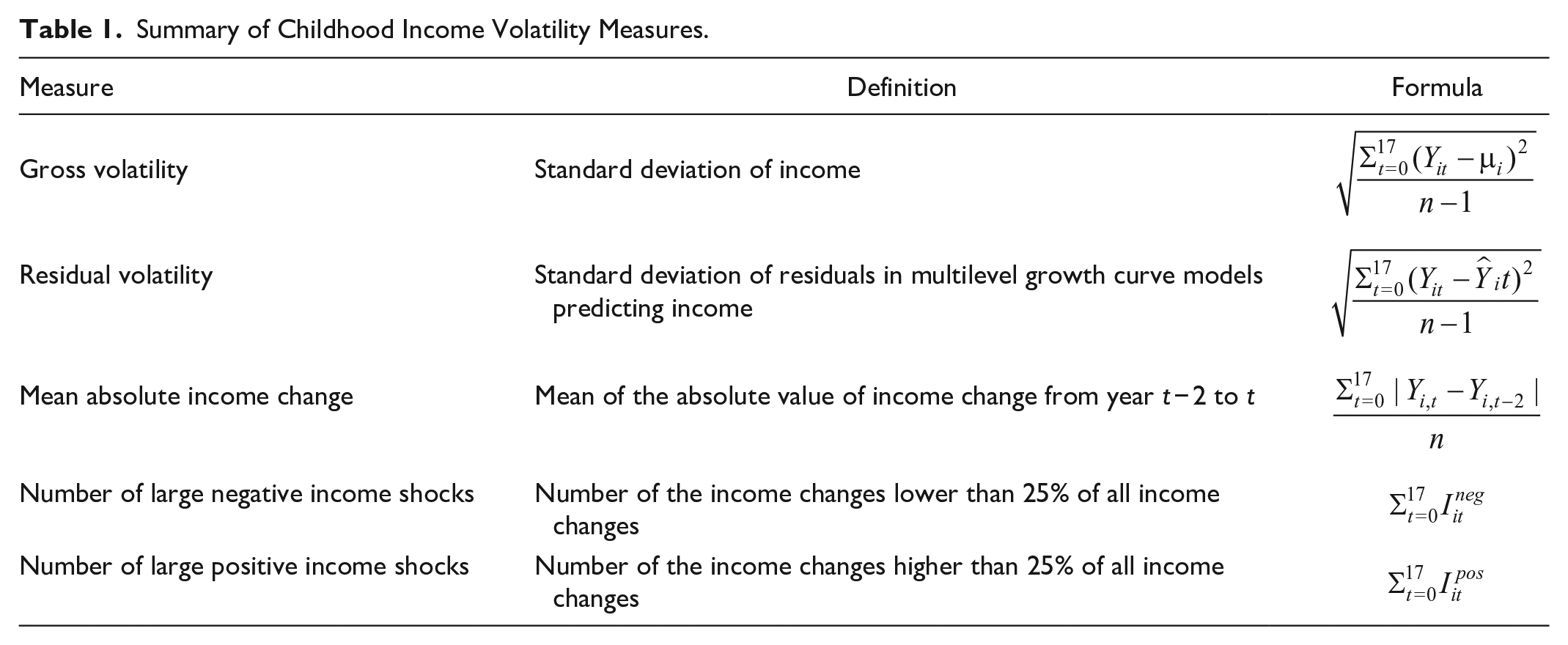
We measure income volatility in five ways. The first is “gross volatility,” which is calculated as the sample standard deviation of the K points of observed total household income (inflation adjusted) from a child’s birth to age 17; that is,

The second measure is residual volatility, which is obtained from estimating the following multilevel growth curve model:

Here,

The third measure is the mean of the absolute value of income change from year t − 2 to t. We use two-year instead of one-year income change to be consistent before and after the PSID switched from annual to biennial interviews in 1997. This measure can be expressed as

While these three measures all focus on the magnitude of fluctuations in income, the next two measures differentiate income changes in positive and negative directions. The fourth measures is the number of large negative income shocks a child experienced during childhood. To construct this measure, we first calculate the change in log income from year t − 2 to t for all children. Then, we rank these income changes for all the children across all waves. Income changes in the bottom ranks are large negative changes and those in the top ranks are large positive changes. If a income change falls in the bottom 25 percent, then we define it as a large negative income shock. Similarly, the fifth measure is the number of large positive income shocks, defined as income changes greater than 25 percent of all income changes. Using

Table 1 summarizes the five measures used in the analysis. To examine the cohort trends in childhood family income volatility, we construct three-year cohorts from those born in 1970 to those born in 1993. We cap the latest birth year at 1993 because the PSID started switching from annual to biannual interviews after 1997 and those who were born in later years lack sufficient sample size. We weigh each child by his or her sample weight in the first wave that she appeared in the PSID survey. Results are robust if we do not apply the weights. Table A1 in the Appendix reports the age-specific sample sizes by cohort, Table A2 reports the mean and standard deviation of log family income by age, and Figure A1 demonstrates the mean and 95 percent confidence intervals of log family income by childhood age for each birth cohort.
Summary of Childhood Income Volatility Measures.
In addition to the cohort-average level of childhood income volatility, we also examine how the cohort trends in both gross volatility and residual volatility vary by childhood experience of two types of family structure: two headed versus single headed. We measure family structure in several ways: (1) ever experienced a nonmarital parent, (2) percentage of childhood years living in a family with a married head, (3) head’s marital status at age 1, and (4) head’s marital status at age 14.
Empirical Results
Cohort Trends in Childhood Family Income Volatility
Figure 1 shows the overall cohort trends in childhood family income volatility in five measures described earlier. From those born in 1970 to those born in 1990, the level of childhood income volatility has increased remarkably over time, except for a dip among those born around 1985. From children born in the 1970s to those born in the early 1990s, childhood experience of gross family income volatility increased by about 50 percent, and residual income volatility increased by about 30 percent. Mean absolute two-year change in income also exhibits a similar cohort trend. When we focus on large positive and negative income shocks, both measures exhibit an upward trend since the 1980 cohort. The increase in large positive income shocks started to increase from the late 1970s cohort to the mid-1980s cohort, and remained relatively stable afterward; the increase in large negative shocks took off later, starting from those born in the mid-1980s, and kept increasing afterward. Overall, these findings suggest that regardless of how we measure income volatility, American children have been living in households with an increasing degree of economic volatility during their childhood.

Cohort trends in childhood family income volatility using different measures.
Family Structure and Family Income Volatility
We next examine how childhood family income volatility varies by family structure. Because the results are similar for different measures, we focus here on results for gross volatility, residual volatility, and mean absolute two-year change. Figure 2 presents the differential trends in childhood family income volatility for two-headed and single-headed families. Here, experience of single-headed families is defined as experiencing any period in which the household head is unmarried between birth and age 17. Consistent with previous studies (DiPrete 2002; Western et al. 2016), household instability stands out as an important source of income volatility. The figure shows that children who have ever had an unmarried parent experience a higher level of family income volatility than those who spent their entire childhood in an two-headed family, and this gap persists up to those born in the mid 1980s. Afterward, the two trajectories diverged substantially, with volatility declining moderately for those who grew up in two-headed families but rising steadily among those who experienced single-headed family structure. This suggests that the overall cohort increase of childhood income volatility is driven primarily by children experiencing single-headed family structure.
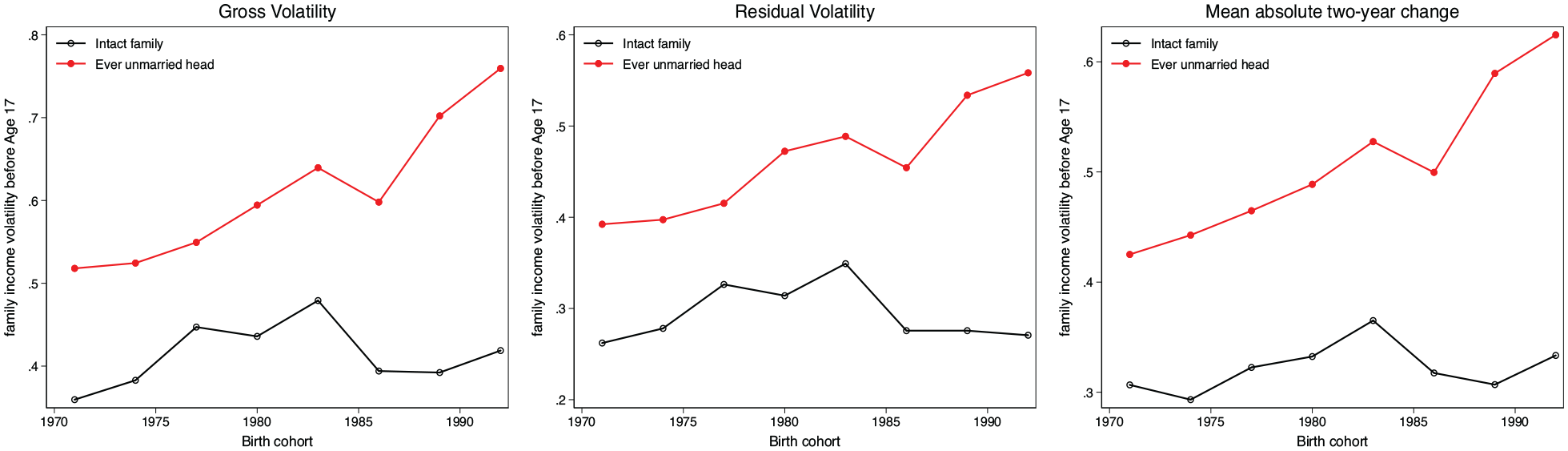
Cohort trends in childhood family income volatility by family structure.
It should be noted, however, that this growth in childhood income volatility happened in the context of an important composition change, that is, the growing prevalence of single-headed families. Figure 3 shows this trend: during the same period, more children were spending part of their childhood in a single-headed family structure. Given that children from single-headed families experience a greater level of income volatility (as shown earlier), this composition change in itself can lead to an increase of overall childhood income volatility, even in the absence of any growth in income volatility within each family structure type.

Cohort trends in childhood experience of head’s marital status using different measures.
Therefore, we conduct a decomposition analysis that attributes the overall increase in childhood income volatility to two sources: the increasing incidence of single-headed family experiences over time (composition change) and the growth in income volatility among those growing up in single-headed families (volatility change). To assess the extent to which these two sources account for the overall cohort trends, we simulate two hypothetical trends under two different scenarios. The first scenario assumes that the proportion of single-headed family has not changed since the cohort born in 1971 (the earliest cohort in our sample), and the second assumes that the income volatility level within different family structures has stayed constant since the 1971 cohort. The difference between the observed trend and the counterfactual trend under the first assumption indicates the extent to which the increasing cohort trends in income volatility is attributable to the growing prevalence of single-headed family structure, and the difference between the counterfactual trend under the second assumption and the first indicates the extent to which the increase income volatility for children across cohorts is attributable to the rise in economic insecurity among children who grew up in single-headed families.
Figure 4 shows the observed and hypothetical trajectories of different measures of family income volatility. 2 Here, the observed cohort trend of volatility for cohort c is written as

where π1c is the share of children ever experiencing a nonmarital household head in cohort c, and V1c and V2c represent the average level of household income volatility experienced by children in cohort c who have ever and never experienced a nonmarital household head, respectively. The blue dashed line shows the counterfactual cohort trend where we fix π1c at its value for the 1971 baseline cohort, and the red dash-dotted line shows the counterfactual cohort trend where we fix both π1c and V1c at their respective values for the 1971 baseline cohort. As the figure shows, both factors explain a portion of the observed growth in childhood family income volatility, but the growth in income volatility within the single-headed family group accounts for a greater share of the increase of family income volatility than the composition change does.

Observed and simulated cohort trends in childhood family income volatility using different measures.
Table 2 presents the numerical results on the estimated effects of composition change and volatility change on cohort trends in childhood family income volatility. The columns under “Simulation Condition” indicates the percentage of observed increase in income volatility—measured as gross volatility, residual volatility, and mean absolute income change, respectively—that remains after holding composition or volatility at the level of the 1971 cohort. The columns under “Effect” indicates the proportion of observed growth of income volatility explained by composition and volatility changes. The numeric results are quite similar across three income volatility measures. Composition change accounts for approximately 20 percent to 30 percent of the total increase in volatility, and volatility change accounts for approximately 61 percent to 65 percent. Taken together, these findings suggest that a predominant proportion of the cohort increase in childhood family income volatility is attributable to the increase of income volatility among single-headed families, and about one third of this association is driven by the growing prevalence of single-headed families. If there had not been any changes in the proportion and income volatility of single-headed families, the level of residual family income volatility experienced by children born in 1992 would have been almost the same as its level for children born in 1971. 3
Effects of Composition Change and Volatility Change on Trends in Childhood Family Income Volatility.

Note: The observed cohort trend of volatility for cohort c is written as Vc = π1cV1c + (1 − π1c)V2c, where π1c is the share of children ever experienced a nonmarital household head in cohort c, and V1c and V2c are the average level of household income volatility experienced by children in cohort c who have ever and never experienced a nonmarital household head, respectively. Column “Fixed π” refers to the counterfactual case where we fix π1c at its value for the 1971 baseline cohort, and “Fixed π and V” refers to the counterfactual case where we fix both π1c and V1c at their respective values for the 1971 baseline cohort. The share of children ever experiencing single parenthood is 36.01 percent and 45.44 percent for the 1971 and 1992 cohorts, respectively.
Variation by Race
We next examine the racial differences in the trends and sources of childhood family income volatility. In theory, the childhood experience of White and Black children may differ in two aspects. First, they may differ in their experience of the incidence of single-headed family structure. Figure 5 shows the race-specific cohort trends in childhood experience of single-headed family structure, using two measures of childhood family structure: the percentage living with an unmarried head and the percentage of living with an unmarried household head at age 1. By both measures, Black children have a higher likelihood of experiencing single-headed family structure. Moreover, both measures suggest that a growing percentage of Black children have lived in single-headed family structure, while the percentage among White children remains stable. 4
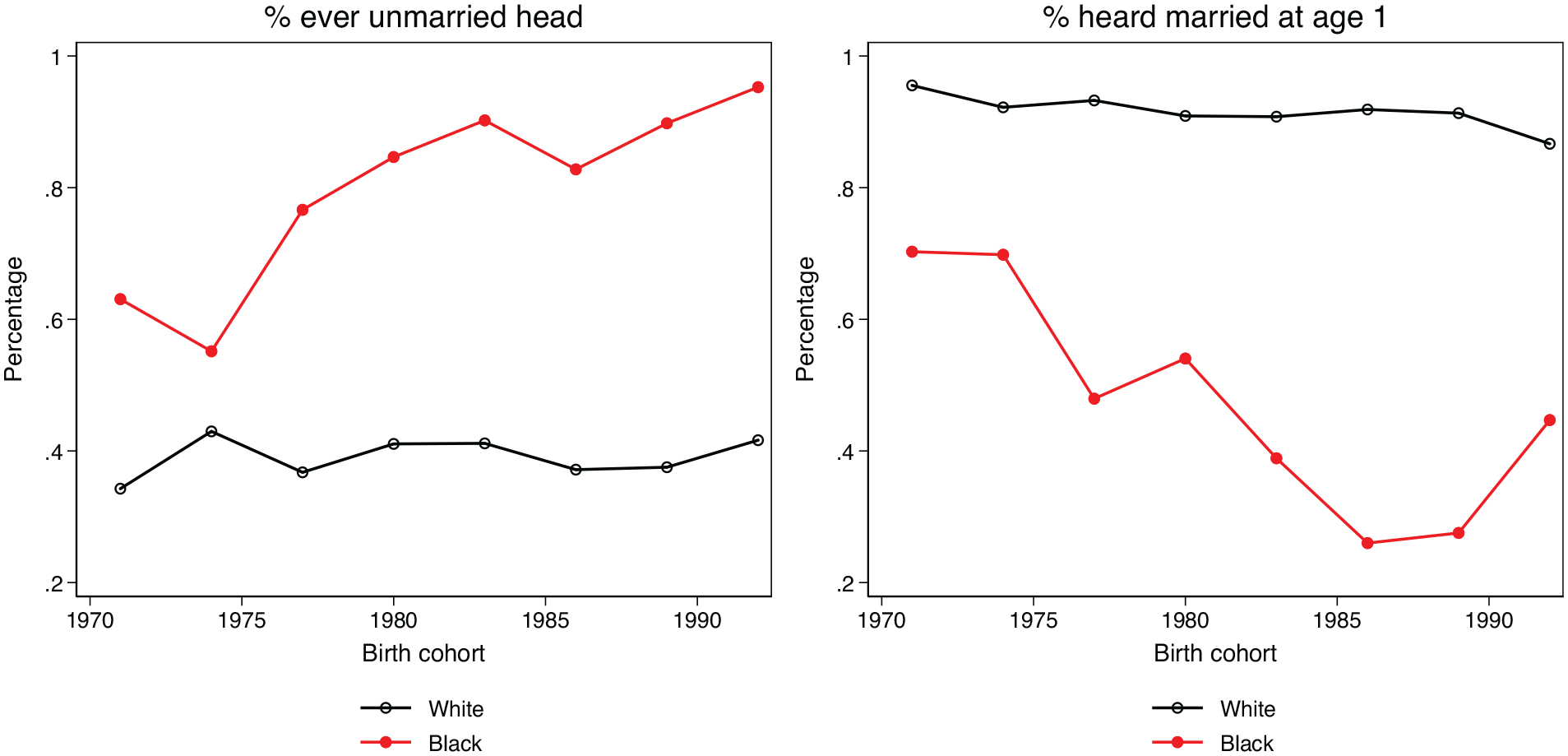
Cohort trends in childhood experience of single-headed family structure by race.
Second, it is also possible that Black and White children in two-headed and single-headed families experienced different levels and trends of family income volatility. This, however, is not supported with data. As Figure 6 shows, both White and Black children in single-headed families experienced a similar increase of income volatility by family structure, with the trends appearing less smooth for Black families as a result of their smaller sample size. Childhood income volatility among children growing up in two-headed families remained relatively unchanged over time, exhibiting a moderate increase in the 1980s but returning to earlier levels thereafter. But on the whole, the level of childhood family income volatility and the upward trend is greater among Black children than among White children (see Figure B3), because a greater share of Black children grew up in single-headed families.

Cohort trends in childhood family income volatility by race.
Do composition change and volatility change affect the cohort trend in childhood family income volatility among White and Black children in different ways? Figure 7 shows the observed and simulated cohort trends using the decomposition methods described earlier, and Table 3 presents the numeric results, which suggest a clear racial difference: for White children, the majority (approximately 70 percent) of the cohort increase in family income volatility is attributable to volatility change, that is, the growth of volatility among single-headed families. For Black children, the majority (approximately 85 percent) of the cohort increase in family income volatility is attributable to the fact that more Black children have lived in single-headed families today than in the past.

Observed and simulated cohort trends in childhood family income volatility by race.
Effects of Composition Change and Volatility Change on Trends in Childhood Family Income Volatility by Race.

Note: The observed cohort trend of volatility for cohort c is written as Vc = π1cV1c + (1 − π1c)V2c, where π1c is the share of children ever experienced a nonmarital household head in cohort c, and V1c and V2c are the average level of household income volatility experienced by children in cohort c who have ever and never experienced a nonmarital household head, respectively. Column “Fixed π” refers to the counterfactual case where we fix π1c at its value for the 1971 baseline cohort, and “Fixed π and V” refers to the counterfactual case where we fix both π1c and V1c at their respective values for the 1971 baseline cohort.
Conclusion and Discussion
An important line of research has established that socioeconomic inequality exists not just in the average economic standing of individuals and families, but also in the extent of volatility in economic standings from time to time (Duncan et al. 1984; Western et al. 2016). Volatility in economic status introduces uncertainty and instability into the family life, and has been shown to have negative intergenerational consequences that shape the lives of children when they grow up (Gennetian et al. 2015; Hardy and Ziliak 2014; Hill et al. 2013). In recent years, a sizable body of literature has documented the growing economic volatility in the labor market, making it a particularly pressing issue as to whether the economy-wide rise of economic insecurity has affected the living conditions of children. Yet current scholarship on children’s experience of family income volatility remains inadequate, with most of the literature to date focusing almost exclusively on period trends and lacking understanding of the differential experiences of volatility across cohorts. To fill this gap, we take advantage of the 50 years of longitudinal data from the PSID to examine the cohort trends in childhood family income volatility in the United States, their association with changing family structure, and the racial differences in these patterns.
The empirical analysis yielded several noteworthy findings. First, childhood experience of income volatility increased significantly since the cohorts in the 1970s, and the increase is most pronounced among children from single-headed families. The growing prevalence of single-headed family types and the growing income volatility among children growing up in single-headed families have both contributed to the growth of childhood income volatility across cohorts, with the latter accounting for a greater proportion of the overall increase. These findings suggest that the rising precariousness in the society has substantially affected the economic environment and life chances of children in the United States, particularly those living in single-headed family environments.
The rise of childhood family income volatility also has far-reaching implications for the production and reproduction of socioeconomic inequality within and across generations. A large body of prior work in both academia and policy fields has focused on improving the level of economic resources to children, and our findings call attention to the volatility of economic standing as another dimension of economic well-being that has become more important for children today. Given the growing volume of empirical evidence on the negative consequence of childhood family income volatility on individual educational and labor market outcomes that reach far into adulthood (Cheng et al. 2020; Gennetian et al. 2015, 2018; Hardy 2014; Hill et al. 2013; Yeung et al. 2002), current scholarship has begun to recognize childhood income volatility as a key link in the intergenerational transmission of socioeconomic (dis)advantage and social mobility. We join this emerging literature to highlight the need for policies and programs that address the potential long-term negative impact on children of growing up in high-volatility families and increase support for families most vulnerable to the growth of income instability.
Our results also revealed substantial racial differences in the sources of rising childhood income volatility. Although the growth of childhood income volatility for Black children is driven primarily by the growing prevalence of single-headed families, the growth of income volatility for White children is attributable mainly to the rise in income volatility among single-headed families. These racial differences stress the need for future research to examine disparities in income instability in the broader context of structural racism that created racial disparities in family formation, economic prospects, and life chances between Black and White families. Policies that aim to improve economic stability among Black children should pay attention to not just the observed patterns of racial disparities in childhood family income instability but also the underlying mechanisms that produce and sustain these racial differences.
Supplemental Material
sj-docx-1-srd-10.1177_23780231231182515 – Supplemental material for Family Structure and Cohort Trends in Childhood Family Income Volatility
Supplemental material, sj-docx-1-srd-10.1177_23780231231182515 for Family Structure and Cohort Trends in Childhood Family Income Volatility by Airan Liu and Siwei Cheng in Socius
Footnotes

Supplemental Material
Supplemental material for this article is available online.
Notes
Author Biographies
References
Supplementary Material
Please find the following supplemental material available below.
For Open Access articles published under a Creative Commons License, all supplemental material carries the same license as the article it is associated with.
For non-Open Access articles published, all supplemental material carries a non-exclusive license, and permission requests for re-use of supplemental material or any part of supplemental material shall be sent directly to the copyright owner as specified in the copyright notice associated with the article.
