




Abstract
Prominent, multidisciplinary perspectives on inequality in America contend that receiving a four-year college degree matters not just for life chances but also for achieving a sense of dignity or respect from others. In this study, the authors assess subjective dignity, or dignity as perceived in one’s own life, according to four-year college degree status and how it overlaps with different economic and psychosocial college-linked resources. Drawing on multiple years of national Gallup survey data (2017 and 2021), the authors find a college gap in subjective dignity as large as the difference linked to full-time work itself. Consistent with Lamont’s perspective on America’s dignity crisis, a lack of perceived socioeconomic standing in society most strongly coincides with why those without a college degree also perceive a lack of dignity within their lives, although finances, work, perceived control, and mattering to others all significantly coincide with the college dignity gap as well.
In an era of widely acknowledged social inequality, and burgeoning movements toward equity and social justice, many social scientists have turned toward a finer understanding of engines of inequality. Among these generative discussions, a college degree figures prominently (Hout 2012; Voss, Hout, and George 2022). Case and Deaton’s (2015) epidemiological report on midlife mortality in America (see also Masters, Tilstra, and Simon 2018) substantiates their account of American capitalism and how it isolates, stigmatizes, and disadvantages workers without college educations (see also Gaydosh et al. 2019; Gutin et al. 2023). Case and Deaton’s argument echoes well-trodden insights about the bifurcation of the economy along “good jobs” with salary, flexibility, and security going disproportionately to college graduates and “bad jobs” marked by hourly pay, inflexibility, and precarity going disproportionately to those without a four-year college degree (Kalleberg 2009, 2018; Schneider and Harknett 2019).
Meanwhile, sociologists have long documented economic and psychosocial pathways by which a college education links to improved life chances and well-being (Hout 2012; Lawrence 2017; Ross and Wu 1995). Economically, college provides individuals with greater lifetime income, buffering against severe financial hardship, and greater probability of working full-time and in professional or managerial occupations (Hout 2012; Mirowsky and Ross 2003). Psychosocially, college graduates perceive greater control and autonomy over their lives and in the workplace (Mirowsky 2011; Mirowsky and Ross 2003, 2007), and they enjoy more extensive connectedness and by some measures an enhanced sense of social support (Andersson 2018; Turner, Turner, and Hale 2014), both of which could help explain their greater sense of trust of people in general (Glanville, Andersson, and Paxton 2013; Putnam 2007), and all of which are salutary processes for building greater well-being. These economic and psychosocial resource benefits persist even as college adds to credentialism, social closure, and stagnating occupational returns in an era of “college for all” (Collins 1979; Horowitz 2018; Weeden 2002).
In this study, we draw on multiple years of national survey data collected recently by the Gallup Organization to document differences in perceived or subjective dignity by college degree status. Given the situational and agentic nature of dignity, we ask whether subjective dignity in fact aligns with structural realities of social and economic inequality attached to college in America. If so, this could provide further evidence for a moralized internalization of hierarchy along the college axis, and by extension an embodiment of social inequalities based in social stress or eroded agency or self-worth (Hitlin and Andersson 2023; Hitlin and Johnson 2015; Pearlin and Bierman 2013). In the following, we begin by outlining an intentionally agnostic, subjective approach to conceptualizing and measuring dignity. Then, we outline the specific paths by which a college education links to multifaceted resources, to provide a framework for explaining a potential college dignity divide.
Background
Lamont’s (2019) programmatic research into the multifaceted social origins of dignity (e.g., Lamont 2000, 2018; Lamont et al. 2016) identifies “the current crisis of American society” built in self-instrumentalization inherent to neoliberalism (Cech 2021; Williams, Blair-Loy, and Berdahl 2013) as well as systemic discrimination and stigmatization, and lack of economic resources, among classed and racialized minorities. Her argument about America’s obsession with “having” instead of “being”—hierarchy instead of heterarchy, market worth instead of a pluralism of worth—makes the key claim that indignity exists across the socioeconomic spectrum. Vitally, however, even as dignity declines across social classes because of the weathering forces of American capitalism, dignity’s felt shape still hinges fundamentally on whether one is a college graduate: “college-educated professionals [are] . . . the alleged economic winner(s) of this growing inequality” (Lamont 2019:663).
However, dignity itself has yet to be quantitatively operationalized in a way that would help substantiate economic and sociological theses about the pivotal role of a college degree to moral worth in America today. If dignity is thought to be a universal right or social endowment, then its distribution might be more problematic than is often acknowledged. Over the centuries, dignity has served as a conceptual touchstone of human rights law and moral philosophy (Hodgkiss 2018; Rosen 2012). Recently, sociologists have incorporated the dignity concept to articulate how workers navigate and preserve their social humanity amid conditions that are unfair, discriminatory, or abusive (e.g., Hodson 2001; Lamont 2000; Roscigno, Yavorsky, and Quadlin 2021). Whereas intrinsic dignity is “a prerequisite of social interaction itself,” attributed dignity is a “negotiated outcome of social interaction” (Callero 2014). Thus, dignity paradoxically is both given and fragile; intangible and practical; inherent and actualized. As Lamont (2012, 2019) and Ridgeway (2019) contend, status and hierarchy perpetuate the devaluations of individuals both morally and in practice, perhaps making the social giving and taking of dignity just as important as its supposed intrinsic nature.
In determining how dignity varies, scholars have proposed differing definitions of the concept—and structural, workplace, or organizational measures that suit these definitions (e.g., Crowley 2013; Hodson and Roscigno 2004; Jacobson 2007). To define dignity in the context of employment, for example, Lamont (2000) cited Hodson’s work: “having autonomy for defining one’s identity and protecting oneself from abuse.” Roscigno et al. (2021) stated, “Consensus, in fact, has begun to emerge that dignity is a multidimensional construct . . . and one that fundamentally rests on respect and recognition” (p. 567). Lamont (2018) likewise has drawn attention to how lower status groups in society develop ways of gleaning some measure of recognition and worth despite their more frequent exposure to social and labor adversities. Despite coping efforts, some of which involve drawing moral boundaries against more resourced groups, society’s hierarchy perpetuates what Lamont calls “recognition gaps” according to social categories such as gender, race, class, or age, for example. Dignity is thought to be interactional and dynamic, reflecting an exertion of agency, poise, resource mobilization, and boundary maintenance in the face of structural or cultural marginalization (Anderson and Snow 2001; Crowley 2013, 2014; Lamont et al. 2016; Oeur 2016).
Definitional complexities surrounding dignity suggest the value of considering a new measurement option. Rather than solely pondering after what dignity “really” is, we might also focus on how dignity is evaluated by individuals. Pugh (2012) asked, “what if we thought about dignity instead as a social construct, something that refers to our capacity to stand as fully recognized participants in our social world, that derives its very meaning from its social context?” (p. 30). Although structural conditions enable and constrain the experience of dignity, there are not bound to be any universal or objective definitions, given how individual and worker agency can be constructed in ways either aligned with or opposed to sources of structural oppression in situated contexts (Emirbayer and Mische 1998).
Indeed, other research has made use of domain-focused, subjective appraisals of respect or fairness (Roscigno et al. 2021), suggesting that perceptions of dignity may also hold value. Objective conditions of worker alienation are analytically separable from subjective meaning-making within those conditions which serves as a basis of boundary work (Lamont 2000; Lamont et al. 2016). Thus, perceptions of dignity are separable from structural indignities, because of variation in situationally constructed identities. In fact, existing scholarship places an emphasis on worker agency, protest, and boundary work—amid discrimination, stigma, or disrespect—in managing a sense of dignity in one’s own life (e.g., Crowley 2014; Hodson and Roscigno 2004; Lamont 2000; Oeur 2016; Roscigno et al. 2021; Sayer 2007).
Crucially, this implies that subjective dignity varies even when structural dignity does not, but to test this we need a form of direct measurement. That is, these treatments do not inquire after whether and how much dignity individuals perceive, whether because of or despite their structural locations. Given the lived complexities of individual perception and worker consciousness, subjective and objective realities hardly align perfectly, which is a foundational premise of the sociological imagination, reflected appraisals, false consciousness, and other conceptual (dis)junctures between the self and its social structures as highlighted by C. Wright Mills, George Herbert Mead, Karl Marx, and others over the decades. In Democracy in America, Alexis de Tocqueville wrote that “true dignity in manners consists in always taking one’s proper station, neither too high nor too low,” which seems to imply that dignity reflects some degree of internalization of hierarchy, even as individuals dispute or resist hierarchy in various situations (Debes 2017; Hitlin and Andersson 2015; Hodson 2001; Lamont 2000; Ridgeway 2019).
Recently, Marmot (2004) asked, “if we cannot measure it [dignity], how will we know we are achieving it?” Marmot suggests that definitional stalemates about dignity across discourse communities have stalled the development of needed empirics on dignity. Given dignity’s eminence as a term in academic, intellectual and popular discourse, dignity arguably is an element of public culture (Lizardo 2017) in ways similar to the concepts of “happiness” and “meaning in life,” meriting its direct measurement as a term and allowing flexibility in how individuals might relate to the term from where they are located socially and personally, perhaps not dissimilarly to how individuals might mobilize or relate to vocabularies of love or connection to make sense of situations and their lives more generally (Bellah et al. 1985; Swidler 2001). More pertinent to respect and recognition, measures of perceived discrimination also have usefully focused on the actor’s view instead of the observer’s (Major, Dovidio, and Link 2018; Monk 2021), from the standpoint of understanding patterns of subjective and physiological distress and thereby understanding long-term physical health outcomes such as hypertension, disease, and death.
Dignity, as a concept, must ultimately be interpreted by individuals if it is to have broader value for society, beyond academic or presupposed definitions of dignity. Like morality itself, dignity has a plurality of definitions or conceptions that are considerably situation dependent (Hitlin and Vaisey 2013; Lamont et al. 2016). However—and crucially, for the approach to dignity we take here—this situationism would not preclude the value of subjective assessments cutting across situations. Mastery or a sense of control, which is enabled structurally by autonomous work and social arrangements (Mirowsky 2011), is one of the most measured psychological resources (Mirowsky and Ross 2007; Pearlin and Bierman 2013), reflecting one’s general appraisals of control or ability across diverse situations. What makes one feel empowered in one situation is not the same as in another, and yet individuals are asked, usefully, by surveys to rate their overall sense of control across the various problems they are confronting in their lives. We take the same generalized approach to subjective dignity.
College as a Cornerstone: Economic and Psychosocial Resources for Life Chances
College attainment is linked to multifaceted gains in life resources that promote well-being (Andersson 2018; Hout 2012; Kalleberg 2018; Lawrence 2017; Mirowsky and Ross 2003). Economically, college provides gains in perceived, relative social status in society, linked to educational credentials, income level, and occupational or job prestige (Adler and Tan 2017; Andersson 2022; Schnittker and McLeod 2005). Psychosocially, college boosts a general sense of effectiveness or control, while also broadening and deepening social support and relationships. We argue that these economic and psychosocial pathways linked to college may, in turn, offer the opportunity to experience a sense of dignity.
Economic Resources
College boosts lifetime income through increased probability of full-time work and entrance into professional or managerial occupations, which come with higher and more consistent earnings (Hout 2012). Even at the same level of income, educated individuals are better able to avoid financial hardship, because of more secure work, improved problem solving, and greater savings, among other factors (Mirowsky and Ross 2003). Even with an emphasis on “college for all,” and with college enrollment at or near historic highs, college still provides a relative boost in socioeconomic standing, as it allows individuals not only to become more financially secure but also more well-off relative to nongraduates. Socioeconomic hierarchies within America position individuals to receive varying levels of social recognition, with widespread recognition becoming less likely and more problematic at lower socioeconomic strata (Lamont et al. 2016; Lamont 2019).
How might economic resources relate to a sense of dignity? Household income potentially enables dignity through management of poverty (Desmond and Western 2018; Sykes et al. 2015) and debt (Wherry 2016; Wherry, Seefeldt, and Alvarez 2019), and the ability to organize a life more in accordance with one’s wishes rather than strict institutional regulations surrounding cash benefits or transfers (e.g., Shaefer et al. 2020). Financial strain in particular represents a chronic threat to individual and family independence, involving demoralizing and highly stressful cycles of austerity, bill collection, and uncertainty when planning future expenses or goals (Shuey and Willson 2014). Full-time work in its own right could bring a sense of dignity given the emphasis on hard labor or wage work so essential to how Americans conceptualize merit and success (Mijs 2018; Williams et al. 2013). Finally, subjective social status involves a sense that one is well-off relative to others in America, and it is promoted by educational attainment and the income and occupational gains that it brings (Adler and Tan 2017; Andersson 2018). Americans view higher education as a source of opportunity and social mobility (McCall 2013), and they accord greater status and respect to educated individuals (Ridgeway 2019). Because status beliefs surrounding education are diffuse, they are likely to permeate many forms of social interaction among informal social ties as well as within formal organizations, where college education is linked to presumed expertise, competence, or worth (Ridgeway 2019).
Psychosocial Resources
Educational attainment enhances a sense of control over life, which is manifest as a general sense of effectiveness at solving various life problems (Mirowsky and Ross 2003). Meanwhile, educational attainment is linked to larger and more diverse personal networks (Andersson 2018) and to an enhanced sense of social support (Turner et al. 2014), which in part is facilitated by less network turnover. Relatedly, the educational marriage divide has been in place for decades and by many accounts has grown (Cherlin 2020), matched by an educational divorce divide. Finally, educated individuals are more trusting of people in general, which in part reflects their embeddedness in more diverse networks (Putnam 2007).
How might each of these psychosocial resources linked to education in turn enhance one’s dignity? Classical discussions of dignity implicate notions of autonomy or free will, under the supposition that being able to exercise one’s wishes or at least assert one’s identity amid challenging circumstances is quintessential to the experience of dignity. For instance, Immanuel Kant located dignity in the practice of morality. Contemporary perspectives on dignity locate dignity in workplace autonomy, in part as a counterbalance to managerial power, or in exercising remaining autonomy amid extreme losses of capacity, such as the dignity resulting from asserting one’s needs or wishes during serious illness or the social process of dying (Post 2022).
Other perspectives on dignity focus less on individual autonomy and more on relationality or meaningful relations with others. Following centuries of philosophical scholarship on identity and sentiment, Miller (2017) located dignity in acts of caring, whereby one comes to know oneself through mattering to and for others. In sociology, dramaturgical accounts of dignity (e.g., Goffman 1959) emphasize the postural basis of social interaction and how relationships rest in how we present ourselves to others through identity claims and subsequent acceptance of those same claims by others. As Bellah et al. (1985) suggested, “dignity only is achieved by becoming a respected member of a community knit together by mutual trust.” Similarly, Sayer (2007) positioned dignity as achieved through “a mix of independence and interdependence,” involving “recognition and trust, as well as autonomy and self-mastery.” “In dignified work relations,” in particular, “people carefully avoid taking advantage of the inherent vulnerability of the employment relationship.” 1
Beyond relationships the validate and support the self, a generalized sense that others can be trusted is linked to optimism and hope. Accounts of dignity promulgated by human development and global health scholars focus specifically on institutional facilitation of dignity, whereby individuals are not exploited or abused and become empowered to think toward the future. Trust is a projected sense of the goodwill of others, in that others are not expected to manipulate or mistreat others or to renege on their social commitments. Social-psychological research has shown that ongoing, diverse social connections are pivotal to the development of a generalized sense of trust (Glanville et al. 2013; Glanville and Paxton 2007).
Overview of the Present Study
The present study carries two main goals relevant to the characterization of dignity in America. First, we implement a measurement innovation of subjective dignity to enable a test of whether college inequality is being felt as a moral divide in society. Second, we evaluate economic and psychosocial resources within the relationship between college and dignity, to begin to understand why perceptions of dignity differ by college degree status.
Methods and Data
We draw on multiple years of national survey data collected by the Gallup Organization in 2017 and again in 2021, the Values and Beliefs of the American Public Survey. This survey offers a random sample of adults aged 18 years and older, living in all 50 U.S. states and the District of Columbia. In February 2017, Gallup randomly selected individuals to participate using an address-based sample frame, mailing 11,000 surveys with a $1 cash incentive, with reminder postcards following about two weeks later. Collection of completed interviews ended on March 21, with n = 1,501 (American Association for Public Opinion Research 1 response rate = 13.6 percent). In 2021, surveys were sent to a separate, random address-based sample frame of 11,000 households. Respondents were allowed to respond to the survey on paper or on the Web. The survey was conducted from January 27 to March 21, in English and Spanish (n = 1,248; American Association for Public Opinion Research 1 response rate = 11.3 percent).
These Gallup surveys are well suited to our study because of their distinctive, diverse set of key subjective dignity and psychosocial measures and extensive sociodemographic measures. We implement a probability weight constructed by Gallup to account for selection probability and nonresponse, including weighting to match the demographic characteristics of the U.S. adult population on the basis of the nearest year Current Population Survey (Gallup Methodology Documents, 2017 and 2021 Values and Beliefs of the American Public Surveys).
Subjective Dignity
In 2017, survey respondents were asked to rate the following items: “My dignity is not up to me,” “I have dignity as a person,” “I feel that my life lacks dignity” “People generally treat me with dignity,” and “I determine my own dignity” (α = .70). For all items, 1 = “strongly disagree,” 2 = “disagree,” 3 = “undecided/neither agree nor disagree,” 4 = “agree,” and 5 = “strongly agree” (reverse scored as necessary to denote higher levels of dignity).
We used all five items in 2017 to assess the proposed subjective dignity construct. A strength of these measures is that they allow dignity to be defined by the respondents. On the basis of the discussion, above, we can surmise what aspects of autonomy and respect serve as cultural references for these Americans, but we elide many of the definitional and philosophical arguments about what dignity “is” by letting respondents reflect cultural beliefs on the basis of their own interpretations. These items vary in the degree to which they characterize dignity as coming from within rather than without (i.e., “dignity of self” and “dignity in relation”; Jacobson 2007), so we began with an exploratory factor analysis. In 2017, principal-components exploratory factor analysis identified one factor with eigenvalue = 1.688 (factor 2 eigenvalue = 0.144). All factor loadings ranged from 0.42 to 0.71. Confirmatory factor analysis with asymptotically distribution free estimation to address response nonnormality, and free covariances among conceptually similar items, retained a one-factor solution against the observed covariance-variance matrix, χ2(2) = 1.663, p = .44, root mean square error of approximation = 0.000, confirmatory fit index = 1.000, Tucker-Lewis index = 1.008, standardized root mean square residual = 0.011.
Having established that a one-factor model was consistent with the observed data in 2017, we used the latter three items, which were the only ones available across both survey years. Latent factor scores were generated and normalized across both years using Stata 17.0. In 2017, the three-item latent score correlates highly with the five-item latent score (r = .900). 2
Four-Year College Degree
Gallup respondents were asked to report their highest level of completed education. Those who listed a “four-year bachelor’s degree from a college or university” or a higher credential are compared with those whose completed education is lower than a four-year college degree.
College-Linked Resources (Economic Resources)
Relative social status is assessed socioeconomically, by asking the respondent, “In terms of having money, education, and a good job, how do you compare to other Americans?” (0 = “worst,” 5 = “average,” 10 = “best”; similar to Adler and Tan 2017; Andersson 2022; Schnittker and McLeod 2005). Last year’s household income is midpoint imputed within broad survey question brackets (ranging from 1 = $10,000 or less to 7 = $150,000 or more). Additionally, respondents were asked, “Which of the following best describes your (your household’s) ability to get along your (its) income?” 1 = “always have money left over,” 2 = “have enough with a little extra sometimes,” 3 = “have just enough, no more,” and 4 = “can’t make ends meet.” We join the latter two categories into an indicator of financial strain. Respondents who reported working 35 or more hours during the past week are classified as full-time, while those working at least 10 hours, but fewer than 35 hours, are classified as part-time.
College-Linked Resources (Psychosocial Resources)
A perceived control scale taps perceptions such as “I can do just about anything I really set my mind to” and “I have little control over the things that happen to me” (reverse coded) (e.g., Mirowsky and Ross 2007; four items; α = .73). An index of mattering to others taps embeddedness within a community or network where one feels valued or esteemed, such as “How much do you feel people pay attention to you?” and “How much do you feel others would miss you if you went away?” (five items; α = .82; Taylor and Turner 2001). Marital status is determined by whether the respondent is currently married, and generalized trust is given by a response to the question, “How much would you say that you trust people in general?” (0 = “not at all” to 1 = “a lot”; similar to Paxton 2007).
Demographic Variables
Age is measured in years; sex is treated as binary. Race/ethnicity is treated as a series of indicators about self-identification as non-Hispanic White (reference), non-Hispanic Black, Hispanic, Asian, and American Indian or Alaska Native. To determine their geographic locale, respondents were asked, “Which of the following best describes the place you now live?” Those living a “large city” or “suburb” are contrasted with those living in a “rural area” (with “a small city or town” serving as reference). Political ideology is measured from “strong Republican” to “leaning Republican” (classified as Republican) to “leaning Democrat” to “strong Democrat” (classified as Democrat).
Analytic Strategy
To assess a college dignity divide, we implement multiple regression. Across a sequence of models, we first estimate the college dignity divide net of demographic control variables and survey year and then test different potential explanations based in multifaceted resources. Across models, we begin with economic resources, and then we proceed to psychosocial resources. Models are estimated under full information maximum likelihood to treat small amounts of missing data on resource covariates (Allison 2002) with survey poststratification weighting and linearized standard errors. Continuous variables are normalized to facilitate comparison of unit changes. Statistical significance of indirect effects is determined using the estat teffects command in Stata 17.
Results
Just over one third (34.3 percent) of the Gallup sample holds a four-year college degree. The normed subjective dignity score is based on the three-item latent variable score (M = 0.568, SD = 0.301; see Figure 1). Raw scores for these three items show that 17.5 percent of the weighted sample feels dignity threat according to at least one of the items (i.e., at least one response of “slightly disagree” or “strongly disagree”). Subjective social status was slightly above “average” (M = 5.986, SD = 2.078). Bracket-imputed household income averaged $70,300 (SD = $52,900), while 32.7 percent of the sample reported financial strain in terms of having “just enough” money or being unable to make ends meet. The percentage of full-time workers in the Gallup sample (46.8 percent) is somewhat elevated relative to the percentage observed for the combined 2017 and 2021 General Social Surveys (GSS) (43.9 percent), reflecting a somewhat lower percentage of college-educated respondents in the GSS (29.6 percent) but somewhat younger average respondent age in the GSS (M = 47.96 years; M = 49.54 years in the Gallup data). 3 Table A1 in the Appendix A presents descriptive statistics by survey year. Analytic variables do not have differing means across survey years, with the exceptions of dignity, perceived control, and mattering to others (lower in 2021 compared with 2017; p values < .05).

Five-indicator measurement model for subjective dignity latent variable.
Table 1 presents a descriptive overview of the college dignity divide, by stratifying subjective dignity and college-linked resources by four-year college degree status. As expected, subjective dignity is greater among those with a four-year degree (0.625 vs. 0.540; +15.7 percent, p < .001). All economic resources are greater among college graduates, as well (ranging from 59.0 percent greater household income and a 59.5 percent increase in full-time work to a 72.8 percent increase in subjective social status; financial strain is 51.0 percent lower among college graduates compared with those without a four-year degree; p < .001 for all). Likewise, psychosocial resources are more extensive among college graduates, including perceived control, mattering to others, marriage, and generalized trust, though these differences are not as dramatic as is observed for economic resources (p < .001 for all). Intercorrelations among economic and psychosocial college-linked resources generally are significant (see Table A2), which also is consistent with bundled gains in resources that college graduates enjoy.
Differences in College-Linked Economic and Psychosocial Resources (2017 and 2021 Gallup Surveys).
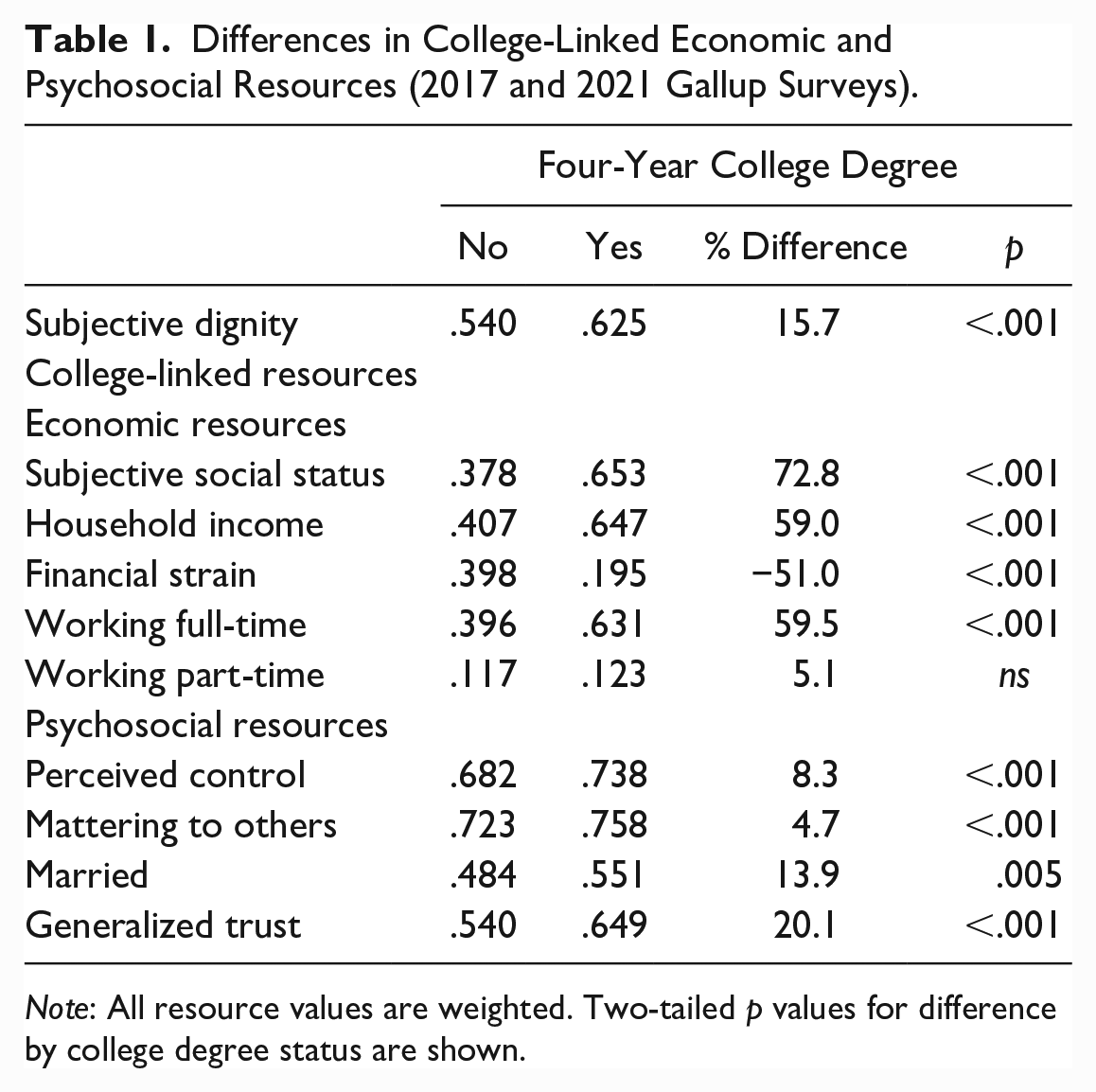
Note: All resource values are weighted. Two-tailed p values for difference by college degree status are shown.
Table 2 moves to multivariable regression approach, reporting parameter estimates from regressions of subjective dignity. All models hold demographic covariates constant (age, sex, race/ethnicity, urbanicity, political party, and survey year; coefficients not shown). Model 1 shows an adjusted college dignity divide similar in size to the raw difference estimate in Table 2 (b = 0.093, p < .001). In an alternative specification of model 1 (not shown), college degree status was interacted with survey year (2017 vs. 2021), revealing a positive but statistically insignificant coefficient (college × 2021, b = 0.040, p = .17).
Survey-Weighted Multiple Regressions of Subjective Dignity (2017 and 2021 Gallup Surveys).

Note: N = 2,749. Estimated under full information maximum likelihood with survey poststratification weighting and linearized standard errors. All continuous variables are normalized; unstandardized estimates are shown. Age, sex, race/ethnicity, urbanicity, political party, and survey year are controlled in all models (estimates not shown). Significance of indirect effects for four-year college degree was evaluated using estat teffects in Stata 17.
p < .05, **p < .01, and ***p < .001 (two tailed).
Model 2 adds subjective social status (b = 0.287, p < .001), rendering the college dignity divide statistically insignificant (b = 0.022, p > .10). The variance explained in dignity more than doubles from model 1 (R2 = .046) to model 2 (R2 = .107; +133 percent), as well. Subjective social status serves as an omnibus indicator of educational, income, and occupational standing, while also capturing a relative overall sense of socioeconomic deprivation relative to other Americans. Across its entire range of values, subjective social status is linked to a difference in dignity tantamount to about 1 standard deviation.
Taking a narrower approach to economic resources, model 3 focuses specifically on current household income (b = 0.184, p < .001) and financial strain (b = −0.060, p < .01). This model likewise produces a large gain in variance explained relative to baseline (R2 = .089; +93.5 percent) and yields the important result of financial strain mattering to dignity even above and beyond current income level. The college dignity divide remains statistically significant (b = 0.040, p < .05), although it attenuates by more than half.
Model 4 focuses solely on current work status, with full-time workers showing a distinct dignity advantage (b = 0.081, p < .001) relative to those not working and part-time workers showing no significant advantage. Here, the gain in variance explained is more modest (R2 = .058; +26.1 percent), and attenuation of the college dignity divide (b = 0.081, p < .001) is much milder relative to the other socioeconomic models.
Models 5 and 6 instead consider the psychosocial resource divide, beginning with perceived control (model 5). Perceived control (b = 0.648, p < .001) increases variance explained in subjective dignity by more than fivefold (R2 = .242; +426 percent relative to model 1), which is consistent with the primacy of autonomy or self-assertion to classical and contemporary theoretical accounts of dignity. Moreover, the predicted dignity gains from perceived control are quite large, amounting to almost two standard deviations in dignity across the entirety of the perceived control scale (i.e., from 0 to 1; perceived control SD = 0.210). Although college graduates do enjoy much greater autonomy both inside and outside the workplace, perceived control by itself is not enough to fully explain the college dignity divide, which remains statistically significant (b = 0.055, p < .001). Model 6 instead focuses on the more relational aspects of inequality relevant to college graduates and the experience of dignity. Mattering to others (b = 0.559, p < .001; range = 0–1, SD = 0.198) links strongly to dignity, while marriage shows no independent contribution (b = 0.005, ns) and generalized trust is significantly associated (b = 0.132, p < .001). This relational resource model again produces a highly notable increase in variance explained relative to baseline (4.5-fold; R2 = .207; +350 percent relative to model 1). Here again, the college dignity divide remains significant (b = 0.052, p < .001).
A final model (model 7) simultaneously adjusts all economic and psychosocial resource pathways linked to college attainment. Variance explained in dignity now reflects all of these resource pathways (R2 = .318). In this model, the estimated college dignity divide is essentially zeroed (b = 0.002, ns), while subjective social status (b = 0.105), household income (b = 0.073), perceived control (b = 0.475), mattering to others (b = 0.344), and generalized trust (b = 0.103) retain independent and significant predictive power. 4
Table 3 summarizes and ranks indirect effects for all economic and psychosocial resources. These estimates are obtained by treating each resource separately within a total effects framework, for ranking purposes. Each resource is specified as transmitting an indirect effect of four-year college degree on subjective dignity, and indirect effects are estimated using estat teffects. Subjective social status and household income each individually explain more than 50 percent of the college dignity divide, while perceived control explains slightly less than half (40.9 percent). With the exception of part-time work, all indirect effects are statistically significant at p < .05.
Ranked Summary of Indirect Effects of Four-Year College on Subjective Dignity (2017 and 2021 Gallup Surveys).

Note: Full information maximum likelihood estimates using Gallup poststratification survey weight. Effect estimates were obtained using estat teffects.
p < .05, **p < .01, and ***p < .001 (two tailed).
Discussion
College attainment is an engine of inequality in American society, in part because it provides a socioeconomic gateway to multifaceted economic and psychosocial resources across the remaining life course. However, the moral and evaluative dimensions of college remain largely overlooked by social science research, as underscored in recent discussions of America’s cultural and moral crises (Case and Deaton 2022; Gutin et al. 2023; Lamont 2019). By revealing the perceived extent of dignity or “recognition” gaps (Lamont 2018) linked to college, our study provides timely evidence for the experience of social inequality as moral and emotional inequality. Our college-linked resource models explain slightly more than 30 percent of the observed variation in subjective dignity in a national, multiyear Gallup sample. The greater subjective dignity that four-year college graduates report—about 15 percent—relative to nongraduates, is sizable in view of the other, typically examined psychosocial resource divides of perceived control and social support.
An encompassing indicator of relative socioeconomic standing, termed subjective social status, is the only resource that by itself renders the college dignity gap insignificant, by explaining more than three fourths of it. Subjective social status has gained considerable interdisciplinary attention in recent decades as a potent indicator of socioeconomic position, as it captures how individuals evaluate themselves relative to others while also streamlining and incorporating educational, financial, and occupational or job differences—and potentially also capturing omitted, valuable aspects of socioeconomic status such as wealth, neighborhood attainment, or college prestige (Adler and Tan 2017; Andersson 2022).
In line with Lamont’s (2019) argument, subjective social status also seems to speak to both the perceived and actual status-garnering character of higher education at a time of differentiated life chances by college (see also Case and Deaton 2022; Kalleberg 2009, 2018). Following this same argument, household income and financial strain also provide a substantial explanation of the college dignity divide, whereas more generic resources linked to college such as perceived control or social networks are less powerful as explanations of the college dignity gap.
Four-year college graduates enjoy clear advantages in economic and psychosocial resources relative to nongraduates, and intercorrelations among economic and psychosocial resources speak to the bundling of these resources, as well. Other than part-time work, all resource pathways both individually and collectively serve to explain the college dignity gap, with subjective social status, household income, perceived control, generalized trust, mattering to others, financial strain, and full-time work all making sizable, significant contributions.
Rather than put forth other or alternative definitions of dignity, the purpose of our research is to work within existing definitions and frameworks to understand variation in the concept. In this study, use of a subjective dignity measure as a criterion allows an opportunity to adjudicate among complementary or even competing definitions of dignity by examining the kinds and strengths of dignity-adjacent concepts. In this way, measurement of subjective dignity can offer one way of moving forward complex discussions of the concept. We contend that conceptualizing and measuring dignity subjectively is long overdue, given the major definitional issues inherent to the concept (Debes 2017; Hitlin and Andersson 2015), and in view of the ethnographic and social-theoretic research programs revealing the fundamentally group-oriented and socially constructed nature of dignity, in ways that reflect a combination of agency and structure as perceived by individuals. We should remain flexible to the possibility that observed levels of dignity reflect objective social conditions, subjective interpretations of these same conditions; and/or socially constructed, possibly dynamic understandings of what dignity or its determinants signify (Emirbayer and Mische 1998).
Our subjective, latent variable approach to dignity parallels other prominent research programs in the social sciences. For instance, self-rated health and subjective social status are two other measures in the population health sciences that have become widely used and cited in part because they defer to subjectivity one way of incorporating or absorbing the immense complexities involved in the measurement of physical health status and socioeconomic status, respectively (Adler and Tan 2017; Andersson 2022; Idler and Benyamini 1997; Jylhä 2009). Agency and despair, two other concepts with currency among social scientists, have moved forward by using latent variable approaches to model what is unobserved within and across particular assumed indicators (Gutin et al. 2023; Hitlin and Elder 2007). We incorporate a single-factor measurement model latent variable approach to subjective dignity here, as a starting point for other measurement approaches to be discussed, debated, and refined in future research.
Future research will need to better distinguish among subjective experiences of autonomy, respect, discrimination, and dignity. Likewise, a more comprehensive analysis of structural variables could continue to disentangle the subjective experience of dignity from the structural conditions supporting it. The Gallup data are cross-sectional, precluding the establishment of how dignity and its determinants are related across time. Here, we are focusing simply on which economic and psychosocial factors coincide with the observed college-dignity link in a national sample. However, by many theoretical accounts, dignity itself is susceptible to within-person change, and an explanation of these changes in dignity could offer a closer explanation of its social determinants. In addition to longitudinal data, life-course data also would provide additional insight, as college education and adult life chances are mutually determined by family socioeconomic origins, raising the possibility that these college-linked disparities are partly rooted earlier in the life course (Andersson 2018; Voss et al. 2022), including a potential basis of trust in early-life social relationships even as ongoing relationships remain important to trust (Glanville et al. 2013).
Although senses of control and mattering to others together are linked to a sense of dignity, reverse causality is certainly possible. However, because dignity is a holistic, subjective assessment, whereas perceived control and mattering to others reflect specific beliefs about personal efficacy and dynamics of social relationships, we believe it is more plausible that they would influence dignity rather than vice versa. Psychosocial resources experienced by persons have complex, interactive properties when it comes to determining mental well-being, even at one point in time (Longest and Thoits 2012; Smith 2010).
Another needed direction for future research is the intersectional examination of dignity returns to college. Just as college economic and health returns are gendered and racialized (e.g., Williams, Lawrence, and Davis 2019), so too might be the dignity returns to college. For instance, the gendered implications of “opting out” suggest dignity could rest on career ambitions, household dynamics, or gender beliefs that both reflect and defy “separate spheres” stratification (Cha 2010). Meanwhile, individuals still in school and those who are retired likely fall outside the scope of the “ideal” or hard worker (Mijs 2018; Williams et al. 2013). In terms of race and ethnicity, economic and psychosocial returns to college often are lower among minoritized groups (Williams et al. 2019), and these resources in turn may bear differing associations with subjective dignity across groups. Relatedly, age and cohort examinations of college dignity variation would be useful as a way of explication potential mechanisms at work, in view of college expansion (Horowitz 2018) and cohort-specific educational patterns of despair (Gaydosh et al. 2019; Gutin et al. 2023) and mortality (Masters, Link, and Phelan 2015).
Our measurement of work in this study is quite limited, not capturing occupational, workplace, or organizational dynamics so essential to the conceptualization and measurement of dignity in stratification research (e.g., Crowley et al. 2013; Hodson 2001; Lamont 2000; Roscigno et al. 2021). Mirowsky (2011) memorably traced a philosophical and sociological history of work, suggesting that educational attainment is fundamentally entwined with autonomy, creativity, and employment, and that all three might shape worker consciousness. Although much of the college dignity divide disappears once material realities (e.g., income) are accounted for, the college dignity divide may also rest in workplace or organizational experiences. For instance, although perceived control as assessed here did not fully attenuate college dignity divide, this could be because we did not assess job autonomy and creativity in this study (Mirowsky 2011). Previous research into worker dignity suggests a fundamental divide between managerial and worker roles (Crowley 2013, 2014; Hodson 2001), and in industrialized societies college graduates are disproportionately represented among the professional and managerial classes. Yet occupational returns to college have been diminishing (Horowitz 2018), and levels of workplace autonomy and creativity differ considerably within and between educational levels (Mirowsky 2011).
Although we did not find that the college dignity divide grew significantly in size across the pandemic (i.e., from 2017 to 2021), this does not rule out the possibility that routes to dignity have shifted within and across educational levels in recent years. More broadly, the coronavirus disease 2019 pandemic has altered the multifaceted economic and psychosocial pathways which connect a college degree to life chances. Work flexibility has allowed college-educated workers to maintain their positions, as lower educated workers endure greater rates of job loss or unstable work (Daly, Buckman, and Seitelman 2020; Kalleberg 2018). Meanwhile, geographic areas with lower densities of college graduates have seen greater susceptibility to pandemic-related infections and mortality, because of spatial, occupational, and behavioral exposures and mechanisms (Anderson, Lopez, and Simburger 2021; Case and Deaton 2022). Meanwhile, just as before the pandemic, politics attach to place, as observed in state-level partisan voting trends (Wasfy et al. 2020), perhaps making local political polarization another mechanism by which college graduates continue to outlive nongraduates.
Support for a one-factor measurement model of subjective dignity does not preclude the possibility that multiple, distinct senses of dignity will need to be captured by future research. For instance, even within the five items we assess here, some refer to how one believes one is treated whereas others refer to how one views oneself, and a century of social psychology has demonstrated that these are separable processes when it comes to reflected appraisals and development of self and identity (e.g., Burke and Stets 2009) and the social origins and experience of dignity proper (Jacobson 2007). These five items are not meant to be exhaustive, but rather to be encompassing of multiple ways that scholars have conceptualized dignity both personally and interpersonally, and with and without regard to the exercise of autonomy for asserting one’s dignity (e.g., Hodgkiss 2018; Rosen 2012).
Overall, our subjective measurement approach is not meant to “solve” problems in the dignity literature so much as offer an additional measurement option that might reveal new ways in which dignity works or is experienced. This said, reference groups are likely to matter above and beyond general perceptions of social support, as they are pivotal to perceptions of recognition and fairness (Hegtvedt and Johnson 2000; Roscigno et al. 2021). One might feel dignified relative to one’s coworkers, relative to one’s financial compensation, both, or neither 5 ; one might possess consciousness transcending and critiquing one’s labor situation, or not (Mirowsky 2011).
Conclusion
A college dignity divide speaks to a social reality of individuals feeling and being left behind or discredited within a college-centric society (Horowitz 2018; Lamont 2019). While material deprivation contributes powerfully to this divide, the perceived relative socioeconomic standing of nongraduates is by itself sufficient to explain away the subjective dignity gap. Understood as an indicator of morally and culturally situated “social personhood” (Hitlin and Andersson 2015), dignity and the underlying social recognition it implies may be an important basis for maintaining well-being within modern societies (Goffman 1959; Lamont 2018; Lamont et al. 2016). Some correlates of subjective dignity demonstrated here, such as relative social status, autonomy, material well-being, and social integration, have well-established associations with mental and physical health. This leads to the reasonable expectation that subjective dignity is not just a moral or social concern but also a public health concern.
Footnotes
Appendix A
Survey-Weighted Intercorrelations of Economic and Psychosocial College-Linked Resources.

| 1 | 2 | 3 | 4 | 5 | 6 | 7 | 8 | 9 | |
|---|---|---|---|---|---|---|---|---|---|
| 1. Subjective social status | 1 | ||||||||
| 2,586 | |||||||||
| 2. Household income | .5630* | 1 | |||||||
| 2,476 | 2,609 | ||||||||
| 3. Financial strain | −.4445* | −.4210* | 1 | ||||||
| 2,574 | 2,587 | 2,701 | |||||||
| 4. Working full-time | .2294* | .4017* | −.1616* | 1 | |||||
| 2,586 | 2,609 | 2,701 | 2,749 | ||||||
| 5. Working part-time | −.0054 | −.0631* | .0567* | −.3401* | 1 | ||||
| 2,586 | 2,609 | 2,701 | 2,749 | 2,749 | |||||
| 6. Perceived control | .2810* | .2238* | −.2330* | .1585* | .0021 | 1 | |||
| 2,579 | 2,595 | 2,692 | 2,717 | 2,717 | 2,717 | ||||
| 7. Mattering to others | .2525* | .2178* | −.1851* | .1010* | −.0114 | .3936* | 1 | ||
| 2,570 | 2,585 | 2,684 | 2,709 | 2,709 | 2,703 | 2,709 | |||
| 8. Married | .2023* | .4315* | −.1720* | .0946* | .009 | .1638* | .2055* | 1 | |
| 2,566 | 2,590 | 2,680 | 2,711 | 2,711 | 2,694 | 2,687 | 2,711 | ||
| 9. Generalized trust | .2406* | .2028* | −.1898* | .0503 | −.0161 | .1419* | .2444* | .1446* | 1 |
| 2,542 | 2,557 | 2,647 | 2,679 | 2,679 | 2,662 | 2,654 | 2,654 | 2,679 |
Note: Pearson estimates were obtained using the corr_svy command. Sample sizes displayed beneath estimates.
p < .05 (two tailed, conservative).
Acknowledgements
We benefited from presentation feedback at the 2019 American Sociological Association meeting and the 2022 Harvard Culture and Social Analysis Workshop. Thanks also to Shai Dromi, Paul Froese, Michèle Lamont, Michael Sauder, Sam Stabler, and Laura Upenieks for their insightful comments.
