




Abstract
Governments around the world struggled to formulate an effective response to the coronavirus disease 2019 pandemic, which was hampered by the widespread diffusion of various conspiracy theories about the virus. Local governments are often responsible for the implementing mitigation measures such as mask mandates and curfews but have received very limited attention in the scholarly literature. In this article, the authors use data from local policy actors in Colorado to evaluate the relationship between conspiratorial beliefs and perceptions of mitigation policy effectiveness. The authors find that many local policy actors hold conspiratorial beliefs, which combine with partisanship to contribute to lower perceptions of policy effectiveness. The authors conclude by discussing future research directions, noting that the broad adoption of conspiracy theories likely changes enforcement at the local scale.
Governments around the world introduced measures to mitigate the spread of coronavirus disease 2019 (COVID-19) (known more colloquially as the “coronavirus”). These included mandating masks, social distancing, closing businesses or limiting their hours, and other measures. Although there is disagreement about the magnitude of their effectiveness, these efforts did reduce the spread of COVID-19 and saved lives (Goldstein, Levy Yeyati, and Sartorio 2021; Howard et al. 2021; Huang et al. 2021; Lyu and Wehby 2020; Trivedi and Das 2021).
However, there were also nontrivial criticisms and resistance to many of these measures. Some of these criticisms rested on the secondary effects of the mitigation efforts. For instance, limiting business hours (or occupancy) could significantly reduce revenues. Closing schools and transitioning to online learning is likely not as effective as in-person learning (Akpınar 2021; Armstrong-Mensah et al. 2020). Lockdowns contributed to job losses (Fazzari and Needler 2021). Social distancing likely deteriorated mental health (Kämpfen et al. 2020; Rodríguez-Fernández et al. 2021:19). Furthermore, the policy response to the pandemic likely engendered food and energy insecurity (Mayer and Ryder 2022; Pereira and Oliveira 2020). Thus, there are real and deleterious impacts of aggressive mitigation measures.
Yet in addition to these critiques, some of the resistance to COVID-19 mitigation appears to have been motivated by partisanship and conspiracy theorizing. A range of conspiracy theories emerged, and some version of these conspiracy theories was adopted by many people in the United States. These include the belief that COVID-19 was a biological weapon created by the Chinese government, that it was manufactured for the sake of population control, or that vaccines contain mind-control microchips, among many others (Douglas 2021; Miller 2020; Uscinski et al. 2020).
Belief in conspiracy theories has long been a common feature of American politics (Hofstadter 1964). Conspiratorial beliefs can have undesirable social consequences such as reducing prosocial behavior and eroding trust in experts (Jolley and Douglas 2014; Pummerer 2022; Van Prooijen, Spadaro, and Wang 2022). For instance, those who believe that climate change is a hoax are less likely to make efforts to reduce their carbon footprint (Pummerer 2022; Van der Linden 2015; Van Prooijen et al. 2022). Using an online panel for the general U.S. population, Pummerer et al. (2022) found that belief in COVID-19 conspiracy theories is associated with less support for COVID-19 mitigation. A study using Amazon Mechanical Turk data reached similar conclusions (Imhoff and Lamberty 2020).
Soon after the start of the pandemic, conservative U.S. media figures and politicians began to question the severity of COVID-19 and promulgate conspiracy theories (Bisbee and Lee 2022; Hamilton and Safford 2021; Hart, Chinn, and Soroka 2020), undoubtedly shifting attitudes among conservatives and Republicans. Existing research demonstrates that Republican party affiliation or conservative political ideology significantly reduces vaccination intentions or other efforts to address COVID-19 (Bruine de Bruin, Saw, and Goldman 2020; Callaghan et al. 2021; Kerr, Panagopoulos, and van der Linden 2021; Romer and Jamieson 2021). Yet conservatives might support some mitigation measures if they are not especially intrusive or punitive (Lyons and Fowler 2021).
In the United States, measures such as mask mandates and curfews were typically instituted by state governments and relied upon local enforcement (Karch 2020). At the substate level, counties and municipal governments also instituted a variety of policy measures (Ebrahim et al. 2020). A large literature in political science points to the role of local governments and “street-level” bureaucrats in implementing policies that are instituted or enforced at the local scale (Lee and Park 2021; Meyers and Vorsanger 2007). This work implies that local actors do not necessarily enact policies in the way envisioned by higher level policy makers and in some cases exercise a great deal of discretion. Immigration policy in an example, where municipal governments do not fully cooperate with federal authorities (Blizzard and Johnston 2020; Ridgley 2008).
A state government might institute a mask mandate, but the enforcement of this mandate occurs through the discretion of local actors. Business owners prefer for local law enforcement to enforce mask mandates, but law enforcement were often reluctant (Jacobs and Ohinmaa 2020). Thus, local policy actors used some discretion in how they enforced policies. Yet there is remarkably little direct research about local governments and COVID-19 mitigation measures. In particular, we do not know the extent of conspiratorial thinking among local policy actors, and how this may affect perceptions or actions around mitigation. Using survey data collected among local governments in Colorado, we evaluate how conspiracy theories about COVID-19 influence perceptions of the effectiveness of COVID-19 mitigation efforts.
Data, Measures, and Methods
Study Region
The present research is part of a larger project to understand the impacts of COVID-19 in the state of Colorado in the western United States. This project involved interviews with the public and policy makers, as well as a general population survey. Colorado has a large and growing economy and regularly is listed as one of the healthiest states in the United States. In 2020, during the height of the pandemic, the state government implemented a variety of measures, such as mask mandates, curfews, and closing of government offices. However, the governor also received both praise and criticism by deferring to local governments to decide on issues such as mask mandates and school closures as the pandemic wore on (Netsanet, Sempson, and Choe 2022). Thus, Colorado provides a compelling context to study perceptions of local policy actors because county and municipal governments were given such authority.
Data Collection
Sampling local governments presents several unique challenges. There are no third-party providers (e.g., Dynata, Qualtrics) that can provide low-cost and quick data. To circumvent this issue, we acquired a list of municipalities, county, and local governments from the state treasurer’s office. We collected e-mail addresses from local government Web sites to develop a sample to distribute a survey hosted on the Qualtrics platform. Roughly 2 percent of local governments—typically small, rural locations—did not provide direct e-mail addresses to local policy actors but rather used online contact forms. In these cases we submitted the survey link and a short invitation via the online contact forms. Four local governments did not provide any contact information for staff or officials, only names. We attempted to locate administrative staff members (e.g., secretaries) who might be able to provide contact information, but those efforts were not successful.
We sought to include any local policy actors that might have some role on enforcement and implementation. These included, but were not limited to, mayors and other elected boards, law enforcement, commissioners, court officials, and many others. We excluded local government employees who likely had little role in enforcement, such as groundskeepers. We acquired 3,310 total e-mail addresses. Among these, 552 e-mails were “bounced”; that is, they were marked as spam and could not reach the recipients. Another 27 were undeliverable, and 4 were duplicates (the same e-mail address was listed for multiple people). Thus, we proceeded with 2,727 valid e-mail addresses. We used seven contact attempts between July 13, 2021, and August 17, 2021, with a median completion time of 6.3 minutes. Four hundred twenty-nine policy actors began the survey, although the number of completions was lower at 202, for a completion rate of 41 percent. Nearly all (about 95 percent) of the incompletes occurred when a respondent navigated to the survey but did not answer a single question. We screened respondents for residence in Colorado, age over 18 years, and employment in local government.
Using the most conservative response rate (American Association for Public Opinion Research 1), the response rate was 7.4 percent. Although other studies of local policy actors in the region have produced similar response rates (e.g., Mayer 2018), we suspect that several factors may have coalesced to lower the response rate. For one, some of the nonresponders were likely laid off from their local government positions, as governments were facing severe fiscal challenges. They may not have felt that they were eligible to participate. Second, a few respondents mentioned that they had already filled out COVID-19 surveys, although not ones related to their roles in local government. We suspect that research fatigue or even confusion among surveys might have eroded the response rate. Finally, during this time, many local governments were operating with few in-person staff members and had moved to virtual meetings. Some digital fatigue may have occurred, wherein potential respondents simply did not want to spend extra time on their devices.
Dependent Variable: Perceived Policy Effectiveness
Following other research (e.g., Mækelæ et al. 2020), we sought to understand perceptions of the effectiveness of a variety of mitigation measures for COVID-19 (“we’d like you to think about how effective various efforts to combat the spread of COVID-19 have been”). These included curfews, stay-at-home orders, mask mandates in businesses, mask mandates in public spaces, temporarily closing nonessential businesses, temporarily closing schools, temperature and symptom checks before entering buildings, limiting social gatherings, signs encouraging sick people to stay home, signs encouraging handwashing, and vaccinations. Figure 1 show the distribution of these items. Signs, masks, vaccinations, limiting social gatherings all had more than 20 percent of respondents stating that they were “extremely effective” while business closures, school closures, symptom checks and curfews were seen as less effective. Notably, fewer than 5 percent of respondents stated that none of the mitigation efforts were not effective.
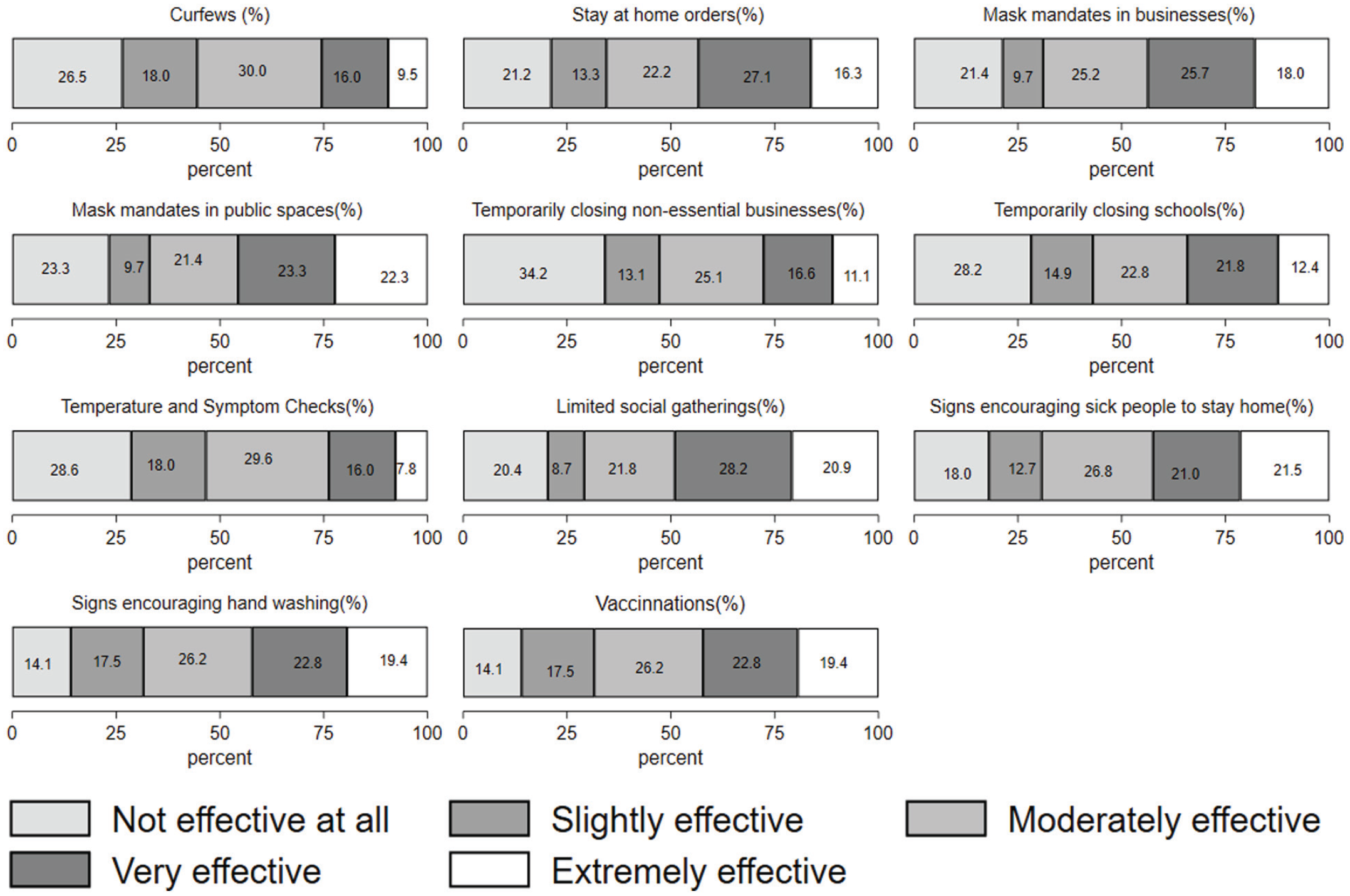
Perceptions of the effectiveness of coronavirus disease 2019 policy measures.
We next performed factor analysis on these items to understand their underlying dimensionality. To do so, we estimated a polychoric correlation matrix (a type of correlation coefficient for ordinal data) and extracted the factors using the iterated principal factors method with a varimax rotation (Holgado-Tello et al. 2010). The factor analysis (Appendix A) produced three factors that we call “general effectiveness,” “mask mandates,” and “information.
Conspiracy Theories
Borrowing from the prior literature on COVID-19 conspiracy theories, we asked the extent to which respondents agreed or disagreed with the following conspiratorial beliefs the origins about COVID-19: COVID-19 is a myth to force vaccinations, there is no such thing as COVID-19, COVID-19 was created as part of a U.S. bioweapon program, COVID-19 was created as part of a Chinese bioweapons program, Big Pharma is deliberately encouraging the spread of COVID-19 to make profits, the government could cure COVID-19 but chooses not to, and COVID-19 escaped from a laboratory. Respondents could “strongly disagree” or “strongly agree” with these items. Figure 2 implies that conspiratorial beliefs are not uncommon but certainly not prevalent among our respondents. For instance, 46.1 percent “strongly disagree” that COVID-19 was created by the Chinese government as part of a bioweapons program, and only 11.9 percent “strongly agree.” Yet 15.7 percent “strongly agree” that COVD-19 escaped from a laboratory. Furthermore, only 18 percent of the sample replied “strongly disagree” for all the conspiracy questions. We used factor analysis to determine the dimensionality of these items, again using a polychoric correlation matrix with the iterated principal factors for extraction and a varimax rotation, this analysis strongly pointed to a single-factor solution (Appendix B).

Distribution of perspectives on coronavirus disease 2019 (CV-19) conspiracy theories.
Partisanship and Control Variables
The perceived effectiveness of policies could depend upon respondent’s own experiences with mitigation policies at the local scale. We asked respondents if their local government had implemented any of the following policies: curfews, stay-at-home orders, mask mandates for government buildings, mask mandates for public places, virtual public meetings, temporarily closing facilities, temporarily closing business, and limiting social gatherings. We then created a tally of “yes” responses to use as a control in our regression models (mean = 4.78, range = 0–8).
Earlier we noted the partisan nature of resistance to COVID-19 mitigation. We asked respondents, “Politically, how do you identify?” with response categories ranging from “very conservative” to “very liberal.” Thirty-five percent of the sample identified as “very conservative” or “somewhat conservative” and 33.9 percent as “very liberal” or “somewhat liberal.” We also control for education using a seven-category variable for education that we recoded into two categories to represent those who had completed college and those who had not. We also control for respondent’s household income (1 = less than $50,000, 2 = $50,000–$99,999, 3 = $100,000 or more). Given the relatively small sample size (n = 167 in the following regressions), we opted for few control variables but provide correlations between the outcomes and other sociodemographic variables in Appendix C.
Regression Models
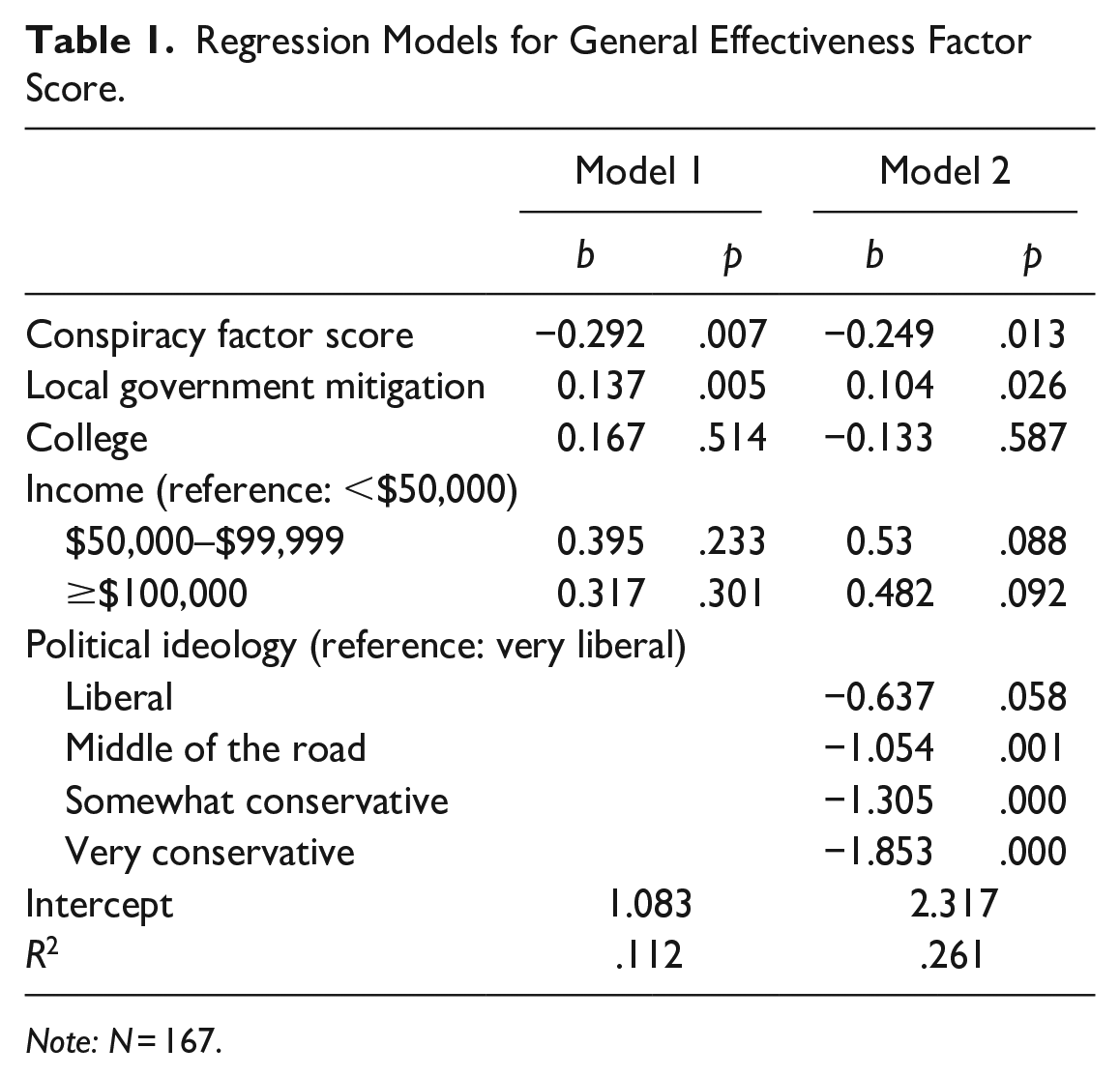
Our factor score for general effectiveness is continuous, so we turn to ordinary least squares regression to model the effects of the predictor variables on this outcome (Table 1). In the first model, we include all the variables described in the prior section except for political ideology. In model 2, we add political ideology and evaluate changes in the estimates of model 1.
Regression Models for General Effectiveness Factor Score.
Note: N = 167.
In model 1, the conspiracy factor score is statistically significant (b = −0.292, p = .007), and its effects are similar in model 2 with the inclusion of political ideology (b = −0.249, p = .013). Political ideology is significant, with “very conservative” respondents less likely to view policies as effective (b = −1.853, p = 0.000). The inclusion of political ideology has also markedly improved the R2 value from .112 to .261.
Local government mitigation efforts are associated with increased perceptions of effectiveness in both models (b = 0.104, p = .026 in both models), while income is nearly significant. But in both models, the effects of demographic factors appear to be relatively muted, a finding that is echoed in the additional models reported in Appendix D. Endorsement of conspiracy theories, experience with local mitigation efforts, and political ideology are the most consistent predictors.
In Appendix D, we estimate regression models for the information and mask mandate factor scores, which show results that are in line with those from Table 1. We provide a series of robustness checks in Appendix E, which imply that the effects reported in Table 3 are relatively robust.
Discussion and Conclusion
Local governments were important actors during the height of the COVID-19 pandemic but have received limited attention in the literature. We find that a nontrivial portion of local policy actors ascribe to various conspiracy theories. These beliefs, coupled with political conservatism, are associated with lower perceptions of policy effectiveness. That is, prior research implies that conspiratorial beliefs lead to lower support for mitigation measures, and our work extends these findings to the domain of perceived policy effectiveness. Although further research is needed, our results imply that conspiracies theories might influence how policy is enacted at the local scale; policy actors who endorse conspiracy theories may exercise some diin how mitigation measures (e.g., mask mandates) are enforced. Future studies should link enforcement data with conspiracy theorization, or researchers could use field-based qualitative methods (e.g., participant observation) to observe the enforcement process during a future pandemic. Also, for any given conspiracy theory, some 10 percent to 22 percent stated that they did not agree or disagree (i.e., perhaps they were undecided); enforcement could become more troublesome if these respondents move toward endorsing conspiracy theories.
Notably, most of the conspiracy theories covered by our scale are related to its origins, not its effects. Conspiracy beliefs about the origins of COVID-19 could hypothetically coexist with a recognition that the virus is dangerous. However, our results imply that conspiratorial beliefs about the origins of COVID-19 reduce perceptions of effectiveness, possibly leading to less rigid enforcement of state mandates at the local scale. Those who do not believe the expert opinion on the origins of COVID-19 (i.e., that it originated in nature) appear to be less willing to stop the spread of COVID-19.
Furthermore, the variation in agreement across the different types of conspiracy theories supports particularism, that is, that conspiracy theories cannot be lumped together but must be assessed on the basis of their own evidential merits (Dentith and Keeley 2018). Richards (2022) designed a framework for evaluating conspiracy theories as they range along detachment from reality and threat level. Yet other aspects, such as who and where gives attention to a particular theory may also be important. For example, the conspiracy theory with the least amount of disagreement and the most about of uncertainly was the “lab leak” theory (i.e., COVID-19 escaped from a lab). Unlike the idea that COVID-19 did not exist, some reputable, mainstream publications have engaged with the lab leak theory (i.e., NPR, the Washington Post, and Vanity Fair), and it was endorsed by the U.S. Department of Energy (albeit with a great deal of uncertainty) long after our data collection ended (Davis and Hawkins 2023). Presumably this increased spread of the theory and lending some credibility to it in early and mid-2021, just before we collected these data (Eban 2021; Farhi and Barr 2021; Ruwitch 2021). Thus, developing clearer understandings of the levels and variations of COVID-19 theories and the potential differential disconnection from reality and impact of potential harm is an important area for future research.
Finally, our present work suggests that more attention should be given to local governments and how they implement health-related policies, during pandemics or other times. Our work implies that conspiratorial beliefs, coupled with political conservatism, were potentially a barrier to an effective response to COVID-19 during the height of the pandemic. This could also persist in other domains; for example, perhaps climate change conspiracy theories hinder local efforts to promote renewable energy or other decarbonization measures, or conspiracy theories about election results could lead to local governments refusing enforce election outcomes. Any of these are worrying possibilities in the current U.S. political climate.
Supplemental Material
sj-docx-1-srd-10.1177_23780231231177154 – Supplemental material for Conspiratorial Ideation Is Associated with Lower Perceptions of Policy Effectiveness: Views from Local Governments during the COVID-19 Pandemic
Supplemental material, sj-docx-1-srd-10.1177_23780231231177154 for Conspiratorial Ideation Is Associated with Lower Perceptions of Policy Effectiveness: Views from Local Governments during the COVID-19 Pandemic by Adam Mayer and Stacia Ryder in Socius
Supplemental Material
sj-xls-1-srd-10.1177_23780231231177154 – Supplemental material for Conspiratorial Ideation Is Associated with Lower Perceptions of Policy Effectiveness: Views from Local Governments during the COVID-19 Pandemic
Supplemental material, sj-xls-1-srd-10.1177_23780231231177154 for Conspiratorial Ideation Is Associated with Lower Perceptions of Policy Effectiveness: Views from Local Governments during the COVID-19 Pandemic by Adam Mayer and Stacia Ryder in Socius
Footnotes
Data Access Statement
The research data supporting this publication are available as supplementary information accompanying this publication.
Funding
The author(s) disclosed receipt of the following financial support for the research, authorship, and/or publication of this article: This study was funded by a Rapid Response Grant from the Natural Hazards Center in Boulder, Colorado.

Supplemental Material
Supplemental material for this article is available online.
Author Biographies
References
Supplementary Material
Please find the following supplemental material available below.
For Open Access articles published under a Creative Commons License, all supplemental material carries the same license as the article it is associated with.
For non-Open Access articles published, all supplemental material carries a non-exclusive license, and permission requests for re-use of supplemental material or any part of supplemental material shall be sent directly to the copyright owner as specified in the copyright notice associated with the article.
