




Abstract
Recent research on intergroup contact theory has emphasized the potency of cross-group friendship for reducing prejudice. Evaluating this claim requires consideration of competing friend influence and selection processes. Few studies have jointly tested these mechanisms and often only in limited, majority/minority group contexts. In this study, the authors articulate several mechanisms linking friendships with intergroup attitudes and test them in a diverse U.S. context (two large high schools with significant representations of multiple ethnoracial groups). The analysis involves a longitudinal network model of friendship and attitude coevolution. The findings indicate that ingroup friends influenced intergroup contact attitudes (ICAs) over time, while more open ICAs promoted selection into cross-group friendship. By contrast, effects of cross-group friendships on ICAs were limited to White students with Black friends. These findings suggest that the effect of intergroup contact is overstated in the context of friendship and that more focus should be paid to understanding other friendship dynamics.
Keywords
Societal divisions such as those based on race, religion, and immigrant origin have motivated research to understand how intergroup attitudes develop and change (Allport 1954; Bigler, Spears Brown, and Markell 2001; Levy and Killen 2008; Sherif and Sherif 1953). One leading perspective on how to reduce prejudice and improve intergroup relations comes from intergroup contact theory (ICT; Allport 1954; Williams 1947). In its most basic formulation, the theory posits that under the right conditions, contact with members of a different social group can mitigate individual intergroup biases. Recent research on ICT has placed particular emphasis on friendship as a potent form of intergroup (or cross-group) contact (Brown and Hewstone 2005; Pettigrew 1998). Studies suggest that the intimate and sustained nature of friendship makes it particularly effective for evoking the mechanisms leading to positive changes in intergroup attitudes (Brody et al. 2008; Davies, Wright, and Aron 2011; Pettigrew 1998).
Nevertheless, friendship differs from weaker forms of contact—the traditional focus of ICT research—in important ways that complicate conventional approaches to evaluating ICT. First, friendships are sites of social influence (Brechwald and Prinstein 2011; Grusec and Hastings 2015). Friends influence one another’s intergroup attitudes, including perceptions about specific outgroups (Hjerm, Eger, and Danell 2018) and general interests in intergroup experiences (Rivas-Drake et al. 2019). Second, selection into friendship is voluntary. Whereas weaker forms of intergroup contact, such as with classmates or acquaintances, can occur via proximity or intervention efforts, cross-group friendship requires that individuals willingly invest time and energy to transform a contact into a friend. Thus, some initial openness to other groups must exist for intergroup friendships to develop. It is important to recognize that these different facets of friendship point to different mechanisms that can produce an association between friendship and intergroup attitudes. In this research, we consider how social influence and network selection operate, alongside intergroup contact, and the consequences for intergroup attitudes. Only rarely has ICT research considered all three mechanisms jointly, making prior inferences about the effects of intergroup contact within friendships tentative at best.
Scholars have pointed to social network analysis as a promising means to disentangle the interdependent and bidirectional pathways that link friendship with attitudes (Kornienko and Rivas-Drake 2022; O’Donnell et al. 2021; Wölfer and Hewstone 2017). A handful of network-based studies have found both friend influence and friend selection on intergroup attitudes, including attitudes toward one’s own ethnic group (Jugert, Leszczensky, and Pink 2020), immigrants as an outgroup (van Zalk et al. 2013) and having cross-group contact in general (Rivas-Drake et al. 2019). Although offering evidence for influence and selection, these studies leave the third mechanism, intergroup contact, unexamined.
To the best of our knowledge, only one network-based study has examined all three of the aforementioned mechanisms linking friendship with attitudes. Bracegirdle et al. (2022) found evidence of both friend influence and selection on intergroup attitudes, but no effect of cross-group friendship on attitudes. Such findings contribute to doubts about the applicability of ICT to friendships. However, the study was focused on a very distinct context: two middle schools in northwest England composed of (South) Asian and White students. The overwhelming majority of students in the schools were Asian, which contrasts their relatively small representation within the United Kingdom more broadly (Office of National Statistics 2022). As the authors acknowledged, the reversal in majority/minority status in the study’s context compared with the national context may have been one reason they failed to find an effect of intergroup contact via friendships. Thus, additional research is needed to determine whether cross-group friendships have their expected effect on intergroup attitudes, particularly in more diverse settings and where the demographic composition, and perhaps group dynamics, more closely mirror the broader population.
In this study, we test the joint effects of cross-group friendship, influence, and selection in two ethnoracially diverse schools in the United States. The schools we study contain a plurality of White students but also significant representations of Black and either Asian or Latinx students. The data thus allow us to examine how intergroup contact operates in a multigroup context and in a country that has a long history of ethnoracial tension and conflicts. Our approach differs from the conventional approach in ICT research that frames this as a two-group, majority/minority question. Although prior work has often studied diverse contexts, there has been a tendency to “flatten” such diversity by combining minority groups or omitting certain groups from the analysis to accommodate a two-group analytic framework, an approach that invariably ignores heterogeneity across minority groups. In this study, we examine friendship dynamics and intergroup attitudes while preserving the multigroup diversity of the schools, which allows us to better capture ingroup/outgroup dynamics.
Given that our contexts are relatively diverse, we use a general measure of intergroup contact attitudes (ICAs), as opposed to attitudes toward a specific social outgroup (typical when studying majority/minority contexts). In particular, we measure youths’ receptivity toward interacting with those outside of their own group (i.e., attitudes toward group boundaries in general). Openness to interacting with other groups is a component of ethnoracial identity that is applicable and relevant to all individuals (Phinney 1992). Research has demonstrated its reliability and implications for intergroup relations and friendships (Lee 2003; Rivas-Drake et al. 2019) and for individual well-being (Guzmán, Santiago-Rivera, and Hasse 2005). As we detail later, ICAs are more likely than group-specific attitudes to be subject to influence by ingroup and outgroup friends, thereby allowing a more comprehensive test of friend influence.
To summarize, our contribution is to test the mechanisms linking friendships with ICAs in a multigroup U.S. context using a general measure of intergroup attitudes. Data come from longitudinal surveys that inquired about students’ ICAs and friendships within two high schools. We test our hypotheses using a stochastic actor-oriented model (SAOM) (Snijders, van de Bunt, and Steglich 2010) that jointly models changes in ICAs and friendships across time. Our results reveal that friendships and ICAs develop in tandem and that only under limited circumstances does intergroup friendship affect ICAs. We discuss the implications of these findings for ICT and efforts to promote more open intergroup attitudes.
Background
ICT
In outlining ICT, Allport (1954) proposed four conditions he believed to be essential for intergroup contact to reduce negative intergroup attitudes (e.g., prejudice): (1) equal-status contact, (2) the pursuit of common goals, (3) institutional support, and (4) intergroup cooperation. As the research stands, Allport’s conditions appear to be facilitative rather than essential for contact effects to occur (Pettigrew and Tropp 2006). More recent studies have moved beyond exploring the “right” conditions, however, to theorizing about the “right” form of contact itself.
There has been a recent move in ICT research to highlight cross-group friendship as the optimal form of contact for negative attitude reduction (Brown and Hewstone 2005; Hamberger and Hewstone 1997; Pettigrew 1998; Pettigrew and Tropp 2006; Phinney, Ferguson, and Tate 1997). According to Pettigrew (1998), cross-group friendships are more likely than other forms of intergroup contact to evoke the mediating processes that enable contact effects (i.e., learning about the outgroup, changing behavior, generating affective ties, and ingroup reappraisal). Among these processes, researchers have focused particularly on the role of friendship as an affective tie that can reduce intergroup anxiety and arouse empathy for other social groups (Brown and Hewstone 2005; Hewstone and Swart 2011; Pettigrew 1998; Pettigrew and Tropp 2008; Swart et al. 2011). Anxiety and uncertainty about the outcomes of intergroup encounters may lead people to avoid interactions with social outgroups and amplify negative perceptions and attitudes (Brown and Hewstone 2005; Davies et al. 2011; Stephan and Stephan 1985). Research suggests cross-group friendship attenuates these experiences of anxiety (Paolini et al. 2004, 2006; Turner, Hewstone, and Voci 2007). At the same time, empathy for one’s cross-group friends can lead individuals to perceive an overlap between themselves and the social groups to which their friends belong (Brown and Hewstone 2005; Davies et al. 2011; Page-Gould et al. 2010; Turner et al. 2007). Together, these affective processes are expected to break down intergroup biases. Pettigrew (1997, 1998), one of the first to emphasize the preeminence of cross-group friendship, proposed a revision of the ICT paradigm to include a fifth and ultimate condition for the operation of intergroup contact: the nurturance of friendships among members of different social groups. We test the contact effect of cross-group friendship as our first hypothesis.
Hypothesis 1: Cross-group friendship leads to more open ICAs.
Extending the ICT Framework in the Context of Friendships
A concern with the shift from intergroup contact to cross-group friendship specifically stems from the complexities involved in friendship. These concerns can be summarized along two lines. First, friendships are multifaceted, and their ingroup/outgroup nature is only one dimension. Friend influence (i.e., friends developing attitudes and values more similar to one another over time) is another mechanism that can operate alongside intergroup contact to shape intergroup attitudes. Furthermore, unlike many forms of intergroup contact, friendships are voluntary. A key factor driving intergroup friendship is individuals’ attitudes toward intergroup contact, which is notably the outcome within ICT. If attitudes drive friendship, then friendship cannot be analyzed as an exogenous source of attitudes as the ICT paradigm asserts; doing so risks bias and overestimating friendship effects. Reconciling the different mechanisms linking friendships and attitudes requires consideration of both attitudes and friendships as endogenous elements within the peer ecology. Following the growing research on ICT using the network approach, we link these pathways (intergroup contact, friend influence, friend selection) within a single, social network framework as articulated in the following discussion.
Friend Influence
Theories of social influence posit that individuals learn the values, attitudes, and behaviors necessary for group living by observing societal and group norms (Bandura 1977; Maccoby 2015; Mead 1934). Norms are communicated through the attitudes and behaviors of others in one’s social environment (e.g., family, friends, and peers). Key mechanisms driving conformity include fear of social exclusion and a desire for belonging. Given that adolescents spend much of their active time in the peer-rich environments of schools, they are particularly susceptible to the norms exhibited by their school friends and peers (Brechwald and Prinstein 2011; Maccoby 2015).
Research shows that intergroup attitudes are susceptible to social influence. Studies in the European context have established a causal link between peer attitudes toward immigrant groups and adolescents’ own attitudes toward those groups (Miklikowska 2017; Miklikowska, Bohman, and Titzmann 2019; van Zalk et al. 2013; Zingora, Stark, and Flache 2020). Some studies have shown that effects of peer influence on attitudes exceed those of intergroup contact (Özdemir, Özdemir, and Boersma 2021). In the Americas, where race plays a more prominent role in social relations, Tropp et al. (2016) found that among American and Chilean students, perceiving more inclusionary peer norms was associated with greater interest and interactions with members of other ethnoracial groups. And Rivas-Drake et al. (2019) found that middle school students in the United States tended to shift their ICAs to align more with the ICAs of their friends, versus nonfriend peers, over time. Accordingly, a key component of our model is social influence, which we suggest operates strongly among friends to affect individual ICAs. Whereas hypothesis 1 focuses on intergroup exposure as a source of attitude change, the friend influence dynamic highlighted by hypothesis 2 attends to attitude assimilation between friends.
Hypothesis 2: Individual ICA becomes more similar to friend ICA over time.
Upon recognition that friends influence ICAs, we turn to whether ingroup (same-group) friends’ attitudes matter more than outgroup (cross-group) friends’ attitudes. According to social identity theory, as children develop they build a sense of identity around their memberships in salient social groups (i.e., ingroups; Allport 1954; Tajfel and Turner 1979). Social identification predisposes individuals to influences from their ingroup peers, whose frame of references are most similar to their own (Abrams and Hogg 1990; Nesdale 2004; Nesdale et al. 2005). Coming from this orientation, many studies have only examined influence from same-group friends, finding that when the norms among ingroup members promote social inclusion, attitudes toward the outgroup become more positive, and, when the opposite is true, intergroup prejudice grows (Miklikowska 2017; Miklikowska et al. 2019; Tropp et al. 2016). Although these studies document influence from ingroup members, they do not offer insight to possible influence from outgroup members.
Studies that have considered both ingroup and outgroup friend influence are few and offer mixed findings. In studying adolescents’ regard for their own ethnoracial group, Jugert et al. (2020) found significant influence from cross-ethnic friends, though this effect was weaker than influence from same-ethnic friends. By contrast, Bracegirdle et al. (2022) examined adolescents’ feelings of warmth toward a specific racial outgroup and found only ingroup friends’ attitudes mattered. Moreover, with respect to the attitude we examine (i.e., ICA), prior research has either made no distinction between the attitudinal influences from ingroup versus outgroup friends (Rivas-Drake et al. 2019) or has tested for the influence of ingroup friends alone (Tropp et al. 2016). Given such scant and conflicting research, it remains an open question whether outgroup friends’ attitudes matter, especially in shaping youth’s general attitudes toward intergroup contact rather than their group-specific attitudes. Hence, our next hypothesis tests the original proposition of social identity theory:
Hypothesis 2A: Individual ICA is influenced by ingroup friend ICA but not by outgroup friend ICA.
Combining Intergroup Contact with Social Influence
Thus far we have described two primary ways friendship can shape attitudes (via intergroup exposure or attitudinal influence). Only a handful of European studies have examined both processes at the same time, and their findings are mixed. Ramiah et al. (2015) and Miklikowska (2017) both found that cross-group friendship and friend influence affect youth’s intergroup behaviors. However, Bracegirdle et al. (2022), whose study is the only one to use a network approach, found that only friend influence matters. There is a need for more research that tests both processes at once and further explore whether and how they operate in combination. Below, we discuss two ways this can occur.
One way is if cross-group friendship moderates ingroup friend influence. Miklikowska (2017) suggests that for people with no outgroup friends, their attitudes are shaped by ingroup friend attitudes. However, for people with outgroup friends, their own experiences can provide the empathy and perspective taking needed to reduce prejudice, and thus offset friend influence. Miklikowska’s (2017) study found friendship-attitude patterns that are consistent with this proposition, but the study did not explicitly account for friend selection, which can lead to overestimates of both contact and influence effects. In this study, we test for the potential interaction between cross-group friendship and ingroup friend influence while accounting for friend selection.
Hypothesis 3: Cross-group friendship reduces the influence of ingroup friend ICA on individual ICA.
To summarize the influence hypotheses, hypothesis 2 posits an effect of all of one’s friends’ attitudes on individuals’ own attitudes, whereas hypothesis 2A distinguishes ingroup from outgroup friend influence, with only the former expected to matter. Hypothesis 3 focuses solely on ingroup friend influence, proposing that having cross-group friends weakens this effect.
A second way cross-group friendship may operate in combination with friend influence is via extended intergroup contact. According to Wright et al. (1997), the simple knowledge or observation that ingroup members have cross-group contact (i.e., extended intergroup contact) can activate the mechanisms underlying both contact effects and friend influence. For example, seeing that one’s friends have befriended members of an outgroup can reduce intergroup anxiety (Tezanos-Pinto, Bratt, and Brown 2010; Turner et al. 2007, 2008) and increase outgroup empathy (Turner et al. 2008; Vezzali et al. 2017). In addition, such action signals that both ingroup and outgroup norms promote or tolerate intergroup exchanges, influencing observers to make appropriate adjustments to their own attitudes (Tezanos-Pinto et al. 2010; Turner et al. 2008). Although evidence of extended intergroup contact is strong within correlational and experimental studies (see Vezzali et al. 2014 for review), network studies that explicitly model friend selection find no such effect (Bracegirdle et al. 2022). Hence, we test the following hypothesis:
Hypothesis 4: Individuals whose friends engage in cross-group friendships develop more open ICAs.
Friend Selection
A critical challenge to bringing friendships into ICT is accounting for the voluntary selection into friendship. The social network perspective offers a framework for understanding the range of mechanisms that drive network development. To begin, the network approach calls attention to the opportunity pool from which friendships are drawn (Blau 1977). Populations with only a small minority group, or with highly segregated substructures (e.g., schools, neighborhoods), inhibit cross-group friendships. Hence, rates of cross-group friendships are expected to differ across contexts because of their demographic makeup, regardless of individual attitudes toward intergroup contact.
Assuming opportunities for cross-group friendship exist, their development is shaped by selection processes on the basis of individual preferences and attitudes. Research has consistently shown that even in diverse settings, individuals befriend same-group peers at above-chance rates, leading to homophily in friendships (McPherson, Smith-Lovin, and Cook 2001; Moody 2001). However, an openness to intergroup contact should offset this tendency to develop ingroup over cross-group friends. Indeed, longitudinal network studies have found that positive intergroup attitudes increase the likelihood of having a cross-group versus same-group friendship (Bracegirdle et al. 2022; Rivas-Drake et al. 2019). This forms the basis for hypothesis 5, which predicts an effect in the opposite causal direction to that outlined by ICT.
Hypothesis 5: Individuals with more open ICAs are more likely to befriend outgroup peers.
The benefits of homophily for identity reinforcement and uncertainty reduction mean that homophily is often not only present on group memberships but also on attitudes and beliefs (McPherson et al. 2001). For instance, studies of youth friendships have found homophilous selection on the basis of similar ethnic/racial identification (Jugert et al. 2020), attitudes toward immigrants (Van Zalk et al. 2013), and ICAs (Rivas-Drake et al. 2019). Homophilous selection on intergroup attitudes can lead to a pattern of attitudinal similarity among friends that is indistinguishable from the effect of friend influence. Hence, we consider whether friends preferentially select one another on the basis of similarity in ICAs.
Hypothesis 6: Individuals are more likely to befriend peers with similar ICAs.
Last, networks promulgate their own change in ways that can affect associations between attitudes and friendship. For instance, triadic closure is the tendency for friendships to develop among individuals who share a common friend. Stark’s (2015) study of European adolescents found that youth with closed ICAs tended to avoid befriending peers with cross-group friendships, setting the stage such that triadic closure would only serve to amplify ingroup friendships. In other words, closed-ICA youth chose ingroup friends, who themselves only had ingroup friends and could thus only introduce them to fellow ingroup members. Hence, evaluating the roles of ethnoracial background and attitudes in friend selection requires accounting for endogenous friend selection processes like triadic closure, but also reciprocity and popularity, all of which can amplify network patterns (Wimmer and Lewis 2010). We do not make hypotheses about such network processes but rather highlight their potential confounding role and account for them in our analysis.
The Present Study
Among the handful of studies that have used a network approach to model different pathways linking friendship and attitudes, only Bracegirdle et al. (2022) have considered the effects of both friend influence and selection alongside cross-group friendship. Their study was focused on the degree of warmth White and Asian students feel toward one another in two middle schools in northwest England. They found more open intergroup attitudes predicted cross-group friendship, but cross-group friendship (and extended cross-group friendship) did not predict attitudes. The lack of support for ICT is somewhat surprising. Though as we have argued above, friendship differs from more general contact in ways likely to constrain the operation of ICT. Thus, there is good reason to be skeptical of extending ICT to friendship. Nonetheless, a rigorous theoretical evaluation requires more than one study and, ideally, that studies consider a variety of intergroup attitudes and a broad range of contexts in which ICT is expected to operate.
We extend prior work by testing the aforementioned hypotheses among a larger, older, and more ethnoracially diverse sample of students in the United States. This sample has significant representation of the most common ethnoracial groups in the United States, including White, Asian, Latinx, and Black students. Consistent with prior studies of diverse group contexts (Rivas-Drake et al. 2019), we use a generalized ICA, operationalized as youths’ openness to traversing group boundaries. This departs from most prior ICT studies, which focused on attitudes toward a specific outgroup. ICA is derived from Phinney’s (1992) other-group orientation scale, which was developed to measure group identity as a general human phenomenon relevant to diverse group settings. As a behavior-specific attitude, ICA should more closely predict intergroup behaviors compared with conventional measures of prejudice used in prior research (Ajzen et al. 2018). Moreover, as a general attitude, ICAs are more likely to be susceptible to influence from outgroup friends than group-specific attitudes, thus allowing us to test for social influence from both ingroup and outgroup friends.
Data
We analyze a panel data set collected through the Teen Identity, Development, and Education Study, which was conducted in 2017 and 2018 to examine the role that friendship and ethnoracial identity play in adolescents’ academic and social adjustment. The study spans three academic semesters and two academic years (i.e., spring and fall 2017, and spring 2018) and involves adolescents from two ethnoracially diverse high schools, one each in a midwestern and southwestern suburban area of the United States. During each academic semester, surveys were administered to all students at the two schools. Response rates are relatively high across time points and schools, ranging from 74 percent to 88 percent at Midwest High and 78 percent to 87 percent at Southwest High (see Table 1). Students who left school after T1 and never returned (e.g., graduated seniors) and those who only joined the survey at T3 were dropped from the analytical sample. Otherwise, any student who completed at least one survey was included in our analysis. The overall sample sizes are 1,609 students at Midwest High and 2,761 students at Southwest High. Thus, the grand total sample size is 4,370.
Descriptive Statistics for Stable Individual Attributes by School.
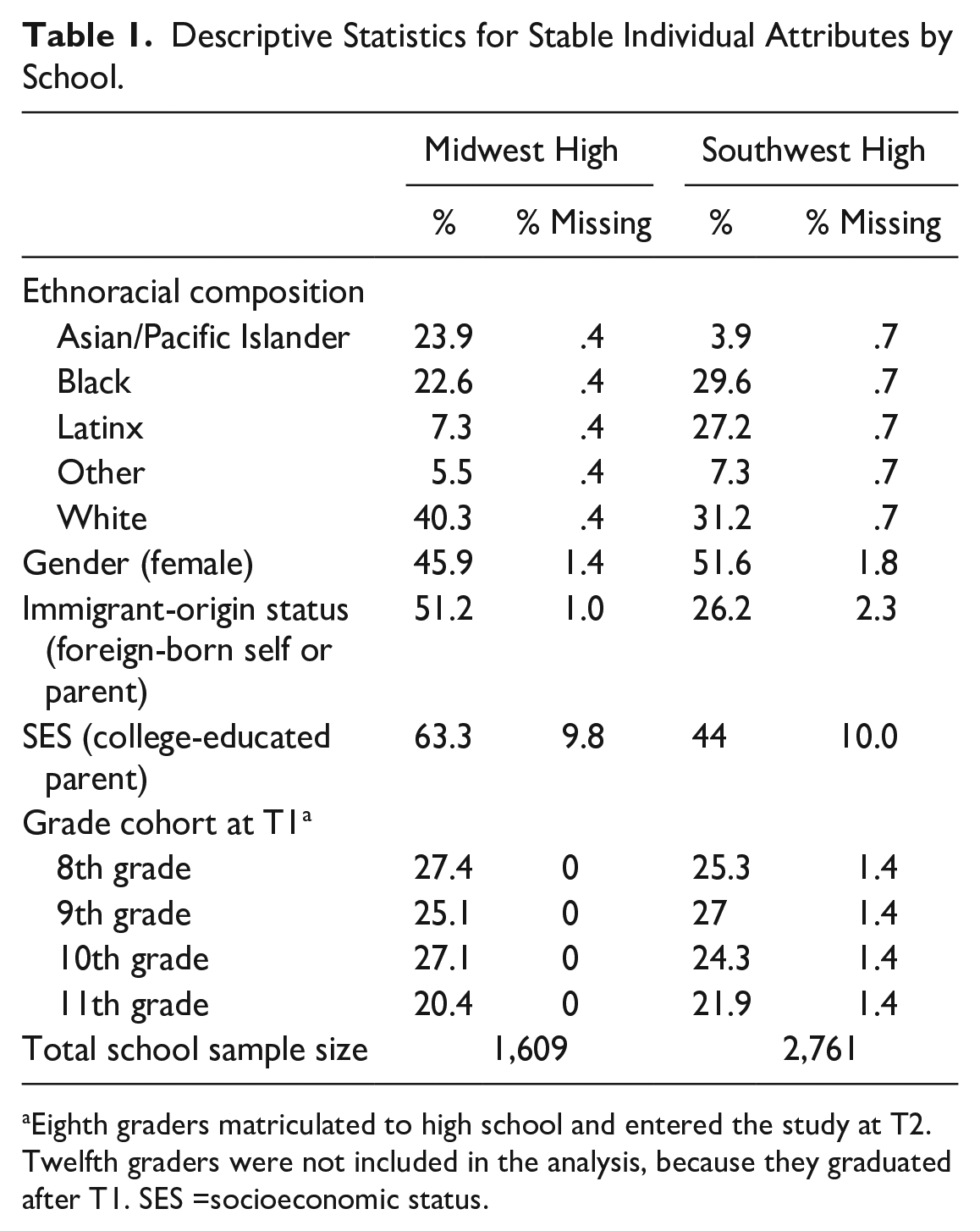
Eighth graders matriculated to high school and entered the study at T2. Twelfth graders were not included in the analysis, because they graduated after T1. SES =socioeconomic status.
ICAs
Our measure of ICAs comes from Phinney’s (1992) other-group orientation scale, which aims to capture how positively individuals feel about interacting with members of other ethnoracial groups. 1 We measured ICA using the mean level of agreement with the following statements, scored on a four-point Likert-type scale: (1) “I like meeting and getting to know people from ethnic groups other than my own,” (2) “I sometimes feel it would be better if different ethnic groups didn’t try to mix together,” (3) “I don’t try to become friends with people from other ethnic groups,” and (4) “I enjoy being around people from ethnic groups other than my own.” Responses to statement 2 and 3 were reverse coded prior to averaging. The Cronbach’s α coefficients are similar across time points and schools, ranging from .76 to .80.
Friendship
The survey asked respondents to nominate up to 10 peers whom they consider their closest friends in school. Friendship nominations were matched to other survey respondents and used to construct an adjacency matrix for each time point and school, wherein 1 indicates a friendship nomination from the respondent to a peer and 0 the absence of a nomination. For respondents who were not on the school’s roster at a particular time point, we coded their incoming and outgoing nominations (friendship ties) as structural zeros, which effectively excludes them from our analysis for that time point. For respondents who were on the school’s roster but did not complete a survey (e.g., absent on the day of the survey) we coded their incoming and outgoing friendships as missing, which allows friendships to be imputed during estimation and leads to less bias than excluding them (Huisman 2014).
Ethnoracial Background
We coded respondents’ ethnoracial background into five categories (i.e., Asian, Black, Latinx, White, and other) on the basis of their answers to two questions. The first question asked students to choose all that apply from six categories provided: Black or African American, Latinx or Hispanic, Asian, American Indian or Native American, White, and other. For those who chose more than one category, a second question asked them to identify one ethnoracial category to which they felt they most belonged. For those who answered “other” and wrote in a response, we attempted to recode the ethnicity specified into one of the major ethnoracial categories (e.g., “Irish” was recoded as White). For those who did not provide further specification, we coded them as other. Because of few responses, we recoded Native American and Middle Eastern students as other. In this study, we base our ingroup versus outgroup definition on shared versus different ethnoracial background.
Controls
Our analysis includes several individual-level and dyadic covariates to control for competing friendship and attitude-change mechanisms. Gender, parental socioeconomic status (SES), and immigrant-origin status are all coded as binary variables, wherein 1 indicates being female, having at least one college-educated parent, and having at least one foreign-born parent, respectively. Grade cohort reflects students’ grade level at T1, which ranges from 8th to 11th grade (approximately ages 14–17 years). We did not include 12th graders in our analysis, because they graduated after T1. Academic performance is an ordinal variable, recoded from respondents’ self-reported average grades. An “A average” is coded 4, “B average” is coded 3, “C average” is coded 2, and “below C” is coded 1. We use school yearbook information to code students’ school-related extracurricular activity involvement, which we transformed into a dyadic indicator of whether each pair of students participated in the same activity. Finally, we use a subscale of the Multidimensional Inventory of Black Identity–Teen (Scottham, Sellers, and Nguyên 2008) to gauge the extent to which respondents emphasized ethnic identity as a central part of their overall self-concept, which can affect their intergroup attitudes and behaviors (Leszczensky and Pink 2019; Tajfel and Turner 1979). The subscale includes three statements (e.g., “If I were to describe myself to someone, one of the first things that I would tell them is my ethnicity”) with Cronbach’s α coefficients ranging from .67 to .72 across time points and schools. We average responses to these statements to create an ethnic identity centrality (EIC) score.
Analytical Strategy
We use a SAOM, one of the few statistical procedures that can model the joint coevolution of dyadic network ties and individual attributes (Snijders et al. 2010). A SAOM is defined through a set of functions that specify mechanisms affecting individual’s friendship and behavioral choices. In this study, we use a behavior function to model friendship effects on student ICA and a network function to model ICA effects on friendship choices. The dual functions allow us to account for both the effects of friendship on ICA and ICA on friendship in all models.
The SAOMs estimate unobserved changes in the network and ICA between observed time points as a continuous-time Markov chain consisting of a sequence of microsteps. Each microstep reflects the opportunity for a single change in a friendship or an ICA. The actor-oriented nature of the model assumes that changes in the network and ICA result from the choices made by individuals during each microstep. In a given microstep, a randomly chosen student makes a change to either their ICAs (increasing or decreasing by one unit or remaining the same) or to their network (adding or dissolving a friendship, or no change). Choices may depend on their own attributes (i.e., ego covariates) but also the attributes of their friends (i.e., alter covariates) and properties of their relationships (i.e., dyadic covariates). Model fitting proceeds through a simulation-based algorithm that iterates through microsteps, allowing actors to change their friendship or behavior on the basis of modeled effects (discussed later) and associated parameter estimates. This process repeats, with parameter values updated, until convergence is reached, and the model is able to reproduce the observed changes in the network and ICA. The maximum convergence ratio for each of the models reported is .22 or lower, which is below the .25 threshold for reliable estimates (Ripley et al. 2022).
Our analysis uses a pooled, or “multigroup,” approach whereby we combined the two schools and treat each pair of adjacent time points within a school as a separate group (or period) in our analysis. With three waves of data and two schools, this results in four periods (i.e., T1/T2 and T2/T3 in each school). This approach helps account for the changing compositions of the schools (because of matriculation and graduation), enhances statistical power, and enables us to test for effects of intergroup contact on ICA. To ascertain whether pooling data from the two schools was appropriate, we first estimated separate SAOMs for the two schools. We found that the patterns of network and behavior changes in the separate models were similar to each other and to results from the joint models. Nevertheless, we took the steps detailed below, to test and account for heterogeneity across periods in the joint models. With the multigroup approach, individual-level and dyadic covariates are centered by the overall mean and the within-period mean, respectively (see Ripley et al. 2022). We left dichotomous variables uncentered for ease of interpretation (i.e., gender, dichotomous ethnoracial variables, SES, and immigrant-origin status). The analyses were conducted using RSiena versions 1.2 through 2.8 (Ripley et al. 2022).
Model Specification
Both the network and behavior functions include rate effects to index opportunities for change between consecutive time points. The functions also include effects akin to intercepts in a conventional linear model. In the network function, this is the outdegree effect, which expresses the general tendency for individuals to make a friendship nomination. 2 This effect tends to have a negative parameter estimate because, for any dyad, a friendship is more likely to be absent than present. In the behavior function, the intercept is expressed through linear and quadratic terms, which in combination represent the distribution of ICA scores. The SAOM assumes that parameter values are constant across periods unless specified otherwise (Ripley et al. 2022). To account for school and temporal heterogeneity in the above effects we allowed their parameters to vary across periods. 3
Behavior Function
Effects in the behavior function predict change in student ICA over time. Positive parameter estimates indicate a tendency to increase ICA or remain at a high level, whereas negative parameters reflect decreasing ICA or staying at a low level. We estimated four models to test our hypotheses regarding influence. Model 1 tests hypothesis 1, the cross-group friendship effect, through an effFrom term corresponding to whether a student named a cross-group friend at the previous time point. 4 A positive parameter estimate would indicate that students who named a cross-group friend at the previous time point tended to have higher ICA levels than students without a cross-group friend. In model 2, we test hypothesis 2, or friend influence, using an average ICA similarity (avSim) term. This effect describes the extent to which a student’s ICA score is similar to the average score of their friends. A positive parameter estimate for this effect indicates a tendency for individuals to make changes in ICA in the direction of their friends’ ICA levels. To further test how strongly the attitudes of ingroup and cross-group friends differentially influence individuals’ ICA (hypothesis 2A) we include separate friend influence terms (avSimW) weighted by ingroup and cross-group friends in model 3.
In model 4, we test whether cross-group friendship moderates friend influence (hypothesis 3) via the following interaction: cross-group friendship (effFrom) × ingroup friend influence (avSim). In model 5, we test for an extended cross-group friendship effect (hypothesis 4) by using the alters’ average cross-group friendship term (avXAlt). A positive parameter would indicate that students with higher proportions of friends with cross-group friends at the previous time point tended to have higher ICAs than students without such extended cross-group friends at the previous time point. Finally, we estimate a fully specified model 6 to assess the aforementioned effects net of one another. For all models, we include controls for ego’s gender, race, academic performance, EIC score, parental SES, and immigrant-origin status using an effFrom term. Figures A1a and A1b in the Appendix show that, for each school, the goodness of fit for the indegree, outdegree, and behavior distributions from model 6 (full model) is adequate.
Network Function
The network function introduces effects to predict changes in friendship ties over time. Positive parameters reflect a tendency to add or keep a tie, whereas negative parameters indicate a tendency to dissolve a friendship or fail to form a new friendship. We focus particularly on the tendency for individuals to have ingroup rather than cross-group friends, which we define on the basis of shared ethnoracial backgrounds (i.e., ethnoracial homophily). To gauge ethnoracial homophily, we apply the sameX effect to ethnoracial background. We expect a positive estimate for this effect, indicating that individuals who share the same ethnoracial background are more likely to be friends than students with different backgrounds. We measure ICA homophily by applying the simX effect to ICA scores. Again, we expect to find a positive estimate for the effect, which would suggest that individuals are more likely to choose friends whose attitudes toward interacting with ethnoracial others are closer to their own (hypothesis 6). To test the other selection hypothesis, that higher ICA scores depress ethnoracial homophily (hypothesis 5), we interact the ethnoracial homophily effect with an ego’s ICA (egoX) effect. We expect a negative parameter estimate, indicating that net of other factors, the tendency to choose ingroup over cross-group friends is weaker for adolescents with a stronger interest in intergroup contact. As part of this test, we control for main effects of ego’s and alter’s ICAs (egoX and alterX), which capture whether the propensity to have a friendship depends on the ICA level of the sender or receiver, respectively. Last, models 3 and 4 include an ethnoracial homophily × ICA homophily interaction to account for whether individuals choose ingroup friends who also have more similar ICAs. This effect is necessary because these models test the opposite causal direction in the behavior function (i.e., that friend influence on ICA is moderated by ethnoracial homophily).
We introduce a variety of dyadic covariates as controls. We include a shared activity effect (X) for pairs of respondents who participated in the same school activities. It is also important to control for other types of homophily that drive friendship. Thus, we include effects to express sameness (sameX) in grade cohort, gender, immigrant-origin status, and parental SES, as well as similarity (simX) in ICA scores, EIC scores, and academic performance.
Other controls in the network function account for endogenous network processes that drive network change. These include effects expressing the sociability of ego and alters (indegree activity [inActSqrt], indegree popularity [inPopSqrt], and outdegree popularity [outPopSqrt]) and the tendency to reciprocate a friendship nomination (reciprocity). Two complementary triadic effects capture the tendency to nominate a friend’s friend as one’s own friend (geometrically weighted edgewise shared partnership [GWESP] [gwespFF]) and, vice versa, the tendency to avoid nominating someone whose friends are not one’s own friend (distance-2 [nbrDist2]). An interaction between reciprocity and GWESP accounts for the empirical observation that friendships embedded within triadic structure are less likely to be reciprocated compared with those that lay outside (Block 2015). Finally, although 12th graders were dropped from the analytic sample because they exited the network after T1, we want to account for their potential influence on network change. Thus, we include an effect (X) indicating which pairs of students had a common 12th grade friend (shared 12th grade friend at T1), which is a form of triadic closure.
Descriptive Statistics
As shown in Table 1, the two schools have diverse but different ethnoracial compositions. At Midwest High, White students are the largest ethnoracial group (40.3 percent), followed by Asian (23.9 percent) and Black (22.6 percent) students, whereas the population of Latinx students is much lower (7.3 percent). At Southwest High, the proportions of White, Black, and Latinx respondents are about equal, while the proportion of Asians is much lower (3.9 percent). The student profiles of the two schools also differ in other ways. About half of the respondents at Midwest High are immigrant origin, meaning that they or one of their parents are foreign born, and 63 percent have at least one college-educated parent. In contrast, only about one fourth of respondents at Southwest High have immigrant-origin backgrounds, and fewer than half have college-educated parents.
Table 2 shows changing individual and network covariates. Students at Midwest High, on average, reported higher grades earned and were involved in more school activities than students at Southwest High. In terms of network change, we see time- and school-specific differences in average numbers of friendship nominations. Fewer friends were nominated in later time points at both schools, although Midwest High students, on average, nominated more friends (3.03–3.68) than Southwest High students (2.66–3.42). The Jaccard indices show the proportion of ties that existed across pairs of consecutive time points (i.e., T1-T2 and T2-T3) over the total number of ties that existed at either one of the two time points. These ranged from 0.28 to 0.34, comfortably exceeding the critical threshold of 0.2 recommended for stochastic actor-oriented modeling.
Descriptive Statistics for Changing Covariates and Networks by School.

Note: ICA = intergroup contact attitude.
Table 2 also shows the odds of a friendship between members of the same ethnoracial group relative to members of different ethnoracial groups. This measure gauges homophily independent of the ethnoracial distribution in each school (Moody 2001). As expected, odds ratios exceed 1, indicating that the odds of an ingroup friendship are greater than the odds of a cross-group friendship.
To help convey the pattern of association between ICA and friendship, we first examine their bivariate association. Figure 1 presents the distribution of ICA at T1 for each school, broken down by whether students have a cross-group friend. On average, students tended to have positive attitudes toward intergroup contact, with the majority of ICA scores being 3 or 4, on a scale ranging from 1 to 4. At more open (higher) levels of ICA, the proportion of students with at least one cross-group friend was consistently greater (from .44 and .52 at the lowest level to .72 and .74 at the highest level for Midwest High and Southwest High, respectively). Thus, cross-group friendship is positively associated with open ICA, though we do not yet have insight to causal direction.
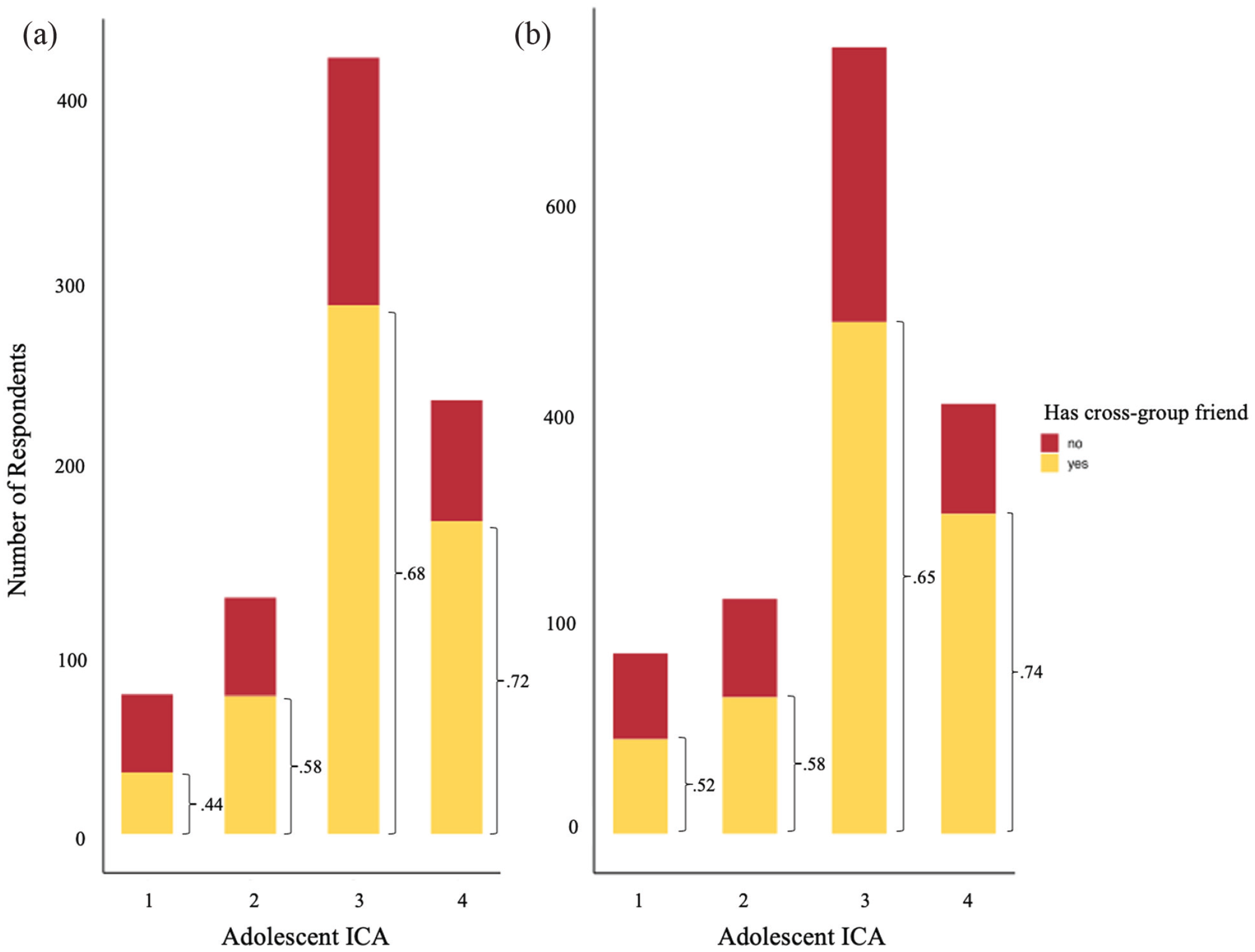
Count of intergroup contact attitude (ICA) scores by cross-group friendship at (a) Midwest High and (b) Southwest High (T1).
To represent homophily on ICA, Figure 2 plots average friend ICA by student ICA. Students who reported higher ICA had friends who, on average, reported higher ICAs as well. The strength of the correlation between respondent ICA and average friend ICA differed by friend group. The correlations with ingroup friend ICA were r = .14 (p < .001) at both schools, which are stronger than the correlations involving cross-group friend ICA: r = .09 (p < .05) for Midwest High and r = .07 (p < .05) for Southwest High. These patterns are consistent with our hypotheses for both social influence and homophilous selection. To discern these hypotheses, we now turn to our SAOM results.

Respondent’s intergroup contact attitude (ICA) and friends’ ICAs by friendship type at (a) Midwest High and (b) Southwest High (T1).
Results
ICAs
Hypothesis 1 predicts that cross-group friendship should lead to more open ICAs. We test this using the cross-group friendship effect in model 1 (Table 3). The results indicate no effect of cross-group friendship on adolescent ICA (b = 0.050, SE = 0.042). That is, students with cross-group friends were no more likely to develop more open ICAs over time than students with no cross-group friends. 5 Thus, we find no support for this facet of ICT.
Stochastic Actor-Oriented Model Estimates (Behavior Function).
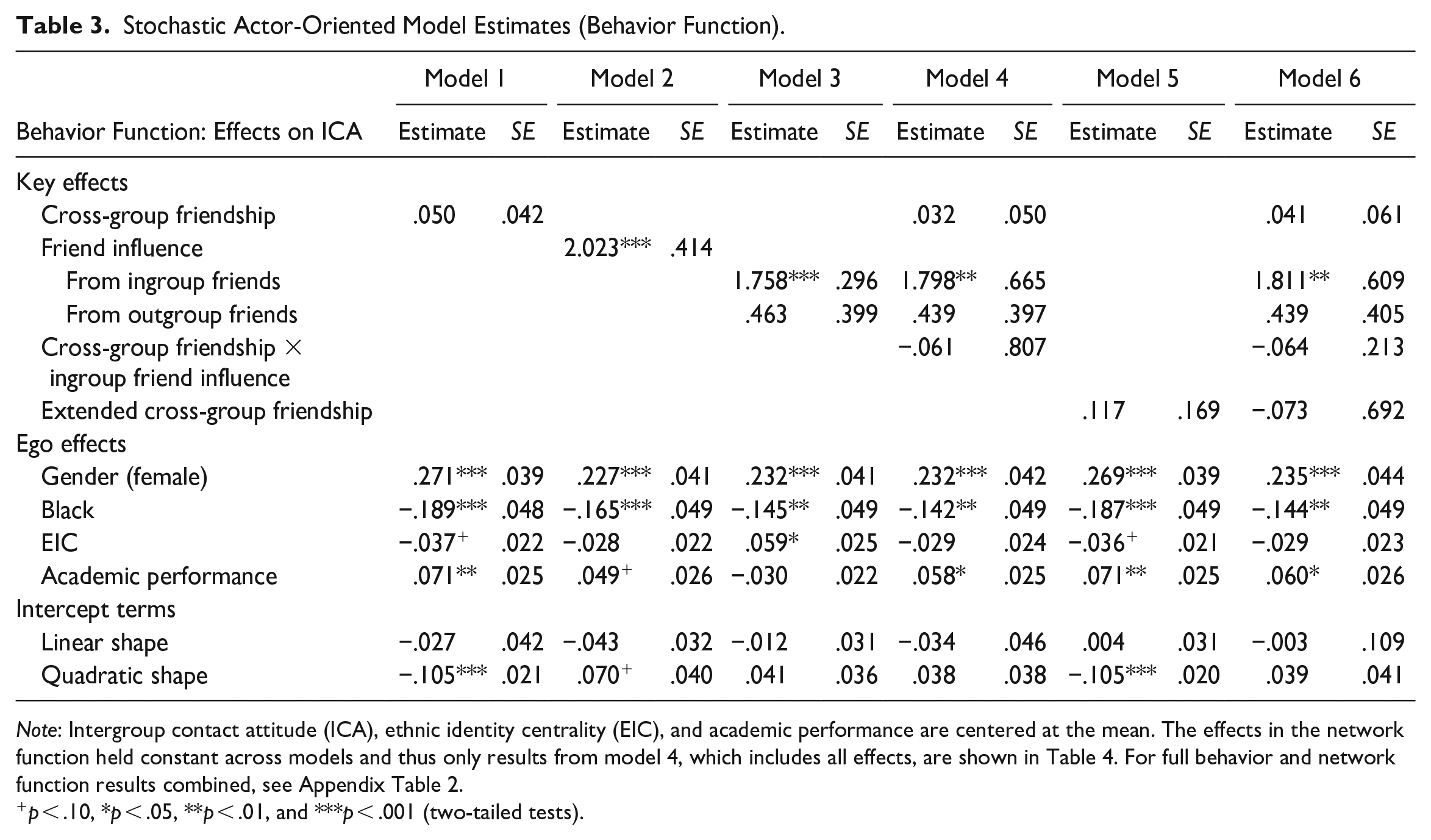
Note: Intergroup contact attitude (ICA), ethnic identity centrality (EIC), and academic performance are centered at the mean. The effects in the network function held constant across models and thus only results from model 4, which includes all effects, are shown in Table 4. For full behavior and network function results combined, see Appendix Table 2.
p < .10, *p < .05, **p < .01, and ***p < .001 (two-tailed tests).
We next assess hypothesis 2, which predicts that adolescent ICA will become more similar to friend ICA over time. We test this using the friend influence effect in model 2. The results reveal a positive and statistically significant effect (b = 2.023, SE = 0.414, p < .001). This result indicates that students exhibited a tendency to make changes in attitudes that brought them closer to their friends or maintain attitudes that aligned with their friends. These findings offer support for hypothesis 2 regarding friend influence on ICA.
Hypothesis 2A predicts that friend influence on ICA comes from ingroup friends rather than from cross-group friends. We test this hypothesis by including separate influence effects for the two friend groups in model 3. The results indicate a positive and significant friend influence effect for ingroup friends (b = 1.758, SE = 0.296, p < .001) and no effect for cross-group friends (b = 0.463, SE = 0.399). In support of hypothesis 2A, the influence on ICA between friends occurred primarily within ethnoracial groups.
Although we found no evidence of an overall cross-group friendship effect on ICA, it is possible for cross-group friendship to operate in other ways. Hypothesis 3 predicts that the strength of friend influence on ICA depends on whether someone has cross-group friends. To test this possibility, we interacted cross-group friendship and ingroup friend influence (model 4). The interaction effect was not significant (b = −0.061, SE = 0.807). Thus, we have no evidence that the presence of cross-group friendship moderates friend influence overall.
Hypothesis 4 reflects the extended contact hypothesis: individuals whose friends engage in cross-group friendships will experience positive changes in ICA. We use the extended cross-group friendship effect to test this hypothesis in model 5. The estimate is not significant (b = 0.117, SE = 0.169). Adolescents whose friends had cross-group friendships were no more likely to develop more open ICAs over time than students without such friendships.
We collectively modeled the aforementioned effects in Model 6. Results indicate that the ingroup friend influence effect (b = 1.811, SE = .609, p < .01) is robust to the inclusion of all intergroup contact effects. It is also worthwhile to highlight other factors in the behavior function that affected adolescent ICA. We found significant effects for gender, race, and academic performance. These results suggest that, regarding attitudes toward intergroup contact, girls are more open than boys, Black students are less open than students of other ethnoracial backgrounds, and students with better grades are more open than their lower performing peers. Our analysis also considered possible effects of parental SES, immigrant-origin status, and separate effects for Asian and Latinx/Hispanic youth. Score tests (Ripley et al. 2022) indicated that the introduction of these effects would not improve model fit. Thus, we excluded them for the sake of a more parsimonious model. 6
Friend Selection
We now turn to our hypotheses regarding ICA and friend selection (Table 4). Because effects in the network function remained stable across the six models, we only present results from model 6, which contained the fullest set of effects (full results for other models can be found in Tables A1 and A2).
Stochastic Actor-Oriented Model Estimates of Model 6 (Network Function).
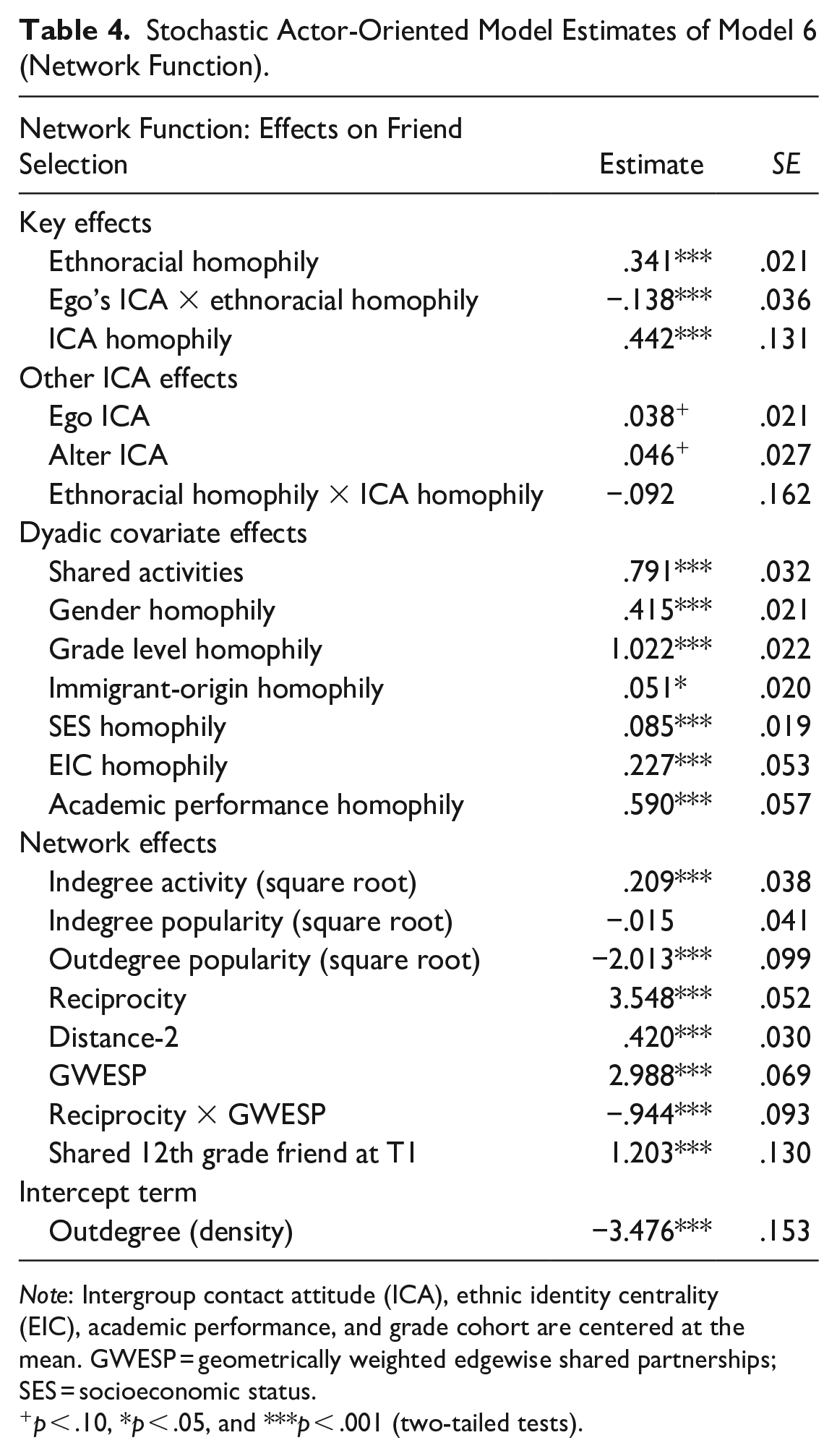
Note: Intergroup contact attitude (ICA), ethnic identity centrality (EIC), academic performance, and grade cohort are centered at the mean. GWESP = geometrically weighted edgewise shared partnerships; SES = socioeconomic status.
p < .10, *p < .05, and ***p < .001 (two-tailed tests).
Hypothesis 5 predicts that adolescents with more open ICAs are more likely to befriend outgroup members (i.e., on the basis of ethnoracial background). For students with ICA scores at the mean, the tendency to select friends on the basis of shared ethnoracial background is indicated by the main effect of ethnoracial homophily, which is positive and statistically significant (b = 0.341, SE = 0.021, p < .001). We test how one’s own ICA moderates this effect by including an interaction between ego’s ICA and ethnoracial homophily. Table 4 reports a significant negative effect of ego’s ICA × ethnoracial homophily on friendship (b = −0.138, SE = 0.036, p < .001), which suggests that greater openness to intergroup contact (higher ICA score) is associated with weaker tendencies to select ingroup friends (relative to selecting cross-group friends), all else being equal. To help convey the pattern these effects represent, Figure 3 illustrates the predicted contribution to the friendship network function on the basis of students’ ICAs for ingroup and cross-group friendships, separately. 7 Higher values on the y-axis indicate that such friendships are more likely (assuming all other effects are equal). The higher predicted contribution for ingroup friends indicates that ingroup friendships are more likely than cross-group friendships. However, at higher ICA levels, ingroup friendships become relatively less likely, while cross-group friendships become relatively more likely. Thus, we find support for hypothesis 5.

Predicted contribution to friendship network function on the basis of adolescent intergroup contact attitudes (ICAs) for ingroup versus cross-group friends.
Hypothesis 6 predicts adolescents are more likely to befriend peers with more similar ICAs. The ICA homophily effect in Table 4 is positive and significant (b = 0.442, SE = 0.131, p < .001), which is evidence in support of hypothesis 6. Interpreting this effect requires consideration of other ICA effects that were also included in our model. Although the interaction between ICA homophily and ethnoracial homophily was not significant, the ego and alter ICA effects were. In particular, the ego ICA (b = 0.038, SE = 0.021, p < .10) and alter ICA (b = .046, SE = 0.027, p < .10) effects were positive and marginally significant, indicating that students more open to intergroup contact named more friends and received more friendship nominations overall. To illustrate the joint effects of ego ICA and alter ICA, Figure 4 presents the predicted contribution to the friendship network function on the basis of hypothetical combinations of ego and alter ICAs. By comparing cells on the diagonal with off-diagonal cells, we see that students with more similar ICAs were more likely to become friends than those who were more dissimilar, with the strongest effect for pairs who match at the highest ICA level.
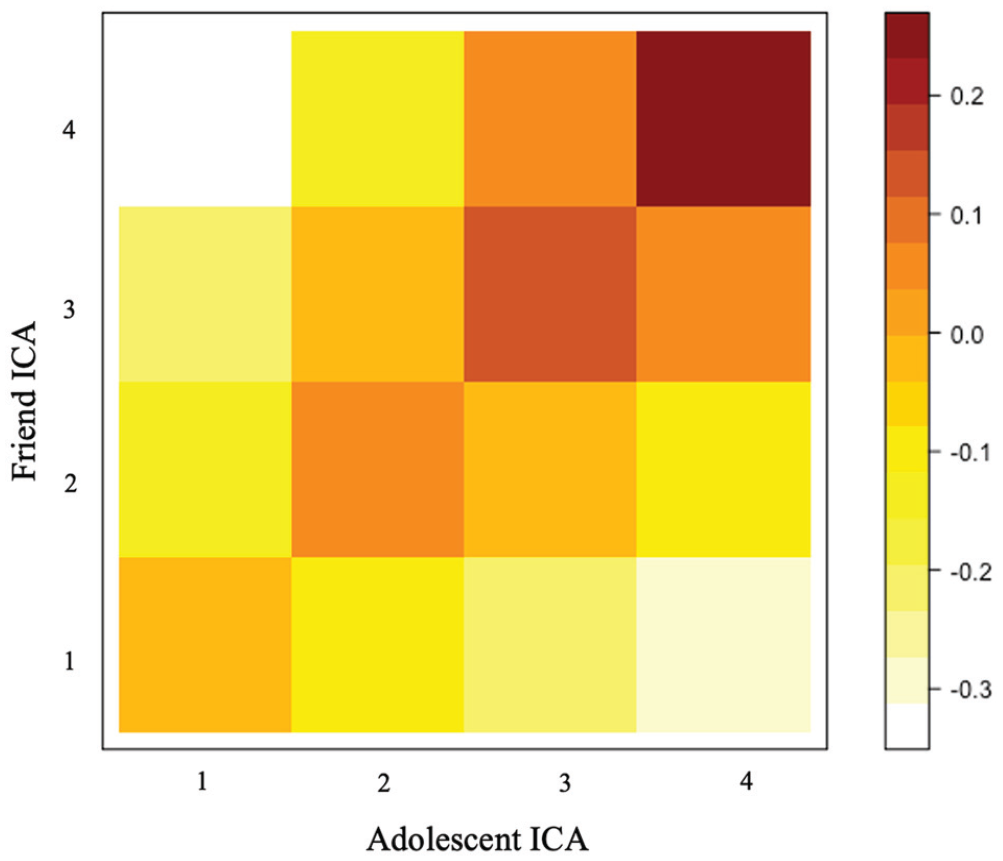
Predicted contribution to friendship network function on the basis of adolescent and friend intergroup contact attitudes (ICAs).
Regarding other controls, we find that homophily operated across gender, immigrant-origin status, parental SES, EIC score, and academic performance (see Table 4). Students who participated in the same school activity were also more likely to be friends. And endogenous network processes were also an important contributor to friend selection, which mirrors what has been found in other high school friendship networks.
Testing for Heterogeneity in Cross-Group Friendships
Our theoretical framework outlines how the well-documented association between cross-group friendship and intergroup attitudes can arise because of processes other than intergroup contact. Thus, we were not completely surprised by the lack of support for the proposition from ICT that cross-group friendship leads to more open ICAs (hypothesis 1). Nevertheless, one important advantage of the diverse school contexts in this study is they allow us to consider possible heterogeneity across group boundaries. Our main analysis treated all types of cross-group friendship the same, regardless of the specific ethnoracial background of the individuals involved. Yet contact between certain groups may be more effective than others at changing attitudes.
In a second phase of analysis, we consider whether specific types of cross-group friendships matter for intergroup attitude development. Intergroup contact studies within the U.S. context have historically focused on friendships between White and Black members and generally found that this friendship combination has a strong prejudice reduction effect for Whites, whereas effects for Black individuals are mixed (Sigelman and Welch 1993; Tropp 2007). In addition, an experimental study on college roommate assignments found that Asian American and White students demonstrated positive attitude changes after being assigned to Latinx or Black roommates, with assignment to Black roommates increasing the ethnoracial heterogeneity of students’ friendship circles as well (Laar et al. 2005). In light of prior research, we conducted further analyses that used interactions specifying particular combinations of ego and alter ethnoracial backgrounds to predict changes in ICA. These analyses also included interactions in the network function to account for whether more open ICA led to the specific type of cross-group friendship.
The combinations we considered are White ego × Black alter, White ego × Latinx alter, and Asian ego × Black alter. Results of these tests reveal a significant effect of cross-group friendship on ICA only in the White ego × Black alter scenario (b = 0.852, SE = 0.427p < .05; see Table A4). This effect indicates that White students who named Black friends tended to have more open ICAs over time. We did not find a corresponding effect for the two other cross-group friendship types. With regard to friend selection, we found that a more open ICA promoted cross-group friendship only in the White ego × Black alter case (b = 0.293, SE = 0.093, p < .05). These analyses offer support for ICT, but only for White adolescents who have Black friends.
Discussion
Intergroup attitudes affect how people perceive and treat members of other social groups and have thus been an important topic of social science research. Recent advances in ICT point to cross-group exposure in the form of friendship as a particularly effective tool for inducing positive attitude change. However, relying on this pathway for broadscale prejudice-reduction may be misguided in light of several naturally occurring friendship dynamics that inhibit cross-group friendship. To better understand this, scholars have recently begun using social network analysis to disentangle the complex pathways linking networks with individual outcomes. Our unique contribution is to examine the association between friendship networks and attitudes in a more diverse context (i.e., two schools with different, multigroup ethnoracial compositions) using a more general measure of ICAs. Whereas the majority of prior network studies have been conducted in Europe, and the United Kingdom specifically, we focus on the United States, an ethnoracially diverse country with its own history of intergroup tension and conflicts. Hence, we were able to test ICT in cross-group friendships involving youth from a range of ethnoracial backgrounds.
Intergroup Exposure and Friendship
To begin, we observed that adolescents with more open ICAs were also more likely to have cross-group friends. Examining this association over time, we found the strongest, most consistent effects were via friend selection. That is, attitudes informed friend selection such that openness to intergroup contact offset adolescents’ tendencies to befriend ingroup peers. By contrast, we found limited evidence that intergroup friendship led to more open attitudes, and no evidence that extended cross-group friendship mattered. Thus, we conclude that the association between ICA and cross-group friendship is primarily a product of attitudes driving behavior.
Even with a more diverse context, a demographic composition that more closely reflects the general population, and a larger sample size, we find no evidence for a general intergroup contact effect, a result that mirrors the null finding in Bracegirdle et al. (2022). 8 However, we leveraged the ethnoracial diversity of our school contexts to test whether specific types of cross-group friendship differentially affected ICA (Laar et al. 2005; Tropp and Pettigrew 2005). This deeper inquiry revealed a significant effect of cross-group friendship specifically for White students with Black friends, but not for White students with Latinx friends or Asian students with Black friends. These results are consistent with the mechanisms underlying intergroup contact effects (e.g., reducing intergroup anxiety, increasing outgroup empathy, and fostering more accurate understanding of the outgroup), which are predicated on a strong ingroup/outgroup distinction and alienation. The Black-White divide is a long-standing, defining feature of U.S. society (Omi and Winant 1994). Overall, although we cannot conclude that general intergroup friendships do not affect ICAs (i.e., no study can prove the null hypothesis), our results point toward effects of intergroup friendship that, if they do exist, are too small to be detected except for when they bridge a substantial group divide.
It is worth considering whether the diversity of the contexts we studied may have precluded intergroup contact effects via friendship. According to ICT, intergroup exposure under the right conditions can promote more open ICAs. If this occurred in the school contexts we observed (e.g., contact via classmates or teammates outside friendships) and led to more open attitudes on average, then there would have been less capacity for intergroup friendships to induce more open attitudes (i.e., a ceiling effect). For two reasons, we are doubtful this explains why we did not find a general intergroup friendship effect. First, only about one third of students were at the most open level of ICA. Hence, most students had the capacity to develop more open attitudes. Second, we observed an influence effect on ICA whereby ingroup friends’ attitudes affected students’ own attitudes. Hence, there was a demonstrated capacity for attitude change due to friendship. Our findings point to attitude influence as the mechanism by which friend ICA matter, not via intergroup friendship. Nonetheless, it remains possible that diverse contexts such as the one we studied have an independent effect on attitudes, hence we encourage future work across a broader range of contexts that compares the effect of intergroup exposure with that of friendship.
Friend Influence on ICA Development
We found strong support for the proposition that influence from friends shapes ICA. This effect was not moderated by having an outgroup friend. Hence, friends were influential regardless of one’s direct contact with other ethnoracial groups. That said, influence was moderated by friends’ ethnoracial membership. Namely, it was only ingroup friends whose ICAs affected adolescents’ own ICAs. A lack of outgroup attitudinal influence is perhaps not surprising for attitudes about particular groups (i.e., that White students’ feelings about Asians are not shaped by Asian friends’ feelings about Asians and vice versa; Bracegirdle et al. 2022). However, our focus was on more general attitudes regarding whether different ethnoracial groups should or should not interact. Although we expected that such general attitudes may be subject to outgroup influence, our results offer no such evidence. This is noteworthy, as it further emphasizes the limited capacity of cross-group friendships (via either intergroup contact or friend influence) to serve as the impetus for intergroup attitude change.
ICA and Friend Selection
Network selection processes play a pivotal role in determining which peers are in the position to exert influence (Osgood 2012; Schaefer 2018). We found that several friend selection processes inhibited the kind of contact that ICT argues is most likely to induce intergroup attitude change. Namely, adolescents preferred friends who shared their ingroup status (i.e., same ethnoracial background) as well as other dimensions correlated with ethnoracial background (e.g., EIC, SES, academic performance, and immigrant-origin status). In addition, we found homophilous selection on the basis of ICA, meaning that friendships were more likely among adolescents who already shared similar levels of interest and comfort toward intergroup contact. These processes lead to friendships that reinforce one’s current attitudes. As such, those adolescents with the least open ICA were also least likely to experience the kind of attitude exposure through friendships that would lead to more open ICA.
Although we found that cross-group friendships were overall less likely, they became more likely for adolescents with more open ICAs (Bracegirdle et al. 2022; Rivas-Drake et al. 2019). On one hand, this finding justifies research on intergroup attitudes and intervention efforts to promote more open ICAs as a means to improve intergroup relations. On the other hand, it exposes the limitation of intergroup contact via friendships as a tool for inducing positive attitude change. Negative attitudes preclude cross-group friendship formation for those individuals who would benefit most from their presence. In combination, these results raise questions about the capacity of cross-group friendships to be a widespread source of change in intergroup attitudes.
Surprisingly, more than a quarter of students with the highest ICA scores did not name a single cross-group friend. Such students are the most open to cross-group friendship, and the diverse school contexts we examined meant that every student had more opportunities for outgroup than ingroup friends. This raises the question of what barriers, beyond attitudes, inhibit the development of intergroup friendships for adolescents open to them? Possibilities include segregated settings (e.g., classes, activities) that limit opportunities to meet outgroup peers (Feld 1982; Juvonen et al. 2019; Schaefer, Simpkins, and Ettekal 2018) or dissimilarity on more salient dimensions (e.g., lack of a common interest). Future research would benefit by examining these possibilities, with an eye toward understanding how and where cross-group friendships develop.
Conclusion
Our research showed that negative intergroup attitudes and intergroup divisions are part of a mutually reinforcing cycle. Although friendship is often considered highly effective for inducing positive intergroup attitude change, our results indicate that the relationship between cross-group friendship and attitudes is driven primarily by attitudes affecting cross-group friendship, with only limited effects of cross-group friendship on attitudes. Although we focused on adolescent school friendships, our theoretical framework is more general, and we expect the social dynamics we observed to operate in a similar manner in other voluntary social relationships across the life course. This, coupled with prior research finding that adolescent friendship patterns shape adult relationships (Ellison and Powers 1994; Kao, Joyner, and Balistreri 2019), may explain why negative intergroup attitudes and divisions between major social groups persist in society even as growing population diversity creates more intergroup exposure.
Although we are hesitant to make recommendations on the basis of one study, our results, combined with accumulating research, offer some direction for those looking for ways to improve intergroup relations. Because negative intergroup attitudes and network divisions are part of an endogenous cycle, there are multiple possible intervention points. One way forward is to design ways to counteract the tendency for individuals with closed ICAs to avoid cross-group friendships. This can take the form of intervention efforts at the dyadic level (Echols and Ivanich 2021) or organizational changes that affect contact opportunities (Jeffrey et al. 2022). Such efforts can benefit from incorporating network principles known to promote friendship, such as propinquity and highlighting similarity on salient dimensions that crosscut race (e.g., aspects of identity beyond race). A second approach is to expand beyond intergroup contact as the lever of change to more seriously consider how changing ingroup norms affects adolescent attitude development. In light of accumulating evidence that friends influence ICAs, efforts that focus on changing individual attitudes, especially among those with an outsized influence on their friends, can prompt a normative change across the (ingroup) friendship network. In turn, more open intergroup attitudes should foster cross-group friendships. Approaches such as these offer the potential to capitalize on the cycle linking intergroup attitudes and friendships to promote more positive intergroup outcomes.
Supplemental Material
sj-docx-1-srd-10.1177_23780231231161048 – Supplemental material for The Limitations of Intergroup Friendship: Using Social Network Analysis to Test the Pathways Linking Contact and Intergroup Attitudes in a Multigroup Context
Supplemental material, sj-docx-1-srd-10.1177_23780231231161048 for The Limitations of Intergroup Friendship: Using Social Network Analysis to Test the Pathways Linking Contact and Intergroup Attitudes in a Multigroup Context by Thoa V. Khuu, David R. Schaefer, Adriana J. Umaña-Taylor and Allison M. Ryan in Socius
Footnotes
Appendix
Stochastic Actor-Oriented Model Estimates for Different Cross-Group Friendship Types.

| Model 1: White Ego × Black Alter | Model 2: White Ego × Latinx Alter | Model 3: Asian Ego × Black Alter | ||||
|---|---|---|---|---|---|---|
| Estimate | SE | Estimate | SE | Estimate | SE | |
| Behavior function: effects on ICA | ||||||
| Key effects | ||||||
| Cross-group friendship | .852* | .427 | −.186 | .394 | .225 | .540 |
| Friends’ influence | 1.980*** | .401 | 2.058*** | .393 | 1.983*** | .402 |
| Ego effects | ||||||
| Gender (female) | .244*** | .042 | .227*** | .041 | .240*** | .042 |
| White | .027 | .080 | .274*** | .079 | .176** | .054 |
| Asian | — | — | −.076 | .113 | ||
| EIC | −.002 | .024 | −.013 | .023 | −.006 | .025 |
| Academic performance | .044 + | .026 | .065* | .026 | .046 + | .028 |
| Alter effects | ||||||
| Black | −.358* | .145 | — | −.278 + | .160 | |
| Latinx | — | .515** | .199 | — | ||
| Intercept terms | ||||||
| Linear shape | −.022 | .056 | −.244*** | .058 | −.044 | .062 |
| Quadratic shape | .054 | .036 | .062 + | .036 | .059 + | .036 |
| Rates | ||||||
| Midwest High T1-T2 | 1.746 | .148 | 1.745 | .160 | 1.753 | .167 |
| Midwest High T2-T3 | 1.722 | .118 | 1.723 | .114 | 1.723 | .118 |
| Southwest High T1-T2 | 1.907 | .140 | 1.903 | .129 | 1.903 | .126 |
| Southwest High T2-T3 | 1.928 | .105 | 1.918 | .112 | 1.919 | .107 |
| Time heterogeneityi | ||||||
| Linear shape: Midwest High T2- T3 | .018 | .067 | .021 | .068 | .022 | .067 |
| Linear shape: Southwest High T1-T2 | .099 | .067 | .019 | .076 | .099 | .067 |
| Linear shape: Southwest High T2-T3 | −.018 | .064 | −.111 | .075 | −.015 | .064 |
| Quadratic shape: Midwest High T2-T3 | .005 | .066 | .003 | .068 | .005 | .065 |
| Quadratic shape: Southwest High T1-T2 | .046 | .064 | .047 | .064 | .050 | .060 |
| Quadratic shape: Southwest High T2-T3 | .106 + | .062 | .108 + | .060 | .112 + | .059 |
| Network function: effects on friend selection | ||||||
| Key effects | ||||||
| Cross-group friendship type | −.572*** | .052 | −.266*** | .054 | −.233** | .081 |
| Cross-group friendship type × ego ICA | .293** | .093 | .118 | .091 | .085 | .143 |
| ICA homophily | .422*** | .095 | .422*** | .098 | .426*** | .103 |
| Other relevant effects | ||||||
| Ego ethnoracial background × ego ICA | −.133** | .043 | −.092* | .043 | −.043 | .063 |
| Alter ethnoracial background × ego ICA | −.030 | .043 | .064 | .048 | −.013 | .037 |
| Ego ethnoracial background | .121*** | .026 | .154*** | .035 | −.100* | .039 |
| Alter ethnoracial background | .139*** | .034 | .074** | .025 | −.005 | .033 |
| Ego ICA | .013 | .030 | −.019 | .026 | −.029 | .022 |
| Alter ICA | .032 | .022 | .030 | .022 | .025 | .022 |
| Dyadic covariate effects | ||||||
| Shared activities | .813*** | .032 | .825*** | .033 | .820*** | .030 |
| Gender homophily | .413*** | .020 | .413*** | .021 | .414*** | .020 |
| Grade level homophily | 1.020*** | .024 | 1.018*** | .023 | 1.019*** | .021 |
| Immigrant-origin homophily | .136*** | .019 | .128*** | .019 | .123*** | .020 |
| SES homophily | .106*** | .019 | .106*** | .020 | .107*** | .019 |
| EIC homophily | .257*** | .052 | .265*** | .055 | .272*** | .053 |
| Academic performance homophily | .605*** | .059 | .619*** | .061 | .614*** | .064 |
| Network effects | ||||||
| Indegree activity (square root) | .211*** | .040 | .211*** | .038 | .212*** | .036 |
| Indegree popularity (square root) | −.018 | .048 | −.010 | .042 | −.015 | .058 |
| Outdegree popularity (square root) | −2.017*** | .121 | −2.000*** | .113 | −2.008*** | .152 |
| Reciprocity | 3.579*** | .055 | 3.576*** | .052 | 3.580*** | .069 |
| Distance-2 | .422*** | .037 | .417*** | .033 | .420*** | .047 |
| GWESP | 3.013*** | .084 | 3.010*** | .074 | 3.016*** | .111 |
| Reciprocity × GWESP | −.948*** | .098 | −.954*** | .101 | −.955*** | .115 |
| Shared 12th grade friend at T1 | 1.225*** | .133 | 1.245*** | .130 | 1.230*** | .134 |
| Intercept term | ||||||
| Outdegree (density) | −3.449*** | .195 | −3.475*** | .151 | −3.403*** | .208 |
| Rates | ||||||
| Midwest High T1-T2 | 14.320 | .577 | 14.332 | .725 | 14.217 | .737 |
| Midwest High T2-T3 | 12.037 | .461 | 12.018 | .484 | 12.012 | .401 |
| Southwest High T1-T2 | 17.416 | .675 | 17.478 | .664 | 17.435 | .702 |
| Southwest High T2-T3 | 14.999 | .527 | 15.063 | .489 | 14.985 | .627 |
| Time heterogeneityi | ||||||
| Density: Midwest High T2-T3 | −.124** | .048 | −.127** | .049 | −.133** | .043 |
| Density: Southwest High T1-T2 | −.147** | .045 | −.160*** | .044 | −.174*** | .040 |
| Density: Southwest High T2-T3 | −.097* | .042 | −.113* | .044 | −.125** | .042 |
Note: EIC = ethnic identity centrality; GWESP = geometrically weighted edgewise shared partnerships; ICA = intergroup contact attitude; SES = socioeconomic status. ireferience group is Midwest High T1-T2
p < .10, *p < .05, **p < .01, and ***p < .001 (two-tailed tests).
Acknowledgements
This research was supported by grants from the National Science Foundation (SES No. 1918162, PI: Schaefer; BCS No. 1625277, PI: Umaña-Taylor; BCS No. 1625196, PI: Rivas-Drake; DGE No. 1839285). We express our appreciation to Chelsea Cypress, Stephanie Pulles, Ethan Schaefer, and Jonathan Ware for their assistance with collecting the extracurricular activity data, and to Sandi Simpkins for advice on coding activities.
1
The following two questions from  other-group orientation scale were dropped because they directly measured intergroup behaviors rather than attitudes: (1) “I often spend time with people from ethnic groups other than my own” and (2) “I am involved in activities with people from other ethnic groups.”
2
The RSiena package defines terms using shortNames such as outdegree and effFrom. We usually refer to effects using these shortNames accompanied by a conceptual definition. However, in cases in which the shortName is less informative, we refer to the effect by a more intuitive name while also providing the shortName for the sake of precision. We refer the reader to for the formulas used to calculate effects.
3
We also tested whether other parameter values differ across periods using the sienaTimeTest function and found no substantial difference across periods after adjusting for heterogeneity in the outdegree, linear, and quadratic terms. This suggests that although network size and ICA distribution differ across schools and waves, the effects operating to shape friendships and ICAs remain consistent.
4
The RSiena package does not have terms that directly correspond to intergroup contact and extended intergroup contact. Thus, we coded these as exogenous individual attributes on the basis of the preceding time point. Thus cross-group friends measured at T1 predict ICA change from T1 to T2, and cross-group friends measured at T2 predict ICA change from T2 to T3. We operationalize intergroup contact as having any cross-group friend, rather than using counts or proportion of cross-group friends, as this allows a more straightforward interpretation of the interaction between cross-group friendship and friend influence (hypothesis 3). However, in our follow-up analyses, we demonstrate that operationalizing intergroup contact in other ways (i.e., count of total cross-group friends or proportion of friends who are cross-group) yield similar results.
5
As a robustness check, we conducted follow-up analyses that operationalized intergroup contact in alternative ways. It may be that the volume or proportion of cross-group friends matters for ICA, not just the presence or absence of a single friend. Thus, we estimated two follow-up SAOMs with the same specification as reported in model 1 but using total number of cross-group friends (totWAlt) and proportion of cross-group friends (avWAlt), respectively, to predict ICA. As in our main analysis, these models yielded null results for the effect of intergroup contact.
6
For a robustness check, we estimated model 6 again while including a full set of effects from individual covariates. The effects include Asian, other (ethnoracial background), Latinx, SES, grade cohort, immigrant-origin background, activity participation, participation in activity with an ethnoracial emphasis (e.g., Black Student Union), and participation in activity with a service or activism component (Student Advocates for Gender Equality). Results indicate that the parameter estimates of our main effects minimally changed (see ), which indicates that the exclusion of these effects in our main models for the sake of a more parsimonious model does not affect the substantive interpretation of our results.
7
The interaction between ethnoracial homophily and ICA homophily is ignored because the effect is not statistically significant.
8
The null finding occurred despite our likely higher statistical power to detect intergroup contact effects. With 4,370 students and two periods of change (across three waves of data), we have more than 8,000 opportunities to observe change. Bracegirdle et al.’s (2022) sample of 1,170 students and four periods of change (across five waves) offered something closer to 4,000 change opportunities.
Author Biographies
References
Supplementary Material
Please find the following supplemental material available below.
For Open Access articles published under a Creative Commons License, all supplemental material carries the same license as the article it is associated with.
For non-Open Access articles published, all supplemental material carries a non-exclusive license, and permission requests for re-use of supplemental material or any part of supplemental material shall be sent directly to the copyright owner as specified in the copyright notice associated with the article.
