




Abstract
What leads Americans to support human rights violations? The authors explore the role of disgust on dehumanization and support for retaliatory human rights violations, including support for torture, targeting noncombatants, and extrajudicial killing. Using a survey experiment, the authors find that American respondents are disgusted with outgroups whose behaviors violate global human rights norms. These feelings of disgust lead respondents to dehumanize these outgroups and support hypothetical human rights violations against past violators as well as noncombatants ostensibly affiliated with them. Although the experimental vignettes also triggered anger and sadness in participants, only disgust reactions consistently produced dehumanization and support for human rights violations against outgroups. The results indicate that global human rights norms delineate not only acceptable behavior toward others but also the boundaries between those deserving and undeserving of human rights protections.
The past several centuries have seen a marked decline in violence and a rise in the protection of human rights (Cole 2016; Elias [1939] 1994; Fariss 2014; Tsutsui 2018). The twentieth century witnessed the rise in protections through a variety of international treaties (e.g., the Genocide Convention) and institutions (e.g., the European Court of Human Rights) as well as domestic laws (e.g., the Victims of Trafficking and Violence Protection Act of 2000 in the United States). The codification of these norms into domestic laws and their promotion by international organizations has contributed to “real improvements in human rights practices” around the world (Hafner-Burton and Tsutsui 2005:1398). Although most treaties and institutions prohibit exceptions to human rights norms (e.g., the Convention against Torture explicitly prohibits national security exceptions in part I, article 2, section 2), state and nonstate actors routinely violate them (Shannon 2000). For example, government authorities might not be permitted to torture criminal suspects, with the exception of foreigners involved in terror. In democratic societies, these violations may be fueled by public approval: a recent Pew Research Center survey revealed that 48 percent of Americans consider torture permissible under certain circumstances (Tyson 2017).
What factors lead individuals to support violating the human rights of others? In this article, we contend that disgust pushes people to sanction exceptions to the universality of human rights norms both directly and through the mediating path of dehumanization. If an outgroup’s behavior is so far beyond the pale of what defines us as members of the global human community as to elicit disgust, then the protections afforded normal humans need not apply. Using an online experimental survey, we asked American adults about their reactions to minor (e.g., looting a town) and severe (e.g., taking young women and girls as sex slaves) human rights violations. We find that outgroup human rights violations generate disgust, which leads to support for violating said outgroups’ human rights in retaliation both directly and indirectly through dehumanization. Our results suggest that this pattern applies not only to the people and organizations directly linked to previous human rights abuses, but also to civilians not actively involved in conflict.
Violating the Human Rights of “Disgusting” Others
Human rights are defined as a set of universal entitlements shared by all human beings regardless of race, sex, nationality, ethnicity, language, religion, or any other status. These include the right to life and liberty, freedom from torture and enslavement, freedom of speech and association, the right to education and equality before the law, and many more. Although the articulation and protection of these rights have grown over the past century (Cole 2016; Fariss 2014; Tsutsui 2018), autocratic states routinely engage in human rights violations, including torture, arbitrary detention, and extrajudicial killings (Conrad and Moore 2010; Haugen and Boutros 2010; Poe, Rost, and Carey 2006). Although democratic states are less likely to commit human rights violations because of political constraints on authorities (Davenport and Armstrong 2004; Hill and Jones 2014), popular support may enable human rights violations in democracies such as the United States. Although a large body of literature in social psychology suggests that individual psychological traits, such as a desire for social dominance or a lack of empathy, may prompt people to support violations of human rights norms (e.g., Ho et al. 2015; Maoz and McCauley 2008), more recent research has shown that the propensity to commit and support violence is largely a function of specific situational contexts and the emotions they elicit (Collins 2008; Luft 2015, 2020).
In this study, we investigate the role of three emotions in generating such support: fear, anger, and disgust. One consistent finding in the literature is that fear brought on by threats to physical security leads citizens of democratic states to support human rights violations like indefinite detention without charge, torture as a means of interrogation, and barring or monitoring contact between criminal defendants and lawyers (Albertson and Gadarian 2015; Blauwkamp, Rowling, and Pettit 2018; Piazza 2015; Pyszczynski, Solomon, and Greenberg 2003). Other studies have shown that anger, which tends to be “triggered in the face of intentional rule violations” (Petersen 2010:359) and associated with a desire for “costly punitive responses” (Molho et al. 2017:611), may lead people to support indiscriminate bombing campaigns, ethnic and racial profiling, torture, and mass deportations (Feinstein 2016; Lerner et al. 2003; Rubin and Salvatore 2019; Skitka et al. 2006).
Although less studied than fear and anger, disgust is another emotion that may be related to individual support for human rights violations. Disgust is a basic human emotion that can be found across cultures and time (Kteily et al. 2015). The facial expression is easy to spot: (1) nose scrunch, (2) raised upper lip, and (3) protruding tongue (Ekman, Friesen, and Hager 2002). Although disgust is understood primarily as a physical reaction to contaminated foods, contagious diseases, decaying corpses, and animal waste (Haidt, McCauley, and Rozin 1994), sociomoral transgressions—including theft, lying, fraud, membership in hate groups, and violence—also trigger disgust (Chapman and Anderson 2013; Giner-Sorolla and Chapman 2017; Heerdink et al. 2019; Hutcherson and Gross 2011; Landy and Goodwin 2015; Molho et al. 2017; Tybur, Lieberman, and Griskevicius 2009; Tybur et al. 2013).
Disgust is related to, but distinct from, other emotions such as fear and anger (Hutcherson and Gross 2011; Miller 1997; Rozin et al. 1999). Fear and disgust are related because with disgust we “fear” contamination, but in most cases fear results from perceived vulnerability rather than out of concern for contamination. Although anger is also related to disgust, the two are distinct emotional reactions (Clifford 2019; Kupfer and Giner-Sorolla 2017). The violation of a rule might make us angry, but it need not lead to disgust. Many Westerners were angered by the Soviet invasion of Afghanistan in 1979 but did not describe the Soviet Union as disgusting; the use of military force was upsetting but within the bounds of normal behavior among great powers. Likewise, norm violations that generate disgust may not necessarily produce anger, especially if they are relatively benign (Hemenover and Schimmack 2007; McGraw and Warren 2010). Finally, although anger and fear can be attenuated by offering justifications for norm violations, disgust is appraised without consideration of conditions or trade-offs (Russell and Giner-Sorolla 2011a, 2013). Even if a disgust-inducing norm violation does no harm and offers substantial benefits, it is still disgusting. In contrast to anger, offering justifications for disgusting behavior that violates “sacred values” may paradoxically increase disgust and moral outrage (Atran 2010; Dehghani et al. 2010).
There are two theoretical reasons to think that people may be more willing to violate the human rights of others they find disgusting. First, disgust spurs people to make severe moral judgments (Wheatley and Haidt 2005). Studies investigating individual differences in disgust propensity 1 have shown that more easily disgusted people are more likely to support the death penalty and military interventions, think of moral transgressors as “evil,” and support longer prison sentences in hypothetical criminal cases (Brenner and Inbar 2015; Inbar et al. 2012; Jones and Fitness 2008). Priming people with disgust by asking them to read about “disgusting delicacies” or having them sit at filthy desks increases the severity of moral judgments (Ben-Nun Bloom 2014; Schnall et al. 2008). For example, Harlé and Sanfey (2010) and Moretti and di Pellegrino (2010) both found that people who viewed disgusting visual material accepted fewer unequal offers in the ultimatum game compared with people who viewed material that evoked anger, amusement, sadness, or serenity. We expect that this relationship between disgust and severe moral judgment should hold when the target of the moral judgment itself is understood as disgusting.
Second, disgust is a powerful othering mechanism. Although difference need not lead to disgust, people who are easily disgusted are more likely to hold ethnocentric and chauvinistic attitudes (Brenner and Inbar 2015; Hodson and Costello 2007; Inbar et al. 2012). Disgust is an object-oriented emotion, meaning that people not only feel disgusted by the beliefs, behavior, and/or values of others but transfer those feelings of disgust toward the social categories to which they belong (Giner-Sorolla and Chapman 2017; Heerdink et al. 2019; Hutcherson and Gross 2011). Because disgust is primitively appraised, difficult to reverse once invoked, and socially transmitted (Danovitch and Bloom 2009; Rozin, Millman, and Nemeroff 1986; Russell and Giner-Sorolla 2011b, 2013), disgust-based group boundaries are likely “easily communicated, transmitted, remembered . . . and shared,” rendering them durable (Brubaker, Loveman, and Stamatov 2004:46). Once an outgroup is deemed disgusting, the corresponding scripts of action associated with relating to members of that outgroup may expand to include violence as a means of differentiating dominant and less stigmatized social categories from “disgusting” others (Wimmer 2013:70–72).
In addition to the direct relationship between disgust and support for retaliatory human rights violations, we propose that disgust indirectly affects these attitudes by facilitating dehumanization. A large body of scholarship suggests that disgust, rather than related emotions like sadness, fear, or anger, is the primary mechanism driving dehumanization: the perception that a person or group lacks essential attributes of humanness (Buckels and Trapnell 2013; Fiske et al. 2002; Haslam and Loughnan 2014:410; Hodson and Costello 2007; Taylor 2007). 2 Because exposure to “extreme outgroups” is associated with decreased brain activation in areas associated with person processing (Harris and Fiske 2006, 2011), activation of disgust-focused stereotypes can lead to “blatant dehumanization” or outright denying the humanity of targeted outgroups (Haslam and Loughnan 2014:405). Blatant dehumanization often involves drawing direct metaphorical links between the essential properties of outgroups and disgusting nonhuman entities such as animals, vermin, or disease, and is perhaps the most extreme form of othering (Haslam, Loughnan, and Sun 2011; Kteily et al. 2015; Leyens et al. 2001; Utych 2018).
Once the essential attributes associated with an outgroup are deemed so disgusting that they are no longer considered human, they may come to be considered outside the bounds of moral consideration, allowing exceptions to norms such as fairness and responsibility to protect (Opotow 1990). The recent history of genocidal conflicts, including the Holocaust, the Balkan wars, and the Darfur and Rwanda genocides, shows how official rhetoric describing outgroups as akin to disgust-inducing physical contaminants, such as biological waste, insects, or diseases, provides not only a sense of superiority among potential aggressors but also ample justification for aggression against targeted outgroups (Hagan and Rymond-Richmond 2008; Haslam 2006; Mamdani 2001; Smith 2020). Scholars have shown that people are more likely to support military action (Jackson and Gaertner 2010), torture (Lindén, Björklund, and Bäckström 2016; Viki, Osgood, and Phillips 2013), forced population transfers (Maoz and McCauley 2008), and retaliatory violence (Bastian, Denson, and Haslam 2013; Leidner, Castano, and Ginges 2013) against dehumanized outgroups, even in high-income democracies. Taken together, previous scholarship suggests that disgust may have either a direct effect on support for human rights violations, an indirect effect through increasing dehumanization, or both.
It is important to point out that some aspects of disgust make it an unlikely mechanism for generating support for human rights violations. First, disgust is theoretically and empirically related to avoidance rather than a desire for punishment to prevent future norm violations (Gutierrez and Giner-Sorolla 2007; Hutcherson and Gross 2011). Second, to the extent that disgust does trigger support for aggression, that aggression is more likely to be indirect—involving ostracization and social exclusion of norm violators—than direct physical confrontation (Clifford 2019; Molho et al. 2017). Finally, norm violations can produce disgust alongside more positive emotions like amusement when audiences are weakly committed to the violated norm, feel as though the violation is far away in space or time, or consider the victims socially distant from themselves (Hemenover and Schimmack 2007; McGraw and Warren 2010; McGraw et al. 2012). In what follows, we test the both the direct and indirect impacts of disgust on support for human rights violations.
Expectations and Methodological Approach
We develop and test five hypotheses regarding how norm violations generate disgust against outgroups, which in turn leads to dehumanization and support for violating their human rights. The path diagram in Figure 1 provides a visual illustration of our hypotheses. We expect:
Hypothesis 1: Severe violations of human rights norms will elicit disgust directed at norm-violating outgroups.

Theoretical model.
Existing theory also suggests that people may be more likely to dehumanize others they find disgusting. We therefore expect:
Hypothesis 2: People who are disgusted by outgroups will be more likely to dehumanize them.
Likewise, because disgust tends to increase the severity of moral judgments and support for harsh penalties for norm violations, we expect:
Hypothesis 3: People who are disgusted by outgroups will be more likely to support retaliatory human rights violations against them.
Previous research suggests it may be easier to support human rights violations against outgroups that are dehumanized.
Hypothesis 4: Participants who dehumanize norm-violating outgroups are more likely to support retaliatory human rights violations against them.
Finally, scholarship on recent genocidal conflicts indicates that dehumanization may be a necessary condition for translating disgust toward outgroups into support for violating their human rights. As such, we expect:
Hypothesis 5: Disgust leads to support for retaliatory human rights violations against outgroups by facilitating dehumanization.
We test these expectations with a series of regression and path analysis models drawing on a survey experiment that employs hypothetical vignettes describing human rights violations followed by probes about emotional states and questions about the offending group.
Data and Methods
We gathered data for this study using a 15-minute survey administered to 332 American adults through the Amazon Mechanical Turk (MTurk) platform 3 between February 19 and February 26, 2019, during which time Islamic State–affiliated groups were routinely carrying out attacks against local and foreign civilians, journalists, and military personnel. 4 Research has shown that MTurk samples are more representative of the general population than in-person convenience samples and that MTurk subjects’ responses to stimuli are empirically consistent with prior research (Berinsky, Huber, and Lenz 2012). Clifford, Jewell, and Waggoner (2015) compared an MTurk sample with two nationally representative samples and found that there were no significant differences across samples on personality traits or political views. Following previous scholarship, we used multiple attention checks before exposure to the experimental treatment (Thomas and Clifford 2017), resulting in the removal of 32 individuals from the analysis. 5 The final result is a sample of 300 American adults.
The key variables in our analyses capture responses to experimental vignettes drawn from the Syrian Civil War. Participants were randomly presented with one of six versions of a vignette describing a fictional attack on the Syrian town of Saraqib by the Islamic Front of Syria (IFS). We divide the vignettes into two versions. In version A, IFS fighters commit minor human rights violations, including beating civilians, looting, and arson. In version B, IFS fighters commit severe human rights violations, including executing civilians, videotaping decapitations, and forcing women and girls into sex slavery. Table 1 details the wording of one vignette from each group. Both versions included variations in the identities of the victims (Shi’a Kurds, Armenian Christians, and Western aid workers). We found no meaningful variation in responses to the vignettes along these lines.
Vignette Wording by Group.

Note: Vignettes within each version also included variations in the identities of victims (Shi’a Kurds, Armenian Christians, and Western aid workers), but there is no meaningful variation in responses to the vignettes along these lines.
After reading one of six versions of the experimental vignette, participants answered three groups of questions: (1) emotional responses to the vignette, (2) support for language dehumanizing IFS members and supporters, and (3) support for retaliatory human rights violations against IFS members and noncombatant supporters (see Appendix A for summary statistics of all variables used in this study). Following best practices (Aviezer et al. 2008; Chapman and Anderson 2013; Gutierrez, Giner-Sorolla, and Vasiljevic 2012; Heerdink et al. 2019; Hutcherson and Gross 2011), we measure emotional responses by presenting participants a list of four emotions—anger, sadness, disgust, and fear—and asking which they currently felt about the IFS. If they clicked on one or more options, they were asked to rate the intensity of the emotion on a 0-to-10 scale. Those who did not select a given emotion in the first screen were given a score of 0 for that emotion. We use z-standardized versions of these variables in statistical models. The manipulation check in Figure 2 illustrates emotional reactions across the two vignette types and indicates that the severe norm violation vignettes (version B) appear to have elicited more negative reactions than the minor violation vignettes (version A).

Histograms of emotional reactions to Islamic Front of Syria actions by vignette type.
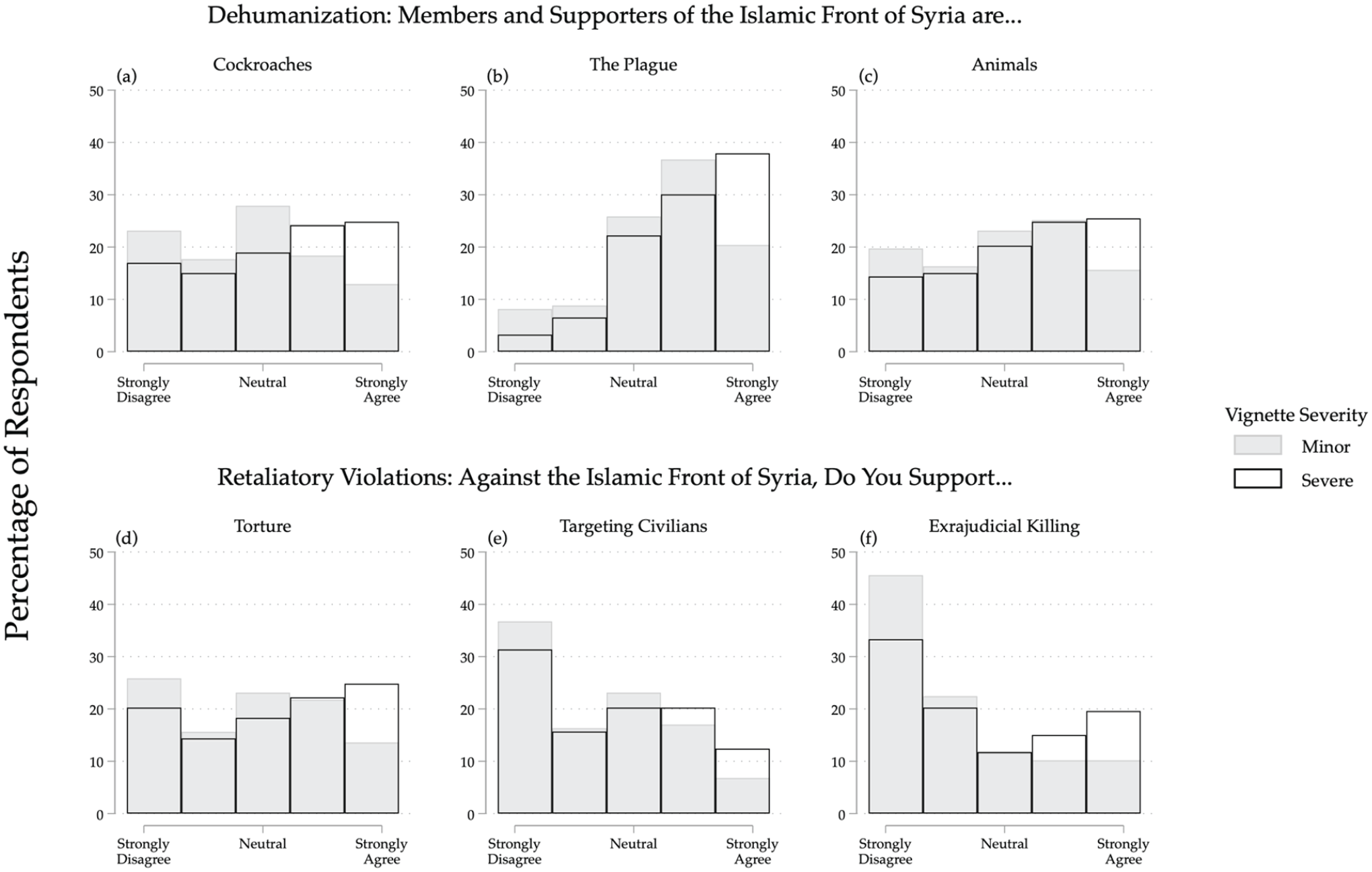
We measure specific attitudes about the IFS in response to the vignette in two areas. The first is the extent to which respondents agree with statements dehumanizing IFS members and supporters using three questions comparing them with cockroaches, a plague, and animals. Second, we measure support for retaliatory human rights violations against IFS members and supporters by asking respondents to rate their agreement with three statements suggesting torture, targeting noncombatants, and extrajudicial killings. All questions have five-point Likert scale response categories ranging from “strongly disagree” to “strongly agree,” 6 and the two sets of measures have high internal consistency (Cronbach’s α = 0.84 for the dehumanization items, Cronbach’s α = 0.78 for the retaliatory human rights violations items). The precise wording of the questions appears in Table 2. Figure 3 illustrates responses to these questions across the two vignette types and shows that the severe norm violation vignette is associated with increased dehumanization and support for retaliatory rights violations relative to the minor norm violation vignette. In what follows, we analyze these sets of variables both independently and using two z-standardized additive indexes.
Wording for Dehumanization and Retaliatory Human Rights Violation Items.

Note: All questions have five-point Likert scale response categories ranging from “strongly disagree” to “strongly agree,” with all “not sure” responses recoded as neutral. We use these clusters of survey items to create z-standardized additive indices for dehumanization and support for retaliatory human rights violations against the Islamic Front of Syria (IFS).
Distribution of emotional response variables by vignette type.
We include three variables measuring psychological traits as controls. First, research has shown that individuals vary on their propensity to experience disgust. We measure trait-level disgust propensity using the revised 25 question disgust scale (DS-R) developed by Olatunji et al. (2007), which is a revision of an earlier scale by Haidt et al. (1994). A number of scholars have found that the DS-R is highly correlated with anti-immigrant attitudes, anti-Muslim attitudes, nativism, and support for the death penalty and military interventions (Brenner and Inbar 2015; Inbar et al. 2012). In our data, we find that the DS-R has high internal consistency (Cronbach’s α = 0.89). We measure trait-level disgust using a z-standardized additive index of the 25 DS-R indicators.
Second, empathy is predicted to decrease disgust, dehumanization, and support for human rights violations. Empathy is defined as the ability to understand and share the feelings of another. 7 As with disgust, some people have high levels of empathy across situations, whereas others have lower levels. If participants can empathize with the victim of aggression, they may be more upset by it and more willing to support actions to stop the aggression. Silver, Karakurt, and Boysen (2015) found that those scoring high on empathy were more supportive of proactive behavior to help human trafficking victims (Silver et al. 2015:940–42). Batson et al. (2007) argued that empathy for victims can trigger “empathetic anger” which can lead to support for retaliation against the perpetrator of violence. We use the 16-question Toronto Empathy Questionnaire to measure empathy (Spreng et al. 2009). The measure has high internal consistency in our data (Cronbach’s α = 0.93).
Third, we control for trait-level social dominance orientation (SDO), a construct that captures an individual’s preference for a hierarchically organized society over a more equitable one (Pratto, Sidanius, and Levin 2006; Pratto et al. 1994). Previous work has shown that SDO is a powerful predictor of prejudice and discrimination (Pratto et al. 2006; Sidanius et al. 2017), sexism (Austin and Jackson 2019), support for war (Heaven et al. 2006), vengeance attitudes (including capital punishment) (McKee and Feather 2008), opposition to affirmative action (Haley and Sidanius 2005), and anti-immigrant attitudes (Cohrs and Stelzl 2010), and is negatively correlated with trait empathy (Pratto et al. 1994). As such, we expect SDO to be related to disgust, dehumanization of outgroups, and support for retaliatory human rights violations. We measure trait SDO with a z-standardized additive index using the 16-item SDO-7 scale (Ho et al. 2015). This measure has high internal consistency in our data (Cronbach’s α = 0.96).
Finally, we include several demographic controls collected before presentation of the vignettes. These include four binary variables indicating that a given respondent: (1) identifies as a woman, (2) identifies as white, (3) is older than 35 years, and (4) has at least some college education. We also include a five-category income variable, a variable measuring self-identification on a seven-point liberal-conservative scale, and a z-standardized additive religiosity index on the basis of six survey items 8 recoded to range from 0 (least religious) to 1 (most religious).
Modeling Strategy
Our hypotheses predict a causal chain between disgust, dehumanization, and support for retaliatory human rights violations that is intensified by more egregious rights violations on behalf of the outgroup in question. We test our hypotheses using a two-pronged modeling approach. We first estimate a series of linear regression models to both verify the baseline associations between our variables of interest and establish the possibility of mediation effects as predicted by our hypotheses. In addition to multivariable models, we also report results from bivariate linear regression models for each dependent variable–independent variable pair to ensure that our results are not driven by collinearity. To avoid distorting model results, we exclude the severe violation vignette dummy from models evaluating relationships between posttreatment variables (Montgomery, Nyhan, and Torres 2018).
Second, we use path analysis to simultaneously test the multiple mediation effects predicted in our theoretical model (Alwin and Hauser 1975; MacKinnon, Fairchild, and Fritz 2007). We use a bootstrapping approach including 95 percent bootstrap confidence intervals using 2,500 samples in Stata 16. Although we cannot test for direct relationships between the experimental treatment and multiple posttreatment outcomes, in this instance we can test the causal relationship between the severe norm violation vignette and disgust without potentially distorting the results for the posttreatment paths in the model. This is because each path specified in the model is represented by its own equation.
Results
Hypothesis 1 predicts that exposure to the severe norm violation vignettes will elicit disgust reactions in participants. The coefficient plot in Figure 4 display results of linear models regressing the severe norm violation vignette dummy on each emotional reaction, dehumanization prompt, and measure of support for retaliatory human rights violations. Model results are broadly consistent with hypothesis 1, suggesting that respondents who were exposed to the severe norm violation vignettes were significantly more likely to report feelings of disgust (β = 0.60, p < .001), anger (β = 0.53, p < .001), and sadness (β = 0.61, p < .001) in both bivariate models and models including psychological traits and demographic controls. We found no statistical relationship between vignette type and fear reactions in any model. There is some evidence for a direct effect of the severe violation vignette on dehumanization; respondents who read it were more likely to compare IFS members and supporters to cockroaches (β = 0.27, p < .05) and the plague (β = 0.31, p < .01) in full models. However, we only find evidence for a relationship between exposure to the severe violation vignette and one of our retaliatory human rights violations variables, support for extrajudicial killing (β = 0.27, p < .01) with the rest having no statistically significant effect (see Appendix B for a detailed table of full model results).

Coefficient plot for linear regression models assessing the impact of the severe violation vignette on posttreatment variables.
Hypothesis 2 predicts that feelings of disgust directed at norm-violating outgroups will make people more likely to dehumanize them. The coefficient plots in Figures 5a to 5c display results of linear models regressing emotional responses to the vignettes on each variable measuring dehumanization of IFS members and supporters (see Appendix C for a detailed table of full model results). The figures show that respondents who were disgusted by the vignette were more likely to compare IFS members and supporters to cockroaches (β = 0.15, p < .05), the plague (β = 0.17, p < .01), and animals (β = 0.20, p < .001). These results are broadly supportive of hypothesis 2. We find similar results with anger, which is statistically associated with all three dehumanization variables. In line with prior research, anger and disgust appear to have independent effects on dehumanization.

Coefficient plots for linear regression models on dehumanization and support for retaliatory rights violations against the Islamic Front of Syria.
Hypothesis 3 predicts that feelings of disgust directed at norm-violating outgroups will make people more likely to support retaliatory human rights violations against them. The coefficient plots in Figures 5d to 5f display results of linear models regressing emotional responses to the vignettes and our dehumanization index on support for retaliatory human rights violations against IFS members and supporters (see Appendix D for a detailed table of full model results). Figure 5d shows that disgust is associated with support for the use of torture only in the bivariate model (β = 0.19, p < .001). In full models, this relationship is driven out of statistical significance by the inclusion of the dehumanization index. We find that people who dehumanize IFS members and supporters are more likely to be receptive to torture (β = 0.47, p < .001), targeting noncombatants (β = 0.44, p < .001), and extrajudicial killing (β = 0.65, p < .001) as methods for dealing with them. These results support hypothesis 4—that respondents who dehumanize norm violators are more likely to support retaliatory human rights violations against them—and also hypothesis 5, that disgust reactions lead to support for retaliatory human rights violations primarily through dehumanization.
We now turn to the path analysis to explicitly test the relationships between our variables of interest using variables capturing emotional responses, alongside z-standardized additive indexes for dehumanization and support for retaliatory human rights violations (see Figure 1 for our theoretical model). All paths in these models include controls for individual psychological traits, gender, race, age, education, income, self-identification on a liberal-conservative scale, and religiosity. The path diagram in Figure 6 shows the model results. The fit statistics indicate an acceptable fit for the path model, including a nonsignificant χ2 statistic (χ2[2] = 2.27, p = .32, confirmatory fit index = 1.00, Tucker-Lewis index = 0.99, standardized root mean square residual = 0.01). Results indicate that the severe norm violation vignettes produced higher disgust reactions in participants (β = 0.60, p < .001), disgust reactions led to dehumanization of IFS members and supporters (β = 0.28, p < .001), and dehumanization generated support for retaliatory human rights violations against the IFS (β = 0.62, p < .001). We do not find evidence for a direct a direct relationship between feeling disgusted by the IFS and support for retaliatory human rights violations (β = 0.004, p = .91). However, we do find that the indirect effect of disgust reactions on support for retaliatory violations is statistically significant (β = 0.17, p < .001) and accounts for approximately 27 percent of the total effect of dehumanization. These results are consistent with the results of our linear regression models (see Figure 5) and support hypothesis 5, suggesting a central role for disgust in translating information about severe human rights violations into dehumanization of rights violators, which in turn raises support for retaliatory human rights violations.

Path diagram with mediation model results.
As robustness checks, we ran analyses excluding the path between the severe violation vignette dummy and disgust reactions 9 as well as analyses excluding all control variables. Similarly, because of substantive overlap between the dehumanization item comparing IFS members and supporters to cockroaches and the item measuring support for extrajudicial killings, we also reran our models using alternative two-item dehumanization and support for retaliatory human rights violation indices. Coefficients and significance levels for the structural paths drawn from our hypotheses are substantively similar for all these supplementary models.
It is possible that our findings for disgust are a result of “semantic confusion” between disgust and anger by the respondents (Nabi 2002). On the basis of previous literature, anger makes a more likely candidate than disgust to lead to a desire for retaliation (e.g., Clifford 2019). Empirically, our linear models show that anger is the only emotional response other than disgust that has a consistent relationship with both exposure to the severe norm violations vignette and our outcomes of interest. As a robustness check, we ran a second path model to simultaneously test the effects of anger and disgust on dehumanization and support for retaliatory human rights violations. Because anger and moral disgust tend to occur together (Giner-Sorolla and Chapman 2017; Heerdink et al. 2019; Molho et al. 2017), and the two reactions are moderately correlated in our data (r = .50), we allow the error terms to covary. 10 As with our previous model, fit statistics indicate acceptable fit including a nonsignificant χ2 statistic (χ2[2] = 1.89, p = .39, confirmatory fit index = 1.00, Tucker-Lewis index = 1.00, standardized root mean square residual = 0.01). Figure 7 illustrates the model results, which show that anger and disgust have similar relationships to both dehumanization and support for retaliatory human rights violations net of one another, though the effect of anger on support for retaliatory human rights violations may be weaker than that of disgust. 11 These results indicate that disgust has a significant and independent impact on dehumanization and support for human rights violations against outgroups.

Path diagram with mediation model including anger results.
Discussion and Conclusions
The expansion of international organizational networks has coincided with the diffusion of global human rights norms, which have been codified, institutionalized, and internalized around the world. Human rights practices have improved as a result; actions such as torture, which not long ago were considered routine, are now understood as abhorrent crimes against humanity (Boli 2005; Meyer et al. 1997). Marginalized people around the world invoke these norms to force domestic governments into compliance (Tsutsui 2018) and assert membership in the universal human community to strengthen their collective position vis-à-vis more powerful outgroups (Gorman and Seguin 2018, 2020). Although democratic states are reticent to violate their residents’ human rights (Conrad and Moore 2010; Davenport and Armstrong 2004; Hill and Jones 2014), widespread popular support may make internal and external violations more likely even in these contexts.
Under what circumstances might people support violating others’ human rights? Our results demonstrate that, when confronted with an outgroup that flagrantly violates human rights norms, American respondents found these outgroups disgusting. In this study, the minor (e.g., looting a town) and severe (e.g., executing aid workers) human rights violations of a terrorist group caused respondents to react with disgust toward this group, leading respondents to dehumanize them and to express support for violating their human rights. Notably, one of the indicators of support for violating the outgroup’s human rights focused on retaliatory attacks against civilians living in the outgroup’s territory, suggesting that participants supported violating human rights of both past perpetrators as well as noncombatants purportedly associated with them.
Although these findings are robust to a number of model specifications, there is potential for reverse causality. First, it is possible that people who support human rights violations may be more likely to dehumanize others to justify their beliefs. Supplemental models indicate that we cannot rule out this possibility; we urge future research to explore the relationship between dehumanization and support for human rights violations. Second, it is possible that a desire for vengeance may occur prior to both dehumanization and feelings of disgust directed at outgroups. To address this, we ran supplemental path analyses testing causal pathways between support for retaliatory violations and disgust as well as dehumanization and disgust. Although the former indicates a statistically significant path, fit indices for both supplemental models indicate very poor model fit. As such, it is likely that feeling disgusted by an outgroup has a causal relationship with dehumanization and support for human rights violations against said outgroup rather than the other way around.
That people make exceptions to the application of human rights norms on the basis of emotional responses to outgroups has implications for international relations and the maintenance of the global order. Because disgust is difficult to reverse once invoked (Danovitch and Bloom 2009; Hutcherson and Gross 2011; Rozin et al. 1986; Russell and Giner-Sorolla 2011b, 2013), a political discourse centered on disgust toward an outgroup may foster support for extended military interventions as well as support for, if not acquiescence toward, human rights violations against that group as well as civilians who are geographically or culturally proximate to them (Al-Ali, Pratt, and Enloe 2009; Hippel et al. 1999). Human rights violations on behalf of democratic states in defense of global human rights norms could spur additional violations by targeted actors, leading to a cycle of violence. Likewise, human rights violations in the name of humanitarian interventions can lead to the impression that global human rights norms are unfairly or inconsistently applied, undermining the idea of universal rights altogether (Ayoob 2002; Gorman 2019).
This study presents several directions for future research. First, it is unclear whether our experimental manipulation—which refers to looting, arson, beatings, and sex slavery—elicited bodily disgust, moral disgust, or both (Chapman and Anderson 2013; Giner-Sorolla and Chapman 2017). Future work should explicitly invoke each form of disgust to test which may lead to dehumanization and support for retaliatory human rights violations. Second, our disgust prompts focus primarily on behaviors rather than beliefs. Scholars might directly test whether holding morally repugnant beliefs also elicits disgust. Third, future experiments should probe these relationships in contexts outside of the Islamic State, as Americans and Westerners may be primed to find the Islamic State inherently disgusting. Future scholarship may seek to replicate our findings using vignettes that focus on domestic hate groups that may be more culturally familiar to Americans. Fourth, our model should be tested with a nationally representative sample and on subjects outside of the United States to examine the generalizability of the findings. Fifth, although results indicate that Americans draw little distinction between violating the human rights of active perpetrators and passive civilians, our survey experiment was not designed to test differences in responses across these two categories of actors. We encourage future scholars to explore the degree to which disgust directed at human rights violators can mobilize people for violence against noncombatants associated with them.
Supplemental Material
sj-docx-1-srd-10.1177_23780231231157686 – Supplemental material for Crossing the Line: Disgust, Dehumanization, and Human Rights Violations
Supplemental material, sj-docx-1-srd-10.1177_23780231231157686 for Crossing the Line: Disgust, Dehumanization, and Human Rights Violations by David L. Rousseau, Brandon Gorman and Lisa E. Baranik in Socius
Supplemental Material
sj-docx-2-srd-10.1177_23780231231157686 – Supplemental material for Crossing the Line: Disgust, Dehumanization, and Human Rights Violations
Supplemental material, sj-docx-2-srd-10.1177_23780231231157686 for Crossing the Line: Disgust, Dehumanization, and Human Rights Violations by David L. Rousseau, Brandon Gorman and Lisa E. Baranik in Socius
Footnotes

Supplemental Material
Supplemental material for this article is available online.
1
Disgust propensity refers to the individual tendency to experience disgust in response to negative stimuli. More disgust-prone people experience disgust more often and to a wider range of stimuli than less disgust-prone people (Haidt et al. 1994; Olatunji et al. 2007; Tybur et al. 2009; van Overveld, de Jong, and Peters 2010).
2
3
To qualify for the study, MTurk participants had to be located in the United States, to have a 95 percent approval rating, and to have completed 1,000 hits. All questions were randomized within each section of the survey, except for reactions to the vignettes and demographic questions.
4
A Google Trends analysis of the topics “Syrian Civil War” and “Islamic State of Iraq and the Levant” indicates that media coverage of these topics was two to five times higher during the data collection period than in December 2022. Coverage peaked in late October 2019, following the U.S.-led raid in northern Syria that resulted in the death of Islamic State leader Abu Bakr al-Baghdadi.
5
We included four attention check screeners in the survey before the experimental treatment. Any participant who failed two or more of these checks was dropped from the analysis. As a robustness check, we reran all of our models keeping these participants in our data with substantively similar results.
6
We recoded all “not sure” responses as belonging to the neutral category. As a robustness check, we reran all of our models dropping respondents who gave “not sure” responses with substantively similar results.
7
8
This index, which we use as a control, has high internal consistency in our data (Cronbach’s α = 0.93).
9
For this model, we restricted the variance of the disgust reaction to 1 to meet the minimum condition of identifiability.
10
Supplemental models excluding this covariance structure produce similar coefficients and p values but unacceptable fit indices.
11
Although the indirect effect of anger through dehumanization is positive (β = 0.13, p < .01), its direct effect is marginally negative (β = −0.08, p < .10), rendering its total effect statistically null (β = 0.05, p = .35). Disgust, on the other hand, has a positive indirect effect (β = 0.12, p < .01) and null direct effect (β = 0.04, p = .47), making the total effect positive and statistically significant (β = 0.15, p < .01).
Author Biographies
References
Supplementary Material
Please find the following supplemental material available below.
For Open Access articles published under a Creative Commons License, all supplemental material carries the same license as the article it is associated with.
For non-Open Access articles published, all supplemental material carries a non-exclusive license, and permission requests for re-use of supplemental material or any part of supplemental material shall be sent directly to the copyright owner as specified in the copyright notice associated with the article.
