




Abstract
On the basis of ethnographic and historical accounts, many movement scholars hold that differences in political expectations and interaction styles inhibit cross-racial collaboration in social movements. Inspired by this research, the authors ask three questions about minority participation in social movements and address them using a survey of more than 6,000 participants in the anti–Iraq War movement. First, the authors ask about relational inequality. Did Black protesters have fewer ties with the antiwar movement than Whites? Second, the authors ask about siloing. Were Black protesters disproportionately concentrated in specific movement organizations? Third, the authors ask if patterns of inequality were similar for Latino and Asian activists? The authors find evidence of relational inequality for Black activists but not Latino or Asian activists. They find evidence of siloing for all three ethnic groups. These empirical results are used to articulate an account of racialized activism with special attention to organizational processes.
Since the 1960s, sociologists and political scientists have conducted surveys at protest events to understand social movement participation (Fisher 2019; Heaney and Rojas 2015; Jasper and Poulsen 1995; Scaminaci and Dunlap 1986; Seidler, Meyer, and MacGillivray 1976; Walgrave and Verhulst 2011). Empirical studies at early twenty-first century protests, such as anti–Iraq War demonstrations and the March for Science, often show that the proportion of Black protesters is lower than the general population when the movement is not directly related to racial inequality (Fisher 2019; Heaney and Rojas 2007, 2015). There is parallel research suggesting that Black activists, and other non-White groups, may experience conflict and exclusion within predominantly White social movement spaces (Cole and Luna 2010; Lichterman 1995, 2021; Luna 2010; Yukich, Fulton, and Wood 2020). These scholars have often argued that status differences and diverging interactional styles exacerbate internal movement differences (Diaz-Veizades and Chang 1996; Lichterman 1995; Yukich et al. 2020). On the basis of ethnographic accounts of social movement organizations, these studies indicate that White and non-White activists enter activist spaces with different political repertoires and expectations, which decreases solidarity between White and non-White activists (e.g., Lichterman 1995; Luna 2010). Thus, retention of non-White activists is likely to become a serious issue for many social movements. Taken together, this diverse scholarship suggests that it is important to study movement participation as a multistage process.
A great deal of research addresses the initial steps of how people are recruited into a movement, such as studies of the role of social networks in recruiting and biographical availability of potential protesters (e.g., Gould 1996; McAdam and Paulsen 1993; Munson 2010; Viterna 2006). In contrast, in this article we focus on post-recruitment processes, especially the role of social movement organizations. How do the experiences of Black and other non-White activists once they have joined the movement differ from those of White activists?
This article is organized around the following questions pertaining to the participation of Black activists in large-scale protest events. First, we ask about relational inequality within a social movement. What evidence was there that Black activists were less likely to have a social connection with a movement organization? Were Black activists less likely to participate in social movement activities? Were they less likely to be repeat participants at protest events? Second, we explore intramovement siloing of Black activists. Was there evidence that Black activists were clustered within particular organizations? If so, what types of organizations maintained social ties with Black activists? Third, how robust are these findings? Did participation patterns look different for other non-White minorities, such as Latino and Asian activists?
We address these questions using a survey of more than 6,000 people who attended large anti–Iraq War protests in the United States from 2007 to 2010 with respect to relational inequality. We report that Black activists were less likely to have been repeat protest participants and to have attended a movement training session. There were no statistically significant differences between minority activists and White activists in terms of having an organizational contact with a social movement organization when control variables are taken into account. With respect to siloing, we produce evidence that Black, Latino, and Asian activists were disproportionately clustered in movement organizations that are either politically radical or focused on racial inequality.
These results enrich our theoretical understanding of how social movements interact with individual activists and how movements retain activists. First, the findings reveal ways that racial stratification is an important feature of social movement participation. Social movements, as much as other organizations, are racialized in the sense that participation inside the organization reflects larger racial hierarchies. Second, significant racial inequalities emerge in later stages of social movement participation. This quantitative evidence complements and extends multiple qualitative studies of social movements that document the challenges of cross-racial organizing. Third, these results are consistent with the view that minority participation in the antiwar movement, and other non-race-focused movements, might be characterized, in part, by a “leaky pipeline” (Blickenstaff 2005), typified by people leaving a movement and by disproportionate concentrations of minority activists in groups that specifically focus on racial inequality.
In the next section, we review the literature on protest surveys and minority participation in protest. We present questions to be addressed with survey data. Then, we discuss the specific case of minority participation in the anti–Iraq War movement. In the “Data and Methods” section, we describe the survey, and in the following section, we present results. In the “Discussion” section, we use the results to motivate a theory of racialized participation in social movements and review the study’s limitations. In the conclusion, we propose avenues for future research.
Non-White Activists and Theories of Social Movement Participation
Social movement scholars have articulated well-developed accounts of social movement recruitment. This research identifies a number of factors that encourage movement participation, such as the presence of social ties between potential recruits and social movement organizations (Gould 1996; McAdam and Paulsen 1993; Munson 2009; Viterna 2006), exposure to media produced by a movement (Vasi et al. 2015), and being at a point in the life course where an individual may have the time needed for protest participation (Munson 2010). A number of studies have used nationally representative samples to identify demographic factors that are associated with protest participation (e.g., Beyerlein et al. 2018). Studies that examined data from the late twentieth century showed that Black survey respondents are more likely to be recruited for protests than White respondents, which may reflect participation in civil rights actions (McVeigh and Smith 1999). More recent research using nationally representative samples often shows that Black respondents report higher rates of protest participation (Beyerlein et al. 2018; Caren, Ghoshal, and Ribas 2011; Corrigall-Brown 2012).
Another strand of research focuses on postrecruitment processes and yields different results. Since the 1960s, scholars have fielded surveys at protests to understand the demographic composition of people who have already chosen to participate. The earliest surveys did not include questions about the respondent’s race or ethnicity (Jasper and Poulsen 1995; Scaminaci and Dunlap 1986; Seidler et al. 1976). However, researchers in the 2000s began including a battery of standard questions about the demographic characteristics of respondents in large-scale American protest events (e.g., Fisher 2019; Heaney and Rojas 2014, 2015).
In general, these studies show that the proportion of protesters who were Black was lower than in the general population, with the exception of crowds that assemble for movements that primarily challenge racial inequality, such as Black Lives Matter (BLM). The list of predominantly White movements includes protests against the Iraq War in the Bush and Obama administrations that were 77 percent to 82 percent White (Heaney and Rojas 2007), and protests at the Democratic and Republican presidential nominating conventions in 2008 were 88 percent White (Heaney 2016). Fisher (2019:45) showed similar results for an anti-Trump resistance protest (77 percent White), the Women’s March (77 percent White), and the March for Science (80 percent White). Frequently, fewer than 10 percent of these demonstrators were Black. At one event surveyed by Fisher, the People’s Climate March, only 3 percent of protesters were self-identified as Black. Fisher also reported that 1 percent of March for Science demonstrators who were surveyed were Black.
Ethnographers and historical sociologists have developed rich accounts of the racial stratification processes found within modern American social movements. A common theme is that Whites and non-Whites often enter social movement spaces with significantly different understandings of the movement’s goals, as well as variation in political behaviors (Lichterman 1995, 2021). For example, Luna (2010) argued that Black and White participants in the March for Women’s Lives relied on substantially different movement framings, which exacerbated differences. A key issue was that White participants often framed access to reproductive rights as a matter of choice in contrast to an issue of justice. These different framings required activist leaders to rearticulate movement frames and make them visible, an often precarious process (Appel 2003). In a similar vein, Yukich et al. (2020) noted that it is extremely difficult for organizations to maintain diverse constituencies unless they make conscious efforts to recognize different “group styles.” Using a mixed-method approach, they showed that when organizations make a conscious effort to include interactional styles from immigrant justice groups, they are more likely to have immigrant participation. Many organizations tend to use more impersonal interactive styles associated with middle-class, college-educated people, and they are less likely to attract a socially diverse constituency (Yukich et al. 2020:498).
Other studies draw attention to the fact that broader racial inequalities can undermine attempts to encourage cross-racial solidarity. Eder, Staggenborg, and Sudderth’s (1995) study of the National Women’s Music Festival showed that organizers did attempt to produce a multiracial music event that was inclusive of lesbians and nonlesbians. They were successful in generating a diverse constituency, but at the same time, participants often sorted into similar enclaves. Organizers found it difficult to simultaneously address the interests of all groups involved. Diaz-Veizades and Chang (1996) documented how two Los Angeles area organizations were founded on an interracial basis but eventually were undermined by long-standing racial conflicts, such as those among Korean, Black, and Latino residents. Brown and Brueggemann’s (1997) analysis of the labor movement illustrates how these cross-cutting pressures may initially fail but can be surmounted. In their historical analysis of northern cross-racial labor mobilizing, they argued that interracial mobilizing was undermined by Black strikebreakers in 1919, but cross-racial mobilizing in a later 1937 wave of strikes was facilitated by new conditions of production that reduced Black-White conflict. A similar dynamic is found in Jung’s (2006) historical analysis of labor mobilization in Hawaii. Jung documents the concentration of a multiethnic labor force in a small number of firms facilitated a collective consciousness.
To summarize, studies of American protests tend to show relatively low rates of minority participation when the event does not focus on racial inequality. Qualitative studies often highlight that interactional differences, divergent expectations, and enduring inequalities are significant barriers to effective cross-racial or interracial organizing.
Relational Inequality and Siloing
Diverse studies reinforce the lesson that that cross-racial cooperation in movements, and in other organizations, is challenging (Strolovitch 2006; Yukich et al. 2020). Many, if not most, organizations may fail at this goal (Kalev, Dobbin, and Kelly 2006). Together, these studies establish that minority participation in social movements is characterized by two empirical regularities. First, there are relational inequalities within movement organizations (Tomaskovic-Devey 2014). If it is the case that cross-racial mobilization is often prevented by differences in shared framings, interactional styles, and political goals, then one would expect minority activists to have fewer ties with social movement organizations and to be less involved with movement activities. Second, if these obstacles are not appropriately countered, minority activists might be associated with a smaller group of organizations that specifically incorporate racial inequality into their identities. That is, social movement organizational fields may develop niches that are more inclusive of non-White activists. In this section we motivate these two expectations by drawing on research on relational inequality and racialized organizations.
A number of scholars have argued that inequality is less about the creation of categories, such as gender and race, and more about how relationships are established and managed within specific institutional settings. Multiple authors in this area of scholarship have connected inequality to interactional processes (e.g., Avent-Holt and Tomaskovic-Devey 2014; Tomaskovic-Devey 2014; Vallas and Cummins 2014). Tomaskovic-Devey (2014) summarized this view by noting that organizational inequality is linked to processes such as resource pooling, claims making, and opportunity hoarding. He also noted that this literature also focuses on how organizational inequalities are installed and deepened through interactional processes. The arguments offered by scholars of organizational inequality directly speak to the issues raised by scholars of cross-racial mobilization. If a social movement organization leadership’s is unable, or unwilling, for example, to use group styles associated with minorities, then they could prop up hierarchies that encourage relatively low participation. Similarly, if movement leadership is not careful to counter the tendency to monopolize organizational resources or hoard opportunities, race-based inequalities may emerge in movement groups.
Relational inequality theory suggests that movement organizations, like many other organizations, are racialized in the sense that Whites are taken to be a de facto dominant group; opportunities within the organization are tied to this status (Ray 2019; Stewart, Garcia, and Petersen 2021). At the level of an individual social movement organization, ethnicity (and Whiteness in particular) may be treated as a taken-for-granted status. Membership in a specific ethnic group becomes a de facto credential for access to the resources that an organization possesses. From this perspective, organizations themselves are mechanisms for creating and maintaining racial stratification. Opportunity hoarding, exclusion from decision-making processes, and the establishment of race-based hierarchies all occur within the confines of organizations. The result is that many organizations become “White spaces” where the dominant ethnic group is the standard and minorities experience systematic exclusion (Anderson 2015; O’Doherty et al. 2013). Furthermore, it may be the case that movement leaders are unaware of the pattern of exclusion that has emerged within social movement organizations.
At the level of organizational fields, scholars have noted that organizational populations themselves may be structured around race (Rojas 2017, 2019; Wooten and Couloute 2017). A key insight is that organizations must contend with a broader institutional environment that includes schemes of racial classification. These racial classifications may induce hierarchies within fields, as organizations that have minority constituencies will be of lower status (Wooten 2015). Furthermore, conflict over such racial classifications can lead to divisions and field bifurcations. Actors who dispute racial classifications might innovate new organizational forms that focus on the interests of racial and ethnic minorities. The ultimate result is that social movement organizations develop niches that are populated by organizations that are, for whatever reason, able to incorporate the different group styles of minority activists (Yukich et al. 2020).
These arguments suggest that the field of movement organizations may exhibit by relational inequality within a single organization, as well as the clustering of activists within organizations that incorporate the representation, and interactional styles, of a specific group. This later point about the “siloing” of minority activists in specific organizations reflects the multidimensional nature of a political group’s identity. Scholars of social movements and interest groups routinely note that organizations develop niches, in part, to represent specific constituencies as well as specific issues (Heaney 2004). Thus, the siloing of activists may indicate the stratification of the larger movement along racial, as well as policy, dimensions.
The Case: Minority Participation in the Anti–Iraq War Movement
Motivated by this discussion of relational inequality and siloing among protesters, we turn to the anti–Iraq War movement of the Bush and Obama administrations. From the invasion of Iraq in 2003 through the later occupation, American peace activists staged years of protests that critiqued the Bush administration’s decision to go to war and to promote various antiwar policies, which included immediate withdrawal, the limitation of troop deployments, and reduced military spending (Heaney and Rojas 2015; Tarrow 2015; Walgrave and Rucht 2010).
The anti–Iraq War movement grew out of more limited protests staged by peace groups in the period after 9/11, when the invasion of Afghanistan revived a movement that had decayed since the 1990s (Heaney and Rojas 2015). As the Bush administration indicated its intention to invade Iraq, large coalitions, such as United for Peace and Justice (UFPJ), were created to organize large-scale protests and lobby for antiwar policies. Scholars and journalists have noted that the movement peaked circa 2006, when the Democratic Party took control of Congress (Heaney and Rojas 2011). Following a change in partisan control of Congress and Barack Obama’s election as President in 2008, the anti–Iraq War movement significantly declined.
Even though this movement has received considerable scholarly attention, few analyses have investigated the specific role that Black, Latino, or Asian activists had in this movement. Still, there is research that provides some information on the relationship of non-White people to the antiwar movement. Specifically, public opinion surveys indicate that Black activists would be an important part of the antiwar coalition because of their pronounced and sustained disagreement with the war (Carrol 2004; Dawson 2003). Throughout much of the Iraq War, major news organizations and polling groups published multiple polls assessing American attitudes toward the Iraq War (e.g., Pew Research Center 2008). One additional survey (Dawson 2003) contains responses from a nationally representative sample of Americans, with an oversampling of Black Americans. Academic research has also focused on the attitudes of members of the armed services (Rohall and Ender 2007), which are important because veterans often become notable antiwar activists (Carver, Cortright, and Doherty 2019; Heaney and Rojas 2006; Leitz 2014). These surveys tend to show that Black respondents were opposed to the war at rates that often surpassed Whites’ disapproval of the war. At least one poll directly asked respondents to rank the importance of the Iraq War as an issue and showed that Black respondents ranked the war as highly as did Whites (Roper Center at Cornell University 2006).
At the same time, some journalistic accounts indicate that the racial dynamics documented by Luna (2010), Yukich et al. (2020), and Eder et al. (1995) were also present in the anti–Iraq War movement. These reports indicate that differences in expectations and de facto exclusion were experienced by some Black and Brown activists, with some activists openly accusing movement leaders of racism (Bloom et al. 2003; Miah 2003; Williams 2003). As a result, it is important to look for evidence of relational inequality and siloing in the movement.
Research Questions
Relational Inequality
Work on interactional styles and civic action reveals that some racial and ethnic minorities may not be full participants within movements (Lichterman 1995, 2021; Luna 2010; Yukich et al. 2020). This research suggests that Black activists have fewer contacts with political movements and they are less likely to participate in movement activities. This possibility is important in the context of social movement theories, which assert that contacts between activists and social movement organizations are crucial for recruitment, retention, and commitment to high-risk activism (e.g., McAdam and Paulsen 1993; Viterna 2006). This analysis implies that Black activists have fewer contacts with the institutions defining a movement. Thus, we ask, Did Black activists have fewer recruitment ties with social movements than did Whites? Did Black activists participate in social movement activities at a lower rate than White activists?
Organizational Silos
Theories of racialized organizations and fields suggest that social movement organizations may become more racially homogenous than the general population (Ray 2019; Rojas 2017; Wooten and Couloute 2017). As movement organizations may have difficulty in adopting varied group styles, minority participation may be low. Empirically, one would expect Black activists to be underrepresented in the typical social movement organization. Following the idea that disputes over racial classifications might lead to differentiation within organizational fields, one might also expect there to be some organizations within a social movement that signal strong representation of minority interests. The audiences for such an organization might have disproportionately large numbers of racial and ethnic minorities. We ask, What evidence was there of clustering of Black activists within particular social movement organizations that recruited support for the antiwar movement? How did racially conscious organizations account for Black representation within a social movement?
Variation in Relational Inequality and Siloing
There is no reason to assume that different minority activists participate in social movements in similar ways. Rather, one would expect that status differences among minorities, which reflect distinct historical trajectories and power relationships to the majority, lead to different modes of political participation. One hypothesis would be that all minority activists would exhibit highly similar relations with social movements. In contrast with this null hypothesis, one might expect variations in exclusion and separation. Thus, we ask, Did non-Black activists exhibit relational inequality and siloing that is similar to Black activists? In what ways was the inequality experienced by Latino and Asian activists different from that experienced by Black activists?
Research Methods and Data
Survey Data
From 2007 to 2010, the authors conducted surveys of people who participated in anti–Iraq War rallies in major metropolitan areas. Respondents were asked about their basic sociodemographic characteristics, their political identification and behavior, and their connections to the movement. During the study, we attended antiwar rallies, smaller events organized by activists, and followed antiwar Web sites and list servers. This immersion allowed us to know when and where major national antiwar rallies were going to be held. The antiwar movement staged national rallies in response to events. These included an annual protest on the anniversary of the invasion of Iraq in March, the inauguration of President Obama, and protests held in the late summer during the Democratic and Republican conventions. As a result, the antiwar movement generated protest waves about three times a year during the height of the movement. During each protest wave, leading antiwar groups organized marches in major metropolitan areas such as Chicago, New York, Boston, San Francisco, and Washington, DC.
Our data come from surveys of protests happening in these urban centers. Given budget constraints, it was not possible to attend all events but we were able to obtain data from around the nation. We fielded multiple surveys in locations where the antiwar movement was especially active, such as Washington, New York, and Chicago (Table 1).
List of Events at Which Surveys Were Conducted.

Survey Method
After we identified places where major antiwar rallies were to be held, we hired teams of surveyors to attend events and field the survey. To survey such a group of people, we adopted a modified version of exit polling. Prior research on crowd sampling validates this method as a way to reduce selection bias (see Walgrave and Verhulst 2011 and Yuen et al. 2022 for reviews). Surveyors were instructed to spread out evenly at one end of the crowd and walk toward the other side. They were instructed to extend an invitation to one person, whom we call the “anchor,” count past this anchor, and choose the fifth person they saw. This procedure reduces bias that may be associated with respondent selection (e.g., male surveyors choosing men). This process was then repeated. If the crowd began to move, we instructed our surveyors to follow the crowd and continue using the procedure of identifying an “anchor” and then move deeper into the crowd. The response rate was 80 percent. This response rate is similar to, or exceeds, the response rates of major surveys such as the General Social Survey (2022), which typically has a response rate of 60 percent to 70 percent.
Survey Instrument
Respondents were asked to complete a two-page survey with both closed-form and open-form questions. The first page of the instrument included standard measures of social status and political behavior, while the second page contained additional questions about movement participation and questions that changed depending on the circumstance (e.g., whether the respondent preferred Obama or Clinton in the 2008 Democratic primary). It asked about race, gender, age, educational attainment, income, and the respondent’s ZIP code, which was used to estimate distance traveled to the protest. The survey also asked respondents about political partisanship and to indicate political ideology from 1 (“very liberal”) to 7 (“very conservative”). Data were also collected about the relationship of the individual to the movement, such as if the person had been contacted by an organization to participate in the event, if they had attended prior antiwar protests, and if they had attended antiwar training sessions. If a respondent indicated that they were recruited by an organization, then they were asked to list all recruiting organizations. Those organizational data were used to assess whether Black activists were disproportionately affiliated with some organizations.
Table 2 contains the descriptive statistics from the surveys. In terms of gender, the sample was 51 percent female. The sample was highly educated, with 64 percent having a college degree or higher, compared with approximately 34 percent of the U.S. population that had a bachelor’s degree or higher (U.S. Census Bureau 2020). Consistent with earlier protest surveys of non–racially focused protest, Whites were over-represented (81 percent), and Black (7 percent) and Latino (7 percent) respondents were underrepresented in comparison with the U.S. population (see U.S. Census Bureau 2021 for population measurements in 2010 and 2020). Asians were underrepresented in our sample (4 percent) compared with 5.4 percent in the population. The analyses also include an “other” category, as 5 percent of respondents indicated racial categories other than Black, White, Latino, or Asian. With respect to the study’s dependent variables, it shows that roughly 39 percent of protest participants were recruited by a social movement organization, 27 percent had previously attended a protest training session, and 76 percent had previously attended an antiwar protest.
Descriptive Statistics.

Note: Political attitudes were assessed as follows: 1 = “very liberal” to 7 = “very conservative.”
Missing Data
As noted earlier, the response rate for our surveys was high (80 percent overall), which is similar, or exceeds, the response rate for major social science surveys such as the General Social Survey. Still, to account for potential bias introduced from missing data, we applied chain imputation where any given independent variable is imputed using complete cases from the other independent variables (Zhang 2003). Furthermore, two measurements of political attitudes, the liberal-conservative scale and a variable indicating that the respondent believed they were “radical,” were only recorded at a few protest sites. Thus, to estimate models with similar numbers of cases, missing values for these variables are estimated.
Results
Relational Inequality
We examine three measures of relational inequality: (1) organizational contact, (2) repeat protest, and (3) training session. For each measure, we estimate two logistic regression models with that measure as the dependent variable. The first specifications contain independent variables only for race/ethnicity. The second specifications also include independent variables for age in years, female, college or higher education, income, log of distance traveled, Democratic Party member, political attitudes, and radical identity. Comparison of the first and second specifications reveals the effects of the control variables on the analysis. Estimates of these models are reported in Table 3.
Model of Organizational Contacts, Repeat Participation, and Social Movement Training Session.

Note: The estimation method is logistic regression.
p ≤ .050. **p ≤ .010. ***p ≤ .001.
The first set of results for organizational contact is reported as model 1.1. These results indicate that Black respondents had significantly fewer contacts than respondents identified with other racial/ethnic categories. However, when control variables are added to model 1.2, this difference is no longer statistically significant. Any effect of race/ethnicity is accounted for by age, gender, income, distance traveled, Democratic partisanship, and political attitudes. Thus, expectations for relational inequality are not upheld using the organizational contact measure.
The first set of results for repeat protest is reported as model 2.1. These results show that Black and Asian respondents were significantly less likely to engage in repeat protests than were respondents identified with other racial/ethnic categories. When control variables are introduced in model 2.2, the result holds up for Black respondents but not for Asian respondents. Thus, the analysis upholds the expectation of relational inequality as measured by repeat protest for Black respondents, robust to significant effects of age, distance traveled, Democratic partisanship, political attitudes, and radical identity.
The first set of results for training session is reported as model 3.1. These results demonstrate that Black respondents were significantly less likely to attend a training session than were those who identified with another race/ethnicity. This conclusion is unchanged when control variables are added to model 3.2. Black respondents were less likely to be present at training sessions, even after accounting for significant effects from age, distance traveled, Democratic partisanship, political attitudes, and radical identity.
Overall, the estimates in Table 3 are consistent with expectations for relational inequality with regard to two of three measures. These expectations are confirmed with respect to repeat protest and training session but not with respect to organizational contact. In some models, control variables are associated with changes in the magnitude and direction of the relevant coefficients. For the model of organizational recruitment, control variables reverse the sign of the Black coefficient (from −.21 to +.08) but it is not statistically significant. We observe less dramatic, but notable reductions in the negative Black coefficient for repeat protest (37 percent) and protest training session (27 percent). Thus, some of the relational inequality is likely due to the demographic profile of Black respondents.
Siloing
If the field of antiwar organizations exhibited siloing of Black activists as suggested by theories of racialized fields, we would expect most Black respondents to follow either the large coalitions that sponsored protests such as the ANSWER Coalition or niche radical or Black-conscious organizations. In contrast, most other organizations would have few, if any, Black recruits.
If the antiwar movement did not have a tendency toward siloing, then we would expect that participants would have been randomly distributed throughout organizations with respect to race or ethnicity. A visual inspection of the data shows that this is not the case. Figures 1 through 4 show the distribution of ethnicity for organizational contacts with White, Black, Latino, and Asian activists. Figure 1 shows that most organizations recruit predominantly White activists. Figures 2, 3, and 4 show that Black, Latino, and Asian activists have a different pattern of contact with movement organizations. In each case, the distribution is bimodal. A notable portion of organizations recruit very low percentages of non-White activists, while another group of organizations recruit large numbers of non-White activists. A Shapiro-Wilk (Shapiro and Wilk 1965) test of the four distributions shows that each is unlikely to follow a normal distribution. The W scores are 0.83, 0.88, 0.91, and 0.90 for the four variables, with p < .001 for all four distributions.

Distribution of White antiwar activists contacted by an organization.
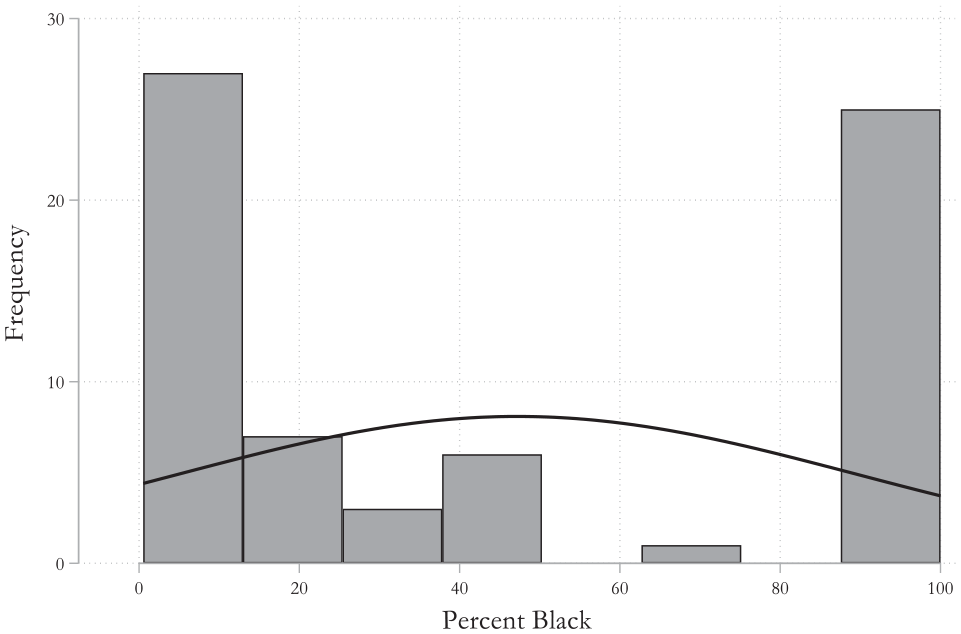
Distribution of Black antiwar activists contacted by an organization.

Distribution of Latino antiwar activists contacted by an organization.

Distribution of percent of Asian antiwar activists contacted by an organization.
The organizational contacts listed in Table 4 illustrate the nature of clustering in the movement by enumerating the largest 20 recruiting organizations and breaking down the recruiting group by race. The ANSWER Coalition recruited 389 people who responded to the survey, 14 of whom were Black (4 percent). Seven UFPJ recruits among 273 respondents (2.5 percent) were Black. Other organizations had similarly low levels of Black recruitment, with Code Pink, MoveOn, and World Can’t Wait at 0.5 percent, 2.3 percent, and 3.4 percent, respectively. Even though the top five organizations recruited 1,093 people, only 2.7 percent were Black.
Top Organizations with the Most Recruiting Contacts by Race.
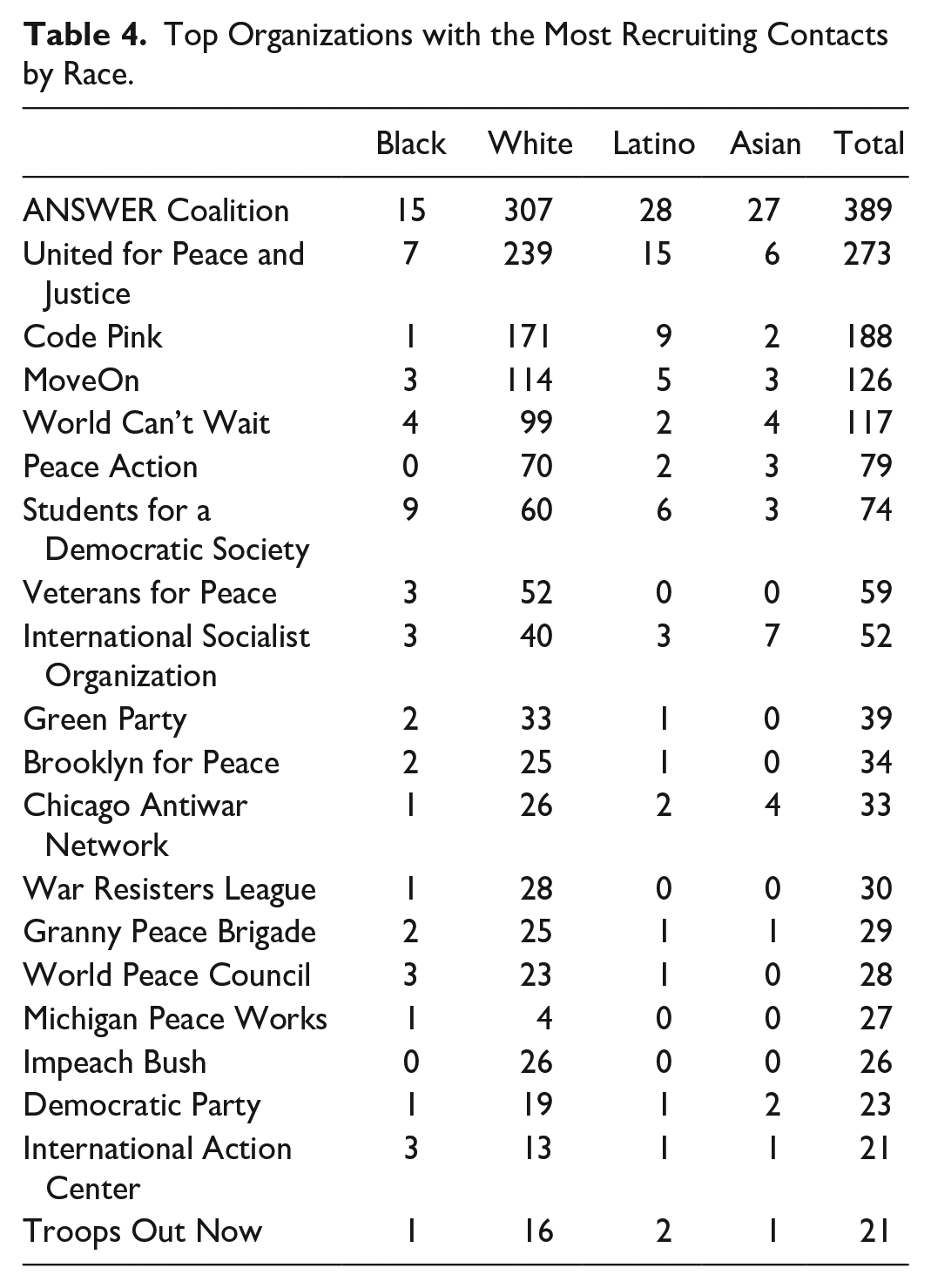
The theory of racialized fields suggests that some organizations would develop identities that would specifically appeal to Black activists. Table 4 identifies the radical groups that attracted Black activists. Among the top 20 organizations, the only 2 organizations with more than 10 percent Black recruits were Students for a Democratic Society and the International Action Center. These two organizations were left leaning. Students for a Democratic Society, an organization founded in 2006, identified itself as a continuation of the radical 1960s-era organization with the same name, and the International Action Center (2022) identified itself as an anti-imperialist organization.
Table 5 approaches the issue of siloing from a slightly different angle. Rather than ask which organizations had very high, or low, concentrations of Black activists in the recruiting network, we ask which organizations recruited high absolute numbers of Black activists. In this way, Table 5 assists with identification of such groups. This table lists the top 20 organizations that recruited Black activists. As the absolute number of Black recruits in the sample is small, it does not take much to be among the top Black-recruiting organizations. It only took three Black recruits in the sample to be in the top 20 Black-recruiting organizations.
Top Organizations with the Most Black Recruiting Contacts.

The organizations in Table 5 include the two largest coalitions, a few far-left groups such as Students for a Democratic Society, and a number of organizations that define themselves in terms of Black interests. Such groups include the Black Is Back Coalition and the International People’s Democratic Uhuru Movement. These two tables present strong evidence for the siloing of Black activists. Blacks are underrepresented within many, if not most, organizations that recruited for the antiwar movement. The few organizations that recruit more than a handful of Black activists were large coalition groups, left-leaning organizations, or groups that focus on Black interests.
Latino and Asian Activists
The evidence presented above demonstrates the existence of relational inequality and siloing in the antiwar movement for Black activists. The results already discussed earlier in Table 3 do not evince relational inequality for Latino or Asian activists. The coefficients for Latino and Asian ethnicity are negative, but they do not meet the α = 0.05 threshold.
Tables 6 and 7 produce the siloing analysis for Latino and Asian respondents. The results are consistent with the siloing analysis for Black activists presented in Table 5, and statistical tests show that the distribution of recruits by race did not follow a normal distribution and was clustered around zero. The largest coalitions, UFPJ and the ANSWER Coalition, recruited relatively large numbers of Latino and Asian protest participants. Some of the same radical organizations, such as the International Action Center, also appear in Tables 6 and 7. There was a more subtle difference between the top Latino and Asian recruiters. The list of Asian recruiters includes groups focused on Asian ethnicity, such as the Korean Workers Alliance and Anakbayan. Analogous groups did not appear in the list of top Latino recruiters. We also note that the Asian-conscious organizations in this list were also politically radical. For example, Anakbayan is a radical left-leaning Philippine youth organization. The results show how Black, Asian, and Latino recruits were disproportionately clustered in a handful of organizations.
Top Organizations with the Most Latino Recruiting Contacts.

Top Organizations with the Most Asian Recruiting Contacts.

Discussion
The findings evince that the antiwar movement had a leaky pipeline. Black activists were less likely to have participated in antiwar movement activities and minority activists in general were disproportionately clustered in niche organizations. These findings stand in contrast with some studies showing that Black respondents in surveys are more likely than Whites to have reported protest participation (Beyerlein et al. 2018; Caren et al. 2011; Corrigall-Brown 2012; McVeigh and Smith 1999). In this section we consider reasons for the differences found between studies of protest crowds, such as the present study, and analyses that rely on nationally representative samples of Americans.
Selection on Political Issues and Event Size
One possibility is that there is an unmeasured selection effect. Studies, such as that of Beyerlein et al. (2018), ask respondents if they participated in protest events but do not present statistical models of which protest events they attended. For example, McVeigh and Smith (1999) reported that Black respondents have a higher rate of protest participation, but they did not indicate which protests they attended. As the survey asks about retrospective participation in previous decades, it may be the case that Black respondents were referring mainly to the civil rights movement. Therefore, Black respondents in national surveys may be reporting political participation, but they were much more likely to be attending civil rights–themed events in the twentieth century or BLM events in the twenty-first century. They may not be as likely to attend events without a racial inequality theme, such as those associated with the environmental or peace movements.
A second possibility is that Black activists have relatively low participation in large national events, such as the World Says NO to War protests of the early to mid-2000s or the anti-Trump protests of the 2010s, but they do attend small events. The data used in this study were obtained from large national protest events. In contrast, it may be the case that Black activists are more likely to participate in smaller events that would not be covered in a study such as this one. This possibility speaks to an important theme found in scholarship on the measurement of political protest. Although large, national protest waves are very important, there are also many smaller events that often do not command the attention of scholars (McAdam et al. 2005). Future research could more fully explore the racial/ethnic composition of these events.
Protest Wave Effects
The data used in this project come from 2007 to 2010, the latter half of the anti–Iraq War movement. Social movement theories explain that protest mobilization may vary significantly over time as movements tend to go through cycles (e.g., Meyer 1993; Tarrow 2022). Therefore, it is possible that the racial/ethnic composition of the antiwar movement changed from 2003 to 2010.
The authors possess data from an earlier time period, 2004 to 2006, but many key variables were not collected during this time period. Earlier surveys did not use the same battery of demographic variables, nor did they ask about participation in social movement activities, such as training sessions. Therefore, it is not possible to completely reproduce the present analysis with data from this earlier time period. However, partial data suggests that many of the processes documented in this study were present in the first half of the anti–Iraq War movement. Portions of the analysis that can be reproduced with earlier data match the results from 2007 to 2010. Specifically, the racial composition of the sample is approximately the same, and logistic regression models of race and organizational recruitment and race produce similar results.
Recruitment and Participation
This analysis raises an important question about recruitment and movement participation. Does the avenue of recruitment influence the degree to which activists are embedded in a social movement? Does this account for any of the racial differences in movement participation? We can use these data to answer this question by estimating the effect of having a recruitment contact with an organization on the probability of being a repeat participant and attending movement training sessions.
The estimates reported in Table 8 show that the type of recruitment does matter somewhat in terms of increasing or suppressing inequality. Activists contacted by organizations were more likely to be repeat participants and attend training sessions than those not contacted by organizations. When recruitment via organization is included in the analysis, Latino activists were less likely to participate in training sessions. The inclusion of organizational recruitment did not change the results for Asian respondents. We have provided a supplement which offers additional tests of this idea by disaggregating the sample by organizational contact and separately estimating the models.
Model of Participation in Antiwar Movement Activities.

Note: The estimation method is logistic regression.
p ≤ .050. ***p ≤ .001.
Developing a Theory of Racialized Activism
The major insight from this study is that there was a notable level of race-based relational inequality within the antiwar movement. It is possible that these racial inequalities exist in other movements that are not focused on race, such as environmentalism and feminism. As suggested by Yukich, Fulton, and Wood’s (2020) work, many organizations in the antiwar coalition may not have adequately incorporated the interests and interactional styles of minority activists. Thus, a theory of racialized activism would benefit from directing attention to postrecruitment patterns as the outcome of meso- and micro-level processes.
At the meso-sociological level, many social movements may not frame their issues in ways that are particularly inviting to minorities or that inadvertently exclude them. As noted by the observational studies of social movements cited earlier in this article, the way that reproductive rights and criminal justice issues are framed often uses a human rights–based approach that does not address systemic racism. Another meso-level issue is the management of the large coalitions that stage national protests. Activist leaders may view the development and maintenance of a diverse base as mainly an issue of inviting minority activists to be on key decision-making bodies, but they do not consider a more thorough approach that includes revising a movement’s literature (e.g., Web sites and pamphlets) and training local activists to organize events in ways that are more attuned to varying needs and interactional styles.
At a micro-sociological level, the patterns described in this study may be interpreted as a type of White space, where the interests of the majority are interpreted as normal and the interests of minorities are not given full consideration. The fact that Black and Latino activists were concentrated in particular organizations and were absent, or nearly absent, in others may reflect the sorting into racially conscious and inclusive spaces. Social movement organizations may inadvertently encourage the kinds of behaviors that relational inequality theorists believe generate racial inequality, such as hoarding opportunities. Within a social movement, this might include holding planning sessions that do not include Black and Brown activists or organizing direct actions in ways that do not consider the additional risks that marginalized activists might have to bear.
Prior research on American race and ethnicity has often noted that Black and Latino populations have varied historical trajectories. It is not clear, though, how these differences are manifest in the daily social life of movement organizations. Another question has to do with efficacy and salience. It may be the case that there is racial variation in terms how activists viewed the effectiveness and relevance of their actions to the antiwar movement. Historical research and interview-based research could be used to explore these possibilities.
Second, research could explore the organizational dynamics of racialized activism. The present study examined one large movement, the anti–Iraq War movement, at a specific period of time. Since then, BLM has become a focal point for progressive activism. It is possible that BLM has rebalanced racial inequality within progressive organizations. Some authors (e.g., Weddington 2021) have found that the rise of BLM shifted issue framings within existing, predominantly White, organizations. Another possibility is that BLM competes with existing Black-themed organizations. Research could assess hypotheses that look at how a Black-conscious movement influenced organizations in non–racially focused areas.
Third, research could improve our understanding of recruitment and relational inequality. This study was not designed to measure entry into a movement and instead was focused on intramovement processes. Still, future research could focus on the pool of potential activists and participants. Following examples such as McAdam and Paulsen (1993) and Viterna (2006), future researchers could develop research designs that look at potential movement participants to analyze race and ethnicity. Such analysis could then be used to assess differential rates of movement recruitment.
Conclusion
Social movement participation is vital to modern societies because activists are often at the front lines of social change. Activists shape political agendas and make claims that lead to new policies. Thus, it is crucial to know if racial and ethnic minorities are not full and equal participants in protests and social movement organizations. The evidence presented in this article suggests that Black activists, and Latino activists to a lesser degree, did not have the same relationship to the antiwar movement as Whites did. These relational inequalities may have exacerbated, or even created, the situation identified by Bloom et al. (2003), whereby there may be resistance by predominantly white organizations to sharing leadership with—much less following the leadership of—activists and organizations of color; the failure of predominantly white organizations to endorse or participate in anti-war activities sponsored by people of color groups; a discussion climate that excludes or demeans the contributions of activists/organizations of color.
The situation in 2023 is much different than it was in 2003, when these antiwar activists raised their concerns. The dominant progressive movement of the 2010s was BLM, which was intensely focused on racial inequality and its institutional manifestations. Still, BLM, like all movements, will reach the end of its cycle, and other movements will take center stage. These future movements may not have racial inequality as their main issue, which creates another opportunity for the processes discussed in this study to reemerge. Activist leaders may not realize that their organizations have become de facto White spaces and could benefit from asserting a more active role in creating practices that undermine barriers for effective interracial organizing.
A question for academic research is whether the centrality of BLM in American progressive politics has changed any of these racial dynamics. Will future movements have more egalitarian practices, or will divergent group styles continue to split activist spaces? On this point, social movement leaders also have a serious task ahead of them. What organizational practices can they cultivate to overcome these divides? Will incorporating antiracist practices have the desired effect of creating racial solidarity? The answers to these questions will help shape American activism in the decades to come.
Supplemental Material
sj-docx-1-srd-10.1177_23780231231157673 – Supplemental material for Black Protesters in a White Social Movement: Looking to the Anti–Iraq War Movement to Develop a Theory of Racialized Activism
Supplemental material, sj-docx-1-srd-10.1177_23780231231157673 for Black Protesters in a White Social Movement: Looking to the Anti–Iraq War Movement to Develop a Theory of Racialized Activism by Fabio Rojas, Michael T. Heaney and Muna Adem in Socius
Supplemental Material
sj-docx-2-srd-10.1177_23780231231157673 – Supplemental material for Black Protesters in a White Social Movement: Looking to the Anti–Iraq War Movement to Develop a Theory of Racialized Activism
Supplemental material, sj-docx-2-srd-10.1177_23780231231157673 for Black Protesters in a White Social Movement: Looking to the Anti–Iraq War Movement to Develop a Theory of Racialized Activism by Fabio Rojas, Michael T. Heaney and Muna Adem in Socius
Footnotes
Acknowledgements
We thank audiences at the American Politics Workshop at Indiana University, the Public Policy Workshop at the University of Michigan, and the American Sociological Association panel on race and political change for insightful critiques.
Funding
The author(s) disclosed receipt of the following financial support for the research, authorship, and/or publication of this article: We thank Indiana University, Yale University, the University of Florida, the University of Michigan, and the Robert Wood Johnson Foundation for their financial support of this project. Upon publication, replication materials will be posted to Harvard Dataverse: 
Supplemental Material
Supplemental material for this article is available online.
Author Biographies
References
Supplementary Material
Please find the following supplemental material available below.
For Open Access articles published under a Creative Commons License, all supplemental material carries the same license as the article it is associated with.
For non-Open Access articles published, all supplemental material carries a non-exclusive license, and permission requests for re-use of supplemental material or any part of supplemental material shall be sent directly to the copyright owner as specified in the copyright notice associated with the article.
