




Abstract
Several theories of fertility behavior assume that planning is important to women. Is this a reasonable assumption? To answer this question, the authors used the National Survey of Fertility Barriers. Among women with unsure or positive fertility intentions at wave 1, most (75 percent) agreed with the statement “It is important to plan my pregnancies.” Logistic regression, adjusted for control variables, indicated that fertility intentions are a distinct construct from pregnancy planning attitudes. Multinomial regression of retrospective pregnancy attitude three years later among a subsample of women who had pregnancies during that period indicated that women who felt that it was more important to plan pregnancies had higher odds of describing their intentions at the time of a subsequent pregnancy as “trying to” become pregnant compared with “okay either way.” Therefore, it is useful to measure and include pregnancy planning attitude, in addition to intentions, in fertility research.
Keywords
The existence of contemporary options for reproductive control suggests that there should be a strong association between fertility intentions and the odds of giving birth, and indeed, such an association does exist (Schoen et al. 1999). Fertility intentions, however, do not provide consistent predictions of achieved fertility at either the individual or aggregate level (Quesnel-Vallée and Morgan 2003). Inaccuracies in predicting fertility outcomes from fertility intentions have led to questions about the utility of fertility intentions for understanding fertility outcomes (Bongaarts 2001). Underlying much research on the association of fertility intentions with fertility outcomes is the assumption that women think that it is important to be planful about pregnancies and that prior intentions will predict subsequent attitudes toward pregnancies that occur. We test these assumptions and argue that in addition to measuring fertility intentions, it is useful to measure pregnancy planning attitudes in studies of fertility outcomes.
Conventional methods of conceptualizing fertility intentions typically assume that all presumably fecund women have intentions (Aiken et al. 2016; Potter et al. 2019). Most women are either trying to become pregnant or trying not to become pregnant, yet a substantial minority of women are “okay either way” about pregnancies (McQuillan, Greil, and Shreffler 2011). Researchers have often coded pregnancies as “unintended” if women said that they were not trying to conceive, but more recent scholarship argues that “fertility intention” is a complex and multidimensional concept (Jones 2018; Klerman 2000; Mumford et al. 2016; Petersen and Moos 1997; Santelli et al. 2009; Stanford et al. 2000; Trussell, Vaughan, and Stanford 1999). Others argue that fertility intentions are better conceptualized as a continuum rather than as a dichotomy (Aiken et al. 2016; Bachrach and Newcomer 1999). In addition, many women are ambivalent or indifferent about whether they desire children (Aiken et al. 2016; Aiken and Potter 2013; Higgins, Popkin, and Santelli 2012; Miller, Barber, and Gatny 2013; Zabin 1999). Ambivalence about pregnancy suggests that a single linear scale is not sufficient to accurately measure intentions (Miller et al. 2013; Weitzman et al. 2017). Little is known about the extent to which women believe that it is important to make childbearing plans, how much attitudes toward the importance of planning vary among women, or how relevant pregnancy planning attitudes are for fertility behavior (Jones 2018; Shreffler et al. 2012). If some of the women who are classified as having “unintended” pregnancies do not consider planning important, then rates of apparently “unintended” pregnancies could be overstated (Aiken et al. 2016).
The goal of this study is to discover whether women’s prospective attitudes about the importance of planning pregnancies (i.e., pregnancy planning attitudes) are associated with their retrospective attitude about a specific pregnancy (i.e., trying to conceive, trying not to conceive, or okay either way about conceiving). We restrict the analyses to the subsample of women who were not surgically sterile and who were asked and answered the focal questions in waves 1 and 2 of the U.S. National Survey of Fertility Barriers. Only women who were unsure or were somewhat to very sure that they intended to have a baby were asked about their attitude toward pregnancy planning. To assess whether pregnancy planning attitude and fertility intentions are distinct concepts, we assessed their association, adjusted for potential confounding variables, using multiple logistic regression. We estimated the association separately for the whole analytical sample (n = 975) and for only those with pregnancies between waves (n = 409). Finally, using multinomial regression as the outcome, we evaluate whether not only intentions but also pregnancy planning attitude are associated with retrospective attitude about trying for a specific pregnancy. Our goal is to more fully understand the potentially complex psychosocial processes involved in decisions (or nondecisions) regarding pregnancy.
Background
The availability of reliable contraception and medically assisted conception has increased reproductive control; it is therefore reasonable for demographers to include fertility intentions, ideals, and desires in theoretical models of human fertility (van de Walle 1992). Ajzen and Klobas (2013) conceptualized fertility intentions as proximate causes of fertility behavior and ideals and desires as distal causes (Hin et al. 2011). Trent (1980) conceptualized fertility intentions as concrete plans to have a child that consider the perceived costs and benefits of doing so.
Fertility surveys also generally include measures of prospective fertility intentions. The General Household Survey, the Generations and Gender Study, the National Longitudinal Survey of Youth, and the National Survey of Family Growth have used a variety of measures of prospective fertility intentions. Some measures have focused on intended parity (i.e., total desired number of children) (Morgan and Rackin 2010; Ní Bhrolcháin and Beaujouan 2011), and others have assessed whether people intend to have any (more) children, thus creating a dichotomous outcome (Philipov and Bernardi 2011). Some measures use a time-limited question (e.g., “in the next three years”) (Testa et al. 2016), but others leave the time horizon open-ended (Miettinen, Basten, and Rotkirch 2011). There is no consensus as to whether time-limited or open–time frame questions do a better job of predicting future fertility behavior (Spéder and Kapitány 2009). In a meta-analysis of studies examining the relationship between education and fertility intentions for different samples, Testa and Stephany (2017) found that, of the 86 analyses they examined, 73 percent used open-ended measures of intentions, 20 percent used time-limited measures, and 7 percent used measures of intended parity.
One reason why so many researchers are interested in fertility intentions is due to a desire to prevent unintended pregnancies (Finer, Lindberg, and Desai 2018). “Unintended pregnancy” is a broad category that includes unplanned, mistimed, and unwanted pregnancies (Santelli et al. 2003). The rate of unintended pregnancies has declined recently in the United States (Finer and Zolna 2016; Mosher, Jones, and Abma 2012) but is still fairly high (45 percent as of 2008) given the possible negative consequences for parents and children (Herd et al. 2016; Sawhill, Thomas, and Monea 2010). Research has documented a variety of risk factors for unintended pregnancy including parity, age, race, and socioeconomic status (SES). Variations in rates of unintended pregnancies among women by SES and race/ethnicity (Finer and Zolna 2016) suggest that the relationship between intentions and achieved fertility is due in part to barriers to contraception access. Contraception nonuse, however, is not due entirely to a lack of access. Mosher et al. (2015) found that women with unintended births most commonly reported not using contraception because they did not think they could get pregnant. Sweeney and Raley (2014) showed that racial/ethnic gaps in unintended childbearing rates persist across SES. Our particular focus in this article is on women’s attitudes toward the importance of planning pregnancies.
One reason that little research has focused on women’s attitudes toward planning pregnancies may be that theoretical models of fertility often take it for granted that fertility behavior is planned. One bit of circumstantial evidence supporting this view is that the best known theoretical model of fertility decision-making behavior is the theory of planned behavior (TPB). The TPB is a general approach to explaining intentional and reasoned action (Ajzen 1991) that has been applied extensively to reproductive decision making (Ajzen and Klobas 2013; Dommermuth, Klobas, and Lappegård 2011). The TPB conceptualizes having a child as the result of rational decision making on the basis of fertility intentions and actual control over having a child. In the TPB, fertility intentions derive from attitude toward having a child, subjective norm for having a child, and perceived control over having a child. These three factors are shaped by relevant behavioral beliefs about the costs and benefits of having a child, beliefs about social support for having a child, and beliefs about factors that might enhance or constrain ability to have a child (Ajzen and Klobas 2013). Critics have claimed that TPB assumes the formulation of intent prior to conception and thereby places too much emphasis on rational and conscious decision making (Miller 2011; Rackin and Bachrach 2016).
The theory of conjunctural action (TCA; sometimes called the “cognitive-social model”) (Johnson-Hanks et al. 2011) was explicitly formulated to address concerns about the overemphasis of the TPB on intentional, rational, planned action (Bachrach and Morgan 2013; Johnson-Hanks et al. 2011). On the basis of recent ideas in cognitive science and social science more generally, the TCA posits that fertility behavior is the result both of conscious and deliberative intentions and of nondeliberative, emotionally laden “automatic” cognitions. The TCA model describes how cognitions derive from social structures, which include both material structures and schemas (relatively stable and abstract representations of the meaning of an object or event) (Bachrach 2014). Thus, the TCA model emphasizes the importance of what Brehm and Schneider (2019) called the “motivational frame.” Schemas associated with social cues such as marriage, age, completing education or buying a house help shape when women in the United States have children (McMahon 1995). The two-child norm in the United States (Hagewen and Morgan 2005) and attitudes that large and one-child families are undesirable (Thornton and Young-DeMarco 2001) also shape childbearing.
One important schema that predominates among more privileged members of U.S. society is the idea that pregnancies ought to be planned (Aiken et al. 2016). No specific data exists about planfulness among fertility researchers (e.g., demographers, psychologists, sociologists, policy makers), but we note here those with higher education likely value planfulness both in general and specifically as it relates to pregnancy. Those who study fertility and fertility intentions may thus be inclined to assume that most U.S. women believe that it is important to plan pregnancies.
There is some evidence, however, suggesting that not all women embrace the planning schema but rather that women differ in the salience they attribute to the idea of planning pregnancies (Barrett and Wellings 2002; Borrero et al. 2015; Fortier and Foster 2017; Geist et al. 2019; Jones 2018; Kendall et al. 2005; Rocca, Harper, and Raine-Bennett 2013). Shreffler et al. (2012) found, in a qualitative study of 56 lower income women of reproductive age in a south central city, that 27 percent of their sample felt that planning one’s pregnancies is only moderately important and that 21 percent held it to be of little or no importance. Thus, only slightly more than half the women in this sample subscribed to the planning schema. In addition, many women adopt fatalistic views around pregnancy, holding that whether one becomes pregnant is not always subject to human control (Gomez et al. 2018; Hernandez et al. 2020; Jones 2018). We argue that it is important to explore whether attitudes about the importance of planning constitutes an aspect of the motivational frame that can shape fertility behavior, even after controlling for fertility intentions.
The schema that pregnancies should be planned, on time, and desired is rooted in the experience of privileged women (Bell 2014). Rackin (2013) found that many women of lower SES agreed that motherhood ideally begins after reaching milestones (e.g., completing education, achieving financial stability, getting married) but viewed the ideal path as unattainable for themselves (Edin and Kefalas 2005). There is also evidence that recent advances in reproductive control, such as developments in contraception (Finer and Zolna 2016) and infertility treatment (Bell 2014), are more accessible to those with higher resources, better health care, and better experiences within medical institutions, resulting in “stratified reproduction” (Colen 1995). For some women with lower SES, motherhood provides value when few other opportunities are available (Edin and Kefalas 2005). Women who lack the socially acceptable circumstances for motherhood but desire to become mothers may not feel as if they are able to plan a pregnancy (Borrero et al. 2015; Jones, Frohwirth, and Blades 2016). Moos et al. (1997) reported that some lower SES women have difficulty finding meaning in the phrase “planned pregnancy.”
Researchers sometimes assume that the vast majority of women have clear fertility intentions, but many women are uncertain or ambivalent about their intentions (Bernardi, Mynarska, and Rossier 2015; Kost and Lindberg 2015). Previous research has found that nearly a quarter of American women are currently “okay either way” about getting pregnant (McQuillan et al. 2011, 2015). Women who are unsure could either be transitioning between intentions (Lifflander, Gaydos, and Hogue 2007) or simply less planful regarding their fertility (McQuillan et al. 2011). Preference construction theory (Ní Bhrolcháin and Beaujouan 2015) holds that people do not actually have fertility preferences; rather, when they are asked questions about preferences, they construct their preferences on the basis of their current circumstances. This viewpoint suggests that uncertainty, rather than certainty, may the natural state of affairs. Thus, many researchers recommend including questions about the certainty of intentions in surveys (Bachrach and Newcomer 1999; Santelli et al. 2009). Indicators of the strength or certainty of intentions have been shown to correlate strongly with fertility behavior (Spéder and Kapitány 2009). A recent study showed that when the Pregnancy Risk Assessment Monitoring System added an option indicating uncertainty about fertility intentions, 12 percent to 15 percent of women chose this option, drawing responses away from all responses except “I wanted to be pregnant then” (Maddow-Zimet and Kost 2020).
Fertility intentions are often measured retrospectively by asking women after the fact if a pregnancy or birth was intended. Such retrospective measures have been criticized as being vulnerable to recall bias, particularly because women are often asked about events long in the past (Rackin and Morgan 2018). Retrospective measures of fertility may also be subject to social desirability bias insofar as mothers may engage in postpartum rationalizations or by an unwillingness to admit that a now loved child was a “mistake.” Prospective studies that ask women if they intend to have a(nother) child and then follow up to see if they do in fact have children (Rackin and Morgan 2018) may reduce problems of recall and social desirability bias. Prospective measures, however, can overestimate the unintended pregnancy rate because women change their fertility intentions over the life course with changing social contexts (Barber and Gatny 2021; Hayford 2009; Iacovou and Tavares 2011; Ní Bhrolcháin, Beaujouan, and Berrington 2010; Rackin and Morgan 2018). Rackin and Morgan (2018) recommended using retrospective measures to assess unintended pregnancies (in part because these measures do not require longitudinal data), but prospective measures may be more appropriate when the goal of the research is to predict future behavior (e.g., having a baby) (Moreau et al. 2013). In this study, we make use of both prospective and retrospective measures of fertility intentions and attitudes.
On the basis of the aforementioned considerations, we posit three research questions:
Research Question 1: Is there variation among U.S women with regard to attitudes about the importance of planning pregnancies?
Research Question 2: Are fertility intentions or other factors associated with variation in attitudes about the importance of planning pregnancies?
Research Question 3: Is prospective attitude about the importance of planning pregnancies (assessed in wave 1) associated with retrospective attitude about trying for a specific pregnancy (assessed in wave 2), adjusted for prospective fertility intentions?
Methods
Data and Sample
This study uses the two-wave (2004–2007 and 2008–2010) U.S. National Survey of Fertility Barriers, a random-digit-dialing telephone survey of 4,796 women of childbearing age (25–45 years) in wave 1 and a subset of their husbands or partners. The study was designed to assess social and health factors associated with reproductive choices and fertility. The data are nationally representative after weighting to adjust for oversamples of women who identify as Black or Hispanic plus women with fertility problems. The response rate for the participants answering the screening questions using the American Association of Public Opinion response rate number 4 (RR4) calculation is 53 percent, typical for contemporary random-digit-dialing surveys (McCarty et al. 2006). RR4 calculates the response rate using both complete and partial interviews in the numerator and applies a rate of assumed eligibility to the sample of unknown eligibility in the denominator (Czajka and Beyler 2016).
Wave 2 contains 2,136 women participants, or 58 percent of those sought. Only 158 women (6 percent) refused to participate in the second interview; the remainder of the attrition was due to challenges recontacting women (e.g., switching to cell phone only, moving because of the economic crisis, moving because of immigration enforcement efforts between 2006 and 2010). Roughly 9 percent of the sample had missing values for independent variables; the variable with the most missing data is family income (about 7 percent of the total cases had missing values). Detailed methodological information as well as the data set are available at https://www.icpsr.umich.edu/icpsrweb/DSDR/studies/36902#bibcite.
The first wave, administered between 2004 and 2007, included a statement about the importance of planning pregnancies and asked women about their level of agreement with the statement. Following a skip pattern, the item about pregnancy planning was asked only of the 2,860 women in wave 1 who said either they intended to have another child or that they were unsure. Wave 2 included questions about any pregnancies that occurred between waves. Once we limited our sample to women who participated in both interviews and who were asked the “importance of planning question, there were only two cases with missing data on other variables. These cases were eliminated from the analysis. For the analyses of the association of prospective fertility intentions and prospective pregnancy planning attitude adjusted for control variables, we run separate logistic regression analyses for all of the women who were asked and answered the pregnancy planning item (n = 975) and the subset of women who subsequently had pregnancies between waves (n = 409). For the multinomial analyses of the association of prospective pregnancy planning attitude and retrospective attitude toward a specific pregnancy, adjusted for prospective fertility intentions, we necessarily include only the women who had pregnancies between waves.
Measures
The focal dependent variable for the second analysis is retrospective attitude about trying for a specific pregnancy, measured at wave 2. Women with pregnancies between waves were asked, “When you got pregnant this time, were you trying to get pregnant, trying not to get pregnant, or were you okay either way?” with “trying to become pregnant” treated as the reference category. This measure is similar to retrospective measures of fertility intentions that ask if a pregnancy or birth was “wanted” (Rackin and Morgan 2018).
The prospective measure of strength of fertility intentions was measured at wave 1 and was constructed by combining two questions that create an ordinal measure of strength of fertility intentions. The first question was “Do you intend to have a baby?” and the second question was “Of course, sometimes things do not work out exactly as we intend them to, or something makes us change our minds. In your case, how sure are you that you will/will not have a child?” These questions are similar to those used in the National Survey of Families and Households. Responses were coded so that they range from low scores, “very sure do not intend” (−2), to high scores, “very sure do intend” (+2), but because of the skip patterns for the measure of retrospective attitudes toward a specific pregnancy, only participants with unsure or positive values are included in this study. Those who said that they “don’t know” their intentions, that they cannot have children, or that they would let God or nature decide were collapsed into “unsure” and coded 0. The range of values for this study ranges from “unsure” (0) to “very sure do intend” (2).
Prospective attitude about the importance of planning pregnancies (i.e., pregnancy planning attitude) was measured at wave 1 by recording level of agreement (“strongly agree,” “agree,” “disagree,” or “strongly disagree”) with the statement “It is important to plan my pregnancies.” Higher scores indicate higher levels of agreement. We treated importance of planning as a categorical ordinal variable. We combined “strongly disagree” and “disagree” into a single category because of the relatively small number of cases in the “strongly disagree” category. We also combined “agree” and “strongly agree” into a single category to create a symmetrical measure. In sensitivity analyses, we compared this dichotomous measure to the original four category measure as well as to a three-category measure that combined “strongly disagree” and “disagree” but left “agree” and “strongly agree” as separate categories. The results were similar in all of the versions of the measure. To simplify the interpretation of the results, we report the results from the analyses with the dichotomous version of the measure. This variable was treated as a dependent variable in the analysis of factors associated with the importance of planning and as an independent variable in the analysis of factors associated with retrospective fertility intentions for pregnancies between waves.
Control variables measured at wave 1 were parity, age at last birthday, marital status, race/ethnicity, and education. The variables were selected because they are associated with fertility intentions and fertility outcomes in prior research, and we anticipate that they will also be associated with importance of planning. We measured parity with indicator variables for women with one child (parity 1), two children (parity 2), or three or more children (parity ≥3) compared with women with no children (parity 0). Because few women have more than three children, the top category is three or more. Age was measured in years and mean-centered for analyses. In a sensitivity analysis, we included a measure of age squared to test for the existence of a nonlinear association. Because we did not find a nonlinear association, we did not include age squared in the analysis. Marital status at wave 1 is a categorical variable, where “married” is the reference category and other possible responses are “cohabiting” and “single.” The “single” category includes both those who were never married and not currently cohabiting as well as those who were previously married and not currently cohabiting.
We assessed race/ethnicity by creating three indicator variables: Black, Hispanic, and other compared with White women, the reference category. Because participants could select more than one racial/ethnic category, we used a decision rule to categorize participants. If women selected Hispanic and another category, they were categorized as Hispanic. We did not have sufficient sample size to make meaningful subcategories from the “other” category; we therefore simply control for this category in the models. Education was measured in years and mean-centered.
Plan of Analysis
The analyses have two general parts. In the first part we describe the sample characteristics. We also use multiple logistic regression to estimate the association of prospective fertility intentions with pregnancy planning attitudes as the outcome to determine whether these two concepts are distinct from one another. We also explore whether any of the control variables (e.g., parity, age, marital status, education, race/ethnicity) are associated with pregnancy planning attitude. Logistic regression is an appropriate model for a dichotomous dependent variable. We estimate separate analyses for the whole sample and the subset of women who have had pregnancies between waves to have a more comprehensive assessment of the associations (using the full sample) and to have continuity with the analyses (using the smaller sample) of retrospective attitude toward a pregnancy among those who had pregnancies. We use multinomial regression to estimate the associations of prospective fertility intentions and pregnancy planning attitudes with retrospective pregnancy attitude because the dependent variable has three nominal categories (i.e., trying to, trying not to, or okay with way). All analyses were conducted using Stata 17. See Figure 1 for a graphic presentation of our conceptual model.

Conceptual model of prospective attitude about the importance of pregnancy planning and fertility intentions with retrospective attitude about a specific pregnancy.
Results
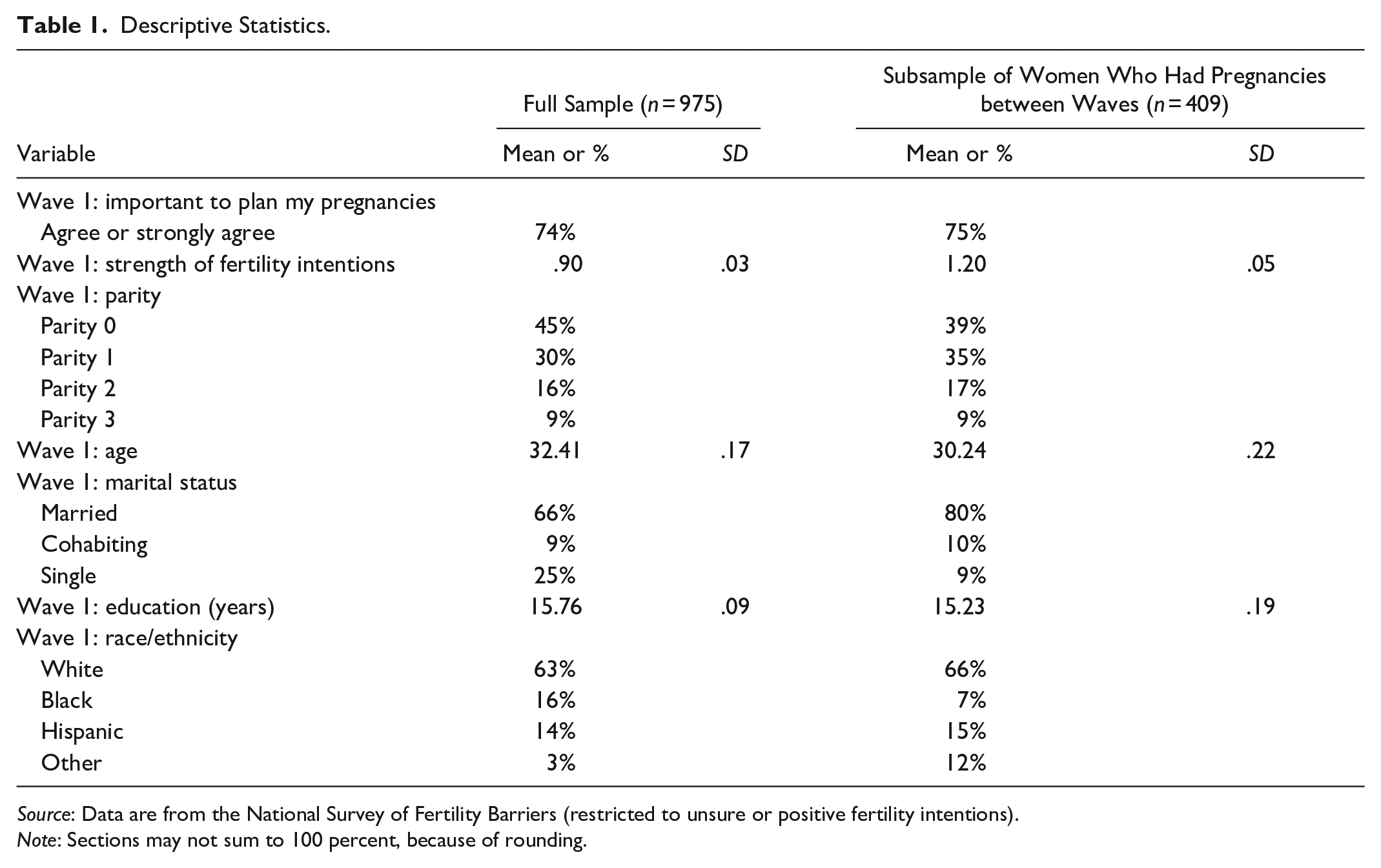
Table 1 presents descriptive statistics for the sample as a whole and the subsample of women who had pregnancies between waves. For the sample as a whole, a quarter of the women (26 percent) disagreed or disagreed strongly that it is important to plan pregnancies, and three quarters (74 percent) agreed or agreed strongly, with similar percentages for those who had pregnancies. Thus, the answer to research question 1 (“Is there variation among U.S women with regard to attitudes about the importance of planning pregnancies?”) is yes. A substantial percentage of women do not think it is important to plan pregnancies. On average, the women in the full sample and the subsample who had children had values that were close to “somewhat sure” that they intended another child. In the full sample, more women had no children than one or two or more, with similar distributions among those with pregnancies between waves. The average age of the women in the full sample (M = 32.41 years) was somewhat higher than in the sample with pregnancies (M = 30.24 years). Almost two thirds of the full sample were married, compared with more than three quarters among those who had pregnancies. The average level of education for both the full sample and the pregnancy subsample was some college. In the full sample, women who identified as White made up almost two thirds of the sample, with the remainder nearly split between women who identified as Black or Hispanic. The percentage White in the pregnancy subsample was similar to that in the full sample, but the percentage Black was about half and the proportion in the other category was four times that of the full sample.
Descriptive Statistics.
Source: Data are from the National Survey of Fertility Barriers (restricted to unsure or positive fertility intentions).
Note: Sections may not sum to 100 percent, because of rounding.
In addition to the summaries above, we also conducted one-sample t tests to compare the means for the subsample that had pregnancies between waves with the means that would have been expected on the basis of the sample as a whole. The women who had pregnancies were just as likely to think that it is important to plan pregnancies (t = .05, p = .932), but their intention to have a(nother) child is stronger (t = 7.3, p = .000). They were less likely than the sample as a whole to have no children (t = −2.434, p = .015) and more likely to have one child (t = 2.90, p = .004). Women who had pregnancies between waves were younger on average than the sample as a whole (t = −7.322, p = .000). The women with pregnancies between waves were more likely to be married (t = 9.055, p = .000) and less likely to be single (t = −11.87, p = .000) than women in the sample as a whole. The women in the pregnancy subsample had slightly higher levels of education (t = 2.34, p = .020) than the sample as a whole. Women who identified as Black were underrepresented among those who had pregnancies between waves (t = −3.81, p = .000).
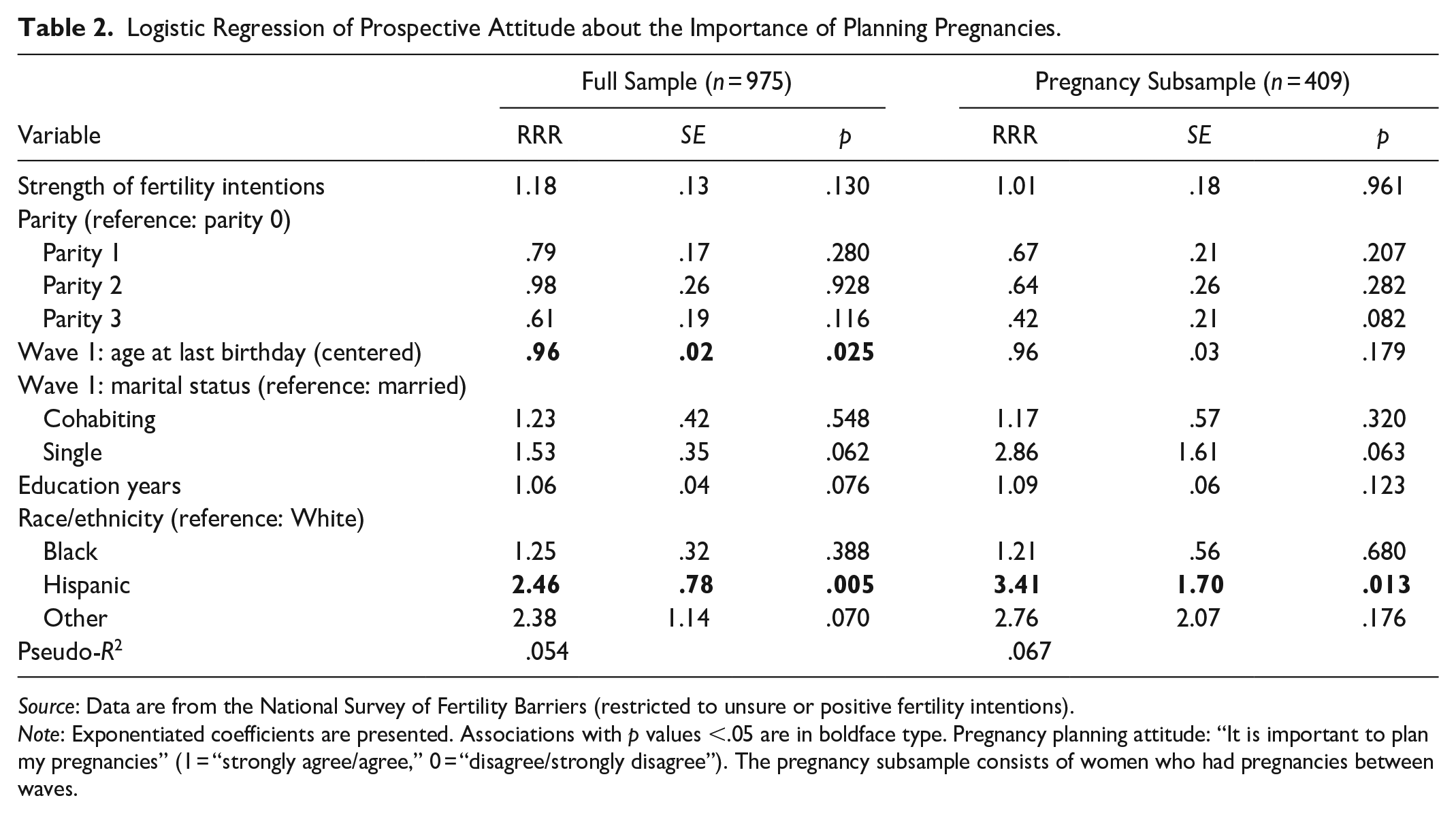
Table 2 displays the results of the logistic regression analysis of factors potentially associated with attitudes about the importance of planning pregnancies. Strength of prospective fertility intentions was not associated with importance of pregnancy planning in either the full sample or the pregnancy subsample, suggesting that these two variables are conceptually distinct. Similarly, parity is not associated with attitudes about the importance of planning pregnancies for either the full sample or the pregnancy subsample. Increases in age were associated with lower likelihood of agreeing that it is important to plan pregnancies in the full sample; although it has the same coefficient, it has a larger standard error in the subsample and is not statistically significant in the pregnancy subsample. Marital status is not associated with importance of pregnancy planning, but in both the full sample and the pregnancy subsample, the coefficient indicating single compared with married women is largest. The coefficient for education is positive, indicating an association between higher importance of planning pregnancies and increases in education, but the p value is greater than .05. In both the full sample and the pregnancy subsample, women who identify as Hispanic have higher odds of agreeing that it is important to plan pregnancies compared with women who identify as White. Thus, the answer to research question 2 (“Are fertility intentions or other factors associated with variation in attitudes about the importance of planning pregnancies?”) is “no” regarding fertility intentions but “yes” regarding two other factors: race/ethnicity and (for the full sample) age.
Logistic Regression of Prospective Attitude about the Importance of Planning Pregnancies.
Source: Data are from the National Survey of Fertility Barriers (restricted to unsure or positive fertility intentions).
Note: Exponentiated coefficients are presented. Associations with p values <.05 are in boldface type. Pregnancy planning attitude: “It is important to plan my pregnancies” (1 = “strongly agree/agree,” 0 = “disagree/strongly disagree”). The pregnancy subsample consists of women who had pregnancies between waves.
Table 3 repeats the descriptive statistics for the subsample of women who had pregnancies between waves as well as separate descriptive statistics by the three categories of retrospective attitude toward trying for a specific pregnancy between waves. For categorical independent variables, we used χ2 tests to determine which groups differed from one another. For continuous independent variables, we used ANOVAs with Šidák post hoc tests to determine which groups differed from one another. To specify which groups are not statistically significant from each other, we use letters next to the coefficients. If the letters in a row are the same, then those coefficients are not significantly different from each other.
Descriptive Statistics by Retrospective Attitude toward Trying for a Specific Pregnancy between Waves.

Source: Data are from the National Survey of Fertility Barriers (restricted to unsure or positive fertility intentions).
Note: analysis of variance with Šidák post hoc tests for continuous variables. Means or percentages that do not share a letter are significantly different at the p < .05 level. Sections may not sum to 100 percent, because of rounding.
Fewer women said that they were trying not to get pregnant when they conceived (n = 39) than were okay either way (n = 134) or trying to conceive (n = 236). Both prospective importance of planning and fertility intentions were associated with retrospective attitude toward trying for the specific pregnancy, and in both cases “trying to” and “okay either way” were different from each other but not from “trying not to have a baby.” The highest percent agreeing that it is important to plan pregnancies was among those trying not to have a baby when they conceived. Among those who said that they were trying to become pregnant at the time of their pregnancies, about three quarters felt that it was important to plan pregnancies, and among those who were okay either way, about two thirds felt that it was important to plan pregnancies, For prospective fertility intentions, the highest mean value is for retrospective attitude about planning pregnancies was, as we would expect, among those who selected “trying to” have a baby (M = 1.31) and lowest for those trying not to have a baby (M = .94), with those “okay either way” in the middle (M = 1.06) The only groups that are significantly different from each other were the “trying to” and “okay either way” groups.
A higher percentage of women who reported trying to become pregnant at the time of conception had no children (parity 0) at wave 1 compared with those okay either way. Age did not differ significantly by retrospective attitude toward the pregnancy. Compared with those who were trying to become pregnant, fewer of the women who were trying not to conceive were married. Average education was highest among those who said they were trying to become pregnant at the time of the pregnancy and lowest for those okay either way. A substantially higher proportion of White women were trying to become pregnant at the time of the pregnancy compared with those “trying not to” or “okay either way.” Therefore, at the bivariate level, fertility intentions, pregnancy planning attitude, and several covariates are associated with retrospective attitude about planning for a specific pregnancy.
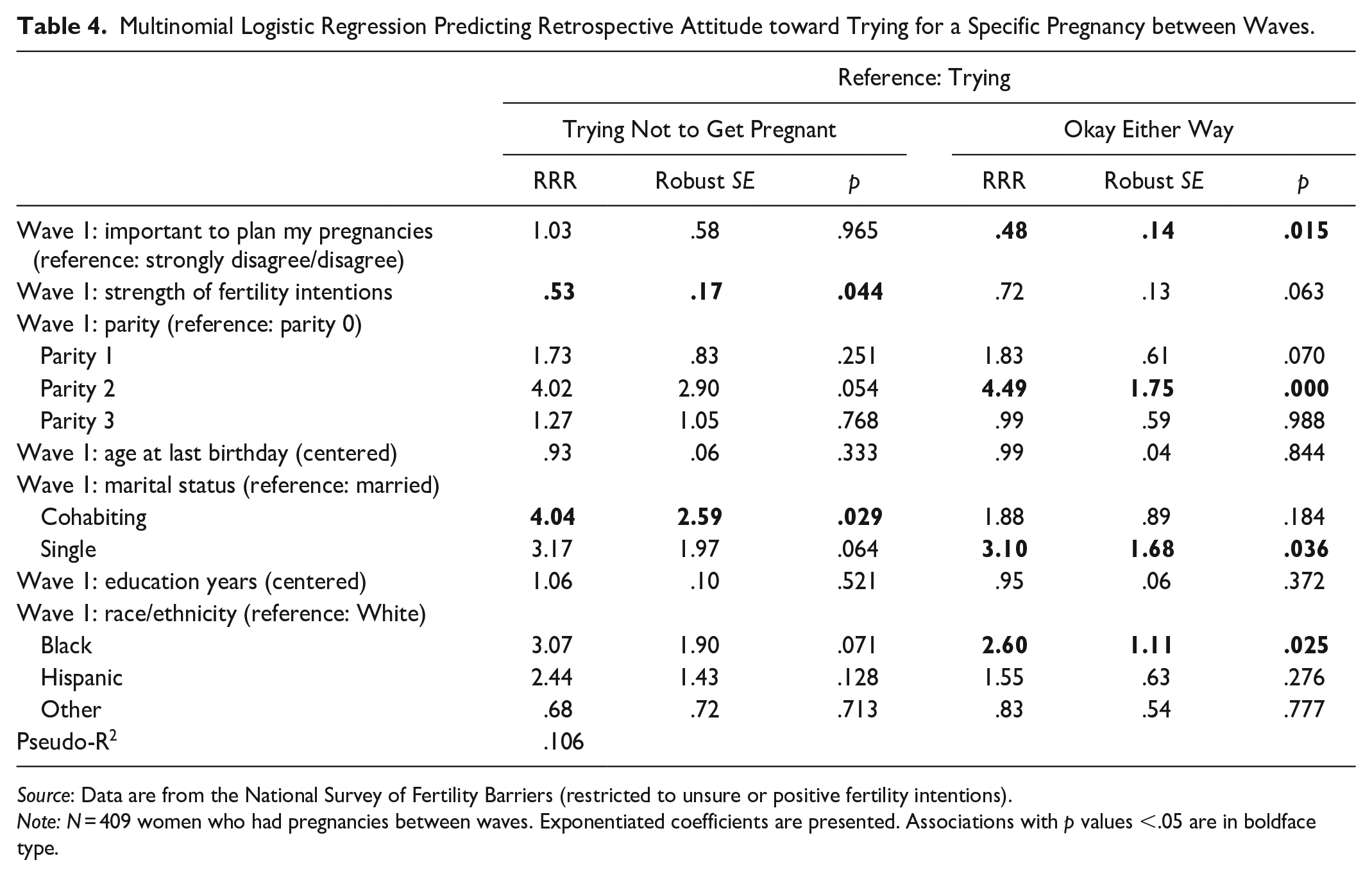
Table 4 displays the results of the multinomial logistic regression analysis of factors associated with retrospective attitude at wave 2 toward the first pregnancy between waves. Compared with (strongly) disagreeing, (strongly) agreeing that it is important to plan pregnancies was associated with significantly lower odds of being okay either way about the pregnancy between waves compared with trying to become pregnant. Thus, the answer to research question 3 (“Is prospective attitude about the importance of planning pregnancies [assessed in wave 1] associated with retrospective attitude about trying for a specific pregnancy [assessed in wave 2], adjusted for prospective fertility intentions?”) is “yes.” We controlled for fertility intentions at wave 1; the results therefore indicate that attitudes toward pregnancy planning is associated with retrospective trying attitude toward a specific pregnancy even after controlling for prospective fertility intentions.
Multinomial Logistic Regression Predicting Retrospective Attitude toward Trying for a Specific Pregnancy between Waves.
Source: Data are from the National Survey of Fertility Barriers (restricted to unsure or positive fertility intentions).
Note: N = 409 women who had pregnancies between waves. Exponentiated coefficients are presented. Associations with p values <.05 are in boldface type.
Several of the control variables were also associated with retrospective trying attitude about a pregnancy. For example, parity 2 is associated with higher odds of being okay compared with trying to become pregnant. Marital status is also associated with retrospective attitude about a pregnancy because women who were cohabiting had higher odds of trying not to become pregnant than those who were trying to become pregnant. In addition, race/ethnicity is associated with retrospective attitude toward the pregnancy, with Black women having higher odds of being okay either way compared with trying to become pregnant than White women.
Figure 2 provides a graphic display of the predicted probability for each combination of attitude toward the pregnancy (“trying to,” “trying not to,” “okay either way”) by pregnancy planning attitude (“disagree” or “agree” it is important to plan). Agreeing rather than disagreeing that planning pregnancies is important was associated with a significantly greater likelihood of saying one was trying to become pregnant at the time of one’s pregnancy. On the other hand, agreeing rather than disagreeing that planning pregnancies is important was associated with a significantly lower likelihood of saying one was “okay either way” at the time of one’s pregnancy. Agreeing rather than disagreeing that planning pregnancies is important was not associated with the likelihood of saying that one was trying not to become at the time of one’s pregnancy.

Predicated probability of retrospective attitude about a specific pregnancy by prospective attitude about the importance of planning pregnancies.
Figure 3 provides a graphic display of the predicted probability for each combination of attitude toward the pregnancy (“trying to,” “trying not to,” “okay either way”) by whether a woman reported at wave 1 that she intended to have another child (“unsure,” “probably yes,” “very sure yes”). Increasing strength of intentions was associated with a significantly greater likelihood of saying one was trying to become pregnant at the time of one’s pregnancy. On the other hand, increasing strength of intentions was associated with a significantly lower likelihood of saying one was “okay either way” or “trying not to” at the time of one’s pregnancy.

Predicated probability of retrospective attitude about a specific pregnancy by prospective attitude by wave 1 intention status.
Conclusion
Inspired by the perspective of the TCA, we investigated variation among women with regard to the degree to which they endorsed the idea that it is important to plan pregnancies. In response to research question 1 (“Is there variation among U.S women with regard to attitudes about the importance of planning pregnancies?”), the answer is clearly “yes.” As noted above, one quarter of the women (25 percent) in the sample disagreed or disagreed strongly that it is important to plan pregnancies. This finding challenges the assumption sometimes made by fertility researchers that virtually all women endorse the planning schema and supports the claim made by many that women differ in the importance they attribute to the idea of planning pregnancies (Barrett and Wellings 2002; Borrero et al. 2015; Fortier and Foster 2017; Geist et al. 2019; Gomez et al. 2018; Hernandez et al. 2020; Jones 2018; Kendall et al. 2005; Rocca et al. 2013; Shreffler et al. 2012). The results also demonstrate that, contrary to assumptions in much research on “unintended pregnancies,” a substantial minority of women are not planful, but rather nearly a third described themselves as okay either way at the time of their pregnancies.
Research question 2 asked, “Are fertility intentions or other factors associated with variation in attitudes about the importance of planning pregnancies?” We note that we did not find much here that distinguished “planners” from “nonplanners.” We did find evidence that older women (compared with younger women) and women who identify as Hispanic (compared with women who identify as White) have higher odds of saying that it is important to plan pregnancies. Importantly, fertility intentions were not significantly related to attitudes (i.e., “schemas”) about the importance of planning pregnancies. Therefore, the importance of planning is not the same construct as fertility intentions. It would be useful for future studies to measure and include measures of attitudes toward planning pregnancies in studies of fertility outcomes.
Research question 3 asked, “Is prospective attitude about the importance of planning pregnancies (assessed in wave 1) associated with retrospective attitude about trying for a specific pregnancy (assessed in wave 2), adjusted for prospective fertility intentions?” In response to this question, we found that women who felt that it was less important to plan pregnancies had higher odds of describing their intentions at the time of a subsequent pregnancy as “okay either way” compared with “trying to” become pregnant. Therefore, including attitudes toward the importance of planning pregnancies in models of retrospective pregnancy attitudes accounted for more of the variation than the model with only fertility intentions. This finding lends support to the idea the taking “motivational frames,” or schemas, into account can improve understanding of the eventual realization of fertility intentions. We did not argue, and did not find, that intentions are unimportant. Indeed, strength of fertility intentions was associated with lower odds of reporting that one was trying not to become pregnant at the time of a pregnancy between waves, compared with trying to become pregnant. We simply argue that it is valuable to measure and include, rather than assume, importance of planning.
Research on infertility often assumes that women are planning when to get pregnant, and research on unintended pregnancies sometimes assumes that women are focused on avoiding pregnancies. Both lines of research presume that women have attitudes and that they plan their pregnancies. Prior work on attitudes toward pregnancy that added the “okay either way” option (McQuillan et al. 2011) showed that some women at some points in their lives do not construct fertility intentions if they have the option not to in the survey. We take this idea a step further and ask whether all women assume that planning to or planning not to conceive is important. We found that, indeed, a substantial proportion of women do not think it is important to plan, and many are the same women who are also okay either way about getting pregnant. Viewed from the perspectives of identifying women who want to conceive but cannot or who want to avoid conception but cannot, the idea that there are women who do not think planning pregnancies is important and/or who are okay either way about getting pregnancy seems far-fetched. It is important, however, to recognize that many women are open to pregnancies that do or do not come, and do not think it is important to plan pregnancies.
It is possible that attitudes toward the importance of planning pregnancies is a multidimensional concept. Therefore, having only one item may not sufficiently capture how women think about pregnancy and ways to support or avoid pregnancies. Similarly, having only one item to measure fertility intentions may not sufficiently capture how women conceptualize seeking to avoid, seeking to conceive, or not having a specific attitude toward pregnancy and its timing. The fact that women who said they did not intend another pregnancy had to be excluded from the study is a serious limitation, particularly for understanding the association of fertility intentions and attitude toward the importance of planning pregnancies. The results of the present study hint at possible interactions and possible additional independent variables that would likely be relevant but could not be included in the present study because of the small sample size. A larger sample would also have allowed us to make finer distinctions among racial/ethnic categories (e.g., West Indian, Caribbean, Puerto Rican, Mexican, Cuban, Guatemalan) and to include a wide range of measures of SES. Future research with a larger sample should explore whether additional indicators of social location (e.g., SES, sexual minority status, immigration status, and more homogeneous racial/ethnic subgroups) shape the association between attitudes toward the importance of planning pregnancies and fertility.
Even with these limitations, the present study shows the importance of considering that some women simply are not planful about pregnancy and may therefore not be susceptible to messages about “planned pregnancies.” Future studies should explore the processes through which women and couples come to value the importance of planning pregnancies more or less, as well as the process through which attitudes toward planning pregnancies are associated with fertility outcomes.
Footnotes
Authors’ Note
This is a revised version of a paper presented at the 2018 European Population Conference in Brussels, Belgium.
Funding
The author(s) disclosed receipt of the following financial support for the research, authorship, and/or publication of this article: This research was supported in part by a grant from the Eunice Kennedy Shriver National Institute of Child Health and Human Development (grant R01-HD044144, “Infertility: Pathways and Psychosocial Outcomes,” Lynn White and David Johnson, co–principal investigators).
