




Abstract
Lower levels of happiness among Blacks compared with Whites are well documented, as are lower levels of happiness among parents compared with nonparents. Yet it remains unclear whether the parenting happiness gap is larger among Blacks compared with Whites. Drawing on the General Social Survey (2010–2018), the authors investigate this question. The authors find that White mothers reported less happiness compared with their White female nonparent counterparts, but contrary to research highlighting the profound challenges of parenting for Black women, a parental happiness gap among Black women was not observed. Among Black men, parents reported a much higher probability of being very happy than their nonparent counterparts, whereas White fathers’ happiness was no different from that of their male counterparts without children. These findings are discussed in view of stereotypes about Black mothers and fathers, their resilience to stressors such as racism and discrimination, and emerging research on the salience of fatherhood for Black men.
In U.S. society, the pursuit of happiness is considered to be one of life’s most important goals (Myers 1992). As such, population-level disparities in self-assessed measures of happiness have been argued to reflect a key indicator of social inequality and an important focus of empirical research (Graham 2017; Lyubomirsky and Lepper 1999). One major emphasis of empirical research on population disparities in happiness has been on differences in happiness among Black Americans compared with White Americans. This body of research has consistently found that both Black men and Black women report less happiness than their White same-gender counterparts (Corra et al. 2009; Yang 2008), although the size of this “happiness gap” has narrowed in the past few decades (Cummings 2020; Iceland and Ludwig-Dehm 2019). Explanations for the Black-White happiness gap point to compositional factors, particularly different levels of wealth, income, education, and marriage rates; disparities in physical health; residential segregation; and exposure to racism and discrimination (see Iceland and Ludwig-Dehm 2019 for an overview).
Surprisingly, one factor that has not been explored as part of the literature on the Black-White happiness gap is whether the unique experience of being a parent among Blacks plays a role in their lower levels of happiness compared with Whites. This question is important for four interconnected reasons. First, a majority of Americans across race and ethnic groups become parents (Livingston 2015). Second, a vast literature on the parental well-being gap—that is, parents’ generally lower levels of well-being compared with adults without children—highlights how parenthood is associated with various stressors that contribute to parents’ lower levels of subjective well-being, including lower levels of happiness (Alesina, Di Tella, and MacCulloch 2004; Di Tella, MacCulloch, and Oswald 2003; Herbst and Ifcher 2016; Umberson and Gove 1989). Third, within the literature on the parental well-being gap, there is a recognition that the “demands” and “costs” of parenthood are not the same for all demographic groups, but vary with regard to differences in parents’ access to social and institutional supports (e.g., family-friendly workplace policies, partner support), exposure to stressors (e.g., work-family conflict, housing instability), and availability of material resources that support parenting efforts-factors that also vary by racial background (Nomaguchi and Milkie 2020; Umberson, Pudrovska, and Reczek 2010). Finally, myriad studies on the experiences of Black parents elucidate the substantial time and energy they must devote to protecting and promoting the welfare of their children in the face of racist school and community contexts (Dow 2019; Elliott and Aseltine 2013; Gonzalez 2022) and barriers (e.g., access to safe neighborhoods) to promoting their children’s well-being.
Weaving together these four insights, in this study we aim to bridge the literatures on the Black-White happiness gap, the parental happiness gap, and the distinctive experiences of Black parents raising children by investigating whether the parenting happiness gap is larger for Blacks than for Whites. Consistent with these literatures, we provide separate estimates by gender, which has been repeatedly found to further differentiate the happiness of Blacks and Whites, as well as parents and nonparents (Cummings 2020; Nomaguchi and Milkie 2020). Also consistent with the much of the extant literature on the Black-White happiness gap, we draw on data from the General Social Survey (GSS; 2010–2018), which is based on a contemporary, representative sample. The results provide further insights as to why Black Americans report lower levels of happiness than White Americans, expand knowledge of how the parenting happiness gap varies across two key demographic groups, and provide fresh understanding of whether the “costs” and “burdens” of parenting are equally experienced across racial groups in the United States.
Disparities in Parental Well-Being
It is well established that parents report lower levels of subjective well-being on measures of global happiness than similar adults without children (see Negraia and Augustine 2020 for a summary of studies; also see Simon 2008). This finding has been observed across a variety of data sets (including the GSS; see Herbst and Ifcher 2016) and country contexts, and it holds true for both men and women (Alesina et al. 2004; Di Tella et al. 2003; Herbst and Ifcher 2016; Umberson and Gove 1989). The basic argument for why children “do not make people happy” (see Pollmann-Schult 2014) is that parents experience more stressors than adults without children, including greater difficulties balancing work and family responsibilities, increased financial and time demands, ongoing worries about children’s development and welfare, and fewer opportunities for salutary experiences, such as sleep or leisure (see Nelson, Kushlev, and Lyubomirsky 2014 for a comprehensive argument), to alleviate such stressors.
The research on parental happiness, however, also recognizes that these stressors are not equally distributed among parents. For example, mothers’ happiness is more negatively affected than fathers’ happiness because mothers tend to face greater time pressure and responsibility for children’s care (Hays 1998; Ruppanner, Perales, and Baxter 2019), engage in more multitasking by combining caregiving with other household or paid labor responsibilities (Offer and Schneider 2011), and remain responsible for the parenting activities (e.g., feeding children, helping with homework) that parents’ tend to find less enjoyable (Musick, Meier, and Flood 2016). This literature also highlights lower levels of parental happiness among single versus married adults (Angeles 2010), unemployed versus employed adults (Meier et al. 2016), parents of older versus young children (Negraia and Augustine 2020), and in countries such as the United States, which offer few formal family policies, compared with other countries (Glass, Simon, and Andersson 2016).
This literature, however, says surprisingly little about how the happiness gap for Blacks compares with that for Whites. This limitation is noteworthy for several reasons. First, across all socioeconomic strata, Blacks have been found to be disadvantaged compared with Whites among a range of indicators of well-being, including happiness. For example, even among those with higher levels of education, Whites report greater levels of happiness than Blacks (Assari 2019). The basic argument for this phenomenon is reflected in minority diminished returns theory (Farmer and Ferraro 2005), which suggests that Blacks experience racism and discrimination across contexts in ways that undercut many of the advantages they may have acquired. This theory can also be applied to suggest the potential for parenthood to impart greater stressors among Black parents, irrespective of their socioeconomic position, as a result of racism and discrimination they must endure (unlike than their White counterparts).
Relatedly, there is an emerging body of research which reveals how Black parents must navigate additional challenges compared with their White peers. This literature, which we describe in more detail in the section that follows, further highlights the importance of examining differences in the parental well-being gap among Blacks and Whites.
Parenting among Black Parents
Numerous studies examining the lives of Black parents reveal how Black parents must devote a large amount of time and energy to managing their children’s lives in ways that White parents do not. For example, several studies highlight how Black mothers must regularly engage in protective strategies to safeguard their children against “hostile environments” that put their children at risk for exposure to unwanted police contact, violence, pejorative images, racist stereotypes, and unjust treatment on the part of teachers, peers, and other adults (Elliott and Aseltine 2013; Gonzalez 2022). Importantly, these protective care strategies are also a part of the lives of Black mothers of higher socioeconomic groups (Dow 2016, 2019). Such strategies involve time and energy intensive activities such as closely monitoring children’s friendships, activities, and whereabouts; keeping children busy in organized activities; vetting activities to ensure that they include diverse groups of children and adults who do not marginalize their children; and teaching children how to navigate their environments, manage impressions, and interact with authority.
In addition to these interpersonal challenges, Black parents must also contend with, and work to offset, a social environment in which (what is characterized as) their more authoritarian approach to parenting (Chao and Kanatsu 2008) is highly scrutinized and viewed as “bad mothering” (Mullings and Mullings-Lewis 2013); Black children are disproportionately removed from their families and put into the child welfare system compared with other children (Roberts 2009); Black children are more likely to experience punishment at school; and Black parents’ efforts to intervene on their children’s behalf at their children’s schools are viewed as undesirable and unacceptable (Lareau and Horvat 1999).
Finally, Black parents often face unique structural challenges to their parenting efforts. For example, Black parents have less access to high quality childcare and schools than White children (Magnuson and Waldfogel 2005), which is relevant to parents’ concerns for children’s learning, safety, and emotional well-being (Cryer and Burchinal 1997). Black parents, irrespective of their socioeconomic position, are also more likely to be employed in jobs that offer less flexibility and opportunities to meet the demands and responsibilities associated with modern parenting norms (Golden 2008; Lareau 2003) and to live in neighborhoods they perceive to be unsafe for their children (Henry et al. 2019).
Consistent with this overall argument, prior research has shown that Black mothers report more parenting stress than White mothers (Nomaguchi and House 2013), although we know of no study that has examined whether Black mothers experience lower levels of happiness than do White mothers. In one study, however, Black mothers reported less happiness regarding their pregnancy than White mothers (Hartnett and Brantley 2020). The authors argued that this finding partly reflects Black mothers’ greater parenting burden, lower levels of social support, and fewer instrumental resources.
We are also unaware of studies that have examined how the subjective well-being of fathers varies among Blacks and Whites. The importance of such an investigation is underscored by a recent ethnographic study which described how Black fathers are more involved in parenting than the extant literature (which is overwhelmingly focused on mothers) has generally acknowledged (Abdill 2018), and thus many of the experiences and parenting stressors observed among Black mothers may extend to Black fathers as well. In further support of this expectation, a study by the Centers for Disease Control and Prevention showed that coresidential Black fathers were more likely to be involved in parenting activities, such as helping with homework and taking children to activities, than White fathers (Jones and Mosher 2013). Given the paucity of research on fathers, and Black fathers in particular, we examine men separately from women, as noted above.
Summary
Informed by general insights from minority diminished returns theory as well as the substantive literature on Black parents’ experiences and well-being, in this study we aim to test the expectation that the parental happiness gap (i.e., the disparity between parents and adults without children) will be larger for Black mothers than White mothers and for Black fathers than for White fathers. The results of this investigation will inform research aimed at understanding Black-White differences in happiness, as well as racial inequalities more broadly.
Methods
Data and Sample
The GSS is a cross-sectional, nationally representative survey of English-speaking, noninstitutionalized adults living in the United States administered by the National Opinion Research Center at the University of Chicago. Data collection for the survey began in 1972 and proceeded annually through 1994, when it became biennial. The GSS is a chief source of data on trends in the attitudes, behaviors, and beliefs of U.S. residents. The GSS also provides detailed demographic data. Since its inception, the GSS has asked respondents to report on their happiness. As such, it has also become a primary source of data for examining population differences in self-assessed happiness in the United States.
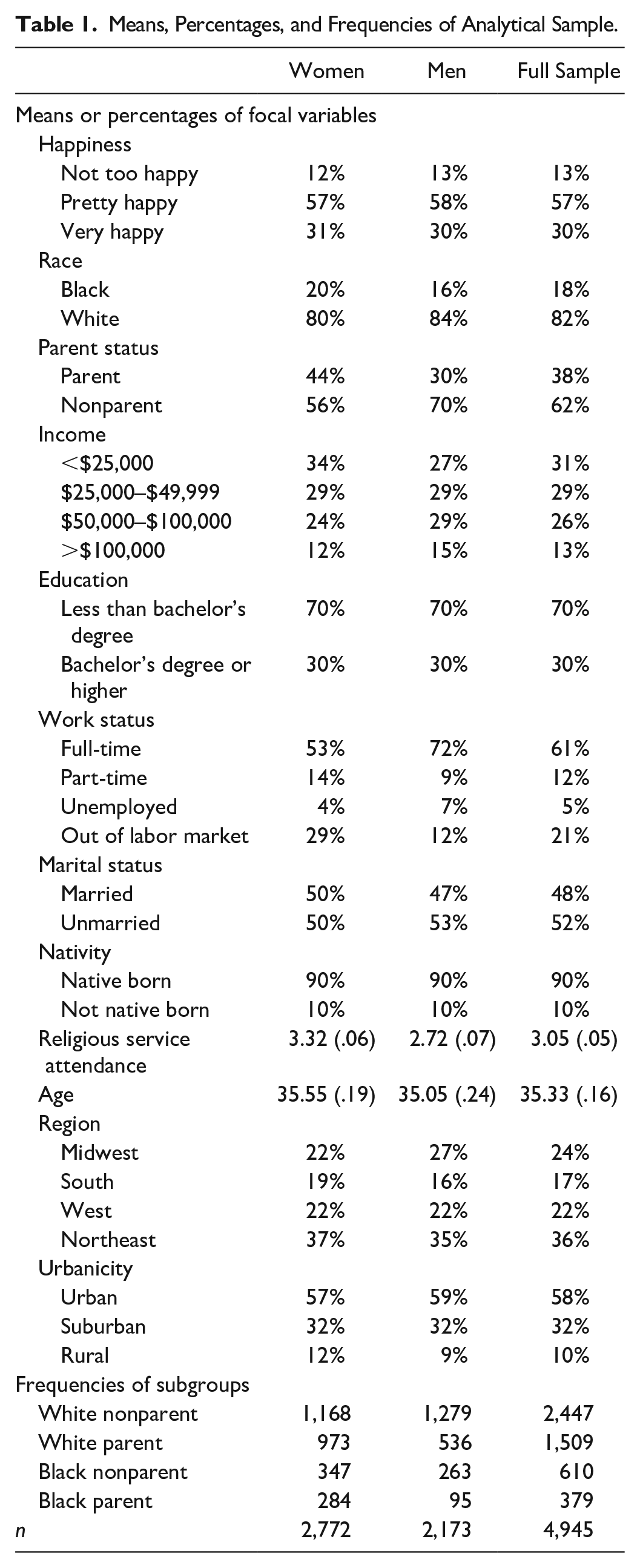
Our analytical sample began by pooling all men and women 20 to 50 years of age participating in the 2010 to 2018 panels of the GSS who reported their race as either Black or White (n = 5,325). We focused on the more recent panels of the GSS, starting with the period following the Great Recession up through the period prior to the start of the COVID-19 pandemic, given how population-level differences in happiness by both race and parental status (as measured by the GSS) have varied across time (Cummings 2020; Herbst and Ifcher 2016). Pooling across several waves provides for larger sample sizes, which would be too small for Black fathers and male nonparents if using just the most recent wave. We restricted the sample to adults aged 50 or younger because the GSS only asks how many children respondents had and whether there are minor children living in the home. Therefore, we cannot be certain if some respondents were grandparents living with their grandchildren. Limiting the sample to younger respondents helps reduce this possibility. Our selection of age 50 followed other studies on parental well-being, which shared similar limitations (Aassve, Goisis, and Sironi 2012; Negraia and Augustine 2020). We also followed these studies by eliminating respondents aged 18 to 20, who are overwhelmingly nonparents, or parents of infants, thereby skewing both subsamples in terms of respondents’ and children’s ages. Characteristics of this sample and frequencies of race × parent subgroups appear in Table 1. We also present this information separately for men and women.
Means, Percentages, and Frequencies of Analytical Sample.
Measures
Dependent Variable
Self-rated happiness was assessed at each survey wave on the basis of the question “Taken all together, how would you say things are these days? Would you say that you are very happy, pretty happy, or not too happy?” We coded these responses two ways. First, we coded them ordinally, assigning responses of “not very happy” a value of 1, “pretty happy” a value of 2, and “very happy” a value of 3. Second, we used dummy coding for each response. We used different coding schemes for different analytical techniques, explained below.
Independent Variables
Respondents were asked what race they considered themselves to be. On the basis of their responses, they were assigned to one of three categories: Black, White, or other. We measured race as a binary measure for whether the respondent was coded as White (reference) or Black (those who reported “other” were excluded). Parental status was operationalized in terms of whether respondents reported that they ever had children and were currently primarily responsible for the care of a child under age 18 living in their home. Respondents who reported having had at least one child and living with a child younger than 18 were assigned to the “parent” category. All other respondents were assigned to the “nonparent” category. Note that this coding procedure, which follows that used by Herbst and Ifcher (2016), who also used the GSS to study differences in parents’ and nonparents’ happiness, is intended to compare those currently raising minor household children with those who are not. Yet, as Herbst and Ifcher pointed out, this procedure also comingles empty nesters, nonresident parents, and parents with coresident adult children in the nonparent category. Unfortunately, given the way that GSS collects information on parental status, we cannot distinguish among these latter three groups. Thus, to test the robustness of our results, we excluded the 1,344 cases (611 men, 733 women) from the nonparent group in which the respondents reported having had children, but no children younger than 18 living with them. The results were nearly identical. We also used a broader approach to measuring the parent category, which allowed the inclusion of adults living with minor children who did not report having had any children themselves but may be adoptive or step parents. This group was very small, and thus their inclusion in the parent subsample did not affect the pattern of results either.
Covariates
To account for factors that may confound the associations among race, parental status, and happiness, we incorporated several covariates collected at each survey wave. These factors included family income (dummy-coded into four categories: <$25,000, $25,000–$49,999, $50,000–$100,000, and >$100,000), education (0 = less than bachelor’s degree, 1 = bachelor’s degree or higher), work status (dummy-coded for full-time, part-time, unemployed, and out of the labor market), marital status (0 = unmarried, 1 = married), religious service attendance frequency (measured continuously, ranging from 0 to 7, in which 0 = never and 7 = every week), nativity (0 = U.S. born, 1 = born outside the United States), age (continuous), region (dummy-coded for Midwest, South, West, and Northeast), and urbanicity (dummy-coded as urban, suburban, and rural). We also incorporated dummy measures of each survey wave.
Analysis Plan
The multivariate models proceeded in five steps. First, we estimated the associations between race and happiness, controlling for the full set of covariates. This model, and all models that followed, were estimated separately for men and women. Next, we added parental status to the model. This step examined differences in happiness among parents compared with nonparents, net of race and the covariates. Third, we added interactions between the measures for race and parental status. Finally, to interpret the interactions, we calculated average adjusted predictions (AAPs) and average marginal effects (AMEs). AAPs provided an estimate of the average probability that a particular subgroup reported a certain level of happiness, for example, the average probability that Black male parents reported being very happy. AMEs estimated the average probability that Black male parents reported a certain level of happiness compared with their probability under the alternate condition—that is, being a nonparent—at the same levels of all other independent variables and tested whether this difference was statistically significantly (i.e., there was a nonzero gap in parental well-being) (Cameron and Trivedi 2005). To simplify the presentation of results, for both sets of estimates (the AAPs and AMEs), we focused on the probabilities of reporting the highest and lowest levels of happiness (very happy, not too happy). Should we observe that these within-race AMEs associated with parental status were significant, as final step, we estimated whether the sizes of the AMEs for Blacks and Whites significantly varied from each other.
In estimating these models, we predicted happiness using three different statistical techniques: ordered logistic regression, generalized logistic regression, and multinomial logistic regression. Typically, ordinal measures such as the GSS measure of happiness are modeled using ordinal logistic regression because the technique is more parsimonious than the others and it is more familiar. Ordered logistic regression assumes, however, that the relationships among the variables are the same for each pair of outcomes. For example, the odds of reporting being “very happy” versus “pretty happy” for parents are the same as their odds of reporting “pretty happy” versus “not too happy.” This assumption is often violated. Indeed, auxiliary analyses in which we conducted a series of Wald tests, iteratively allowing coefficients to be unconstrained, indicated that a handful of variables violated the proportional odds assumption, most notably race for the estimates of men. Thus, we used two additional techniques. The first, generalized logistic regression, modeled happiness as an ordinal measure but allowed selected covariates to vary (Williams 2006). As such, the model produced two sets of coefficients: those comparing very happy with pretty happy and those comparing pretty happy with not too happy. Second, we used multinomial logistic regression, which did not assume an ordinality to happiness. As with the AAPs and AMEs, for these models, we focused on the estimates for the very happy and not too happy categories. We present the results for all three techniques, which produced nearly identical results.
Models were estimated using Stata version 15.1 (StataCorp, College Station, TX). AAPs and AMEs were calculated using Stata’s margins feature. All estimates used the WTSALL survey weight and adjusted for the complex sampling design. The subpop feature was used to limit the analytical sample, including by gender, while maintaining its representativeness relative to the U.S. population. To account for missing data, we used listwise deletion techniques given that there were only small amounts of missing data (7 percent of all cases) (Allison 2001). Sample sizes for the multivariate results are noted in the tables.
Results
Overview of Multivariate Results
Table 2 provides the model coefficients from the ordered logistic, generalized logistic, and multinomial logistic regressions models for the male and female subsamples. Table 3 provides the calculations of the AAPs and AMEs based on these model coefficients. AAPs reflected average predicted probabilities in reporting a particular outcome. AMEs reflected the average differences in probabilities conditional on parental status (i.e., the parental happiness gap). We focus on describing the AAPs and AMEs over the model coefficients because they are more intuitive, they provide a standardized metric across all three modeling approaches, and they provide a clearer answer to the questions posed by this study.
Regression Model Coefficients for Women (n = 2,772) and Men (n = 2,173).

Note: Models control for income, education, work status, marital status, religious service attendance, region, urbanicity, nativity, age, and survey wave and adjust for the complex sampling design of the General Social Survey.
p < .10. *p < .05. **p < .01. ***p < .001.
AAPs and AMEs for Women (n = 2,772) and Men (n = 2,173).

Note: Models control for income, education, work status, marital status, religious service attendance, region, urbanicity, nativity, age, and survey wave and adjust for the complex sampling design of the General Social Survey. AAP = average adjusted prediction; AME = average marginal effect.
p < .10. *p < .05. **p < .01. ***p < .001.
Estimates for Women
We begin with the estimates for the female subsample. The patterns of results were robust across all three model specifications. Thus, we focus on describing the results from the first set of models using ordered logistic regression. The results of model 1 provided evidence that Black women have lower levels of happiness than White women. In Model 2, which added the measure for parental status, this association remained statistically significant. Model 2 also revealed that mothers have significantly lower levels of happiness than female nonparents. To provide a more substantive understanding of these differences, we turn to Table 3. The AAPs revealed that the average probability that Black women reported being not too happy was 18 percent, whereas for White women, this figure was 14 percent. The average probability that Black women reported being very happy was 23 percent, whereas for White women, this figure was 27 percent. The probability of mothers’ reporting that they are not too happy was 17 percent, whereas this figure was 15 percent for female nonparents. The probability that mothers reported that they were very happy was 24 percent, whereas this figure was 28 percent for female nonparents. Note that these race and parental status differences in happiness were all statistically significant at the minimum probably threshold of p < .05.
Model 3 added interactions between the measure for race and parental status. Although the interaction term was not statistically significant, there may still be significant differences by parental status within race groups (i.e., a conditional effect), as indicated by the AMEs. Thus, we again turn to Table 3. The AAPs revealed that Black mothers had a 20 percent probability of reporting that they were not too happy, whereas Black nonparents had a 17 percent probability. Black mothers also had a 21 percent probability of reporting that they were very happy, whereas Black nonmothers had a 24 percent probability. However, these differences by parental status among Black women, as indicated by the AMEs, were not significant. Thus, for Black women, we did not observe a parental happiness gap. For White women, differences by parental status in reporting that they were both not very happy and very happy were statistically significant. The probability of White mothers to report that they were not very happy was 2 percent more than for White nonmothers (16 percent for mothers, 14 percent for nonmothers). The probability of White mothers to report that they were very happy was 3 percent less than for White nonmothers (25 percent for mothers, 28 percent for nonmothers). Thus, a parenting happiness gap was observed among White women.
Estimates for Men
For men, model 1 of the ordered logistic regression models did not indicate that Black men were less happy that White men. The results of Model 2 also did not provide evidence of significant differences by parental status. Note that for men, the proportional odds assumption was violated for the race coefficient. Thus, we also consider the results of the generalized logistic regressions, which focused on comparisons between the not too happy and pretty happy reports (note that the coefficient for the pretty happy reports vs. very happy reports was identical), and the multinomial logistic regressions, which compared the categories of not too happy and very happy. The generalized logistic regression model suggested that Blacks were more likely to be not too happy versus pretty happy. This significant coefficient for Black men of being not too happy translated to a 24 percent probability, compared with 17 percent for White men, as indicated by the AAPs. There was no significant variation by parental status. The multinomial logistic regressions suggested that Black men compared with White men were less likely to be very happy versus not too happy, but fathers were more likely to be very happy versus not too happy than nonfathers. According to the AAPs, Black men’s probability of reporting that they were not too happy was 27 percent, whereas for White men, it was 19 percent. Black men’s probability of reporting that they were very happy was 25 percent, compared with 25 percent for White men. Fathers’ probability of reporting that they were not too happy was 15 percent, whereas it was 22 percent for nonparents. The probability of reporting being very happy for fathers was 27 percent, compared with 24 percent for nonparents. These latter figures suggest that contrary to some extant research, among men, parents were happier than their nonparent counterparts, although these patterns were not consistent across modeling strategies. Patterns by race were consistent across models and with prior research on the happiness gap between Black and White men.
In Model 3 of Table 2, we added the interaction between the measures of race and parental status. These models provided evidence of a statistically significant interaction across all three model specifications, although the sizes of the estimates varied somewhat across models. Turning again to Table 3, our estimates revealed that Black fathers’ probabilities of reporting they were not too happy ranged from 11 percent to 17 percent, whereas this figure for Black nonparents ranged from 23 percent to 30 percent. Following a similar pattern, Black fathers’ reports of being very happy ranged from 34 percent to 35 percent, whereas this figure for Black male nonparents ranged from 18 percent to 22 percent. The estimates of the AMEs suggested that these differences by parental status were statistically significant across all three modeling approaches for Black men. The sizes of these differences were also consistent across model specifications (12 percent to 13 percent less for fathers compared with nonfathers for not too happy, 14 percent to 16 percent greater for fathers compared with nonfathers for very happy). For White men, there was no significant difference in reporting that they were not too happy or very happy by parental status on the basis of any of the models. Thus, Black fathers were substantially more likely to be very happy, and less likely to be not too happy, compared with Black nonparents, but there was no difference in parental well-being among Whites. These patterns run contrary to both research on race and parental status differences in happiness.
Discussion
Race differences in happiness among Americans are well documented, as are differences in happiness between parents and nonparents (Herbst and Ifcher 2016; Iceland and Ludwig-Dehm 2019). Yet few studies have aimed to bridge these literatures by examining whether differences in parental happiness are the same across racial groups. This oversight is noteworthy, given the various strands of research highlighting the ways that parenting creates additional challenges for Black parents compared with White parents. It is also surprising, given the broader literature on parental happiness and its emphasis on how demographic factors moderate the “costs” of parenthood (Nomaguchi and Milkie 2020), as well as the profundity of race in stratifying other forms of well-being. Thus, in this study, we take steps to fill this important gap in knowledge by drawing on a seminal source of research on happiness, the GSS, to investigate racial disparities in the parental happiness gap for men and women. Our findings provide several fresh insights, several of which ran counter to our expectations.
To begin, we found that the happiness gap among parents compared with nonparents was observed for White women, but not Black women. These results suggest that despite the challenges that Black mothers face—such as stereotyping around motherhood, fears around their children’s well-being, and the need to contend with hostile environments (Dow 2019; Elliott and Aseltine 2013)—they may be exceptionally resilient in terms of their happiness. This pattern is consistent with other research on resiliency among Black Americans. For example, numerous studies find that Blacks suffer no worse mental health disorders than Whites, a phenomenon sometimes called the Black-White mental health paradox (Erving, Thomas, and Frazier 2019). Although the reasons for this phenomenon remain unclear, some have argued that Blacks promote a type of racial socialization that celebrates overcoming adversity and a strong sense of group identity, both of which may enhance the positive emotional aspects of parenting, despite its challenges. In further support of this view, studies have suggested that Blacks are more likely to view themselves than Whites as role models to their children (Hart et al. 2001). Doing so in the face of challenges may thus enhance meaning and the positive emotional experience Black mothers derive from parenting in ways that help offset some (albeit not all, given that Black women in general reported less happiness than White women) of the factors that would potentially undermine Black mothers’ well-being. Other explanations for why we did not observe lower levels of happiness among Black mothers compared with Black nonmothers include that Black mothers often experience high levels of community support-in contrast to mothers in White communities, which embrace a more individualist approach to family life (Collins 2002; Dow 2019)-which may promote greater subjective well-being. Black mothers also spend more time in the company of their children (Nomaguchi et al. 2022) than White mothers, which has been associated with greater happiness among parents (Negraia and Augustine 2020). More broadly, these findings also indicate that parental status does not play a role in Black-White differences in women’s happiness.
For men, we found that parental status also did not differentiate the happiness of Whites, perhaps because White fathers share less responsibility for more time-intensive and stressful caregiving than their partners (Musick et al. 2016). An alternative set of explanations, which are informed by and evoked in studies showing that the parental happiness gap has grown smaller (Herbst and Ifcher 2016; Preisner et al. 2020), are that the relative happiness advantage of men without children may have declined in the context of growing social disconnectedness, which parenthood helps buffer. At the same time, the happiness of men with children has grown as gendered norms around fathers’ caregiving have allowed fathers to experience more time in play, leisure, and other enjoyable family activities (Negraia et al. 2018).
For Black men, those with children were substantially more likely to report being very happy, and far less likely to report being not very happy, than their nonparent male counterparts. These results suggest that fathering is a far more salient experience for Black men than prior research has recognized. Results also extend a handful of ethnographic studies on lower income, generally noncustodial Black fathers (who are of note far more involved with their children than commonly assumed; Abdill 2018), which indicate that Black men may subscribe to a different view of fatherhood borne out of structural barriers that have historically hindered Black fathers from providing financially in the same way as White fathers (Bloome 2014). Specifically, Black fathers reject traditional notions of the package deal, in which satisfaction from fathering is derived from one’s ability to financially provide (Townsend 2002) and instead endorse a model of “relational fathering” or “new package deal” that celebrates the joys of fathering (see Edin and Nelson 2013). For example, as many of the men in the study by Edin and Nelson (2013) recounted, fatherhood “made life worth living,” children were viewed as the ultimate gift, and many of the banal aspects of basic care in which White fathers engage less frequently than White mothers—such as teaching children and helping them dress—were described as “priceless and a treasure any man would want to claim” (p. 221). In this way, these findings also serve to contradict stereotypical notions of Black fathers as being uninterested in fathering. More broadly, these findings also indicate that parental status does not explain Black men’s lower levels of happiness compared with White men’s, as observed in prior studies (e.g., Cummings 2020; Iceland and Ludwig-Dehm 2019).
Of course, at this time, many of the inferences based on these patterns of results are conjecture. It remains unclear how Black mothers blunt the potentially negative impact that “mothering while black” (Dow 2019) has on their subjective well-being or why fathering has such a positive impact on Black men. However, this study underscores the importance of exploring such questions in future research. At the same time, this study has several other limitations that should be noted. First, the validity and reliability of self-assessed generalized measures of happiness, including the happiness measure the GSS, continue to be debated. Some have argued that a more nuanced scale of happiness is preferable (Lyubomirsky and Lepper 1999). Others argue in support of a conceptually distinct way of measuring well-being through momentary measures (Negraia and Augustine 2020). Future studies should therefore also replicate the present study using other measures of happiness. At the same time, the use of the GSS measures provide a strong connection to past research on happiness, and our within-race estimation procedure accounts for race differences in the interpretation and conceptualization of happiness that challenge reliability.
Second, we also must acknowledge that it is likely that the patterns we observed are further differentiated by adults’ education, income, and marital status, as well as characteristics of parents’ children (e.g., ages, gender). Although an exploration of such factors is beyond the scope of the present study, and in many cases is limited by small sample sizes, particularly among Black fathers, future studies based on other data should consider these sources of variability as well. Last, consistent with prior research, we focused on parents who were coresidential and caring for minor children. Yet the experiences of nonresidential parents, and particularly of fathers, are also important to recognize, as highlighted in recent ethnographic accounts of minority fathers, and should be considered more carefully in future research as well, as should the experiences of other parents, such as step and social parents as well as parents who are empty nesters or caring for household adult children. Doing so, however, would also require other data.
In sum, the aim of this study was to address an important question that had yet to be answered: whether parenting (vs. not caring for minor household children) is negatively associated with the happiness of Blacks more so than that of Whites. Our results indicated a surprising pattern of results. Among women, White mothers were less happy than female nonmothers, but this was not the case for Black women. These results suggest that Black mothers’ levels of happiness were resilient to the numerous well-documented challenges they face protecting and promoting the welfare of their children. For men, Black fathers were far more likely to be happy than their nonparent counterparts, although this was not true for White men, for whom we did not observe any differences in happiness by parental status. These results highlight the profundity of the father role for Black men and controvert much conventional thinking and stereotyping and Black men’s experiences of fatherhood.
