




Abstract
Advocates for reform have highlighted violations of probation and parole conditions as a key driver of mass incarceration. As a 2019 Council of State Governments report declared, supervision violations are “filling prisons and burdening budgets.” Yet few scholarly accounts estimate the precise role of technical violations in fueling prison populations during the prison boom. Using national surveys of state prison populations from 1979 to 2016, the authors document that most incarcerated persons are behind bars for new sentences. On average, just one in eight people in state prisons on any given day has been locked up for a technical violation of community supervision alone. Thus, strategies to substantially reduce prison populations must look to new criminal offenses and sentence length.
Scholarly and public attention on the expansion of punishment in the United States since the 1970s has focused largely on imprisonment. Yet most people under penal control are not in prison but on supervision in the community through probation and parole. People released on community supervision must follow an exhaustive set of conditions—often including regular office visits, random drug tests, housing and employment mandates, a requirement to avoid arrest, and fines and fees—that, if violated, can lead to a technical violation of the terms of supervision. As adults on probation and parole are only conditionally free in the community, these technical violations can easily lead to revocation, or incarceration in jail or prison, with few due-process protections in court (Phelps and Ruhland 2022). Scholars and advocates thus argue that rather than serving as an “alternative” to prison, community supervision more often “widens the net” and fuels a revolving door of imprisonment (Caplow and Simon 1999; Petersilia 2003).
In 2019, the Council of State Governments Justice Center released the results of a survey of state corrections departments, declaring that probation and parole violations were “filling prisons” and thwarting reforms to end mass incarceration. Much of the report focused on prison admissions, finding that half of all state prison entries in 2017 were for people on probation and parole at the time of the arrest. Among those, roughly half were incarcerated for technical violations—meaning that fully one quarter of all prison admissions were for technical violations. Yet trends in prison admissions often diverge from prison populations, as day-in-time estimates are more heavily skewed toward people serving long sentences, whereas admission estimates veer toward those in for short stints of imprisonment. 1 In addition, the Council of State Governments report only provided a snapshot of 2017, rather than tracing the long arc of the prison boom.
Have technical violations truly been “filling” prisons, and did they fuel mass incarceration? To answer this question, we provide the first estimates of the share of the U.S. state prison population incarcerated for technical violations of community supervision from 1979 to 2016. Our visualization draws on the only nationally representative survey of adults in state prisons, the Bureau of Justice Statistics Survey of Prison Inmates series (Glaze 2019). In each survey, respondents were asked whether they were on probation or parole at the time of their arrest. The surveys also ask about why people were admitted to prison, including questions about new sentences for adults who were on community supervision, that we use to identify imprisonment for technical violations. 2
The results displayed in the left-hand side of Figure 1 document the explosive rise in prison populations. Between 1979 and 2004, the estimated number of adults incarcerated in state prisons who had been on probation and parole at the time of arrest ballooned, from less than 100,000 to more than 500,000, as the total imprisoned population reached 1.2 million. This quick growth in the number behind bars, however, masks the relative stability in the share of people formerly on community supervision, as displayed in the right-hand panel of Figure 1. Adults who were on probation and parole at the time of arrest have consistently comprised one third or more of the prison population since the start of the prison boom, from a low of 35 percent in 1979 to a peak of nearly 47 percent in 1997. By 2016, this figure had dropped back to 38 percent. Yet people incarcerated for technical violations alone have constituted only a small share of the prison population, roughly one in eight on average. This figure has been remarkably static, from a low of 11 percent in 1991 to a peak of 14 percent in 1997 and 2004, and back to 11 percent by 2016. The remaining majority of the prison population are new court admissions (i.e., persons who were not on supervision at arrest). Together, these trends mean that by 2016, nearly 140,000 adults were behind bars in state prisons for technical supervision violations alone, a total equivalent to exactly half of the total prison population in 1979.
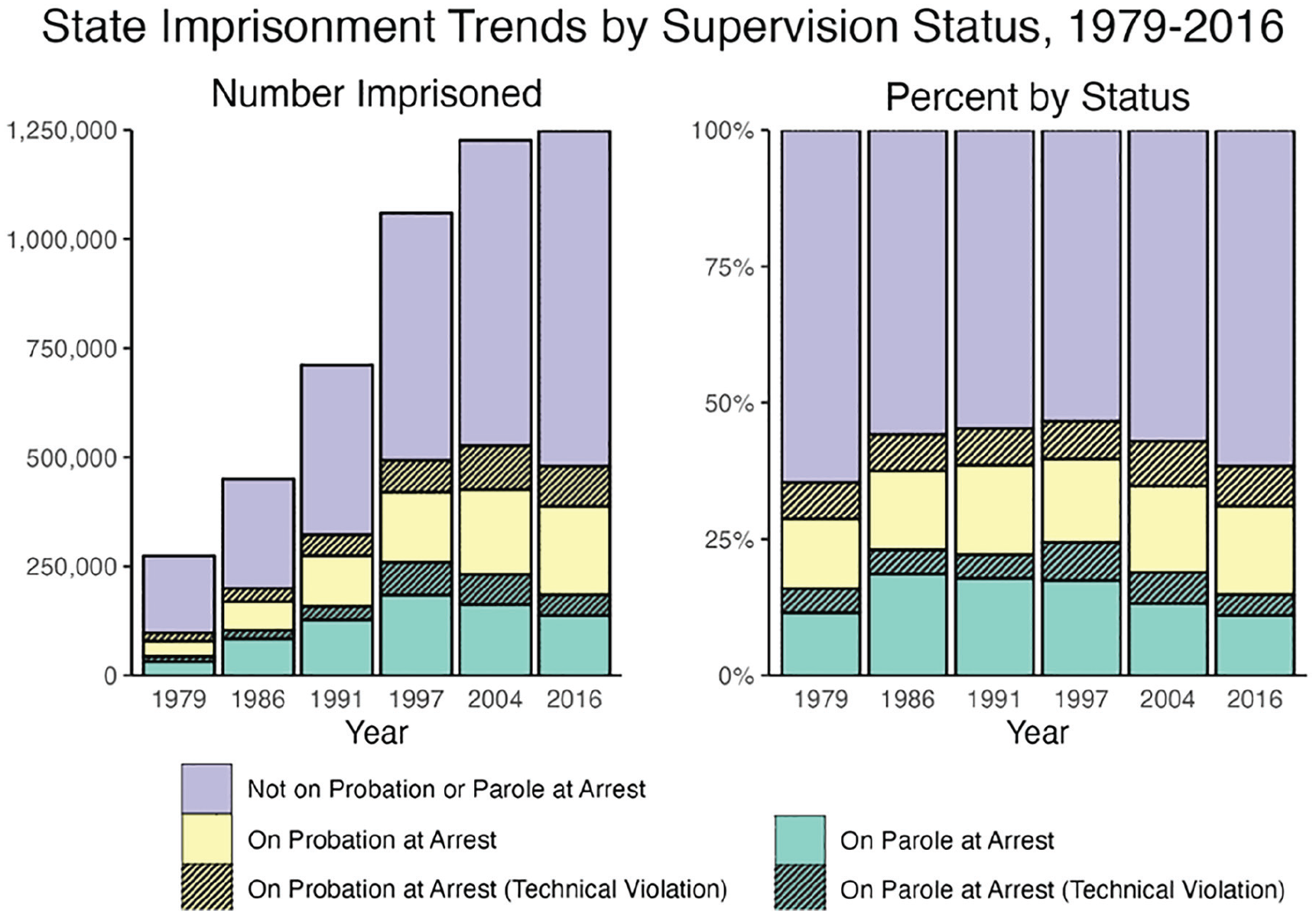
Estimated number (left) and percentage (right) of the total adult population incarcerated in state prisons by community supervision status at arrest. Persons categorized as incarcerated for technical violations reported that they were on probation or parole at arrest and had not been sentenced for new offenses. New sentences for technical violations alone were excluded and counted as technical violations. The percentages of returns for technical violations in 1979 and 1986 were imputed using the 1991 estimates because of data limitations.
These estimates suggest that although adults on community supervision constitute a substantial part of mass incarceration’s growth, technical violations have not been a primary driver of prison populations. Instead, punishment ratcheted up both for those on and off probation and parole. People with sentences for new criminal offenses, whether on community supervision at the time of arrest or not, represent most of those behind bars. This does not, however, mean that reformers should stop focusing attention on technical violations. Although such violations represent a relatively small share of the population at any given point in time, they are a more substantial contributor to admissions and the churn in and out of prisons. In addition, revocations may more substantially affect local jail populations (Phelps 2018). Finally, the threat of incarceration for technical violations is one of the major stressors of being on supervision (Phelps and Ruhland 2022). Reducing revocation is thus a vital task for justice reformers, but it will not end mass incarceration alone.
Supplemental Material
sj-pdf-1-srd-10.1177_23780231221148631 – Supplemental material for Are Supervision Violations Filling Prisons? The Role of Probation, Parole, and New Offenses in Driving Mass Incarceration
Supplemental material, sj-pdf-1-srd-10.1177_23780231221148631 for Are Supervision Violations Filling Prisons? The Role of Probation, Parole, and New Offenses in Driving Mass Incarceration by Michelle S. Phelps, H. N. Dickens and De Andre’ T. Beadle in Socius
Footnotes
Acknowledgements
Our thanks to Tracy Snell at the Bureau of Justice Statistics for helpful advice on data cleaning and analysis and to Audrey Dorélien, Ryan Larson, Jane Sumner, and Elizabeth Wrigley-Field for suggestions on the data visualization. Thanks also to Khoa Vu for expert research assistance, supported by the Minnesota Population Center, which receives funding from the Eunice Kennedy Shriver National Institute of Child Health and Human Development (Award number P2CHD041023).

Supplemental Material
Supplemental material for this article is available online.
Notes
Author Biographies
References
Supplementary Material
Please find the following supplemental material available below.
For Open Access articles published under a Creative Commons License, all supplemental material carries the same license as the article it is associated with.
For non-Open Access articles published, all supplemental material carries a non-exclusive license, and permission requests for re-use of supplemental material or any part of supplemental material shall be sent directly to the copyright owner as specified in the copyright notice associated with the article.
