




Abstract
Across a variety of measures of safety and rehabilitation, our current systems of parole and probation are failing. Research shows that community supervision fails to reduce crime; traps its subjects in cycles of criminal justice involvement; is excessively punitive; and creates widespread harm to individuals, families, and communities—all while failing to significantly contribute to the social and economic integration of those under its control. We argue for a wholesale reform of community supervision, including the abandonment of current monitoring and control functions, and the repurposing of resources into systems of support for the hundreds of thousands of people leaving prison and jail every year. We also provide an overview to the articles assembled for this volume, which chart the challenges facing those on community supervision and offer a roadmap of potential policy solutions for improving the life chances of formerly incarcerated and justice-involved people.
Introduction
Every year, more than 500,000 people are released from prison (Carson 2020), and more than ten million people cycle through the nation’s jails (Zeng and Minton 2021). For many, the end of incarceration means the beginning of community supervision, which entails regular meetings with probation or parole officers and an elevated risk of reincarceration (Carson 2020; Oudekerk and Kaeble 2021). 1 Seventy percent of formerly imprisoned people enter parole or some other form of community supervision (Carson 2020). Yet even these numbers understate the scope of correctional oversight beyond incarceration. At any point in time, one in forty-six Americans is on community supervision, and there are now about 4.4 million people on probation or parole (Oudekerk and Kaeble 2021). As the United States reckons with the harms of mass incarceration and aggressive policing, comprehensive criminal justice reform must also address the reach and impact of probation and parole.
What are we accomplishing with millions of people on community supervision? Originally, probation and parole were intended to help people reintegrate after a criminal conviction by building pathways to economic and social opportunity. Since criminal justice supervision is concentrated in communities that face high levels of joblessness, discrimination, and poverty, the historic mission to provide social support can help not only the people on probation and parole, but their families and neighborhoods, too. Improving opportunities also makes communities safer: education, stable jobs, housing security, and good health all reduce crime (e.g., Sampson and Laub 2003; Bozick et al. 2018; Kirk et al. 2018; Link et al. 2019).
Yet by these standards, community supervision is failing. Research documents the low rates of employment, housing stability, health care access, and myriad other indicators of social and economic reintegration among people on supervision (Visher and Travis 2003; Western et al. 2015; Harding et al. 2014). Table 1 shows that compared to the general population, people on probation or parole are almost three times more likely to be unemployed, almost twice as likely to be poor, and more than twice as likely to receive assistance from government programs. They are more likely to be out of the labor force due to disability, less likely to have health insurance, and more likely to describe themselves as being in poor or fair health; they have more limitations on daily activities and are twice as likely to be in psychological distress. They are also twice as likely to have less than a high school education and a third less likely to have ever attended college. Finally, they experience much higher rates of residential instability. 2
Economic and Health Characteristics of Community Supervision Population Compared to Those Not Currently on Supervision, Individuals Ages 18 to 64 in 2017 to 2019 (means and standard errors)
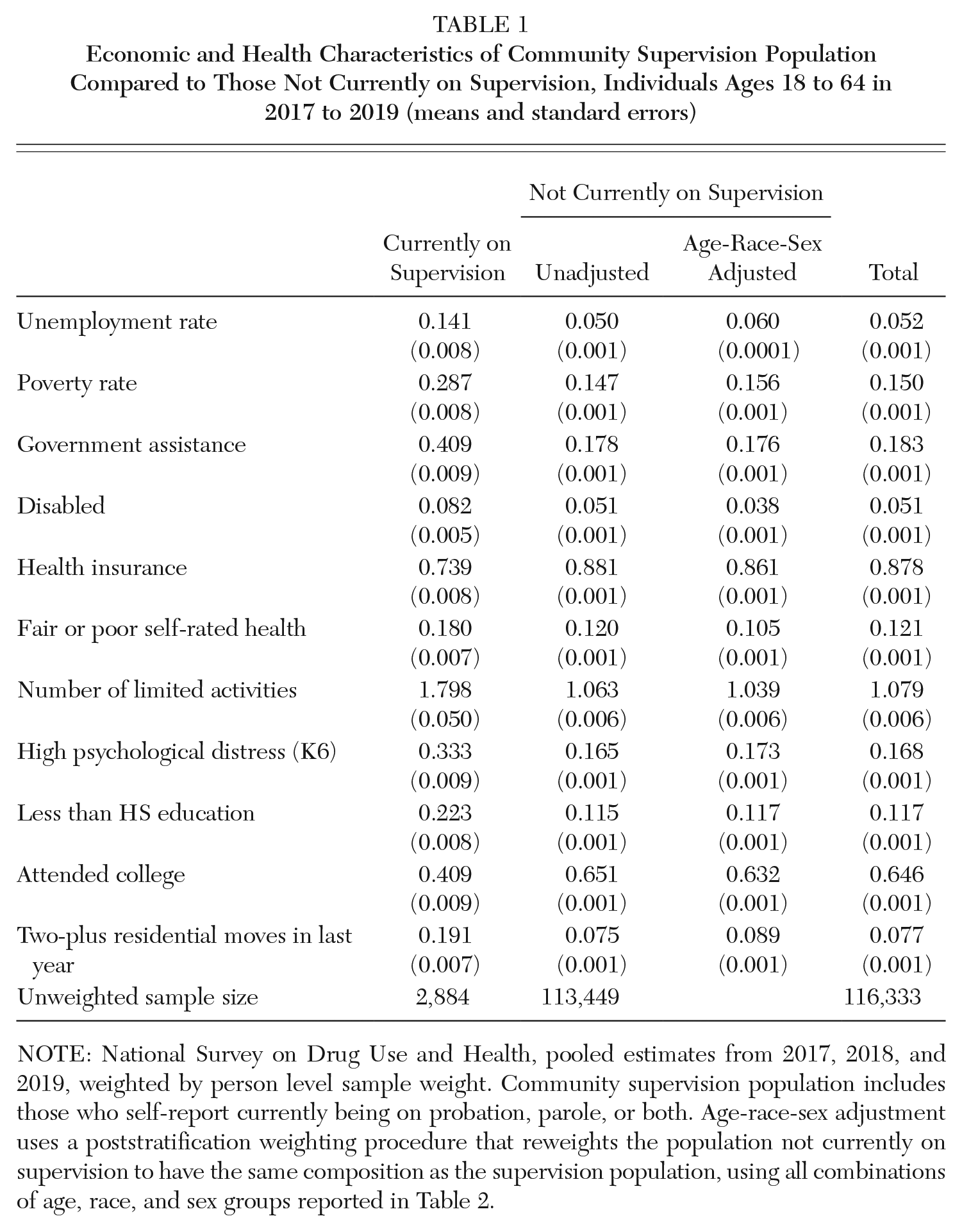
NOTE: National Survey on Drug Use and Health, pooled estimates from 2017, 2018, and 2019, weighted by person level sample weight. Community supervision population includes those who self-report currently being on probation, parole, or both. Age-race-sex adjustment uses a poststratification weighting procedure that reweights the population not currently on supervision to have the same composition as the supervision population, using all combinations of age, race, and sex groups reported in Table 2.
At the same time, people on community supervision are at high risk of arrest and incarceration. Sixty-eight percent of people released from prison are arrested within three years (Alper et al. 2018). Among people on probation, at least 12 percent become incarcerated; among those on parole, the figure is 27 percent (Horowitz 2018). People on probation or parole who get arrested are often said to have failed and, in some cases, that may be true; but an honest and dispassionate look at the evidence shows how the system is failing them and that our system of community supervision needs comprehensive reform.
The failures of community supervision disproportionately impact people of color, poor people, and those with low levels of education (see Table 2). For example, African Americans, who make up only 13 percent of the United States population, comprise 30 percent of people on community supervision; one in twenty-three African Americans is on probation or parole at any point in time (Horowitz 2018). Table 3 shows the poverty rate among those on supervision compared to those who are not, by race and sex, illustrating the intersectional nature of the disadvantages experienced by people on probation and parole. Poverty is much more common among Black and Hispanic people on supervision, especially women; half of all Black women on supervision live in poverty, as do 41 percent of Hispanic women. (See the online appendix for other characteristics by race and sex among the community supervision population.) Given the racial disparities and high poverty rate in probation and parole populations, transforming community supervision to improve well-being and opportunity would advance racial and economic justice.
Demographic Characteristics of the Community Supervision Population Compared to Those Not Currently on Supervision, Individuals Ages 18 to 64 in 2017 to 2019
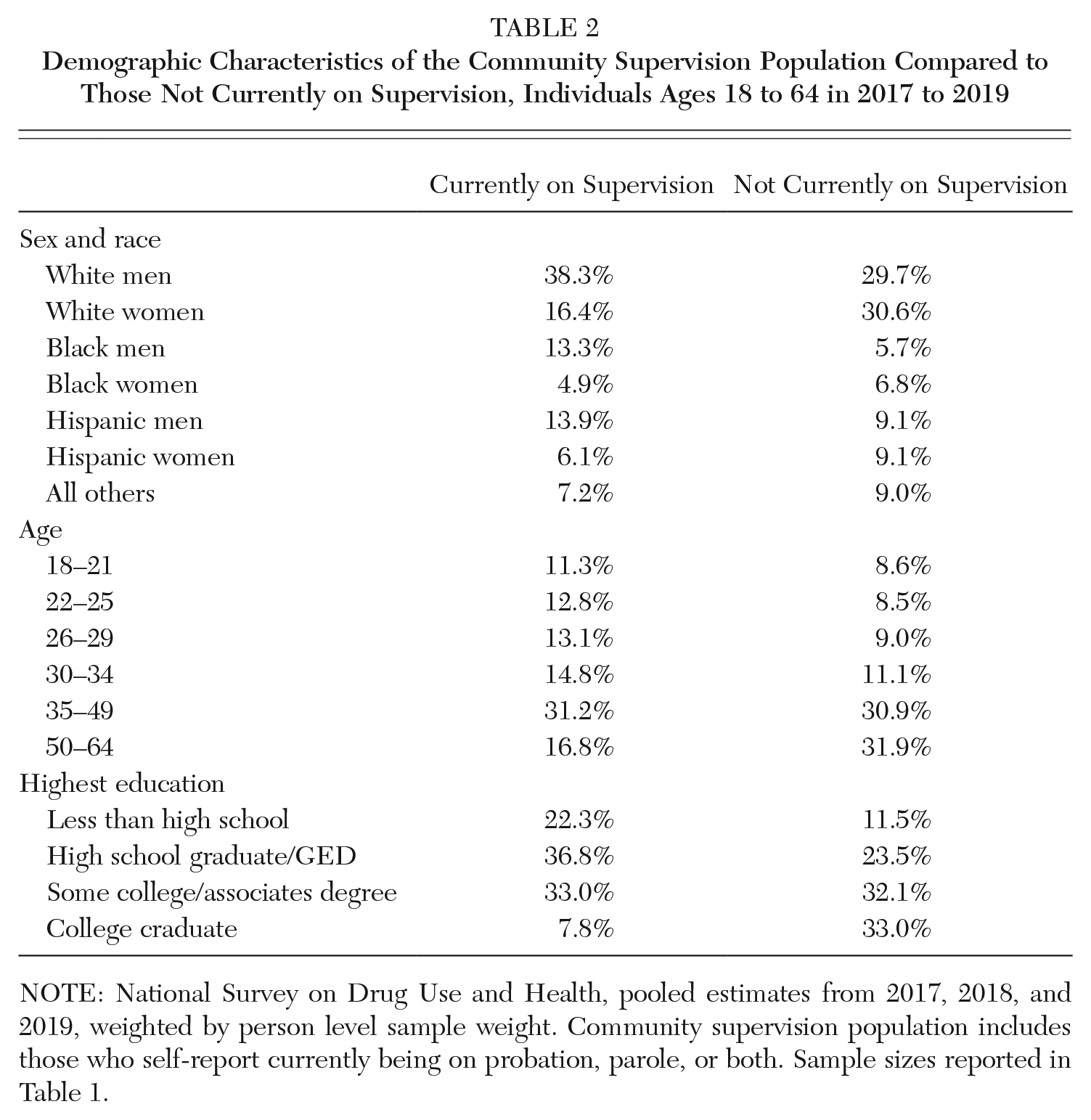
NOTE: National Survey on Drug Use and Health, pooled estimates from 2017, 2018, and 2019, weighted by person level sample weight. Community supervision population includes those who self-report currently being on probation, parole, or both. Sample sizes reported in Table 1.
Poverty Rate by Community Supervision and Sex and Race, Individuals Ages 18 to 64 in 2017 to 2019 (means, SEs, and unweighted sample size)
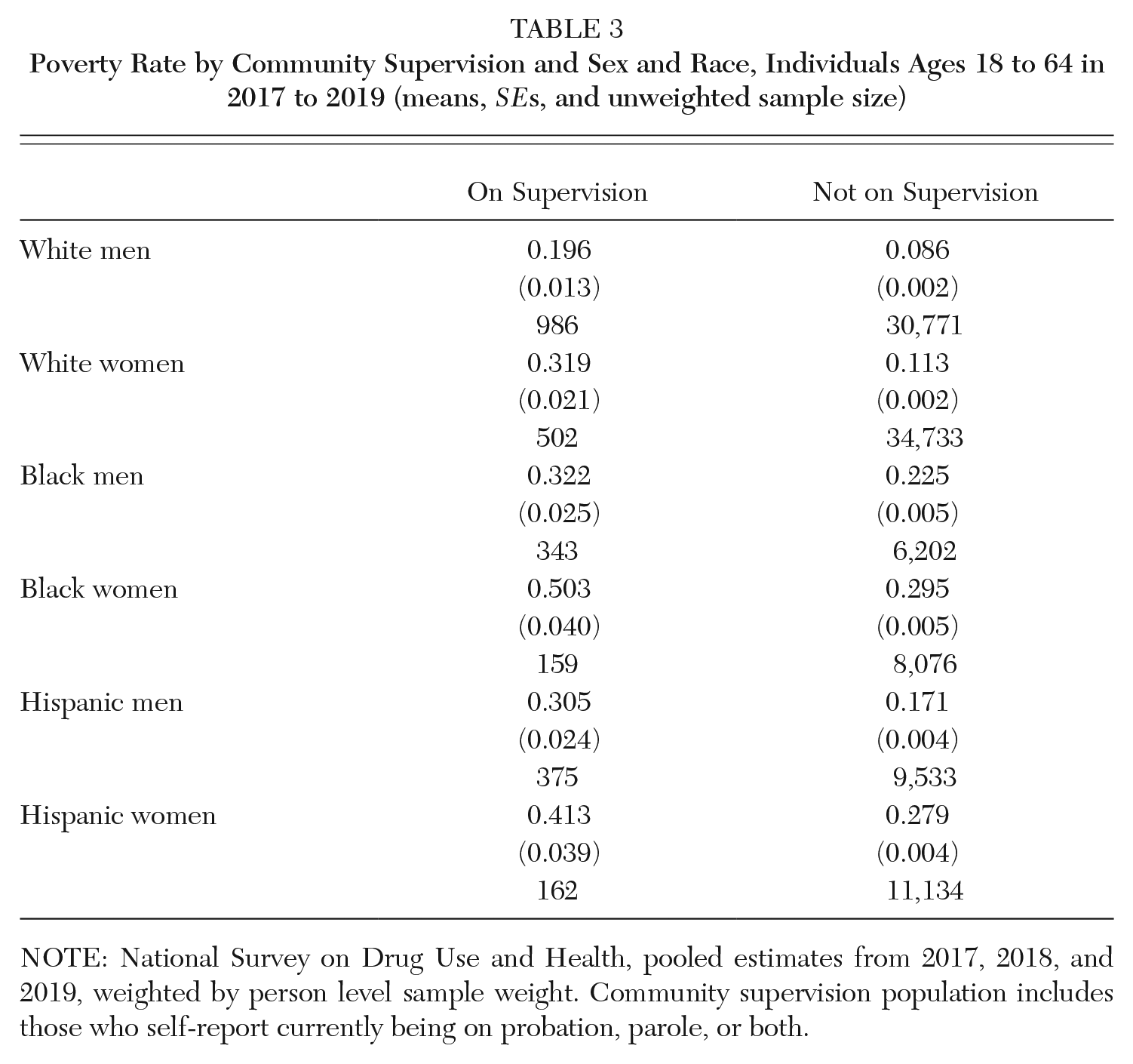
NOTE: National Survey on Drug Use and Health, pooled estimates from 2017, 2018, and 2019, weighted by person level sample weight. Community supervision population includes those who self-report currently being on probation, parole, or both.
We introduce a set of articles that examine various facets of community supervision and the experiences and outcomes of those subject to it. The articles review, evaluate, and synthesize research on a comprehensive set of topics related to community supervision, including labor markets, employment, education, job training, employers and stigma, self-employment, health and health care access, housing, supervision requirements and sanctions, tax policy, and the role of justice-impacted people in promoting reform. We hope that this work will make the case to policymakers, practitioners, reform advocates, employers, and researchers that community supervision is not living up to its goals and provide evidence to inform much-needed change.
Our goal is to redirect the policy conversation about community supervision from its emphasis on crime prevention and risk reduction toward a new paradigm focused on social integration and economic justice. Doing so, we hope, will pave the way for urgent reforms. These will not only improve the well-being of people on community supervision along with their families and broader communities, but also offer a different way of thinking about public safety in the aftermath of a criminal conviction.
Reimagining Community Supervision
Consistent with the criminal justice system’s larger focus on punishment (Feeley and Simon 1992; Simon 1993; Garland 2001; Western 2006), the current system of community supervision focuses on the surveillance and control of what is often treated as a deviant and potentially dangerous population. As we imagine policies that emphasize the integration of socially and economically marginalized people, our critique rests on the following five propositions.
The current model of community supervision doesn’t reduce crime
With over four million people on community supervision, we might expect empirical evidence to show that probation and parole significantly reduces crime. But this is not the case. Indeed, our review of the research finds little evidence that community supervision improves public safety.
Few studies compare criminal involvement among those on community supervision and those who are unsupervised. However, some older analyses find similar recidivism rates among parolees and others who leave prison without supervision, controlling for demographic characteristics and criminal history (Waller 1974; Gottfredson et al. 1982; Sacks and Logan 1980). More recent evidence comes from recidivism studies that report, for example, rates of rearrest or reincarceration among prison releasees who return to the community either on parole or with no supervision conditions. Amy Solomon and her colleagues compared state prison releasees who were released to community supervision, either through a parole hearing or by statute, with a comparison group who received no supervision (Solomon, Kachnowski, and Bhati 2005). In the two years after prison release, people on supervision and released by statute had the highest rearrest rates of 62 percent, compared to 61 percent for those who were unsupervised, and 54 percent for those released by a parole board. At two years after release, the likelihood of arrest was slightly higher for parolees than for those without supervision. The authors conclude that, “Overall, parole supervision has little effect on re-arrest rates of released prisoners” (Solomon, Kachnowski, and Bhati 2005, 1).
Moreover, “recidivism” depends not only on the behavior of people under supervision, but also on parole and probation officers. Officers contribute to recidivism by sending probationers and parolees to prison, not for new crimes, but for technical violations of their conditions of release. For example, although one study found higher rearrest rates among prison releasees with no supervision (65.2 percent) than among parolees (50.7 percent) (Osterman, Saleron, and Hyatt 2015), this gap shrank when parole revocation was included in the definition of recidivism and disappeared entirely when controlling for demographics, offense, and a risk score (see also Jackson 1983). Other modes of community supervision, such as day reporting centers (which provide a combination of services and supervision), also have no effects on recidivism, or are associated with elevated rates of crime (Hyatt and Osterman 2019; Wong et al. 2019).
Alongside research exploring the effects of community supervision on new criminal justice contact, a large programmatic literature finds that interventions in the areas of behavioral health, drug treatment, education, and employment are sometimes associated with reduced rates of arrest and incarceration, but program effects tend to be small, reducing measured recidivism by around 10 or 15 percent (Gaes et al. 1999; National Research Council 2008, chap. 4). In practice, good programs are difficult to scale and replicate. Even more challenging, community supervision has moved away from intensive programming and case management in favor of monitoring compliance with conditions of supervision (Petersilia 2006).
Community supervision traps people in cycles of system involvement
An emerging body of research shows that community supervision, in conjunction with other parts of the criminal justice system, can trap people in a cycle of escalating criminal justice involvement. Probation and parole departments often combine intensive surveillance and monitoring with low tolerance for even minor violations of supervision conditions. Violations of parole and probation are easily detected and often met with further punishment, including reincarceration and other custodial sanctions (Harding et al. 2013; Harding, Siegel, and Morenoff 2017). Indeed, 29 percent of state and federal prison admissions nationwide are for technical violations of probation or parole (Carson 2020). Long periods of supervision only exacerbate these dynamics (Bradner et al. 2020).
The “revolving door” of prison is not a simple function of individual behavior. Instead, it can be attributed in part to the intensive supervision that typifies parole. Parole—which itself has no impact on the risk of future convictions for serious or violent crime—produces more prison admissions for violations than probation (Harding, Morenoff, et al. 2017; Harding, Morenoff, and Wyse 2019). Parolees who are younger at their first arrest or who have severe substance use problems—and may be most susceptible to ongoing surveillance—are especially vulnerable to reincarceration for violations (Franco et al. 2021). Similarly, people sentenced to jail on top of probation—compared to those sentenced only to probation—are supervised more intensely on probation. As a result, they are more likely to be sent to prison for violations, even though they are no more likely to be imprisoned for new crimes and have no higher rates of arrest or conviction (Menefee et al. 2021).
The “built-in” escalation of punishment also exists in other parts of the criminal justice system that intersect with parole and probation. For example, people detained in jail pretrial are more likely to be convicted, largely due to their weakened position in plea bargaining and the incentive to plead guilty to be released (Dobbie, Goldin, and Yang 2018). Yet a conviction creates or adds to one’s criminal record, leading to harsher sentences in the future (Kurlychek and Johnson 2019). Meanwhile, people on parole also face more severe punishment if convicted of a new crime. They are more likely to be sentenced to prison, owing both to formal sentencing guidelines and to the discretion of judges and prosecutors (Hickert et al. 2021).
The criminal justice system also traps people on prolonged periods of parole and probation by imposing fines as punishment and fees for supervision (Harris 2016). In most jurisdictions, community supervision cannot be completed until monetary sanctions are paid, extending the time people are subject to monitoring and thereby at high risk of reincarceration for violations. Moreover, the costs of such fines and fees can disrupt reintegration and desistance from crime (Harris, Evans, and Beckett 2010; DeMarco, Dwuer, and Haynie 2021). Imposed on a typically poor population, payment of monetary sanctions can preclude paying for stable housing or investing in education or training—which help promote reintegration and limit recidivism. Unpaid fines and fees can result in debt and bad credit (Link 2019), exacerbating stigma for employers, landlords, and loan officers (Pleggenkuhle 2018).
Scholars and policymakers use the term “net widening” for criminal justice processes that escalate involvement (Austin and Krisberg 1981; McMahan 1990; Tonry and Lynch 1996; Phelps 2013). Perhaps the paradigmatic example of net widening is intensive probation. Originally intended to divert people from prison by providing a community-based sentencing alternative with more stringent conditions than traditional probation (Palumbo, Clifford, and Snyder-Joy 1992; Petersilia 1999), it ended up increasing the incidence of technical violations and incarceration compared to routine supervision (Caplow and Simon 1999; Lin 2010; Lin, Grattet, and Petersilia 2010). Similar results exist for intensive parole (Petersilia and Turner 1993). The failure of intensive supervision shows how systems based on monitoring and surveillance will only perpetuate punishment.
The current system is historically and internationally extreme and excessively punitive
Although the current focus on monitoring and punishment has come to seem “natural” or inevitable, community supervision systems have significantly changed over time. The original emphasis on rehabilitation yielded, alongside the rise of mass incarceration, to a concern with compliance and control. Furthermore, the U.S. system has grown into an extreme outlier internationally, with a rate of community supervision 8.5 times the European average; only three U.S. states have rates below that of any European country (Bradner et al. 2020).
Historically, probation and parole had distinct origins (Rothman 2002). Probation was conceived as a type of mentoring assistance, chiefly for young people who were not deeply involved in crime. Parole, on the other hand, was designed to promote reintegration following imprisonment. Both systems were founded to offer social assistance, not to intrude on liberty or impose a shadow criminal justice penalty. Probation and parole officers, in their most rehabilitative versions, operated as social workers connecting people to jobs and other kinds of support. Starting in the 1980s, however, with the growth of punitive criminal justice policy, the case management model came to an end, as community supervision came to resemble law enforcement (Petersilia 2006). The work of parole and probation officers shifted from social integration to monitoring compliance with the conditions of release and revoking people to incarceration for violations of conditions. With a typical caseload of fifty or sixty supervisees, officers were left with little time to do more than administer a drug test, check pay stubs and residential addresses, inquire about compliance with conditions, and collect supervision fees.
Quantitative trends also suggest that probation has become more punitive. Analyzing national and state-level trends in probation and incarceration from 1980 to 2010, Phelps (2013) found that during the 1980s, increases in state probation rates were associated with declines in their incarceration rates, consistent with the use of probation to divert people from prison. In the 1990s and 2000s, however, changes in the probation rate were positively associated with changes in the incarceration rate. This finding supports the idea that the expansion of probation over those decades led to higher incarceration rates, widening the net of penal control.
Punitiveness is significantly a cultural project. People who come into contact with the criminal justice system face a kind of “othering”; they are widely (and mistakenly) cast by policymakers and the public as outsiders of low moral worth who are worthy of harsh punishment. This belief is both a cause and a consequence of the disproportionate representation of people of color throughout the criminal justice system, from arrest to pretrial detention, incarceration, and community supervision (Western 2006; Alexander 2010; Menendian and Rothstein 2020; Bradner et al. 2020). Policymakers and the public also often assume that most people who leave prison or jail intend to engage in criminal activity upon release. Yet research documents the positive intentions of returning citizens; the vast majority of formerly incarcerated people desire “conventional” roles as workers, family members, students, and community members (Seim 2016; Western 2018; Harding, Dobson, et al. 2017; Harding et al. 2019; Jones 2018; Miller 2020). Indeed, studies that follow formerly incarcerated people over time find that they devote incredible effort to job search and family reunification upon release. Criminal behavior often results either from barriers to reintegration that cause poverty and housing insecurity or from relapses to addiction or mental illness that are themselves typically rooted in a life history of trauma (Sugie 2018; Western et al. 2015; Western 2018; Harding et al. 2019). These findings suggest that support rather than punishment will lower recidivism.
The current system creates real, widespread harms
Beyond failing to prevent crime and imposing excessive punishment that traps people in an escalating cycle of criminal justice involvement, the current system also creates real and widespread harms. These harms center on the people who are under supervision but radiate outward to affect their families, neighborhoods, and communities.
For people on parole or probation, supervision can interfere with employment. It can send a negative signal to employers, dictate the times that people under supervision are available to work, and demands that compliance to supervision be prioritized over professional obligations (see Capece’s article in this volume; Phelps and Ruthland 2022). Periods of incarceration for violations of supervision can also lower earnings and harm employment prospects (Harding, Siegel, and Morenoff 2017). Similarly, people on supervision report that it can interfere with college and job training (see Quach et al.’s article in this volume). Such barriers to employment, earnings, and human capital development leave people under supervision less able to support their families and, thus, increase child poverty. Relatedly, because the current system focuses on surveillance and punishment rather than support, the burden of helping people on supervision rebuild their lives falls squarely on the shoulders of family members. Often, they provide support despite themselves being economically insecure and poorly equipped to offer material resources (Harding et al. 2014, 2019).
High rates of incarceration for parole and probation violations coupled with the geographic concentration of people on supervision (Kirk 2020) create community-level harms. These emerge through the social and economic disruptions caused by many members of the community cycling in and out of prisons and jails. For example, communities with high incarceration rates are less able to reduce crime through informal social control because incarceration cycling disrupts social networks (Clear 2007). Incarceration cycling also increases the transmission of infectious diseases between prisons and jails and communities (Johnson and Raphael 2009).
Social and economic integration after incarceration improves communities and public safety
The current focus on surveillance over support is also counterproductive from a public safety perspective. Research shows that we can improve public safety and reduce crime by focusing on integration rather than punishment. For example, stable, full-time employment in well-paying jobs promotes desistance from crime (Sampson and Laub 1993; Ramakers et al. 2017; LaBriola 2020), but the low-wage work often mandated by parole requirements does not (Seim and Harding 2020).
In addition, connections to family and community protect against criminal behavior by creating “stakes in conformity,” building daily routines, and insulating people from others involved in crime (Sampson and Laub 1993; Laub and Sampson 2003). In other words, when people find meaningful social roles in their families and communities, they have more to lose by engaging in crime and fewer opportunities to do so.
Probation and parole could be reformed to focus on income support, healthcare, and employment programs, all of which effectively divert people from crime. Research on welfare policy, for example, shows that young people from low-income families face a 20 percent lower risk of arrest when they receive income benefits from the Supplemental Security Income program (Deshpande and Mueller-Smith 2021). Some employment programs offering guaranteed jobs and training immediately after incarceration have also been found to significantly reduce the risks of arrest and incarceration (Redcross et al. 2012).
Beyond employment and income support, healthcare also correlates with reductions in arrest. States that expanded Medicaid enrollment under the Affordable Care Act have arrest rates 20 to 30 percent lower than similar states that opted out of Medicaid expansion; the effect of Medicaid was especially large on the drug arrest rate (Simes and Jahn 2022). Relatedly, a large-scale scoping review identified high-quality childcare as one of the most effective anticrime interventions, having sizable effects on arrest rates well into adulthood (Hawks et al. 2021). Overall, then, the best available evidence suggests that significant investments in healthcare, income support, and high-quality social services can help achieve many of the outcomes that probation and parole have struggled to provide.
Ten Papers on Community Supervision Reform
To reimagine probation and parole, we have assembled a series of policy papers that examine various aspects of community supervision, as well as the challenges and resources of people impacted by the system. These articles summarize central currents in the research literature and formulate policies and programs that might help integrate people on community supervision into their families and communities. Together, the articles provide an evidence base for future reforms.
The collection begins with an article by Sykes, Ballard, Mata, Sharry, and Sola, who describe structural changes in the U.S. labor market that have disadvantaged justice-impacted workers. Workers without a college education and with a criminal record not only face wage stagnation—caused in part, by the decline of manufacturing industries and the increase in service sector employment—but also find their employment prospects limited by the widespread use of criminal record checks and the disruptive effects of probation and parole conditions. Sykes and colleagues conclude that investments in education and job training, regulation of the use of background checks in hiring, and limitations on community supervision sanctions will promote labor market performance among formerly incarcerated people.
Holzer examines how employers and policymakers can improve living wage employment among people on community supervision. He notes that the underemployment of formerly incarcerated people represents an important loss not just to individual workers and their families, but also to employers and the entire economy. Reviewing evidence on the employment obstacles facing people on community supervision—including low human capital, poor mental health, criminal record stigma, and legal barriers to licensing and employment—Holzer argues that certificates of relief, expungement, and job training are promising policy options.
Capece shows how community supervision itself interferes with the employment of people under its control. Evidence shows, he argues, that current parole and probation practices do not help formerly incarcerated people achieve sustainable, living wage jobs, despite employment’s central role in preventing recidivism. Indeed, the mandates of parole and probation are more disruptive than beneficial. Capece proposes a new, “strengths-based” system of community supervision that focuses on pursuing and maintaining employment, as well as a two-year time limit on community supervision.
The next three articles focus on specific policy areas that could improve employment among people on community supervision. Bushway addresses the potential for job training and subsidized jobs to improve labor market outcomes and upward mobility among people under supervision. He argues that such programs can not only improve job skills and lower barriers to hiring, but also help reshape the identities of people coming home from prison and jail. Based on these analyses, Bushway recommends an identity-based approach to community supervision, in which parole and probation officers reorient their focus to behaviors and opportunities that foster prosocial identities, thereby promoting desistance.
Quach, Cerda-Jara, Deverux, and Smith advocate for increased access to college education in prison and after release, to meet both the increasing demand for college-educated workers and the strong desire for college education among many justice-involved people. They detail policy changes to broaden education among currently and formerly incarcerated people, including expanding opportunities for college coursework in prisons, actively recruiting students in prisons, creating prison learning communities, reforming parole and probation to support education, and expanding campus-based communities and supports for justice-impacted students.
Given the stigma of a criminal record in the labor market, Hwang analyzes entrepreneurship as an alternative pathway to upward mobility for formerly incarcerated people, a group with a high level of entrepreneurial ambition. Hwang proposes a series of policy reforms to promote entrepreneurship among formerly incarcerated people, including removing restrictions on government-backed small business loans, expanding opportunities for business training and support, and building social and human capital in this historically marginalized population.
Changes to tax policy could also improve the reentry outcomes of formerly incarcerated people and their families by providing more resources and opportunities for social and economic reintegration. Smith proposes more inclusive versions of the existing Earned Income Tax Credit and Work Opportunity Tax Credit, as well as a new “Returning Community Members Tax Credit” to reward those who support people returning from institutions including military service, foster care, inpatient treatment, and penal facilities.
Formerly incarcerated people experience high rates of homelessness and housing instability, which are substantial barriers to reintegration. To address the mutually reinforcing increases in rates of incarceration and homelessness, Augustine and Kushel explain promising policy options to improve housing security among people on supervision. These include preventing homelessness through better release planning, expanded eviction prevention programs, expanding access to permanent rental subsidies, and antidiscrimination enforcement. Policies to help move people from homelessness to housing include expanded shelter and permanent housing options, permanent supportive housing, and rapid rehousing programs. They also advocate for reforms to parole and probation conditions like residency restrictions that increase the risk of homelessness.
Hawks, Norton, and Wang synthesize research on health and health care access among justice-involved people. People under supervision have high rates of chronic disease, mental illness, and substance use disorders, but limited access to healthcare, health insurance, and evidence-based addiction treatment. Hawks and colleagues argue that health conditions must be managed not by probation and parole officers, but by health professionals. This would broaden access to medication-based addiction treatment and stop the practice of revocation for addiction relapse. To accomplish these goals, community-based primary health care, mental health treatment, and addiction treatment need to be expanded.
Finally, Christian surveys the landscape of local, community-based reentry partnerships that have developed over the last decade to support the reintegration of formerly incarcerated people. These collaborations—between service providers, community-based organizations, and grassroots organizations formed by justice-impacted people and their families—offer a new model for postincarceration support that could replace the traditional systems of parole and probation.
The volume concludes with commentaries from two criminal justice reform leaders with direct experience of incarceration. Hodge proposes a human-rights centered approach to reforming community supervision that views those impacted by the criminal justice system as key stakeholders in reform efforts. Crampton argues that community supervision must be reformed so that people who have “paid their debt” to society can return to their lives without the ongoing harm of collateral consequences.
Looking Forward
The contributions to this volume all focus on building stability, opportunity, and pathways to upward mobility for people under supervision. At present, parole and probation departments, which monitor compliance with supervision conditions, are not organized to help people succeed in their lives and support their families. As such, these articles advocate replacing the focus on surveillance and control with efforts to promote integration and opportunity. Wholesale reforms could develop a socially integrative kind of justice for people who have come into conflict with the law. The articles collected here —along with the research reviewed in this introduction—provide four main guides for policy change.
Abandon the control and supervision model
Since research finds no evidence that community supervision prevents crime—and can in fact undermine stability and opportunity and function as a recidivism trap—the primary recommendation is to abandon the supervision, control, and reincarceration functions of probation and parole. People on probation and parole may, of course, commit new offenses, but no evidence suggests that community supervision provides any advantage over the regular channels of police and the courts in preventing or prosecuting new crimes. Since community supervision has little clear benefit but large fiscal and social costs, its scale and intensity must be greatly reduced. Specific proposals in this volume for reducing the supervisory function of probation and parole include limiting periods of supervision to no longer than a year or two and greatly reducing the discretionary power of revocation. While such reforms may be within the realm of current political feasibility, the research supports an even more ambitious transformation. There is little clear criminal justice purpose for probation or parole departments that operate as a kind of secondary punishment. Instead, investments in education, training, employment, healthcare, and housing could better reach the original goal of diverting people from crime and supporting their integration after incarceration.
Housing and reentry planning
To attain upward mobility, quality jobs, and stable employment, people must first have a firm foundation of social and material security. The articles identify three key needs—housing, healthcare, and income—and offer concrete strategies to meet them. To guarantee safe and stable housing, research recommends reentry planning and referrals to housing services but, above all, rental subsidies to help people access decent, secure homes. Healthcare is also a pressing need for a population that struggles with chronic illness and unmet needs for mental health and addiction treatment. Expanding community primary care would help people see doctors and other providers immediately after release from incarceration, and regularly after that. Along with housing and healthcare, social stability also depends on income security. Research suggests that extending existing tax policies could provide valuable income support to people on supervision and to the families that support them.
Education and training
Several of the articles note the need to improve justice-involved people’s capacity to take advantage of opportunities in the labor market and the economy more generally. From this perspective, finding a job is not the greatest challenge facing people under supervision. Instead, the challenge is to find work in occupations that offer stable employment, good wages, and income growth over the life course. The minimum wage work common on the resumes of people on probation and parole largely fails to provide job security, a living income, or the prospect of rising pay with work experience. Education and training can widen access to career employment. To secure career jobs, workers often need postsecondary education that, in turn, often requires tuition assistance and on-campus support for those enrolled as students a little later than usual. Job training and technical education for employment in skilled trades offers another path to the kind of career employment that supports long-term social integration. The articles offer ambitious suggestions to improve education and training, beyond connecting justice-impacted people with minimum wage work. These include developing entrepreneurial talent and supporting assistance for small businesses.
Creating employer incentives and removing barriers to employment
While building the capacities of people under supervision can help lead to quality jobs, people on probation and parole find ever-greater obstacles the higher they climb in the labor market. For instance, the stigma of criminalization uncovered through background and reference checks is greater for well-paying jobs. The articles suggest that criminal record expungement and certificates of relief could help reduce stigma, lowering barriers to employment. Tax policy or job subsidies could also incentivize employers to provide employment opportunities to justice-involved people. In addition, antidiscrimination guidance and enforcement at the state and federal levels could help defuse the stigma of a criminal record.
These recommendations—attending to people’s basic needs for housing, healthcare, and income; increasing education and training; reducing collateral consequences; and incentivizing employers—outline a new paradigm. This paradigm would provide the support that lowers crime more effectively than probation and parole. Moreover, since such measures would improve the well-being of those under supervision, a paradigm shift from surveillance to opportunity would serve justice in new and fundamental ways. If our system, which is marked by racial inequality and operates in some of the nation’s poorest communities, promoted well-being and upward mobility, we could produce a meaningful kind of public safety based on a fairer distribution of resources and opportunities.
Supplemental Material
sj-docx-1-ann-10.1177_00027162221115486 – Supplemental material for From Supervision to Opportunity: Reimagining Probation and Parole
Supplemental material, sj-docx-1-ann-10.1177_00027162221115486 for From Supervision to Opportunity: Reimagining Probation and Parole by David J. Harding, Bruce Western, Jasmin A. Sandelson, David J. Harding, Bruce Western and Jasmin A. Sandelson in The ANNALS of the American Academy of Political and Social Science
Footnotes
Notes
Supplemental Material
Supplemental material for this article is available online.
David J. Harding is a professor of sociology at the University of California, Berkeley, and Director of UC Berkeley’s Social Science D-Lab. He is the author of On the Outside: Prisoner Reentry and Reintegration (Chicago 2019) and After Prison: Navigating Adulthood in the Shadow of the Justice System (Russell Sage 2020).
Bruce Western is the Bryce Professor of Sociology and Social justice and directs the Justice Lab at Columbia University. He is the author of Punishment and Inequality in America (Russell Sage 2006) and Homeward: Life in the Year after Prison (Russell Sage 2018).
Jasmin A. Sandelson is an associate research scholar at Columbia University’s Justice Lab and an MFA student in New York University’s creative writing program. Her forthcoming book explores the power of friendships between poor teenage girls to mitigate poverty’s harms.
References
Supplementary Material
Please find the following supplemental material available below.
For Open Access articles published under a Creative Commons License, all supplemental material carries the same license as the article it is associated with.
For non-Open Access articles published, all supplemental material carries a non-exclusive license, and permission requests for re-use of supplemental material or any part of supplemental material shall be sent directly to the copyright owner as specified in the copyright notice associated with the article.
