




Abstract
The authors ask descriptive questions concerning the relationship between social movement organizations (SMOs) and the state. Which movement’s SMOs are consulted the most by the state? Do only a few “spokes-organizations” speak for the whole of movements? Has the state increasingly consulted SMOs over time? Do the movements consulted most by the state advise only a few state venues? The authors present and describe a new publicly available data set covering 2,593 SMOs testifying at any of the 87,249 public congressional hearings held during the twentieth century. Testimony is highly concentrated across movements, with just four movements giving 64 percent of the testimony before Congress. A very few “spokes-organizations” testify far more often than typical SMOs. The SMO congressional testimony diversified over the twentieth century from primarily “old” movements such as Labor to include “new” movements such as the Environmental movement. The movements that testified most often did so before a broader range of congressional committees.
In the early 1970s social movement theory began to center the state as the main target of social movements and the social movement organization (SMO) as the primary carrier of mass movements (Gamson 1975; McCarthy and Zald 1977; Oberschall 1973; Tilly, Tilly, and Tilly 1975). Foundational theories such as political opportunity theory (McAdam 1999; Tilly 1978) and political mediation theory (Amenta, Carruthers, and Zylan 1992) argue that expanding access to state decision makers is necessary for social movement emergence and success. Theories of institutional pluralism in the United States (Grossmann 2012; Truman 1971) contend that SMO presence at congressional hearings is an important outcome of organizational and constituency resources. Yet despite the centrality of the state-SMO relationship to social movement theory, foundational descriptive questions remain: Which movement’s SMOs are consulted the most by the state? Do state institutions such as Congress consult a diverse group of SMOs from each movement, or do a few “spokes-organizations” speak for the whole of a movement? Has the state increasingly consulted SMOs over time? Do the movements consulted the most by the state advise only a few state venues?
We emphasize that these questions are descriptive rather than causal. Description is not only foundational for causal analysis but also answers “what,” “when,” and “whom” questions of substantive importance in their own right (Gerring 2012). Yet, scholarship on social movements has focused mostly on causal questions, and although there is a large body of case studies with detailed descriptions of single movements, research has neglected cross-movement description generally (Amenta and Ramsey 2010). Cross-movement comparative description has been difficult in our particular case because we have not had systematic data across movements describing when the state consults SMOs (Burstein 2019). Here, we answer our questions with new data on when the U.S. Congress consults SMOs throughout the twentieth century.
We use SMO presence at congressional hearings as an indicator of when the state consults SMOs. Congressional hearings are called by committees that are organized around distinct political issues and governing responsibilities. Committees hold hearings and call witnesses to gather information on bills, conduct oversight, and investigate problems. Witnesses can only testify at hearings, never on the floor, and committee leaders, chosen by the majority party, have veto power on who gets invited. However, since 1970, chamber rules state that minority members can call witnesses for at least one day. Witnesses may be called because they provide desired expertise (Baumgartner and Leech 1998; Ganz and Soule 2019), or they reflect partisan interests (Park 2017), or their organizations are presumed to speak for important constituencies (Ban, Park, and You 2022; Grossmann 2012; Schlozman et al. 2015). Indeed, these hearings are the primary vehicle through which the legislative branch gathers information (Baumgartner and Jones 2015; Burstein and Hirsh 2007).
Our SMO congressional hearings data cover 2,593 SMOs, from 36 different social movement families and when they testified at any of the 87,249 public congressional hearings held during the twentieth century. These data are posted publicly (https://osf.io/cqsh6/). Our data draw heavily on existing lists of SMOs (Amenta et al. 2009; Earl et al. 2004; Gamson 1975; Goldstein 2008; Minkoff 1993; Southern Poverty Law Center 2022). Ours is not the first data describing SMOs before Congress (Albert 2013; Ganz and Soule 2019; Goss 2020; Grossmann 2012), but it is the most extensive, providing a broad comparative look at SMO representation across both organizations and movements over the entire twentieth century.
We find that the majority of SMO testimony comes from a handful of movements (the Labor, Environmental, Farmers’, and Veterans’ movements together account for roughly two thirds of the congressional testimony given by SMOs). Within movements, a select group of SMOs, so-called spokes-organizations, give most of the testimony. Which social movements testified before congressional hearings shifted over the twentieth century from “old” economically oriented movements to “new” identity- and issue-based movements (Melucci 1980). The movements that testified most often did so before a wider range of congressional committees than movements that testified before a more concentrated range of committees.
Data Collection
Political scientists and sociologists have collected and analyzed several data sets relevant to social movements and congressional hearings. The most prominent of these is the Policy Agendas project, which covers all postwar hearings (1946–2020) and categorizes hearings by substantive topic (Baumgartner and Jones 2009). These topics, such as “civil rights” or “environment,” can be indicators of movement influence on Congress, and scholars have analyzed when social movement activity may lead to Congress holding more hearings on particular topics (Johnson, Agnone, and McCarthy 2010; King, Bentele, and Soule 2007), but these data do not show whether or which SMOs were consulted at those hearings. Others have collected data on when SMOs testify before Congress, but these data are limited to single movements (Albert 2013; Ganz and Soule 2019; Goss 2020) or shorter time periods (Grossmann 2012). Others have collected multimovement data but have focused on movement activity rather than state outcomes (Earl et al. 2004; Minkoff 1993). The closest analogues to our project are Amenta and colleagues (2009) data on the representation of a large number of SMOs and SMO families in the news media and Gamson’s (1975) analysis of the state outcomes of a representative sample of U.S. SMOs from the pre–World War II period.
There are no comprehensive lists of SMOs (especially historically) for reference (Andrews and Edwards 2004; Burstein 2021), but we draw on several lists of SMOs from existing sources to capture as many SMOs as possible. The first and most extensive source we used is the Political Organizations in the News (PONs) project (Amenta et al. 2009). PONs compiles SMO names for 35 different SMO families over the twentieth century, facilitating a longer historical analysis of who testifies before Congress. We then used the Dynamics of Collective Action and Minkoff’s (1997, 1999) Encyclopedia of Associations data 1 to identify SMOs that were not in the PONs data. The PONs list deliberately omits revolutionary movements, so we also included organizations identified in the Southern Poverty Law Center’s list of hate and extremist groups and the Attorney General’s List of Subversive Organizations (Goldstein 2008). Finally, we include organizations identified in Gamson’s (1975) pathbreaking study of SMO outcomes. From these sources we identified a total of 2,593 SMOs. Table 1 shows the number of SMOs we include from each list and their overlap. Ultimately it is impossible to say what proportion of the true universe of SMOs this represents, and we encourage future researchers to expand this list, but we also think it unlikely that we have missed any truly prominent SMOs.
Number of Organizations Included from SMO Source Lists.
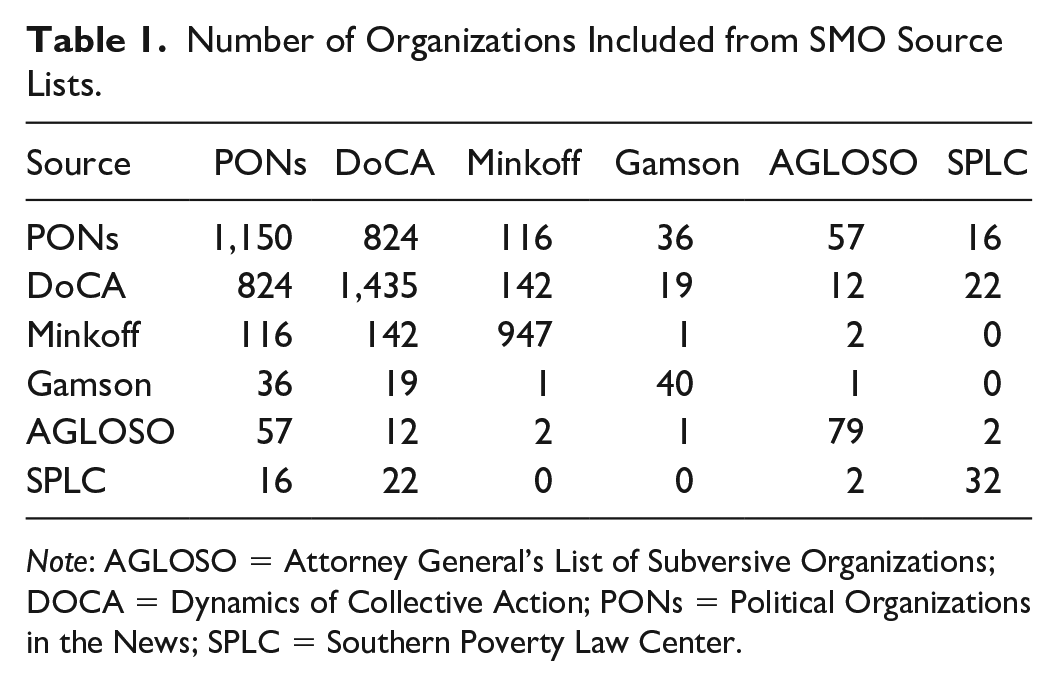
Note: AGLOSO = Attorney General’s List of Subversive Organizations; DOCA = Dynamics of Collective Action; PONs = Political Organizations in the News; SPLC = Southern Poverty Law Center.
After compiling our list of SMOs, we Web-scraped the metadata of every congressional hearing from 1900 to 1999 through ProQuest Congressional. ProQuest Congressional contains complete lists of dates, committees, hearing titles, subject matter, witnesses, and witness affiliations. 2 In sum, Congress held 87,249 hearings with 1,113,273 witnesses during the twentieth century. We then used search strings created for each SMO to search the entire population of hearings for each mention of the SMO in the metadata. These mentions were predominantly witness testimony but sometimes included SMOs mentioned in hearing descriptions (but were absent as witnesses) or references to SMO-authored reports or memos.
Although big-data methods such as ours help researchers collect large amounts of data quickly, they are often “dirty” or unreliable; potentially including both false positives and false negatives (Salganik 2019; Wang et al. 2016). We therefore extensively validated our machine-gathered data with human coders. Undergraduate coders manually searched the metadata in the ProQuest archives using search strings similar to those used by the machine. 3 We gave coders the SMO name, search string, and computer-generated count of hearings. Coders were then asked to verify the computer-generated count, check for potential false positives, and consider possible false negatives. Coders checked 50 percent of hearings for SMOs with 10 to 50 results, a 10 percent sample for SMOs organizations with more than 50 results, and all cases for SMOs with fewer than 10 hearings to look for potential false positives. 4 Coders helped identify false negatives (due mainly to missing abbreviations) and eliminate false positives, for example, flagging hearings for companies such as Black Panther Oil and Gas or SDS 5 Lumber or removing hits for “CIO” 6 (chief information officer) after 1970. In another example, the Ku Klux Klan had more than 800 hearings in our original results, but only 73 cases in our manual search, because our machine coding identified the “klan” string in words such as Oakland. These kinds of errors are not specific to our data but endemic to machine coding and difficult to identify without systematic human verification.
We are focused on hearings in which Congress invites SMOs to testify as representatives for their issues and claims, yet some congressional hearings are intended to stigmatize or delegitimate SMOs (Noakes 2000; Pontikes, Negro, and Rao 2010). To remove cases in which SMOs were targeted for delegitimation at hearings, we started by identifying all investigative hearings, hearings in which the organization is the subject but did not testify, and hearings in which witnesses are “alleged” or “former” SMO members. Undergraduate coders then manually reviewed each of these hearings to determine if the organization in question was the target of delegitimation (Krippendorf’s α = .845; Hayes and Krippendorff 2007). We used the data from these initial rounds of coding to train a random forest classifier to find candidates for similar cases, which were then reviewed manually by undergraduate coders, yielding a further 168 cases. In total, we removed 1,539 SMO hearings from our data.
Results
Movements and SMOs Most Frequently Testifying before Congress
Which movement’s SMOs are consulted the most by the state? Here we present descriptive statistics and visualizations of which SMOs and movements testify before Congress most often. These statistics are based only on the SMOs in the PONs data because they include consistent movement coding and coverage over our period of analysis. Figure 1 shows that the top SMOs come disproportionately from the Labor, Farmers’, Environmental, and Veterans’ movements. These four movements account for 64 percent of all movement testimony during the twentieth century. As discussed later with Figure 3, the longevity of some of these movements accounts for some, but by no means all, of the difference as the Labor and Veterans’ movements continue to testify at comparatively high rates even after the 1960s.
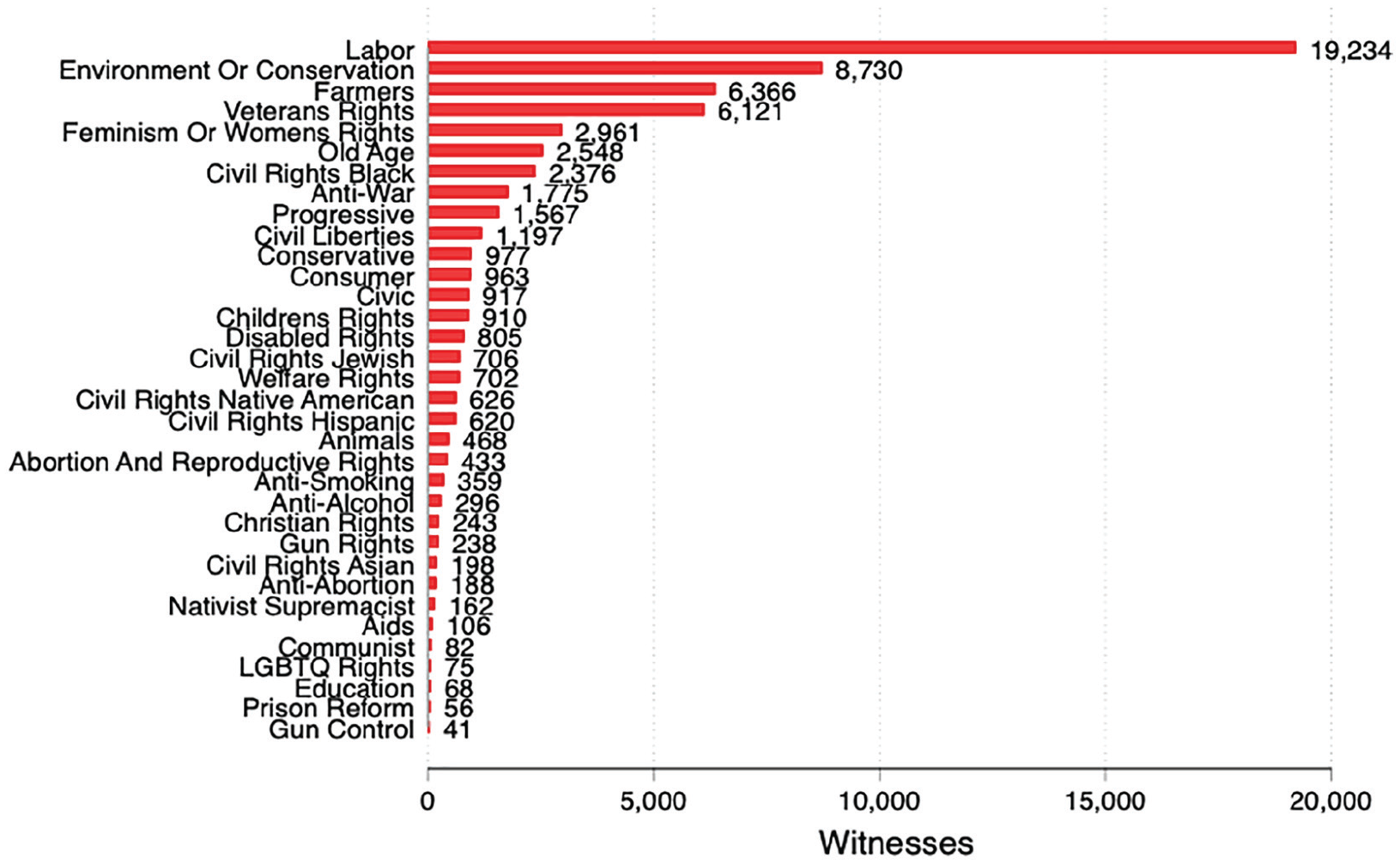
Total witnesses with SMO affiliation by movement, twentieth century.
Table 2 shows that the most represented SMOs naturally often come from the most represented movements: 22 of the 30 SMOs that testified most often come from the Labor, Environment, Farmers’, or Veterans’ movements. Other SMOs in the top 30 are spokes-organizations for somewhat less well represented movements, such as the American Civil Liberties Union, AARP, or NAACP. Many of the top SMOs testify more often than entire movements. The AFL-CIO alone, for example, testified more often than all but four of the top social movements. The Sierra Club alone gave the equivalent of 62 percent of the entire Black Civil Rights Movement’s testimony (2,729 hearings). Disabled American Veterans (present at 1,094 hearings) gave more testimony than the entirety of the (nonveteran) disability rights movement (present at 898 hearings).
SMOs Most Frequently Testifying before Congress in the Twentieth Century.

Aside from the AFL-CIO, which adopted more institutional tactics halfway through the twentieth century (Mills and Schneider 2001), the only SMO in the top 30 with some history of street protest is the NAACP. SMOs with histories of contentious tactics or violence, such as the Black Panther Party or the Ku Klux Klan, although being among the most visible groups in the New York Times and Washington Post throughout the twentieth century (Amenta et al. 2009:640), 7 are conspicuously absent from the most represented SMOs before Congress. 8
The Spokes-Organization Structure of SMO Testimony before Congress
Does the state consult a diverse group of SMOs from each movement, or do a few “spokes-organizations” speak for the whole of a movement? New York Times coverage of SMOs is highly unequal (Amenta et al. 2009; Seguin 2016), and Gamson (2004) argued that media coverage follows a “spokes-organization” pattern whereby protest and other actions by the broader movement lead to coverage of its most prominent moderate SMOs. But it is unclear if such a pattern is present for testimony at congressional hearings. Grossmann (2012:9) argued that as advocacy groups become prominent participants in public debate, they become “spokespersons” for a set of ideas or a constituency and are invited to testify to represent those interests. However, Jones, Theriault, and Whyman (2019) argue that Congress seeks a diversity of information, which may encourage them to invite a broad cross-section of SMOs. Here we describe the distribution of testimony across SMOs.
Ultimately, arguments about spokes-organizations are about the structure of inequality in the voice of the SMOs within a movement. Spokes-organizations speak for other organizations in the movement rather than in addition to those organizations. A movement where all SMOs testified at near equal rates would not be said to have spokes-organizations. However, a movement in which one SMO testified to the exclusion of all other SMOs could be said to have a pure spokes-organization structure. Naturally, we would expect movements to fall between these extremes empirically. We therefore assess the spokes-organization structure of movements by measuring the inequality in testimony by the SMOs within each movement and consider high inequality evidence of a spokes-organization structure.
We use Gini coefficients to measure inequality in testimony within movements. The Gini coefficient is scale invariant (Allison 1978:870), which allows us to meaningfully compare the inequality in testimony within one movement to another. This is much like how we can compare within-country income inequality without worrying about between-country differences in total or average income. The Gini coefficient ranges from 0 to 1, with 0 representing perfect equality (in this case, all SMOs in the same movement family would have the same number of testimonies) and 1 representing perfect inequality (where only one SMO would have given all the testimony).
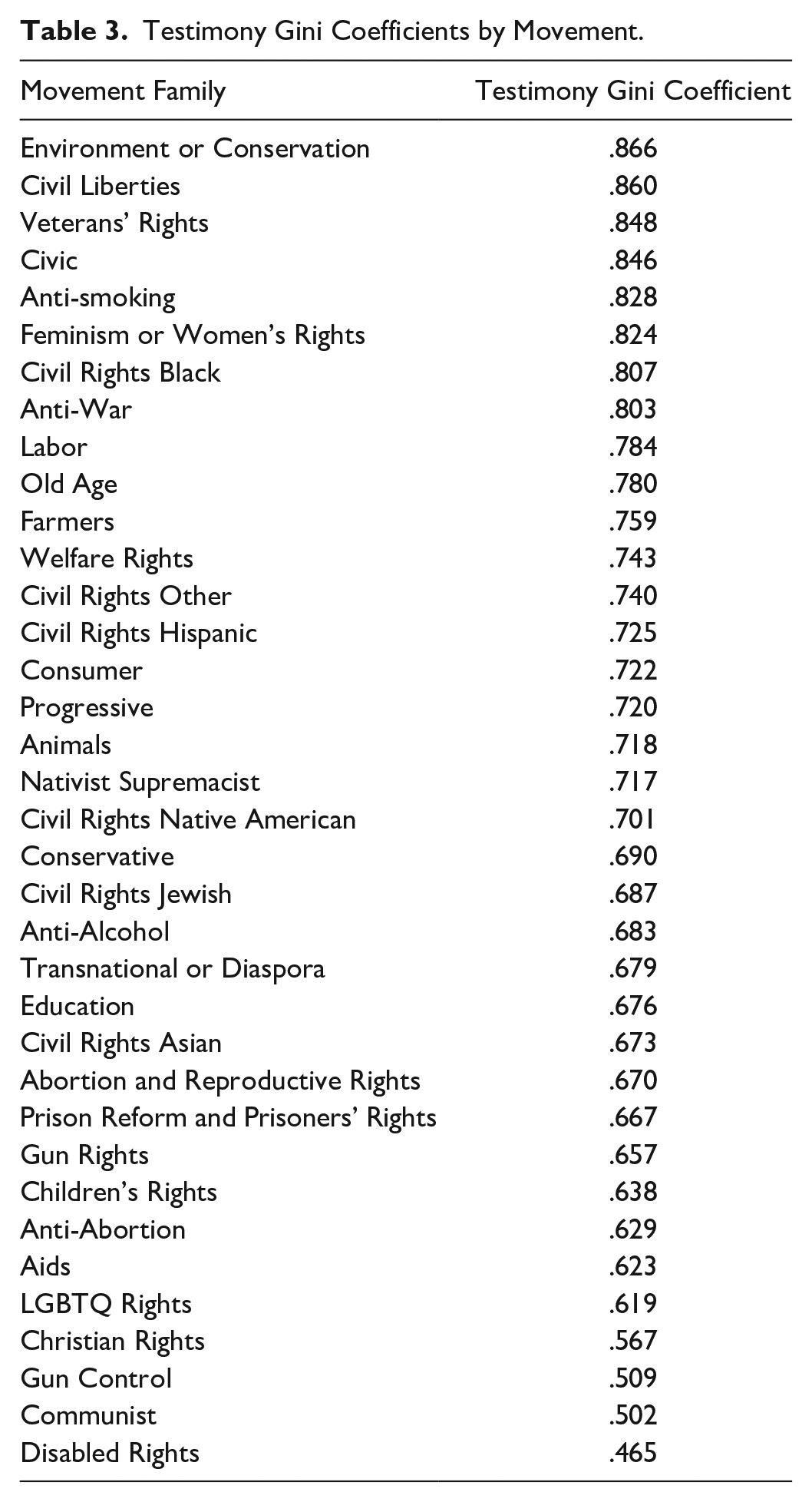
Table 3 shows the Gini coefficient for each movement family for the number of hearings at which each SMO in the movement has testified. This measures how unequally testimony is distributed across SMOs within movement family, and thus higher Gini coefficients are evidence of a “spokes-organization” structure whereby one or a few SMOs speak for the movement. Although we do not set a specific cutoff for the Gini coefficient that would constitute a “spokes-organization” structure, we can compare these Gini coefficients to that for income inequality in the United States in 2019: .415 (World Bank n.d.). Table 3 shows that the testimony Gini coefficients for all movement families are above that for the U.S. income distribution, with nearly half of the families having Gini coefficients above .7. We consider this strong evidence for a spokes-organization structure among many of these families. For instance, of the 21 SMOs within the Civil Liberties movement family, the American Civil Liberties Union accounts for 77 percent of the testimony. Even in the large and diverse Environmental movement, which contains 163 SMOs, 5 SMOs account for 53 percent of the testimony. 9
Testimony Gini Coefficients by Movement.
Although total SMO testimony comes mostly from spokes-organizations, it is also true that a great many SMOs give some testimony before Congress. In our data, 680 SMOs are present at five or fewer hearings, and 302 organizations appear only once before Congress. Because these SMOs are generally small and obscure organizations, it is also likely that many more SMOs give a limited amount of congressional testimony but are missing from our data.
Figure 2 above shows that movement families with higher inequality within the family also have higher total testimony. That is, the more the movements have a “spokes-organization” structure of testimony, the more overall testimony they give. The correlation between logged total hearings and the Gini coefficient for hearings is .67 (p < .001). This is a descriptive analysis, claiming only that high inequality of testimony is associated with more testimony. Still, it is worth noting that this relationship is not tautological (as the Gini coefficient is scale invariant). Nor is the relationship confounded by the number of organizations in the movement: in a multiple regression, the number of SMOs within the family was not a statistically significant predictor of total testimony (p = .06), while the Gini coefficient remained so (p < .001). As we discuss in the conclusion, we see multiple possible explanations for this relationship.
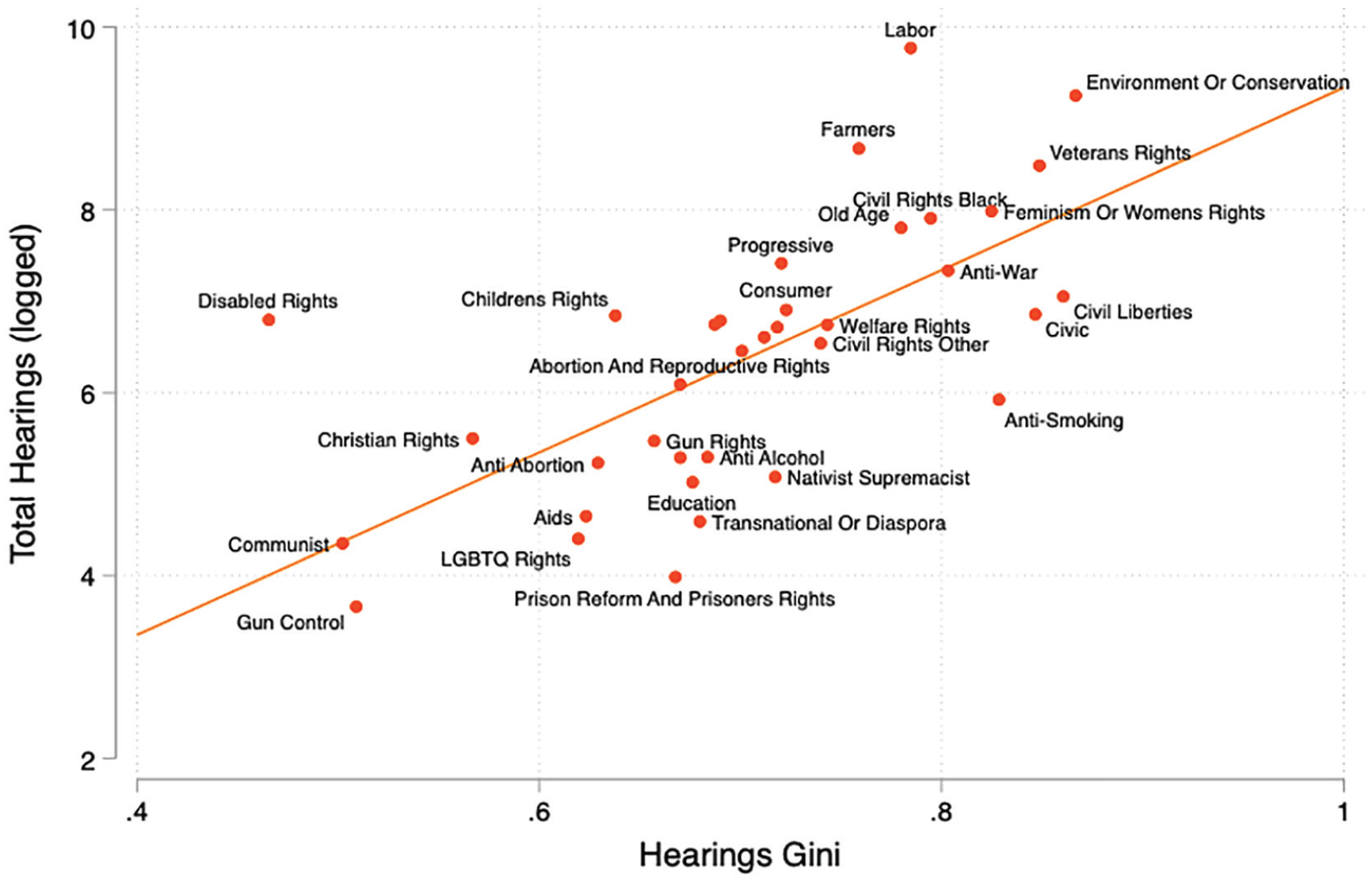
Total hearings and hearings inequality by movement.
Changes in Total SMO Testimony before Congress during the Twentieth Century
Has the state increasingly consulted SMOs over time? Here we show that the frequency and diversity of SMOs testifying before Congress grew considerably over the twentieth century. Figure 3 below shows the proportion of total witnesses at congressional hearings affiliated with SMOs broken out by movement. The time trends in Figure 3 confirm and add context to what we know about movement influence in Congress and the timelines for specific movements during the twentieth century. The first half of the twentieth century was dominated by “old movements” such as Labor, Veterans’, and Farmers’ SMOs. Still, groups such as the Suffragists are also evident (here labeled “Feminism”). Spikes in Labor movement representation (in red) coincide with congressional debates over seminal labor bills, including the Norris–La Guardia Act in 1932 (which banned yellow dog contracts, among other prolabor policies), the Wagner Act (1935), and the Taft-Hartley Act (1947). By the 1960s, we see the emergence of “new social movements” such as the Civil Rights and Environmental movements (Melucci 1980). This timeline also aligns with “the Great Broadening,” which begins in the 1950s and continued through the 1970s (Jones et al. 2019), showing that the increasing range of topics also corresponds to an increasing diversity of SMOs testifying at hearings. This increasing diversity can be seen in the rise of the “other” category over the second half of the twentieth century (the dark blue band in Figure 3), which stands for the 27 less represented social movement families not explicitly included in Figure 3, and in Figure 4, which displays testimony for less prominent movements.

Percentage of witnesses at congressional hearings with SMO affiliations by movement.

Percentage of witnesses at congressional hearings with SMO affiliations by movement (less prominent movements).
Figure 3 is also consistent with the literature on the dynamics of specific movements. The labor movement’s congressional representation mirrors its growth and sustained influence through the 1960s and its broader decline, especially since the mid-1980s (Fantasia and Stepan-Norris 2004). Similarly, we can see the Farmers’ Movement’s efforts to push for tariff protection in the 1920s and, despite the declining number of farms and rural residents (Tontz 1964), their continued influence through the 1960s. The origins of the veterans’ movement were in the nineteenth century (Skocpol 1992), but we can see their SMOs’ renewed prominence after World War I and throughout the rest of the twentieth century. 10 The women’s rights movement also played a persistent role over the period, winning acceptance before the Nineteenth Amendment and establishing consistent representation starting in the late 1960s (Goss 2020; McCammon et al. 2001). 11 Indeed, SMOs such as the National American Woman Suffrage Association and the Congressional Union for Woman Suffrage testified during the many hearings that preceded Woman’s Suffrage, discussing voting rights, the acceptability of street protests, and other issues (e.g., HRG-1914-HJH-0018 and HRG-1913-DCS-0002). We can also see how the Anti-War movement is recognized during periods of conflict, beginning in the late 1930s and 1940s, although not to the same degree as other movements. During the 1910s, SMOs coded “conservative,” mostly antisuffrage and antiprohibition organizations, were prominent. The 1960s marked increasing testimony from the old age movement (Amenta 2006), minority civil rights movements (McAdam 1999), and the environmental movement (Johnson and Frickel 2011).
Figure 4 below illustrates the trajectory of many of the less prominent movements displayed as “all other movements” in Figure 3. Many of these movements gain prominence before Congress beginning around 1960. Post-Gingrich 1990s spikes in the Christian Rights movement’s testimony is mostly associated with Focus on the Family, which testified at hearings about HIV treatment, teen pregnancy, and LGBTQ issues, among other topics. Early spikes in the first decade of the twentieth century for the Children’s rights movement are associated with the National Child Welfare League and campaigns to outlaw child labor. The Anti-Saloon League dominates the anti-alcohol movement’s testimony in the lead up to the 1919 Volstead Act, establishing national alcohol prohibition, which is consistent with historical accounts emphasizing the legislative effectiveness of the Anti-Saloon League (e.g., Kerr 1985).
Congressional Structure and SMO Testimony
Do the movements consulted most by the state advise only a few state venues? Congress is organized into standing and subcommittees to facilitate policy creation and oversight, increase efficiency, and solidify the legislative branches’ role in the governing process (Fenno 1966; Shepsle 1989). These committees, and the hearings they hold, create distinct, if at times overlapping, venues at which SMOs can be consulted by the state.
Congressional committees began to coalesce into a “textbook Congress” in the early twentieth century, a process that was solidified with the Legislative Reorganization Act (LRA) of 1946. The LRA defined committee jurisdictions, made them more systematic, and combined committees with similar responsibilities (Schickler 2011:727). This also established the 19 House of Representatives standing committees and 15 Senate standing committees, a count that changed only with the addition of the House Committee on Homeland Security after 9/11. Standing committees include Judiciary, Appropriations, and Ways and Means among many others. These committees are responsible for policy recommendations, drafting bills for voting, oversight, and investigations. Hearings are a crucial part of this process as witnesses share information and perspective. Historically, standing committee chairs are powerful positions given to senior members of Congress. Yet changes to selecting chairs in the mid-1970s have minimized the importance of seniority (Aldrich and Rohde 2005). Although committees are expected to focus on their issues, there are no real restraints on hearing topics, and so the range of possibilities (particularly for committees such as Judiciary and Ways and Means [taxation]) is broad.
Committees may align with some social movement’s interests (e.g., the Farmers’ Movement and the agriculture committee), whereas other movements may struggle to find an obvious “home” (e.g., the Gun Control Movement). More generally, if a movement finds a narrow “niche” before one or small handful of committees, it may find more success and testify more than movements whose testimony is more evenly spread across multiple committees (Olzak and Johnson 2019). On the other hand, more successful movements may get invited to testify more often because they have made their issue of interest to a wider set of committees (Goss 2020; Wang, Piazza, and Soule 2018).
To investigate the structure of movement testimony across committees we focus on the more stable post-LRA standing committees (1947–1999). Focusing on the modern congressional committee structure allows us to make more consistent cross-committee comparisons. Overall, from 1947 to 1999, we identify 36 different standing committees. 12 About 95 percent of the congressional hearings with SMO testimony from 1947 to 1999 took place before at least one of these standing committees.
The concentration of a movement’s testimony across congressional committees gives us a measure of how broad or narrow a movement’s congressional niche is. Table 4 lists the Gini coefficient for each movement’s testimony across committees and the two or three committees they testified to most often. A Gini coefficient equal to 1 would represent a movement that testifies only before one committee, and a Gini coefficient of 0 would represent a movement with its testimony spread perfectly evenly before all 36 committees.
Movement’s Top Committees and Testimony Concentration 1947 to 1999.

Note: H = House of Representatives; S = Senate.
The Communist movement testified most often before the House Un-American Activities Committee, but these were generally repressive hearings and excluded from this analysis.
We find that across movements, a higher concentration in testimony before congressional hearings (a higher Gini coefficient) is associated with lower total testimony. The correlation between the count of the logged total testimony by movement and the Gini coefficient for committees is r = −.64. For example, the labor movement (0.578) and the women’s movement (0.557) have two of the lowest Gini coefficients because they give a significant share of their testimony across many committees and are two of the most prominent movements in Congress. On the other hand, the education movement, among the least represented before Congress, has its testimony mostly concentrated in the House and Senate committees on labor and education. As Goss (2020) argued, social movements appear to benefit from attention to their issues diffusing as others connect them with a range of topics and committees. Nevertheless, some important exceptions, such as the Environmental or Veterans’ movements concentrate their testimony into relatively few committees and are among the most prominent in Congress.
Discussion and Conclusions
Which movement’s SMOs are consulted the most by the state? The SMOs and movements that testified before Congress most often were not always the most prominent in the news media or the most studied in the academic literature. In many cases, the movements that the state consulted most are those that, for reasons of political ideology, or the identity of the people they represented, represent favored constituencies in the larger society (Schneider and Ingram 1993). For instance, the Farmers’ and Veterans’ movements represent groups that are lionized by the wider society (Skocpol 1992) and are routinely consulted by Congress. The Black Civil Rights movement, however, despite being the second most covered movement in the New York Times (Amenta et al. 2009:604), 13 is only the seventh most consulted movement in Congress, and other racial minority movements are consulted even less. More systematic comparison is necessary here, and we encourage future researchers, perhaps with these data, to investigate how the race (Bracey 2021; Oliver 2017) and ideology (Oliver and Johnston 2000) of movements and SMOs shape how Congress and the state receive them.
Does the state consult a wide swath of SMOs from each movement, or only do only a few “spokes-organizations” speak for the whole of a movement? We find that movement testimony before Congress has a spokes-organization structure, wherein a small handful of SMOs testify on behalf of entire movements. We see three possible explanations for this. First, the spokes-organization structure may reflect inequalities in the resources, professionalization, framing, and tactical acumen of SMOs within movements, so that some SMOs are simply better positioned to get their issues before Congress. Second, it is possible that as Congress begins consulting SMOs from a particular movement, it develops contacts and relationships with specific SMOs that take on a self-reinforcing character, so that spokes-organizations come to represent a constituency or set of interests through a path-dependent process (Grossmann 2012). Indeed, Grossman’s (2010) institutional pluralism argument suggests that these points work together: organizational differences get initial attention before the path dependent process takes over. Third, it may reflect a division of labor wherein more radical SMOs gain attention for their issues and cause disruption, leading to more moderate SMOs being invited to testify as spokes-organizations (Gamson 2004). To better tackle these questions, scholars could merge our data with existing sources that provide data on the organizational strength of movements (Minkoff 1997) or the collective action events that SMOs sponsor (Earl et al. 2004), and we encourage future research to take the spokes-organization structure of testimony as a puzzle to explain.
Has the state increasingly consulted SMOs over time? We find that before 1960, Congress largely accepted “old movements” such as the Labor, Veterans’, and Farmers’ Movements (Melucci 1980). But after 1960, the types of social movements testifying before Congress expanded and diversified considerably. The increasing acceptance of Labor, Civil Rights, and Women’s organizations likely facilitated the introduction of new issues into congressional debates (Jones and Baumgartner 2005), as well as expanding government responsibility for civil rights, women’s rights, and health care issues (Amenta et al. 2019; Jones et al. 2019). Notably, we find that testimony by SMOs begins to decline in the late 1990s, a period that follows a decade of the normalization of social movements and protest (Meyer and Tarrow 1998), declining labor union membership and stagnating social movement participation (Caren, Ghoshal, and Ribas 2011; Western and Rosenfeld 2011), as well as the success of Newt Gingrich’s Contract with America. Future research should not only interrogate how resources, political opportunities, and public opinion shaped the trajectory of individual social movement families’ testimony over time but also how changes in the political structure (e.g., the closing of the Office of Technological Assessment; Ban, Park, and You 2022; Bimber 1996) affected opportunities for testimony.
Do the movements consulted most by the state advise only a few state venues? We find that the movements that are consulted the most often testify more evenly across congressional committees, rather than concentrating their testimony before only one or a few committees. On its face this finding would suggest that more successful movements are able to make their issues relevant to wide variety of state actors and institutions (Goss 2020), rather than focus on exploiting more narrow niches within state institutions (Olzak and Johnson 2019). Even within the scope of our results however, some movements, like the Environmental movement testify extensively before a narrow range of committees. Future research should more fully explore how committee structure influences which SMOs testify and why. We caution however, that committee structure should not be interpreted as an exogenous source of political opportunity: because committees can be created in response to movement pressure, committee structure may be as much an effect of movement success as a cause.
More broadly, we join previous calls for more cross-movement comparative research (Amenta et al. 2009; Gamson 1975). Large-scale comparative analyses play a crucial role in collaboration with small-N case analyses for the development and evaluation of our theoretical understanding of political institutions and political change. A profusion of studies on single movements or a small handful movements, or over short stretches of time, risks leaving us with many nuanced studies, but no common denominator across which to compare movements (Amenta and Ramsey 2010:31). Sustaining a broad comparative agenda for the study of social movements will require gathering, and publicly sharing, data sets spanning multiple movements over long stretches of time. We hope the data we share here is a step toward this goal.
Footnotes
Acknowledgements
We thank Megan Cicotte, Ava Davisson, Anna Ratterman, Bethany Brunner, and Matthew Jordan for their help cleaning the data, and Andrew Davis for his help with collecting the data. We would also like to thank Edwin Amenta, Neal Caren, and Debra Minkoff for sharing data. We also thank the Penn State Social Movements working group for their helpful comments on early versions of the manuscript.
Authors’ Note
Drs. Seguin and Maher contributed equally to this article.
Funding
The author(s) disclosed receipt of the following financial support for the research, authorship, and/or publication of this article: We acknowledge the support of a seed grant from the University of Arizona and National Science Foundation grant 1824092.
