




Abstract
The relationship between social movements and formal organizations has long been a concern to scholars of collective action. Many have argued that social movement organizations (SMOs) provide resources that facilitate movement emergence, while others have highlighted the ways in which SMOs institutionalize or coopt movement goals. Through an examination of the relationship between Occupy Wall Street and the field of SMOs in New York City, this article illustrates a third possibility: that a moment of insurgency becomes a more enduring movement in part through the changes it induces in the relations among the SMOs in its orbit.
Since September 17, 2011, when protestors first began their occupation of Zuccotti Park near Wall Street, pundits and scholars have sought to make sense of both the causes and consequences of Occupy Wall Street (OWS) (Pickerill and Krinsky 2012; Soule 2012). Where did it come from, what was it, and what impact did it have? On its face, OWS seems to challenge long-standing ideas among social movement scholars about the role of formal organizations in movement emergence and movement decline. Resource mobilization or political process theories would have expected formal social movement organizations (SMOs) to have facilitated the emergence of OWS (McAdam 1982; McCarthy and Zald 1977). Yet both popular and scholarly accounts suggest that these organizations were peripheral to its early success (Gitlin 2013; Gould-Wartofsky 2015). Neither, however, can SMOs easily be said to have institutionalized, tamed, or coopted OWS, as might have been predicted by earlier scholars such as Piven and Cloward (1979); if anything, scholars of OWS have argued that it did not have the impact it might have had because of its resistance to formal organization (Kreiss and Tufekci 2013:2).
Rather than arguing either that organizations facilitate or inhibit movement emergence and success, in this article I suggest that moments of insurgency become movements in part through the more enduring changes they induce in the practices of established organizations surrounding them. One important and underappreciated consequence of OWS, this article shows, was that it heightened coordination across the SMO field in New York City for the four years following. This period of heightened coordination, rather than the two months during which Zuccotti Park was occupied, ought to be understood as the temporal boundaries for the movement that the moment of OWS spawned. Theoretically, then, this article sheds new light on the relationships among moments of insurgency, social movements, and SMOs and suggests that scholarship ought to pay more attention to the impact of moments (and movements) on the organizational ties that, in turn, facilitate and constrain social action (Giugni 1998).
The article proceeds as follows: First, I review existing literature on the relationship between social movements and formal organizations and suggest how OWS might extend existing theory about this relationship. Next, I review my methodological strategies for bounding New York’s SMO field and bounding the OWS “movement.” I then present findings on the changing shape of the SMO field in the years after OWS, using both newspaper co-mentions and organizational board ties, before concluding with a discussion of the implications of these findings for social movement theory.
Movements, Moments, and Organizations
In much scholarship on collective action and social movements, formal organizations are understood as facilitating movement emergence and success (Gamson 1975; Jenkins and Perrow 1977; McAdam 1982; McCarthy and Zald 1977; Oberschall 1978; Olson 1965; Tilly 1978). Within some of this literature, in fact, the distinction between SMOs and social movements is elided almost entirely; a movement cannot be differentiated from the organizations of which it consists (Zald and Ash 1966). Why are organizations so important? McCarthy and Zald (1977:1216) argued that because “resources are necessary for engagement in social conflict,” and because “resource aggregation requires some minimal form of organization,” SMOs are therefore necessary for social movement emergence. This assumption has been taken up and developed by a number of scholars investigating a wide variety of different movements (Barkan 1979; Gamson 1975; Jenkins and Perrow 1977; McAdam 1982; Morris 1984).
The most well-known dissenting voices against this perspective may be Piven and Cloward (1979; see also Cloward and Piven 1984; for a review, see Clemens and Minkoff 2004), who draw on classical theorists such as Weber (1946) and Michels ([1911] 1962) to argue that formal organizations may in fact impede social movements through processes of bureaucratization and cooptation. According to them, the preoccupation on the left with building “mass-based permanent organizations” means that organizers and activists “do not usually escalate the momentum of the people’s protests” (pp. xxi–xxii), instead seeking to channel it—unsuccessfully, they argue—into formal organizations. SMOs discipline social protest in ways that make it less effective. In turn, they suggest, a disciplinary preoccupation with SMOs as the sine qua non of social movements risks blinding social movement scholars from forms of insurgency outside the boundaries of organization (see Scott 1985).
There is likely some truth to each of these opposing accounts. Even McAdam, a central proponent of political process theory, recognizes that organizations may impede social movements through processes of bureaucratization and cooptation, though he maintains that Piven and Cloward “overstate the negative effects of organization on insurgency” (see McAdam 1982:54–56). Piven (2013), in turn, acknowledges that “structure or organization is a corollary of collective action” at the same time she maintains her skepticism about the “flawed organizational forms of the past” (p. 193).
In recent years, then, the literature has moved away from general claims about the positive or negative impacts of organizations on social movements toward a recognition that organizations (like other “mobilizing structures”) are multivalent and may, depending on the circumstances, facilitate or constrain movement activity. Organizations facilitate certain types of activity while inhibiting others (see Goodwin and Jasper 1999). A labor bureaucracy that, in general, depoliticizes members by channeling their collective concerns into individualized grievance procedures may, under the right circumstances, allow its leaders the autonomy to pursue “social movement union” goals (Voss and Sherman 2000). Organizations putatively established to facilitate people’s engagement in politics may, paradoxically, serve to depoliticize them (Eliasoph 1998). Rather than asking whether SMOs are important to social movements in general, then, we might ask how movements manifest themselves within organizations—or, said differently, how movements come to be expressed within organizational practice. The intuition here is that SMOs may behave differently in “movement times” than they do in nonmovement times.
OWS is a particularly good candidate “movement” with which to find purchase on the relationship between social movements and organizations in part because it is explained so poorly by resource mobilization theory or a theory of organizational cooptation. Theoretically this is useful because it provides an anomaly through which we might extend existing theory (Burawoy 1998). Methodologically this is useful because it allows us to examine how OWS exogenously induced changes in SMOs in New York City without worrying about SMOs’ reciprocal impact on the emergence of OWS.
Established New York City SMOs were not involved in any readily apparent way in the emergence or growth of OWS. The initial call for action came from the Canadian anticonsumerist magazine Adbusters in July 2011, and mobilization took place not through existing formal organizations as much as through the channels of social media (Gaby and Caren 2012; Penney and Dadas 2013; Tremayne 2014). Yet neither can OWS said to have been tamed or coopted by formal organizations. Piven and Cloward’s suspicion of formal organization was very much in evidence among the activists of OWS. Kreiss and Tufekci (2013) argued that OWS represented “a movement where the fullest expression of individual identity and a denial of engagement with the structured demands of institutional politics are its very form of politics” (p. 2). The fact that this suspicion was incorporated into OWS practice means that it may not apply as readily to it. If anything, criticisms of OWS have tended to emphasize how its aversion to “pragmatic, institutional” (Kreiss and Tufekci 2013:4) politics limited its impact. Many of the popular and academic critiques of the movement were that it was too resistant to organization and institutionalization and that this resistance led to its ephemerality. Preoccupied with avoiding cooptation by institutionalized politics, according to these critics, OWS activists were unable to translate its moment into a lasting movement (Gitlin 2013).
One possible response to OWS’s anomalous status in relationship to SMOs is that OWS does not fit existing social movement theory precisely because it was not a social movement in the first place. Along these lines, some have suggested that OWS ought to be understood instead as a “moment” of insurgency with little enduring impact. In an essay on OWS, Calhoun (2013) wrote that it may have been “more moment than movement.” He continued that “OWS was less an organizational effort . . . than a dramatic performance” and that “its most important impact may lie in culture not movement organization [emphasis added]” (p. 37). This argument finds empirical support among studies of the social media practices of OWS participants. One of the most rigorous studies along these lines, based on an analysis of a random sample of 25,000 OWS online activists, concluded that OWS had very little impact on these activists’ behavior in the months after Zuccotti Park was cleared. These actors quickly returned to baseline levels of engagement with politics, and participation in OWS only slightly increased the extent to which they connected with one another (Conover et al. 2013). The authors concluded, “It is doubtless that supporters may have hoped for a more sustained discourse than is evident from the near-complete abandonment of these once high-profile communication channels” (p. 5). Although social media played an important role in helping OWS go viral (Gaby and Caren 2012; Penney and Dadas 2013), this virality was a short-lived flare in consciousness with little impact on participants over the long term (Conover et al. 2013).
Yet this explanation seems incomplete given the collective action that followed on the heels of OWS, from the Fight for $15, to the election of Bill de Blasio, to the Black Lives Matter movement, to Bernie Sanders’s presidential campaign. Todd Gitlin (2013) offered a different, slightly more satisfying metaphor: rather than a “moment,” OWS was a “stream” that “emerged from, belonged to, and flowed into a wave of movements. From this wave there will likely come other waves, as well as hiatuses, rivulets and contrary waves, both long and short. None of them are predictable” (p. 41). Here OWS is considered endogenous to a broad tide of moral outrage of which it is only one manifestation. Yet where many bound the OWS movement too narrowly—it was a discrete and ephemeral “moment”—Gitlin bounds it too broadly, as being part of an amorphous transnational movement stretching back into the past and extending into the indefinite future.
In this article I suggest that the OWS moment became a broader movement—one that extended beyond the OWS moment—by way of the new collaborations it induced among the SMOs in its orbit. This heightened level of collaboration lasted for at least four years after the occupation of Zuccotti Park, with potentially even longer lasting effects. Although Calhoun (2013) is right that OWS was a “moment” rather than a movement, he is wrong that its most important impact was in culture rather than movement organization. 1 In fact, one of the most important impacts of OWS may have been the new organizational collaborations it spawned. And although Gitlin (2013) is right that OWS was a part of something bigger, he is unable to bound the something of which it was a part or recognize OWS’s importance to its inception. The origins of OWS surely can be traced to previous national and international events (as the origins of any event can be). But within the context of New York City, OWS seems to have had an exogenous impact on the SMO field.
OWS drew organizations from a variety of different issue orientations into its orbit, connecting these organizations to one another in ways that they had not been connected before and, in turn, expanding the scope of collaborations that these organizations could imagine undertaking in the future. Organizations previously disconnected or only tangentially connected to one another came to interact as part of the same social movement community (Collins 2004; Feld 1981; Staggenborg 1998). To anticipate the central findings, within a newspaper co-mention network I find a sharp increase in network transitivity, and a decrease in network modularity, among a sample of SMOs in the months after the beginning of OWS movement, a trend that endures for approximately four years after. Similarly, I find that board interlocks among these SMOs increase sharply in the years after OWS, particularly among those organizations mentioned in the article data in connection with OWS.
Data and Methods
Like other recent social movement scholarship, this article takes as its analytic object the social movement field (Jung, King, and Soule 2014; Larson and Soule 2009; Minkoff 1994, 1997; Soule and King 2008; Wang and Soule 2012). One immediate problem facing such research concerns how to bound the field. Soule and her colleagues (Larson and Soule 2009; Soule and King 2008; Wang and Soule 2012, 2016) make use of data from the Dynamics of Collective Action Project (DCAP), an ambitious effort to document every protest event covered by the New York Times between 1960 and 1995. To identify and code each event, researchers involved in this project read every issue of the Times cover to cover. Such an undertaking is hugely labor (and resource) intensive. Moreover, it is not without its own limitations. For instance, a focus on the Times alone is vulnerable to selection bias that might be remedied by making use of multiple sources (Earl et al. 2004:74–75). 2
Social movement scholars making use of newspaper data have, for good reason, been concerned with distinguishing between what happens and what gets reported on. But, particularly when it comes to an examination of organizational collaboration, we might also treat news coverage as an accomplishment. As a rich line of scholarship on frame analysis (for a review, see Benford and Snow 2000) has made clear, organizations regularly strategize about how to get themselves into (or out of 3 ) newspaper stories. And media are often, although certainly not always, themselves targets of protest (see, e.g., Gamson 1989). Moreover, from the perspective of an SMO, it seems unclear why coverage of its attendance at a protest event would necessarily be more important than coverage of a press conference it held, coverage of legislative victories it was able publicly to claim, coverage of its position in relationship to an issue, or any number of other activities that might not fit under the umbrella of the protest “event.” An advantage of the strategy deployed by those who make use of the DCAP data is that they are able to cleanly identify organizational ties by organizations’ copresence at the subset of protest events covered by the Times in which these organizations are mentioned. A disadvantage, however, is that it is unable to analyze the other important ways in which connections among these organizations might be captured in newspaper stories. This is particularly important in this more contemporary period, in which media presence of varying kinds is so critical to SMOs’ identities and success.
In this article I make use of a different strategy. Rather than using participation in protest events as the primary criterion for identification as an SMO, I instead asked a large number of social movement organizers in New York City to identify the organizers (and, by association, the organizations) that were most central to social justice work in the city. I used a respondent-driven sampling design to generate the list of organizers (and organizations). Such a sampling strategy has been shown to produce unbiased estimates about “hidden populations” (Salganik and Heckathorn 2004). I began on December 4, 2013, with a set of 60 “seeds,” 49 of whom were identified through a survey administered to participants in a now defunct university leadership program 4 and 11 of whom were identified through personal contacts of myself and my research assistants. Each of these 60 seeds was permitted to nominate up to 5 organizers whom they most respected, and this process was iterated repeatedly over the course of 11 months. By November 2014 we had accumulated a list of 566 organizers who were highly respected by their peers. These 566 organizers, in turn, were associated with 296 SMOs.
I use two separate strategies to explore the changes in the connections among these organizations over time. First, I conducted LexisNexis searches for each of the 296 organizations on the list, limiting the search to all newspaper articles written in the 12 years between January 1, 2004, and December 31, 2015. Once I filtered out extraneous articles and news sources inconsistent over time, I was left with 46,994 articles. 5
A network of SMOs was generated by examining organizational co-mentions within these newspaper articles, in which organizations are treated as vertices and co-appearances in news stories are treated as edges. One concern is that organizations considered important to the SMO field at the time of the sampling (2013–2014) may not have existed prior to OWS, so the network dynamics observed since OWS may merely reflect the addition of these more recent organizations. For this reason, I restrict my analyses to those organizations that first appear in the co-mention network before OWS. 6 This is consistent with my central question, which is how OWS may have influenced ties among established SMOs. Although the complete co-mention network consists of 205 organizations (i.e., 205 organizations are mentioned as having collaborative ties at some point during the 12-year period), the restricted sample consists of 152 organizations.
One still might be concerned that the respondent-driven sample design used here would lead to selecting organizations that are more closely interconnected at the time of the sampling than they have been in the past (or might be in the future). Conservatively, then, the paper tells a story about network change within that particular set of organizations central to the SMO field at the time of the sampling, rather than about the SMO field of New York City in general over time. The temporal generalizability of the results depends on the rate at which the organizations considered central to the SMO field changes. Given that my sample focuses on organizations that are well established, the replacement rate seems likely to be low, meaning that the changes I observe in the sampled network are likely reflective of enduring changes in the SMO field.
To examine network dynamics over time, yearly windows of such organizational co-mentions were constructed at a week step. 7 In particular, I examine whether and how the network’s structure changes as a result of OWS, beginning on September 17, 2011, and how enduring these changes are. Table 1 presents summary statistics for the co-mention networks over the entire interval of study, as well as broken down according to whether the end of the window occurred before or after the beginning of OWS. Here we can already see, in a general way, that the structure of the network is different in the post-OWS period than it was in the pre-OWS period. Transitivity is significantly higher, modularity is significantly lower, and density is significantly higher in the post-OWS period. Importantly, the number of vertices (organizations) in the network remains relatively unchanged over the study period, suggesting that this is not merely a story of more organizations being discussed in the news after the emergence of OWS.
Summary Statistics of Co-mention Networks.

Note: Standard errors, clustered by year of window end date, in parentheses. OWS = Occupy Wall Street.
One obvious concern is what a “co-mention” represents and whether this changes over time. To have confidence that the article co-mention is an accurate indicator of organizational collaboration of some form, I took a random sample of 200 articles (100 before OWS and 100 after OWS) and coded them as to the type of tie indicated by the newspaper co-mention. Figure 1 illustrates the breakdown of co-mentions before and after OWS in this sample. Co-mentions indicate joint participation in protests in 6 articles before OWS and 13 articles after OWS. Most commonly (21 before and 26 after OWS), co-mentions indicate nonprotest collaborations, which include press conferences at which representatives from different organizations speak, coalitions of which different organizations are a part, organizations’ joint participation in a forum or other event, and organizations’ issuing joint statements, working papers, full-page advertisements, and so on. Co-mentions indicate organizations’ speaking about the same issue from similar perspectives in 20 articles before OWS and 14 after OWS. These types of co-mentions are less directly suggestive of active collaboration, although they may well be (i.e., when a journalist asks a representative to put him or her in touch with another organization for comment). At the very least, they demonstrate organizations’ common issue focus, which may be associated with other sorts of interactions (Feld 1981). Co-mentions indicate organizations’ being discussed in the same context in 22 articles before OWS and 24 articles after OWS, for example, when a staff member of one organization is reported to have attended an event sponsored by another or when an article criticizes two organizations for the same reason. This, again, is not direct evidence of a tie but is suggestive of one. In 11 articles before OWS and 9 articles after OWS, a co-mention indicated that the same individual was or had been associated with two or more organizations.

What co-mentions mean.
A particular concern is that organizations may be mentioned together in an article when they are active antagonists, raising questions about whether co-mentions can be used as an indicator of collaboration (i.e., a union representing striking workers and these workers’ employer may be discussed in the same article but can hardly be understood to be collaborating). In my sample, this is quite rare. Only 4 articles before OWS and 1 article after OWS discussed SMOs as antagonists (most frequently in the context of unions’ endorsing opposing candidates). Finally, some co-mentions (15 articles before OWS and 13 articles after OWS) are merely noise (i.e., a list of weekend events in New York City mentions one event sponsored by one organization and an entirely separate event sponsored by another).
On the basis of the sample, newspaper co-mentions are, as a whole, a good indicator of organizational collaboration. Because of the very small percentage of co-mentions representing antagonism, it seems reasonable to treat co-mentions overall as a sign of positive collaboration. Furthermore, there is no marked difference in the types of collaborations present before and after OWS. If anything, co-mentions seem to become a slightly better indicator of organizational collaboration after OWS. In the interval after OWS, co-mentions are somewhat more likely to represent joint protest, other nonprotest collaboration, and being discussed in a similar context and slightly less likely to represent being quoted on a similar issue, organizational conflict, or noise.
One still may be concerned about the precise relationship between new organizational collaborations and media coverage of new organizational collaborations. In other words, how can we be sure that changes in the structure of news coverage reflect changes in actual collaboration? According to this line of argument, the impact of OWS may not have been on the SMO field so much as on the discursive opportunity structures that the field faced (Ferree 2003; Koopmans and Olzak 2004). One piece of evidence suggesting that this is not the case can be found in studies of news coverage following OWS, which show that news coverage about OWS and the issue of income inequality declined relatively quickly in the months after the clearing of Zuccotti Park (Gould-Wartofsky 2015:223–24). This suggests that the discursive opportunity structure directly attributable to OWS was relatively short lived (Ferree 2003; Koopmans and Olzak 2004). I return to this question in more detail in the analysis of my data. To anticipate my findings, changes in the frequency of articles seem to follow the changes in network structure by approximately two years. If anything, changes in patterns of collaboration seem to drive changes in news coverage rather than the other way around.
More generally, however, to dismiss media co-mentions as epiphenomenal, one would have to believe in what seems like an unrealistic degree of independence between the discursive opportunity structure faced by SMOs and SMO activity. SMOs are strategic about the news stories they work to be included in (and excluded from). They are also influenced by the stories about them. Two organizations that are quoted in the same article as having similar perspectives about the same issue may not be actively collaborating at the time of the story, but it seems plausible that such an article may have an impact on the organizations’ likelihood of future collaboration. Although it is impossible with these data to rule out the possibility that the effects may be influenced by changing patterns of media attention, this attention likely has a reflexive impact on the SMO field. At the same time we accept that media coverage may distort reality, we should acknowledge that this coverage may influence it.
I explore the changing nature of the SMO field in one additional way as well, by analyzing changes in the board interlock network among the SMOs in my sample between 2011 and 2013. This allows me to investigate the extent to which the increasing collaboration captured in newspaper co-mention data is reflected in a far less common but far more intensive form of collaboration, namely, sharing board members or having a staff member from one organization sit on the board of another. Previous research has shown the importance of such interlocks for mobilization among firms and other forms of organization (Burris 2005; Mizruchi 2013). My strategy builds on recent work by Yue (2016), who used changes in board interlock networks as an outcome variable.
I make use of the National Center for Charitable Statistics database (http://nccsweb.urban.org) to find tax return data in two years, 2011 and 2013, for each of those organizations in my sample that existed in both years and was formalized enough to file tax returns independently. I was able to find data for 122 of the 296 organizations in the sample. Organizations may be missing from this board analysis for one of two reasons. First, some organizations did not exist in 2011. Second, some organizations were loosely structured groups (or coalitions) that did not have a formal structure or paid staff members or were fiscally sponsored by other organizations. Neither of these sources of “missing” data poses a problem for my argument, however, because the analysis is focused explicitly on how OWS influenced collaborations among more formal, institutionalized organizations. Just as in the newspaper co-mention data, we are interested in that subset of organizations that existed in the pre-OWS period.
A complete list of organizations used in both the co-mention analysis and in the board interlock analysis is provided in the appendix, along with brief summaries of each organization’s mission or purpose. This provides a sense of the wide variety of organizations included in the sample and might also serve as a useful index for future researchers of the SMO field in New York City. 8
OWS and the Consolidation of a Social Movement Community
One of the most important, and relatively intuitive, measures of a network’s community structure is its transitivity, which is the ratio of closed triads observed over the number of connected triads. If organization A is connected to organization B and organization B is connected to organization C, the triad is transitive if organization A is also connected to organization C. The transitivity of a network has been associated with the strength of ties among actors (Granovetter 1973:1376–77); with the generation of group norms, accountability structures, and trust among actors (Coleman 1988:S105–108); and with enhanced communication (Burt 2000). A community tends to be experienced as a community when actors tied to a third actor are also tied to one another.
Figure 2A illustrates the transitivity of the yearly organizational co-mention graph at a week step. The vertical bar corresponds to September 17, 2011, the first day of OWS. The trend line is a line fitted to the data before OWS that allows one to visualize the extent to which the data after OWS fit the trend of the network’s evolution in the seven years before. This graph shows a sharp, discontinuous increase in the transitivity of the co-mention graph in the weeks immediately following OWS. Although the transitivity of the network seems to have declined more recently, it remains elevated even at the end of 2015, four years after the end of OWS.
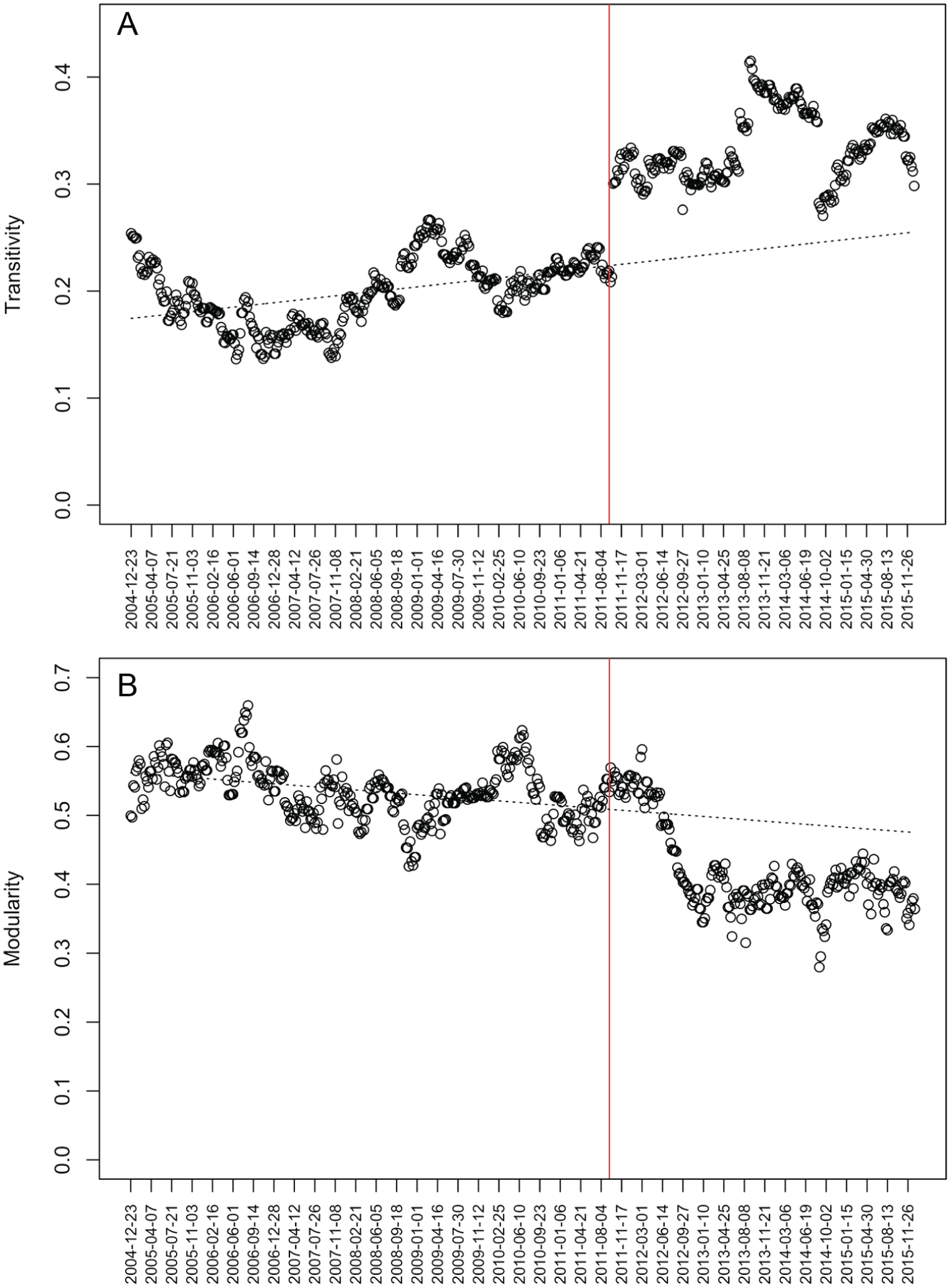
(A) Transitivity of organization network over time. (B) Modularity of organization network over time.
A second important measure of network community is its modularity, which can be understood as the extent to which a network is organized into distinct subgroups. Networks with high modularity are densely connected within groups and sparsely connected between groups, above and beyond what we expect at random. Thus, given a particular network division, the modularity of a network is the percentage of ties that occur between vertices within (rather than across) network divisions minus the percentage of ties that occur between vertices within network divisions in a randomly rewired version of the original network. In the case of this analysis, more specifically, modularity should be understood as the modularity of the network given that network division that maximizes modularity (Pons and Latapy 2006; Shwed and Bearman 2010). If transitivity concerns the extent to which there is closure in a network, modularity concerns the ease with which a community can be broken into subcomponents. In relation to the organizational network here, the question is whether organizations’ increasing levels of transitivity occur within clearly defined subgroups (e.g., racial justice organizations begin to collaborate more, but only with one another) or whether organizational collaboration occurs across different subgroups, decreasing the salience of these subgroups. In the context of academic citation networks, Shwed and Bearman (2010) showed that a contentious literature will be characterized by well-defined citation communities, while “consensus formation exhibits a decline in community salience” (p. 822). Analogously, a decrease in the extent of modularity in the SMO network is likely indicative of increasing agreement about movement issues, goals, and tactics (see Baldassarri and Bearman 2007). Figure 2B illustrates the modularity of the organizational network over time. Here, again, there is a clear change in the structure of the network following the emergence of OWS. Modularity in the network declines in the weeks after the emergence of OWS and remains deflated for the following four years.
Together, these findings suggest that OWS led to changes in the community structure of SMOs in New York, despite the fact that these organizations were involved only peripherally in the occupation itself. OWS seems to have created a heightened sense of community across the field and new opportunities for information diffusion and accountability. These changes lasted for years after OWS ended.
Such findings support and extend some of the more thorough qualitative work on OWS. In one of the most detailed case studies of OWS, Gitlin (2012, 2013) distinguished between what he called an “inner movement” and an “outer movement.” He argued that OWS was initiated and spearheaded by an “inner movement,” “a radical core . . . veterans of left-wing campaigns . . . whose master stroke was to devise a form of action, occupation, that parlayed electronic networks into the forming of face-to-face community” (Gitlin 2013:9). In turn, he suggested, the “outer movement” consisted of the “much greater numbers of people who marched with Occupy on its days of maximum pageantry.” These participants, he continued, “were middle-class people, union members, progressives of various stripes—not so photogenic, not outré, though far more numerous” (p. 21). Gould-Wartofsky (2015) likewise documented the ways in which OWS collaborated with more established organizations, from labor unions to not-for-profit organizations. In compelling ethnographic detail, he described an October 5 “Community/Labor March on Wall Street”:
[There was a] long column of 99 Percenters in their “complex unity”: undocumented Americans affirming, “Somos El 99 Percent”; unemployed workers demanding “Jobs Not Cuts” and “Jobs Not Wars”; indebted undergraduates inveighing against “Indentured Servitude”; single mothers with their children, testifying, “I Can’t Afford to Go to the Doctor”; the homeless reminding the nation of its “44 Million on Food Stamps” and its “Millions [of] Lost Homes.” (p. 97)
Both Gitlin and Gould-Wartofsky showed that OWS brought new constituencies together as they were all drawn toward it.
Yet both Gitlin and Gould-Wartofsky implied that the coalitions formed through OWS were short lived. By the time of an anniversary “Black Monday” march on September 17, 2012, Gould-Wartofsky (2015) observed, “the occupiers’ onetime institutional allies [were] conspicuous in their absence.” The unions were “otherwise occupied” with election season. He continued, “Gone, too, [were] the community organizations and their disenfranchised constituencies, whose needs continued to go unmet” (pp. 206–207). Gitlin (2013), in turn, suggested that OWS failed because of the inner movement’s suspicion of the outer movement: “The ‘inner movement’s’ awkward fit with that ‘outer movement’ blocked transformation into an enduring structure capable of winning substantial reforms over time” (p. 3). Of the future of OWS, Gitlin wrote, “Occupy 2.0, if there is to be one, requires reconfiguration. It would have to be powered by people of many sorts of networks and organizations of many sorts” (p. 23).
These accounts thus fail to appreciate the lasting impact of OWS on the structures of collaborations in the SMO field observed here. This may be because they are focused on the dynamics of the “inner movement” of OWS without attending to the horizontal connections that were deepened among the “outer movement.” As suggested above, OWS induced a change in the structure of the SMO community in New York City. It also seems to have induced a more general change in the cohesion of this community. Figure 3 presents a graph of the density of the co-mention network over the course of the study period. Although the trend prior to OWS was slightly negative (i.e., the network was becoming less cohesive), the density increases sharply in the years following OWS.

Density of organization network over time.
Compared with the transitivity and modularity, the change in network density appears less stable, oscillating quite dramatically in the post-OWS period. Nevertheless, throughout this period the network density never dips below the trend line, suggesting a consistent elevation in the density of the co-mention network in the period following OWS.
It is difficult to disentangle the extent to which particular collaborations were forged through OWS or inspired as a result of it. Either way, however, such new organizational relationships are evidenced even in the small number of articles included in the random sample. As but one example, before OWS the only organizations mentioned in relationship to protesting police violence were organizations traditionally associated with the issue, such as the National Action Network, The Brotherhood/Sister Sol, and the Center for Constitutional Rights. After OWS, however, new types of organizations were mentioned in relationship to protesting police violence, organizations that range from the union SEIU 32BJ (which was quoted in relationship to protests against stop-and-frisk in April 2013), to Jews for Racial and Economic Justice, to the Arab American Association of New York (which jointly held a rally as part of the Black Lives Matter movement in December 2014).
Finally, I return to a question discussed briefly in the “Data and Methods” section: do the patterns shown here reveal new patterns of collaboration or merely new patterns of media coverage? I previously argued that this very distinction may underestimate the ways in which media are a constitutive part of collective action. Nevertheless, we may also compare the timing of the changes in the network discussed above with changes in the raw number of articles written about any of the organizations in the sample. Figure 4 presents a yearly window, again moving at a week step, of the total number of articles written about these organizations. Interestingly, although we do observe a sharp increase in the number of articles written, this increase does not occur until the beginning of 2014, two and half years after the end of OWS. If anything, news coverage of the organizations in the sample actually declines slightly immediately after OWS. Changes in the transitivity, modularity, and density of the co-mention network all precede the spike in overall coverage by at least a year.

Article count over time.
Although we cannot draw strong conclusions on the basis of the timing of these respective changes, they do suggest that, if anything, new patterns of collaboration were more likely to drive increasing news coverage than the other way around.
Increasing Board Interconnectedness
To what extent is the durable rise in collaboration captured in the article co-mention network reflected in increases in other forms of organizational collaboration? Another indicator of organizational collaboration is the extent of board interlock, that is, organizations’ either sharing the same board member or having a staff member from one’s own organization sit on the board of another organization. This form of collaboration is much more intensive than the forms of collaboration captured in newspaper articles and thus likely more infrequent. Furthermore, because board membership is captured only annually, in 990 tax forms, it does not offer the sort of temporal precision as to the changes in collaboration structures offered by the continuous newspaper data. On the other hand, its advantage is that it is invulnerable to the types of selection bias with which one might be concerned in relationship to newspaper data.
Figure 5 displays board interlock networks from two years, 2011 and 2013. Here I restrict the data to those organizations for which 990 tax forms were available in each year, to examine the changing structures of collaboration among the same organizations (i.e., the same number of organizations, 122, is included in each year). Given that OWS began in September 2011, it is unlikely that changes in board membership as a result of OWS-enabled collaboration would have time to manifest by the end of the year. Thus, I consider the 2011 network as “before OWS.” In turn, I consider the 2013 data as “after OWS.”

Organizational board ties, 2011 and 2013.
As is clear from the figure, and is expressed quantitatively in Table 2, the board interlock network both grows and becomes more closely interconnected between 2011 and 2013. The number of SMOs who have at least one tie with another SMO in the sample expands from 49 to 62, while the size of the largest component in the network increases from 25 to 40. The average number of ties among those SMOs in the network rises slightly from 2 to 2.26.
Changes in the Board Network of SMOs, 2011 to 2013.

Note: OWS = Occupy Wall Street; SMO = social movement organization.
An even more compelling pattern emerges when I examine whether there is a relationship between the organization’s involvement in OWS and the extent to which its board ties increase or decrease. For this I return to the newspaper data and generate a network of organizational co-mentions with “Occupy Wall Street,” restricted to those organizations within the board network. Figure 6 shows this network. Twenty-nine of the 69 organizations in either board network are mentioned explicitly in relationship to OWS. Of these 29, 9 make up one large component, in that they are mentioned in relationship to OWS at the same time they are mentioned in relationship to one another.
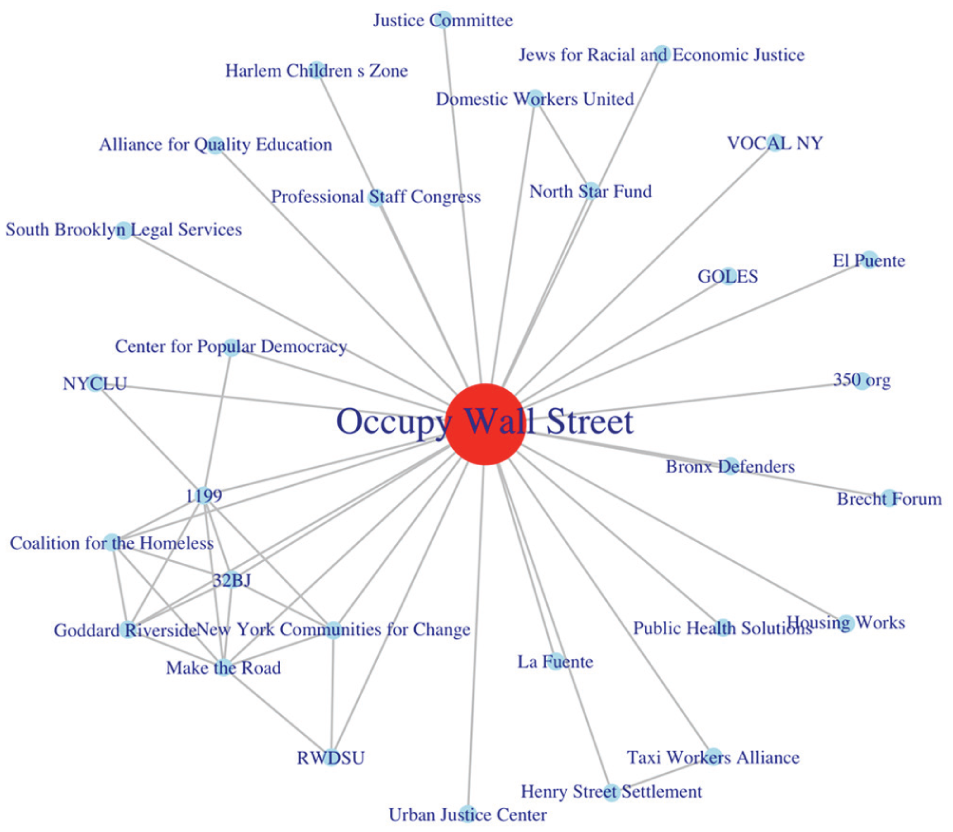
Occupy co-mentions network.
Table 2 also shows changes in degree centrality in the board interlock network for these different categories of organizations, across the 69 organizations included in either board interlock network. Among the organizations not mentioned explicitly in relationship to OWS, degree centrality increases by an average of 0.58. Among all organizations mentioned in relationship to OWS, degree centrality increases by an average of 0.73. And among the six organizations in the large “OWS component,” degree centrality increases by an average of 1.11. These seem like relatively small differences. Nevertheless, mean degree within the interlock network is also small (2.04 in 2011). Another way of putting it is that degree centrality increases by 29 percent for those not mentioned explicitly in relationship to OWS, 36 percent for those mentioned in relationship to OWS, and 54 percent for those mentioned and in the large OWS component.
The board interlock data thus provides additional evidence to support the conclusions reached in the analysis of newspaper co-mentions. Between 2011 and 2013 the board interlock network grew in size and became a more cohesive community. Furthermore, increases in board ties were particularly pronounced for those collaborating with one another in relationship to OWS.
Conclusion
One interview respondent, 9 a middle-aged white man who directs a voluntary association associated with religious congregations around NYC, was disdainful of OWS: “The Occupy Wall Street people were fools,” he said. “They didn’t understand the first thing about relationships. They were preadolescent really. . . . There’s a glorification of being cute and outrageous.” This perspective is reflective of one conventional understanding of OWS: that OWS was driven by a group of countercultural young activists who failed to articulate any concrete goals, failed to build relationships with potential allies, and failed to institutionalize the movement in ways that might have led to lasting impact.
Yet, as Giugni (1998) reminded us, “the effects of social movements are often indirect [or] unintended” (p. 386). They are also not easily recognizable as they happen. Although OWS may not have led in any readily apparent way to institutionalized political power, I argue, it did lead to new forms of organizational collaboration among SMOs in New York City, which in turn may have facilitated campaigns as wide ranging as the Fight for $15, the election of Bill de Blasio, and Black Lives Matter. This study is thus a reminder that the meanings of events in the recent past are likely to change as a result of future events (Bearman, Faris, and Moody 1999). Those mourning the end of OWS in early 2012 likely could not have appreciated what it might go on to make possible.
One limitation of this article is that its analysis is restricted to New York City, and so it does not capture the impact of OWS on national collaborations or on other states or municipalities. Future research might explore the extent to which variation in Occupy activity within a community is associated with future SMO activity, after controlling for previous levels of contentious politics. Future research might also explore the particular characteristics that made OWS a moment of field consolidation and search for comparable moments that had neutral or even negative impacts on the structure of an SMO field. Another limitation is that the I analyzes change in the structure of the field without focusing on changes in the content of the field. Future research might explore in more detail the specific ways in which OWS or other moments of protest shift network power among different types of organizations.
Despite these limitations, this article offers an important new perspective on the relationship between social movements and SMOs. It suggests that even short-lived moments such as OWS can have long-term, enduring impacts on movement organizations through the new structures of collaboration these moments induce. Collaborations among SMOs have been shown to facilitate tactical diffusion and innovation (Wang and Soule 2012, 2016), and increasing ties across diverse movement constituencies have been shown to bolster organizations’ strategic capacities (Ganz 2000). Exploiting OWS as an exogenous shock to the SMO field in New York City, this is one of the first studies to demonstrate the independent impact of an insurgent moment on the structures of collaboration that make such tactical diffusion and strategic capacity possible.
Footnotes
Appendix
Organizations Used in Co-mention Analysis (1) and Board Analysis (2).

| Organization Name | (1) | (2) | Organizational Mission/Purpose |
|---|---|---|---|
| 32BJ | x | x | With more than 145,000 members, we are the largest union of property service workers in the U.S. |
| 350.org | x | x | 350.org is building a global grassroots movement to solve the climate crisis. Our online campaigns, grassroots organizing, and mass public actions are led from the bottom up by thousands of volunteer organizers in over 188 countries. |
| ACT UP | x | ACT UP New York, the AIDS Coalition to Unleash Power, is a diverse non-partisan group of individuals united in anger and committed to direct action to end the AIDS crisis. | |
| Adalah-NY | x | Adalah-NY is a local, grassroots, non-hierarchical volunteer-only group of concerned individuals that advocates for justice, equality, and human rights for the Palestinian people through educational activities and campaign-building. | |
| ALIGN | x | x | ALIGN: The Alliance for a Greater New York’s mission is to create good jobs, vibrant communities, and an accountable democracy for all New Yorkers. Our work unites worker, community, and other allies to build a more just and sustainable New York. |
| Alliance for Quality Education | x | x | The Alliance for Quality Education is a coalition mobilizing communities across the state to keep New York true to its promise of ensuring a high quality public education to all students regardless of zip code. |
| Amalgamated Transit Union | x | Founded in 1892, the ATU works to promote transit issues and fights for the interests of its hard-working members in the U.S. and Canada. | |
| Annenberg Institute for School Reform | x | The Annenberg Institute for School Reform at Brown University is a national policy-research and reform support organization that promotes quality education for all children, especially in urban communities. | |
| Anti-Violence Project | x | x | AVP empowers lesbian, gay, bisexual, transgender, queer, and HIV-affected communities and allies to end all forms of violence through organizing and education, and supports survivors through counseling and advocacy. |
| Arab American Association of New York | x | x | Our mission is to support and empower the Arab Immigrant and Arab American community by providing services to help them adjust to their new home and become active members of society. Our aim is for families to achieve the ultimate goals of independence, productivity and stability. |
| Asian American Legal Defense and Education Fund | x | x | Founded in 1974, the Asian American Legal Defense and Education Fund (AALDEF) is a national organization that protects and promotes the civil rights of Asian Americans. By combining litigation, advocacy, education, and organizing, AALDEF works with Asian American communities across the country to secure human rights for all. |
| Association for Neighborhood and Housing Development | x | x | The Association for Neighborhood and Housing Development (ANHD) works to build the strength of the community development movement in New York City. ANHD was founded in 1974 with the mission to help low-income communities thrive and to ensure that all New Yorkers can live in decent, affordable housing and neighborhoods. |
| Audre Lorde Project | x | The Audre Lorde Project is a Lesbian, Gay, Bisexual, Two Spirit, Trans and Gender Non Conforming People of Color center for community organizing, focusing on the New York City area. | |
| Avaaz | x | x | Avaaz—meaning “voice” in several European, Middle Eastern and Asian languages—launched in 2007 with a simple democratic mission: organize citizens of all nations to close the gap between the world we have and the world most people everywhere want. |
| BCT Partners | x | BCT Partners provides professional development training and project support to specialized pool of consultants working with the HHS ACF Children’s Bureau National Capacity Building Center for States (the “Center”). | |
| Black Alliance for Just Immigration | x | x | The Black Alliance for Just Immigration (BAJI) believes that a thriving multiracial democracy requires racial, social and economic justice for all. African Americans and black immigrants are stronger together and we can win by becoming leaders in the fight against structural racism and systemic discrimination. BAJI was formed to bring Black voices together to advocate for equality and justice in our laws and our communities. |
| Black Women’s Blueprint | x | Black Women’s Blueprint envisions a world where women and girls of African descent are fully empowered and where gender, race and other disparities are erased. | |
| Brandworkers | x | x | Brandworkers is a non-profit organization bringing local food production workers together for good jobs and a sustainable food system. |
| Brecht Forum | x | x | From October 1975 through May 2014, the BRECHT FORUM served as a cultural and educational center for people who work for social justice, equality and a new culture that puts human needs first. |
| Bronx Defenders | x | x | The Bronx Defenders provides innovative, holistic, and client-centered criminal defense, family defense, civil legal services, social work support and advocacy to indigent people of the Bronx. |
| Center for Community Change | x | The Center’s mission is to build the power and capacity of low-income people, especially low-income people of color, to change their communities and public policies for the better. | |
| Center for Constitutional Rights | x | x | The Center for Constitutional Rights is dedicated to advancing and protecting the rights guaranteed by the United States Constitution and the Universal Declaration of Human Rights. Founded in 1966 by attorneys who represented civil rights movements in the South, CCR is a non-profit legal and educational organization committed to the creative use of law as a positive force for social change. |
| Center for Law and Social Justice | x | The mission and vision of CLSJ is to provide quality advocacy, training, and expert services in a personal manner to people of African descent and the disenfranchised. | |
| Center for Popular Democracy | x | The Center for Popular Democracy works to create equity, opportunity and a dynamic democracy in partnership with high-impact base-building organizations, organizing alliances, and progressive unions. | |
| Center for Urban Pedagogy | x | x | The Center for Urban Pedagogy (CUP) is a nonprofit organization that uses design and art to improve civic engagement. |
| Central Presbyterian Church | x | Not applicable | |
| Civic Bakery | x | Civic bakery supports creativity and rabble-rousing by many means: Documentary film, live performance, written word, art installation, short form, feature length, outside, inside, on a big screen, on your mobile phone, or in the streets. | |
| Clean Air Campaign | x | x | Our mission is to improve air quality. |
| Coalition for Educational Justice | x | Led by parents, the NYC Coalition for Educational Justice is organizing a movement to end the inequities in the city’s public school system. | |
| Coalition for the Homeless | x | x | The Coalition for the Homeless helps over 3,500 men, women and children each day with food, crisis services, advocacy, housing, job training and kids programs. |
| Coatlicue Theater | x | The company’s plays and workshops address social, political, cultural and identity issues that impact their lives and their community. | |
| CODEPINK | x | CODEPINK is a women-led grassroots organization working to end U.S. wars and militarism, support peace and human rights initiatives, and redirect our tax dollars into healthcare, education, green jobs and other life-affirming programs. | |
| College and Community Fellowship | x | x | Helps formerly incarcerated women to continue with college by providing mentoring, counseling, stipends, and tutoring. |
| Color of Change | x | Color Of Change is the nation’s largest online racial justice organization. We help people respond effectively to injustice in the world around us. As a national online force driven by over one million members, we move decision-makers in corporations and government to create a more human and less hostile world for Black people in America. | |
| Commission on the Public’s Health System | x | x | To fight for equal access to quality health care for everyone regardless of race, ethnicity, language spoken, diagnosis, or the ability to pay. |
| Committee Against Asian American Violence | x | CAAAV Organizing Asian Communities works to build grassroots community power across diverse poor and working class Asian immigrant and refugee communities in New York City. | |
| Committee of Interns and Residents | x | x | CIR is the largest housestaff union in the United States representing over 14,000 housestaff. We aim to help unite and empower other resident physicians to have a stronger voice within their hospitals. |
| Communication Workers of America | x | CWA is America’s largest communications and media union. | |
| Community Resource Exchange | x | Community Resource Exchange’s vision is to build a more just, equitable and livable city for all New Yorkers. To achieve this goal, CRE provides strategic advice, management assistance, and capacity building services to New York City nonprofits working to fight poverty and advance social justice. | |
| Community Voices Heard | x | x | Community Voices Heard (CVH) is a member-led multi-racial organization, principally women of color and low-income families in New York State that builds power to secure social, economic and racial justice for all. We accomplish this through grassroots organizing, leadership development, policy changes, and creating new models of direct democracy. |
| Cooper Square Committee | x | x | The Cooper Square Committee (CSC) works with area residents to contribute to the preservation and development of affordable, environmentally healthy housing and community/cultural spaces so that the Cooper Square area remains racially, economically, and culturally diverse. |
| Correctional Association of New York | x | x | Founded in 1844, the Correctional Association of New York (the CA) is an independent non-profit organization that advocates for a more humane and effective criminal justice system and a more just and equitable society. |
| Council of Senior Centers and Services | x | Mission: to champion the rights of older adults to make New York City a better place to live. | |
| Cypress Hills Local Development Corporation | x | x | With community residents leading the way, the mission of CHLDC is to build a strong, sustainable Cypress Hills and East New York, where youth and adults achieve educational and economic success, secure healthy and affordable housing and develop leadership skills to transform their lives and community. |
| Damayan | x | x | Damayan is a grassroots organization based in New York and New Jersey of and for Filipino im/migrant workers and led by Filipino women domestic workers. Damayan was officially founded in 2002 and became a 501 C 3 in 2003. |
| DC37 | x | x | Our members care for the sick, the children, the elderly. We maintain bridges, parks, roads and subways. We staff the hospitals, schools, libraries, social service centers and city colleges. We do the clerical work, the maintenance work, the technical work that keeps this city running. Our state members uphold rent regulations and serve as interpreters and reporters in the courts. Some of us wear uniforms, some of us wear hard hats, some of us use computers or calculators.—See more at: http://www.dc37.net/about/whoweare.html#sthash.MchD93Au.dpuf. |
| Desis Rising Up and Moving | x | x | DRUM was founded in 2000 to build the power of South Asian low wage immigrant workers, youth, and families in New York City to win economic and educational justice, and civil and immigrant rights. |
| Domestic Workers United | x | x | Domestic Workers United [DWU] is an organization of Caribbean, Latina and African nannies, housekeepers, and elderly caregivers in New York, organizing for power, respect, fair labor standards and to help build a movement to end exploitation and oppression for all. |
| Dominican Women’s Development Center | x | DWDC’s mission is to aid in the growth and development of our self esteem by affirming our identity and solidarity through multicultural and holistic social services as well as with the provision of educational, economic and cultural development programming. | |
| Drug Policy Alliance | x | x | Our mission is to advance those policies and attitudes that best reduce the harms of both drug use and drug prohibition, and to promote the sovereignty of individuals over their minds and bodies. |
| Drum Major Institute | x | x | Our work individually and collectively has been rooted in helping communities gain access to economic justice, freedoms, basic human rights and liberties entitled to all, by providing advocacy programs, thought leadership, expertise and support for well-needed initiatives through our staff and implementing partners. |
| East Brooklyn Congregations | x | We are part of the Industrial Areas Foundation, the nation’s first and largest network of multi-faith community organizations—and we have seven decades of experience winning tough battles across the nation. East Brooklyn Congregations was founded in September, 1980 in East New York and Brownsville. | |
| Edwin Gould Services for Children and Families | x | x | To protect and nurture those children whose families are unwilling or unable to care for them and to strengthen families so that every member has the opportunity to help themselves toward a better future. |
| El Puente | x | x | El Puente is a community human rights institution that promotes leadership for peace and justice through the engagement of members (youth and adult) in the arts, education, scientific research, wellness and environmental action. . . . Organizing in North Brooklyn and beyond, El Puente remains at the forefront of community/youth learning and development issues and as such, initiates and impacts social policy both locally and nationally. |
| Empire State Pride Agenda | x | x | The Empire State Pride Agenda is New York’s statewide lesbian, gay, bixexual and transgender (LGBT) civil rights and advocacy group. |
| Evan Donaldson Adoption Institute | x | The Donaldson Adoption Institute’s mission is to better the lives of everyone touched by adoption through sound research, education and advocacy that improves laws, policies and practices. | |
| Faith in New York | x | Our Mission: To activate the voices of New Yorkers of faith by building, training, and supporting grassroots congregational-based teams of congregants across the city who identify, advocate, and organize New Yorkers around issues, policies, and elections that affect our communities, neighborhoods, and city. | |
| Families for Freedom | x | x | Founded in September 2002, Families for Freedom is a New York-based multi-ethnic human rights organization by and for families facing and fighting deportation. |
| FIERCE | x | FIERCE is a membership-based organization building the leadership and power of lesbian, gay, bisexual, transgender, and queer (LGBTQ) youth of color in New York City. | |
| Fifth Avenue Presbyterian Church | x | Not applicable | |
| First Corinthian Baptist Church | x | Not applicable | |
| Flatbush Community Development Corporation | x | x | Flatbush Development Corporation (FDC) is dedicated to meeting the needs of a diverse Flatbush community. FDC identifies and responds to these needs by creating programs, campaigns, and partnerships through economic development, housing, youth, immigration and other initiatives that promote enhanced quality of life, safety, and preservation of our neighborhood. |
| Freedom to Marry | x | x | Freedom to Marry is the campaign working to win marriage nationwide. We partner with a diverse range of organizations and supporters across the country to end the exclusion of same-sex couples from the responsibilities, protections, and commitment of marriage. |
| FUREE | x | x | Families United for Racial and Economic Equality (FUREE) is a member led Brooklyn-based multiracial program of Fifth Avenue Committee (FAC) led by mostly women of color. We organize and unite low-income families to build power to fight against systems of oppression so that the work of all people is valued and all of us have the right and ability to decide and live out our own destinies. |
| Girls for Gender Equity | x | x | Girls for Gender Equity (GGE) promotes physical, psychological, social and economic well-being of girls, women and ultimately the entire community. |
| Goddard Riverside Community Center | x | x | Goddard Riverside Community Center is one of New York City’s leading human service organizations. We work to meet people’s basic needs—food, shelter, education—and to bring them together for mutual aid, social action, and to celebrate our richness as a society. |
| Good Jobs First | x | Good Jobs First is a national policy resource center for grassroots groups and public officials, promoting corporate and government accountability in economic development and smart growth for working families. | |
| Good Old Lower East Side | x | x | GOLES (Good Old Lower East Side) is a neighborhood housing and preservation organization that has served the Lower East Side of Manhattan since 1977. We’re dedicated to tenants’ rights, homelessness prevention, economic development, and community revitalization. |
| Green Worker Cooperatives | x | x | Green Worker Cooperatives (GWC) is a non-profit organization that incubates environmentally sustainable worker cooperatives in the South Bronx of New York City. |
| Groundswell | x | Groundswell organizes community power to bring economic equity to the energy sector. We believe that clean energy is a necessity, not a luxury good; we’re all in this together; and it’s not OK to leave our neighbors who are struggling behind. | |
| Harlem Children’s Zone | x | x | HCZ has achieved unprecedented success, helping thousands of children and families and disrupting the cycle of generational poverty in Central Harlem through our innovative and effective programs. |
| Harlem United Community AIDS Center | x | x | Our mission is to provide 100% access to quality HIV/AIDS care for all our clients, regardless of race, socio-economic status, or sexual orientation. |
| Health GAP | x | x | Health GAP (Global Access Project) is an organization of U.S.-based AIDS and human rights activists, people living with HIV/AIDS, public health experts, fair trade advocates and concerned individuals who campaign against policies of neglect and avarice that deny treatment to millions and fuel the spread of HIV. |
| Henry Street Settlement | x | x | Founded in 1893 by social work and public health pioneer Lillian Wald and based on Manhattan’s Lower East Side, Henry Street Settlement delivers a wide range of social service, arts and health care programs to more than 50,000 New Yorkers each year. |
| Herstory Writers Workshop | x | Since its inception, Herstory has taught thousands of heretofore silenced Long Islanders to transform their personal stories into intensely moving narratives that connect individual experiences with larger social issues. | |
| HIV Law Project | x | HIV Law Project believes that all people deserve the same rights, including the right to live with dignity and respect, the right to be treated as equal members of society, and the right to have their basic human needs fulfilled. These fundamental rights are elusive for many people living with HIV/AIDS. Through innovative legal services and advocacy programs, HIV Law Project fights for the rights of the most underserved people living with HIV/AIDS. | |
| Holy Cross Church | x | Not applicable | |
| Housing Works | x | x | Housing Works is a healing community of people living with and affected by HIV/AIDS. Our mission is to end the dual crises of homelessness and AIDS through relentless advocacy, the provision of lifesaving services, and entrepreneurial businesses that sustain our efforts. |
| Human Services Council | x | HSC strengthens New York’s nonprofit human services sector, ensuring all New Yorkers, across diverse neighborhoods, cultures, and generations reach their full potential. | |
| Imperial Court | x | x | The Imperial Court of New York is a 501c3 not-for-profit organization that has raised millions of dollars for worthy causes since its inception in 1986. The New York Court has gained recognition in the tri-state New York City region for the tireless work it has done on behalf of the gay, lesbian, bisexual and transgender community. |
| Institute for Transportation and Development Policy | x | The Institute for Transportation and Development Policy (ITDP) is a non-governmental non-profit organization that focuses on developing bus rapid transit (BRT) systems, promoting biking, walking, and non-motorized transport, and improving private bus operators margins. | |
| Jews for Racial and Economic Justice | x | x | For 25 years, Jews For Racial & Economic Justice (JFREJ) has pursued racial and economic justice in New York City by advancing systemic changes that result in concrete improvements in people’s everyday lives. We are inspired by Jewish tradition to fight for a sustainable world with an equitable distribution of economic and cultural resources and political power. |
| Justice Committee | x | The Justice Committee (JC) is a Latina/Latino-led organization dedicated to building a movement against police violence and systemic racism in New York City. | |
| Justice League | x | Justice League NYC was co-founded by Carmen Perez and Marvin Bing, Jr. in 2013 as a task force of The Gathering For Justice. Calling on their peers—youth leaders exceptional talent and promise—Justice League NYC quickly assembled as a diverse group of young criminal justice experts, direct service providers, activists, advocates, artists and formerly incarcerated individuals bringing their resources to the table to create a blueprint to reform the criminal and social justice system in NY City and State. | |
| La Fuente | x | x | La Fuente, A Tri-State Worker and Community Fund, Inc. is a not-for-profit organization working to bring together organized labor and community partners around immigrant and worker rights issues. |
| La Union | x | La Unión is a member-led organization with a goal to empower new immigrants to be actively involved in shaping the dialogue around immigration policy and policy reform, as well as to advocate for themselves and their community in cases of exploitation, injustice, and inequality. | |
| Labor Notes | x | Labor Notes is a media and organizing project that has been the voice of union activists who want to put the movement back in the labor movement since 1979. | |
| Legal Aid Society | x | The Legal Aid Society is a private, not-for-profit legal services organization, the oldest and largest in the nation, dedicated since 1876 to providing quality legal representation to low-income New Yorkers. | |
| Little Sisters of the Assumption Family Health Service | x | x | LSA Family Health Service, founded by the Little Sisters of the Assumption, strengthens and empowers vulnerable families and children by meeting their basic needs for food, healthcare, education and a safe home, in the belief that affirming families in their own dignity improves the entire community. |
| Make the Road-New York | x | x | Make the Road New York (MRNY) builds the power of Latino and working class communities to achieve dignity and justice through organizing, policy innovation, transformative education, and survival services. |
| Malcolm X Grassroots Movement | x | The Malcolm X Grassroots Movement is an organization of Afrikans in America/New Afrikans whose mission is to defend the human rights of our people and promote self-determination in our community. | |
| Metro New York Health Care for All Campaign | x | Metro New York Health Care for All is a city-wide, multi-constituency health care justice coalition. We were founded during the health care reform debate of the early 1990s, and have continued to bring together community groups, labor unions, professional associations, and faith communities to advocate for universal health care, and we engage in other health care justice efforts strategic to that goal. | |
| Metropolitan Council on Housing | x | The Metropolitan Council on Housing is a tenants’ rights membership organization made up of New York City tenants who believe in our motto of “housing for people, not profit.” We formed over 50 years ago to fight for a city where everyone has access to safe, decent, affordable housing. | |
| Mothers on the Move | x | Mothers on the Move / Madres en Movimiento (MOM) is a member-led community organization which was founded in 1992 as a vehicle for low income people of color to take strategic leadership in campaigns to transform ourselves and our communities. | |
| Movement for Justice in El Barrio | x | Movement for Justice in El Barrio is a community organization based in East Harlem, New York City that is a reaction to, and organizes against, gentrification in the neighborhood. | |
| Mutual Housing Association of New York | x | x | MHANY is committed to promoting, developing and managing affordable housing in New York. |
| NAACP Legal Defense and Education Fund | x | The NAACP Legal Defense and Educational Fund, Inc. is America’s premier legal organization fighting for racial justice. | |
| National Action Network | x | x | National Action Network is one of the leading civil rights organizations in the Nation with chapters throughout the entire United States. |
| National Association of Social Workers | x | x | The National Association of Social Workers (NASW) is the largest membership organization of professional social workers in the world, with 132,000 members. |
| National Black Programming Consortium | x | x | The National Black Programming Consortium is committed to a fully realized expression of democracy. We support diverse voices by developing, producing and distributing innovative media about the Black experience and by investing in visionary content makers. |
| National Domestic Workers Alliance | x | The National Domestic Workers Alliance (NDWA) is the nation’s leading voice for dignity and fairness for the millions of domestic workers in the United States, most of whom are women. | |
| National Gay and Lesbian Task Force | x | The National LGBTQ Task Force advances full freedom, justice and equality for LGBTQ people. | |
| National Latina Institute for Reproductive Health | x | x | National Latina Institute for Reproductive Health (NLIRH) builds Latina power to guarantee the fundamental human right to reproductive health, dignity and justice. We elevate Latina leaders, mobilize our families and communities, transform the cultural narrative and catalyze policy change. |
| National Mobilization Against Sweatshops | x | x | NMASS (National Mobilization Against Sweatshops) is a workers membership organization that was founded by young working people in 1996 in New York City. We have a Workers’ Center in the Lower East Side of Manhattan, and members and supporters all over the country. |
| Neighborhood Housing Services | x | NHS of NYC revitalizes underserved neighborhoods by creating and preserving affordable housing and providing opportunities for homeow nership education, financial assistance and community leadership. Working in partnership with government and business, we are led by local residents and guided by local needs. | |
| New Economy Project | x | New Economy Project works with community groups to build a new economy that works for all, based on principles of cooperation, democracy, equity, racial justice, and ecological sustainability. | |
| New Harvest | x | New Harvest is a 501(c)(3) non-profit promoting innovative technologies that address global food insecurity, and the growing environmental and ethical concerns associated with industrial livestock production. | |
| New Settlement | x | . . . New Settlement has become a thriving community with programs like the College Access Center and the Parent Action Committee, which provide important resources to the neighborhood’s youth and families. | |
| New Visions for Public Schools | x | x | We are dedicated to ensuring that all New York City public school students, regardless of race or economic class, have access to a high-quality education that prepares them for the rigors of college and the workforce. |
| New World Foundation | x | x | Rooted in a long tradition of advancing an ever-expanding view of civil rights in America, the New World Foundation strengthens community-based organizations and local leadership. |
| New York Alliance Against Sexual Assault | x | The mission of the New York City Alliance Against Sexual Assault is to prevent sexual violence and reduce the harm it causes through education, research and advocacy. | |
| New York Asian Women’s Center | x | x | The New York Asian Women’s Center helps women and their children overcome domestic violence and other forms of abuse by empowering them to govern their own lives. The Center provides a safe haven through multi-lingual support programs and shelter services. In addition, the Center works to raise public awareness about violence against women, advocates for the rights of survivors, and acts as an agent of social change. |
| New York Communities for Change | x | x | New York Communities for Change (NYCC) is a coalition of working families in low and moderate income communities fighting for social and economic justice throughout the State. |
| New York Community Trust | x | x | Through the generosity of New Yorkers who have set up charitable funds with us, we are able to make grants for a huge range of charitable activity so important to the well-being and vitality of our city. We are New York City’s community foundation, and one of the largest funders of City nonprofits. |
| New York Environmental Justice Alliance | x | Founded in 1991, the New York City Environmental Justice Alliance (NYC-EJA) is a non-profit, 501(c)3 city-wide membership network linking grassroots organizations from low-income neighborhoods and communities of color in their struggle for environmental justice. | |
| New York Harm Reduction Educators | x | New York Harm Reduction Educators (NYHRE) is a non-profit organization devoted to promoting the health, safety and well-being of marginalized, low-income persons who use drugs, their loved ones and their communities. | |
| New York Hotel Trades Council | x | x | The New York Hotel and Motel Trades Council, AFL-CIO . . . is the union of hotel workers in the New York City metropolitan area and the Capital Region of New York State. |
| New York Immigration Coalition | x | x | The New York Immigration Coalition aims to achieve a fairer and more just society that values the contributions of immigrants and extends opportunity to all. The NYIC promotes immigrants’ full civic participation, fosters their leadership, and provides a unified voice and a vehicle for collective action for New York’s diverse immigrant communities. |
| New York State Nurses Association | x | The New York State Nurses Association is a union of 37,000 frontline nurses standing together for strength at work, our practice, safe staffing, and healthcare for all. We are New York’s largest union and professional association for registered nurses. | |
| New York State Youth Leadership Council | x | x | The NYSYLC was the first undocumented youth led organization in New York. We work to empower immigrant youth through leadership development, grassroots organizing, educational advancement, and self-expression. Our goal is to give undocumented youth the tools and space to organize and create change in our communities. |
| New York Taxi Workers Alliance | x | x | NYTWA is a membership based non-profit union fighting for the rights of NYC’s 50,000+ taxi drivers. |
| New York Women’s Foundation | x | x | We are a cross-cultural alliance of women catalyzing partnerships and leveraging human and financial capital to achieve sustained economic security and justice for women and girls. With fierce determination, we mobilize hearts, minds and resources to create an equitable and just future for women, families and communities in New York City. |
| North Star Fund | x | x | North Star Fund is New York City’s community foundation working to create a more just and equitable city. By organizing donors, raising funds for grassroots activism, and distributing grants, we support efforts ranging from better schools, housing and health care, to protecting civil liberties and creating living wage jobs. |
| Northwest Bronx Community and Clergy Coalition | x | x | NWBCCC members seek social, economic, environmental, and racial justice for our families, our communities, and ourselves. We do this through community organizing that utilizes non-violent confrontation, negotiation, and principled compromise. |
| Not an Alternative | x | Not An Alternative is a 12 year old NY-based collective and non-profit organization that works at the intersection of art, activism and pedagogy. It has a mission to affect popular understandings of events, symbols, institutions, and history. | |
| NYC Pride | x | NYC Pride celebrates the LGBT community by hosting Pride Week events that inspire, educate, commemorate and celebrate our diverse community. | |
| NYCLU | x | x | The New York Civil Liberties Union (NYCLU) is one of the nation’s foremost defenders of civil liberties and civil rights. |
| NYPIRG | x | x | NYPIRG seeks to empower, train and educate students and community members through organizing and advocacy in order to solve significant problems affecting the health, environment, democratic institutions and quality of life for New York State’s residents. |
| Palestinian Campaign for the Academic and Cultural Boycott of Israel | x | The Palestinian Campaign for the Academic and Cultural Boycott of Israel (PACBI) was launched in Ramallah in April 2004 by a group of Palestinian academics and intellectuals. | |
| Park Avenue Christian Church | x | Not applicable | |
| Picture the Homeless | x | x | Picture the Homeless was founded on the principle that homeless people have civil and human rights regardless of our race, creed, color or economic status. Picture the Homeless was founded and is led by homeless people. We refuse to accept being neglected and we demand that our voices and experience are heard at all levels of decision-making that impact us. |
| Poverty Initiative | x | The Poverty Initiative is dedicated to raising up generations of religious and community leaders committed to building a social movement to end poverty, led by the poor. The Poverty Initiative is the core program of the Kairos Center for Religions, Rights, and Social Justice. | |
| Pratt Area Community Council | x | x | PACC embraces a vision in which people strive together to build an equitable, diverse, engaged, and flourishing community in central Brooklyn. |
| Pratt Center for Community Development | x | Pratt Center works for a more equitable and sustainable city for all New Yorkers, by empowering low- and moderate-income communities to plan for and realize their futures. | |
| Professional Staff Congress | x | x | The Professional Staff Congress is the union that represents more than 25,000 faculty and staff at the City University of New York (CUNY) and the CUNY Research Foundation. |
| Public Health Solutions | x | Public Health Solutions is one of the country’s largest public health institutes and one of New York’s leading nonprofit organizations. We improve the health of people and communities throughout New York by integrating research, policy, capacity building, and direct service. | |
| Queens Community House | x | x | Queens Community House impacts the lives of thousands of Queens residents daily through a broad network of programs and services. |
| Queens Museum | x | x | The Queens Museum is dedicated to presenting the highest quality visual arts and educational programming for people in the New York metropolitan area, and particularly for the residents of Queens, a uniquely diverse, ethnic, cultural, and international community. |
| Queers for Economic Justice | x | Queers for Economic Justice is a progressive non-profit organization committed to promoting economic justice in a context of sexual and gender liberation. | |
| Red Horse Strategies | x | Red Horse Strategies has more than 8 decades of experience as campaign professionals for top state and national elected officials, labor organizations, advocacy groups and non-profits. We offer a critical depth of expertise in campaign operations, communications and strategy. | |
| Restaurant Opportunities Center | x | The mission of the Restaurant Opportunities Centers (ROC) United is to improve wages and working conditions for the nation’s restaurant workforce. | |
| Restaurant Opportunities Center | x | Our Mission: to improve wages and working conditions for the nation’s 11 million restaurant workers. | |
| Right to the City Alliance | x | Right to the City (RTTC) emerged in 2007 as a unified response to gentrification and a call to halt the displacement of low-income people, people of color, marginalized LGBTQ communities, and youths of color from their historic urban neighborhoods. | |
| RWDSU | x | x | For over three quarters of a century, the RWDSU has fought for the rights of working people. The roots of the RWDSU were laid down in the 1930s when a group of local unions including retail clerks and warehouse workers in New York City banded together. The RWDSU was chartered by the Congress of Industrial Organizations in 1937. |
| Sakhi for South Asian Women | x | Sakhi for South Asian Women exists to end violence against women. We unite survivors, communities, and institutions to eradicate domestic violence as we work together to create strong and healthy communities. | |
| SEIU-1199 | x | x | We are a Union of healthcare workers. We work in the homecare, hospital and nursing home industries, as well as pharmacies, freestanding clinics and other healthcare settings. We care for the sick, the infirm, the elderly. Ours is noble work. With nearly 400,000 members throughout New York State, Massachusetts, New Jersey, Florida, Maryland and the District of Columbia, we are the largest local union in the world. |
| Sheet Metal Workers | x | Our mission is to establish and maintain desirable working conditions and thus provide for our members and their families that measure of comfort, happiness and security to which every citizen is entitled in return for his labor, from a deep sense of pride in our trade, to give a fair day’s work for a fair day’s pay. | |
| Social Justice Leadership | x | The mission of Social Justice Leadership (SJL) is to develop a new generation of social justice leaders and organizations with the skills, analysis, and competence to lead a renewed social justice movement. | |
| South Brooklyn Legal Services | x | x | The mission of South Brooklyn Legal Services is to seek equal justice for low-income people in Brooklyn by providing a broad range of legal advocacy and information, helping empower poor people to identify and defeat the causes and effects of poverty in their communities. |
| Stonewall Democratic Club | x | The Stonewall Democratic Club of New York City was founded in 1986 as the first and only citywide LGBT Democratic organization in New York City. | |
| Strong Economy for All | x | The Strong Economy for All Coalition fights for fair taxes and fair budgets, more jobs and better wages, investments in education and higher education for our future, a strong safety net and public financing of elections. We are made up of some of New York’s most engaged and effective unions and community organizations. | |
| Sylvia Rivera Law Project | x | x | The Sylvia Rivera Law Project works to guarantee that all people are free to self-determine gender identity and expression, regardless of income or race, and without facing harassment, discrimination or violence. |
| Syracuse Peace Council | x | The Syracuse Peace Council (SPC), founded in 1936, is an antiwar/social justice organization. | |
| Teamsters for a Democratic Union | x | Teamsters for a Democratic Union is a grassroots organization of thousands of members across North America, working together to rebuild Teamster Power. | |
| Teamsters Local 814 | x | x | Founded in 1903, the Teamsters mission is to organize and educate workers towards a higher standard of living. |
| Tenants and Neighbors | x | x | To build a unified and powerful statewide organization that empowers and educates tenants; preserves affordable housing, livable neighborhoods, and diverse communities; and strengthens tenant protections. |
| Tenants Political Action Committee | x | Our Mission is to give a strong public voice to tenants and to make tenants a viable electoral force. | |
| The Black Institute | x | x | The mission of The Black Institute is to shape intellectual discourse and dialogue and impact public policy uniquely from a Black perspective (a perspective which includes all people of color in the United States and throughout the Diaspora). |
| The Brotherhood/Sister Sol | x | x | Founded in 1995, The Brotherhood/Sister Sol (Bro/Sis) provides comprehensive, holistic and long-term support services to youth who range in age from eight to twenty-two. Bro/Sis offers wrap around evidence-based programming. |
| The Children’s Aid Society | x | The Children’s Aid Society helps children in poverty to succeed and thrive. We do this by providing comprehensive supports to children and their families in targeted high-needs New York City neighborhoods. | |
| Transportation Alternatives | x | x | Our mission is to reclaim New York City’s streets from the automobile, and to advocate for bicycling, walking and public transit as the best transportation alternatives. |
| Treatment Action Group | x | Treatment Action Group (TAG) is a US-based HIV/AIDS activist organization formed in 1991 involved with worldwide efforts to increase research on treatments for HIV and for deadly co-infections that affect people with HIV, such as hepatitis C and tuberculosis. | |
| UNITE HERE | x | UNITE HERE represents workers throughout the U.S. and Canada who work in the hotel, gaming, food service, airport, textile, manufacturing, distribution, laundry, and transportation industries. | |
| UNITE HERE Local 100 | x | UNITE HERE represents workers throughout the U.S. and Canada who work in the hotel, gaming, food service, airport, textile, manufacturing, distribution, laundry, and transportation industries. | |
| UNITE HERE Local 6 | x | UNITE HERE represents workers throughout the U.S. and Canada who work in the hotel, gaming, food service, airport, textile, manufacturing, distribution, laundry, and transportation industries. | |
| United Methodist Women | x | The entire program and organization of United Methodist Women focuses on mission. Our mission initiatives include: Providing opportunities to grow spiritually; Equipping women and girls to be leaders; Providing transformative educational experiences; Organizing for growth and flexibility; Working for justice through service and advocacy. | |
| United Way of New York City | x | x | United Way of New York City (UWNYC) has been a trusted partner to government, corporate partners and community-based organizations for over 76 years serving low income New Yorkers. |
| UPROSE | x | Incorporated in 1966, UPROSE is Brooklyn’s oldest Latino community based organization. Today, UPROSE is an intergenerational, multi-racial, nationally-recognized community organization that promotes the sustainability and resiliency of the Sunset Park community in Brooklyn through community organizing, education, leadership development and cultural/artistic expression. | |
| Urban Justice Center | x | x | Since 1981, the Urban Justice Center has served New York City’s most vulnerable residents through a combination of direct legal service, systemic advocacy, community education and political organizing. |
| Urban Youth Collaborative | x | Led by students, the Urban Youth Collaborative (UYC) brings together New York City students to fight for real education reform that puts students first. Demanding a high quality education for all students, our young people struggle for social, economic, and racial justice in our schools and communities. | |
| Violence Intervention Program | x | x | Violence Intervention Program’s mission is to lead victims of domestic abuse to safety, empower them to live violence-free lives & reach their full potential. |
| VOCAL-NY | x | x | Voices Of Community Advocates & Leaders (VOCAL-NY) is a statewide grassroots membership organization building power among low-income people affected by HIV/AIDS, the drug war and mass incarceration, along with the organizations that serve us, to create healthy and just communities. We accomplish this through community organizing, leadership development, public education, direct services, participatory research and direct action. |
| Washington Heights Corner Project | x | Washington Heights CORNER Project’s (WHCP) mission is to significantly improve the health and quality of life of people who use drugs. | |
| WE ACT | x | In 1988, community activists joined forces with environmental litigators to fight for landmark changes in Northern Manhattan’s air quality. Nearly 30 years later, we have not stopped fighting for justice. | |
| WhyHunger | x | WhyHunger is a leading global hunger organization working to end childhood hunger. Our mission is to fight against hunger through our programs. | |
| Women’s Housing and Economic Development Corporation | x | x | The Women’s Housing and Economic Development Corporation (WHEDco) is a community development organization founded on the radically simple idea that all people deserve healthy, vibrant communities. We build award-winning, sustainable, affordable homes—but our work is not over when our buildings are complete. |
| Workers Justice Project | x | Our mission is to empower low-wage immigrant workers to gain a voice in the workplace and build strong and economically sustainable communities through education, organizing, leadership development, and the growth of grassroots economic alternatives | |
| Working Families Party | x | x | Working Families is a growing progressive political organization that fights for an economy that works for all of us, and a democracy in which every voice matters. We believe that our children’s life chances must not be determined at birth, and that America must be a nation that allows all its people to thrive. |
| Writers Guild East | x | x | The Writers Guild of America, East, (WGAE) is a labor union of thousands of professionals who are the primary creators of what is seen or heard on television and film in the U.S., as well as the writers of a growing portion of original digital media content. |
| Youth Communication | x | Youth Communication equips and empowers educators and youth workers with real teen-written stories and a literacy-rich training model to engage struggling youth and build their social and emotional learning skills. | |
| Youth Ministries for Peace and Justice | x | Guided by a prophetic faith, YMPJ’s purpose is to transform both the people and the physical infrastructure of blighted South Bronx neighborhoods and change the systems that negatively impact them. |
Acknowledgements
The author thanks the Robert Wood Johnson Health and Society Fellowship program and Columbia University for their support.
Author’s Note
This article has benefited tremendously from the advice and comments of Peter Bearman, David Stark, Byungkyu Lee, Mark Hoffman, and Debra Minkoff; and the research assistance of Terrell Frazier, Tracy Pugh, Daniel Bustillo, and Isabel Iturrios-Fourzan.
1
There is a deeper problem with the distinction Calhoun made between culture and organization, in that culture seems best conceived as “an ubiquitous and constitutive dimension of all social relations, structures, networks, and practices” rather than as a “distinct (and delimited) empirical social sphere” ( :47).
:47).
2
Earl et al. (2004) argued that newspapers’ reports of “hard news” like the “who, what, when, where, and why of the event” are mostly “subject to errors of omission,” implying that the information contained is likely to be accurate. , more optimistically, argued that “most assessments conclude that the ‘hard facts’ of [an] event are generally accurately covered by newspapers” (p. 1683) and include among these “hard facts” the organizations that are a part of a protest event.
3
For example, Francesca Polletta (1998a, ) discussed how students told stories about their involvement in the civil rights movement that emphasized the spontaneous nature of their protests and downplayed students’ ties to organizations. As a more contemporary example, the Service Employees International Union (SEIU) has provided large amounts of funding to support the Fight for $15 campaign but in media accounts has deliberately downplayed its role.
4
The Charles H. Revson Fellowship was a program at Columbia University designed for New York City civic leaders, which hosted more than 300 fellows between 1978 and 2010. Fellows came from a wide variety of different organizations and agencies. I surveyed the entire list of living alumni and treated as seeds those who self-identified as “organizers.”
5
One potentially confounding factor was that beginning on August 30, 2012, LexisNexis began including articles from U.S. Official News, a news service that disseminates press releases by state and local governments and often makes mention of local nongovernmental organizations. I ran the results both including and excluding these stories, but my main results exclude them. The effects using the unrestricted sample were even more pronounced.
6
The results are largely consistent if the full sample of organizations is included, but they are more difficult to interpret, because the number of organizations included in the network increases in the period after OWS.
7
The patterns observed are robust to windows that are shorter (i.e., six months) and longer (i.e., two years).
8
One important question this article does not answer is how quickly the organizations considered central to the social movement field in New York City change. Given that I am restricting the analysis to organizations that existed prior to OWS, I assume them to be relatively stable actors in the SMO field over time. However, one’s interpretation of the results might change to the extent that one believes the sample would vary depending on the time of sampling.
9
Although not discussed extensively in this article, I conducted semistructured interviews with a stratified sample of 55 of the organizers mentioned in the initial respondent-driven sample. These interviews, conducted between January 2014 and March 2016, lasted between 60 and 90 minutes. OWS was not a primary focus of the interviews, but it arose as a critical juncture in many respondents’ accounts.