



Abstract
The United States is the only country to admit the majority of its immigrants on the basis of kinship ties. Although policy makers typically view family migration as less favorable and assume that family immigrants do not contribute to the U.S. economy, this argument is oversimplified and ignores the role of gender and the various ways that family immigration works. This study captures the multiple aspects of immigrants’ entry visas and its intersection with gender to examine the employment behavior of college-educated immigrant men and women who arrived in the United States via several family-based and skill-based categories. Using nationally representative data from 2010, 2013, and 2015 National Survey of College Graduates, the author finds that immigrants’ initial entry pathways into the United States continue to stratify their employment behavior and trajectories, especially for immigrant women. The conditions of family-sponsored immigration matter; temporary migration as a spouse is negatively associated with immigrant women’s employment but not permanent family migration.
Immigration status and specifically how immigrants enter the United States is a form of stratification that affects their long-term integration and life chances in the host country. This point is often depicted in long-standing public debates about whether family immigrants or immigrants who are approved entry on the basis of their kin relationships with U.S. permanent residents and citizens have worse integration outcomes than skill-based migration, who are selected on their human capital or by employers. Related, several recent legislative proposals have recommended the elimination of certain family-sponsored immigration categories to be replaced with skill-based migration. Although policy makers typically view family migration as less favorable and assume that family immigrants do not contribute to the U.S. economy, this argument is oversimplified and incomplete and ignores the role of gender and the various ways that family immigration works. These assumptions also overlook how upon arrival, immigrants are simultaneously stratified on other dimensions besides their reason for entry, such as whether their stay is permanent or temporary, which affect their long-term integration. Thus, a comprehensive understanding of the integration of family-sponsored and skill-based immigrants requires a multidimensional and intersectional lens that incorporates multiple aspects of an immigrant’s entry status and gender.
To understand the relationship between entry visa status and immigrants’ labor market outcomes, this study examines a nationally representative sample of college graduates. Currently, immigrants in the United States are more educated than ever (Krogstad and Radford 2018). In 2018, immigrants with at least a college degree represented 30 percent of the foreign-born population (Olsen-Medina and Batalova 2020). Given global rises in educational attainment and the influx of highly skilled workers, especially from Asia, the population has doubled since 1980, when they constituted about 15.7 percent (Krogstad and Radford 2018). Although educated immigrants represent 17 percent of the civilian labor force, they are much more represented in occupations that require at least a college degree. For instance, nearly 45 percent of software developers are college-educated immigrants. Immigrant women’s rising education levels have contributed to their role in the U.S. labor force, especially in health care and service sectors (Institute for Women’s Policy Research 2022). Educated immigrants typically arrive via a few categories: permanent residents, students, and temporary (skilled) visas, namely, H1-B visas (Ruiz and Gramlich 2019). Given the emphasis on educational attainment in debates about skill-based versus family-sponsored immigration, examining college-educated immigrants makes it possible to address whether observed employment differences between family-based and employment-based immigrants are due primarily to selection differences in human capital. In this study I ask, (1) What are the effects of entry visa status on the employment behavior of college-educated immigrants who currently hold permanent status? and (2) How do gender and marriage shape the relationship between immigrants’ entry visa status and employment behavior?
Multiple Dimensions of Immigrants’ Entry Status
New immigrants enter the United States on a permanent or temporary visa. Although nearly 66 percent of immigrants initially arrive on some sort of temporary visa before transitioning to permanent residency, their initial status in the United States continues to matter for their subsequent integration and labor market outcomes (Kreisberg 2019; Massey and Malone 2002). Immigrants are approved entry to the United States for a variety of reasons, though the most common are family, employment, and study. For some categories, such as family sponsorship, visas may be permanent or temporary, which can affect the composition and entitlements afforded to them. Nearly 93 percent of all new immigrants arriving as permanent residents are granted approval for family sponsorship. They can arrive as children, spouses, siblings, or parents of U.S. citizens and permanent residents in the family admission class or are family members (spouses and children) of principals in the other admission classes 1 (Hunt 2011; U.S. Department of Homeland Security 2016). Temporary family-sponsored immigration is limited to spouses and dependent children younger than 21 years, and predominantly filled by immigrant women. This includes spouses of temporary students, workers, and diplomats, though spouses of skilled temporary workers (H-4 visas) are the largest category of temporary family-based migration (U.S. Department of Homeland Security 2015; Wilson 2018). Thus, even when immigrants are approved entry for similar reasons (e.g., family reunification), they encounter different visa regimes, experiences, and outcomes in the United States. To date, the consequences of these initial differences in entry status on immigrants’ labor market outcomes are underexamined.
One reason why the various categories of permanent and temporary migration are not well understood is because of limited available information that distinguishes immigrants’ entry visa categories and observes their long-term integration, including whether they adjust to permanent residency or citizenship (Massey and Malone 2002). To illustrate, Gelatt (2020) and Kreisberg (2019) focused on immigrants’ admission categories when they were approved for permanent residency and in turn, only observe immigrants’ outcomes for a short period of time (approximately five years). Additionally, although Jasso (2011) and Massey and Malone (2002) found that immigrants who arrive on permanent and temporary visas (also referred to as new-arrival permanent immigrants and adjustee permanent immigrants) have different trajectories, they are unable to examine whether such differences shape integration outcomes and persist over long periods of time.
Instead, in this study I take a longer view of immigrants’ employment behavior by using retrospective information on immigrants’ initial entry visas to the United States, which indicates (1) whether their initial entry visa to the United States was permanent or temporary and (2) the approved reason for their entry visa (family, work, study, etc.). I also propose an interactive model that captures multiple aspects of immigrants’ entry visas and its intersection with gender to examine the employment behavior of college-educated immigrant men and women who arrived in the United States via several family-based (e.g., temporary and permanent family who arrived as adults and children) and skill-based (e.g., temporary work and temporary students) categories. I observe immigrants’ employment behavior after they have secured permanent residency or citizenship. Focusing on employment behavior, as opposed to wages or occupational status, will capture how immigrants across various entry statuses alter their employment behavior over time.
Temporary versus Permanent Arrivals
The effect of an immigrant’s entry visa status is debated and hypothesized to work in different ways. Given the different dimensions embedded in entry visa categories, I review (1) how temporary and permanent visa status shapes immigrant integration and employment, (2) how gender shapes immigrant employment, and (3) how entry visa categories interact with gender to shape employment behavior. There are several reasons why immigrants who arrive on a temporary visa experience different trajectories than immigrants who arrive on a permanent visa. As the two groups face different visa regimes, this directly shapes immigrants’ (1) rights and entitlements and (2) level of visa stress.
Rights and Entitlements
First, entry visas directly shape an immigrant’s employment by determining their rights and entitlements. Immigrants arriving via permanent family sponsorship and employment categories are permanent residents and thus, are entitled to employment rights, public benefits (e.g., financial aid and welfare), and economic and educational opportunities (Fox 2016; Oropesa, Landale, and Hillemeier 2015). In contrast, immigrants arriving as temporary family, who are overwhelmingly spouses of temporary workers, have few or no employment rights and minimal opportunities to establish independence. 2 Many cannot obtain a social security number or driver’s license, open a bank account, or initiate credit history (Balgamwalla 2014; Banerjee 2019; Hunt 2011). Temporary spouses and children are classified as secondary or dependent applicants in their immigration applications and do not have control of their immigration status as their rights are tied to their relationship with the principal applicant (Balgamwalla 2014). State designations of primary and secondary applicants create power imbalances that can affect household relations and labor market decisions. Although all family-sponsored immigration is based on kinship ties, permanent family immigrants can establish independence as they are permanent residents whereas temporary family are not, which can create large disparities in employment behavior.
Among temporary skill-based immigration, temporary workers have the ability to work (Somerville and Walsworth 2009) and temporary students typically have limited work eligibility though a majority hold a U.S. job prior to receiving permanent residence (Hunt 2011; Massey and Malone 2002). From this perspective, this suggests that permanent family who arrived as adults and children would show the greatest employment and work hours, followed by temporary workers, temporary students, and temporary family who arrived as adults and children, net of controls. This perspective also suggests that any initial differences across entry visa categories would disappear after securing permanent residency.
Visa Stress
Second, in addition to rights and entitlements, the different visa regimes that temporary and permanent visa holders encounter also create different experiences of stress (Jasso et al. 2005). Temporary visa holders are more likely to encounter visa stress or stress associated with obtaining legal permanent residence. Stress can be associated with filing immigration documents, possible deportation, and wait times in the approval process. Related, Jasso (2011) found that temporary visa holders are more likely to experience a loss of their documents by consular offices overseas, which lengthens the visa process. Prolonged temporary status not only delays an immigrant’s eligibility for full employment and other rights, but it also limits their labor market prospects and long-term trajectories. Jasso et al. (2005) also found that visa stress tends to end with the removal of conditional restrictions. Visa stress negatively affects immigrants’ mental health and well-being and limits their productivity in the labor market. From this perspective, this suggests that temporary visa holders will encounter more visa stress that could negatively affect their employment behavior relative to those who arrive as permanent residents.
Gender and Immigrant Employment
Another aspect that may shape immigrants’ integration and employment behavior is gender. The labor market experience of immigrant women is not a simple extension of immigrant men’s experiences. Rather, gender and migration are intersectional matrices of oppression shaping women’s employment behavior and opportunities (Flippen 2014). Nonetheless, there are mixed hypotheses about how gender shapes immigrants’ employment behavior. One hypothesis is that married immigrant women’s employment behavior and work hours is shaped by their spouses’(Cobb-Clark and Connolly 2001; Duleep and Sanders 1993). High costs and initial labor market difficulties experienced by immigrant men may create higher expectations for immigrant women to work (Frank and Hou 2015; Greenman 2011). Immigrant families view women’s employment as contributing to the household’s financial security (Cobb-Clark and Crossley 2004; Duleep 1998; Duleep and Sanders 1993). In turn, from this perspective, international migration could relax gender norms in immigrant families and propel immigrant women into paid employment.
A second hypothesis is that family responsibilities and gender norms have different effects on men and women’s labor market outcomes and employment behavior that typically disadvantages women, including professional women from minority and migrant backgrounds (Greenman 2011; Noonan and Corcoran 2004; Shauman and Noonan 2007). After migration, the responsibilities associated with family stability and resettlement fall upon immigrant women and mothers (Ho 2006; Raghuram and Kofman 2004). In turn, married immigrant women often reduce or withdraw from the labor market to assume childcare and domestic responsibilities (Ho 2006; Wall and José 2004). Their lower participation in paid employment is consistent for those with low and high education levels (Ho 2006; Iredale 2005; Meares 2010). Overall, traditional and gendered household strategies could contribute to observed labor market disparities across entry visa categories among educated immigrants (Hunt 2011; Lofstrom and Hayes 2011; Mithas and Lucas 2010).
An Interactive View of Gender and Entry Status
Although entry visa status and gender may separately affect employment, they can also intersect to produce an interactive effect. I explore an interactive view in which gender and various entry visa categories intersect to affect the employment behavior of immigrant men and women differently. There are several ways that the two factors can intersect. The first explanation posits that entry visa categories are deeply gendered and visa categories select immigrant men and women differently. In turn, the relationship between entry status (skill based vs. family based) and employment behavior may be spurious because immigrant men and women are unequally distributed across their entry statuses. The composition of skill-based and family-based immigration is heavily gendered where immigrant men are positioned as primary migrants in skill-based categories or as independent breadwinners, who migrate for employment whereas immigrant women rely heavily on family reunification, often entering as wives and mothers (Kofman 2013; McCall 2005). In turn, immigrant women, including highly skilled professionals, are more likely to be dependents or “trailing spouses” (Aure 2013; Boucher 2007; Iredale 2005; Meares 2010). Gendered systems and beliefs not only shape the entry visa categories assigned to immigrant men and women, but also their relationships, household negotiations, and employment behavior once in a given visa category (Banerjee 2019; Hondagneu-Sotelo 1992). I account for selection by controlling for differences in observed heterogeneity.
A second explanation posits that entry visas interact with gender norms and household strategies to produce different employment behavior for dependent men and women (Banerjee 2019; Banerjee and Phan 2015; Elrick and Lightman 2016; Ho 2006; Iredale 2005). This has primarily been observed through the lens of dependent status, which reinforces traditional gender norms by perpetuating assumptions of female economic dependency and in turn, negatively shapes immigrant women’s employment behavior and labor market outcomes but not immigrant men (Balgamwalla 2014; Banerjee and Phan 2015). For instance, immigrant wives who considered self-employment often did so in negotiation with their husbands, whereas the employment behavior of dependent men was never questioned (Banerjee 2019). Additionally, men who were trailing spouses were less likely to adopt an identity as dependent. However, the interaction between gender and entry visas has not been fully explored, especially for immigrant women and men arriving across several entry visa categories. It is possible that gendered household strategies also differentially affect the labor market outcomes of immigrant women and men in other entry visa categories.
Marriage and Immigrant Women’s Employment
The relationship between gender, entry status, and employment behavior needs to be considered within the broader knowledge on immigrant women’s employment, which is shaped by marriage and gendered household migration strategies (Cobb-Clark and Connolly 2001; Elrick and Lightman 2016; Flippen and Parrado 2015; Frank and Hou 2015). Generally, married immigrant women show lower employment than their non-married counterparts and this is consistent across education levels (Read and Cohen 2007). Married immigrant women often reduce or withdraw from the labor market to assume childcare and domestic responsibilities (Ho 2006; Wall and José 2004).
Related, immigrant women who migrate internationally to accommodate their partner’s careers are penalized in the labor market (Banerjee 2019; Meares 2010). Married immigrant women may curtail their own employment to prioritize their husbands’ careers, such as postpone applying for recognition of their credentials until after their spouses have completed the process or abandoned the process altogether (Iredale 2005). For instance, Iredale (2005) found that educated women often postponed applying for recognition of their credentials until after their spouses have completed the process or abandoned the process altogether. Nonetheless, the findings do not provide specific predictions related to entry visas per se. A consideration of marital status in the relationship between entry status and employment will allow us to adjudicate between explanations associated with entitlements and rights, gender selection in immigration policy, and family structure. Thus, I consider the role of marital status on the relationship between entry visa status and employment behavior without any a priori predictions.
Data and Methods
I analyze the 2010, 2013, and 2015 National Surveys of College Graduates (NSCGs). NSCG, a nationally representative survey of college graduates in the United States. The NSCG is a repeated cross-sectional biennial survey with information on immigrants’ entry visa category, labor force status, work hours, and current immigration status (e.g., temporary visa, permanent resident, citizen). I combined 2010, 2013, and 2015 NSCG, which have a rotating panel design so that every new panel receives a baseline survey and three biennial follow-up interviews before rotating out of the survey. There is a moderate sample overlap among the 2010, 2013, and 2015 waves that allows me to exploit the longitudinal feature of the data. Starting with the 2017 NSCG, information identifying respondents across survey waves is not publicly available. I select a subsample of immigrant men and women aged 25 to 64 years, comprising 37,800 observations from 33,424 individuals. I follow conventional standards for observing the employment outcomes of individuals in their prime working age (Baluran and Patterson 2021; Hendi and Ho 2021). I also restrict the sample to individuals who have transitioned to permanent resident or citizen status to ensure that immigrants in the sample currently share similar rights and entitlements, specifically employment rights. 3
NSCG is advantageous because it contains information on both immigrants’ entry status and current immigration status (permanent resident or citizen) for a sample of authorized college-educated immigrants. To my knowledge, New Immigrant Survey (NIS) provides the only other microdata with similar information on immigrants’ entry visas, employment behavior, and sociodemographic characteristics. NIS data are older, though, and given the increases in temporary migration from 2004 (30 million) to 2015 (76 million), older data sets are limited in capturing the diversity of temporary entry statuses (U.S. Department of Homeland Security 2006, 2016). Additionally, although NIS provides information for several temporary visa categories (e.g., temporary visitors for business, temporary visitors for pleasure, temporary workers and trainees, and temporary students and families), the sample sizes are small, especially for spouses of temporary visa holders. 4 Given the smaller sample sizes in NIS, I am unable to conduct robust multivariate analyses, as I can with NSCG data. 5 Additionally, whereas NIS observes immigrants when they become permanent residents and five years later, NSCG captures immigrants over longer periods of time because of the retrospective question on immigrants’ initial entry visa to the United States. Additionally, in NSCG, I can observe whether immigrants transition to permanent residency or citizenship. Overall, NSCG provides a substantially larger sample with information on immigrants across several arrival cohorts that I can observe for longer periods of time. NSCG is comparable with the national estimates of college-educated immigrants. 6
One limitation is that NSCG does not include a respondent’s national origin, which is associated with entry visa categories (Massey and Malone 2002). I include birth region as a proxy. 7 Additionally, NSCG does not ask about an individual’s specific entry visa and in turn, the measure could include a broad range of groups and family relationships. For instance, temporary family visas can include spouses and minor children of temporary visa holders. However, given the rich data that are available in NSCG, such as age at arrival, I am able to further disaggregate permanent and temporary family into those who arrive as children (20 years and younger) or adults (21 years and older). Overall, I am confident the entry visa measure represents some of the largest groups of temporary and permanent migration, such as permanent family, student and exchange visitors, and temporary workers and their families (U.S. Department of Homeland Security 2015). Notwithstanding these limitations, NSCG is the most comprehensive data for understanding the relationship between gender, entry status, and immigrants’ employment behavior among educated immigrants in the United States.
Dependent Variables
The main dependent variables are employment status and work hours. Employment status is a dichotomous, time-changing variable measuring whether a respondent was employed during the reference week or not. Work hours is a continuous, time-changing measure of a respondent’s work hours during a typical week.
Key Independent Variable
The key independent variable is entry status. Respondents in the NSCG who were born abroad and without U.S. citizenship are asked about their visa category when they first came to the United States for six months or more. Using this question and additional survey information available, I create the following categories: permanent family adult, 8 temporary work, temporary student, temporary family spouse, 9 permanent family child, temporary family child, and other temporary visa. The original wording for entry visa category is included in Table A1 in the Appendix.
Independent Variables
I control for gender (measured as female and male as the reference), highest educational degree (measured as master’s degree, PhD, professional degree, and bachelor’s degree as the reference category), marital status (measured as married or common-law; separated, divorced, or widowed; and single as the reference category), father’s highest education (measured as high school degree, college or more, and less than high school as the reference), mother’s highest education (measured as high school degree, college or more, and less than high school as the reference), age, children at home (measured as having any children living at home or not), age at arrival (measured as arriving between ages 0 and 18 vs. arriving at age 19 or older as the reference category), race (measured as Asian/Hawaiian, Hispanic, Black, multiple race, and white as the reference), immigrant arrival cohort (measured as 1966–1975, 1976–1985, 1986–1995, 1996–2005, 2006–2014, and arrived in 1965 or before as the reference category), birth region (measured as Asia, North America, Central America, Caribbean, South America, Africa, Oceania, and Europe as the reference), student (measured as whether a respondent was enrolled in a degree program in the previous week or not as the reference), region where first college degree was awarded (Europe, Americas, Asia, Africa, Caribbean, other, and the United States as the reference), and current immigration status (measured as permanent resident for 6–10 years, permanent resident for 11 or more years, citizen, and permanent resident for 5 or less years as the reference). In Table A2 and Figure 4, in which I focus on individuals who are married or in common-law relationships, I include two additional variables about spouses: spouse’s employment (measured as part-time, no employment, and full-time as the reference) and whether spouse’s job requires a bachelor’s degree or not.
Analytic Strategy and Estimation
I fit random-effect logistic regression models to assess employment and random-effect linear regression models to examine work hours. As the data includes multiple observations for individuals, I include a random intercept term to account for the nesting of observations within the same individuals (Wooldridge 2010). The advantage of random-effects models is that they can estimate group level differences that are generalizable to the population level, which is not possible with fixed effects models (Florian 2018). Random-effects models exploit within-and-between individual variation and estimates the coefficients on the explanatory variables, which allows me to estimate the effects of covariates that do not change over time, such as entry status, gender, and immigrant cohort (Rabe-Hesketh and Skrondal 2008). This is essential given this study’s emphasis on entry status, gender, and the interaction between the two.
The employment model takes the following general form:

where pit represents the probability of employment,

where yit represents weekly work hours.
One potential issue is that the relationship between immigrant’s entry status and employment outcomes are driven by selection into these categories. It is possible that entry visa status may be associated with other individual characteristics, such as premigration human capital and demographic characteristics. If immigrants are differently selected by their entry visa, this may create a spurious relationship between entry status and employment outcomes (Rosenbaum and Rubin 1983). To illustrate, temporary workers and students are screened on their skills or potential to earn a higher degree before they receive approval for entry into the United States which facilitates labor market and employment outcomes in the host country to a greater extent than immigrants who are approved entry on their family relationships (Hunt 2011).
To account for systematic differences in baseline characteristics across entry status, I use propensity score methods, which balances on covariates and accounts for observable bias (Austin 2011). The propensity score model determines each respondent’s probability of receiving a treatment or arriving with a “lower” entry status (e.g., status with fewer rights and entitlements), using covariates related to human capital and demographic characteristics (Kreisberg 2019). Propensity score matching controls for selection on observable characteristics and thus, does not control for selection on unobservable heterogeneity or unmeasured characteristics (Winship and Morgan 1999); therefore, I cannot control for unobserved characteristics, such as differences in motivation that may be associated with entry status and employment.
The method compares matched pairs of treated and untreated individuals with a similar propensity score (Rosenbaum and Rubin 1983). I create three pairs to reflect adult family-based migration (temporary spouse vs. permanent family adult); skill-based migration (temporary student vs. temporary work); and child family-based migration (temporary family child vs. permanent family child). I calculate three propensity scores: the propensity of arriving as a temporary spouse versus permanent family adult, the propensity of arriving as a temporary student versus temporary work, and the propensity of arriving as a temporary family child versus permanent family child, which takes the following form (Austin 2011):

The first pair is interpreted as the propensity of entering with a treatment effect (temporary spouse) compared with the untreated (permanent family adult), after balancing on observable characteristics. The second pair is interpreted as the effect of entering as a temporary student versus temporary work after balancing on observable characteristics using the same weighting procedure described above. The third pair is interpreted as the effect of entering as a temporary family child versus permanent family child after balancing on observable characteristics. After balancing the sample, I estimate a propensity score weighted logistic regression predicting employment using similar covariates as my other regressions.
Results
Table 1 provides descriptive statistics for independent and dependent variables in the analyses by gender. There are clear gender differences in employment, work hours, and entry status. Immigrant men have higher employment rates (92.3 percent) relative to immigrant women (82.2 percent) and also show higher average work hours (44.7 vs. 40.1 hours). I also find that immigrant men and women are unequally distributed across entry status. Although nearly one fifth of men and one quarter of women enter as permanent family children, men are more likely to arrive via temporary work (17.5 percent) or temporary student (31.6 percent) whereas immigrant women are more likely to enter as a temporary student (22.7 percent), temporary spouse (11.1 percent), and permanent family adult (13.2 percent). Despite a highly educated immigrant sample, I find that women are overrepresented in temporary and permanent family categories, indicating the role of family networks in female migration (Boucher 2007; Donato et al. 2008; Iredale 2005; Kofman 2013; Man 2004; McCall 2005; Meares 2010). Across the board, educational attainment is comparable among men and women in my sample. Overall, differences in human capital or skills are unlikely to account for gender disparities in employment behavior.
Descriptive Statistics.
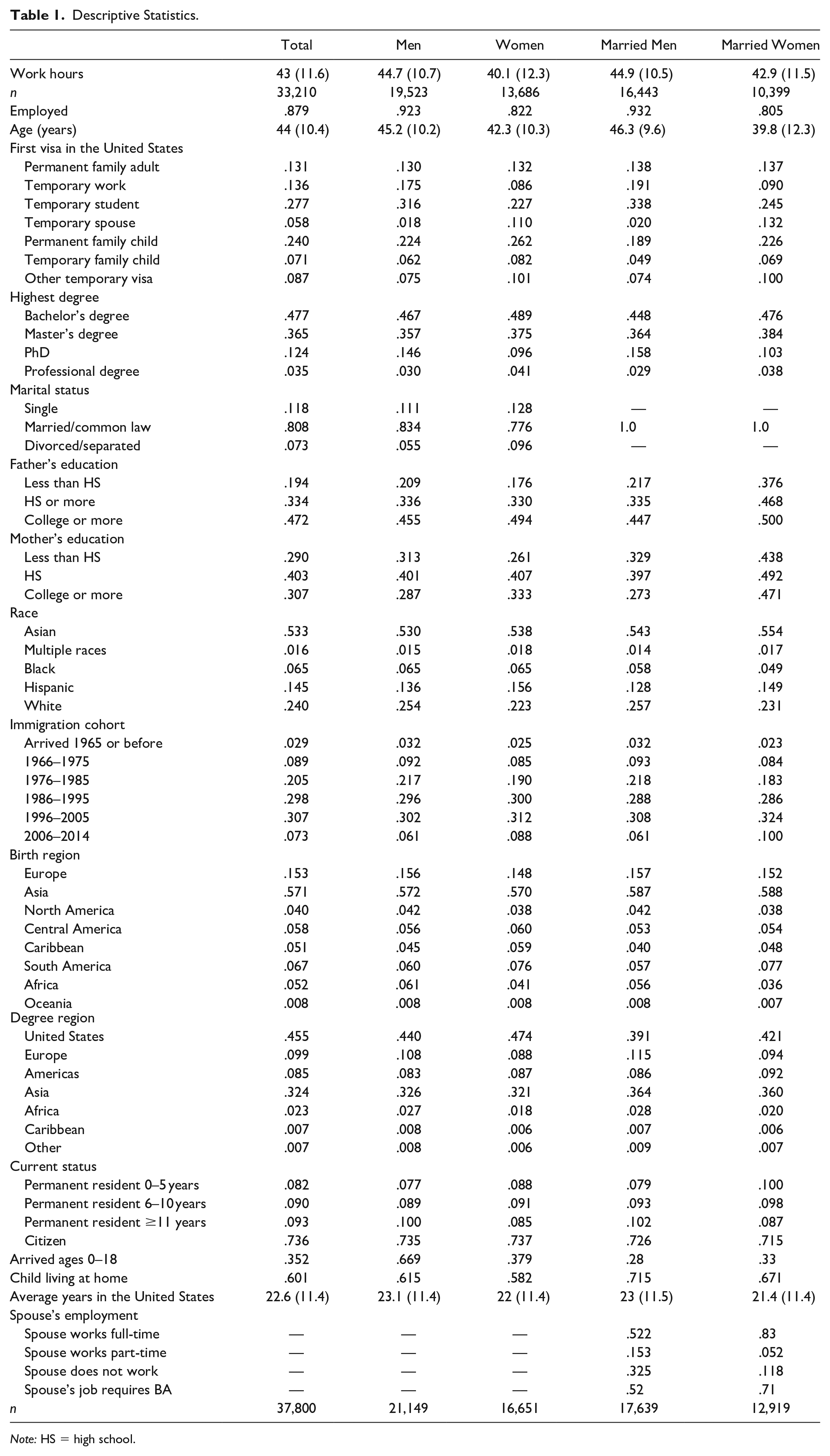
Note: HS = high school.
Table 2, model 1, provides the odds ratios from random-effect logistic regression analyses predicting employment status among immigrant men and women. Model 1 includes an interaction to assess whether the effects of family-based and skill-based migration on employment differ by gender along with several controls. Given the interaction terms in the equation, results are best interpreted with predicted probabilities of employment by entry visa and gender in Figure 1.
Odds Ratios and Coefficients Predicting Employment and Work Hours among Immigrants.
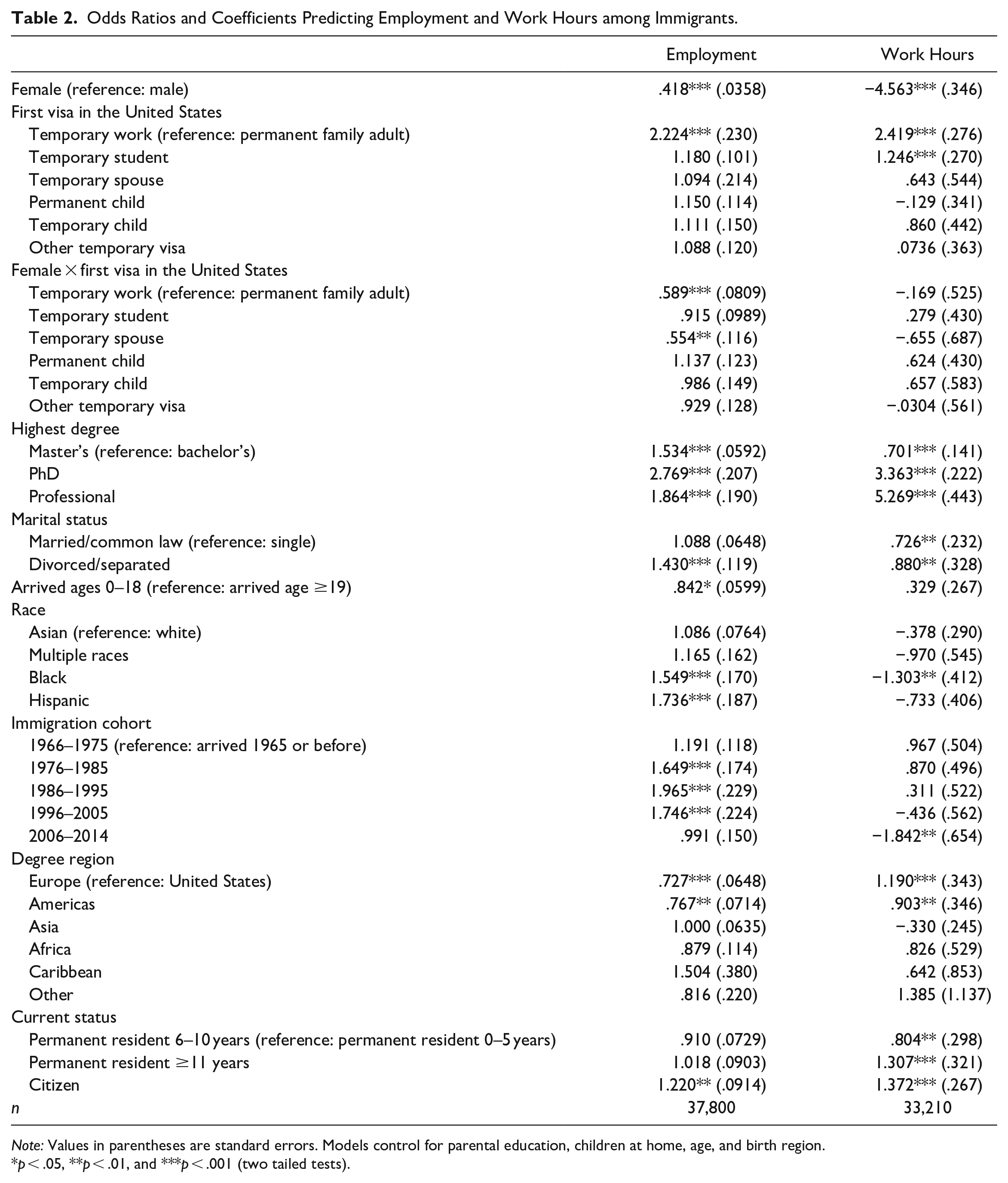
Note: Values in parentheses are standard errors. Models control for parental education, children at home, age, and birth region.
p < .05, **p < .01, and ***p < .001 (two tailed tests).

Predicted probability of employment by entry visa categories for immigrant women and men.
Figure 1 shows a persistent gender gap as immigrant men in each entry status have a greater likelihood of employment than their female counterparts, highlighting immigrant men’s labor market advantage. Among immigrant men, those arriving via temporary work show an advantage with a 0.96 probability of employment, followed by temporary family child, temporary students, permanent family child, and temporary spouse (0.92), and permanent family adult (0.91), showing mixed evidence about greater employment behavior among skill-based immigrants relative to family immigrants. Immigrant men show high probabilities of employment regardless of entry visa. My results also show limited evidence that those who entered with permanent status show greater outcomes than those who arrived with a temporary status.
In contrast, immigrant women’s employment probabilities are much lower than men’s across each status, even among women who arrived in categories that are assessed on their skills and human capital. To illustrate, Figure 1 shows that among immigrant women, those arriving via temporary work and as permanent family child have the highest probability of employment (0.85), followed by temporary family child (0.83), students (0.82), permanent family adult (0.81), and temporary spouses (0.73). Women who arrived as temporary spouses exhibit the lowest employment among immigrant women and in the entire sample. This trend among temporary spouses, however, is not apparent among immigrant men, indicating the gendered effects of family migration and specifically, temporary spousal migration on employment.
Next, to assess whether the observed disparities in employment are attributed to selection bias, I use propensity score matching techniques. In Figure 2, I present the predicted probability of employment for three pairs: (1) temporary spouse versus permanent family adult, (2) temporary student versus temporary work, and (3) temporary family child versus permanent family child, by gender. Among immigrant women, I find that temporary spouses (0.66) have a substantially lower employment probability than permanent family (0.73) after balancing on observable characteristics. In separate analyses, I find that the difference between permanent family adult and temporary spouses is statistically significant. This suggests that even after transitioning to permanent residency, immigrant women who initially arrived as temporary spouses show a lower probability of employment than immigrant women arriving as permanent family as adults. After balancing on observable characteristics, there are still some differences in employment probabilities (0.06) between women who arrived as temporary workers versus temporary students and between women who arrived as permanent versus temporary family children (0.02). A persistent and significant disparity (0.07) between women who arrived as temporary spouses versus permanent family adult even after using matched cases suggests that selection bias on observable characteristics is not driving this difference. The analogous results for immigrant men show that after balancing on observable characteristics, there are some differences in employment probabilities across the pairs of entry status and that at least some categories of entry status appear to matter less for immigrant men’s employment. Overall, there is limited evidence showing that immigrants screened and selected solely on their skills have greater employment behavior than immigrants sponsored by family.

Predicted probability of employment for immigrant women and men weighted by propensity scores.
In Table 1, model 2, I assess the effect of entry status on another aspect of employment behavior: hours worked. Model 2 includes the interaction between gender and entry visas, net of controls. Given the interaction term in the equation, the results are best interpreted with marginal effects of predicted hours worked each week in Figure 3.

Predicted average weekly work hours by entry visa categories for immigrant women and men.
Figure 3 illustrates the predicted mean employment hours for each entry status by gender. The difference between men and women represents the gender gap in work hours. Figure 3 shows that immigrant men and women across all statuses are engaged in full-time employment, though men show higher average work hours than women. Immigrant men across all statuses show higher predicted work hours than women, exceeding 40 hours each week. Men who arrived via temporary work show the highest weekly work hours (46.2 hours), followed by those who arrived as a temporary student (45.1 hours), temporary family child (44.7 hours), temporary spouse (44.5 hours), permanent family adult (43.8 hours), and permanent family child (43.7 hours). Among immigrant women, those who arrived via temporary work show the highest weekly work hours (41.5 hours), followed by those who arrived as temporary student and temporary family child (40.8 hours), permanent family child (39.7 hours), permanent family adult (39.3 hours), and temporary spouse (39.2 hours).
Whereas women arriving as temporary spouses show a substantially lower employment probability, women who engage in paid work do so at similar levels than those who entered as permanent family adults and children. Although the findings reveal a gender difference in work hours patterned by entry status, they do not show an interactive effect as observed with employment in Figure 1. In turn, the remainder of this study is focused on understanding the mechanisms driving immigrant women’s lower employment, specifically temporary spouses.
I also consider whether employment differences across entry status and gender are shaped by marital status. Table A2 shows the odds ratios predicting employment separately by current marital status (married or common-law partnerships and unmarried), which allows me to also control for spouse’s employment status. To interpret the interaction term in Table A2, Figure 4 displays the employment probabilities for married and unmarried women. For brevity, I focus on immigrant women who arrived as permanent family adults and temporary spouses and are currently married or unmarried to disentangle the effects of entry status, marital status, and gender. 10 Figure 4 shows that regardless of entry status, unmarried immigrant women have higher probabilities of employment than married women.

Predicted probability of employment by temporary and permanent family status and marital status for immigrant women.
Figure 4 shows that married immigrant women who arrived as temporary spouses show the lowest predicted employment (0.74) as opposed to women who arrived as temporary spouses but are now not married (0.93), married permanent family adults (0.80), and unmarried permanent family adults (0.89). The figure shows a large employment disadvantage among married individuals regardless of their entry status. Married women who arrived as temporary spouses continue to show the lowest employment probability, indicating the negative association between marital status, temporary family entry status, and employment.
However, I find that among unmarried women, entry status appears to matter less for employment. For instance, across all of the entry statuses, the predicted probability of employment ranges from 0.89 to 0.93 for unmarried women and 0.74 to 0.85 for married women. Therefore, not only do married women have lower employment probabilities, but there is also greater stratification by entry visa. Overall, this indicates that different household strategies or negotiations may drive employment disparities between women who arrive as temporary spouses versus permanent family adults. Overall, marriage is a key predictor in explaining the lower employment among women who arrived as temporary spouses. It is possible that those who are currently married encounter different household negotiations than unmarried women, despite sharing an entry status as temporary family. This suggests that immigrant women’s lower employment is not driven by entry status alone but its combination with marital status.
Discussion and Conclusion
In this study I use a multidimensional measure of immigrant’s entry visa pathways (permanent family adult, temporary work, temporary student, temporary spouse, permanent family child, and temporary family child) to examine how differences in initial entry status continue to affect the employment behavior of college-educated immigrants, even after these immigrants have secured permanent status. This study also shows how the relationship between entry visa status and employment behavior differs by gender and marital status, including between- and intragender differences.
There are three main findings of this study. First, this study shows an interactive effect between gender and entry status where immigrant men who arrive via temporary work show the greatest employment behavior but there is large variation across the other statuses, especially by gender. Even when sharing the same entry status and securing permanent status as a permanent resident or citizen, educated immigrant women consistently show lower paid employment than immigrant men. Overall, the findings show limited support that skill-based immigrants have greater employment behavior than family-based immigrants over long periods of time, which is in contrast with Gelatt (2020) and Massey and Malone (2002).
The gender disparity is most dramatic among temporary spouses. Immigrant women who arrive as temporary spouses show the lowest employment rates, but this is not true among men who arrive as temporary spouses, indicating gender differences in how immigrants manage secondary or dependent status (Banerjee 2019; Ho 2006). It is possible that a lack of work eligibility for temporary spouses intersects with traditional gender norms to create this gender disparity. My findings hold even after using propensity score matching and comparing closely matched cases. This suggests a need to look beyond explanations related to sorting and selection on observable characteristics in immigration policy as these factors do not fully account for the observed gender differences (Boucher 2007; Iredale 2005).
One potential explanation for the gender difference is that immigrant men and women interpret their statuses in different ways (Banerjee 2019). For instance, when immigrant women are trailing spouses, traditional gender norms and household strategies and assumptions of female economic dependency are reinforced, producing different employment behavior for men and women that negatively shapes immigrant women’s employment behavior and outcomes (Balgamwalla 2014; Banerjee and Phan 2015). However, this is not the case for men (Banerjee 2019). Overall, my findings extend this body of work on and how immigrant couples tied movers together by showing a persistent gender disadvantage across several entry statuses. More qualitative work about how educated immigrant men and women arriving under different entry statuses and immigrant couples adjust their employment behavior is needed to further illuminate these complex processes.
Second, this study reveals that the effects of family-sponsored migration on immigrant women’s employment behavior depends on the conditions of their entry status. I find that immigrant women who arrive as temporary spouses show significantly lower employment than permanent family adults and children and temporary family children, suggesting that family-sponsored immigration is not inherently detrimental for employment. Rather, it depends on the conditions of their family-sponsored migration, namely, whether it is permanent or temporary and possibly the specific kin relationship to the primary applicant (spouse, child, or other family member). These initial differences in family immigration persist and shape employment behavior, even after immigrants transitioning to a permanent status.
One potential reason why permanent family who arrive as children and adults show higher employment rates is because of their protections afforded from permanent residency. In addition to their rights, they are sponsored by U.S. permanent residents or citizens, which may allow them greater security as a family unit. They encounter little or no visa stress (Jasso et al. 2005; Jasso 2011). In contrast, temporary family have limited rights and avenues to establish independence and given that both individuals in the family unit have temporary statuses, women who arrive as temporary spouses may be more likely to make different household negotiations than their permanent family counterparts (Balgamwalla 2014). Additionally, temporary family-sponsored immigrants typically encounter a more abrupt move to the United States, giving them less time to prepare for their move. In contrast, permanent residents have more time to prepare and make plans in the United States, which may facilitate their labor market prospects. 11 One exception are temporary family children, who, like permanent family children have the benefit of growing up and are socialized in the United States and have greater familiarity with U.S. institutions (Glick and Yabiku 2016). Future research examining the entry status at the couple or household levels could illuminate our understanding of the broader effects of entry status for employment behavior.
One caveat is that my findings show that although arriving as a temporary spouse structures whether immigrant women engage in paid employment, it has minimal effect on the extent to which they engage in paid employment. Therefore, when immigrant women who arrive as a temporary spouse participate in the labor market, they do so at similar rates than immigrant women who arrived as permanent family adults and temporary students. Thus, for immigrant women arriving as temporary spouses, their employment trajectory is driven by lower labor market participation, rather than the extent to which they work. This broadens our understanding of the labor market experiences of dependents or spouses, which has primarily focused on their wages, occupational status, or labor market participation (Banerjee and Phan 2015; Elrick and Lightman 2016). My findings offer a more nuanced understanding by focusing on immigrant’s employment behavior and illustrating the pivotal junctures that affect the employment trajectories of immigrant women who enter as temporary spouses versus other types of family immigration.
Third, this study shows that marriage mediates the relationship between entry status and employment among women, especially those who arrive as temporary spouses. Married women who arrived as temporary spouses continue to show lower employment than their unmarried counterparts. Immigrant women who are currently unmarried show higher employment outcomes, even if they arrived as temporary spouses, as they have taken steps to establish their economic and legal independence, including their right to remain in the country (Balgamwalla 2014). Of course, selection out of marriage is a consideration that is beyond the scope of this study and future research may consider.
This study shows that a gendered relationship between the state (entry visa) and labor market is mediated by marital status. My findings build on explanations associated with immigrant women’s employment restrictions or relationship with the state, which only partially account for the lower employment of women who arrived as temporary spouses (Balgamwalla 2014). The findings also extend our understanding of why marriage negatively affects immigrant women’s employment (Donato, Piya, and Jacobs 2014) by highlighting the different household negotiations for married and unmarried women and how this intersects with their entry status. Although gender role ideology is more traditional among married immigrant couples who migrate together (Banerjee and Phan 2015), this may be exacerbated for those in temporary and precarious positions. The process of migrating and resettling together may intersect with challenges imposed by immigration policy and in turn, exacerbate and cement gender inequalities, especially if there is an expectation of advancing husbands’ careers prior to migration (Ho 2006; Meares 2010).
Overall, this study contributes to our knowledge about the employment behavior of an understudied group: educated immigrant women. Even when immigrant women possess high levels of skills and human capital, they exhibit considerably lower employment behavior than immigrant men, which counters the logic underpinning skill-based immigration. This study helps elucidate this puzzle by showing that immigrants’ initial entry pathways into the United States continue to stratify their employment behavior and trajectories, especially for immigrant women. The findings highlight a major blindsight in our understanding of family-based and skill-based immigration and immigration policy effects, which have overwhelmingly focused on immigrant men and largely assumed that the effects work in similar ways for men and women (Hao 2013; Ho 2006; for a review, see Kõu and Bailey 2017). Additionally, this study expands on broad “family” and “skill” categories by adopting a multidimensional lens of entry status that also incorporates whether the category is temporary or permanent and whether immigrants arrived as an adult or child family member. The fact that entry status shapes immigrant women’s employment and career trajectories in qualitatively different ways than those of immigrant men suggests that immigration policies and our understanding of entry pathways is still tentative. This study’s findings build on a body of work showing that family- and skill-based immigration have long-term consequences for immigrant’s labor market outcomes (Akresh 2008; Jasso and Rosenzweig 1995), but a comprehensive understanding of these effects needs to consider gender and marital status along with more detailed information on entry visa categories that specify family relationships.
One limitation of this study is that it cannot capture self-selection out of the United States. It is possible that immigrants who are less successful in the U.S. labor market may return to their origin country or to another host country (Hou and Bonikowska 2018). The U.S. government does not collect official statistics on outmigration and it is a poorly understood component of official population estimates, but there is some evidence to show that country of birth and residency shape outmigration. For instance, Borjas and Bratsberg (1996) found that immigrants from Asia and other less developed countries are less likely to out-migrate. Additionally, authorized immigrants, permanent residents, and immigrants who have resided in the United States for longer periods are less likely to out-migrate (Bhaskar, Arenas-Germosén, and Dick 2013). Given the composition of my sample, this suggests that the study’s results are unlikely to be driven solely by outmigration.
Another limitation of this study is that it focuses on a sample of educated immigrants, who may have greater household resources that allow them to voluntarily opt out of paid employment than less educated immigrants. However, the gender gap in employment among college-educated immigrants (15.4 percent) is smaller than among the total immigrant population (23.2 percent) (U.S. Census Bureau 2022), which suggests that gender disparities by entry status may be a larger issue that is even more pronounced for less educated immigrants. Thus, my findings on college-educated immigrants may underestimate the true extent of gender disparities by entry visa status. Future research may consider how the relationship between entry status and gender differs by class and education levels.
This study’s findings have important implications for U.S. immigration policy. If the U.S. government is to maximize immigrants’ human capital in the labor market, then it is imperative to improve the employment opportunities for family members, specifically temporary spouses and immigrant women. Providing employment rights for all temporary spouses would be a first step. The United States is more restrictive than other countries, such as Australia and New Zealand, which provide similar rights for primary and secondary applicants (Boucher 2007; Immigration New Zealand 2020). Employment eligibility could alleviate low rates of labor market participation, a specific hurdle facing dependent immigrant women in their career trajectories and in establishing their independence in the United States. Given assortative mating, many spouses of skilled migrants are also skilled and their absence in the U.S. labor market leads to brain waste, a loss of income among immigrant women and households, and unclaimed tax revenue for the U.S. government.
Supplemental Material
sj-docx-1-srd-10.1177_23780231221144354 – Supplemental material for Gendered Pathways: Employment Behavior among Family-Based and Skill-Based Immigrants in the United States
Supplemental material, sj-docx-1-srd-10.1177_23780231221144354 for Gendered Pathways: Employment Behavior among Family-Based and Skill-Based Immigrants in the United States by Rennie Lee in Socius
Footnotes
Appendix
Odds Ratios from Logistic Regression Predicting Employment among Married and Unmarried Immigrants.

| Married | Unmarried | |
|---|---|---|
| Female (reference: male) | .363*** (.0345) | 1.246 (.302) |
| First visa in the United States | ||
| Temporary work (reference: permanent family adult) | 2.281*** (.256) | 2.388* (.941) |
| Temporary student | 1.184 (.111) | 1.357 (.375) |
| Temporary spouse | 1.283 (.276) | .532 (.321) |
| Permanent family child | 1.362** (.161) | 1.103 (.275) |
| Temporary family child | 1.202 (.205) | 1.856 (.627) |
| Other temporary visa | 1.067 (.131) | 1.818 (.569) |
| Female × first visa in the United States | ||
| Temporary work (reference: permanent family adult) | .579*** (.0860) | .806 (.340) |
| Temporary student | .920 (.109) | .873 (.266) |
| Temporary spouse | .520** (.119) | 3.282 (2.604) |
| Permanent family child | .886 (.112) | .932 (.253) |
| Temporary family child | .766 (.143) | .635 (.248) |
| Other temporary visa | .972 (.149) | .454 (.188) |
| Highest degree | ||
| Master’s (reference: bachelor’s) | 1.597*** (.0708) | 1.293* (.146) |
| PhD | 3.035*** (.254) | 2.099** (.521) |
| Professional | 2.060*** (.242) | 1.162 (.251) |
| Arrived ages 0–18 (reference: arrived age ≥19) | .855 (.0715) | .928 (.157) |
| Race | ||
| Asian (reference: white) | 1.208* (.0951) | .684 (.147) |
| Multiple races | 1.120 (.176) | .916 (.335) |
| Black | 1.578*** (.201) | 1.167 (.334) |
| Hispanic | 1.645*** (.198) | 1.565 (.459) |
| Immigration cohort | ||
| 1966–1975 (reference: arrived 1965 or before) | 1.323* (.154) | .743 (.186) |
| 1976–1985 | 1.807*** (.221) | 1.039 (.256) |
| 1986–1995 | 2.111*** (.284) | 1.440 (.430) |
| 1996–2005 | 1.782*** (.262) | 1.609 (.530) |
| 2006–2014 | .923 (.158) | 1.328 (.546) |
| Degree region | ||
| Europe (reference: United States) | .718*** (.0720) | .627 (.165) |
| Americas | .744** (.0786) | .954 (.233) |
| Asia | .999 (.0711) | .945 (.173) |
| Africa | .793 (.113) | .888 (.321) |
| Caribbean | 1.580 (.457) | 1.466 (.774) |
| Other | .901 (.282) | .502 (.340) |
| Spouse’s employment | ||
| Spouse works part-time (reference: spouse works full-time) | 1.496*** (.117) | — |
| Spouse does not work | .789*** (.0524) | — |
| Spouse job requires BA (reference: spouse job does not require BA) | .751*** (.0425) | — |
| Current status | ||
| Permanent resident 6–10 years (reference: permanent resident 0–5 years) | .928 (.0797) | .733 (.220) |
| Permanent resident ≥11 years | 1.053 (.103) | 1.016 (.281) |
| Citizen | 1.260** (.103) | 1.219 (.301) |
| n | 30,558 | 6,491 |
Note: Values in parentheses are standard errors. Models control for parental education, children at home, age, and birth region.
p < .05, **p < .01, and ***p < .001 (two-tailed tests).
Acknowledgements
I thank Stephanie Nawyn, Van Tran, Janeen Baxter, Rebecca Jean Emigh, anonymous reviewers, and the editorial board for their helpful comments on previous drafts of this article.
Funding
The author(s) disclosed receipt of the following financial support for the research, authorship, and/or publication of this article: This project was supported by the Australian Research Council Centre of Excellence for Children and Families over the Life Course (CE200100025).
Supplemental Material
Supplemental material for this article is available online.
1
New arrivals through family admission class represent 85 percent of all new permanent entries to the United States. Additionally, among the employment, diversity, and other visa categories, approximately half or more of these new permanent entrants are spouses and children of principals ( ). Therefore, the national data underscores that family is the largest admission class among new permanent arrivals and family members constitute more than half of the remaining admission categories. Thus, regardless of admission category among new permanent arrivals, the overwhelming majority are family members.
2
The most common temporary spousal visas are spouses of temporary workers (H-4), intracompany transfers (L-2), and academic students (F-2). All prohibit employment for spouses at the time of the survey.
3
In separate analyses, I find similar results with a sample that is not restricted to permanent residents and citizens.
4
Even with basic controls (education and gender), sample sizes in the NIS for temporary spouses, temporary workers, spouses of U.S. citizens or permanent residents, students, and dependents of students are substantially smaller than the samples with NSCG data.
5
I conduct similar analyses with NIS data and find results that are consistent with my analyses using NSCG data. I find that women who arrived as temporary spouses show one of the lowest probabilities of employment and lower employment probabilities than spouses of U.S. citizens.
6
In the NSCG, Latinos are overrepresented and whites are slightly underrepresented relative to national estimates.
7
The NIS includes national origin, but given the small sample sizes, only region of birth could be used reliably.
8
In the NSCG, respondents who arrived as permanent residents do not specify the specific category under which they received permanent residency. However, statistics from the show that approximately 93 percent of incoming permanent residents in the United States are approved entry via their family relationships. I restrict individuals in this category to those who arrived as adults 21 years and older. To ensure that individuals did not arrive via a permanent employment visa, I remove all individuals who stated that work was their primary and only reason for migrating. The majority of respondents arriving as permanent resident adults in my sample state that family is the major reason for migration. Overall, I am confident that majority of the respondents in this category arrived via family reunification.
9
Work rights attached to H-4 visas have changed over time. The modern version of H-4 visas that restricted work rights for spouses was enacted in 1990. To account for this policy change, I restrict my sample to those who arrived after 1990 as a temporary dependent at the age of 21 years or older. Starting May 26, 2015, the eligibility for work rights expanded (employment authorization document) for a subset of individuals on a H-4 visa holders (). However, this preceded the time my respondents were observed in NSCG. Employment and education questions in wave 2015 of NSCG refer to reference week, the week of February 1, 2015. In separate analyses, I also conducted my analyses without the 2015 sample and the results are similar. Therefore, I am confident that the expansion of work authorization in 2015 is unlikely to affect my results.
11
To illustrate, the wait times for approvals of H1-B visas and their spouses are significantly shorter than those of spouses of U.S. permanent residents and citizens.
Author Biography
References
Supplementary Material
Please find the following supplemental material available below.
For Open Access articles published under a Creative Commons License, all supplemental material carries the same license as the article it is associated with.
For non-Open Access articles published, all supplemental material carries a non-exclusive license, and permission requests for re-use of supplemental material or any part of supplemental material shall be sent directly to the copyright owner as specified in the copyright notice associated with the article.
