




Abstract
In this IMR Methods Note, we spotlight the rise in quantitative data availability, measurements, and scholarly investigations of US immigrant and immigration policies (IIPs). To begin, we offer a detailed account of the quantitative data sources, measures, and analytical strategies that have been developed by scholars studying IIPs over the last two decades. We then highlight this scholarship's important advances toward identifying IIPs’ intended, unintended, and spillover effects on immigrant and nonimmigrant populations in the United States. To conclude, we discuss ongoing challenges and future opportunities for deepening research on US IIPs and their psychosocial, behavioral, and health implications. Our review illuminates how data on federal immigration enforcement activities, and on federal, state, and municipal immigrant laws have engendered increasingly sophisticated quantitative studies of the US IIP climate. At the same time, it highlights several dimensions in which existing work stands to be strengthened, including the need for comparisons of newly developed IIP measures and their estimated effects; greater exploration of IIPs’ potentially heterogeneous effects across distinct subpopulations; and more attention to endogeneity, or in other words, the political and demographic processes that give rise to nonrandom variation in how IIPs take shape across space and time.
Introduction
Federal immigration policies—those regulating who is allowed into and expelled from the United States — and state, county, and municipal immigrant policies — which regulate who is granted access to goods and services — have direct effects on immigrant well-being by shaping access to resources, symbolic out-group membership, and social and economic threats (Menjívar and Abrego 2012; Asad and Clair 2018). 1 Moreover, immigrant and immigration policies (IIPs) can reach beyond immigrants to affect ethnic minorities in the United States more broadly (Santos, Menjívar, and Godfrey 2013). These spillover effects can occur through changes in racial profiling, government surveillance, civil discrimination, and diffuse threats to mixed-status families and individuals who are stereotyped as immigrants (Aranda, Menjívar, and Donato 2014). Such far-reaching consequences have potentially profound implications for the health and well-being of the individuals who are impacted by IIPs, and as such, have garnered considerable attention from migration scholars.
Much of the scholarship on the consequences of IIPs for civilians, including much of the earliest work, has been qualitative. For instance, ethnographic studies have, for decades, provided detailed accounts of how “illegality” and deportability shape undocumented immigrants’ daily life (Chavez 1997; De Genova 2002; Prieto 2018; García 2019; Gómez Cervantes and Menjívar 2020; Martinez-Aranda 2020). Likewise, studies employing in-depth interviews have long shown how IIPs can directly and indirectly affect immigrants’ and their family members’ interpersonal relationships, security, and emotional well-being (Rodríguez and Hagan 2004; Hagan, Rodriguez and Castro 2011; Golash-Boza 2019). Moreover, qualitative scholarship has also explored the perceptions of immigrants and members of mixed-status households so as to understand how specific laws such as Arizona's SB1070 (Valdez, Padilla, and Valentine 2013; Gómez and O’Leary 2019) or the Legal Arizona Worker's Act (Ayón et al. 2012) shape social relationships and access to formal healthcare and employment. Qualitative work has thus been seminal in calling attention to the far-reaching consequences of IIPs.
With increasing awareness of IIPs’ impacts revealed by qualitative scholarship, and increasing quantitative data availability on IIPs, quantitative scholarship measuring IIPs’ impacts has recently begun to proliferate. In this IMR Methods Note, we spotlight the rise in quantitative data availability, measurements, and scholarly investigations of US IIPs. The proliferation of research in this area parallels ever-increasing geographic variation in state and municipal legislation and federal enforcement activities (Amuedo-Dorantes and Lopez 2017), a dramatic rise in immigrant detention (Altman and Ascherio 2020), and the increasing ease with which scholars can access comprehensive data on these laws and activities occurring across different levels of government. In the pages that follow, we review some of the most prominent quantitative data sources and approaches to measuring IIPs and describe how these data and measurements have engendered new insights into IIPs’ far-reaching effects. Given the incredible volume of rigorous IIP-related research, we do not offer an exhaustive review of findings, but instead, synthesize the predominant quantitative data and methods used in this scholarship and reflect upon its main contributions, challenges, and opportunities.
Data Sources
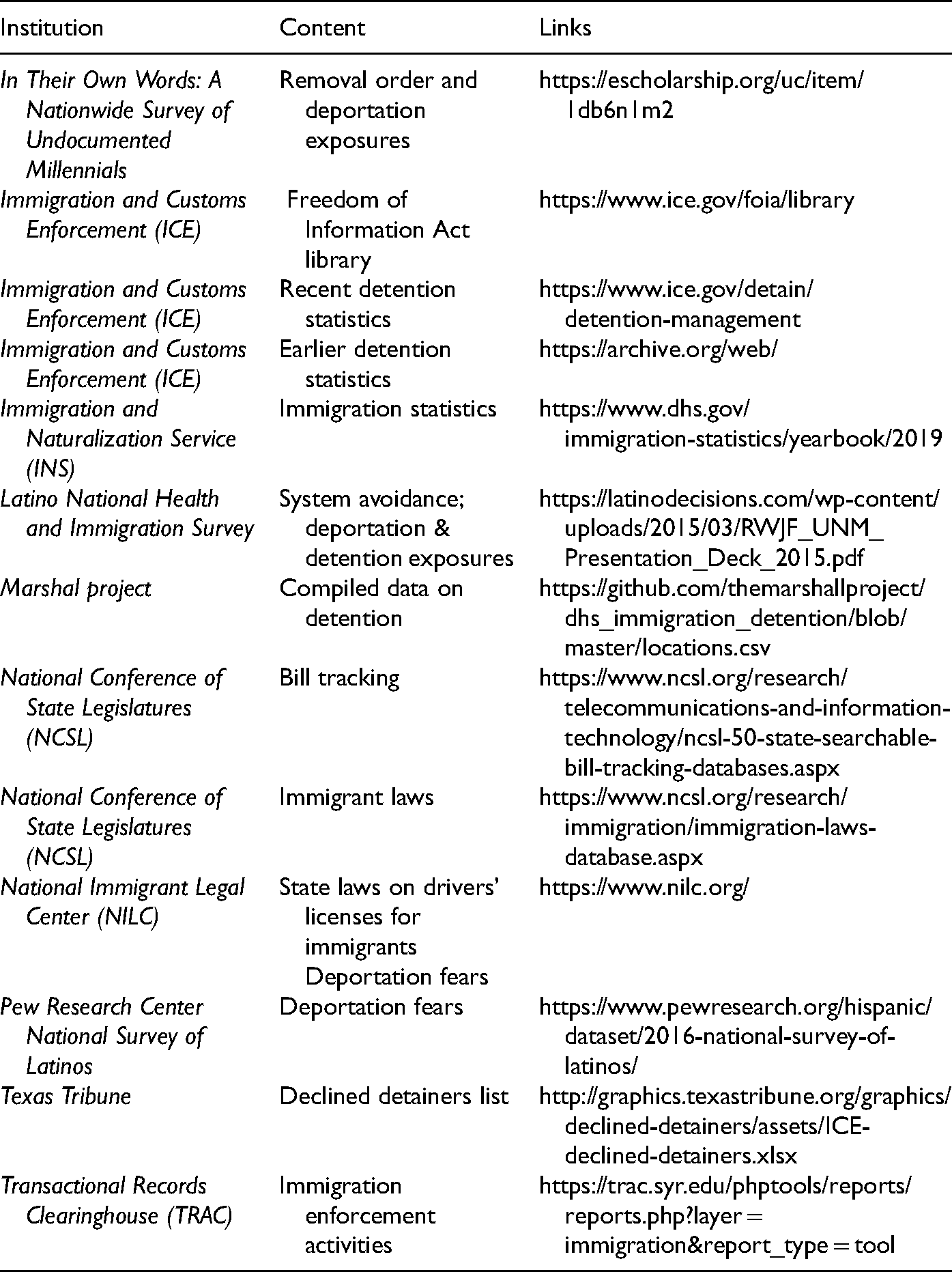
Some of the main quantitative data sources on IIPs come from Immigration and Customs Enforcement (ICE) and Customs and Border Patrol agency records on ICE raids and immigrant detentions and deportations, both of which are published by the Department of Homeland Security (DHS). 2 These records are made available through individual researchers’ Freedom of Information Act (FOIA) requests and through the Transactional Records Access Clearinghouse (TRAC), which aggregates information provided by ICE in response to these requests. FOIA requests, and TRAC's compilation of data based on these requests, are critical to addressing inconsistencies in federally released data. Two other prominent data sources include state immigrant laws, which are aggregated by the National Conference of State Legislatures (NCSL), and state-, county-, and city-level sanctuary policies, which are compiled by advocacy organizations like the National Immigrant Legal Center (NILC) and the Immigrant Legal Resource Center (for a more extensive list, see Appendix A).
These various data sources engender analyses of IIPs occurring at different governmental levels, such as state-level employment policies like E-Verify; counties’ participation in the Secure Communities program, through which police and prisons partner with ICE; states, counties, and cities’ adoption of sanctuary policies to limit cooperation with ICE; and federal detention and removal rates at the MSA, county, and state-level, among others. Records of police activities like pedestrian stops offer further information about less explicit “backdoor” policies (Varsanyi 2008) whereby city ordinances and/or local policing practices curb opportunities for undocumented immigrants. Meanwhile, large-scale surveys like the Latino National Health and Immigration Survey, In Their Own Words: A Nationwide Survey of Undocumented Millennials, and Pew Research Center National Survey of Latinos, which collect information on personal experiences with removal orders, exposure to deportation with one's social network, and/or worries about deportation, enable insights into the reach of federal immigration enforcement and of the IIP climate more broadly.
Measurement of IIP
A central methodological challenge in quantitative research on IIPs is how to operationalize them. For instance, scholars must make important decisions related to the geographic level of measurement, such as whether to focus on IIPs occurring at the municipal, county, state, or federal level. One strategy is to focus on specific state laws — such as the implementation of SB1070 in Arizona (Santos and Menjívar 2013; Flores 2017; Santos et al. 2018; Torche and Sirois 2019) or SB54 in California (Kubrin and Bartos 2020). Focusing on a specific law allows scholars to compare outcomes of interest in the pre- and post-law periods. Studies taking this approach have adopted a variety of analytic strategies ranging from straightforward pre–post comparisons within a particular state to difference-in-difference strategies that compare pre–post differences in “treatment” states where a law was introduced to pre–post differences in “control” states where it was not. 3
An extension of this approach is to estimate the effects of similar types of laws across diverse contexts. For example, at the state level, scholars have pooled data from different states and explored the effects of omnibus immigration laws (Allen and McNeely 2017) and E-verify mandates (Amuedo-Dorantes and Bansak 2012) by comparing outcomes of interest in states with these policies to in states without them. 4 At a more local level (e.g., county or city), scholars have similarly examined the effects of 287(g) agreements with ICE (Parrado 2012; Nguyen and Gill 2016; Stanhope et al. 2019; Dee and Murphy 2020); participation in the federal Secure Communities program (Miles and Cox 2014; Treyger, Chalfin and Loeffler 2014; Bellows 2018; Ryo and Peacock 2020); sanctuary policies (Lyons, Vélez and Santoro 2013; Amuedo-Dorantes and Deza 2019; Martínez-Schuldt and Martínez 2019, 2021; Hausman 2020); and “backdoor” policies (Legewie et al. 2022).
Although work focused on individual laws has made significant strides toward understanding the implementation and effects of those laws, such studies do not capture the full tenor of a given IIP climate (Philbin et al. 2018). To that end, some scholars have taken to examining multiple state laws at once and comparing and contrasting laws based on their perceived exclusivity or inclusivity (Rhodes et al. 2020). 5 Although measuring laws in this way relies on a subjective interpretation process, scholars who take this approach use multiple coders to code each law so as to standardize the process and minimize bias.
Taking this one step further, the Immigration Policy Climate (IPC) index integrates both exclusionary and inclusionary state laws into a comprehensive scale (Samari, Nagle, and Coleman-Minahan 2021). In the IPC, states receive one point for the presence of laws in 14 domains (and zero points for their absence). Each point's direction is determined by whether the laws in that domain prohibit or safeguard immigrants’ rights. 6 Points are then summed such that more negative scores represent more exclusionary policy environments and more positive scores represent more inclusionary ones. Others have taken similar approaches to aggregating information based on counts of exclusionary and inclusionary policies across multiple domains (Hatzenbuehler et al. 2017; Reich 2017; Wallace et al. 2019). Most often, indices taking this approach simultaneously consider whether a lawful residence is a requirement for access to formal employment; whether it is a requirement for access to public services like healthcare, welfare, and driver’s licenses; and the extent to which law enforcement officers are mandated to cooperate with federal immigration authorities. An important benefit of these index approaches is therefore that they account for the multifaceted nature of state-level IIPs.
One limitation of most state-level IIP indices, however, is that they do not consider policy reach. To that end, one state-level index, developed by Monogan (2013, 45), ordinally scores laws based on whether they are “(1) symbolic, (2) affecting a small group of immigrants, (3) affecting many immigrants in a substantial way and (4) directly affecting immigrants’ ability to reside in a state.” Although this index, too, relies on the subjective interpretation of individual laws, each law is coded by multiple coders in order to cross-validate coding. 7
Other scholars, rather than examine state laws, concentrate on immigration enforcement activities within states. At least one study measures immigration enforcement at the state level using the rate of I-247 detention and notification requests per 100,000 state residents (Friedman and Venkataramani 2021). However, most studies concerned squarely with immigration enforcement activities tend to focus on a more local level. These studies typically rely on counts or rates of immigrant arrest, detention, and/or deportation at the county- or MSA level (Bellows 2018; Moinester 2019; Pedroza 2019; Hausman 2020; Bansak and Pearlman 2021). A key advantage of these approaches is that they capture the intensity of tangible enforcement activities that impose direct threats to immigrants within a given geographic area (Menjívar and Abrego 2012).
Considering that counties and cities can adopt policies that are inconsistent with surrounding state policies and that federal immigration enforcement activities, like ICE raids, can occur unevenly within states (Cade 2018), scholars increasingly recognize the importance of accounting for coexisting IIPs occurring across multiple levels of government. Some, therefore, have begun to develop more sophisticated indices that combine information from multiple geographic levels. For example, Pham and Hoang Van (2019) offer a comprehensive state-level Immigration Climate Index (ICI) comprised of information on state, county, and city laws. In the ICI, laws that are exclusionary receive negative scores while laws that are inclusionary receive positive ones. Laws are broken into four tiers and assigned a corresponding number of points, depending on whether they (1) affect immigrants’ lives in a real but minimal way; (2) impact immigrants’ access to easily replaceable benefits; (3) grant or restrict their access to (almost) irreplaceable benefits; or (4) infringe upon their physical security via policing or deportation risk. Then, each law's score is weighted depending on the size of the governed population relative to the state's total population. 8
Another comprehensive approach is to construct a population-weighted MSA-level index of interior immigration enforcement that combines information on the presence of state-level omnibus laws and E-verify mandates as well as counties’ participation in 287(g) agreements or the Secure Communities program (Amuedo-Dorantes and Lopez 2017; Amuedo-Dorantes and Arenas-Arroyo 2019). Because laws and enforcement activities change within a state, county, or city over time, IIP indices like these, and the ones described above, are almost always time-varying. This feature enables scholars to both compare scores across different places at the same point in time and to observe how scores change within places over time (Amuedo-Dorantes and Arenas-Arroyo 2019).
Effects of IIPs
Alongside rising quantitative data availability and measures of IIPs have come many opportunities to explore IIPs’ extensive effects on people's behavior, health, and well-being. Indeed, past scholarship has explored their effects on a wide spectrum of outcomes ranging from employment (Amuedo-Dorantes and Bansak 2012), to school enrollment (Amuedo-Dorantes and Lopez 2015; Dee and Murphy 2020), to psychological well-being (Hatzenbuehler et al. 2017; Venkataramani et al. 2017), and birthweight (Torche and Sirois 2019), among others (Theodore and Habans 2016; Allen and McNeely 2017; Martínez-Schuldt and Martínez 2021). To investigate IIPs’ effects, studies taking quantitative approaches combine information on the timing and/or location of policies with preexisting microdata from georeferenced surveys or administrative records (see Amuedo-Dorantes and Arrenas-Aroyo (2019) and Torche and Sirois (2019) for examples).
Integrating data on IIPs with individual-level data, in turn, facilitates examinations of how individuals’ outcomes change alongside changes in their IIP climate. In many cases, the aim of this scholarship is to estimate IIPs’ effects on immigrants and or specific subsets of immigrants. For instance, the federal Deferred Action for Childhood Arrivals (DACA) program specifically targeted undocumented immigrants who arrived prior to 2007 at age 15 or younger, were ≥15 and <31 years old in 2012, had no criminal record, had a high school diploma or GED or were enrolled in school or had a history of military service. Quantitative studies of DACA's educational and employment consequences have estimated the effects for undocumented immigrants who are likely DACA-eligible and have compared them to immigrants who were ineligible either because they were documented (Hsin and Otrega 2018; Hamilton, Patler and Savinar 2021), or because they were undocumented but ineligible based on arrival age or year (Hamilton, Patler and Savinar 2021). These studies’ emphasis on likely eligible individuals reflects common data limitations where incomplete information on all eligibility criteria prevents precise identification of DACA-eligible individuals. 9
Similarly, because information about legal status is sensitive and rarely collected in surveys, migration scholars have also had to devise proxies for whether someone is likely an unauthorized immigrant. 10 Some proxies for unauthorized status are conditional on whether a person is Hispanic, a non-citizen, with a high school degree or less and either between the ages of 16 and 45 (Passel and Taylor 2010; Amuedo-Dorantes and Bansak 2012) or living in the United States for ≥5 years (Amuedo-Dorantes and Arenas-Arroyo 2021). Amuedo-Dorantes and Arroyo (2021) offer a description of how predictive these characteristics are of undocumented status and show the comparability of this latter approach to an alternative known as the residual methodology approach, which works by process of elimination: it assumes that immigrants are documented if they have US citizenship, receive public benefits, work in the government sector, have an occupation requiring licensure, are married to a legal immigrant or US citizen, were born in Cuba, or arrived prior to 1980 (Passel et al. 2014; Borjas 2017). Identifying and/or proxying for documentation status allows scholars to estimate IIPs’ intended and unintended effects on different sub-populations.
Studies examining IIPs’ intended effects offer key insights into how effective specific policies are at achieving their stated objectives. E-verify, for example, is a federal, web-based program through which employers can verify the identity and eligibility of potential employees so as to curtail the formal employment of individuals who are unauthorized to work in the US. Consistent with the program's goals, one study exploring the effects of state-level E-verify mandates estimates that these mandates decrease likely unauthorized men's probability of employment by three percentage points and likely unauthorized women's probability of employment by seven percentage points (Amuedo-Dorantes and Bansak 2012).
Secure Communities is another federal program through which arrested individuals’ fingerprints are sent to DHS to screen for immigration violations. The overarching objective of Secure Communities is “to protect the safety and security of the communities it serves” through “the removal of public safety and national security threats, those who have violated our nation's immigration laws, including those who have failed to comply with a final order of removal, and those who have engaged in fraud/willful misrepresentation in connection with official government matters” (ICE 2021). Two studies exploring the effects of counties’ participation in Security Communities, however, find that participating had no significant effect on crime rates in those counties and therefore did not make them more “secure” (Miles and Cox 2014; Treyger, Chalfin and Loeffler 2014).
Prior research has also explored the intended effects of IIPs that aim to protect immigrants. For instance, sanctuary policies are designed to minimize immigrant deportations by refusing cooperation with ICE. In keeping with this goal, a study evaluating the effects of county sanctuary policies found that these policies reduced deportations of fingerprinted individuals by approximately one-third and reduced deportations of individuals with no criminal record by approximately one-half (Hausman 2020).
Beyond examining their intended effects, migration scholars have also investigated the unintended effects of IIPs on foreign-born populations. Documenting and understanding these unintended consequences is equally important given that IIPs may prompt many psychosocial and behavioral changes among immigrants. To that end, several studies have explored the consequences of IIPs on immigrants’ fertility and birth outcomes. For instance, one study shows that increasing the intensity of immigration enforcement at the MSA level (measured through a comprehensive IIP index) lowers the rate of childbearing among likely unauthorized Hispanic women (Amuedo-Dorantes and Arenas-Arroyo 2021). Another finds that the passing of SB1070 in Arizona, informally known as the punitive “show me your papers” law, significantly decreased the birthweight and intrauterine growth of babies born to Latina immigrant mothers, but had no analogous effects on babies born to non-immigrant Latina mothers who were pregnant and residing in Arizona at the time (Torche and Sirois 2019). These findings suggest that SB1070 heightened prenatal stress among pregnant Latina immigrants, with detrimental consequences for their developing fetuses. A third study yields similar findings from a North Carolina county's adoption of a 287(g) agreement (Tome et al. 2021). Another study takes a very different approach to investigating the unintended effects of IIPs on foreign-born populations by exploring employer discrimination. Although not examining the effects of specific IIPs, this study included both audit and survey experiments among prospective employers to show that, relative to native-born Latinos, employers discriminate against both documented and undocumented foreign-born Latinos at nearly the same rate owing to concerns about the foreign-born's perceived deportability (Kreisberg 2022).
The previous scholarship also elucidates that protective IIPs can have unintended beneficial effects for immigrants. Scholarship in this area, for example, highlights that counties’ implementation of sanctuary policies diminishes chronic school absenteeism among English language learners (O’Connell 2019). It further highlights that DACA, which is intended to protect eligible immigrants who arrived in the United States as children from deportation, improved the mental health of DACA-eligible immigrants (Venkataramani et al. 2017) and decreased the rate of low-birthweight babies born to Mexican immigrants (Hamilton, Langer, and Patler 2021).
Beyond documenting the intended and unintended effects of many different IIPs (and combinations of them), recent migration scholarship further demonstrates the ways in which IIPs can spill over to affect nonimmigrant populations in the United States. Much of the scholarship is centered around spillover effects for Hispanic populations, who constitute the largest ethnic minority in the United States (Aranda, Menjívar, and Donato 2014). Within this scholarship, recent studies have shown, for example, that IIPs shape Hispanic populations’ evasion of public institutions. For instance, increased immigration enforcement intensity lowers voter registration rates among eligible individuals in mixed-status households (Amuedo-Dorantes and Lopez 2017) and reduces the likelihood that eligible Hispanic children will enroll in Medicaid (Watson 2014; Bitler et al. 2021). Immigrant-friendly sanctuary policies, in contrast, increase the likelihood that Hispanic victims of violence report their victimizations to legal authorities (Martínez-Schuldt and Martínez 2021) and correspondingly decrease rates of domestic homicides of Hispanic women (Amuedo-Dorantes and Deza 2019).
Prior scholarship evinces additional consequences of restrictive IIPs for US-born children as well. Among children born in the United States to undocumented mothers, for example, higher immigration enforcement decreases the likelihood of living with both parents and increases the likelihood of living with nonparents (Amuedo-Dorantes and Arenas-Arroyo 2019). Meanwhile, intensifying local deportation rates increase Hispanic children's school absenteeism (Kirksey et al. 2020), as does the implementation of 287(g) agreements (Bellows 2021). What is more, 287(g) agreements undermine the school attendance of Hispanic children who were never limited in their English proficiency and who are therefore unlikely to be from immigrant households (Bellows 2021). Other studies similarly show that Secure Communities’ participation undermines the school performance of both Hispanic and Black children (Bellows 2019). These effects have meaningful consequences for racial disparities in the United States. For instance, as one study shows, Hispanic-White school achievement gaps grow concomitantly with the number of deportations occurring within a 25-mile radius of a given school (Kirksey et al. 2020).
Existing migration scholarship further reveals that IIPs’ consequences for US-born children can begin in-utero. Consistent with 287(g) agreements’ effects on birthweight among babies born to immigrants, in the southeastern United States, 287(g) agreements increase the likelihood that Hispanic babies are born very pre-term (Stanhope et al. 2021). Moreover, across the United States, Hispanic babies’ likelihood of being born very pre-term increases alongside greater legal restrictions on immigrants’ rights (Stanhope et al. 2019). That such effects are observed among Hispanic populations on the whole suggests that restrictive IIPs generalizably exacerbate stress for Hispanics. Indeed, at least one study finds that increasing legal restrictions on immigrants’ rights undermines Hispanics’ mental health and increases their psychological distress (Hatzenbuehler et al. 2017). Given that most US states are trending toward increasingly restrictive IIPs (Samari, Nagle, and Coleman-Minahan 2021), these findings coalesce with the fact that even US-born and naturalized Hispanic citizens increasingly fear deportation (Asad 2020). Moreover, partially owing to the behavioral consequences of fearing deportation, parents’ lack of legal status can impede the cognitive and language development of toddlers (Yoshikawa 2011).
Although less abundant, research on the unintended spillover effects of IIPs among non-Hispanics helps elucidate some of the mechanisms by which IIPs may induce these effects among non-immigrant Hispanics. In particular, two studies suggest that restrictive IIPs can exacerbate explicit discrimination and negative stereotypes of Hispanics. The first illustrates how Arizona's SB1070 galvanized Arizonans’ normative expression of anti-Hispanic sentiments on Twitter (Flores 2017). The second finds that when local politicians introduce restrictive immigrant legislation, the sale of handguns and long guns goes up (Flores 2015). Coupled with ethnographic evidence, this second study further suggests that gun sales increased because local politicians’ negative stereotyping of immigrants exacerbated community members’ perceptions of immigrants as threats and distorted their perceptions of the size of local immigrant populations.
Challenges and Opportunities
Despite the momentous uptick in quantitative IIP scholarship, various methodological challenges and opportunities remain. First, there is an ongoing need for greater exploration of heterogeneous treatment effects. Although scholars have explored variation in IIPs’ effects based on individual-level characteristics such as nativity (Torche and Sirois 2019) and race or ethnicity (De Trinidad Young et al. 2022; Legewie et al. 2022), qualitative work highlights the need for further investigations of how these differences may become compounded by other individual-level attributes like gender or legal status (Cho 2017; Aptekar and Hsin 2022; Hsin and Aptekar 2022; Reed, Hsin and Aptekar 2022). Moreover, given the “racialization of illegality” (García 2017), quantitative scholarship should further explore heterogeneity across individual-level traits that are associated with a person's perceived illegality, such as their English fluency (Flores and Schachter 2018).
Existing scholarship would similarly benefit from explorations of how IIPs’ effects vary by communities’ demographic attributes like urbanicity, the relative size of ethnic minority subpopulations, and whether or not a given community is a new or established immigrant destination. Each of these characteristics can contribute to immigrants’ and ethnic minorities’ visibility, social resources, and experiences of discrimination (Winders 2012; Gómez Cervantes and Menjívar 2020). Relatedly, an important opportunity is to explore heterogeneity in the effects of state-level IIPs’ across sanctuary and nonsanctuary locales and across differing intensities of immigrant arrests, detentions, and deportations. Although the most sophisticated indices account for IIPs occurring across various levels of government, rarely does quantitative scholarship consider whether or how policies occurring at one level are moderated by those occurring at another.
Second, as new research on the effects of IIPs emerges, further investigations of the mechanisms underlying these effects are called for. Studies elucidating the spillover effects of IIPs’ on explicit discrimination and gun sales, for example, provide important insights into some of the pathways by which exclusionary IIPs may exacerbate stress for both immigrant and nonimmigrant Hispanics (Flores 2015, 2017). These same studies, as well as others (Torche and Sirois 2019; Hamilton, Langer and Patler 2021), further elucidate key temporal dimensions of IIPs’ effects in ways that help illuminate underlying processes. For instance, Torche and Sirois (2019, 27) show that Arizona's SB1070 negatively impacted birth weight in the second half of 2010 but not before or after then. As they explain, this “suggests that the decline in birth weight resulted from exposure to SB1070 becoming law rather than from its (partial) implementation.” More attention to the temporal dimensions of IIPs’ effects, as well as explorations of IIPs’ effects on a wider range of outcomes and among a wider diversity of US subpopulations, thus, promises to reveal insights into when and why IIPs benefit or harm different subsets of immigrants. Similarly, quantitative scholarship would benefit from applying a longer historical lens to understand how policy climates and their effects evolve over time.
Third, scholarship evaluating the effects of IIPs would benefit from more careful consideration of IIPs’ potential sources of endogeneity, e.g., the political, economic, and demographic conditions that undergird IIPs’ spatiotemporal evolution (Monogan 2013; Reich 2017; Wallace et al. 2019; Ryo and Peacock 2020). For instance, it could be that unobserved community characteristics — such as local levels of hostility toward immigrants — rather than IIPs themselves lead to observed effects. IIP scholarship would therefore benefit from further innovation in experimental and quasi-experimental strategies that address such potential sources of bias.
Finally, as migration scholars introduce increasingly complex IIP measures, there is a need to reflect on their conceptualization. For one thing, aggregate measures should consider how to incorporate less overtly stipulated “backdoor” policies. For another, quantitative scholarship stands to compare the estimates yielded by different measures. Do different ways of specifying IIPs in a given state and time lead to different substantive conclusions about their impacts on the lives and livelihoods of immigrant populations? On the one hand, demonstrating the robustness of existing findings to various operationalizations lends further confidence in the credibility of those findings and in the internal validity of individual IIP measures. On the other hand, documenting when discrepancies arise and investigating what explains these differences will foster new insights into the mechanisms underlying IIPs’ effects and sharpen our measurement of them. Increasing data sharing and the transparency of IIP indices’ construction offers crucial opportunities to advance IIP scholarship in these ways.
Concluding Thoughts
Over the last 20 years, US federal immigration tactics have grown increasingly hostile (Alvord, Menjívar, and Gómez Cervantes 2018) and, in response, states and municipalities have expanded or resisted federal policies within their confines (Amuedo-Dorantes and Lopez 2017). The resultant evolution of local legislation has, in turn, contributed to vast geographic disparities in IIP contexts: Some states and counties have expanded the scope of their own powers to curb immigration (Allen and McNeely 2017) while others have refused to cooperate with federal agencies (Arrocha 2021). Moreover, some of these latter locales have faced intensified, retaliatory federal ICE activity (Cade 2018). The increasingly draconian nature of federal immigration laws, coupled with their uneven geographic enforcement and the rapid expansion of states’ and municipalities’ complementary or counteracting laws underscore the need to carefully measure different types of IIPs — and combinations of them — and to examine whether and how evolving IIP contexts affect immigrant as well as nonimmigrant populations.
To that end, migration scholars have made tremendous strides. Recent scholarship has leveraged spatiotemporal variation in policies — and newly available data on them — to quantitatively measure and examine the effects of individual state laws like Arizona's SB1070; common forms of state, county, and city immigrant legislation, like omnibus laws and sanctuary policies; states and counties’ participation in federal immigration programs like E-verify; and localized federal immigration enforcement activities, like immigrant arrests, detentions, and deportations. This scholarship, in tandem with a large body of qualitative work, illuminates that IIPs can have both intended and unintended consequences for immigrants and can spill over to have consequences for nonimmigrants. It is therefore imperative for migration scholars to continue measuring IIPs, documenting when and how these policies evolve, estimating their effects on a wide range of outcomes, and exploring heterogeneity therein. Continuing to expand research in this area will further deepen migration scholars’ understanding of the US IIP landscape and heighten scholars, advocates, and policymakers’ understanding of the far-reaching, multifaceted consequences of IIPs co-occurring across multiple levels of government.
Footnotes
Acknowledgements
This report was made possible with funding from a grant from the National Science Foundation (1918337, PIs Behrman and Weitzman), the William T. Grant Foundation (202101713, PI Weitzman), and a population center grant from the National Institute for Child Health and Human Development to the Population Research Center at the University of Texas at Austin (P2CHD042849). The content is solely the responsibility of the authors and does not necessarily represent the official views of the funders. The authors are grateful to Rene Flores, Cecilia Menjívar, and Florencia Torche for their thoughtful comments on the development of this work.
Declaration of Conflicting Interests
The author(s) declared no potential conflicts of interest with respect to the research, authorship, and/or publication of this article.
Funding
The author(s) disclosed receipt of the following financial support for the research, authorship, and/or publication of this article: This work was supported by the National Science Foundation, Eunice Kennedy Shriver National Institute of Child Health and Human Development, William T. Grant Foundation (grant numbers 1918337, P2CHD042849, and 202101713).

Notes
Appendix A. Example Data Sources on IIPs
| Institution | Content | Links |
|---|---|---|
| In Their Own Words: A Nationwide Survey of Undocumented Millennials | Removal order and deportation exposures | https://escholarship.org/uc/item/1db6n1m2 |
| Immigration and Customs Enforcement (ICE) | Freedom of Information Act library | https://www.ice.gov/foia/library |
| Immigration and Customs Enforcement (ICE) | Recent detention statistics | https://www.ice.gov/detain/detention-management |
| Immigration and Customs Enforcement (ICE) | Earlier detention statistics | https://archive.org/web/ |
| Immigration and Naturalization Service (INS) | Immigration statistics | https://www.dhs.gov/immigration-statistics/yearbook/2019 |
| Latino National Health and Immigration Survey | System avoidance; deportation & detention exposures | https://latinodecisions.com/wp-content/uploads/2015/03/RWJF_UNM_Presentation_Deck_2015.pdf |
| Marshal project | Compiled data on detention | https://github.com/themarshallproject/dhs_immigration_detention/blob/master/locations.csv |
| National Conference of State Legislatures (NCSL) | Bill tracking | https://www.ncsl.org/research/telecommunications-and-information-technology/ncsl-50-state-searchable-bill-tracking-databases.aspx |
| National Conference of State Legislatures (NCSL) | Immigrant laws | https://www.ncsl.org/research/immigration/immigration-laws-database.aspx |
| National Immigrant Legal Center (NILC) | State laws on drivers’ licenses for immigrants Deportation fears |
https://www.nilc.org/ |
| Pew Research Center National Survey of Latinos | Deportation fears | https://www.pewresearch.org/hispanic/dataset/2016-national-survey-of-latinos/ |
| Texas Tribune | Declined detainers list | http://graphics.texastribune.org/graphics/declined-detainers/assets/ICE-declined-detainers.xlsx |
| Transactional Records Clearinghouse (TRAC) | Immigration enforcement activities | https://trac.syr.edu/phptools/reports/reports.php?layer = immigration&report_type = tool |