




Abstract
Research on the effects of disruptive events on family-related decision making provides competing predictions with different channels, and the available evidence is mixed. This study focuses on the Tokyo subway sarin attack in 1995, the most disastrous terrorist attack in modern Japanese history. The findings indicate that in the years following the sarin attack, marriage and divorce rates decreased in areas served by the affected subway lines relative to areas not served by them within the Tokyo metropolis. The effects do not appear to be driven by a change in population compositions. The negative effects of the sarin attack on marriage and divorce are weaker in areas with higher social welfare expenditures. The findings are consistent with the perspective that the sarin attack triggered perceived uncertainty, such that people adhered to their status quo; with the availability of social welfare, they perceived the impact as less pervasive.
Disruptive events—political violence, natural disasters, or pandemics—shift beliefs and decisions. Research has linked them to various socioeconomic and demographic outcomes, including economic activity (Abadie and Gardeazabal 2003), the demographic compositions of neighborhoods (Raker 2020), and exposure to intimate partner violence (Weitzman and Behrman 2016). Yet how disruptive events shape major life-course transitions—marital formation and dissolution—is ex ante unclear, because of multiple theoretical expectations. They may positively or negatively affect these life-course transitions by inducing stress (Goldmann and Galea 2014), increasing solidarity (Bowlby 1969; Solomon, Greenberg, and Pyszczynski 1991), depressing economic conditions (Abadie and Gardeazabal 2003), or increasing perceived uncertainty (Aassve, Le Moglie, and Mencarini 2021; Mills and Blossfeld 2013). Consequently, the available evidence about their effects is mixed at best (e.g., Ahmed 2017; Cicatiello et al. 2019; Cohan and Cole 2002; Cohan, Cole, and Schoen 2009; Deryugina, Kawano, and Levitt 2018; Nakonezny, Reddick, and Rodgers 2004; Stevenson and Wolfers 2007; Wagner, Choi, and Cohen 2020).
This study is focused on the Tokyo subway sarin attack of 1995, the most disastrous terrorist attack in modern Japanese history. In March 1995, members of Aum Shinrikyo, a doomsday cult, released sarin in the Tokyo metro system. Sarin is a deadly nerve gas that was first developed by Nazis during World War II. At the time, the sarin attack was one of the earlier terrorist attacks with a chemical weapon, leading to much world attention. The release of sarin during the rush hour into the three major metro subway lines in the Tokyo metropolis resulted in 13 deaths and nearly 6,000 injuries to ordinary citizens. This indiscriminate terrorist attack is indeed the second largest terrorist attack in terms of injuries to civilians, after the 9/11 terrorist attack, in modern history. It arguably increased insecurity and uncertainty about future prospects among people with geographic proximity to where sarin was released.
The sarin attack provides a unique setting to examine the family consequences of disruptive events, and this study provides three contributions. First, large shocks—whether political violence, natural disasters, or pandemics including the coronavirus disease 2019 pandemic—affect all aspects of social and economic life. However, to the extent that they affect the whole of society in terms of, for example, the economy, societal functions, and population compositions, their effects are too large to isolate specific, direct effects on particular aspects of social life from the knock-on effects of other factors that are also affected by these events. In comparison, the sarin attack did not generate as much physical destruction and did not generate government-based regulations that would change social interaction. Therefore, focusing on the sarin attack allows me to examine the family consequences in the absence of many other externalities. 1 Furthermore, while previous studies on terrorist attacks and divorce typically rely on cross-sectional or temporal comparisons (Cohan et al. 2009; Nakonezny et al. 2004), in this study I adopt two alternative approaches. First, a standard difference-in-differences (DiD) approach compares the trends in divorce and marriage rates in areas served by the affected subway lines relative to areas not served by them in the years leading to and years following the sarin attack. Second, another approach, which I refer to as a distance-based DiD approach, compares the trends in the outcomes in areas located closer to and areas located farther away from the focal point of the attack in the years leading to and following the sarin attack. I exploit these sources variation in an event-study design.
Second, I examine the heterogeneous effects of the sarin attack by social welfare expenditures. This heterogeneous analysis has two purposes. First, although I admit that this analysis is only suggestive, it can shed light on one potential channel of the link between disruptive events and the family process. Conditional on income levels, social welfare expenditures can lower the cost of decision making related to the family domain. This line of reasoning suggests that if the effects of the sarin attack are due to perceived uncertainty, people should have perceived the impact of increased uncertainty less pervasive in areas with higher social welfare expenditures. Second, the analysis allows us to understand the type of policy interventions for marital formation and dissolution in the presence of terrorism.
Third, I examine both marriage and divorce in the Japanese context. Extant explanations of marital formation and dissolution in Japan focus primarily on education, economic opportunities, and values and attitudes (e.g., Raymo, Fukuda, and Iwasawa 2013; Raymo et al. 2015; Yoshida 2010). There is limited understanding of how people respond to sudden and unexpected exposure to perceived uncertainty produced by a terrorist attack in Japan. Therefore, examining the family consequences of terrorism enriches our understanding of family-related decision making in Japan. Additionally, the following characteristics of marriage and divorce make Japan a suitable case to examine for the present inquiry. For one, alternative options for marriage (i.e., cohabitation) were not common during the study period (1990–1997). The proportions of those who were currently cohabiting were only 1.1 percent and 1.7 percent in 1992 and 1997, respectively (National Institute of Population Social Security Research 2015). Thus, a change in marriage rates following the terrorist attack is not likely to reflect other living arrangements for couples. Furthermore, during the study period, about 70 percent of separated couples submitted their divorce notice and got divorced within the same year, and this trend was quite stable (Ministry of Health, Labour and Welfare n.d.). Therefore, potential measurement error on the divorce outcome is less of a concern. Given these demographic trends, Japan provides an interesting case to better understand the family consequences of terrorism.
Disruptive Events and Marital Formation and Dissolution
There are four competing perspectives on the relationship between disruptive events and marital formation and dissolution. In particular, disruptive events may positively or negatively shape these outcomes by (1) inducing stress, (2) increasing solidarity, (3) deteriorating economic conditions, or (4) increasing perceived uncertainty in the affected environments.
First, disruptive events may induce psychological stress, which in turn decreases marital formation and increases marital dissolution. Disruptive events can lead to negative psychological consequences and mental health problems, such as anxiety, depression, and posttraumatic stress disorder (Goldmann et al. 2014). Because these negative psychological outcomes are associated with poor interpersonal relations and communication (Davila et al. 1997; Fincham et al. 1997; Tesser and Beach 1998), couples may decide to get divorced or forgo getting married.
Second, disruptive events may increase solidarity, leading to an increase in marital formation and a decrease in marital dissolution. Disruptive events, especially those that generate an extreme level of threatening circumstances, can increase the need to provide comfort, safety, and security as a way to cope with fear (Solomon et al. 1991). Additionally, under threatening circumstances, proximity and support seeking can be a strategy to maintain safety and emotional comfort (Bowlby 1969). By bonding with others with whom life is shared, people in such circumstances may maintain comfort, safety, and security. These perspectives indicate that disruptive events lead to an increase in marriage and a decrease in divorce.
Third, disruptive events can negatively affect economic circumstances (Abadie and Gardeazabal 2003), which may positively or negatively affect marriage and divorce. On one hand, negative economic circumstances can decrease marriage and increase divorce rates if marriage and divorce impose more costs than benefits (Becker 1973; Becker, Landes, and Michael 1977). In this case, disruptive events can lead to a decrease in marriage and an increase in divorce. On the other hand, negative economic circumstances can increase marriage and decrease divorce if couples share risk. That is, when getting married and not getting divorced are viewed as “insurance” against economic hardship, couples with limited financial resources could benefit from pooling and sharing their economic resources (Stevenson and Wolfers 2007; Wilcox 2009). In this case, disruptive events can lead to an increase in marriage and a decrease in divorce.
Last, disruptive events can trigger perceived uncertainty about future prospects, which in turn reduces the expected utility of both marriage and divorce. Both marriage and divorce are major life-course transitions that involve risks, in that long-term changes in individuals’ lifestyles are accompanied by these transitions. Therefore, both marriage and divorce impose long-term costs. Under perceived uncertainty about the future, as a way to reduce risks, people adhere to their status quo: people remain single, and couples (on the margins of getting divorced) decide not to get divorced. That is, disruptive events reduce both marriage and divorce. Although this channel has not been proposed in the context of terrorism and marital formation and dissolution, a similar argument has been tested in relation to an economic crisis (Aassve et al. 2021; Mills and Blossfeld 2013).
Previous studies on disruptive events and marital formation and dissolution have provided mixed evidence. For instance, Hurricane Katrina led to an increase in divorce, a decrease in marriage (Deryugina et al. 2018), and a decrease in the number of household members (Bleemer and van der Klaauw 2019). Hurricane Hugo increased the number of divorces and marriages (Cohan and Cole 2002), and the L’Aquila earthquake in Italy increased marriage rates (Cicatiello et al. 2019). Similarly, marriage and divorce rates were higher during World War II (Stevenson and Wolfers 2007). At the individual level, armed conflict in sub-Saharan Africa increases the likelihood of divorce relative to marriage (Thiede et al. 2020). By contrast, the 9/11 terrorist attack and the Oklahoma City bombing decreased the number of divorce cases (Cohan et al. 2009; Nakonezny et al. 2004). The Great East Japan earthquake led to a decline in divorce rates (Matsubayashi and Kamada 2021), and marriage rates were lower than expected in the following year (Hamamatsu et al. 2014). In a similar vein, the 2010 Pakistani flood decreased marriages (Ahmed 2017). Contrasting findings from these studies suggest that different channels are at play, depending on the nature, location, and timing of the disruptive event.
Research that examines terrorism/conflict and its family consequences usually focuses only on the number of divorce cases at the aggregate level (Cohan et al. 2009; Nakonezny et al. 2004) or the likelihood of divorce relative to marriage at the individual level (Thiede et al. 2020). However, focusing on both marital formation and dissolution allows us to better understand the family consequences of terrorism. This is particularly important, given that different channels provide different predictions about the direction of these outcomes in response to disruptive events. Teasing out multiple channels is difficult, but the direction of a change in these outcomes helps us hint at potential channels.
In addition, I examine heterogeneous responses to the sarin attack by regional differences in social welfare expenditures. Conditional on income levels, social welfare expenditures can lower the cost of decision making related to the family domain. For instance, child welfare expenses can increase not only marital formation but also marital dissolution. For the former, child welfare expenses lower the cost of child-rearing for would-be married couples; for the latter, they increase the outside option for married couples, especially for would-be single mothers, on the margins of getting divorced. Thus, assuming that people are less likely to take cost-involving behaviors under perceived uncertainty, if the effects of the sarin attack on marital formation and dissolution are due to enhanced uncertainty, one should observe weaker effects on marital formation and dissolution in areas with higher social welfare expenditures. That is, people would have perceived the impact of increased uncertainty resulting from the sarin attack as less pervasive.
Data
I use data at the ward level in the Tokyo metropolis. The Tokyo metropolis consists of 23 special wards, 26 cities, 5 towns, and 8 villages. These types of jurisdictions differ from one another with respect to lifestyles, population compositions, and socioeconomic conditions. To reduce geographical heterogeneity across municipalities, I focus on the 23 special wards. The sample period is from 1990 to 1997. I limit the sample period up to 1997 because unemployment rates rose sharply beginning in 1998 due to the economic crisis. Thus, the sample limit up to 1997 allows me to differentiate the effects of the sarin attack from the economic crisis shock. The number of observations is 184 (23 wards × 8 years).
Treatment Variables
Although the real intention of Aum Shinrikyo’s leader, Shoko Asahara, was not never revealed before he received the death penalty, the release of sarin aimed to attack the Japanese government. Aum Shinrikyo released sarin into three major metro lines, Hibiya, Chiyoda, and Muronouchi, all of which serve Kasumigaseki Station, the closest station to the National Diet Building. I create a binary treatment indicator that equals 1 if wards are served by one of the affected subway lines and 0 otherwise. Figure 1 maps the geographical distribution of wards with the affected subway lines. Of 23 wards in the Tokyo metropolis, there are 13 wards, served by one of the affected subway lines. Appendix A provides the full list of wards with the affected subway lines.

Geographical distribution of wards with and without affected subway lines.
As an alternative treatment measurement, I calculate the shortest distance between two wards and use the minimum distance from the Chiyoda or Chuo ward to a given ward. Sarin was released into the three subway lines, and thus there were no exact locations attacked; however, a large number of victims were rescued in the Chiyoda and Chuo wards. Hence, the Chiyoda and Chuo wards serve as the focal point. The distance from either of these wards captures the intensity of the sarin attack. The mean of minimum distance from the Chiyoda or Chuo ward is 6.945 km (4.315 mi).
Outcome Variables
The outcomes of interest are marriage and divorce rates. Marriage rates are the number of marriage cases per 1,000 residents; divorce rates are crude divorce rates, defined as the number of divorce cases per 1,000 residents. 2 Furthermore, to ensure that the effects of the sarin attack are not due to a change in population compositions, I examine out- and in-migration rates. Out-migration rates are defined as the number of out-migrants per 1,000 residents. In-migration rates are defined as the number of in-migrants per 1,000 residents. One caveat is that data on out- and in-migration are not available for 1992 and 1993. The base population (i.e., denominator) is measured as the average population between 1990 and 1994 to avoid the possibility that the overall population endogenously changes in the postattack period. All of these measures are available from the Tokyo Statistical Yearbook.
Pretreatment Moderator and Covariates
For a pretreatment moderator, I use social welfare expenditures. For pretreatment covariates, I include the log of population, sex ratio, proportions aged 15 to 64 years, the log of taxable income, and unemployment rates. These pretreatment covariates can account for demographic compositions and socioeconomic conditions across wards. For instance, population size, sex ratio, and age compositions serve as direct proxies for the marriage market. Income and unemployment are important consideration for couples to get married or divorced. Appendix B provides a test of covariate balance. The result suggests that although the sarin attack appeared to be an idiosyncratic shock with respect to its timing, wards served by the affected subway lines and wards not served by them differ in a few observable characteristics, indicating the importance of controlling for them.
All the measures except for income and unemployment rates are available from the Tokyo Statistical Yearbook; taxable income and unemployment rates are available from the Portal Site of Official Statistics of Japan. I measure them in the preattack period to avoid posttreatment bias (Elwert and Winship 2014). Specifically, I use the average of these measures between 1990 and 1994; for unemployment rates, however, because of data availability, I take the average of unemployment rates in 1990 and 1995. Table 1 provides the summary statistics of the outcome variables, moderator, and covariates in the preattack period.
Summary Statistics.

Identification Strategy
Event-Study Design
A simple comparison between wards served by the affected subway lines and wards not served by them or a comparison before and after the sarin attack could be misleading to understand the family consequences. First, a cross-sectional comparison may confound with unobserved heterogeneity across wards. The perpetrators strategically chose where to attack, which may be correlated with preexisting observed and unobserved differences associated with the outcomes. Indeed, wards served by the affected subway lines and those not served by them differ in a few observable characteristics, as shown in Table A1. Second, a time-series comparison does not disentangle the effects of the sarin attack from other macro shocks that happened at the same time as the attack. Indeed, Japan experienced another tragedy in 1995: the great Hanshin earthquake. Although the Tokyo metropolis and the damaged areas of the great Hanshin earthquake are geographically far from one another, a simple before and after analysis does not identify the effects of the sarin attack in the presence of another shock.
I attempt to overcome these issues in two ways. The first approach is a standard DiD design, which exploits (1) geographical variation (wards served by the affected subway lines and wards not served by them) and (2) time variation (before and after the sarin attack). The second approach is a distance-based DiD design, which exploits (1) geographical variation (wards located closer to and wards located farther away from the Chiyoda or Chuo ward) and (2) time variation (before and after the sarin attack) (for a DiD design that uses continuous or distance measures, see Dube, Dube, and García-Ponce 2013; Nunn and Qian 2011). The underlying assumption for these approaches is that there is no strong rationale to believe that there are shocks in 1995, other than the sarin attack, that would differentially affect the outcomes (1) in wards served by the affected subway lines and wards not served by them or (2) in wards located closer to and wards located farther away from the Chiyoda or Chuo ward.
I estimate the following event-study specification that compares the trends in the outcome in wards served by the affected subway lines relative to wards not served by them in the years leading to and years following the sarin attack:

I normalize the timing of observation, such that time t is measured with respect to the year of the sarin attack.
Second, with the distance variation, I estimate the following distance-based event-study specification that compares the trends in the outcome in wards located closer to and wards farther away from the Chiyoda or Chuo ward in the years leading to and years following the sarin attack:
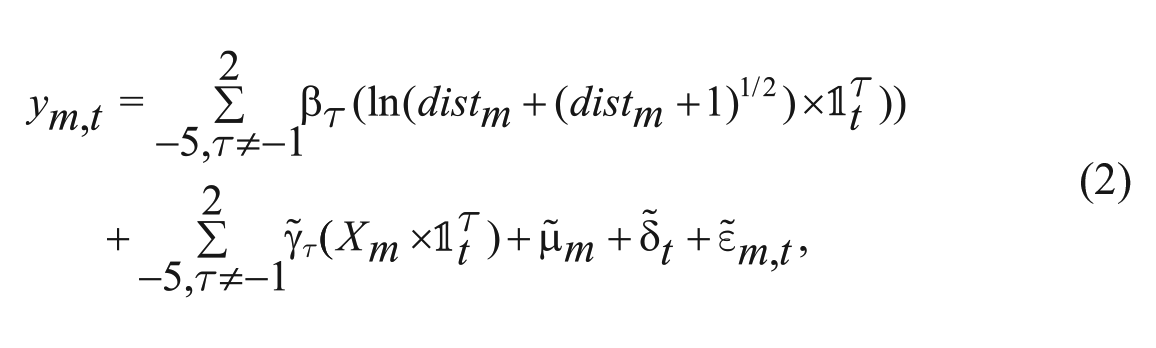
distm is the minimum distance from either the Chiyoda or Chuo ward to a ward m. The distance variable takes 0 for the Chiyoda and Chuo wards and takes a higher value for wards located farther away from those wards. I expect the treatment effects are the strongest for the Chiyoda and Chuo wards, and they diminish as wards are located farther away. To capture nonlinearity, I use the inverse hyperbolic sine transformation (ln(distm + (distm + 1)1/2)). I then include the interaction term of the distance variable with time indicators with 1994 as the reference period.
Note that if the sarin attack decreased the outcome, β is positive. By contrast, if it increased it, β is negative. To see this, consider the case in which the attack decreased the outcome. In this case, the Chiyoda and Chuo wards would experience a greater decrease (more negative) in the outcome than wards farther away (less negative) from the Chiyoda or Chuo ward. Because the distance variable takes a higher value for wards located farther away from the Chiyoda or Chuo ward, the positive coefficients then imply a decrease in the outcome. By contrast, if the attack increased the outcome, then the Chiyoda and Chuo wards would experience a greater increase (more positive) in the outcome than wards farther away (less positive) from the Chiyoda and Chuo wards. The negative coefficients thus imply an increase in the outcome.
Xm×
Researchers often include unit-specific time trends, hoping to control for preexisting differential trends in the outcome prior to the treatment. However, the inclusion of unit-specific time trends even controls for heterogeneous trends in the outcome in the posttreatment period, inducing posttreatment bias. Instead of including ward-specific time trends, I apply a two-step procedure (Goodman-Bacon 2021). First, using only the pretreatment period (1990–1994), I first fit linear time trends across wards, then subtract them from the outcome on the whole panel period. Second, I estimate the equations 1 and 2 on the transformed outcome. Because this strategy detrends the outcome only using the pretreatment period, it does not suffer from posttreatment bias that may suppress heterogeneous outcome trends in the posttreatment period.
I provide the following remarks. First, I assume that the treatment variables capture direct as well as indirect exposure to the sarin attack. Direct exposure is exposure in which people were on one of the subways during the attack or they were the direct victims of the attack, while indirect exposure is exposure in which people who lived nearby saw or heard the attack. The idea behind indirect exposure is that the degree of a threatening experience should be amplified among residents who live nearby (e.g., Cohan and Cole 2002). Both the binary and distance treatment variables capture such geographic proximity.
Second, I note that the stable unit treatment value assumption (SUTVA), which requires no interferences across units, might be violated. In the case of direct exposure, some people might have been on one of the affected subway lines during the attack, but they may not have lived in wards served by the affected subway lines. Because I use the place of residence to measure the outcome variables, those who were directly exposed to the attack and did not live in the affected wards are not included in the treatment group. This can be a violation of SUTVA. Here, I discuss the potential direction of bias due to such a violation. The present estimates likely serve as a lower bound. To see this, consider those who used one of the affected subway lines and resided in one of the unaffected wards; they were directly exposed to the attack and changed their behavior in one of the unaffected wards. As the DiD design compares the trends in the outcome between wards served by the affected subway lines and wards served not served by them before and after the attack, differences in the outcome between the two groups would be larger, had not been for such interferences.
Heterogeneous Effects by Social Welfare Expenditures
Last, I estimate the following DiD with heterogeneous effects by social welfare expenditures:


Recall that to avoid potential posttreatment bias, welfarem is the average social welfare expenditure between 1990 and 1994, and welfarem ×
Results
Event-Study Analysis
Figure 2 provides point estimates and 95 percent confidence intervals. In the figure, the x-axis indicates years relative to the sarin attack, and the y-axis indicates the estimates. The confidence intervals in the solid line indicate standard errors clustered at the ward level, and those in the dashed line indicate standard errors clustered at the ward and year levels. The top panels represent the results from specification 1, and the bottom panels represent the results from specification 2. Both figures indicate consistent results and show that the sarin attack decreased both marriage and divorce rates. Recall that if the sarin attack decreased divorce and marriage rates, then α < 0 and β > 0 in the postattack period, and α = 0 and β = 0 in the preattack period.

Event-study estimates of the Tokyo subway sarin attack on marriage and divorce rates with 95 percent confidence intervals.
The results with the binary treatment variable, as shown in the top panels, indicate that coefficients on lead treatment indicators are not distinguishable from zero. Thus, in the years leading to the sarin attack, there were negligible differences in the trends in both marriage and divorce rates between wards with and without the affected subway lines. Coefficients on lag treatment indicators are large and statistically significant for marriage and divorce. Thus, in the years following the sarin attack, wards with the affected subway lines experienced a greater decline in marriage and divorce relative to wards without them. For marriage, the average of estimates in the postattack period is −0.949, indicating a decrease in the number of marriage cases 0.949 per 1,000 residents. Given the baseline mean of marriage rates in the preattack period is 6.957, the estimates imply a 13 percent decrease in marriage rates. For divorce, the average of estimates in the postattack period is −0.239, indicating that the sarin attack decreases divorce rates by 13 percent relative to the baseline mean of divorce rates in the preattack period (1.751). To be clear, divorce rates were on the rise during this period; thus the negative effects imply that increasing rates of divorce were slower in wards with the affected subway lines relative to wards without them in the postattack period.
Turning to the results with the distance treatment variable, the bottom figures indicate that coefficients on lead treatment indicators are not distinguishable from zero. Thus, in the years leading to the sarin attack, there were negligible differences in the trends in both marriage and divorce across wards with varying distances from the Chiyoda or Chuo ward. In the years following the attack, wards closer to the Chiyoda or Chuo ward experienced a greater decline in marriage and divorce, relative to wards farther away from the Chiyoda or Chuo ward. One percent closer to the Chiyo or Chuo ward, marriage on average decreases by 0.037 percent, and divorce on average decreases by 0.06 percent in the postattack period. It is important to note, however, that while there are clear upward trends in the postattack period for marriage, coefficients on lag treatment indicators are not statistically significant at the conventional levels. 3
Permutation Inference
To ensure that the effects of the sarin attack are not due to chance, I run a permutation test. In this exercise, I randomly assign the treatment status across wards and years, which I refer to as placebo treatments. The intuition behind this exercise is that if the estimated effects of the sarin attack are not artifacts, then the estimates derived from the placebo treatments should not have significant effects. For this test, I redraw placebo treatments randomly and reestimate placebo treatment effects. I iterate this process 1,000 times. Figure 3 shows the resulting distribution of the estimated placebo coefficients. In the figure, the dashed red line indicates the lower 5 percent of the distribution of placebo coefficients; the solid purple line represents the DiD estimate of the sarin attack. 4 If the effects of the sarin attack are not artifacts, then the estimated coefficients (from equation 5) indicated by the solid purple line should be at left tail of the distribution of placebo coefficients indicated by the dashed red line. This is exactly what Figure 3 shows.

Permutation inference for marriage and divorce rates.
Change in Population Compositions
One potential concern for the observed results is that the family consequences of the sarin attack may be due to a change in population compositions. For instance, it could be that the sarin attack induced people to move out of the affected wards, or it discouraged them to move into those wards. Additionally, potential migration induced by the sarin attack can violate SUTVA. To probe into this possibility, I examine the effects of the sarin attack on out- and in-migration. Figure 4 shows the results, indicating little change in out- or in-migration in response to the sarin attack. For out-migration, the results with the binary as well as distance treatment variables indicate null effects in the posttreatment periods. For in-migration, the result with the binary treatment variable indicates that in-migration patterns in the postattack period are quite stable. The result with the distance treatment variable indicates, however, that the coefficient on the two-year lag treatment variable is negative and statistically significant, while the coefficients on the contemporaneous and one-year lag treatment variables are precisely null. Overall, these results provide little evidence that observed effects on marriage and divorce are driven by a change in population compositions.

Event-study estimates of the Tokyo subway sarin attack on out- and in-migration rates with 95 percent confidence intervals.
Heterogeneous Effects by Social Welfare Expenditures
Thus far, the results indicate that the sarin attack decreased both divorce and marriage, which are not driven by a change in population compositions. Overall, the results are consistent with the perspective that people adhered to their status quo in response to great perceived uncertainty induced by the sarin attack. To better understand the conditions under which people adhered to their status quo in the face of perceived uncertainty, this section examines heterogeneous effects by social welfare expenditures, which can lower the cost of decision making related to the family domain.
Figure 5 illustrates the heterogeneous effects of the sarin attack according to social welfare expenditures in two ways. First, the solid line and dashed band indicate the marginal effect of the sarin attack with 95 percent confidence intervals when using social welfare expenditures as a continuous variable. Second, the three dots with the solid lines indicate the binned estimates as in Hainmueller, Mummolo, and Yiqing Xu (2019); the marginal effect of the sarin attack evaluated at the low, medium, and high social welfare expenditures, respectively. The bottom of the x-axis indicates the distribution of social welfare expenditures across wards.
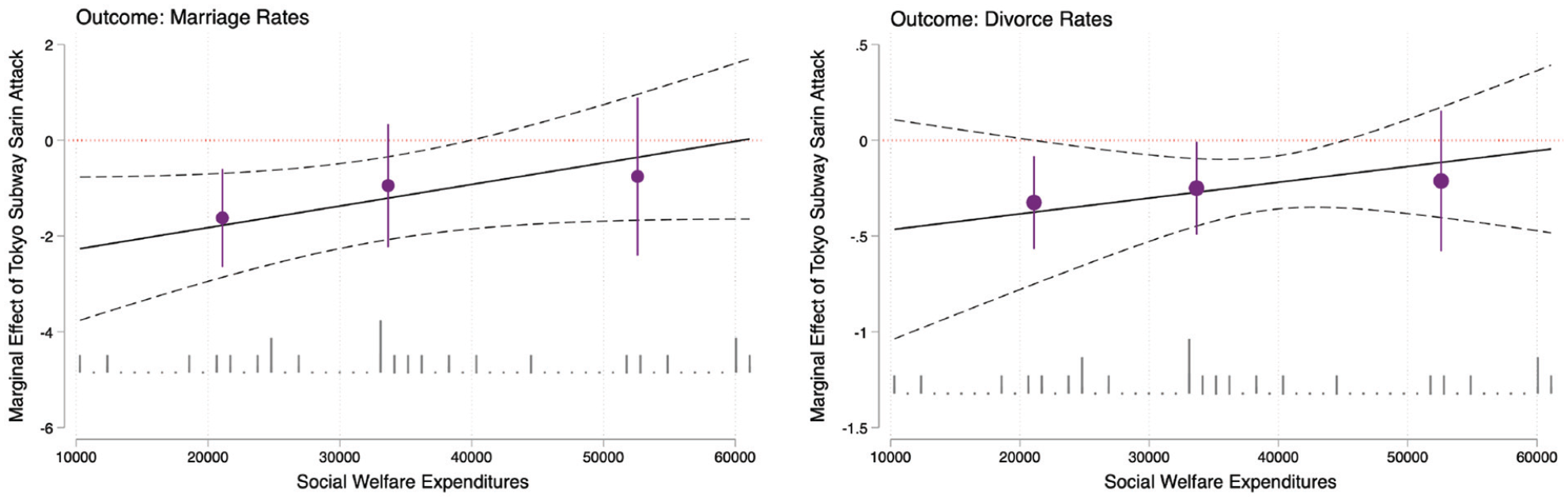
Heterogeneous effects by social welfare expenditures.
The left and right panels of Figure 5 represent the results for marriage and divorce, respectively. Decreasing rates of divorce and marriage are weaker in wards with higher expenditures on social welfare. This result is consistent with the idea that the effects of the sarin attack on marriage and divorce are weaker in wards where people perceived uncertainty as less pervasive.
Robustness Checks and Other Results
This section briefly discusses robustness checks and other empirical results presented in the Appendices:
Appendix C attempts to alleviate the potential concern that the effects of the sarin attack may reflect fear generated by the great Hanshin earthquake.
Appendix D estimates the DiD specification, in which I exclude each treated ward one at a time. The analysis allows me to examine whether the effects of the sarin attack are driven by a particular treated ward.
Appendix E examines the robustness of the main results to alternative (1) inference methods, (2) estimators, (3) outcome measures, and (4) sample periods.
Appendix F tests an alternative way to understand the uncertainty channel by examining income levels.
Appendix G tests an alternative channel by examining school absence among elementary and junior high school students.
Discussion and Conclusion
In this study I examine whether and how terrorism affects family consequences by focusing on the Tokyo subway sarin attack of 1995. The findings are threefold. First, the sarin attack reduced both marriage and divorce rates. Second, these effects do not seem to be driven by out- or in-migration. Third, the negative effects of the sarin attack on marriage and divorce are weaker in wards with higher social welfare expenditures. Taken together, the findings are consistent with the perspective that the sarin attack induced perceived uncertainty, where people adhered to their status quo, especially for those living in wards with fewer resources.
The availability of social welfare is generally thought to increase welfare outcomes for citizens, but the results indeed suggest contrasting policy implications for marriage and divorce in the presence of heightened uncertainty. That is, on one hand, the sarin attack decreased marriage rates, and decreasing rates were weaker for wards with high availability of social welfare. This suggests that to mitigate adverse effects on marriage, policies that can enhance social welfare appear to be effective policy in the presence of heightened uncertainty. On the other hand, the sarin attack decreased divorce rates, and decreasing rates were also weaker for wards with high availability of social welfare. This suggests that to stabilize families on the margins of getting divorced, a different type of policy may be necessary. More generally, given a reduction in both marriage and divorce, the findings suggest that different types of family interventions in the postterrorism period are necessary.
Why are the effects persistent in the two years following the attack? One possibility is that in the postattack period, an emergency response system headed by the prime minister’s office and a series of policies related to security and public safety were established. In addition, trashcans in train stations were removed, and the use of coin lockers was banned at train stations. These postattack responses may have amplified residents’ perceived uncertainty and insecurity in their environment in the long run.
However, there could be other channels at play, which could explain the persistent effects. First, research shows that individuals’ risk preferences change in response to disruptive events, although a consensus about the direction of change has not been reached (e.g., Brown et al. 2019; Hanaoka, Shigeoka, and Watanabe 2018). To the extent that the decision to get married or divorced depends on individuals’ risk preferences (Light and Ahn 2010; Schmidt 2008), it is possible that the observed effects in this study are due to a change in individuals’ risk preferences. If a change in risk preferences is persistent, this could explain the persistent effects of the sarin attack. Second, the sarin attack may have led to a change in time use, which in turn shaped the patterns of marital formation and dissolution over time. For example, research indicates that crime disrupts commuting patterns (Graif, Lungeanu, and Yetter 2017). In the present context, in the wake of the sarin attack, people may have refrained from going out or avoided subways, which may have reduced interaction for couples, especially when they lived far away from one another. This may have reduced the likelihood of marital formation. Additionally, research suggests school absence increases in response to crime (Burdick-Will, Stein, and Grigg 2019). Thus, the sarin attack may have affected children’s school attendance, which in turn may have shaped parents’ time spent with children within the household. Given that parents’ time allocation affects family dynamics, the sarin attack may have affected marital dissolution. If time-use patterns become a new routine and are persistent, then these changes may explain the persistent effects. Future research is necessary to better understand how terrorism shapes marital dissolution and formation through a change in individual-level risk preferences or a change in time use, and whether these channels could explain the persistent effects.
With that said, the present study broadens our understanding of family-related decision making under perceived uncertainty and insecurity generated by terrorism, by highlighting the unintended roles of terrorism in shaping marital formation and dissolution.
Footnotes
Appendix A: List of Wards with Affected Subway Lines
Table A1 provides a list of wards with affected subway lines. Of 23 special wards, 13 wards are considered affected by the sarin attack.
Appendix B: Covariate Balance in the Preattack Period
Figure B1 provides a test of covariate balance in the preattack period. I regress the treatment indicator (which equals 1 for wards with the affected subway lines) on covariates (average between 1990 and 1994). All the continuous variables are standardized to mean = 0 and standard deviation = 1. The results indicate that the coefficients on social welfare expenditures, the log of income, and proportions aged 15 to 64 years are not significant, but the coefficient on the log of income is large in magnitude. The coefficient on the log of population is negative, large in magnitude, and statistically significant; the coefficient on sex ratio is negative and statistically significant, but small in magnitude; and the coefficient on unemployment rates is positive and marginally significant, but small in magnitude.
Appendix C: Confounding Effects from the Great Hanshin Earthquake
One of the obstacles to identifying the effects of the sarin attack is that Japan experienced another tragic event in 1995, the great Hanshin earthquake in Hyogo prefecture. Although the Tokyo metropolis (the east side of Japan) and Hyogo (the west wide of Japan) prefecture are geographically far away from each other, both incidents were well reported via media, so that it may be less clear whether estimated effects reflect fear generated by the sarin attack or by the great Hanshin earthquake. However, I believe that this is not a concern for the present estimates, because there is no strong rationale to believe that the effects of the sarin attack are different between wards with and without the affected subway lines or across wards with varying distances from the Chuo or Chiyoda ward.
With that said, to alleviate the potential concern, I exploit an additional variation: the number of wooden houses. A large number of victims during the great Hanshin earthquake were concentrated among areas with high concentrations of wooden houses. If observed effects are driven by fear and uncertainties generated the great Hanshin earthquake resulted in marital formation and dissolution within the Tokyo metropolis, the effects should be pronounced in wards with high proportions of wooden houses.
To test this, I create a binary variable that equals 1 if the proportions of wooded houses is above the median of the variable and 0 otherwise. Then, I include the interaction term of the wooden houses indicator and treatment indicator. Table C1 provides the estimation results. The coefficients on the interaction term are not statistically significant for both marriage and divorce, indicating that differences in the effects of the sarin attack across wards are negligible across wards with high and low concentrations of wooden houses. This indirectly eliminates the potential confounding effects from the great Hanshin earthquake.
Appendix D: Excluding Each of the Wards with Affected Subway Lines One at a Time
I estimate the DiD specification, where I exclude each treated ward one at a time. The analysis allows me to examine whether the effects of the sarin attack are driven by a particular treated ward. Figure D1 provides the point estimates and 95 percent confidence intervals. In the figure, the y-axis indicates an excluded treated ward and the x-axis indicates the estimate. The results show that the effects of the sarin attack are quite stable when each treated ward is excluded one at a time, indicating that the results are not driven by a particular ward.
Appendix E: Robustness Check
Table E1 provides robustness checks, where column 1 serves as the baseline estimates.
Appendix F: An Alternative Way to Understand the Uncertainty Channel
For the main analysis, I examine the heterogeneous effects of the sarin attack by social welfare expenditures, and I interpret that the results are consistent with the uncertainty channel. This section examines an alternative way to understand the uncertainty channel by examining income levels. Economic resources may increase individuals’ willingness to take risks because they can buffer potential negative consequences, and thus those with more resources may have a weaker tendency to stick to their status quo. One immediate implication of this argument is that the negative effects of the sarin attack on marriage and divorce rate are weaker in areas with higher income levels. The results in Figure F1 are consistent with this interpretation, although the results appear to be slightly noisy.
I note one important difference in their interpretations between heterogeneous effects by social welfare expenditures and income levels. In the case of social welfare expenditures, I assume that, conditional on income levels, individuals’ willingness to take risks are homogeneous; but their ability to take risks varies by regional differences in social welfare expenditures. In the case of income levels, I assume that individuals’ willingness to take risks are heterogeneous; but their ability to take risks is the same (conditional on social welfare expenditures).
Appendix G: Alternative Channel: School Absence
In the discussion and conclusion section, as an alternative channel, I discuss that the sarin attack may have changed marital formation and dissolution through a change in time use such as commuting patterns and parents’ time allocation to children. Here, I test the latter channel by examining long school absence among elementary and junior high school students. Long absence is defined as absence from school for more than 30 consecutive days. Figure G1 provides the result, indicating that there is little change in school absence in the years following the sarin attack. However, there may be other ways that the sarin attack could have changed time use; hence, this result is only tentative and suggestive.
Acknowledgements
I thank Tetsuya Hoshino, Hiro Ishise Tetsuya Matsubayashi, Takeshi Murooka, Hidenori Takahashi, Fumiya Uchikoshi, and seminar and conference participants at the Happy Hour Seminar!, the Annual Conference of the International Network of Analytical Sociologists, Keio University, Kwansei Gakuin University, Osaka University, and the Research on East Asian Demography and Inequality (student and postdoc seminar), and the editors and two anonymous referees for their comments and suggestions. All errors are my own.
Correction (January 2023):
Article updated to correct “. . . decreases by 3.7 percent, and divorce on average decreases by 6 percent. . .” to “. . .decreases by 0.037 percent, and divorce on average decreases by 0.06 percent. . . ” in the Results section.
Funding
The author(s) disclosed receipt of the following financial support for the research, authorship, and/or publication of this article: This work was supported by a Grant-in-Aid from the Japan Society for the Promotion of Science (21K13283).
