



Abstract
Previous work has suggested that the drastic Khmer-Rouge-era changes to the family institution have not endured. Potentially more influential in the long term were the rapid socio-economic changes Cambodia underwent starting in the 1990s. We use four waves of the Cambodian Demographic and Health Surveys from 2000 to 2014 to document contemporary trends in marriage formation and dissolution. We find little change in the centrality of marriage, as both cohabitation and sex between unmarried partners remain quite rare. Marriage also continues to be nearly universal and early for women, but we find that the transition to self-arranged “love” marriages occurred earlier and faster than previously documented. A sign that parental endorsement may still matter though, marriage dissolution continues to be associated with spousal characteristics deemed undesirable by past generations. While higher among recent marriage cohorts, especially in the first year after marriage, levels of marriage dissolution remain comparatively low overall.
Introduction
In Western societies, marriage has undergone profound changes since at least half a century ago and scholars are debating whether it is appropriate to talk about a “de-institutionalization” of marriage (Cherlin, 2020). In other parts of the world, scholars pay close attention to more recent family changes and debate whether these could be the early signs of an equally profound transformation (e.g., Raymo, Park, Xie, & Yeung, 2015; Yeung, Desai, & Jones, 2018).
To date, little evidence of family change has been presented in Cambodia. Perceived as an institution of social reproduction, the family was targeted for radical transformation, if not complete abolition during the 3 years, 8 months, and 20 days of Democratic Kampuchea (1975–79). This entailed encouraging young adults to stop deferring to their parents in spousal choice and even the rounding up of eligible bachelors for mass marriages performed on the spot by some local government cadres, known as the “Khmers Rouges” (KR) (Anderson, 2010; LeVine, 2010).
Despite this, the KR efforts to radically transform marriage and the family did not seem to have any durable effect on marriage patterns and on the centrality of marriage. Heuveline and Poch (2006) report that in the following two decades, a majority of post-KR marriages were again arranged, by the family of the bride or, albeit less frequently, by the family of the groom. Moreover, in spite of the severe gender imbalance induced by mortality differentials during the KR years, Heuveline and Poch (2007) show that the vast majority of each female cohort eventually get married.
The only tangible sign of change in the institution of marriage concerns marital stability. Heuveline and Poch (2006) do document a slow increase in the risk of marital disruption before the end of the 20th century. Comparing the risk across marriage cohorts, they find that the increase has little to do with any aftermath of the KR experience and argue that it is more likely linked to the fast pace of the socio-economic changes that followed the signing of the 1991 Paris Agreement and the 1992–93 United Nations Transitional Authority in Cambodia (UNTAC). These changes include a rapid growth of wage labor opportunities for young, unmarried women in the factories that quickly sprung up at the outskirts of the capital city, Phnom Penh.
These opportunities may also contribute to the emergence of premarital cohabitation, which has been observed in other Southeast Asian capitals such as in Bangkok (Esara, 2012) or Manila (Xenos & Kabamalan, 2007), and might in turn result in premarital conceptions and births. Evidence of such trends is hard to detect from nationally representative surveys, but this may be due to data limitations. As reported by Heuveline and Hong (2017), interviewers collecting fertility histories in the late 1990s were inclined to skip never-married women rather than to ask questions they deemed inappropriate for these women. With considerable effort to build interviewer-interviewee rapport and mitigate response biases, Nishigaya (2010) reports that 55% of the interviewed unmarried female migrants aged 15–24 working in Phnom Penh’s garment factories had engaged in premarital sexual intercourse.
In this paper, we document and assess the determinants of contemporary trends in unmarried cohabitation and extramarital sex, marriage patterns, and marital stability in Cambodia using four waves of the Cambodian Demographic and Health Surveys from the years 2000 (CDHS, 2000, National Institute of Public Health, National Institute of Statistics [Cambodia] and ORC Macro, 2006 thereafter), 2005 (National Institute of Public Health, National Institute of Statistics [Cambodia] and ORC Macro, 2006; CDHS 2005 thereafter), 2010 (National Institute of Statistics, Directorate General for Health, and ICF Macro, 2011; CDHS 2010 thereafter), and 2014 (National Institute of Statistics, Directorate General for Health and ICF International, 2015; CDHS 2014 thereafter). More specifically, we show that against this background of fast-paced socio-economic changes, marriage continues to be nearly universal and early for Cambodian women and that sexual activity and cohabitation continue to be rare outside marriage. Contrary to prior findings, however, we show that the prevalence of family-arranged marriages now appears to have started declining as early as in the 1980s, and that this transition accelerated markedly after 2000. In contrast, recent trends in marital stability are largely extending earlier trends towards lower marital stability relative to earlier cohorts, with proportions of marriages ending in divorce or separation remaining modest in absolute terms. Moreover, the same marital characteristics that have long been deemed undesirable by older generations seem to continue to predict marital instability.
Background
The Cambodian Context
Southeast Asia is a region of vast diversity, be it in terms of geography, history, ethnicity, religion, culture, economy, or demography (Heuveline & Hirschman, 2015; Reid, 1988a, 1993; Wolters, 1999). In 1863, the establishment of a French Protectorate brought Cambodia and its Northern and Eastern neighbors, Laos and Vietnam, into French Indochina. Unequivocally, French Indochina was administratively and culturally centered in Vietnam. Independent since 1953, the country’s fate was soon to become tied to Vietnam’s again. The Vietnam-American War contributed to the establishment of Democratic Kampuchea (often referred to as “the KR regime”) in April 1975. The regime collapsed in January 1979 in the hands of Vietnamese troops that remained in Cambodia for the next decade. In part because the country’s current head of State, Prime Minister Hun Sen, has been in this position since that period (January 1985), the degree to which Vietnam has continued to play a role in Cambodia in the following years and possibly to the present remains a hot-button issue in Cambodian politics (Hughes, 2001). Nevertheless, that similarities between the two countries’ political regime, administrative structures, and economic system have emerged and largely endured should not be a matter of controversy.
Before the French Protectorate, however, Cambodia might have had more in common with its Western neighbor, Thailand. Before the 1920 introduction of the French Code Civil to guide civil law, for instance, Cambodian social rules and practices were observed to match those written down in the 1805 Siamese Code (Lingat, 1952). Therevada Buddhism is by far the main religion in both countries. By contrast with Vietnam, some matrilineal features were observed in Cambodia. Their relevance has long bee debated by anthropologists though (Ledgerwood, 1995, 2012; Népote, 1992) and the Cambodian kinship system may be more appropriately characterized as bilateral than matrilineal. Matrilocal preferences were widely recognized, with newlyweds expected to reside with or near the brides’ parents at first until they were able to form a new independent household nearby (Ebihara, 1968). Multi-generational living was thus relatively rare, and the system might also be described as neo-local rather than matrilocal (Heuveline, 2016). A possible exception concerned one of the daughters (typically the youngest, referred to as Poev in Khmer) who might remain with her husband in the parental household to help her parents in old age. In any case, Cambodian couples were highly pragmatic and young couples routinely departed from normative living arrangements, such as when economic opportunities were available near the groom’s parents’ home (Demont & Heuveline, 2008). Another indication of this pragmatism is that nuclear households are less common in urban areas than in rural areas (Heuveline & Hong, 2016), as urban households are more frequently solicited to take in rural relatives who want to pursue education or work opportunities in the city.
Women in Southeast Asia enjoyed a high degree of autonomy overall (Reid, 1988b) and greater gender symmetry was expected in a bilateral kinship system (Hirschman & Teerawichitchainan, 2003). Lingat (1952) noted that Cambodian custom unambiguously placed a wife under the authority of her husband but pointed out the belief that matrilocality provided married daughters some protection from potential excesses of authoritarianism from their husbands. He added that wives were allowed to unilaterally seek a legal divorce with relative ease, whereas a husband could do so only if his wife had been unfaithful. His alternative was to simply leave, forfeiting his rights to the family assets acquired since marriage, which in the case of legal divorce would have been divided equally between the spouses.
Divorced women, however, were much less likely to remarry than divorced men. Stark differences between the male and the female proportions divorced or widowed were clearly visible in the 1962 census data (e.g., in the age group 50–54, 7.4% for males and 27.5% for females, Table 19, Migozzi, 1973, p. 245). While there is no doubt that social norms were strongly gendered, May Ebihara (1968) noted a “happy balance” between men and women in Cambodia. This may no longer apply, however (Frieson, 2011; Lilja, 2013, p. 29), the most worrisome sign of which would arguably be the high prevalence of domestic violence against women (Eng, Li, Muslow, & Fischer, 2010; Yount & Carrera, 2006). Finally, child-raising norms continued to be strongly gendered. Similar to what was documented in Thailand (VanLandingham, Suprasert, Sittritrai, Vaddhanaphuti, & Grandjean, 1993), in particular, there were clearly double standards concerning boys’ and girls’ premarital sexual behavior. In spite of starkly differential treatment and expectations, parents seemed to exhibit no preference for sons.
Marriage and the Family
Marriage was described as nearly universal for men and women in Cambodia, early for women, and frequently arranged by the respective parents. Rather than marrying off a daughter against her will, parents were encouraged to seek her consent (Lingat, 1952). However, a fairly long spousal selection process and a preference for young wives (under age 25) implied that a daughter could not veto her parents’ choices too many times. A Khmer proverb reminded daughters that “you should be married before you are called an old maid” (Heuveline & Poch, 2006). Indeed, the 1962 census showed that only 2% of women aged 50 years and over were never married and that women’s mean age at marriage was 21.3 years (Migozzi, 1973, p. 145).
According to Népote’s (1992), the bride typically came from a slightly higher social background than the groom. Possibly for this reason, the groom or his parents would initiate contact with a potential bride’s family, and a matchmaker would often be involved in identifying potential grooms meeting the status requirements. For marital harmony, the slight social imbalance would be compensated by the groom’s personal qualities, such as his assiduity at work and abstinence from undesirable behavior. He was also expected to be older than his bride, but within the same age group up to roughly 7 years older (Népote, 1992, p. 135), and indeed the observed age differences between spouses in the 1962 census averaged 3 years (Migozzi, 1973). Marrying an older bride was not favored but tolerated. The engagement was sealed by the public acceptance of gifts from the potential groom to his future parents-in-law, but the elaborate wedding ceremony usually took place much later (Pich, 1984). The potential groom’s qualities were traditionally put to the test during this period of up to a year between the engagement and the wedding ceremony, during which he was expected to work for his in-laws (twee bomrae, in Khmer), a form of in-kind bride-wealth payment. In some cases, the future groom lived with his future bride and her parents during that time, a de facto form of premarital cohabitation. After the public acceptance of the engagement gifts, however, a cohabiting couple would already be considered as married by their families and neighbors.
Marriage and the family came under “systematic assaults” during the KR regime (Kiernan, 1996). Kinship and marriage ties were seen as instrumental to the social reproduction that the regime sought to eliminate, but also competed directly with the blind obedience the regime demanded. Family members were often separated as a result of being assigned to different work teams formed on the basis of age and gender. In fundamental contrast with the moral, religious and cultural foundations of Cambodian society, young adults were taught that they owed everything to the regime rather than to their parents (Ebihara, 1993). They were also encouraged to choose one another independently of their parents and only seek the authorization of their village leaders (LeVine, 2010). The number of such “spontaneous” marriages might have been less than anticipated, and the regime assumed even greater control of the matter by organizing marriages en masse. Village leaders then took over traditional parental responsibilities by pairing unmarried men and women in a collective, quick administrative procedure (Ngor, 1987; Ponchaud, 1998). In many respects, the impact on perceived family duties was at most temporary. As many survivors’ accounts demonstrate (e.g., Pran & DePaul, 1999), individuals kept on taking considerable risks to care for immediate family members and as soon as the regime fell, on 7 January 1979, the survivors took to the roads to search and reunite with kin. Heuveline and Poch (2006) also noted a quick return to parent-arranged marriages and, perhaps surprisingly, found that the KR period marriage cohorts did not experience higher divorce rates than adjacent marriage cohorts. The median age at first marriage also remained stable for first two post-KR decades, at around 20 years of age (CDHS, 2005).
Several deviations from traditional marriage patterns were noted, however. In the late 1990s, marriage arrangements appeared to be more frequently initiated by the bride’s family (Heuveline & Poch, 2006). This might be linked to a deficit of young males, induced by the excessive male mortality during the KR regime (Heuveline, 2015), that led daughters’ parents to be more assertive in the subsequent years than in the past. Heuveline and Poch (2006) also report deviations from the age difference norm of the early 1980s marriage cohorts, which they interpret as responses to the gender imbalance in the “marriage market” at the time, as a strong adherence to the normative age difference would have forced a substantial proportion of women to permanent celibacy (as observed in other contexts, e.g., Lichter, McLaughlin, Kephart & Landry, 1992). Finally, a prenuptial period of twee bomrae was no longer expected. As noted in India as well (Fuller & Narasimhan 2008), with the development of formal education, the level of education has become a crucial marriage criterion, providing a more salient measure of a future husband’s quality. Contrary to changes already underway at the time in India (Lin, Desai & Chen 2020), however, a suitable groom was still expected to be more educated than his future wife.
Contemporary Socio-Economic Changes
While the KR regime seems to have had only a limited impact on the Cambodian family, the different socio-economic environment of Cambodian youths today and in the first post-KR decade might be expected to affect family formation. First, both boys and girls are now expected to receive 9 years of basic education from first-grade enrollment age of 6 years–15 years of age (Ayres, 2000). In theory, these 9 years would allow children to complete lower secondary school, but late enrollment and grade repetition are both common (Heuveline & Hong, 2017). With many children falling short of that target, gender gaps in education have been narrowing. In 2014, 75% of women and 84% of men between ages 15 and 49 were literate, and the proportion of women who had attended any secondary school had increased to 40%, from 17% in 2000 (CDHS 2000) and 35% in 2010 (CDHS 2010), compared to 52% for men (CDHS 2014). There is a strong age gradient in the gender gap, large among older women but disappearing among younger ones. Current school enrollment among 6–14 year-olds has reached 88.5% for girls and 86.9% for boys in 2014, up from 84.5% and 83.9%, respectively in 2009 (National Institute of Statistics, 2015).
Economic change has been at least as swift. A transition to market economy was initiated after the 1986 Doi Moi in Vietnam, but the United Nations did not recognize the Cambodian government with Vietnamese troops still present and the country continued to be largely isolated from the United States and West European Nations. The December 1990 Agreement on a Comprehensive Political Settlement of the Cambodia Conflict (known as the Paris Agreement) ended the diplomatic impasse and initiated the gradual integration of the Cambodian market into the global economy. The 1994 Investment Law and Labor Code facilitated foreign investments. With labor costs rising in other countries in the region, Cambodia’s manufacturing sector took off, providing new wage labor opportunities for young, unmarried women, in particular in the garment industry (Chea & Sok, 2001; Ear, 2011).
As of 2010, 85% of women aged 15–49 had been fully or partially employed in the previous 12 months (CDHS 2010). A large proportion of Cambodian women being employed hardly represented a new phenomenon. This proportion remained relatively stable: in 2000, 73% of women aged 15–49 were fully employed with an additional 9% with some employment in the previous 12 months (CDHS 2000). During this time, garment factories were recruiting almost exclusively never-married women, providing an opportunity for some savings before marriage and generating a migratory flow of young “factory girls” to the outskirts of the capital city (Derks, 2008). Over time, however, with wages substantially higher than that from farming, women began to return to the factories after marriage. As a result, three quarters of employed women aged 15–49 were earning some cash and in-kind payments or only cash in 2010, compared to 57% of their counterparts 5 years earlier (CDHS 2005 and CDHS 2010). This largely reflects a declining proportion of women employed in agriculture, from which they were unlikely to receive any cash.
Data and Methods
Data
Our data are culled from four rounds of the Cambodian Demographic and Health Surveys (CDHS): 2000, 2005, 2010, and 2014. An independent, nationally representative sample of women of age 15–49 in all selected households was interviewed for each survey round. The CDHS samples are large (17,578 women in 2014) and typically enjoy a very high response rate (98% of women in 2014, CDHS 2014).
To study extramarital behavior, we use three sets of survey questions. The first one concerns extramarital sexual activity. The survey includes two items: whether a woman has been sexually active in the past 12 months and, if so, her relationship with her partner(s) in these past 12 months. The second set more specifically concerns premarital sex, and includes two survey items: whether a woman ever had sex before marriage and the age at which respondents became sexually active (relative to age at first marriage). The last set concerns unmarried cohabitation and includes a single question on living arrangements at the time of the survey. This item is only available from the 2005, 2010, and 2014 rounds, but the first two are available in all rounds.
To study marriage patterns, we consider four sets of survey questions. The first one concerns the universality of marriage and includes the same question about living arrangements at the time of the survey. From this survey item, we calculate the proportion of ever-married women who reported being married, widowed, and divorced or separated by age group and by survey. This assumes that women who reported their status as separated were previously married and not just living with their partner, an assumption we return to in the discussion section based on our results on non-marital cohabitation. The second set concerns the timing of marriage for men and women and uses the reported age at (first) marriage. The third set concerns the age difference between the spouses. For women married more than once, the survey only provides the age of their last husband. The last set concerns spousal selection. This set includes two questions to ever-married women: how long they had known their husband before their marriage and who had chosen their husband for them. For women who were married more than once, these questions refer to their current or most recent husband only. Unfortunately, these questions were only included in the 2000 and 2005 rounds. We analyze changes in spousal selection across marriage cohorts. Women married during the KR years (1975–78) are grouped together, as well as women married before the KR to avoid further dividing up this relatively small subsample. Post-KR marriage cohorts are grouped in 7-year cohorts: 1979–85, 1986–92, 1993–99, and 2000–06. (In the CDHS 2005, some women were actually interviewed in 2006).
Last, we consider the risk of marital disruption. As the observation of the risk for currently married women was censored at the time of the survey, marriage duration needs to be estimated. Unfortunately, this is more challenging than other analyses because the surveys do not include partnership histories. The date of a first marriage can be inferred from a woman’s reported age at (first) marriage, but for women married more than once, the start date of higher-order marriages cannot be determined. Moreover, for women who were widowed, divorced, or separated at the time of the survey, the date of marriage dissolution is not available. Following the strategy used by Heuveline and Poch (2006), we use the year of last sexual intercourse as a proxy. We assess the validity of that assumption in the discussion section based on our results on sexual activity.
These limitations force us to exclude women married more than once from our analytical sample for marital disruption. Using longitudinal data from the Mekong Island Population Laboratory (MIPopLab) (Inter-university Consortium for Political and Social Research, 2017), Heuveline and Poch (2006) show that, as is the case elsewhere, higher-order marriages are less stable than first marriages in Cambodia. As remarriages are relatively rare for women in Cambodia, the bias in estimates of marital stability induced by the restricting of analyses to women married only once is relatively small and, more importantly, the extent of the bias would have to vary across marriage cohorts to affect our comparisons. While this is encouraging, it would be useful to confirm this finding with more recent longitudinal data collected by MIPopLab’s successor, the Mekong Integrated Population-Registration Areas of Cambodia (MIPRAoC) (Heuveline, Clark, Eaton et al., 2017).
As for spousal selection, we are interested in changes across the marriage cohorts, grouped in the same manner with the addition of the 2007–2014 cohorts. Control variables include respondents’ characteristics (age at marriage, education, occupation, and dummy variables for premarital sex and regional location), husbands’ characteristics (education relative to his wife and occupation), and marriages’ characteristics (number and gender of children). We did not attempt any imputation for missing variables and women with missing variables were dropped from the analyses, bringing our final sample size to 42,935 women pooled across the four surveys.
Methods
We first estimate descriptive statistics of extramarital behavior, marriage patterns, and the proportions of marriages ending in divorce or separation, by marriage cohort and duration. We then use Cox hazards models to analyze how the risk of marital disruption is affected by the independent variables within 10 years of the date of marriage or by the time of the survey, whichever happens first. We account for time-varying characteristics by splitting the data and creating time-interacted dummies for the number and gender of children. Because interaction terms were significant for multiple children, they were retained in the model.
In a graphical post-estimation of the Cox models, we assessed the assumption of proportional odds by comparing predicted and observed values for the marital cohort model and for the divorce cohort model. We found no crossover in the marital cohort model, but some in the divorce cohort model. The assumption of proportional odds thus appears plausible for the marital cohort models, but perhaps more problematic for the divorce cohort models, which we thus do not present here.
Results
Extramarital Behavior
Across the four surveys (pooled data), 88.1% of women aged 15–49 reported being sexually active in the 12 months before the survey, a proportion-slightly increasing from the CDHS 2000 (85.5%) to the CDHS 2014 (89.9%) while the male proportion remained between 94.9 and 93.3% (CDHS 2005 to CDHS 2014; item unavailable in CDHS 2000). Among sexually active women, 99.3% reported their spouse as their only partner during that period (pooled data), whereas for males, the proportion remained lower and fairly stable between 91.9% and 94.0% (CDHS 2005 to CDHS 2014). The main change for men was the declining proportion of commercial partners, from 4.5% in 2005 (thus more than half of partners other than spouse) to .9% in 2014.
Descriptive Statistics, by Marriage Cohort, Women Aged 15–49, Married Only Once.
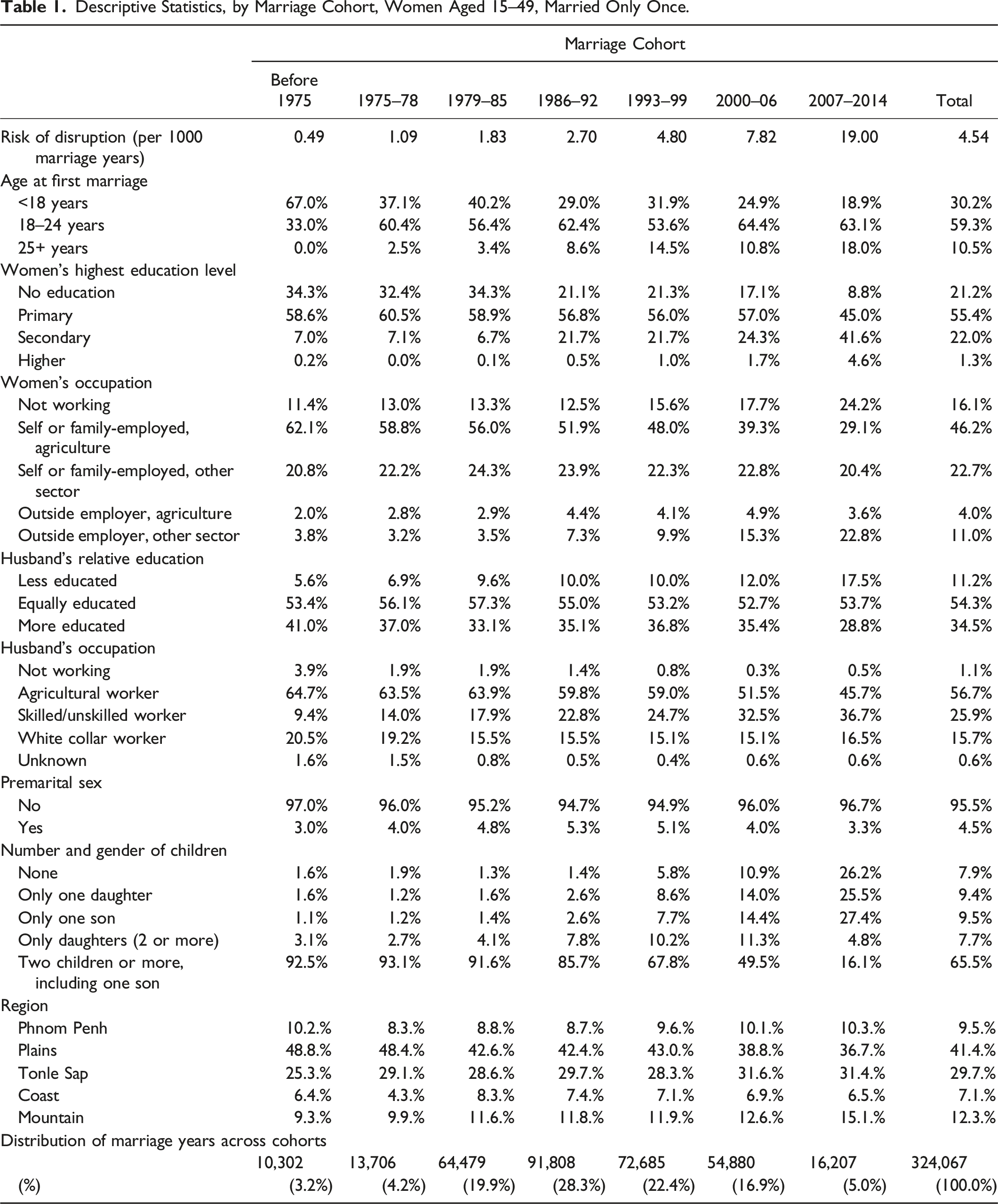
In 2005, only .4% of women aged 15–49 reported living together with an unmarried partner. As a ratio of all women living with a partner, only .5% did so without being married to that partner. The proportion hardly changed in the following decade, approaching .6% in 2010 and declining back to .5% in 2014.
Marriage Patterns
Marriage remained nearly universal for women. The never-married proportion among women aged 45–49 was still slightly below 5% in the CDHS 2014 as it had been in the CDHS 2000. The proportion did go up to 7.1% in the CDHS 2010. This corresponded to the 1960–1964 birth cohorts, who were in the modal ages for marriage in the early 1980s when the sex ratio in the “marriage market” was most severely distorted by gender differentials in mortality during the KR regime.
Marriage also continued to be relatively early for women. The median age increased slightly to 20.3 years in 2010 and 20.5 years in 2014. Marriage before 15 years of age became quite rare in the post-KR birth cohorts, but in 2014, one in four women were married by age 18—unchanged from 2010. The median age at marriage increased slightly more for men than for women, from 22.6 years in 2010 to 23.0 years in 2014.
In 2005, the median age difference between wives and their husbands was 2.9 years, with 30.0% of women aged 15–49 having a husband 5 or more years older than them. The age difference between spouses again illustrates the marriage market conditions in the post-KR years. Among women aged 40–49 in 2005, the majority of whom would have married in the early 1980s, 18.3% were 2 or more years older than their husband, compared to 6.7% among women aged 20–29 who married around the turn of the century. Based on the CDHS 2014, the age difference between spouses seemed to have stabilized for couples marrying more recently, with a mean difference of 3.0 years for the 1970–74, 1975–79, and 1980–84 birth cohorts.
Figure 1 displays spouse selection results from the 2000 and 2005 samples combined. In the pre-KR marriage cohorts, the dominant mode of spousal selection was a husband chosen by the bride’s family (55.4%) or a bride chosen by the husband’s family (18.4%), but in both cases with the bride’s consent. As many as 39.3% of the women in these marriage cohorts did not meet their husband until their wedding day, whereas 25.0% of them reported having known their future husband since childhood. Distribution of spousal selection mode, by first marriage cohort, ever-married women aged 15–49 at the time of the survey (in percent).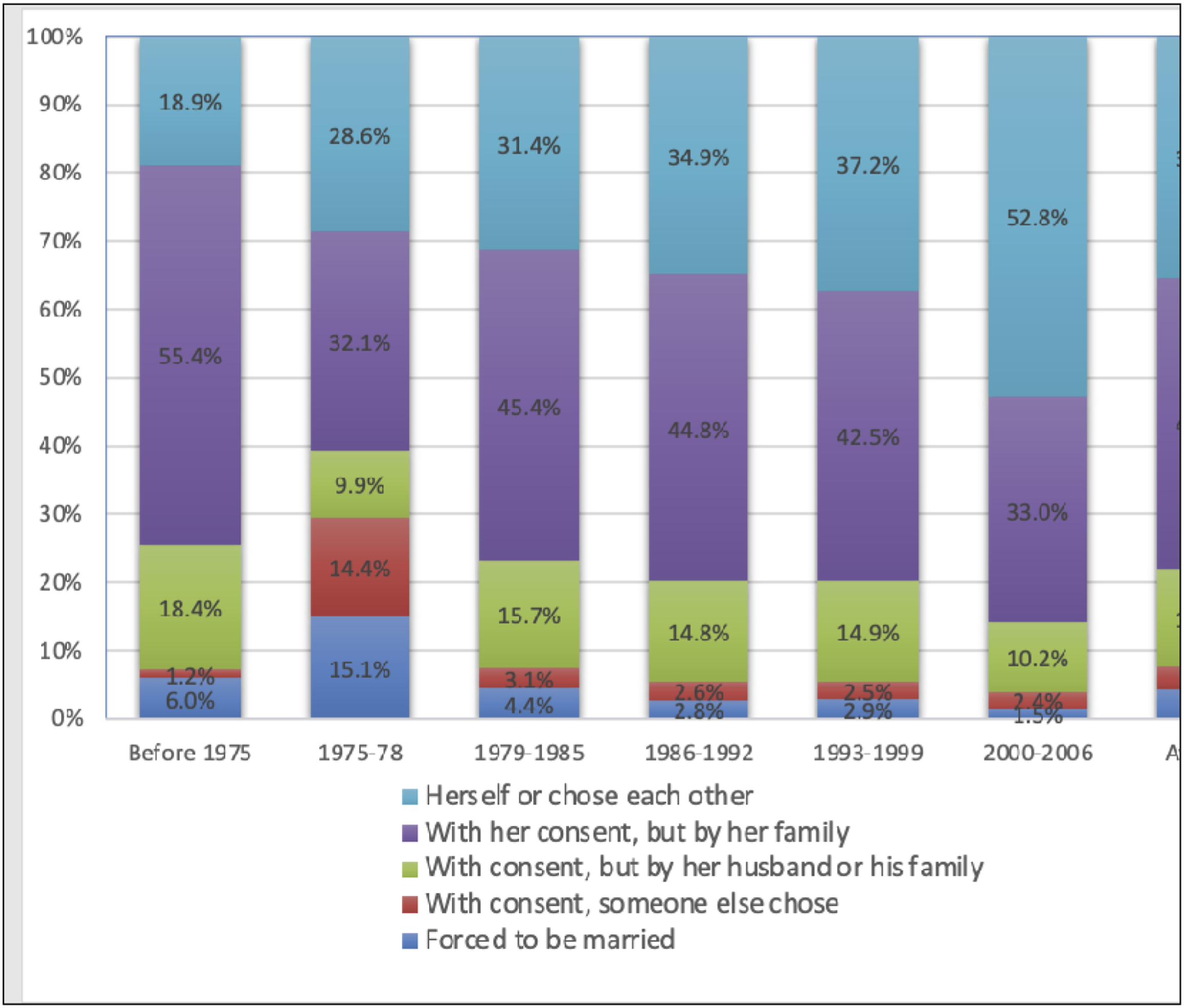
A radical departure from these patterns can be observed during the KR era. The proportion of family-arranged marriages declined, and the proportion of women reporting that they chose their husband themselves or that they and their husband had chosen each other increased to 28.6%. The starkest contrast with previous cohorts, however, concerned the 29.5% of women stating that they were forced to marry their husband or that they gave their consent but that their husband was not chosen by themselves, their family, or their husband’s family. The proportion of women who reported meeting their husband on the wedding day also reached a record high of 49% for these marriage cohorts.
After the KR years, forced marriages and those arranged by non-family members returned to pre-KR levels (7.5% in 1979–85 compared to 7.2% before 1975), but marriages in which the spouses had chosen each other did not. Instead, the proportion of these marriages continued to increase incrementally to 31.4% in the 1979–85 cohorts and 37.2% in the 1993–99 cohorts. As a result of these two opposite trends, marriages in which one party was chosen by the other party’s family with the bride’s consent represented the majority of marriages again in the two decades following the KR, but less so than before the KR, with proportions slowly slipping from 61.1% in 1979–85 to 57.4% in 1993–99.
This trend accelerated dramatically after 1999, and among the 2000–06 marriage cohorts a majority of women (52.8%) reported that they had chosen their husband themselves or that they and their husband had chosen each other. This was accompanied by abrupt changes in how long before marriage women had known their future husband. Whereas up to the 1993–99 cohorts, a majority of women still reported having met their husband only on the wedding day (26.2%) or having known him since childhood (25.4%), a majority of women in the 2000–06 marriage cohorts (55.9%) reported having known their husband for more than a month (but not since childhood).
Marital Stability
Figure 2 shows the proportion of marriages that ended in divorce or separation by duration across the different marriage cohorts. In spite of a starkly different distribution of spousal selection, the KR era marriage cohorts do not stand out with respect to marital stability. On the contrary, Figure 2 exhibits proportions of marriages ending in divorce or separation that at every duration increases incrementally from one set of marriage cohorts to the next. While the proportions are clearly trending upward, the level of marital disruption remains quite modest compared to other settings. While less stable than earlier marriage cohorts, nearly 95% of the 2000–06 marriage cohorts is still intact after 7 years. Proportion of marriages ending in divorce or separation, by duration and first marriage cohort, only-once married women aged 15–49 at the time of the survey.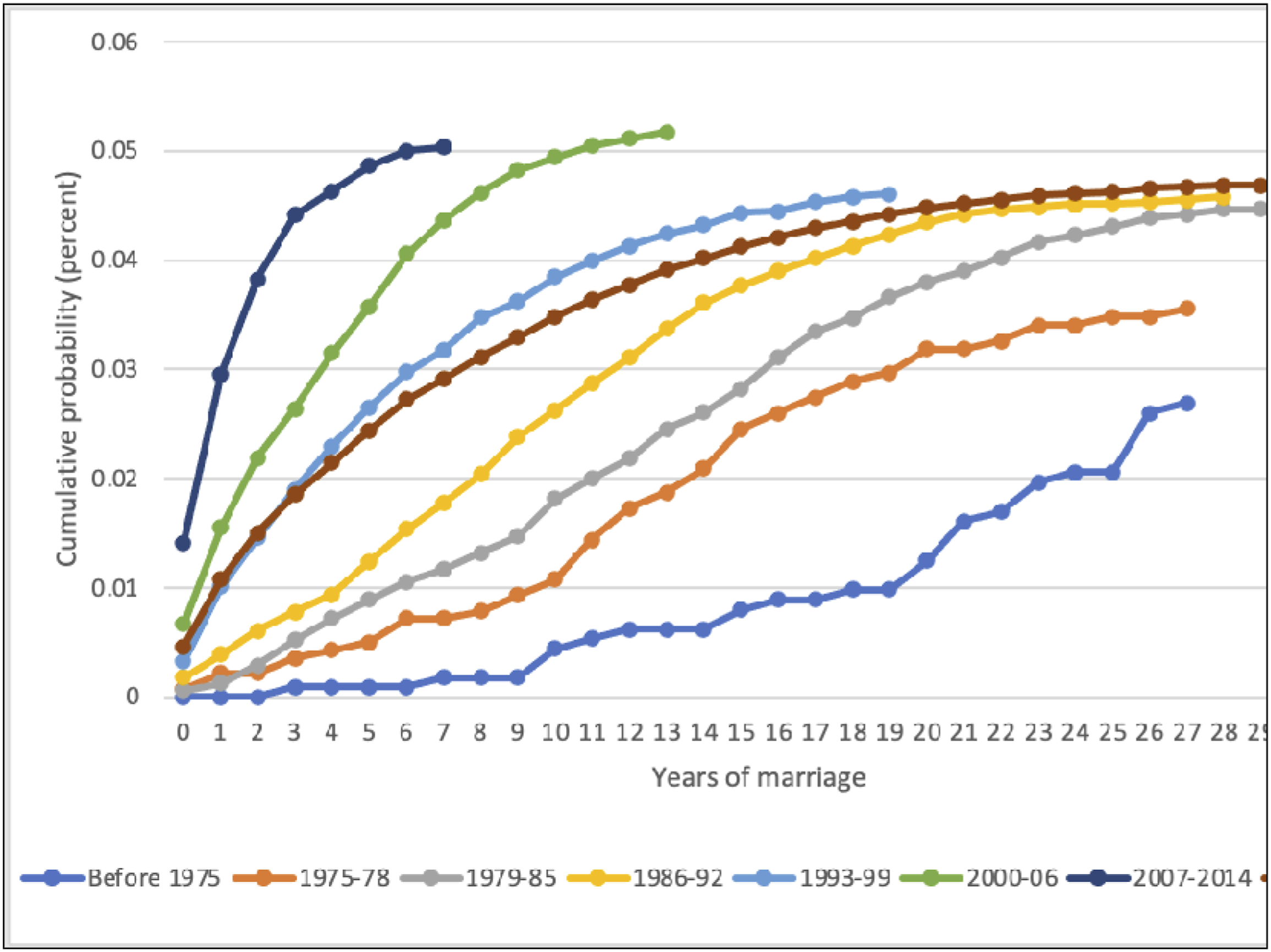
Before introducing results from the Cox hazards models, Table 1 shows the distribution of the models’ covariates in our pooled sample of only-once-married women. The proportion of women married by age 18 is 30%, higher than in any of the cross-sectional proportions noted above. This reflects the well-known age censoring issue in retrospective surveys (Rindfuss, Palmore, & Bumpass, 1982), which is most clearly visible in the earlier marriage cohorts. As the oldest women in our sample were 49 in 2000, the only women in the pre-1975 marriage cohorts are those who married before age 25. Otherwise, we observe increases in education and in non-familial, non-agricultural employment across marriage cohorts that mirror the temporal trends described in the background section.
Cox Hazards Models of Marriage Disruption, Women Aged 15–49, Married Only Once.
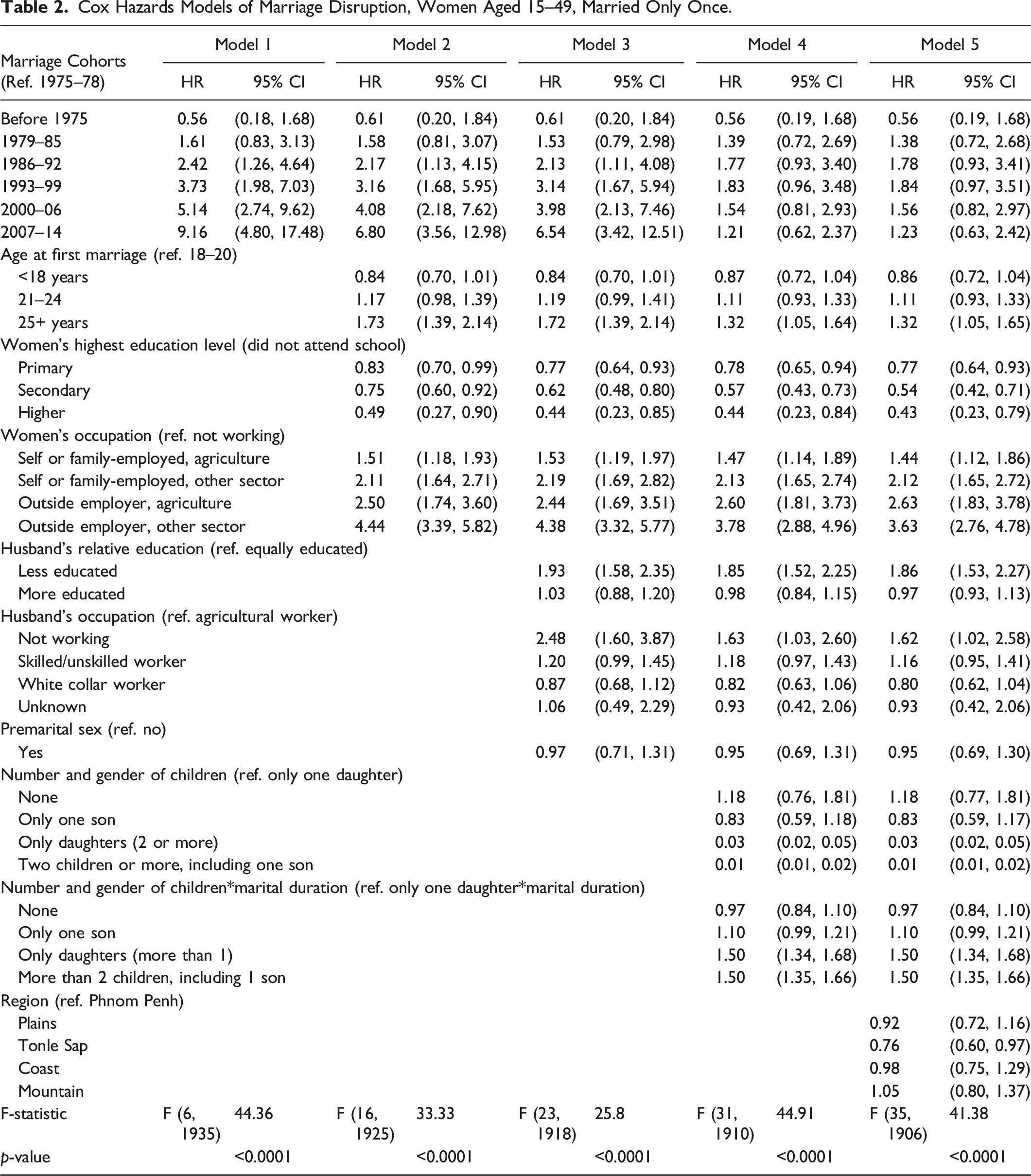
The addition of the selected husbands’ characteristics has little effect on the estimated hazards ratios for women’s characteristics (Model 3), but controlling for those, marriages in which the husband is less educated than his wife or not employed appear significantly less stable. With the addition of the number and gender of children, including interaction terms with marriage duration (Model 4), the marriage-cohort hazards ratios are no longer significant (at the 95% confidence level). Having two children or more, regardless of gender and especially early in the marriage, appears to be strongly protective against marital disruption. As seen in Table 1, however, there are very few women in the early cohorts with less than two children and this may cause the coefficients to be unstable. The estimated hazards ratios are not changed by the addition of regional dummy variables (Model 5), but the risk of dissolution appears significantly lower for the Tonle Sap region (in the central part of the country) than in Phnom Penh Province, which is the region around the capital city.
Discussion
We continue to find a low prevalence of unmarried cohabitation: less than 1% of cohabitations at any point in time are between unmarried partners. As noted in the background section, premarital cohabitation might not be that uncommon in Cambodia, especially after a publicly witnessed engagement. As these couples are by and large considered as married even though their official wedding ceremony has not taken place, it is possible that some would report themselves as married. However, the premarital duration of these cohabitations tends to be relatively short compared to the average marriage duration, and this under-reporting should not induce too large a bias in the estimated prevalence of unmarried cohabitation. Cohabitation still does not appear as a durable alternative to marriage in Cambodia. For women, premarital sex is also rare.
Marriage continues to be near universal and, for women, early. In estimating the proportion of women ever married, we included women whose current status is divorced or separated. The latter could include separations from a non-marital partnership, but this is unlikely to represent many separations given the low prevalence of non-marital cohabitation. While an increase in women’s age at (first) marriage may signal changes in social relations within the family (Cherlin, 2014), it only increases slowly in Cambodia, and the average age remains under 21 years. In spite of narrowing gender gaps particularly in education, the age at marriage increases faster for males than for females. A plus 2–3 years age difference between husbands and wives remains common.
As documented in previous studies, marital selection patterns show a clear departure during the KR years from what can be described as normative in pre-KR times: marriage partners being chosen, with the consent of the bride, by either the bride’s or the groom’s family. Nearly two thirds of the women in these marriage cohorts did not meet their husband until their wedding day or had known their future husband since childhood, likely a neighbor or a somewhat distant relative. Second-cousin matching has been described as the favored matching arrangement in earlier times in Cambodia (Népote, 1992). Encouraged by the KR policies and local cadres, the departure from this pattern resulted in both a higher proportion of marriages arranged by neither the bride’s nor the groom’s family, with or without the consent of the bride, and a higher proportion of marriages in which the bride had chosen her groom or she and her groom had chosen each other. These changes have been documented before even though, understandably, more attention has been paid to marriages arranged by non-family members, possibly local KR cadres, in which case they have been assimilated to forced marriages, the bride’s consent being arguably difficult to assess in such cases (Anderson, 2010).
What has not been as well documented to date, however, is the fact that while these likely forced marriages became very rare again after the KR, the proportion of marriages in which the bride had chosen her groom or she and her groom had chosen each other did not return to pre-KR levels. Quite the contrary, that proportion continued to increase, incrementally for the next couple of decades and more markedly after 2000, to represent the majority of marriage arrangements in the 2000–06 cohorts. This assessment differs from what Heuveline and Poch (2006) describe, namely, a return to the pre-KR pattern of spousal selection during the 1979–2000 period. To further investigate this discrepancy, we compare the patterns of spousal selection for each set of marriage cohorts as reported in the 2000 survey, used by Heuveline and Poch, and in the 2005 survey. In each set of marriage cohorts, we find higher proportions of women in 2005 than in 2000 reporting that they had chosen their husband themselves or that they and their husband had chosen each other. In 2000, for instance, 52.3% of women married in 1993–99 reported that their family had chosen their husband, with their consent, and 22.6% reported that they had chosen their husband or that they and their husband had chosen each other. In 2005, the proportions in the same marriage cohorts were reversed: 34.7% (husband chosen by their family with their consent) and 48.8% (she had chosen her husband or husband and wife had chosen each other). While the proportions do not have to be exactly the same, since women who remarried between 2000 and 2005 may be included in the 2000 sample but not in the 2005 sample, the incidence of remarriage for women is too low to account for that large a change. More likely, as retrospective reports regarding marital choice are affected by social desirability, and as self-arranged marriages became the most common form of marriage arrangement after 2000, self-arranged marriages in earlier marriage cohorts became more frequently reported than previously acknowledged when family-arranged marriages were recognized as the norm.
Our descriptive results indicate that the KR policies might have had a more lasting impact than previously thought and initiated a transformation in the patterns of spousal selection. However, we are not able to infer whether the KR period played a causal role or whether this transformation might have happened regardless of the post-KR changes in Cambodian society and economy. The acceleration of the shift towards self-arranged marriages after 2000 strongly suggests that these post-KR changes had played a key role. And while we do not have data to assess this trend past 2005, the very fact that questions about spousal selection were no longer included after 2005 may very well indicate that by that time the revolution in patterns of spousal selection was all but completed, and no longer a matter of interest.
With respect to marital stability, the observed changes are more in line with changes noted earlier in Cambodia (Heuveline & Poch, 2006) and in other parts of the region (Dommaraju & Jones, 2011; Yeung, Desai, & Jones, 2018). Contrary to the post-2000 acceleration noted above, increases in duration-specific risks of marital disruption appear to continue at a similar pace after 2000. Moreover, compared to the shift in spousal selection patterns and the fertility decline from 6.5 children per woman in the post-KR years (Heuveline & Poch, 2007) to 2.7 in the early 2010s (CDHS 2014), the increase in marital disruption remains quite modest. Even among the early 21st century marriage cohorts, the vast majority of marriages (95.0%) are still intact after 7 years.
To estimate these duration-specific proportions of marriage ending in divorce or separation in the absence of marital histories in the CDHS data, we rely on a strategy developed by Heuveline and Poch (2006) that uses the year of last sexual activity to estimate the end of marriage for widowed and divorced or separated women. That year may be earlier than the year the marriage had ended if the spouses were not sexually active that year, but this should be rare as we find that 97.9% of currently married women reported being sexually active in the past 12 months. More frequently, the year of last sexual intercourse might be later than the year the marriage had ended if previously married women had been sexually active after the marriage ended. The relationship to sexual partners is only provided for partners in the past 12 months, but only 1.0% of previously married women reported sexual activity with a partner other than their spouse in the past 12 months. Whether extramarital sex is under-reported or not, this suggests that the reported date of last intercourse corresponds to marital sex for the vast majority of ever-married women, including previously married ones. While this assumption would not be valid in all contexts, it still appears to provide a correct inference for the year of marital disruption for most previously married women in Cambodia.
Results from our Cox hazards models of marital disruption seem to indicate that cohort changes in marital stability are actually driven by fertility changes and that additional children reduce the risk of marital disruption. Because the number of children is strongly associated with the marriage cohorts, even after controlling for marriage duration, these results lack robustness and should be interpreted with caution. Also, contrary to other settings where gender differences could be leveraged to assess the direction of the causality (Morgan, Lye, & Condran, 1988), we find no effect of the gender of children on marital stability. Together with the plateauing of the divorce risk after a few years (Figure 2), however, a lower risk for couples with children would be consistent with observed trends in Nepal (Jennings, 2016).
Three spousal characteristics remain significant predictors of marital stability. Even after controlling for marriage cohorts and the number and gender of children, first marriages are more likely to end in divorce or separation when a woman marries after age 25, when a wife is more educated than her husband, or when her husband does not work. The effect of a husband’s occupation is consistent with determinants of marital stability documented in many other settings (Charles & Stephens, 2004), but the higher risks of marital disruption for women who are more educated and marry later are far less commonplace. In Western Nations in particular, an early age at marriage has generally been observed to increase the odds of marital disruption (Kuperberg, 2014). The opposite continues to be the case in Cambodia, where, as noted earlier, women’s median age at marriage has also been quite stable. That increases in female education have not had much impact on age at marriage is not entirely surprising in Cambodia, where much of those increases concerns secondary education, typically completed by the age most women marry. Reduction in the educational gender gap should, however, provide more opportunities for hypogamous marriages with respect to education (i.e., in which the wife is more educated than her husband). The fading out of the relative instability of these marriages observed elsewhere (Van Bavel, Schwartz & Esteve, 2018) has so far not taken place in Cambodia.
Interestingly, both hypogamous marriages and “late” marriages (after age 25 for women) have long been considered less desirable in Cambodia. Marriage partners that depart from normative patterns may have other individual characteristics, unobserved here, that contribute to marital instability. The relative instability of these marriages may also indicate that they continue to be seen as less desirable by the spouses’ families and that, even though spousal selection has gradually become the prerogative of the potential bride and groom rather than their parents’, conforming to family expectations still matters for marital stability. These associations and the concentration of the increase in divorce risks in the first year after marriage, again both documented in Nepal as well (Jennings, 2016), seem to indicate that the endorsement of spousal choices by parents is becoming less of a prerequisite to marriage and more of a still relevant determinant of marital stability. As suggested elsewhere (Allendorf & Pandian 2016), the role of parents in their children’s marriage might be described as “shifting” rather than “declining.”
Overall, this examination of contemporary marriage trends in Cambodia is consistent with prior studies (e.g., Demont & Heuveline, 2008) showing that while some changes are taking place, albeit more slowly than could be expected given the ongoing macro-structural changes, some of the norms that have governed family behaviors continue to operate. More generally, this observation is consistent with the view that while these macro-structural changes do eventually induce transitions in family behavior, these transitions do not necessarily follow a single path in the expected direction (Hirschman, 1994; Hirschman & Teerawichitchainan, 2003; Raymo, Park, Xie, & Yeung 2015; Yeung, Desai & Jones 2018).
Footnotes
Declaration of Conflicting Interests
The author(s) declared no potential conflicts of interest with respect to the research, authorship, and/or publication of this article.
Funding
The author(s) disclosed receipt of the following financial support for the research, authorship, and/or publication of this article: The authors benefited from facilities and resources provided by the California Center for Population Research at UCLA (CCPR), which receives core support (P2C-HD041022) from the Eunice Kennedy Shriver National Institute of Child Health and Human Development (NICHD).
