




Abstract
Using the 2017–2018 American Time Use Survey, the authors investigate how a comprehensive set of temporal conditions of paid work affects parental child care time, with attention to gender and education. Temporal work conditions include access to leave, inflexible start and end times, short advance notice of work schedules, types of work shifts, and usual days worked. Among mothers, the only significant relationship is between usual days worked and routine care time. Among fathers, lacking access to paid leave and having inflexible start and end times are associated with reduced routine care time, and working on variable days of the week is related to less developmental care time. Temporal work conditions also shape the educational gap in parental child care time. Importantly, nonstandard shifts and working on weekends widen the educational gradient in mothers’ developmental care time. The findings imply that temporal work conditions amplify gender inequality in work-family lives and families as agents of class reproduction.
The ability of parents to devote sufficient time to care work is profoundly influenced by the temporal conditions of paid work. Hours, schedules, and their (in)flexibility, (in)stability. and (un)predictability are integral elements of temporal work conditions (Gerstel and Clawson 2015). Compared with workers in other Western industrialized countries, American workers work longer hours and more often at nonstandard times, such as at nights or on weekends (Hamermesh and Stancanelli 2015). With growing economic precarity and the shift of risk from employers to employees, work-hour instability, last-minute shifts, and inflexible schedules have become increasingly prevalent, especially among non-college-educated, low-wage workers (Gerstel and Clawson 2018; Schneider and Harknett 2019). The increase in demands from work time and work schedules has raised the question, “Can employed parents make time for children?” (Presser 1989). Given the critical influence of parental involvement on child development (Kalil 2015; Waldfogel and Washbrook 2011), how temporal work conditions shape parents’ child care time has far-reaching implications for child well-being.
In this study, we use nationally representative time-diary data to investigate how a comprehensive set of temporal work conditions affects mothers’ and fathers’ child care time. We draw on the American Time Use Survey (ATUS) 2017–2018 Leave and Job Flexibilities Module to examine routine and developmental child care time among employed parents with children younger than 13 years. Because parental ability to control their time to manage competing work-family demands varies with social class (Gerstel and Clawson 2018), we consider how associations between temporal work conditions and parental child care time are conditioned by education. Education is a powerful predictor of both access to job resources and parental time investments in children (Altintas 2016; Gerstel and Clawson 2015; Schneider, Hastings, and LaBriola 2018).
This study makes several contributions to the existing literature. First, although prior research has examined temporal dimensions of work and parental child care time in the United States, most studies have focused on only one dimension, without considering temporal dimensions more comprehensively (Davis et al. 2015; Fox et al. 2013; Hill et al. 2013; Kim 2020; Noonan, Estes, and Glass 2007; Sayer and Gornick 2012; Wight, Raley, and Bianchi 2008). Parental child care time is influenced by competing time demands from paid work and also constrained by work-schedule rigidity and instability. Additionally, temporal dimensions of employment are not mutually exclusive (Estes 2005; Presser 1989). For instance, some parents work at night with schedule flexibility. Flexible schedules and nonstandard work shifts may enhance parents’ ability to “time shift” or coordinate availability of their time with times when children require care, thus theoretically increasing child care time. By contrast, other parents work on weekends or variable days with schedule unpredictability, which might make it harder to coordinate parental time availability and work schedules with times when children require care, thus reducing child care time. In this study, we leverage rich information on work time, work schedules, and their flexibility, stability, and predictability to better isolate how each temporal dimension of employment is associated with parental child care time.
Second, because work-family experiences vary by gender (Kim et al. 2020; Perry-Jenkins and Gerstel 2020), we investigate whether time “binds” between work and family responsibilities are experienced more strongly among mothers or among fathers. Gendered patterns of child care influence gendered employment and relational outcomes (Goldin 2021). Work demands are often cited as barriers to parental (especially father) involvement in child care activities (Kelly and Moen 2020; Roeters, Van Der Lippe, and Kluwer 2009). Yet research indicates that women use flexible schedules to reduce time conflicts between employment and care (Chung and Van der Horst 2018; Kim 2020), whereas findings are more mixed for fathers. Two studies revealed that fathers more often used schedule flexibility to increase paid work and personal time (Chung and Van der Horst 2020; Sharpe, Hermsen, and Billings 2002), but one study showed that schedule flexibility increased fathers’ daily interactions with children (Kim 2020). The mixed evidence for fathers from these studies may stem from their singular focus on job flexibility rather than a more comprehensive consideration of temporal work conditions. Given that men’s involvement in the private sphere is crucial to completing the gender revolution (Goldscheider, Bernhardt, and Lappegård 2015), our findings regarding mothers’ and fathers’ child care time in the changing economy shed light on the future of gender equality.
Third, although temporal conditions of employment differ by workers’ education (Gerstel and Clawson 2015, 2018; Kalleberg 2011), less is known about educational variation in the associations of temporal work conditions with child care time (Perry-Jenkins and Gerstel 2020). We advance the literature by identifying which specific temporal work conditions intersect with education in affecting child care time. Furthermore, we separately consider influences on routine and developmental child care. College-educated mothers spend more total time on child care activities, particularly developmental activities, compared with non-college-educated mothers (Altintas 2016; Hsin and Felfe 2014). Because parents across social classes espouse ideologies of intensive mothering (Ishizuka 2019), the educational gradient in child care time has been attributed in part to the higher likelihood of less educated employed parents holding “bad” jobs. The idea is that less educated parents’ job schedule instability and nonstandard work shifts reduce their time available when children need care (Gerstel and Clawson 2018; Prickett and Augustine 2021). This suggests that regardless of education, parents in jobs with unfavorable temporal conditions (lack of job flexibility, nonstandard work shifts) may not be able to protect child care time to the same extent as parents in “good” jobs. It is also possible, however, that parents with more education reduce other time constraints (e.g., by outsourcing and using technology to reduce time necessary for housework or travel), so their child care time is less affected by temporal work conditions. Educational gradients in parental time investments in children are one aspect of how families reproduce intergenerational advantage (Kalil 2015; Schneider et al. 2018; Waldfogel and Washbrook 2011). Determining whether temporal conditions of work affect child care time in similar or distinct ways by parental education is necessary to further understanding of the role of family in the reproduction of social inequality.
The Job Demands-Resources Model
This study draws on the job demands-resources (JD-R) model. This model posits that job characteristics profoundly influence worker well-being (Bakker, Demerouti, and Sanz-Vergel 2014). Regardless of occupational settings, job characteristics generally can be categorized into two types: job demands and job resources. Job demands deplete employees’ energy to fulfill work-related requirements and create substantial physiological and psychological costs for workers (Bakker and Demerouti 2007). Job resources, by contrast, stimulate workers’ motivation, personal growth, and accomplishment of work goals, and mitigate job demands and associated negative consequences (Bakker and Demerouti 2007). Although the JD-R model originally was developed to understand the impact of job characteristics on work-related outcomes, such as burnout and work engagement (Bakker et al. 2014), scholars have applied it to investigate how demands and resources of the job shape workers’ outcomes in the family domain (Bakker et al. 2011; Hook, Ruppanner, and Casper 2022; Kelly et al. 2014; Minnotte 2016). According to the JD-R model, job resources (e.g., autonomy on the job, employees’ control over work schedules) increase workers’ ability to accomplish work tasks and still fulfill family responsibilities, thus reducing stress and presumably increasing time available for care work (Kelly et al. 2014). By contrast, job demands increase parents’ strain, spill over to employees’ energies outside work and constrain the time they could devote to child care (Hook et al. 2022).
Temporal Conditions of Work as Job Demands or Resources
Temporal dimensions of employment that represent job demands and job resources include conditions of work time and work schedules (Gerstel and Clawson 2015; Schneider and Harknett 2019). Working long hours and nonstandard times is commonplace in the U.S. workforce (Hamermesh and Stancanelli 2015). The Fair Labor Standards Act defines 40 hours to be a standard workweek, but half of full-time workers worked more than 40 hours a week in 2013 and 2014 (Saad 2014). In addition, nonstandard work hours outside the 9-to-5 Monday-to-Friday schedule have become pervasive in the 24/7 economy (Gerstel and Clawson 2018; Presser 2005). National data from 2003 through 2011 showed that 34 percent of employees worked on weekends (Hamermesh and Stancanelli 2015). In 2017 and 2018, 16 percent of wage and salary workers did not work a regular day shift, and 35 percent of workers learned their work schedules less than two weeks in advance (Bureau of Labor Statistics 2019b). Furthermore, a large share of workers face rigid workplace schedules that often lead to work-life conflict (Schieman, Glavin, and Milkie 2009). About half of workers cannot adjust their starting and ending times of work (Bureau of Labor Statistics 2019b; Kim 2020). Nearly 40 percent of wage and salaried employees in a 2002 national survey reported that it was somewhat or very hard to take time off during the workday for personal or family reasons, and 54 percent of those with children reported that they had no paid leave allowing them to care for sick children (Galinsky et al. 2010).
Temporal work conditions as job demands or resources could spill over beyond the workplace to affect nonwork outcomes such as parental care of children (Minnotte 2016). For example, working longer hours reduces time available for child care (Kelly and Moen 2020; Sayer and Gornick 2012), but studies have rarely considered other temporal aspects of work. We consider multiple temporal work conditions to determine influences of work schedule conflicts and time conflicts on parental child care time. In addition to long work hours, nonstandard, irregular, and unpredictable employment schedules are also job demands that likely increase time conflicts and interfere with family responsibilities (Harknett, Schneider, and Luhr 2022; Schieman et al. 2009). These demanding work schedules can limit parents’ ability to align available time with activities of other individuals and with temporal rhythms of schools, child care centers, and children’s events (Hill et al. 2013). For example, parents working nonstandard evening hours face more challenges than those working a standard daytime shift to care for or interact with their children during the after-school hours when children are awake (Wight et al. 2008). On-call or last-minute shifts also make it harder for parents working in low-wage jobs to secure child care arrangements (Harknett et al. 2022).
Employee-controlled schedule flexibility is a job resource that offers workers autonomy (Bakker and Demerouti 2007; Kelly et al. 2014; Kim 2020). Two main forms of schedule flexibility are flextime and job leaves. Flextime allows workers to change the start and end times of their workday, and job leaves enable workers to take time off to meet their personal or family needs (Galinsky et al. 2010; Glass and Estes 1997). Voydanoff (2005) conceptualized schedule flexibility as a boundary-spanning resource, which connects the work and family domains, enhances the boundary flexibility between the two domains, and thus helps workers coordinate their activities in both domains and increases work-family balance. Qualitative evidence suggests that schedule flexibility decreases problems coordinating time availability for time-sensitive child care, such as attending school events that happen during the workday, dropping off or picking up children at child care centers or their events, and being home for children outside school hours (Estes 2005). Therefore, schedule flexibility may mitigate employment constraints on care work and thus increase parental child care time (Davis et al. 2015).
There are several limitations of existing studies examining the impact of temporal work conditions on child care time among U.S. workers. First, some studies were based on nonrepresentative samples and reached inconclusive findings. For example, two studies showed that flextime was associated with increased child care time for parents (Davis et al. 2015; Estes 2005), whereas others did not demonstrate a significant association (Hill et al. 2013; Noonan et al. 2007). Second, three studies used nationally representative time-diary data from the ATUS, but they all used older data collected in 2003 and/or 2004 and mostly examined selected temporal aspects of work. Sayer and Gornick (2012) examined employment hours and found that parents working longer hours generally spent less time on child care activities. Wight et al. (2008) examined nonstandard shifts and showed that compared with their same-gender counterparts working day shifts, mothers working evening shifts performed less routine child care, whereas fathers working nonday shifts did more routine child care. In addition, parents working evening shifts were less likely than those working day shifts to engage in education-related child care activities (Wight et al. 2008). Genadek and Hill (2017) investigated multiple temporal conditions of work, including flextime, working a regular daytime schedule, working a variable schedule, and working after 6 p.m. They found that fathers with variable schedules spent less time with children, whereas working after 6 p.m. was associated with more child care time for mothers. Genadek and Hill, however, used the ATUS linked to the Current Population Survey to examine a small sample of parents (237 mothers and 294 fathers). The scheduling arrangements and child care time were measured several months or a year apart, which may account for the lack of association between flexible or daytime schedules and parental child care time.
In the present study, we address these limitations using the ATUS 2017–2018 Leave and Job Flexibilities Module to examine how mothers’ and fathers’ child care time varies across a comprehensive set of temporal work conditions. This allows us to determine if work amount, timing, and control have independent associations with child care time and, if so, which is more consequential. We focus on a gender comparison between mothers and fathers, and we advance prior research by investigating how the relationships between multiple temporal aspects of work and child care time differ by education. Maternal nonstandard, unstable, and unpredictable work schedules are associated with lower cognitive and behavioral well-being among children (Han 2005; Schneider and Harknett 2022) and higher parental strain and distress (Nomaguchi and Milkie 2020). Identifying more precisely which temporal conditions of work affect parental child care time, and how this varies by gender and education, is necessary to more fully understanding the costs and benefits of employment for the well-being of parents and children. Our findings will also advance understanding of family transmission of advantage and disadvantage.
Temporal Conditions of Work and Child Care Time: Gender Variation
The gender perspective contends that the division of labor is based on demarcating “men’s” time from “women’s” time (Twiggs, McQuillan, and Ferree 1999). The amount of child care time and the specific tasks performed are highly gendered, with mothers spending more time on child care, especially on routine care, than fathers (Raley, Bianchi, and Wang 2012; Sayer, Bianchi, and Robinson 2004). In addition, contemporary work-family arrangements are configured by cultural mores about appropriate adult roles of women and men as well as gendered parenting ideologies. Despite progress toward gender equality in paid work, cultural norms that mothers are “natural” caregivers and fathers are primary breadwinners remain deeply entrenched (England 2011). Furthermore, the contemporary climate of parenting requires parents, especially mothers, to devote copious amounts of time to “cultivating” their children’s mental and psychological development (Hays 1996; Prickett and Augustine 2021; Sayer et al. 2004). Research indicates that mothers remain more accountable than fathers for prioritizing time with children over competing employment demands (Hook et al. 2022).
Although the JD-R model predicts that child care time generally increases with job resources and decreases with job demands, we expect that mothers’ child care time is less influenced by temporal conditions of work than is fathers’ child care time. The intensive mothering norm places women’s devotion to the family above other commitments (Hays 1996). Irrespective of employment conditions, women are expected to be actively involved in “labor-consuming child rearing” (Hays 1996:4). Notably, despite increases in the labor force participation of women with young children, their time spent on child care nearly doubled from 1975 to 2009–2010 (Bianchi et al. 2012). Given that mothers find ways (though not easily) to work around their job schedules to accommodate children’s needs and perform intensive mothering (Bianchi 2000; Wight et al. 2008), their child care (especially developmental care) time may be less sensitive to the temporal aspects of their job.
In contrast to intensive mothering that requires substantial maternal time investments in children, good fathering is more closely tied to men’s breadwinning abilities than to their provision of time-intensive daily caregiving (Townsend 2002). If fathers work at jobs with long hours or those with inflexible, unpredictable, or nonstandard schedules, they may need to devote greater effort to meeting work demands, sapping time and energy for family life. Although fathers’ child care time has increased in recent decades (Bianchi et al. 2012), their child care activities are often perceived as discretionary “helping” activities that are subsidiary to employment (Gerstel and Clawson 2014). Thus, fathers’ child care time, especially time devoted to routine child care, may be more sensitive to the demands and resources associated with the temporal conditions of their job.
Temporal Conditions of Work and Child Care Time: Educational Variation
In today’s bifurcated economy, educational attainment increasingly demarcates the hours people work and the quality of jobs they hold. Highly educated people tend to work in “good” jobs—professional or managerial jobs with autonomy, generous benefits, and more supervisor support—but also typically work longer hours (Kalleberg 2011; Kelly and Moen 2020). Less educated workers tend to work at precarious “bad” jobs, characterized by less than full-time hours, scant if any benefits, and high levels of routine schedule instability (Kalleberg 2011; Schneider and Harknett 2019). Job quality can shape the time parents devote to developmental child care activities and ultimately affect child well-being (Schneider and Harknett 2022).
Temporal aspects of work may have distinct meanings and implications depending on workers’ education. For highly educated workers, flexibility tends to be employee driven and indicates worker autonomy and control over time (Gerstel and Clawson 2015). Employee-driven flexibility may offer resources that help workers meet family needs (e.g., spending time with children) and professional goals (Davis et al. 2015; Kelly and Moen 2020). For less educated workers, however, routine instability in their work schedules is increasingly a way for employers to minimize labor costs and offload risks onto workers, thereby representing a type of employer-driven flexibility (Gerstel and Clawson 2015; Schneider and Harknett 2019). These less educated workers often have very little input into their work schedules and are expected to be available for last-minute shifts and adjust other aspects of lives around uncertain hours that vary from week to week. One study of parents working in retail and food service sector finds that parents who work on-call shifts and those with variable work schedules must rely on multiple child care arrangements, including sibling and self-care of children because parents are not able to count on being available to care for their children (Harknett et al. 2022).
Approaches to parenting differ by education in ways that may yield different associations of temporal work conditions with child care time. A college degree is particularly important for shaping parental child care time (Sayer 2016). College-educated fathers and mothers spend more time on child care than their less educated counterparts (Prickett and Augustine 2021; Sayer 2016). Although parents regardless of social class espouse intensive parenting norms (Ishizuka 2019), college-educated parents may be more able than their less educated counterparts to invest in their children and perform time-intensive child rearing, and thus facilitate intergenerational transmission of class advantages (Lareau 2003). College-educated parents may also be able to leverage job resources, such as schedule flexibility and access to leave, to time-shift their availability to correspond with children’s availability.
Although the educational gradient in parental child care time is well established, much less is known about how education and temporal aspects of work intersect to shape child care time. Studies consider only work hours as a temporal work condition and offer mixed evidence about how work hours differentially affect college-educated and less educated mothers’ child care time. A study using child time diaries from the Panel Study of Income Dynamics revealed a negative association of work hours with child care only for non-college-educated mothers (Hsin and Felfe 2014), but a study using ATUS parent time diaries showed that longer work hours are associated with a greater reduction in child care time for college-educated mothers (Gupta, Sayer, and Pearlman 2021). Open empirical questions remain about how education and other temporal work conditions jointly affect child care time and if results differ for mothers’ and fathers’ time.
Bakker and Demerouti (2007) posited that incorporating personal resources in the JD-R model is an important extension of the model. Work demands and the lack or loss of job resources may be less consequential for individuals with greater personal resources (Bakker and Demerouti 2007; Kim 2020). Given social and economic returns to college education (Hout 2012), highly educated parents likely have more resources outside work to mitigate the negative impact of job demands on their family life and to better protect their time with children. Considering that highly educated parents emphasize concerted cultivation and developmental activities in parenting (Hsin and Felfe 2014; Lareau 2003), they may use resources afforded by their education (e.g., money to outsource housework and use of time-saving technologies and services) to ensure that they are able to devote more time to developmental child care activities. By contrast, less educated parents may be doubly disadvantaged when they are faced with demanding temporal conditions of employment and limited access to economic, technological, or informational resources. In short, we expect that educational differences in child care (especially developmental care) time may be heightened by temporal demands of work.
Data
We use data from the ATUS 2017–2018 Leave and Job Flexibilities Module. The data were obtained online from the Integrated Public Use Microdata Series Time Use system (https://timeuse.ipums.org). As the first federally administered time-diary survey in the United States, the ATUS collects nationally representative data on how adults allocate time to all activities, including paid work and child care. The ATUS sample consists of noninstitutionalized U.S. residents ages 15 and older.
The ATUS 2017–2018 Leave and Job Flexibilities Module was designed to collect information on access to paid and unpaid work leave, access to job flexibility, and work schedules. Of the 19,816 ATUS respondents in 2017–2018, 10,554 employed wage and salary workers were eligible for the module. Of those eligible workers, 10,071 respondents completed the module. Although there was also a leave module in 2011, the questions we use to assess temporal work conditions are markedly different and not directly comparable between the 2011 and 2017–2018 modules. Thus, we do not include respondents from the 2011 leave module.
Of the 10,071 employed workers who completed the Leave and Job Flexibilities Module, we limit our sample to 1,807 women and 1,721 men with at least one own child younger than 13 years living in the household, because we are interested in parents whose child-rearing demands are the most intense and for whom the child care measures are most relevant (Genadek and Hill 2017; Raley et al. 2012). The ATUS surveyed only one respondent per household. Therefore, we do not have couple-level data on time use or work schedules even if the respondent’s spouse or cohabiting partner was present in the household. Given that only 55 mothers (3.04 percent) and 23 fathers (1.34 percent) have missing values on variables used in the analysis, we use listwise deletion to handle missing data. The final sample size is 1,752 mothers and 1,698 fathers.
Measures
Dependent Variables
We follow previous research (Hook et al. 2022; Raley et al. 2012) to measure parental child care time in minutes during the diary day when parents report doing two specific types of activities to care for or help any child younger than 18 years in the household. The measures capture the time parents directly engage in caregiving activities, with a child being the main focus of the activity:
Routine child care, which includes the everyday physical care required to ensure that children are fed, groomed, and getting adequate sleep and necessary medical care; general supervision and monitoring of children; organization and planning for children; waiting for and transporting children; and coordinating child care services.
Developmental child care, which includes interactive activities, such as playing, reading, talking, and doing arts and crafts with children; helping or teaching children; attending children’s events (e.g., recital, school play); and all activities related to children’s education (including attending meetings and school conferences).
We code related travel with the type of care. For instance, travel related to children’s health would be coded with routine child care, whereas travel related to children’s education would be coded with developmental child care (see Appendix Section 1 for details about creating the two measures of parental child care time in the Integrated Public Use Microdata Series Time Use system).
Independent Variables
Temporal conditions of paid work are measured using five variables:
Access to leave, a form of schedule flexibility (Galinsky et al. 2010; Glass and Estes 1997), is measured through three dummy variables: no access to leave, access to unpaid leave on job only, and access to paid leave on job regardless of receiving unpaid leave or not.
Types of work shift are from responses to a question about whether respondents usually worked a daytime schedule or some other schedule on their job. A standard day shift is usually distinguished from various nonstandard shifts (Schneider and Harknett 2019; Wight et al. 2008). We therefore categorize work shifts into three types: a regular day shift, a regular evening or night shift, and other shifts (rotating shift, split shift, irregular schedule, or others).
Usual days worked are from responses to a question about which days of the week respondents usually worked. We categorize responses into three dummy variables that provide an indicator of schedule instability: work on weekdays only, work on weekends, and usual days worked vary. Consistent with Presser (2005), few respondents worked on weekends only (8 of 569 respondents [1.4 percent] who reported usually working on weekends worked only on weekends).
Inflexible start and end times, an indicator of schedule inflexibility, are derived from the question “Do you have flexible work hours that allow you to vary or make changes in the times you begin and end work?” We create a dummy variable coded 1 if respondents answered “no” and 0 if respondents answered “yes.”
Short advance notice, a form of schedule unpredictability and instability (Schneider and Harknett 2019), is measured using the question “How far in advance do you know your work schedule?” We create a dummy variable, with 1 indicating having less than two weeks’ advance notice and 0 indicating at least two weeks’ advance notice (Schneider and Harknett 2019).
To facilitate interpretation, for all temporal conditions of work, we code indicators of “good jobs” as the reference category, namely, access to paid leave, a regular day shift, working on weekdays only, flextime (flexible start and end times), and at least two weeks’ advance notice of work schedules.
Educational variation in the relationship between temporal conditions of employment and parental child care time is also a focus. Education is measured using a dummy variable indicating whether respondents are college graduates or not (1 = yes, 0 = no) (Sayer 2016).
Control Variables
Our control variables include those documented to affect child care time (Sayer 2016; Sayer et al. 2004). We control for work hours, a well-studied temporal dimension of employment (Sayer and Gornick 2012). In addition to the three typical categories (Bianchi 2000; Sayer and Gornick 2012)—part-time hours (<35 hours), standard full-time hours (35–40 hours), and long full-time hours (≥41 hours)—we include a separate indicator to capture those who work full-time but their work hours vary. In supplementary analyses, we also examined interactions between work hours and education. 1
Partnership status is measured using three dummy variables: spouse present, unmarried partner present, and no spouse or partner present. Age is measured in years as a continuous variable. Race is categorized into four groups: non-Hispanic White, non-Hispanic Black, Hispanic, and other racial/ethnic groups (combined because there are not enough cases to separate respondents who identify as Asian, Native American, and multiracial). Working in professional or managerial occupations has implications for job demands and resources experienced by workers (Kalleberg 2011). We thus control for occupation with a dummy variable coded 1 indicating professional and managerial occupations and 0 otherwise. Because child care demands vary with the number and age of children in the household (Raley et al. 2012), we control for the number of children younger than 18 years and age of the youngest child. We top-code the number of children at four because only 1.3 percent of respondents had five or more children. Following Gershenson (2013), we include a dummy variable to measure whether the diary day is in the summer months of June, July, and August (1 = yes, 0 = no), because parental child care time tends to differ between summertime and other times. We also control for whether the diary day is on the weekend (1) or weekday (0) (Gupta et al. 2021), and we include a survey year dummy (2017 = 0, 2018 = 1).
Analytic Strategies
We use ordinary least squares regression models to predict average minutes per day mothers and fathers spend doing child care activities. All analyses are performed separately for mothers and fathers (Sayer et al. 2004; Wight et al. 2008). All regression models are weighted to account for survey design and the minimal nonresponse, and 160 replicate weights are used to generate standard errors (Bureau of Labor Statistics 2019a).
Our analyses are conducted in two steps. First, we include the temporal conditions of employment, accounting for education and control variables in the model. This analysis allows us to evaluate whether parental child care time is associated with temporal aspects of paid work, net of other characteristics. By examining the correlation matrix and variance inflation factors, we have confirmed that our models do not suffer multicollinearity problems when we add all measures of temporal work conditions at once. Second, we add interaction terms between education and temporal dimensions of work. We fit separate models by adding only one set of interaction term(s) each time (e.g., interactions between education and access to leave from work in the first model, those between education and types of work shift in the second model). This analysis illuminates whether temporal conditions of paid work have different impacts on child care time of college-educated and less educated parents. Data and code for this article are available online: https://osf.io/7cu6v/.
Results
Descriptive Results
Table 1 presents weighted descriptive statistics for mothers and fathers separately, with the rightmost column showing the significance level of gender differences in means and proportions. Employed mothers spend more time on routine than developmental child care (81 vs. 42 minutes). By comparison, fathers spend roughly equal time on routine and developmental child care (37 vs. 33 minutes). As a result, the gender gap in routine care time is more pronounced (the ratio of mothers’ to fathers’ time is 2.2) compared with that in developmental care time (1.3).
Weighted Descriptive Statistics by Gender.
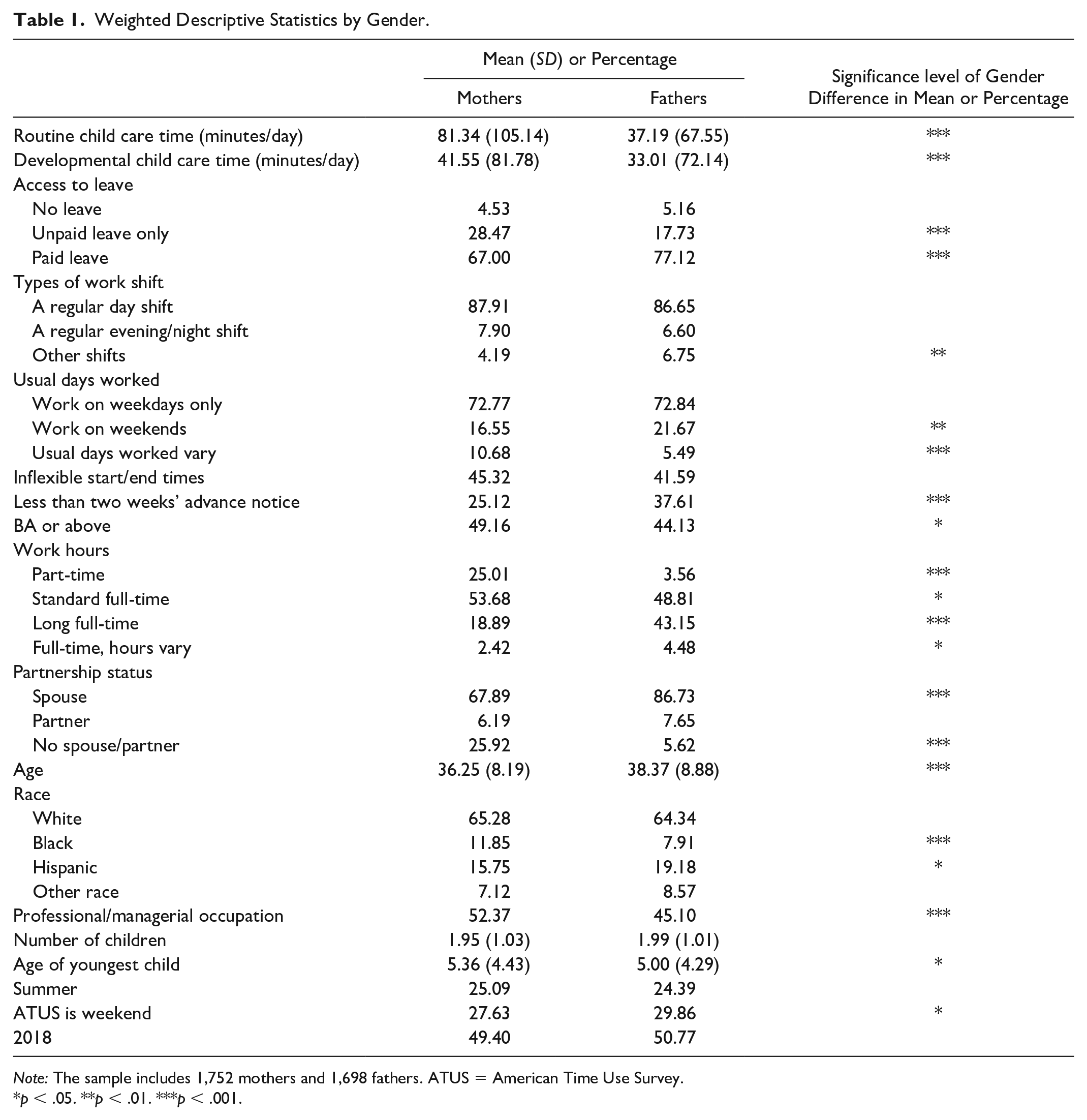
Note: The sample includes 1,752 mothers and 1,698 fathers. ATUS = American Time Use Survey.
p < .05. **p < .01. ***p < .001.
The majority of mothers and fathers have access to leave (95 percent), often paid leave. Most parents work regular day shifts (nearly 90 percent) and usually work on weekdays only (73 percent). The data also indicate that many parents experience temporal work condition instability. For nearly 30 percent of parents, their usual days worked either involve weekends or vary. Furthermore, about half of mothers (45 percent) and fathers (42 percent) have inflexible start and stop times of work. A quarter of mothers and nearly two fifths of fathers have less than two weeks’ advance notice of their work schedules.
Ordinary Least Squares Regression Results: Temporal Conditions of Work and Parental Child Care Time
Next, we turn to ordinary least squares regression models in Table 2 to examine the relationship between temporal dimensions of employment and parental child care time. Because child care time is measured by minutes per day, regression coefficients indicate differences in average daily minutes mothers and fathers spend on child care activities across temporal conditions of work.
Ordinary Least Squares Regression Models Predicting Mothers’ and Fathers’ Child Care Time.

Note: Values in parentheses are standard errors. In models predicting routine or developmental child care time, the significance level of gender differences in regression coefficients is indicated by superscripts a, b, c, and d (ap < .001, bp < .01, cp < .05, and dp < .10). ATUS = American Time Use Survey.
p < .05. **p < .01. ***p < .001.
Table 2 shows that access to leave from work and flextime are significantly associated with fathers’ routine child care time. Specifically, compared with fathers who have access to paid leave, routine child care time is 20 minutes lower for fathers who have no access to any paid or unpaid leave (p < .001) and 9 minutes lower for those with access to only unpaid leave (p < .05). Routine child care time of fathers with inflexible start and end times is 8 minutes lower than that of fathers with flextime (p < .05). This result based on time-diary data corresponds with non-time-diary research, which reveals that the availability of flextime arrangements is associated with a higher frequency of daily routine parent-child interactions for fathers (Kim 2020).
Usual days worked are significantly associated with both mothers’ and fathers’ child care time but in gender-differentiated ways (three of the four gender differences in coefficients are significant at the .01–.10 level). Compared with mothers who usually work on weekdays only, time in routine child care activities is 17 minutes lower among mothers who usually work on weekends (p < .05). Having usual days worked that vary is, however, associated with more maternal time in routine child care (b = 31.522, p < .05). Different patterns emerge among fathers: working on variable days of the week, as opposed to usually working on weekdays only, is associated with less paternal time in developmental child care (b = −12.947, p < .05).
Two temporal work conditions that indicate work-schedule instability and unpredictability—working a shift other than a regular day shift and having less than two weeks’ advance notice—are not significantly related to either mothers’ or fathers’ child care time. Overall, across two types of child care activities and five temporal aspects of work, the only significant relationship among mothers is between usual days worked and routine care time: compared with working on weekdays only, variable work days increase mothers’ routine child care time, whereas working on weekends negatively affects mothers’ routine child care time. By comparison, among fathers, lacking access to paid leave and having inflexible start and end times are associated with reduced routine care time, and working on variable days of the week is related to less developmental care time. The results suggest that mothers’ developmental child care time is least sensitive to temporal conditions of employment.
Parental child care time is also shaped by parents’ educational level in gendered ways. Even holding other variables constant, college-educated mothers spend more time (12 minutes more) on developmental care than less educated mothers (p < .05). College-educated fathers spend more time (14 minutes more) on routine child care than less educated fathers (p < .001).
Ordinary Least Squares Regression Results: Educational Variation
Next, we fit models with interaction terms between education and temporal aspects of work. To facilitate interpretation, we graphically present predicted daily child care time in minutes for significant results in Figures 1 and 2, with other covariates set at their means. Models with significant interaction terms are presented in Appendix Section 2, and results from the other models with nonsignificant interaction terms are presented in Appendix Section 3.

Predicted developmental child care time (minutes/day) for mothers, by maternal education and type of work shift or usual days worked.

Predicted routine child care time (minutes/day) for fathers, by paternal education and type of work shift or advance notice of work schedules.
Working nonstandard shifts and working on weekends widen educational gaps in mothers’ developmental child care time. As shown in Figure 1A, among mothers who work a regular day shift, predicted developmental child care time is 37.61 minutes for less educated mothers and 47.48 minutes for college-educated mothers, a small difference of 10 minutes (p = .058). 2 Among mothers who work a regular evening/night shift, the difference in developmental child care time between college-educated and less educated mothers is slightly larger (27 minutes) but not statistically significant, perhaps because of the small sample size (p = .106). Among mothers working nonstandard shifts, the educational gap is larger, at 42 minutes (13.69 minutes among less educated mothers vs. 55.89 minutes among college-educated mothers, p = .025).
Importantly, working other nonstandard shifts, as opposed to a regular day shift, negatively affects developmental child care time only among less educated mothers. Non-college-educated mothers who work regular day shifts report triple the time in developmental child care compared with those who work nonstandard shifts (37.61 vs. 13.69 minutes, p = .016). By contrast, college-educated mothers’ developmental child care time does not significantly differ across the three types of work shift. The results are consistent with our expectation that the child care “costs” of work schedules affect less educated mothers more strongly.
Figure 1B shows that the educational gap in mothers’ developmental child care time is larger among those usually working on weekends than those working on weekdays only. Among mothers who work on weekdays only, the gap in developmental care time between less educated and college-educated mothers is only 8 minutes and not statistically significant (37.77 vs. 45.61 minutes, p = .126). Among mothers who usually work on weekends, less educated mothers spend 23.37 minutes on developmental child care, whereas college-educated mothers spend 61.91 minutes, resulting in a difference of 39 minutes (p = .002). Among mothers whose usual days worked vary, although college-educated mothers spend more time on developmental child care than less educated mothers (56.89 vs. 46.63 minutes), the difference of 10 minutes is not statistically significant (p = .445). Thus, compared with working on weekdays only, working on weekends widens the educational gap in mothers’ developmental child care time by 31 minutes per day (p = .013). 3
As for fathers, type of work shift and advance notice of work schedules interact with education to shape routine child care. The results, as we elaborate on later, are somewhat surprising because job demands arising from scheduling arrangements appear to narrow or even reverse the educational gap in fathers’ routine child care time.
Figure 2A shows fathers’ routine child care time by education and type of work shift. Among fathers who work a regular day shift, college-educated fathers spend 45.71 minutes on routine care, significantly higher than their less educated counterparts, who spend 29.39 minutes (p < .001). The gap in routine care time between college- and less educated fathers narrows to about 9 minutes and becomes nonsignificant among those who work a regular evening or night shift (36.14 vs. 27.55 minutes, p = .264). Among fathers who work other nonstandard shifts, college-educated fathers spend 31.01 minutes on routine care, lower than their less educated counterparts, who spend 50.97 minutes, but this difference between the two educational groups is not significant at the 0.05 level (p = .107). Compared with working a regular day shift, working other nonstandard shifts significantly reverses the educational gap in routine child care time from favoring college-educated fathers to favoring less educated fathers (p = .003).
Figure 2B shows that the educational difference in fathers’ routine child care time differs by the advance notice of their work schedules. Among fathers with relatively predictable schedules (at least two weeks’ advance notice), highly educated fathers spend significantly more time (16 minutes more) on routine child care than less educated fathers (47.93 vs. 29.94 minutes, p < .001). By contrast, among fathers with less than two weeks’ advance notice, college-educated and less educated fathers do not differ significantly in their routine care time (38.75 vs. 33.18 minutes, p = .203). Thus, the educational gap in routine child care time favors college-educated fathers to a smaller extent when fathers have less than two weeks’ advance notice of their work schedules.
Conclusions
Temporal conditions of paid work likely spill over to nonwork domains and influence parental child care time. Empirical questions remain as to which temporal work condition matters more and whether the influence differs between fathers and mothers or varies with parental education. We advance prior research by investigating how a comprehensive set of temporal work conditions shapes parental child care time. For mothers, usual days worked affect routine child care time, but access to leave from work, flextime, advance notice of work schedules, and types of work shift are not associated with time in either routine or developmental child care. Compared with usually working on weekdays only, nonstandard work arrangements such as usually working on weekends are associated with mothers’ lower levels of routine child care time. Weekend jobs may take mothers’ time away from their children during the days when schools and child care facilities are closed and more parental supervision or care is needed.
Somewhat unexpectedly, we find that working on variable days of the week is associated with mothers’ higher levels of routine child care time, relative to working on weekdays only. Supplementary analysis shows that compared with mothers who usually work on weekdays only, mothers who work variable days are more likely to work part-time hours (38 percent vs. 20 percent) and are much less likely to work five days a week (42 percent vs. 86 percent). Thus, although variable work days could represent unpredictability and instability of employment schedules and thus increase job demands, it is possible that working on variable days of the week reflects schedule flexibility and that mothers work on those “flexible” jobs to better accommodate their child care responsibilities. It is also possible that variable work days are incompatible with nonparental child care arrangements, thus requiring higher levels of parental care (Harknett et al. 2022). To better understand our finding, future research is needed about whether mothers working variable days have the flexibility or autonomy to decide during which days of the week they work and if this is related to child care responsibilities and ability to use nonparental child care.
Fathers’ child care time is associated with three temporal dimensions of their job. Having no access to paid leave and lacking flextime arrangements are both associated with fathers’ lower levels of routine child care time. Thus, when work and family interfere with each other, fathers appear to mostly reduce the routine care they provide to their children. Additionally, working variable days is significantly associated with fathers’ reduced developmental care time. Unlike mothers working on variable days of the week, nearly 90 percent of fathers in our sample whose usual work days vary are full-time workers. Given that fathers rarely adjust their employment to accommodate child care needs (Raley et al. 2012), usual days worked that vary may indeed represent schedule unpredictability for fathers, increase their job demands, and hinder their ability to fit in the schedules of and participate in children’s developmental activities.
These results are consistent with the gender perspective of understanding parental child care time. Although mothers’ routine care time is responsive to temporal work conditions (like usual days worked), their developmental care time is much less so. In light of the pervasive intensive mothering norms, caring for children and engaging in activities that foster child development are critical to “being a good mother” under societal expectations (Hays 1996; Ishizuka 2019). Therefore, even with inflexible, unstable, or nonstandard work schedules, mothers may find ways to maximize their time spent with children especially on developmental activities (Bianchi 2000; Prickett and Augustine 2021). By contrast, how much time fathers spend on developmental and routine child care is sensitive to the demands and resources of their job. Providing for the family is still more central to good fathering than being highly involved in child care (Townsend 2002). Thus, when faced with competing demands from work and family, fathers may tend to prioritize meeting job demands over contributing to child care. Fathers working on variable days of the week may cut down on providing developmental child care as they encounter more difficulty aligning their time availability with temporal rhythms of children’s school and extracurricular activities (e.g., educational classes, school conferences, recreational activities). For fathers who work at jobs that require rigid start and end times and offer no access to paid leave, meeting job demands may interfere with family life and reduce fathers’ time in routine child care, which is typically performed by mothers anyway and often seen as “optional” for fathers to take on (Gerstel and Clawson 2014).
We also find that temporal dimensions of work play a role in structuring educational disparities in parenting time. Less educated mothers who work nonstandard schedules (nonstandard shifts, usually working on weekends) spend less time on developmental child care activities than their college-educated counterparts, a difference that is much smaller or statistically nonsignificant among mothers who work standard schedules (a regular day shift, working on weekdays only). Not only do worse temporal conditions of work have a more negative impact on less educated mothers’ child care time, those mothers are also more likely to occupy jobs with worse conditions (Gerstel and Clawson 2015). Supplementary analysis (Appendix Section 4) shows that less educated mothers are three times as likely as college-educated mothers to usually work on weekends (24 percent vs. 8 percent) and twice as likely to work a shift other than a regular day/evening/night shift (6 percent vs. 3 percent). Thus, nonstandard aspects of work time may exacerbate educational differences in mothers’ parenting time, leading to children’s diverging destinies and growing family socioeconomic inequalities (McLanahan 2004; Schneider et al. 2018).
Two temporal work conditions seem to narrow the educational gap in fathers’ routine child care time: short advance notice and nonstandard shifts. College-educated fathers spend more time on routine child care than their less educated counterparts, only among those with at least two weeks’ advance notice of their work schedules. This educational gap disappears among fathers with less than two weeks’ advance notice. Similarly, working nonstandard shifts appears to narrow or even reverse the educational gap in fathers’ routine child care time. Among those working a regular day shift, college-educated fathers spend more time on routine child care than less educated fathers, but this gap narrows to nonexistent among those working a regular evening or night shift and reverses to favor less educated fathers among those working other nonstandard shifts (e.g., rotating, split, or irregular shifts). It is worth noting that nearly 90 percent of fathers in our sample work regular day shifts. Our finding is nevertheless consistent with prior nonrepresentative research, which showed that nonstandard aspects of work time led to more child care time for male emergency medical technicians (working class, less educated) than for male doctors (middle class, highly educated) (Gerstel and Clawson 2014). Additional research is needed to understand why work shift (standard vs. nonstandard) and advance notice of work schedules (predictable vs. unpredictable) differentially influence college-educated and less educated fathers’ involvement in routine care of children. Research is also needed using couple-level data on educational variation in how temporal work conditions affect child care time for both partners. Non-time-diary studies report that working-class partnered parents work split shifts to maximize parental time available for child care (Gerstel and Clawson 2014), but research is needed among other partnered parents.
This research has several limitations. First, given the cross-sectional nature of our data, we cannot establish the causal relationship between temporal conditions of work and parental child care time. It is possible that mothers, and to a lesser extent fathers, choose certain type of employment or work schedules for family or child care reasons (Bureau of Labor Statistics 2019b). Future research may leverage longitudinal data or experimental designs to address this limitation.
Second, previous research suggests that parents may coordinate their work schedules to engage in tag-team parenting (Brayfield 1995; Fox et al. 2013; Weinshenker 2016), but we do not have couple-level data on time use or temporal dimensions of work. If appropriate data become available, future research could examine how individuals’ child care time and the gender division of child care between the two parents are shaped by individuals’ and their spouses’ or partners’ temporal conditions of employment.
Third, the mechanisms underlying the associations between temporal aspects of work and parental child care time are largely speculative. We draw on the JD-R model and prior research to conceptualize this study, but more qualitative research is needed to understand the ways in which schedules, as well as the flexibility, instability, and unpredictability of work time, affect parents’ ability to engage in developmental and routine child care activities.
To conclude, our results show that temporal dimensions of employment are associated with parents’ child care time in ways that differ by gender and education. Only usual days worked are associated with mothers’ routine care time, whereas for fathers, no access to paid leave and inflexible start and end times are both related to reduced routine care time and variable work days are associated with less developmental care time. This finding suggests that reducing work-schedule demands has the potential to increase men’s involvement in family life and ultimately contribute to the unstalling and completion of the gender revolution (Goldscheider et al. 2015). Furthermore, prior research shows that less educated workers are more likely than highly educated workers to hold jobs with inflexible, unpredictable, and nonstandard schedules (Gerstel and Clawson 2015, 2018). We extend prior research to show that short advance notice and nonstandard shifts appear to narrow or even reverse the educational gap in fathers’ routine child care time. Because lack of advance notice of work schedules attenuates the educational gradient in fathers’ routine child care time, whereas it does not affect the educational gradient in mothers’ routine child care time, inequalities in which fathers get “good” versus “bad” jobs reduce the potential of less gendered parenting practices in day-to-day child care. Moreover, unstable and irregular scheduling arrangements, such as nonstandard shifts and weekend jobs, have a more negative impact on less educated mothers’ engagement in developmental activities with children. Thus, inequalities in who gets “good” jobs and who gets “bad” jobs, as well as the differential impacts of temporal work conditions on parental child care time, especially on maternal time in developmental activities, may contribute to and further widen disparities in child well-being across social classes.
Supplemental Material
sj-docx-1-srd-10.1177_23780231221132383 – Supplemental material for Gender and Educational Variation in How Temporal Dimensions of Paid Work Affect Parental Child Care Time
Supplemental material, sj-docx-1-srd-10.1177_23780231221132383 for Gender and Educational Variation in How Temporal Dimensions of Paid Work Affect Parental Child Care Time by Yue Qian and Liana C. Sayer in Socius
Footnotes
Funding
The authors disclosed receipt of the following financial support for the research, authorship, and/or publication of this article: Yue Qian received start-up funds from the Department of Sociology at the University of British Columbia. Liana Sayer acknowledges support from the Eunice Kennedy Shriver National Center for Child Health and Human Development for “Time Use Data for Health and Well-Being” (R01HD053654-11). Any opinions, findings, and conclusions or recommendations expressed in this paper are those of the authors and do not necessarily reflect the views of the funders.

Supplemental Material
Supplemental material for this article is available online.
Notes
Author Biographies
References
Supplementary Material
Please find the following supplemental material available below.
For Open Access articles published under a Creative Commons License, all supplemental material carries the same license as the article it is associated with.
For non-Open Access articles published, all supplemental material carries a non-exclusive license, and permission requests for re-use of supplemental material or any part of supplemental material shall be sent directly to the copyright owner as specified in the copyright notice associated with the article.
