




Abstract
What makes police departments change their practices? Do they transform in isolation, or do they mimic their neighbors? Combining insights from organizational theory and urban sociology, the authors argue that organizational change diffuses, in part, through physically proximate institutions. They apply this theory to an underexamined trend: the decline of misdemeanor arrests in the United States between 1990 and 2018. The study first explores the spatial dynamics of low-level law enforcement by graphing and mapping trends across a range of metropolitan types, finding that suburbs made the fewest low-level arrests and central cities reduced their arrests the most during these years. A spatial autoregressive panel data model reveals that police departments decreased their misdemeanor arrests more when nearby departments did so, net of crime rates and other controls, evincing spatial mimicry. Police reform efforts need not target only state and federal governments but can diffuse outward from city-level changes.
Keywords
Why do organizations change? Do they transform in isolation, or do they mimic their neighbors? We address these questions to police organizations to inform debates over reforming law enforcement. Although much is known about how policing policies diffuse spatially (Burruss and Giblin 2014; Carter 2016; Giblin 2006), less is known about how police practices spread. This is despite findings that law enforcement practices are only weakly related to police policies (Cordner and Biebel 2005; Manning 2008). If police mimic one another, efforts to improve policing need not concentrate at large scales such as state or federal governments. Reformers can make changes in a few cities and expect those improvements to diffuse outward.
In this study, we analyze how proximate police departments interact in the context of an underexamined trend: the decline in misdemeanor arrests in the United States. The sharp growth of misdemeanor arrests in the 1980s and 1990s received extensive scholarly attention (e.g., Harcourt 2001; Kelling 2015; Weisburd et al. 2015). Less documented was the subsequent decline of such arrests in the 2000s and 2010s (Stevenson and Mayson 2018). Police departments in more than three quarters of U.S. cities decreased their misdemeanor arrest rates between the national peak in 1997 and 2018, with the median department making 36 percent fewer such arrests during this time (FBI 2018; Stevenson and Mayson 2018).
We help explain the striking reduction in low-level arrests by investigating how arrest rate fluctuations cluster spatially and how police agencies are influenced by their neighbors. To date “virtually no research has been conducted on . . . how police organizations can affect one another” (Klinger 2004:129). The research that does exist has concentrated on the influence of large urban police departments and most of that has examined just one agency, the New York Police Department (Mitchell and Beckett 2008; Marat 2019; Wacquant 2009). This study expands beyond major cities to map and graph the diffusion of misdemeanor arrest practices throughout a range of urban, suburban, and rural places. We analyze regional variation in misdemeanor arrests while controlling for other relevant factors like crime rates and police budgets. Then, drawing on concepts from the sociology of organizations and urban sociology, we emphasize the spatial component of mimetic isomorphism to explain police practices. This theory expects organizations to change (morph) by mimicking their neighbors, and the theory leads us to hypothesize that police departments decrease their discretionary arrests more when nearby departments do. This institutional mimicry helps explain the large, secular decline in misdemeanor arrests as partly a contagious, self-reinforcing diffusion through nearby municipalities.
We focus on misdemeanor arrests because they are among the most numerous and consequential police actions. They account for 80 percent of all arrests in the typical year and have harmful consequences for those arrested and their communities, despite their limited violence reduction benefits (FBI 2018; Kohler-Hausmann 2022; National Academies of Sciences, Engineering, and Medicine 2018). Although we focus on misdemeanor arrests, we expect that trends in other police actions will also diffuse spatially. Nearby departments are likely to resemble one another in their rates of stops, summonses, uses of force, and felony investigation practices.
Descriptive methods and a negative binomial model reveal that police department behavior varies by urbanicity. Police in suburbs made the fewest misdemeanor arrests during the study period. Police in rural towns made the most. A spatial autoregressive panel data model finds spatial mimetic isomorphism. Police departments decreased their misdemeanor arrests by 0.8 percent when neighboring agencies decreased theirs by 1 percent, net of crime and other controls.
The Misdemeanor Arrest Decline
For years, scholars had largely assumed that low-level arrest rates remained high after their increase in the 1980s and 1990s (see, e.g., Engel, Corsaro, and Ozer 2017; Kohler-Hausmann 2014; Kubrin et al. 2010; Natapoff 2011). The first research to explicitly analyze the post-1990s period, however, showed that misdemeanor arrest rates in the United States had “been falling steadily since 1997” (Stevenson and Mayson 2018:120). Quality-of-life arrests, a subset of the most discretionary misdemeanor arrests, began falling even sooner and fell even more (Beck 2019). Although arrests for drug possession and simple assault increased following the 1990s, the other 17 misdemeanor offense types for which the Federal Bureau of Investigation (FBI) collects data declined. These declining arrest categories included offenses such as driving under the influence, disorderly conduct, vandalism, and illegal weapons possession (Stevenson and Mayson 2018).
Single-city studies have revealed low-level arrest declines in St. Louis, Durham, Los Angeles, and Louisville, with Seattle and Prince George’s County, experiencing stable rates (Lens, Stoll, and Kuai 2019; Schaefer, Hughes, and Jude 2018; Slocum et al. 2018; Taylor et al. 2019). Even New York City, among the foremost practitioners of broken-windows policing and intense misdemeanor enforcement, experienced a dramatic reduction in low-level arrests in the years after 2011 (Chauhan et al. 2018).
Despite such declines, a growing body of research is revealing the often severe consequences of misdemeanor arrests for those arrested, their communities, and police (Kohler-Hausmann 2022). People arrested for misdemeanors are ensnared in the legal system for years as they struggle to pay off their fines and cope with the job, housing, medical, and family stress arrests frequently cause (Kohler-Hausmann 2014; Natapoff 2018; Remster and Kramer 2018). People with misdemeanor records were significantly less likely to receive job callbacks than those with no criminal records, at rates comparable to those with felony records (Leasure 2019). Furthermore, misdemeanor arrests are criminogenic rather than crime suppressive. People randomly assigned to have their nonviolent misdemeanor charge dropped were much less likely to get arrested during the subsequent two years (Agan, Doleac, and Harvey 2021). Even for those not arrested, vicarious contact with police for petty offenses generates more cynical attitudes toward the legal system, destabilizes family relationships, and compromises employment (Geller and Fagan 2019). Departments that make more discretionary arrests also experience more police killings (Sinyangwe 2021).
These consequences of low-level arrests fall most squarely on nonwhite people. Despite the aggregate decline in misdemeanor arrest rates, the racial disparity in such arrests remains stark. Black people were arrested three times more often than white people for misdemeanor offenses in 2015, the same proportion as in 1980 (Stevenson and Mayson 2018). If intense misdemeanor enforcement reduced crime, a difficult calculus would have to balance these consequences against any crime reduction benefits, but a consensus report by the National Academies of Sciences, Engineering, and Medicine (2018) noted that “generalized aggressive use of increased misdemeanor arrests . . . generates small to null impacts on crime” (p. 4-44). Understanding what makes misdemeanor arrests fluctuate might help ameliorate their harms and racial disparities.
Variations in Misdemeanor Arrest
Police officers’ surrounding environments pattern how often they make low-level arrests, and two of the most studied contextual factors are crime rates and racial demographics, though urbanicity (a municipality’s status as urban, suburban, or rural) is another likely covariate. Police chiefs and other practitioners often argue that variations in misdemeanor enforcement are driven by offending patterns and residents’ requests for service (Kelling and Bratton 2015). Referred to as theories of “differential offending” or “community violence,” this approach suggests that criminal behavior is the primary driver of variation in arrests and punishment (Hindelang 1978; Tillyer and Engel 2012). There is mixed evidence supporting differential offending theory. At an individual level, survey data show a positive correlation between offending and being arrested (D’Alessio and Stolzenberg 2003; Krohn et al. 2010). At higher scales, evidence of the relationship between arrest and crime rates is mixed. Although some city-level studies have documented an association between crime and arrests (e.g., Beck et al. 2022; Chappell, MacDonald, and Manz 2006), others have not (e.g., Lum and Vovak 2018).
The research is clearer that community demographics influence arrest practices. This scholarship has focused on the racial threat hypothesis, the theory that misdemeanor arrests are a method of social control intended to counter the “symbolic threat” of racial minorities (Blalock 1967). Individual officers’ racial bias affects individual arrests (Alpert, MacDonald, and Dunham 2005; Fagan et al. 2010; Golub, Johnson, and Dunlap 2007), though these relationships can be mediated by situational factors such as offender demeanor or the seriousness of a criminal offense (Klinger 1996). At the community level, growth in an area’s Black population is consistently and positively related to low-level arrests (Eitle, D’Alessio, & Stolzenberg 2002; Eitle and Monahan 2009; Kane, Gustafson, and Bruell 2013).
Although less studied than crime or racial demographics, the urbanicity of a police department’s location (whether it is in an urban, a suburban, or a rural place) is another important contextual determinant of arrest rates (Lynch and Logan 2020; Weisheit, Falcone, and Wells 1994). Police in suburbs made more very-low-level arrests than police in large cities starting in 2014, and qualitative research demonstrates that suburban policing can be intense and racially unequal (Beck 2019; Boyles 2015). Whether a municipality’s low-level arrest rate is associated with its socioeconomic demographics differs by its urbanicity (Beck 2019; Crank 1990). Police in rural areas confront different demands by the public, with animal control and interpersonal disputes the most frequent calls for service there (Payne, Berg, and Sun 2005). Criminal justice outcomes outside large cities are often extreme (Kang-Brown and Subramanian 2017; Simes 2021), and research might miss important trends if it does not analyze places across the urban-rural continuum.
Crime, racial demographics, and urbanicity affect police organizations from without. Internal police organizational characteristics also affect arrest rates (Eitle 2005; Maguire 2003). If a department has more formal policies (e.g., those covering the use of deadly force), it arrests more Black people and fewer white people for drug offenses (Eitle and Monahan 2009). However, local government policies such as community policing are unrelated to arrest outcomes (Chappell et al. 2006). Some studies show that a department’s level of bureaucracy (measured as its number of administrative personnel) is unrelated to arrest outcomes (Chappell et al. 2006), whereas others show bureaucratization decreases the likelihood of discretionary arrests (Mastrofski, Ritti, and Hoffmaster 1987). This past research on police organizations has examined differences between departments. We analyze exchange between them by measuring the spatial diffusion of arrest practices to nearby departments while also analyzing how urbanicity relates to low-level arrests.
The Spatial Component of Mimetic Isomorphism
Although many theories of institutional change focus on organizations’ internal characteristics such as their structure or management, neoinstitutional theory emphasizes the role of external pressures. Firms, nonprofits, and other organizations change or “morph” because of the pressures from the surrounding institutional context. DiMaggio and Powell (1983) outlined three types of such change: coercive, normative, and mimetic institutional isomorphism. Coercive isomorphism occurs when higher authorities compel adaptation by changing laws or access to resources, as when the federal government awards grants to police agencies that adopt community policing (Giblin and Burruss 2009; Wilson 2005). Normative isomorphism compels adaptation by changing the standards of legitimacy or professionalization, as when governments or professional associations design new trainings or best practices (Grattet and Jenness 2005; Skogan and Hartnett 2005). Mimetic isomorphism, the focus of the present study, occurs when organizations learn from and adopt the practices of their peers (DiMaggio and Powell 1983:152). Organizations, either intentionally or unintentionally, model themselves after similar organizations that are perceived to be more legitimate or successful.
Organizations in fields as diverse as auditing, banking, nonprofits, newspapers, and education have all displayed this mimetism (Anafinova 2020; Haveman 1993; Judge, Li, and Pinsker 2010; Han 1994; Rambotti 2017), and police organizations have as well (Carter 2016; Giblin 2006; Maguire 2014). Police personnel from different agencies frequently discuss common practices during phone calls or site visits and often describe their innovations as modeled on other, more successful agencies (Giblin 2006; Giblin, Burruss, and Schafer 2014). Police innovations diffuse through socially networked law enforcement agencies, with new policies spreading to those with personal relationships among their personnel (Lum et al. 2018; Skogan and Harnett 2005; Weisburd and Lum 2005). The diffusion of community and “intelligence-led” policing are two examples of such a spread. Police departments were more likely to adopt the policies when they experienced outside pressure from other law enforcement agencies (Burruss and Giblin 2014; Carter 2016). Mimetic isomorphism also helps explain the diffusion of techniques such as crime analysis software, hate crime reporting, and homeland security strategies (Burruss, Giblin, and Schafer 2010; King 2007; Schafer, Burruss, and Giblin 2009; Willis, Mastrofski, and Weisburd 2007; Wilson 2005). This past research has measured the spread of policing policies. Sensitive to how policies and practices are often divorced (Beck et al. 2022; Cordner and Biebel 2005; Manning 2008), in the present study we examine a police practice, misdemeanor arrests.
Institutional theory and extant research have described the diffusion of institutional practices through social networks (Wood et al. 2019). We emphasize the spatial element of mimetic isomorphism by describing the diffusion of change through physically proximate organizations. A commonly cited “first rule” of spatial analysis is that “everything is related to everything else, but near things are more related than distant things” (Tobler 1970:236). Research demonstrates that organizational outcomes in a variety of fields are spatially embedded. Physical proximity affects everything from whether retail firms adopt loyalty programs to whether state governments promote venture capital investment (Allaway, Berkowitz, and D’Souza 2003; Hägerstrand 1967; Leicht and Jenkins 1998).
Although the Chicago School analyzed the spatial dependence of crime as early as the 1940s (Shaw and McKay 1942), the spatial dependence of policing has been less developed. Indeed, although experimental criminologists have documented the spatial diffusion of crime control benefits as an outcome of certain police practices (Telep et al. 2014), only a few studies have assessed whether the practices themselves are spatially dependent or spill over to nearby agencies. Simpson and Hipp (2019:718) found evidence for “a contagious effect” of police departments policies of southern California. Departments in that region varied together in their adoption of community policing, technology, and other organizational characteristics in 1993 but converged on similar policies by 2000, only to diverge again after that (Simpson and Hipp 2019).
What mechanisms might account for the spatial clustering of police practices? First, we suspect professional and social networks are stronger when police personnel neighbor one another. As any professionals do, police managers and officers communicate and network. Willis and Mastrofski (2011:391) speculated that “spatial proximity likely continues to be an important mechanism of information exchange” between police organizations. Klinger (1997) called these professional connections “territorially based independent work groups [that communicate] within and across police organizations” (p. 279). The geographic proximity of such work groups amplifies both the likelihood and intensity of personal connections. Giblin et al. (2014) found that personnel in small police departments were more likely to interact with personnel in large departments if they were physically proximate, and the small departments increased their homeland security preparation as a result. We suspect that these networks do not just exchange information, but also exert social pressures that will encourage mimicry and herding in police practices.
Police are also likely to learn about the behavior of neighboring police through the media. Local television, newspapers, and geographically specific social media such as Facebook groups and Nextdoor will convey law enforcement practices across city boundaries. Police departments also swap personnel and equipment, serving as additional opportunities for exchange. For example, the Denver Police Department gathered nonlethal munitions from neighboring agencies when it exhausted its munitions during protests in 2020 (Nieberg 2020). Nearby departments also share personnel when officers move in search of better pay, to avoid disciplinary action, or after a firing (Allen 2018; Barker, Keller, and Eder 2021). One study showed that 3 percent of officers in Florida had been previously fired from other departments in the state (Grunwald and Rappaport 2020). These social and professional networks, media exchanges, and departmental swaps are conduits through which proximate police organizations will come to mimic one another.
Data show that proximity patterns the style and form of policing within police departments as well as between them (Gordon 2020; Klinger 1997; Skogan 2006). Spatial awareness and “territorial domain” are key aspects of community policing, for example, wherein beat and other low-level officers are expected to be knowledgeable of specific problems of their patrolled neighborhoods (Crank 2004; Klinger 1997, 2004; Skogan 2006). In turn, the police become what Gordon (2020) referred to as “place consolidators,” that actively construct and react to the larger cultural, structural, and geographic elements of their cities. Police stops and arrests within a single police department cluster spatially (e.g., Beck 2020; Gordon 2020; Laniyonu 2018), and we expect these practices to spill over across police departments as well.
In discussing the environmental and organizational influencers of officer behavior, Klinger (2004) commented that “virtually no research has been conducted . . . on how police organizations can affect one another” (p. 131). To evaluate whether proximate police departments imitate one another, and whether that imitation contributed to the large misdemeanor arrest decline, we test whether cities decreased their misdemeanor arrests more when neighboring cities did so. Drawing on spatial and organizational research and theory, we hypothesize that police practices will spill over to proximate departments.
Data and Analytic Strategy
Data
This study has two goals: first, to analyze how the misdemeanor arrest decline varied by urbanicity and, second, to assess whether misdemeanor policing practices spill over to proximate departments. To address each, we devised two samples and two analytic strategies. First, we gathered annual data from 1990 to 2016 on U.S. municipalities with more than 5,000 people. Because of covariate availability, the multivariate models stop with 2016 data, though our descriptive graphs go through 2018. We omitted cities from the first sample if they were missing more than two thirds of their data on the dependent variable. This process generated a sample of 72,268 municipality-years (our unit of analysis), which includes 2,839 municipalities in the typical year. These places are home to 109 million people, about one third of the U.S. population. Our second sample analyzes spatial spillover, which requires a balanced sample (i.e., one with a consistent number of units in each year). This reduces the sample to 36,998 municipality-years, made up of the 1,432 municipalities without missing data. These samples are designed to include the largest possible breadth of cities, not to be representative of all U.S. cities. Although the thousands of places in each model are expansive, if they are systematically different than the places we do not capture, our findings might not be generalizable to all U.S. municipalities. We use the terms municipality and place interchangeably.
Dependent Variables
Arrest data come from the FBI’s Uniform Crime Reporting (UCR) data set “Arrests by Age, Sex, and Race, 1974–2018” (Kaplan 2020). Our definition of “misdemeanor” reflects the FBI’s “part 2” crimes, a designation that includes the 19 least serious offenses for which the bureau collects data. The most common arrests in this measure were for driving under the influence, drug possession, and disorderly conduct. The misdemeanor arrest rate is the count of these arrests per 1,000 city residents.
Focal Explanatory Variables
Our measure of urbanicity mirrors the U.S. Office of Management and Budget’s designation. Central cities are those the Office of Management and Budget defines as “principal cities,” suburbs are municipalities inside a metropolitan statistical area but outside the principal city, and rural towns are places outside of metropolitan statistical areas.
We capture the influence of nearby police departments by including spatial lags of the misdemeanor arrest rates in nearby cities weighted by distance (i.e., closer cities are weighted more heavily). The lags come from a spectral-normalized, inverse-distance weighting matrix constructed using the National Historical Geographic Information System’s 2015 Place Points shapefile.
Control Variables
A possible explanation for the decline of misdemeanor enforcement is the decline of misdemeanor crime. Measuring misdemeanor crime is extremely difficult because what qualifies as, for instance, “disorderly conduct” is subjective and because most misdemeanor crime, such as drug possession, goes unreported. Because of this, the present analysis uses the violent crime rate as our measure of crime. It is less suspectable to definitional slippage and measurement error. The findings will rest on the assumption that low-level crime and serious crime fluctuate together.
Researchers often explain the racial disparity in arrests as the result of racial threat. The white power structure of cities fears Black people, so they turn to policing to enforce racial control (Blalock 1967; Parker, Stults, and Rice 2005). To capture any fluctuations in policing that might be due to heightened racial fears, we measure the percentage of each city that is Black and the percentage that is Latino.
In line with resource dependency theory, research has shown that police agencies with more funding make more low-level arrests (Beck et al. 2022). To capture this dynamic, we control for cities’ police expenditures using data from the U.S. Census Bureau’s Annual Survey of State and Local Government Finances. Police expenditure is lagged one year to capture the delay between budgeting and spending. Our police funding variable is the inflation-adjusted dollars spent on police per city resident. It includes intergovernmental transfers such as those from the federal government to hire more police officers.
We adjust for region of the country by mirroring the Census Bureau’s four regions: Northeast, Midwest, South, and West. We control for cities’ socioeconomic characteristics by creating an index of advantage with factor analysis. It combines each city’s rate of employment, rate of people above the poverty line, share of the population with a college degree, and median income. This approach avoids the problems of multicollinearity entering the variables separately could cause. We also control for demographics: the percentage of the city born outside the United States, the number of 18- to 41-year-old men (Figures and Legewie 2019), the percentage of the housing units that are vacant, and the total population. For years missing control variable data, we linearly interpolated those data.
Analytic Strategy
We are interested in how misdemeanor arrest rates vary by two spatial dynamics: urbanicity and the arrest practices of nearby police departments. Because the first of these does not vary over time (e.g., places are durably suburbs), and the second one does vary by time (e.g., nearby cities’ misdemeanor arrest rates fluctuate), we devised two modeling strategies to account for both between- and within-municipality differences.
The first approach analyzes the role of urbanicity, which varies between, not within, cities, by fitting a negative binomial model. The distribution of misdemeanor arrests’ rightward skew led us to the negative binomial approach. Because such models cannot accommodate rate outcomes, we use the raw count of misdemeanor arrests and include population as an offset (also called exposure) variable (Powers and Xie 1999). We pool all years of data from each place, so we cluster the errors by municipality to avoid serial autocorrelation (also called correlated errors; Sayrs 1989). The model takes the following form:

The outcome yit represents the misdemeanor arrests of city i at time t. It is regressed on the constant α and a vector of the predictors xit. The coefficient β1 is the coefficient of interest for addressing the question of urbanicity. The term wiyit represents the outcome yit multiplied by the spatial weighting matrix wi. Its coefficient β2 indicates spatial spillover of misdemeanor arrests that the subsequent model addresses more thoroughly. The population offset Eit is logged to correct skewness, and the idiosyncratic error term εit is clustered by city to avoid serial autocorrelation.
Our second model analyzes change within cities over time to test our hypothesis that police agencies are more likely to decrease their misdemeanor arrests when nearby departments do so. To test this spatial diffusion theory, we ran a spatial autoregressive panel data model (Lee and Yu 2010). This reveals the spillover from nearby cities that occurs both through the mimicry of police practice and through unmeasured variables by including a spatially lagged dependent variable and a spatially lagged error term. In addition to incorporating a spatial lag derived from the distance-weighted matrix, these models can accommodate place fixed effects that, crucially, control for all time-invariant characteristics. This is important because neighboring cities share similar characteristics that we need to rule out to isolate the role of mimetism. For instance, nearby cities might be governed by the same state laws, and they will share a regional economy and a climate. Most consequentially for this study, nearby cities will likely share a similar political environment. The prevalence of liberal or conservative beliefs clusters spatially. Place fixed effects control for these unobserved variables, given that they did not change during the study period. Municipalities in conservative places such as the upper Rocky Mountain region are compared with themselves over time rather than with places in liberal areas such as the West Coast. However, we do not capture when political ideology changes, as when a region becomes more liberal over time. We know that political shifts occur very slowly and often nationally, so we do not expect this will bias the results of our city-level study of 26 years, but it still represents a limitation of the study. A spatial autoregressive panel data model with place fixed effects fits our research question because it combines time-series and spatial data analysis in one procedure to capture spatial spillover and control for time-invariant characteristics. Models that analyze only space or time would miss the other crucial component.
This model takes the following form:

where yit is the logged (to reduce skewness) misdemeanor arrest rate in city i at time t; α i is the place-specific fixed effect; β1 is the coefficient of xit, a vector of explanatory variables; β2 is the coefficient of wiyit, a term multiplying the dependent variable yit by the spatial weighting matrix wi to capture spillover effects via the dependent variable; β3 is the coefficient for the spatial error term (ξ it ) multiplied by the same spatially weighting matrix (wi) to capture unobserved spillover via unmeasured variables; and ε it is the idiosyncratic error.
Results
Descriptive Results
Table 1 presents variable means and standard deviations for 1990 and 2016 and the percentage change between the two years. Because of covariate availability, multivariate models stop in 2016, and the descriptive graphs go through 2018.
Variable Means and Standard Deviations.
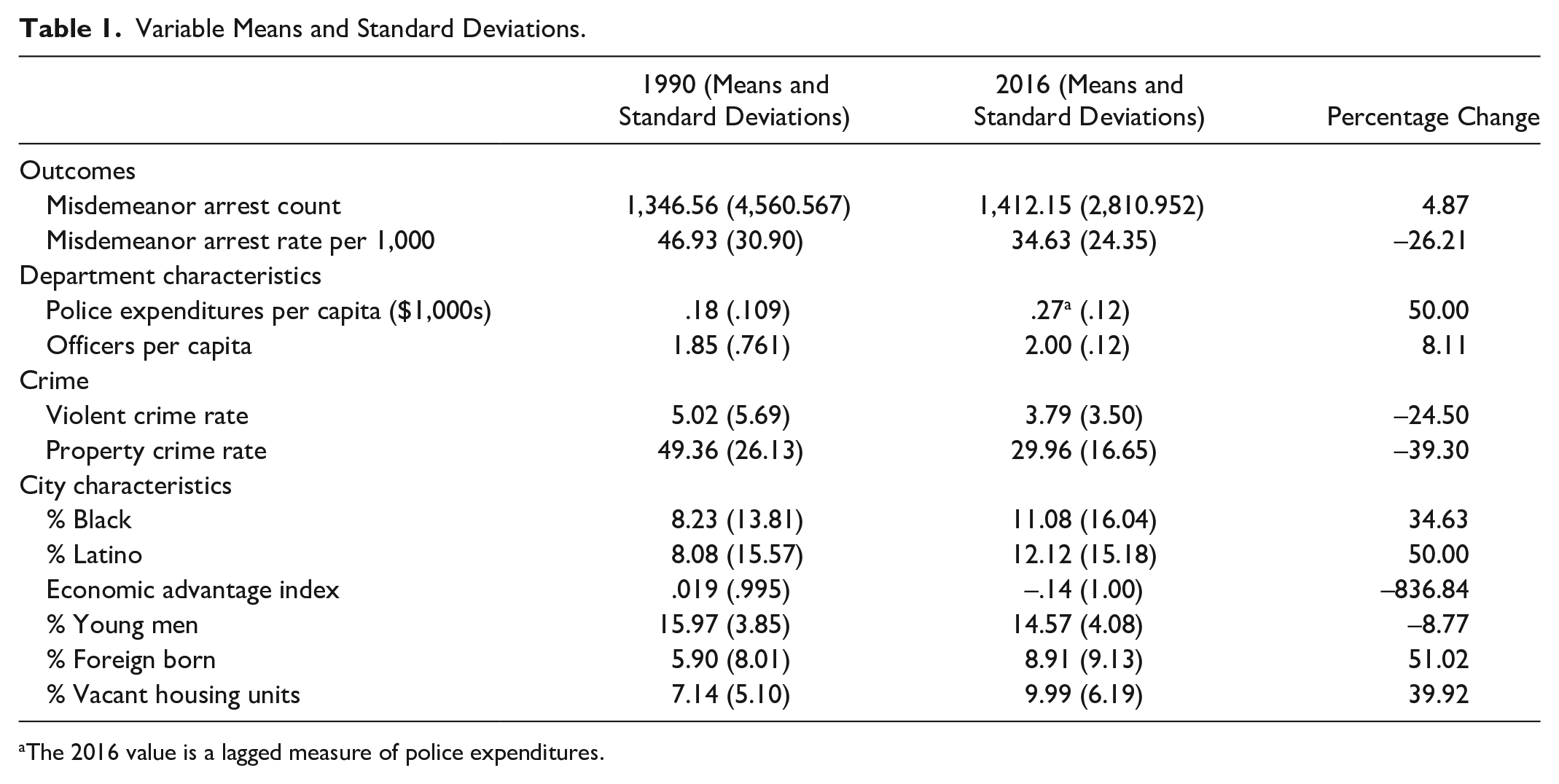
The 2016 value is a lagged measure of police expenditures.
Figure 1 displays the national misdemeanor arrest rate in the lefthand graph and that same rate disaggregated by urbanicity in the righthand graph. The national rate shows the striking decline from its 1997 peak until 2018. The righthand graph reveals that the same basic trend held for central cities, suburbs, and rural towns, though the magnitude of each was different. Central cities and suburbs saw large post-1997 drops (–51 percent and –48 percent, respectively), and rural towns saw a sizable but smaller decline (–34 percent). Rural towns were home to the most misdemeanor arrests per capita in each year, and suburbs were home to the least. Central cities looked like rural towns in 1990 but had come to resemble suburbs by 2018. Strikingly, police in rural towns made twice the misdemeanor arrests that their counterparts in suburbs did in 2018. This graph provides descriptive evidence that policing practices vary across urbanization contexts, points to a durable enforcement intensity in rural areas, and suggests that cities and suburbs are converging.

Misdemeanor arrest rates nationally and by urbanicity.
Figure 2 maps the change in misdemeanor arrest rates for cities of more than 50,000 people in the 48 contiguous states between 1997 (the national peak) and 2018. To aid legibility, we show fewer cities on this map than we include in our graphical and multivariate analyses. Cities undergoing declines in misdemeanor arrest rates, represented by the dark green circles, are clearly more numerous. These are the 80 percent of municipalities that made fewer misdemeanor arrests in 2018 than in 1997. The Midwest, the Northwest, and northern California were home to clusters of cities with decreasing arrests. Several cities in Texas had growing arrest rates, contravening the national trend, and the Northeast had the most stable arrest rates. Even in Texas and the Northeast, however, most cities saw decreases. The regional clusters are one indication police are influenced by neighboring practices. The largest drops in misdemeanor arrests occurred in Columbia, South Carolina, Raleigh, North Carolina, and Cleveland, Ohio, with each place making more than 90 percent fewer arrests in 2018 than in 1997. The largest increases were in Memphis, Tennessee, Cedar Rapids, Iowa, and Carrollton, Texas, each with growth rates of more than 100 percent.
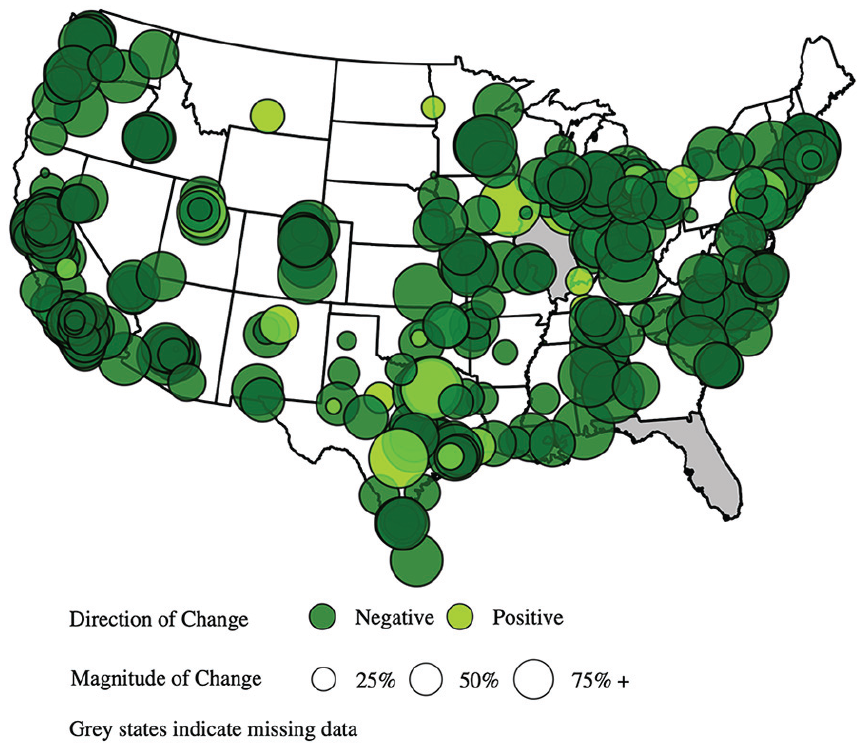
Map of changes in misdemeanor arrest rates from 1997 to 2018 in municipalities with more than 75,000 residents.
Multivariate Results
To examine relationship between urbanicity and misdemeanor arrest rates, we fit a negative binomial model, the incidence rate ratios (IRRs) of which are displayed as model 1 in Table 2. IRRs are exponentiated coefficients, so IRRs greater than 1 indicate a positive relationship, and those less than 1 indicate a negative relationship. Urbanicity proved to be a somewhat meaningful correlate. In line with Figure 2 above, police in suburbs made 5 percent fewer misdemeanor arrests than those in central cities, the reference category ([1 – 0.95] × 100 = 5). The difference between rural towns and central cities is not statistically significant.
Models of Misdemeanor Arrests.

Note: IRR = incidence rate ratio.
p < .05. **p < .01. ***p < .001.
Although this model focuses on variation in misdemeanor arrest rates by urbanicity, a handful of department and city-level predictors were statistically significant. The spatial lag of the dependent variable is positive, providing early evidence that police departments mimic one another. We test this more thoroughly in the next model. Police in the Northeast and Midwest did not arrest at different rates than those in the South, the reference category. However, police in the West made 19 percent more low-level arrests (0.186 × 100 = 19). The U.S. misdemeanor arrest decline was somewhat uneven regionally. Model 1 also reveals that larger police forces had higher arrest rates, as did better funded departments. Agencies in cities with more Black people and more economically advantaged cities had lower arrest rates. Those with more Latino people had higher rates.
Emphasizing the spatial element of the theory of mimetic isomorphism, we hypothesized that police would imitate police in nearby cities and so arrest practices would diffuse through proximate places. Model 2 addresses this hypothesis using a spatial autoregressive panel data model estimating change over time within municipalities, holding constant all time-invariant characteristics such as urbanicity and region and allowing nearby cities to influence the focal city through the error term and the dependent variable. We find support for the spatial element of mimetic isomorphism. The spatial lag of the dependent variable shows that a 1 percent decrease in the misdemeanor arrest rate of nearby cities was related to a 0.8 percent decrease in the focal city (because the dependent variables are logged, the coefficients are elasticities). The spatial error term was similarly statistically significant, indicating that nearby cities influence the focal city through unmeasured variables. This supports the theory that misdemeanor arrest practices cluster spatially and police departments mimic their neighbors.
Discussion and Conclusion
We wanted to know what makes police departments change. Combining DiMaggio and Powell’s (1983) theory of organizational change with a geographic perspective, we mobilized the spatial component of mimetic isomorphism and hypothesized that organizations such as police departments mimic their neighbors. To test this, we analyzed a heretofore underexamined trend: the steady and enduring decline in misdemeanor arrests in the United States between 1990 and 2018. Misdemeanor policing has been studied mostly in large urban departments, so we built a data set of 2,839 municipalities that included places across the urban-suburban-rural continuum.
In analyzing more than 25 years of data, we found that this distinction in urbanicity was important. Suburbs made fewer low-level arrests, but they are converging with cities in their arrest practices.
These findings suggest that police researchers need to study practices across a range of metropolitan contexts. Not doing so would neglect the places where most people live and risk misdescribing trends that vary by urbanicity, such as the misdemeanor arrest decline.
A second important finding was that spatial diffusion helps explain low-level policing practices. A spatial autoregressive panel data model revealed that police departments decreased their misdemeanor arrests more when proximate departments also did, even after accounting for changes in crime rates and other covariates, as well as time-invariant characteristics such as urbanicity and historical political ideology. This supports the theory that police agencies change, in part, by mimicking their neighbors. That we found region to have a mixed impact on misdemeanor arrests, but proximity to have a large impact, suggests that police learn from nearby, not distant, neighbors. We suspect spatial mimetic isomorphism is true for other organizational types and other police practices and invite future researchers to test other manifestations. Past research has conceptualized police as organizations, and our findings suggest that we should also view those organizations as embedded in place.
Although our data cannot reveal what mechanism connects proximity with police practice, we highlight several pathways. The spatially bounded professional and social networks of police personnel likely serve as both sites of information exchange and of conformity pressures. Traditional and social media coverage are conduits of information on arrest practices, and the sharing of equipment and personnel are further pathways through which police practices diffuse. All these forces are likely stronger among proximate departments, and they could explain our findings.
This study is limited in that we rely on data from the FBI’s UCR data program, to which not all police agencies report complete data. Although we attempt to mitigate this by limiting our analysis to municipalities with more than 17 years of data, this does not ensure that we captured all systematic missingness, which has the potential to distort our estimates. We think the geographic breadth of the UCR data outweighs this cost, but it means our samples are not strictly representative of all U.S. municipalities.
One policy implication of these findings is that police reform in one place is likely to spread elsewhere. Although there are 18,000 police agencies in the United States (Reaves 2011), social movements and advocates seeking to alleviate the many harms of misdemeanor arrests will not have to change each police department individually. Reformers and policy makers can use the mimetic nature of organizational adaptation to generate cascades of change through nearby police departments. This also means that the best scale for police reform need not be the largest. Although changes to state and national policy are doubtless important, local changes can ripple outward. As researchers reinvigorate their understanding of police embedded in places, policy makers can as well.
