




Abstract
The authors explore whether mandatory, universal, in-person sexual misconduct training achieves its goals to build knowledge about sexual assault and harassment and increase intentions to report episodes of assault. The authors present results from three studies with quasi-experimental designs as well as interviews with students and staff members at a diverse public university in the western United States. The surprising finding is that participating in training makes women students less likely to say they that will report experiences of sexual assault to university authorities. The training produces some small positive effects: students gain broader definitions of sexual misconduct and are less likely to endorse common rape myths, and women students express less sexist attitudes immediately after training. This study raises questions about whether one-shot training helps reduce sexual violence and increase reporting on college campuses and whether universities should invest in these types of training.
Public and private organizations throughout the United States have invested in programs to combat sexual assault and sexual harassment, often referred to using the umbrella term sexual misconduct. One of the most widespread and least controversial mechanisms to prevent and reduce sexual misconduct is training, long a key component of the arsenal of human resources professionals in private corporations (Dobbin and Kalev 2019; Dobbin and Kelly 2007). In the 2000s, the federal government began to require institutions of higher education to provide sexual misconduct prevention training for students, staff members, and faculty members to comply with Title IX and the Violence Against Women Act (Holland 2017; Melnick 2018).
Does mandatory sexual misconduct training on college campuses achieve these goals? In this article, we present results from three quasi-experimental studies of training programs conducted in 2017 and 2018 at a large public university in the western United States. We designed a survey instrument to capture the immediate effects of the training on its objectives, which reflect goals of Title IX guidelines issued by the U.S. Department of Education during the Obama administration. We complement the analysis of these survey data with insights from interviews with 37 students, interviews with university staff members, and observations of more than a dozen training sessions.
We find that participating in training produces positive, though modest, effects on students’ knowledge and attitudes. Students gain a broader understanding of the behaviors that universities classify as sexual misconduct and weaker adherence to beliefs conducive to sexual assault, and women are less likely to express sexist attitudes after the training.
Our surprising finding is that training makes women less likely to say that they would report sexual assault. In all three studies, participating in training is associated with a large and highly statistically significant drop in the share of women who affirm that, if they were sexually assaulted by another student, they would be “very likely” or “somewhat likely” to report the experience to the university.
Although our study was not designed to systematically explore the reasons for the drop in reporting intentions, we speculate about it on the basis of interview material and responses to other survey questions. We suggest that training may aggravate women’s perceptions of the social risks involved in reporting. Women students resist labeling their experiences as assault and categorizing their sexual relationships as nonconsensual or coercive in the ways portrayed by training (cf. Khan et al. 2018).
Our research adds additional evidence to a body of work showing that a great deal of training is of limited efficacy at reducing sexual misconduct (see DeGue et al. 2014 for a review) and especially contributes to research on the relationship between policies and reporting rates (cf. Richards, Gillespie, and Branscum 2021). In contrast to many other studies on sexual assault prevention, which involve evaluations of researcher-designed training with recruited student participants, our research examines the effects of mandatory training required of all students as a condition of enrollment and designed and delivered by university staff members, not members of the research team. 1 Our study thus offers evidence of what programs that are scaled up to target an entire population are likely to achieve. Our findings raise doubts that one-shot trainings help reduce sexual violence on college campuses and that significant investments to encourage students, especially women, to report assault has not changed perceptions about the risks that reporting incurs.
Expectations about Training Effects
According to Obama-era Title IX guidelines, prevention-oriented training should promote, among other goals, (1) greater knowledge about sexual misconduct and the importance of consent; (2) increased awareness of university policies, procedures, and relevant laws; and (3) changes in behavior to make the campus safer, including more reporting by victims and bystander intervention (Holland 2017). Although the Trump administration changed Title IX guidelines in 2020, especially regarding investigative procedures (Melnick 2020), the vast majority of universities continued to require that students, staff members, and faculty members participate in sexual misconduct training. Since the Biden administration plans to reverse most of the Trump changes, the Obama-era guidelines remain pertinent (Biden 2021; U.S. Department of Education 2022).
Existing evidence suggests that sexual misconduct trainings that minimally comply with federal requirements, such as short, single-dose trainings, produce few effects that are known to reduce sexual misconduct (CDC 2014; DeGue et al. 2014). To be sure, the majority of studies find that sexual misconduct training increases participants’ knowledge about misconduct, such as what behavior counts as misconduct and the relevant laws and rules (see, e.g., review in Roehling and Huang 2018), and thus meet some of the government’s Title IX goals. However, there is limited evidence that this type of legal and social knowledge is linked to actual behavior, such as rape perpetration (DeGue et al. 2014:357). Effective trainings that produce behavioral changes tend to be delivered in multiple doses over time, involve several dimensions—such as an educational curriculum combined with social norms marketing, community-level changes, and policy changes—and require active participation, among other elements (Banyard et al. 2017; Bezrukova et al. 2016; DeGue et al. 2014; Orchowski et al. 2020; Tharp et al. 2011).
There is little evidence about whether training affects intentions to report misconduct or actual reporting behavior, one of goals in the 2011 “Dear Colleague” guidelines issued by the U.S. Department of Education during the Obama administration to increase notoriously low rates of reporting (see, e.g., Holland and Cortina 2017; Krebs et al. 2016; Orchowski, Meyer, and Gidycz 2009; Sabina and Ho 2014). The evidence we do have implies that the policy shift under Obama has not led to more reporting. Richards et al. (2021), for example, found that higher educational institutions with mandatory training and other policies intended to encourage reporting and reduce its risks are not associated with greater reporting rates.
Although not an explicit goal of Title IX guidelines, it is important to explore whether and how training affects beliefs about gender. Feminist analyses have long linked violence against women to unequal gender relations and traditional social norms (Htun and Weldon 2012). Considerable empirical evidence shows that gender violence is more prevalent in places where people endorse sexist beliefs, such as men’s authority over women (Cools and Kotsadam 2017; Heise and Kotsadam 2015; Htun and Jensenius 2022). Systems of inequality are sustained by cultural beliefs about group difference and the enactment of those beliefs in behaviors and institutions (Jost and Banaji 1994; Ridgeway 2011; Sewell 1992).
Contemporary trainings emphasize the principle of affirmative consent, codified in the policies of hundreds of universities and the laws of several U.S. states (Emba 2015). Affirmative consent requires that students of all gender identities obtain explicit and enthusiastic consent for sexual activity. Affirmative consent’s emphasis on equal responsibility for consent has the potential to encourage a shift in gender norms, as traditional heterosexual values expect men to dominate sexual relations (Hamilton and Armstrong 2009). Research on status characteristics theory has shown that one-time interventions aimed at changing cultural beliefs about men and women’s relative status can lead to more equal interactional behavior (Lucas 2003; Walker 2019). These findings suggests that in theory, affirmative consent training could help undermine traditional gender stereotypes and sexist beliefs. It is unlikely that stand-alone trainings will induce large and durable changes in people’s view about gender. However, participating in training may contribute to the accumulation of routine encounters in which traditional gender beliefs are challenged and invalidated, especially when part of a more comprehensive cultural change strategy (Bezrukova et al. 2016; CDC 2014; Ridgeway 2011).
Empirical Approach
Our goal was to capture the effects of a mandatory, universal, in-person training delivered by a public university to incoming and enrolled students. University staff members developed the training to comply with an agreement between the university and the U.S. Department of Justice (DOJ) following an investigation into allegations of Title IX violations. According to the agreement, the university had to train students, staff members, and faculty members; revise its policies; improve reporting and investigation procedures; and conduct annual surveys to measure rates of sexual assault, sexual harassment, and other harmful behaviors.
The student training program provided a unique opportunity to study ordinary reactions to sexual misconduct training in a real-life setting. We undertook this effort with approval of university leaders and the collaboration of the staff members who organized and delivered the training.
The agreement between the DOJ and the university required that some 27,000 students participate in an in-person training. Incoming students, whether first-year or transfer students, participated in the training as part of their new student orientation programs held during the summer. Continuing students were sent multiple notices and reminders informing them that they needed to sign up for the training, under penalty of a registration hold. Students were instructed to go to a university web-based platform where they selected and registered for a training session on a particular date. 2
The training involved listening to a one-hour lecture and then participating in a small-group discussion lasting about 30 minutes. The topics covered in the lecture included definitions and examples of sexual misconduct, university policies, Title IX and federal law, reporting procedures, data on the prevalence of assault and harassment, examples of cultural products and values conducive to assault and harassment, bystander intervention strategies, the concept of affirmative consent, and an illustrative video about consent. During the small-group discussions, students engaged in exercises intended to increase their understanding of consent and to probe other issues raised by the lecture. The content of the curriculum exceeded Title IX guidelines by challenging sexist culture. In interviews with the research team, university staff members emphasized the importance of cultural change to effective sexual violence prevention.
In this article, we report results from three quasi-experimental studies seeking to capture immediate effects of the training on measures that operationalize, at least in part, the goals outlined in Obama-era Title IX guidelines. We were also interested to explore whether the training affected views about gender and sexism. We compared responses from students who had undergone the training to other very similar groups of students who had not yet undergone the training. 3 We did this by randomly (or as-if randomly) assigning some students to complete the survey immediately before the training began (our control groups) and others to complete the survey immediately after the training (our treatment groups) (see Online Appendix A for details.) We conducted the first study in July 2017 and then repeated it in November 2017 and July 2018. The treatment groups in all three studies received training from the same staff member.
Repeating the study at three time points increases our confidence in the patterns we report. In exploratory analyses, we examined whether differences in study populations across the three studies or subtle differences in the training itself affected results, and we found few differences. 4 Thus, most of the findings we report are based on data pooled from all three studies. We also report some results from questions we asked in only one or two studies (not all three), as we made minor modifications to the survey instrument for each study (more on this later).
The goal of our quasi-experimental research design was to achieve balance across our “treatment” and “control” groups on observable and unobservable variables, which enables us to interpret the differences in responses across them as the short-term causal effect of the training. As Table 1 shows, the two groups are mostly balanced. As expected given the student population, the vast majority of the respondents are between the ages of 18 and 24 years. Slightly more than half the respondents identify as women; 0.3 percent (3 individuals) and 1.6 percent (16 individuals) report transgender or gender-non-conforming identities, respectively; and the rest identify as men. About 45 percent are first-generation college students. The largest share of students identify as Hispanic-Latino, followed by White. Smaller shares identify as Native American, African American, Asian, and mixed. The treatment and control groups are generally similar on these variables, with the exception that there are significantly more White respondents in the control group. 5 In the “Findings” section we report differences in responses across the control and treatment conditions for men and women, without controlling for other observable variables. We checked the robustness of the patterns we report by running multilevel models with respondents nested in survey rounds (to account for possible differences across the three studies) and controlling for age, gender, and racial or ethnic identity. These results are reported in Online Appendix B.
Balance Statistics for the Main Estimating Sample.

Note: Data are from the studies conducted in July 2017, November 2017, and July 2018. Age is a categorical variable (<18, 18–24, or ≥25 years); gender has four categories (woman, man, transgender, and nonconforming); first-generation college student means answering no to whether at least one parent had obtained a degree from a 4-year college or university; and the race and ethnic identity question has five categories, and people who checked more than one category are coded as mixed.
To gain additional perspectives on the training, we conducted 37 in-person interviews with students who had participated in the training. We asked students about their perceptions of the training and its efficacy, sexual harassment and assault on campus, the role and response of the university, and whether they had noticed changes to the campus climate after the training. With some respondents, we elicited reactions to our study results, such as the reduced intention to report assault to the university. We also interviewed several university staff members and public officials involved with the university’s strategies to combat sexual misconduct. 6
Outcome Measures
The goal of our study is to look for evidence of effects on the objectives of the training discussed above: changes in beliefs about sexual misconduct, reporting intentions, and attitudes toward gender and sexism.
Beliefs about Sexual Misconduct
We were interested in how the training affected students’ definitions of sexual misconduct and rape myth acceptance. During the training, university staff members informed students that sexual harassment involves unwelcome conduct, that sex without consent (defined as “affirmative, informed, and conscious decision to willingly engage in mutually acceptable sexual activity”) may be considered sexual assault, and that the person initiating sex has the responsibility to obtain clear, verbal consent from their partner(s).
We assessed students’ beliefs about sexual misconduct in two ways. 7 First, our survey instrument presented respondents with a series of statements asking whether they would consider certain behaviors to be sexual misconduct. 8 In all three studies, we asked about two statements that are clear examples of misconduct: “A student in one of your classes shows you nude pictures of another student on their cell phone” and “A man has sex with a woman who is extremely drunk and unable to speak clearly.” We also asked about a potentially more ambiguous statement: “Another student tells you that you look really good in your new jeans.” The research team does not consider this behavior to be misconduct, but we were interested to see whether the training would induce students to apply the misconduct definition too broadly. 9 Finally, we included a statement that is not misconduct—“Two students have sex after both expressed their consent”—to gauge whether training increased the likelihood of misidentifying misconduct.
Second, we measured students’ acceptance of rape myths, as other studies tend to do (see, e.g., Banyard, Moynihan, and Crossman 2009; Cares et al. 2015; Coker et al. 2011; Gidycz, Orchowski, and Berkowitz 2011; Peterson et al. 2018). We modified a version of the Illinois Rape Myth Acceptance Scale developed by Payne, Lonsway, and Fitzgerald (1999) and updated by McMahon and Farmer (2011). We used different versions of the subscales across the three studies. 10 For clarity, in the main text we report only the results for the four questions that we asked in all three studies, and include additional findings in Online Appendix C. We recorded all responses on a six-point Likert-type scale. 11
Behavioral Intentions to Report
Our main question about reporting was “If you were sexually assaulted by another student at UNM, how likely would you be to report the assault to a campus authority?” In July and November 2017, we followed up with additional questions about retaliation for reporting and getting blamed for suffering assault. Students responded to the questions on a four-point scale, with answers ranging from “very likely” to “not at all likely.”
Attitudes about Gender and Sexism
After hearing accounts from some of our interviewees suggesting that the training may have triggered a backlash effect in some male participants, we decided to probe how the training affects sexist beliefs the third and final time we conducted the study. 12 To measure sexism, we adapted measures from Glick and Fiske’s (2001, 2011) Ambivalent Sexism Inventory, which is intended to capture the dualistic nature of contemporary sexism, wherein antipathy toward competition from women for power and resources (hostile sexism) often coexists with protective attitudes toward women family members and other intimates (benevolent sexism). Both types of attitudes legitimize and contribute to gender inequality (Ibid).
We asked five questions to measure hostile sexism (Glick and Fiske 1996). 13 An example from the five statements forming a shortened version of the hostile sexism score is “Women are too easily offended.” We measure benevolent sexism using Glick and Fiske’s Protective Paternalism subscale. An example from the four statements forming a shortened version of the benevolent sexism scale is “In a disaster, women ought to be rescued before men.”
Students responded to the different statements in the scales on a five-point Likert-type scale, from “totally agree” to “totally disagree.” Following Glick and Fiske, we calculated the average score of responses to the four statements in the benevolent sexism scale (α = 0.71) and the five statements in the hostile sexism scale (α = 0.82). We then rescaled the score so that 0 indicates disagreement with all the sexist statements (less sexist) and 1 indicates agreement with all the statements (more sexist).
Findings
Beliefs about Misconduct
What Counts as Misconduct?
We first explore whether student understandings of sexual misconduct come into alignment with university policy after training. Figure 1 shows the share of the respondents who agree with the four statements about notions of misconduct, captured before and after the training. 14 The data are divided into male (left panel) and female (right panel) respondents. 15

Effects of training on understandings of sexual misconduct.
For the clearest example of proscribed behavior in the study—“A man has sex with a woman who is extremely drunk and unable to speak clearly”—we see in Figure 1 that the majority of students consider this to be sexual misconduct before and after the training. However, men are somewhat less likely to think so before the training, and for men there is a statistically significant treatment effect of the training of about 4 percentage points. When it comes to being shown nude pictures of another student, there was higher agreement before the training that this constituted sexual misconduct (77.3 percent and 81.3 percent), and there is a significant treatment effect of the training for both male (7.2 percentage points) and female (9.7 percentage points) respondents.
When it comes to more ambiguous behavior, Figure 1 shows that about 13 percent of the respondents say that they consider getting a compliment about their jeans to constitute sexual misconduct before training. During training, university staff members emphasize the need to get consent before making a sexually suggestive statement. After training, about 20 percent of the students agree that complimenting clothing amounts to sexual misconduct. This treatment effect differs considerably by gender identity, however. Among women, the estimated treatment effect of the training is about 11 percentage points, compared with 3.3 percentage points among men. The bottom pairs of bars of Figure 1 shows that almost no students misidentify consensual sex as misconduct, either before or after the training.
Rape Myths
The training aims to reduce agreement with rape myths. In Figure 2 we show responses to four questions about rape myths that were included in all our studies. These questions represent short-form measures of the full rape myth scales and have been used effectively by other researchers. 16 We reverse the answer categories so that 0 indicates strong disagreement with the statement and 5 indicates strong agreement.

Responses to questions about rape myths in the three studies.
As Figure 2 shows, there is a significant difference between the treatment and control groups across most of the questions, indicating that the training is nudging views about rape myths in the intended direction. Male respondents tend to agree somewhat more with the statements both before and after the training, indicating a stronger adherence to the rape myths. 17 As additional findings we report in Figure C.1 show, our findings are substantively similar across different versions of rape myth subscales.
In summary, the training significantly broadened people’s definitions of what constitutes sexual misconduct (even about behavior that many people continue to find ambiguous) and reduced rape myth acceptance. Still, it is worth noting that most of the students already held a broad definition of sexual misconduct and rejected rape myths prior to training, a finding consistent with what students said during our interviews.
For example, many of the students we interviewed about the training found it to be “unnecessary,” “nothing new,” and “redundant.” They explained that they did not need training to tell them that sexual violence is an important topic. Others said the training teaches commonsense facts, such as the idea that rape is bad. These accounts are consistent with what one student wrote in a written evaluation collected by the staff implementing the training: “a lot of the presentation made me feel like I was being talked to like a child.” 18
Intentions to Report
Across the three studies, we asked students how likely they were to report to the campus authorities if they themselves were sexually assaulted by another student. Because one of the main goals of this training is to increase reporting, it is surprising to find that the training leads to a notable drop in the intention to report.
Figure 3 displays the responses to this question for men (left panel) and women (right panel). There is little difference in men’s responses before and after the training: about 80 percent say that they are either “somewhat likely” or “very likely” to report an incident of assault. Women, however, are almost 13 percentage points less likely to say that they will report assault to campus authorities after participating in training (p < .01). This pattern is present in all the three studies and is robust to including random effects for survey rounds and demographic controls (see Table B.3 in Online Appendix B). It is also robust to treating the four-point Likert-type scale as a continuous variable.

Effect of training on intentions to report sexual assault.
What is more, women are more likely than men to perceive reporting as risky, even after participating in the training. In fact, as Figure 4 shows, the training makes women more likely to think that they would be retaliated against if they reported assault (p = .07), though they are more likely to think that campus authorities would believe their claims. The share of women who believe that they will be blamed for experiencing sexual assault does not change. These findings imply that training fails to dislodge, and may even exacerbate, the expectation that reporting assault will lead to a “revictimization” of women. 19
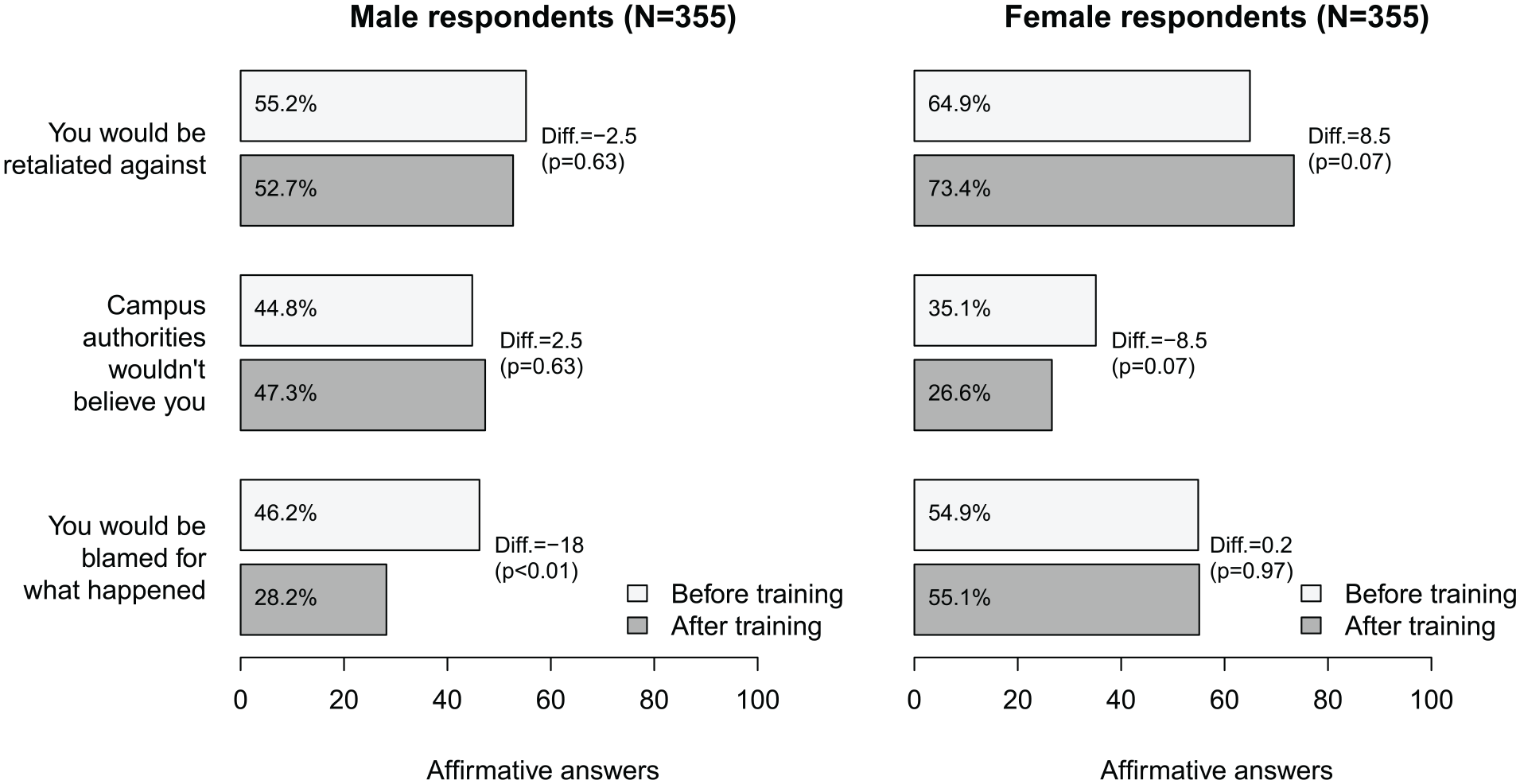
Effects of training on anticipated reactions to reporting.
Men have different expectations than women about the risks associated with reporting assault. As Figure 4 shows, before training men are less likely than women to think that they will experience retaliation if they report, and this gap grows after training to 18 percentage points. The training also shifts men’s (but not women’s) beliefs about whether they will be blamed for experiencing assault. Some 46 percent of men say that they will incur blame before participating in training, and this share drops to 28 percent of men after the training, a statistically significant drop of 18 percentage points.
When we asked students we interviewed what they thought about our data revealing a decline in reporting intentions, several women students noted that the training made reporting seem like a lot of work. Some were concerned that because perpetrators often escape punishment, reporting would not lead to anything, and the training failed to convince them otherwise. Other students attributed the decline in willingness to report to the training’s message about affirmative consent, which classifies many behaviors students consider normal (such as engaging in sexual activity under the influence of alcohol and other drugs) as sexual misconduct. As one of our interviewees noted, students may have realized that they themselves had committed or experienced what the training calls “assault.” Resistance to defining their experiences as assault may have made them less willing to report (cf. Khan et al. 2018). 20
Sexist Attitudes
When we interviewed students who had participated in the training, some expressed hostility toward the process and the content. Several men, in particular, said they resented being forced to take the training. One male student said that he felt that the training “unfairly targeted men.” Indeed, 63 percent of the men we spoke with expressed negative views about the training, compared to 39 percent of women. 21
Did the university’s mandatory training produce a boomerang effect in certain people, which happens when a message produces a result that is the opposite of its intention (Byrne and Hart 2009)? Some studies show that policy discussions of sexual assault and harassment activate traditional gender stereotypes and trigger defensive reactions in participants, though reactions often vary between men and women and may depend on the gender identity of the trainer (Tinkler et al. 2015; Tinkler 2012, 2013). Others suggest that training induces psychological reactance and may even cause some people to become more sexist (Bingham and Scherer 2001; Malamuth, Huppin, and Linz 2018; Tinkler 2012).
Figure 5 displays responses to the two sexism scales we presented respondents with in the third study. As we can see in the figure, men agree more with the sexist statements than women overall, particularly the statements about benevolent sexism, and these views do not change as a result of training. After the training, however, women are significantly less likely to express sexist attitudes on both dimensions. Participating in training thus increases the gender gap with regard to sexist beliefs. 22

Responses to sexist statements before and after the training.
Discussion
The most striking finding of our study is that women students become less likely to say that they would report experiences of sexual assault after participating in sexual misconduct training. We see a 12 percentage point decline in the share of women who say they would report assault to the university. The share of men who say that they would report assault does not change. In addition, women become more likely to say they would encounter retaliation if they report.
Our results imply that the university’s considerable investments in reporting did not change women’s perceptions of reporting’s desirability and its risks. Women do not all welcome the possibility of reporting assault, and they are more worried about the consequences of reporting than are men. Not reporting allows women to downplay a bad experience, reject the label of victim, and preserve their existing relationships (Khan et al. 2018). Sitting through sexual misconduct training—perhaps by concretizing the meaning of assault for survivors or potential survivors—may actually induce greater resistance to reporting among women.
On the brighter side, we find that training expands student knowledge about, and attitudes toward, sexual assault and harassment in ways intended by the university and the federal government’s Title IX goals. This is potentially important, as changing knowledge and attitudes may be necessary to change the culture surrounding gendered violence on college campuses (Hirsch et al. 2019). However, the effect sizes are small and reflect the training’s immediate impact, as our study design precluded gathering evidence of changes in behavior and attitudes after more time had passed. 23 Future research should probe whether the positive and negative effects of the training endure over the medium to longer term.
In contrast to other work showing that discussions of sexual assault and harassment activate gender stereotypes (e.g. Tinkler 2013), our surveys do not show that training aggravates sexist beliefs. However, we do find that men’s and women’s views on sexism diverge more after the training (see Figure 5). Some of our interviews suggest that for some people—and despite trainers’ gender neutral discourse and avoidance of the male perpetrator–female victim stereotype—the training may have reinforced differences between men and women. For example, one woman student told us she found the training to be “isolating”: it made everyone feel, like the genders, feel polarized. So, when I walked in there, I was having a comfortable conversation with my neighbor who was a man and by the end it was like we were trying to distance our seats as much as we could from each other.
24
The need to comply with federal mandates motivated university officials to develop the training program we studied, as is the case with hundreds of other institutions of higher education around the country. At our study site, the compliance process was intense because of the DOJ oversight agreement. The agreement led to multiple changes in policy and process, which were necessary and overdue, but it also had some detrimental effects on institutional culture.
A senior university leader characterized the challenge of reducing sexual assault on campus in the following way: How do you solve a problem? Look to other cases of institutional success. [such as our work to increase graduation rates] Leadership took a strong stand and communicated a clear message. We made the issue a priority. We targeted problem cases. We did research and got data [that ruled out what many people thought to be the source of the problem]. . . . But it’s hard to launch this process under the guise of a [federal] investigation, which makes everyone defensive and resentful.
25
University administrators had mixed interpretations of how much programming federal guidelines required. As one compliance officer put it, “I have super high expectations of what it means to meet [federal] expectations, but others see it more minimally.” 26 Senior university leaders assigned responsibility for sexual violence prevention to certain campus units without giving them the extra staffing and budget that serious efforts require. One administrator of these units noted that the university “is continuing the pattern of marginalization and underfunding of these issues.” 27
Conclusion
Our findings echo the results of other studies showing that one-time sexual misconduct training may be of limited efficacy (DeGue et al. 2014; Dobbin and Kalev 2019; Magley et al. 2013; National Academies of Sciences, Engineering, and Medicine 2018). In addition, the results of our study suggest that the training activates women students’ concerns that survivors suffer more costs than benefits by reporting assault (Holland, Cortina, and Freyd 2018; Smith and Freyd 2014). Finally, our study shows that a federal oversight program intended to foster Title IX compliance did not lead to an effective training effort. Although federal oversight helped improve other elements of the university’s approach to sexual misconduct, it also put university staff members who cared deeply about the problem of sexual assault in the tough position of delivering the most comprehensive curriculum they could in a single dose.
If university leaders choose training as a strategy to reduce rates of assault and harassment, programs should conform to evidence-based best practices. Studies show that effective trainings involve multiple sessions—as many as 10—not just one (Tharp et al. 2011). Trainings are ideally part of a comprehensive approach to prevention involving work on social norms, policy change, bystander intervention, and community factors (Banyard, Moynihan, and Plante 2007; DeGue et al. 2014; Orchowski et al. 2020).
Other promising strategies to reduce assault and harassment on campus could leverage research findings from organizational sociology and social psychology. For example, Dobbin and Kalev’s (2022) study of private sector organizations shows that engaging leaders in diversity-promoting activities helps promote more inclusive organizational cultures. Training managers, rather than employees, is more effective at reducing rates of sexual harassment (Dobbin and Kalev 2019). In our study, we observed the most enthusiasm and commitment to cultural change among the staff who developed and implemented the trainings. One way to grow the number of internal change agents would be to engage faculty members more. Universities could consider training faculty members to present a prevention curriculum to students in the classroom, potentially in multiple doses. By enlisting faculty members in prevention efforts, this approach has the potential to nurture leader commitment to change and encourage leaders to model new norms, such as intolerance of sexual misconduct (cf. Htun et al. 2022).
Influential individuals in a social network can change people’s perceptions about whether harmful behaviors are acceptable or unacceptable and thus reduce levels of conflict, such as bullying, in schools (Paluck, Shepherd, and Aronow 2016). In addition to engaging faculty members as change agents, university leaders could seed campus social networks with students who model preventive behaviors, such as bystander intervention, and thus trigger changes in campus climates. Both strategies would create and empower agents of change at university sites besides the Title IX office and other dedicated prevention units. Effective approaches to reduce sexual misconduct require long-term investments and commitments to cultural change.
Supplemental Material
sj-pdf-1-srd-10.1177_23780231221124574 – Supplemental material for Effects of Mandatory Sexual Misconduct Training on University Campuses
Supplemental material, sj-pdf-1-srd-10.1177_23780231221124574 for Effects of Mandatory Sexual Misconduct Training on University Campuses by Mala Htun, Francesca R. Jensenius, Melanie Sayuri Dominguez, Justine Tinkler and Carlos Contreras in Socius
Supplemental Material
sj-zip-2-srd-10.1177_23780231221124574 – Supplemental material for Effects of Mandatory Sexual Misconduct Training on University Campuses
Supplemental material, sj-zip-2-srd-10.1177_23780231221124574 for Effects of Mandatory Sexual Misconduct Training on University Campuses by Mala Htun, Francesca R. Jensenius, Melanie Sayuri Dominguez, Justine Tinkler and Carlos Contreras in Socius
Footnotes
Acknowledgements
We are extremely grateful to many people for helping us with this study, particularly Cole Carvour, Nash Jones, Lisa Lindquist, Chriselle Martinez, Anna Sanchez, and Nasha Torrez. We are also thankful for advice and support from other researchers including Theresa Cruz, Jessica Goodkind, Liz Hutchison, and Louise Lamphere. We presented earlier versions of this paper at the Midwest Political Science Association Annual Meeting, the American Political Science Association Annual Meeting, the University of New Mexico, the University of Oslo, Northwestern University, and the University of Chicago, and we are thankful for feedback from participants at those panels and workshops, as well as for comments from Margaret Brower, James Druckman, Olle Folke, Kristin Goss, Ann Orloff, and Libby Sharrow.
Funding
The author(s) disclosed receipt of the following financial support for the research, authorship, and/or publication of this article: This research project was made possible by funding from the Office of the Vice President for Research at the University of New Mexico and the Research Council of Norway (project 250753).

Supplemental Material
Notes
Author Biographies
References
Supplementary Material
Please find the following supplemental material available below.
For Open Access articles published under a Creative Commons License, all supplemental material carries the same license as the article it is associated with.
For non-Open Access articles published, all supplemental material carries a non-exclusive license, and permission requests for re-use of supplemental material or any part of supplemental material shall be sent directly to the copyright owner as specified in the copyright notice associated with the article.
